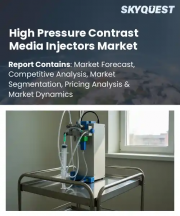
|
시장보고서
상품코드
2092159
조영제 주입기 시장 예측(2026-2032년)Contrast Media Injectors Market - Global Forecast 2026-2032 |
||||||
 360iResearch
조영제 주입기 시장은 2032년까지 연평균 복합 성장률(CAGR) 8.23%로 38억 2,000만 달러 규모로 확대될 것으로 예측됩니다.
| 주요 시장 통계 | |
|---|---|
| 기준 연도 : 2025년 | 21억 9,000만 달러 |
| 추정 연도 : 2026년 | 23억 7,000만 달러 |
| 예측 연도 : 2032년 | 38억 2,000만 달러 |
| CAGR(%) | 8.23% |
조영제 주입기 요약 보고서
조영제 주입기는 컴퓨터 단층촬영(CT), 자기공명영상(MRI), 혈관조영술, 중재적 방사선학 및 심혈관 시술에서 요오드계 조영제, 가돌리늄계 조영제, 생리식염수 및 기타 약물을 압력, 유량 및 타이밍을 제어하여 투여하기 위해 사용되는 필수적인 의료용 영상 진단 장치입니다. 그 임상적 가치는 진단 영상의 화질, 환자의 안전성, 워크플로우의 효율성, 그리고 선량 최적화와 밀접한 관련이 있습니다. 영상진단 부문이 검사의 복잡화와 처리 능력에 대한 기대감 증가에 대응해 나가는 가운데, 수요는 주입기의 정밀도, 프로토콜의 표준화, 다수 환자에 대한 워크플로우 대응, 영상진단 시스템과의 통합, 그리고 조영제 투여에 관한 안전 대책 준수 등의 요소에 의해 점점 더 좌우되고 있습니다. 구매 시 주요 고려 사항으로는 CT 및 MRI실과의 호환성, 듀얼 헤드 및 주사기 없는 구성, 혈관 외 누출 모니터링, 방사선 정보 시스템과의 연동, 자동 기록 기능, 감염 관리 설계, 그리고 유지보수의 신뢰성 등이 있습니다. 조영제 주입기 시장 동향은 질병의 조기 발견, 저침습적 중재, 종양학 분야의 병기 분류, 심혈관 영상 진단, 응급 진단, 그리고 일관성, 안전성, 운영상의 생산성을 중시하는 가치 기반 의료 모델 등 보다 광범위한 의료 분야의 우선순위에 의해서도 영향을 받고 있습니다.
조영제 주입기 도입이 가져온 혁신적인 변화
조영제 주입기의 동향은 독립형 기계식 투여 시스템에서 보다 안전하고 표준화된 영상 진단을 지원하도록 설계된 네트워크 연결형이자 프로토콜 기반 플랫폼으로 전환되고 있습니다. 방사선과 의료진은 수작업으로 인한 편차를 줄이고, 생리식염수 세척이 가능하며, 체중에 기반한 프로토콜이나 적응증별 프로토콜을 지원하고, 품질 보증을 위해 주입 데이터를 기록할 수 있는 주입기를 우선적으로 선택하고 있습니다. CT 영상 진단은 응급의료, 종양학, 순환기학, 외상 평가 분야에서 검사 건수가 많기 때문에 여전히 주요 활용 사례로 자리 잡고 있습니다. 한편, MRI용 주입기는 비자성체의 안전 요건과 가돌리늄의 정밀한 투여를 중심으로 계속 발전하고 있습니다. 혈관조영 및 중재 시술 분야에서는 혈관을 명확하게 관찰하기 위한 압력 관리, 타이밍의 정확성, 그리고 시술자의 제어 능력이 중요시되고 있습니다. 동시에, 감염 예방, 지속가능성 및 수명 주기 총비용이 조달 과정에서 중요한 요소로 부상함에 따라, 의료 기관에서는 소모품, 튜브 세트, 주사기 시스템 및 폐기물 발생량에 대한 재평가가 진행되고 있습니다. 조영제의 안전성, 이상반응 보고, 신장 기능 위험도 선별 검사, 그리고 의료기기의 추적 가능성에 대한 규제 당국의 관심이 높아짐에 따라, 문서화 기능이 통합되고 표준화된 워크플로우를 갖춘 주입기의 필요성이 더욱 커지고 있습니다.
조영제 주입기에 대한 인공지능의 누적 영향
인공지능(AI)은 임상 의사의 감독을 대체하는 것이 아니라, 워크플로우 최적화, 프로토콜 의사결정 지원, 예측 유지보수 및 영상 진단 최적화를 통해 조영제 주입기의 사용에 영향을 미치기 시작하고 있습니다. AI를 활용한 방사선 의학 생태계는 환자의 특성, 검사 유형, 스캐너 매개변수 및 과거 프로토콜의 실적을 분석하여, 보다 일관성 있는 조영제 투여를 지원할 수 있습니다. 영상 진단 플랫폼, 전자의무기록 및 선량 관리 시스템과 연동함으로써, 주입기의 데이터는 품질 모니터링, 유해 사건 검증, 혈관 외 누출 동향 분석 및 조영제 사용 현황 감사에 기여할 수 있습니다. 또한 AI는 병목 현상 파악, 장비 유지보수 필요성 예측, 그리고 검사 건수가 많은 영상진단센터의 일정 관리 효율 향상을 통해 업무 개선을 지원합니다. 임상 현장에서 AI의 누적적 효과는 프로토콜 준수율 향상, 조영 효과가 불충분하여 발생하는 재검사 감소, 신장 위험 및 알레르기와 관련된 의사결정 과정 지원, 그리고 감사 가능성 강화를 통해 가장 두드러지게 나타납니다. 그러나 이를 도입하기 위해서는 검증된 알고리즘, 사이버 보안 대책, 상호 운용성 기준, 투명한 임상 거버넌스, 그리고 방사선과 의사, 기술자 및 생체의공학 팀 간의 명확한 책임 분담이 필수적입니다.
조영제 주입기 시장에 대한 주요 지역별 분석
아시아태평양은 진단 영상 검사 역량의 확대, 만성 질환 부담 증가, 그리고 선진 및 신흥 의료 시스템 모두에서 병원 현대화를 위한 투자가 특징입니다. 해당 지역의 조영제 주입기에 대한 수요는 CT, MRI 및 중재적 영상 진단의 이용 확대에 힘입어 증가하고 있으며, 조달 시에는 처리 능력, 합리적인 가격, 서비스 가용성 및 다양한 스캐너 제품군과의 호환성이 점점 더 중요시되고 있습니다. 북미는 여전히 매우 성숙한 환경을 갖추고 있으며, 첨단 영상 진단의 활용, 체계화된 방사선과 업무 흐름, 인증 요건, 그리고 환자 안전에 대한 강한 중시를 바탕으로 네트워크 연결형 주입기, 자동 기록, 프로토콜 표준화가 추진되고 있습니다. 라틴아메리카에서는 공공 및 민간 영상 진단 인프라의 현대화가 진행되고 있으며, 이러한 도입에는 예산 제약, 장비의 내구성, 교육 기회, 그리고 중앙 집중형 진단 서비스의 확대와 같은 요인들이 영향을 미치고 있습니다. 유럽에서는 엄격한 의료기기 규제, 품질 보증에 대한 기대, 방사선 및 조영제 투여량의 최적화를 위한 노력, 그리고 소모품의 지속가능성에 대한 관심 고조가 시장을 형성하고 있습니다. 중동에서는 3차 의료, 전문 병원, 종양학, 심혈관 의료, 진단센터에 대한 투자가 활발히 이루어지고 있으며, 첨단 영상 진단 시스템과 통합된 최신 주입기가 선호되고 있습니다. 아프리카에서는 도입 현황에 편차가 나타나고 있으며, 주입기 수요는 도시 지역의 병원과 민간 진단센터에 집중되어 있는 반면, 보다 광범위한 이용 확대에는 영상 진단 장치의 접근성, 서비스 인프라, 인재 양성 및 조달 자금이 영향을 미치고 있습니다.
조영제 주입기에 관한 주요 경제·전략 그룹 분석
아세안 지역에서는 조영제 주입기의 도입이 의료 인프라 확충, 의료 관광, 주요 도시 지역의 CT 및 MRI 이용 기회 확대와 밀접한 관련이 있는 한편, 비용 대비 효과가 높은 구성과 신뢰성 높은 사후 서비스도 여전히 중요하게 여겨지고 있습니다. GCC 국가들에서는 전문 의료, 디지털 병원, 종양학 프로그램 및 심혈관 진단에 대한 투자로 인해 첨단 영상 진단 기술에 대한 수요가 활발하며, 통합 주입기의 연결성과 높은 처리 능력이 조달 과정에서 중요한 우선순위로 대두되고 있습니다. 유럽연합(EU)에서는 규정 준수, 의료기기의 안전성, 표준화된 임상 프로토콜, 데이터 보호 및 친환경 일회용 제품의 활용이 매우 중요하게 여겨지고 있으며, 이러한 요인들이 문서화 및 품질 관리를 지원하는 주입기의 도입을 촉진하고 있습니다. BRICS 국가들에서는 다양하면서도 현저한 영상 진단 분야의 성장이 관찰되고 있으며, 막대한 환자 수, 공중보건에 대한 투자, 민간 진단 시장의 성장에 힘입어 CT, MRI 및 중재 시술에 걸쳐 확장성이 뛰어난 주입기 시스템에 대한 수요가 발생하고 있습니다. G7 국가들에서는 대체로 성숙한 도입 양상이 나타나며, 병원 및 영상진단 네트워크에서는 상호운용성, 서비스 신뢰성, 자동화, 사이버 보안, 그리고 워크플로우 및 환자 안전 측면에서 측정 가능한 개선이 중시되고 있습니다. 나토(NATO) 회원국(대부분이 선진 의료 경제권과 겹치는 국가들)은 견고한 의료 인프라, 표준화된 조달 관행, 비상사태 대비, 외상 영상 진단, 그리고 안전한 연결형 의료기기에 대한 관심 증가의 영향을 받고 있습니다.
조영제 주입기 수요를 좌우하는 주요 국가의 동향
미국은 선진적인 방사선과 업무 흐름 도입에 있어 선도적인 위치를 차지하고 있으며, 문서화, 안전 프로토콜 및 운영 효율성에 대한 강한 중시를 바탕으로 CT, MRI, 응급 영상 진단, 중재적 방사선학 및 심혈관 진단 등 각 분야에서 조영제 주입기가 널리 사용되고 있습니다. 캐나다에서는 병원의 영상진단 장비 현대화, 공공 의료 계획, 그리고 품질을 중시하는 방사선과 서비스와 관련하여 꾸준한 수요가 나타나고 있습니다. 멕시코와 브라질은 라틴아메리카의 주요 시장으로, 민간 진단 네트워크, 병원 투자, 도시 지역의 영상 진단 접근성 확대가 주입기 도입을 촉진하고 있지만, 조달 시에는 성능과 합리적인 가격, 서비스 범위의 균형이 중시되는 경향이 있습니다. 영국, 독일, 프랑스, 이탈리아, 스페인은 확립된 영상진단 인프라를 유지하고 있으며, 이러한 인프라의 도입 현황은 규제 준수, 조영제의 적정 사용, 방사선과 직원의 효율성, 그리고 공공 및 민간 영상진단 자산의 현대화에 의해 형성되고 있습니다. 러시아에서는 진단 역량과 국내 의료 시스템의 회복탄력성이 여전히 최우선 과제로 꼽히고 있으며, 조영제 주입기에 대한 수요는 병원의 영상 진단 및 혈관 내 시술 수요와 밀접한 관련이 있습니다. 중국에서는 주요 병원과 지역 의료 네트워크 전반에 걸쳐 영상 진단 인프라가 확대되고 있으며, 고처리량 CT 및 MRI 서비스에 중점을 두고 있습니다. 한편, 인도 수요는 진단 네트워크의 확대, 3차 의료기관 증가, 그리고 종양학, 순환기학, 응급의료 분야에서 첨단 영상진단의 활용 확대에 힘입어 성장하고 있습니다. 일본과 한국은 성숙한 기술 집약형 환경을 갖추고 있으며, 정밀도, 신뢰성, 컴팩트한 설계 및 워크플로우 통합이 중요시되고 있습니다. 호주에서는 공공 및 민간 의료 현장을 불문하고 품질 기준, 환자 안전, 그리고 효율적인 영상 진단 제공이 중시되고 있으며, 이는 신뢰성이 높고 네트워크로 연결된 조영제 주입 시스템에 대한 수요를 뒷받침하고 있습니다.
조영제 주입기 업계의 선두주자가 되기 위한 실천적 제안
업계 선도 기업들은 임상적 정확성, 워크플로우 자동화, 상호 운용성, 그리고 안전성을 중시하는 설계를 모두 갖춘 주입기 플랫폼을 우선적으로 고려해야 합니다. 제품 전략에서는 듀얼 헤드 기능, 생리식염수 플러싱 최적화, 프로그래밍 가능한 프로토콜, 압력 모니터링, 혈관 외 유출 위험 감소, 주입 기록 자동 수집 등 CT, MRI 및 혈관조영술에 특화된 요구 사항에 중점을 두어야 합니다. 영업팀은 검사 결과의 편차 감소, 스캐너 이용률 향상, 소모품 효율화, 사이버 보안 대책 마련, 영상 정보 시스템과의 통합 등 병원 측의 우선 순위에 맞추어 제품 및 서비스를 조정해야 합니다. 제조업체와 유통업체은 방사선사 대상의 임상 교육을 강화하고, 프로토콜 최적화를 지원하는 한편, 가동 중단 시간을 줄이기 위한 명확한 유지보수 절차를 제공해야 합니다. 신흥 시장에서는 유연한 조달 모델, 내구성이 뛰어난 하드웨어, 현지화된 서비스 네트워크 및 교육 프로그램이 도입을 촉진하는 데 기여합니다. 성숙한 시장에서는 데이터 연동, AI를 활용한 워크플로우 지원, 일회용 제품의 지속가능성, 그리고 규정 준수 관련 문서화를 차별화의 핵심으로 삼아야 합니다. 모든 지역에서 리더는 구매 과정의 초기 단계부터 방사선과 의사, 방사선사, 조달 팀, 생체의공학 엔지니어 및 감염 관리 관련 이해관계자들과 협력하여, 단순히 장비 구매에 그치지 않는 측정 가능한 가치를 입증해야 합니다.
조영제 주입기 분석을 위한 조사 기법
본 요약본은 검증되고 데이터로 뒷받침되는 업계, 임상, 규제 및 의료 인프라 정보원에 초점을 맞춘 체계적인 2차 조사 방법을 통해 작성되었습니다. 이 조사 방식에서는 공개된 의료기기 규제, 방사선 의학 실무 지침, 조영제 안전성에 관한 권고 사항, 의료 기술 평가 자료, 병원 조달 관련 고려 사항, 동료 심사를 거친 임상 문헌 및 영상 진단 워크플로우에 관한 간행물에서 얻은 정보를 종합하고 있습니다. 본 분석에서는 CT, MRI, 혈관조영술, 중재적 방사선학, 심혈관 영상, 종양 진단, 응급의료 분야에서 조영제 주입기의 용도를 평가하고 있으나, 시장 규모, 시장 점유율 또는 예측치에 대해서는 제시하지 않습니다. 지역, 그룹 및 국가별 분석 결과는 의료 인프라의 성숙도, 영상 진단 이용 패턴, 규제 환경, 진단 역량, 조달 행태, 인력 준비 현황 및 기술 도입 지표를 통해 해석됩니다. 정성적 증거, 운영상의 관련성, 환자 안전에 미치는 영향, 그리고 연결성, 자동화, AI를 활용한 워크플로우, 문서화 기능 등의 기술 동향에 중점을 두고 있습니다.
결론: 조영제 주입기의 전략적 전망
영상진단 기관들이 보다 안전하고 신속하며 표준화된 조영 검사를 요구하는 가운데, 조영제 주입기의 전략적 중요성이 커지고 있습니다. 시장의 방향성은 연계된 워크플로우, 프로토콜 자동화, 환자 안전, 문서화 정확성, 소모품 관리, 그리고 첨단 CT, MRI, 혈관조영 시스템과의 호환성에 의해 결정됩니다. 임상 검증과 거버넌스가 계속해서 핵심이 될 것이라는 전제 하에, 인공지능(AI)과 디지털 통합은 프로토콜의 일관성, 서비스 계획, 품질 감사 및 운영 효율성을 향상시킴으로써 주입기의 가치를 높일 것으로 기대됩니다. 지역마다 기회의 차이가 큽니다. 성숙한 의료 시스템에서는 상호 운용성, 규정 준수, 자동화가 우선시되는 반면, 신흥 시장에서는 접근성, 합리적인 가격, 서비스의 신뢰성, 그리고 인재 양성이 중시되고 있습니다. 제품 설계, 임상 지원 및 상업적 실행을 이러한 현실에 맞추어 조정할 수 있는 업계 관계자들은 방사선과, 병원, 진단센터 및 중재적 영상 진단 팀의 변화하는 요구에 대응하는 데 있어 가장 유리한 입지를 확보할 수 있을 것입니다.
자주 묻는 질문
목차
제1장 서문
제2장 조사 방법
제3장 주요 요약
제4장 시장 개요
제5장 시장 인사이트
제6장 AI의 누적 영향, 2026년
제7장 조영제 주입기 시장 : 제품 유형별
제8장 조영제 주입기 시장 : 기술별
제9장 조영제 주입기 시장 : 최종 사용자별
제10장 조영제 주입기 시장 : 용도별
제11장 조영제 주입기 시장 : 유통 채널별
제12장 조영제 주입기 시장 : 지역별
제13장 조영제 주입기 시장 : 그룹별
제14장 조영제 주입기 시장 : 국가별
제15장 경쟁 구도
제16장 기업 개요
JHS 26.07.24The Contrast Media Injectors Market is projected to grow by USD 3.82 billion at a CAGR of 8.23% by 2032.
| KEY MARKET STATISTICS | |
|---|---|
| Base Year [2025] | USD 2.19 billion |
| Estimated Year [2026] | USD 2.37 billion |
| Forecast Year [2032] | USD 3.82 billion |
| CAGR (%) | 8.23% |
Contrast Media Injectors Executive Summary
Contrast media injectors are essential medical imaging devices used to deliver iodinated contrast, gadolinium-based contrast, saline, and other agents with controlled pressure, flow rate, and timing during computed tomography, magnetic resonance imaging, angiography, interventional radiology, and cardiovascular procedures. Their clinical value is closely linked to diagnostic image quality, patient safety, workflow efficiency, and dose optimization. As imaging departments handle rising procedure complexity and higher throughput expectations, demand is increasingly shaped by injector precision, protocol standardization, multi-patient workflow support, integration with imaging systems, and compliance with safety practices for contrast administration. Key purchasing considerations include compatibility with CT and MRI suites, dual-head and syringeless configurations, extravasation monitoring, connectivity with radiology information systems, automated documentation, infection-control design, and maintenance reliability. The contrast media injector landscape is also influenced by broader healthcare priorities, including early disease detection, minimally invasive interventions, oncology staging, cardiovascular imaging, emergency diagnostics, and value-based care models that reward consistency, safety, and operational productivity.
Transformative Shifts in Contrast Media Injector Adoption
The contrast media injectors landscape is shifting from standalone mechanical delivery systems toward connected, protocol-driven platforms designed to support safer and more standardized imaging. Radiology providers are prioritizing injectors that reduce manual variability, enable saline flushing, support weight-based and indication-specific protocols, and capture injection data for quality assurance. CT imaging remains a major use case due to high procedural volume in emergency care, oncology, cardiology, and trauma evaluation, while MRI injectors continue to evolve around non-ferromagnetic safety requirements and precise gadolinium delivery. Angiography and interventional applications are emphasizing pressure management, timing accuracy, and operator control for vascular visualization. At the same time, healthcare facilities are reassessing consumables, tubing sets, syringe systems, and waste generation as infection prevention, sustainability, and total lifecycle cost become more prominent procurement factors. Regulatory attention to contrast safety, adverse event reporting, kidney-risk screening, and device traceability is reinforcing the need for injectors with integrated documentation and standardized workflows.
Cumulative Impact of Artificial Intelligence on Contrast Injection
Artificial intelligence is beginning to influence contrast media injector use through workflow intelligence, protocol decision support, predictive maintenance, and imaging optimization rather than replacing clinician oversight. AI-enabled radiology ecosystems can help analyze patient characteristics, exam type, scanner parameters, and historical protocol performance to support more consistent contrast administration. When connected with imaging platforms, electronic health records, and dose-management systems, injector data can contribute to quality monitoring, adverse event review, extravasation trend analysis, and contrast utilization audits. AI also supports operational improvements by identifying bottlenecks, anticipating equipment service needs, and improving scheduling efficiency in high-volume imaging centers. In clinical practice, the cumulative impact of AI is strongest when it improves protocol adherence, reduces repeat scans caused by suboptimal enhancement, supports renal-risk and allergy-related decision pathways, and strengthens auditability. However, adoption depends on validated algorithms, cybersecurity controls, interoperability standards, transparent clinical governance, and clear accountability between radiologists, technologists, and biomedical engineering teams.
Key Regional Insights Across the Contrast Media Injectors Landscape
Asia-Pacific is characterized by expanding diagnostic imaging capacity, rising chronic disease burden, and investment in hospital modernization across both advanced and emerging healthcare systems. Demand for contrast media injectors in the region is supported by growth in CT, MRI, and interventional imaging utilization, with procurement increasingly focused on throughput, affordability, service availability, and compatibility with diverse scanner fleets. North America remains a highly mature environment where advanced imaging utilization, structured radiology workflows, accreditation requirements, and strong emphasis on patient safety favor connected injector systems, automated documentation, and protocol standardization. Latin America is advancing through public and private imaging infrastructure upgrades, with adoption influenced by budget sensitivity, equipment durability, training availability, and centralized diagnostic service expansion. Europe is shaped by rigorous medical device regulation, quality assurance expectations, radiation and contrast dose optimization initiatives, and growing attention to sustainability in consumables. The Middle East is investing in tertiary care, specialty hospitals, oncology, cardiovascular services, and diagnostic centers, supporting preference for modern injectors that integrate with advanced imaging suites. Africa presents a more uneven adoption profile, with injector demand concentrated in urban hospitals and private diagnostic centers, while broader access is affected by imaging equipment availability, service infrastructure, workforce training, and procurement funding.
Key Economic and Strategic Group Insights for Contrast Media Injectors
Within ASEAN, contrast media injector adoption is closely tied to healthcare infrastructure expansion, medical tourism, and increasing CT and MRI access in major urban centers, while cost-effective configurations and reliable after-sales service remain important. The GCC demonstrates strong demand for advanced imaging technologies due to investment in specialty care, digital hospitals, oncology programs, and cardiovascular diagnostics, making integrated injector connectivity and high-throughput performance relevant procurement priorities. The European Union places strong emphasis on regulatory compliance, device safety, standardized clinical protocols, data protection, and environmentally responsible use of disposables, shaping adoption of injectors that support documentation and quality management. BRICS countries show diverse but significant imaging expansion dynamics, with large patient populations, public health investment, and private diagnostic growth creating opportunities for scalable injector systems across CT, MRI, and interventional use cases. G7 countries generally reflect mature adoption patterns, with hospitals and imaging networks emphasizing interoperability, service reliability, automation, cybersecurity, and measurable improvements in workflow and patient safety. NATO member countries, many of which overlap with advanced healthcare economies, are influenced by resilient healthcare infrastructure, standardized procurement practices, and increased attention to emergency preparedness, trauma imaging, and secure connected medical devices.
Key Country Insights Shaping Contrast Media Injector Demand
The United States leads in advanced radiology workflow adoption, with contrast media injectors used extensively across CT, MRI, emergency imaging, interventional radiology, and cardiovascular diagnostics, supported by strong emphasis on documentation, safety protocols, and operational efficiency. Canada shows steady demand linked to hospital imaging modernization, public healthcare planning, and quality-focused radiology services. Mexico and Brazil are important Latin American markets where private diagnostic networks, hospital investments, and urban imaging access support injector deployment, although procurement often balances performance with affordability and service coverage. The United Kingdom, Germany, France, Italy, and Spain maintain well-established imaging infrastructures, with adoption shaped by regulatory compliance, contrast stewardship, radiology workforce efficiency, and modernization of public and private imaging assets. Russia continues to prioritize diagnostic capacity and domestic healthcare resilience, with injector demand linked to hospital imaging and vascular procedure needs. China is expanding imaging infrastructure across major hospitals and regional care networks, with strong focus on high-throughput CT and MRI services, while India's demand is supported by growing diagnostic chains, tertiary hospitals, and rising utilization of advanced imaging for oncology, cardiology, and emergency care. Japan and South Korea are mature, technology-intensive environments where precision, reliability, compact design, and workflow integration are significant. Australia emphasizes quality standards, patient safety, and efficient imaging delivery across public and private care settings, supporting demand for reliable and connected contrast injection systems.
Actionable Recommendations for Contrast Media Injector Industry Leaders
Industry leaders should prioritize injector platforms that combine clinical precision, workflow automation, interoperability, and safety-centered design. Product strategies should focus on CT, MRI, and angiography-specific requirements, including dual-head capabilities, saline flush optimization, programmable protocols, pressure monitoring, extravasation risk mitigation, and automated injection record capture. Commercial teams should align offerings with hospital priorities such as reduced procedure variability, improved scanner utilization, consumables efficiency, cybersecurity readiness, and integration with imaging informatics. Manufacturers and distributors should strengthen clinical education for radiology technologists, support protocol optimization, and provide clear maintenance pathways to reduce downtime. In emerging markets, flexible procurement models, durable hardware, localized service networks, and training programs can improve adoption. In mature markets, differentiation should center on data connectivity, AI-enabled workflow support, sustainability of disposables, and compliance-ready documentation. Across all regions, leaders should engage radiologists, technologists, procurement teams, biomedical engineers, and infection-control stakeholders early in the buying process to demonstrate measurable value beyond device acquisition.
Research Methodology for Contrast Media Injector Analysis
This executive summary is developed through a structured secondary research methodology focused on verified and data-backed industry, clinical, regulatory, and healthcare infrastructure sources. The research approach synthesizes information from publicly available medical device regulations, radiology practice guidance, contrast safety recommendations, healthcare technology assessment materials, hospital procurement considerations, peer-reviewed clinical literature, and imaging workflow publications. The analysis evaluates contrast media injector applications across CT, MRI, angiography, interventional radiology, cardiovascular imaging, oncology diagnostics, and emergency care without presenting market size, market share, or forecast estimates. Regional, group, and country insights are interpreted through healthcare infrastructure maturity, imaging utilization patterns, regulatory environments, diagnostic capacity, procurement behavior, workforce readiness, and technology adoption indicators. Emphasis is placed on qualitative evidence, operational relevance, patient-safety implications, and technology trends such as connectivity, automation, AI-supported workflow, and documentation capabilities.
Conclusion: Strategic Outlook for Contrast Media Injectors
Contrast media injectors are becoming more strategically important as imaging providers seek safer, faster, and more standardized contrast-enhanced examinations. The market's direction is defined by connected workflows, protocol automation, patient safety, documentation accuracy, consumables management, and compatibility with advanced CT, MRI, and angiography systems. Artificial intelligence and digital integration are expected to enhance injector value by improving protocol consistency, service planning, quality audits, and operational efficiency, provided that clinical validation and governance remain central. Regional opportunities differ significantly: mature healthcare systems prioritize interoperability, compliance, and automation, while emerging markets emphasize access, affordability, service reliability, and workforce training. Industry participants that align product design, clinical support, and commercial execution with these realities will be best positioned to support the evolving needs of radiology departments, hospitals, diagnostic centers, and interventional imaging teams.
Table of Contents
1. Preface
- 1.1. Objectives of the Study
- 1.2. Market Definition
- 1.3. Market Segmentation & Coverage
- 1.4. Years Considered for the Study
- 1.5. Currency Considered for the Study
- 1.6. Language Considered for the Study
- 1.7. Key Stakeholders
2. Research Methodology
- 2.1. Introduction
- 2.2. Research Design
- 2.2.1. Primary Research
- 2.2.2. Secondary Research
- 2.3. Research Framework
- 2.3.1. Qualitative Analysis
- 2.3.2. Quantitative Analysis
- 2.4. Market Size Estimation
- 2.4.1. Top-Down Approach
- 2.4.2. Bottom-Up Approach
- 2.5. Data Triangulation
- 2.6. Research Outcomes
- 2.7. Research Assumptions
- 2.8. Research Limitations
3. Executive Summary
- 3.1. Introduction
- 3.2. CXO Perspective
- 3.3. Market Size & Growth Trends
- 3.4. New Revenue Opportunities
- 3.5. Next-Generation Business Models
- 3.6. Industry Roadmap
4. Market Overview
- 4.1. Introduction
- 4.2. Industry Ecosystem & Value Chain Analysis
- 4.2.1. Supply-Side Analysis
- 4.2.2. Demand-Side Analysis
- 4.2.3. Stakeholder Analysis
- 4.3. Market Dynamics
- 4.3.1. Key Drivers
- 4.3.2. Key Restraints
- 4.3.3. Key Opportunities
- 4.3.4. Key Challenges
- 4.4. Porter's Five Forces Analysis
- 4.5. PESTLE Analysis
- 4.6. Market Outlook
- 4.6.1. Near-Term Market Outlook (0-2 Years)
- 4.6.2. Medium-Term Market Outlook (3-5 Years)
- 4.6.3. Long-Term Market Outlook (5-10 Years)
- 4.7. Go-to-Market Strategy
5. Market Insights
- 5.1. Consumer Insights & End-User Perspective
- 5.2. Consumer Experience Benchmarking
- 5.3. Opportunity Mapping
- 5.4. Distribution Channel Analysis
- 5.5. Pricing Trend Analysis
- 5.6. Regulatory Compliance & Standards Framework
- 5.7. ESG & Sustainability Analysis
- 5.8. Disruption & Risk Scenarios
- 5.9. Return on Investment & Cost-Benefit Analysis
6. Cumulative Impact of Artificial Intelligence 2026
7. Contrast Media Injectors Market, by Product Type
- 7.1. Introduction
- 7.2. Injector Systems
- 7.2.1. CT Injector Systems
- 7.2.2. MRI Injector Systems
- 7.2.3. Angiography Injector Systems
- 7.2.4. Cardiovascular Injector Systems
- 7.2.5. Interventional Radiology Injector Systems
- 7.3. Consumables
- 7.3.1. Syringes
- 7.3.2. Tubing Sets
- 7.3.3. Catheters
- 7.3.4. Connectors
8. Contrast Media Injectors Market, by Technology
- 8.1. Introduction
- 8.2. Automated Injection Systems
- 8.3. Semi-Automated Injection Systems
- 8.4. Manual Injection Systems
9. Contrast Media Injectors Market, by End User
- 9.1. Introduction
- 9.2. Ambulatory Care Centers
- 9.3. Diagnostic Imaging Centers
- 9.4. Hospitals
- 9.5. Academic & Research Institutes
10. Contrast Media Injectors Market, by Application
- 10.1. Introduction
- 10.2. Interventional Cardiology
- 10.2.1. Coronary Angiography
- 10.2.2. Cardiac Catheterization
- 10.2.3. PCI Procedures
- 10.3. Interventional Radiology
- 10.3.1. Vascular Imaging
- 10.3.2. Neurointerventional Procedures
- 10.3.3. Oncology Interventions
- 10.3.4. Embolization Procedures
- 10.4. Neurology Imaging
- 10.5. Urology Imaging
11. Contrast Media Injectors Market, by Distribution Channel
- 11.1. Introduction
- 11.2. Online
- 11.3. Offline
12. Contrast Media Injectors Market, by Region
- 12.1. Asia-Pacific
- 12.2. North America
- 12.3. Latin America
- 12.4. Europe
- 12.5. Middle East
- 12.6. Africa
13. Contrast Media Injectors Market, by Group
- 13.1. ASEAN
- 13.2. GCC
- 13.3. European Union
- 13.4. BRICS
- 13.5. G7
- 13.6. NATO
14. Contrast Media Injectors Market, by Country
- 14.1. United States
- 14.2. Canada
- 14.3. Mexico
- 14.4. Brazil
- 14.5. United Kingdom
- 14.6. Germany
- 14.7. France
- 14.8. Russia
- 14.9. Italy
- 14.10. Spain
- 14.11. China
- 14.12. India
- 14.13. Japan
- 14.14. Australia
- 14.15. South Korea
15. Competitive Landscape
- 15.1. Market Share Analysis, 2025
- 15.2. FPNV Positioning Matrix, 2025
- 15.3. Market Concentration Analysis, 2025
- 15.3.1. Concentration Ratio (CR)
- 15.3.2. Herfindahl Hirschman Index (HHI)
- 15.4. Recent Developments & Impact Analysis, 2025
- 15.5. Product Portfolio Analysis, 2025
- 15.6. Benchmarking Analysis, 2025
16. Company Profiles
- 16.1. ACIST Medical Systems Inc
- 16.2. Allengers Medical Systems Limited
- 16.3. AngioDynamics Inc
- 16.4. Apollo RT Co. Ltd
- 16.5. B. Braun SE
- 16.6. Bayer AG
- 16.7. Bracco Imaging S.p.A.
- 16.8. Canon Medical Systems Corporation
- 16.9. Cook Group
- 16.10. CS Diagnostics GmbH
- 16.11. GE HealthCare Technologies Inc
- 16.12. Guerbet
- 16.13. Imaxeon Pty Ltd
- 16.14. Injekta A/S
- 16.15. LnkMed Medical Technology Co. Ltd
- 16.16. Mediso Medical Imaging Systems Ltd
- 16.17. Medtron AG
- 16.18. Merit Medical Systems Inc
- 16.19. Mindray Medical International Limited
- 16.20. Nemoto Kyorindo Co. Ltd
- 16.21. Nipro Corporation
- 16.22. Sanrad Medical Systems
- 16.23. Shenzhen Anke High-tech Co. Ltd
- 16.24. Shenzhen Antmed Co. Ltd
- 16.25. Shenzhen Seacrown Electromechanical Co. Ltd
- 16.26. Siemens Healthineers AG
- 16.27. Sino Medical-Device Technology Co. Ltd
- 16.28. Trivitron Healthcare Pvt. Ltd
- 16.29. ulrich GmbH & Co. KG
- 16.30. Vygon SA