|
시장보고서
상품코드
2109027
카운터 UAS 시스템(C-UAS) 시장 : 솔루션별, 최종 사용자별, 전개 형태별, 사정 거리별, 기술별, 지역별 예측(-2031년)Counter-UAS System (C-UAS) Market by Solution (Drone Detection, Tracking & Identification, C2, UAS Mitigation & Neutralization), End Use (Commercial, Defense, Government & Law Enforcement), Deployment, Range, Technology, Region - Global Forecast to 2031 |
||||||

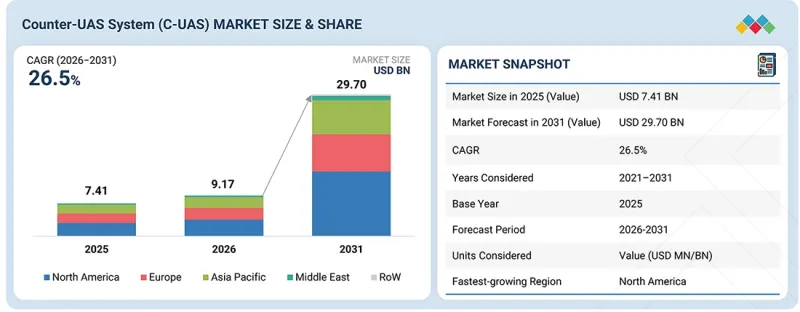
카운터 UAS 시스템(C-UAS) 시장 규모는 2026년에는 91억 7,000만 달러, 2031년까지 297억 달러에 이를 것으로 추정되고 예측 기간 중 연평균 복합 성장률(CAGR)은 26.5%를 나타낼 전망입니다.
| 조사 범위 | |
|---|---|
| 조사 대상 기간 | 2021-2031년 |
| 기준 연도 | 2025년 |
| 예측 기간 | 2026-2031년 |
| 산정 단위 | 금액(100만/10억 달러) |
| 부문 | 솔루션별, 최종 사용자별, 전개 형태별, 사정 거리별, 기술별, 지역별 |
| 대상 지역 | 아시아태평양, 유럽, 중동 및 아프리카, 북미, 기타 지역 |
현대 군사 작전에서 상용 드론, FPV 드론, 자율형 드론의 활용이 지속적으로 확대됨에 따라, 방위 기관들은 통합형 C-UAS 시스템의 조달을 늘리고 있습니다. 이러한 시스템은 모든 작전 환경에서 끊임없이 진화하는 드론 위협을 감지, 추적, 식별하고, 해당 위협을 완화하는 능력을 향상시킵니다. FPV 드론, 자율형 UAV 및 협업형 드론 스웜의 활용이 증가함에 따라, 군사 및 치안 작전에서 동시에 발생하는 여러 드론 위협에 대처하기 위해 다중 센서 감지, 통합된 지휘통제 및 확장 가능한 대응 기능을 갖춘 C-UAS 시스템의 도입이 진행되고 있습니다.
2026년부터 2031년에 걸쳐 중거리(6-20km) 부문이 카운터 UAS 시스템(C-UAS) 시장을 주도할 것으로 전망됩니다.
사정거리별로 보면, 예측 기간 동안 중거리(6-20km) 부문이 카운터 UAS 시스템(C-UAS) 시장을 주도할 것으로 예측됩니다. 이러한 시스템은 드론에 의한 위협을 감지, 추적, 식별 및 대응하기 위한 충분한 커버리지를 제공함으로써 군사 기지, 공항, 국경 지역 및 중요 인프라 보호에 널리 활용되고 있습니다. 커버리지, 운용상의 유연성, 호환성의 균형은 물론, 고정 설치형 및 이동형으로의 배치가 가능하다는 점 때문에 국방 및 정부 보안 분야에서 널리 채택되고 있습니다.
예측 기간 동안 AI 탑재 부문이 가장 빠르게 성장할 것으로 전망됩니다.
기술별로는 AI 탑재 부문이 2026년부터 2031년에 걸쳐 카운터 UAS 시스템(C-UAS) 시장에서 가장 높은 연평균 성장률(CAGR)을 나타낼 전망입니다. 이러한 시스템은 여러 센서에서 수집된 데이터를 실시간으로 분석하여 드론에 의한 위협을 감지, 분류, 추적 및 식별합니다. 이를 통해 위협 평가를 신속하게 수행하고, 오경보를 줄이며, 시그니처가 적은 드론이나 협동 행동을 취하는 드론 무리에 대한 대응 능력을 향상시킵니다. AI와 레이더, RF 감지, EO/IR 센서, 지휘통제 플랫폼과의 통합이 진행되고 있는 것이 국방, 국토 안보, 중요 인프라 분야에서 AI 탑재 C-UAS 시스템의 도입을 촉진하고 있습니다.
2026년부터 2031년에 걸쳐 중동이 두 번째로 높은 연평균 성장률(CAGR)을 나타낼 전망
중동은 예측 기간 동안 카운터 UAS 시스템(C-UAS) 시장에서 두 번째로 높은 연평균 성장률(CAGR)을 보일 것으로 전망됩니다. 이 지역에서는 진화하는 드론 위협으로부터 군사 기지, 주요 에너지 인프라, 공항, 국경 지역, 정부 시설을 보호하기 위해 C-UAS 시스템에 대한 투자를 확대되고 있습니다. 통합형 레이더, RF 감지, EO/IR 센서, 지휘통제 플랫폼 및 대응 기술의 조달이 증가하고 있으며, 이는 국방 및 국토 안보 각 분야에서 C-UAS 역량 확대를 뒷받침하고 있습니다.
조사 범위 :
본 시장 조사는 다양한 부문 및 하위 부문에 걸친 카운터 UAS 시스템(C-UAS) 시장을 대상으로 합니다. 본 조사는 각 지역별 해당 시장 규모와 성장 잠재력을 추정하는 것을 목적으로 합니다. 또한, 시장 내 주요 기업에 대한 상세한 경쟁 분석, 기업 프로파일, 제품 및 사업 제공에 관한 주요 발견 사항, 최근 동향, 그리고 각 기업이 채택한 주요 시장 전략에 대해서도 다루고 있습니다.
본 보고서를 구매해야 하는 이유 :
본 보고서는 시장을 선도하는 기업 및 신규 진출기업에게 카운터 UAS 시스템(C-UAS) 시장 전체 매출에 대한 가장 정확한 추정치를 제공합니다. 또한 이해관계자가 경쟁 구도를 이해하고, 자사의 비즈니스를 더 나은 위치로 이끌며, 적절한 시장 진출 전략을 수립하기 위한 추가적인 인사이트를 얻는 데 도움이 됩니다. 더불어 본 보고서는 이해관계자가 시장 동향을 파악하는 데 도움을 주며, 주요 시장 성장 촉진요인, 시장 성장 억제요인, 과제 및 기회에 대한 정보를 제공합니다.
본 보고서는 다음 사항에 대한 인사이트를 제공합니다.
- 시장 성장 촉진요인(적대적 및 무단 드론 관련 사고 증가, 드론을 광범위하게 활용하는 전쟁에 따른 국방력 현대화), 제약 요인(대응 권한에 대한 규제 및 법적 제한, 시스템 전체 도입에 드는 높은 비용과 복잡성), 기회(다층형 C-UAS 아키텍처 채택, 비군사적 용도 활용), 과제(드론 전술 및 기술의 급속한 진화, 복잡한 운영 환경에서의 신뢰성 높은 성능)
- 시장 침투도 : 시장을 선도하는 주요 기업이 제공하는 C-UAS 시스템에 대한 종합적인 정보
- 제품 개발 및 혁신 : 대드론(C-UAS) 시장의 향후 기술, 연구개발 활동 및 신제품 출시에 대한 상세한 분석
- 시장 개발 : 다양한 지역의 수익성 높은 시장에 대한 종합적인 정보
- 시장 다각화 : 카운터 UAS 시스템(C-UAS) 시장의 신제품, 미개척 지역, 최근 동향 및 투자에 대한 종합적인 정보
- 경쟁 분석 : 카운터 UAS 시스템(C-UAS) 시장의 주요 기업들 시장 점유율, 성장 전략, 제품 및 생산 능력에 관한 상세한 분석
자주 묻는 질문
목차
제1장 서론
제2장 주요 요약
제3장 프리미엄 인사이트
제4장 시장 개요
제5장 업계 동향
제6장 기술 진보, AI의 영향, 특허, 혁신, 향후 응용
제7장 규제 상황
제8장 고객 현황과 구매 행동
제9장 카운터 UAS 시스템(C-UAS) 시장, 솔루션별(시장 규모 및 예측(-2031년) - 100만 달러)
제10장 카운터 UAS 시스템(C-UAS) 시장, 최종 사용자별(시장 규모 및 예측(-2031년) - 100만 달러)
제11장 카운터 UAS 시스템(C-UAS) 시장, 전개 형태별(시장 규모 및 예측(-2031년) - 100만 달러)
제12장 카운터 UAS 시스템(C-UAS) 시장, 항속 거리별(시장 규모 및 예측(-2031년) - 100만 달러)
제13장 카운터 UAS 시스템(C-UAS) 시장, 기술별(시장 규모 및 예측(-2031년) - 100만 달러)
제14장 카운터 UAS 시스템(C-UAS) 시장, 지역별(시장 규모 및 예측(-2031년) - 100만 달러)
제15장 경쟁 구도
제16장 기업 개요
제17장 조사 및 기술 기관 조사 방법
제18장 부록
KTH 26.08.20The counter-UAS system (C-UAS) market size is estimated to be USD 9.17 billion in 2026 and USD 29.70 billion by 2031, at a CAGR of 26.5% during the forecast period.
| Scope of the Report | |
|---|---|
| Years Considered for the Study | 2021-2031 |
| Base Year | 2025 |
| Forecast Period | 2026-2031 |
| Units Considered | Value (USD MN/BN) |
| Segments | Solution, End Use, Deployment, Range, Technology, Region |
| Regions covered | Asia Pacific, Europe, Middle East & Africa, North America, and RoW |
Defense organizations are increasing the procurement of integrated C-UAS systems as the use of commercial, FPV, and autonomous drones continues to expand in modern military operations. These systems improve the ability to detect, track, identify, and mitigate evolving drone threats across operational environments. The increasing use of FPV drones, autonomous UAVs, and coordinated drone swarms is driving the adoption of C-UAS systems with multi-sensor detection, integrated command and control, and scalable mitigation capabilities to address multiple simultaneous drone threats across military and security operations.
Medium-range (6-20 km) segment to dominate the counter-UAS system (C-UAS) market from 2026 to 2031
By range, the medium-range (6-20 km) segment is projected to lead the counter-UAS system (C-UAS) market during the forecast period. These systems are widely used to protect military bases, airports, border areas, and critical infrastructure by providing sufficient coverage for detecting, tracking, identifying, and mitigating drone threats. Their balance of coverage, operational flexibility, and compatibility, along with fixed-site and mobile deployments, supports their adoption across defense and government security applications.
AI-enabled segment to be the fastest-growing during the forecast period
By technology, the AI-enabled segment is projected to record the highest CAGR in the counter-UAS system (C-UAS) market between 2026 and 2031. These systems describe the detection, classification, tracking, and identification of drone threats by analyzing data from multiple sensors in real time. They support faster threat assessment, reduce false alarms, and improve response against low-signature drones and coordinated drone swarms. The increasing integration of AI with radar, RF detection, EO/IR sensors, and command and control platforms is driving the adoption of AI-enabled C-UAS systems across defense, homeland security, and critical infrastructure applications.
Middle East to register the second-highest CAGR between 2026 and 2031
The Middle East is projected to register the second-highest CAGR in the counter-UAS system (C-UAS) market during the forecast period. The region is increasing investments in C-UAS systems to protect military bases, critical energy infrastructure, airports, border areas, and government facilities from evolving drone threats. Growing procurement of integrated radar, RF detection, EO/IR sensors, command and control platforms, and mitigation technologies is supporting the expansion of C-UAS capabilities across defense and homeland security applications.
The breakdown of profiles for primary participants in the counter-UAS system (C-UAS) market is provided below:
- By Company Type: Tier 1 - 30%, Tier 2 - 45%, and Tier 3 - 25%
- By Designation: C-Level Executives - 20%, Directors - 10%, and Others - 70%
- By Region: North America - 40%, Europe - 20%, Asia Pacific - 20%, Middle East - 10%, and RoW - 10%
Research Coverage:
This market study covers the counter-UAS system (C-UAS) market across various segments and subsegments. It aims to estimate the size and growth potential of this market across different regions. This study also includes an in-depth competitive analysis of the key players in the market, their company profiles, key observations related to their products and business offerings, recent developments, and key market strategies they adopted.
Reasons to Buy This Report:
The report will help the market leaders/new entrants with information on the closest approximations of the revenue numbers for the overall counter-UAS system (C-UAS) market. It will also help stakeholders understand the competitive landscape and gain more insights to position their businesses better and plan suitable go-to-market strategies. The report will also help stakeholders understand the market pulse and will provide information on key market drivers, restraints, challenges, and opportunities.
The report provides insights into the following pointers:
- Market drivers (Increase in hostile and unauthorized drone incidents, Defense modernization driven by drone-heavy warfare), restraints (Regulatory and legal limits on mitigation authority, High cost and complexity of full-system deployment), opportunities (Adoption of layered C-UAS architectures, Use in non-military applications), challenges (Rapid evolution of drone tactics and technologies, Reliable performance in complex operating environments)
- Market Penetration: Comprehensive information on C-UAS systems offered by the top players in the market
- Product Development/Innovation: Detailed insights into upcoming technologies, research & development activities, and product launches in the counter-UAS system (C-UAS) market
- Market Development: Comprehensive information about lucrative markets across varied regions
- Market Diversification: Exhaustive information about new products, untapped geographies, recent developments, and investments in the counter-UAS system (C-UAS) market
- Competitive Assessment: In-depth assessment of market share, growth strategies, products, and manufacturing capabilities of leading players in the counter-UAS system (C-UAS) market
TABLE OF CONTENTS
1 INTRODUCTION
- 1.1 STUDY OBJECTIVES
- 1.2 MARKET DEFINITION
- 1.3 STUDY SCOPE
- 1.3.1 MARKET SEGMENTATION & REGIONAL SNAPSHOT
- 1.3.2 INCLUSIONS & EXCLUSIONS
- 1.4 YEARS CONSIDERED
- 1.5 CURRENCY CONSIDERED
- 1.6 STAKEHOLDERS
2 EXECUTIVE SUMMARY
- 2.1 KEY INSIGHTS AND MARKET HIGHLIGHTS
- 2.2 KEY MARKET PARTICIPANTS: MAPPING OF STRATEGIC DEVELOPMENTS
- 2.3 DISRUPTIVE TRENDS SHAPING MARKET
- 2.4 HIGH-GROWTH SEGMENTS AND EMERGING FRONTIERS
- 2.5 SNAPSHOT: GLOBAL MARKET SIZE, GROWTH RATE, AND FORECAST
3 PREMIUM INSIGHTS
- 3.1 ATTRACTIVE OPPORTUNITIES FOR PLAYERS IN COUNTER-UNMANNED AIRCRAFT SYSTEMS (C-UAS) MARKET
- 3.2 COUNTER-UNMANNED AIRCRAFT SYSTEMS (C-UAS) MARKET, BY RANGE
- 3.3 COUNTER-UNMANNED AIRCRAFT SYSTEMS (C-UAS) MARKET, BY TECHNOLOGY
- 3.4 COUNTER-UNMANNED AIRCRAFT SYSTEMS (C-UAS) MARKET, BY MILITARY & DEFENSE END USER
- 3.5 COUNTER-UNMANNED AIRCRAFT SYSTEMS (C-UAS) MARKET, BY DEPLOYMENT
- 3.6 COUNTER-UNMANNED AIRCRAFT SYSTEMS (C-UAS) MARKET, BY SOLUTION
4 MARKET OVERVIEW
- 4.1 INTRODUCTION
- 4.2 MARKET DYNAMICS
- 4.2.1 DRIVERS
- 4.2.1.1 Increase in hostile and unauthorized drone incidents
- 4.2.1.2 Drone-heavy warfare escalating defense modernization
- 4.2.1.3 Growing need for low-altitude airspace security
- 4.2.2 RESTRAINTS
- 4.2.2.1 Regulatory and legal limits on mitigation authority
- 4.2.2.2 High cost and complexity of full-system deployment
- 4.2.3 OPPORTUNITIES
- 4.2.3.1 Adoption of layered C-UAS architectures
- 4.2.3.2 Expanding use in non-military applications
- 4.2.3.3 AI-enabled detection, classification, and decision support
- 4.2.4 CHALLENGES
- 4.2.4.1 Rapid evolution of drone tactics and technologies
- 4.2.4.2 Inconsistent performance in complex operating environments
- 4.2.1 DRIVERS
- 4.3 UNMET NEEDS AND WHITE SPACES
- 4.3.1 RISE OF NUISANCE ACTIVITY
- 4.3.2 INTELLIGENCE, SURVEILLANCE, AND RECONNAISSANCE (ISR) THREATS
- 4.3.3 PAYLOAD DELIVERY FAILURES
- 4.4 INTERCONNECTED MARKET AND CROSS-SECTOR OPPORTUNITIES
- 4.4.1 COUNTER-DRONES IN INTEGRATED SOLDIER SYSTEMS
- 4.4.2 COUNTER-DRONES FOR LITTORAL VESSELS
- 4.4.3 COUNTER-DRONES FOR HEAVY ARMOR AND VEHICLES
- 4.5 STRATEGIC MOVES BY TIER 1, 2, AND 3 PLAYERS
5 INDUSTRY TRENDS
- 5.1 ECOSYSTEM ANALYSIS
- 5.1.1 PROMINENT COMPANIES
- 5.1.2 SMALL & MEDIUM SIZED ENTERPRISES
- 5.1.3 END USERS
- 5.2 VALUE CHAIN ANALYSIS
- 5.2.1 RESEARCH & DEVELOPMENT
- 5.2.2 SENSOR & MATERIAL DEVELOPMENT
- 5.2.3 SUBSYSTEM/PRODUCT MANUFACTURING
- 5.2.4 SYSTEM ASSEMBLY & INTEGRATION
- 5.2.5 POST-SALES SERVICE
- 5.3 SUPPLY CHAIN ANALYSIS
- 5.3.1 COMPONENT SUPPLIERS
- 5.3.2 SYSTEM INTEGRATORS & OPERATORS
- 5.3.3 C-UAS SYSTEM MANUFACTURERS
- 5.3.4 END USERS
- 5.4 IMPACT OF 2025 US TARIFFS
- 5.4.1 KEY TARIFF RATES
- 5.4.2 PRICE IMPACT ANALYSIS
- 5.4.3 IMPACT ON COUNTRY/REGION
- 5.4.3.1 US
- 5.4.3.2 Europe
- 5.4.3.3 Asia Pacific
- 5.4.4 IMPACT ON END-USE INDUSTRIES
- 5.4.4.1 Commercial & civil
- 5.4.4.2 Critical infrastructure & government security
- 5.4.4.3 Military & defense
- 5.4.4.4 Homeland security & law enforcement
- 5.5 CASE STUDY ANALYSIS
- 5.5.1 MULTI-CITY C-UAS PROTECTION DURING FIFA WORLD CUP 2026
- 5.5.2 COMBAT-SCALE USE OF ANTI-SHAHED INTERCEPTOR DRONES IN UKRAINE
- 5.5.3 FIRST WARTIME USE OF HIGH-POWER LASER C-UAS SYSTEMS IN ISRAEL
- 5.5.4 PROJECT GOLDEN SHIELD: AUTONOMOUS LAYERED C-UAS FOR ARMORED FORMATIONS
- 5.6 TRADE ANALYSIS
- 5.6.1 IMPORT SCENARIO (HS CODE 852610)
- 5.6.2 EXPORT SCENARIO (HS CODE 852610)
- 5.7 KEY CONFERENCES & EVENTS, 2026-2027
- 5.8 TOTAL COST OF OWNERSHIP
- 5.9 INVESTMENT AND FUNDING SCENARIO
- 5.10 PRICING ANALYSIS
- 5.10.1 INDICATIVE SELLING PRICE OF C-UAS, BY KEY PLAYER, 2025
- 5.10.1.1 Indicative Selling Price of Fixed-Site C-UAS, By Key Player, 2025 (USD/Unit)
- 5.10.1.2 Indicative Selling Price of Portable/Man-Portable C-UAS, By Key Player, 2025(USD/Unit)
- 5.10.1.3 Indicative Selling Price of Vehicle-Mounted C-UAS, By Key Player, 2025(USD/Unit)
- 5.10.1.4 Indicative Pricing of Shipborne/Maritime C-UAS, By Key Player, 2025 (USD/Unit)
- 5.10.1.5 Indicative Pricing of Airborne/Interceptor-Drone C-UAS, By Key Player, 2025 (USD/Unit)
- 5.10.2 AVERAGE SELLING PRICE TREND OF C-UAS, BY REGION
- 5.10.1 INDICATIVE SELLING PRICE OF C-UAS, BY KEY PLAYER, 2025
- 5.11 MACROECONOMIC OUTLOOK
- 5.11.1 INTRODUCTION
- 5.11.2 GDP TRENDS AND FORECAST
- 5.11.3 TRENDS IN GLOBAL COUNTER-UAS (C-UAS) INDUSTRY
- 5.11.4 TRENDS IN GLOBAL DEFENSE INDUSTRY
- 5.12 BUSINESS MODELS
- 5.12.1 PRODUCT SALES (HARDWARE & INTEGRATED SYSTEMS)
- 5.12.2 SYSTEM INTEGRATION & PROJECT-BASED SOLUTIONS
- 5.12.3 LIFECYCLE SERVICES & SOFTWARE SUBSCRIPTION
6 TECHNOLOGICAL ADVANCEMENTS, AI-DRIVEN IMPACT, PATENTS, INNOVATIONS, AND FUTURE APPLICATIONS
- 6.1 KEY EMERGING TECHNOLOGIES
- 6.1.1 AI-ENABLED SENSOR FUSION AND THREAT CLASSIFICATION
- 6.1.2 LAYERED C2/BATTLE MANAGEMENT SOFTWARE
- 6.1.3 HIGH-ENERGY LASER SYSTEMS
- 6.1.4 HIGH-POWER MICROWAVE SYSTEMS
- 6.1.5 AUTONOMOUS INTERCEPTOR DRONES
- 6.2 COMPLEMENTARY TECHNOLOGIES
- 6.2.1 UTM/U-SPACE SYSTEMS
- 6.2.2 REMOTE ID INTEGRATION
- 6.2.3 PHYSICAL SECURITY AND VIDEO MANAGEMENT SYSTEMS
- 6.3 ADJACENT TECHNOLOGIES
- 6.3.1 SHORT-RANGE AIR DEFENSE SYSTEMS
- 6.3.2 ELECTRONIC WARFARE SYSTEMS
- 6.4 TECHNOLOGY ROADMAP
- 6.5 PATENT ANALYSIS
- 6.6 FUTURE APPLICATIONS
- 6.7 IMPACT OF AI/GENERATIVE AI ON COUNTER-UNMANNED AIRCRAFT SYSTEMS (C-UAS) MARKET
- 6.7.1 TOP USE CASES AND MARKET POTENTIAL
- 6.7.2 BEST PRACTICES IN C-UAS
- 6.7.3 CASE STUDIES OF IMPLEMENTATION OF GENERATIVE AI IN C-UAS
- 6.7.4 INTERCONNECTED ADJACENT ECOSYSTEM AND IMPACT ON MARKET PLAYERS
- 6.7.5 CLIENTS' READINESS TO ADOPT GEN AI
- 6.8 SUCCESS STORIES AND REAL-WORLD APPLICATIONS
- 6.8.1 ANDURIL INDUSTRIES - AI-POWERED C-UAS COMMAND AND CONTROL
- 6.8.2 HENSOLDT - MULTI-SENSOR FUSION IN XPELLER COUNTER-DRONE SYSTEM
- 6.8.3 DEDRONE - AI-DRIVEN AIRSPACE SECURITY AND THREAT CLASSIFICATION
7 REGULATORY LANDSCAPE
- 7.1 REGIONAL REGULATIONS AND COMPLIANCE
- 7.1.1 REGULATORY BODIES, GOVERNMENT AGENCIES, AND OTHER ORGANIZATIONS
- 7.1.2 INDUSTRY STANDARDS
8 CUSTOMER LANDSCAPE & BUYER BEHAVIOR
- 8.1 DECISION-MAKING PROCESS
- 8.2 BUYER STAKEHOLDERS AND BUYING EVALUATION CRITERIA
- 8.2.1 KEY STAKEHOLDERS IN BUYING PROCESS
- 8.2.2 INFLUENCE OF STAKEHOLDERS ON BUYING PROCESS, BY END USER
- 8.2.3 BUYING EVALUATION CRITERIA
- 8.2.4 KEY BUYING CRITERIA, BY END USER
- 8.3 ADOPTION BARRIERS & INTERNAL CHALLENGES
- 8.4 UNMET NEEDS FROM VARIOUS END-USE INDUSTRIES
9 COUNTER-UNMANNED AIRCRAFT SYSTEMS (C-UAS) MARKET, BY SOLUTION (MARKET SIZE & FORECAST TO 2031 - IN USD MILLION)
- 9.1 INTRODUCTION
- 9.2 DRONE DETECTION, TRACKING, AND IDENTIFICATION
- 9.2.1 MULTI-SENSOR FUSION AND AI-BASED ANALYTICS TO TRANSFORM DRONE DETECTION AND IDENTIFICATION ACCURACY
- 9.2.2 DRONE DETECTION RADAR
- 9.2.2.1 L-band
- 9.2.2.2 S-band
- 9.2.2.3 C-band
- 9.2.2.4 X-band
- 9.2.2.5 Ku-band
- 9.2.2.6 Other frequency bands
- 9.2.2.7 Multi band
- 9.2.3 PASSIVE RF ANALYZERS
- 9.2.4 COUNTER-DRONE ACOUSTIC SENSORS
- 9.2.4.1 Arrays
- 9.2.4.2 Microphones
- 9.2.5 ELECTRO-OPTICAL AND INFRARED CAMERAS
- 9.2.5.1 Multispectral
- 9.2.5.2 Hyperspectral
- 9.2.6 MULTI-SENSOR SYSTEMS
- 9.3 COMMAND & CONTROL (C2)
- 9.3.1 EVOLVING C2 ARCHITECTURES TO ENABLE FASTER, CONNECTED, AND MORE RESILIENT COUNTER-DRONE OPERATIONS
- 9.3.2 COUNTER-UAS COMMAND & CONTROL SYSTEM
- 9.3.3 INTEGRATED C2 SYSTEM
- 9.4 UAS MITIGATION & NEUTRALIZATION
- 9.4.1 INTEGRATION OF LAYERED MITIGATION SYSTEMS TO ENHANCE DRONE NEUTRALIZATION EFFICIENCY ACROSS THREAT ENVIRONMENTS
- 9.4.2 HARD KILL
- 9.4.2.1 Intercept drones
- 9.4.2.2 C-UAS kinetic missiles
- 9.4.2.3 Anti-swarm munition
- 9.4.2.4 High-power microwave anti-drone systems
- 9.4.2.5 High-energy lasers
- 9.4.2.6 Others
- 9.4.3 SOFT KILL/ELECTRONIC COUNTERMEASURES
- 9.4.3.1 Anti-FPV RF jamming technology
- 9.4.3.2 Anti-drone guns
- 9.4.3.3 Integrated (RF+GPS/GNSS)
- 9.4.3.4 Global navigation satellite system (GNSS) jamming
- 9.4.3.5 Spoofing, protocol manipulation, and cyber-takeover systems
- 9.5 SERVICES
- 9.5.1 LIFECYCLE SERVICE MODELS TO STRENGTHEN RELIABILITY AND SUSTAINMENT
- 9.5.2 SOFTWARE UPGRADE
- 9.5.3 HARDWARE UPGRADE
- 9.5.4 MAINTENANCE & SUPPORT
- 9.5.5 INSTALLATION & INTEGRATION SERVICES
10 COUNTER-UNMANNED AIRCRAFT SYSTEMS (C-UAS) MARKET, BY END USER (MARKET SIZE & FORECAST TO 2031 - IN USD MILLION)
- 10.1 INTRODUCTION
- 10.2 COMMERCIAL & CIVIL
- 10.2.1 RISING DRONE MISUSE ACROSS CIVIL INFRASTRUCTURE TO ACCELERATE DEMAND FOR C-UAS SOLUTIONS IN PRIVATE SECTOR
- 10.2.2 PUBLIC VENUES
- 10.2.3 TRANSPORTATION HUBS
- 10.2.4 RESEARCH & DEVELOPMENT CENTERS
- 10.2.5 CORPORATE & INDUSTRIAL FACILITIES
- 10.2.5.1 Stadiums & arenas
- 10.2.5.2 Airports
- 10.2.5.3 Prisons
- 10.2.5.4 Power plants
- 10.2.5.5 Oil & gas fields
- 10.2.5.6 Data centers
- 10.2.5.7 Defense industrial base sector
- 10.3 MILITARY & DEFENSE
- 10.3.1 DEFENSE MODERNIZATION AND ASYMMETRIC THREATS TO ACCELERATE C-UAS ADOPTION ACROSS ARMED SERVICES
- 10.3.2 ARMED FORCES
- 10.3.3 AIR FORCE
- 10.3.4 NAVY
- 10.3.5 OTHER SPECIAL FORCES
- 10.4 HOMELAND SECURITY & LAW ENFORCEMENT
- 10.4.1 GROWING CIVIL AIRSPACE INTRUSIONS AND PUBLIC SECURITY RISKS TO DRIVE ADOPTION OF C-UAS
- 10.4.2 NATIONAL/FEDERAL POLICE
- 10.4.3 CIVILIAN INTELLIGENCE & SECURITY AGENCIES
- 10.4.4 PARAMILITARY POLICE
11 COUNTER-UNMANNED AIRCRAFT SYSTEMS (C-UAS) MARKET, BY DEPLOYMENT (MARKET SIZE & FORECAST TO 2031 - IN USD MILLION)
- 11.1 INTRODUCTION
- 11.2 FIXED-SITE SYSTEMS
- 11.2.1 INCREASING DEPLOYMENT OF PERMANENT COUNTER-UAS INFRASTRUCTURE TO DRIVE MARKET
- 11.3 PORTABLE / MAN-PORTABLE SYSTEMS
- 11.3.1 INCREASING DEMAND FOR MOBILE COUNTER-UAS CAPABILITIES TO DRIVE MARKET
- 11.3.2 HANDHELD SYSTEMS
- 11.3.3 BACKPACK/MANPACK SYSTEMS
- 11.3.4 TRIPOD-MOUNTED/FIELD-DEPLOYABLE SYSTEMS
- 11.4 VEHICLE-MOUNTED SYSTEMS
- 11.4.1 GROWING REQUIREMENT FOR MOBILE PROTECTION OF MILITARY AND BORDER OPERATIONS TO DRIVE MARKET
- 11.5 SHIPBORNE/MARITIME SYSTEMS
- 11.5.1 INCREASING NEED TO PROTECT NAVAL ASSETS AND COASTAL INFRASTRUCTURE FROM DRONE THREATS TO DRIVE MARKET
- 11.6 AIRBORNE & ELEVATED PLATFORM-MOUNTED SYSTEMS
- 11.6.1 INCREASING DEMAND FOR WIDER AERIAL SURVEILLANCE AND MOBILE COUNTER-UAS COVERAGE TO DRIVE MARKET
12 COUNTER-UNMANNED AIRCRAFT SYSTEMS (C-UAS) MARKET, BY RANGE (MARKET SIZE & FORECAST TO 2031 - IN USD MILLION)
- 12.1 INTRODUCTION
- 12.2 SHORT RANGE (< 1 KM)
- 12.2.1 URBAN AND CRITICAL SITE SECURITY TO ACCELERATE ADOPTION OF COMPACT SHORT-RANGE COUNTER-DRONE SYSTEMS
- 12.3 TACTICAL RANGE (1-5 KM)
- 12.3.1 MILITARY AND LAW ENFORCEMENT AGENCIES EXPAND TACTICAL-RANGE C-UAS CAPABILITIES FOR MOBILE FIELD OPERATIONS
- 12.4 MEDIUM RANGE (6-20 KM)
- 12.4.1 INCREASE IN BORDER SURVEILLANCE AND MILITARY BASE PROTECTION PROGRAMS TO DRIVE GROWTH
- 12.5 LONG RANGE (21-50 KM)
- 12.5.1 INCREASING CROSS-BORDER DRONE INTRUSIONS TO PROPEL INVESTMENTS IN LONG-RANGE COUNTER-DRONE PLATFORMS
- 12.6 EXTENDED RANGE (> 50 KM)
- 12.6.1 STRATEGIC DEFENSE MODERNIZATION TO SPUR DEVELOPMENT OF EXTENDED-RANGE C-UAS NETWORKS
13 COUNTER-UNMANNED AIRCRAFT SYSTEMS (C-UAS) MARKET, BY TECHNOLOGY (MARKET SIZE & FORECAST TO 2031 - IN USD MILLION)
- 13.1 INTRODUCTION
- 13.2 CONVENTIONAL
- 13.2.1 UPGRADES IN RADAR AND RF TECHNOLOGIES SUSTAIN GROWTH OF CONVENTIONAL COUNTER-DRONE SOLUTIONS
- 13.3 AI-POWERED
- 13.3.1 AI-POWERED C-UAS PLATFORMS TRANSFORM THREAT DETECTION, DECISION-MAKING, AND OPERATIONAL AUTONOMY
14 COUNTER-UNMANNED AIRCRAFT SYSTEMS (C-UAS) MARKET, BY REGION (MARKET SIZE & FORECAST TO 2031 - IN USD MILLION)
- 14.1 INTRODUCTION
- 14.2 NORTH AMERICA
- 14.2.1 US
- 14.2.1.1 Expansion of integrated homeland security programs and rapid defense procurement to drive market
- 14.2.2 CANADA
- 14.2.2.1 North American Aerospace Defense Command (NORAD) modernization and Arctic security investments to drive market
- 14.2.1 US
- 14.3 EUROPE
- 14.3.1 UK
- 14.3.1.1 Rising airspace security incidents to drive C-UAS expansion
- 14.3.2 GERMANY
- 14.3.2.1 Layered defense deployment to strengthen country's C-UAS capabilities
- 14.3.3 FRANCE
- 14.3.3.1 Expansion of sovereign Counter-UAS capabilities through civil-military integration to drive market
- 14.3.4 ITALY
- 14.3.4.1 Drone-related incidents to drive C-UAS reinforcement
- 14.3.5 SPAIN
- 14.3.5.1 Rising drone smuggling incidents to drive market expansion
- 14.3.6 POLAND
- 14.3.6.1 Rising drone activity near Eastern frontier to drive growth
- 14.3.7 REST OF EUROPE
- 14.3.1 UK
- 14.4 ASIA PACIFIC
- 14.4.1 CHINA
- 14.4.1.1 Rising threats from foreign drones to drive market
- 14.4.2 JAPAN
- 14.4.2.1 Integration of advanced sensing technologies and sovereign airspace security programs to drive market
- 14.4.3 AUSTRALIA
- 14.4.3.1 Rising incidents of drone threats to drive country's C-UAS development
- 14.4.4 SOUTH KOREA
- 14.4.4.1 Growing emphasis on indigenous multi-layered air defense and rapid military technology integration to drive market
- 14.4.5 INDIA
- 14.4.5.1 Expansion of indigenous defense manufacturing and protection of strategic infrastructure to drive market
- 14.4.6 REST OF ASIA PACIFIC
- 14.4.1 CHINA
- 14.5 MIDDLE EAST
- 14.5.1 GCC
- 14.5.1.1 UAE
- 14.5.1.1.1 Rising drone activity to boost C-UAS expansion
- 14.5.1.2 Saudi Arabia
- 14.5.1.2.1 Expansion of defense localization and protection of strategic energy infrastructure to drive market
- 14.5.1.1 UAE
- 14.5.2 ISRAEL
- 14.5.2.1 Persistent border drone incursions to spur demand for C-UAS
- 14.5.3 TURKIYE
- 14.5.3.1 Expansion of indigenous defense innovation and operational deployment of layered counter-UAS capabilities to drive market
- 14.5.4 REST OF MIDDLE EAST
- 14.5.1 GCC
- 14.6 REST OF THE WORLD
- 14.6.1 AFRICA
- 14.6.1.1 Need for national security governance to strengthen C-UAS integration
- 14.6.2 LATIN AMERICA
- 14.6.2.1 Rising border drone activities to boost market
- 14.6.1 AFRICA
15 COMPETITIVE LANDSCAPE
- 15.1 INTRODUCTION
- 15.2 KEY PLAYER STRATEGIES/RIGHT TO WIN, 2021-2025
- 15.3 REVENUE ANALYSIS, 2021-2025
- 15.4 MARKET SHARE ANALYSIS, 2025
- 15.5 BRAND COMPARISON
- 15.6 COMPANY VALUATION AND FINANCIAL METRICS
- 15.7 COMPANY EVALUATION MATRIX: KEY PLAYERS, 2025
- 15.7.1 STARS
- 15.7.2 EMERGING LEADERS
- 15.7.3 PERVASIVE PLAYERS
- 15.7.4 PARTICIPANTS
- 15.7.5 COMPANY FOOTPRINT
- 15.7.5.1 Company footprint
- 15.7.5.2 Region footprint
- 15.7.5.3 Deployment footprint
- 15.7.5.4 End user footprint
- 15.7.5.5 Range footprint
- 15.8 COMPANY EVALUATION MATRIX: STARTUPS/SMES, 2024
- 15.8.1 PROGRESSIVE COMPANIES
- 15.8.2 RESPONSIVE COMPANIES
- 15.8.3 DYNAMIC COMPANIES
- 15.8.4 STARTING BLOCKS
- 15.8.5 COMPETITIVE BENCHMARKING
- 15.8.5.1 List of startups/SMEs
- 15.8.5.2 Competitive benchmarking of startups/SMEs
- 15.9 COMPETITIVE SCENARIO
- 15.9.1 PRODUCT LAUNCHES
- 15.9.2 DEALS
- 15.9.3 OTHER DEVELOPMENTS
16 COMPANY PROFILES
- 16.1 KEY PLAYERS
- 16.1.1 RTX
- 16.1.1.1 Business overview
- 16.1.1.2 Products offered
- 16.1.1.3 Recent developments
- 16.1.1.3.1 Product launches & enhancements
- 16.1.1.3.2 Deals
- 16.1.1.3.3 Other developments
- 16.1.1.4 MnM view
- 16.1.1.4.1 Right to win
- 16.1.1.4.2 Strategic choices
- 16.1.1.4.3 Weaknesses and competitive threats
- 16.1.2 LOCKHEED MARTIN CORPORATION
- 16.1.2.1 Business overview
- 16.1.2.2 Products offered
- 16.1.2.3 Recent developments
- 16.1.2.3.1 Product launches & enhancements
- 16.1.2.3.2 Deals
- 16.1.2.3.3 Other developments
- 16.1.2.4 MnM view
- 16.1.2.4.1 Right to win
- 16.1.2.4.2 Strategic choices
- 16.1.2.4.3 Weaknesses and competitive threats
- 16.1.3 NORTHROP GRUMMAN
- 16.1.3.1 Business overview
- 16.1.3.2 Products offered
- 16.1.3.3 Recent developments
- 16.1.3.3.1 Deals
- 16.1.3.3.2 Other developments
- 16.1.3.4 MnM view
- 16.1.3.4.1 Right to win
- 16.1.3.4.2 Strategic choices
- 16.1.3.4.3 Weaknesses and competitive threats
- 16.1.4 ELBIT SYSTEMS LTD
- 16.1.4.1 Business overview
- 16.1.4.2 Products offered
- 16.1.4.3 Recent developments
- 16.1.4.3.1 Product launches & enhancements
- 16.1.4.3.2 Deals
- 16.1.4.3.3 Other developments
- 16.1.4.4 MnM view
- 16.1.4.4.1 Right to win
- 16.1.4.4.2 Strategic choices
- 16.1.4.4.3 Weaknesses and competitive threats
- 16.1.5 RAFAEL ADVANCED DEFENSE SYSTEMS LTD
- 16.1.5.1 Business overview
- 16.1.5.2 Products offered
- 16.1.5.3 Recent developments
- 16.1.5.3.1 Product launches & enhancements
- 16.1.5.3.2 Deals
- 16.1.5.3.3 Other developments
- 16.1.5.4 MnM view
- 16.1.5.4.1 Right to win
- 16.1.5.4.2 Strategic choices
- 16.1.5.4.3 Weaknesses and competitive threats
- 16.1.6 DEDRONE BY AXON
- 16.1.6.1 Business overview
- 16.1.6.2 Products offered
- 16.1.6.3 Recent developments
- 16.1.6.3.1 Product launches & enhancements
- 16.1.6.3.2 Deals
- 16.1.6.3.3 Other developments
- 16.1.7 DRONESHIELD LTD
- 16.1.7.1 Business overview
- 16.1.7.2 Products offered
- 16.1.7.3 Recent developments
- 16.1.7.3.1 Product launches & enhancements
- 16.1.7.3.2 Deals
- 16.1.7.3.3 Other developments
- 16.1.8 AERODEFENSE
- 16.1.8.1 Business overview
- 16.1.8.2 Products offered
- 16.1.8.3 Recent developments
- 16.1.8.3.1 Product launches & enhancements
- 16.1.8.3.2 Deals
- 16.1.8.3.3 Other developments
- 16.1.9 ANDURIL INDUSTRIES
- 16.1.9.1 Business overview
- 16.1.9.2 Products offered
- 16.1.9.3 Recent developments
- 16.1.9.3.1 Deals
- 16.1.9.3.2 Other developments
- 16.1.10 DIEHL STIFTUNG & CO. KG
- 16.1.10.1 Business overview
- 16.1.10.2 Products offered
- 16.1.10.3 Recent developments
- 16.1.10.3.1 Deals
- 16.1.10.4 Other developments
- 16.1.11 ELECTRO OPTIC SYSTEMS
- 16.1.11.1 Business overview
- 16.1.11.2 Products offered
- 16.1.11.3 Recent developments
- 16.1.11.3.1 Product launches & enhancements
- 16.1.11.3.2 Deals
- 16.1.11.4 Other developments
- 16.1.12 ISRAEL AEROSPACE INDUSTRIES
- 16.1.12.1 Business overview
- 16.1.12.2 Products offered
- 16.1.12.3 Recent developments
- 16.1.12.3.1 Product launches & enhancements
- 16.1.12.3.2 Deals
- 16.1.12.3.3 Other developments
- 16.1.13 BHARAT ELECTRONICS LIMITED (BEL)
- 16.1.13.1 Business overview
- 16.1.13.2 Products offered
- 16.1.13.3 Recent developments
- 16.1.13.3.1 Product developments
- 16.1.13.3.2 Deals
- 16.1.13.3.3 Other developments
- 16.1.14 LEONARDO DRS
- 16.1.14.1 Business overview
- 16.1.14.2 Products offered
- 16.1.14.3 Recent developments
- 16.1.14.3.1 Product launches & enhancements
- 16.1.14.3.2 Deals
- 16.1.14.3.3 Other developments
- 16.1.15 THALES
- 16.1.15.1 Business overview
- 16.1.15.2 Products offered
- 16.1.15.3 Recent developments
- 16.1.15.3.1 Deals
- 16.1.15.3.2 Other developments
- 16.1.16 HENSOLDT AG
- 16.1.16.1 Business overview
- 16.1.16.2 Products offered
- 16.1.16.3 Recent developments
- 16.1.16.3.1 Product launches & enhancements
- 16.1.16.3.2 Deals
- 16.1.16.3.3 Other developments
- 16.1.17 ASELSAN A.S.
- 16.1.17.1 Business overview
- 16.1.17.2 Products offered
- 16.1.17.3 Recent developments
- 16.1.17.3.1 Product launches & enhancements
- 16.1.17.3.2 Other developments
- 16.1.18 SAAB AB
- 16.1.18.1 Business overview
- 16.1.18.2 Products offered
- 16.1.18.3 Recent developments
- 16.1.18.3.1 Product launches & enhancements
- 16.1.18.3.2 Other developments
- 16.1.19 HANWHA SYSTEMS CO., LTD
- 16.1.19.1 Business overview
- 16.1.19.2 Products offered
- 16.1.19.3 Recent developments
- 16.1.19.3.1 Deals
- 16.1.19.3.2 Other developments
- 16.1.20 RHEINMETALL AG
- 16.1.20.1 Business overview
- 16.1.20.2 Products offered
- 16.1.20.3 Recent developments
- 16.1.20.3.1 Product launches & enhancements
- 16.1.20.3.2 Deals
- 16.1.20.3.3 Other developments
- 16.1.21 EDGE GROUP PJSC
- 16.1.21.1 Business overview
- 16.1.21.2 Products offered
- 16.1.21.3 Recent developments
- 16.1.21.3.1 Product launches & enhancements
- 16.1.21.3.2 Deals
- 16.1.21.3.3 Other developments
- 16.1.22 KONGSBERG
- 16.1.22.1 Business overview
- 16.1.22.2 Products offered
- 16.1.22.3 Recent developments
- 16.1.22.3.1 Product launches & enhancements
- 16.1.22.3.2 Deals
- 16.1.22.3.3 Other developments
- 16.1.23 BAE SYSTEMS
- 16.1.23.1 Business overview
- 16.1.23.2 Products offered
- 16.1.23.3 Recent developments
- 16.1.23.3.1 Deals
- 16.1.23.3.2 Other developments
- 16.1.24 HONEYWELL INTERNATIONAL INC
- 16.1.24.1 Business overview
- 16.1.24.2 Products offered
- 16.1.24.3 Recent developments
- 16.1.24.3.1 Product launches & enhancements
- 16.1.24.3.2 Deals
- 16.1.24.3.3 Other developments
- 16.1.25 BLIGHTER SURVEILLANCE SYSTEMS LIMITED
- 16.1.25.1 Business overview
- 16.1.25.2 Products offered
- 16.1.25.3 Recent developments
- 16.1.25.3.1 Product launches & enhancements
- 16.1.25.3.2 Deals
- 16.1.25.3.3 Other developments
- 16.1.26 INDRA
- 16.1.26.1 Business overview
- 16.1.26.2 Products offered
- 16.1.26.3 Recent developments
- 16.1.26.3.1 Deals
- 16.1.26.3.2 Other developments
- 16.1.27 AEROVIRONMENT, INC.
- 16.1.27.1 Business overview
- 16.1.27.2 Products offered
- 16.1.27.3 Recent developments
- 16.1.27.3.1 Product launches & enhancements
- 16.1.27.3.2 Deals
- 16.1.27.3.3 Other developments
- 16.1.1 RTX
- 16.2 OTHER PLAYERS
- 16.2.1 MY DEFENCE A/S
- 16.2.2 FORTEM TECHNOLOGIES
- 16.2.3 D-FEND SOLUTIONS AD LTD
- 16.2.4 INDRAJAAL DRONE DEFENCE INDIA PRIVATE LIMITED
- 16.2.5 CERBAIR
- 16.2.6 EPIRUS INC.
- 16.2.7 DZYNE
- 16.2.8 ZEN TECHNOLOGIES LIMITED
- 16.2.9 BIG BANG BOOM SOLUTIONS
- 16.2.10 ADVANCED PROTECTION SYSTEMS SA
17 RESEARCH & TECHNICAL BODIES RESEARCH METHODOLOGY
- 17.1 RESEARCH DATA
- 17.1.1 SECONDARY DATA
- 17.1.1.1 Key data from secondary sources
- 17.1.2 PRIMARY DATA
- 17.1.2.1 Primary participants
- 17.1.2.2 Key data from primary sources
- 17.1.2.3 Breakdown of primary interviews
- 17.1.2.4 Insights from industry experts
- 17.1.1 SECONDARY DATA
- 17.2 FACTOR ANALYSIS
- 17.2.1 INTRODUCTION
- 17.2.2 DEMAND-SIDE INDICATORS
- 17.2.3 SUPPLY-SIDE INDICATORS
- 17.3 MARKET SIZE ESTIMATION
- 17.3.1 BOTTOM-UP APPROACH
- 17.3.1.1 Market size estimation methodology
- 17.3.2 TOP-DOWN APPROACH
- 17.3.1 BOTTOM-UP APPROACH
- 17.4 DATA TRIANGULATION
- 17.5 RESEARCH ASSUMPTIONS
- 17.6 RESEARCH LIMITATIONS
- 17.7 RISK ASSESSMENT
18 APPENDIX
- 18.1 LAUNDRY LIST OF COMPANIES
- 18.2 DISCUSSION GUIDE
- 18.3 KNOWLEDGESTORE: MARKETSANDMARKETS' SUBSCRIPTION PORTAL
- 18.4 CUSTOMIZATION OPTIONS
- 18.5 RELATED REPORTS
- 18.6 AUTHOR DETAILS