|
시장보고서
상품코드
1881225
배터리 여권 시장 : 적합성별, 비즈니스 모델별, 최종사용자별, 배터리 유형별, 기술별, 산업별, 지역별 - 예측(-2035년)Battery Passport Market by Industry, Battery Type, Technology, End User, Business Model, Region - Global Forecast to 2035 |
||||||

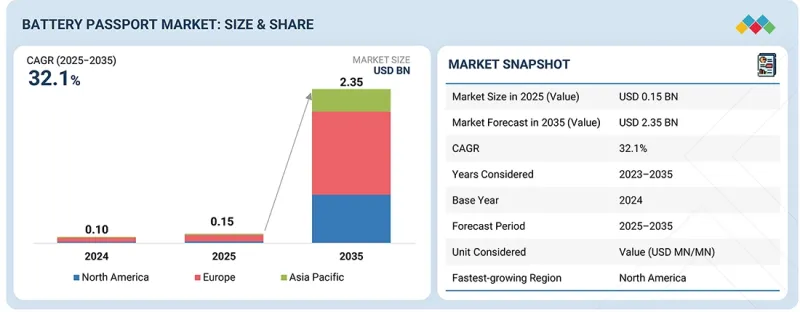
배터리 여권 시장 규모는 2025년 1억 5,000만 달러에서 2035년까지 23억 5,000만 달러에 이를 것으로 예측되고 있어 CAGR은 32.1%로 전망되고 있습니다.
유럽에서는 각 제조업체들이 EU 배터리 규제를 준수하면서 배터리 패스포트 도입이 가속화되고 있습니다. 기업들은 블록체인 기반 식별자, 내장 메모리 장치, 암호화 된 QR 코드 또는 NFC 액세스를 채택하여 조달 기록, 탄소 메트릭, 화학 데이터, 내구성 매개 변수를 캡처하고, 안전한 클라우드 연결을 통해 블록체인 기반 식별자, 내장 메모리 장치, 암호화 된 QR 코드 또는 NFC 액세스를 채택하고 있습니다. 건전성 지표, 사이클 패턴, 충전 거동, 열 이력 등의 센서 데이터는 주요 EU 시장 전반에 걸쳐 일관된 검증을 지원합니다.
| 조사 범위 | |
|---|---|
| 조사 대상 기간 | 2023-2035년 |
| 기준 연도 | 2024년 |
| 예측 기간 | 2025-2035년 |
| 대상 단위 | 금액(100만 달러) |
| 부문 | 적합성별, 비즈니스 모델별, 최종사용자별, 배터리 유형별, 기술별, 산업별, 지역별 |
| 대상 지역 | 아시아태평양, 유럽, 북미 |
블록체인 플랫폼은 변조 방지 감사 추적, 허가제 접근, 추적 가능한 수명주기 기록을 제공하며, 재활용 업체는 재료 구성 및 회수 경로에 대한 자동화된 정보를 얻을 수 있습니다. 온보드 진단 기능, BMS 암호화, OTA 기능, 통일된 데이터 형식을 갖춘 모듈식 배터리 설계는 컴플라이언스를 간소화하고, 시장 진출기업에게 검증된 라이프사이클 투명성은 필수적입니다.

2025년부터 2032년까지 승용차 및 상용차 부문에서 EV 및 PHEV의 급격한 증가로 인해 리튬 기반 화학물질이 90-95% 이상의 점유율을 유지하면서 인증된 조달, 탄소 지표, 내구성 데이터, 재활용 함량 검증에 대한 요구가 증가함에 따라 자동차 산업은 배터리 패스포트의 가장 큰 채택 분야가 될 것으로 예측됩니다. BMW, Mercedes-Benz, Volkswagen, Stellantis, Kia 등의 자동차 제조업체들은 EU 규정 2023/1542를 준수하기 위해 이미 여권 대응 데이터 모델 통합을 추진하고 있습니다. 또한, 키아의 공개 테스트와 북미 및 아시아 지역에서의 유사한 노력은 생산부터 폐기까지 통합된 추적 가능성으로의 전환을 반영하고 있습니다. 이 시스템은 공급업체 보고의 효율성을 높이고, BMS 데이터와 수명주기 지표를 일치시키며, 재활용업체와 세컨드 라이프 사업자에게 재료 회수 및 재사용을 위한 검증된 인풋을 제공합니다. 향후 전기차 도입 규모 확대, 공시 의무 강화, 지역 내 조화 노력으로 인해 자동차 제조업체는 배터리 패스포트 생태계 전반의 보고 기준, 상호운용성 프레임워크, 라이프사이클 거버넌스 관행의 주요 추진자로 자리매김하고 있습니다.
나트륨 이온 배터리는 중국, 인도, 유럽에서 자동차 및 지역 프로그램을 통한 집중적인 상업적 활동을 통해 발전하고 있으며, 파일럿 라인에서 대규모 배치로의 전환이 가속화되고 있습니다. 업계 리더은 구체적인 진전을 추진하고 있습니다. 예를 들어, CATL은 모빌리티 및 전력 저장 이용 사례를 위해 Naxtra 플랫폼을 확장하고 있습니다. Northvolt는 대규모 저장 시스템용 160Wh/kg 셀의 검증을 완료했으며, Reliance 산하 Faradion은 인도의 모빌리티 및 전력망 수요에 대응하기 위해 에너지 밀도와 사이클 안정성 향상을 추진하고 있습니다. 이러한 발전은 리튬 공급에 대한 압박이 심한 지역에서 비용 효율적인 대체 기술로 전환하는 것을 반영하고 있습니다. 배터리 패스포트는 경질 탄소, 프루시안 블루 특성, 전도성 임계값, 안정성 마커, 전압 곡선 거동과 같은 나트륨 특유의 파라미터를 포착하는 데 필수적입니다. 이는 리튬 이온 배터리와 다른 고유한 방전 특성과 열 반응성을 가지고 있기 때문에 전용 보고 형식과 BMS 로직이 필요합니다. 이 화학 기술이 산업적으로 확산됨에 따라 맞춤형 여권 프레임워크는 공급망 적격성 평가, 운영 신뢰성 및 규제 준수를 지원합니다. 이러한 매개변수를 디지털 여권 프레임워크에 통합하면 검증 프로세스가 강화되어 나트륨 이온 자산의 정확한 수명 종료 계획을 수립할 수 있습니다. 이 화학 기술의 낮은 재료 비용과 우수한 지속가능성 특성은 추적 가능한 수명주기 데이터에 대한 수요 증가와 잘 부합하여 정보 조달, 탄소 측정 및 내구성 기록을 위한 디지털 배터리 패스포트 구조의 조기 채택을 촉진하고 있습니다.
유럽은 규정(EU) 2023/1542에 따른 배터리 여권 도입의 주요 운영 지역입니다. 이 규정은 관련 배터리에 대한 기계 판독 가능 여권 및 상호운용성 요건을 정의하고, 규제 용량 기준치를 초과하는 배터리에 적용되는 이행 마일스톤을 규정합니다. 업계 및 연구 컨소시엄이 기술 기반을 구축하고 있습니다. 유럽 전역에서 여러 EU 회원국이 디지털 배터리 여권 이니셔티브를 추진하고 있습니다. 특히 독일은 분산원장 기술을 활용한 분산형 상호운용 가능한 여권 개발에 있어 Battery Pass 컨소시엄, FIWARE, IPCEI Batteries, BASE 프로젝트(스페인, 벨기에, 리투아니아, 네덜란드, 아일랜드 파트너 참여)를 주도하고 있습니다. 주도하고 있습니다. 프랑스는 GBA 연계 재활용 시범사업을 통해 기여하고, 스웨덴은 가치사슬 작업반을 통해 참여하며, 네덜란드와 벨기에는 BASE에 참여하고 있습니다. 배터리 패스, CIRPASS/CIRPASS 2, 자동차 에코시스템 '카테나 X' 등의 업계 컨소시엄은 재료의 출처, 탄소 회계, 셀 및 팩 제조, 열화, 사용 후 처리 경로, BMS, MES, ERP 시스템을 연계하는 암호화 API를 갖춘 안전한 디지털 식별자 등 조화로운 데이터 모델을 개발하고 있습니다. 독일, 프랑스, 스웨덴의 시범사업에서 당사자 간 동의 프레임워크와 사이클 이력 및 열 이력 실시간 분석에 대한 검증이 진행되고 있으며, 유럽은 표준 기반 배터리 패스포트 도입에 있어 가장 앞서가는 지역으로 자리매김하고 있습니다.
세계의 배터리 패스포트(Battery Passport) 시장에 대해 조사했으며, 성별/비즈니스 모델별/최종사용자별/배터리 유형별/기술별/산업별/지역별 동향, 시장 진출기업 프로파일 등의 정보를 정리하여 전해드립니다.
자주 묻는 질문
목차
제1장 서론
제2장 조사 방법
제3장 주요 요약
제4장 프리미엄 인사이트
제5장 시장 개요
- 서론
- 시장 역학
- 미충족 요구와 공백
- 연결된 시장과 분야간 기회
- Tier1/2/3 기업의 전략적 움직임
제6장 업계 동향
- 거시경제 지표
- 생태계 분석
- 가격 분석
- 밸류체인 분석
- 사례 연구 분석
- 미국의 2025년 관세
- 주요 컨퍼런스 및 이벤트
- 고객의 비즈니스에 영향을 미치는 동향/혼란
- 투자 및 자금조달 시나리오
- 배터리 여권 파일럿 시험
- 배터리 여권 프레임워크
- 배터리 여권 정보
- 배터리 여권 에코시스템의 주요 컨소시엄과 구상
- 배터리 여권 도입 대처와 비용 요인
제7장 기술 진보, AI 별 영향, 특허, 혁신, 향후 응용
- 주요 기술
- 보완적 기술
- 인접 기술
- 기술 로드맵
- AI/생성형 AI의 영향
- 특허 분석
- 향후 응용
제8장 지속가능성과 규제 상황
- 규제 구조
- 지속가능성 이니셔티브
- 지속가능성에 대한 영향과 규제 정책 이니셔티브
- 인증, 라벨 및 환경기준
제9장 고객 상황과 구매 행동
- 의사결정 프로세스
- 주요 이해관계자와 구입 기준
- 채택 장벽과 내부 과제
- 최종 이용 산업의 미충족 요구
제10장 배터리 여권 시장(적합성별)
- 서론
- EU 배터리 규정 준수 배터리
- 시범 사업 대상 배터리
- 비준수/기존 배터리
제11장 배터리 여권 시장(비즈니스 모델별)
- 서론
- 사업 형태별 비즈니스 모델
- 수입원별 비즈니스 모델
제12장 배터리 여권 시장(최종사용자별)
- 서론
- 규정 준수 최종사용자
- 운영 최종사용자
제13장 배터리 여권 시장(배터리 유형별)
- 서론
- 리튬 이온
- 납축 전지
- 나트륨 이온
- 기타
- 주요 인사이트
제14장 배터리 여권 시장(기술별)
- 서론
- 블록체인 기반
- 클라우드 기반
- IoT와 AI의 통합
- 기타
- 주요 인사이트
제15장 배터리 여권 시장(업계별)
- 서론
- 자동차
- 에너지 및 유틸리티
- 오프로드 및 산업용
- 기타
- 주요 인사이트
제16장 배터리 여권 시장(지역별)
- 서론
- 아시아태평양
- 중국
- 일본
- 한국
- 인도
- 말레이시아
- 유럽
- 독일
- 프랑스
- 네덜란드
- 스페인
- 핀란드
- 스웨덴
- 노르웨이
- 북미
- 미국
- 캐나다
제17장 경쟁 구도
- 서론
- 주요 시장 진출기업의 전략/강점, 2023년-2025년
- 시장 점유율 분석, 2024년
- 브랜드/제품 비교
- 기업 평가 매트릭스 : 주요 시장 진출기업, 2024년
- 기업 평가 매트릭스 : 신규 기업/중소기업, 2024년
- 경쟁 시나리오
제18장 기업 개요
- 주요 시장 진출기업
- MINESPIDER GMBH
- AVL
- SIEMENS
- CIRCULOR
- OPTEL GROUP
- CIRCULARISE
- DENSO CORPORATION
- IPOINT-SYSTEMS GMBH
- CHARGEZONE
- RCS GLOBAL
- 기타 기업
- PERFICIENT INC
- BLOQSENS AG
- TATA ELXSI
- VOLVO CARS
- THINGSPIRE
- GLASSDOME
- BATX ENERGIES
- MICROVAST HOLDINGS, INC.
- FARASIS ENERGY GMBH
- EVERLEDGER LIMITED
- RESOURCE
- SPHERITY GMBH
제19장 부록
LSH 25.12.10The battery passport market is projected to reach USD 2.35 billion by 2035, from USD 0.15 billion in 2025, with a CAGR of 32.1%. The rollout of battery passports in Europe is accelerating as manufacturers align with the EU Battery Regulation. Firms are adopting blockchain-backed identifiers with secure cloud links, embedded memory units, and encrypted QR or NFC access to capture sourcing records, carbon metrics, chemistry data, and durability parameters. Sensor feeds from state-of-health indicators, cycle patterns, charging behavior, and thermal traces support consistent validation across major EU markets.
| Scope of the Report | |
|---|---|
| Years Considered for the Study | 2023-2035 |
| Base Year | 2024 |
| Forecast Period | 2025-2035 |
| Units Considered | Value (USD Million) |
| Segments | Battery Passport Market by Industry, Battery Type, Technology, End User, Business Model, Region |
| Regions covered | Asia Pacific, Europe, and North America |
Blockchain platforms provide tamper-proof audit trails, permissioned access, and traceable lifecycle entries, while recyclers gain automated insights into material composition and recovery routes. Modular battery designs with onboard diagnostics, BMS encryption, OTA capability, and harmonized data formats streamline compliance, making verified lifecycle transparency mandatory for market participation.
"Automotive is expected to surpass other industries during the forecast period."
The automotive industry is expected to remain the largest adopter of battery passports as EV and PHEV volumes surge sharply across passenger and commercial segments from 2025 to 2032, with lithium-based chemistries maintaining a share of more than 90-95% and driving the need for authenticated sourcing, carbon metrics, durability data, and recycled-content validation. OEMs such as BMW, Mercedes-Benz, Volkswagen, Stellantis, and Kia are already integrating passport-ready data models to comply with EU Regulation 2023/1542, while Kia's public trials and similar initiatives across North America and Asia reflect the shift toward unified production-to-end-of-life traceability. These systems streamline supplier reporting, align BMS data with lifecycle indicators, and support recyclers and second-life operators with verified inputs for material recovery and reuse. The scale of upcoming EV deployment, tightening disclosure mandates, and region-wide harmonization efforts position automotive players as the primary drivers of reporting standards, interoperability frameworks, and lifecycle governance practices across the battery passport ecosystem.
"Sodium-ion is expected to exhibit the fastest growth during the forecast period."
The sodium-ion battery is advancing through focused commercial activity, with automotive and regional programs in China, India, and Europe accelerating its shift from pilot lines to scaled deployment. Industry leaders are pushing tangible progress. For instance, CATL is expanding its Naxtra platform for mobility and storage use cases. Northvolt has validated 160 Wh/kg cells for large-scale storage systems, while Faradion, under Reliance, is driving improvements in energy density and cycle stability to meet India's mobility and grid needs. These developments reflect a move toward cost-efficient alternatives where lithium supply pressures are significant. As adoption rises, battery passports will be essential for capturing sodium-specific parameters, such as hard-carbon or Prussian-blue characteristics, conductivity thresholds, stability markers, and voltage-curve behavior. This requires distinct reporting formats and BMS logic that differ from those of lithium-ion batteries due to their unique discharge signatures and thermal responses. A tailored passport framework will support supply chain qualification, operational reliability, and regulatory compliance as the chemistry gains industrial traction. Integrating these parameters into digital passport frameworks enhances validation processes and supports accurate end-of-life planning for sodium-ion assets. The chemistry's lower material cost and favorable sustainability characteristics align well with the rising need for traceable lifecycle data, prompting early adoption of digital battery passport structures for sourcing information, carbon metrics, and durability records.
"Europe is expected to be the largest market during the forecast period."
Europe is the primary operational region for the deployment of the Battery Passport under Regulation (EU) 2023/1542, which defines a machine-readable passport and interoperability requirements for relevant batteries, with implementation milestones applying to batteries exceeding the regulatory capacity threshold. Industry and research consortia are shaping the technical baseline. Across Europe, several EU member states are advancing digital battery passport initiatives. Notably, Germany leads the Battery Pass consortium, FIWARE, IPCEI Batteries, and the BASE project (with partners from Spain, Belgium, Lithuania, the Netherlands, and Ireland) in developing decentralized, interoperable passports utilizing distributed ledger technology. France contributes through recycling pilot projects linked to the GBA, while Sweden engages via value-chain working groups, and the Netherlands and Belgium participate in BASE. Industry consortia, such as Battery Pass, CIRPASS/CIRPASS 2, and the Catena X automotive ecosystem, are developing harmonized data models for material provenance, carbon accounting, cell and pack manufacturing, degradation, end-of-life routing, and secure digital identifiers with encrypted APIs that link BMS, MES, and ERP systems. Pilots in Germany, France, and Sweden are validating cross-party consent frameworks and real-time analytics for cycle and thermal history, positioning Europe as the most advanced region for standards-based battery passport deployment.
In-depth interviews were conducted with CEOs, marketing directors, other innovation and technology directors, and executives from various key organizations operating in this market.
- By Company Type: Battery Passport Providers - 69% and Others - 31%
- By Designation: CXOs - 46%, Managers - 23%, and Others - 31%
- By Region: North America - 8%, Europe - 61%, and Asia Pacific - 31%
The battery passport market is dominated by established players, including Minespider GmbH (Germany), AVL (Austria), Siemens (Germany), Circulor (UK), and Optel Group (Canada). These companies actively manufacture and develop new and advanced connectors. They have also set up R&D facilities and offer best-in-class products to their customers.
Research Coverage:
The study covers the battery passport market by industry (automotive, energy & utility, off-highway/industrial, other industries), battery type (lithium-ion, lead-acid, sodium-ion, other batteries), technology (blockchain-based battery passport, cloud-based battery passport, IoT & AI-integrated battery passport, other technologies), compliance (EU Battery Regulation-compliant batteries, batteries under pilot schemes, non-compliant/legacy batteries), end users (compliance end users, operational end users), business model (software-as-a-service platform, white-label solution, on-premise deployment, subscription, licensing, pay-per-use), and region (Asia Pacific, Europe, and North America). It also covers the competitive landscape and company profiles of the major players in the battery passport market.
Key Benefits of Purchasing this Report
The study provides a comprehensive competitive analysis of key market players, including their company profiles, key insights into product and business offerings, recent developments, and primary market strategies. The report will assist market leaders and new entrants with estimates of revenue figures for the overall battery passport market and its subsegments. It helps stakeholders understand the competitive landscape and gain additional insights to better position their businesses and develop effective go-to-market strategies. Additionally, the report provides information on key market drivers, restraints, challenges, and opportunities, enabling stakeholders to stay informed about market dynamics.
The report provides insights into the following points:
- Analysis of key drivers (battery supply chain transparency and sustainability, regulatory enforcement and compliance mandates, consumer-centric traceability and brand trust), restraints (data confidentiality and market reluctance, high CapEx and OpEx for compliance, fragmented standards and interoperability gaps), opportunities (circular economy, battery-as-a-service enablement), and challenges (transition and implementation challenges, technical complexity, data accuracy, governance, and cybersecurity) influencing market growth
- Product Development/Innovation: Detailed insights on upcoming technologies, R&D activities, and product launches in the battery passport market
- Market Development: Comprehensive information about lucrative markets; the report analyzes battery passports across various regions
- Market Diversification: Exhaustive information about new products, untapped geographies, recent developments, and investments in the battery passport market
- Competitive Assessment: In-depth assessment of market shares, growth strategies, and service offerings of leading players like Minespider GmbH (Germany), AVL (Austria), Siemens (Germany), Circulor (UK), and Optel Group (Canada)
TABLE OF CONTENTS
1 INTRODUCTION
- 1.1 STUDY OBJECTIVES
- 1.2 MARKET DEFINITION
- 1.3 STUDY SCOPE
- 1.3.1 MARKETS COVERED AND REGIONAL SCOPE
- 1.3.2 INCLUSIONS AND EXCLUSIONS
- 1.3.3 YEARS CONSIDERED
- 1.4 CURRENCY CONSIDERED
- 1.5 STAKEHOLDERS
2 RESEARCH METHODOLOGY
- 2.1 RESEARCH DATA
- 2.1.1 SECONDARY DATA
- 2.1.1.1 List of secondary sources
- 2.1.1.2 Key data from secondary sources
- 2.1.2 PRIMARY DATA
- 2.1.2.1 Primary interviewees from demand and supply sides
- 2.1.2.2 Breakdown of primary interviews
- 2.1.2.3 List of primary participants
- 2.1.1 SECONDARY DATA
- 2.2 MARKET SIZE ESTIMATION
- 2.2.1 BOTTOM-UP APPROACH
- 2.2.2 TOP-DOWN APPROACH
- 2.3 DATA TRIANGULATION
- 2.4 FACTOR ANALYSIS
- 2.5 RESEARCH ASSUMPTIONS AND RISK ASSESSMENT
- 2.6 RESEARCH LIMITATIONS
3 EXECUTIVE SUMMARY
- 3.1 KEY INSIGHTS AND MARKET HIGHLIGHTS
- 3.2 KEY MARKET PARTICIPANTS: SHARE INSIGHTS AND STRATEGIC DEVELOPMENTS
- 3.3 DISRUPTIVE TRENDS SHAPING MARKET
- 3.4 HIGH-GROWTH SEGMENTS AND EMERGING FRONTIERS
- 3.5 MNM INSIGHTS ON EU BATTERY REGULATIONS
- 3.6 SNAPSHOT: GLOBAL MARKET SIZE, GROWTH RATE, AND FORECAST
4 PREMIUM INSIGHTS
- 4.1 ATTRACTIVE OPPORTUNITIES FOR PLAYERS IN BATTERY PASSPORT MARKET
- 4.2 BATTERY PASSPORT MARKET, BY REGION
- 4.3 BATTERY PASSPORT MARKET, BY BATTERY TYPE
- 4.4 BATTERY PASSPORT MARKET, BY INDUSTRY
- 4.5 BATTERY PASSPORT MARKET, BY TECHNOLOGY
5 MARKET OVERVIEW
- 5.1 INTRODUCTION
- 5.2 MARKET DYNAMICS
- 5.2.1 DRIVERS
- 5.2.1.1 Battery supply chain transparency and sustainability
- 5.2.1.2 Regulatory enforcement and compliance mandates
- 5.2.1.3 Consumer-centric traceability and brand trust
- 5.2.2 RESTRAINTS
- 5.2.2.1 Data confidentiality and market reluctance
- 5.2.2.2 Fragmented standards and interoperability gaps
- 5.2.2.3 High CapEx and OpEx for compliance
- 5.2.3 OPPORTUNITIES
- 5.2.3.1 Battery industry's shift toward circular economy
- 5.2.3.2 Rise of Battery-as-a-Service model
- 5.2.4 CHALLENGES
- 5.2.4.1 Data accuracy, governance, and cybersecurity concerns
- 5.2.4.2 Transition and implementation constraints
- 5.2.4.3 Technical complexity
- 5.2.1 DRIVERS
- 5.3 UNMET NEEDS AND WHITE SPACES
- 5.3.1 UNMET NEEDS
- 5.3.2 WHITE SPACES
- 5.4 INTERCONNECTED MARKETS AND CROSS-SECTOR OPPORTUNITIES
- 5.4.1 SCALE OF COLLABORATION AND MARKET INTERDEPENDENCE
- 5.4.2 REGULATORY SYNCHRONIZATION AND COMPLIANCE TIMELINES
- 5.4.3 R&D COLLABORATION AND FUNDING SUPPORT
- 5.5 STRATEGIC MOVES BY TIER-1/2/3 PLAYERS
- 5.5.1 TIER 1
- 5.5.2 TIER 2
- 5.5.3 TIER 3
6 INDUSTRY TRENDS
- 6.1 MACROECONOMIC INDICATORS
- 6.1.1 INTRODUCTION
- 6.1.2 GDP TRENDS AND FORECAST
- 6.1.2.1 Regional GDP dynamics
- 6.1.2.1.1 Developed markets (US, EU, and Japan)
- 6.1.2.1.2 Emerging markets (China, India, and Southeast Asia)
- 6.1.2.2 Investment environment
- 6.1.2.3 Implications for battery passport adoption
- 6.1.2.1 Regional GDP dynamics
- 6.1.3 TRENDS IN EV AND EV BATTERY INDUSTRY
- 6.1.3.1 EV penetration and market dynamics
- 6.1.3.2 Battery manufacturing expansion
- 6.1.3.3 Regulatory and policy alignment
- 6.1.3.4 Strategic implications for stakeholders
- 6.2 ECOSYSTEM ANALYSIS
- 6.2.1 RAW MATERIAL SUPPLIERS AND MINERS
- 6.2.2 BATTERY MANUFACTURERS
- 6.2.3 OEMS
- 6.2.4 RECYCLERS AND SECOND-LIFE OPERATORS
- 6.2.5 DIGITAL PASSPORT AND TRACEABILITY PROVIDERS
- 6.2.6 REGULATORY AUTHORITIES AND GOVERNANCE ORGANIZATIONS
- 6.2.7 TECHNOLOGY AND AI PROVIDERS
- 6.2.8 AUDITORS AND CERTIFICATION AGENCIES
- 6.3 PRICING ANALYSIS
- 6.4 VALUE CHAIN ANALYSIS
- 6.5 CASE STUDY ANALYSIS
- 6.5.1 EFFICIENT RECYCLING PROCESSES THROUGH BATTERY PASSPORT DATA
- 6.5.2 BATTERY PASSPORT WITH QR AND BLOCKCHAIN TECHNOLOGY
- 6.5.3 BATTERY PASSPORT IMPLEMENTATION WITH MINESPIDER
- 6.6 US 2025 TARIFF
- 6.6.1 IMPACT OF US TARIFFS ON BATTERY VALUE CHAIN
- 6.6.1.1 Cost and import dynamics
- 6.6.1.2 Supply chain reorientation
- 6.6.2 REGULATORY ALIGNMENT AND TRANSPARENCY IMPLICATIONS
- 6.6.3 SPECIFIC IMPLICATIONS FOR BATTERY PASSPORT MARKET
- 6.6.3.1 Opportunity side
- 6.6.3.2 Risk/Headwind side
- 6.6.4 STRATEGIC CONSIDERATIONS FOR US BATTERY PASSPORT MARKET
- 6.6.5 RECOMMENDATIONS FOR STAKEHOLDERS
- 6.6.1 IMPACT OF US TARIFFS ON BATTERY VALUE CHAIN
- 6.7 KEY CONFERENCES AND EVENTS
- 6.8 TRENDS/DISRUPTIONS IMPACTING CUSTOMER BUSINESS
- 6.9 INVESTMENT AND FUNDING SCENARIO
- 6.10 BATTERY PASSPORT PILOT TRIALS
- 6.10.1 2023 BATTERY PASSPORT PILOT TRIALS
- 6.10.2 2024 BATTERY PASSPORT PILOT TRIALS
- 6.11 BATTERY PASSPORT FRAMEWORK
- 6.12 BATTERY PASSPORT INFORMATION
- 6.13 KEY CONSORTIUMS AND INITIATIVES IN BATTERY PASSPORT ECOSYSTEM
- 6.13.1 CATENA-X AUTOMOTIVE NETWORK (2021)
- 6.13.2 BATTERY PASS CONSORTIUM (2022)
- 6.13.3 GLOBAL BATTERY ALLIANCE BATTERY PASSPORT (2017)
- 6.13.4 CIRPASS PROJECT (2022)
- 6.14 BATTERY PASSPORT IMPLEMENTATION EFFORTS AND COST DRIVERS
7 TECHNOLOGICAL ADVANCEMENTS, AI-DRIVEN IMPACT, PATENTS, INNOVATIONS, AND FUTURE APPLICATIONS
- 7.1 KEY TECHNOLOGIES
- 7.1.1 CELL CHEMISTRY AND MATERIAL-LEVEL TRACEABILITY
- 7.1.2 STATE-OF-HEALTH MONITORING AND LIFECYCLE DATA INTEGRATION
- 7.1.3 BLOCKCHAIN INTEGRATION FOR TAMPER-PROOF DATA
- 7.2 COMPLEMENTARY TECHNOLOGIES
- 7.2.1 BATTERY MANAGEMENT AND TELEMETRY SYSTEMS
- 7.2.2 IOT AND EDGE INTELLIGENCE INTEGRATION
- 7.2.3 ARTIFICIAL INTELLIGENCE, DIGITAL TWINS, AND PREDICTIVE ANALYTICS
- 7.3 ADJACENT TECHNOLOGIES
- 7.3.1 BATTERY RECYCLING AND END-OF-LIFE INTEGRATION
- 7.3.2 AUTOMATED DISMANTLING AND MATERIAL RECOVERY PROCESSES
- 7.4 TECHNOLOGY ROADMAP
- 7.5 IMPACT OF AI/GEN AI
- 7.5.1 TOP USE CASES AND MARKET POTENTIAL
- 7.5.2 INTERCONNECTED ECOSYSTEM AND IMPACT ON MARKET PLAYERS
- 7.5.3 CLIENTS' READINESS TO ADOPT GEN AI IN BATTERY PASSPORT MARKET
- 7.6 PATENT ANALYSIS
- 7.7 FUTURE APPLICATIONS
- 7.7.1 APPLICATION OF TRACEABILITY SYSTEMS FOR DATA COLLECTION
- 7.7.1.1 Future application
- 7.7.1.2 Strategic impact
- 7.7.2 INTEGRATION INTO OFFICIAL DOWNSTREAM PROCESSES
- 7.7.2.1 Future application
- 7.7.2.2 Strategic impact
- 7.7.3 AGGREGATION OF DATA FROM MULTIPLE BATTERY PASSPORTS
- 7.7.3.1 Future application
- 7.7.3.2 Strategic impact
- 7.7.1 APPLICATION OF TRACEABILITY SYSTEMS FOR DATA COLLECTION
8 SUSTAINABILITY AND REGULATORY LANDSCAPE
- 8.1 REGULATORY FRAMEWORK
- 8.1.1 REGULATORY BODIES, GOVERNMENT AGENCIES, AND OTHER ORGANIZATIONS
- 8.1.2 REGULATIONS RELATED TO BATTERY PASSPORTS
- 8.1.2.1 Europe
- 8.1.2.1.1 EU Battery Regulation
- 8.1.2.2 North America
- 8.1.2.2.1 US Inflation Reduction Act
- 8.1.2.2.2 US Department of Energy's Battery Recycling Initiative
- 8.1.2.3 Asia Pacific
- 8.1.2.3.1 Automobile Management Act
- 8.1.2.1 Europe
- 8.1.3 COMPLIANCE COSTS PER BATTERY AND INFLUENCE ON OEM SOURCING STRATEGIES
- 8.1.4 INDUSTRY STANDARDS
- 8.1.5 REGULATIONS ON CIRCULARITY AND RESOURCE EFFICIENCY: DIN DKE SPEC 99100
- 8.2 SUSTAINABILITY INITIATIVES
- 8.2.1 CORE SUSTAINABILITY DIMENSIONS
- 8.2.1.1 Environmental impact transparency
- 8.2.1.2 Social responsibility and human rights compliance
- 8.2.1.3 Governance and data integrity
- 8.2.2 CIRCULAR ECONOMY INTEGRATION
- 8.2.3 GLOBAL COLLABORATIONS AND PILOTS
- 8.2.4 MEASURABLE SUSTAINABILITY OUTCOMES
- 8.2.5 CARBON IMPACT AND ECO-APPLICATIONS
- 8.2.1 CORE SUSTAINABILITY DIMENSIONS
- 8.3 SUSTAINABILITY IMPACT AND REGULATORY POLICY INITIATIVES
- 8.4 CERTIFICATION, LABELING, AND ECO-STANDARDS
9 CUSTOMER LANDSCAPE AND BUYER BEHAVIOR
- 9.1 DECISION-MAKING PROCESS
- 9.2 KEY STAKEHOLDERS AND BUYING CRITERIA
- 9.3 ADOPTION BARRIERS AND INTERNAL CHALLENGES
- 9.4 UNMET NEEDS FROM END-USE INDUSTRIES
10 BATTERY PASSPORT MARKET, BY COMPLIANCE
- 10.1 INTRODUCTION
- 10.2 EU BATTERY REGULATION-COMPLIANT BATTERIES
- 10.3 BATTERIES UNDER PILOT SCHEMES
- 10.3.1 BATTERY PASSPORT PILOT PARTICIPANTS
- 10.4 NON-COMPLIANT/LEGACY BATTERIES
11 BATTERY PASSPORT MARKET, BY BUSINESS MODEL
- 11.1 INTRODUCTION
- 11.2 BUSINESS MODELS BY MODE OF OPERATION
- 11.2.1 SOFTWARE-AS-A-SERVICE PLATFORM
- 11.2.2 WHITE-LABEL SOLUTION
- 11.2.3 ON-PREMISE DEPLOYMENT
- 11.3 BUSINESS MODELS BY REVENUE STREAM
- 11.3.1 SUBSCRIPTION
- 11.3.2 LICENSING
- 11.3.3 PAY-PER-USE/TRANSACTIONAL
12 BATTERY PASSPORT MARKET, BY END USER
- 12.1 INTRODUCTION
- 12.2 COMPLIANCE END USERS
- 12.2.1 BATTERY MANUFACTURERS
- 12.2.2 EV MANUFACTURERS
- 12.2.3 BATTERY RECYCLERS
- 12.3 OPERATIONAL END USERS
- 12.3.1 ENERGY STORAGE SYSTEM INTEGRATORS
- 12.3.2 UTILITY OPERATORS
- 12.3.3 FLEET OPERATORS
13 BATTERY PASSPORT MARKET, BY BATTERY TYPE
- 13.1 INTRODUCTION
- 13.2 LITHIUM-ION
- 13.2.1 REGULATORY COMPLIANCE FOR BATTERY TRACEABILITY TO DRIVE MARKET
- 13.3 LEAD-ACID
- 13.3.1 HIGH RECYCLING-EFFICIENCY AND SECOND-LIFE APPLICATIONS TO DRIVE MARKET
- 13.4 SODIUM-ION
- 13.4.1 ABUNDANT RAW MATERIALS, STRONG LOW-TEMPERATURE PERFORMANCE, AND SUPPLY CHAIN DIVERSIFICATION TO DRIVE MARKET
- 13.5 OTHER BATTERIES
- 13.6 PRIMARY INSIGHTS
14 BATTERY PASSPORT MARKET, BY TECHNOLOGY
- 14.1 INTRODUCTION
- 14.2 BLOCKCHAIN-BASED
- 14.2.1 TRACEABILITY, COMPLIANCE, AND DATA INTEGRITY ACROSS BATTERY SUPPLY CHAIN TO DRIVE MARKET
- 14.3 CLOUD-BASED
- 14.3.1 EFFICIENT LIFECYCLE TRACKING AND STREAMLINED REPORTING ACROSS BATTERY SUPPLY CHAIN TO DRIVE MARKET
- 14.4 IOT & AI-INTEGRATED
- 14.4.1 REAL-TIME MONITORING AND DATA-DRIVEN LIFECYCLE MANAGEMENT REQUIREMENTS TO DRIVE MARKET
- 14.5 OTHER TECHNOLOGIES
- 14.6 PRIMARY INSIGHTS
15 BATTERY PASSPORT MARKET, BY INDUSTRY
- 15.1 INTRODUCTION
- 15.2 AUTOMOTIVE
- 15.2.1 REGULATORY COMPLIANCE, CONSUMER DEMAND, AND SUPPLY CHAIN TRANSPARENCY TO DRIVE MARKET
- 15.3 ENERGY & UTILITY
- 15.3.1 ESG REQUIREMENTS, MATERIAL TRACEABILITY, AND SECOND-LIFE APPLICATIONS TO DRIVE MARKET
- 15.4 OFF-HIGHWAY/INDUSTRIAL
- 15.4.1 REGULATORY ADHERENCE, RISK MITIGATION, MATERIAL TRACEABILITY, AND STANDARDS ALIGNMENT TO DRIVE MARKET
- 15.5 OTHER INDUSTRIES
- 15.6 PRIMARY INSIGHTS
16 BATTERY PASSPORT MARKET, BY REGION
- 16.1 INTRODUCTION
- 16.2 ASIA PACIFIC
- 16.2.1 CHINA
- 16.2.2 JAPAN
- 16.2.3 SOUTH KOREA
- 16.2.4 INDIA
- 16.2.5 MALAYSIA
- 16.3 EUROPE
- 16.3.1 GERMANY
- 16.3.2 FRANCE
- 16.3.3 NETHERLANDS
- 16.3.4 SPAIN
- 16.3.5 FINLAND
- 16.3.6 SWEDEN
- 16.3.7 NORWAY
- 16.4 NORTH AMERICA
- 16.4.1 US
- 16.4.2 CANADA
17 COMPETITIVE LANDSCAPE
- 17.1 INTRODUCTION
- 17.2 KEY PLAYER STRATEGIES/RIGHT TO WIN, 2023-2025
- 17.3 MARKET SHARE ANALYSIS, 2024
- 17.4 BRAND/PRODUCT COMPARISON
- 17.5 COMPANY EVALUATION MATRIX: KEY PLAYERS, 2024
- 17.5.1 STARS
- 17.5.2 EMERGING LEADERS
- 17.5.3 PERVASIVE PLAYERS
- 17.5.4 PARTICIPANTS
- 17.5.5 COMPANY FOOTPRINT
- 17.5.5.1 Company footprint
- 17.5.5.2 Region footprint
- 17.5.5.3 Battery type footprint
- 17.5.5.4 Industry footprint
- 17.6 COMPANY EVALUATION MATRIX: START-UPS/SMES, 2024
- 17.6.1 PROGRESSIVE COMPANIES
- 17.6.2 RESPONSIVE COMPANIES
- 17.6.3 DYNAMIC COMPANIES
- 17.6.4 STARTING BLOCKS
- 17.6.5 COMPETITIVE BENCHMARKING
- 17.6.5.1 List of start-ups/SMEs
- 17.6.5.2 Competitive benchmarking of start-ups/SMEs
- 17.7 COMPETITIVE SCENARIO
- 17.7.1 PRODUCT LAUNCHES/DEVELOPMENTS
- 17.7.2 DEALS
- 17.7.3 EXPANSIONS
- 17.7.4 OTHER DEVELOPMENTS
18 COMPANY PROFILES
- 18.1 KEY PLAYERS
- 18.1.1 MINESPIDER GMBH
- 18.1.1.1 Business overview
- 18.1.1.2 Solutions offered
- 18.1.1.3 Recent developments
- 18.1.1.3.1 Product launches/developments
- 18.1.1.3.2 Deals
- 18.1.1.3.3 Other developments
- 18.1.1.4 MnM view
- 18.1.1.4.1 Key strengths
- 18.1.1.4.2 Strategic choices
- 18.1.1.4.3 Weaknesses and competitive threats
- 18.1.2 AVL
- 18.1.2.1 Business overview
- 18.1.2.2 Solutions offered
- 18.1.2.3 Recent developments
- 18.1.2.3.1 Product launches/developments
- 18.1.2.4 MnM view
- 18.1.2.4.1 Key strengths
- 18.1.2.4.2 Strategic choices
- 18.1.2.4.3 Weaknesses and competitive threats
- 18.1.3 SIEMENS
- 18.1.3.1 Business overview
- 18.1.3.2 Solutions offered
- 18.1.3.3 Recent developments
- 18.1.3.3.1 Deals
- 18.1.3.4 MnM view
- 18.1.3.4.1 Key strengths
- 18.1.3.4.2 Strategic choices
- 18.1.3.4.3 Weaknesses and competitive threats
- 18.1.4 CIRCULOR
- 18.1.4.1 Business overview
- 18.1.4.2 Solutions offered
- 18.1.4.3 Recent developments
- 18.1.4.3.1 Deals
- 18.1.4.4 MnM view
- 18.1.4.4.1 Key strengths
- 18.1.4.4.2 Strategic choices
- 18.1.4.4.3 Weaknesses and competitive threats
- 18.1.5 OPTEL GROUP
- 18.1.5.1 Business overview
- 18.1.5.2 Solutions offered
- 18.1.5.3 Recent developments
- 18.1.5.3.1 Deals
- 18.1.5.4 MnM view
- 18.1.5.4.1 Key strengths
- 18.1.5.4.2 Strategic choices
- 18.1.5.4.3 Weaknesses and competitive threats
- 18.1.6 CIRCULARISE
- 18.1.6.1 Business overview
- 18.1.6.2 Solutions offered
- 18.1.6.3 Recent developments
- 18.1.6.3.1 Deals
- 18.1.6.3.2 Expansions
- 18.1.7 DENSO CORPORATION
- 18.1.7.1 Business overview
- 18.1.7.2 Solutions offered
- 18.1.7.3 Recent developments
- 18.1.7.3.1 Product launches/developments
- 18.1.8 IPOINT-SYSTEMS GMBH
- 18.1.8.1 Business overview
- 18.1.8.2 Solutions offered
- 18.1.8.3 Recent developments
- 18.1.8.3.1 Deals
- 18.1.9 CHARGEZONE
- 18.1.9.1 Business overview
- 18.1.9.2 Solutions offered
- 18.1.9.3 Recent developments
- 18.1.9.3.1 Product launches/developments
- 18.1.10 RCS GLOBAL
- 18.1.10.1 Business overview
- 18.1.10.2 Solutions offered
- 18.1.10.3 Recent developments
- 18.1.10.3.1 Product launches/developments
- 18.1.10.3.2 Deals
- 18.1.10.3.3 Other developments
- 18.1.1 MINESPIDER GMBH
- 18.2 OTHER PLAYERS
- 18.2.1 PERFICIENT INC
- 18.2.2 BLOQSENS AG
- 18.2.3 TATA ELXSI
- 18.2.4 VOLVO CARS
- 18.2.5 THINGSPIRE
- 18.2.6 GLASSDOME
- 18.2.7 BATX ENERGIES
- 18.2.8 MICROVAST HOLDINGS, INC.
- 18.2.9 FARASIS ENERGY GMBH
- 18.2.10 EVERLEDGER LIMITED
- 18.2.11 RESOURCE
- 18.2.12 SPHERITY GMBH
19 APPENDIX
- 19.1 INSIGHTS FROM INDUSTRY EXPERTS
- 19.2 DISCUSSION GUIDE
- 19.3 KNOWLEDGESTORE: MARKETSANDMARKETS' SUBSCRIPTION PORTAL
- 19.4 CUSTOMIZATION OPTIONS
- 19.4.1 BATTERY PASSPORT MARKET, BY BATTERY TYPE, AT COUNTRY LEVEL (FOR COUNTRIES COVERED IN REPORT)
- 19.4.2 BATTERY PASSPORT MARKET, BY INDUSTRY, AT COUNTRY LEVEL (FOR COUNTRIES COVERED IN REPORT)
- 19.4.3 COMPANY INFORMATION
- 19.4.3.1 Profiling of additional market players (up to five)
- 19.5 RELATED REPORTS
- 19.6 AUTHOR DETAILS