|
시장보고서
상품코드
1928858
AI 검사 시장 : 서비스 유형별, 기술별, 서비스 딜리버리 방식별, 용도별, 소싱 유형별, 최종 이용 산업별, 지역별 - 세계 예측(-2032년)AI Inspection Market by Service Type (Testing, Inspection, Certification), Technology (Computer Vision, ML, NLP), Service Delivery Mode, Application, Sourcing Type (In-house, Outsourced), End-use Industry, and Region - Global Forecast to 2032 |
||||||

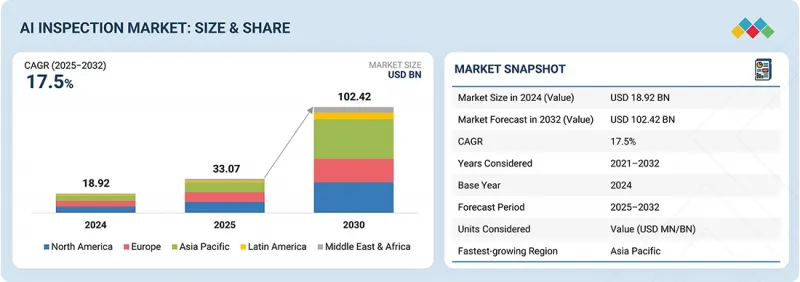
세계의 AI 검사 시장 규모는 2025년 330억 7,000만 달러에서 2032년까지 1,024억 2,000만 달러에 달할 것으로 예측되며, 예측 기간 동안 CAGR로 17.5%의 성장이 전망됩니다.
이러한 성장은 규제 당국의 감시 강화, 감사 대응 준비에 대한 기대 증가, 수동 검사에서 AI를 활용한 시험, 검사, 인증으로의 전환에 의해 촉진되고 있습니다.
| 조사 범위 | |
|---|---|
| 조사 대상 기간 | 2021-2032년 |
| 기준 연도 | 2024년 |
| 예측 기간 | 2025-2032년 |
| 단위 | 10억 달러 |
| 부문 | 서비스 유형, 기술, 용도, 지역 |
| 대상 지역 | 북미, 유럽, 아시아태평양, 기타 지역 |
컴퓨터 비전과 ML 분석은 결함 감지 및 위험 우선순위를 개선하고, 자연어 처리(NLP)는 문서화 및 증거 워크플로우의 자동화를 실현하고 있습니다. 기업이 여러 지점을 운영하거나 공급망 전반에 걸쳐 더 넓은 커버리지와 빠른 검증 주기를 요구함에 따라 원격/하이브리드 배송 모델이 빠르게 확산되고 있습니다.
"감사 대응 및 신뢰성 요구사항이 업계 전반에서 강화되는 가운데 AI 인증 서비스가 가장 빠르게 성장하고 있습니다."
AI 인증 서비스는 AI 검사 시장에서 가장 높은 CAGR로 성장할 것으로 예상됩니다. 이는 기업들이 컴플라이언스 성과에 대한 감시가 강화되면서 감사에 대응할 수 있는 디지털 증거에 기반한 신속하고 일관성 있는 인증 판단을 요구하고 있기 때문입니다. ESG 검증 요건 확대, 제품 및 프로세스 규제 강화, 검사 데이터 및 검증 워크플로우에 대한 소급 가능한 표준화된 문서에 대한 의존도 증가로 인해 성장이 촉진되고 있습니다. 또한, 원격/하이브리드 딜리버리 모델이 성숙해짐에 따라 추적성과 거버넌스를 훼손하지 않으면서도 확장 가능한 감사 및 신속한 대응을 가능하게 하는 인증도 가속화되고 있습니다. 수요가 정기 점검에서 지속적인 보증으로 계속 이동한다고 가정할 때, AI 검사 서비스는 여러 지점에 대한 배포 요구와 반복성을 향상시키면서 수작업에 대한 의존도를 줄이려는 노력에 힘입어 계속해서 두 번째로 빠르게 성장하는 분야가 될 것으로 예상됩니다.
"기업이 관리, 데이터 보안, 워크플로우 통합을 우선시하는 가운데, 인하우스 소싱이 2025년 AI 검사 시장을 주도합니다."
2025년 AI 검사 시장에서 인하우스 소싱이 가장 큰 비중을 차지할 것으로 예상됩니다. 많은 기업들이 품질과 컴플라이언스가 중요한 워크플로우에 대한 직접적인 관리 권한을 유지하면서 AI의 결과물과 거버넌스에 대한 신뢰성을 구축하는 것을 선호하기 때문입니다. 이 접근 방식은 검사 데이터가 기밀성이 높고, 프로세스가 생산 KPI와 밀접하게 연동되어 있으며, 결과를 내부 QMS, 위험 및 보고 시스템에 원활하게 통합해야 하는 경우에 특히 일반적입니다. 인하우스 도입은 또한 외부 의존도를 확대하기 전, 여러 거점 업무 전반에 걸쳐 모델, 임계값, 예외 처리를 표준화해야 할 필요성을 반영합니다. 한편, 아웃소싱은 기업이 확장된 규모, 공인된 전문성, 신속한 배포, 분산된 자산 및 공급업체 네트워크에 대한 관리형 원격/하이브리드 딜리버리를 추구함에 따라 여전히 높은 성장세를 보이고 있으며, 소싱 부문의 다음 중요한 기회 분야로 꼽히고 있습니다. 소싱 부문의 다음 중요한 기회 분야가 되고 있습니다.
"인도는 예측 기간 동안 AI 검사 시장에서 가장 빠르게 성장하는 국가가 될 것으로 예상됩니다."
인도는 예측 기간 동안 AI 검사 시장에서 가장 빠르게 성장하는 국가가 될 것으로 예상됩니다. 이는 확대되는 산업 인프라 활동에서 기업들이 수동 보증에서 AI를 활용한 시험, 검사, 인증으로 전환을 가속화하고 있기 때문입니다. 제조 생태계의 급속한 성장, 수출 지향의 증가, 추적성 및 감사에 대응할 수 있는 문서화에 대한 고객 요구의 강화, 다중 거점 운영에서 컴퓨터 비전 및 머신러닝을 통한 품질 및 프로세스 보증의 채택을 촉진하고 있습니다. 컴플라이언스, 안전, 공급업체 투명성에 대한 관심이 높아지면서 AI 인증 및 ESG 검증 프로그램에 대한 수요도 증가하고 있습니다. 이와 함께 원격/하이브리드 배송 모델은 분산된 플랜트, 자산, 공급업체 네트워크의 커버리지 향상, 검사 주기 단축, 부족한 숙련된 인력에 대한 의존도 감소를 목표로 확산되고 있습니다.
세계의 AI 검사 시장에 대해 조사 분석했으며, 주요 촉진요인과 저해요인, 제품 개발 및 혁신, 경쟁 구도 등의 정보를 전해드립니다.
자주 묻는 질문
목차
제1장 소개
제2장 주요 요약
제3장 중요한 인사이트
- AI 검사 시장의 기업에서 매력적인 기회
- AI 검사 시장 : 서비스 딜리버리 방식별
- AI 검사 시장 : 용도별
- AI 검사 시장 : 제조 최종 이용 산업별
제4장 시장 개요
- 시장 역학
- 성장 촉진요인
- 성장 억제요인
- 기회
- 과제
- 미충족 수요와 화이트 스페이스
- 상호 접속된 시장과 부문 횡단적인 기회
- Tier 1/2/3 기업의 전략적 활동
제5장 업계 동향
- Porter's Five Forces 분석
- 거시경제 지표
- GDP 동향과 예측
- 세계의 자동차 업계 동향
- 헬스케어와 생명과학 업계 동향
- 공급망 분석
- 생태계 분석
- 주요 회의와 이벤트(2026-2027년)
- 고객 비즈니스에 영향을 미치는 동향/디스럽션
- 사례 연구 분석
- AI 검사 시장에 대한 2025년 미국 관세의 영향
- 주요 관세율
- 가격의 영향 분석
- 국가/지역에 대한 영향
- 최종 이용 산업에 대한 영향
제6장 기술의 진보, 특허, 혁신, 향후 용도
- 주요 신기술
- 컴퓨터 비전
- 머신러닝(ML)·애널리틱스
- 자연어 처리(NLP)
- 디지털 트윈·시뮬레이션 서비스
- 생성형 AI·대규모 언어 모델(LLMS)
- 보완 기술
- 엣지 AI·엣지 컴퓨팅
- 클라우드 컴퓨팅·데이터 플랫폼
- 설명 가능한 AI(XAI)·모델 거버넌스
- 기술/제품 로드맵
- 특허 분석
- 향후 용도
제7장 규제 상황
- 지역 규제와 컴플라이언스
- 규제기관, 정부기관, 기타 조직
- 업계 표준
제8장 고객 상황과 구매 행동
- 의사결정 프로세스
- 바이어 이해관계자와 구입 평가 기준
- 구매 프로세스의 주요 이해관계자
- 구입 기준
- 채용 장벽과 내부 과제
- 다양한 최종 이용 산업으로부터의 미충족 수요
- 시장 수익성
제9장 AI 검사 시장 : 서비스 유형별
- AI 시험 서비스
- AI 검사 서비스
- AI 인증 서비스
- 기타 서비스 유형
제10장 AI 검사 시장 : 기술별
- 컴퓨터 비전
- 머신러닝(ML)·애널리틱스
- 자연어 처리(NLP)
- 기타 기술
제11장 AI 검사 시장 : 용도별
- 품질·프로세스 보증
- 규제·컴플라이언스 관리
- 자산 보전 관리
- 사이버 보안·데이터 보증
- 지속가능성·ESG 감사
- 기타 용도
제12장 AI 검사 시장 : 서비스 딜리버리 방식별
- 온사이트
- 원격
- 하이브리드
제13장 AI 검사 시장 : 소싱 유형별
- 인하우스
- 아웃소싱
제14장 AI 검사 시장 : 최종 이용 산업별
- 제조
- 에너지·유틸리티
- 소비재·소매
- 농업·식품
- IT·통신
- 건설·인프라
- 운송·물류
- 기타 업계
제15장 AI 검사 시장 : 지역별
- 아시아태평양
- 중국
- 일본
- 인도
- 한국
- 호주
- 태국
- 베트남
- 말레이시아
- 인도네시아
- 싱가포르
- 기타 아시아태평양
- 북미
- 미국
- 캐나다
- 유럽
- 독일
- 프랑스
- 영국
- 이탈리아
- 스페인
- 네덜란드
- 북유럽
- 기타 유럽
- 라틴아메리카
- 브라질
- 아르헨티나
- 멕시코
- 기타 라틴아메리카
- 중동 및 아프리카
- GCC 국가
- 남아프리카공화국
- 기타 중동 및 아프리카
제16장 경쟁 구도
- 개요
- 주요 기업이 채용한 전략
- 매출 분석(2020-2024년)
- 시장 점유율 분석(2024년)
- 기업 평가와 재무 지표
- 브랜드/제품의 비교
- 기업 평가 매트릭스 : 주요 기업(2024년)
- 기업 평가 매트릭스 : 스타트업/중소기업(2024년)
- 경쟁 시나리오
제17장 기업 개요
- 주요 AI 대응 TIC 서비스 프로바이더
- SGS SA
- BUREAU VERITAS
- TUV RHEINLAND
- TUV SUD
- DEKRA
- INTERTEK GROUP PLC
- DNV
- APPLUS+
- EUROFINS SCIENTIFIC
- UL LLC
- 기타 AI 대응 TIC 서비스 프로바이더
- TUV NORD GROUP
- ELEMENT MATERIALS TECHNOLOGY
- ALS LIMITED
- KIWA
- SOCOTEC
- RINA
- MISTRAS GROUP
- ACUREN
- LLOYD'S REGISTER
- LRQA
- TEAM, INC.
- ROSEN GROUP
- NDT GLOBAL
- QIMA
- BSI GROUP
- AI 기술·인프라 인에이블러
- IBM
- GOOGLE LLC
- MICROSOFT AZURE
- AMAZON WEB SERVICES
- CREDO AI
- HOLISTIC AI
- LANDINGAI
- NVIDIA
- COGNEX
- SUPER.AI
제18장 조사 방법
제19장 부록
KSM 26.02.24The global AI inspection market is expected to grow from USD 33.07 billion in 2025 to USD 102.42 billion by 2032, at a CAGR of 17.5% during the forecast period. Growth is driven by stricter regulatory scrutiny, higher audit-readiness expectations, and the shift from manual checks to AI-enabled testing, inspection, and certification.
| Scope of the Report | |
|---|---|
| Years Considered for the Study | 2021-2032 |
| Base Year | 2024 |
| Forecast Period | 2025-2032 |
| Units Considered | Value (USD Billion) |
| Segments | By Service Type, Technology, Application and Region |
| Regions covered | North America, Europe, APAC, RoW |
Computer vision and ML analytics are improving defect detection and risk prioritization, while NLP is automating documentation and evidence workflows. Remote and hybrid delivery models are scaling faster as enterprises seek wider coverage and quicker verification cycles across multi-site operations and supply chains.
"AI-powered Certification Services Are Growing the Fastest as Audit Readiness and Trust Requirements Intensify Across Industries"
AI-powered certification services are projected to grow at the highest CAGR in the AI inspection market as enterprises face rising scrutiny on compliance outcomes and need faster, more consistent certification decisions supported by audit-ready digital evidence. Growth is being fueled by expanding ESG verification requirements, tighter product and process regulations, and increasing reliance on standardized documentation that can be traced back to inspection data and validated workflows. Certification is also accelerating as remote and hybrid delivery models mature, enabling scalable audits and faster turnaround without compromising traceability and governance. If demand continues to shift toward continuous assurance rather than periodic checks, AI-powered inspection services are expected to remain the next-fastest growth area, supported by multi-site rollout needs and the push to reduce manual dependency while improving repeatability.
"In-house Sourcing to lead the AI Inspection Market in 2025 as Enterprises Prioritize Control, Data Security, and Workflow Integration."
In-house sourcing is estimated to hold the largest share of the AI inspection market in 2025, as many enterprises prefer to retain direct control over quality and compliance-critical workflows while building confidence in AI outputs and governance. This approach is particularly common where inspection data is sensitive, processes are tightly coupled with production KPIs, and results must integrate seamlessly into internal QMS, risk, and reporting systems. In-house adoption also reflects the need to standardize models, thresholds, and exception handling across multi-site operations before expanding external reliance. At the same time, outsourced sourcing remains the higher-growth avenue as companies scale deployments and seek accredited expertise, faster rollouts, and managed remote and hybrid delivery for distributed assets and supplier networks, making it the next key opportunity area within the sourcing segment.
"India Is the Fastest-Growing Country in the AI Inspection Market During the Forecast Period"
India is projected to be the fastest-growing country in the AI inspection market over the forecast period as enterprises accelerate the shift from manual assurance to AI-enabled testing, inspection, and certification across expanding industrial and infrastructure activity. Rapid growth in manufacturing ecosystems, increasing export orientation, and tighter customer expectations for traceability and audit-ready documentation are pushing adoption of computer vision and ML-led quality and process assurance across multi-site operations. Rising focus on compliance, safety, and supplier transparency is also strengthening demand for AI-supported certification and ESG verification programs. In parallel, remote and hybrid delivery models are gaining traction to improve coverage across distributed plants, assets, and supplier networks while reducing inspection cycle time and dependence on scarce skilled manpower.
Breakdown of Primaries
Various executives from key organizations operating in the AI inspection market were interviewed in-depth, including CEOs, marketing directors, and innovation and technology directors.
- By Company Type: Tier 1 - 40%, Tier 2 - 35%, and Tier 3 - 25%
- By Designation: C-level Executives - 30%, Directors - 40%, and Others - 30%
- By Region: Asia Pacific - 30%, North America - 30%, Europe - 25%, and Rest of the World - 15%
SGS SA (Switzerland), Bureau Veritas (France), DEKRA (Germany), TUV SUD (Germany), TUV RHEINLAND (Germany), Intertek Group plc (UK), DNV (Norway), Applus+ (Spain), Eurofins Scientific (Luxembourg), UL LLC (US), TUV NORD (Germany), TUV NORD Group (Germany), Element Materials Technology (UK), ALS Limited (Australia), Kiwa (Netherlands), SOCOTEC (France), RINA S.p.A (Italy), MISTRAS Group (US), Acuren (US), Lloyd's Register (UK), LRQA (UK), TEAM, Inc. (US), ROSEN Group (Switzerland), NDT Global (Ireland), OIMA (China), and BSI Group (UK) are some of the key players in the AI inspection market. The study includes an in-depth competitive analysis of these key players in the AI inspection market, covering their company profiles, recent developments, and key market strategies.
Study Coverage
The report segments the AI Inspection market and forecasts its service type, technology, applications, service delivery mode, sourcing type, end-use industry, and regions. The report also discusses the drivers, restraints, opportunities, and challenges pertaining to the market. It gives a detailed view of the market across five main regions-North America, Asia Pacific, Europe, Latin America, and the Middle East & Africa. The report includes a supply chain analysis of the key players and their competitive analysis of the AI inspection ecosystem.
Key Benefits of Buying the Report
- Analysis of key drivers (Rising regulatory complexity and compliance intensity across industries; Pressure to reduce inspection turnaround time and operational costs), restraints (High upfront investment and long validation cycles within accredited TIC frameworks; Integration complexity with legacy inspection processes and client-specific compliance requirements), opportunities (Monetization of inspection data and compliance intelligence services; Expansion into underserved mid-market and SME compliance segments), and challenges (Shortage of qualified personnel for AI-governed inspection and regulatory interpretation; Ensuring regulatory trust, explainability, and cross-border acceptance of inspection outcomes) influencing the growth of the AI Inspection market
- Solution/Service Development/Innovation: Detailed insights into upcoming components, technologies, research, and development activities in the AI Inspection market
- Market Development: Comprehensive information about lucrative markets-the report analyses the AI Inspection market across varied regions
- Market Diversification: Exhaustive information about new AI-powered TIC services in untapped geographies, recent developments, and investments in the AI Inspection market
- Competitive Assessment: In-depth assessment of market shares and growth strategies, and offerings of leading players, such as SGS SA (Switzerland), Bureau Veritas (France), DEKRA (Germany), TUV SUD (Germany), TUV RHEINLAND (Germany), Intertek Group plc (UK), DNV (Norway), Applus+ (Spain), Eurofins Scientific (Luxembourg), and UL LLC (US)
TABLE OF CONTENTS
1 INTRODUCTION
- 1.1 STUDY OBJECTIVES
- 1.2 MARKET DEFINITION
- 1.3 STUDY SCOPE
- 1.3.1 MARKETS COVERED & REGIONAL SCOPE
- 1.3.2 INCLUSIONS & EXCLUSIONS
- 1.3.3 YEARS CONSIDERED
- 1.3.4 CURRENCY CONSIDERED
- 1.4 LIMITATIONS
- 1.5 STAKEHOLDERS
2 EXECUTIVE SUMMARY
- 2.1 MARKET HIGHLIGHTS & KEY INSIGHTS
- 2.2 KEY MARKET PARTICIPANTS: MAPPING OF STRATEGIC DEVELOPMENTS
- 2.3 DISRUPTIVE TRENDS IN AI INSPECTION MARKET
- 2.4 HIGH-GROWTH SEGMENTS & EMERGING FRONTIERS
- 2.5 REGIONAL SNAPSHOT: MARKET SIZE, GROWTH RATE, AND FORECAST
3 PREMIUM INSIGHTS
- 3.1 ATTRACTIVE OPPORTUNITIES FOR PLAYERS IN AI INSPECTION MARKET
- 3.2 AI INSPECTION MARKET, BY SERVICE DELIVERY MODE
- 3.3 AI INSPECTION MARKET, BY APPLICATION
- 3.4 AI INSPECTION MARKET, BY MANUFACTURING END-USE INDUSTRY
4 MARKET OVERVIEW
- 4.1 INTRODUCTION
- 4.2 MARKET DYNAMICS
- 4.2.1 DRIVERS
- 4.2.1.1 Rising regulatory complexity and compliance intensity across industries
- 4.2.1.2 Pressure to reduce inspection turnaround time and operational costs
- 4.2.1.3 Growth of remote inspection and digital audit models
- 4.2.1.4 Increasing focus on safety, asset integrity, and lifecycle risk management
- 4.2.1.5 Digital transformation of TIC service delivery models
- 4.2.2 RESTRAINTS
- 4.2.2.1 High upfront investment and long validation cycles within accredited TIC frameworks
- 4.2.2.2 Integration complexity with legacy inspection processes and client-specific compliance requirements
- 4.2.3 OPPORTUNITIES
- 4.2.3.1 Monetization of inspection data and compliance intelligence services
- 4.2.3.2 Expansion into underserved mid-market and SME compliance segments
- 4.2.3.3 Development of sector-specific and regulation-specific assurance offerings
- 4.2.4 CHALLENGES
- 4.2.4.1 Shortage of qualified personnel for AI-governed inspection and regulatory interpretation
- 4.2.4.2 Ensuring regulatory trust, explainability, and cross-border acceptance of inspection outcomes
- 4.2.1 DRIVERS
- 4.3 UNMET NEEDS & WHITE SPACES
- 4.4 INTERCONNECTED MARKETS & CROSS-SECTOR OPPORTUNITIES
- 4.5 STRATEGIC MOVES BY TIER-1/2/3 PLAYERS
5 INDUSTRY TRENDS
- 5.1 PORTER'S FIVE FORCES ANALYSIS
- 5.1.1 THREAT OF NEW ENTRANTS
- 5.1.2 THREAT OF SUBSTITUTES
- 5.1.3 BARGAINING POWER OF SUPPLIERS
- 5.1.4 BARGAINING POWER OF BUYERS
- 5.1.5 INTENSITY OF COMPETITIVE RIVALRY
- 5.2 MACROECONOMIC INDICATORS
- 5.2.1 INTRODUCTION
- 5.2.2 GDP TRENDS & FORECAST
- 5.2.3 TRENDS IN GLOBAL AUTOMOTIVE INDUSTRY
- 5.2.4 TRENDS IN HEALTHCARE & LIFE SCIENCE INDUSTRY
- 5.3 SUPPLY CHAIN ANALYSIS
- 5.4 ECOSYSTEM ANALYSIS
- 5.5 KEY CONFERENCES & EVENTS, 2026-2027
- 5.6 TRENDS/DISRUPTIONS IMPACTING CUSTOMERS' BUSINESSES
- 5.7 CASE STUDY ANALYSIS
- 5.7.1 CASE STUDY 1: AI-ENABLED REMOTE INSPECTION AND DIGITAL ASSURANCE IN ENERGY INFRASTRUCTURE
- 5.7.2 CASE STUDY 2: AI-POWERED DRONE AND IMAGE-BASED INSPECTION FOR SOLAR ASSETS
- 5.7.3 CASE STUDY 3: AI-ENHANCED QUALITY AND COMPLIANCE INSPECTION IN CONSUMER GOODS MANUFACTURING
- 5.8 IMPACT OF 2025 US TARIFFS ON AI INSPECTION MARKET
- 5.8.1 INTRODUCTION
- 5.8.2 KEY TARIFF RATES
- 5.8.3 PRICE IMPACT ANALYSIS
- 5.8.4 IMPACT ON COUNTRIES/REGIONS
- 5.8.4.1 US
- 5.8.4.2 Europe
- 5.8.4.3 Asia Pacific
- 5.8.5 IMPACT ON END-USE INDUSTRIES
6 TECHNOLOGICAL ADVANCEMENTS, PATENTS, INNOVATIONS, AND FUTURE APPLICATIONS
- 6.1 KEY EMERGING TECHNOLOGIES
- 6.1.1 COMPUTER VISION
- 6.1.2 MACHINE LEARNING (ML) & ANALYTICS
- 6.1.3 NATURAL LANGUAGE PROCESSING (NLP)
- 6.1.4 DIGITAL TWIN & SIMULATION SERVICES
- 6.1.5 GENERATIVE AI & LARGE LANGUAGE MODELS (LLMS)
- 6.2 COMPLEMENTARY TECHNOLOGIES
- 6.2.1 EDGE AI & EDGE COMPUTING
- 6.2.2 CLOUD COMPUTING & DATA PLATFORMS
- 6.2.3 EXPLAINABLE AI (XAI) & MODEL GOVERNANCE
- 6.3 TECHNOLOGY/PRODUCT ROADMAP
- 6.4 PATENT ANALYSIS
- 6.5 FUTURE APPLICATIONS
- 6.5.1 KEY FUTURE APPLICATIONS
7 REGULATORY LANDSCAPE
- 7.1 REGIONAL REGULATIONS & COMPLIANCE
- 7.1.1 REGULATORY BODIES, GOVERNMENT AGENCIES, AND OTHER ORGANIZATIONS
- 7.1.2 INDUSTRY STANDARDS
8 CUSTOMER LANDSCAPE & BUYER BEHAVIOR
- 8.1 DECISION-MAKING PROCESS
- 8.2 BUYER STAKEHOLDERS & BUYING EVALUATION CRITERIA
- 8.2.1 KEY STAKEHOLDERS IN BUYING PROCESS
- 8.2.2 BUYING CRITERIA
- 8.3 ADOPTION BARRIERS & INTERNAL CHALLENGES
- 8.4 UNMET NEEDS FROM VARIOUS END-USE INDUSTRIES
- 8.5 MARKET PROFITABILITY
9 AI INSPECTION MARKET, BY SERVICE TYPE
- 9.1 INTRODUCTION
- 9.2 AI-POWERED TESTING SERVICES
- 9.2.1 THROUGHPUT AND COMPLIANCE-AT-SCALE TO DRIVE AI-POWERED TESTING TRANSFORMATION
- 9.2.2 SOFTWARE & SYSTEMS TESTING
- 9.2.3 HARDWARE & PHYSICAL TESTING
- 9.3 AI-POWERED INSPECTION SERVICES
- 9.3.1 RISK-BASED INTEGRITY AND ZERO-DEFECT EXPECTATIONS TO ACCELERATE AI-POWERED INSPECTION ADOPTION
- 9.3.2 VISUAL INSPECTION & QUALITY CONTROL (QC)
- 9.3.3 ASSET & INFRASTRUCTURE INSPECTION
- 9.4 AI-POWERED CERTIFICATION SERVICES
- 9.4.1 AUDITABLE COMPLIANCE AND TRUST-BY-DESIGN TO ACCELERATE AI-POWERED CERTIFICATION ADOPTION
- 9.4.2 COMPLIANCE & REGULATORY VALIDATION
- 9.4.3 AI MODEL & ALGORITHM CERTIFICATION
- 9.4.4 AUTOMATED REPORTING & DOCUMENTATION
- 9.5 OTHER SERVICE TYPES
- 9.5.1 AUDITING & ASSESSMENT
- 9.5.2 TRAINING & BUSINESS ASSURANCE
10 AI INSPECTION MARKET, BY TECHNOLOGY
- 10.1 INTRODUCTION
- 10.2 COMPUTER VISION
- 10.2.1 STANDARDIZED VISUAL EVIDENCE AND SCALABLE DEFECT DETECTION TO BOOST MARKET GROWTH
- 10.3 MACHINE LEARNING (ML) & ANALYTICS
- 10.3.1 RISK-BASED DECISIONING AND PREDICTIVE INSIGHT AT SCALE TO DRIVE DEMAND
- 10.3.2 PREDICTIVE & PRESCRIPTIVE ANALYTICS
- 10.3.3 UNSUPERVISED LEARNING (ANOMALY DETECTION)
- 10.3.4 SUPERVISED LEARNING-BASED CLASSIFICATION
- 10.4 NATURAL LANGUAGE PROCESSING (NLP)
- 10.4.1 DOCUMENTATION-INTENSIVE COMPLIANCE AND EVIDENCE TRACEABILITY AT SCALE TO SUPPORT GROWTH
- 10.5 OTHER TECHNOLOGIES
- 10.5.1 DIGITAL TWIN & SIMULATION SERVICES
- 10.5.2 GENERATIVE AI & LARGE LANGUAGE MODELS (LLMS)
11 AI INSPECTION MARKET, BY APPLICATION
- 11.1 INTRODUCTION
- 11.2 QUALITY & PROCESS ASSURANCE
- 11.2.1 DEFECT PREVENTION AND PROCESS STABILITY AT SCALE
- 11.3 REGULATORY & COMPLIANCE MANAGEMENT
- 11.3.1 EVIDENCE TRACEABILITY AND CONSISTENT INTERPRETATION ACROSS JURISDICTIONS TO BOOST MARKET GROWTH
- 11.4 ASSET INTEGRITY MANAGEMENT
- 11.4.1 RISK-BASED ASSET RELIABILITY AND LIFECYCLE ASSURANCE TO SUPPORT GROWTH
- 11.5 CYBERSECURITY & DATA ASSURANCE
- 11.5.1 DIGITAL TRUST, SYSTEM RESILIENCE, AND DATA INTEGRITY ASSURANCE
- 11.6 SUSTAINABILITY & ENVIRONMENTAL, SOCIAL, AND GOVERNANCE (ESG) AUDITING
- 11.6.1 TRANSPARENCY, TRACEABILITY, AND SCALABLE ESG ASSURANCE TO BOOST DEMAND
- 11.7 OTHER APPLICATIONS
- 11.7.1 SAFETY & RISK ANALYTICS
- 11.7.2 R&D AND T&D SUPPORT SERVICES
12 AI INSPECTION MARKET, BY SERVICE DELIVERY MODE
- 12.1 INTRODUCTION
- 12.2 ON-SITE
- 12.2.1 PHYSICAL ACCESS, SAFETY MANDATES, AND REGULATORY PRESENCE TO SUSTAIN ON-SITE AI-ENABLED DELIVERY
- 12.2.2 FIELD INSPECTION SERVICES
- 12.2.3 IN-FACILITY TESTING SERVICES
- 12.2.4 ON-LOCATION CERTIFICATION SERVICES
- 12.2.5 EMBEDDED QUALITY ASSURANCE SERVICES
- 12.3 REMOTE
- 12.3.1 SCALABILITY, SPEED, AND CENTRALIZED EXPERTISE TO DRIVE DEMAND FOR REMOTE AI-ENABLED DELIVERY
- 12.3.2 CLOUD-BASED ANALYSIS SERVICES
- 12.3.3 REMOTE MONITORING SERVICES
- 12.3.4 VIRTUAL INSPECTION SERVICES
- 12.3.5 DIGITAL AUDIT SERVICES
- 12.3.6 ONLINE CERTIFICATION SERVICES
- 12.4 HYBRID
- 12.4.1 REGULATORY ACCEPTANCE AND OPERATIONAL EFFICIENCY TO DRIVE ADOPTION OF HYBRID AI-ENABLED DELIVERY
- 12.4.2 COMBINED ON-SITE & REMOTE SERVICES
- 12.4.3 BLENDED INSPECTION MODELS
- 12.4.4 FLEXIBLE SERVICE DELIVERY
- 12.4.5 MULTI-LOCATION COORDINATION SERVICES
13 AI INSPECTION MARKET, BY SOURCING TYPE
- 13.1 INTRODUCTION
- 13.2 IN-HOUSE
- 13.2.1 CONTROL, DATA OWNERSHIP, AND DEEP INTEGRATION WITH OPERATIONS TO BOOST MARKET GROWTH
- 13.3 OUTSOURCED
- 13.3.1 ACCESS TO SPECIALIZED EXPERTISE AND SCALABLE AI-ENABLED DELIVERY TO SUPPORT GROWTH
14 AI INSPECTION MARKET, BY END-USE INDUSTRY
- 14.1 INTRODUCTION
- 14.2 MANUFACTURING
- 14.2.1 AUTOMOTIVE
- 14.2.1.1 High-throughput production and zero-defect expectations to drive AI inspection adoption
- 14.2.2 ELECTRONICS & SEMICONDUCTORS
- 14.2.2.1 Miniaturization, yield sensitivity, and precision-driven inspection requirements to support growth
- 14.2.3 AEROSPACE & DEFENSE
- 14.2.3.1 Safety-critical certification and traceability-driven inspection demand to drive market growth
- 14.2.4 HEAVY MACHINERY & INDUSTRIAL
- 14.2.4.1 Asset reliability and lifecycle quality assurance in complex equipment to drive demand
- 14.2.5 HEALTHCARE & LIFE SCIENCES
- 14.2.5.1 Patient safety, regulatory rigor, and validation-driven assurance requirements to contribute to growth
- 14.2.1 AUTOMOTIVE
- 14.3 ENERGY & UTILITIES
- 14.3.1 OIL & GAS
- 14.3.1.1 Asset integrity, safety assurance, and regulatory compliance across value chain to boost growth
- 14.3.2 POWER GENERATION & RENEWABLES
- 14.3.2.1 Grid reliability, asset availability, and transition-driven inspection demand to drive growth
- 14.3.1 OIL & GAS
- 14.4 CONSUMER GOODS & RETAIL
- 14.4.1 PRODUCT SAFETY, BRAND PROTECTION, AND SUPPLY CHAIN TRACEABILITY TO POSITIVELY IMPACT MARKET GROWTH
- 14.5 AGRICULTURE & FOOD
- 14.5.1 FOOD SAFETY, QUALITY CONSISTENCY, AND REGULATORY TRACEABILITY TO FUEL GROWTH
- 14.6 IT & TELECOMMUNICATIONS
- 14.6.1 SOFTWARE DEVELOPMENT & IT SERVICES
- 14.6.1.1 Continuous delivery, system reliability, and compliance-ready assurance to boost demand
- 14.6.2 TELECOMMUNICATION INFRASTRUCTURE
- 14.6.2.1 Network reliability, uptime assurance, and regulatory compliance at scale to propel market growth
- 14.6.1 SOFTWARE DEVELOPMENT & IT SERVICES
- 14.7 CONSTRUCTION & INFRASTRUCTURE
- 14.7.1 STRUCTURAL SAFETY, PROJECT COMPLIANCE, AND LIFECYCLE ASSURANCE TO DRIVE ADOPTION OF AI INSPECTION SOLUTIONS
- 14.8 TRANSPORTATION & LOGISTICS
- 14.8.1 SUPPLY CHAIN & WAREHOUSE OPERATIONS
- 14.8.1.1 Operational visibility, safety compliance, and throughput optimization to fuel growth
- 14.8.2 AEROSPACE, MARITIME, AND RAIL ASSETS
- 14.8.2.1 Safety-critical asset integrity and regulatory-driven inspection requirements to drive market
- 14.8.1 SUPPLY CHAIN & WAREHOUSE OPERATIONS
- 14.9 OTHER VERTICALS
15 AI INSPECTION MARKET, BY REGION
- 15.1 INTRODUCTION
- 15.2 ASIA PACIFIC
- 15.2.1 CHINA
- 15.2.1.1 Large-scale manufacturing, export compliance, and industrial digitalization to drive market growth
- 15.2.2 JAPAN
- 15.2.2.1 Precision manufacturing, quality discipline, and advanced automation to support growth
- 15.2.3 INDIA
- 15.2.3.1 Industrial expansion, export alignment, and digital quality adoption to fuel market
- 15.2.4 SOUTH KOREA
- 15.2.4.1 Technology-intensive manufacturing and export-driven quality control to propel market
- 15.2.5 AUSTRALIA
- 15.2.5.1 Regulatory rigor, asset integrity, and infrastructure assurance to boost market
- 15.2.6 THAILAND
- 15.2.6.1 Manufacturing hub expansion and export-oriented quality assurance to drive market
- 15.2.7 VIETNAM
- 15.2.7.1 Rapid industrialization and global supply chain integration to support growth
- 15.2.8 MALAYSIA
- 15.2.8.1 Electronics manufacturing and standards-driven inspection adoption
- 15.2.9 INDONESIA
- 15.2.9.1 Infrastructure development and industrial base expansion to propel growth
- 15.2.10 SINGAPORE
- 15.2.10.1 Regional TIC hub and advanced digital assurance adoption to propel market
- 15.2.11 REST OF ASIA PACIFIC
- 15.2.1 CHINA
- 15.3 NORTH AMERICA
- 15.3.1 US
- 15.3.1.1 Regulatory intensity, technology leadership, and enterprise-scale adoption to drive market growth
- 15.3.2 CANADA
- 15.3.2.1 Resource-driven industries and compliance-focused inspection to fuel growth
- 15.3.1 US
- 15.4 EUROPE
- 15.4.1 GERMANY
- 15.4.1.1 Industrial engineering leadership and standards-centric assurance to drive market growth
- 15.4.2 FRANCE
- 15.4.2.1 Aerospace strength, industrial regulation, and compliance modernization to support market
- 15.4.3 UK
- 15.4.3.1 Regulatory transition, infrastructure assurance, and digital inspection adoption to propel market
- 15.4.4 ITALY
- 15.4.4.1 Manufacturing diversity and quality-driven compliance to support growth
- 15.4.5 SPAIN
- 15.4.5.1 Industrial modernization and infrastructure-linked inspection demand to aid growth
- 15.4.6 NETHERLANDS
- 15.4.6.1 Logistics hub, advanced manufacturing, and digital compliance to drive market
- 15.4.7 NORDICS
- 15.4.7.1 Sustainability leadership and asset-centric inspection to contribute to market growth
- 15.4.8 REST OF EUROPE
- 15.4.1 GERMANY
- 15.5 LATIN AMERICA
- 15.5.1 BRAZIL
- 15.5.1.1 Industrial scale, energy assets, and regulatory modernization to drive market
- 15.5.2 ARGENTINA
- 15.5.2.1 Energy development and industrial compliance needs to fuel growth
- 15.5.3 MEXICO
- 15.5.3.1 Manufacturing integration and export-driven inspection demand to drive growth
- 15.5.4 REST OF LATIN AMERICA
- 15.5.1 BRAZIL
- 15.6 MIDDLE EAST & AFRICA
- 15.6.1 GCC COUNTRIES
- 15.6.1.1 Saudi Arabia
- 15.6.1.1.1 Energy dominance, mega-projects, and asset integrity at scale to drive market growth
- 15.6.1.2 UAE
- 15.6.1.2.1 Infrastructure modernization, regulatory excellence, and digital assurance to fuel growth
- 15.6.1.3 Rest of GCC Countries
- 15.6.1.1 Saudi Arabia
- 15.6.2 SOUTH AFRICA
- 15.6.2.1 Mining, energy assets, and compliance-led inspection demand to support market
- 15.6.3 REST OF MIDDLE EAST & AFRICA
- 15.6.1 GCC COUNTRIES
16 COMPETITIVE LANDSCAPE
- 16.1 OVERVIEW
- 16.2 STRATEGIES ADOPTED BY KEY PLAYERS
- 16.3 REVENUE ANALYSIS, 2020-2024
- 16.4 MARKET SHARE ANALYSIS, 2024
- 16.5 COMPANY VALUATION & FINANCIAL METRICS
- 16.6 BRAND/PRODUCT COMPARISON
- 16.7 COMPANY EVALUATION MATRIX: KEY PLAYERS, 2024
- 16.7.1 STARS
- 16.7.2 EMERGING LEADERS
- 16.7.3 PERVASIVE PLAYERS
- 16.7.4 PARTICIPANTS
- 16.7.5 COMPANY FOOTPRINT: KEY PLAYERS, 2024
- 16.7.5.1 Company footprint
- 16.7.5.2 Region footprint
- 16.7.5.3 Service type footprint
- 16.7.5.4 Technology footprint
- 16.7.5.5 Application footprint
- 16.7.5.6 End-use industry footprint
- 16.8 COMPANY EVALUATION MATRIX: STARTUPS/SMES, 2024
- 16.8.1 PROGRESSIVE COMPANIES
- 16.8.2 RESPONSIVE COMPANIES
- 16.8.3 DYNAMIC COMPANIES
- 16.8.4 STARTING BLOCKS
- 16.8.5 COMPETITIVE BENCHMARKING: STARTUPS/SMES, 2024
- 16.8.5.1 Detailed list of key startups/SMEs
- 16.8.5.2 Competitive benchmarking of key startups/SMEs
- 16.9 COMPETITIVE SCENARIO
- 16.9.1 SOLUTION/SERVICE LAUNCHES
- 16.9.2 DEALS
- 16.9.3 EXPANSIONS
- 16.9.4 OTHER DEVELOPMENTS
17 COMPANY PROFILES
- 17.1 INTRODUCTION
- 17.2 KEY AI-POWERED TIC SERVICE PROVIDERS
- 17.2.1 SGS SA
- 17.2.1.1 Business overview
- 17.2.1.2 Solutions/Services offered
- 17.2.1.3 Recent developments
- 17.2.1.3.1 Solution/Service launches
- 17.2.1.3.2 Deals
- 17.2.1.3.3 Other developments
- 17.2.1.4 MnM view
- 17.2.1.4.1 Key strengths/Right to win
- 17.2.1.4.2 Strategic choices
- 17.2.1.4.3 Weaknesses/Competitive threats
- 17.2.2 BUREAU VERITAS
- 17.2.2.1 Business overview
- 17.2.2.2 Solutions/Services offered
- 17.2.2.3 Recent developments
- 17.2.2.3.1 Solution/Service launches
- 17.2.2.3.2 Deals
- 17.2.2.3.3 Expansions
- 17.2.2.4 MnM view
- 17.2.2.4.1 Key strengths/Right to win
- 17.2.2.4.2 Strategic choices
- 17.2.2.4.3 Weaknesses/Competitive threats
- 17.2.3 TUV RHEINLAND
- 17.2.3.1 Business overview
- 17.2.3.2 Solutions/Services offered
- 17.2.3.3 Recent developments
- 17.2.3.3.1 Solution/Service launches
- 17.2.3.3.2 Deals
- 17.2.3.3.3 Expansions
- 17.2.3.3.4 Other developments
- 17.2.3.4 MnM view
- 17.2.3.4.1 Key strengths/Right to win
- 17.2.3.4.2 Strategic choices
- 17.2.3.4.3 Weaknesses/Competitive threats
- 17.2.4 TUV SUD
- 17.2.4.1 Business overview
- 17.2.4.2 Solutions/Services offered
- 17.2.4.3 Recent developments
- 17.2.4.3.1 Solution/Service launches
- 17.2.4.3.2 Deals
- 17.2.4.3.3 Expansions
- 17.2.4.3.4 Other developments
- 17.2.4.4 MnM view
- 17.2.4.4.1 Key strengths/Right to win
- 17.2.4.4.2 Strategic choices
- 17.2.4.4.3 Weaknesses/Competitive threats
- 17.2.5 DEKRA
- 17.2.5.1 Business overview
- 17.2.5.2 Solutions/Services offered
- 17.2.5.3 Recent developments
- 17.2.5.3.1 Solution/Service launches
- 17.2.5.3.2 Deals
- 17.2.5.3.3 Expansions
- 17.2.5.3.4 Other developments
- 17.2.5.4 MnM view
- 17.2.5.5 Key strengths/Right to win
- 17.2.5.6 Strategic choices
- 17.2.5.7 Weaknesses/Competitive threats
- 17.2.6 INTERTEK GROUP PLC
- 17.2.6.1 Business overview
- 17.2.6.2 Solutions/Services offered
- 17.2.6.3 Recent developments
- 17.2.6.3.1 Solution/Service launches
- 17.2.6.3.2 Deals
- 17.2.6.3.3 Expansions
- 17.2.6.3.4 Other developments
- 17.2.7 DNV
- 17.2.7.1 Business overview
- 17.2.7.2 Solutions/Services offered
- 17.2.7.3 Recent developments
- 17.2.7.3.1 Solution/Service launches
- 17.2.7.3.2 Deals
- 17.2.7.3.3 Expansions
- 17.2.7.3.4 Other developments
- 17.2.8 APPLUS+
- 17.2.8.1 Business overview
- 17.2.8.2 Recent developments
- 17.2.8.2.1 Solution/Service launches
- 17.2.8.2.2 Deals
- 17.2.8.2.3 Expansions
- 17.2.8.2.4 Other developments
- 17.2.9 EUROFINS SCIENTIFIC
- 17.2.9.1 Business overview
- 17.2.9.2 Solutions/Services offered
- 17.2.9.3 Recent developments
- 17.2.9.3.1 Solution/Service launches
- 17.2.9.3.2 Deals
- 17.2.9.3.3 Expansions
- 17.2.9.3.4 Other developments
- 17.2.10 UL LLC
- 17.2.10.1 Business overview
- 17.2.10.2 Solutions/Services offered
- 17.2.10.3 Recent developments
- 17.2.10.3.1 Solution/Service launches
- 17.2.10.3.2 Deals
- 17.2.10.3.3 Expansions
- 17.2.10.3.4 Other developments
- 17.2.1 SGS SA
- 17.3 OTHER AI-POWERED TIC SERVICE PROVIDERS
- 17.3.1 TUV NORD GROUP
- 17.3.2 ELEMENT MATERIALS TECHNOLOGY
- 17.3.3 ALS LIMITED
- 17.3.4 KIWA
- 17.3.5 SOCOTEC
- 17.3.6 RINA
- 17.3.7 MISTRAS GROUP
- 17.3.8 ACUREN
- 17.3.9 LLOYD'S REGISTER
- 17.3.10 LRQA
- 17.3.11 TEAM, INC.
- 17.3.12 ROSEN GROUP
- 17.3.13 NDT GLOBAL
- 17.3.14 QIMA
- 17.3.15 BSI GROUP
- 17.4 AI TECHNOLOGY & INFRASTRUCTURE ENABLERS
- 17.4.1 IBM
- 17.4.2 GOOGLE LLC
- 17.4.3 MICROSOFT AZURE
- 17.4.4 AMAZON WEB SERVICES
- 17.4.5 CREDO AI
- 17.4.6 HOLISTIC AI
- 17.4.7 LANDINGAI
- 17.4.8 NVIDIA
- 17.4.9 COGNEX
- 17.4.10 SUPER.AI
18 RESEARCH METHODOLOGY
- 18.1 RESEARCH DATA
- 18.1.1 SECONDARY RESEARCH
- 18.1.1.1 Major secondary sources
- 18.1.1.2 Key data from secondary sources
- 18.1.2 PRIMARY DATA
- 18.1.2.1 Primary interviews with experts
- 18.1.2.2 Key data from primary sources
- 18.1.2.3 Key industry insights
- 18.1.2.4 Breakdown of primary interviews
- 18.1.3 SECONDARY & PRIMARY RESEARCH
- 18.1.1 SECONDARY RESEARCH
- 18.2 MARKET SIZE ESTIMATION
- 18.2.1 BOTTOM-UP APPROACH
- 18.2.1.1 Approach to estimate market size using bottom-up approach
- 18.2.2 TOP-DOWN APPROACH
- 18.2.2.1 Approach to estimate market size using top-down approach
- 18.2.1 BOTTOM-UP APPROACH
- 18.3 DATA TRIANGULATION
- 18.4 RESEARCH ASSUMPTIONS
- 18.5 RISK ASSESSMENT
- 18.6 RESEARCH LIMITATIONS
19 APPENDIX
- 19.1 INSIGHTS FROM INDUSTRY EXPERTS
- 19.2 DISCUSSION GUIDE
- 19.3 KNOWLEDGESTORE: MARKETSANDMARKETS' SUBSCRIPTION PORTAL
- 19.4 CUSTOMIZATION OPTIONS
- 19.5 RELATED REPORTS
- 19.6 AUTHOR DETAILS