

|
시장보고서
상품코드
1937993
인라인 계측 시장 : 제공 제품별, 자동화 수준별, 용도별, 최종 이용 산업별, 설비별, 지역별 예측(-2032년)Inline Metrology Market by Equipment (CMMS, ODS, Laser Line Scanners, Machine Vision Systems, Multisensor Measuring Systems), Application (Quality Control & Inspection, Reverse Engineering, Assembly Verification) - Global Forecast to 2032 |
||||||

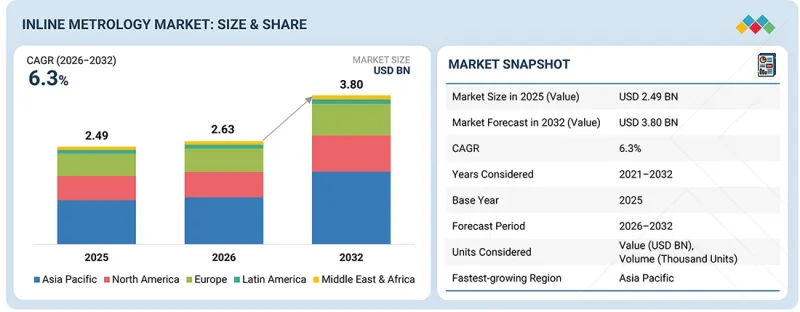
세계의 인라인 계측 시장 규모는 2026년 26억 3,000만 달러에서 2032년까지 38억 달러에 이를 것으로 예측되며 CAGR은 6.3%를 나타낼 전망입니다.
| 조사 범위 | |
|---|---|
| 조사 대상 기간 | 2021-2032년 |
| 기준 연도 | 2024년 |
| 예측 기간 | 2026-2032년 |
| 대상 단위 | 금액(10억 달러) |
| 부문 | 제공 제품별, 자동화 수준별, 용도별, 최종 이용 산업별, 설비별, 지역별 |
| 대상 지역 | 북미, 유럽, 아시아태평양 및 기타 지역 |
제조 복잡성 증가, 자동화 및 스마트 공장 이니셔티브 채택 확대, 실시간 생산 통합 품질 관리로의 전환에 힘입어 시장은 꾸준한 성장을 경험하고 있습니다. 자동차, 반도체, 전자 및 산업 분야의 제조업체들은 수율 향상, 공정 안정성 강화, 높은 처리량에서 더 엄격한 치수 공차 지원을 위해 인라인 계측 솔루션에 투자하고 있습니다. 전기차, 첨단 전자기기, 고정밀 부품의 확대로 고속 비접촉 측정 시스템에 대한 수요가 더욱 증가하고 있습니다. 광학 센싱, 머신 비전, 멀티센서 플랫폼, 소프트웨어 분석, 폐쇄 루프 공정 제어 분야의 발전은 측정 정확도를 향상시키고 불량률을 감소시키며 대량 생산 환경의 일관성을 높이고 있습니다.
반도체 및 전자 산업은 장치 복잡성 증가, 특징 크기 축소, 첨단 제조 노드 확장에 힘입어 예측 기간 동안 인라인 계측 시장에서 가장 빠른 성장률을 기록할 것으로 전망됩니다. 반도체 팹 및 전자 제조업체들은 대량 생산 과정에서 핵심 치수, 오버레이, 두께, 표면 품질을 실시간으로 모니터링하기 위해 인라인 계측을 점점 더 많이 도입하고 있습니다. 고급 패키징, 칩릿 아키텍처, AI 가속기, 고밀도 전자 어셈블리의 급속한 채택은 고속·고정밀 인라인 측정에 대한 수요를 더욱 가속화하고 있습니다. 수율 최적화와 공정 안정성이 핵심 경쟁 요인으로 부상함에 따라 반도체 및 전자 제조업체들은 인라인 계측 솔루션 투자를 확대하고 있어, 이 부문이 가장 빠르게 성장하는 최종 이용 산업이 될 전망입니다.
제조업체들이 측정 및 검사를 생산 라인에 직접 통합하는 경우가 증가함에 따라, 품질 관리 및 검사 부문은 용도별 인라인 계측 시장에서 가장 큰 비중을 차지할 것으로 예상됩니다. 인라인 계측 시스템은 치수 편차, 표면 결함 및 공정 드리프트를 실시간으로 감지하는 데 널리 사용되어 다운스트림 검사 및 수동 품질 점검에 대한 의존도를 줄입니다. 이러한 접근 방식은 조기 결함 감지를 가능하게 하고, 수율을 개선하며, 대량 생산 환경에서 불량품 및 재작업량을 최소화합니다. 자동차, 반도체 및 산업 제조 분야에서 생산량이 증가하고 공차가 더욱 엄격해짐에 따라, 인라인 품질 관리 및 검사는 인라인 계측 솔루션의 가장 중요하고 널리 채택된 용도로 남아 있습니다.
북미는 첨단 제조 산업의 강력한 입지, 반도체 제조 이니셔티브, 자동차 및 항공우주 생산을 바탕으로 2026년 세계의 인라인 계측 시장에서 두 번째로 큰 점유율을 차지할 것으로 예상됩니다. 북미는 반도체 제조, 전기차 생산, 항공우주 시스템, 산업 자동화에 대한 상당한 투자 혜택을 누리고 있으며, 이 모든 분야는 고정밀 생산 통합 측정 솔루션을 요구합니다. 또한 선도적인 기술 공급업체 및 연구 기관의 존재와 인더스트리 4.0 관행의 조기 도입은 인라인 계측에 대한 꾸준한 수요를 뒷받침합니다. 스마트 제조 및 국내 생산 역량에 대한 지속적인 초점으로 북미는 인라인 계측 시장에서 강력한 위치를 유지할 것으로 예상됩니다.
인라인 계측 시장에서 세계적으로 큰 존재감을 보이는 주요 기업으로는 Hexagon AB(스웨덴), Carl Zeiss AG(독일), KLA Corporation(미국), KEYENCE CORPORATION(일본), Renishaw plc(영국) 등을 들 수 있습니다.
조사 범위
이 보고서는 인라인 계측 시장을 부문화하고 제품 제공 형태, 설비, 자동화 수준, 용도, 최종 이용 산업, 지역별로 시장 규모를 예측했습니다. 또한 시장 성장에 영향을 미치는 촉진요인, 억제요인, 기회 및 과제에 대한 종합적인 검토를 제공합니다. 정성적·정량적 양면에서 시장을 분석했습니다.
본 보고서 구매 이유 :
본 보고서는 인라인 계측 시장을 세분화하고 제품군, 설비, 자동화 수준, 용도, 최종 이용 산업, 지역별로 시장 규모를 예측합니다. 또한 시장 성장에 영향을 미치는 촉진요인, 억제요인, 기회, 과제에 대한 포괄적인 분석을 제공합니다. 본 보고서는 시장의 정성적 및 정량적 측면을 모두 다룹니다.
이 보고서는 다음 포인트에 대한 인사이트를 제공합니다.
- 주요 성장 촉진요인 분석 (제로 불량 및 첫 생산부터 완벽한 제조에 대한 강조 증가, 대량·고정밀 생산 선호, 인더스트리 4.0 및 디지털 제조 프레임워크 도입, 샘플링 기반 품질 관리에서 완전한 인라인 검사로의 전환), 억제요인(상당한 초기 자본 투자 필요, 기존 생산 라인에 인라인 계측기 통합의 복잡성, 설계 변동성이 큰 소량 또는 다품종 생산의 제한적 적합성), 기회(반도체 제조 능력의 세계의 확장, 전기차 및 배터리 제조에 대한 관심 증가, AI 및 ML 기반 계측 소프트웨어의 발전), 과제(고속 생산 시 측정 정확도 유지, 시스템 견고성과 측정 감도 간의 균형 유지)
- 제품 개발/혁신 : 인라인 계측 시장에서 출시 예정 기술, 연구 개발 활동, 제품/서비스 출시 관련 상세 인사이트
- 시장 개발 : 다양한 지역별 인라인 계측 시장 분석을 통한 수익성 높은 시장 정보 종합 제공
- 시장 다각화 : 인라인 계측 시장의 신제품, 미개척 지역, 최근 동향 및 투자 관련 포괄적 정보
- 경쟁평가 : 주요 진입기업(Hexagon AB(스웨덴), Carl Zeiss AG(독일), KLA Corporation(미국), KEYENCE CORPORATION(일본), Renishaw plc(영국) 등) 시장 점유율, 성장 전략, 제품 제공 내용에 대한 상세한 평가
자주 묻는 질문
목차
제1장 서론
제2장 주요 요약
제3장 중요 인사이트
제4장 시장 개요
- 시장 역학
- 성장 촉진요인
- 억제요인
- 기회
- 과제
- 미충족 요구와 공백
- 상호접속된 시장과 분야간 기회
- Tier 1/2/3 참가 기업의 전략적 움직임
제5장 기술의 진보, AI의 영향, 특허, 혁신, 장래의 응용
- 주요 신기술
- 보완적 기술
- 인접 기술
- 기술/제품 로드맵
- 특허 분석
- 미래의 응용
- 인라인 계측의 AI 영향
제6장 고객정세와 구매행동
- 의사결정 프로세스
- 구매 프로세스에 관여하는 주요 이해관계자와 그 평가기준
- 채용 장벽과 내부 과제
- 다양한 최종 이용 산업의 미충족 요구
- 시장 수익성
제7장 규제 상황
- 규제기관, 정부기관, 기타 조직
- 업계 표준
- 지속가능성에 대한 노력
- 지속가능성에 미치는 영향과 규제 정책의 노력
- 인증, 라벨, 환경 기준
제8장 업계 동향
- Porter's Five Forces 분석
- 거시경제 전망
- 공급망 분석
- 생태계 분석
- 가격 분석
- 무역 분석
- 주된 회의와 이벤트(2026-2027년)
- 고객사업에 영향을 주는 동향/혼란
- 투자 및 자금조달 시나리오(2021-2025년)
- 사례 연구 분석
- 미국 관세가 인라인 계측 시장에 미치는 영향(2025년)
제9장 인라인 계측 시장(제공 제품별)
- 장비
- 소프트웨어
- 서비스
제10장 인라인 계측 시장(자동화 수준별)
- 완전 자동화
- 반자동화
제11장 인라인 계측 시장(용도별)
- 품질 관리 및 검사
- 리버스 엔지니어링
- 조립 검증
- 기타
제12장 인라인 계측 시장(최종 이용 산업별)
- 항공우주 및 방위
- 자동차
- 의료기기
- 반도체 및 전자
- 에너지 및 전력
- 중장비
- 기타 최종 이용 산업
제13장 인라인 계측 시장(설비별)
- 좌표 측정기(CMMS)
- 광학 디지타이저 및 스캐너(ODS)
- 머신 비전 시스템
- 멀티 센서 측정 시스템
- X선 및 컴퓨터 단층촬영(CT) 시스템
- 기타
제14장 인라인 계측 시장(지역별)
- 아시아태평양
- 중국
- 일본
- 인도
- 한국
- 호주
- 동남아시아
- 기타
- 북미
- 미국
- 캐나다
- 유럽
- 독일
- 영국
- 프랑스
- 이탈리아
- 스페인
- 폴란드
- 북유럽
- 기타
- 라틴아메리카
- 브라질
- 아르헨티나
- 멕시코
- 기타
- 중동 및 아프리카
- GCC
- 남아프리카
- 기타
제15장 경쟁 구도
- 개요
- 주요 참가 기업의 경쟁 전략/강점(2022-2025년)
- 시장 점유율 분석(2025년)
- 수익 분석(2020-2024년)
- 기업평가와 재무지표
- 브랜드 비교
- 기업평가 매트릭스 : 주요 진입기업(2025년)
- 기업평가 매트릭스 : 스타트업/중소기업(2025년)
- 경쟁 시나리오
제16장 기업 프로파일
- 주요 진출기업
- HEXAGON AB
- CARL ZEISS AG
- KLA CORPORATION
- KEYENCE CORPORATION
- RENISHAW PLC
- MITUTOYO CORPORATION
- NIKON CORPORATION
- FARO
- JENOPTIK
- CREAFORM
- 기타 기업
- COGNEX CORPORATION
- ACCUSCAN
- BAKER HUGHES COMPANY
- NORDSON CORPORATION
- ATT METROLOGY SOLUTIONS
- SGS SOCIETE GENERALE DE SURVEILLANCE SA
- AUTOMATED PRECISION INC(API)
- APPLIED MATERIALS, INC.
- PERCEPTRON, INC.
- SHINING 3D
- INTERTEK GROUP PLC
- BRUKER
- MICRO-EPSILON
- BASLER AG
- METROLOGIC GROUP
- INNOVMETRIC SOFTWARE INC.
- SMARTRAY GMBH
- WENZEL GROUP
- SCANTECH(HANGZHOU) CO., LTD.
- POLYGA INC.
제17장 조사 방법
제18장 부록
HBR 26.02.26The global inline metrology market is estimated to reach USD 3.80 billion by 2032 from USD 2.63 billion in 2026, registering a CAGR of 6.3%.
| Scope of the Report | |
|---|---|
| Years Considered for the Study | 2021-2032 |
| Base Year | 2024 |
| Forecast Period | 2026-2032 |
| Units Considered | Value (USD Billion) |
| Segments | By Equipment, Application, Technology and Region |
| Regions covered | North America, Europe, APAC, RoW |
The market is experiencing steady growth, driven by rising manufacturing complexity, increasing adoption of automation and smart factory initiatives, and the shift toward real-time, production-integrated quality control. Manufacturers across automotive, semiconductor, electronics, and industrial sectors are investing in inline metrology solutions to improve yield, enhance process stability, and support tighter dimensional tolerances at higher throughput. The expansion of electric vehicles, advanced electronics, and high-precision components further increases demand for high-speed, non-contact measurement systems. Advancements in optical sensing, machine vision, multisensor platforms, software analytics, and closed-loop process control are improving measurement accuracy, reducing scrap, and enhancing consistency in high-volume production environments.
"Semiconductor & electronics end-use industry to register the fastest growth throughout forecast period."
The semiconductor & electronics industry is projected to register the fastest growth rate in the inline metrology market during the forecast period, driven by increasing device complexity, shrinking feature sizes, and the expansion of advanced manufacturing nodes. Semiconductor fabs and electronics manufacturers are increasingly deploying inline metrology to enable real-time monitoring of critical dimensions, overlay, thickness, and surface quality during high-volume production. The rapid adoption of advanced packaging, chiplet architectures, AI accelerators, and high-density electronic assemblies further intensifies the need for high-speed, high-precision inline measurement. As yield optimization and process stability become critical competitive factors, semiconductor and electronics manufacturers are accelerating investments in inline metrology solutions, making this segment the fastest-growing end-use industry.
"Quality control & inspection application to account for largest market share in 2032."
The quality control & inspection segment is expected to account for the largest share of the inline metrology market, based on application, as manufacturers increasingly embed measurement and inspection directly into production lines. Inline metrology systems are widely used to detect dimensional deviations, surface defects, and process drift in real time, reducing reliance on downstream inspection and manual quality checks. This approach enables early defect detection, improves yield, and minimizes scrap and rework in high-throughput manufacturing environments. As production volumes rise and tolerances become tighter across automotive, semiconductor, and industrial manufacturing, inline quality control and inspection remain the most critical and widely adopted application of inline metrology solutions.
"North America to account for second-largest market share in 2026."
North America is projected to hold the second-largest share of the global inline metrology market in 2026, supported by a strong presence of advanced manufacturing industries, semiconductor fabrication initiatives, and automotive and aerospace production in the region. North America benefits from significant investments in semiconductor manufacturing, electric vehicle production, aerospace systems, and industrial automation, all of which require high-precision, production-integrated measurement solutions. In addition, the presence of leading technology providers and research institutions, along with early adoption of Industry 4.0 practices, supports steady demand for inline metrology. With continued focus on smart manufacturing and domestic production capabilities, North America is expected to maintain a strong position in the inline metrology market.
The break-up of the profile of primary participants in the inline metrology market is as follows:
- By Company Type: Tier 1 - 35%, Tier 2 - 45%, Tier 3 - 20%
- By Designation Type: Directors - 35%, Managers - 25%, Others - 40%
- By Region: Asia Pacific - 40%, Europe - 20%, North America- 30%, Latin America-5%, Middle East & Africa - 5%
Note: Other designations include sales, marketing, and product managers.
The three tiers of the companies are based on their total revenues as of 2024: Tier 1: >USD 1 billion, Tier 2: USD 500 million-1 billion, and Tier 3: USD 500 million.
The major players in the inline metrology market with a significant global presence include Hexagon AB (Sweden), Carl Zeiss AG (Germany), KLA Corporation (US), KEYENCE CORPORATION (Japan), Renishaw plc (UK), and others.
Research Coverage
The report segments the inline metrology market and forecasts its size by offering, equipment, automation level, application, end-use industry, and region. It also provides a comprehensive review of drivers, restraints, opportunities, and challenges influencing market growth. The report covers both qualitative and quantitative aspects of the market.
Reasons to Buy the Report:
The report will help leaders/new entrants in this market by providing approximate revenue figures for the overall inline metrology market and related segments. This report will help stakeholders understand the competitive landscape and gain deeper insights to strengthen their market position and plan effective go-to-market strategies. The report also helps stakeholders understand the market pulse and provides information on key drivers, restraints, opportunities, and challenges.
The report provides insights into the following pointers:
- Analysis of key drivers (increasing emphasis on zero-defect and right-first-time manufacturing, inclination toward high-volume and high-precision production, adoption of Industry 4.0 and digital manufacturing frameworks, transition from sampling-based quality control to full inline inspection), restraints (requirement for substantial upfront capital investment, complexities in integrating inline metrology into existing production lines, limited suitability in low-volume or high-mix production with design variability), opportunities (global expansion of semiconductor manufacturing capacity, rising focus on electric vehicle and battery manufacturing, advancements in AI- and ML-enabled metrology software), and challenges (maintaining measurement accuracy at high production speeds, balancing system robustness with measurement sensitivity).
- Product Development/Innovation: Detailed insights on upcoming technologies, research & development activities, and product/service launches in the inline metrology market
- Market Development: Comprehensive information about lucrative markets by analyzing the inline metrology market across varied regions
- Market Diversification: Exhaustive information about new products, untapped geographies, recent developments, and investments in the inline metrology market
- Competitive Assessment: In-depth assessment of market shares, growth strategies, and product offerings of leading players, including Hexagon AB (Sweden), Carl Zeiss AG (Germany), KLA Corporation (US), KEYENCE CORPORATION (Japan), and Renishaw plc (UK), among others.
TABLE OF CONTENTS
1 INTRODUCTION
- 1.1 STUDY OBJECTIVES
- 1.2 MARKET DEFINITION
- 1.3 MARKET SCOPE
- 1.3.1 MARKET SEGMENTATION AND REGIONAL SCOPE
- 1.3.2 INCLUSIONS AND EXCLUSIONS
- 1.3.3 YEARS CONSIDERED
- 1.4 CURRENCY CONSIDERED
- 1.5 UNIT CONSIDERED
- 1.6 LIMITATIONS
- 1.7 STAKEHOLDERS
- 1.8 SUMMARY OF CHANGES
2 EXECUTIVE SUMMARY
- 2.1 MARKET HIGHLIGHTS AND KEY INSIGHTS
- 2.2 KEY MARKET PARTICIPANTS: MAPPING OF STRATEGIC DEVELOPMENTS
- 2.3 DISRUPTIVE TRENDS IN INLINE METROLOGY MARKET
- 2.4 HIGH-GROWTH SEGMENTS
- 2.5 REGIONAL SNAPSHOT: MARKET SIZE, GROWTH RATE, AND FORECAST
3 PREMIUM INSIGHTS
- 3.1 OPPORTUNITIES FOR PLAYERS IN INLINE METROLOGY MARKET
- 3.2 INLINE METROLOGY MARKET, BY OFFERING
- 3.3 INLINE METROLOGY MARKET, BY EQUIPMENT
- 3.4 INLINE METROLOGY MARKET, BY AUTOMATION LEVEL
- 3.5 INLINE METROLOGY MARKET, BY APPLICATION
- 3.6 INLINE METROLOGY MARKET IN ASIA PACIFIC, BY END-USE INDUSTRY AND COUNTRY
4 MARKET OVERVIEW
- 4.1 INTRODUCTION
- 4.2 MARKET DYNAMICS
- 4.2.1 DRIVERS
- 4.2.1.1 Increasing emphasis on zero-defect and right-first-time manufacturing
- 4.2.1.2 Inclination toward high-volume, high-precision production
- 4.2.1.3 Adoption of Industry 4.0 and digital manufacturing framework
- 4.2.1.4 Transition from sampling-based quality control to full inline inspection
- 4.2.2 RESTRAINTS
- 4.2.2.1 Requirement for substantial upfront capital investment
- 4.2.2.2 Complexities associated with integrating inline metrology into existing production lines
- 4.2.2.3 Less suitability of inline metrology in low-volume or high-mix production with design variability
- 4.2.3 OPPORTUNITIES
- 4.2.3.1 Global expansion of semiconductor manufacturing capacity
- 4.2.3.2 Rising focus on expanding electric vehicle and battery manufacturing capacity
- 4.2.3.3 Advancements in AI- and ML-enabled metrology software
- 4.2.4 CHALLENGES
- 4.2.4.1 Maintaining measurement accuracy at high production speeds
- 4.2.4.2 Balancing system robustness with measurement sensitivity
- 4.2.1 DRIVERS
- 4.3 UNMET NEEDS AND WHITE SPACES
- 4.3.1 UNMET NEEDS IN INLINE METROLOGY MARKET
- 4.3.2 WHITE SPACE OPPORTUNITIES
- 4.4 INTERCONNECTED MARKETS AND CROSS-SECTOR OPPORTUNITIES
- 4.4.1 INTERCONNECTED MARKETS
- 4.4.2 CROSS-SECTOR OPPORTUNITIES
- 4.5 STRATEGIC MOVES BY TIER 1/2/3 PLAYERS
- 4.5.1 KEY MOVES AND STRATEGIC FOCUS OF MARKET PLAYERS
5 TECHNOLOGICAL ADVANCEMENTS, AI-DRIVEN IMPACT, PATENTS, INNOVATIONS, AND FUTURE APPLICATIONS
- 5.1 KEY EMERGING TECHNOLOGIES
- 5.1.1 INLINE OPTICAL MEASUREMENT AND 3D SCANNING TECHNOLOGIES
- 5.1.2 AI-ENABLED INLINE MACHINE VISION SYSTEMS
- 5.2 COMPLEMENTARY TECHNOLOGIES
- 5.2.1 MULTISENSOR AND HYBRID INLINE METROLOGY PLATFORMS
- 5.2.2 ADVANCED SOFTWARE, ANALYTICS, AND SPC INTEGRATION
- 5.3 ADJACENT TECHNOLOGIES
- 5.3.1 PROBE INDUSTRIAL AUTOMATION, ROBOTICS, AND PRODUCTION LINE INTEGRATION
- 5.3.2 DIGITAL TWINS AND SMART MANUFACTURING PLATFORMS
- 5.4 TECHNOLOGY/PRODUCT ROADMAP
- 5.4.1 SHORT-TERM (2025-2027): HIGH-SPEED AUTOMATION, AI VISION, & PRODUCTION INTEGRATION
- 5.4.2 MID-TERM (2027-2030): MULTI-SENSOR PLATFORMS, CLOSED-LOOP CONTROL & SMART FACTORIES
- 5.4.3 LONG-TERM (2030-2035+): AUTONOMOUS INSPECTION, DIGITAL TWINS, & SYSTEM-LEVEL CONVERGENCE
- 5.5 PATENT ANALYSIS
- 5.6 FUTURE APPLICATIONS
- 5.7 IMPACT OF AI ON INLINE METROLOGY
- 5.7.1 TOP USE CASES AND MARKET POTENTIAL
- 5.7.2 BEST PRACTICES RELATED TO AI IMPLEMENTATION IN INLINE METROLOGY MARKET
- 5.7.3 CASE STUDIES OF AI IMPLEMENTATION IN INLINE METROLOGY MARKET
- 5.7.4 INTERCONNECTED/ADJACENT ECOSYSTEM AND IMPACT ON MARKET PLAYERS
- 5.7.5 CLIENTS' READINESS TO ADOPT AI IN INLINE METROLOGY MARKET
6 CUSTOMER LANDSCAPE AND BUYER BEHAVIOR
- 6.1 DECISION-MAKING PROCESS
- 6.2 KEY STAKEHOLDERS INVOLVED IN BUYING PROCESS AND THEIR EVALUATION CRITERIA
- 6.2.1 KEY STAKEHOLDERS IN BUYING PROCESS
- 6.2.2 BUYING CRITERIA
- 6.3 ADOPTION BARRIERS AND INTERNAL CHALLENGES
- 6.4 UNMET NEEDS OF VARIOUS END-USE INDUSTRIES
- 6.5 MARKET PROFITABILITY
- 6.5.1 REVENUE POTENTIAL
- 6.5.2 COST DYNAMICS
- 6.5.3 MARGIN OPPORTUNITIES, BY APPLICATION
7 REGULATORY LANDSCAPE
- 7.1 INTRODUCTION
- 7.1.1 REGULATORY BODIES, GOVERNMENT AGENCIES, AND OTHER ORGANIZATIONS
- 7.1.2 INDUSTRY STANDARDS
- 7.1.3 SUSTAINABILITY INITIATIVES
- 7.1.4 SUSTAINABILITY IMPACT AND REGULATORY POLICY INITIATIVES
- 7.1.5 CERTIFICATIONS, LABELING, AND ECO-STANDARDS
8 INDUSTRY TRENDS
- 8.1 INTRODUCTION
- 8.2 PORTER'S FIVE FORCES ANALYSIS
- 8.2.1 INTENSITY OF COMPETITIVE RIVALRY
- 8.2.2 BARGAINING POWER OF SUPPLIERS
- 8.2.3 BARGAINING POWER OF BUYERS
- 8.2.4 THREAT OF NEW ENTRANTS
- 8.2.5 THREAT OF SUBSTITUTES
- 8.3 MACROECONOMIC OUTLOOK
- 8.3.1 INTRODUCTION
- 8.3.2 GDP TRENDS AND FORECAST
- 8.3.3 TRENDS IN GLOBAL METROLOGY INDUSTRY
- 8.3.4 TRENDS IN GLOBAL INLINE METROLOGY INDUSTRY
- 8.4 SUPPLY CHAIN ANALYSIS
- 8.5 ECOSYSTEM ANALYSIS
- 8.6 PRICING ANALYSIS
- 8.6.1 PRICING RANGE OF INLINE METROLOGY EQUIPMENT, BY KEY PLAYER, 2025
- 8.6.2 AVERAGE SELLING PRICE TREND OF INLINE METROLOGY EQUIPMENT, BY TYPE, 2023-2025
- 8.6.3 AVERAGE SELLING PRICE TREND OF INLINE METROLOGY EQUIPMENT, BY REGION, 2023-2025
- 8.7 TRADE ANALYSIS
- 8.7.1 IMPORT SCENARIO (HS CODE 903180)
- 8.7.2 EXPORT SCENARIO (HS CODE 903180)
- 8.8 KEY CONFERENCES AND EVENTS, 2026-2027
- 8.9 TRENDS/DISRUPTIONS IMPACTING CUSTOMER BUSINESS
- 8.10 INVESTMENT AND FUNDING SCENARIO, 2021-2025
- 8.11 CASE STUDY ANALYSIS
- 8.11.1 AUTOMATED OPTICAL METROLOGY DEPLOYMENT TO SCALE INLINE MEASUREMENT AND DIGITAL INSPECTION CAPACITY AT SKODA AUTO
- 8.11.2 CMM INTEGRATION BY BENTELER AUTOMOTIVE FOR FULLY AUTOMATED IN-LINE 3D MEASUREMENT OF CHASSIS COMPONENTS
- 8.11.3 TEMPO TECHNOLOGY ADOPTION FOR FASTER INSPECTION PROCESS AT ALLOY SPECIALTIES
- 8.11.4 ROBOTIC INLINE CT METROLOGY IMPLEMENTATION BY BMW FOR REAL-TIME IDENTIFICATION OF DEFECTIVE COMPONENTS
- 8.11.5 NON-CONTACT METROLOGY SOLUTION DEPLOYMENT BY FORD TO MONITOR GEAR SURFACE PROCESSING
- 8.12 IMPACT OF 2025 US TARIFF ON INLINE METROLOGY MARKET
- 8.12.1 INTRODUCTION
- 8.12.2 KEY TARIFF RATES
- 8.12.3 PRICE IMPACT ANALYSIS
- 8.12.4 IMPACT ON COUNTRIES/REGIONS
- 8.12.4.1 US
- 8.12.4.2 Europe
- 8.12.4.3 Asia Pacific
- 8.12.5 IMPACT ON END-USE INDUSTRIES
9 INLINE METROLOGY MARKET, BY OFFERING
- 9.1 INTRODUCTION
- 9.2 EQUIPMENT
- 9.2.1 INCREASING FOCUS OF MANUFACTURERS ON HIGH-VOLUME PRODUCTION WITH MINIMAL REWORK TO ACCELERATE DEMAND
- 9.3 SOFTWARE
- 9.3.1 DATA ACQUISITION SOFTWARE
- 9.3.1.1 Ability to detect dimensional deviations and process drift without interrupting production to boost demand
- 9.3.2 ANALYSIS SOFTWARE
- 9.3.2.1 Pressing need for real-time interpretation of inline measurement data in automated manufacturing to spike adoption
- 9.3.3 STATISTICAL PROCESS CONTROL SOFTWARE
- 9.3.3.1 Potential to identify process drift and variation at early stage to elevate demand
- 9.3.4 CAD INTEGRATION SOFTWARE
- 9.3.4.1 Necessity for design-to-production feedback in automated manufacturing to drive segmental growth
- 9.3.5 OTHER SOFTWARE TYPES
- 9.3.1 DATA ACQUISITION SOFTWARE
- 9.4 SERVICES
- 9.4.1 INSTALLATION SERVICES
- 9.4.1.1 Need to ensure pre-operational synchronization in production lines to spur demand
- 9.4.2 CALIBRATION SERVICES
- 9.4.2.1 Necessity for measurement accuracy and consistency in continuous inline operations to fuel segmental growth
- 9.4.3 TRAINING SERVICES
- 9.4.3.1 Focus on reducing dependency on external support and improving response times to quality issues to propel market
- 9.4.4 MAINTENANCE SERVICES
- 9.4.4.1 Inclination toward mitigating risks associated with component wear, sensor degradation, and alignment drift to support demand
- 9.4.5 OTHER SERVICE TYPES
- 9.4.1 INSTALLATION SERVICES
10 INLINE METROLOGY MARKET, BY AUTOMATION LEVEL
- 10.1 INTRODUCTION
- 10.2 FULLY AUTOMATED
- 10.2.1 INCREASING FOCUS ON HIGH-VOLUME AND ZERO-DEFECT MANUFACTURING TO SPIKE DEMAND
- 10.3 SEMI-AUTOMATED
- 10.3.1 EMPHASIS ON BALANCING INSPECTION EFFICIENCY AND CAPITAL EXPENDITURE TO BOOST DEMAND
11 INLINE METROLOGY MARKET, BY APPLICATION
- 11.1 INTRODUCTION
- 11.2 QUALITY CONTROL & INSPECTION
- 11.2.1 RISING ADOPTION IN HIGH-VOLUME AUTOMOTIVE AND ELECTRONICS MANUFACTURING TO ACCELERATE SEGMENTAL GROWTH
- 11.2.2 DIMENSIONAL INSPECTION
- 11.2.3 SURFACE INSPECTION
- 11.2.4 DEFECT DETECTION
- 11.3 REVERSE ENGINEERING
- 11.3.1 USE OF INLINE METROLOGY FOR GEOMETRY CAPTURE AND DESIGN VALIDATION TO DRIVE MARKET
- 11.4 ASSEMBLY VERIFICATION
- 11.4.1 FOCUS ON MAINTAINING CONSISTENT ASSEMBLY QUALITY ALONG WITH HIGH-THROUGHPUT PRODUCTION TO FUEL SEGMENTAL GROWTH
- 11.5 OTHER APPLICATIONS
12 INLINE METROLOGY MARKET, BY END-USE INDUSTRY
- 12.1 INTRODUCTION
- 12.2 AEROSPACE & DEFENSE
- 12.2.1 STRINGENT QUALITY REQUIREMENTS AND COMPONENT COMPLEXITY TO DRIVE INLINE METROLOGY ADOPTION
- 12.3 AUTOMOTIVE
- 12.3.1 HIGH PRODUCTION VOLUMES, TIGHT DIMENSIONAL TOLERANCES, AND STRINGENT QUALITY REQUIREMENTS TO SPUR DEMAND
- 12.4 MEDICAL DEVICES
- 12.4.1 STRICT REGULATIONS AND PRECISION REQUIREMENTS TO SPUR INLINE METROLOGY DEMAND
- 12.5 SEMICONDUCTOR & ELECTRONICS
- 12.5.1 USE OF HIGH-SPEED OPTICAL AND INSPECTION SYSTEMS FOR DEFECT DETECTION AND PATTERN VERIFICATION TO SUPPORT MARKET GROWTH
- 12.6 ENERGY & POWER
- 12.6.1 GROWING IMPORTANCE OF INLINE METROLOGY IN WIND ENERGY COMPONENT MANUFACTURING TO FOSTER MARKET GROWTH
- 12.7 HEAVY MACHINERY
- 12.7.1 PROFICIENCY IN VERIFYING GEOMETRY AND ALIGNMENT IN HEAVY MACHINERY COMPONENTS TO DRIVE INLINE METROLOGY ADOPTION
- 12.8 OTHER END-USE INDUSTRIES
- 12.8.1 ARCHITECTURE & CONSTRUCTION
- 12.8.2 RESEARCH
- 12.8.3 METALS & MINING
- 12.8.4 FOOD & BEVERAGES
- 12.8.5 GLASS & CERAMICS
- 12.8.6 PLASTICS & POLYMERS
13 INLINE METROLOGY MARKET, BY EQUIPMENT
- 13.1 INTRODUCTION
- 13.2 COORDINATE MEASURING MACHINES (CMMS)
- 13.2.1 ROBUSTNESS, THERMAL STABILITY, AND HIGHER MEASUREMENT THROUGHPUT FEATURES TO DRIVE ADOPTION
- 13.2.2 BRIDGE CMMS
- 13.2.3 GANTRY CMMS
- 13.3 OPTICAL DIGITIZERS & SCANNERS (ODS)
- 13.3.1 ABILITY TO INSPECT DELICATE, COMPLEX, AND FREE-FORM COMPONENTS WITHOUT PHYSICAL CONTACT TO AUGMENT DEMAND
- 13.3.2 LASER LINE SCANNERS (LLS)
- 13.3.2.1 Growing demand for high-speed surface inspection in automated production environments to boost segmental growth
- 13.3.3 STRUCTURED LIGHT SCANNERS (SLS)
- 13.3.3.1 Rising demand for full-field 3D inspection of complex geometries to drive segmental growth
- 13.3.4 LASER TRACKERS
- 13.3.4.1 Need for high-accuracy measurement of large-scale components in production process to create opportunities
- 13.3.5 OTHER ODS TYPES
- 13.4 MACHINE VISION SYSTEMS
- 13.4.1 POTENTIAL FOR SCALABLE, DATA-DRIVEN, AND REAL-TIME INSPECTION ACROSS MANUFACTURING OPERATIONS TO FOSTER ADOPTION
- 13.5 MULTISENSOR MEASURING SYSTEMS
- 13.5.1 RISING DEMAND FOR UNIFIED MEASUREMENT PLATFORMS TO PROPEL SEGMENTAL GROWTH
- 13.6 X-RAY & COMPUTED TOMOGRAPHY (CT) SYSTEMS
- 13.6.1 PROFICIENCY IN OFFERING DEEPER INSIGHT INTO INTERNAL QUALITY AND STRUCTURAL INTEGRITY TO SPUR DEMAND
- 13.7 OTHER EQUIPMENT
14 INLINE METROLOGY MARKET, BY REGION
- 14.1 INTRODUCTION
- 14.2 ASIA PACIFIC
- 14.2.1 CHINA
- 14.2.1.1 Strategic investment in automated manufacturing to spike demand
- 14.2.2 JAPAN
- 14.2.2.1 Rising adoption of smart manufacturing practices focused on reliability and repeatability to fuel market growth
- 14.2.3 INDIA
- 14.2.3.1 Increasing investments in semiconductor fabrication and advanced packaging to create growth opportunities
- 14.2.4 SOUTH KOREA
- 14.2.4.1 Strong focus on ensuring process stability across high-volume semiconductor production lines to boost adoption
- 14.2.5 AUSTRALIA
- 14.2.5.1 Growing activity in defense manufacturing, advanced materials, and high-value industrial production to support market growth
- 14.2.6 SOUTHEAST ASIA
- 14.2.6.1 Increasing automation in vehicle assembly and component production to create lucrative opportunities
- 14.2.7 REST OF ASIA PACIFIC
- 14.2.1 CHINA
- 14.3 NORTH AMERICA
- 14.3.1 US
- 14.3.1.1 Strong emphasis of manufacturing firms on process control and quality assurance to accelerate demand
- 14.3.2 CANADA
- 14.3.2.1 Aerospace, automotive, and industrial machinery sectors to contribute most to market growth
- 14.3.1 US
- 14.4 EUROPE
- 14.4.1 GERMANY
- 14.4.1.1 Significant presence of leading global metrology equipment suppliers to expedite market growth
- 14.4.2 UK
- 14.4.2.1 Stringent quality and certification requirements in aerospace sector to propel market
- 14.4.3 FRANCE
- 14.4.3.1 Revolutionizing automotive manufacturing processes to augment market growth
- 14.4.4 ITALY
- 14.4.4.1 Increasing manufacturing of premium and performance-oriented vehicles to facilitate market growth
- 14.4.5 SPAIN
- 14.4.5.1 Strong base of suppliers of automotive components and high-volume assembly plants to drive market
- 14.4.6 POLAND
- 14.4.6.1 Automotive, electronics, and industrial manufacturing sectors to be key enablers of market traction
- 14.4.7 NORDICS
- 14.4.7.1 Rising use of inline inspection systems in precision manufacturing and equipment assembly processes to drive market
- 14.4.8 REST OF EUROPE
- 14.4.1 GERMANY
- 14.5 LATIN AMERICA
- 14.5.1 BRAZIL
- 14.5.1.1 Surging demand from automotive and aerospace industries to foster market growth
- 14.5.2 ARGENTINA
- 14.5.2.1 Growing focus of vehicle manufacturers on export markets to boost adoption
- 14.5.3 MEXICO
- 14.5.3.1 Strong electronics manufacturing base to create potential for market growth
- 14.5.4 REST OF LATIN AMERICA
- 14.5.1 BRAZIL
- 14.6 MIDDLE EAST & AFRICA
- 14.6.1 GCC
- 14.6.1.1 Saudi Arabia
- 14.6.1.1.1 Development of advanced industrial clusters to create scalable opportunities
- 14.6.1.2 UAE
- 14.6.1.2.1 Strong focus on industrial diversification and export-oriented production to enable market expansion
- 14.6.1.3 Rest of GCC
- 14.6.1.1 Saudi Arabia
- 14.6.2 SOUTH AFRICA
- 14.6.2.1 Presence of automotive OEMs to unlock growth potential
- 14.6.3 REST OF MIDDLE EAST & AFRICA
- 14.6.1 GCC
15 COMPETITIVE LANDSCAPE
- 15.1 OVERVIEW
- 15.2 KEY PLAYER COMPETITIVE STRATEGIES/RIGHT TO WIN, 2022-2025
- 15.3 MARKET SHARE ANALYSIS, 2025
- 15.4 REVENUE ANALYSIS, 2020-2024
- 15.5 COMPANY VALUATION AND FINANCIAL METRICS
- 15.5.1 INLINE METROLOGY MARKET: COMPANY VALUATION
- 15.5.2 INLINE METROLOGY MARKET: FINANCIAL METRICS
- 15.6 BRAND COMPARISON
- 15.6.1 HEXAGON AB (SWEDEN)
- 15.6.2 CARL ZEISS AG (GERMANY)
- 15.6.3 KLA CORPORATION (US)
- 15.6.4 KEYENCE CORPORATION (JAPAN)
- 15.6.5 RENISHAW PLC (UK)
- 15.7 COMPANY EVALUATION MATRIX: KEY PLAYERS, 2025
- 15.7.1 STARS
- 15.7.2 EMERGING LEADERS
- 15.7.3 PERVASIVE PLAYERS
- 15.7.4 PARTICIPANTS
- 15.7.5 COMPANY FOOTPRINT: KEY PLAYERS, 2025
- 15.7.5.1 Company footprint
- 15.7.5.2 Region footprint
- 15.7.5.3 Offering footprint
- 15.7.5.4 Equipment footprint
- 15.7.5.5 Application footprint
- 15.7.5.6 End-use industry footprint
- 15.8 COMPANY EVALUATION MATRIX: STARTUPS/SMES, 2025
- 15.8.1 PROGRESSIVE COMPANIES
- 15.8.2 RESPONSIVE COMPANIES
- 15.8.3 DYNAMIC COMPANIES
- 15.8.4 STARTING BLOCKS
- 15.8.5 COMPETITIVE BENCHMARKING: STARTUPS/SMES, 2025
- 15.8.5.1 Inline metrology market: List of key startups/SMEs
- 15.8.5.2 Inline metrology market: Competitive benchmarking of key startups/SMEs
- 15.9 COMPETITIVE SCENARIO
- 15.9.1 PRODUCT LAUNCHES
- 15.9.2 DEALS
16 COMPANY PROFILES
- 16.1 KEY PLAYERS
- 16.1.1 HEXAGON AB
- 16.1.1.1 Business overview
- 16.1.1.2 Products/Solutions/Services offered
- 16.1.1.3 Recent developments
- 16.1.1.3.1 Product launches
- 16.1.1.3.2 Deals
- 16.1.1.4 MnM view
- 16.1.1.4.1 Key strengths/Right to win
- 16.1.1.4.2 Strategic choices
- 16.1.1.4.3 Weaknesses/Competitive threats
- 16.1.2 CARL ZEISS AG
- 16.1.2.1 Business overview
- 16.1.2.2 Products/Solutions/Services offered
- 16.1.2.3 Recent developments
- 16.1.2.3.1 Product launches
- 16.1.2.3.2 Deals
- 16.1.2.4 MnM view
- 16.1.2.4.1 Key strengths/Right to win
- 16.1.2.4.2 Strategic choices
- 16.1.2.4.3 Weaknesses/Competitive threats
- 16.1.3 KLA CORPORATION
- 16.1.3.1 Business overview
- 16.1.3.2 Products/Solutions/Services offered
- 16.1.3.3 Recent developments
- 16.1.3.3.1 Product launches
- 16.1.3.4 MnM view
- 16.1.3.4.1 Key strengths/Right to win
- 16.1.3.4.2 Strategic choices
- 16.1.3.4.3 Weaknesses/Competitive threats
- 16.1.4 KEYENCE CORPORATION
- 16.1.4.1 Business overview
- 16.1.4.2 Products/Solutions/Services offered
- 16.1.4.3 Recent developments
- 16.1.4.3.1 Product launches
- 16.1.4.4 MnM view
- 16.1.4.4.1 Key strengths/Right to win
- 16.1.4.4.2 Strategic choices
- 16.1.4.4.3 Weaknesses/Competitive threats
- 16.1.5 RENISHAW PLC
- 16.1.5.1 Business overview
- 16.1.5.2 Products/Solutions/Services offered
- 16.1.5.3 Recent developments
- 16.1.5.3.1 Product launches
- 16.1.5.3.2 Deals
- 16.1.5.4 MnM view
- 16.1.5.4.1 Key strengths/Right to win
- 16.1.5.4.2 Strategic choices
- 16.1.5.4.3 Weaknesses/Competitive threats
- 16.1.6 MITUTOYO CORPORATION
- 16.1.6.1 Business overview
- 16.1.6.2 Products/Solutions/Services offered
- 16.1.6.3 Recent developments
- 16.1.6.3.1 Product launches
- 16.1.7 NIKON CORPORATION
- 16.1.7.1 Business overview
- 16.1.7.2 Products/Solutions/Services offered
- 16.1.7.3 Recent developments
- 16.1.7.3.1 Product launches
- 16.1.7.3.2 Deals
- 16.1.8 FARO
- 16.1.8.1 Business overview
- 16.1.8.2 Products/Solutions/Services offered
- 16.1.8.3 Recent developments
- 16.1.8.3.1 Product launches
- 16.1.8.3.2 Deals
- 16.1.9 JENOPTIK
- 16.1.9.1 Business overview
- 16.1.9.2 Products/Solutions/Services offered
- 16.1.9.3 Recent developments
- 16.1.9.3.1 Product launches
- 16.1.9.3.2 Deals
- 16.1.9.3.3 Other developments
- 16.1.10 CREAFORM
- 16.1.10.1 Business overview
- 16.1.10.2 Products/Solutions/Services offered
- 16.1.10.3 Recent developments
- 16.1.10.3.1 Product launches
- 16.1.10.3.2 Deals
- 16.1.10.3.3 Expansions
- 16.1.1 HEXAGON AB
- 16.2 OTHER PLAYERS
- 16.2.1 COGNEX CORPORATION
- 16.2.2 ACCUSCAN
- 16.2.3 BAKER HUGHES COMPANY
- 16.2.4 NORDSON CORPORATION
- 16.2.5 ATT METROLOGY SOLUTIONS
- 16.2.6 SGS SOCIETE GENERALE DE SURVEILLANCE SA
- 16.2.7 AUTOMATED PRECISION INC (API)
- 16.2.8 APPLIED MATERIALS, INC.
- 16.2.9 PERCEPTRON, INC.
- 16.2.10 SHINING 3D
- 16.2.11 INTERTEK GROUP PLC
- 16.2.12 BRUKER
- 16.2.13 MICRO-EPSILON
- 16.2.14 BASLER AG
- 16.2.15 METROLOGIC GROUP
- 16.2.16 INNOVMETRIC SOFTWARE INC.
- 16.2.17 SMARTRAY GMBH
- 16.2.18 WENZEL GROUP
- 16.2.19 SCANTECH (HANGZHOU) CO., LTD.
- 16.2.20 POLYGA INC.
17 RESEARCH METHODOLOGY
- 17.1 RESEARCH DATA
- 17.1.1 SECONDARY AND PRIMARY RESEARCH
- 17.1.2 SECONDARY DATA
- 17.1.2.1 Key data from secondary sources
- 17.1.2.2 List of key secondary sources
- 17.1.3 PRIMARY DATA
- 17.1.3.1 List of primary interview participants
- 17.1.3.2 Key data from primary sources
- 17.1.3.3 Key industry insights
- 17.1.3.4 Breakdown of primaries
- 17.2 MARKET SIZE ESTIMATION
- 17.2.1 BOTTOM-UP APPROACH
- 17.2.1.1 Approach to arrive at market size using bottom-up analysis (demand side)
- 17.2.2 TOP-DOWN APPROACH
- 17.2.2.1 Approach to arrive at market size using top-down analysis (supply side)
- 17.2.1 BOTTOM-UP APPROACH
- 17.3 DATA TRIANGULATION
- 17.4 RESEARCH ASSUMPTIONS
- 17.5 GROWTH PROJECTION AND FORECAST-RELATED ASSUMPTIONS
- 17.6 RESEARCH LIMITATIONS
- 17.7 RISK ANALYSIS
18 APPENDIX
- 18.1 DISCUSSION GUIDE
- 18.2 KNOWLEDGESTORE: MARKETSANDMARKETS' SUBSCRIPTION PORTAL
- 18.3 CUSTOMIZATION OPTIONS
- 18.4 RELATED REPORTS
- 18.5 AUTHOR DETAILS


