|
시장보고서
상품코드
1937994
환경 모니터링 시장(-2030년) : 제품 유형(센서, 실내 모니터, 야외 모니터), 샘플링 방법(연속, 액티브, 패시브, 간헐적), 컴포넌트, 용도, 최종사용자, 지역별Environmental Monitoring Market by Product Type (Sensors, Indoor Monitors, Outdoor Monitors), Sampling Method (Continuous, Active, Passive, Intermittent), Component, Application, End User, and Region - Global Forecast to 2030 |
||||||

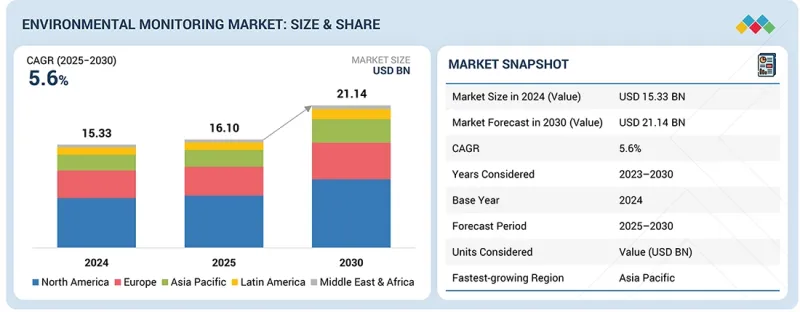
세계의 환경 모니터링 시장 규모는 2025년 161억 달러에서 2030년까지 211억 4,000만 달러에 달할 것으로 예측되고 있으며, CAGR은 5.6%로 전망되고 있습니다.
| 조사 범위 | |
|---|---|
| 조사 대상 기간 | 2024-2030년 |
| 기준연도 | 2024년 |
| 예측 기간 | 2025-2030년 |
| 대상 단위 | 금액(달러) |
| 부문 | 제품, 샘플링 방법, 컴포넌트, 용도, 최종사용자, 지역 |
| 대상 지역 | 북미, 유럽, 아시아태평양, 라틴아메리카, 중동 및 아프리카 |
정부의 엄격한 오염 모니터링 기준, PM2.5 수준의 상승으로 인한 대기 질 악화, 이러한 수준으로 인한 건강 우려 증가 등의 요인이 환경 모니터링 시장을 주도하고 있습니다.
"야외 모니터 부문은 예측 기간 중 가장 높은 성장률을 나타낼 것으로 예측됩니다. "
제품별로 환경 모니터링 시장은 실내 모니터, 야외 모니터, 센서, 웨어러블 기기, 소프트웨어로 분류됩니다. 야외 모니터 부문은 다시 고정형 모니터와 휴대용 모니터로 세분화됩니다. 야외 모니터 부문은 첨단 모니터링 기술의 보급, IoT 통합, 무선 연결 솔루션의 발전으로 인해 가장 높은 성장률을 보일 것으로 예측됩니다. 미세먼지(PM2.5, PM10), 휘발성유기화합물(VOC), 온실가스를 실시간으로 측정하기 위해 환경 모니터와 센서가 점점 더 많이 활용되고 있습니다. 이러한 제품 수요 증가는 주로 환경 친화적인 산업 공정의 확립을 위한 정부 규제의 강화, 환경오염 모니터링 시스템의 산업적 용도 증가, 야외 고정형 모니터의 최종사용자 기반 확대, 대규모 환경 모니터링 시스템 개발을 위한 정부 자금 지원 증가, 환경 보전 및 기후 변화로 인한 생태계 영향 억제를 위한 민관 협력의 지속적 노력에 기인합니다. 대규모 환경 모니터링 시스템 개발을 위한 정부 자금 증가, 환경보전과 기후 변화로 인한 생태계 영향을 억제하기 위한 민관 협력의 지속적 노력에 기인합니다.
"용도별로는 대기오염 모니터링 부문이 예측 기간 중 가장 높은 CAGR을 나타낼 것으로 예측됩니다. "
용도별로 환경 모니터링 시장은 대기오염 모니터링, 수질오염 모니터링, 토양오염 모니터링, 소음오염 모니터링으로 분류됩니다. 수질오염 모니터링 분야는 다시 지표수 및 지하수 모니터링과 폐수 모니터링으로 세분화됩니다. 주요 시장(미국, 유럽, 중국, 인도, 중동 등)의 대기오염 수준 증가, 센서 기반 공기질 모니터링 시스템에 대한 수용성 및 수요 증가, 건강에 대한 관심 증가, 여러 정부의 엄격한 대기오염 규제법으로 인해 대기오염 모니터링은 예측 기간 중 가장 빠른 성장세를 보일 것으로 예측됩니다. 응용 분야가 될 것으로 예측됩니다.
"예측 기간 중 아시아태평양이 가장 높은 성장률을 보일 것으로 예측됩니다. "
아시아태평양은 석유화학 정련소와 금속 및 광업의 주요 거점이며, 이는 전 세계 대기 및 수질 오염 수준의 연간 상승에 크게 기여하고 있습니다. 중국 정부의 엄격한 오염 모니터링 전략 시행, 급속한 대규모 산업화, 점점 더 엄격해지는 환경 규제, 안전 규제에 대한 대응 수요 증가는 이 지역의 환경 모니터링 제품에 대한 수요 증가를 촉진할 것으로 예측됩니다. 첨단 산업 클러스터에서는 환경 시스템의 이상 감지 및 예지보전을 위해 IoT 지원 센서 네트워크와 AI 기반 모니터링 소프트웨어를 통합하고 있습니다. 일본과 인도 등의 국가에서의 스마트 시티 구상도 실시간 대기질 대시보드를 지원하는 광범위한 환경 센서 네트워크의 보급을 촉진하고 있습니다.
세계의 환경 모니터링(Environmental Monitoring) 시장을 조사했으며, 시장 개요, 시장 성장에 영향을 미치는 각종 영향요인 분석, 기술 및 특허 동향, 법 및 규제 환경, 사례 분석, 시장 규모 추이 및 예측, 각종 부문별/지역별/주요 국가별 상세 분석, 경쟁 구도, 주요 기업 개요 등의 정보를 정리하여 전해드립니다.
자주 묻는 질문
목차
제1장 서론
제2장 개요
제3장 주요 인사이트
제4장 시장 개요
제5장 업계 동향
제6장 기술, 특허, 디지털, AI의 도입에 의한 전략적 파괴
제7장 지속가능성과 규제 상황
제8장 고객 상황과 구매 행동
제9장 환경 모니터링 시장 : 제품별
제10장 환경 모니터링 시장 : 샘플링 방법별
제11장 환경 모니터링 시장 : 컴포넌트별
제12장 환경 모니터링 시장 : 용도별
제13장 환경 모니터링 시장 : 최종사용자별
제14장 환경 모니터링 시장 : 지역별
제15장 경쟁 구도
제16장 기업 개요
제17장 조사 방법
제18장 부록
KSA 26.03.05The global environmental monitoring market is projected to reach USD 21.14 billion by 2030 from USD 16.10 billion in 2025, at a CAGR of 5.6%.
| Scope of the Report | |
|---|---|
| Years Considered for the Study | 2024-2030 |
| Base Year | 2024 |
| Forecast Period | 2025-2030 |
| Units Considered | Value (USD billion) |
| Segments | Product, Sampling Method, Component, Application, End User and Region |
| Regions covered | North America, Europe, APAC, LATAM, MEA |
Factors such as stringent government pollution-monitoring standards, deteriorating air quality due to rising PM2.5 levels, and increased health concerns stemming from these levels are driving the environmental monitoring market.
"The outdoor monitors segment to record fastest growth rate over forecast period"
Based on product, the environmental monitoring market is classified into indoor monitors, outdoor monitors, sensors, wearables, and software. The outdoor monitors segment is further segmented into fixed monitors and portable monitors. The outdoor monitors segment is anticipated to grow at the fastest rate, driven by the growing adoption of advanced monitoring technologies, Internet of Things (IoT) integration, and wireless connectivity solutions. Environmental monitors and sensors are increasingly used to measure particulate matter (PM2.5, PM10), volatile organic compounds (VOCs), and greenhouse gases in real time. The growing demand for these products can majorly be attributed to the rising industrial use of environmental pollution monitoring systems (coupled with the increasingly stringent government regulations for establishing environment-friendly industrial processes), expansion of the end user base of fixed outdoor monitors, increasing government funding to develop large-scale environmental monitoring systems, and continuous public-private initiatives for environmental preservation and limiting the ecological effects of climate change.
"By application, air pollution monitoring segment to register highest CAGR during forecast period"
Based on application, the environmental monitoring market is divided into air pollution monitoring, water pollution monitoring, soil pollution monitoring, and noise pollution monitoring. The water pollution monitoring segment is further categorized as surface & groundwater monitoring and wastewater monitoring. Air pollution monitoring is expected to be the fastest-growing application during the forecast period due to the rising level of air pollution across key markets (such as the US, Europe, China, India, and the Middle East), growing acceptance and demand for sensor-based air quality monitoring systems, increasing health concerns, and stringent air pollution control legislation by several governments.
"Asia Pacific to witness the highest growth rate during the forecast period"
Asia Pacific is anticipated to witness the fastest growth rate over the forecast period. It is segmented into China, India, Japan, South Korea, Australia, and the Rest of Asia Pacific, including Malaysia, Taiwan, Singapore, and New Zealand. The Asia-Pacific region is a major hub for petrochemical refineries and the metals and mining industries, which have contributed significantly to the annual rise in global air and water pollution levels. The government's increasing emphasis on strict implementation of pollution monitoring strategies, rapid and large-scale industrialization, increasingly stringent environmental regulations, and the growing need to comply with safety regulations are expected to boost the region's demand for environmental monitoring products. Advanced industrial clusters are integrating IoT-enabled sensor networks with AI-driven monitoring software for anomaly detection and predictive maintenance of environmental systems. Smart-city initiatives in countries such as Japan and India also promote broader networks of ambient sensors to support real-time air-quality dashboards.
A breakdown of the primary participants referred to for this report is provided below:
- By Company Type: Tier 1 - 45%, Tier 2 - 35%, and Tier 3 - 20%
- By Designation: C-level Executives - 30%, Directors - 20%, and Others - 50%
- By Region: North America - 36%, Europe - 22%, Asia Pacific - 20%, Latin America - 12%, and Middle East and Africa - 10%
The prominent players in the environmental monitoring market are as follows:
Agilent Technologies (US), Danaher (US), Thermo Fisher Scientific (US), Shimadzu Corporation (Japan), PerkinElmer (US), 3M (US), Emerson Electric Co. (US), bioMerieux S.A. (France), Honeywell International Inc. (US), Merck KGaA (Germany), Siemens AG (Germany), Emerson Electric Co. (US), and Forbes Marshall (India), among others.
Research Coverage
This report analyzes the environmental monitoring market by product, component, sampling type, application, end user, and region. It also covers the factors impacting market growth, analyzes various opportunities and challenges, and provides details on the competitive landscape for market leaders. Furthermore, the report analyzes micromarkets by growth trends and forecasts market segment revenue across five main regions (and the respective countries in these regions).
Reasons to Buy the Report
The report will help market leaders/new entrants with information on the closest approximations of revenue for the overall environmental monitoring market and its subsegments. This report will help stakeholders understand the competitive landscape and gain deeper insights to position their businesses better and plan suitable go-to-market strategies. The report also helps stakeholders understand the market pulse and provides insights into key drivers, restraints, challenges, and opportunities.
This report provides insights into the following pointers:
- Analysis of key drivers (Development of environment-friendly industries, increased health concerns due to rising pollution levels), restraints (High cost of environmental monitoring products), opportunities (Increased government funding to prevent and control environmental pollution, growth opportunities in emerging markets), and challenges (Slow adoption of environmental control policies) influencing the growth of the environmental monitoring market
- Product Development/Innovation: Detailed insights on upcoming technologies, research & development activities, and new product & service launches in the environmental monitoring market
- Market Development: Comprehensive information about lucrative markets by providing the environmental monitoring market analysis across varied regions
- Market Diversification: Exhaustive information about new products & services, untapped geographies, recent developments, and investments in the environmental monitoring market
- Competitive Assessment: In-depth assessment of market shares, growth strategies, and service offerings of leading players like Thermo Fisher Scientific Inc. (US), Danaher Corporation (US), Agilent Technologies, Inc. (US), 3M (US), and Shimadzu Corporation (Japan).
TABLE OF CONTENTS
1 INTRODUCTION
- 1.1 STUDY OBJECTIVES
- 1.2 MARKET DEFINITION
- 1.3 STUDY SCOPE
- 1.3.1 MARKET SEGMENTATION & REGIONAL SCOPE
- 1.3.2 INCLUSIONS & EXCLUSIONS
- 1.3.3 YEARS CONSIDERED
- 1.3.4 CURRENCY CONSIDERED
- 1.4 STAKEHOLDERS
2 EXECUTIVE SUMMARY
- 2.1 MARKET HIGHLIGHTS & KEY INSIGHTS
- 2.2 KEY MARKET PARTICIPANTS: MAPPING OF STRATEGIC DEVELOPMENTS
- 2.3 DISRUPTIVE TRENDS IN ENVIRONMENTAL MONITORING MARKET
- 2.4 HIGH-GROWTH SEGMENTS
3 PREMIUM INSIGHTS
- 3.1 ENVIRONMENTAL MONITORING MARKET OVERVIEW
- 3.2 ENVIRONMENTAL MONITORING MARKET, BY REGION
- 3.3 ASIA PACIFIC: ENVIRONMENTAL MONITORING MARKET, BY REGION AND END USER
- 3.4 GEOGRAPHIC SNAPSHOT OF ENVIRONMENTAL MONITORING MARKET
4 MARKET OVERVIEW
- 4.1 INTRODUCTION
- 4.2 MARKET DYNAMICS
- 4.2.1 DRIVERS
- 4.2.1.1 Growing need for efficient natural resource management
- 4.2.1.2 Development of environment-friendly industries
- 4.2.1.3 Development of wireless cellular and non-cellular communication technologies
- 4.2.1.4 Increased health concerns due to rising pollution levels
- 4.2.2 RESTRAINTS
- 4.2.2.1 High cost of environmental monitoring products
- 4.2.2.2 Limited technical expertise and infrastructure
- 4.2.3 OPPORTUNITIES
- 4.2.3.1 Increased government funding to prevent and control environmental pollution
- 4.2.3.2 Supportive government rules and regulations against environmental pollution
- 4.2.3.3 Growing oil & gas industry
- 4.2.3.4 Growth opportunities in emerging markets
- 4.2.4 CHALLENGES
- 4.2.4.1 Slow adoption of pollution control policies
- 4.2.4.2 Lack of protocol standardization across countries
- 4.2.1 DRIVERS
- 4.3 UNMET NEEDS & WHITE SPACES
- 4.4 INTERCONNECTED MARKETS & CROSS-SECTOR OPPORTUNITIES
- 4.5 STRATEGIC MOVES BY TIER-1/2/3 PLAYERS
5 INDUSTRY TRENDS
- 5.1 PORTER'S FIVE FORCES ANALYSIS
- 5.1.1 THREAT OF NEW ENTRANTS
- 5.1.2 THREAT OF SUBSTITUTES
- 5.1.3 BARGAINING POWER OF SUPPLIERS
- 5.1.4 BARGAINING POWER OF BUYERS
- 5.1.5 INTENSITY OF COMPETITIVE RIVALRY
- 5.2 MACROECONOMIC OUTLOOK
- 5.2.1 INTRODUCTION
- 5.2.2 GDP TRENDS AND FORECAST
- 5.2.3 TRENDS IN GLOBAL ENVIRONMENTAL MONITORING INDUSTRY
- 5.3 VALUE CHAIN ANALYSIS
- 5.3.1 RESEARCH & DEVELOPMENT
- 5.3.2 RAW MATERIAL PROCUREMENT AND MANUFACTURING
- 5.3.3 DISTRIBUTION AND MARKETING & SALES
- 5.3.4 POST-SALES SERVICES
- 5.4 SUPPLY CHAIN ANALYSIS
- 5.4.1 RAW MATERIAL PROCUREMENT
- 5.4.2 MANUFACTURING
- 5.4.3 SALES & DISTRIBUTION
- 5.4.4 END USERS
- 5.5 ECOSYSTEM ANALYSIS
- 5.5.1 ROLE IN ECOSYSTEM
- 5.6 PRICING ANALYSIS
- 5.6.1 AVERAGE SELLING PRICE OF ENVIRONMENTAL MONITORING ANALYTICAL INSTRUMENTS, BY TYPE, 2024
- 5.6.2 AVERAGE SELLING PRICE OF ENVIRONMENTAL MONITORING PRODUCTS, BY KEY PLAYER, 2024
- 5.6.3 AVERAGE SELLING PRICE OF ENVIRONMENTAL MONITORING PRODUCTS, BY REGION, 2023-2025
- 5.7 TRADE ANALYSIS
- 5.7.1 IMPORT SCENARIO FOR HS CODE 9031
- 5.7.2 EXPORT SCENARIO FOR HS CODE 9031
- 5.8 KEY CONFERENCES & EVENTS, 2025-2027
- 5.9 TRENDS/DISRUPTIONS IMPACTING CUSTOMER'S BUSINESS
- 5.10 INVESTMENT & FUNDING SCENARIO
- 5.11 IMPACT OF 2025 US TARIFF ON ENVIRONMENTAL MONITORING MARKET
- 5.11.1 KEY TARIFF RATES
- 5.11.2 PRICE IMPACT ANALYSIS
- 5.11.3 IMPACT ON COUNTRY/REGION
- 5.11.3.1 North America
- 5.11.3.1.1 US
- 5.11.3.2 Europe
- 5.11.3.3 Asia Pacific
- 5.11.3.1 North America
- 5.11.4 IMPACT ON END-USE INDUSTRIES
6 STRATEGIC DISRUPTION THROUGH TECHNOLOGY, PATENTS, DIGITAL, AND AI ADOPTIONS
- 6.1 TECHNOLOGY ANALYSIS
- 6.1.1 KEY TECHNOLOGIES
- 6.1.1.1 Analytical laboratory technologies
- 6.1.1.2 Remote sensing & satellite technology
- 6.1.1.3 Wireless sensor technologies
- 6.1.2 COMPLEMENTARY TECHNOLOGIES
- 6.1.2.1 Cloud computing and data management
- 6.1.2.2 Automation and robotics
- 6.1.3 ADJACENT TECHNOLOGIES
- 6.1.3.1 Geographic information system (GIS)
- 6.1.1 KEY TECHNOLOGIES
- 6.2 PATENT ANALYSIS
- 6.3 IMPACT OF AI/GEN AI ON ENVIRONMENTAL MONITORING MARKET
- 6.3.1 TOP USE CASES AND MARKET POTENTIAL
- 6.3.2 AI USE CASES
- 6.3.3 BEST PRACTICES IN ENVIRONMENTAL MONITORING MARKET
- 6.3.4 CASE STUDIES
- 6.3.5 INTERCONNECTED ADJACENT ECOSYSTEM & IMPACT ON MARKET PLAYERS
- 6.3.6 CLIENTS' READINESS TO ADOPT GENERATIVE AI
- 6.4 SUCCESS STORIES & REAL-WORLD APPLICATIONS
- 6.5 FUTURE APPLICATIONS
7 SUSTAINABILITY AND REGULATORY LANDSCAPE
- 7.1 REGIONAL REGULATIONS & COMPLIANCE
- 7.1.1 REGULATORY BODIES, GOVERNMENT AGENCIES, AND OTHER ORGANIZATIONS
- 7.1.2 INDUSTRY STANDARDS
- 7.1.2.1 North America
- 7.1.2.1.1 US
- 7.1.2.1.2 Canada
- 7.1.2.2 Europe
- 7.1.2.2.1 UK
- 7.1.2.2.2 France
- 7.1.2.2.3 Germany
- 7.1.2.3 Asia Pacific
- 7.1.2.3.1 China
- 7.1.2.3.2 Japan
- 7.1.2.3.3 India
- 7.1.2.4 Latin America
- 7.1.2.4.1 Brazil
- 7.1.2.4.2 Mexico
- 7.1.2.5 Middle East & Africa
- 7.1.2.5.1 UAE
- 7.1.2.5.2 South Africa
- 7.1.2.1 North America
- 7.2 SUSTAINABILITY IMPACT & REGULATORY POLICY INITIATIVES
- 7.3 CERTIFICATIONS, LABELING, AND ECO-STANDARDS
8 CUSTOMER LANDSCAPE & BUYER BEHAVIOR
- 8.1 DECISION-MAKING PROCESS
- 8.2 KEY STAKEHOLDERS & BUYING EVALUATION CRITERIA
- 8.2.1 KEY STAKEHOLDERS IN BUYING PROCESS
- 8.2.2 KEY STAKEHOLDERS IN BUYING PROCESS
- 8.2.3 KEY BUYING CRITERIA
- 8.3 ADOPTION BARRIERS & INTERNAL CHALLENGES
- 8.4 UNMET NEEDS FROM VARIOUS END-USE INDUSTRIES
9 ENVIRONMENTAL MONITORING MARKET, BY PRODUCT
- 9.1 INTRODUCTION
- 9.2 INDOOR MONITORS
- 9.2.1 FIXED INDOOR MONITORS
- 9.2.1.1 Integration with building systems and regulatory compliance to drive adoption
- 9.2.2 PORTABLE INDOOR MONITORS
- 9.2.2.1 Personalized and decentralized indoor air quality awareness to fuel market demand
- 9.2.1 FIXED INDOOR MONITORS
- 9.3 OUTDOOR MONITORS
- 9.3.1 FIXED OUTDOOR MONITORS
- 9.3.1.1 Integrated multi-media environmental sensing for holistic pollution management to propel market growth
- 9.3.2 PORTABLE OUTDOOR MONITORS
- 9.3.2.1 Focus on ESG/sustainability reporting and corporate risk management to support segment growth
- 9.3.1 FIXED OUTDOOR MONITORS
- 9.4 SENSORS
- 9.4.1 INDUSTRIAL DIGITIZATION AND IOT INTEGRATION TO BE KEY GROWTH STRATEGIES FOR ENVIRONMENTAL SENSORS
- 9.5 WEARABLES
- 9.5.1 PERSONALIZED HEALTH AND EXPOSURE ANALYTICS TO FUEL WEARABLE MONITOR ADOPTION
- 9.6 SOFTWARE
- 9.6.1 CLOUD-BASED ENVIRONMENTAL INTELLIGENCE AND DATA INTEGRATION TO DRIVE SOFTWARE ADOPTION
10 ENVIRONMENTAL MONITORING MARKET, BY SAMPLING METHOD
- 10.1 INTRODUCTION
- 10.2 CONTINUOUS MONITORING
- 10.2.1 REGULATORY PRESSURE FOR REAL-TIME PUBLIC HEALTH PROTECTION TO FOCUS ON MARKET GROWTH
- 10.3 ACTIVE MONITORING
- 10.3.1 TARGETED SOURCE IDENTIFICATION THROUGH ACTIVELY STIMULATED SAMPLING TO PROPEL MARKET GROWTH
- 10.4 PASSIVE MONITORING
- 10.4.1 LONG-TERM EXPOSURE MAPPING WITH MINIMAL OPERATIONAL BURDEN TO AUGMENT MARKET GROWTH
- 10.5 INTERMITTENT MONITORING
- 10.5.1 EVENT-DRIVEN SAMPLING FOR EPISODIC POLLUTION MANAGEMENT TO AID MARKET GROWTH
11 ENVIRONMENTAL MONITORING MARKET, BY COMPONENT
- 11.1 INTRODUCTION
- 11.2 PARTICULATE DETECTION
- 11.2.1 PM2.5 DETECTION
- 11.2.1.1 Regulatory scrutiny and increased adverse health issues to propel detection
- 11.2.2 PM10
- 11.2.2.1 Focus on urban planning and dust source management to aid market growth
- 11.2.3 OTHER PARTICULATE DETECTION
- 11.2.1 PM2.5 DETECTION
- 11.3 CHEMICAL DETECTION
- 11.3.1 GAS DETECTION
- 11.3.1.1 Focus on industrial safety and regulatory compliance to aid segment growth
- 11.3.2 VOLATILE ORGANIC COMPOUND DETECTION
- 11.3.2.1 Indoor air quality management and public health protection to augment segment growth
- 11.3.3 PESTICIDE DETECTION
- 11.3.3.1 Agricultural safety and environmental risk mitigation to focus on market growth
- 11.3.4 OTHER CHEMICAL DETECTION
- 11.3.1 GAS DETECTION
- 11.4 BIOLOGICAL DETECTION
- 11.4.1 INCREASING CONCERNS OVER MICROBIAL EXPOSURE AND FOCUS ON REAL-TIME PATHOGEN MONITORING TO DRIVE MARKET
- 11.5 TEMPERATURE SENSING
- 11.5.1 CONTEXTUALIZATION FOR MULTI-PARAMETER ENVIRONMENTAL ANALYTICS TO AID MARKET GROWTH
- 11.6 MOISTURE DETECTION
- 11.6.1 NEED TO IMPROVE CHEMICAL, PARTICULATE, AND BIOLOGICAL SENSOR ACCURACY TO FOCUS ON MARKET GROWTH
- 11.7 NOISE MEASUREMENT
- 11.7.1 ASSESSMENT OF ENVIRONMENTAL NOISE TO BE ESSENTIAL FOR FAVORABLE URBAN AND PUBLIC HEALTH POLICY
12 ENVIRONMENTAL MONITORING MARKET, BY APPLICATION
- 12.1 INTRODUCTION
- 12.2 AIR POLLUTION MONITORING
- 12.2.1 REAL-TIME MULTI-POLLUTANT INTELLIGENCE FOR PUBLIC HEALTH AND URBAN MANAGEMENT TO DRIVE MARKET
- 12.3 WATER POLLUTION MONITORING
- 12.3.1 WASTEWATER MONITORING
- 12.3.1.1 Regulatory compliance and contaminant source control to propel market growth
- 12.3.2 SURFACE & GROUNDWATER MONITORING
- 12.3.2.1 Resource sustainability and environmental risk mitigation to aid market growth
- 12.3.1 WASTEWATER MONITORING
- 12.4 SOIL POLLUTION MONITORING
- 12.4.1 NEED TO SAFEGUARD SOIL HEALTH FOR AGRICULTURE, FORESTRY, AND URBAN DEVELOPMENT TO AUGMENT MARKET GROWTH
- 12.5 NOISE POLLUTION MONITORING
- 12.5.1 RISING GOVERNMENT FUNDING FOR EFFECTIVE NOISE POLLUTION MANAGEMENT TO FAVOR MARKET GROWTH
13 ENVIRONMENTAL MONITORING MARKET, BY END USER
- 13.1 INTRODUCTION
- 13.2 GOVERNMENT AGENCIES & SMART CITY AUTHORITIES
- 13.2.1 DATA-DRIVEN URBAN GOVERNANCE AND STRICT REGULATORY ENFORCEMENT TO DRIVE MARKET
- 13.3 ENTERPRISES
- 13.3.1 ENTERPRISES TO DEPLOY ENVIRONMENTAL MONITORING SYSTEMS FOR ESG DISCLOSURES AND ENVIRONMENTAL RISK MITIGATION
- 13.4 COMMERCIAL USERS
- 13.4.1 FACILITY OPTIMIZATION AND COMPLIANCE ACROSS SERVICE ENVIRONMENTS TO DRIVE MARKET
- 13.5 RESIDENTIAL USERS
- 13.5.1 HEALTH-DRIVEN DEMAND FOR INDOOR AND AMBIENT ENVIRONMENTAL INTELLIGENCE TO AID MARKET ADOPTION
- 13.6 HEALTHCARE & PHARMACEUTICAL INDUSTRIES
- 13.6.1 PRECISION ENVIRONMENTAL CONTROL FOR PATIENT SAFETY AND PRODUCT INTEGRITY TO PROPEL MARKET GROWTH
- 13.7 INDUSTRIAL USERS
- 13.7.1 FOCUS ON EMISSIONS CONTROL, WORKER SAFETY, AND OPERATIONAL EFFICIENCY TO FAVOR MARKET GROWTH
- 13.8 OTHER END USERS
14 ENVIRONMENTAL MONITORING MARKET, BY REGION
- 14.1 INTRODUCTION
- 14.2 NORTH AMERICA
- 14.2.1 MACROECONOMIC OUTLOOK FOR NORTH AMERICA
- 14.2.2 US
- 14.2.2.1 US to dominate North American environmental monitoring market during study period
- 14.2.3 CANADA
- 14.2.3.1 Industrial decarbonization, high ESG disclosure pressure, and increased environmental monitoring funding to drive market
- 14.3 EUROPE
- 14.3.1 MACROECONOMIC OUTLOOK FOR EUROPE
- 14.3.2 GERMANY
- 14.3.2.1 Industrial modernization and improved precision manufacturing standards to aid market growth
- 14.3.3 FRANCE
- 14.3.3.1 Focus on urban health and public-space air-quality transformation to augment market growth
- 14.3.4 UK
- 14.3.4.1 Increased importance of infrastructure renewal and environmental risk governance to favor market growth
- 14.3.5 ITALY
- 14.3.5.1 Environmental compliance and regional ecosystem restoration to drive market
- 14.3.6 SPAIN
- 14.3.6.1 Integrated climate resilience across air, water, soil, and noise to aid market growth
- 14.3.7 REST OF EUROPE
- 14.4 ASIA PACIFIC
- 14.4.1 MACROECONOMIC OUTLOOK FOR ASIA PACIFIC
- 14.4.2 JAPAN
- 14.4.2.1 High industrial precision standards and environmental compliance in pharmaceuticals to drive market
- 14.4.3 CHINA
- 14.4.3.1 Integration of advanced technology and industrial-emission precision monitoring to propel market growth
- 14.4.4 INDIA
- 14.4.4.1 Regulatory tightening under National Clean Air Programme (NCAP) to augment market growth
- 14.4.5 SOUTH KOREA
- 14.4.5.1 National push for hyper-precision air-quality forecasting and sensor density expansion to propel market growth
- 14.4.6 AUSTRALIA
- 14.4.6.1 Climate driven wildfire risk and need for early-warning environmental intelligence to boost market growth
- 14.4.7 REST OF ASIA PACIFIC
- 14.5 LATIN AMERICA
- 14.5.1 MACROECONOMIC OUTLOOK FOR LATIN AMERICA
- 14.5.2 BRAZIL
- 14.5.2.1 Climate-amplified water insecurity and basin degradation to fuel adoption of environmental monitoring
- 14.5.3 MEXICO
- 14.5.3.1 Urban water scarcity and wastewater-driven public-health risk to drive market
- 14.5.4 REST OF LATIN AMERICA
- 14.6 MIDDLE EAST & AFRICA
- 14.6.1 MACROECONOMIC OUTLOOK FOR MIDDLE EAST & AFRICA
- 14.6.2 GCC COUNTRIES
- 14.6.2.1 Water scarcity and technological modernization under climate pressure to propel adoption of environmental monitoring
- 14.6.3 REST OF MIDDLE EAST & AFRICA
15 COMPETITIVE LANDSCAPE
- 15.1 INTRODUCTION
- 15.2 KEY PLAYER STRATEGIES/RIGHT TO WIN
- 15.2.1 OVERVIEW OF STRATEGIES ADOPTED BY KEY PLAYERS IN ENVIRONMENTAL MONITORING MARKET
- 15.3 REVENUE ANALYSIS, 2020-2024
- 15.4 MARKET SHARE ANALYSIS, 2024
- 15.4.1 RANKING OF KEY PLAYERS
- 15.5 COMPANY EVALUATION MATRIX: KEY PLAYERS, 2024
- 15.5.1 STARS
- 15.5.2 EMERGING LEADERS
- 15.5.3 PERVASIVE PLAYERS
- 15.5.4 PARTICIPANTS
- 15.5.5 COMPANY FOOTPRINT: KEY PLAYERS, 2024
- 15.5.5.1 Company footprint
- 15.5.5.2 Region footprint
- 15.5.5.3 Product footprint
- 15.5.5.4 Application footprint
- 15.5.5.5 End-use footprint
- 15.6 COMPANY EVALUATION MATRIX: STARTUPS/SMES, 2024
- 15.6.1 PROGRESSIVE COMPANIES
- 15.6.2 RESPONSIVE COMPANIES
- 15.6.3 DYNAMIC COMPANIES
- 15.6.4 STARTING BLOCKS
- 15.6.5 COMPETITIVE BENCHMARKING OF STARTUPS/SMES, 2024
- 15.6.5.1 Detailed list of key startups/SMEs
- 15.6.5.2 Competitive benchmarking of key startups/SMEs
- 15.7 COMPETITIVE SCENARIO
- 15.7.1 PRODUCT LAUNCHES
- 15.7.2 DEALS
- 15.7.3 EXPANSIONS
- 15.8 COMPANY VALUATION & FINANCIAL METRICS
- 15.8.1 FINANCIAL METRICS
- 15.8.2 COMPANY VALUATION
- 15.9 BRAND/PRODUCT COMPARISON
16 COMPANY PROFILES
- 16.1 KEY PLAYERS
- 16.1.1 THERMO FISHER SCIENTIFIC INC.
- 16.1.1.1 Business overview
- 16.1.1.2 Products offered
- 16.1.1.3 Recent developments
- 16.1.1.3.1 Product launches
- 16.1.1.4 MnM view
- 16.1.1.4.1 Right to win
- 16.1.1.4.2 Strategic choices
- 16.1.1.4.3 Weaknesses & competitive threats
- 16.1.2 AGILENT TECHNOLOGIES, INC.
- 16.1.2.1 Business overview
- 16.1.2.2 Products offered
- 16.1.2.3 Recent developments
- 16.1.2.3.1 Product launches
- 16.1.2.3.2 Deals
- 16.1.2.4 MnM view
- 16.1.2.4.1 Right to win
- 16.1.2.4.2 Strategic choices
- 16.1.2.4.3 Weaknesses & competitive threats
- 16.1.3 VERALTO (DANAHER CORPORATION)
- 16.1.3.1 Business overview
- 16.1.3.2 Products offered
- 16.1.3.3 Recent developments
- 16.1.3.3.1 Product launches
- 16.1.3.4 Other developments
- 16.1.3.5 MnM view
- 16.1.3.5.1 Right to win
- 16.1.3.5.2 Strategic choices
- 16.1.3.5.3 Weaknesses & competitive threats
- 16.1.4 SHIMADZU CORPORATION
- 16.1.4.1 Business overview
- 16.1.4.2 Products offered
- 16.1.4.3 Recent developments
- 16.1.4.3.1 Product launches
- 16.1.4.3.2 Expansions
- 16.1.4.4 MnM view
- 16.1.4.4.1 Right to win
- 16.1.4.4.2 Strategic choices
- 16.1.4.4.3 Weaknesses & competitive threats
- 16.1.5 PERKINELMER
- 16.1.5.1 Business overview
- 16.1.5.2 Products offered
- 16.1.5.3 Recent developments
- 16.1.5.3.1 Product launches
- 16.1.5.4 MnM view
- 16.1.5.4.1 Right to win
- 16.1.5.4.2 Strategic choices
- 16.1.5.4.3 Weaknesses & competitive threats
- 16.1.6 3M
- 16.1.6.1 Business overview
- 16.1.6.2 Products offered
- 16.1.6.3 Recent developments
- 16.1.6.3.1 Product launches
- 16.1.7 EMERSON ELECTRIC CO.
- 16.1.7.1 Business overview
- 16.1.7.2 Products offered
- 16.1.7.3 Recent developments
- 16.1.7.3.1 Product launches
- 16.1.8 BIOMERIEUX
- 16.1.8.1 Business overview
- 16.1.8.2 Products offered
- 16.1.9 MERCK KGAA
- 16.1.9.1 Business overview
- 16.1.9.2 Products offered
- 16.1.10 HONEYWELL INTERNATIONAL, INC.
- 16.1.10.1 Business overview
- 16.1.10.2 Products offered
- 16.1.10.3 Recent developments
- 16.1.11 SIEMENS
- 16.1.11.1 Business overview
- 16.1.11.2 Products offered
- 16.1.11.3 Recent developments
- 16.1.11.3.1 Expansions
- 16.1.12 FORBES MARSHALL
- 16.1.12.1 Business overview
- 16.1.12.2 Products offered
- 16.1.13 HORIBA LTD.
- 16.1.13.1 Business overview
- 16.1.13.2 Products offered
- 16.1.13.3 Recent developments
- 16.1.13.3.1 Product launches
- 16.1.14 TELEDYNE TECHNOLOGIES
- 16.1.14.1 Business overview
- 16.1.14.2 Products offered
- 16.1.15 TE CONNECTIVITY
- 16.1.15.1 Business overview
- 16.1.15.2 Products offered
- 16.1.1 THERMO FISHER SCIENTIFIC INC.
- 16.2 OTHER PLAYERS
- 16.2.1 ENVIRONMENTAL SENSORS INC.
- 16.2.2 SPECTRIS
- 16.2.3 RTX
- 16.2.4 AMS-OSRAM AG
- 16.2.5 POWTECHNOLOGY LIMITED
- 16.2.6 RARITAN INC. (LEGRAND)
- 16.2.7 NESA SRL (OFFICINE MACCAFERRI SPA)
- 16.2.8 TEXAS INSTRUMENTS INCORPORATED
- 16.2.9 SENSIRION AG
- 16.2.10 OMEGA ENGINEERING INC. (DWYEROMEGA)
- 16.2.11 AEROQUAL
17 RESEARCH METHODOLOGY
- 17.1 RESEARCH DATA
- 17.1.1 SECONDARY RESEARCH
- 17.1.1.1 Key secondary sources
- 17.1.1.2 Key data from secondary sources
- 17.1.1.3 Objectives of secondary research
- 17.1.2 PRIMARY RESEARCH
- 17.1.2.1 Key primary sources
- 17.1.3 KEY PARTICIPANTS
- 17.1.3.1 Breakdown of primary interviews
- 17.1.3.2 Objectives of primary research
- 17.1.3.3 Key industry insights
- 17.1.1 SECONDARY RESEARCH
- 17.2 MARKET SIZE ESTIMATION
- 17.2.1 BOTTOM-UP APPROACH
- 17.2.1.1 Company revenue estimation
- 17.2.1.2 Customer-based market estimation
- 17.2.1.3 Primary interviews
- 17.2.2 TOP-DOWN APPROACH
- 17.2.1 BOTTOM-UP APPROACH
- 17.3 DATA TRIANGULATION
- 17.4 STUDY ASSUMPTIONS
- 17.5 RESEARCH LIMITATIONS
- 17.6 RISK ASSESSMENT
- 17.7 GROWTH RATE ASSUMPTIONS
- 17.8 SUMMARY OF CHANGES
18 APPENDIX
- 18.1 DISCUSSION GUIDE
- 18.2 KNOWLEDGESTORE: MARKETSANDMARKETS' SUBSCRIPTION PORTAL
- 18.3 CUSTOMIZATION OPTIONS
- 18.4 RELATED REPORTS
- 18.5 AUTHOR DETAILS