|
시장보고서
상품코드
1964920
해사용 디지털 트윈 시장 예측(-2032년) : 제공별, 최종사용자별, 컴포넌트별, 유형별, 실현 기술별, 지역별Digital Twin in Marine Market by Offering (Platform & Solutions, Services), End User (Shipbuilders, Ship Operators, Offshore & Energy Operators, Ports & Terminals), Component, Type, Enabling Technology, & Region - Global Forecast to 2032 |
||||||

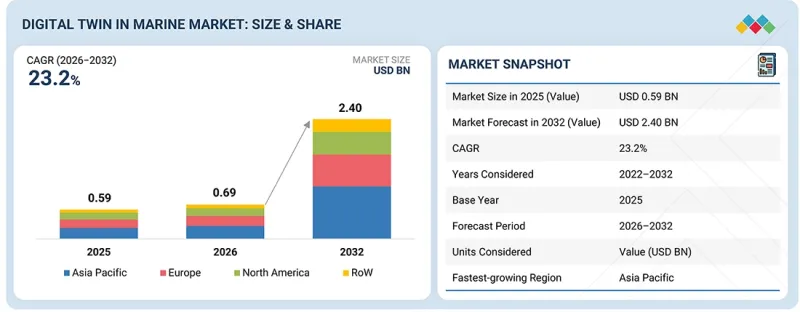
세계의 해사용 디지털 트윈 시장 규모는 2025년 5억 9,000만 달러에서 2032년까지 24억 달러에 달할 것으로 예측되며, 예측 기간에 CAGR로 23.2%의 성장이 전망되고 있습니다.
시장 성장은 해운업계의 디지털화, 운영 효율화, 자산 수명주기 최적화에 대한 집중도가 높아짐에 의해 촉진되고 있습니다. 조선사 및 선박 운영사들은 선박 설계의 정확도 향상, 실운용 환경 시뮬레이션, 시제품 제작 및 시험 관련 비용 절감을 목적으로 디지털 트윈 솔루션을 도입하고 있습니다.
| 조사 범위 | |
|---|---|
| 조사 대상 기간 | 2021-2032년 |
| 기준연도 | 2024년 |
| 예측 기간 | 2025-2032년 |
| 단위 | 10억 달러 |
| 부문 | 제공, 최종사용자, 유형, 지역 |
| 대상 지역 | 북미, 유럽, 아시아태평양, 기타 지역 |
디지털 트윈을 통해 선박의 건강, 연료 소비, 설비 신뢰성을 지속적으로 추적할 수 있으므로 예지보전 및 실시간 성능 모니터링에 대한 수요가 증가함에 따라 디지털 트윈의 도입이 더욱 가속화되고 있습니다. 항만 및 오프쇼어 사업자들도 터미널 관리 최적화, 물류 계획 강화, 오프쇼어 자산의 보다 안전한 관리를 위해 디지털 트윈을 도입하고 있습니다. 스마트 항만, 커넥티드 선박, 해양 자동화 인프라에 대한 투자 확대가 시장의 모멘텀을 강화하고 있습니다. 해사 이해관계자들이 비용 절감, 규제 준수, 지속가능성 목표를 우선시하는 가운데, 디지털 트윈 기술은 차세대 해사 업무와 장기적인 디지털 전환 전략의 중요한 원동력이 되고 있습니다.
"플랫폼 솔루션 부문이 해양용 디지털 트윈 시장에서 가장 큰 비중을 차지할 것으로 예측됩니다. "
플랫폼 솔루션 부문은 조선, 함대 운영, 항만, 해양 시설에서 종합적인 디지털 트윈 플랫폼의 채택이 확대됨에 따라 예측 기간 중 해양 디지털 트윈 시장에서 큰 비중을 차지할 것으로 예측됩니다. 해양 이해관계자들은 실시간 선박 모니터링, 예지보전, 성능 최적화를 실현하고 예기치 못한 다운타임과 운영 리스크를 줄이기 위해 디지털 트윈 솔루션을 도입하고 있습니다. 이 플랫폼은 복잡한 해양 자산 전반에 걸쳐 가상 모델링, 시뮬레이션, 데이터 통합을 지원하여 자산 수명주기 전반에 걸쳐 의사결정을 개선합니다.
중앙 집중식 분석, 원격 자산 관리, 연료 효율 최적화에 대한 수요 증가로 채택이 더욱 가속화되고 있습니다. 또한 스마트 조선소, 커넥티드 선단, 디지털 항만 인프라에 대한 투자 증가는 확장 가능한 디지털 트윈 플랫폼의 구축을 가속화하고 있습니다. 해사 조직이 운영 효율성, 안전 규정 준수, 지속가능성을 우선시하는 가운데, 플랫폼과 솔루션 제공은 해사 산업의 장기적인 디지털 전환을 달성하는 데 필수적인 요소로 자리 잡고 있습니다.
"최종사용자별로는 선박 운영자 부문이 예측 기간 중 해양 디지털 트윈 시장에서 상당한 CAGR로 성장할 것으로 예측됩니다. "
선박 운영자 부문은 실시간 선박 모니터링, 예지보전, 항해 성능 최적화 솔루션의 채택이 증가함에 따라 예측 기간 중 해양 디지털 트윈 시장에서 상당한 CAGR로 성장할 것으로 예측됩니다. 선박 운영사들은 디지털 트윈 플랫폼을 통해 선박의 가상 복제본을 구축하여 엔진 상태, 연료 소비, 구조적 건전성, 항해 성능 등을 지속적으로 분석했습니다. 이를 통해 고장을 조기에 감지할 수 있으며, 계획되지 않은 다운타임을 줄일 수 있습니다. 운영 비용 절감, 연료 효율 개선, 규제 준수, 해양 안전 향상에 대한 관심이 높아짐에 따라 채택이 더욱 가속화되고 있습니다. 또한 디지털 트윈은 최적화된 항로 계획, 기상 위험 관리, 선단 전체의 데이터베이스 의사결정을 촉진하고 장거리 운항시 신뢰성을 높입니다. 해상 운송이 더욱 연결되고 데이터 중심화됨에 따라 선박 운영업체들의 디지털 트윈 솔루션에 대한 수요는 계속 강세를 보이고 있으며, 향후 수년간 이 부문의 건전한 성장이 강화될 것으로 예측됩니다.
세계의 해양용 디지털 트윈 시장에 대해 조사 분석했으며, 주요 촉진요인 및 저해요인, 제품 개발 및 혁신, 경쟁 구도 등의 정보를 전해드립니다.
자주 묻는 질문
목차
제1장 서론
제2장 개요
제3장 중요 인사이트
제4장 시장 개요
제5장 업계 동향
제6장 기술의 진보, AI에 의한 영향, 특허, 혁신
제7장 규제 상황
제8장 고객 상황과 구매 행동
제9장 디지털 트윈 솔루션의 컴포넌트
제10장 해사 용도로 사용되는 디지털 트윈의 유형
제11장 해사용 디지털 트윈 시장 : 제공별
제12장 해사용 디지털 트윈 시장 : 최종사용자별
제13장 해사용 디지털 트윈 시장 : 지역별
제14장 경쟁 구도
제15장 기업 개요
제16장 조사 방법
제17장 부록
KSA 26.03.24The digital twin in marine market is projected to grow from USD 0.59 billion in 2025 to USD 2.40 billion by 2032, registering a CAGR of 23.2% during the forecast period. Market growth is driven by the maritime industry's increasing focus on digitalization, operational efficiency, and asset lifecycle optimization. Shipbuilders and vessel operators are adopting digital twin solutions to enhance ship design accuracy, simulate real-world operating conditions, and reduce the costs associated with prototyping and testing.
| Scope of the Report | |
|---|---|
| Years Considered for the Study | 2021-2032 |
| Base Year | 2024 |
| Forecast Period | 2025-2032 |
| Units Considered | Value (USD Billion) |
| Segments | By Offering, End User, Type and Region |
| Regions covered | North America, Europe, APAC, RoW |
The rising demand for predictive maintenance and real-time performance monitoring is further accelerating adoption, as digital twins enable the continuous tracking of vessel health, fuel consumption, and equipment reliability. Ports and offshore operators are also deploying digital twins to optimize terminal operations, enhance logistics planning, and ensure safer management of offshore assets. Growing investments in smart ports, connected vessels, and maritime automation infrastructure are strengthening market momentum. As marine stakeholders prioritize cost reduction, regulatory compliance, and sustainability goals, digital twin technology is becoming a critical enabler of next-generation maritime operations and long-term digital transformation strategies.
"By offering the platform & solutions segment to hold a significant share of the digital twin in the marine market."
The platform & solutions segment is expected to hold a significant share of the digital twin in marine market during the forecast period, driven by the increasing adoption of integrated digital twin platforms across shipbuilding, fleet operations, ports, and offshore facilities. Marine stakeholders are deploying digital twin solutions to enable real-time vessel monitoring, predictive maintenance, and performance optimization, reducing unplanned downtime and operational risks. These platforms support virtual modeling, simulation, and data integration across complex marine assets, improving decision-making throughout the asset lifecycle.
Growing demand for centralized analytics, remote asset management, and fuel efficiency optimization is further strengthening adoption. Additionally, rising investments in smart shipyards, connected fleets, and digital port infrastructure are accelerating the deployment of scalable digital twin platforms. As maritime organizations prioritize operational efficiency, safety compliance, and sustainability initiatives, platform and solution offerings are becoming essential to achieving long-term digital transformation in the marine industry.
"By end user, the ship operators segment is expected to grow at a significant CAGR in the digital twin in marine market during the forecast period."
The ship operators segment is expected to grow at a significant CAGR in the digital twin in marine market during the forecast period, driven by increasing adoption of real-time vessel monitoring, predictive maintenance, and voyage performance optimization solutions. Ship operators are deploying digital twin platforms to build virtual replicas of vessels that continuously analyze engine condition, fuel consumption, structural health, and navigational performance, enabling early fault detection and reducing unplanned downtime. Rising focus on operational cost reduction, fuel efficiency improvement, regulatory compliance, and enhanced maritime safety is further accelerating adoption. Additionally, digital twins facilitate optimized route planning, weather risk management, and data-driven decision-making across fleets, thereby enhancing reliability during long-haul operations. As maritime transport becomes more connected and data-centric, demand for digital twin solutions among ship operators is expected to remain strong, reinforcing the robust growth of this segment in the coming years.
"Asia Pacific is the fastest-growing region in the digital twin in marine market during the forecast period."
Asia Pacific is expected to witness the highest growth in the digital twin in marine market during the forecast period, driven by its dominance in global shipbuilding, expanding commercial port networks, and increasing investment in maritime digitalization. Major shipbuilding nations, including China, South Korea, and Japan, are integrating digital twin platforms into their ship design, construction, and testing processes to reduce build cycles and enhance design accuracy. At the same time, leading ports in Singapore, Shanghai, Busan, and Hong Kong are adopting digital twins to optimize berth planning, cargo handling, and terminal operations. Ship operators across the region are deploying digital twins to track real-time vessel performance, manage fuel efficiency, and facilitate predictive maintenance, thereby meeting cost reduction and emission compliance requirements. Government-backed smart port programs, green shipping initiatives, and rising adoption of connected vessel technologies are further accelerating implementation. As maritime operations in the Asia Pacific become increasingly data-driven, the region continues to lead global adoption of digital twins in the marine industry.
Breakdown of Primaries
A variety of executives from key organizations operating in the digital twin in marine market were interviewed in-depth, including CEOs, marketing directors, and innovation and technology directors.
- By Company Type: Tier 1 - 40%, Tier 2 - 35%, and Tier 3 - 25%
- By Designation: C-level - 40%, Directors - 45%, and Others - 15%
- By Region: Asia Pacific - 41%, North America - 26%, Europe - 28%, and RoW - 5%
Note: The RoW region includes the Middle East, Africa, and South America. Other designations include product, sales, and marketing managers. Three tiers of companies have been defined based on their total revenues. Tier 3: revenue less than USD 100 million, Tier 2: revenue between USD 100 million and USD 1 billion, and Tier 1: revenue more than USD 1 billion.
Key companies operating in the digital twin in marine market include Siemens (Germany), Dassault Systemes (France), ABB (Switzerland), Wartsila (Finland), Kongsberg (Norway), Hexagon (Sweden), Cadmatic (Finland), Digital Twin Marine (UK), SailPlan (UK), Prevu3D (Canada), Open Simulation Platform (Norway), Akselos S.A. (Switzerland), Cupix Inc. (US), Bentley Systems, Incorporated (US), BMT (UK), and Schneider Electric (France). Other players active in the market include NAPA (Finland), Bachmann Electronic GmbH (Austria), Navantia (Spain), CGI (Canada), Fujitsu (Japan), Bureau Veritas (France), Lloyd's Register (UK), and Fincantieri (Italy). These companies compete by developing advanced marine digital twin platforms, integrating real-time data, and utilizing simulation and analytics capabilities, as well as lifecycle management solutions for ships, offshore assets, and port infrastructure. Strategic focus areas include virtual ship design, predictive maintenance, fleet performance optimization, smart port digitalization, and offshore asset monitoring. Continuous investment in maritime digital transformation, connected vessel ecosystems, cloud-based platforms, and AI-driven operational intelligence is expected to sustain competition and innovation across the global digital twin in the marine market.
The study provides a detailed competitive analysis of these key players in the digital twin in marine market, presenting their company profiles, most recent developments, and key market strategies.
Research Coverage
The report segments the digital twin in marine market and forecasts its size by offering, end user, application based on end user, and region. The report also discusses the drivers, restraints, opportunities, and challenges pertaining to the market. It gives a detailed view of the market across four main regions-North America, Europe, Asia Pacific, and the RoW. Supply chain analysis has been included in the report, along with the key players and their competitive analysis in the digital twin in marine ecosystem.
Key Benefits of Buying the Report
- Analysis of key drivers (increasing need to manage lifecycle costs of capital-intensive marine assets, growing demand for predictive maintenance and reduced unplanned downtime, rising focus on vessel performance optimization and fuel efficiency), restraints (high initial investment and integration costs, complexity of retrofitting legacy fleets and infrastructure), opportunities (rising investment in smart ports and offshore renewable energy projects, growing adoption of system-level digital twins across connected marine ecosystems), and challenges (interoperability and integration across diverse marine stakeholders, organizational and operational challenges in scaling beyond pilot projects) influencing the growth of the digital twin in marine market.
- Product Development/Innovation: Detailed insights on upcoming technologies, research and development activities, and product launches in the digital twin in marine market.
- Market Development: Comprehensive information about lucrative markets - the report analyses the digital twin in marine market across varied regions.
- Market Diversification: Exhaustive information about new products/services, untapped geographies, recent developments, and investments in the digital twin in marine market.
- Competitive Assessment: In-depth assessment of market shares, growth strategies, and service offerings of leading players like Siemens (Germany), Dassault Systemes (France), ABB (Switzerland), Wartsila (Finland), and Kongsberg (Norway), among others.
TABLE OF CONTENTS
1 INTRODUCTION
- 1.1 STUDY OBJECTIVES
- 1.2 MARKET DEFINITION
- 1.3 MARKET SCOPE
- 1.3.1 MARKET SEGMENTATION AND REGIONAL SCOPE
- 1.3.2 INCLUSIONS AND EXCLUSIONS
- 1.3.3 YEARS CONSIDERED
- 1.4 CURRENCY CONSIDERED
- 1.5 STAKEHOLDERS
2 EXECUTIVE SUMMARY
- 2.1 MARKET HIGHLIGHTS AND KEY INSIGHTS
- 2.2 KEY MARKET PARTICIPANTS: MAPPING OF STRATEGIC DEVELOPMENTS
- 2.3 DISRUPTIVE TRENDS IN DIGITAL TWIN IN MARINE MARKET
- 2.4 HIGH-GROWTH SEGMENTS
- 2.5 REGIONAL SNAPSHOT: MARKET SIZE, GROWTH RATE, AND FORECAST
3 PREMIUM INSIGHTS
- 3.1 ATTRACTIVE OPPORTUNITIES FOR PLAYERS IN DIGITAL TWIN IN MARINE MARKET
- 3.2 DIGITAL TWIN IN MARINE MARKET, BY OFFERING
- 3.3 DIGITAL TWIN IN MARINE MARKET, BY END USER
- 3.4 DIGITAL TWIN IN MARINE MARKET FOR SHIP OPERATORS, BY APPLICATION
- 3.5 DIGITAL TWIN IN MARINE MARKET, BY REGION
4 MARKET OVERVIEW
- 4.1 INTRODUCTION
- 4.2 MARKET DYNAMICS
- 4.2.1 DRIVERS
- 4.2.1.1 Increasing need for lifecycle cost management of marine assets
- 4.2.1.2 Growing emphasis on predictive maintenance to reduce unplanned downtime
- 4.2.1.3 Heightened focus on fleet performance and fuel efficiency optimization
- 4.2.2 RESTRAINTS
- 4.2.2.1 High upfront investment and integration costs
- 4.2.2.2 Complexities in retrofitting legacy fleets with digital interfaces
- 4.2.3 OPPORTUNITIES
- 4.2.3.1 Increasing investment in smart ports and renewable energy projects
- 4.2.3.2 Rising adoption of system-level digital twins across connected marine ecosystems
- 4.2.4 CHALLENGES
- 4.2.4.1 Interoperability and integration issues among marine stakeholders
- 4.2.4.2 Organizational and operational challenges in scaling beyond pilot projects
- 4.2.1 DRIVERS
- 4.3 INTERCONNECTED MARKETS AND CROSS-SECTOR OPPORTUNITIES
- 4.4 STRATEGIC MOVES BY TIER-1/2/3 PLAYERS
5 INDUSTRY TRENDS
- 5.1 PORTER'S FIVE FORCES ANALYSIS
- 5.1.1 BARGAINING POWER OF SUPPLIERS
- 5.1.2 BARGAINING POWER OF BUYERS
- 5.1.3 THREAT OF NEW ENTRANTS
- 5.1.4 THREAT OF SUBSTITUTES
- 5.1.5 INTENSITY OF COMPETITIVE RIVALRY
- 5.2 MACROECONOMIC OUTLOOK
- 5.2.1 INTRODUCTION
- 5.2.2 GDP TRENDS AND FORECAST
- 5.2.3 TRENDS IN GLOBAL MARINE INDUSTRY
- 5.3 VALUE CHAIN ANALYSIS
- 5.4 ECOSYSTEM ANALYSIS
- 5.5 PRICING ANALYSIS
- 5.5.1 PRICING RANGE OF MARINE DIGITAL TWIN PLATFORMS, BY KEY PLAYER, 2025
- 5.5.2 AVERAGE SELLING PRICE TREND OF MARINE DIGITAL TWIN PLATFORMS, BY REGION, 2022-2025
- 5.6 INVESTMENT AND FUNDING SCENARIO
- 5.7 TRADE ANALYSIS
- 5.7.1 IMPORT SCENARIO (HS CODE 851769)
- 5.7.2 EXPORT SCENARIO (HS CODE 851769)
- 5.8 TRENDS/DISRUPTIONS IMPACTING CUSTOMER BUSINESS
- 5.9 KEY CONFERENCES AND EVENTS, 2026-2027
- 5.10 CASE STUDY ANALYSIS
- 5.10.1 HD HYUNDAI HEAVY INDUSTRIES ADOPTS SIEMENS' DIGITAL TWIN AND PLM SOLUTIONS TO IMPROVE OPERATIONAL EFFICIENCY
- 5.10.2 SAMSUNG HEAVY INDUSTRIES DEPLOYS DASSAULT SYSTEMES' 3DEXPERIENCE DIGITAL TWIN PLATFORM TO IMPROVE SHIP DELIVERY TIME
- 5.10.3 NORWEGIAN CRUISE LINE HOLDINGS LEVERAGES WARTSILA'S VESSEL PERFORMANCE DIGITAL TWINS TO IMPROVE OPERATIONS
- 5.11 IMPACT OF 2025 US TARIFF - DIGITAL TWIN IN MARINE MARKET
- 5.11.1 INTRODUCTION
- 5.11.2 KEY TARIFF RATES
- 5.11.3 PRICE IMPACT ANALYSIS
- 5.11.4 IMPACT ON REGIONS
- 5.11.4.1 North America
- 5.11.4.2 Europe
- 5.11.4.3 Asia Pacific
- 5.11.5 IMPACT ON END USERS
6 TECHNOLOGICAL ADVANCEMENTS, AI-DRIVEN IMPACTS, PATENTS, AND INNOVATIONS
- 6.1 KEY EMERGING TECHNOLOGIES
- 6.1.1 INTERNET OF THINGS (IOT) AND INDUSTRIAL INTERNET OF THINGS (IIOT)
- 6.1.2 ARTIFICIAL INTELLIGENCE (AI) AND MACHINE LEARNING (ML)
- 6.2 COMPLEMENTARY TECHNOLOGIES
- 6.2.1 CLOUD AND EDGE COMPUTING
- 6.2.2 ADVANCED SIMULATION AND PHYSICS-BASED MODELING
- 6.3 ADJACENT TECHNOLOGIES
- 6.3.1 AUTONOMOUS AND REMOTE MONITORING SYSTEMS
- 6.3.2 AUGMENTED REALITY (AR) AND VIRTUAL REALITY (VR)
- 6.4 TECHNOLOGY ROADMAP
- 6.5 PATENT ANALYSIS
- 6.6 IMPACT OF AI ON DIGITAL TWIN IN MARINE MARKET
- 6.6.1 TOP USE CASES AND MARKET POTENTIAL
- 6.6.2 BEST PRACTICES FOLLOWED BY OEMS IN DIGITAL TWIN IN MARINE MARKET
- 6.6.3 CASE STUDIES RELATED TO AI IMPLEMENTATION IN DIGITAL TWIN IN MARINE MARKET
- 6.6.4 INTERCONNECTED ECOSYSTEM AND IMPACT ON MARKET PLAYERS
- 6.6.5 CLIENTS' READINESS TO ADOPT AI-INTEGRATED MARINE DIGITAL TWINS
7 REGULATORY LANDSCAPE
- 7.1 REGIONAL REGULATIONS AND COMPLIANCE
- 7.1.1 REGULATORY BODIES, GOVERNMENT AGENCIES, AND OTHER ORGANIZATIONS
- 7.1.2 STANDARDS AND REGULATIONS
8 CUSTOMER LANDSCAPE AND BUYER BEHAVIOR
- 8.1 DECISION-MAKING PROCESS
- 8.2 KEY STAKEHOLDERS INVOLVED IN BUYING PROCESS AND THEIR EVALUATION CRITERIA
- 8.2.1 KEY STAKEHOLDERS IN BUYING PROCESS
- 8.2.2 BUYING CRITERIA
- 8.3 ADOPTION BARRIERS AND INTERNAL CHALLENGES
- 8.4 UNMET NEEDS OF VARIOUS END USERS
9 COMPONENTS OF DIGITAL TWIN SOLUTIONS
- 9.1 INTRODUCTION
- 9.2 PHYSICAL ASSETS/HARDWARE
- 9.3 SENSORS AND IOT DEVICES
- 9.4 DATA ANALYTICS AND AI MODELS
- 9.5 SIMULATION SOFTWARE
10 TYPES OF DIGITAL TWINS USED IN MARINE APPLICATIONS
- 10.1 INTRODUCTION
- 10.2 SHIP DESIGN AND CONSTRUCTION TWIN
- 10.3 ENGINE AND PROPULSION SYSTEM TWIN
- 10.4 FLEET PERFORMANCE TWIN
- 10.5 PORT AND LOGISTICS TWIN
- 10.6 NAVIGATION AND VOYAGE OPTIMIZATION TWIN
- 10.7 HULL PERFORMANCE AND STRUCTURAL TWIN
11 DIGITAL TWIN IN MARINE MARKET, BY OFFERING
- 11.1 INTRODUCTION
- 11.2 PLATFORMS & SOLUTIONS
- 11.2.1 INCREASING ADOPTION OF REAL-TIME MONITORING AND PREDICTIVE MAINTENANCE TO FUEL SEGMENTAL GROWTH
- 11.3 SERVICES
- 11.3.1 PRESSING NEED FOR RELIABLE AND SCALABLE DIGITAL TWIN OPERATIONS TO BOOST DEMAND FOR SERVICE FRAMEWORKS
- 11.3.2 PROFESSIONAL SERVICES
- 11.3.3 MANAGED SERVICES
12 DIGITAL TWIN IN MARINE MARKET, BY END USER
- 12.1 INTRODUCTION
- 12.2 SHIPBUILDERS
- 12.2.1 NEED TO STRENGTHEN SHIPBUILDING PERFORMANCE AND DELIVERY ACCURACY TO BOOST DIGITAL TWIN DEMAND
- 12.2.2 DIGITAL TWIN IN MARINE MARKET FOR SHIPBUILDERS, BY APPLICATION
- 12.2.2.1 Design & engineering
- 12.2.2.1.1 Increasing focus on building next-generation green vessels to accelerate adoption of digital twin during design & engineering phase
- 12.2.2.2 Production planning & optimization
- 12.2.2.2.1 Inclination toward higher productivity and faster delivery to encourage use of digital twin during production planning & optimization
- 12.2.2.3 Digital handover package
- 12.2.2.3.1 Greater emphasis on long-term service contracts and remote diagnostics to encourage use of digital twin in digital handover package
- 12.2.2.4 Virtual commissioning
- 12.2.2.4.1 Increasing focus on reliable and timely project execution to drive digital twin deployment during virtual commissioning
- 12.2.2.1 Design & engineering
- 12.3 SHIP OPERATORS
- 12.3.1 RISING PREFERENCE FOR REAL-TIME INSIGHT INTO VESSEL PERFORMANCE, EQUIPMENT CONDITION, AND ENVIRONMENTAL IMPACT TO FUEL DIGITAL TWIN ADOPTION
- 12.3.2 DIGITAL TWIN IN MARINE MARKET FOR SHIP OPERATORS, BY APPLICATION
- 12.3.2.1 Fleet performance monitoring
- 12.3.2.1.1 Propensity of digital twin in tracking propulsion efficiency, hull resistance, auxiliary power load, and voyage speed to facilitate demand
- 12.3.2.2 Predictive maintenance
- 12.3.2.2.1 Strategic emphasis on reducing emergency repair costs and avoiding voyage disruptions to spike digital twin demand
- 12.3.2.3 Voyage optimization
- 12.3.2.3.1 Rising focus on reducing fuel consumption and emission levels to spur demand for digital twins
- 12.3.2.4 Fuel efficiency management
- 12.3.2.4.1 Elevating adoption of data-driven strategies to minimize fuel waste to accelerate digital twin deployment
- 12.3.2.5 Regulatory compliance
- 12.3.2.5.1 Capability of digital twin to enable standardized compliance and fleet performance governance to spur demand
- 12.3.2.1 Fleet performance monitoring
- 12.4 OFFSHORE & ENERGY OPERATORS
- 12.4.1 NECESSITY TO DETECT EQUIPMENT DEGRADATION AND PROCESS INEFFICIENCIES BEFORE SYSTEM FAILURES TO DRIVE DIGITAL TWIN ADOPTION
- 12.4.2 DIGITAL TWIN IN MARINE MARKET FOR OFFSHORE & ENERGY OPERATORS, BY APPLICATION
- 12.4.2.1 Asset integrity management
- 12.4.2.1.1 Requirement for real-time data to assess high-value offshore assets to expedite digital twin utilization
- 12.4.2.2 Production process optimization
- 12.4.2.2.1 Expanding reliance on digital twin for stabilizing production output to support market growth
- 12.4.2.3 Predictive maintenance
- 12.4.2.3.1 Integration of historical performance records and sensor inputs with digital twin for early detection of equipment degradation to propel market
- 12.4.2.4 Subsea infrastructure monitoring
- 12.4.2.4.1 Surging adoption of digital twin for early detection of leaks and structural anomalies to drive market
- 12.4.2.1 Asset integrity management
- 12.5 PORTS & TERMINALS
- 12.5.1 CRITICAL REQUIREMENT TO OPTIMIZE DAILY RESOURCE ALLOCATION AND MINIMIZE CONGESTION TO AMPLIFY DIGITAL TWIN DEMAND
- 12.5.2 DIGITAL TWIN IN MARINE MARKET FOR PORTS & TERMINALS, BY APPLICATION
- 12.5.2.1 Terminal operations optimization
- 12.5.2.1.1 Urgent need for real-time identification of process inefficiencies and operational bottlenecks to stimulate digital twin adoption
- 12.5.2.2 Equipment fleet management
- 12.5.2.2.1 Strengthening demand to reduce unplanned downtime, extend asset life cycles, and improve asset productivity to favor digital twin deployment
- 12.5.2.3 Berth planning & optimization
- 12.5.2.3.1 Pressing need to reduce berth conflicts and waiting times to expedite digital twin utilization
- 12.5.2.4 Port call management
- 12.5.2.4.1 Efforts to increase port competitiveness in global maritime trade networks to contribute to digital twin implementation
- 12.5.2.1 Terminal operations optimization
13 DIGITAL TWIN IN MARINE MARKET, BY REGION
- 13.1 INTRODUCTION
- 13.2 NORTH AMERICA
- 13.2.1 US
- 13.2.1.1 Focus on enhancing vessel traffic management, berth scheduling, and emergency response to boost market growth
- 13.2.2 CANADA
- 13.2.2.1 High investment in digitalizing port infrastructure, commercial shipping, and offshore operations to fuel market growth
- 13.2.3 MEXICO
- 13.2.3.1 Expanding network of seaports and digital transformation to create market growth opportunities
- 13.2.1 US
- 13.3 EUROPE
- 13.3.1 GERMANY
- 13.3.1.1 Implementation of smart port initiatives to accelerate market growth
- 13.3.2 FRANCE
- 13.3.2.1 Increasing focus on port resilience, traffic optimization, and data interoperability to contribute to market growth
- 13.3.3 UK
- 13.3.3.1 Mounting adoption of advanced modeling, simulation, and data-driven systems to enhance operational efficiency to drive market
- 13.3.4 SPAIN
- 13.3.4.1 Rising deployment of digital technologies to improve marine asset monitoring to bolster market growth
- 13.3.5 ITALY
- 13.3.5.1 Growing emphasis on modernizing marine operations and improving vessel efficiency to foster market growth
- 13.3.6 POLAND
- 13.3.6.1 Increasing investment in digital modeling, data integration, and real-time infrastructure visibility tools to augment market growth
- 13.3.7 NORDICS
- 13.3.7.1 Rising implementation of port data modernization initiatives to boost market growth
- 13.3.8 REST OF EUROPE
- 13.3.1 GERMANY
- 13.4 ASIA PACIFIC
- 13.4.1 CHINA
- 13.4.1.1 Rising integration of advanced digital modeling and simulation systems into port operations to boost market growth
- 13.4.2 JAPAN
- 13.4.2.1 High emphasis on improving vessel performance, safety, and long-term operational efficiency to facilitate market growth
- 13.4.3 INDIA
- 13.4.3.1 Strong focus on real-time monitoring, predictive analytics, and data-driven decision-making for port operations to drive market
- 13.4.4 SOUTH KOREA
- 13.4.4.1 Rising adoption of real-time operational data and simulation tools to improve cargo handling to fuel market growth
- 13.4.5 AUSTRALIA
- 13.4.5.1 Increase in marine logistics research, autonomous operations, and real-time simulation of port processes to augment market growth
- 13.4.6 INDONESIA
- 13.4.6.1 Rising implementation of port digitalization programs to contribute to market growth
- 13.4.7 MALAYSIA
- 13.4.7.1 Growing emphasis on smart port digitalization initiatives to accelerate market growth
- 13.4.8 THAILAND
- 13.4.8.1 Heightened focus on strengthening digital infrastructure and smart logistics ecosystems to expedite market growth
- 13.4.9 VIETNAM
- 13.4.9.1 Rising need to improve transparency and logistics coordination across major seaports to fuel market growth
- 13.4.10 REST OF ASIA PACIFIC
- 13.4.1 CHINA
- 13.5 ROW
- 13.5.1 SOUTH AMERICA
- 13.5.1.1 Brazil
- 13.5.1.1.1 Extensive coastline, large port network, and high seaborne trade volumes to bolster market growth
- 13.5.1.2 Argentina
- 13.5.1.2.1 Modernization of terminal operations and gradual integration of digital platforms to accelerate market growth
- 13.5.1.3 Rest of South America
- 13.5.1.1 Brazil
- 13.5.2 MIDDLE EAST
- 13.5.2.1 Bahrain
- 13.5.2.1.1 Targeted port modernization efforts to accelerate market growth
- 13.5.2.2 Kuwait
- 13.5.2.2.1 Need for terminal planning and resilience testing against climate and congestion scenarios to drive market
- 13.5.2.3 Oman
- 13.5.2.3.1 Prioritization of traffic management, yard optimization, and coastal resilience to boost market growth
- 13.5.2.4 Qatar
- 13.5.2.4.1 Emphasis on terminal optimization and supply-chain visibility to contribute to market growth
- 13.5.2.5 Saudi Arabia
- 13.5.2.5.1 National digital infrastructure programs to accelerate market growth
- 13.5.2.6 UAE
- 13.5.2.6.1 Rise in integrated port ecosystems to bolster market growth
- 13.5.2.7 Rest of Middle East
- 13.5.2.1 Bahrain
- 13.5.3 AFRICA
- 13.5.3.1 South Africa
- 13.5.3.1.1 Port modernization to improve efficiency, reduce congestion, and enhance asset reliability to drive market
- 13.5.3.2 Rest of Africa
- 13.5.3.1 South Africa
- 13.5.1 SOUTH AMERICA
14 COMPETITIVE LANDSCAPE
- 14.1 INTRODUCTION
- 14.2 KEY PLAYER COMPETITIVE STRATEGIES/RIGHT TO WIN, 2023-2026
- 14.3 REVENUE ANALYSIS, 2020-2024
- 14.4 MARKET SHARE ANALYSIS, 2025
- 14.5 COMPANY VALUATION AND FINANCIAL METRICS
- 14.6 BRAND COMPARISON
- 14.6.1 SIEMENS (GERMANY)
- 14.6.2 ABB (SWITZERLAND)
- 14.6.3 DASSAULT SYSTEMES (FRANCE)
- 14.6.4 WARTSILA (FINLAND)
- 14.6.5 KONGSBERG MARITIME (NORWAY)
- 14.7 COMPANY EVALUATION MATRIX: KEY PLAYERS, 2025
- 14.7.1 STARS
- 14.7.2 EMERGING LEADERS
- 14.7.3 PERVASIVE PLAYERS
- 14.7.4 PARTICIPANTS
- 14.7.5 COMPANY FOOTPRINT: KEY PLAYERS, 2025
- 14.7.5.1 Company footprint
- 14.7.5.2 Region footprint
- 14.7.5.3 Offering footprint
- 14.7.5.4 End user footprint
- 14.8 COMPANY EVALUATION MATRIX: STARTUPS/SMES, 2025
- 14.8.1 PROGRESSIVE COMPANIES
- 14.8.2 RESPONSIVE COMPANIES
- 14.8.3 DYNAMIC COMPANIES
- 14.8.4 STARTING BLOCKS
- 14.8.5 COMPETITIVE BENCHMARKING: STARTUPS/SMES, 2025
- 14.8.5.1 Detailed list of key startups/SMEs
- 14.8.5.2 Competitive benchmarking of key startups/SMEs
- 14.9 COMPETITIVE SCENARIO
- 14.9.1 PRODUCT LAUNCHES
- 14.9.2 DEALS
15 COMPANY PROFILES
- 15.1 KEY PLAYERS
- 15.1.1 SIEMENS
- 15.1.1.1 Business overview
- 15.1.1.2 Products/Solutions/Services offered
- 15.1.1.3 Recent developments
- 15.1.1.3.1 Product launches
- 15.1.1.3.2 Deals
- 15.1.1.4 MnM view
- 15.1.1.4.1 Key strengths/Right to win
- 15.1.1.4.2 Strategic choices
- 15.1.1.4.3 Weaknesses/Competitive threats
- 15.1.2 DASSAULT SYSTEMES
- 15.1.2.1 Business overview
- 15.1.2.2 Products/Solutions/Services offered
- 15.1.2.3 Recent developments
- 15.1.2.3.1 Deals
- 15.1.2.4 MnM view
- 15.1.2.4.1 Key strengths/Right to win
- 15.1.2.4.2 Strategic choices
- 15.1.2.4.3 Weaknesses/Competitive threats
- 15.1.3 ABB
- 15.1.3.1 Business overview
- 15.1.3.2 Products/Solutions/Services offered
- 15.1.3.3 Recent developments
- 15.1.3.3.1 Deals
- 15.1.3.4 MnM view
- 15.1.3.4.1 Key strengths/Right to win
- 15.1.3.4.2 Strategic choices
- 15.1.3.4.3 Weaknesses/Competitive threats
- 15.1.4 WARTSILA
- 15.1.4.1 Business overview
- 15.1.4.2 Products/Solutions/Services offered
- 15.1.4.3 Recent developments
- 15.1.4.3.1 Deals
- 15.1.4.4 MnM view
- 15.1.4.4.1 Key strengths/Right to win
- 15.1.4.4.2 Strategic choices
- 15.1.4.4.3 Weaknesses/Competitive threats
- 15.1.5 KONGSBERG MARITIME
- 15.1.5.1 Business overview
- 15.1.5.2 Products/Solutions/Services offered
- 15.1.5.3 Recent developments
- 15.1.5.3.1 Deals
- 15.1.5.4 MnM view
- 15.1.5.4.1 Key strengths/Right to win
- 15.1.5.4.2 Strategic choices
- 15.1.5.4.3 Weaknesses/Competitive threats
- 15.1.6 SCHNEIDER ELECTRIC
- 15.1.6.1 Business overview
- 15.1.6.2 Products/Solutions/Services offered
- 15.1.6.3 Recent developments
- 15.1.6.3.1 Deals
- 15.1.7 HEXAGON AB
- 15.1.7.1 Business overview
- 15.1.7.2 Products/Solutions/Services offered
- 15.1.7.3 Recent developments
- 15.1.7.3.1 Product launches
- 15.1.7.3.2 Deals
- 15.1.8 BENTLEY SYSTEMS, INCORPORATED
- 15.1.8.1 Business overview
- 15.1.8.2 Products/Solutions/Services offered
- 15.1.8.3 Recent developments
- 15.1.8.3.1 Deals
- 15.1.9 CADMATIC
- 15.1.9.1 Business overview
- 15.1.9.2 Products/Solutions/Services offered
- 15.1.9.3 Recent developments
- 15.1.9.3.1 Deals
- 15.1.9.3.2 Expansions
- 15.1.10 NAPA
- 15.1.10.1 Business overview
- 15.1.10.2 Products/Solutions/Services offered
- 15.1.10.3 Recent developments
- 15.1.10.3.1 Product launches
- 15.1.10.3.2 Deals
- 15.1.10.3.3 Expansions
- 15.1.11 NAVANTIA
- 15.1.11.1 Business overview
- 15.1.11.2 Products/Solutions/Services offered
- 15.1.11.3 Recent developments
- 15.1.11.3.1 Deals
- 15.1.11.3.2 Expansions
- 15.1.12 BMT
- 15.1.12.1 Business overview
- 15.1.12.2 Products/Solutions/Services offered
- 15.1.12.3 Recent developments
- 15.1.12.3.1 Deals
- 15.1.13 BACHMANN ELECTRONIC GMBH
- 15.1.13.1 Business overview
- 15.1.13.2 Products/Solutions/Services offered
- 15.1.1 SIEMENS
- 15.2 OTHER PLAYERS
- 15.2.1 SAIL PLAN
- 15.2.2 DIGITAL TWIN MARINE
- 15.2.3 PREVU 3D
- 15.2.4 AKSELOS S.A.
- 15.2.5 CUPIX INC.
- 15.2.6 MAXWHERE
- 15.2.7 BUREAU VERITAS MARINE & OFFSHORE
- 15.2.8 CGI INC.
- 15.2.9 DNV
- 15.2.10 CETASOL
- 15.2.11 TWINZO
- 15.2.12 HPC HAMBURG PORT CONSULTING GMBH
16 RESEARCH METHODOLOGY
- 16.1 RESEARCH DATA
- 16.1.1 SECONDARY AND PRIMARY RESEARCH
- 16.1.2 SECONDARY DATA
- 16.1.2.1 List of secondary sources
- 16.1.2.2 Key data from secondary sources
- 16.1.3 PRIMARY DATA
- 16.1.3.1 Primary interviews with experts
- 16.1.3.2 Key data from primary sources
- 16.1.3.3 Key insights from industry experts
- 16.1.3.4 Breakdown of primaries
- 16.2 MARKET SIZE ESTIMATION
- 16.2.1 BOTTOM-UP APPROACH
- 16.2.1.1 Approach to estimate market size using bottom-up analysis
- 16.2.2 TOP-DOWN APPROACH
- 16.2.2.1 Approach to estimate market size using top-down analysis
- 16.2.1 BOTTOM-UP APPROACH
- 16.3 DATA TRIANGULATION
- 16.4 RESEARCH ASSUMPTIONS
- 16.5 RESEARCH LIMITATIONS
- 16.6 RISK ANALYSIS
17 APPENDIX
- 17.1 INSIGHTS FROM INDUSTRY EXPERTS
- 17.2 DISCUSSION GUIDE
- 17.3 KNOWLEDGESTORE: MARKETSANDMARKETS' SUBSCRIPTION PORTAL
- 17.4 CUSTOMIZATION OPTIONS
- 17.5 RELATED REPORTS
- 17.6 AUTHOR DETAILS