
|
시장보고서
상품코드
1979419
이소시아네이트 시장(-2030년) : 유형(MDI, TDI, 지방족), 용도(발포체, 접착제&실란트, 페인트), 최종사용자 산업(자동차, 건축 및 건설, 가구 및 침구, 소비재, 산업용 페인트), 지역별Isocyanates Market by Type (MDI, TDI, Aliphatic), Application (Foams, Adhesives & Sealants, Coatings), End-use Industry (Automotive, Building & Construction, Furniture & Bedding, Consumer Goods, Industrial Coatings), and Region - Global Forecast to 2030 |
||||||

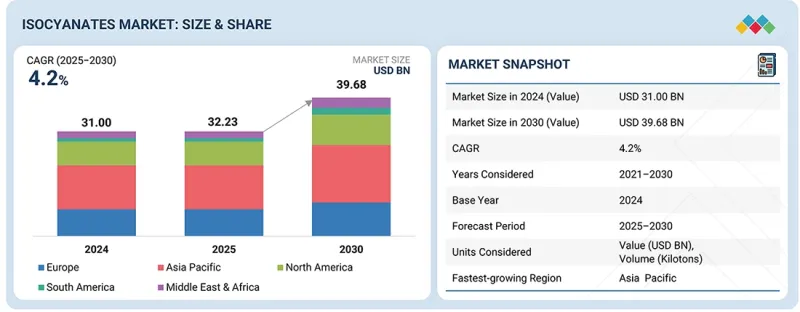
세계의 이소시아네이트 시장 규모는 2025년 322억 3,000만 달러에서 2030년에는 396억 8,000만 달러로 성장하고, 예측 기간에는 금액 기준으로 CAGR 4.2%를 나타낼 전망입니다.
| 조사 범위 | |
|---|---|
| 조사 대상 기간 | 2021-2030년 |
| 기준 연도 | 2024년 |
| 예측 기간 | 2025-2030년 |
| 단위 | 금액(달러), 킬로톤 |
| 부문 | 유형, 최종사용자 산업, 용도, 지역 |
| 대상 지역 | 아시아태평양, 북미, 유럽, 중동 및 아프리카, 남미 |
이소시아네이트는 최근 몇 년 동안 꾸준한 성장세를 보이고 있으며, 폴리우레탄 수요 증가를 배경으로 앞으로도 완만한 성장세를 이어갈 것으로 예측됩니다. 도시화, 인프라 개발, 자동차 산업(소형차 및 전기자동차 포함)의 성장도 건축 단열재 및 냉장창고용 경질 폴리우레탄 폼의 사용 증가에 크게 기여하고 있습니다. 이러한 수요는 가구 및 침구 제조 산업에서 연질 폴리우레탄 폼의 사용 확대에 힘입은 바 큽니다. 또한, 아시아태평양은 활발한 제조 활동과 생산 능력 증설에 힘입어 전체 이소시아네이트 생산량 증가의 주요 견인차 역할을 하고 있습니다. 마지막으로, 에너지 효율 향상과 지속 가능한 재료 사용을 촉진하는 규제 노력도 이소시아네이트 시장의 상승 추세를 뒷받침할 것입니다. 이소시아네이트 생산 확대에는 원자재 가격 변동과 강화되는 환경 규제 등 몇 가지 장벽이 존재하지만, 지속적인 기술 혁신과 산업 응용 분야에서의 이소시아네이트 사용 확대는 시장의 지속적인 성장을 뒷받침할 것으로 보입니다.
"유형별로는 MDI 부문이 예측 기간 동안 가장 큰 시장 점유율을 차지할 것으로 예측됩니다."
유형별로는 MDI(메틸렌디페닐디이소시아네이트)가 시장을 독점하고 있는 것으로 추정됩니다. MDI의 주요 용도는 경질 폴리우레탄 폼의 제조이며, 우수한 단열성과 매우 높은 강도 대 중량비를 제공하기 때문에 건축 단열재, 냉동 설비, 콜드체인 인프라에 널리 사용되고 있습니다. 또한, MDI는 연질 폼, 바인더, 엘라스토머, 접착제, 실란트 등 다양한 용도로 사용되어 자동차, 가구, 신발, 산업 시장 수요를 더욱 증가시키고 있습니다. 톨루엔디이소시아네이트(TDI)에 비해 MDI는 우수한 기계적 특성, 높은 치수 안정성, 낮은 휘발성을 가지고 있어 건축 및 산업 응용 분야에 더 적합합니다. 또한, 에너지 절약형 건축과 세계 인프라 개발에 대한 관심이 높아지면서 MDI 기반 제품을 사용한 단열재에 대한 수요가 급격히 증가하고 있습니다. 아시아태평양에 대규모 제조시설이 집중되어 있는 점과 지속적인 기술 발전도 MDI 시장 우위를 더욱 강화시키고 있습니다.
"최종 사용자 산업별로는 건축 및 건설 부문이 예측 기간 동안 가장 큰 시장 점유율을 차지할 것으로 예측됩니다."
건축 및 건설 분야는 이소시아네이트 생산에 필수적인 역할을 하는 폴리우레탄의 가장 큰 최종 사용자 시장으로, 이소시아네이트의 가장 큰 최종 사용자 시장입니다. 주로 MDI계 이소시아네이트는 우수한 구조 성능과 단열 특성으로 벽, 지붕, 바닥, 배관, 냉장창고의 단열재로 널리 사용되는 경질 폴리우레탄 폼의 제조에 필수적입니다. 또한, 세계 각국 정부의 에너지 절약 규제 강화에 따라 고에너지 성능의 단열재에 대한 수요가 지속적으로 증가하고 있습니다. 또한, 개발도상국의 인구 증가, 급속한 도시화, 주택 및 상업용 건설 활동의 확대, 개보수 및 개조 프로젝트 증가는 이소시아네이트 제품의 소비를 매우 빠른 속도로 이끌고 있습니다. 폴리우레탄 코팅, 실란트, 접착제, 방수 시스템은 기계적 특성 향상, 내구성 증가, 내후성 강화, 구조적 무결성 강화를 가져와 건설 산업에서 이소시아네이트 시장 점유율을 더욱 확대하고 있습니다.
"아시아태평양은 예측 기간 동안 가장 큰 시장 점유율을 차지할 것으로 예측됩니다."
대규모 이소시아네이트 소비는 주로 아시아태평양이 주도하고 있습니다. 이 지역은 가장 규모가 큰 지역 시장이며, 대륙 전체에서 진행 중인 많은 건설 프로젝트, 아시아의 강력한 제조 능력, 급속한 도시 성장을 배경으로 하고 있습니다. 중국, 인도, 일본, 한국 등 건설 활동이 활발한 주요 국가에서는 신축 건물의 단열 및 에너지 절약용 경질 폴리우레탄 폼 제품에 대한 수요가 두드러지게 나타나고 있습니다. 또한 아시아태평양은 자동차, 가구, 전자제품, 가전제품의 주요 생산기지이기도 합니다. 이들 산업에서는 이소시아네이트에서 생산되는 폴리우레탄계 재료가 대량으로 소비되고 있습니다. 또한, 지속적인 인구 증가, 가처분 소득 증가, 중산층 확대에 따라 아시아태평양 전체에서 주택 및 소비재에 대한 수요가 증가하고 있습니다. 또한, 아시아태평양에는 중국을 중심으로 많은 대규모 이소시아네이트 생산시설이 존재하여 국제 수출을 위한 경쟁력 있는 가격 설정과 안정적인 공급을 실현하고 있습니다. 정부의 산업 육성 정책과 인프라 투자를 통한 산업 육성 지원은 아시아태평양의 이소시아네이트 시장의 지속적인 성장에 기여하고 있습니다. 이 지역에서의 대량 소비, 확대되는 최종 사용자 시장 및 제조 능력의 조합은 이 지역을 이소시아네이트의 주요 시장으로 자리매김하고 있습니다.
세계의 이소시아네이트(Isocyanate) 시장을 조사했으며, 시장 개요, 시장 성장에 영향을 미치는 각종 영향요인 분석, 기술 및 특허 동향, 법 및 규제 환경, 사례 분석, 시장 규모 추이 및 예측, 각종 부문별/지역별/주요 국가별 상세 분석, 경쟁 구도, 주요 기업 개요 등의 정보를 정리하여 전해드립니다.
자주 묻는 질문
목차
제1장 서론
제2장 주요 요약
제3장 프리미엄 인사이트
제4장 시장 개요
제5장 업계 동향
제6장 기술 진보, AI의 영향, 특허, 혁신, 향후 용도
제7장 지속가능성과 규제 상황
제8장 고객 현황과 구매 행동
제9장 이소시아네이트 시장 : 용도별
제10장 이소시아네이트 시장 : 최종사용자 산업별
제11장 이소시아네이트 시장 : 유형별
제12장 이소시아네이트 시장 : 지역별
제13장 경쟁 구도
제14장 기업 개요
제15장 조사 방법
제16장 부록
LSH 26.04.08The global isocyanates market is projected to grow from USD 32.23 billion in 2025 to USD 39.68 billion by 2030, registering a CAGR of 4.2% during the forecast period (2025-2030), in terms of value.
| Scope of the Report | |
|---|---|
| Years Considered for the Study | 2021-2030 |
| Base Year | 2024 |
| Forecast Period | 2025-2030 |
| Units Considered | Value (USD Million/Billion), Volume (Kilotons) |
| Segments | Type, End-use Industry, Application, and Region |
| Regions covered | Asia Pacific, North America, Europe, Middle East & Africa, and South America |
Isocyanates have experienced steady growth in recent years and are expected to continue at a moderate pace, driven by rising demand for polyurethane. Urbanization, infrastructure development, and growth in the automotive sector (including lightweight and electric vehicles) are significant contributors to the increased use of rigid polyurethane foams for building insulation and cold storage. This demand is also driven by the growing use of flexible polyurethane foams in the furniture and bedding manufacturing industries. In addition, the Asia Pacific region remains a key driver of overall isocyanate volume growth, supported by strong manufacturing activity and added capacity. Lastly, regulatory initiatives promoting energy efficiency and the use of sustainable materials will support this upward trend in the isocyanates market. There are several obstacles to expanding isocyanate production, including fluctuating raw material prices and increasingly stringent environmental regulations; however, ongoing innovation and the growing use of isocyanates in industrial applications will support continued market expansion.
"By type, the MDI segment is anticipated to account for the largest market share during the forecast period (2025-2030)."
By type, MDI (methylene diphenyl diisocyanate) is estimated to dominate the isocyanates market. The primary use of MDI is in the production of rigid polyurethane foam, which offers excellent thermal efficiency and a very high strength-to-weight ratio, making it widely used for building insulation, refrigeration, and cold chain infrastructure. In addition, MDI is used in numerous other applications, such as flexible foams, binders, elastomers, adhesives, and sealants, further increasing demand from automotive, furniture, footwear, and industrial markets. Compared to TDI (toluene diisocyanate), MDI provides better mechanical properties, improved dimensional stability, and lower volatility, making it more favorable for construction and industrial applications. Furthermore, due to the emphasis on energy-efficient buildings and global infrastructure development, demand for insulation using MDI-based products has increased dramatically. MDI's dominant position in the market is also enhanced by large-scale production facilities typically located in the Asia Pacific region and ongoing improvements in technology.
By end-use industry, the building & construction segment is anticipated to account for the largest market share during the forecast period (2025-2030).
The building & construction sector is by far the largest end-use market for isocyanates, owing to their essential role in the polyurethanes used to manufacture them. Isocyanates, mainly the MDI variety, are critical in producing rigid polyurethane foams, which are extensively used for insulation of walls, roofs, floors, pipes, and cold storage, thanks to their superior structural performance and thermal properties. Furthermore, with increased regulations imposed on energy efficiency by governments around the world, there has been a continual increase in demand for insulation materials with high energy performance. In addition, population growth, rapid urbanization, and the expansion of residential and commercial construction activities in developing economies, along with additional renovation and retrofit projects, have driven the consumption of isocyanate-based products at a very rapid pace. As polyurethane-based coatings, sealants, adhesives, and waterproofing systems improve mechanical properties, increase durability, enhance weather resistance, and strengthen structural integrity, they further increase the market share of isocyanates in the construction industry.
"Asia Pacific is anticipated to account for the largest market share during the forecast period (2025-2030)."
Large-scale isocyanate consumption is primarily driven by the Asia Pacific region, the largest regional market, due to the large number of construction projects underway across the continent, strong manufacturing capabilities in Asia, and the rapid pace of urban growth. Major countries with high construction activity, such as China, India, Japan, and South Korea, drive significant demand for rigid polyurethane foam products for insulation and energy efficiency in new buildings. Furthermore, the Asia Pacific region is a major hub for automotive, furniture, electronics, and appliance manufacturing. These industries consume significant amounts of polyurethane-based materials produced from isocyanates. Continued population growth, rising disposable incomes, and the expansion of the middle class have led to rising demand for housing and consumer goods across the Asia Pacific region. In addition, there are many large-scale isocyanate production facilities in the Asia Pacific region, with a concentration in China, that offer highly competitive pricing for isocyanate products and a strong supply for international exports. Government support for industrial development, through both industrial development policies and infrastructure investment, is contributing to the continued growth of the isocyanate market in the Asia Pacific region. The combination of heavy consumption, growing end-use markets, and production capabilities in Asia Pacific is establishing the region as the dominant market for isocyanates.
In-depth interviews were conducted with Chief Executive Officers (CEOs), marketing directors, other innovation and technology directors, and executives from key organizations operating in the isocyanates market, and secondary research was used to determine and verify the market sizes of several segments.
- By Company Type: Tier 1 - 50%, Tier 2 - 30%, and Tier 3 - 20%
- By Designation: Managers- 15%, Directors - 20%, and Others - 65%
- By Region: North America - 30%, Europe - 25%, Asia Pacific - 35%, the Middle East & Africa -5%, and South America- 5%
The isocyanates market comprises of major companies such as BASF (Germany), Covestro AG (Germany), Wanhua (China), Huntsman International LLC (US), Tosoh Corporation (Japan), SABIC (Saudi Arabia), Mitsui Chemicals Inc. (Japan), Hanwha Solutions (South Korea), Cangzhou Dahua Group Co., Ltd. (China) and Dow (US). The study includes in-depth competitive analysis of these key players in the isocyanates market, with their company profiles, recent developments, and key market strategies.
Research Coverage
This report segments the isocyanates market by type, end-use industry, application, and region, and provides estimates of the overall market value across various regions. A detailed analysis of key industry players has been conducted to provide insights into their business overviews, products & services, key strategies, and expansions associated with the isocyanates market.
Key benefits of buying this report
This research report focuses on multiple levels of analysis - industry analysis (industry trends), market ranking analysis of top players, and company profiles, which together provide an overall view of the competitive landscape; emerging and high-growth segments of the isocyanates market; high-growth regions; and market drivers, restraints, opportunities, and challenges.
The report provides insights into the following:
- Analysis of drivers: Surging demand for polyurethane foams in insulation & lightweight materials, automotive industry electrification & weight reduction, shift to advanced coatings with enhanced durability and low VOC compliances, restraints (stringent regulatory environment for isocyanate handling and substitution risks from emerging polymer technologies), opportunities (development of bio-based & greener isocyanate routes, rapid growth of footwear & technical textile applications, increasing demand in renewable energy sectors), and challenges (technical formulation complexity at end user, feedstock supply chain disruptions) influencing the growth of isocyanates market.
- Market Penetration: Comprehensive information on the isocyanates offered by top players in the global market
- Product Development/Innovation: Detailed insights on upcoming technologies, product launches, expansions, and acquisitions in the isocyanates market
- Market Development: Comprehensive information about lucrative emerging markets, the report analyzes the markets for isocyanates market across regions
- Market Capacity: Production capacity of the companies is provided, wherever available, with upcoming capacities for the isocyanates market
- Competitive Assessment: In-depth assessment of market share, strategies, products, and manufacturing capabilities of leading players in the isocyanates market
TABLE OF CONTENTS
1 INTRODUCTION
- 1.1 STUDY OBJECTIVES
- 1.2 MARKET DEFINITION
- 1.3 STUDY SCOPE
- 1.3.1 MARKETS COVERED AND REGIONAL SCOPE
- 1.3.2 INCLUSIONS AND EXCLUSIONS
- 1.3.3 YEARS CONSIDERED
- 1.3.4 CURRENCY CONSIDERED
- 1.3.5 UNIT CONSIDERED
- 1.4 STAKEHOLDERS
2 EXECUTIVE SUMMARY
- 2.1 KEY INSIGHTS AND MARKET HIGHLIGHTS
- 2.2 KEY MARKET PARTICIPANTS: SHARE INSIGHTS AND STRATEGIC DEVELOPMENTS
- 2.3 DISRUPTIVE TRENDS SHAPING MARKET
- 2.4 HIGH-GROWTH SEGMENTS & EMERGING FRONTIERS
- 2.5 SNAPSHOT: GLOBAL MARKET SIZE, GROWTH RATE, AND FORECAST
3 PREMIUM INSIGHTS
- 3.1 ATTRACTIVE OPPORTUNITIES FOR PLAYERS IN ISOCYANATES MARKET
- 3.2 ISOCYANATES MARKET, BY TYPE AND REGION
- 3.3 ISOCYANATES MARKET, BY APPLICATION
- 3.4 ISOCYANATES MARKET, BY END-USE INDUSTRY
- 3.5 ISOCYANATES MARKET, BY COUNTRY
4 MARKET OVERVIEW
- 4.1 INTRODUCTION
- 4.2 MARKET DYNAMICS
- 4.2.1 DRIVERS
- 4.2.1.1 Surging demand for polyurethane foams in insulation & lightweight materials
- 4.2.1.2 Automotive industry electrification & weight reduction
- 4.2.1.3 Shift to advanced coatings with enhanced durability and low VOC compliance
- 4.2.2 RESTRAINTS
- 4.2.2.1 Stringent regulatory environment for isocyanate handling
- 4.2.2.2 Substitution risks from emerging polymer technologies
- 4.2.3 OPPORTUNITIES
- 4.2.3.1 Development of bio-based & greener isocyanate routes
- 4.2.3.2 Rapid growth of footwear & technical textile applications
- 4.2.3.3 Increasing demand in renewable energy sectors
- 4.2.4 CHALLENGES
- 4.2.4.1 Technical formulation complexity at end users
- 4.2.4.2 Feedstock supply chain disruptions
- 4.2.1 DRIVERS
- 4.3 UNMET NEEDS AND WHITE SPACES
- 4.3.1 UNMET NEEDS IN ISOCYANATES MARKET
- 4.3.2 WHITE SPACE OPPORTUNITIES
- 4.4 INTERCONNECTED MARKETS AND CROSS-SECTOR OPPORTUNITIES
- 4.4.1 INTERCONNECTED MARKETS
- 4.4.2 CROSS-SECTOR OPPORTUNITIES
- 4.5 STRATEGIC MOVES BY TIER-1/2/3 PLAYERS
- 4.5.1 KEY MOVES AND STRATEGIC FOCUS
5 INDUSTRY TRENDS
- 5.1 PORTER'S FIVE FORCES ANALYSIS
- 5.1.1 THREAT OF NEW ENTRANTS
- 5.1.2 THREAT OF SUBSTITUTES
- 5.1.3 BARGAINING POWER OF SUPPLIERS
- 5.1.4 BARGAINING POWER OF BUYERS
- 5.1.5 INTENSITY OF COMPETITIVE RIVALRY
- 5.2 MACROECONOMIC INDICATORS
- 5.2.1 INTRODUCTION
- 5.2.2 GDP TRENDS AND FORECAST
- 5.2.3 TRENDS IN GLOBAL AUTOMOTIVE INDUSTRY
- 5.3 SUPPLY CHAIN ANALYSIS
- 5.4 PRICING ANALYSIS (2021-2024)
- 5.4.1 AVERAGE SELLING PRICE TREND, BY REGION (2021-2024)
- 5.4.2 AVERAGE SELLING PRICE TREND, BY TYPE (2021-2024)
- 5.4.3 AVERAGE SELLING PRICE TREND, BY APPLICATION (2021-2024)
- 5.4.4 AVERAGE SELLING PRICE TREND, BY END-USE INDUSTRY (2021-2024)
- 5.4.5 AVERAGE SELLING PRICE OF ISOCYANATE TYPES AMONG KEY PLAYERS, 2024
- 5.5 ECOSYSTEM ANALYSIS
- 5.6 TRADE ANALYSIS
- 5.6.1 IMPORT SCENARIO (HS CODE 292910)
- 5.6.2 EXPORT SCENARIO (HS CODE 292910)
- 5.7 KEY CONFERENCES AND EVENTS, 2026
- 5.8 TRENDS/DISRUPTIONS IMPACTING CUSTOMER BUSINESS
- 5.9 INVESTMENT AND FUNDING SCENARIO
- 5.10 CASE STUDY ANALYSIS
- 5.10.1 ADVANCING AUTOMOTIVE LIGHTWEIGHTING THROUGH ISOCYANATE-BASED POLYURETHANE SYSTEMS
- 5.10.2 ENERGY-EFFICIENT BUILDINGS WITH ISOCYANATE-BASED POLYURETHANE INSULATION SYSTEMS
- 5.10.3 STRENGTHENED ELECTRONICS DURABILITY AND THERMAL MANAGEMENT THROUGH ISOCYANATE TECHNOLOGIES
- 5.11 IMPACT OF 2025 US TARIFF - ISOCYANATES MARKET
- 5.11.1 INTRODUCTION
- 5.11.2 KEY TARIFF RATES
- 5.11.3 PRICE IMPACT ANALYSIS
- 5.11.4 IMPACT ON COUNTRIES/REGIONS
- 5.11.4.1 North America
- 5.11.4.2 Europe
- 5.11.4.3 Asia Pacific
- 5.11.5 IMPACT ON END-USE INDUSTRIES
6 TECHNOLOGICAL ADVANCEMENTS, AI-DRIVEN IMPACT, PATENTS, INNOVATIONS, AND FUTURE APPLICATIONS
- 6.1 KEY EMERGING TECHNOLOGIES
- 6.1.1 PHOSGENATION PROCESS OPTIMIZATION
- 6.1.2 NON-PHOSGENE ISOCYANATE PRODUCTION ROUTES
- 6.1.3 INTEGRATED MDI/TDI COMPLEXES WITH UPSTREAM ANILINE
- 6.1.4 LOW-CARBON AND ELECTRIFIED ISOCYANATE PRODUCTION
- 6.2 COMPLEMENTARY TECHNOLOGIES
- 6.2.1 POLYOL FORMULATION AND REACTIVE BLENDING
- 6.2.2 CONTINUOUS FOAMING, COATING, AND CASTING PROCESS
- 6.2.3 DIGITAL PROCESS CONTROL AND SMART MANUFACTURING
- 6.3 ADJACENT TECHNOLOGIES
- 6.3.1 NON-ISOCYANATE POLYURETHANES AND BIO-BASED POLYMER SYSTEMS
- 6.3.2 ALTERNATIVE THERMOSET AND THERMOPLASTIC MATERIAL SYSTEMS
- 6.4 TECHNOLOGY/PRODUCT ROADMAP
- 6.4.1 SHORT-TERM ROADMAP: PROCESS OPTIMIZATION AND COST RATIONALIZATION
- 6.4.2 MID-TERM ROADMAP: CUSTOMIZATION, APPLICATION-SPECIFIC GRADES, AND SUSTAINABILITY INTEGRATION
- 6.4.3 LONG-TERM ROADMAP: ADVANCED FUNCTIONALIZATION AND CIRCULAR MATERIAL ENABLEMENT
- 6.5 PATENT ANALYSIS
- 6.5.1 METHODOLOGY
- 6.5.2 GRANTED PATENTS, 2016-2025
- 6.5.2.1 Publication trends, 2016-2025
- 6.5.3 INSIGHTS
- 6.5.4 LEGAL STATUS
- 6.5.5 JURISDICTION ANALYSIS
- 6.5.6 TOP APPLICANTS
- 6.5.7 LIST OF MAJOR PATENTS
- 6.6 FUTURE APPLICATIONS
- 6.6.1 ELECTRIC VEHICLE (EV) BATTERY SYSTEMS AND E-MOBILITY MATERIALS
- 6.6.2 HIGH-PERFORMANCE BUILDING INSULATION FOR NET-ZERO CONSTRUCTION
- 6.6.3 LIGHTWEIGHT STRUCTURAL COMPOSITES FOR AUTOMOTIVE, RAIL, AND AEROSPACE
- 6.6.4 ADVANCED ELECTRONICS ENCAPSULATION AND THERMAL MANAGEMENT MATERIALS
- 6.7 IMPACT OF AI/GEN AI ON ISOCYANATES MARKET
- 6.7.1 TOP USE CASES AND MARKET POTENTIAL
- 6.7.2 BEST PRACTICES IN ISOCYANATES MANUFACTURING
- 6.7.3 CASE STUDIES OF AI IMPLEMENTATION IN ISOCYANATES MARKET
- 6.7.4 INTERCONNECTED ADJACENT ECOSYSTEM AND IMPACT ON MARKET PLAYERS
- 6.7.5 CLIENTS' READINESS TO ADOPT GENERATIVE AI IN ISOCYANATES MARKET
- 6.8 SUCCESS STORIES AND REAL-WORLD APPLICATIONS
- 6.8.1 BASF (GERMANY): INTEGRATED ISOCYANATE AND POLYURETHANE SOLUTIONS
- 6.8.2 COVESTRO AG (GERMANY): HIGH-PERFORMANCE POLYURETHANE MATERIAL SOLUTIONS
- 6.8.3 HUNTSMAN (US): SPECIALTY ISOCYANATES AND POLYURETHANE SYSTEMS
7 SUSTAINABILITY AND REGULATORY LANDSCAPE
- 7.1 REGIONAL REGULATIONS AND COMPLIANCE
- 7.1.1 REGULATORY BODIES, GOVERNMENT AGENCIES, AND OTHER ORGANIZATIONS
- 7.1.2 INDUSTRY STANDARDS
- 7.2 SUSTAINABILITY INITIATIVES
- 7.2.1 CARBON IMPACT AND ECO-APPLICATIONS OF ISOCYANATES
- 7.3 SUSTAINABILITY IMPACT AND REGULATORY POLICY INITIATIVES
- 7.4 CERTIFICATIONS, LABELING, AND ECO-STANDARDS
8 CUSTOMER LANDSCAPE & BUYER BEHAVIOR
- 8.1 DECISION-MAKING PROCESS
- 8.2 BUYER STAKEHOLDERS AND BUYING EVALUATION CRITERIA
- 8.2.1 KEY STAKEHOLDERS IN BUYING PROCESS
- 8.2.2 BUYING CRITERIA
- 8.3 ADOPTION BARRIERS & INTERNAL CHALLENGES
- 8.4 UNMET NEEDS FROM VARIOUS END-USE INDUSTRY
- 8.5 MARKET PROFITABILITY
- 8.5.1 VALUE ADDITION AND FUNCTIONAL PREMIUMS
- 8.5.2 FEEDSTOCK AND COST STRUCTURE SENSITIVITY
- 8.5.3 SCALE, CUSTOMIZATION, AND OPERATING LEVERAGE
- 8.5.4 CUSTOMER LOCK-IN AND SWITCHING COSTS
9 ISOCYANATES MARKET, BY APPLICATION
- 9.1 INTRODUCTION
- 9.2 FOAMS
- 9.2.1 RIGID FOAMS
- 9.2.1.1 Segment growth driven by global building construction activity and sustainability-driven insulation requirements
- 9.2.2 FLEXIBLE FOAMS
- 9.2.2.1 Growth in consumer goods and automotive interiors requirements for comfort and vibration damping to drive segment
- 9.2.1 RIGID FOAMS
- 9.3 ADHESIVES & SEALANTS
- 9.3.1 DRIVEN BY INCREASING USE IN CONSTRUCTION JOINTS, AUTOMOTIVE LIGHTWEIGHTING, AND STRUCTURAL BONDING
- 9.4 COATINGS
- 9.4.1 GROWTH IN AUTOMOTIVE REFINISH, INDUSTRIAL PROTECTION, AND ARCHITECTURAL COATING DEMAND
- 9.5 ELASTOMERS AND CAST SYSTEMS
- 9.5.1 LEVERAGED BY EXPANSION OF MINING, CONSTRUCTION, AND HEAVY INDUSTRIAL EQUIPMENT MARKETS.
- 9.6 OTHERS
10 ISOCYANATES MARKET, BY END-USE INDUSTRY
- 10.1 INTRODUCTION
- 10.2 AUTOMOTIVE
- 10.2.1 DEMAND FOR AUTOMOTIVE LIGHTWEIGHTING AND COMFORT TO DRIVE DEMAND
- 10.3 BUILDING & CONSTRUCTION
- 10.3.1 RISING DEMAND FOR ISOCYANATES IN MEDICAL PACKAGING TO DRIVE MARKET
- 10.4 FURNITURE & BEDDING
- 10.4.1 RISING DEMAND FOR INSULATION AND STRUCTURAL MATERIALS TO BOOST CONSUMPTION
- 10.5 INDUSTRIAL COATINGS
- 10.5.1 GROWING USE OF DURABLE AND PROTECTIVE COATINGS TO DRIVE DEMAND
- 10.6 ELECTRICALS & ELECTRONICS
- 10.6.1 INCREASE IN ELECTRONICS PROTECTION AND INSULATION APPLICATIONS TO SUPPORT MARKET GROWTH
- 10.7 CONSUMER GOODS
- 10.7.1 EXPANDING APPLICATIONS SUPPORT MARKET GROWTH
- 10.8 OTHERS
11 ISOCYANATES MARKET, BY TYPE
- 11.1 INTRODUCTION
- 11.2 AROMATIC ISOCYANATES
- 11.2.1 TDI
- 11.2.1.1 Segment driven by large-scale consumption in flexible foams for furniture, bedding, and automotive seating applications
- 11.2.2 MDI
- 11.2.2.1 Growth supported by strong demand for rigid insulation foams and structural polyurethane materials in construction and appliances
- 11.2.1 TDI
- 11.3 ALIPHATIC ISOCYANATES
- 11.3.1 HDI
- 11.3.1.1 Segment driven by demand for UV-stable and durable coatings in automotive and industrial applications
- 11.3.2 IPDI
- 11.3.2.1 Rising use in non-yellowing, weather-resistant coatings and specialty polyurethane systems to boost segment
- 11.3.3 HMDI
- 11.3.3.1 Use in high-performance elastomers and coatings for superior mechanical strength and UV stability to drive growth
- 11.3.1 HDI
- 11.4 OTHER TYPES
12 ISOCYANATES MARKET, BY REGION
- 12.1 INTRODUCTION
- 12.2 ASIA PACIFIC
- 12.2.1 CHINA
- 12.2.1.1 Rising consumer goods production and retail sales increase polyurethane-based product usage
- 12.2.2 JAPAN
- 12.2.2.1 Sustained automotive production and advanced manufacturing sectors to drive specialty polyurethane demand
- 12.2.3 INDIA
- 12.2.3.1 Rapid expansion of automotive production and government-backed infrastructure investment to drive demand
- 12.2.4 SOUTH KOREA
- 12.2.4.1 Strong automotive and electronics manufacturing to drive consistent demand
- 12.2.5 REST OF ASIA PACIFIC
- 12.2.1 CHINA
- 12.3 NORTH AMERICA
- 12.3.1 US
- 12.3.1.1 Strong construction and expanding EV manufacturing drives demand
- 12.3.2 CANADA
- 12.3.2.1 Climate-driven insulation demand and infrastructure upgrades support steady growth
- 12.3.3 MEXICO
- 12.3.3.1 Expanding automotive and nearshoring-led manufacturing growth to fuel consumption
- 12.3.1 US
- 12.4 EUROPE
- 12.4.1 GERMANY
- 12.4.1.1 Robust automotive and advanced manufacturing sectors sustain isocyanates demand
- 12.4.2 ITALY
- 12.4.2.1 Diverse manufacturing and construction activities underpin stable isocyanate demand across multiple applications
- 12.4.3 FRANCE
- 12.4.3.1 Industrial diversification enables steady isocyanates consumption across automotive, construction, and specialty sectors.
- 12.4.4 UK
- 12.4.4.1 Construction and diversified manufacturing sectors to boost market
- 12.4.5 SPAIN
- 12.4.5.1 Robust automotive production supports expansive downstream applications
- 12.4.6 REST OF EUROPE
- 12.4.1 GERMANY
- 12.5 MIDDLE EAST & AFRICA
- 12.5.1 GCC COUNTRIES
- 12.5.1.1 Saudi Arabia
- 12.5.1.1.1 Expansion of automotive manufacturing and large construction projects to fuel growth
- 12.5.1.2 UAE
- 12.5.1.2.1 Strategic industrial diversification and manufacturing expansion to boost demand
- 12.5.1.3 Other GCC countries
- 12.5.1.4 South Africa
- 12.5.1.4.1 Strong automotive manufacturing base supports sustained demand for polyurethane materials
- 12.5.1.5 Rest of Middle East & Africa
- 12.5.1.1 Saudi Arabia
- 12.5.1 GCC COUNTRIES
- 12.6 SOUTH AMERICA
- 12.6.1 ARGENTINA
- 12.6.1.1 Resilient automotive and construction sectors support incremental growth in isocyanate applications
- 12.6.2 BRAZIL
- 12.6.2.1 Strong automotive production coupled with expanding construction and furniture industries to drive demand
- 12.6.3 REST OF SOUTH AMERICA
- 12.6.1 ARGENTINA
13 COMPETITIVE LANDSCAPE
- 13.1 INTRODUCTION
- 13.2 KEY PLAYERS' STRATEGIES/RIGHT TO WIN
- 13.3 MARKET SHARE ANALYSIS, 2024
- 13.3.1 BASF
- 13.3.2 WANHUA
- 13.3.3 COVESTRO AG
- 13.3.4 DOW
- 13.3.5 HUNTSMAN INTERNATIONAL LLC
- 13.4 REVENUE ANALYSIS
- 13.5 COMPANY EVALUATION MATRIX: KEY PLAYERS, 2024
- 13.5.1 STARS
- 13.5.2 EMERGING LEADERS
- 13.5.3 PERVASIVE PLAYERS
- 13.5.4 PARTICIPANTS
- 13.5.5 COMPANY FOOTPRINT: KEY PLAYERS, 2024
- 13.5.5.1 Company footprint
- 13.5.5.2 Region footprint
- 13.5.5.3 Type footprint
- 13.5.5.4 Application footprint
- 13.5.5.5 End-use industry footprint
- 13.6 COMPANY EVALUATION MATRIX: STARTUPS/SMES, 2024
- 13.6.1 PROGRESSIVE COMPANIES
- 13.6.2 RESPONSIVE COMPANIES
- 13.6.3 DYNAMIC COMPANIES
- 13.6.4 STARTING BLOCKS
- 13.6.5 COMPETITIVE BENCHMARKING
- 13.6.5.1 Detailed list of key startups/SMEs
- 13.6.5.2 Competitive benchmarking of key startups/SMEs
- 13.7 BRAND/PRODUCT COMPARISON
- 13.8 COMPANY VALUATION AND FINANCIAL METRICS
- 13.9 COMPETITIVE SCENARIO
- 13.9.1 DEALS
- 13.9.2 EXPANSIONS
14 COMPANY PROFILES
- 14.1 KEY PLAYERS
- 14.1.1 BASF
- 14.1.1.1 Business overview
- 14.1.1.2 Products/Solutions/Services offered
- 14.1.1.3 Recent developments
- 14.1.1.3.1 Product launches
- 14.1.1.3.2 Deals
- 14.1.1.3.3 Expansions
- 14.1.1.4 MnM view
- 14.1.1.4.1 Right to win
- 14.1.1.4.2 Strategic choices
- 14.1.1.4.3 Weaknesses and competitive threats
- 14.1.2 COVESTRO AG
- 14.1.2.1 Business overview
- 14.1.2.2 Products/Solutions/Services offered
- 14.1.2.3 Recent developments
- 14.1.2.3.1 Product launches
- 14.1.2.3.2 Deals
- 14.1.2.3.3 Expansions
- 14.1.2.4 MnM view
- 14.1.2.4.1 Right to win
- 14.1.2.4.2 Strategic choices
- 14.1.2.4.3 Weaknesses and competitive threats
- 14.1.3 TOSOH CORPORATION
- 14.1.3.1 Business overview
- 14.1.3.2 Products/Solutions/Services offered
- 14.1.3.3 Recent developments
- 14.1.3.3.1 Expansions
- 14.1.3.4 MnM view
- 14.1.3.4.1 Right to win
- 14.1.3.4.2 Strategic choices
- 14.1.3.4.3 Weaknesses and competitive threats
- 14.1.4 WANHUA
- 14.1.4.1 Business overview
- 14.1.4.2 Products/Solutions/Services offered
- 14.1.4.3 Recent developments
- 14.1.4.3.1 Expansions
- 14.1.4.4 MnM view
- 14.1.4.4.1 Right to win
- 14.1.4.4.2 Strategic choices
- 14.1.4.4.3 Weaknesses and competitive threats
- 14.1.5 SABIC
- 14.1.5.1 Business overview
- 14.1.5.2 Products/Solutions/Services offered
- 14.1.5.3 MnM view
- 14.1.5.3.1 Right to win
- 14.1.5.3.2 Strategic choices
- 14.1.5.3.3 Weaknesses and competitive threats
- 14.1.6 HANWHA SOLUTIONS
- 14.1.6.1 Business overview
- 14.1.6.2 Products/Solutions/Services offered
- 14.1.6.3 MnM view
- 14.1.6.3.1 Right to win
- 14.1.6.3.2 Strategic choices
- 14.1.6.3.3 Weaknesses and competitive threats
- 14.1.7 HUNTSMAN INTERNATIONAL LLC
- 14.1.7.1 Business overview
- 14.1.7.2 Products/Solutions/Services offered
- 14.1.7.3 Recent developments
- 14.1.7.3.1 Expansions
- 14.1.7.4 MnM view
- 14.1.7.4.1 Right to win
- 14.1.7.4.2 Strategic choices
- 14.1.7.4.3 Weaknesses and competitive threats
- 14.1.8 DOW
- 14.1.8.1 Business overview
- 14.1.8.2 Products/Solutions/Services offered
- 14.1.8.3 Recent developments
- 14.1.8.3.1 Expansions
- 14.1.8.4 MnM view
- 14.1.8.4.1 Right to win
- 14.1.8.4.2 Strategic choices
- 14.1.8.4.3 Weaknesses and competitive threats
- 14.1.9 MITSUI CHEMICALS INC
- 14.1.9.1 Business overview
- 14.1.9.2 Products/Solutions/Services offered
- 14.1.9.3 Recent developments
- 14.1.9.3.1 Expansions
- 14.1.9.4 MnM view
- 14.1.9.4.1 Right to win
- 14.1.9.4.2 Strategic choices
- 14.1.9.4.3 Weaknesses and competitive threats
- 14.1.10 CANGZHOU DAHUA GROUP CO. LTD.
- 14.1.10.1 Business overview
- 14.1.10.2 Products/Solutions/Services offered
- 14.1.10.3 MnM view
- 14.1.10.3.1 Right to win
- 14.1.10.3.2 Strategic choices
- 14.1.10.3.3 Weaknesses and competitive threats
- 14.1.1 BASF
- 14.2 OTHER PLAYERS
- 14.2.1 OCI COMPANY LTD.
- 14.2.2 SAPICI S.P.A.
- 14.2.3 KAROON PETROCHEMICAL COMPANY
- 14.2.4 GANSU YINGUANG CHEMICAL INDUSTRY GROUP CO., LTD.
- 14.2.5 ASAHI KASEI CORPORATION
- 14.2.6 EVONIK INDUSTRIES AG
- 14.2.7 ARKEM KIMYA SAN. TIC. A.S
- 14.2.8 SHANDONG INOV POLYURETHANE CO. LTD
- 14.2.9 GUJARAT NARMADA VALLEY FERTILIZERS & CHEMICALS LIMITED
- 14.2.10 SADARA
15 RESEARCH METHODOLOGY
- 15.1 RESEARCH DATA
- 15.1.1 SECONDARY DATA
- 15.1.1.1 Key data from secondary sources
- 15.1.2 PRIMARY DATA
- 15.1.2.1 Key data from primary sources
- 15.1.2.2 Key primary interview participants
- 15.1.2.3 Breakdown of primary interviews
- 15.1.2.4 Key industry insights
- 15.1.1 SECONDARY DATA
- 15.2 MARKET SIZE ESTIMATION
- 15.2.1 BOTTOM-UP APPROACH
- 15.2.2 TOP-DOWN APPROACH
- 15.3 BASE NUMBER CALCULATION
- 15.3.1 APPROACH 1: SUPPLY-SIDE ANALYSIS
- 15.3.2 APPROACH 2: DEMAND-SIDE ANALYSIS
- 15.4 MARKET FORECAST APPROACH
- 15.4.1 SUPPLY SIDE
- 15.4.2 DEMAND SIDE
- 15.5 DATA TRIANGULATION
- 15.6 FACTOR ANALYSIS
- 15.7 RESEARCH ASSUMPTIONS
- 15.8 RESEARCH LIMITATIONS AND RISK ASSESSMENT
16 APPENDIX
- 16.1 DISCUSSION GUIDE
- 16.2 KNOWLEDGESTORE: MARKETSANDMARKETS' SUBSCRIPTION PORTAL
- 16.3 CUSTOMIZATION OPTIONS
- 16.4 RELATED REPORTS
- 16.5 AUTHOR DETAILS


