
|
시장보고서
상품코드
1993562
호기 분석기 시장 : 기술별, 용도별, 최종사용자별 - 세계 예측(-2031년)Breath Analyzers Market by Technology (Fuel Cells, Semiconductor Oxide Sensors, Other Technologies), Application (Alcohol Detection, Drug Abuse Detection, Medical Applications), End User (Law Enforcement Agencies, Enterprises) - Global Forecast to 2031 |
||||||

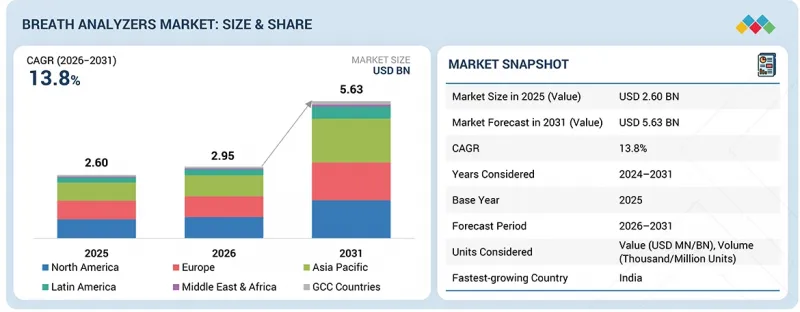
세계의 호기 분석기 시장 규모는 2026년 29억 5,000만 달러에서 2031년까지 56억 3,000만 달러에 달할 것으로 예측되며, 예측 기간 동안 CAGR로 13.8%의 성장이 전망됩니다.
| 조사 범위 | |
|---|---|
| 조사 대상 기간 | 2024-2031년 |
| 기준 연도 | 2025년 |
| 예측 기간 | 2025-2031년 |
| 단위 | 10억 달러 |
| 부문 | 기술, 용도, 최종사용자, 지역 |
| 대상 지역 | 북미, 유럽, 아시아태평양, 라틴아메리카, 중동 및 아프리카, GCC 국가 |
작업장 안전 규정 및 기업 정책으로 인해 다양한 산업 분야에서 호기 분석기의 사용이 점점 더 많이 권장되고 있습니다. 건설, 광업, 운송, 석유 및 가스, 제조 등의 산업에서는 사고 및 업무상 위험을 최소화하기 위해 직원의 음주 상태를 엄격하게 모니터링해야 합니다. 이러한 고위험 환경에서 음주로 인한 능력저하는 심각한 안전사고, 경제적 손실, 그리고 고용주의 법적 책임으로 이어질 수 있습니다. 그 결과, 조직에서는 음주측정기를 이용한 채용 전 검사, 불시 검사, 사고 후 검사 등 알코올 검사 프로그램을 도입하고 있습니다. 이 장비는 신속하고 비침습적인 검사가 가능하며, 일상적인 작업장 모니터링에 적합합니다. 또한, 많은 국가의 산업안전보건 기준은 안전에 중요한 역할을 하는 직원에 대한 알코올 검사를 권장하거나 의무화하고 있습니다. 또한, 고용주는 휴대용 호기 분석기를 사용하여 실시간 모니터링 및 작업장 정책 준수를 보장하기 위해 휴대용 호기 분석기를 채택하고 있습니다. 따라서 직원 안전과 위험 관리에 대한 관심이 높아지면서 산업 및 기업 환경에서 호기 분석기 채택이 증가하고 있습니다.
기술적으로는 연료전지식 호기 분석기가 전 세계 법집행기관의 도로상 알코올 검사에서 표준이 되고 있습니다. 정부 및 교통 당국은 증거 능력을 갖춘 정확도를 제공하고 다양한 환경 조건에서 빈번한 사용을 견딜 수 있는 장비를 우선시하고 있습니다. 연료전지 센서는 일관되고 신뢰할 수 있는 혈중알코올농도(BAC) 측정을 제공함으로써 이러한 요구사항을 충족합니다. 많은 국가에서 공식적인 음주운전 단속 프로그램에서 연료전지식 호기 분석기 사용을 의무화하고 있습니다. 알코올 관련 교통 사고 감소에 대한 전 세계적인 관심이 높아짐에 따라 법집행기관은 이러한 장비의 배포를 계속 확대하고 있습니다. 이러한 조직적인 채택의 확산은 연료전지 기술 부문의 큰 시장 점유율에 크게 기여하고 있습니다.
최종사용자의 경우, 전 세계적으로 증가하는 알코올 관련 교통사고로 인해 각국 정부는 단속을 강화할 수밖에 없는 상황입니다. 법집행기관은 음주 운전자를 신속하게 감지하고 교통사고로 인한 사망자를 예방하기 위해 호기 분석기에 크게 의존하고 있습니다. 음주운전은 많은 국가에서 교통사고 사망의 주요 원인으로, 당국은 빈번한 도로변 검사와 음주단속을 실시하고 있습니다. 호기 분석기를 통해 경찰관은 검사실의 도움 없이도 즉각적이고 정확한 검사를 할 수 있습니다. 휴대성과 사용 편의성으로 인해 거리 단속을 위한 최적의 장비입니다. 정부가 사고율을 낮추고 공공안전을 개선하기 위한 노력을 강화하면서 경찰의 호기 분석기에 대한 수요는 지속적으로 크게 증가하고 있습니다.
북미가 호기 분석기 시장에서 가장 큰 시장 점유율을 차지하고 있습니다. 북미에는 호기 분석기 시장의 주요 기업 및 기술 제공업체가 다수 존재하며, 이는 지역 시장 지배력에 기여하고 있습니다. 알코올 감지 기술을 전문으로 하는 일류 기업의 존재는 혁신, 제품 개발 및 첨단 장비의 조기 채택을 촉진하고 있습니다. 이들 기업은 호기 분석기의 정확성, 연결성, 휴대성을 향상시키기 위해 연구개발에 많은 투자를 하고 있습니다. 또한, 탄탄한 유통망과 법집행기관, 의료 기관, 직장 안전 프로그램과의 파트너십을 통해 지역 내 광범위한 호흡 검사기 보급을 촉진하고 있습니다. 또한, 탄탄한 산업 생태계는 새로운 호흡 분석 기술의 규제 승인과 상용화를 가속화하고 있습니다.
세계의 호기 분석기 시장에 대해 조사 분석했으며, 주요 촉진요인 및 저해요인, 제품 개발 및 혁신, 경쟁 구도에 대한 정보를 전해드립니다.
자주 묻는 질문
목차
제1장 소개
제2장 주요 요약
제3장 중요한 인사이트
제4장 시장 개요
제5장 업계 동향
제6장 기술의 진보, AI에 의한 영향, 특허, 혁신, 향후 용도
제7장 규제 상황
제8장 고객 상황과 구매 행동
제9장 호기 분석기 시장 : 기술별
제10장 호기 분석기 시장 : 용도별
제11장 호기 분석기 시장 : 최종사용자별
제12장 호기 분석기 시장 : 지역별
제13장 경쟁 구도
제14장 기업 개요
제15장 조사 방법
제16장 부록
KSM 26.04.15The breath analyzers market is projected to reach USD 5.63 billion by 2031 from USD 2.95 billion in 2026, at a CAGR of 13.8% during the forecast period.
| Scope of the Report | |
|---|---|
| Years Considered for the Study | 2024-2031 |
| Base Year | 2025 |
| Forecast Period | 2025-2031 |
| Units Considered | Value (USD billion) |
| Segments | Technology, Application, End User, and Region |
| Regions covered | North America, Europe, Asia Pacific, Latin America, Middle East & Africa, and GCC Countries |
Workplace safety regulations and corporate policies are increasingly encouraging the use of breath analyzers across multiple industries. Sectors such as construction, mining, transportation, oil & gas, and manufacturing require strict monitoring of employee sobriety to minimize accidents and operational risks. Alcohol impairment in these high-risk environments can lead to severe safety incidents, financial losses, and legal liabilities for employers. As a result, organizations are implementing alcohol testing programs that include pre-employment screening, random testing, and post-incident testing using breath analyzers. The devices offer rapid and non-invasive testing, making them suitable for routine workplace monitoring. In addition, occupational health and safety standards in many countries recommend or mandate alcohol testing in safety-sensitive roles. Employers are also adopting portable breath analyzers to ensure real-time monitoring and compliance with workplace policies. The growing emphasis on employee safety and risk management is therefore driving the adoption of breath analyzers in industrial and corporate environments.
Based on technology, fuel-cell breath analyzers have become the standard for law enforcement agencies worldwide in roadside alcohol testing. Governments and traffic authorities prioritize devices that deliver evidential-grade accuracy and withstand frequent usage under diverse environmental conditions. Fuel-cell sensors meet these requirements by providing consistent and dependable BAC measurements. Many countries mandate the use of fuel-cell-based breath analyzers for official drunk-driving enforcement programs. With the growing global focus on reducing alcohol-related road accidents, law enforcement agencies continue to expand the deployment of these devices. This widespread institutional adoption significantly contributes to the large market share of the fuel-cell technology segment.
Based on end user, the growing number of alcohol-related road accidents globally has compelled governments to strengthen enforcement measures. Law enforcement agencies rely heavily on breath analyzers to detect intoxicated drivers quickly and prevent road fatalities. Alcohol-impaired driving is a leading contributor to traffic deaths in many countries, prompting authorities to conduct frequent roadside screening and sobriety checkpoints. Breath analyzers enable officers to perform immediate and accurate testing without requiring laboratory support. Their portability and ease of use make them ideal for roadside enforcement. As governments intensify efforts to reduce accident rates and improve public safety, the demand for breath analyzers among police departments continues to increase significantly.
North America holds the largest market share in the breath analyzers market. North America hosts several leading manufacturers and technology providers in the breath analyzers market, contributing to regional market dominance. The presence of well-established companies specializing in alcohol detection technologies encourages innovation, product development, and early adoption of advanced devices. These companies invest heavily in research and development to improve the accuracy, connectivity, and portability of breath analyzers. Additionally, strong distribution networks and partnerships with law enforcement agencies, healthcare institutions, and workplace safety programs facilitate the widespread deployment of breath-testing devices across the region. The strong industrial ecosystem also accelerates regulatory approvals and commercialization of new breath analysis technologies.
A breakdown of the primary participants (supply side) for the breath analyzers market referred to in this report is provided below:
- By Company Type: Tier 1 (34%), Tier 2 (38%), and Tier 3 (28%)
- By Designation: C-level Executives (26%), Directors (35%), and Others (39%)
- By Region: North America (17%), Europe (39%), Asia Pacific (28%), Latin America (8%), Middle East & Africa (3%), and GCC Countries (5%)
Prominent players in the breath analyzers market are Dragerwerk AG & Co. KGaA (Germany), Lifeloc Technologies (US), Alcohol Countermeasure Systems Corporation (ACS) (Canada), Intoximeters, Inc. (US), Alcolizer Pty. Ltd. (Australia), AK GlobalTech (India), Quest Products, Inc. (US), Abbott (US), EnviteC Wismar GmbH (Germany), and Andatech Private Limited (Australia), among others.
Research Coverage
The report evaluates the breath analyzers market and estimates the market size and future growth potential of this market based on various segments, including technology, application, end user, and region. The report also includes a competitive analysis of the major players in this market, along with company profiles, product offerings, recent developments, and key market strategies.
Reasons to Buy the Report
The report will provide market leaders and new entrants with estimated revenue figures for the overall breath analyzers market and its subsegments. It will help stakeholders understand the competitive landscape and gain insights that can improve their business positioning and inform effective go-to-market strategies. Additionally, the report will give stakeholders a sense of the market environment by highlighting key drivers, challenges, obstacles, and opportunities.
This report provides insights into the following points:
- Analysis of key drivers (growing alcohol and drug abuse, stringent government regulations, and growing use of breath analyzers in detecting various diseases), restraints (accuracy concerns and hygiene concerns), opportunities (technological advancements, emerging markets, and increasing adoption of breath analyzers), and challenges (regulatory fragmentation and legal acceptance)
- Product Enhancement/Innovation: Comprehensive details about product launches and anticipated trends in the global breath analyzers market
- Market Development: Thorough knowledge and analysis of the profitable rising markets by technology, application, end user, and region
- Market Diversification: Comprehensive information about newly launched products, expanding markets, current advancements, and investments in the global breath analyzers market
- Competitive Assessment: Thorough evaluation of the market shares, growth plans, offerings, and capacities of the major competitors in the global breath analyzers market
TABLE OF CONTENTS
1 INTRODUCTION
- 1.1 STUDY OBJECTIVES
- 1.2 MARKET DEFINITION
- 1.3 STUDY SCOPE
- 1.3.1 SEGMENTS COVERED & REGIONAL SCOPE
- 1.3.2 INCLUSIONS & EXCLUSIONS
- 1.3.3 YEARS CONSIDERED
- 1.4 CURRENCY
- 1.5 KEY STAKEHOLDERS
- 1.6 SUMMARY OF CHANGES
2 EXECUTIVE SUMMARY
- 2.1 KEY INSIGHTS & MARKET HIGHLIGHTS
- 2.2 KEY MARKET PARTICIPANTS: SHARE INSIGHTS & STRATEGIC DEVELOPMENTS
- 2.3 DISRUPTIVE TRENDS SHAPING MARKET GROWTH
- 2.4 HIGH-GROWTH SEGMENTS & EMERGING FRONTIERS
- 2.5 SNAPSHOT: GLOBAL MARKET SIZE, GROWTH RATE, AND FORECAST
3 PREMIUM INSIGHTS
- 3.1 BREATH ANALYZERS MARKET OVERVIEW
- 3.2 ASIA PACIFIC: BREATH ANALYZERS MARKET, BY END USER
- 3.3 BREATH ANALYZERS MARKET: GEOGRAPHIC GROWTH OPPORTUNITIES
- 3.4 BREATH ANALYZERS MARKET: REGIONAL MIX
- 3.5 BREATH ANALYZERS MARKET: DEVELOPED VS. EMERGING ECONOMIES
4 MARKET OVERVIEW
- 4.1 INTRODUCTION
- 4.2 MARKET DYNAMICS
- 4.2.1 DRIVERS
- 4.2.1.1 Growing alcohol and drug abuse
- 4.2.1.2 Stringent government regulations
- 4.2.1.3 Growing use of breath analyzers in detecting various diseases
- 4.2.2 RESTRAINTS
- 4.2.2.1 Accuracy concerns
- 4.2.2.2 Hygiene concerns
- 4.2.3 OPPORTUNITIES
- 4.2.3.1 Technological advancements
- 4.2.3.2 Emerging markets
- 4.2.3.3 Increasing adoption of breath analyzers
- 4.2.4 CHALLENGES
- 4.2.4.1 Regulatory fragmentation and legal acceptance
- 4.2.1 DRIVERS
- 4.3 UNMET NEEDS & WHITE SPACES
- 4.3.1 UNMET NEEDS IN BREATH ANALYZERS MARKET
- 4.3.2 WHITE SPACE OPPORTUNITIES
- 4.4 INTERCONNECTED MARKETS & CROSS-SECTOR OPPORTUNITIES
- 4.4.1 INTERCONNECTED MARKETS
- 4.4.2 CROSS-SECTOR OPPORTUNITIES
- 4.5 STRATEGIC MOVES BY TIER-1/2/3 PLAYERS
5 INDUSTRY TRENDS
- 5.1 PORTER'S FIVE FORCES ANALYSIS
- 5.1.1 THREAT OF NEW ENTRANTS
- 5.1.2 THREAT OF SUBSTITUTES
- 5.1.3 BARGAINING POWER OF BUYERS
- 5.1.4 BARGAINING POWER OF SUPPLIERS
- 5.1.5 INTENSITY OF COMPETITIVE RIVALRY
- 5.2 MACROECONOMIC OUTLOOK
- 5.2.1 INTRODUCTION
- 5.2.2 GDP TRENDS & FORECAST
- 5.2.3 TRENDS IN GLOBAL ALCOHOL & DRUG TESTING DEVICES INDUSTRY
- 5.2.4 TRENDS IN GLOBAL FORENSIC & LAW ENFORCEMENT EQUIPMENT INDUSTRY
- 5.3 SUPPLY CHAIN ANALYSIS
- 5.4 VALUE CHAIN ANALYSIS
- 5.5 ECOSYSTEM ANALYSIS
- 5.6 PRICING ANALYSIS
- 5.6.1 AVERAGE SELLING PRICE OF BREATH ANALYZER PRODUCTS, BY KEY PLAYER
- 5.6.2 AVERAGE SELLING PRICE TREND OF BREATH ANALYZER PRODUCTS, BY REGION
- 5.7 TRADE ANALYSIS
- 5.7.1 IMPORT SCENARIO (HS CODE 903180)
- 5.7.2 EXPORT DATA (HS CODE 903180)
- 5.8 KEY CONFERENCES & EVENTS, 2026-2027
- 5.9 TRENDS/DISRUPTIONS IMPACTING CUSTOMERS' BUSINESSES
- 5.10 INVESTMENT & FUNDING SCENARIO
- 5.11 CASE STUDY ANALYSIS
- 5.11.1 CASE STUDY 1: SCALING ALCOHOL SCREENING IN LAW ENFORCEMENT
- 5.11.2 CASE STUDY 2: IMPLEMENTING BREATH ANALYSIS FOR HOSPITAL-BASED DIAGNOSTICS
- 5.11.3 CASE STUDY 3: WORKPLACE ALCOHOL MONITORING IN INDUSTRIAL SETTINGS
- 5.12 IMPACT OF 2025 US TARIFFS ON BREATH ANALYZERS MARKET
- 5.12.1 INTRODUCTION
- 5.12.2 KEY TARIFF RATES
- 5.12.3 PRICE IMPACT ANALYSIS
- 5.12.4 IMPACT ON COUNTRIES/REGIONS
- 5.12.4.1 North America
- 5.12.4.2 Europe
- 5.12.4.3 Asia Pacific
- 5.12.5 IMPACT ON END-USE INDUSTRY
6 TECHNOLOGICAL ADVANCEMENTS, AI-DRIVEN IMPACT, PATENTS, INNOVATIONS, AND FUTURE APPLICATIONS
- 6.1 KEY EMERGING TECHNOLOGIES
- 6.1.1 ADVANCED FUEL-CELL SENSORS
- 6.1.2 INFRARED (IR) SPECTROSCOPY
- 6.2 COMPLEMENTARY TECHNOLOGIES
- 6.2.1 BIOSENSOR & CHEMICAL SENSOR TECHNOLOGIES
- 6.2.2 POINT-OF-CARE DIAGNOSTIC PLATFORMS
- 6.3 TECHNOLOGY/PRODUCT ROADMAP
- 6.3.1 SHORT TERM (2025-2027) | FOUNDATION & EARLY COMMERCIALIZATION
- 6.3.2 MID TERM (2027-2030) | EXPANSION & STANDARDIZATION
- 6.3.3 LONG TERM (2030-2035+) | MASS COMMERCIALIZATION & DISRUPTION
- 6.4 PATENT ANALYSIS
- 6.4.1 INSIGHTS: JURISDICTION & TOP APPLICANT ANALYSIS
- 6.5 FUTURE APPLICATIONS
- 6.5.1 AI-ENABLED IMPAIRMENT DETECTION & SMART MOBILITY INTEGRATION
- 6.5.2 NON-INVASIVE MEDICAL BREATH DIAGNOSTICS
- 6.5.3 CONTINUOUS & PASSIVE MONITORING SYSTEMS
- 6.6 IMPACT OF AI/GEN AI ON BREATH ANALYZERS MARKET
- 6.6.1 TOP USE CASES & MARKET POTENTIAL
- 6.6.2 CASE STUDIES OF AI IMPLEMENTATION IN BREATH ANALYZERS MARKET
- 6.6.3 INTERCONNECTED ADJACENT ECOSYSTEMS & IMPACT ON MARKET PLAYERS
- 6.6.4 CLIENTS' READINESS TO ADOPT GENERATIVE AI IN BREATH ANALYZERS MARKET
7 REGULATORY LANDSCAPE
- 7.1 REGIONAL REGULATIONS & COMPLIANCE
- 7.1.1 REGULATORY BODIES, GOVERNMENT AGENCIES, AND OTHER ORGANIZATIONS
- 7.1.2 INDUSTRY STANDARDS
8 CUSTOMER LANDSCAPE & BUYER BEHAVIOR
- 8.1 DECISION-MAKING PROCESS
- 8.2 BUYER STAKEHOLDERS & BUYING EVALUATION CRITERIA
- 8.2.1 KEY STAKEHOLDERS IN BUYING PROCESS
- 8.2.2 KEY BUYING CRITERIA
- 8.3 ADOPTION BARRIERS & INTERNAL CHALLENGES
- 8.4 UNMET NEEDS FROM VARIOUS END-USE INDUSTRIES
- 8.5 MARKET PROFITABILITY
- 8.5.1 REVENUE POTENTIAL
- 8.5.2 COST DYNAMICS
- 8.5.3 MARGIN OPPORTUNITIES IN KEY APPLICATIONS
9 BREATH ANALYZERS MARKET, BY TECHNOLOGY
- 9.1 INTRODUCTION
- 9.2 FUEL CELLS
- 9.2.1 HIGH LEVEL OF ACCURACY AND CONSTANT INNOVATION TO FUEL MARKET GROWTH
- 9.3 SEMICONDUCTOR OXIDE SENSORS
- 9.3.1 NORTH AMERICA TO SHOW HIGHEST DEMAND FOR SEMICONDUCTOR-BASED ANALYZERS
- 9.4 OTHER TECHNOLOGIES
10 BREATH ANALYZERS MARKET, BY APPLICATION
- 10.1 INTRODUCTION
- 10.2 ALCOHOL DETECTION
- 10.2.1 INCREASING ROAD ACCIDENTS AND STRINGENT DUI LAWS TO DRIVE MARKET GROWTH
- 10.3 DRUG ABUSE DETECTION
- 10.3.1 TECHNOLOGICAL ADVANCEMENTS TO SUPPORT MARKET GROWTH
- 10.4 MEDICAL APPLICATIONS
- 10.4.1 HIGH PREVALENCE OF TUBERCULOSIS TO DRIVE MARKET GROWTH
11 BREATH ANALYZERS MARKET, BY END USER
- 11.1 INTRODUCTION
- 11.2 LAW ENFORCEMENT AGENCIES
- 11.2.1 INCREASING ACCIDENTS LINKED TO DUI TO RESULT IN HIGHER ADOPTION OF BREATH ANALYZERS
- 11.3 ENTERPRISES
- 11.3.1 INCREASING ADOPTION OF BREATHALYZERS AT WORKPLACES TO DRIVE MARKET GROWTH
- 11.4 INDIVIDUALS
- 11.4.1 AWARENESS AND AFFORDABILITY OF PERSONAL BREATHALYZERS TO DRIVE DEMAND AMONG INDIVIDUALS
12 BREATH ANALYZERS MARKET, BY REGION
- 12.1 INTRODUCTION
- 12.2 NORTH AMERICA
- 12.2.1 US
- 12.2.1.1 Growing number of road accidents to drive market growth
- 12.2.2 CANADA
- 12.2.2.1 Government initiatives to support market growth
- 12.2.1 US
- 12.3 EUROPE
- 12.3.1 GERMANY
- 12.3.1.1 Germany to dominate breath analyzers market in Europe
- 12.3.2 UK
- 12.3.2.1 Government initiatives to drive adoption of breath analyzers in UK
- 12.3.3 FRANCE
- 12.3.3.1 Growing number of road accidents to propel adoption of breath analyzers in France
- 12.3.4 ITALY
- 12.3.4.1 Rising drink-driving incidents to support adoption of breath analyzers in Italy
- 12.3.5 SPAIN
- 12.3.5.1 Strict DUI regulations and enforcement to accelerate breath analyzer adoption in Spain
- 12.3.6 REST OF EUROPE
- 12.3.1 GERMANY
- 12.4 ASIA PACIFIC
- 12.4.1 CHINA
- 12.4.1.1 China to dominate APAC market during forecast period
- 12.4.2 JAPAN
- 12.4.2.1 Harsh drunken driving laws and technological developments to drive market growth in Japan
- 12.4.3 INDIA
- 12.4.3.1 India is among fastest-growing markets for breath analyzers
- 12.4.4 AUSTRALIA
- 12.4.4.1 Strict government regulations to spur market growth
- 12.4.5 SOUTH KOREA
- 12.4.5.1 Strong enforcement and new policies to drive breath analyzer adoption in South Korea
- 12.4.6 REST OF ASIA PACIFIC
- 12.4.1 CHINA
- 12.5 LATIN AMERICA
- 12.5.1 BRAZIL
- 12.5.1.1 Strong enforcement and alcohol-related accidents to drive breath analyzer adoption
- 12.5.2 MEXICO
- 12.5.2.1 Rising DUI incidents and urban enforcement to boost breath analyzer demand
- 12.5.3 REST OF LATIN AMERICA
- 12.5.1 BRAZIL
- 12.6 MIDDLE EAST & AFRICA
- 12.6.1 PUBLIC AWARENESS CAMPAIGNS TO DRIVE MARKET GROWTH
- 12.7 GCC COUNTRIES
- 12.7.1 GROWING USE OF DIGITAL AND EVIDENTIAL BREATH ANALYZERS TO SUPPORT GROWTH
13 COMPETITIVE LANDSCAPE
- 13.1 OVERVIEW
- 13.2 KEY PLAYER STRATEGY/RIGHT TO WIN
- 13.3 REVENUE ANALYSIS, 2021-2025
- 13.4 MARKET SHARE ANALYSIS, 2025
- 13.5 COMPANY EVALUATION MATRIX: KEY PLAYERS, 2025
- 13.5.1 STARS
- 13.5.2 EMERGING LEADERS
- 13.5.3 PERVASIVE PLAYERS
- 13.5.4 PARTICIPANTS
- 13.5.5 COMPANY FOOTPRINT: KEY PLAYERS, 2025
- 13.5.5.1 Company footprint
- 13.5.5.2 Region footprint
- 13.5.5.3 Technology footprint
- 13.5.5.4 Application footprint
- 13.5.5.5 End-user footprint
- 13.6 COMPETITIVE EVALUATION MATRIX: STARTUPS/SMES, 2025
- 13.6.1 PROGRESSIVE COMPANIES
- 13.6.2 RESPONSIVE COMPANIES
- 13.6.3 DYNAMIC COMPANIES
- 13.6.4 STARTING BLOCKS
- 13.6.5 COMPETITIVE BENCHMARKING: STARTUPS/SMES, 2025
- 13.6.5.1 Detailed list of key startups/SMEs
- 13.6.5.2 Competitive benchmarking of startups/SMEs
- 13.7 COMPANY VALUATION & FINANCIAL METRICS
- 13.7.1 FINANCIAL METRICS
- 13.7.2 COMPANY VALUATION
- 13.8 BRAND/PRODUCT COMPARISON
- 13.9 COMPETITIVE SCENARIO
- 13.9.1 PRODUCT LAUNCHES
- 13.9.2 DEALS
14 COMPANY PROFILES
- 14.1 KEY PLAYERS
- 14.1.1 DRAGERWERK AG & CO. KGAA
- 14.1.1.1 Business overview
- 14.1.1.2 Products offered
- 14.1.1.3 Recent developments
- 14.1.1.3.1 Product launches
- 14.1.1.4 MnM view
- 14.1.1.4.1 Right to win
- 14.1.1.4.2 Strategic choices
- 14.1.1.4.3 Weaknesses & competitive threats
- 14.1.2 LIFELOC TECHNOLOGIES, INC.
- 14.1.2.1 Business overview
- 14.1.2.2 Products offered
- 14.1.2.3 MnM view
- 14.1.2.3.1 Right to win
- 14.1.2.3.2 Strategic choices
- 14.1.2.3.3 Weaknesses & competitive threats
- 14.1.3 ALCOHOL COUNTERMEASURE SYSTEMS CORPORATION (ACS)
- 14.1.3.1 Business overview
- 14.1.3.2 Products offered
- 14.1.3.3 MnM view
- 14.1.3.3.1 Right to win
- 14.1.3.3.2 Strategic choices
- 14.1.3.3.3 Weaknesses & competitive threats
- 14.1.4 INTOXIMETERS, INC.
- 14.1.4.1 Business overview
- 14.1.4.2 Products offered
- 14.1.4.3 Recent developments
- 14.1.4.3.1 Deals
- 14.1.4.4 MnM view
- 14.1.4.4.1 Right to win
- 14.1.4.4.2 Strategic choices
- 14.1.4.4.3 Weaknesses & competitive threats
- 14.1.5 ALCOLIZER PTY. LTD.
- 14.1.5.1 Business overview
- 14.1.5.2 Products offered
- 14.1.5.3 Recent developments
- 14.1.5.3.1 Product launches
- 14.1.5.3.2 Deals
- 14.1.5.4 MnM view
- 14.1.5.4.1 Right to win
- 14.1.5.4.2 Strategic choices
- 14.1.5.4.3 Weaknesses & competitive threats
- 14.1.6 AK GLOBALTECH
- 14.1.6.1 Business overview
- 14.1.6.2 Products offered
- 14.1.7 QUEST PRODUCTS, INC.
- 14.1.7.1 Business overview
- 14.1.7.2 Products offered
- 14.1.8 ENVITEC WISMAR GMBH
- 14.1.8.1 Business overview
- 14.1.8.2 Products offered
- 14.1.9 ANDATECH PRIVATE LIMITED
- 14.1.9.1 Business overview
- 14.1.9.2 Products offered
- 14.1.10 ABBOTT
- 14.1.10.1 Business overview
- 14.1.10.2 Products offered
- 14.1.1 DRAGERWERK AG & CO. KGAA
- 14.2 OTHER PLAYERS
- 14.2.1 LION LABORATORIES
- 14.2.2 CMI
- 14.2.3 ADVANCED SAFETY DEVICES
- 14.2.4 BACTRACK, INC.
- 14.2.5 BEDFONT SCIENTIFIC LTD.
- 14.2.6 PAS SYSTEMS INTERNATIONAL
- 14.2.7 ALCOPRO, INC.
- 14.2.8 AKERS BIOSCIENCES, INC.
- 14.2.9 C4 DEVELOPMENT LTD.
- 14.2.10 GUTH LABORATORIES
- 14.2.11 CANARY HEALTH TECHNOLOGIES
- 14.2.12 HUMORS TECH
- 14.2.13 HOUND LABS
- 14.2.14 BREATHOMIX
- 14.2.15 OWLSTONE MEDICAL
15 RESEARCH METHODOLOGY
- 15.1 RESEARCH DATA
- 15.1.1 SECONDARY DATA
- 15.1.1.1 Key data from secondary sources
- 15.1.2 PRIMARY DATA
- 15.1.2.1 Key data from primary sources
- 15.1.2.2 Key industry insights
- 15.1.1 SECONDARY DATA
- 15.2 MARKET SIZE ESTIMATION
- 15.3 MARKET BREAKDOWN & DATA TRIANGULATION
- 15.4 MARKET SHARE ESTIMATION
- 15.5 STUDY ASSUMPTIONS
- 15.6 METHODOLOGY-RELATED LIMITATIONS
- 15.7 RISK ASSESSMENT
- 15.8 RESEARCH LIMITATIONS
16 APPENDIX
- 16.1 DISCUSSION GUIDE
- 16.2 KNOWLEDGESTORE: MARKETSANDMARKETS' SUBSCRIPTION PORTAL
- 16.3 CUSTOMIZATION OPTIONS
- 16.4 RELATED REPORTS
- 16.5 AUTHOR DETAILS


