|
시장보고서
상품코드
1993568
인버터 시장 : 접속 유형별, 출력전압별, 판매 채널별, 출력전력정격별, 유형별, 최종사용자별, 지역별 - 세계 예측(-2030년)Inverter Market by Type (Solar Inverter, Vehicle Inverter, Others), Connection Type (Standalone, Grid-tied), Sales Channel (Direct, Indirect), End User, Output Voltage, Power Rating, and Region - Global Forecast to 2030 |
||||||

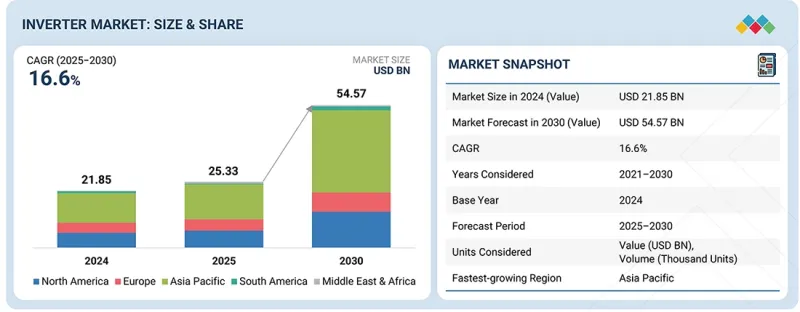
인버터 시장 규모는 2025년 253억 3,000만 달러에서 2030년까지 545억 7,000만 달러로 성장하며, 예측 기간 중 CAGR은 16.6%에 달할 것으로 전망되고 있습니다.
주요 경제권에서 태양광발전 설비, 배터리 저장 시스템(BESS) 및 전기자동차 충전 인프라의 급속한 발전으로 인해 효율적인 전력 변환, 계통 연계 및 시스템 최적화를 위한 첨단 인버터 솔루션에 대한 수요가 크게 증가하고 있습니다.
| 조사 범위 | |
|---|---|
| 조사 대상 기간 | 2021-2030년 |
| 기준연도 | 2024년 |
| 예측 기간 | 2025-2030년 |
| 대상 단위 | 금액(100만/10억 달러) |
| 부문 | 접속 유형별, 출력전압별, 판매 채널별, 정격 출력별, 유형별, 최종사용자별, 지역별 |
| 대상 지역 | 아시아태평양, 북미, 남미, 중동 및 아프리카, 유럽 |
인도에서는 대규모 태양광 공원 개발, 국가 계획에 따른 옥상 태양광 도입, 그린 수소 및 에너지 저장 프로젝트에 대한 투자로 인해 스트링형, 중앙집중형, 하이브리드형 인버터의 도입이 확대되고 있습니다. 이러한 노력에는 무효전력 제어, 안티아일랜드 보호, 저전압 라이드스루(LVRT) 등의 계통연계 기능을 갖춘 스마트 인버터가 활용되고 있으며, 인버터는 현대의 분산형 에너지 시스템에서 핵심적인 역할을 담당하고 있습니다.
미국에서는 초당적 인프라법 및 인플레이션 억제법을 포함한 연방 정부의 지원 정책으로 인해 재생에너지 용량 확대, 청정 에너지 장비 생산 및 전력망 현대화가 가속화되고 있습니다. 이러한 정책은 계통 형성 능력을 갖춘 첨단 인버터와 디지털 모니터링 기능, 사이버 보안 기능을 갖춘 기기의 보급을 촉진하고 있습니다. 유럽에서는 탈탄소화 목표, 에너지 자급자족 정책, 주거용 태양광발전의 보급이 주택, 상업용, 산업 및 유틸리티 규모 시장에서 인버터 수요를 더욱 촉진하고 있습니다. 이러한 추세는 모두 재생에너지 보급률, 에너지 효율, 전력망 탄력성 향상을 가능하게 하고 있으며, 이는 인버터 시장이 세계 에너지 전환에서 중심적인 역할을 할 수 있는 요인으로 작용하고 있습니다.
100-300V 부문은 예측 기간 중 인버터 시장에서 가장 큰 점유율을 차지할 것으로 예측됩니다. 이는 주로 이 출력 전압이 주거용 태양광발전 시스템, 소규모 상업시설, 통신 인프라 및 비상 전원 공급 장치에 널리 사용되기 때문입니다. 이 전압 범위의 인버터는 일반적으로 옥상 태양광발전이나 축전지 시스템에 채택되어 태양전지판이나 축전지에서 생산된 직류 전력을 가정이나 소규모 사업장에 전력을 공급할 수 있는 실용적인 교류 전력으로 효율적으로 변환하는 데 사용됩니다. 저전압 배전망 및 단상 시스템과 쉽게 통합할 수 있으며, 분산형 발전 환경에 특히 적합합니다. 또한 주거용 및 소규모 상업용 시스템에서 하이브리드 인버터의 보급이 확대되고 있는 것도 인버터에 대한 수요 증가의 한 요인으로 작용하고 있습니다. 이러한 시스템은 축전지 통합, 지능형 에너지 관리, 순계량 및 전력 수출 제어와 같은 계통 연계 서비스를 가능하게 합니다. 100-300V 카테고리는 신흥 국가에서의 도입 확대라는 이점도 누리고 있습니다. 이들 국가에서는 정부의 우대 정책, 모듈 가격 하락, 전기요금 상승으로 인해 지붕형 태양광발전의 도입이 가속화되고 있습니다. 100-300V 전압 범위의 인버터는 대규모 프로젝트 및 상업 및 산업 프로젝트에서 일반적으로 사용되는 고전압 시스템에 비해 설치 비용이 저렴하고 설치가 용이하며 정비가 적습니다.
대규모 태양광발전소, 풍력발전소, 계통 연계형 축전지 시스템의 급속한 확대로 예측 기간 중 유틸리티 부문은 인버터 시장에서 가장 빠르게 성장하는 최종사용자가 될 것으로 예측됩니다. 탈탄소화 목표를 달성하고 에너지 안보를 확보하기 위해 주요 경제국 정부와 전력회사는 재생에너지 도입 용량을 적극적으로 확대하고 있습니다. 이러한 추세는 유틸리티 규모의 프로젝트에서 대형 중앙형 및 스트링 인버터에 대한 수요를 주도하고 있습니다. 이 인버터는 높은 입력 직류 전압에 대응하고 우수한 변환 효율을 제공하도록 설계되었으며, 무효전력 보상, 주파수 조정, 고장시 과전압 내전압 기능 등 고급 계통 연계 기능을 갖추고 있습니다. 모듈식 아키텍처, 높은 전력 밀도, 원격 진단, SCADA 통합 기능을 갖춘 최신 유틸리티 인버터는 발전소를 효율적으로 모니터링하고 성능을 최적화할 수 있게 해줍니다. 또한 태양광, 풍력, 축전지를 결합한 하이브리드 재생에너지 공원의 사용이 증가함에 따라 에너지를 분배하고 계통 요구 사항을 문제없이 충족시키기 위해 통합 전력 변환 시스템이 필요하므로 이 부문에서 인버터의 사용이 더욱 촉진되고 있습니다.
북미는 미국과 캐나다의 높은 재생에너지 이용률, 대규모 배터리 저장 프로젝트, 종합적인 전력망 현대화 프로그램에 힘입어 예측 기간 중 인버터 시장에서 두 번째로 큰 시장으로 성장할 것으로 예측됩니다. 이 지역에서는 여전히 대규모 태양광 및 풍력발전이 크게 증가하고 있으며, 분산형 옥상 시스템 및 상업 및 산업용 시스템도 증가하고 있으며, 이 모든 분야에서 에너지를 변환하고 송전망에 통합하기 위한 첨단 인버터 기술이 요구되고 있습니다. 청정 에너지에 대한 세제 혜택, 국내 제조에 대한 인센티브, 전력망 업그레이드 투자 등 유리한 정책적 지침도 인버터 수요를 촉진하고 있습니다. 또한 북미의 전력회사들은 인버터 기반 자원(IBR)의 보급률 증가에 따른 문제, 즉 계통 관성 감소, 전압 변동, 양방향 전력 흐름 등의 문제를 해결하기 위해 보다 스마트한 그리드 형성 기능을 갖춘 인버터로의 전환을 추진하고 있습니다. 계통의 신뢰성과 복원력을 보장하기 위해 무효전력 제어, 주파수 응답, 저전압 라이드스루, 실시간 모니터링과 같은 고급 기능을 갖춘 최신형 인버터에 대한 수요가 증가하고 있습니다.
Huawei Technologies(중국), Sungrow(중국), TBEA(중국), SMA Solar Technology AG(독일), Enphase Energy(미국)는 인버터 시장의 주요 기업 중 일부입니다. 본 조사에서는 이들 주요 기업에 대해 기업 개요, 최근 동향, 주요 시장 전략을 포함한 상세한 경쟁 분석을 실시했습니다.
조사 범위:
이 보고서는 인버터 시장을 유형, 정격 출력, 출력 전압, 연결 방식, 판매 채널, 최종사용자 및 지역별로 정의, 설명 및 예측합니다. 또한 시장에 대한 상세한 정성적, 정량적 분석도 제공합니다. 이 보고서는 시장의 주요 촉진요인, 저해요인, 기회, 과제를 종합적으로 검토하고 있습니다. 또한 시장의 다양한 중요한 측면에 대해서도 다루고 있습니다. 여기에는 경쟁 구도 분석, 시장 역학, 금액 기준 시장 규모 추정, 인버터 시장 전망 동향이 포함됩니다.
이 보고서 구매의 주요 이점
- 이 보고서에서는 인버터 시장의 성장에 영향을 미치는 주요 촉진요인(재생에너지 분야 투자 확대, 주택용 태양광발전 시스템 설치 증가), 제약요인(높은 직류 전압에 따른 안전 위험), 기회요인(전기자동차 수요 증가, 고출력 밀도 인버터 수요), 과제(회색) 시장에서의 비용 효율적인 제품의 유통이 제조업체에 가격 압박을 가하고 있는 점)에 대해 분석했습니다.
- 시장 동향 : 수익성 높은 시장에 대한 종합적인 정보 - 이 보고서는 다양한 지역의 인버터 시장을 분석합니다.
- 시장 다각화 : 인버터 시장의 신제품 및 서비스, 미개발 지역, 최근 동향 및 투자에 대한 종합적인 정보를 제공합니다.
- 경쟁 분석 - Huawei Technologies(중국), Sungrow(중국), SMA Solar Technology AG(독일), MA Solar Italy(이탈리아), SolarEdge(이스라엘), Fronius International GmbH(오스트리아), Power Electronics S.L.(스페인), Altenergy Power System Inc.(중국), Enphase Energy(미국), DARFON(대만), Schneider Electric(프랑스), GE Vernova(미국), Delta Electronics, Inc.(대만), Exide Industries Ltd.(인도), Samlex Europe B.V.(네덜란드), GOODWE(중국), Sineng Electric(중국), Ginlong Technologies(중국), BESTEK(중국), KACO new energy(독일), Growatt New Energy(중국), TBEA(중국), TMEIC(일본), Yaskawa-Solectria Solar(미국) 및 AISWEI Technology(중국) 등이 인버터 시장에 참여하고 있습니다.
- 제품 혁신 및 개발: 인버터 시장에서는 특히 스마트한 디지털 제어 메커니즘과 예지보전 메커니즘의 도입에 따라 제품 출시 및 업그레이드가 활발하게 이루어지고 있습니다. 실리콘 카바이드(SiC) 및 질화갈륨(GaN) 반도체 소자의 효율 향상, 첨단 액체 냉각 및 하이브리드 냉각, 모듈식 또는 컴팩트한 설계와 같은 지속가능한 개발은 재생에너지 통합, 스마트 그리드, 에너지 저장 및 유틸리티 규모의 시스템에서 점점 더 많이 사용되고 있습니다. 에서의 적용이 확대됨에 따라 점점 더 널리 보급되고 있습니다. 디지털 제어 개선, 인공지능(AI)을 활용한 예지보전, 최적화된 파워 일렉트로닉스/반도체 설계를 통해 설치가 간편하고, 설치 면적을 줄이고, 쉽게 확장할 수 있는 하이브리드 솔루션의 개발이 진행되고 있습니다. 계통 안정성, 주파수 조정, 전압 유지 및 무효전력 대응 능력을 제공합니다.
자주 묻는 질문
목차
제1장 서론
제2장 개요
제3장 주요 인사이트
제4장 시장 개요
제5장 업계 동향
제6장 기술, 특허, 디지털 기술, AI의 도입에 의한 전략적 파괴
제7장 지속가능성과 규제 상황
제8장 고객 상황과 구매 행동
제9장 인버터 시장(접속 유형별)
제10장 인버터 시장(출력전압별)
제11장 인버터 시장(판매 채널별)
제12장 인버터 시장(출력전력정격별)
제13장 인버터 시장(유형별)
제14장 인버터 시장(최종사용자별)
제15장 인버터 시장(지역별)
제16장 경쟁 구도
제17장 기업 개요
제18장 조사 방법
제19장 부록
KSA 26.04.16The inverter market is projected to grow from USD 25.33 billion in 2025 to USD 54.57 billion by 2030, at a CAGR of 16.6% during the forecast period. The swift development of solar PV installations, battery energy storage systems (BESS), and EV charging infrastructure in large economies is putting a significant strain on the demand for advanced inverter solutions to provide efficient power conversion, grid synchronization, and system optimization.
| Scope of the Report | |
|---|---|
| Years Considered for the Study | 2021-2030 |
| Base Year | 2024 |
| Forecast Period | 2025-2030 |
| Units Considered | Value (USD Million/Billion) |
| Segments | By Type, Connection Type, Sales Channel, End User, Output Voltage, Power Rating, Output Voltage |
| Regions covered | Asia Pacific, North America, South America, Middle East & Africa, Europe |
In India, string, central, and hybrid inverters are increasingly being deployed due to the development of large-scale solar parks, the adoption of rooftop solar under national schemes, and investments in green hydrogen and energy storage projects. These initiatives involve smart inverters with grid-support features such as reactive power control, anti-islanding protection, and low-voltage ride-through (LVRT), positioning inverters at the heart of modern distributed energy systems.
The expansion of renewable energy capacity, production of clean energy equipment in the US, and modernization of the electrical grid are accelerating due to supportive federal policies, including incentives from the Bipartisan Infrastructure Law and the Inflation Reduction Act. These policies encourage the widespread use of advanced inverters with grid-forming power, as well as digital monitoring and cybersecurity features. In Europe, decarbonization goals, energy self-reliance policies, and rooftop penetration are driving even greater inverter demand in the residential, commercial, industrial, and utility-scale markets. All these trends are making it possible to achieve greater renewable levels, energy efficiency, and grid resilience, which contributes to the central role of the inverter market in the global energy transition.
"By output voltage, the 100-300 V segment is expected to lead the market during the forecast period."
The 100-300 V segment will account for the maximum share of the inverter market during the forecast period, mainly because of the wide usage of this output voltage in residential solar systems, mini commercial set-ups, telecommunication infrastructure, and backup power. Inverters in this voltage span commonly find application in rooftop solar PVs and battery energy storage, where they are used to efficiently convert DC power produced by the solar panels or batteries into practical AC power to power homes and small businesses. They are particularly well-suited for distributed generation environments as they can easily integrate with low-voltage distribution networks and single-phase systems. Demand for these inverters is also growing because of the increasing popularity of hybrid inverters in residential and small commercial systems. These systems facilitate battery storage integration, intelligent energy management, and grid-interactive services like net metering and export control. The 100-300 V category also enjoys the advantage of expanding installations in emerging economies, where adoption of rooftop solar is gaining momentum thanks to favorable government policies, decreasing prices of modules, and increasing electricity tariffs. Inverters with a voltage range of 100-300 V are more economical to deploy, easier to install, and require less maintenance compared to higher voltage systems commonly used in large-scale and commercial-industrial projects.
"By end user, the utility segment is projected to register the fastest growth during the forecast period."
The utility segment is expected to be the fastest-growing end user in the inverter market throughout the forecast period as a result of swift growth in large-scale solar PV facilities, wind farms, and grid-connected battery energy storage systems. To meet decarbonization goals and ensure energy security, governments and utilities in major economies are actively expanding renewable energy capacity. This trend drives demand for large central and string inverters in utility-scale projects. These inverters are designed to handle high input DC voltages, provide excellent conversion efficiencies, and include advanced grid support features such as reactive power compensation, frequency regulation, and fault ride-through capabilities. The ability to monitor the plant efficiently and optimize the performance of a plant has been made possible by modern utility inverters with modular architectures, high power density, remote diagnostics, and SCADA integration. Moreover, the increasing use of hybrid renewable parks with solar, wind, and storage further spurs the use of inverters in the segment since combined power conversion systems are needed to dispatch energy and meet grid requirements without issues.
"By region, North America is estimated to account for the second-largest market share during the forecast period."
North America is estimated to be the second-largest market for inverters during the forecast period, driven by the high level of renewable energy utilization, extensive battery energy storage projects, and the overall grid modernization programs in both the US and Canada. The area is still experiencing a significant influx of utility-scale solar and wind power, as well as an increase in distributed rooftop and commercial and industrial systems, all of which demand sophisticated inverter technology to convert the energy and integrate it into the grid. Favorable policy guidelines, such as tax subsidies on clean energy, domestic manufacturing incentives, and investments in transmission upgrades, are also boosting inverter demand. In addition, utilities in North America are moving toward smarter and grid-forming inverters to deal with the issues of high penetration of inverter-based resources (IBRs), which include decreased system inertia, voltage variations, and two-way power flows. The need to ensure reliability and resilience of the grid is driving the requirement for modern inverters that have advanced features, like reactive power control, frequency response, low-voltage ride-through, and real-time monitoring.
In-depth interviews were conducted with key industry participants, subject-matter experts, C-level executives of leading market players, and industry consultants, among others, to obtain and verify critical qualitative and quantitative information and to assess future market prospects. The distribution of primary interviews is as follows:
By Company Type: Tier 1 - 45%, Tier 2 - 30%, and Tier 3 - 25%
By Designation: C-level Executives - 35%, Directors - 25%, and Others - 40%
By Region: Asia Pacific - 33%, North America - 27%, Europe - 20%, Middle East & Africa - 12%, and South America - 8%
Note: The tiers of the companies are defined based on their total revenues as of 2024. Tier 1: > USD 1 billion, Tier 2: USD 500 million to USD 1 billion, and Tier 3: < USD 500 million. Other designations include sales managers, engineers, and regional managers.
Huawei Technologies Co., Ltd. (China), Sungrow (China), TBEA Co., Ltd. (China), SMA Solar Technology AG (Germany), and Enphase Energy (US) are some of the major players in the inverter market. The study includes an in-depth competitive analysis of these key players, including their company profiles, recent developments, and key market strategies.
Research Coverage:
The report defines, describes, and forecasts the inverter market by type, power rating, output voltage, connection type, sales channel, end user, and region. It also offers a detailed qualitative and quantitative analysis of the market. The report comprehensively reviews the major market drivers, restraints, opportunities, and challenges. It also covers various important aspects of the market. These include an analysis of the competitive landscape, market dynamics, market estimates in terms of value, and future trends in the inverter market.
Key Benefits of Buying the Report
- It provides an analysis of key drivers (Increasing investments in renewable energy sector, Increasing residential solar rooftop installations), restraints (Safety risk associated with high DC voltages), opportunities (Growing demand for electric vehicles, Demand for high-power density inverters), challenges (availability of cost-effective products in gray market leading to pricing pressure on manufacturers) influencing the growth of the inverter market.
- Market Development: Comprehensive information about lucrative markets - the report analyses the inverter market across varied regions.
- Market Diversification: Exhaustive information about new products and services, untapped geographies, recent developments, and investments in the inverter market.
- Competitive Assessment: In-depth assessment of market shares, growth strategies, and service offerings of leading players like Huawei Technologies Co., Ltd. (China), Sungrow (China), SMA Solar Technology AG (Germany), MA Solar Italy (Italy), SolarEdge (Israel), Fronius International GmbH (Austria), Power Electronics S.L. (Spain), Altenergy Power System Inc. (China), Enphase Energy (US), DARFON (Taiwan), Schneider Electric (France), GE Vernova (US), Delta Electronics, Inc. (Taiwan), Exide Industries Ltd. (India), Samlex Europe B.V. (Netherlands), GOODWE (China), Sineng Electric (China), Ginlong Technologies (China), BESTEK (China), KACO new energy (Germany), Growatt New Energy (China), TBEA Co., Ltd. (China), TMEIC (Japan), Yaskawa - Solectria Solar (US), and AISWEI Technology Co., Ltd. (China), among others, in the inverter market.
- Product Innovation/Development: Product introduction and upgrade in inverter products are high in the inverter market, particularly with the introduction of smart digital control mechanisms and predictive maintenance mechanisms. Sustainable developments, including silicon carbide (SiC) and gallium nitride (GaN) semiconductor-based device efficiency, advanced liquid or hybrid cooling, and modular or compact designs, are increasingly gaining ground with more applications in the renewable energy integration, smart grids, energy storage, and utility-scale systems. The development of hybrid solutions is also advancing, with improved digital controls, artificial intelligence (AI)-based predictive maintenance, and optimized power electronics/semiconductor designs, simplifying deployment, reducing footprints, enabling easy scalability, and offering better grid stability, frequency regulation, voltage support, and reactive power capability to the modern power systems.
TABLE OF CONTENTS
1 INTRODUCTION
- 1.1 STUDY OBJECTIVES
- 1.2 MARKET DEFINITION
- 1.3 STUDY SCOPE
- 1.3.1 MARKETS COVERED AND REGIONAL SCOPE
- 1.3.2 INCLUSIONS AND EXCLUSIONS
- 1.3.3 YEARS CONSIDERED
- 1.4 UNITS CONSIDERED
- 1.4.1 CURRENCY/VALUE UNIT
- 1.4.2 VOLUME UNIT
- 1.5 LIMITATIONS
- 1.6 STAKEHOLDERS
- 1.7 SUMMARY OF CHANGES
2 EXECUTIVE SUMMARY
- 2.1 KEY INSIGHTS AND MARKET HIGHLIGHTS
- 2.2 KEY MARKET PARTICIPANTS: MAPPING OF STRATEGIC DEVELOPMENTS
- 2.3 DISRUPTION SHAPING INVERTER MARKET
- 2.4 HIGH GROWTH SEGMENTS
- 2.5 SNAPSHOT: GLOBAL MARKET SIZE, GROWTH RATE, AND FORECAST
3 PREMIUM INSIGHTS
- 3.1 ATTRACTIVE OPPORTUNITIES FOR PLAYERS IN INVERTER MARKET
- 3.2 INVERTER MARKET, BY TYPE AND REGION
- 3.3 INVERTER MARKET, BY TYPE
- 3.4 INVERTER MARKET, BY CONNECTION TYPE
- 3.5 INVERTER MARKET, BY SALES CHANNEL
- 3.6 INVERTER MARKET, BY OUTPUT POWER RATING
- 3.7 INVERTER MARKET, BY OUTPUT VOLTAGE
- 3.8 INVERTER MARKET, BY END USER
- 3.9 INVERTER MARKET, BY COUNTRY
4 MARKET OVERVIEW
- 4.1 INTRODUCTION
- 4.2 MARKET DYNAMICS
- 4.2.1 DRIVERS
- 4.2.1.1 Growing capital investments in renewable energy sector
- 4.2.1.2 Surge in solar installations driven by government policies, incentives, and national renewable energy programs
- 4.2.1.3 Rapid expansion of residential rooftop solar systems
- 4.2.2 RESTRAINTS
- 4.2.2.1 Safety concerns linked to high DC voltage levels in inverter systems
- 4.2.2.2 Increased stress and reduced lifespan of batteries from extended inverter operation
- 4.2.3 OPPORTUNITIES
- 4.2.3.1 Rising demand for electric vehicles and associated charging infrastructure
- 4.2.3.2 Growing investments in smart grid development and modernization
- 4.2.3.3 Increasing need for high-power-density inverters to support compact, efficient designs
- 4.2.4 CHALLENGES
- 4.2.4.1 Presence of low-cost, gray-market products creating intense pricing pressure on legitimate manufacturers
- 4.2.1 DRIVERS
- 4.3 UNMET NEEDS AND WHITE SPACES
- 4.3.1 UNMET NEEDS IN INVERTER MARKET
- 4.3.2 WHITE SPACE OPPORTUNITIES
- 4.4 INTERCONNECTED MARKETS AND CROSS-SECTOR OPPORTUNITIES
- 4.4.1 INTERCONNECTED MARKETS
- 4.4.2 CROSS-SECTOR OPPORTUNITIES
- 4.5 STRATEGIC MOVES BY TIER-1/2/3 PLAYERS
- 4.5.1 KEY MOVES AND STRATEGIC FOCUS
5 INDUSTRY TRENDS
- 5.1 PORTER'S FIVE FORCES ANALYSIS
- 5.1.1 THREAT OF NEW ENTRANTS
- 5.1.2 THREAT OF SUBSTITUTES
- 5.1.3 BARGAINING POWER OF SUPPLIERS
- 5.1.4 BARGAINING POWER OF BUYERS
- 5.1.5 INTENSITY OF COMPETITIVE RIVALRY
- 5.2 MACROECONOMIC INDICATORS
- 5.2.1 INTRODUCTION
- 5.2.2 GDP TRENDS AND FORECAST
- 5.2.3 TRENDS IN GLOBAL INVERTER INDUSTRY
- 5.3 VALUE CHAIN ANALYSIS
- 5.4 ECOSYSTEM ANALYSIS
- 5.5 PRICING ANALYSIS
- 5.5.1 AVERAGE SELLING PRICE TREND, BY TYPE
- 5.5.2 AVERAGE SELLING PRICE TREND, BY REGION
- 5.5.3 AVERAGE SELLING PRICE TREND, BY REGION
- 5.6 TRADE ANALYSIS
- 5.6.1 IMPORT SCENARIO (HS CODE 850440)
- 5.6.2 EXPORT SCENARIO (HS CODE 850440)
- 5.7 KEY CONFERENCES AND EVENTS, 2025-2026
- 5.8 TRENDS/DISRUPTIONS IMPACTING CUSTOMER BUSINESS
- 5.9 INVESTMENT AND FUNDING SCENARIO
- 5.10 CASE STUDY ANALYSIS
- 5.10.1 SEAMLESS UTILITY-SCALE SOLAR RETROFIT FOR GRID STABILITY IN GREECE
- 5.10.2 RETROFIT OF LEGACY CENTRAL INVERTERS WITH SMART STRING INVERTERS IN CHINA
- 5.10.3 GRID-FORMING INVERTER ENABLED BLACKSTART FOR ISLAND MICROGRID IN AUSTRALIA
- 5.11 INVERTER MARKET: IMPACT OF 2025 US TARIFFS
- 5.11.1 INTRODUCTION
- 5.11.2 KEY TARIFF RATES
- 5.11.3 PRICE IMPACT ANALYSIS
- 5.11.4 IMPACT ON COUNTRIES/REGIONS
- 5.11.4.1 US
- 5.11.4.2 Europe
- 5.11.4.3 Asia Pacific
- 5.11.5 IMPACT ON END-USE INDUSTRIES
6 STRATEGIC DISRUPTION THROUGH TECHNOLOGY, PATENTS, DIGITAL, AND AI ADOPTIONS
- 6.1 KEY EMERGING TECHNOLOGIES
- 6.1.1 Z-SOURCE INVERTERS
- 6.1.2 SOLAR MICROINVERTERS
- 6.2 COMPLEMENTARY TECHNOLOGIES
- 6.2.1 ENERGY STORAGE SYSTEMS (ESS)
- 6.2.2 INTEGRATION WITH ENERGY STORAGE
- 6.3 TECHNOLOGY/PRODUCT ROADMAP
- 6.3.1 SHORT-TERM (2025-2027) | FOUNDATION & EARLY COMMERCIALIZATION
- 6.3.2 MID-TERM (2027-2030) | EXPANSION & STANDARDIZATION
- 6.3.3 LONG-TERM (2030+) | MASS COMMERCIALIZATION & DISRUPTION
- 6.4 PATENT ANALYSIS
- 6.4.1 INTRODUCTION
- 6.4.2 METHODOLOGY
- 6.4.3 DOCUMENT TYPE
- 6.4.4 INSIGHTS
- 6.4.5 LEGAL STATUS OF PATENTS
- 6.4.6 JURISDICTION ANALYSIS
- 6.4.7 TOP APPLICANTS
- 6.4.8 LIST OF PATENTS BY SAMSUNG ELECTRONICS CO, LTD
- 6.4.9 LIST OF PATENTS BY APPLE INC
- 6.5 FUTURE APPLICATIONS
- 6.5.1 SMART GRIDS: ENABLING 100% RENEWABLE OR HIGH-IBR GRIDS WITH SYNTHETIC INERTIA
- 6.5.2 ELECTRIC VEHICLE INFRASTRUCTURE & V2G: BIDIRECTIONAL GRID-TO-VEHICLE/VEHICLE-TO-GRID CHARGING HUBS TO ALIGN EV CHARGING WITH SOLAR AVAILABILITY
- 6.5.3 DATA CENTERS & HIGH-TECH FACILITIES: ULTRA-RELIABLE, LOW HARMONIC, AND RESILIENT POWER DELIVERY WITH HYBRID SOLAR-STORAGE MICROGRIDS
- 6.5.4 INDUSTRIAL DECARBONIZATION & ELECTRIFICATION: PRECISION POWER CONDITIONING FOR HEAVY INDUSTRY
- 6.6 IMPACT OF AI/GEN AI ON INVERTER MARKET
- 6.6.1 TOP USE CASES AND MARKET POTENTIAL
- 6.6.2 BEST PRACTICES IN INVERTER MARKET
- 6.6.3 CASE STUDIES OF AI IMPLEMENTATION IN INVERTER MARKET
- 6.6.4 INTERCONNECTED ADJACENT ECOSYSTEM AND IMPACT ON MARKET PLAYERS
- 6.6.5 CLIENTS' READINESS TO ADOPT GENERATIVE AI IN INVERTER MARKET
- 6.7 SUCCESS STORIES AND REAL-WORLD APPLICATIONS
- 6.7.1 HUAWEI TECHNOLOGIES CO., LTD: UTILITY-SCALE SOLAR FARM YIELD OPTIMIZATION WITH AI-DRIVEN MPPT
- 6.7.2 SUNGROW: GRID-FORMING HYBRID MICROGRID IN REMOTE INDUSTRIAL PARK
- 6.7.3 ENPHASE ENERGY: RESIDENTIAL VIRTUAL POWER PLANT AND OUTAGE RESILIENCE
7 SUSTAINABILITY AND REGULATORY LANDSCAPE
- 7.1 REGIONAL REGULATIONS AND COMPLIANCE
- 7.1.1 REGULATORY BODIES, GOVERNMENT AGENCIES, AND OTHER ORGANIZATIONS
- 7.1.2 INDUSTRY STANDARDS
- 7.2 SUSTAINABILITY INITIATIVES
- 7.2.1 CARBON IMPACT AND ECO-APPLICATIONS OF INVERTERS
- 7.3 SUSTAINABILITY IMPACT AND REGULATORY POLICY INITIATIVES
- 7.4 CERTIFICATIONS, LABELING, ECO-STANDARDS
8 CUSTOMER LANDSCAPE & BUYER BEHAVIOR
- 8.1 DECISION-MAKING PROCESS
- 8.2 BUYER STAKEHOLDERS AND BUYING EVALUATION CRITERIA
- 8.2.1 KEY STAKEHOLDERS IN BUYING PROCESS
- 8.2.2 BUYING CRITERIA
- 8.3 ADOPTION BARRIERS & INTERNAL CHALLENGES
- 8.4 UNMET NEEDS FROM VARIOUS END USERS
- 8.5 MARKET PROFITIBILITY
- 8.5.1 REVENUE POTENTIAL
- 8.5.2 COST DYNAMICS
- 8.5.3 MARGIN OPPORTUNITIES BY END USER
9 INVERTER MARKET, BY CONNECTION TYPE
- 9.1 INTRODUCTION
- 9.2 STANDALONE
- 9.2.1 RISING ELECTRICITY CONSUMPTION AND DEPENDENCE ON ELECTRONIC DEVICES TO BOOST MARKET
- 9.3 GRID-TIED
- 9.3.1 CONVENTIONAL INVERTERS
- 9.3.1.1 Increasing installation of solar PV systems in residential and commercial sectors to propel market
- 9.3.2 SMART INVERTERS
- 9.3.2.1 Technological advancements in grid-tied inverters to drive market
- 9.3.1 CONVENTIONAL INVERTERS
10 INVERTER MARKET, BY OUTPUT VOLTAGE
- 10.1 INTRODUCTION
- 10.2 100-300 V
- 10.2.1 RISING ELECTRICITY DEMAND DUE TO URBANIZATION TO DRIVE MARKET
- 10.3 301-500 V
- 10.3.1 GROWING REQUIREMENT FOR UNINTERRUPTED POWER SUPPLY FROM COMMERCIAL AND INDUSTRIAL SECTORS TO FUEL MARKET GROWTH
- 10.4 ABOVE 500 V
- 10.4.1 INCREASING INVESTMENTS IN POWER INFRASTRUCTURE DEVELOPMENT TO CONTRIBUTE TO MARKET GROWTH
11 INVERTER MARKET, BY SALES CHANNEL
- 11.1 INTRODUCTION
- 11.2 DIRECT
- 11.2.1 RISING PREFERENCE FOR DIRECT PROCUREMENT OF VEHICLE INVERTERS AMONG AUTOMOBILE MANUFACTURERS TO DRIVE MARKET
- 11.3 INDIRECT
- 11.3.1 INCREASING ADOPTION OF INVERTERS IN RESIDENTIAL SECTOR AND PV PLANTS TO CONTRIBUTE TO MARKET GROWTH
12 INVERTER MARKET, BY OUTPUT POWER RATING
- 12.1 INTRODUCTION
- 12.2 BELOW 10 KW
- 12.2.1 RISING DEMAND FROM RESIDENTIAL SECTOR TO CONTRIBUTE TO MARKET GROWTH
- 12.3 10-50 KW
- 12.3.1 INCREASING DEPLOYMENT IN EXPANDING COMMERCIAL SECTOR TO FUEL DEMAND
- 12.4 51-100 KW
- 12.4.1 GROWING DEMAND FROM PV PLANTS AND VARIOUS INDUSTRIES TO BOOST MARKET GROWTH
- 12.5 101 - 500 KW
- 12.5.1 RISING NUMBER OF PV PLANTS AND EXPANDING INDUSTRY TO DRIVE MARKET
- 12.6 ABOVE 500 KW
- 12.6.1 RISING NUMBER OF UTILITY-SCALE RENEWABLE ENERGY PROJECTS, LARGE INDUSTRIAL COMPLEXES, AND GRID-SUPPORT APPLICATIONS TO DRIVE MARKET
13 INVERTER MARKET, BY TYPE
- 13.1 INTRODUCTION
- 13.2 SOLAR INVERTERS
- 13.2.1 CENTRAL INVERTERS
- 13.2.1.1 Rise in demand from PV plants to drive market
- 13.2.2 STRING INVERTER
- 13.2.2.1 Rising installation of solar panels in residential and commercial sectors to boost market growth
- 13.2.3 MICROINVERTERS
- 13.2.3.1 Increasing demand for microinverters in residential sector to fuel market growth
- 13.2.4 HYBRID INVERTERS
- 13.2.4.1 Multiple benefits of hybrid inverters to drive market
- 13.2.1 CENTRAL INVERTERS
- 13.3 VEHICLE INVERTER
- 13.3.1 BATTERY ELECTRIC VEHICLE (BEV)
- 13.3.1.1 Favorable government initiatives related to EVs to propel market
- 13.3.2 HYBRID ELECTRIC VEHICLE (HEV)
- 13.3.2.1 Increased demand for fuel-efficient vehicles and implementation of stringent emission norms to fuel market growth
- 13.3.3 PLUG-IN HYBRID ELECTRIC VEHICLE (PHEV)
- 13.3.3.1 Rising demand for EVs to boost market growth
- 13.3.1 BATTERY ELECTRIC VEHICLE (BEV)
- 13.4 OTHER TYPES
14 INVERTER MARKET, BY END USER
- 14.1 INTRODUCTION
- 14.2 RESIDENTIAL
- 14.2.1 INCREASE IN GOVERNMENT INITIATIVES TO INCREASE RENEWABLE ENERGY ACCESS FOR HOUSEHOLDS TO DRIVE MARKET
- 14.3 COMMERCIAL AND INDUSTRIAL
- 14.3.1 GROWTH IN ADOPTION OF SMART ELECTRICITY TO FUEL DEMAND
- 14.4 UTILITY
- 14.4.1 RISE IN IMPLEMENTATION OF RENEWABLE ENERGY POLICIES IN SEVERAL COUNTRIES TO FOSTER MARKET GROWTH
15 INVERTER MARKET, BY REGION
- 15.1 INTRODUCTION
- 15.2 ASIA PACIFIC
- 15.2.1 CHINA
- 15.2.1.1 Record solar expansion and global manufacturing dominance to shape growth of Chinese inverter market
- 15.2.2 INDIA
- 15.2.2.1 Solar additions and rooftop subsidy programs to accelerate growth of Indian inverter market
- 15.2.3 JAPAN
- 15.2.3.1 Policy shift toward rooftop solar and self-consumption to reshape growth of Japanese inverter market
- 15.2.4 AUSTRALIA
- 15.2.4.1 Rising rooftop solar and battery storage integration to accelerate growth of Australian inverter market
- 15.2.5 REST OF ASIA PACIFIC
- 15.2.1 CHINA
- 15.3 NORTH AMERICA
- 15.3.1 US
- 15.3.1.1 Record grid modernization and global manufacturing dominance to shape growth of US inverter market
- 15.3.2 CANADA
- 15.3.2.1 New Solar deployment and subsidy programs to accelerate growth of Canadian inverter market
- 15.3.3 MEXICO
- 15.3.3.1 Utility-scale expansion and storage integration to accelerate growth of Mexican inverter market
- 15.3.1 US
- 15.4 EUROPE
- 15.4.1 UK
- 15.4.1.1 Policy-driven solar expansion and distributed energy adoption to accelerate UK inverter market growth
- 15.4.2 FRANCE
- 15.4.2.1 Auction-driven solar expansion and self-consumption reforms to shape growth trajectory of French inverter market
- 15.4.3 GERMANY
- 15.4.3.1 Feed-in tariff phase-out and regulatory tightening to reshape growth dynamics of German inverter market
- 15.4.4 ITALY
- 15.4.4.1 Incentive transition and distributed solar softening to influence growth path of Italian inverter market
- 15.4.5 SPAIN
- 15.4.5.1 Utility-scale momentum and policy transition to drive growth in Spanish inverter market
- 15.4.6 REST OF EUROPE
- 15.4.1 UK
- 15.5 SOUTH AMERICA
- 15.5.1 BRAZIL
- 15.5.1.1 Increase in investments in solar technology to propel demand in Brazil
- 15.5.2 ARGENTINA
- 15.5.2.1 Government incentives to promote solar energy generation to boost Argentine market growth
- 15.5.3 REST OF SOUTH AMERICA
- 15.5.1 BRAZIL
- 15.6 MIDDLE EAST & AFRICA
- 15.6.1 GCC
- 15.6.1.1 Large-scale renewable and infrastructure investments to propel growth of GCC inverter market
- 15.6.2 SAUDI ARABIA
- 15.6.2.1 Vision 2030-driven renewable expansion and mega infrastructure projects accelerating inverter demand in Saudi Arabia
- 15.6.3 UAE
- 15.6.3.1 Net-zero strategies and smart infrastructure expansion driving growth of UAE inverter market
- 15.6.4 REST OF GCC
- 15.6.5 SOUTH AFRICA
- 15.6.5.1 Power reliability challenges and industrial electrification accelerating growth of South African inverter market
- 15.6.6 REST OF MIDDLE EAST & AFRICA
- 15.6.1 GCC
16 COMPETITIVE LANDSCAPE
- 16.1 OVERVIEW
- 16.2 KEY PLAYER STRATEGIES/RIGHT TO WIN, 2021-2026
- 16.3 MARKET SHARE ANALYSIS, 2024
- 16.4 REVENUE ANALYSIS, 2020-2024
- 16.5 COMPANY VALUATION AND FINANCIAL METRICS
- 16.6 BRAND/PRODUCT COMPARISON
- 16.7 COMPANY EVALUATION MATRIX: KEY PLAYERS, 2024
- 16.7.1 STARS
- 16.7.2 EMERGING LEADERS
- 16.7.3 PERVASIVE PLAYERS
- 16.7.4 PARTICIPANTS
- 16.7.5 COMPANY FOOTPRINT: KEY PLAYERS, 2024
- 16.7.5.1 Company footprint
- 16.7.5.2 Region footprint
- 16.7.5.3 End user footprint
- 16.7.5.4 Type footprint
- 16.7.5.5 Connection type footprint
- 16.8 COMPANY EVALUATION MATRIX: STARTUPS/SMES, 2024
- 16.8.1 PROGRESSIVE COMPANIES
- 16.8.2 RESPONSIVE COMPANIES
- 16.8.3 DYNAMIC COMPANIES
- 16.8.4 STARTING BLOCKS
- 16.8.5 COMPETITIVE BENCHMARKING: STARTUPS/SMES, 2024
- 16.8.5.1 Detailed list of key startups/SMEs
- 16.8.5.2 Competitive benchmarking of key startups/SMEs
- 16.9 COMPETITIVE SCENARIO
- 16.9.1 PRODUCT LAUNCHES
- 16.9.2 DEALS
- 16.9.3 EXPANSIONS
- 16.9.4 OTHER DEVELOPMENTS
17 COMPANY PROFILES
- 17.1 KEY PLAYERS
- 17.1.1 HUAWEI TECHNOLOGIES CO., LTD.
- 17.1.1.1 Business overview
- 17.1.1.2 Products/Solutions/Services offered
- 17.1.1.3 Recent developments
- 17.1.1.3.1 Deals
- 17.1.1.3.2 Other developments
- 17.1.1.4 MnM view
- 17.1.1.4.1 Key strengths/Right to win
- 17.1.1.4.2 Strategic choices
- 17.1.1.4.3 Weaknesses/Competitive threats
- 17.1.2 SUNGROW
- 17.1.2.1 Business overview
- 17.1.2.2 Products/Solutions/Services offered
- 17.1.2.3 Recent developments
- 17.1.2.3.1 Deals
- 17.1.2.3.2 Other developments
- 17.1.2.4 MnM view
- 17.1.2.4.1 Key strengths/Right to win
- 17.1.2.4.2 Strategic choices
- 17.1.2.4.3 Weaknesses/Competitive threats
- 17.1.3 SMA SOLAR TECHNOLOGY AG
- 17.1.3.1 Business overview
- 17.1.3.2 Products/Services/Solutions offered
- 17.1.3.3 Recent developments
- 17.1.3.3.1 Product launches
- 17.1.3.3.2 Deals
- 17.1.3.3.3 Other developments
- 17.1.3.4 MnM view
- 17.1.3.4.1 Key strengths/Right to win
- 17.1.3.4.2 Strategic choices
- 17.1.3.4.3 Weaknesses/Competitive threats
- 17.1.4 TBEA CO., LTD.
- 17.1.4.1 Business overview
- 17.1.4.2 Products/Solutions/Services offered
- 17.1.4.3 MnM view
- 17.1.4.3.1 Key strengths
- 17.1.4.3.2 Strategic choices
- 17.1.4.3.3 Weaknesses/Competitive threats
- 17.1.5 ENPHASE ENERGY
- 17.1.5.1 Business overview
- 17.1.5.2 Products/Solutions/Services offered
- 17.1.5.3 Recent developments
- 17.1.5.3.1 Product launches
- 17.1.5.3.2 Deals
- 17.1.5.3.3 Expansions
- 17.1.5.4 MnM view
- 17.1.5.4.1 Key strengths
- 17.1.5.4.2 Strategic choices
- 17.1.5.4.3 Weaknesses/Competitive threats
- 17.1.6 GE VERNOVA
- 17.1.6.1 Business overview
- 17.1.6.2 Products/Solutions/Services offered
- 17.1.6.3 Recent developments
- 17.1.6.3.1 Product launches
- 17.1.6.3.2 Deals
- 17.1.7 SOLAREDGE
- 17.1.7.1 Business overview
- 17.1.7.2 Products/Solutions/Services offered
- 17.1.7.3 Recent developments
- 17.1.7.3.1 Product launches
- 17.1.7.3.2 Deals
- 17.1.7.3.3 Expansions
- 17.1.7.3.4 Other developments
- 17.1.8 MA SOLAR ITALY
- 17.1.8.1 Business overview
- 17.1.8.2 Products/Solutions/Services offered
- 17.1.8.3 Recent developments
- 17.1.8.3.1 Product launches
- 17.1.8.3.2 Deals
- 17.1.8.3.3 Expansions
- 17.1.9 FRONIUS INTERNATIONAL GMBH
- 17.1.9.1 Business overview
- 17.1.9.2 Products/Services/Solutions offered
- 17.1.9.3 Recent developments
- 17.1.9.3.1 Product launches
- 17.1.9.3.2 Other developments
- 17.1.10 GOODWE
- 17.1.10.1 Business overview
- 17.1.10.2 Products/Services/Solutions offered
- 17.1.10.3 Recent developments
- 17.1.10.3.1 Deals
- 17.1.10.3.2 Expansions
- 17.1.11 DARFON
- 17.1.11.1 Business overview
- 17.1.11.2 Products/Solutions/Services offered
- 17.1.12 SCHNEIDER ELECTRIC
- 17.1.12.1 Business overview
- 17.1.12.2 Products/Solutions/Services offered
- 17.1.12.3 Recent developments
- 17.1.12.3.1 Deals
- 17.1.12.3.2 Other developments
- 17.1.13 DELTA ELECTRONICS, INC.
- 17.1.13.1 Business overview
- 17.1.13.2 Products/Solutions/Services offered
- 17.1.13.3 Recent developments
- 17.1.13.3.1 Deals
- 17.1.14 EXIDE INDUSTRIES LTD.
- 17.1.14.1 Business overview
- 17.1.14.2 Products/Solutions/Services offered
- 17.1.15 SINENG ELECTRIC
- 17.1.15.1 Business overview
- 17.1.15.2 Products/Solutions/Services offered
- 17.1.15.3 Recent developments
- 17.1.15.3.1 Deals
- 17.1.15.3.2 Other developments
- 17.1.16 GINLONG TECHNOLOGIES
- 17.1.16.1 Business overview
- 17.1.16.2 Products/Solutions/Services offered
- 17.1.1 HUAWEI TECHNOLOGIES CO., LTD.
- 17.2 OTHER PLAYERS
- 17.2.1 SAMLEX EUROPE B.V.
- 17.2.2 BESTEK
- 17.2.3 TMEIC
- 17.2.4 YASKAWA - SOLECTRIA SOLAR
- 17.2.5 KACO NEW ENERGY
- 17.2.6 GROWATT NEW ENERGY
- 17.2.7 POWER ELECTRONICS S.L.
- 17.2.8 ALTENERGY POWER SYSTEM INC.
- 17.2.9 AISWEI TECHNOLOGY CO., LTD.
18 RESEARCH METHODOLOGY
- 18.1 RESEARCH DATA
- 18.2 SECONDARY AND PRIMARY RESEARCH
- 18.2.1 SECONDARY DATA
- 18.2.1.1 List of key secondary sources
- 18.2.1.2 Key data from secondary sources
- 18.2.2 PRIMARY DATA
- 18.2.2.1 List of primary interview participants
- 18.2.2.2 Key industry insights
- 18.2.2.3 Breakdown of primaries
- 18.2.2.4 Key data from primary sources
- 18.2.1 SECONDARY DATA
- 18.3 MARKET SIZE ESTIMATION METHODOLOGY
- 18.3.1 BOTTOM-UP APPROACH
- 18.3.2 TOP-DOWN APPROACH
- 18.3.3 DEMAND-SIDE ANALYSIS
- 18.3.3.1 Demand-side assumptions
- 18.3.3.2 Demand-side calculations
- 18.3.4 SUPPLY-SIDE ANALYSIS
- 18.3.4.1 Supply-side assumptions
- 18.3.4.2 Supply-side calculations
- 18.4 FORECAST
- 18.5 DATA TRIANGULATION
- 18.6 RESEARCH LIMITATIONS
- 18.7 RISK ANALYSIS
19 APPENDIX
- 19.1 DISCUSSION GUIDE
- 19.2 KNOWLEDGESTORE: MARKETSANDMARKETS' SUBSCRIPTION PORTAL
- 19.3 CUSTOMIZATION OPTIONS
- 19.4 RELATED REPORTS
- 19.5 AUTHOR DETAILS