

|
시장보고서
상품코드
1996975
타이어 검사용 X선 장비 시장 예측(-2032년) : 시스템 유형별, 기술별, 사용 사례별, 용도별, 지역별X Ray Machine Market for Tire Inspection By System Type, Technology, Use Case, Application, and Region - Global Forecast to 2032 |
||||||

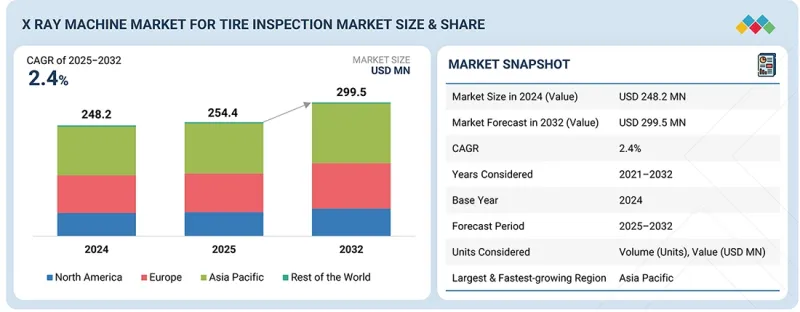
타이어 검사용 X선 장비 시장 규모는 2025년 2억 5,450만 달러에서 2032년까지 2억 9,950만 달러로 성장하며, CAGR은 2.4%에 달할 것으로 예측됩니다.
장비 제조업체들이 대형 오프로드 타이어(OTR) 및 특수 타이어에 대응할 수 있도록 시스템 기능을 확장하고, 다양한 타이어 크기, 하중 등급, 차량 카테고리에 걸쳐 제품 포트폴리오를 확대하면서 시장이 성장하고 있습니다. 이를 통해 대상 고객층과 용도의 범위가 넓어지고 있습니다.
| 조사 범위 | |
|---|---|
| 조사 대상 기간 | 2022-2032년 |
| 기준연도 | 2024년 |
| 예측 기간 | 2025-2032년 |
| 대상 단위 | 수량(단위), 금액(100만 달러) |
| 부문 | 시스템 유형별, 기술별, 사용 사례별, 용도별, 지역별 |
| 대상 지역 | 아시아태평양, 유럽, 북미 및 기타 지역 |
대량 생산을 하는 승용차 및 상용차 타이어 공장에서는 하공정 보증 비용과 수출시 불합격 사례를 방지하기 위해 100% 구조 검사를 도입하고 있습니다. 자동화된 인라인 시스템은 결함 추적, 실시간 불합격 판정 및 공정 수정을 지원합니다. 제조업체들이 무결점 제조 전략에 집중하는 가운데, 통합형 고속 X선 검사 플랫폼에 대한 수요가 증가하고 있습니다.
타이어 검사용 고정형 엑스레이 장비는 중/대량 생산을 하는 타이어 제조 공장에서 품질 보증의 핵심 인프라로 기능하고 있습니다. 고정형 시스템은 표준화된 검사 프로토콜과 공장 전체의 데이터 통합을 가능하게 합니다. 타이어의 성형, 가황, 기타 최종 검사 단계에서 폐쇄 루프 품질관리를 지원하는 디지털 결함 아카이브는 중요한 분야 중 하나입니다. 고정식 엑스레이 검사 장비 수요는 현대 타이어의 내부 구조의 복잡성, OEM의 품질 기준 강화, EV 전용 타이어 생산 확대, 고하중 상용차 부문의 확대, 현장 고장률 최소화에 대한 압력에 의해 주도되고 있습니다. MES 플랫폼 및 자동화 시스템과의 통합을 통해 고정형 장비는 단순한 독립적인 검사 장비가 아닌 장기적인 품질관리 자산으로 기능하게 되었습니다. 높은 처리 능력, 일관된 검사 정확도 및 연속 작동에 대한 적응성으로 인해 고정식 X선 검사 시스템은 전 세계 1등급 타이어 제조업체들이 선호하는 시스템 유형으로 자리 잡았습니다. 고정식 X-Ray 타이어 검사 시스템의 주요 공급업체로는 COMET 그룹 산하 YXLON International, VisiConsult, Nikon Metrology, Mesnac, Rayslov Inspection Technology 등이 있으며, 이들 중 상당수는 는 대규모 타이어 공장에 대응하기 위해 자동 반입 시스템 및 AI 기반 결함 분류 모듈을 통합하고 있습니다.
Tier 1 제조업체는 대규모 운영, 엄격한 규정 준수 의무, 세계 자동차 OEM 공급망과의 긴밀한 협력 관계를 가지고 있습니다. 특히 승용차용 레이디얼 타이어, 트럭-버스용 레이디얼 타이어, 전기자동차 전용 플랫폼용 레이디얼 타이어의 경우, 각 타이어가 출하 전에 구조적 검증을 받는 대량 생산형 자동화 생산라인을 가동하고 있습니다. 전 세계 OEM 업체들은 IATF 16949와 같은 프레임워크에 따라 무결점 정책과 추적성 기준을 철저히 준수하고 있으며, 1등급 공급업체는 비파괴 검사 시스템을 통해 내부 벨트 정렬, 비드 무결성, 플라이 중첩 및 내부 이물질 유무를 검증하도록 요구하고 있습니다. 또한 타이어의 구조도 다층 스틸 벨트, 보강 측벽, 소음 감소 인서트 등의 채용으로 복잡해져 육안 검사로는 불충분하고 고투과성 X선 시스템에 대한 의존도가 높아지고 있습니다. 또한 Tier 1 제조업체들은 리콜 위험과 법적 책임의 위험이 매우 높은 유럽 및 북미 규제 시장에 수출하고 있으며, 이는 첨단 검사 기술에 대한 적극적인 투자를 촉진하고 있습니다. 그들의 강력한 설비 투자 능력과 X-Ray 시스템과 MES(제조 실행 시스템) 및 AI 기반 결함 분류 플랫폼과의 지속적인 통합은 도입을 더욱 촉진하고 있습니다.
유럽은 타이어 구조의 변화, 엄격한 규제 준수 요건, 기존 2D 방사선 촬영에서 고해상도 3D CT 시스템으로의 빠른 전환으로 인해 타이어 검사 엑스레이 장비 시장에서 가장 빠른 성장을 보일 것으로 예측됩니다. 타이어 제조업체들은 압력, 온도, 트레드 마모 센서를 타이어 구조 내에 직접 내장하고 있으며, 이로 인해 내부 구조의 복잡성이 증가하고 고무 컴파운드, 스틸 벨트, 전자 모듈 간의 접합부가 증가하고 있습니다. 이러한 구조적 통합을 위해서는 임베디드 부품 주변의 미세한 공극, 코드 이탈, 공기 갇힘 및 접착 불균일성을 감지하기 위해 더 높은 투과율과 높은 해상도를 가진 X선 시스템이 필요합니다. 센서의 위치 및 구조적 무결성을 정확하게 검증하기 위해 기존의 2D 시스템은 첨단 디지털 방사선 촬영 및 3D CT 플랫폼으로 보완되거나 대체되고 있습니다. 동시에 유럽 타이어 및 림 기술 기구(ETRO)의 엄격한 규정 준수 요건과 유럽 연합 항공 안전 기구(EASA)의 인증 프레임워크는 무결점 제조 및 추적 가능성에 대한 의무를 강화하고 있습니다. 유럽의 타이어 공장은 고도로 자동화된 생산 라인을 가동하고 있으며, 고정식 인라인 X선 시스템은 가황 프레스, 로봇 핸들링 유닛, MES 플랫폼과 통합되어 100% 검사 및 디지털 결함 매핑을 가능하게 합니다. 이러한 자동화 성숙도는 독립적인 오프라인 검사가 아닌 완전히 통합된 검사 셀로의 전환을 가속화하고 있습니다.
이 경쟁 환경에는 Yxlon International, VisiConsult, RX Solutions, Nikon Metrology와 같은 유럽의 X선 기술 프로바이더들이 포함되어 있으며, 이들은 Continental AG, Michelin, Pirelli와 같은 대형 타이어 제조업체와 긴밀히 협력하고 있습니다. 타이어 제조업체와 긴밀하게 협력하고 있습니다. 고정식 인라인 디지털 방사선 촬영은 여전히 대량 생산 승용차 및 트럭 타이어 제조에 선호되는 구성이지만, 오프라인 3D CT 시스템은 스마트 타이어 검증, 연구개발(R&D) 특성화 및 프리미엄 부문 승인에 점점 더 많이 활용되고 있습니다. 점점 더 많이 활용되고 있습니다. 예를 들어 독일의 Continental AG는 센서 기술을 통합하여 상용화에 앞서 정확한 모듈 배치와 장기적인 구조적 접착 성능을 보장하기 위해 강화된 사내 X-레이 검사 프로토콜을 통해 검증을 진행하고 있습니다.
타이어 검사용 엑스레이 장비 시장의 주요 기업으로는 AMETEK Micro-Poise(미국), Technip Energies N.V.(프랑스), Comet(독일), MESNAC(중국), Nikon Corporation Industrial Solutions(일본) 등이 있습니다. 일본)가 있습니다. 이들 기업은 시장에서의 지위를 유지하기 위해 다양한 전략을 채택하고 있습니다. 주요 전략은 신제품 출시, 제휴 및 사업 확장입니다. 이러한 전략은 시장내 각 기업의 포지셔닝을 파악하기 위해 분석되고 있습니다. 제조업체들은 변화하는 규제와 소비자의 요구에 부응하기 위해 첨단이고 다양한 엑스레이 타이어 검사 장비 솔루션을 제공함으로써 시장에서의 전략적 지위를 유지하는 데 주력하고 있습니다.
조사 범위:
이 보고서는 시스템 유형별, 기술별, 이용 사례별, 용도별, 지역별로 타이어 검사용 엑스레이 장비 시장을 조사했습니다. 또한 생태계내 주요 시장 진출기업경쟁 구도와 기업 개요에 대해서도 다루고 있습니다.
이 보고서는 시장내 주요 기업에 대한 상세한 경쟁 분석과 함께 기업 개요, 제품 및 사업 제공에 대한 주요 관찰 사항, 최근 동향, 주요 시장 전략에 대해 다루고 있습니다.
이 보고서 구매의 주요 이점:
- 이 보고서는 타이어 검사 생태계 및 그 하위 부문의 엑스레이 장비 시장 매출에 대한 가장 정확한 추정치에 대한 정보를 제공함으로써 이 시장 시장 리더와 신규 시장 진출기업에게 도움을 줄 것입니다.
- 이 보고서는 이해관계자들이 경쟁 구도를 이해하고, 비즈니스 포지셔닝을 개선하고, 적절한 시장 진출 전략을 수립할 수 있는 인사이트을 얻을 수 있도록 돕습니다.
- 또한 이 보고서는 이해관계자들이 시장 동향을 파악하고 주요 시장 성장 촉진요인, 시장 성장 억제요인, 과제 및 기회에 대한 정보를 제공하는 데 도움이 될 것입니다.
이 보고서에서는 다음과 같은 사항에 대한 인사이트을 제공
- 주요 촉진요인(내부 검사 실시 증가, 고급 3D 영상처리 기능별 수요 증가, 주행 차량 수 증가 및 타이어 교체 주기 단축에 따른 내부 검사 증가), 제약 요인(검사 라인당 고가의 설비 투자, 설치 및 유지보수 복잡성), 기회 요인(AI를 활용한 결함 자동 분류, 엑스레이 검사 및 제조 실행 시스템(MES) 통합) 및 과제(이미지 해상도와 타이어 생산 속도의 균형 조정) 분석
- 제품 개발/혁신 : 시장에서의 미래 기술, R&D 활동 및 제품 출시에 대한 심층적인 인사이트
- 시장 개발: 수익성 높은 시장에 대한 종합적인 정보(이 보고서는 다양한 지역의 타이어 검사 엑스레이 장비 시장을 분석합니다. )
- 시장 다각화 : 신제품, 미개발 지역, 최근 동향 및 시장 투자에 대한 종합적인 정보
- 경쟁사 분석 : AMETEK Micro-Poise(미국), Technip Energies N.V.(프랑스), Comet(독일), MESNAC(중국), Nikon Corporation Industrial Solutions(일본) 등 주요 시장 진입업체들 시장 순위, 성장 전략 및 서비스 제공에 대한 상세한 평가
자주 묻는 질문
목차
제1장 서론
제2장 개요
제3장 주요 인사이트
제4장 시장 개요
제5장 업계 동향
제6장 기술 진보, AI에 의한 영향, 특허, 혁신, 향후 응용
제7장 고객 상황과 구매 행동
제8장 규제 상황
제9장 타이어 검사용 X선 장비 시장(시스템 유형별)
제10장 타이어 검사용 X선 장비 시장(기술별)
제11장 타이어 검사용 X선 장비 시장(사용 사례별)
제12장 타이어 검사용 X선 장비 시장(용도별)
제13장 타이어 검사용 X선 장비 시장(지역별)
제14장 경쟁 구도
제15장 기업 개요
제16장 조사 방법
제17장 부록
KSA 26.04.21The X ray machine market for tire inspection is projected to grow from USD 254.5 million in 2025 to USD 299.5 million by 2032, at a CAGR of 2.4%. The market is growing as equipment manufacturers are expanding system capabilities to accommodate larger OTR and specialty tires, while broadening their product portfolios across multiple tire sizes, load ratings, and vehicle categories, thereby widening their addressable customer base and application scope.
| Scope of the Report | |
|---|---|
| Years Considered for the Study | 2022-2032 |
| Base Year | 2024 |
| Forecast Period | 2025-2032 |
| Units Considered | Volume (Units), Value (USD Million) |
| Segments | System Type, Technology, Use Case, Application, and Region |
| Regions covered | Asia Pacific, Europe, North America, and Rest of the World |
High-volume passenger and commercial tire plants are implementing 100 percent structural inspection to prevent downstream warranty costs and export rejections. Automated in-line systems are supporting defect traceability, real-time rejection, and process correction. As manufacturers are aligning with zero-defect manufacturing strategies, the demand for integrated high-speed X ray inspection platforms is strengthening.
"The stationary X ray machines are projected to lead the market during the forecast period."
Stationary X ray machines for tire inspection serve as core quality assurance infrastructure within medium and high-volume tire manufacturing plants. Stationary systems are enabling standardized inspection protocols and plant-wide data integration. Digital defect archiving, supporting closed-loop quality control between tire building, curing, and other final inspection stages, is one of the key areas. A stationary X ray machine is driven by increasing internal complexity of modern tires, rising OEM quality benchmarks, growth in EV-specific tire production, expansion of high load commercial vehicle segments, and pressure to minimize field failure rates. Integration with MES platforms and automation systems is allowing stationary installations to function as long-term quality control assets rather than standalone inspection equipment. Their higher throughput capability, consistent inspection accuracy, and suitability for continuous operation are making them the preferred system type for Tier 1 global tire manufacturers. Leading suppliers of stationary X ray tire inspection systems include YXLON International under COMET Group, VisiConsult, Nikon Metrology, Mesnac, and Rayslov Inspection Technology, many of which are integrating automated loading systems and AI-based defect classification modules to support large-scale tire plants.
"The Tier 1 segment is projected to be the largest use case during the forecast period."
Tier 1 manufacturers have large-scale operations, strict compliance obligations, and deep integration with global automotive OEM supply chains. These manufacturers are operating high-volume, automated production lines where each tire is undergoing structural validation before dispatch, particularly across passenger car radial, truck and bus radial, and EV-specific platforms. Global OEMs are enforcing zero-defect policies and traceability standards under frameworks such as IATF 16949, requiring Tier 1 suppliers to validate internal belt alignment, bead integrity, ply overlap, and internal foreign inclusions through non-destructive inspection systems. Tire architectures are also becoming more complex, with multi-layer steel belts, reinforced sidewalls, and noise reduction inserts, making visual inspection insufficient and increasing reliance on high penetration X ray systems. In addition, Tier 1 manufacturers are exporting to regulated markets across Europe and North America, where recall exposure and liability risks are significantly higher, driving proactive investment in advanced inspection technologies. Their stronger capital expenditure capacity and ongoing integration of X-ray systems with MES and AI-driven defect classification platforms are further reinforcing adoption.
"Smart tire integration and regulatory stringency are driving advanced X ray adoption in European manufacturing."
Europe is projected to register the fastest growth in the X ray machine market for tire inspection due to structural changes in tire architecture, stringent regulatory compliance requirements, and rapid migration from conventional 2D radiography to high-resolution 3D CT systems. Tire manufacturers are embedding pressure, temperature, and tread wear sensors directly within the tire structure, which is increasing internal architecture complexity and introducing additional interfaces between rubber compounds, steel belts, and electronic modules. This structural integration requires higher penetration and higher resolution X ray systems to detect micro voids, cord displacement, air entrapment, and bonding inconsistencies around embedded components. Conventional 2D systems are being supplemented or replaced by advanced digital radiography and 3D CT platforms to ensure precise validation of sensor positioning and structural integrity. At the same time, stringent compliance requirements under the European Tire and Rim Technical Organisation and certification frameworks governed by the European Union Aviation Safety Agency are reinforcing zero-defect manufacturing and traceability mandates. European tire plants are operating highly automated production lines, where stationary in-line X ray systems are being integrated with curing presses, robotic handling units, and MES platforms to enable 100 percent inspection and digital defect mapping. This automation maturity is accelerating the shift toward fully integrated inspection cells rather than standalone offline testing.
The competitive ecosystem includes European X ray technology providers such as Yxlon International, VisiConsult, RX Solutions, and Nikon Metrology, working closely with leading tire manufacturers, including Continental AG, Michelin, and Pirelli. Stationary in-line digital radiography remains the preferred configuration for high-volume passenger and truck tire production, while offline 3D CT systems are increasingly used for smart tire validation, R&D characterization, and premium segment approval. For instance, Continental AG in Germany has embedded sensor technologies that are being validated through enhanced internal X-ray inspection protocols to ensure accurate module placement and long-term structural bonding performance prior to commercial deployment.
In-depth interviews were conducted with CEOs, marketing directors, other innovation and technology directors, and executives from various key organizations operating in this market.
- By Company Type: X Ray Machine Manufacturers for Tire Inspection- 50%, Tire Manufacturers - 40%, Others - 10%
- By Designation: CXOs - 30%, Directors - 40%, Others - 30%
- By Country: Asia Pacific - 20%, North America - 20%, Europe - 50%, and Rest of the World - 10%
Major players in the X ray machine market for tire inspection are AMETEK Micro-Poise (US), Technip Energies N.V. (France), Comet (Germany), MESNAC (China), and Nikon Corporation Industrial Solutions (Japan). These players have been adopting various strategies to sustain their positions in the market. Major strategies adopted are product launches, deals, and expansions. These strategies have been analyzed to understand the positions of these companies in the market. Manufacturers focus on maintaining their strategic position in the market by offering advanced, various X ray tire inspection machine solutions to meet evolving regulatory and consumer demands.
Research Coverage:
The report covers the X ray machine market for tire inspection, in terms of system type (stationary (in-line and off-line), mobile), technology (2D X ray and 3D CT), Use Case (Tier 1, OEM, and aftermarket), application (tire inspection, tread inspection, sidewall inspection, bead inspection and others), and region (Asia Pacific, Europe, North America, and Rest of the World). It covers the competitive landscape and company profiles of the major players in the ecosystem.
The study also includes an in-depth competitive analysis of the key players in the market, along with their company profiles, key observations related to product and business offerings, recent developments, and key market strategies.
Key Benefits of Buying the Report:
- This report will help market leaders/new entrants in this market with information on the closest approximations of revenue numbers for the X ray machine market for tire inspection ecosystem and its subsegments.
- This report will help stakeholders understand the competitive landscape and gain more insights to better position their businesses and plan suitable go-to-market strategies.
- This report will also help stakeholders understand the market's pulse and provide information on key market drivers, restraints, challenges, and opportunities.
The report provides insight into the following pointers:
- Analysis of key drivers (increasing internal inspection practices, advanced 3D imaging capabilities increasing demand, increase in vehicles on road and tire replacement cycles driving higher internal inspection), restraints (high capital investment per inspection line, higher installation and service complexity), opportunities (AI-driven automated defect classification, integration of X ray inspection with manufacturing execution system), and challenges (balancing image resolution with tire production speed)
- Product Development/Innovation: Detailed insights into upcoming technologies, research & development activities, and product launches in the market
- Market Development: Comprehensive information about lucrative markets (the report analyzes the X ray machine market for tire inspection across varied regions)
- Market Diversification: Exhaustive information about new products, untapped geographies, recent developments, and investments in the market
- Competitive Assessment: In-depth assessment of market ranking, growth strategies, and service offerings of leading market players like AMETEK Micro-Poise (US), Technip Energies N.V. (France), Comet (Germany), MESNAC (China), and Nikon Corporation Industrial Solutions (Japan)
TABLE OF CONTENTS
1 INTRODUCTION
- 1.1 STUDY OBJECTIVES
- 1.2 MARKET DEFINITION
- 1.3 STUDY SCOPE
- 1.3.1 MARKETS COVERED AND REGIONAL SCOPE
- 1.3.2 YEARS CONSIDERED
- 1.4 CURRENCY CONSIDERED
- 1.5 STAKEHOLDERS
2 EXECUTIVE SUMMARY
- 2.1 MARKET HIGHLIGHTS AND KEY INSIGHTS
- 2.2 KEY MARKET PARTICIPANTS: MAPPING OF STRATEGIC DEVELOPMENTS
- 2.3 DISRUPTIVE TRENDS IN X RAY MACHINE MARKET FOR TIRE INSPECTION
- 2.4 HIGH-GROWTH SEGMENTS IN X RAY MACHINE MARKET FOR TIRE INSPECTION
- 2.5 REGIONAL SNAPSHOT: MARKET SIZE, GROWTH RATE, AND FORECAST
3 PREMIUM INSIGHTS
- 3.1 OPPORTUNITIES FOR PLAYERS IN X RAY MACHINE MARKET FOR TIRE INSPECTION
- 3.2 X RAY MACHINE MARKET FOR TIRE INSPECTION, BY SYSTEM TYPE
- 3.3 X RAY MACHINE MARKET FOR TIRE INSPECTION, BY TECHNOLOGY
- 3.4 X RAY MACHINE MARKET FOR TIRE INSPECTION, BY USE CASE
- 3.5 X RAY MACHINE MARKET FOR TIRE INSPECTION, BY REGION
4 MARKET OVERVIEW
- 4.1 INTRODUCTION
- 4.2 MARKET DYNAMICS
- 4.2.1 DRIVERS
- 4.2.1.1 Increasing internal inspection practices
- 4.2.1.2 Advanced 3D imaging capabilities
- 4.2.1.3 Increase in vehicles on road and tire replacement cycles driving higher internal inspection
- 4.2.2 RESTRAINTS
- 4.2.2.1 High capital investment per inspection line
- 4.2.2.2 Higher installation and service complexity
- 4.2.3 OPPORTUNITIES
- 4.2.3.1 AI-driven automated defect classification
- 4.2.3.2 Integration of X ray inspection with manufacturing execution system
- 4.2.4 CHALLENGES
- 4.2.4.1 Balancing image resolution with tire production speed
- 4.2.1 DRIVERS
- 4.3 UNMET NEEDS AND WHITE SPACES
- 4.3.1 UNMET NEEDS
- 4.3.2 WHITE SPACE OPPORTUNITIES
- 4.4 INTERCONNECTED MARKETS AND CROSS-SECTOR OPPORTUNITIES
- 4.5 STRATEGIC MOVES BY KEY PLAYERS IN X RAY MACHINE MARKET FOR TIRE INSPECTION
5 INDUSTRY TRENDS
- 5.1 MACROECONOMIC INDICATORS
- 5.1.1 INTRODUCTION
- 5.1.2 GDP TRENDS AND FORECAST
- 5.1.3 US PROVIDING STABLE OUTLOOK FOR TIRE INVESTMENTS AND DEMAND TO BE SUPPORTED BY ONGOING UPGRADES IN TIRE INSPECTION
- 5.1.4 TRENDS IN GLOBAL AUTOMOTIVE & TRANSPORTATION INDUSTRY
- 5.2 ECOSYSTEM ANALYSIS
- 5.2.1 COMPONENT SUPPLIERS
- 5.2.2 SUBSYSTEM PROVIDERS
- 5.2.3 SOFTWARE PROVIDERS
- 5.2.4 X RAY TIRE INSPECTION MACHINE MANUFACTURERS
- 5.2.5 END USERS (TIRE MANUFACTURERS, OEMS, AND OTHERS)
- 5.3 SUPPLY CHAIN ANALYSIS
- 5.4 PRICING ANALYSIS
- 5.4.1 AVERAGE SELLING PRICE TREND OF KEY PLAYERS, 2026
- 5.4.2 AVERAGE SELLING PRICE TREND, BY TECHNOLOGY, 2025-2026
- 5.4.3 AVERAGE SELLING PRICE TREND, BY REGION, 2024-2026
- 5.5 TRENDS AND DISRUPTIONS IMPACTING CUSTOMER BUSINESS
- 5.6 INVESTMENT AND FUNDING SCENARIO
- 5.7 KEY CONFERENCES AND EVENTS, 2026-2027
- 5.8 TRADE ANALYSIS
- 5.8.1 IMPORT SCENARIO (HS CODE 902219)
- 5.8.2 EXPORT SCENARIO (HS CODE 902219)
- 5.9 CASE STUDY ANALYSIS
- 5.9.1 INLINE 2D DIGITAL X RAY FOR HIGH-VOLUME PASSENGER CAR TIRE PRODUCTION
- 5.9.2 AUTOMATED 2D X RAY WITH AI DEFECT RECOGNITION FOR OEM TIRE SUPPLY
- 5.9.3 INDUSTRIAL CT FOR PREMIUM SUV AND PERFORMANCE TIRE VALIDATION
- 5.9.4 CT BASED INTERNAL STRUCTURE ANALYSIS FOR HIGH-PERFORMANCE TIRE DESIGN
- 5.9.5 INDUSTRIAL CT FOR OEM HOMOLOGATION AND GEOMETRIC VALIDATION
- 5.9.6 LAB-BASED DIGITAL X RAY FOR OEM RETURN FAILURE ANALYSIS
- 5.10 IMPACT OF 2026 EU-INDIA TRADE DEAL
- 5.10.1 INTRODUCTION
- 5.10.2 KEY TARIFF RATES
- 5.10.3 PRICE IMPACT ANALYSIS
- 5.10.4 SUPPLY CHAIN AND LOCALIZATION IMPACT
- 5.10.5 STRATEGIC MARKET OUTLOOK
- 5.11 ANALYSIS OF LEADING X RAY MACHINE MANUFACTURERS FOR TIRE INSPECTION
- 5.11.1 X RAY TIRE INSPECTION MACHINE COMPARISON BY KEY PLAYERS
- 5.11.2 INLINE VS. OFFLINE ADOPTION TRENDS
6 TECHNOLOGICAL ADVANCEMENTS, AI-DRIVEN IMPACT, PATENTS, INNOVATIONS, AND FUTURE APPLICATIONS
- 6.1 KEY EMERGING TECHNOLOGIES
- 6.1.1 3D TIRE TOMOGRAPHY RECONSTRUCTION
- 6.1.2 AUTOMATIC DEFECT RECOGNITION
- 6.2 COMPLEMENTARY TECHNOLOGIES
- 6.2.1 PHASE CONTRAST AND ADVANCED IMAGING PHYSICS
- 6.2.2 STATISTICAL DEFECT MAPPING AND PROCESS FEEDBACK INTEGRATION
- 6.3 TECHNOLOGY/PRODUCT ROADMAP
- 6.4 PATENT ANALYSIS
- 6.4.1 INTRODUCTION
- 6.4.1.1 List of Patents
- 6.4.1 INTRODUCTION
- 6.5 FUTURE APPLICATIONS
- 6.5.1 ON-DEMAND QUALITY ASSURANCE IN HIGH-VOLUME TIRE PRODUCTION
- 6.5.2 FLEET AND SPECIALTY TIRE HEALTH MONITORING
- 6.5.3 AI-ASSISTED PREDICTIVE TIRE FAILURE DETECTION
- 6.6 IMPACT OF AI ON X RAY MACHINE MARKET FOR TIRE INSPECTION
- 6.6.1 TOP USE CASES AND MARKET POTENTIAL
- 6.6.2 BEST PRACTICES FOLLOWED BY X RAY TIRE INSPECTION MACHINE MANUFACTURERS
- 6.6.3 CASE STUDIES RELATED TO AI IMPLEMENTATION IN X RAY MACHINE MARKET FOR TIRE INSPECTION
- 6.6.4 INTERCONNECTED ECOSYSTEM AND IMPACT ON MARKET PLAYERS
- 6.6.5 CLIENTS' READINESS TO ADOPT AI-INTEGRATED X RAY MACHINES FOR TIRE INSPECTION
7 CUSTOMER LANDSCAPE & BUYER BEHAVIOR
- 7.1 DECISION-MAKING PROCESS
- 7.2 KEY STAKEHOLDERS
- 7.2.1 KEY STAKEHOLDERS INVOLVED IN BUYING PROCESS AND THEIR EVALUATION CRITERIA
- 7.2.2 BUYING CRITERIA
- 7.3 ADOPTION BARRIERS AND INTERNAL CHALLENGES
- 7.3.1 X STRUCTURAL ADOPTION CONSTRAINTS AND OPERATIONAL LIMITATIONS
- 7.3.2 DATA GOVERNANCE AND TRACEABILITY INTEGRATION COMPLEXITY
- 7.3.3 STANDARDIZATION LIMITATIONS AND CROSS-PLANT DEPLOYMENT VARIABILITY
- 7.4 UNMET NEEDS OF VARIOUS END USERS/END-USE INDUSTRIES
- 7.4.1 REAL-TIME INLINE INTEGRATION WITH SMART MANUFACTURING SYSTEMS
- 7.4.2 LOWER TOTAL COST OF OWNERSHIP (TCO) AND REDUCED MAINTENANCE DOWNTIME
- 7.4.3 INSPECTION CAPABILITY FOR INCREASINGLY COMPLEX TIRE ARCHITECTURES
8 REGULATORY LANDSCAPE
- 8.1 REGIONAL REGULATIONS AND COMPLIANCE
- 8.1.1 REGULATORY BODIES, GOVERNMENT AGENCIES, AND OTHER ORGANIZATIONS
- 8.1.2 INDUSTRY STANDARDS
- 8.2 SUSTAINABILITY INITIATIVES
- 8.3 IMPACT OF REGULATORY POLICIES ON SUSTAINABILITY INITIATIVES
9 X RAY MACHINE MARKET FOR TIRE INSPECTION, BY SYSTEM TYPE
- 9.1 INTRODUCTION
- 9.2 STATIONARY
- 9.2.1 INLINE
- 9.2.1.1 Increasing stringency of OEM quality benchmarks to drive growth
- 9.2.2 OFFLINE
- 9.2.2.1 Ideal for high-precision and comprehensive defect detection
- 9.2.1 INLINE
- 9.3 MOBILE
- 9.3.1 FLEXIBLE DEPLOYMENT AND LOWER CAPITAL INTENSITY TO DRIVE GROWTH
- 9.4 KEY PRIMARY INSIGHTS
10 X RAY MACHINE MARKET FOR TIRE INSPECTION, BY TECHNOLOGY
- 10.1 INTRODUCTION
- 10.2 2D
- 10.2.1 TO DRIVE HIGH-THROUGHPUT AND COST-EFFICIENT TIRE INSPECTION
- 10.3 3D
- 10.3.1 RISING STRUCTURAL COMPLEXITY IN TIRE ARCHITECTURE TO DRIVE ACCELERATED ADOPTION OF 3D CT INSPECTION SYSTEMS
- 10.4 KEY PRIMARY INSIGHTS
11 X RAY MACHINE MARKET FOR TIRE INSPECTION, BY USE CASE
- 11.1 INTRODUCTION
- 11.2 TIER 1
- 11.2.1 HIGH-VOLUME PRODUCTION AND COMPLEX TIRE ARCHITECTURES TO DRIVE GROWTH
- 11.3 OEM
- 11.3.1 RISING OEM LIABILITY AND ZERO-DEFECT MANUFACTURING STANDARDS TO DRIVE GROWTH
- 11.4 AFTERMARKET
- 11.4.1 RETREADING, IMPROVED TIC, AND INSPECTION PROCESSES TO DRIVE AFTERMARKET
- 11.5 KEY PRIMARY INSIGHTS
12 X RAY MACHINE MARKET FOR TIRE INSPECTION, BY APPLICATION
- 12.1 INTRODUCTION
- 12.2 TIRE INSPECTION
- 12.3 TREAD INSPECTION
- 12.4 SIDEWALL INSPECTION
- 12.5 BEAD INSPECTION
- 12.6 OTHER / SPECIALTY INSPECTIONS
- 12.7 KEY PRIMARY INSIGHTS
13 X RAY MACHINE MARKET FOR TIRE INSPECTION, BY REGION
- 13.1 INTRODUCTION
- 13.2 ASIA PACIFIC
- 13.2.1 CHINA
- 13.2.1.1 Scaling tire production capacity to drive advanced digital X ray inspection deployment across high-volume manufacturing hubs
- 13.2.2 INDIA
- 13.2.2.1 Radialization growth and export expansion to boost investment in structural X ray tire inspection systems
- 13.2.3 JAPAN
- 13.2.3.1 Premium engineering to drive high-resolution X ray adoption
- 13.2.4 SOUTH KOREA
- 13.2.4.1 Export-driven growth to accelerate advanced X ray adoption
- 13.2.5 REST OF ASIA PACIFIC
- 13.2.1 CHINA
- 13.3 EUROPE
- 13.3.1 GERMANY
- 13.3.1.1 Premium and EV tire engineering to accelerate 3D CT adoption
- 13.3.2 FRANCE
- 13.3.2.1 Export-led manufacturing to drive automated X ray integration
- 13.3.3 ITALY
- 13.3.3.1 Focus on high-performance tire manufacturing to increase precision inspection demand
- 13.3.4 SPAIN
- 13.3.4.1 High-volume production to reinforce 2D system preference
- 13.3.5 UK
- 13.3.5.1 Replacement-driven market structure to sustain cost-focused 2D X ray adoption
- 13.3.6 REST OF EUROPE
- 13.3.1 GERMANY
- 13.4 NORTH AMERICA
- 13.4.1 US
- 13.4.1.1 Liability pressure and zero-defect mandates to drive inline X ray adoption
- 13.4.2 CANADA
- 13.4.2.1 Strict quality compliance and OEM standards to advance X ray inspection
- 13.4.3 MEXICO
- 13.4.3.1 Export-driven radial tire capacity expansion to accelerate inline X ray inspection system deployment
- 13.4.1 US
- 13.5 REST OF THE WORLD
- 13.5.1 UAE
- 13.5.1.1 Technology upgrades and high vehicle ownership base to drive market
- 13.5.2 SAUDI ARABIA
- 13.5.2.1 Localization-led growth to drive advanced tire inspection systems
- 13.5.1 UAE
14 COMPETITIVE LANDSCAPE
- 14.1 OVERVIEW
- 14.2 KEY PLAYERS' STRATEGIES/RIGHT TO WIN
- 14.3 MARKET RANKING ANALYSIS FOR KEY PLAYERS, 2025
- 14.4 REVENUE ANALYSIS OF KEY PLAYERS, 2025
- 14.5 COMPANY VALUATION AND FINANCIAL METRICS
- 14.5.1 COMPANY VALUATION
- 14.5.2 FINANCIAL METRICS
- 14.6 BRAND/PRODUCT COMPARISON
- 14.7 COMPANY EVALUATION MATRIX: KEY PLAYERS, 2025
- 14.7.1 STARS
- 14.7.2 EMERGING LEADERS
- 14.7.3 PERVASIVE PLAYERS
- 14.7.4 PARTICIPANTS
- 14.7.5 COMPANY FOOTPRINT: KEY PLAYERS, 2025
- 14.7.5.1 Company footprint
- 14.7.5.2 Region footprint
- 14.7.5.3 Technology footprint
- 14.7.5.4 System type footprint
- 14.8 COMPANY EVALUATION MATRIX: STARTUPS/SMES, 2025
- 14.8.1 PROGRESSIVE COMPANIES
- 14.8.2 RESPONSIVE COMPANIES
- 14.8.3 DYNAMIC COMPANIES
- 14.8.4 STARTING BLOCKS
- 14.8.5 COMPETITIVE BENCHMARKING: STARTUPS/SMES, 2025
- 14.8.5.1 Competitive benchmarking of startups/SMEs
- 14.9 COMPETITIVE SCENARIO
- 14.9.1 PRODUCT LAUNCHES/DEVELOPMENTS/ENHANCEMENTS
- 14.9.2 DEALS
- 14.9.3 EXPANSIONS
- 14.9.4 OTHER DEVELOPMENTS
15 COMPANY PROFILES
- 15.1 KEY PLAYERS
- 15.1.1 AMETEK MICRO-POISE
- 15.1.1.1 Business overview
- 15.1.1.2 Products offered
- 15.1.1.3 Recent developments
- 15.1.1.3.1 Expansions
- 15.1.1.4 MnM view
- 15.1.1.4.1 Key strengths
- 15.1.1.4.2 Strategic choices
- 15.1.1.4.3 Weaknesses & competitive threats
- 15.1.2 TECHNIP ENERGIES N.V.
- 15.1.2.1 Business overview
- 15.1.2.2 Products offered
- 15.1.2.3 Recent developments
- 15.1.2.3.1 Deals
- 15.1.2.4 MnM view
- 15.1.2.4.1 Key strengths
- 15.1.2.4.2 Strategic choices
- 15.1.2.4.3 Weaknesses & competitive threats
- 15.1.3 COMET
- 15.1.3.1 Business overview
- 15.1.3.2 Products offered
- 15.1.3.3 Recent developments
- 15.1.3.3.1 Expansions
- 15.1.3.4 MnM view
- 15.1.3.4.1 Key strengths
- 15.1.3.4.2 Strategic choices
- 15.1.3.4.3 Weaknesses & competitive threats
- 15.1.4 MESNAC
- 15.1.4.1 Business overview
- 15.1.4.2 Products offered
- 15.1.4.3 Recent developments
- 15.1.4.3.1 Deals
- 15.1.4.3.2 Expansions
- 15.1.4.3.3 Other developments
- 15.1.4.4 MnM view
- 15.1.4.4.1 Key strengths
- 15.1.4.4.2 Strategic choices
- 15.1.4.4.3 Weaknesses & competitive threats
- 15.1.5 NIKON CORPORATION INDUSTRIAL SOLUTIONS
- 15.1.5.1 Business overview
- 15.1.5.2 Products offered
- 15.1.5.3 Recent developments
- 15.1.5.3.1 Product launches/enhancements
- 15.1.5.3.2 Deals
- 15.1.5.4 MnM view
- 15.1.5.4.1 Key strengths
- 15.1.5.4.2 Strategic choices
- 15.1.5.4.3 Weaknesses & competitive threats
- 15.1.6 X-SCAN
- 15.1.6.1 Business overview
- 15.1.6.2 Products offered
- 15.1.6.3 Recent developments
- 15.1.6.3.1 Product developments
- 15.1.7 TMSI
- 15.1.7.1 Business overview
- 15.1.7.2 Products offered
- 15.1.7.3 Recent developments
- 15.1.7.3.1 Deals
- 15.1.7.3.2 Other developments
- 15.1.8 HAMAMATSU PHOTONICS K.K.
- 15.1.8.1 Business overview
- 15.1.8.2 Products offered
- 15.1.8.3 Recent developments
- 15.1.8.3.1 Deals
- 15.1.8.3.2 Expansions
- 15.1.9 BLUE STAR ENGINEERING & ELECTRONICS LTD.
- 15.1.9.1 Business overview
- 15.1.9.2 Products offered
- 15.1.9.3 Recent developments
- 15.1.9.3.1 Deals
- 15.1.9.3.2 Expansions
- 15.1.10 ALFAMATION
- 15.1.10.1 Business overview
- 15.1.10.2 Products offered
- 15.1.11 PARTH SYSTEMS INDIA PVT. LTD.
- 15.1.11.1 Business overview
- 15.1.11.2 Products offered
- 15.1.12 DETECTION TECHNOLOGY PLC.
- 15.1.12.1 Business overview
- 15.1.12.2 Products offered
- 15.1.12.3 Recent developments
- 15.1.12.3.1 Product launches/enhancements
- 15.1.12.3.2 Expansions
- 15.1.1 AMETEK MICRO-POISE
- 15.2 OTHER PLAYERS
- 15.2.1 NORTH STAR IMAGING INC.
- 15.2.2 METRIX NDT
- 15.2.3 TEKNA AUTOMAZIONE
- 15.2.4 DANDONG AOLONG RADIATIVE INSTRUMENT GROUP CO., LTD.
- 15.2.5 ZEISS GROUP
- 15.2.6 BAKER HUGHES COMPANY
- 15.2.7 HAVEN METROLOGY, INC.
- 15.2.8 MQS TECHNOLOGIES PRIVATE LIMITED
- 15.2.9 CONTINENTAL AG
- 15.2.10 RX SOLUTIONS SAS
- 15.2.11 GL INSPECTION SYSTEMS GMBH
- 15.2.12 TOSHIBA INFRASTRUCTURE SYSTEMS AND SOLUTIONS CORPORATION
- 15.2.13 RAYSOV INSPECTION TECHNOLOGY CO., LTD.
16 RESEARCH METHODOLOGY
- 16.1 RESEARCH DATA
- 16.1.1 SECONDARY DATA
- 16.1.2 KEY SECONDARY SOURCES
- 16.1.2.1 List of secondary sources
- 16.1.2.2 Key data from secondary sources
- 16.1.3 PRIMARY DATA
- 16.1.3.1 Primary interviews - demand and supply sides
- 16.1.3.2 Key industry insights and breakdown of primary interviews
- 16.1.3.3 List of primary participants
- 16.2 MARKET SIZE ESTIMATION
- 16.2.1 TOP-DOWN APPROACH
- 16.3 DATA TRIANGULATION
- 16.4 FACTOR ANALYSIS
- 16.5 RESEARCH ASSUMPTIONS
- 16.6 RESEARCH LIMITATIONS
- 16.7 RISK ASSESSMENT
17 APPENDIX
- 17.1 KEY INSIGHTS FROM INDUSTRY EXPERTS
- 17.2 DISCUSSION GUIDE
- 17.3 KNOWLEDGESTORE: MARKETSANDMARKETS' SUBSCRIPTION PORTAL
- 17.4 CUSTOMIZATION OPTIONS
- 17.5 RELATED REPORTS
- 17.6 AUTHOR DETAILS


