
|
시장보고서
상품코드
2003244
모듈형 바닥재 시장 : 제품 유형별(LVT, 세라믹, 고무, 폴리올레핀), 시공 방법별(인터락킹, 루스 레이), 용도별, 지역별 - 세계 예측(-2031년)Modular Flooring Market by Product Type (LVT, Ceramic, Rubber, Polyolefin), Installation Technique (Interlocking, Loose Lay), End-use (Household, Workplace, Healthcare, Education, Retail), and Region - Global Forecast to 2031 |
||||||

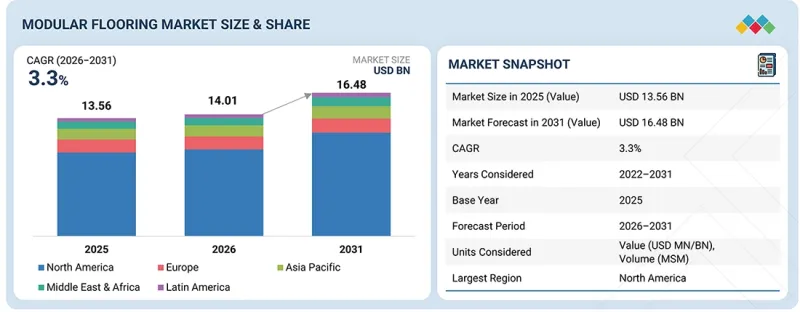
모듈형 바닥재 시장 규모는 예측 기간 동안 CAGR 3.3%로 확대되어 2026년 140억 1,000만 달러에서 2031년에는 164억 8,000만 달러에 달할 것으로 전망됩니다.
모듈형 바닥재에 대한 수요는 현대 직장, 의료 시설, 교육 인프라의 음향 성능 향상과 편안함에 대한 요구가 높아짐에 따라 모듈형 바닥재에 대한 수요가 증가하고 있습니다.
| 조사 범위 | |
|---|---|
| 조사 대상 기간 | 2022-2031년 |
| 기준 연도 | 2025년 |
| 예측 기간 | 2026-2031년 |
| 단위 | 금액(달러)·수량(평방미터) |
| 부문 | 유형, 시공 방법, 용도, 지역 |
| 대상 지역 | 북미, 아시아태평양, 유럽, 중동 및 아프리카, 남미 |
"예측 기간 동안 세라믹은 두 번째 제품 유형이 될 것으로 예상됩니다."
세라믹 부문은 뛰어난 내구성, 내습성 및 긴 수명 성능에 힘입어 예측 기간 동안 두 번째로 큰 제품 유형이 될 것으로 예상됩니다. 이러한 성장 전망은 유동인구가 많은(이용 빈도가 높은) 장소나 습기가 많은 장소(예 : 병원, 학교, 교통, 거리)에서 모듈형 타일이 많이 사용되기 때문입니다. 모듈형 세라믹 타일이 사용되는 세 가지 주요 분야는 유동인구가 많은 지역, 내화학성이 필요한 지역, 극심한 온도 변화가 있는 실내 및 반 실외 지역입니다. 이 부문의 성장 전망에 기여하는 또 다른 요인으로는 디지털 인쇄 기술 및 표면처리 공정의 지속적인 발전을 들 수 있습니다. 이를 통해 모듈형 세라믹 타일은 물리적 특성을 손상시키지 않고 모든 천연 소재를 재현할 수 있게 되어 모듈형 세라믹 제품의 미적 다양성을 향상시켰습니다. 특히 규제가 엄격한 환경에서 유지보수가 용이하고 위생적인 바닥재에 대한 수요에 힘입어 모듈형 세라믹 바닥재 사용이 증가하는 것도 모듈형 세라믹 부문을 촉진하는 요인으로 작용하고 있습니다.
"예측 기간 동안 루스레이가 주요 시공 방법이 될 것으로 예상됩니다."
루스레이 바닥재는 유연성, 시공의 신속성, 개보수 프로젝트에 대한 적응성 등 다양한 장점으로 인해 예측 기간 동안 모듈형 바닥재 시장에서 중요한 시공 방법이 될 것으로 예상됩니다. 루스레이 바닥재 시스템은 접착제나 복잡한 잠금장치가 필요 없고, 주로 고마찰성 안감을 활용하여 안정적인 바닥면을 형성하기 때문에 시공시간과 작업인원을 크게 줄일 수 있습니다. 이는 상업용 사무실 공간, 소매점, 다운타임을 최소화해야 하는 바닥재에 적합합니다. 루스레이 바닥재는 기존 바닥재 위에 쉽게 시공할 수 있을 뿐만 아니라, 타일의 제거 및 재배치도 용이하여 개보수 주기 및 공간 재구성에 있어 전반적인 효율성이 향상됩니다. 루스레이 바닥재 시리즈는 연동식 바닥재 제품만큼 구조적 강성이 높지 않은 경우도 있지만, 이 시공 기술의 발전으로 중간 정도의 교통량에서 성능이 크게 향상되었습니다.
"시장 규모 측면에서 볼 때, 예측 기간 동안 유럽 지역은 두 번째로 큰 시장이 될 것으로 예상됩니다."
예측 기간 동안 유럽은 두 번째 지역이 될 것으로 예상됩니다. 이러한 성장은 유럽의 지속가능성, 순환 경제에 대한 노력, 건설 품질에 대한 규제 강화에 기인한 것으로 보입니다. 상업용 사무실 공간, 의료 환경, 교육 시설, 소매점, 특히 개조 및 리노베이션 프로젝트에서 모듈형 바닥재에 대한 관심이 다시금 높아지고 있으며, 엄격한 환경 규제와 친환경 인증 요구 사항으로 인해 모듈형 바닥재가 이전보다 더 자주 채택되고 있습니다. 또한, 모듈형 바닥재를 제조하는 많은 대형 제조업체와 기업들은 새로운 방법과 기술 향상에 지속적으로 투자하고 있기 때문에 혁신적인 제품을 제공하고 공급망 효율성을 높일 수 있는 능력이 여전히 매우 높은 수준입니다.
세계의 모듈형 바닥재 시장을 조사했으며, 시장 개요, 시장 성장에 영향을 미치는 각종 영향요인 분석, 기술·특허 동향, 법·규제 환경, 사례 분석, 시장 규모 추정 및 예측, 각종 부문별·지역별·주요 국가별 상세 분석, 경쟁 구도, 주요 기업 개요 등의 정보를 정리하여 전해드립니다.
자주 묻는 질문
목차
제1장 소개
제2장 주요 요약
제3장 주요 인사이트
제4장 시장 개요
제5장 업계 동향
제6장 기술의 진보
제7장 지속가능성과 규제 상황
제8장 고객 상황과 구매 행동
제9장 모듈형 바닥재 시장 : 제품 유형별
제10장 모듈형 바닥재 시장 : 시공 방법별
제11장 모듈형 바닥재 시장 : 최종사용자별
제12장 모듈형 바닥재 시장 : 지역별
제13장 경쟁 구도
제14장 기업 개요
제15장 조사 방법
제16장 부록
KSM 26.04.27The modular flooring market is projected to grow from USD 14.01 billion in 2026 to USD 16.48 billion by 2031, at a CAGR of 3.3% during the forecast period. The demand for modular flooring is attributed to improved acoustic performance and comfort requirements in modern workplaces, healthcare facilities, and education infrastructure.
| Scope of the Report | |
|---|---|
| Years Considered for the Study | 2022-2031 |
| Base Year | 2025 |
| Forecast Period | 2026-2031 |
| Units Considered | Value (USD Million/Billion) Volume (Million Square Meter) |
| Segments | Type, Installation Technique, End-use and Region |
| Regions covered | North America, Asia Pacific, Europe, Middle East & Africa, and South America |
"Ceramic is projected to be the second-largest product type during the forecast period."
The ceramic segment is projected to be the second-largest product type in the modular flooring market during the forecast period, driven by its superior durability, moisture resistance, and long lifecycle performance. The projected growth is due to the high use of modular tiles in high-traffic (high occupancy) and high-moisture (e.g., hospitals, schools, transit, streetscapes) settings. The three biggest areas where modular ceramic tiles are being utilized include traffic areas, chemical-resistant areas, and indoor and semi-indoor areas due to extreme temperature fluctuations. Another factor contributing to the projected growth of this segment includes continuing advancements in digital printing technology and surface finishing processes, which have allowed modular ceramic tiles to replicate any natural material (without compromising their physical attributes) while increasing the aesthetic versatility of modular ceramic products. The growing use of modular ceramic flooring, driven by demand for low-maintenance, hygienic flooring products, especially in regulated environments, has also been another factor propelling the modular ceramic segment.
"Loose lay is projected to be a prominent installation technique during the forecast period."
The loose lay series of floors is projected to be an important installation technique in the modular flooring market during the forecast period due to its many benefits, such as flexibility, speed of installation, and application to renovation-focused projects. Loose lay flooring systems have no adhesive or complex locking methods, therefore creating a stable floor primarily through the use of the high-friction backing and consequently greatly reducing installation time and worker requirements. This is suitable for commercial office space, retail locations, and floor space that requires the minimization of downtime. Due to the ease of installing loose lay floors over existing flooring materials and the ease of removing and relocating tiles, the overall efficiency of refurbishment cycles and space reconfiguration is increased. Although the loose lay series of floors may not have the same amount of structural rigidity as interlocking flooring products, improvements in the technology of this installation technique have substantially improved performance under moderate traffic loads.
"In terms of value, the European region is projected to be the second-largest market during the forecast period."
Europe is projected to be the second-largest region in the modular flooring market during the forecast period. The growth can be attributed to an increased regulatory emphasis in Europe on sustainability, circular economy initiatives, and construction quality. With renewed focus on modular flooring for commercial office spaces, healthcare environments, education facilities, and retail locations, particularly within projects involving renovation and refurbishment, as well as stringent environmental regulations and green certification requirements, modular flooring is being specified more frequently than before. In addition, because many of the largest manufacturers and companies producing modular flooring continue to invest in new methods and improved technologies, their ability to offer innovative products and improve supply chain efficiencies remains very strong.
Breakdown of Primary Interviews:
By Company Type: Tier 1: 25%, Tier 2: 42%, and Tier 3: 33%
By Designation: C-level Executives: 20%, Directors: 30%, and Other Designations: 50%
By Region: North America: 20%, Europe: 10%, Asia Pacific: 40%, South America: 10%, and Middle East & Africa: 20%
Notes: Other designations include sales, marketing, and product managers.
Tier 1: >USD 1 billion; Tier 2: USD 500 million-1 billion; and Tier 3: <USD 500 million
Companies Covered: Mohawk Industries, Inc. (US), Shaw Industries Group, Inc. (US), Tarkett (France), Armstrong Flooring, Inc. (US), Forbo Holding AG (Switzerland), Interface, Inc. (US), Gerflor Group (France), Mannington Mills, Inc. (US), Beaulieu International Group (Belgium), TOLI Corporation (Japan), and Milliken (US), among others are covered in the report.
The study includes an in-depth competitive analysis of these key players in the modular flooring market, with their company profiles, recent developments, and key market strategies.
Research Coverage
This research report categorizes the modular flooring market based on product type (luxury vinyl tiles, ceramic, rubber, polyolefin other product types), installation technique (interlocking, loose lay), end-use (household, workplace, healthcare, education, retail, others), and region (Asia Pacific, North America, Europe, South America, and Middle East & Africa). The report's scope covers detailed information regarding the drivers, restraints, challenges, and opportunities influencing the growth of the modular flooring market. A detailed analysis of the key industry players has been done to provide insights into their business overview, products offered, and key strategies, such as partnerships, collaborations, product launches, expansions, and acquisitions, associated with the modular flooring market. This report covers a competitive analysis of upcoming startups in the modular flooring market ecosystem.
Reasons to Buy the Report
The report will offer the market leaders/new entrants with information on the closest approximations of the revenue numbers for the overall modular flooring market and the subsegments. This report will help stakeholders understand the competitive landscape, gain more insights into positioning their businesses better, and plan suitable go-to-market strategies. The report will help stakeholders understand the pulse of the market and provide them with information on key market drivers, restraints, challenges, and opportunities.
The report provides insights into the following points:
Analysis of key drivers (increasing construction activity in commercial and non-commercial infrastructure, rising renovation and retrofit activities in commercial buildings, and expansion of manufacturing and logistics facilities requiring durable interlocking flooring), restraints (subfloor preparation sensitivity and installation constraints, high dependence on petrochemical-based raw materials), opportunities (development of fully recyclable closed-loop modular flooring systems, smart flooring tiles with embedded sensor technology), and challenges (engineering reliable click-lock and interlocking systems across different climate conditions, managing rapid product collection turnover in design-oriented markets)
- Product Development/Innovation: Detailed insights into upcoming technologies, research & development activities, and product & service launches in the modular flooring market
- Market Development: Comprehensive information about profitable markets (the report analyzes the modular flooring market across varied regions)
Market Diversification: Exhaustive information about new products & services, untapped geographies, recent developments, and investments in the modular flooring market
- Competitive Assessment: In-depth assessment of market shares, growth strategies, and product offerings of leading players such as Mohawk Industries, Inc. (US), Shaw Industries Group, Inc. (US), Tarkett (France), Armstrong Flooring, Inc. (US), Forbo Holding AG (Switzerland), Interface, Inc. (US), Gerflor Group (France), Mannington Mills, Inc. (US), Beaulieu International Group (Belgium), TOLI Corporation (Japan), and Milliken (US)
TABLE OF CONTENTS
1 INTRODUCTION
- 1.1 STUDY OBJECTIVES
- 1.2 MARKET DEFINITION
- 1.3 STUDY SCOPE
- 1.3.1 MARKETS COVERED & REGIONAL SCOPE
- 1.3.2 INCLUSIONS & EXCLUSIONS
- 1.3.3 YEARS CONSIDERED
- 1.3.4 CURRENCY CONSIDERED
- 1.3.5 UNIT CONSIDERED
- 1.3.6 STAKEHOLDERS
- 1.4 SUMMARY OF CHANGES
2 EXECUTIVE SUMMARY
- 2.1 KEY INSIGHTS AND MARKET HIGHLIGHTS
- 2.2 KEY MARKET PARTICIPANTS: SHARE INSIGHTS AND STRATEGIC DEVELOPMENTS
- 2.3 DISRUPTIVE TRENDS SHAPING MARKET
- 2.4 HIGH-GROWTH SEGMENTS & EMERGING FRONTIERS
- 2.5 SNAPSHOT: GLOBAL MARKET SIZE, GROWTH RATE, AND FORECAST
3 PREMIUM INSIGHTS
- 3.1 ATTRACTIVE OPPORTUNITIES FOR PLAYERS IN MODULAR FLOORING MARKET
- 3.2 MODULAR FLOORING MARKET, BY PRODUCT TYPE AND REGION
- 3.3 MODULAR FLOORING MARKET, BY INSTALLATION TECHNIQUE
- 3.4 MODULAR FLOORING MARKET, BY END USER
- 3.5 MODULAR FLOORING MARKET, BY COUNTRY
4 MARKET OVERVIEW
- 4.1 INTRODUCTION
- 4.2 MARKET DYNAMICS
- 4.2.1 DRIVERS
- 4.2.1.1 Increasing construction activity in commercial and non-commercial infrastructure
- 4.2.1.2 Rising renovation and retrofit activities in commercial buildings
- 4.2.1.3 Expansion of manufacturing and logistics facilities that require durable interlocking flooring
- 4.2.2 RESTRAINTS
- 4.2.2.1 Subfloor preparation sensitivity and installation constraints
- 4.2.2.2 High dependence on petrochemical-based raw materials
- 4.2.3 OPPORTUNITIES
- 4.2.3.1 Development of fully recyclable closed-loop modular flooring systems
- 4.2.3.2 Smart flooring tiles with embedded sensor technology
- 4.2.4 CHALLENGES
- 4.2.4.1 Engineering reliable click-lock and interlocking systems across different climate conditions
- 4.2.4.2 Managing rapid product collection turnover in design-oriented markets
- 4.2.1 DRIVERS
- 4.3 UNMET NEEDS AND WHITE SPACES
- 4.3.1 UNMET NEEDS IN MODULAR FLOORING MARKET
- 4.3.1.1 Subfloor intolerance and locking-joint failure
- 4.3.1.2 Thermal expansion mismatch in high-temperature environments
- 4.3.1.3 Permanent indentation under point loads
- 4.3.2 WHITE SPACE OPPORTUNITIES
- 4.3.2.1 Seismic-resilient modular flooring systems
- 4.3.2.2 Phase-change material flooring for energy-efficient buildings
- 4.3.2.3 Infection-control modular flooring for healthcare facilities
- 4.3.1 UNMET NEEDS IN MODULAR FLOORING MARKET
- 4.4 INTERCONNECTED MARKETS AND CROSS-SECTOR OPPORTUNITIES
- 4.4.1 INTERCONNECTED MARKETS
- 4.4.2 CROSS-SECTOR OPPORTUNITIES
- 4.5 STRATEGIC MOVES BY TIER 1/2/3 PLAYERS
- 4.5.1 KEY MOVES AND STRATEGIC FOCUS
5 INDUSTRY TRENDS
- 5.1 PORTER'S FIVE FORCES' ANALYSIS
- 5.1.1 THREAT OF NEW ENTRANTS
- 5.1.2 THREAT OF SUBSTITUTES
- 5.1.3 BARGAINING POWER OF SUPPLIERS
- 5.1.4 BARGAINING POWER OF BUYERS
- 5.1.5 INTENSITY OF COMPETITIVE RIVALRY
- 5.2 MACROECONOMIC ANALYSIS
- 5.2.1 INTRODUCTION
- 5.2.2 GDP TRENDS AND FORECASTS
- 5.2.3 CONSTRUCTION VALUE ADDED
- 5.3 VALUE CHAIN ANALYSIS
- 5.4 ECOSYSTEM ANALYSIS
- 5.5 PRICING ANALYSIS
- 5.5.1 AVERAGE SELLING PRICE OF KEY PLAYERS, BY PRODUCT TYPE
- 5.5.2 AVERAGE SELLING PRICE TREND, BY REGION
- 5.6 TRADE ANALYSIS
- 5.6.1 IMPORT DATA RELATED TO HS CODE 3918, BY COUNTRY, 2021-2025 (USD THOUSAND)
- 5.6.2 EXPORT DATA RELATED TO HS CODE 3918, BY COUNTRY, 2021-2025 (USD THOUSAND)
- 5.7 KEY CONFERENCES AND EVENTS, 2025-2026
- 5.8 TRENDS/DISRUPTIONS IMPACTING CUSTOMER BUSINESS
- 5.9 INVESTMENT AND FUNDING SCENARIO
- 5.10 CASE STUDY ANALYSIS
- 5.10.1 TARKETT: ABN AMRO OFFICES
- 5.10.2 FORBO HOLDING AG: SCHIPHOL AIRPORT
- 5.10.3 INTERFACE, INC: HALL & WILCOX OFFICE
- 5.11 IMPACT OF 2025 US TARIFFS ON MODULAR FLOORING MARKET
- 5.11.1 INTRODUCTION
- 5.11.2 KEY TARIFF RATES
- 5.11.3 PRICE IMPACT ANALYSIS
- 5.11.4 KEY IMPACT ON VARIOUS REGIONS
- 5.11.4.1 US
- 5.11.4.2 Europe
- 5.11.4.3 Asia Pacific
- 5.11.5 1.16.5. IMPACT ON END-USE INDUSTRIES
6 TECHNOLOGICAL ADVANCEMENTS
- 6.1 KEY TECHNOLOGIES
- 6.1.1 RIGID CORE POLYMER COMPOSITE ENGINEERING
- 6.1.2 MULTI-LAYER CO-EXTRUSION PROCESSING TECHNOLOGY
- 6.1.3 EMBOSSING-IN-REGISTER (EIR) SURFACE STRUCTURING
- 6.2 COMPLEMENTARY TECHNOLOGIES
- 6.2.1 THERMAL INSULATION LAYER ENGINEERING
- 6.2.2 ANTI-STATIC (ESD) SURFACE TREATMENT
- 6.3 ADJACENT TECHNOLOGIES
- 6.3.1 BIO-BASED POLYMER MATERIAL ENGINEERING
- 6.3.2 SMART SENSOR-EMBEDDED SURFACE SYSTEMS
- 6.4 TECHNOLOGY/PRODUCT ROADMAP
- 6.4.1 SHORT-TERM (2025-2027) | MATERIAL OPTIMIZATION AND INSTALLATION EFFICIENCY PHASE
- 6.4.2 MID-TERM (2027-2030) | SMART MANUFACTURING AND PERFORMANCE ENGINEERING PHASE
- 6.4.3 LONG-TERM (2030-2035+): CIRCULAR MATERIAL SYSTEMS AND INTELLIGENT FLOORING PHASE
- 6.5 PATENT ANALYSIS
- 6.5.1 INTRODUCTION
- 6.5.2 APPROACH
- 6.5.3 TOP APPLICANTS
- 6.6 FUTURE APPLICATIONS
- 6.6.1 EMBEDDED INDOOR POSITIONING & NAVIGATION FLOORING
- 6.6.2 AUTONOMOUS MICRO-CLIMATE ZONING FLOORING
- 6.6.3 INTEGRATED HEALTH MONITORING FLOORING SYSTEMS
- 6.6.4 AUTONOMOUS CLEANING & SURFACE MAINTENANCE FLOORING
- 6.7 IMPACT OF AI/GENERATIVE AI ON MODULAR FLOORING MARKET
- 6.7.1 TOP USE CASES AND MARKET POTENTIAL
- 6.7.2 BEST PRACTICES IN MODULAR FLOORING
- 6.7.3 CASE STUDIES OF AI IMPLEMENTATION IN MODULAR FLOORING MARKET
- 6.7.4 INTERCONNECTED ADJACENT ECOSYSTEM AND IMPACT ON MARKET PLAYERS
- 6.7.5 CLIENTS' READINESS TO ADOPT GENERATIVE AI IN MODULAR FLOORING MARKET
7 SUSTAINABILITY AND REGULATORY LANDSCAPE
- 7.1 REGIONAL REGULATIONS AND COMPLIANCE
- 7.1.1 REGULATORY BODIES, GOVERNMENT AGENCIES, AND OTHER ORGANIZATIONS
- 7.1.2 INDUSTRY STANDARDS
- 7.2 SUSTAINABILITY INITIATIVES
- 7.2.1 CARBON IMPACT AND ECO-APPLICATIONS OF MODULAR FLOORING
- 7.2.1.1 Carbon impact reduction
- 7.2.1.2 Eco-applications
- 7.2.1 CARBON IMPACT AND ECO-APPLICATIONS OF MODULAR FLOORING
- 7.3 SUSTAINABILITY IMPACT AND REGULATORY POLICY INITIATIVES
- 7.4 CERTIFICATIONS, LABELING, AND ECO-STANDARDS
8 CUSTOMER LANDSCAPE & BUYER BEHAVIOR
- 8.1 DECISION-MAKING PROCESS
- 8.2 KEY STAKEHOLDERS AND EVALUATION CRITERIA
- 8.2.1 KEY STAKEHOLDERS IN BUYING PROCESS
- 8.2.2 BUYING CRITERIA
- 8.3 ADOPTION BARRIERS & INTERNAL CHALLENGES
- 8.4 UNMET NEEDS FROM VARIOUS END USERS
- 8.5 MARKET PROFITABILITY
- 8.5.1 REVENUE POTENTIAL
- 8.5.2 COST DYNAMICS
- 8.5.3 MARGIN OPPORTUNITIES, BY END USER
9 MODULAR FLOORING MARKET, BY PRODUCT TYPE
- 9.1 INTRODUCTION
- 9.2 LUXURY VINYL TILES
- 9.2.1 FASTER INSTALLATION DURABILITY AND DESIGN VERSATILITY DRIVE DEMAND
- 9.3 CERAMIC
- 9.3.1 INCREASING DEMAND FOR HIGH DURABILITY AND STRUCTURAL STABILITY - KEY DRIVER
- 9.4 RUBBER
- 9.4.1 INCREASING FOCUS ON IMPACT RESISTANCE SAFETY AND ACOUSTIC PERFORMANCE TO DRIVE ADOPTION
- 9.5 POLYOLEFIN
- 9.5.1 DEMAND FOR LIGHTWEIGHT CHEMICAL-RESISTANT AND HIGHLY DURABLE MODULAR SURFACES TO BOOST SEGMENT
- 9.6 OTHER PRODUCT TYPES
10 MODULAR FLOORING MARKET, BY INSTALLATION TECHNIQUE
- 10.1 INTRODUCTION
- 10.2 INTERLOCKING
- 10.2.1 STRUCTURAL INTEGRITY, INSTALLATION EFFICIENCY, AND LONG-TERM JOINT RELIABILITY - MAIN SEGMENT DRIVERS
- 10.3 LOOSE LAY
- 10.3.1 MINIMAL SUBFLOOR DEPENDENCY ENABLED BY HIGH-MASS FRICTION-BASED LOOSE LAY SYSTEMS - KEY DRIVER
- 10.4 MAGNETIC SYSTEMS
11 MODULAR FLOORING MARKET, BY END USER
- 11.1 INTRODUCTION
- 11.2 HOUSEHOLD
- 11.2.1 INCREASING RESIDENTIAL RENOVATION ACTIVITY AND DEMAND FOR LOW-MAINTENANCE DURABLE SURFACES TO DRIVE SEGMENT
- 11.3 WORKPLACE
- 11.3.1 ADOPTION DRIVEN BY DEMAND FOR HIGH-TRAFFIC DURABILITY, FLEXIBLE SPACE CONFIGURATION, AND MINIMAL DOWNTIME
- 11.4 HEALTHCARE
- 11.4.1 NEED FOR HYGIENIC, CHEMICAL-RESISTANT, AND LOW DISRUPTION FLOORING SOLUTIONS TO BOOST DEMAND
- 11.5 EDUCATION
- 11.5.1 HIGH DURABILITY, SAFETY, AND ACOUSTIC PERFORMANCE - KEY CONSIDERATIONS FOR ADOPTION
- 11.6 RETAIL
- 11.6.1 HIGH-TRAFFIC DURABILITY, RAPID STORE REFURBISHMENT, AND VISUAL MERCHANDISING TO DRIVE ADOPTION
- 11.7 OTHER END USERS
12 MODULAR FLOORING MARKET, BY REGION
- 12.1 INTRODUCTION
- 12.2 NORTH AMERICA
- 12.2.1 US
- 12.2.1.1 Rising demand driven by lifestyle and commercial shifts
- 12.2.2 CANADA
- 12.2.2.1 Strong demand result of rapid residential and infrastructure growth
- 12.2.3 MEXICO
- 12.2.3.1 Market driven by strong residential and infrastructure expansion
- 12.2.1 US
- 12.3 ASIA PACIFIC
- 12.3.1 CHINA
- 12.3.1.1 Market expansion driven by construction growth and urbanization
- 12.3.2 INDIA
- 12.3.2.1 Accelerated urbanization and infrastructure expansion to boost market growth
- 12.3.3 JAPAN
- 12.3.3.1 Rising demand a result of infrastructure expansion and urban modernization
- 12.3.4 SOUTH KOREA
- 12.3.4.1 Rising Demand for Modular Flooring in South Korea is Driven by Residential, Infrastructure, and Industrial Expansion
- 12.3.5 REST OF ASIA PACIFIC
- 12.3.1 CHINA
- 12.4 EUROPE
- 12.4.1 GERMANY
- 12.4.1.1 Market driven by construction growth and green infrastructure initiatives
- 12.4.2 FRANCE
- 12.4.2.1 Rising demand for efficient, durable, and adaptable flooring to boost market
- 12.4.3 UK
- 12.4.3.1 Residential, industrial, and digital infrastructure growth - key market drivers
- 12.4.4 ITALY
- 12.4.4.1 Public investment and urban regeneration to drive market
- 12.4.5 REST OF EUROPE
- 12.4.1 GERMANY
- 12.5 MIDDLE EAST & AFRICA
- 12.5.1 GCC COUNTRIES
- 12.5.1.1 Saudi Arabia
- 12.5.1.1.1 Mega projects and urban expansion to drive market
- 12.5.1.2 UAE
- 12.5.1.2.1 Real estate expansion and mega infrastructure projects to boost market
- 12.5.1.3 Other GCC countries
- 12.5.1.1 Saudi Arabia
- 12.5.2 SOUTH AFRICA
- 12.5.2.1 Infrastructure investment and housing development to drive market
- 12.5.3 REST OF MIDDLE EAST & AFRICA
- 12.5.1 GCC COUNTRIES
- 12.6 SOUTH AMERICA
- 12.6.1 BRAZIL
- 12.6.1.1 Market driven by housing expansion and infrastructure investments
- 12.6.2 ARGENTINA
- 12.6.2.1 Investment reforms and construction recovery to boost market
- 12.6.3 REST OF SOUTH AMERICA
- 12.6.1 BRAZIL
13 COMPETITIVE LANDSCAPE
- 13.1 OVERVIEW
- 13.2 KEY PLAYER STRATEGIES/RIGHT TO WIN
- 13.3 REVENUE ANALYSIS, 2020-2024
- 13.4 MARKET SHARE ANALYSIS, 2024
- 13.5 BRAND COMPARISON
- 13.6 COMPANY EVALUATION MATRIX: KEY PLAYERS, 2024
- 13.6.1 STARS
- 13.6.2 EMERGING LEADERS
- 13.6.3 PERVASIVE PLAYERS
- 13.6.4 PARTICIPANTS
- 13.6.5 COMPANY FOOTPRINT: KEY PLAYERS, 2024
- 13.6.5.1 Company footprint
- 13.6.5.2 Region footprint
- 13.6.5.3 Product type footprint
- 13.6.5.4 Installation technique footprint
- 13.6.5.5 End user footprint
- 13.7 COMPANY EVALUATION MATRIX: STARTUPS/SMES, 2024
- 13.7.1 PROGRESSIVE COMPANIES
- 13.7.2 RESPONSIVE COMPANIES
- 13.7.3 DYNAMIC COMPANIES
- 13.7.4 STARTING BLOCKS
- 13.7.5 COMPETITIVE BENCHMARKING: STARTUPS/SMES, 2024
- 13.7.5.1 List of key startups/SMEs
- 13.7.6 COMPETITIVE BENCHMARKING OF KEY STARTUPS/SMES
- 13.8 COMPANY VALUATION AND FINANCIAL METRICS
- 13.8.1 COMPANY VALUATION
- 13.9 FINANCIAL METRICS
- 13.10 COMPETITIVE SCENARIO
- 13.10.1 PRODUCT LAUNCHES
- 13.10.2 DEALS
- 13.10.3 EXPANSIONS
14 COMPANY PROFILES
- 14.1 KEY PLAYERS
- 14.1.1 MOHAWK INDUSTRIES, INC.
- 14.1.1.1 Business overview
- 14.1.1.2 Products/Solutions/Services offered
- 14.1.1.3 Recent developments
- 14.1.1.3.1 Product launches
- 14.1.1.3.2 Deals
- 14.1.1.4 MnM view
- 14.1.1.4.1 Right to win
- 14.1.1.4.2 Strategic choices
- 14.1.1.4.3 Weakness and competitive threats
- 14.1.2 SHAW INDUSTRIES GROUP, INC.
- 14.1.2.1 Business overview
- 14.1.2.2 Products/Solutions/Services offered
- 14.1.2.3 Recent developments
- 14.1.2.3.1 Product launches
- 14.1.2.3.2 Deals
- 14.1.2.3.3 Expansions
- 14.1.2.4 MnM view
- 14.1.2.4.1 Right to win
- 14.1.2.4.2 Strategic choices
- 14.1.2.4.3 Weaknesses & competitive threats
- 14.1.3 TARKETT
- 14.1.3.1 Business overview
- 14.1.3.2 Products/Solutions/Services offered
- 14.1.3.3 Recent developments
- 14.1.3.3.1 Product launches
- 14.1.3.3.2 Deals
- 14.1.3.4 MnM view
- 14.1.3.4.1 Right to win
- 14.1.3.4.2 Strategic choices
- 14.1.3.4.3 Weaknesses and competitive threats
- 14.1.4 ARMSTRONG FLOORING, INC.
- 14.1.4.1 Business overview
- 14.1.4.2 Products/Solutions/Services offered
- 14.1.4.3 Recent developments
- 14.1.4.3.1 Product launches
- 14.1.4.3.2 Deals
- 14.1.4.4 MnM view
- 14.1.4.4.1 Right to win
- 14.1.4.4.2 Strategic choices
- 14.1.4.4.3 Weaknesses and competitive threats
- 14.1.5 FORBO HOLDING AG
- 14.1.5.1 Business overview
- 14.1.5.2 Products/Solutions/Services offered
- 14.1.5.3 Recent developments
- 14.1.5.3.1 Product launches
- 14.1.5.3.2 Deals
- 14.1.5.3.3 Expansions
- 14.1.5.4 MnM view
- 14.1.5.4.1 Right to win
- 14.1.5.4.2 Strategic choices
- 14.1.5.4.3 Weaknesses and competitive threats
- 14.1.6 INTERFACE, INC.
- 14.1.6.1 Business overview
- 14.1.6.2 Products/Solutions/Services offered
- 14.1.6.3 Recent developments
- 14.1.6.3.1 Product launches
- 14.1.6.3.2 Expansions
- 14.1.6.4 MnM view
- 14.1.7 GERFLOR GROUP
- 14.1.7.1 Business overview
- 14.1.7.2 Products/Solutions/Services offered
- 14.1.7.3 Recent developments
- 14.1.7.3.1 Product launches
- 14.1.7.3.2 Deals
- 14.1.7.3.3 Expansions
- 14.1.7.4 MnM view
- 14.1.8 MANNINGTON MILLS, INC.
- 14.1.8.1 Business overview
- 14.1.8.2 Products/Solutions/Services offered
- 14.1.8.3 Recent developments
- 14.1.8.3.1 Product launches
- 14.1.8.3.2 Deals
- 14.1.8.3.3 Expansions
- 14.1.8.4 MnM view
- 14.1.9 BEAULIEU INTERNATIONAL GROUP
- 14.1.9.1 Business overview
- 14.1.9.2 Products/Solutions/Services offered
- 14.1.9.3 Recent developments
- 14.1.9.3.1 Product launches
- 14.1.9.3.2 Deals
- 14.1.9.3.3 Expansions
- 14.1.9.4 MnM view
- 14.1.10 TOLI CORPORATION
- 14.1.10.1 Business overview
- 14.1.10.2 Products/Solutions/Services offered
- 14.1.10.3 Recent developments
- 14.1.10.3.1 Product launches
- 14.1.10.3.2 Deals
- 14.1.10.3.3 Expansions
- 14.1.10.4 MnM view
- 14.1.11 MILLIKEN
- 14.1.11.1 Business overview
- 14.1.11.2 Products/Solutions/Services offered
- 14.1.11.3 Recent developments
- 14.1.11.3.1 Product launches
- 14.1.11.3.2 Deals
- 14.1.11.4 MnM view
- 14.1.1 MOHAWK INDUSTRIES, INC.
- 14.2 OTHER PLAYERS
- 14.2.1 JAMES HALSTEAD PLC
- 14.2.2 DIXIE GROUP, INC.
- 14.2.3 VICTORIA PLC
- 14.2.4 LX HAUSYS, LTD.
- 14.2.5 CFL HOLDING LIMITED
- 14.2.6 PARADOR
- 14.2.7 ADORE FLOORS, INC.
- 14.2.8 BOLON AB
- 14.2.9 ALTRO LIMITED
- 14.2.10 RESPONSIVE INDUSTRIES LTD.
- 14.2.11 WELSPUN FLOORING
- 14.2.12 BURMATEX
- 14.2.13 AMTICO INTERNATIONAL
- 14.2.14 PROTEX FLOORING CO., LTD.
- 14.2.15 ORIENTBELL
- 14.2.16 CERAMICHE REFIN S.P.A.
- 14.2.17 PANARIAGROUP INDUSTRIE CERAMICHE S.P.A.
15 RESEARCH METHODOLOGY
- 15.1 RESEARCH DATA
- 15.1.1 SECONDARY DATA
- 15.1.1.1 Key data from secondary sources
- 15.1.2 PRIMARY DATA
- 15.1.2.1 Key data from primary sources
- 15.1.1 SECONDARY DATA
- 15.2 MARKET SIZE ESTIMATION
- 15.2.1 TOP-DOWN AND BOTTOM-UP APPROACH
- 15.2.1.1 Base number calculation
- 15.2.2 DEMAND-SIDE APPROACH
- 15.2.3 SUPPLY-SIDE APPROACH
- 15.2.1 TOP-DOWN AND BOTTOM-UP APPROACH
- 15.3 MARKET FORECAST APPROACH
- 15.3.1 SUPPLY SIDE
- 15.3.2 DEMAND SIDE
- 15.4 DATA TRIANGULATION
- 15.5 RESEARCH ASSUMPTIONS
- 15.6 RISK ASSESSMENT
- 15.7 GROWTH RATE ASSUMPTIONS
16 APPENDIX
- 16.1 DISCUSSION GUIDE
- 16.2 KNOWLEDGESTORE: MARKETSANDMARKETS' SUBSCRIPTION PORTAL
- 16.3 CUSTOMIZATION OPTIONS
- 16.4 RELATED REPORTS
- 16.5 AUTHOR DETAILS


