|
시장보고서
상품코드
2037805
CNG 탱크 시장 예측(-2031년) : 탱크 유형(유형 1, 유형 2, 유형 3, 유형 4), 재질(금속, 유리섬유, 탄소섬유), 차종(소형차, 중형차, 대형차), 용도(연료 탱크, 운송용 탱크), 지역별CNG Tanks Market by Tank Type (Type 1, Type 2, Type 3, Type 4), Material Type (Metal, Glass Fiber, Carbon Fiber), Vehicle Type (Light-Duty, Medium-Duty, Heavy-Duty), Application (Fuel Tanks, Transportation Tanks) and Region - Global Forecast to 2031 |
||||||

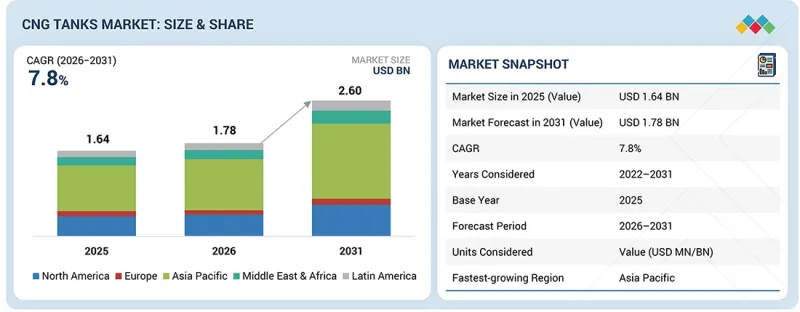
CNG 탱크 시장 규모는 2026년에 17억 8,000만 달러로 추계되고 있으며, 예측 기간 중 CAGR 7.8%로 추이하며, 2031년에는 26억 달러에 달할 것으로 전망되고 있습니다.
| 조사 범위 | |
|---|---|
| 조사 대상 기간 | 2022-2031년 |
| 기준연도 | 2025년 |
| 예측 기간 | 2026-2031년 |
| 단위 | 금액(달러) |
| 부문 | 탱크 유형, 재질, 차종, 용도 |
| 대상 지역 | 유럽, 북미, 아시아태평양, 중동 및 아프리카, 라틴아메리카 |
유형 3 CNG 탱크 시장은 이 탱크가 제공하는 성능, 안전성 및 비용의 유리한 조합으로 인해 예측 기간 중 두 번째로 빠른 성장을 보일 것으로 예상됩니다. CNG Type 3는 금속 라이너가 있는 복합재료(일반적으로 탄소섬유 또는 유리섬유)로 제조되며, 기존 금속 실린더보다 무게당 용량이 큰 탱크로 제작됩니다. 이 디자인은 같은 크기의 금속 실린더보다 구조적 무결성이 우수합니다. 따라서 CNG Type 3 탱크는 완전 복합재 CNG 탱크보다 제조비용이 저렴하여, 차량 사업자나 상용차 사업자에게 추가 비용 없이 운영 효율성을 높일 수 있는 비용 효율적인 수단입니다. 중대형 트럭 업계에서 경량 저장 옵션에 대한 수요가 증가함에 따라 CNG Type 3 탱크의 채택이 계속 확대될 것으로 예상됩니다.
"소재별로는 유리섬유 복합재료가 예측 기간 중 두 번째로 높은 CAGR을 기록할 것으로 예상됩니다. "
재료 유형별로 보면 유리섬유 복합재료는 높은 비용 효율성으로 인해 예측 기간 중 두 번째로 높은 CAGR을 기록할 것으로 예상됩니다. 탄소섬유보다 저렴하고 강도, 내구성, 내식성의 균형이 잘 잡혀 있습니다. 따라서 비용에 민감한 차량 및 상업용 차량에 적합합니다. 또한 접근성과 제조의 용이성으로 인해 특히 개발도상국에서 저렴한 가격의 경량 저장 옵션에 대한 수요가 증가하고 있는 개발도상국에서 더욱 광범위하게 채택되고 있습니다.
"차종별로는 중형차 부문이 금액 기준으로 예측 기간 중 두 번째로 높은 CAGR을 기록할 것으로 예상됩니다. "
도시 물류, 배송, 대중교통 이용 확대에 따라 중형 차량은 예측 기간 중 두 번째로 높은 성장률을 보일 것으로 예상됩니다. 이러한 차량은 매일 정해진 경로를 장거리 주행하므로 CNG는 보다 경제적이고 환경 친화적인 연료 선택이 될 수 있습니다. 도시내 및 라스트 마일 배송 서비스에 대한 수요가 증가함에 따라 CNG를 동력원으로 하는 중형 차량의 이용이 촉진되고 있습니다. 또한 대도시 지역의 오염 감소에 대한 규제 압력으로 인해 차량 운영 업체들은 더 깨끗한 연료로 전환해야 하는 상황에 처해 있습니다. 이러한 배경에서 중형 차량은 환경 규제 준수와 운영 효율성의 균형을 맞추는 중요한 시장으로 부상하고 있습니다.
"용도별로는 연료 탱크 부문이 예측 기간 중 금액 기준으로 두 번째로 높은 CAGR을 기록할 것으로 예상됩니다. "
자동차에 CNG 저장 시스템의 통합이 진행됨에 따라 연료 탱크의 용도는 예측 기간 중 두 번째로 높은 성장률을 보일 것으로 예상됩니다. 승용차 및 상용차 시장에서 천연가스 차량이 보급됨에 따라 차량용 연료 탱크에 대한 수요가 급격히 증가하고 있습니다. 이 탱크는 압축 가스를 안전하고 효율적으로 저장하는 데 필수적이기 때문에 차량 설계에서 매우 중요한 역할을 합니다. 또한 배기가스 저감 및 연료비 절감에 대한 관심이 높아지면서 OEM 및 차량 운영업체들은 CNG 기반 연료 시스템으로 전환을 권장하고 있습니다. 그 결과, 기존 시장과 신흥 시장 모두에서 CNG 탱크의 이용이 증가하고 있습니다.
"중동 및 아프리카이 예측 기간 중 금액 기준으로 두 번째로 높은 CAGR을 기록할 것으로 예상"
에너지 자원의 다양화와 기존 연료에 대한 의존도 감소에 대한 관심이 높아짐에 따라 중동 및 아프리카은 예측 기간 중 두 번째로 높은 성장률을 보일 것으로 예상됩니다. 이 지역의 풍부한 천연가스 매장량과 가스 인프라에 대한 지속적인 투자는 운송 및 산업용 CNG 개발을 촉진하고 있습니다. 또한 도시화의 진전과 저렴한 대체 연료에 대한 수요 증가도 천연가스 차량으로의 전환을 촉진하고 있습니다. 청정연료와 배출가스 감축을 지원하는 정부 정책으로 시장이 확대되고 있습니다. 그 결과, 이 지역은 CNG 탱크에 있으며, 유망한 시장으로 떠오르고 있습니다.
세계의 CNG 탱크(CNG Tank) 시장을 조사했으며, 시장 개요, 시장 성장에 영향을 미치는 각종 영향요인 분석, 기술-특허 동향, 법-규제 환경, 사례 분석, 시장 규모 추이 및 예측, 각종 부문별-지역별-주요 국가별 상세 분석, 경쟁 구도, 주요 기업 개요 등의 정보를 정리하여 전해드립니다.
자주 묻는 질문
목차
제1장 서론
제2장 개요
제3장 주요 인사이트
제4장 시장 개요
제5장 업계 동향
제6장 기술, 특허, 디지털 기술, AI의 도입에 의한 전략적 디스럽션
제7장 지속가능성과 규제 상황
제8장 고객 상황과 구매 행동
제9장 CNG 탱크 시장 : 탱크 유형별
제10장 CNG 탱크 시장 : 재질별
제11장 CNG 탱크 시장 : 차종별
제12장 CNG 탱크 시장 : 용도별
제13장 CNG 탱크 시장 : 지역별
제14장 경쟁 구도
제15장 경쟁 구도
제16장 조사 방법
제17장 부록
KSA 26.06.01The CNG tanks market is estimated at USD 1.78 billion in 2026 and is projected to reach USD 2.60 billion by 2031, at a CAGR of 7.8% during the forecast period.
| Scope of the Report | |
|---|---|
| Years Considered for the Study | 2022-2031 |
| Base Year | 2025 |
| Forecast Period | 2026-2031 |
| Units Considered | Value (USD Million/Billion) |
| Segments | Tank Type, Material Type, Vehicle Type, Application |
| Regions covered | Europe, North America, Asia Pacific, the Middle East & Africa, and Latin America |
The Type 3 CNG tank market is expected to be among the second-fastest growing during the projection period, owing to the favorable combination of performance, safety, and cost these tanks offer. The CNG Type-3 is manufactured from a composite material (typically carbon or glass fiber) with a metallic liner, creating a tank with a larger volume per weight than traditional metallic cylinders - this design results in superior structural integrity than that offered by similar-sized metallic cylinders. As such, CNG Type-3 tanks are less expensive to manufacture than fully-composite CNG tanks and thus provide a cost-effective way for fleet operators and commercial vehicle operators to achieve greater operational efficiency at no additional costs. The growing demand for lightweight storage options in the medium- and heavy-duty trucking industry will continue to drive increased adoption of CNG Type 3 tanks.
"In terms of value, glass fiber composite material is expected to register the second-highest CAGR during the forecast period."
Based on material type, glass fiber composite is expected to register the second-highest CAGR during the forecast period, due to its cost-effectiveness. It is less expensive than carbon fiber and provides a well-balanced combination of strength, durability, and corrosion resistance. Because of this, it is ideal for cost-sensitive fleet applications and commercial vehicles. Furthermore, its accessibility and ease of production encourage broader adoption, particularly in developing nations where there is a growing need for affordable, lightweight storage options.
"In terms of value, the medium-duty vehicles segment is expected to register the second-highest CAGR during the forecast period."
Due to their growing use in urban logistics, distribution, and public transportation, medium-duty vehicles (MDVs) are expected to experience the second-highest growth in the CNG tanks market during the projection period. Because these cars travel long daily distances on predetermined routes, CNG is a more affordable and environmentally friendly fuel option. The use of CNG-powered MDVs is being encouraged by the rising demand for intra-city and last-mile delivery services. Fleet operators are also being encouraged to switch to cleaner fuel sources by regulatory pressure to cut pollution in metropolitan areas. Because of this, MDVs are becoming a significant market that strikes a balance between environmental compliance and operational effectiveness.
"In terms of value, the fuel tank application segment is expected to register the second-highest CAGR during the forecast period."
Due to the growing integration of CNG storage systems into automobiles, the fuel tank segment of the CNG tanks market is expected to grow at the second-highest rate by application over the projected period. The need for onboard fuel tanks is increasing dramatically as natural gas cars become more popular in both passenger and business markets. These tanks are a crucial part of vehicle design because they are necessary for the safe and effective storage of compressed gas. Additionally, OEMs and fleet operators are being encouraged to switch to CNG-based fuel systems by the increased emphasis on lowering emissions and fuel costs. As a result, both established and emerging markets are seeing an increase in the use of gasoline tanks.
"In terms of value, the Middle East & Africa is expected to register the second-highest CAGR during the forecast period."
Due to the growing emphasis on diversifying energy sources and lowering reliance on traditional fuels, the Middle East & Africa is anticipated to see the second-highest growth in the CNG tanks market over the forecast period. The development of CNG for transportation and industrial applications is being aided by the region's plentiful natural gas reserves and ongoing investments in gas infrastructure. The transition to natural gas vehicles is also being aided by increased urbanization and the growing need for affordable fuel substitutes. The market is expanding due to government programs that support cleaner fuels and lower emissions. Consequently, the area is becoming a prospective market for CNG tanks.
This study has been validated through primary interviews with industry experts globally. The primary sources have been divided into the following three categories:
- By Company Type: Tier 1 - 60%, Tier 2 - 20%, and Tier 3 - 20%
- By Designation: C-level - 33%, Director-level - 33%, and Managers - 34%
- By Region: North America - 15%, Europe - 25%, Asia Pacific - 30%, the Middle East & Africa - 20%, and Latin America - 10%
The report provides a comprehensive analysis of the following companies:
Prominent companies in this market are Worthington Enterprises (US), Luxfer Group (US), Hexagon Composites ASA (Norway), EKC (India), CIMC Enric Holdings Limited (China), Time Technoplast (India), Faber Industrie SPA (Italy), Composite Advanced Technologies (US), Quantum Fuel System LLC (US), Rama Cylinders (India), Beijing Tianhai Walnal Industry Co., Ltd. (China), Lianyungang Zhungfu Lianzhong Composite Group (China), Luxi New Energy Equipment (China), SinoCleansky (China), and Jay Fe Cylinders Limited (India).
Research Coverage
This research report categorizes the CNG tanks market by Tank Type (Type 1, Type 2, Type 3, Type 4), Material Type (Metal, Carbon Fiber Composites, Glass Fiber Composites), Vehicle Type (LDV, MDV and HDV), Application (Fuel Tank, Transportation Tank), and region (America, Europe, Asia Pacific, the Middle East & Africa, and Latin America). The scope of the report includes detailed information on the major factors influencing the growth of the CNG tanks market, including drivers, restraints, challenges, and opportunities. A thorough examination of the key industry players has been conducted to provide insights into their business overview, solutions and services, key strategies, and recent developments in the CNG tanks market. This report includes a competitive analysis of upcoming startups in the CNG tanks market ecosystem.
Reasons to buy this report
The report will help market leaders/new entrants in this market with information on the closest approximations of revenue for the overall CNG tanks market and its subsegments. This report will help stakeholders understand the competitive landscape and gain more insights to better position their businesses and plan suitable go-to-market strategies. The report also helps stakeholders understand the pulse of the market and provides them with information on key market drivers, restraints, challenges, and opportunities.
The report provides insights into the following pointers:
- Analysis of key drivers (Increasing use of CNG tanks in automotive industry), restraints (Scarcity of CNG refueling stations in emerging economies), opportunities (Increasing support from government for Bio-CNG), and challenges (Impact of fluctuating oil prices on the CNG tanks market) are influencing the growth of the CNG tanks market
- Product Development/Innovation: Detailed insights on upcoming technologies, research & development activities, and product launches in the CNG tanks market
- Market Development: Comprehensive information about lucrative markets - the report analyzes the CNG tanks market across varied regions
- Market Diversification: Exhaustive information about services, untapped geographies, recent developments, and investments in the CNG tanks market
- Competitive Assessment: In-depth assessment of market shares, growth strategies, and product offerings of leading players like Worthington Enterprises (US), Luxfer Group (US), Hexagon Composites ASA (Norway), EKC (India), CIMC Enric Holdings Limited (China), Time Technoplast (India), Faber Industrie SPA (Italy), Composite Advanced Technologies (US), Quantum Fuel System LLC (US), Rama Cylinders (India), Beijing Tianhai walnal Industry Co., Ltd. (China), Lianyungang Zhungfu Lianzhong Composite Group (China), Luxi New Energy Equipment (China), SinoCleansky (China), and Jay Fe Cylinders Limited (India).
TABLE OF CONTENTS
1 INTRODUCTION
- 1.1 STUDY OBJECTIVES
- 1.2 MARKET DEFINITION
- 1.3 STUDY SCOPE
- 1.3.1 MARKETS COVERED AND REGIONAL SCOPE
- 1.3.2 INCLUSIONS AND EXCLUSIONS
- 1.3.3 YEARS CONSIDERED
- 1.3.4 CURRENCY CONSIDERED
- 1.3.5 UNIT CONSIDERED
- 1.4 STAKEHOLDERS
- 1.5 SUMMARY OF CHANGES
2 EXECUTIVE SUMMARY
- 2.1 KEY INSIGHTS AND MARKET HIGHLIGHTS
- 2.2 KEY MARKET PARTICIPANTS: SHARE INSIGHTS AND STRATEGIC DEVELOPMENTS
- 2.3 DISRUPTIVE TRENDS SHAPING MARKET
- 2.4 HIGH-GROWTH SEGMENTS & EMERGING FRONTIERS
- 2.5 SNAPSHOT: GLOBAL MARKET SIZE, GROWTH RATE, AND FORECAST
3 PREMIUM INSIGHTS
- 3.1 ATTRACTIVE OPPORTUNITIES FOR PLAYERS IN CNG TANKS MARKET
- 3.2 CNG TANKS MARKET, BY APPLICATION AND REGION
- 3.3 CNG TANKS MARKET, BY TANK TYPE
- 3.4 CNG TANKS MARKET, BY COUNTRY
4 MARKET OVERVIEW
- 4.1 INTRODUCTION
- 4.2 MARKET DYNAMICS
- 4.2.1 DRIVERS
- 4.2.1.1 Increasing demand for CNG-powered vehicles
- 4.2.1.2 Government initiatives supporting CNG vehicle adoption and infrastructure development
- 4.2.1.3 Rising cost of traditional fuels
- 4.2.2 RESTRAINTS
- 4.2.2.1 Scarcity of CNG refueling stations in emerging economies
- 4.2.2.2 High cost of CNG tanks and need for regulatory approvals
- 4.2.3 OPPORTUNITIES
- 4.2.3.1 Introduction of lightweight composite material-based CNG cylinders
- 4.2.3.2 Increasing government support for bio-CNG
- 4.2.4 CHALLENGES
- 4.2.4.1 Impact of oil price fluctuations
- 4.2.4.2 Development of electric cars and competition from alternative fuels
- 4.2.1 DRIVERS
- 4.3 UNMET NEEDS AND WHITE SPACES
- 4.3.1 UNMET NEEDS IN CNG TANKS MARKET
- 4.3.2 WHITE SPACE OPPORTUNITIES
- 4.4 INTERCONNECTED MARKETS AND CROSS-SECTOR OPPORTUNITIES
- 4.4.1 INTERCONNECTED MARKETS
- 4.4.2 CROSS-SECTOR OPPORTUNITIES
- 4.5 EMERGING BUSINESS MODELS AND ECOSYSTEM SHIFTS
- 4.5.1 EMERGING BUSINESS MODELS
- 4.5.2 ECOSYSTEM SHIFTS
- 4.6 STRATEGIC MOVES BY TIER-1/2/3 PLAYERS
- 4.6.1 KEY MOVES AND STRATEGIC FOCUS
5 INDUSTRY TRENDS
- 5.1 PORTER'S FIVE FORCES ANALYSIS
- 5.1.1 THREAT OF NEW ENTRANTS
- 5.1.2 THREAT OF SUBSTITUTES
- 5.1.3 BARGAINING POWER OF SUPPLIERS
- 5.1.4 BARGAINING POWER OF BUYERS
- 5.1.5 INTENSITY OF COMPETITIVE RIVALRY
- 5.2 MACROECONOMICS INDICATORS
- 5.2.1 INTRODUCTION
- 5.2.2 GDP TRENDS AND FORECAST
- 5.2.3 TRENDS IN GLOBAL AUTOMOTIVE INDUSTRY
- 5.3 VALUE CHAIN ANALYSIS
- 5.4 ECOSYSTEM ANALYSIS
- 5.5 PRICING ANALYSIS
- 5.5.1 AVERAGE SELLING PRICE OF CNG TANKS, OFFERED BY KEY PLAYERS, BY TANK TYPE
- 5.5.2 AVERAGE SELLING PRICE TREND OF CNG TANKS, BY REGION, 2024-2025
- 5.6 TRADE ANALYSIS
- 5.6.1 IMPORT SCENARIO (HS CODE 731100)
- 5.6.2 EXPORT SCENARIO (HS CODE 731100)
- 5.7 KEY CONFERENCES AND EVENTS, 2026-2027
- 5.8 TRENDS/DISRUPTIONS IMPACTING CUSTOMER BUSINESS
- 5.9 INVESTMENT AND FUNDING SCENARIO
- 5.10 CASE STUDY ANALYSIS
- 5.10.1 FUEL COST REDUCTION THROUGH STRATEGIC CNG FLEET RETROFITTING AND INFRASTRUCTURE INVESTMENT
- 5.10.2 LONG-TERM SUSTAINABILITY AND OPERATIONAL FLEXIBILITY VIA CNG SUPPLY CHAIN DEVELOPMENT
- 5.10.3 TRANSFORMING VEHICLE PACKAGING WITH TWIN-CYLINDER CNG INTEGRATION
- 5.11 IMPACT OF 2025 US TARIFF ON CNG TANKS MARKET
- 5.11.1 INTRODUCTION
- 5.11.2 KEY TARIFF RATES
- 5.11.3 PRICE IMPACT ANALYSIS
- 5.11.4 IMPACT ON COUNTRIES/REGIONS
- 5.11.4.1 US
- 5.11.4.2 Europe
- 5.11.4.3 Asia Pacific
- 5.11.5 IMPACT ON APPLICATIONS
6 STRATEGIC DISRUPTION THROUGH TECHNOLOGY, PATENTS, DIGITAL, AND AI ADOPTIONS
- 6.1 KEY EMERGING TECHNOLOGIES
- 6.1.1 METAL FABRICATION
- 6.1.2 FILAMENT WINDING
- 6.2 COMPLEMENTARY TECHNOLOGIES
- 6.2.1 LINER MANUFACTURING (POLYMER/METAL LINERS)
- 6.3 TECHNOLOGY/PRODUCT ROADMAP
- 6.3.1 SHORT-TERM (2025-2027) | FOUNDATION & EARLY COMMERCIALIZATION
- 6.3.2 MID-TERM (2027-2030) | EXPANSION & STANDARDIZATION
- 6.3.3 LONG-TERM (2030-2035+) | MASS COMMERCIALIZATION & DISRUPTION
- 6.4 PATENT ANALYSIS
- 6.4.1 INTRODUCTION
- 6.4.2 METHODOLOGY
- 6.4.3 DOCUMENT TYPE
- 6.4.4 INSIGHTS
- 6.4.5 LEGAL STATUS OF PATENTS
- 6.4.6 JURISDICTION ANALYSIS
- 6.4.7 TOP APPLICANTS
- 6.4.8 LIST OF PATENTS BY OSHKOSH CORP
- 6.5 FUTURE APPLICATIONS
- 6.5.1 ALTERNATIVE FUEL VEHICLES (NGVS): LIGHT-DUTY AND HEAVY-DUTY VEHICLES USING CNG FOR CLEANER MOBILITY
- 6.5.2 PUBLIC TRANSPORTATION SYSTEMS: CNG-POWERED BUSES AND FLEET VEHICLES FOR URBAN TRANSIT
- 6.5.3 LOGISTICS & COMMERCIAL FLEETS: TRUCKS AND DELIVERY VEHICLES ADOPTING CNG FOR COST EFFICIENCY
- 6.5.4 INDUSTRIAL GAS STORAGE & TRANSPORT: HIGH-PRESSURE STORAGE AND DISTRIBUTION OF NATURAL GAS
- 6.5.5 REMOTE & OFF-GRID ENERGY SYSTEMS: CNG-BASED ENERGY SUPPLY FOR DECENTRALIZED POWER GENERATION
- 6.6 IMPACT OF AI/GEN AI ON CNG TANKS MARKET
- 6.6.1 TOP USE CASES AND MARKET POTENTIAL
- 6.6.2 BEST PRACTICES IN CNG TANKS MARKET
- 6.6.3 CASE STUDIES OF AI IMPLEMENTATION IN CNG TANKS MARKET
- 6.6.4 INTERCONNECTED ADJACENT ECOSYSTEM AND IMPACT ON MARKET PLAYERS
- 6.6.5 CLIENTS' READINESS TO ADOPT GENERATIVE AI IN CNG TANKS MARKET
- 6.7 SUCCESS STORIES AND REAL-WORLD APPLICATIONS
- 6.7.1 WORTHINGTON ENTERPRISES: IOT-ENABLED SMART CYLINDERS AND FLEET LOGISTICS
- 6.7.2 HEXAGON COMPOSITES: DIGITAL SYSTEMS INTEGRATION FOR HEAVY-DUTY MOBILITY
- 6.7.3 QUANTUM FUEL SYSTEMS: VIRTUAL PIPELINE AND PREDICTIVE CAPACITY
7 SUSTAINABILITY AND REGULATORY LANDSCAPE
- 7.1 REGIONAL REGULATIONS AND COMPLIANCE
- 7.1.1 REGULATORY BODIES, GOVERNMENT AGENCIES, AND OTHER ORGANIZATIONS
- 7.1.2 INDUSTRY STANDARDS
- 7.2 SUSTAINABILITY INITIATIVES
- 7.2.1 CARBON IMPACT AND ECO-APPLICATIONS OF CNG TANKS
- 7.2.1.1 Carbon impact reduction
- 7.2.1.2 Eco-Applications
- 7.2.1 CARBON IMPACT AND ECO-APPLICATIONS OF CNG TANKS
- 7.3 SUSTAINABILITY IMPACT AND REGULATORY POLICY INITIATIVES
- 7.4 CERTIFICATIONS, LABELING, ECO-STANDARDS
8 CUSTOMER LANDSCAPE & BUYER BEHAVIOR
- 8.1 DECISION-MAKING PROCESS
- 8.2 BUYER STAKEHOLDERS AND BUYING EVALUATION CRITERIA
- 8.2.1 KEY STAKEHOLDERS IN BUYING PROCESS
- 8.2.2 BUYING CRITERIA
- 8.3 ADOPTION BARRIERS & INTERNAL CHALLENGES
- 8.4 UNMET NEEDS FROM VARIOUS APPLICATIONS
- 8.5 MARKET PROFITABILITY
- 8.5.1 REVENUE POTENTIAL
- 8.5.2 COST DYNAMICS
- 8.5.3 MARGIN OPPORTUNITIES, BY APPLICATION
9 CNG TANKS MARKET, BY TANK TYPE
- 9.1 INTRODUCTION
- 9.2 TYPE 1 CNG TANKS
- 9.2.1 DEPENDABILITY, LONGEVITY, LOW COST, AND STRENGTH TO DRIVE MARKET
- 9.3 TYPE 2 CNG TANKS
- 9.3.1 LIGHTER WEIGHT TO BOOST MARKET
- 9.4 TYPE 3 CNG TANKS
- 9.4.1 INCREASING LOAD-CARRYING CAPACITY OF VEHICLES TO PROPEL MARKET
- 9.5 TYPE 4 CNG TANKS
- 9.5.1 INCREASE IN VEHICLE MILEAGE TO SUPPORT MARKET
10 CNG TANKS MARKET, BY MATERIAL TYPE
- 10.1 INTRODUCTION
- 10.2 METALS
- 10.2.1 INCREASING DEMAND FOR CHEAP RAW MATERIALS TO DRIVE MARKET
- 10.3 CARBON FIBER
- 10.3.1 INCREASED DEMAND FOR LIGHTWEIGHT MATERIALS IN TRANSPORTATION INDUSTRY TO BOOST MARKET
- 10.4 GLASS FIBER
- 10.4.1 INCREASING DEMAND FOR LIGHTER MATERIALS TO PROPEL MARKET
11 CNG TANKS MARKET, BY VEHICLE TYPE
- 11.1 INTRODUCTION
- 11.2 LIGHT-DUTY VEHICLES
- 11.2.1 CLEANER AND ECONOMICAL FUEL TO DRIVE MARKET
- 11.3 MEDIUM-DUTY VEHICLES
- 11.3.1 PRICE BENEFIT OF CNG TO SUPPORT MARKET
- 11.4 HEAVY-DUTY VEHICLES
- 11.4.1 LOWER COST AND EMISSIONS TO PROPEL MARKET
12 CNG TANKS MARKET, BY APPLICATION
- 12.1 INTRODUCTION
- 12.2 FUEL TANKS
- 12.2.1 DURABILITY, LOW COST, AND LOW CO2 EMISSIONS TO DRIVE MARKET
- 12.3 TRANSPORTATION TANKS
- 12.3.1 WEIGHT REDUCTION QUALITIES OF TANKS TO BOOST MARKET
13 CNG TANKS MARKET, BY REGION
- 13.1 INTRODUCTION
- 13.2 ASIA PACIFIC
- 13.2.1 CHINA
- 13.2.1.1 Stringent government standards to fuel demand
- 13.2.2 INDIA
- 13.2.2.1 Growing sales of CNG-powered vehicles to drive market
- 13.2.3 PAKISTAN
- 13.2.3.1 Demand for cost-effective CNG fuel to foster growth
- 13.2.4 THAILAND
- 13.2.4.1 Increasing demand for natural gas-fueled vehicles to boost market
- 13.2.5 REST OF ASIA PACIFIC
- 13.2.1 CHINA
- 13.3 EUROPE
- 13.3.1 ITALY
- 13.3.1.1 Supportive government policies and investments in refueling infrastructure to drive market
- 13.3.2 GERMANY
- 13.3.2.1 Significant demand for CNG cars to boost market
- 13.3.3 RUSSIA
- 13.3.3.1 Expansion of NGV fleet and construction of CNG fueling stations to drive demand
- 13.3.4 FRANCE
- 13.3.4.1 Increasing adoption of natural gas vehicles in commercial and public transportation sectors
- 13.3.5 UK
- 13.3.5.1 Broader government strategy to decarbonize transport to drive market
- 13.3.6 ARMENIA
- 13.3.6.1 High adoption of CNG vehicles to drive market growth
- 13.3.7 REST OF EUROPE
- 13.3.1 ITALY
- 13.4 NORTH AMERICA
- 13.4.1 US
- 13.4.1.1 Growing adoption of CNG fuel in medium- and heavy-duty trucks to drive market
- 13.4.2 CANADA
- 13.4.2.1 Abundant natural gas resources and stringent government policies to drive market
- 13.4.1 US
- 13.5 LATIN AMERICA
- 13.5.1 BRAZIL
- 13.5.1.1 Substantial CNG production to drive market
- 13.5.2 ARGENTINA
- 13.5.2.1 Strong infrastructure and low cost of NGV conversion to drive market
- 13.5.3 REST OF LATIN AMERICA
- 13.5.1 BRAZIL
- 13.6 MIDDLE EAST & AFRICA
- 13.6.1 GCC COUNTRIES
- 13.6.1.1 SAUDI ARABIA
- 13.6.1.1.1 Import reliance and certification dynamics to drive market
- 13.6.1.1 SAUDI ARABIA
- 13.6.2 REST OF GCC COUNTRIES
- 13.6.3 IRAN
- 13.6.3.1 Extensive establishment of CNG refueling infrastructure to drive market
- 13.6.4 REST OF MIDDLE EAST & AFRICA
- 13.6.1 GCC COUNTRIES
14 COMPETITIVE LANDSCAPE
- 14.1 OVERVIEW
- 14.2 KEY PLAYER STRATEGIES/RIGHT TO WIN
- 14.3 REVENUE ANALYSIS, 2021-2025
- 14.4 MARKET SHARE ANALYSIS, 2025
- 14.5 BRAND/PRODUCT COMPARISON
- 14.6 COMPANY EVALUATION MATRIX: KEY PLAYERS, 2025
- 14.6.1 STARS
- 14.6.2 EMERGING LEADERS
- 14.6.3 PERVASIVE PLAYERS
- 14.6.4 PARTICIPANTS
- 14.6.5 COMPANY FOOTPRINT: KEY PLAYERS, 2025
- 14.6.5.1 Company footprint
- 14.6.5.2 Region footprint
- 14.6.5.3 Tank type footprint
- 14.6.5.4 Material type footprint
- 14.6.5.5 Application footprint
- 14.7 COMPANY EVALUATION MATRIX: STARTUPS/SMES, 2025
- 14.7.1 PROGRESSIVE COMPANIES
- 14.7.2 RESPONSIVE COMPANIES
- 14.7.3 DYNAMIC COMPANIES
- 14.7.4 STARTING BLOCKS
- 14.7.5 COMPETITIVE BENCHMARKING: STARTUPS/SMES, 2025
- 14.7.5.1 Detailed list of key startups/SMEs
- 14.7.5.2 Competitive benchmarking of key startups/SMEs
- 14.8 COMPANY VALUATION AND FINANCIAL METRICS
- 14.9 COMPETITIVE SCENARIO
- 14.9.1 PRODUCT LAUNCHES
- 14.9.2 DEALS
- 14.9.3 EXPANSIONS
15 COMPETITIVE LANDSCAPE
- 15.1 KEY COMPANIES
- 15.1.1 WORTHINGTON ENTERPRISES
- 15.1.1.1 Business overview
- 15.1.1.2 Products offered
- 15.1.1.3 Recent developments
- 15.1.1.3.1 Deals
- 15.1.1.4 MnM view
- 15.1.1.4.1 Right to win
- 15.1.1.4.2 Strategic choices
- 15.1.1.4.3 Weaknesses and competitive threats
- 15.1.2 LUXFER GROUP
- 15.1.2.1 Business overview
- 15.1.2.2 Products offered
- 15.1.2.3 Recent developments
- 15.1.2.3.1 Deals
- 15.1.2.4 MnM view
- 15.1.2.4.1 Right to win
- 15.1.2.4.2 Strategic choices
- 15.1.2.4.3 Weaknesses and competitive threats
- 15.1.3 HEXAGON COMPOSITES ASA
- 15.1.3.1 Business overview
- 15.1.3.2 Products offered
- 15.1.3.3 Recent developments
- 15.1.3.3.1 Deals
- 15.1.3.4 MnM view
- 15.1.3.4.1 Right to win
- 15.1.3.4.2 Strategic choices
- 15.1.3.4.3 Weaknesses and competitive threats
- 15.1.4 EKC
- 15.1.4.1 Business overview
- 15.1.4.2 Products offered
- 15.1.4.3 MnM view
- 15.1.4.3.1 Right to win
- 15.1.4.3.2 Strategic choices
- 15.1.4.3.3 Weaknesses and competitive threats
- 15.1.5 CIMC ENRIC HOLDINGS LIMITED
- 15.1.5.1 Business overview
- 15.1.5.2 Products offered
- 15.1.5.3 Recent developments
- 15.1.5.3.1 Deals
- 15.1.5.4 MnM view
- 15.1.5.4.1 Right to win
- 15.1.5.4.2 Strategic choices
- 15.1.5.4.3 Weaknesses and competitive threats
- 15.1.6 TIME TECHNOPLAST LTD.
- 15.1.6.1 Business overview
- 15.1.6.2 Products offered
- 15.1.6.3 Recent developments
- 15.1.6.3.1 Deals
- 15.1.6.3.2 Expansions
- 15.1.6.4 MnM view
- 15.1.6.4.1 Right to win
- 15.1.6.4.2 Strategic choices
- 15.1.6.4.3 Weaknesses and competitive threats
- 15.1.7 BEIJING TIANHAI INDUSTRY CO., LTD.
- 15.1.7.1 Business overview
- 15.1.7.2 Products offered
- 15.1.7.3 MnM view
- 15.1.7.3.1 Right to win
- 15.1.7.3.2 Strategic choices
- 15.1.7.3.3 Weaknesses and competitive threats
- 15.1.8 FABER INDUSTRIE SPA
- 15.1.8.1 Business overview
- 15.1.8.2 Products offered
- 15.1.8.3 MnM view
- 15.1.8.3.1 Right to win
- 15.1.8.3.2 Strategic choices
- 15.1.8.3.3 Weaknesses and competitive threats
- 15.1.9 LUXI NEW ENERGY EQUIPMENT GROUP CO., LTD.
- 15.1.9.1 Business overview
- 15.1.9.2 Products offered
- 15.1.9.3 MnM view
- 15.1.9.3.1 Right to win
- 15.1.9.3.2 Strategic choices
- 15.1.9.3.3 Weaknesses and competitive threats
- 15.1.10 SINOCLEANSKY
- 15.1.10.1 Business overview
- 15.1.10.2 Products offered
- 15.1.10.3 MnM view
- 15.1.10.3.1 Right to win
- 15.1.10.3.2 Strategic choices
- 15.1.10.3.3 Weaknesses and competitive threats
- 15.1.11 QUANTUM FUEL SYSTEMS LLC
- 15.1.11.1 Business overview
- 15.1.11.2 Products offered
- 15.1.11.3 Recent developments
- 15.1.11.3.1 Product launches
- 15.1.11.3.2 Deals
- 15.1.11.4 MnM view
- 15.1.11.4.1 Right to win
- 15.1.11.4.2 Strategic choices
- 15.1.11.4.3 Weaknesses and competitive threats
- 15.1.12 RAMA CYLINDERS
- 15.1.12.1 Business overview
- 15.1.12.2 Products offered
- 15.1.12.3 MnM view
- 15.1.12.3.1 Right to win
- 15.1.12.3.2 Strategic choices
- 15.1.12.3.3 Weaknesses and competitive threats
- 15.1.1 WORTHINGTON ENTERPRISES
- 15.2 OTHER PLAYERS
- 15.2.1 COMPOSITE ADVANCED TECHNOLOGIES, LLC
- 15.2.2 GALILEO TECHNOLOGIES
- 15.2.3 LIANYUNGANG ZHONGFU LIANZHONG COMPOSITES GROUP CO., LTD
- 15.2.4 JAY FE CYLINDERS LIMITED
- 15.2.5 SAHUWALA CYLINDERS LTD.
- 15.2.6 EURO INDIA CYLINDERS LTD.
- 15.2.7 STEELHEAD COMPOSITES, INC.
- 15.2.8 KIOSHI COMPRESION
- 15.2.9 ANHUI CLEAN ENERGY CO., LTD.
- 15.2.10 SHANGHAI METAL CORPORATION
- 15.2.11 SANTEK
- 15.2.12 INFLEX
- 15.2.13 INDORUSS SYNERGY
16 RESEARCH METHODOLOGY
- 16.1 RESEARCH DATA
- 16.1.1 SECONDARY DATA
- 16.1.1.1 Key data from secondary sources
- 16.1.2 PRIMARY DATA
- 16.1.2.1 Key data from primary sources
- 16.1.2.2 Key primary interview participants
- 16.1.2.3 Breakdown of primary interviews
- 16.1.2.4 Key industry insights
- 16.1.1 SECONDARY DATA
- 16.2 MARKET SIZE ESTIMATION
- 16.2.1 BOTTOM-UP APPROACH
- 16.2.2 TOP-DOWN APPROACH
- 16.3 BASE NUMBER CALCULATION
- 16.3.1 APPROACH 1: SUPPLY-SIDE ANALYSIS
- 16.3.2 APPROACH 2: DEMAND-SIDE ANALYSIS
- 16.3.2.1 Approach 1: By vehicle type
- 16.3.2.2 Approach 2: By Indian market
- 16.4 MARKET FORECAST APPROACH
- 16.4.1 SUPPLY SIDE
- 16.4.2 DEMAND SIDE
- 16.5 DATA TRIANGULATION
- 16.6 FACTOR ANALYSIS
- 16.7 RESEARCH ASSUMPTIONS
- 16.8 RESEARCH LIMITATIONS AND RISK ASSESSMENT
17 APPENDIX
- 17.1 DISCUSSION GUIDE
- 17.2 KNOWLEDGESTORE: MARKETSANDMARKETS' SUBSCRIPTION PORTAL
- 17.3 CUSTOMIZATION OPTIONS
- 17.4 RELATED REPORTS
- 17.5 AUTHOR DETAILS