|
시장보고서
상품코드
2055588
광선치료기 시장 : 제품별, 용도별, 최종사용자별, 지역별 - 예측(-2031년)Phototherapy Equipment Market by Product (Conventional Phototherapy Equipment, Fiber-Optic Phototherapy Equipment), Application (Neonatal Jaundice, Skin Diseases (Psoriasis, Vitiligo)), End User (Hospitals, Homecare Settings) - Global Forecast to 2031 |
||||||

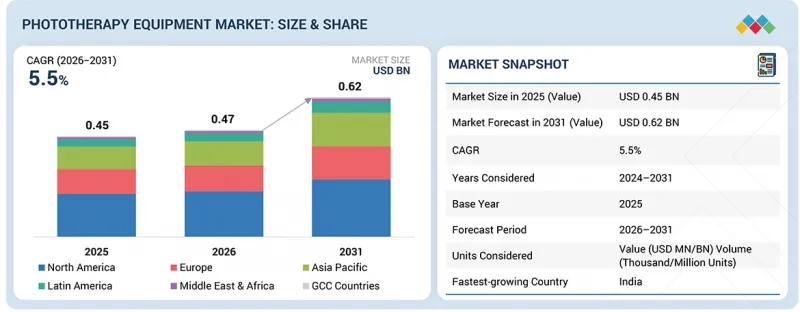
광선치료기 시장 규모는 2026년 4억 7,000만 달러에서 CAGR 5.5%로 확대되어 2031년에는 6억 2,000만 달러에 이를 것으로 예측됩니다.
| 조사 범위 | |
|---|---|
| 조사 대상 기간 | 2026-2031년 |
| 기준연도 | 2025년 |
| 예측 기간 | 2026-2031년 |
| 대상 단위 | 금액(10억 달러) |
| 부문 | 제품별, 용도별, 최종사용자별, 지역별 |
| 대상 지역 | 북미, 유럽, 아시아태평양, 라틴아메리카, 중동 및 아프리카 및 GCC 국가 |
지속적인 기술 혁신, 특히 기존의 형광등이나 할로겐 광원에서 LED 기반 광선 치료 시스템으로의 전환이 시장 성장을 크게 견인하고 있습니다. LED 광선 치료 장치는 높은 에너지 효율, 긴 수명, 발열 감소, 정확한 파장 제어 등 많은 장점을 갖추고 있어, 위험을 최소화하면서 치료 효과를 높여줍니다. 또한, 이러한 시스템은 균일한 광 분포를 구현하여 신생아 의료 및 피부과 의료 양 분야에서 임상 성과를 향상시킵니다. 또한, 장비 설계의 발전으로 인해 콤팩트하고 사용하기 쉬우며 유지보수 부담이 적은 시스템이 개발되어, 규모와 자원이 각기 다른 의료시설에서도 도입하기 쉬워졌습니다. 또한, 각 제조업체는 디지털 디스플레이, 광도 조절 기능, 자동 타이머 등의 스마트 기능을 통합하여 사용 편의성과 치료 정확도를 높이고 있습니다. 의료 종사자들 사이에서 기술적으로 진보된 솔루션에 대한 선호도가 높아짐에 따라, 구형 장비에서 최신 LED 기반 시스템으로의 교체 속도가 빨라지고 있습니다. 이러한 지속적인 혁신의 순환은 환자의 치료 성과를 향상시킬 뿐만 아니라, 개선된 광선 치료 기기에 대한 전 세계적인 수요를 꾸준히 창출하고 있습니다.
제품별 - 기존 광선 치료 기기가 주류를 이루는 가장 큰 요인 중 하나는 LED 기반 기기나 광섬유 시스템과 같은 첨단 대체 기기에 비해 비용 면에서 우위를 점하고 있다는 점입니다. 기존 장비는 일반적으로 초기 도입 비용이 저렴하여, 예산 제약이 심한 병원에 매우 매력적입니다. 설비 투자 외에도, 이러한 시스템은 설계가 간단하고 부품을 쉽게 구할 수 있어 유지보수 비용도 낮게 유지할 수 있습니다. 이러한 합리적인 가격은 의료 제공업체가 양질의 치료와 재정적 제약을 조화시켜야 하는 가격에 민감한 시장에서 특히 중요합니다. 공립 병원, 소규모 진료소 및 지방 의료 센터에서는 막대한 투자를 필요로 하지 않으면서도 만족스러운 임상 결과를 가져다주는 비용 대비 효과가 높은 솔루션을 우선적으로 선택하는 경우가 많습니다. 게다가, 특히 정부 자금을 지원하는 의료 제도의 대규모 조달 프로그램에서는 경제성 때문에 기존 장비가 선호되는 경향이 있습니다. 이러한 뛰어난 비용 대비 효과 덕분에, 기술적으로 진보된 대체 기기가 이용 가능함에도 불구하고, 기존의 광선 요법은 여전히 널리 사용되고 있으며 시장 수요를 주도하고 있습니다.
용도별 - 광선 요법은 그 안전성, 유효성 및 비침습성이 입증되었기 때문에 신생아 고빌리루빈혈증의 1차 치료법으로 널리 인정받고 있습니다. 이 치료법은 빌리루빈을 수용성 이성체로 변환하여, 간에서의 결합 과정 없이 배설될 수 있도록 함으로써 효과를 발휘합니다. 주요 의료기관의 임상 지침에서는 교환 수혈과 같은 침습성이 높은 처치를 고려하기 전에, 초기 중재로서 광선 요법을 강력히 권장하고 있습니다. 이러한 강력한 임상적 권고 덕분에 광선 치료 장치는 병원, 특히 신생아 중환자실(NICU)이나 산부인과 센터에서 일상적으로 사용되고 있습니다. 이 치료법은 시행이 간편하고, 필요한 훈련도 최소한으로 충분하며, 부작용 위험도 낮기 때문에 의료 자원이 제한된 환경에서도 널리 활용하기에 적합합니다. 또한, LED 기반 광선 치료 시스템과 같은 기술적 진보로 인해 치료 효율이 더욱 향상되고 운영 비용이 절감됨에 따라, 광선 치료가 우선적으로 선택되는 치료법으로서의 입지가 더욱 공고해지고 있습니다. 그 결과, 의료진은 지속적으로 광선 요법 장치를 사용하고 있으며, 이것이 신생아 황달 분야에서 해당 장치의 압도적인 시장 점유율을 이끌고 있습니다.
북미의 잘 갖춰진 의료 인프라는 광선 치료 기기의 광범위한 도입을 뒷받침하는 데 있어 매우 중요한 역할을 하고 있습니다. 이 지역에는 병원, 전문 클리닉, 그리고 첨단 신생아 치료 시설로 구성된 광범위한 네트워크가 구축되어 있으며, 이들 모두 신생아 질환 및 피부 질환을 효율적으로 진단하고 치료할 수 있는 시설을 갖추고 있습니다. 미국과 캐나다의 의료 시스템은 엄격한 임상 프로토콜, 최신 의료 기술, 그리고 고도로 훈련된 전문가를 특징으로 하며, 이를 통해 광선 치료 솔루션을 일상적인 진료에 원활하게 통합할 수 있게 해줍니다. 또한, 시설이 잘 갖춰진 신생아 집중치료실(NICU)이 마련되어 있어 고위험 신생아라도 즉시 치료를 받을 수 있습니다. 이 인프라는 광선 요법에 대한 접근성을 높일 뿐만 아니라, 의료진이 LED 기반 장치와 같은 기술적으로 진보된 시스템에 투자하도록 장려하고 있습니다. 또한, 엄격한 품질 기준에 따른 의료기기의 정기적인 업그레이드 및 유지보수도 지속적인 수요에 기여하고 있습니다. 이러한 견고한 의료 생태계의 존재 덕분에, 다양한 의료 현장에서 광선 치료 장치가 지속적으로 활용되고 도입될 수 있게 되었습니다.
광선 치료 기기 시장의 주요 기업으로는 Dragerwerk AG & Co. KGaA(독일), GE HealthCare(미국), Natus Medical(미국), Atom Medical(일본), Bistos(한국), Ningbo David(중국), Phothera(미국), STRATA Skin Sciences(미국), Xuzhou Kernel Medical(중국), Shanghai SIGMA High-tech(중국), Ultralite Enterprises, Inc.(미국), Hoenle Medical GmbH(독일), Weyer(독일), Neolight(미국), Fanem(브라질), Phoenix Medical Systems(인도) 등이 있습니다.
조사 범위
본 보고서에서는 광선 치료 기기 시장을 분석하고, 제품, 용도, 최종 사용자, 지역 등 다양한 부문을 바탕으로 시장 규모와 향후 성장 잠재력을 추정하고 있습니다. 또한, 본 시장의 주요 기업에 대한 경쟁 분석 외에도 기업 프로파일, 제품 라인업, 최근 동향 및 주요 시장 전략에 대해서도 다루고 있습니다.
이 보고서를 구매해야 하는 이유
본 보고서는 시장 선도 기업 및 신규 진출기업을 대상으로, 전체 시장, 광선 치료 기기 시장 및 그 하위 부문의 매출에 대한 가장 정확한 추정치를 제공합니다. 본 보고서는 이해관계자들이 경쟁 구도를 파악하고, 자사의 비즈니스를 더 유리한 위치에 놓으며, 적절한 시장 진출 전략을 수립하는 데 필요한 추가적인 인사이트를 얻는 데 도움이 됩니다. 또한, 본 보고서는 이해관계자들이 시장 동향을 파악할 수 있도록 지원하며, 시장의 주요 촉진요인, 억제요인, 장애 요인 및 기회에 관한 데이터를 제공합니다.
본 보고서에서는 다음 사항에 대한 인사이트를 제공합니다.
- 주요 촉진요인(신생아 황달 발생률 증가, 조산 및 저체중아 증가, 피부 질환 유병률 증가, 기술적으로 진보된 광선치료기 출시, LED 기반 광선치료기의 채택 확대), 제약 요인(대체 치료법의 다용도 사용, 신규 기기 승인에 관한 FDA의 엄격한 규제 방침), 기회(저비용 광선치료기 개발, 피부 질환 치료에서 가정용 광선 요법의 보급 확대), 과제(신흥 시장에서 재생품 광선치료기 구매 증가 추세, 개발도상국에서의 광선치료기 보급 제한성)
- 제품 강화 및 혁신 : 세계 광선 치료 기기 시장의 제품 출시 및 예상 동향에 대한 종합적인 분석
- 시장 개발: 제품, 용도, 최종 사용자, 지역별로 살펴본 수익성이 높은 성장 시장에 대한 상세한 인사이트와 분석.
- 시장의 다각화 : 전 세계 광선 치료 기기 시장의 신제품 출시, 시장 확대, 최신 동향 및 투자에 관한 종합적인 정보
- 경쟁사 분석 : 세계 광선 치료 기기 시장에서 주요 경쟁사 시장 점유율, 성장 계획, 제공 제품 및 생산 능력에 대한 철저한 평가
자주 묻는 질문
목차
제1장 서론
제2장 주요 요약
제3장 프리미엄 인사이트
제4장 시장 개요
제5장 업계 동향
제6장 기술 진보, AI의 영향, 특허, 혁신, 그리고 향후 응용
제7장 고객 현황과 구매 행동
제8장 규제 상황
제9장 광선치료기 시장(제품별)
제10장 광선치료기 시장(용도별)
제11장 광선치료기 시장(최종사용자별)
제12장 광선치료기 시장(지역별)
제13장 경쟁 구도
제14장 기업 개요
제15장 조사 방법
제16장 부록
LSH 26.06.19The phototherapy equipment market is projected to reach USD 0.62 billion by 2031, up from USD 0.47 billion in 2026, at a CAGR of 5.5%.
| Scope of the Report | |
|---|---|
| Years Considered for the Study | 2026-2031 |
| Base Year | 2025 |
| Forecast Period | 2026-2031 |
| Units Considered | Value (USD billion) |
| Segments | Product, Application, End user, and Region |
| Regions covered | North America, Europe, Asia Pacific, Latin America, Middle East & Africa, and GCC Countries |
Continuous technological innovation, particularly the transition from conventional fluorescent and halogen light sources to LED-based phototherapy systems, is significantly driving market growth. LED phototherapy devices offer multiple advantages, including higher energy efficiency, longer operational lifespan, reduced heat emission, and precise wavelength targeting, which enhances treatment effectiveness while minimizing risks. These systems also provide uniform light distribution, improving clinical outcomes in both neonatal and dermatological applications. Additionally, advancements in device design have led to the development of compact, user-friendly, and low-maintenance systems, making them more accessible to healthcare facilities with varying resource levels. Manufacturers are also integrating smart features such as digital displays, intensity controls, and automated timers, which improve usability and treatment accuracy. The growing preference for technologically advanced solutions among healthcare providers is accelerating the replacement of older equipment with modern LED-based systems. This ongoing innovation cycle not only improves patient outcomes but also creates a steady global demand for upgraded phototherapy equipment.
Based on product: One of the most significant drivers of the dominance of conventional phototherapy equipment is its cost advantage over advanced alternatives, such as LED-based and fiber-optic systems. Conventional units typically have lower upfront acquisition costs, making them highly attractive for hospitals operating under tight budget constraints. In addition to capital expenditure, these systems also incur lower maintenance and servicing costs due to their simpler design and readily available components. This affordability becomes particularly crucial in price-sensitive markets, where healthcare providers must balance quality care with financial limitations. Public hospitals, small clinics, and rural healthcare centers often prioritize cost-effective solutions that can deliver acceptable clinical outcomes without significant investment. Moreover, large-scale procurement programs, especially in government-funded healthcare systems, tend to favor conventional equipment due to its economic viability. This strong cost-benefit equation ensures that conventional phototherapy remains widely accessible and continues to dominate market demand despite the availability of technologically advanced alternatives.
Based on application: Phototherapy is universally recognized as the first-line treatment for neonatal hyperbilirubinemia due to its proven safety, efficacy, and non-invasive nature. It works by converting bilirubin into water-soluble isomers that can be excreted without requiring liver conjugation. Clinical guidelines across major health organizations strongly recommend phototherapy as the initial intervention before considering more invasive procedures such as exchange transfusion. This strong clinical endorsement ensures that phototherapy devices are routinely used in hospitals, particularly in NICUs and maternity centers. The treatment is easy to administer, requires minimal training, and has a low risk of adverse effects, making it suitable for widespread use even in resource-limited settings. Additionally, advancements such as LED-based phototherapy systems have further improved treatment efficiency and reduced operational costs, reinforcing its position as the preferred treatment modality. As a result, healthcare providers consistently rely on phototherapy equipment, which drives its dominant share in the neonatal jaundice segment.
North America's well-developed healthcare infrastructure plays a crucial role in supporting the widespread adoption of phototherapy equipment. The region boasts an extensive network of hospitals, specialty clinics, and advanced neonatal care facilities, all equipped to diagnose and treat neonatal and dermatological conditions efficiently. Healthcare systems in the US and Canada are characterized by strong clinical protocols, modern medical technologies, and highly trained professionals, enabling seamless integration of phototherapy solutions into routine care. Additionally, the availability of well-equipped neonatal intensive care units ensures that even high-risk infants receive immediate treatment. This infrastructure not only facilitates access to phototherapy but also encourages healthcare providers to invest in technologically advanced systems such as LED-based devices. Furthermore, regular upgrades and maintenance of medical equipment, driven by stringent quality standards, contribute to sustained demand. The presence of such a robust healthcare ecosystem ensures consistent utilization and adoption of phototherapy devices across multiple care settings.
A breakdown of the primary participants (supply-side) for the phototherapy equipment market referred to in this report is provided below:
- By Company Type: Tier 1:34%, Tier 2: 38%, and Tier 3: 28%
- By Designation: C-level: 26%, Director Level: 35%, and Others: 39%
- By Region: North America: 17%, Europe: 39%, Asia Pacific: 28%, Latin America: 8%, Middle East & Africa: 3%, GCC Countries: 5%
Prominent players in the phototherapy equipment market are market Dragerwerk AG & Co. KGaA (Germany), GE HealthCare (US), Natus Medical (US), Atom Medical (Japan), Bistos (South Korea), Ningbo David (China), Phothera (US), STRATA Skin Sciences (US), Xuzhou Kernel Medical (China), Shanghai SIGMA High-tech (China), Ultralite Enterprises, Inc. (US), Hoenle Medical GmbH (Germany), Weyer (Germany), Neolight (US), Fanem (Brazil), Phoenix Medical Systems (India), among others.
Research Coverage
The report evaluates the phototherapy equipment market and estimates the market size and future growth potential of this market based on various segments, including product, application, end user, and region. The report also includes a competitive analysis of the major players in this market, along with company profiles, product offerings, recent developments, and key market strategies.
Reasons to Buy the Report
The report will assist the market leader and new entrants with data on the nearest approximations of revenue for the overall market, the phototherapy equipment market, and its subsegments. The report will assist stakeholders in understanding the competitive landscape and in gaining further insights to better position their businesses and develop appropriate go-to-market strategies. The report assists the stakeholders in understanding the market pulse and gives them data on influential drivers, hindrances, obstacles, and opportunities in the market.
This report provides insights into the following points:
- Analysis of key drivers (rising incidence of neonatal jaundice, rising number of preterm and low-weight births, rising prevalence of skin diseases, launch of technologically advanced phototherapy equipment, rising adoption of LED-based phototherapy equipment), restraints (high use of alternative modes of treatment, stringent FDA regulatory policies for the approval of new devices), opportunities (development of low-cost phototherapy equipment, rising adoption of home phototherapy for the treatment of skin diseases), and challenges (rising trend of purchasing refurbished phototherapy equipment in emerging markets, limited adoption of phototherapy equipment in developing nations)
- Product Enhancement/Innovation: Comprehensive details about product launches and anticipated trends in the global phototherapy equipment market
- Market Development: Thorough knowledge and analysis of the profitable rising markets by product, application, end user, and region.
- Market Diversification: Comprehensive information about newly launched products, expanding markets, current advancements, and investments in the global phototherapy equipment market
- Competitive Assessment: Thorough evaluation of the market shares, growth plans, offerings, and capacities of the major competitors in the global phototherapy equipment market
TABLE OF CONTENTS
1 INTRODUCTION
- 1.1 STUDY OBJECTIVES
- 1.2 MARKET DEFINITION
- 1.3 STUDY SCOPE
- 1.3.1 MARKETS COVERED
- 1.3.2 INCLUSIONS & EXCLUSIONS
- 1.3.3 YEARS CONSIDERED
- 1.3.4 CURRENCY CONSIDERED
- 1.4 STAKEHOLDERS
- 1.5 SUMMARY OF CHANGES
2 EXECUTIVE SUMMARY
- 2.1 KEY INSIGHTS AND MARKET HIGHLIGHTS
- 2.2 KEY MARKET PARTICIPANTS: SHARE INSIGHTS AND START DEVELOPMENTS
- 2.3 DISRUPTIVE TRENDS SHAPING MARKET
- 2.4 HIGH-GROWTH SEGMENTS & EMERGING FRONTIERS
- 2.5 SNAPSHOT: GLOBAL MARKET SIZE, GROWTH RATE, AND FORECAST
3 PREMIUM INSIGHTS
- 3.1 PHOTOTHERAPY EQUIPMENTS MARKET OVERVIEW
- 3.2 ASIA PACIFIC: PHOTOTHERAPY EQUIPMENT MARKET, BY END USER
- 3.3 PHOTOTHERAPY EQUIPMENT MARKET: GEOGRAPHIC GROWTH OPPORTUNITIES
- 3.4 PHOTOTHERAPY EQUIPMENT MARKET: REGIONAL MIX
- 3.5 PHOTOTHERAPY EQUIPMENT MARKET: DEVELOPED COUNTRIES VS. EMERGING ECONOMIES
4 MARKET OVERVIEW
- 4.1 INTRODUCTION
- 4.2 MARKET DYNAMICS
- 4.2.1 DRIVERS
- 4.2.1.1 Rising incidence of neonatal jaundice
- 4.2.1.2 Growing number of preterm and low-weight births
- 4.2.1.3 Rising prevalence of skin diseases
- 4.2.1.4 Launch of technologically advanced phototherapy equipment
- 4.2.1.5 Rising adoption of LED-based phototherapy equipment
- 4.2.2 RESTRAINTS
- 4.2.2.1 High use of alternative modes of treatment
- 4.2.2.2 Stringent regulatory policies for new device approval
- 4.2.3 OPPORTUNITIES
- 4.2.3.1 Development of low-cost phototherapy equipment
- 4.2.3.2 Rising adoption of home phototherapy for treating skin diseases
- 4.2.4 CHALLENGES
- 4.2.4.1 Rising trend of purchasing refurbished equipment in emerging markets
- 4.2.4.2 Limited adoption of phototherapy equipment in developing nations
- 4.2.1 DRIVERS
- 4.3 UNMET NEEDS AND WHITE SPACES
- 4.3.1 UNMET NEEDS IN PHOTOTHERAPY EQUIPMENT MARKET
- 4.3.2 WHITE SPACE OPPORTUNITIES
- 4.4 INTERCONNECTED MARKETS AND CROSS-SECTOR OPPORTUNITIES
- 4.4.1 INTERCONNECTED MARKETS
- 4.4.2 CROSS-SECTOR OPPORTUNITIES
- 4.5 STRATEGIC MOVES BY TIER-1/2/3 PLAYERS
5 INDUSTRY TRENDS
- 5.1 PORTER'S FIVE FORCES ANALYSIS
- 5.1.1 THREAT OF NEW ENTRANTS
- 5.1.2 THREAT OF SUBSTITUTES
- 5.1.3 BARGAINING POWER OF BUYERS
- 5.1.4 BARGAINING POWER OF SUPPLIERS
- 5.1.5 INTENSITY OF COMPETITIVE RIVALRY
- 5.2 MACROECONOMIC OUTLOOK
- 5.2.1 INTRODUCTION
- 5.2.2 GDP TRENDS AND FORECAST
- 5.2.3 TRENDS IN GLOBAL NEONATAL & DERMATOLOGY CARE INDUSTRY
- 5.3 SUPPLY CHAIN ANALYSIS
- 5.4 VALUE CHAIN ANALYSIS
- 5.5 ECOSYSTEM ANALYSIS
- 5.6 PRICING ANALYSIS
- 5.6.1 AVERAGE SELLING PRICE TREND, BY KEY PLAYER (2025)
- 5.6.2 AVERAGE SELLING PRICE TREND, BY REGION (2024-2026)
- 5.7 TRADE ANALYSIS
- 5.7.1 IMPORT SCENARIO (HS CODE 9018090)
- 5.7.2 EXPORT SCENARIO (HS CODE 9018090)
- 5.8 KEY CONFERENCES AND EVENTS, 2026-2027
- 5.9 TRENDS/DISRUPTIONS IMPACTING CUSTOMERS' BUSINESSES
- 5.10 INVESTMENT & FUNDING SCENARIO
- 5.11 CASE STUDY ANALYSIS
- 5.11.1 CASE STUDY 1: SMART NICU UPGRADE AT BOSTON CHILDREN'S HOSPITAL
- 5.11.2 CASE STUDY 2: AFFORDABLE PHOTOTHERAPY EXPANSION IN RURAL INDIA
- 5.11.3 CASE STUDY 3: PREDICTIVE NEONATAL MONITORING AT MOUNT SINAI HOSPITAL, CANADA
- 5.12 IMPACT OF US TARIFFS-PHOTOTHERAPY EQUIPMENT MARKET
- 5.12.1 INTRODUCTION
- 5.12.2 KEY TARIFF RATES
- 5.12.3 PRICE IMPACT ANALYSIS
- 5.12.4 IMPACT ON COUNTRIES/REGIONS
- 5.12.4.1 North America
- 5.12.4.2 Europe
- 5.12.4.3 Asia Pacific
- 5.12.5 END-USE INDUSTRY IMPACT
6 TECHNOLOGICAL ADVANCEMENTS, AI-DRIVEN IMPACT, PATENTS, INNOVATIONS, AND FUTURE APPLICATIONS
- 6.1 KEY EMERGING TECHNOLOGIES
- 6.1.1 ADVANCED LED PHOTOTHERAPY SYSTEMS
- 6.1.2 FIBER-OPTIC & WEARABLE PHOTOTHERAPY TECHNOLOGIES
- 6.2 COMPLEMENTARY TECHNOLOGIES
- 6.2.1 BIOSENSOR & CHEMICAL SENSOR TECHNOLOGIES
- 6.2.2 POINT-OF-CARE & HOME CARE TREATMENT PLATFORMS
- 6.3 TECHNOLOGY/PRODUCT ROADMAP
- 6.3.1 SHORT-TERM (2025-2027) | FOUNDATION & EARLY COMMERCIALIZATION
- 6.3.2 MID-TERM (2027-2030) | EXPANSION & STANDARDIZATION
- 6.3.3 LONG-TERM (2030-2035+) | MASS COMMERCIALIZATION & DISRUPTION
- 6.4 PATENT ANALYSIS
- 6.4.1 INSIGHTS: JURISDICTION AND TOP APPLICANT ANALYSIS
- 6.5 FUTURE APPLICATIONS
- 6.5.1 AI-ENABLED SMART PHOTOTHERAPY & CONNECTED CARE SYSTEMS
- 6.5.2 NON-INVASIVE MEDICAL BREATH DIAGNOSTICS
- 6.5.3 NEXT-GENERATION LED & PRECISION PHOTOTHERAPY TECHNOLOGIES
- 6.6 IMPACT OF AI/GEN AI ON PHOTOTHERAPY EQUIPMENT MARKET
- 6.6.1 TOP USE CASES AND MARKET POTENTIAL
- 6.6.2 BEST PRACTICES FOLLOWED BY MANUFACTURERS/OEMS IN PHOTOTHERAPY EQUIPMENT MARKET
- 6.6.3 CASE STUDIES OF AI IMPLEMENTATION IN PHOTOTHERAPY EQUIPMENT
- 6.6.4 INTERCONNECTED ADJACENT ECOSYSTEMS AND IMPACT ON MARKET PLAYERS
- 6.6.5 CLIENTS' READINESS TO ADOPT GENERATIVE AI IN PHOTOTHERAPY EQUIPMENT MARKET
7 CUSTOMER LANDSCAPE & BUYER BEHAVIOR
- 7.1 DECISION-MAKING PROCESS
- 7.2 KEY STAKEHOLDERS INVOLVED IN BUYING PROCESS AND THEIR EVALUATION CRITERIA
- 7.2.1 KEY STAKEHOLDERS IN BUYING PROCESS
- 7.2.2 KEY BUYING CRITERIA
- 7.3 ADOPTION BARRIERS & INTERNAL CHALLENGES
- 7.4 UNMET NEEDS OF VARIOUS END-USE INDUSTRIES
- 7.5 MARKET PROFITABILITY
- 7.5.1 REVENUE POTENTIAL
- 7.5.2 COST DYNAMICS
- 7.5.3 MARGIN OPPORTUNITIES IN KEY APPLICATIONS
8 REGULATORY LANDSCAPE
- 8.1 REGIONAL REGULATIONS AND COMPLIANCE
- 8.1.1 REGULATORY BODIES, GOVERNMENT AGENCIES, AND OTHER ORGANIZATIONS
- 8.1.2 INDUSTRY STANDARDS
9 PHOTOTHERAPY EQUIPMENT MARKET, BY PRODUCT
- 9.1 INTRODUCTION
- 9.2 CONVENTIONAL PHOTOTHERAPY
- 9.2.1 AFFORDABILITY AND ACCESSIBILITY DRIVING CONTINUED USE OF CONVENTIONAL PHOTOTHERAPY EQUIPMENT
- 9.3 FIBER-OPTIC PHOTOTHERAPY
- 9.3.1 PARENT-FRIENDLY DESIGN AND HOME-BASED CARE DEMAND ACCELERATE GROWTH IN FIBER-OPTIC PHOTOTHERAPY
10 PHOTOTHERAPY EQUIPMENT MARKET, BY APPLICATION
- 10.1 INTRODUCTION
- 10.2 NEONATAL JAUNDICE
- 10.2.1 INCREASING NUMBER OF PRETERM AND LOW-WEIGHT BIRTHS TO DRIVE MARKET GROWTH
- 10.3 SKIN DISEASES
- 10.3.1 PSORIASIS
- 10.3.1.1 Rising demand for non-invasive therapies and technological advancements to drive market
- 10.3.2 VITILIGO
- 10.3.2.1 High effectiveness in managing vitiligo drives market growth
- 10.3.3 ECZEMA
- 10.3.3.1 Growing burden of pediatric eczema to support demand for phototherapy
- 10.3.1 PSORIASIS
11 PHOTOTHERAPY EQUIPMENT MARKET, BY END USER
- 11.1 INTRODUCTION
- 11.2 HOSPITALS
- 11.2.1 RISING PATIENT ADMISSIONS AND ADVANCED TREATMENT INFRASTRUCTURE SUPPORT DOMINANCE OF HOSPITALS
- 11.3 HOME CARE SETTINGS
- 11.3.1 INCREASING ADOPTION OF PORTABLE AND HOME-USE DEVICES TO DRIVE MARKET GROWTH
12 PHOTOTHERAPY EQUIPMENT MARKET, BY REGION
- 12.1 INTRODUCTION
- 12.2 NORTH AMERICA
- 12.2.1 US
- 12.2.1.1 Government initiatives and technological advancements supporting market growth
- 12.2.2 CANADA
- 12.2.2.1 Expansion of neonatal care services and home-based phototherapy adoption driving market growth
- 12.2.1 US
- 12.3 EUROPE
- 12.3.1 GERMANY
- 12.3.1.1 Advanced healthcare infrastructure and innovation leadership driving market growth
- 12.3.2 UK
- 12.3.2.1 NHS modernization and increasing dermatology treatment demand supporting market growth
- 12.3.3 FRANCE
- 12.3.3.1 Public healthcare investments and rising neonatal care demand driving market growth
- 12.3.4 ITALY
- 12.3.4.1 Healthcare modernization and rising awareness of skin disease treatments supporting market growth
- 12.3.5 SPAIN
- 12.3.5.1 Rising neonatal healthcare investments and dermatology treatment adoption are driving growth
- 12.3.6 REST OF EUROPE
- 12.3.1 GERMANY
- 12.4 ASIA PACIFIC
- 12.4.1 CHINA
- 12.4.1.1 Healthcare expansion and domestic medical device manufacturing driving market growth
- 12.4.2 JAPAN
- 12.4.2.1 Aging population and advanced healthcare technologies supporting market growth
- 12.4.3 INDIA
- 12.4.3.1 Rising neonatal healthcare demand and government healthcare initiatives driving market growth
- 12.4.4 AUSTRALIA
- 12.4.4.1 Expansion of neonatal healthcare programs and dermatology services supporting market growth
- 12.4.5 SOUTH KOREA
- 12.4.5.1 Technological innovation and expanding dermatology care driving market growth
- 12.4.6 REST OF ASIA PACIFIC
- 12.4.1 CHINA
- 12.5 LATIN AMERICA
- 12.5.1 BRAZIL
- 12.5.1.1 Expanding neonatal healthcare services and growing dermatology market supporting growth
- 12.5.2 MEXICO
- 12.5.2.1 Healthcare modernization and increasing neonatal care awareness driving market growth
- 12.5.3 REST OF LATIN AMERICA
- 12.5.1 BRAZIL
- 12.6 MIDDLE EAST & AFRICA
- 12.7 GCC COUNTRIES
13 COMPETITIVE LANDSCAPE
- 13.1 OVERVIEW
- 13.2 KEY PLAYER STRATEGIES/RIGHT TO WIN
- 13.3 REVENUE ANALYSIS
- 13.4 MARKET SHARE ANALYSIS
- 13.5 COMPANY EVALUATION MATRIX: KEY PLAYERS, 2025
- 13.5.1 STARS
- 13.5.2 EMERGING LEADERS
- 13.5.3 PERVASIVE PLAYERS
- 13.5.4 PARTICIPANTS
- 13.5.5 COMPANY FOOTPRINT: KEY PLAYERS, 2025
- 13.5.5.1 Company footprint
- 13.5.5.2 Region footprint
- 13.5.5.3 Product footprint
- 13.5.5.4 Application footprint
- 13.5.5.5 End-user footprint
- 13.6 COMPETITIVE EVALUATION MATRIX: STARTUPS/SMES, 2025
- 13.6.1 PROGRESSIVE COMPANIES
- 13.6.2 RESPONSIVE COMPANIES
- 13.6.3 DYNAMIC COMPANIES
- 13.6.4 STARTING BLOCKS
- 13.6.5 COMPETITIVE BENCHMARKING: STARTUPS/SMES, 2025
- 13.6.5.1 Detailed list of key startups/SMEs
- 13.6.5.2 Competitive benchmarking of startups/SMEs
- 13.7 COMPANY VALUATION AND FINANCIAL METRICS
- 13.7.1 FINANCIAL METRICS
- 13.7.2 COMPANY VALUATION
- 13.8 BRAND COMPARISON
- 13.9 COMPETITIVE SCENARIO
- 13.9.1 PRODUCT LAUNCHES & APPROVALS
- 13.9.2 DEALS
14 COMPANY PROFILES
- 14.1 KEY PLAYERS
- 14.1.1 GE HEALTHCARE
- 14.1.1.1 Business overview
- 14.1.1.2 Products offered
- 14.1.1.3 MnM view
- 14.1.1.3.1 Right to win
- 14.1.1.3.2 Strategic choices
- 14.1.1.3.3 Weaknesses and competitive threats
- 14.1.2 DRAGERWERK AG & CO. KGAA
- 14.1.2.1 Business overview
- 14.1.2.2 Products offered
- 14.1.2.3 Recent developments
- 14.1.2.3.1 Product launches
- 14.1.2.4 MnM view
- 14.1.2.4.1 Right to win
- 14.1.2.4.2 Strategic choices
- 14.1.2.4.3 Weaknesses and competitive threats
- 14.1.3 NATUS SENSORY
- 14.1.3.1 Business overview
- 14.1.3.2 Products offered
- 14.1.3.3 Recent developments
- 14.1.3.3.1 Deals
- 14.1.3.4 MnM view
- 14.1.3.4.1 Key strengths/Right to win
- 14.1.3.4.2 Strategic choices made
- 14.1.3.4.3 Weaknesses and competitive threats
- 14.1.4 PHOTHERA
- 14.1.4.1 Business overview
- 14.1.4.2 Products offered
- 14.1.4.3 Recent developments
- 14.1.4.3.1 Product launches
- 14.1.4.4 MnM view
- 14.1.4.4.1 Key strengths/Right to win
- 14.1.4.4.2 Strategic choices made
- 14.1.4.4.3 Weaknesses and competitive threats
- 14.1.5 SHANGHAI SIGMA HIGH-TECH CO., LTD.
- 14.1.5.1 Business overview
- 14.1.5.2 Products offered
- 14.1.5.3 Recent developments
- 14.1.5.3.1 Product launches
- 14.1.5.4 MnM view
- 14.1.5.4.1 Right to win
- 14.1.5.4.2 Strategic choices
- 14.1.5.4.3 Weaknesses and competitive threats
- 14.1.6 ATOM MEDICAL CORP
- 14.1.6.1 Business overview
- 14.1.6.2 Products offered
- 14.1.7 PHOENIX MEDICAL SYSTEMS
- 14.1.7.1 Business overview
- 14.1.7.2 Products offered
- 14.1.8 NEOLIGHT LLC
- 14.1.8.1 Business overview
- 14.1.8.2 Products offered
- 14.1.8.3 Recent developments
- 14.1.8.3.1 Deals
- 14.1.9 FANEM
- 14.1.9.1 Business overview
- 14.1.9.2 Products offered
- 14.1.10 BISTOS CO., LTD.
- 14.1.10.1 Business overview
- 14.1.10.2 Products offered
- 14.1.1 GE HEALTHCARE
- 14.2 OTHER PLAYERS
- 14.2.1 NINGBO DAVID MEDICAL DEVICE CO., LTD.
- 14.2.2 STRATA SKIN SCIENCES
- 14.2.3 XUZHOU KERNEL MEDICAL EQUIPMENT CO., LTD.
- 14.2.4 ULTRALITE ENTERPRISES, INC.
- 14.2.5 HOENLE MEDICAL GMBH
- 14.2.6 WEYER GMBH
- 14.2.7 SHENZHEN COMEN MEDICAL INSTRUMENTS CO., LTD.
- 14.2.8 THERALIGHT, LLC
- 14.2.9 ATHRODAX LTD
- 14.2.10 CURELIGHT
- 14.2.11 PHOTO THERAPEUTICS LTD
- 14.2.12 TINY HEARTS TECHNOLOGY
- 14.2.13 LIFETRONS INNO EQUIPMENTS PVT LTD
- 14.2.14 IBIS MEDICAL EQUIPMENT AND SYSTEMS PVT LTD
- 14.2.15 SCI HEALTH
15 RESEARCH METHODOLOGY
- 15.1 RESEARCH DATA
- 15.1.1 SECONDARY DATA
- 15.1.1.1 Key data from secondary sources
- 15.1.2 PRIMARY DATA
- 15.1.2.1 Key data from primary sources
- 15.1.2.2 Key industry insights
- 15.1.1 SECONDARY DATA
- 15.2 MARKET SIZE ESTIMATION
- 15.3 MARKET BREAKDOWN AND DATA TRIANGULATION
- 15.4 MARKET SHARE ESTIMATION
- 15.5 STUDY ASSUMPTIONS
- 15.6 METHODOLOGY-RELATED LIMITATIONS
- 15.7 RISK ASSESSMENT
- 15.8 RESEARCH LIMITATIONS
16 APPENDIX
- 16.1 DISCUSSION GUIDE
- 16.2 KNOWLEDGESTORE: MARKETSANDMARKETS' SUBSCRIPTION PORTAL
- 16.3 CUSTOMIZATION OPTIONS
- 16.4 RELATED REPORTS
- 16.5 AUTHOR DETAILS