
|
시장보고서
상품코드
2058126
유럽의 건축용 코팅 시장 : 용도별, 기술별, 기재별, 최종 용도별, 국가별 - 세계 예측(-2031년)Europe Architectural Coatings Market by Technology, Substrate, Application, End-Use, and Country - Global Forecast to 2031 |
||||||

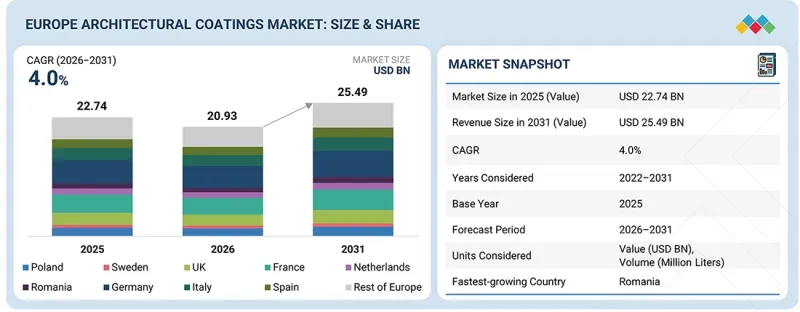
유럽의 건축용 코팅 시장 규모는 2026년 209억 3,000만 달러에서 2031년까지 254억 9,000만 달러로 성장하여 예측 기간 동안 CAGR 4.0%를 기록할 것으로 전망됩니다.
| 조사 범위 | |
|---|---|
| 조사 대상 기간 | 2022-2031년 |
| 기준 연도 | 2025년 |
| 예측 기간 | 2026-2031년 |
| 산정 단위 | 금액(100만/10억 달러), 수량(100만 리터) |
| 부문 | 용도별, 기술별, 기재별, 최종 용도별, 국가별 |
| 대상 지역 | 유럽 |
유럽의 건축용 코팅 시장은 다양한 용도의 보수 공사 빈도가 높기 때문에 성장이 예상됩니다. 건설 산업이 발달한 이 지역은 성숙한 시장으로 분류되며, 수요는 신축 공사보다는 주로 도장 재시공 공사에 따라 좌우될 것입니다. 서유럽 국가들에서는 내구성, 표면의 미관, 보호 성능 향상을 목적으로 한 건물 개보수 공사가 꾸준히 증가하고 있습니다. 또한, 유럽의 정책 및 규제 체계는 환경에 미치는 영향을 최소화하고 유해 물질이 포함되지 않은 도료의 사용을 장려함으로써 시장의 급속한 발전에 기여하고 있습니다. 에너지 절약형 건축의 보급에 따라, 열전도를 차단하고 내후성이 뛰어나며 그 밖의 여러 장점을 갖춘 반사형 도료의 인기가 높아지고 있습니다. 경험이 풍부하고 전문적인 시공업체의 존재에 더해, 특히 독일, 영국, 프랑스와 같은 선진국에서 DIY 부문 이용자들의 활동이 증가함에 따라, 이 지역은 도료 제조업체들에게 유리한 환경이 되고 있습니다. 주거 수준 향상과 더불어 구매력이 높은 인구의 증가가 맞물려 중동부 유럽 국가들의 시장 확대에 기여하고 있습니다.
"용도별로는 파사드 2부문이 예측 기간 동안 가장 큰 점유율을 차지할 것으로 예상됩니다."
파사드 2 부문은 예측 기간 동안 가장 빠르게 성장할 것으로 예상됩니다. 이는 도료 시장 수요의 상당 부분이 단열 및 기타 기능을 결합한 파사드 시스템과 관련되어 있기 때문입니다. 이러한 파사드 시스템은 도료층을 도포하기 전에 제대로 기능하도록 하기 위해 여러 층의 프라이머와 베이스 코트, 보강제를 사용하여 바탕 처리를 해야 합니다. 외벽 단열 코팅의 용도 중 가장 일반적인 예 중 하나는 외단열 복합 시스템(ETICS)입니다. 이러한 종류의 파사드 시스템에서는 고품질의 밀착성, 균열 방지 및 우수한 방습성을 확보하기 위해 코팅 하층에 이러한 층이 존재하는 것이 필수적입니다. 유럽에서 단열 코팅에 대한 수요가 증가하는 것은 EU의 요건에 따라 에너지 효율이 높은 건축물 건설 및 건물 에너지 소비량 감축을 위한 움직임이 강화되고 있기 때문입니다. 또한, 내구성이 뛰어나고 효율적인 외벽 단열 시스템을 구축하는 데 있어 바탕 처리층이 중요하다는 점도 그 수요에 영향을 미치고 있습니다. 또한, 건설 업계의 지속가능성 관련 동향 변화 역시 친환경 코팅을 포함한 그린 기술의 활용을 촉진하고 있습니다.
용도별로는 예측 기간 동안 프로페셔널 부문이 가장 큰 점유율을 차지할 것으로 예상됩니다.
예측 기간 동안 프로페셔널 부문이 가장 큰 점유율을 차지할 것으로 예상됩니다. 이러한 우위는 유럽 건설 업계가 기존의 도급 방식에 크게 의존하고 있다는 점과 프로젝트 수행에 있어 높은 전문성을 갖추고 있다는 점에 기인한 것으로 보입니다. 건설, 개보수 및 리모델링 프로젝트에는 높은 수준의 전문 지식과 전문성이 요구됩니다. 이러한 프로젝트는 대개 여러 차례의 도포 공정이 수반되기 때문에 향후 몇 년 동안 이 부문은 성장할 것으로 예상됩니다. 프로페셔널 부문을 뒷받침하는 또 다른 중요한 요인은 유럽 건축용 코팅 시장에서 진행되는 프로젝트의 규모와 복잡성입니다. 오래된 건물의 개보수는 더 복잡해지는 경향이 있어, 일반적으로 전문가의 참여가 필요합니다. 이러한 전문적인 지식에 대한 수요는 도장 공정이 복잡하여 전문가의 감독이 필요한 대규모 상업용 빌딩, 복합 오피스 단지, 주택 개발 프로젝트에서 특히 두드러집니다.
독일은 유럽 건축용 코팅 시장에서 가장 큰 점유율을 차지할 것으로 예상됩니다.
2025년, 독일은 유럽 건축용 코팅 시장에서 1위로 도약했습니다. 이 나라의 이러한 확고한 입지는 고도로 발달한 건설 부문과 신축 및 개보수 공사에서 전문가의 시공에 의존하고 있기 때문으로 보입니다. 독일에서는 도장 업체나 인증 건설업체가 대부분의 제품을 시공하기 때문에 건축용 코팅의 전문적인 시공이 매우 중요합니다. 이들의 참여는 상업, 산업, 주택 건설 분야, 특히 정밀도가 요구되는 프로젝트에서 특히 중요합니다.
프로페셔널 부문은 전국 각지에서 진행 중인 노후 인프라 및 건물 개보수 공사에서 큰 혜택을 보고 있습니다. 건축용 코팅 수요의 상당 부분은 이러한 개보수 공사, 특히 노후된 주택이나 인프라의 개보수와 관련하여 발생하고 있습니다. 게다가 대규모 상업 시설, 사무실, 공동 주택에서의 도료 수요 역시 고품질의 시공을 보장하기 위해 전문가에 대한 의존도가 높은 것이 현실입니다.
기존 인프라 및 건물의 대규모 개보수는 전문 업체 부문의 신뢰도를 한층 더 높이고 있습니다. 오래된 주택 및 인프라의 현대화를 포함한 개보수 프로젝트가 수요의 대부분을 차지하고 있습니다. 대규모 상업 시설, 사무실, 주택에서도 코팅 시스템을 효율적이고 내구성 있게 시공하기 위해서는 전문 시공업체에 대한 의존도가 높아지고 있습니다. 또한, 인프라 구축, 에너지 효율 개선 공사 및 신규 상업용 건축물에 대한 지속적인 투자가 독일 내 코팅 솔루션에 대한 높은 수요를 이끌고 있으며, 이를 통해 독일은 이 지역 내 주요 시장 진입 기업으로 자리매김하고 있습니다. 또한, 벽체 단열 시스템을 접목한 보다 고도화된 코팅 솔루션은 전문적인 시공 기술이 필요하기 때문에 이 과정에서 전문가의 중요성이 부각되고 있습니다.
- 기업 유형별 : Tier 1-50%, Tier 2-30%, Tier 3-20%
- 직책별 : 이사 20%, 관리자 15%, 기타 65%
- 지역별 : 영국 25%, 독일 35%, 스웨덴 25%, 네덜란드 10%, 폴란드 5%
유럽 건축용 코팅 시장에는 AkzoNobel N.V.(네덜란드), PPG Industries, Inc.(미국), The Sherwin-Williams Company(미국), Nippon Paint Holdings(일본), RPM International, Inc.(미국), Kansai Paint(일본), Axalta Coating Systems(미국), DAW SE(독일), Hempel(덴마크), Jotun(노르웨이) 등의 주요 기업으로 구성되어 있습니다.
본 조사에서는 유럽 건축용 코팅 시장의 주요 기업들에 대해 상세한 경쟁 분석을 수행하고 있습니다. 또한 각 기업 개요, 최근 동향 및 주요 시장 전략에 대해서도 다루고 있습니다.
조사 범위
본 보고서에서는 유럽 건축용 코팅 시장을 기술, 기질, 최종 용도, 용도 및 국가별로 세분화하고 있습니다. 또한, 각 지역의 시장 전체 규모에 대한 추정치를 제공하고 있습니다. 주요 업계 진입 기업에 대한 상세한 분석을 통해, 유럽 건축용 코팅 시장과 관련된 사업 개요, 제품 및 서비스, 주요 전략, 그리고 사업 확장에 대한 인사이트를 제공합니다.
본 보고서를 구매할 때의 주요 이점
본 조사 보고서는 업계 분석(업계 동향), 주요 기업의 시장 순위 분석, 기업 개요 등 다각적인 분석에 중점을 두고 있으며, 이를 종합하여 경쟁 구도, 신흥 및 고성장 부문, 고성장 지역, 그리고 시장의 촉진요인, 제약, 기회, 과제에 대한 전반적인 현황을 제공합니다.
본 보고서에서는 다음 사항에 대한 인사이트를 제공합니다:
- 성장 촉진요인 분석 : (리모델링 및 개조 수요, 수지·바인더 기술의 발전, E-Commerce 및 D2C 채널의 성장), 제약요인(엄격한 환경 규제 및 규정 준수 비용, 원자재 가격 변동), 기회(바이오 기반 및 순환형 도료 개발, 동유럽에서의 사업 확장, 첨단 도포 기술 및 기후 변화에 강한 도료), 과제(DIY로 향하는 소비자 선호도 변화)
- 시장 침투 : 주요 기업들이 제공하는 유럽 건축용 코팅에 관한 종합적인 정보
- 제품 개발 및 혁신 : 유럽 건축용 코팅 시장의 향후 기술 동향, 신제품 출시, 사업 확장 및 M&A에 대한 상세한 분석
- 시장 개발 : 각 지역의 수익성이 높은 신흥 시장에 대한 종합적인 정보
- 시장 규모 : 입수 가능한 범위 내에서 각 기업의 생산능력을 제시하고, 유럽 건축용 코팅 시장의 향후 생산능력에 대해서도 기술하고 있습니다.
- 경쟁사 분석 : 유럽 건축용 코팅 시장의 주요 기업별 시장 점유율, 전략, 제품 및 생산능력에 대한 상세 분석
자주 묻는 질문
목차
제1장 소개
제2장 주요 요약
제3장 주요 인사이트
제4장 시장 개요
제5장 업계 동향
제6장 기술 진보, AI에 의한 영향, 특허, 혁신, 그리고 향후 응용
제7장 지속가능성과 규제 상황
제8장 고객 상황과 구매 행동
제9장 유럽의 건축용 코팅 시장(용도별)
제10장 유럽의 건축용 코팅 시장(기술별)
제11장 유럽의 건축용 코팅 시장(기재별)
제12장 유럽의 건축용 코팅 시장(최종 용도별)
제13장 유럽의 건축용 코팅 시장(국가별)
제14장 경쟁 구도
제15장 기업 개요
제16장 조사 방법
제17장 부록
KSM 26.06.19The Europe architectural coatings market is projected to grow from USD 20.93 billion in 2026 to USD 25.49 billion by 2031, registering a CAGR of 4.0% during the forecast period.
| Scope of the Report | |
|---|---|
| Years Considered for the Study | 2022-2031 |
| Base Year | 2025 |
| Forecast Period | 2026-2031 |
| Units Considered | Value (USD Million/Billion), Volume (Million Liters) |
| Segments | By Country, By Technology, By Substrate, By Application, By End-Use |
| Regions covered | Europe |
The architectural coating market in Europe is anticipated to expand due to the high frequency of renovations across different applications. With a developed construction industry, the region can be characterized as mature, and demand will be determined mainly by repainting projects rather than constructions of entirely new buildings. Western European states continue experiencing steady growth thanks to building refurbishments aimed at providing better wearability, surface appearance, and protection. European policies and regulatory frameworks also contribute to faster development by encouraging the use of coatings that minimize environmental impact and are free from harmful substances. The development of energy-efficient buildings has caused increased popularity for reflective coatings, which prevent heat transfer, resist weathering, and provide other similar advantages. The presence of experienced and professional contractors together with increased activity of DIY segment users, especially in such developed states as Germany, Great Britain, and France, has made the region favorable for coatings producers. Improving housing standards, combined with the growing number of people with higher purchasing capacity, also contributes to the expansion in Central and Eastern European countries.
"By application, the facade 2 segment is expected to account for the largest share during the forecast period."
The facade 2 segment is expected to be the fastest-growing segment during the forecast period, since a great part of the coatings market demand is linked to facade systems that combine insulation and other functions. These facade systems need to be prepared by using several layers of primers and basecoats and reinforcing agents to function properly prior to applying the coating layer. When it comes to insulation coating applications on facades, one of the most common examples is External Thermal Insulation Composite Systems (ETICS). In this type of facade system, the presence of the layers under the coating is necessary to achieve high-quality adhesion, crack prevention, and better moisture protection. Increased demand for insulation coatings in Europe can be explained by a growing trend towards building energy-efficient structures and lowering the amount of energy consumed in buildings as per EU requirements. Additionally, the importance of the preparatory layer in creating a long-lasting and efficient facade insulation system also influences its demand. Moreover, changes in sustainability-related trends in the construction industry encourage the use of green technologies, including eco-friendly coatings.
By end-use, the professional segment is expected to account for the largest share during the forecast period.
The professional segment is expected to account for the largest share during the forecast period. This dominance can be attributed to the European construction industry's strong reliance on traditional contracting methods and high level of professionalism in executing projects. Construction, renovation, and refurbishment projects require a high degree of expertise and professionalism. Since these projects often involve multiple layers of application, the segment is expected to grow in the coming years. Another significant factor reinforcing the professional category is the size and complexity of the projects executed within the developed Europe architectural coatings market. Renovation of older structures tends to be more complicated and typically requires professional involvement. This need for professional expertise is particularly evident in large commercial buildings, office complexes, and residential developments, where the application of coatings is complex and requires expert supervision.
Germany is expected to account for the largest share of the Europe architectural coatings market.
In 2025, Germany emerged as the leader in the Europe architectural coatings market. This strong position of the country can be attributed to its well-developed construction sector and its reliance on professional applications for new constructions and renovations. In Germany, the professional application of architectural coatings is crucial as painters and certified builders apply most products. Their involvement is especially significant in commercial, industrial, and residential construction sectors, particularly in projects that demand precision.
The professional sector significantly benefits from the ongoing renovation of old infrastructure and buildings across the country. A substantial portion of the demand for architectural coatings arises from these renovation efforts, particularly regarding older residential properties and infrastructure upgrades. Additionally, the need for coatings in large commercial, office, and multi-residential buildings relies heavily on professionals to ensure high-quality application.
Extensive renovation of existing infrastructure and buildings further reinforces the reliability of the professional sector. Renovation projects, including the modernization of old housing and infrastructure, generate a major part of the demand. Large commercial facilities, offices, and multi-family residential complexes also depend on professional contractors for the efficient and lasting application of coating systems. Additionally, ongoing investments in infrastructure improvements, energy-efficient renovations, and new commercial construction contribute to the high demand for coating solutions in Germany, making it a dominant market player in the region. Moreover, more sophisticated coating solutions that incorporate wall insulation systems require specialized application techniques, highlighting the importance of professionals in this process.
In-depth interviews were conducted with Chief Executive Officers (CEOs), marketing directors, and other innovation and technology executives from various key organizations operating in the Europe architectural coatings market.
- By Company Type: Tier 1 - 50%, Tier 2 - 30%, and Tier 3 - 20%
- By Designation: Directors - 20%, Managers- 15%, and Others - 65%
- By Region: UK - 25%, Germany - 35%, Sweden - 25%, Netherlands -10%, and Poland- 5%
The Europe architectural coatings market comprises of major companies, including AkzoNobel N.V. (Netherlands), PPG Industries, Inc. (United States), The Sherwin-Williams Company (United States), Nippon Paint Holdings (Japan), RPM International, Inc. (United States), Kansai Paint (Japan), Axalta Coating Systems (United States), DAW SE (Germany), Hempel (Denmark), Jotun (Norway).
This study covers an in-depth competitive analysis of these key players in the Europe architectural coatings market. It also covers their company profiles, recent developments, and key market strategies.
Research Coverage
This report segments the Europe architectural coatings market by technology, substrate, end-use, application, and country. It provides estimations for the overall value of the market across various regions. A detailed analysis of key industry players has been conducted to provide insights into their business overviews, products & services, key strategies, and expansions associated with the Europe architectural coatings market.
Key Benefits of Buying this Report
This research report is focused on various levels of analysis - industry analysis (industry trends), market ranking analysis of top players, and company profiles - which together provide an overall view of the competitive landscape; emerging and high-growth segments; high-growth regions; and market drivers, restraints, opportunities, and challenges.
The report provides insights into the following pointers:
- Analysis of drivers: (Demand for renovation & refurbishment, advancements in resin & binder technologies, growth of e-commerce & direct-to-consumer channels), restraints (Stringent environmental regulations & compliant costs, volatility in raw material prices), opportunities (Development of bio-based & circular coatings, expansion in Eastern Europe, advanced application technologies and climate-resilient coatings), and challenges (Shifting consumer preferences toward DIY)
- Market Penetration: Comprehensive information on the Europe architectural coatings offered by top players
- Product Development/Innovation: Detailed insights on upcoming technologies, product launches, expansions, and acquisitions in the Europe architectural coatings market
- Market Development: Comprehensive information about lucrative, emerging markets across regions
- Market Capacity: Production capacity of the companies is provided wherever available, with upcoming capacities for the Europe architectural coatings market
- Competitive Assessment: In-depth assessment of market shares, strategies, products, and manufacturing capabilities of leading players in the Europe architectural coatings market
TABLE OF CONTENTS
1 INTRODUCTION
- 1.1 STUDY OBJECTIVES
- 1.2 MARKET DEFINITION
- 1.3 STUDY SCOPE
- 1.3.1 MARKETS COVERED AND REGIONAL SCOPE
- 1.3.2 INCLUSIONS AND EXCLUSIONS
- 1.3.3 YEARS CONSIDERED
- 1.3.4 CURRENCY CONSIDERED
- 1.3.5 UNIT CONSIDERED
- 1.4 STAKEHOLDERS
2 EXECUTIVE SUMMARY
- 2.1 KEY INSIGHTS AND MARKET HIGHLIGHTS
- 2.2 KEY MARKET PARTICIPANTS: SHARE INSIGHTS AND STRATEGIC DEVELOPMENTS
- 2.3 DISRUPTIVE TRENDS SHAPING MARKET
- 2.4 HIGH-GROWTH SEGMENTS & EMERGING FRONTIERS
- 2.5 SNAPSHOT: MARKET SIZE, GROWTH RATE, AND FORECAST
3 PREMIUM INSIGHTS
- 3.1 ATTRACTIVE OPPORTUNITIES FOR PLAYERS IN EUROPEAN ARCHITECTURAL COATINGS MARKET
- 3.2 EUROPEAN ARCHITECTURAL COATINGS MARKET, BY TECHNOLOGY AND COUNTRY
- 3.3 EUROPEAN ARCHITECTURAL COATINGS MARKET, BY SUBSTRATE
- 3.4 EUROPEAN ARCHITECTURAL COATINGS MARKET, BY APPLICATION
- 3.5 EUROPEAN ARCHITECTURAL COATINGS MARKET, BY END USE
- 3.6 EUROPEAN ARCHITECTURAL COATINGS MARKET, BY COUNTRY
4 MARKET OVERVIEW
- 4.1 INTRODUCTION
- 4.2 MARKET DYNAMICS
- 4.2.1 DRIVERS
- 4.2.1.1 Strong renovation & refurbishment demand
- 4.2.1.2 Advancements in resin & binder technologies
- 4.2.1.3 Growth of e-commerce & direct-to-consumer channels
- 4.2.2 RESTRAINTS
- 4.2.2.1 Stringent environmental regulations & compliance costs
- 4.2.2.2 Volatility in raw material prices
- 4.2.3 OPPORTUNITIES
- 4.2.3.1 Bio-based & circular coatings
- 4.2.3.2 Expansion in Eastern Europe
- 4.2.3.3 Functional & smart coatings creating high-margin innovation segments
- 4.2.4 CHALLENGES
- 4.2.4.1 Shifting consumer preference toward DIY, resulting in margin dilution and demand fragmentation
- 4.2.1 DRIVERS
- 4.3 UNMET NEEDS AND WHITE SPACES
- 4.3.1 UNMET NEEDS IN EUROPEAN ARCHITECTURAL COATINGS MARKET
- 4.3.2 WHITE SPACE OPPORTUNITIES
- 4.4 INTERCONNECTED MARKETS AND CROSS-SECTOR OPPORTUNITIES
- 4.4.1 INTERCONNECTED MARKETS
- 4.4.2 CROSS-SECTOR OPPORTUNITIES
- 4.5 STRATEGIC MOVES BY TIER-1/2/3 PLAYERS
- 4.5.1 KEY MOVES AND STRATEGIC FOCUS
5 INDUSTRY TRENDS
- 5.1 PORTER'S FIVE FORCES ANALYSIS
- 5.1.1 THREAT OF NEW ENTRANTS
- 5.1.2 THREAT OF SUBSTITUTES
- 5.1.3 BARGAINING POWER OF SUPPLIERS
- 5.1.4 BARGAINING POWER OF BUYERS
- 5.1.5 INTENSITY OF COMPETITIVE RIVALRY
- 5.2 MACROECONOMICS INDICATORS
- 5.2.1 INTRODUCTION
- 5.2.2 GDP TRENDS AND FORECAST
- 5.2.3 TRENDS IN EUROPEAN PAINTS & COATINGS INDUSTRY
- 5.3 SUPPLY CHAIN ANALYSIS
- 5.4 PRICING ANALYSIS (2022-2025)
- 5.4.1 AVERAGE SELLING PRICE TREND, BY COUNTRY (2022-2025)
- 5.4.2 AVERAGE SELLING PRICE TREND OF EUROPEAN ARCHITECTURAL COATINGS, BY TECHNOLOGY (2022-2025)
- 5.4.3 AVERAGE SELLING PRICE TREND OF EUROPEAN ARCHITECTURAL COATINGS, BY SUBSTRATE (2022-2025)
- 5.4.4 AVERAGE SELLING PRICE OF EUROPEAN ARCHITECTURAL COATINGS AMONG KEY PLAYERS, BY TECHNOLOGY, 2025
- 5.5 ECOSYSTEM ANALYSIS
- 5.6 TRADE ANALYSIS
- 5.6.1 IMPORT SCENARIO (HS CODE 320910)
- 5.6.2 EXPORT SCENARIO (HS CODE 320910)
- 5.7 KEY CONFERENCES AND EVENTS, 2026
- 5.8 TRENDS/DISRUPTIONS IMPACTING CUSTOMER BUSINESS
- 5.9 INVESTMENT AND FUNDING SCENARIO
- 5.10 CASE STUDY ANALYSIS
- 5.10.1 TRANSITIONING TO HIGH-PERFORMANCE WATER-BASED TECHNOLOGIES IN EUROPEAN ARCHITECTURAL COATINGS
- 5.10.2 ENHANCING DURABILITY AND SUSTAINABILITY FOR PLASTIC & COMPOSITE SUBSTRATES IN ARCHITECTURAL APPLICATIONS
- 5.10.3 OPTIMIZING REGIONAL PRICING STRATEGIES AND PERFORMANCE COATINGS ACROSS EUROPEAN MARKETS
- 5.11 IMPACT OF 2025 US TARIFF - EUROPEAN ARCHITECTURAL COATINGS MARKET
- 5.11.1 INTRODUCTION
- 5.11.2 KEY TARIFF RATES
- 5.11.3 PRICE IMPACT ANALYSIS
- 5.11.4 IMPACT ON COUNTRIES
- 5.11.4.1 Germany
- 5.11.4.2 Italy
- 5.11.4.3 France
- 5.11.4.4 Spain
- 5.11.4.5 UK
- 5.11.5 IMPACT ON END-USE SECTORS
6 TECHNOLOGICAL ADVANCEMENTS, AI-DRIVEN IMPACT, PATENTS, INNOVATIONS, AND FUTURE APPLICATIONS
- 6.1 KEY EMERGING TECHNOLOGIES
- 6.1.1 WATERBORNE COATINGS TECHNOLOGY
- 6.1.2 ACRYLIC RESIN SYSTEMS
- 6.1.3 LOW/ZERO-VOC FORMULATION TECHNOLOGY
- 6.1.4 FUNCTIONAL COATINGS TECHNOLOGY
- 6.2 COMPLEMENTARY TECHNOLOGIES
- 6.2.1 DIGITAL COLOR MATCHING & VISUALIZATION TOOLS
- 6.2.2 ADVANCED TINTING SYSTEMS
- 6.2.3 SURFACE PREPARATION & PRIMER TECHNOLOGIES
- 6.3 ADJACENT TECHNOLOGIES
- 6.3.1 SMART COATINGS & SENSOR-INTEGRATED MATERIALS
- 6.3.2 BIO-BASED & CIRCULAR MATERIAL TECHNOLOGIES
- 6.4 TECHNOLOGY/PRODUCT ROADMAP
- 6.4.1 NEAR-TERM: OPTIMIZATION OF WATERBORNE & LOW-VOC TECHNOLOGIES
- 6.4.2 MID-TERM: EXPANSION OF FUNCTIONAL & HIGH-PERFORMANCE COATINGS
- 6.4.3 MID- TO LONG-TERM: DIGITALIZATION & CUSTOMIZATION TECHNOLOGIES
- 6.4.4 LONG-TERM: DIGITALIZATION & CUSTOMIZATION TECHNOLOGIES
- 6.5 PATENT ANALYSIS
- 6.5.1 METHODOLOGY
- 6.5.2 GRANTED PATENTS, 2016-2025
- 6.5.2.1 Publication trends for last ten years
- 6.5.3 INSIGHTS
- 6.5.4 LEGAL STATUS
- 6.5.5 JURISDICTION ANALYSIS
- 6.5.6 TOP APPLICANTS
- 6.5.7 LIST OF MAJOR PATENTS
- 6.6 FUTURE APPLICATIONS
- 6.6.1 ENERGY-EFFICIENT BUILDING ENVELOPES
- 6.6.2 SMART & SELF-MONITORING SURFACES
- 6.6.3 HYGIENIC & HEALTH-ENHANCING SPACES
- 6.6.4 SELF-CLEANING & LOW-MAINTENANCE INFRASTRUCTURE
- 6.7 IMPACT OF AI/GEN AI ON EUROPEAN ARCHITECTURAL COATINGS MARKET
- 6.7.1 TOP USE CASES AND MARKET POTENTIAL
- 6.7.2 BEST PRACTICES IN ARCHITECTURAL COATINGS MANUFACTURING
- 6.7.3 CASE STUDIES OF AI IMPLEMENTATION IN EUROPEAN ARCHITECTURAL COATINGS MARKET
- 6.7.4 INTERCONNECTED ADJACENT ECOSYSTEM AND IMPACT ON MARKET PLAYERS
- 6.7.5 CLIENTS' READINESS TO ADOPT GENERATIVE AI IN EUROPEAN ARCHITECTURAL COATINGS MARKET
- 6.8 SUCCESS STORIES AND REAL-WORLD APPLICATIONS
- 6.8.1 AKZONOBEL N.V.: ADVANCED LOW-VOC AND DIGITAL COLOR SOLUTIONS FOR SUSTAINABLE BUILDINGS
- 6.8.2 PPG INDUSTRIES, INC.: HIGH-PERFORMANCE AND DURABILITY-DRIVEN COATINGS FOR COMMERCIAL INFRASTRUCTURE
- 6.8.3 DAW SE: ENERGY-EFFICIENT FACADE COATINGS AND INSULATION-INTEGRATED SYSTEMS
7 SUSTAINABILITY AND REGULATORY LANDSCAPE
- 7.1 REGIONAL REGULATIONS AND COMPLIANCE
- 7.1.1 REGULATORY BODIES, GOVERNMENT AGENCIES, AND OTHER ORGANIZATIONS
- 7.1.2 INDUSTRY STANDARDS
- 7.2 SUSTAINABILITY INITIATIVES
- 7.2.1 CARBON IMPACT AND ECO-APPLICATIONS OF EUROPEAN ARCHITECTURAL COATINGS
- 7.3 SUSTAINABILITY IMPACT AND REGULATORY POLICY INITIATIVES
- 7.4 CERTIFICATIONS, LABELING, ECO-STANDARDS
8 CUSTOMER LANDSCAPE & BUYER BEHAVIOR
- 8.1 DECISION-MAKING PROCESS
- 8.2 BUYER STAKEHOLDERS AND BUYING EVALUATION CRITERIA
- 8.2.1 KEY STAKEHOLDERS IN BUYING PROCESS
- 8.2.2 BUYING CRITERIA
- 8.3 ADOPTION BARRIERS & INTERNAL CHALLENGES
- 8.4 UNMET NEEDS FROM VARIOUS END-USE INDUSTRIES
- 8.5 MARKET PROFITABILITY
- 8.5.1 PREMIUMIZATION & PRODUCT DIFFERENTIATION
- 8.5.2 RAW MATERIAL COST VOLATILITY
- 8.5.3 COMPETITIVE INTENSITY & PRICING PRESSURE
- 8.5.4 DEMAND STRUCTURE (RENOVATION VS. NEW BUILD)
- 8.5.5 OPERATIONAL EFFICIENCY & DIGITALIZATION
9 EUROPEAN ARCHITECTURAL COATINGS MARKET, BY APPLICATION
- 9.1 INTRODUCTION
- 9.2 INTERIOR WALL PAINT
- 9.2.1 DOMINATING VOLUME THROUGH RENOVATION-LED DEMAND AND INDOOR AIR QUALITY FOCUS
- 9.3 TRIM, LACQUERS, VARNISH
- 9.3.1 ENHANCING AESTHETICS AND PROTECTION FOR INTERIOR WOOD SURFACES
- 9.4 FACADE 1
- 9.4.1 DRIVING EXTERIOR DURABILITY AND AESTHETIC DIFFERENTIATION
- 9.5 FACADE 2
- 9.5.1 ENABLING ENERGY EFFICIENCY AND STRUCTURAL PROTECTION
- 9.6 WOOD CARE
- 9.6.1 PROTECTING AND PRESERVING NATURAL WOOD IN OUTDOOR ENVIRONMENTS
- 9.7 OTHER APPLICATIONS
10 EUROPEAN ARCHITECTURAL COATINGS MARKET, BY TECHNOLOGY
- 10.1 INTRODUCTION
- 10.2 WATER BASED
- 10.2.1 DRIVING SUSTAINABLE DOMINANCE THROUGH LOW-EMISSION INNOVATION
- 10.3 SOLVENT-BASED
- 10.3.1 SUSTAINING NICHE DEMAND THROUGH PERFORMANCE RELIABILITY
- 10.4 HIGH SOLID
- 10.4.1 ENHANCING PERFORMANCE WHILE REDUCING ENVIRONMENTAL FOOTPRINT
- 10.5 OTHER TECHNOLOGIES
11 EUROPEAN ARCHITECTURAL COATINGS MARKET, BY SUBSTRATE
- 11.1 INTRODUCTION
- 11.2 METAL
- 11.2.1 DOMINATING THROUGH DURABILITY AND CORROSION PROTECTION NEEDS
- 11.3 WOOD
- 11.3.1 BALANCING AESTHETICS WITH PROTECTION AND SUSTAINABILITY
- 11.4 PLASTIC & COMPOSITES
- 11.4.1 ENABLING LIGHTWEIGHT AND VERSATILE ARCHITECTURAL APPLICATIONS
- 11.5 OTHER SUBSTRATES
12 EUROPEAN ARCHITECTURAL COATINGS MARKET, BY END USE
- 12.1 INTRODUCTION
- 12.2 CONSUMER
- 12.2.1 EXPANDING THROUGH ACCESSIBILITY, AESTHETICS, AND RETAIL-DRIVEN ENGAGEMENT
- 12.3 PROFESSIONAL
- 12.3.1 DRIVING VOLUME THROUGH LARGE-SCALE PROJECTS AND PERFORMANCE REQUIREMENTS
13 EUROPEAN ARCHITECTURAL COATINGS MARKET, BY COUNTRY
- 13.1 EUROPE
- 13.1.1 GERMANY
- 13.1.1.1 Renovation-led facade upgrades driving architectural coatings demand
- 13.1.2 ITALY
- 13.1.2.1 Heritage renovation and decorative finishes driving architectural coatings demand
- 13.1.3 FRANCE
- 13.1.3.1 Indoor air quality focus driving interior wall paint demand
- 13.1.4 UK
- 13.1.4.1 DIY renovation culture driving interior wall paint demand
- 13.1.5 SPAIN
- 13.1.5.1 Climate exposure and facade protection driving architectural coatings demand
- 13.1.6 SWEDEN
- 13.1.6.1 Timber-based construction driving exterior woodcare coatings demand
- 13.1.7 POLAND
- 13.1.7.1 Rapid residential construction driving interior wall paint demand
- 13.1.8 NETHERLANDS
- 13.1.8.1 Moisture-resistant facade systems driving coatings demand
- 13.1.9 ROMANIA
- 13.1.9.1 Urban housing expansion driving interior wall paint demand
- 13.1.10 REST OF EUROPE
- 13.1.1 GERMANY
14 COMPETITIVE LANDSCAPE
- 14.1 INTRODUCTION
- 14.2 KEY PLAYERS' STRATEGIES/RIGHT TO WIN
- 14.3 MARKET SHARE ANALYSIS, 2025
- 14.4 REVENUE ANALYSIS
- 14.5 COMPANY EVALUATION MATRIX: KEY PLAYERS, 2026
- 14.5.1 STARS
- 14.5.2 EMERGING LEADERS
- 14.5.3 PERVASIVE PLAYERS
- 14.5.4 PARTICIPANTS
- 14.5.5 COMPANY FOOTPRINT: KEY PLAYERS, 2026
- 14.5.5.1 Company footprint
- 14.5.5.2 Technology footprint
- 14.5.5.3 Substrate Footprint
- 14.5.5.4 Application footprint
- 14.5.5.5 Country footprint
- 14.6 COMPANY EVALUATION MATRIX: STARTUPS/SMES, 2024
- 14.6.1 PROGRESSIVE COMPANIES
- 14.6.2 RESPONSIVE COMPANIES
- 14.6.3 DYNAMIC COMPANIES
- 14.6.4 STARTING BLOCKS
- 14.6.5 COMPETITIVE BENCHMARKING
- 14.6.5.1 Detailed list of key startups/SMEs
- 14.6.5.2 Competitive benchmarking of key startups/SMEs
- 14.7 BRAND/PRODUCT COMPARISON
- 14.8 COMPANY VALUATION AND FINANCIAL METRICS
- 14.9 COMPETITIVE SCENARIO
- 14.9.1 PRODUCT LAUNCHES
- 14.9.2 DEALS
- 14.9.3 EXPANSIONS
15 COMPANY PROFILES
- 15.1 KEY PLAYERS
- 15.1.1 THE SHERWIN-WILLIAMS COMPANY
- 15.1.1.1 Business overview
- 15.1.1.2 Products/Solutions/Services offered
- 15.1.1.3 Recent developments
- 15.1.1.3.1 Product launches
- 15.1.1.3.2 Deals
- 15.1.1.3.3 Expansions
- 15.1.1.4 MnM view
- 15.1.1.4.1 Right to win
- 15.1.1.4.2 Strategic choices
- 15.1.1.4.3 Weaknesses and competitive threats
- 15.1.2 AKZO NOBEL N.V.
- 15.1.2.1 Business overview
- 15.1.2.2 Products/Solutions/Services offered
- 15.1.2.3 Recent developments
- 15.1.2.3.1 Product launches
- 15.1.2.3.2 Deals
- 15.1.2.3.3 Expansions
- 15.1.2.4 MnM view
- 15.1.2.4.1 Right to win
- 15.1.2.4.2 Strategic choices
- 15.1.2.4.3 Weaknesses and competitive threats
- 15.1.3 PPG INDUSTRIES, INC.
- 15.1.3.1 Business overview
- 15.1.3.2 Products/Solutions/Services offered
- 15.1.3.3 Recent developments
- 15.1.3.3.1 Product launches
- 15.1.3.3.2 Deals
- 15.1.3.4 MnM view
- 15.1.3.4.1 Right to win
- 15.1.3.4.2 Strategic choices
- 15.1.3.4.3 Weaknesses and competitive threats
- 15.1.4 STO SE & CO. KGAA
- 15.1.4.1 Business overview
- 15.1.4.2 Products/Solutions/Services offered
- 15.1.4.3 Recent developments
- 15.1.4.3.1 Product launches
- 15.1.4.3.2 Expansions
- 15.1.4.4 MnM view
- 15.1.4.4.1 Right to win
- 15.1.4.4.2 Strategic choices
- 15.1.4.4.3 Weaknesses and competitive threats
- 15.1.5 FLUGGER GROUP A/S
- 15.1.5.1 Business overview
- 15.1.5.2 Products/Solutions/Services offered
- 15.1.5.3 Recent developments
- 15.1.5.3.1 Product launches
- 15.1.5.3.2 Deals
- 15.1.5.4 MnM view
- 15.1.5.4.1 Right to win
- 15.1.5.4.2 Strategic choices
- 15.1.5.4.3 Weaknesses and competitive threats
- 15.1.6 SNIEzKA TRADE OF COLOURS SP. Z O.O.
- 15.1.6.1 Business overview
- 15.1.6.2 Products/Solutions/Services offered
- 15.1.6.3 MnM view
- 15.1.6.3.1 Right to win
- 15.1.6.3.2 Strategic choices
- 15.1.6.3.3 Weaknesses and competitive threats
- 15.1.7 MAPEI SPA.
- 15.1.7.1 Business overview
- 15.1.7.2 Products/Solutions/Services offered
- 15.1.7.3 Recent developments
- 15.1.7.3.1 Product launches
- 15.1.7.3.2 Expansions
- 15.1.7.4 MnM view
- 15.1.7.4.1 Right to win
- 15.1.7.4.2 Strategic choices
- 15.1.7.4.3 Weaknesses and competitive threats
- 15.1.8 DAW SE
- 15.1.8.1 Business overview
- 15.1.8.2 Products/Solutions/Services offered
- 15.1.8.3 MnM view
- 15.1.8.3.1 Right to win
- 15.1.8.3.2 Strategic choices
- 15.1.8.3.3 Weaknesses and competitive threats
- 15.1.9 JOTUN
- 15.1.9.1 Business overview
- 15.1.9.2 Products/Solutions/Services offered
- 15.1.9.3 Recent developments
- 15.1.9.3.1 Product launches
- 15.1.9.4 MnM view
- 15.1.9.4.1 Right to win
- 15.1.9.4.2 Strategic choices
- 15.1.9.4.3 Weaknesses and competitive threats
- 15.1.10 HEMPEL A/S
- 15.1.10.1 Business overview
- 15.1.10.2 Products/Solutions/Services offered
- 15.1.10.3 Recent developments
- 15.1.10.3.1 Product launches
- 15.1.10.3.2 Deals
- 15.1.10.4 MnM view
- 15.1.10.4.1 Right to win
- 15.1.10.4.2 Strategic Choices
- 15.1.10.4.3 Weaknesses and competitive threats
- 15.1.1 THE SHERWIN-WILLIAMS COMPANY
- 15.2 OTHER PLAYERS
- 15.2.1 BRILLUX GMBH & CO. KG
- 15.2.2 TEKNOS GROUP
- 15.2.3 BECKERS GROUP
- 15.2.4 MEFFERT AG FARBWERKE
- 15.2.5 KARL BUBENHOFER AG
- 15.2.6 BERLING PAINTS
- 15.2.7 VITEX SA
- 15.2.8 KEIMFARBEN GMBH
- 15.2.9 SAN MARCO GROUP
- 15.2.10 OIKOS PAINT SRL
- 15.2.11 CIN, S.A.
- 15.2.12 TERRACO HOLDINGS LTD.
- 15.2.13 BARPIMO COATINGS
- 15.2.14 CROMOLOGY
- 15.2.15 BENJAMIN MOORE & CO.
16 RESEARCH METHODOLOGY
- 16.1 RESEARCH DATA
- 16.1.1 SECONDARY DATA
- 16.1.1.1 Key data from secondary sources
- 16.1.2 PRIMARY DATA
- 16.1.2.1 Key data from primary sources
- 16.1.2.2 Key primary interview participants
- 16.1.2.3 Breakdown of primary interviews
- 16.1.2.4 Key industry insights
- 16.1.1 SECONDARY DATA
- 16.2 MARKET SIZE ESTIMATION
- 16.2.1 BOTTOM-UP APPROACH
- 16.2.2 TOP-DOWN APPROACH
- 16.3 BASE NUMBER CALCULATION
- 16.3.1 APPROACH 1: SUPPLY-SIDE ANALYSIS
- 16.3.2 APPROACH 2: DEMAND-SIDE ANALYSIS
- 16.4 MARKET FORECAST APPROACH
- 16.4.1 SUPPLY SIDE
- 16.4.2 DEMAND SIDE
- 16.5 DATA TRIANGULATION
- 16.6 FACTOR ANALYSIS
- 16.7 RESEARCH ASSUMPTIONS
- 16.8 RESEARCH LIMITATIONS AND RISK ASSESSMENT
17 APPENDIX
- 17.1 DISCUSSION GUIDE
- 17.2 KNOWLEDGESTORE: MARKETSANDMARKETS' SUBSCRIPTION PORTAL
- 17.3 CUSTOMIZATION OPTIONS
- 17.4 RELATED REPORTS
- 17.5 AUTHOR DETAILS


