

|
시장보고서
상품코드
2059963
원격 환자 모니터링(RPM) 시장 예측(-2031년) : 제공, 기능(심장, 혈당, 멀티파라미터), 용도(당뇨병, 순환기, 신경), 최종사용자별(병원, 외래 수술 센터, 제약 및 바이오테크)Remote Patient Monitoring (RPM) Market by Offering, Function (Cardiac, Glucose, Multiparameter), Application (Diabetes, Cardio, Neuro), End User (Hospital, ASC, Pharma & Biotech) - Global Forecast to 2031 |
||||||

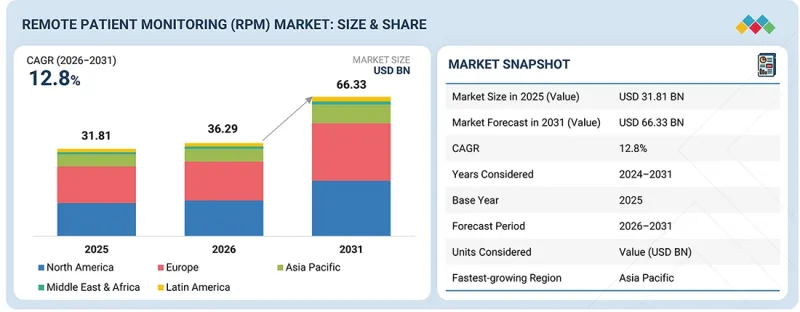
원격 환자 모니터링(RPM) 시장 규모는 2026년 362억 9,000만 달러에서 2031년에는 663억 3,000만 달러에 달할 것으로 예측되고 있으며, 예측 기간 중 CAGR 12.8%라는 높은 신장률을 보일 것으로 전망되고 있습니다.
원격 환자 모니터링(RPM) 시장은 AI, 웨어러블 생체 센서, 클라우드 컴퓨팅, IoT, 예측 분석의 통합을 원동력으로 삼아 급속한 기술적 진보를 이루고 있습니다.
| 조사 범위 | |
|---|---|
| 조사 대상 기간 | 2026-2031년 |
| 기준연도 | 2025년 |
| 예측 기간 | 2026-2031년 |
| 단위 | 금액(달러) |
| 부문 | 컴포넌트, 적응증, 최종사용자 |
| 대상 지역 | 북미, 유럽, 아시아태평양, 라틴아메리카, 중동 및 아프리카 |
기업과 연구 기관들은 지속적인 실시간 건강 상태 추적, 위험 요인의 조기 발견, 맞춤형 질환 관리가 가능한 AI 기반 RPM 플랫폼 개발을 점점 더 적극적으로 추진하고 있습니다. 또한 11월 25일에는 연구진이 HALO-X 플랫폼을 활용한 멀티모달 AI RPM 프레임워크를 개발하여, 웨어러블 센서 데이터, 임상 기록, 환자 보고 결과를 통합함으로써 암 환자의 유해 임상 사건 예측에서 83.9%의 정확도를 달성했습니다(출처: arXiv) . 이러한 노력은 전 세계 원격 환자 모니터링 시장의 성장을 여실히 보여주고 있습니다.
"도입 형태별로는 클라우드가 원격 환자 모니터링 소프트웨어 시장에서 가장 높은 성장률을 보일 것으로 전망된다"
이 모델에는 여러 클라우드 소스의 데이터를 손쉽게 통합할 수 있다는 점, 원격지에 있는 사용자의 무제한 접근, 낮은 유지 관리 비용, 높은 보안 및 개인정보 보호 수준, 편리한 접근성, 하드웨어를 미리 구매할 필요가 없다는 점, 용량 및 자원 활용에 있으며, 뛰어난 유연성 등 여러 가지 장점이 있습니다. 또한 클라우드 기반 모델을 통해 제공되는 다양한 애플리케이션 역시 이 분야의 성장을 지원하고 있습니다. 회계 관리, 성과 관리, 웹 메일, 인스턴트 메시징 등의 주요 기능을 이용할 수 있게 되어 시장 확대에 기여하고 있습니다.
“2025년에는 북미가 원격 환자 모니터링 시장을 주도할 것”
북미 지역은 높은 의료 기술 보급률, 견고하고 확립된 의료 인프라, 의료비의 지속적인 증가 등 여러 요인으로 인해 원격 환자 모니터링 시장을 독점했습니다. 또한 북미에는 디지털 헬스 및 웨어러블 기술 분야를 선도하는 혁신적인 기업이 다수 존재합니다. BioIntelliSense와 같은 기업은 급성기 및 급성기 이후 치료를 위해 웨어러블 생체 센서 플랫폼을 활용한 지속적인 원격 모니터링 솔루션을 확대하고 있습니다. 또한 Oura Health는 스마트 링을 활용한 심혈관 및 웰니스 모니터링 기능을 미국 시장에서 확대하고 있습니다.
이 보고서에서는 전 세계 원격 환자 모니터링(RPM) 시장을 조사하여, 시장 개요, 시장 성장에 영향을 미치는 다양한 요인에 대한 분석, 기술 및 특허 동향, 법규제 환경, 사례 연구, 시장 규모 추이 및 전망, 각종 분류·지역/주요 국가별 상세 분석, 경쟁 현황, 주요 기업 개요 등을 정리하여 전해드립니다.
자주 묻는 질문
목차
제1장 서론
제2장 개요
제3장 주요 인사이트
제4장 시장 개요
제5장 업계 동향
제6장 고객 상황과 구매 행동
제7장 원격 환자 모니터링(RPM) 시장 : 컴포넌트별
제8장 원격 환자 모니터링(RPM) 시장 : 적응증별
제9장 원격 환자 모니터링(RPM) 시장 : 최종사용자별
제10장 원격 환자 모니터링(RPM) 시장 : 지역별
제11장 경쟁 구도
제12장 기업 개요
제13장 조사 방법
제14장 부록
KSA 26.06.25The remote patient monitoring market is projected to reach USD 66.33 billion by 2031 from USD 36.29 billion in 2026, at a high CAGR of 12.8% during the forecast period. The remote patient monitoring (RPM) market is experiencing rapid technological advancements driven by the integration of artificial intelligence (AI), wearable biosensors, cloud computing, the Internet of Things (IoT), and predictive analytics.
| Scope of the Report | |
|---|---|
| Years Considered for the Study | 2026-2031 |
| Base Year | 2025 |
| Forecast Period | 2026-2031 |
| Units Considered | Value (USD billion) |
| Segments | Component, Indication, and End-user |
| Regions covered | North America, Europe, Asia Pacific, Latin America, and the Middle East & Africa. |
Companies and research institutions are increasingly developing AI-enabled RPM platforms capable of continuous real-time health tracking, early risk detection, and personalized disease management. Additionally, on November 25, researchers developed a multimodal AI RPM framework using the HALO-X platform that achieved 83.9% accuracy in predicting adverse clinical events among cancer patients by integrating wearable sensor data, clinical records, and patient-reported outcomes (Source: arXiv). Such initiatives highlight the growth of the global remote patient monitoring market.
"Cloud-based deployment is the fastest-growing segment in the remote patient monitoring software by deployment."
Cloud-based deployment is expected to be the fastest-growing segment in the remote patient monitoring market, mainly because this model has several advantages, such as easy integration of data from multiple cloud sources, unlimited access by users from remote locations, low maintenance costs, high security and privacy, easy access, no need to buy hardware up front, and excellent flexibility in the use of capacity and resources. A plethora of applications made accessible through the cloud-based model, with core functionalities including accounting, performance management, and webmail and instant messaging, are proving helpful in fueling this particular portion.
"North America dominated the remote patient monitoring market in 25."
The remote patient monitoring market is segmented into five major regions: North America, Europe, Asia Pacific, Latin America, and the Middle East and Africa. The North American region dominated the remote patient monitoring market due to several factors, including high adoption rates of healthcare technologies, a robust, well-established healthcare infrastructure, and sustained growth in healthcare spending that supports this progress. Additionally, North America is home to several leading digital health and wearable technology innovators. Companies such as BioIntelliSense are expanding continuous remote monitoring solutions using wearable biosensor platforms for acute and post-acute care. Similarly, Oura Health is expanding smart ring-based cardiovascular and wellness monitoring capabilities across the US market.
The breakdown of primary participants is as mentioned below:
- By Company Type - Tier 1: 40%, Tier 2: 35%, and Tier 3: 25%
- By Designation - C-level: 35%, Director-level: 40%, and Others: 25%
- By Region - North America: 45%, Europe: 30%, Asia Pacific: 20%, Latin America: 3%, and Middle East & Africa: 2%.
Koninklijke Philips N.V. (Netherlands), Medtronic (Ireland), OMRON Healthcare, Inc. (Japan), GE Healthcare (US), Oracle (US), Boston Scientific Corporation (US), Abbott (US), NIHON KOHDEN CORPORATION (Japan), Siemens Healthineers AG (Germany), Baxter (US), Biobeat (Israel), Biotronik (Germany), VitalConnect (US), and others are the key players in the remote patient monitoring market.
- The study includes an in-depth competitive analysis of these key players in the remote patient monitoring market, with their company profiles, recent developments, and key market strategies.
Research Coverage
The report analyzes the remote patient monitoring market. It aims to estimate the market size and future growth potential of various market segments based on indication, component, end user, and region. The report also provides a competitive analysis of the key players in this market, along with their company profiles, offerings, recent developments, and key market strategies.
Reasons to buy this report
The report will help the market leaders/new entrants in this market with information on the closest approximations of the revenue numbers for the remote patient monitoring market and the subsegments. This report will help stakeholders understand the competitive landscape and gain more insights to position their businesses better and to plan suitable go-to-market strategies. The report also helps stakeholders understand the pulse of the market and provides them with information on key market drivers, restraints, challenges, and opportunities.
The report provides insights into the following pointers:
- Analysis of key drivers (transformation of patient care through digital innovation, Expansion of telehealth in remote patient monitoring), restraints (high investments and lack of IT expertise, behavioral barriers and healthcare affordability challenges in remote patient monitoring) opportunities (emergence of AI & ML, growing shift toward outpatient care environments, gradual shift toward outpatient care environments), and challenges (concerns associated with data security, data accessibility issues) influencing the growth of the remote patient monitoring market
- Product Development/Innovation: Detailed insights on upcoming technologies, research & development activities, and product launches in the remote patient monitoring market
- Market Development: Comprehensive information about lucrative markets-the report analyzes the remote patient monitoring market across varied regions.
- Market Diversification: Exhaustive information about new products & services, untapped geographies, recent developments, and investments in the remote patient monitoring market
- Competitive Assessment: In-depth assessment of market shares, growth strategies and service offerings of leading players such as Koninklijke Philips N.V. (Netherlands), Medtronic (Ireland), OMRON Corporation (Japan), GE Healthcare (US), Boston Scientific Corporation (US), Abbott (US), NIHON KOHDEN CORPORATION (Japan), and Siemens Healthineers (AG); among others in the remote patient monitoring market
TABLE OF CONTENTS
1 INTRODUCTION
- 1.1 STUDY OBJECTIVES
- 1.2 MARKET DEFINITION
- 1.3 MARKET SCOPE
- 1.3.1 MARKET SEGMENTATION
- 1.3.2 INCLUSIONS & EXCLUSIONS
- 1.3.3 YEARS CONSIDERED
- 1.3.4 CURRENCY CONSIDERED
- 1.4 LIMITATIONS
- 1.5 STAKEHOLDERS
- 1.6 SUMMARY OF CHANGES
2 EXECUTIVE SUMMARY
- 2.1 KEY INSIGHTS AND MARKET HIGHLIGHTS
- 2.2 KEY MARKET PARTICIPANTS: SHARE INSIGHTS AND STRATEGIC DEVELOPMENTS
- 2.3 DISRUPTIVE TRENDS SHAPING THE MARKET
- 2.4 HIGH-GROWTH SEGMENTS & EMERGING FRONTIERS
- 2.5 SNAPSHOT: GLOBAL MARKET SIZE, GROWTH RATE, AND FORECAST
3 PREMIUM INSIGHTS
- 3.1 REMOTE PATIENT MONITORING MARKET OVERVIEW
- 3.2 REMOTE PATIENT MONITORING MARKET, BY COMPONENT & REGION
- 3.3 REMOTE PATIENT MONITORING MARKET: REGIONAL SNAPSHOT
4 MARKET OVERVIEW
- 4.1 INTRODUCTION
- 4.1.1 DRIVERS
- 4.1.1.1 Transformation of patient care through digital innovation
- 4.1.1.2 Expansion of telehealth in remote patient monitoring
- 4.1.1.3 Rising prevalence of chronic diseases
- 4.1.1.4 Increasing geriatric population and rising uptake of RPM services
- 4.1.1.5 Growing need for cost-containment across healthcare facilities
- 4.1.1.6 Technological innovation in wearables, mHealth apps, and connected devices
- 4.1.2 RESTRAINTS
- 4.1.2.1 High investments and lack of IT expertise
- 4.1.2.2 Behavioral barriers and healthcare affordability challenges in remote patient monitoring
- 4.1.2.3 Challenges associated with CMS regulations
- 4.1.3 OPPORTUNITIES
- 4.1.3.1 Emergence of AI & ML
- 4.1.3.2 Gradual shift toward outpatient care environments
- 4.1.3.3 Increasing utilization for infectious disease diagnostics
- 4.1.3.4 Rising initiatives for hospital-at-home programs
- 4.1.4 CHALLENGES
- 4.1.4.1 Concerns associated with data security
- 4.1.4.2 Data accessibility issues
- 4.1.4.3 Incorporation of SDOH factors into RPM programs
- 4.1.1 DRIVERS
- 4.2 UNMET NEEDS AND WHITE SPACES
- 4.3 INTERCONNECTED MARKETS AND CROSS-SECTOR OPPORTUNITIES
- 4.4 STRATEGIC MOVES BY TIER 1/2/3
5 INDUSTRY TRENDS
- 5.1 PORTER'S FIVE FORCES ANALYSIS
- 5.1.1 THREAT OF NEW ENTRANTS
- 5.1.2 THREAT OF SUBSTITUTES
- 5.1.3 BARGAINING POWER OF SUPPLIERS
- 5.1.4 BARGAINING POWER OF BUYERS
- 5.1.5 INTENSITY OF COMPETITIVE RIVALRY
- 5.1.6 GRADUAL SHIFT TO VALUE-BASED & PATIENT-CENTRIC CARE
- 5.2 MACROECONOMIC INDICATORS
- 5.2.1 INTRODUCTION
- 5.2.2 GDP TRENDS AND FORECAST
- 5.2.3 TRENDS IN GLOBAL HEALTHCARE
- 5.3 ECOSYSTEM ANALYSIS
- 5.4 VALUE CHAIN ANALYSIS
- 5.5 PRICING ANALYSIS
- 5.5.1 INDICATIVE PRICING FOR REMOTE PATIENT MONITORING DEVICES, BY KEY PLAYER (2025)
- 5.5.2 INDICATIVE PRICE FOR REMOTE PATIENT MONITORING BY REGION (2025)
- 5.6 TARIFF & REGULATORY ANALYSIS
- 5.6.1 TARIFF DATA (HS CODE 9018)
- 5.6.2 TARIFF DATA (HS CODE 9021)
- 5.6.3 TARIFF DATA (HS CODE 9022)
- 5.7 TRADE ANALYSIS
- 5.7.1 TRADE ANALYSIS FOR REMOTE PATIENT MONITORING DEVICES (HSN CODE: 90189099)
- 5.7.2 TRADE ANALYSIS FOR REMOTE PATIENT MONITORING DEVICES (HSN CODE: 9021)
- 5.7.3 TRADE ANALYSIS FOR REMOTE PATIENT MONITORING DEVICES (HSN CODE: 9022)
- 5.8 KEY CONFERENCES AND EVENTS, 2026-2027
- 5.8.1 REMOTE PATIENT MONITORING MARKET: DETAILED LIST OF CONFERENCES & EVENTS, 2026-2027
- 5.9 TRENDS/DISRUPTIONS IMPACTING CUSTOMER BUSINESS
- 5.10 CASE STUDY ANALYSIS
- 5.10.1 REMOTE PATIENT MONITORING PORTAL AUTOMATION
- 5.10.1.1 Case 1: Cost savings and performance boost through automation
- 5.10.2 PATIENT MONITORING PORTAL AUTOMATION
- 5.10.2.1 Case 2: RPM drives engagement and generates substantial returns
- 5.10.1 REMOTE PATIENT MONITORING PORTAL AUTOMATION
- 5.11 IMPACT OF 2025 US TARIFF - REMOTE PATIENT MONITORING MARKET
- 5.11.1 INTRODUCTION
- 5.11.2 KEY TARIFF RATES
- 5.11.3 PRICE IMPACT ANALYSIS
- 5.11.4 IMPACT ON COUNTRY/REGION
- 5.11.4.1 US
- 5.11.4.2 Europe
- 5.11.4.3 Asia-Pacific
- 5.11.5 IMPACT ON END USERS
- 5.11.5.1 Healthcare Providers
- 5.11.5.2 Healthcare Payers
- 5.11.5.3 Patients
- 5.11.5.4 Pharmaceutical & Biotechnological Companies
- 5.11.5.5 Medtech Companies
- 5.11.5.6 Other End Users
- 5.12 TECHNOLOGY ANALYSIS
- 5.12.1 KEY EMERGING TECHNOLOGIES
- 5.12.1.1 Miniature wearable devices
- 5.12.1.2 Artificial intelligence & machine learning
- 5.12.1.3 Cloud computing
- 5.12.1.4 Patient engagement tools
- 5.12.1.5 EHR integration
- 5.12.1.6 Voice assistant integration
- 5.12.2 COMPLEMENTARY TECHNOLOGIES
- 5.12.2.1 5G connectivity
- 5.12.2.2 mHealth apps
- 5.12.2.3 Digital therapeutics
- 5.12.2.4 Telehealth platforms
- 5.12.3 ADJACENT TECHNOLOGIES
- 5.12.3.1 POC diagnostics
- 5.12.3.2 Smart home health devices
- 5.12.1 KEY EMERGING TECHNOLOGIES
- 5.13 TECHNOLOGY/PRODUCT ROADMAP
- 5.14 PATENT ANALYSIS
- 5.14.1 PATENT PUBLICATION TRENDS FOR REMOTE PATIENT MONITORING
- 5.14.2 JURISDICTION AND TOP APPLICANT COUNTRIES FOR REMOTE PATIENT MONITORING
- 5.14.3 LEADING PATENTS IN REMOTE PATIENT MONITORING MARKET
- 5.15 FUTURE APPLICATIONS
- 5.16 IMPACT OF GENERATIVE AI/AI ON REMOTE PATIENT MONITORING MARKET
- 5.16.1 KEY USE CASES
- 5.16.2 CASE STUDIES FOR GENERATIVE AI/AI IMPLEMENTATION
- 5.16.2.1 Case study 1: Enhancing remote patient monitoring for cancer treatment with NLP and HIPAA-compliant annotation
- 5.16.2.2 Case study 2: Leveraging AI for proactive infection prevention in hospitals
- 5.16.2.3 Telehealth & telemedicine
- 5.16.2.4 Wearable devices
- 5.16.2.5 Digital healthcare
- 5.16.2.6 Home healthcare
- 5.16.3 USER READINESS & IMPACT ASSESSMENT
- 5.16.3.1 User readiness
- 5.16.3.1.1 User A: Hospitals
- 5.16.3.1.2 User B: Ambulatory surgery centers
- 5.16.3.2 Impact assessment
- 5.16.3.2.1 User A: Hospitals
- 5.16.3.2.2 User B: Ambulatory surgery centers
- 5.16.3.1 User readiness
- 5.16.4 REGULATORY BODIES, GOVERNMENT AGENCIES, & OTHER ORGANIZATIONS
- 5.16.5 REGULATORY ANALYSIS
6 CUSTOMER LANDSCAPE & BUYER BEHAVIOR
- 6.1 INTRODUCTION
- 6.2 DECISION-MAKING PROCESS
- 6.3 KEY STAKEHOLDERS AND BUYING CRITERIA
- 6.3.1 KEY STAKEHOLDERS IN BUYING PROCESS
- 6.3.2 BUYING CRITERIA
- 6.4 END USER ANALYSIS
- 6.4.1 UNMET NEEDS
- 6.4.2 END USER EXPECTATIONS
- 6.5 ADOPTION BARRIERS & INTERNAL CHALLENGES
- 6.6 MARKET PROFITABILITY
7 REMOTE PATIENT MONITORING MARKET, BY COMPONENT
- 7.1 INTRODUCTION
- 7.2 DEVICES
- 7.2.1 BY FUNCTION
- 7.2.1.1 Cardiac monitoring devices
- 7.2.1.1.1 Increasing uptake of ECG monitors and rising cases of hypertension to fuel market
- 7.2.1.2 Neurological monitoring devices
- 7.2.1.2.1 Growing demand for clinical-grade wearable devices for routine monitoring to drive market
- 7.2.1.3 Respiratory monitoring devices
- 7.2.1.3.1 Rising demand for peak flow meters and sleep apnea monitors to fuel market
- 7.2.1.4 Blood glucose monitoring devices
- 7.2.1.4.1 Increasing prevalence of diabetes to support market growth
- 7.2.1.5 Fetal & neonatal monitoring devices
- 7.2.1.5.1 Growing focus on vital health monitoring in preterm births to drive market
- 7.2.1.6 Weight monitoring devices
- 7.2.1.6.1 High incidence of obesity and growing advancements in smart weighing scales to fuel market
- 7.2.1.7 Multiparameter monitoring devices
- 7.2.1.7.1 Measurement of spO2, blood sugar, and respiratory activity to fuel uptake
- 7.2.1.8 Pulse oximeter devices
- 7.2.1.8.1 Rising demand in preoperative & home care settings to support market growth
- 7.2.1.9 Thermometers
- 7.2.1.9.1 Growing focus on home healthcare to fuel market
- 7.2.1.10 Other monitoring devices
- 7.2.1.1 Cardiac monitoring devices
- 7.2.2 BY TYPE
- 7.2.2.1 Wearable devices
- 7.2.2.1.1 Ability to provide real-time insights to drive market
- 7.2.2.2 Implantable devices
- 7.2.2.2.1 Advancements in wireless communication technologies to boost demand
- 7.2.2.3 Handheld & portable devices
- 7.2.2.3.1 Growing focus on device miniaturization to fuel market
- 7.2.2.4 Other devices
- 7.2.2.1 Wearable devices
- 7.2.1 BY FUNCTION
- 7.3 SOFTWARE
- 7.3.1 SOFTWARE, BY DEPLOYMENT MODEL
- 7.3.1.1 On-premises
- 7.3.1.1.1 Enhanced control, data security, and customization benefits to fuel market
- 7.3.1.2 Cloud-based models
- 7.3.1.2.1 Real-time data sharing and high-security features to boost demand
- 7.3.1.1 On-premises
- 7.3.2 SOFTWARE, BY TRANSMISSION TYPE
- 7.3.2.1 Synchronous transmission
- 7.3.2.1.1 Growing availability of real-time data analytics to boost demand
- 7.3.2.2 Asynchronous transmission
- 7.3.2.2.1 Increasing need for low-resource flexible solutions to support market growth
- 7.3.2.1 Synchronous transmission
- 7.3.1 SOFTWARE, BY DEPLOYMENT MODEL
- 7.4 SERVICES
- 7.4.1 EXPANSION OF TELEMEDICINE PLATFORMS AND INTEGRATION OF SERVICE MODELS TO SUPPORT MARKET GROWTH
8 REMOTE PATIENT MONITORING MARKET, BY INDICATION
- 8.1 INTRODUCTION
- 8.2 ONCOLOGY
- 8.2.1 GROWING FOCUS ON EARLY DISEASE DETECTION TO DRIVE MARKET
- 8.3 CARDIOLOGY
- 8.3.1 HIGH INCIDENCE OF CVD TO PROPEL MARKET
- 8.4 NEUROLOGY
- 8.4.1 INCREASING PREVALENCE OF NEUROLOGICAL CONDITIONS TO FUEL MARKET
- 8.5 DIABETES
- 8.5.1 GROWING FOCUS ON TELEHEALTH CONSULTATIONS FOR DIABETES MANAGEMENT TO BOOST DEMAND
- 8.6 SLEEP DISORDERS
- 8.6.1 INCREASING INCIDENCE OF SLEEP APNEA TO SUPPORT MARKET GROWTH
- 8.7 RESPIRATORY DISEASES
- 8.7.1 RISING CASES OF COPD AND ASTHMA TO FUEL MARKET
- 8.8 WELLNESS IMPROVEMENT
- 8.8.1 UTILIZATION OF WEIGHT MANAGEMENT & PERSONAL HEALTH APPS TO SUPPORT MARKET GROWTH
- 8.9 MENTAL HEALTH
- 8.9.1 GROWING FOCUS ON DEVELOPMENT OF PREDICTIVE HEALTH MODELS FOR COGNITIVE THERAPY TO PROPEL MARKET
- 8.10 OTHER INDICATIONS
9 REMOTE PATIENT MONITORING MARKET, BY END USER
- 9.1 INTRODUCTION
- 9.2 HEALTHCARE PROVIDERS
- 9.2.1 HOSPITALS
- 9.2.1.1 Ability to purchase technologically advanced telehealth devices to fuel market
- 9.2.2 ASCS, ACCS, AND OTHER OUTPATIENT SETTINGS
- 9.2.2.1 Increasing demand for cost-effective perioperative devices to fuel market
- 9.2.3 LONG-TERM CARE & ASSISTED LIVING FACILITIES
- 9.2.3.1 Expanding geriatric population and growing focus on chronic disease management to fuel market
- 9.2.4 HOME HEALTHCARE
- 9.2.4.1 Growing preference for remote care to drive market
- 9.2.5 OTHER HEALTHCARE PROVIDERS
- 9.2.1 HOSPITALS
- 9.3 HEALTHCARE PAYERS
- 9.3.1 LOW COSTS AND IMPROVED HEALTHCARE FACILITIES TO DRIVE MARKET
- 9.4 PATIENTS
- 9.4.1 INCREASING FOCUS ON AI INTEGRATION INTO WEARABLE DEVICES TO BOOST DEMAND
- 9.5 PHARMACEUTICAL & BIOTECHNOLOGY COMPANIES
- 9.5.1 RISING NEED FOR ENHANCED CLINICAL TRIAL OUTCOMES TO SUPPORT MARKET GROWTH
- 9.6 MEDTECH COMPANIES
- 9.6.1 INTEGRATION OF RPM WITH MEDTECH SOLUTIONS FOR DIAGNOSTIC ACCURACY TO FUEL MARKET
- 9.7 OTHER END USERS
10 REMOTE PATIENT MONITORING MARKET, BY REGION
- 10.1 INTRODUCTION
- 10.2 NORTH AMERICA
- 10.2.1 MACROECONOMIC OUTLOOK FOR NORTH AMERICA
- 10.2.2 US
- 10.2.2.1 Supportive regulatory frameworks for AI implementation to boost demand
- 10.2.3 CANADA
- 10.2.3.1 Growing need to curtail healthcare costs to drive market
- 10.3 EUROPE
- 10.3.1 MACROECONOMIC OUTLOOK FOR EUROPE
- 10.3.2 GERMANY
- 10.3.2.1 Favorable reimbursements for technological innovation to propel market
- 10.3.3 UK
- 10.3.3.1 Government support for AI implementation to boost demand
- 10.3.4 FRANCE
- 10.3.4.1 Implementation of ETAPES program to fuel market
- 10.3.5 ITALY
- 10.3.5.1 Growing focus on digital transformation for value-centric patient care to drive market
- 10.3.6 SPAIN
- 10.3.6.1 Rising funding investments for digital health plans to boost market
- 10.3.7 REST OF EUROPE
- 10.4 ASIA PACIFIC
- 10.4.1 MACROECONOMIC OUTLOOK FOR ASIA PACIFIC
- 10.4.2 CHINA
- 10.4.2.1 Shortage of physicians and growing focus on RPM solutions to support market growth
- 10.4.3 JAPAN
- 10.4.3.1 Rising geriatric population and subsequent rise in preventive care to drive market
- 10.4.4 INDIA
- 10.4.4.1 Expanding target patient population to drive market
- 10.4.5 AUSTRALIA
- 10.4.5.1 Growing government support and telehealth expansion to drive market
- 10.4.6 SOUTH KOREA
- 10.4.6.1 Strategic partnerships and AI innovations accelerate RPM adoption
- 10.4.7 REST OF ASIA PACIFIC
- 10.5 LATIN AMERICA
- 10.5.1 MACROECONOMIC OUTLOOK FOR LATIN AMERICA
- 10.5.2 BRAZIL
- 10.5.2.1 Growing focus on telehealth consultations to drive market
- 10.5.3 MEXICO
- 10.5.3.1 Improvements in healthcare infrastructure to boost demand
- 10.5.4 REST OF LATIN AMERICA
- 10.6 MIDDLE EAST & AFRICA
- 10.6.1 MACROECONOMIC OUTLOOK FOR MIDDLE EAST & AFRICA
- 10.6.2 GCC
- 10.6.2.1 Government initiatives for investments in RPM solutions to support market growth
- 10.6.3 SAUDI ARABIA
- 10.6.3.1 Expansion of connected healthcare ecosystem
- 10.6.4 UAE
- 10.6.4.1 Strengthening of connected healthcare ecosystem with AI-enabled RPM solutions to boost market
- 10.6.5 REST OF GCC
- 10.6.5.1 Market propelled by digital health transformation
- 10.6.6 SOUTH AFRICA
- 10.6.6.1 Increasing adoption of telehealth infrastructure to drive market
- 10.6.7 REST OF MIDDLE EAST & AFRICA
11 COMPETITIVE LANDSCAPE
- 11.1 OVERVIEW
- 11.2 KEY PLAYER STRATEGIES/RIGHT TO WIN
- 11.2.1 OVERVIEW OF STRATEGIES ADOPTED BY KEY PLAYERS IN REMOTE PATIENT MONITORING MARKET
- 11.3 REVENUE ANALYSIS, 2021-2025
- 11.4 MARKET SHARE ANALYSIS, 2025
- 11.5 COMPANY EVALUATION MATRIX: KEY PLAYERS, 2025
- 11.5.1 STARS
- 11.5.2 EMERGING LEADERS
- 11.5.3 PERVASIVE PLAYERS
- 11.5.4 PARTICIPANTS
- 11.5.5 COMPANY FOOTPRINT: KEY PLAYERS, 2025
- 11.5.5.1 Company footprint
- 11.5.5.2 Region footprint
- 11.5.5.3 Component footprint
- 11.5.5.4 Indication footprint
- 11.5.5.5 End user footprint
- 11.6 COMPANY EVALUATION MATRIX: STARTUPS/SMES, 2025
- 11.6.1 PROGRESSIVE COMPANIES
- 11.6.2 RESPONSIVE COMPANIES
- 11.6.3 DYNAMIC COMPANIES
- 11.6.4 STARTING BLOCKS
- 11.6.5 COMPETITIVE BENCHMARKING: STARTUPS/SMES, 2025
- 11.6.5.1 Detailed list of key startups/SMEs
- 11.6.5.2 Competitive benchmarking of startups/SMEs
- 11.7 COMPANY VALUATION & FINANCIAL METRICS
- 11.7.1 FINANCIAL METRICS
- 11.7.2 COMPANY VALUATION
- 11.8 BRAND/SOFTWARE COMPARISON
- 11.9 COMPETITIVE SCENARIO
- 11.9.1 PRODUCT/SERVICE LAUNCHES & APPROVALS
- 11.9.2 DEALS
- 11.9.3 EXPANSIONS
- 11.9.4 OTHER DEVELOPMENTS
12 COMPANY PROFILES
- 12.1 KEY PLAYERS
- 12.1.1 KONINKLIJKE PHILIPS N.V.
- 12.1.1.1 Business overview
- 12.1.1.2 Products/Services offered
- 12.1.1.3 Recent developments
- 12.1.1.3.1 Product/Service launches & approvals
- 12.1.1.3.2 Deals
- 12.1.1.4 MnM view
- 12.1.1.4.1 Key strengths
- 12.1.1.4.2 Strategic choices
- 12.1.1.4.3 Weaknesses & competitive threats
- 12.1.2 OMRON HEALTHCARE, INC. (SUBSIDIARY OF OMRON CORPORATION)
- 12.1.2.1 Business overview
- 12.1.2.2 Products/Services offered
- 12.1.2.3 Recent developments
- 12.1.2.3.1 Product/Service launches & approvals
- 12.1.2.3.2 Deals
- 12.1.2.3.3 Other developments
- 12.1.2.4 MnM view
- 12.1.2.4.1 Key strengths
- 12.1.2.4.2 Strategic choices
- 12.1.2.4.3 Weaknesses & competitive threats
- 12.1.3 MEDTRONIC
- 12.1.3.1 Business overview
- 12.1.3.2 Products/Services offered
- 12.1.3.3 Recent developments
- 12.1.3.3.1 Product/Service launches & approvals
- 12.1.3.3.2 Deals
- 12.1.3.3.3 Other developments
- 12.1.3.4 MnM view
- 12.1.3.4.1 Key strengths
- 12.1.3.4.2 Strategic choices
- 12.1.3.4.3 Weaknesses & competitive threats
- 12.1.4 GE HEALTHCARE
- 12.1.4.1 Business overview
- 12.1.4.2 Products/Services offered
- 12.1.4.3 Recent developments
- 12.1.4.3.1 Product/Service launches & approvals
- 12.1.4.3.2 Deals
- 12.1.4.4 MnM view
- 12.1.4.4.1 Key strengths
- 12.1.4.4.2 Strategic choices
- 12.1.4.4.3 Weaknesses & competitive threats
- 12.1.5 ABBOTT
- 12.1.5.1 Business overview
- 12.1.5.2 Products/Services offered
- 12.1.5.3 Recent developments
- 12.1.5.3.1 Product/Service launches & approvals
- 12.1.5.3.2 Expansions
- 12.1.5.3.3 Other developments
- 12.1.5.4 MnM view
- 12.1.5.4.1 Key strengths
- 12.1.5.4.2 Strategic choices
- 12.1.5.4.3 Weaknesses & competitive threats
- 12.1.6 ORACLE
- 12.1.6.1 Business overview
- 12.1.6.2 Products/Services offered
- 12.1.6.3 Recent developments
- 12.1.6.3.1 Product/Service launches & approvals
- 12.1.6.3.2 Deals
- 12.1.7 BOSTON SCIENTIFIC CORPORATION
- 12.1.7.1 Business overview
- 12.1.7.2 Products/Services offered
- 12.1.7.3 Recent developments
- 12.1.7.3.1 Product/Service launches & approvals
- 12.1.7.3.2 Deals
- 12.1.7.3.3 Other developments
- 12.1.8 NIHON KOHDEN CORPORATION
- 12.1.8.1 Business overview
- 12.1.8.2 Products/Services offered
- 12.1.8.3 Recent developments
- 12.1.8.3.1 Product/Service launches & approvals
- 12.1.8.3.2 Deals
- 12.1.9 SIEMENS HEALTHINEERS AG
- 12.1.9.1 Business overview
- 12.1.9.2 Products/Services offered
- 12.1.9.3 Recent developments
- 12.1.9.3.1 Product/Service launches & approvals
- 12.1.9.3.2 Deals
- 12.1.10 BAXTER
- 12.1.10.1 Business overview
- 12.1.10.2 Products/Services offered
- 12.1.10.3 Recent developments
- 12.1.10.3.1 Product/Service launches & approvals
- 12.1.10.3.2 Deals
- 12.1.11 BIOBEAT
- 12.1.11.1 Business overview
- 12.1.11.2 Products/Services offered
- 12.1.11.3 Recent developments
- 12.1.11.3.1 Product/Service launches & approvals
- 12.1.11.3.2 Deals
- 12.1.12 BIOTRONIK
- 12.1.12.1 Business overview
- 12.1.12.2 Products/Services offered
- 12.1.12.3 Recent developments
- 12.1.12.3.1 Product/Service launches & approvals
- 12.1.12.3.2 Deals
- 12.1.13 VITALCONNECT
- 12.1.13.1 Business overview
- 12.1.13.2 Products/Services offered
- 12.1.13.3 Recent developments
- 12.1.13.3.1 Deals
- 12.1.13.3.2 Other developments
- 12.1.14 VIVALNK, INC.
- 12.1.14.1 Business overview
- 12.1.14.2 Products/Services offered
- 12.1.14.3 Recent developments
- 12.1.14.3.1 Product/Service launches & approvals
- 12.1.14.3.2 Deals
- 12.1.15 CLEARARCH, INC.
- 12.1.15.1 Business overview
- 12.1.15.2 Products/Services offered
- 12.1.15.3 Recent developments
- 12.1.15.3.1 Product/Service launches & approvals
- 12.1.15.3.2 Deals
- 12.1.16 OPTUM, INC. (VIVIFY HEALTH - PART OF OPTUM)
- 12.1.16.1 Business overview
- 12.1.16.2 Products/Services offered
- 12.1.17 BLUE SPARK TECHNOLOGIES, INC.
- 12.1.17.1 Business overview
- 12.1.17.2 Products/Services offered
- 12.1.17.3 Recent developments
- 12.1.17.3.1 Product/Service launches & approvals
- 12.1.18 LIGHTBEAM
- 12.1.18.1 Business overview
- 12.1.18.2 Products/Services offered
- 12.1.18.3 Recent developments
- 12.1.18.3.1 Deals
- 12.1.19 CLOUD DIAGNOSTICS CANADA ULC
- 12.1.19.1 Business overview
- 12.1.19.2 Products/Services offered
- 12.1.19.3 Recent developments
- 12.1.19.3.1 Product/Service launches & approvals
- 12.1.19.3.2 Deals
- 12.1.20 TELADOC HEALTH, INC.
- 12.1.20.1 Business overview
- 12.1.20.2 Products/Services offered
- 12.1.20.3 Recent developments
- 12.1.20.3.1 Product/Service launches & approvals
- 12.1.20.3.2 Deals
- 12.1.21 GUANGDONG TRANSTEK MEDICAL ELECTRONICS CO., LTD.
- 12.1.21.1 Business overview
- 12.1.21.2 Products/Services offered
- 12.1.21.3 Recent developments
- 12.1.21.3.1 Other developments
- 12.1.1 KONINKLIJKE PHILIPS N.V.
- 12.2 OTHER PLAYERS
- 12.2.1 CARESIMPLE INC.
- 12.2.2 TIMEDOC, INC.
- 12.2.3 COACHCARE
- 12.2.4 DOZEE (TURTLE SHELL TECHNOLOGIES PVT LTD)
- 12.2.5 HEALTH RECOVERY SOLUTIONS
13 RESEARCH METHODOLOGY
- 13.1 RESEARCH DATA
- 13.1.1 SECONDARY DATA
- 13.1.1.1 Key data from secondary sources
- 13.1.2 PRIMARY DATA
- 13.1.2.1 Key data from primary sources
- 13.1.2.2 Breakdown of primary sources
- 13.1.1 SECONDARY DATA
- 13.2 MARKET SIZE ESTIMATION
- 13.2.1 SUPPLY-SIDE ANALYSIS
- 13.2.2 BOTTOM-UP APPROACH: END USER ADOPTION
- 13.2.3 TOP-DOWN OF PARENT MARKET ASSESSMENT
- 13.2.4 COMPANY PRESENTATIONS AND PRIMARY INTERVIEWS
- 13.3 MARKET BREAKDOWN AND DATA TRIANGULATION
- 13.4 RESEARCH ASSUMPTIONS
- 13.4.1 MARKET SIZING ASSUMPTIONS
- 13.4.2 OVERALL STUDY ASSUMPTIONS
- 13.5 RISK ASSESSMENT
- 13.6 RESEARCH LIMITATIONS
- 13.6.1 METHODOLOGY-RELATED LIMITATIONS
- 13.6.2 SCOPE-RELATED LIMITATIONS
14 APPENDIX
- 14.1 DISCUSSION GUIDE
- 14.2 KNOWLEDGESTORE: MARKETSANDMARKETS' SUBSCRIPTION PORTAL
- 14.3 CUSTOMIZATION OPTIONS
- 14.4 RELATED REPORTS
- 14.5 AUTHOR DETAILS


