|
시장보고서
상품코드
2059968
컨베이어 시스템 시장 예측(-2033년) : 유형별, 컴포넌트별, 조작별, 용도별, 기술별, 서브 업계별, 지역별Conveyor System Market by Industry (Retail & Distribution, Food & Beverage, Automotive, Electronic, Mining, & Airport), Type (Belt, Roller, Overhead, Floor, Pallet, Crescent, Cable, Bucket), Component, Operation, & Region - Global Forecast to 2033 |
||||||

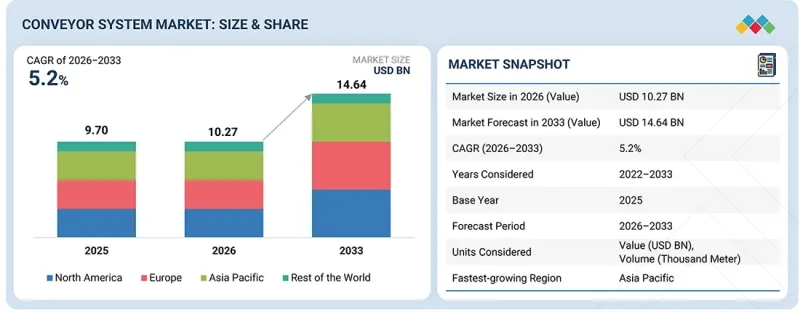
컨베이어 시스템 시장 규모는 2026년 102억 7,000만 달러에서 2033년까지 146억 4,000만 달러로, CAGR 5.2%로 확대할 것으로 예측됩니다.
컨베이어 시스템 시장의 수요는 자재 흐름을 일괄 처리 방식이 아닌, 생산 및 유통 공정에 긴밀하게 통합된 연속적이고 자동화된 운영 방식으로의 전환에 의해 형성되고 있습니다. 자동차 제조 분야에서 컨베이어는 유연한 조립 라인 구성과 다차종 생산을 지원하며, 수작업 개입을 줄이면서 생산량 증대를 가능하게 합니다.
| 조사 범위 | |
|---|---|
| 조사 대상 기간 | 2026-2033년 |
| 기준연도 | 2025년 |
| 예측 기간 | 2026-2033년 |
| 대상 단위 | 10억 달러 |
| 부문 | 유형별, 컴포넌트별, 조작별, 용도별, 기술별, 서브 업계별, 지역별 |
| 대상 지역 | 아시아태평양, 유럽, 북미 및 기타 지역 |
창고 및 E-Commerce 물류 분야에서 컨베이어 기반 분류 시스템과 크로스도킹 시스템은 증가하는 소포 처리량, 점점 더 까다로워지는 배송 일정, 그리고 지속적인 인력 부족에 대응하기 위해 필수적인 요소로 자리 잡고 있습니다. 식품, 음료, 제약 업계에서는 생산 규모를 확대하는 동시에 안전성, 추적성 및 규제 요건을 충족하기 위해 위생적이고 세척이 용이한 컨베이어에 의존하고 있습니다. 제조업, 광업 및 공항에서는 가동 중단 시간 단축, 에너지 사용 최적화, 운영 신뢰성 향상을 위해 센서를 통합하고 소프트웨어 기반 컨베이어 시스템을 도입하는 추세가 점점 더 확산되고 있습니다. 모든 산업 분야에서 기업은 수요 패턴의 변화에 따라 확장 및 재구성이 가능한 모듈식 컨베이어 레이아웃으로의 전환을 추진하고 있으며, 이를 지원하는 것은 흐름 효율과 시스템 응답성을 향상시키는 자동화, 상태 모니터링 및 지능형 제어 시스템의 활용 확대입니다.
팔레트 컨베이어 분야는 예측 기간 중 높은 성장 기회가 있을 것으로 전망됩니다.
대규모 E-Commerce 및 옴니채널 물류 네트워크에서 팔레트화 처리량이 증가함에 따라 소매 및 물류 컨베이어 시스템 시장에서 팔레트 컨베이어가 가장 빠른 성장세를 보일 것으로 예상됩니다. SKU의 복잡성이 높은 현대의 물류 센터에서는 하루에 수천 개의 팔레트 이동을 처리하고 있으며, 대규모 시설의 경우 20만-50만 제곱피트를 초과하는 경우도 드물지 않습니다. 이러한 시설에서는 팔레트 기반의 물류 흐름이 입고 보충 및 출하 주기의 핵심을 이루고 있습니다. 이 정도 규모의 물류 처리에서는 수작업이 비효율적이기 때문에 입고, 보관, 출하 각 구역에 걸쳐 지속적이고 통제된 물류 흐름을 확보하기 위해 자동화된 팔레트 이송 시스템의 도입이 확대되고 있습니다. 이러한 성장은 팔레트 컨베이어와 자동 창고 시스템(AS/RS), 그리고 창고 관리 플랫폼 간의 통합이 진전되고 있는 점도 지원하고 있으며, 선진국 시장의 대규모 물류 센터에서 자동화 도입률은 약 50%에 달하고 있습니다. 이러한 통합은 팔레트 이동을 고밀도 보관 시스템 및 신속한 주문 처리 업무와 동기화하는 데 필수적이며, 특히 재고 회전율이 기존 소매 물류 모델보다 훨씬 높은 E-Commerce 중심의 시설에서 중요합니다. 창고 자동화에 대한 투자의 기세가 도입을 지속적으로 견인하고 있으며, 대형 물류 업체들은 단축된 배송 일정을 준수하면서도 증가하는 소포 및 팔레트 처리량을 관리하기 위해 처리 능력이 높은 물류 인프라를 확대하고 있습니다. 예를 들어 2026년 2월, 데마틱은 대량 처리가 필요한 E-Commerce 및 멀티채널 물류 네트워크를 대상으로 한 첨단 AS/RS 솔루션을 발표했습니다. 이는 대규모 소매 및 물류 시설에서 완전 자동화된 팔레트 취급 시스템이 지속적으로 확대되고 있음을 반영한 것입니다.
식품 관련 산업 중에서도 육류·가금류 산업이 가장 빠른 성장을 이룰 것으로 전망됩니다.
예측 기간 중 식품 및 음료용 컨베이어 시스템 시장에서 육류·가금류 부문이 가장 높은 성장률을 보일 것으로 예상됩니다. 이는 가공 및 포장 라인 전반에 걸쳐 위생적이고 자동화된 고속 취급에 대한 수요가 증가함에 따라 지원되고 있습니다. 생산자들은 위생 관리 수준을 높이고 수작업으로 인한 접촉을 줄이기 위해, 생육류, 가금류 절단육, 트레이, 카톤 및 포장된 제품을 처리할 수 있는 컨베이어 시스템으로 전환하고 있습니다. 또한 가공업체가 엄격한 식품 안전 기준을 충족하고 오염 위험을 줄이며, 세척, 절단, 검사, 냉동, 포장 등 각 공정에서 일관된 제품 흐름을 유지해야 하므로 이 부문의 중요성은 더욱 커지고 있습니다. 예를 들어 2026년 3월, Key Technology사는 육류 및 가금류 가공 시설에서 제품의 자동 이송, 검사 공정 및 포장 라인의 효율을 향상시키도록 설계된 가금류 가공용 ‘SmartConveyor System’을 발표했습니다.
육류 및 가금류용 컨베이어 시스템은 제품의 안전성, 생산 라인의 효율성, 그리고 체계적인 취급이 여전히 핵심 요건인 위생적인 식품 가공 설비의 중요한 요소로 자리 잡고 있습니다.
공항 업계에서는 벨트식 컨베이어 시스템이 가장 큰 시장 점유율을 차지할 것으로 전망됩니다.
벨트 컨베이어 시스템은 처리량이 많은 공항 업무에서 끊임없이 이동하는 수하물을 처리하는 역할을 담당하고 있으므로 공항용 컨베이어 시스템 시장에서 가장 큰 점유율을 차지할 것으로 예상됩니다. 전 세계 여객 수는 팬데믹 이전 수준으로 회복되어 연간 40억 명을 넘어섰으며, 제한된 처리 시간 내에 더 많은 수하물을 처리해야 한다는 점에서 공항 수하물 시스템에 가해지는 부담이 커지고 있습니다. 대규모 허브 공항에서는 현재 시간당 1만 개가 넘는 피크 시간대 수하물을 처리하고 있으며, 체크인, 보안 검색, 환승, 도착 구역을 거쳐 안정적이고 중단 없는 이동이 이루어지려면 벨트식 연속 수송이 필수적입니다. 공항의 수하물 처리 시스템이 완전히 통합된 자동화 네트워크로 설계되는 사례가 늘고 있습니다. 이 네트워크에서 벨트 컨베이어는 보안 검사 장치, RFID 추적 시스템 및 자동 분류 시스템을 연결하는 주요 운송 계층의 역할을 합니다. 이는 환승 수하물이 전체 수하물 물동량의 약 40%를 차지하기도 하는 환승이 잦은 허브 공항에서 특히 중요하며, 지연을 방지하기 위해서는 엄격하게 동기화된 이동이 필요합니다. 아시아태평양, 유럽, 중동 전역에서 진행 중인 공항 확장으로 인해 이러한 추세는 더욱 강화되고 있습니다. 새로운 터미널이나 기존 시설의 개보수에서는 반자동 시스템이 아닌, 완전 자동화된 수하물 처리 시스템으로의 전환이 진행되고 있습니다. 히스로 공항 확장 및 중앙 공항 교통 허브(Centralny Port Komunikacyjny)와 같은 프로젝트들은 장기적인 여객 수 증가와 운영 효율성을 지원하기 위해 대용량 컨베이어 기반 시스템을 핵심으로 설계되었습니다.
예측 기간 중 유럽은 컨베이어 시스템 시장에서 큰 점유율을 차지할 것으로 전망됩니다.
유럽은 자동차, 식품 및 음료, 공항, 소매, 첨단 제조와 같은 분야의 확고한 산업 기반을 바탕으로 컨베이어 시스템 시장에서 가장 큰 점유율을 차지할 것으로 예상됩니다. 이 지역은 세계 최고 수준의 자동화 보급률을 자랑하며, 서유럽의 신규 창고 및 물류 센터 대부분은 컨베이어 기반의 분류 및 시설내 운송을 포함한 자동 자재 취급 시스템을 이미 운영하고 있습니다. 독일, 프랑스, 영국, 이탈리아, 네덜란드는 특히 자동차 생산 클러스터나 국경을 초월한 물류 허브 주변에서, 긴밀한 제조 네트워크와 고도로 발달한 물류 인프라를 바탕으로 계속해서 수요를 주도하고 있습니다. 주요 구조적 요인으로는 비용 및 규정 준수 환경이 꼽힙니다. 인건비 상승과 엄격한 산업안전 기준에 따라 기업은 수작업에 의한 하역 작업을 줄이고, 자동화된 자재 취급 솔루션을 도입해야 하는 상황에 직면해 있습니다. 이를 통해 컨베이어는 생산성 향상, 운영 위험 감소, 그리고 공장, 창고, 공항 전반에 걸친 일관된 처리 능력 유지를 도모하기 위한 최적의 선택지가 되고 있습니다. 또한 이 지역에서는 신규 설비 건설보다는 기존 인프라 업그레이드에 대한 투자가 지속되고 있으며, 특히 물류 및 공항 운영 분야에서는 자동화 업그레이드를 통해 속도, 신뢰성 및 공간 효율성 향상에 중점을 두고 있습니다. 예를 들어 2026년 5월, Interroll Holding AG는 수직 이송 및 물류 시스템 포트폴리오를 강화하기 위해 Royal Apollo Group을 인수했습니다. 이는 유럽의 자동화 생태계 내에서 이루어지고 있는 지속적인 통합과 역량 확대를 반영한 것입니다. 전반적으로 볼 때, 유럽의 리더십은 높은 자동화 보급률, 강력한 규제 환경, 그리고 기존 산업 및 물류 인프라의 꾸준한 현대화에 의해 지원되고 있습니다.
컨베이어 시스템 시장에는 Daifuku(일본), Continental AG(독일), Dematic(미국), Vanderlande Industries B.V.(네덜란드), Interroll Holding AG(스위스) 등의 주요 제조업체가 포함됩니다.
조사 범위:
본 조사는 컨베이어 시스템 시장의 다양한 부문을 대상으로 하고 있습니다. 그 목적은 각 부문 시장 규모와 향후 성장 가능성을 추정하는 데 있습니다. 또한 주요 시장 참여자에 대한 상세한 경쟁 분석도 포함되어 있으며, 기업 개요, 제품 및 사업 제공과 관련된 주요 관찰 사항, 최근 동향, 인수 사례 등이 포괄적으로 다루어져 있습니다.
본 조사 보고서에서는 컨베이어 시스템 시장을 산업 분야(소매·유통, 식품 및 음료, 자동차, 전자기기, 광업, 공항), 유형(벨트, 롤러, 오버헤드, 플로어, 팔레트, 크레센트, 케이블, 버킷, 기타), 구성 부품, 운영 방식(자동, 반자동, 수동) 및 지역(북미, 유럽, 아시아태평양, 기타 지역)별로 분류하고 있습니다.
이 보고서의 범위에는 컨베이어 시스템 시장의 성장에 영향을 미치는 주요 요인(촉진요인, 제약 요인, 과제 및 기회)에 대한 상세한 정보가 포함되어 있습니다. 주요 업계 주요 기업에 대한 상세한 분석을 통해 각 기업의 사업 개요, 솔루션, 서비스, 주요 전략, 계약, 파트너십, 합의 사항, 제품 및 서비스 출시, 합병 및 인수, 그리고 컨베이어 시스템 시장과 관련된 최근 동향에 대한 인사이트를 제공합니다. 이 보고서에서는 컨베이어 시스템 시장의 생태계 내에서 중소기업(SME) 및 스타트업 기업의 경쟁 분석에 대해서도 다루고 있습니다.
이 보고서를 구매해야 하는 주요 이유:
- 이 보고서는 컨베이어 시스템 시장 전체 및 그 하위 부문의 매출에 대한 가장 정확한 추정치를 제공하며, 시장 선도 기업과 신규 진입 기업에 도움이 될 것입니다.
- 이 보고서는 이해관계자들이 경쟁 구도를 이해하고, 자사의 비즈니스를 더 유리한 위치에 놓으며, 적절한 시장 진입 전략을 수립하는 데 필요한 추가적인 인사이트를 얻는 데 도움이 됩니다.
- 또한 이 보고서는 이해관계자들이 시장 동향을 파악하는 데 도움이 되며, 주요 시장 촉진요인, 시장 억제요인, 과제 및 기회에 대한 정보를 제공합니다.
- 이 보고서는 이해관계자들이 컨베이어 시스템 시장의 현재 및 향후 가격 동향을 이해하는 데에도 도움이 됩니다.
이 보고서에서는 다음 사항에 대한 인사이트를 제공합니다. :
- 주요 촉진요인(자동화의 확산, 대량 생산에서 컨베이어 시스템의 광범위한 활용, 희토류 금속 채굴의 급증, E-Commerce 업계의 컨베이어 시스템에 대한 높은 수요), 제약 요인(높은 설치 및 유지보수 비용, 틈새 시장인 창고·자동차·전자기기 분야에서의 자동화 구현의 어려움), 기회(린 물류 원칙의 통합, 컨베이어 시스템의 혁신, 배출량 감축을 위한 친환경 컨베이어의 급속한 도입) 및 과제(신흥 시장에서 현지 기업의 강력한 입지, 시스템 장애에 따른 안전에 대한 우려 증가)에 대해 분석하고, 이러한 요인들이 컨베이어 시스템 시장의 성장에 미치는 영향을 밝히고 있습니다.
- 제품 개발/혁신: 컨베이어 시스템 시장의 향후 기술, 연구개발 활동 및 신제품·서비스 출시에 관한 상세 인사이트.
- 시장 개발: 수익성이 높은 시장에 대한 포괄적인 정보. 이 보고서에서는 다양한 지역에 걸친 컨베이어 시스템 시장을 분석하고 있습니다.
- 시장의 다양화: 컨베이어 시스템 시장의 신제품·서비스, 미개발 지역, 최근 동향 및 투자에 관한 포괄적인 정보.
- 경쟁사 분석: 컨베이어 시스템 시장에서 Daifuku(일본), Continental AG(독일), Dematic(미국), Vanderlande Industries B.V.(네덜란드), Interroll Holding AG(스위스) 등 주요 기업의 시장 점유율, 성장 전략, 서비스 제공에 대한 상세한 평가.
- 전략: 이 보고서는 이해관계자들이 컨베이어 시스템 시장의 동향을 파악하는 데 도움을 줄 뿐만 아니라, 주요 시장 촉진요인, 시장 억제요인, 과제 및 기회에 대한 정보를 제공합니다.
자주 묻는 질문
목차
제1장 서론
제2장 개요
제3장 주요 인사이트
제4장 시장 개요
제5장 업계 동향
제6장 기술 진보, AI에 의한 영향, 특허, 혁신, 향후 응용
제7장 규제 상황과 지속가능성 구상
제8장 고객 상황과 구매 행동
제9장 컨베이어 시스템 시장(유형별)
제10장 컨베이어 시스템 시장(컴포넌트별)
제11장 컨베이어 시스템 시장(조작별)
제12장 공항 업계용 컨베이어 시스템 시장(유형별)
제13장 소매·유통업계용 컨베이어 시스템 시장(유형별)
제14장 광업용 컨베이어 시스템 시장(유형별)
제15장 광산용 컨베이어 시스템 시장(용도별)
제16장 광산용 컨베이어 시스템 시장(기술별)
제17장 자동차 산업용 컨베이어 시스템 시장(유형별)
제18장 전자기기 산업용 컨베이어 시스템 시장(유형별)
제19장 식품 및 음료 업계용 컨베이어 시스템 시장(서브 업계별)
제20장 컨베이어 시스템 시장(지역별)
제21장 경쟁 구도
제22장 기업 개요
제23장 조사 방법
제24장 부록
KSA 26.06.24The conveyor system market size is projected to grow from USD 10.27 billion in 2026 to USD 14.64 billion by 2033, at a CAGR of 5.2%. The conveyor system market demand is being shaped by the shift toward continuous, automated operations, in which material flow is tightly integrated into production and distribution processes rather than handled in batches. In automotive manufacturing, conveyors support flexible assembly-line architectures and multi-model production, enabling higher output with reduced manual intervention.
| Scope of the Report | |
|---|---|
| Years Considered for the Study | 2026-2033 |
| Base Year | 2025 |
| Forecast Period | 2026-2033 |
| Units Considered | USD Billion |
| Segments | Industry, Type, Component, Operation, & Region |
| Regions covered | Asia Pacific, Europe, North America, and Rest of the World |
In warehousing and ecommerce logistics, conveyor-based sortation and cross-docking systems have become essential to manage rising parcel volumes, tighter delivery timelines, and ongoing labor constraints. The food, beverage, and pharmaceutical industries rely on hygienic, washdown-capable conveyors to meet safety, traceability, and regulatory requirements while scaling production. Industrial manufacturing, mining, and airports are increasingly adopting sensor-integrated and software-enabled conveyor systems to reduce downtime, optimize energy use, and improve operational reliability. Across sectors, companies are also moving toward modular conveyor layouts that can be expanded or reconfigured as demand patterns change, supported by greater use of automation, condition monitoring, and intelligent control systems that improve flow efficiency and system responsiveness.
Pallet conveyor segment is expected to witness high growth opportunities during the forecast period.
Pallet conveyors are expected to see the fastest growth in the retail and distribution conveyor system market, driven by rising palletized throughput in large-scale e-commerce and omnichannel fulfillment networks. Modern distribution centers handling high SKU complexity now process thousands of pallet moves per day, with large facilities often exceeding 200,000-500,000 square feet, in which pallet-based flows are a core part of inbound replenishment and outbound dispatch cycles. This scale of movement is making manual handling inefficient, driving the adoption of automated pallet conveying to ensure continuous, controlled flow across receiving, storage, and shipping zones. The growth is also supported by the increasing integration of pallet conveyors with automated storage and retrieval systems and warehouse control platforms, with automation penetration in large distribution centers at approximately 50% in developed markets. This integration is critical for synchronizing pallet movement with high-density storage systems and high-speed order-fulfillment operations, particularly in e-commerce-driven facilities, where inventory turnover rates are significantly higher than in traditional retail distribution models. Investment momentum in warehouse automation continues to drive adoption, with large logistics operators expanding high-throughput distribution infrastructure to manage rising parcel and pallet volumes while meeting compressed delivery timelines. For instance, in February 2026, Dematic announced advanced AS RS solutions targeting high-volume ecommerce and multichannel distribution networks, reflecting the continued expansion of fully automated pallet handling systems in large-scale retail and logistics facilities.
Meat and poultry industry will see the fastest growth in the food subindustry.
Meat and poultry are expected to grow at the fastest rate in the food and beverage conveyor system market during the forecast period, supported by higher demand for hygienic, automated, and high-speed handling across processing and packaging lines. Producers are shifting toward conveyor systems that can handle raw meat, poultry cuts, trays, cartons, and packaged products with improved sanitation control and reduced manual contact. This segment is also gaining importance as processors need to meet strict food safety standards, reduce the risk of contamination, and maintain consistent product flow across the washing, cutting, inspection, freezing, and packaging areas. For instance, in March 2026, Key Technology introduced its SmartConveyor System for poultry processing applications, designed to improve automated product handling, inspection flow, and packaging line efficiency in meat and poultry facilities.
Meat and poultry conveyor systems are becoming a key part of hygienic food-processing layouts, where product safety, line efficiency, and controlled handling remain central requirements.
Belt-type conveyor systems will account for the largest market share in the airport industry.
Belt conveyor systems are expected to hold the largest share in the airport conveyor system market due to their role in handling continuous baggage flow across high-volume airport operations. Global passenger traffic has recovered to pre-pandemic levels, exceeding 4 billion passengers annually, increasing pressure on airport baggage systems to process higher volumes within fixed turnaround windows. Large hub airports now handle peak loads exceeding 10,000 bags per hour, making continuous belt-based transport essential for stable, uninterrupted movement through check-in, screening, transfer, and arrival zones. Airport baggage handling systems are increasingly designed as fully integrated automation networks, in which belt conveyors serve as the primary transport layer linking screening equipment, RFID tracking, and automated sortation systems. This is particularly important in transfer-heavy hubs, where connecting baggage can account for around 40% of the total baggage flow, requiring tightly synchronized movement to avoid delays. Ongoing airport expansion across Asia Pacific, Europe, and the Middle East is reinforcing adoption, with new terminals and upgrades moving toward fully automated baggage handling rather than semi-manual systems. Projects such as Heathrow expansion and Centralny Port Komunikacyjny are designed around high-capacity conveyor-based systems to support long-term traffic growth and operational efficiency.
Europe is expected to account for a significant share of the conveyor system market during the forecast period.
Europe is expected to hold the largest share of the conveyor system market, supported by its established industrial base in automotive, food and beverage, airports, retail, and advanced manufacturing. The region has one of the highest automation penetration levels globally, with a large share of new warehouses and distribution centers in Western Europe already operating with automated material handling systems, including conveyor-based sortation and intra-facility transport. Germany, France, the UK, Italy, and the Netherlands continue to drive demand due to dense manufacturing networks and highly developed logistics infrastructure, particularly around automotive production clusters and cross-border fulfillment hubs. A major structural driver is the cost and compliance environment, in which higher labor costs and strict workplace safety standards are pushing companies to reduce manual handling and adopt automated material-handling solutions. This has made conveyors a preferred option for improving productivity, reducing operational risk, and maintaining consistent throughput across factories, warehouses, and airports. The region is also seeing ongoing investment in upgrading existing infrastructure rather than building new capacity, particularly in logistics and airport operations, where automation upgrades focus on improving speed, reliability, and space efficiency. For instance, in May 2026, Interroll Holding AG acquired Royal Apollo Group to strengthen its portfolio of vertical conveying and logistics systems, reflecting ongoing consolidation and capability expansion within the European automation ecosystem. Overall, Europe's leadership is driven by its high automation penetration, strong regulatory environment, and steady modernization of existing industrial and logistics infrastructure.
In-depth interviews were conducted with CXOs, marketing directors, other innovation and technology managers, and executives from various key organizations operating in the conveyor system market. The break-up of the primaries is as follows:
- By Company Type: OEMs - 25%, Tier 1 - 70%, and Tier 2 & 3 - 5%,
- By Designation: CXO - 25%, Managers - 60%, and Executives - 15%
- By Region: North America - 15%, Europe - 50%, Asia Pacific - 15%, and RoW - 20%
The conveyor system market comprises major manufacturers such as Daifuku Co., Ltd. (Japan), Continental AG (Germany), Dematic (US), Vanderlande Industries B.V. (Netherlands), and Interroll Holding AG (Switzerland).
Research Coverage:
The study covers the conveyor system market across various segments. It aims at estimating the market size and future growth potential of this market across different segments. The study also includes an in-depth competitive analysis of key market players, including their company profiles, key observations on product and business offerings, recent developments, and acquisitions.
This research report categorizes the conveyor system market by industry (retail & distribution, food & beverage, automotive, electronic, mining, & airport), type (belt, roller, overhead, floor, pallet, crescent, cable, bucket, & others) component, operation (automated, semi-automatic & manual), and region (North America, Europe, Asia Pacific, and Rest of the World)
The report's scope covers detailed information regarding the major factors, such as drivers, restraints, challenges, and opportunities, influencing the growth of the conveyor system market. A detailed analysis of the key industry players provides insights into their business overview, solutions, and services; key strategies; contracts, partnerships, agreements, product & service launches, mergers and acquisitions, and recent developments associated with the conveyor system market. Competitive analysis of SMEs/startups in the conveyor system market ecosystem is covered in this report.
Key reasons to buy this report:
- The report will help market leaders/new entrants with information on the closest approximations of revenue numbers for the overall conveyor system market and its subsegments.
- This report will help stakeholders understand the competitive landscape and gain more insights to position their businesses better and plan suitable go-to-market strategies.
- The report also helps stakeholders understand the market pulse and provides information on key market drivers, restraints, challenges, and opportunities.
- The report also helps stakeholders understand the current and future pricing trends of the conveyor system market.
The report provides insights into the following pointers:
- Analysis of key drivers (growing adoption of automation, extensive use of conveyor systems for mass production, surge in mining of rare earth metals, high demand for conveyor systems from e-commerce industry), restraints (high installation and maintenance costs, non-feasibility of automation in niche warehousing, automotive, and electronics applications), opportunities (integration of lean logistics principles, innovations in conveyor systems, rapid deployment of green conveyors to reduce emissions), and challenges (significant presence of local players in emerging markets, rising safety concerns due to system failures) influencing the growth of the conveyor system market.
- Product Development/Innovation: Detailed insights on upcoming technologies, research & development activities, and new product & service launches in the conveyor system market.
- Market Development: Comprehensive information about lucrative markets - the report analyses the conveyor system market across varied regions.
- Market Diversification: Exhaustive information about new products & services, untapped geographies, recent developments, and investments in the conveyor system market.
- Competitive Assessment: In-depth assessment of market shares, growth strategies, and service offerings of leading players like Daifuku Co., Ltd. (Japan), Continental AG (Germany), Dematic (US), Vanderlande Industries B.V. (Netherlands), and Interroll Holding AG (Switzerland), among others, in the conveyor system market.
- Strategies: The report also helps stakeholders understand the pulse of the conveyor system market and provides them with information on key market drivers, restraints, challenges, and opportunities.
TABLE OF CONTENTS
1 INTRODUCTION
- 1.1 STUDY OBJECTIVES
- 1.2 MARKET DEFINITION
- 1.3 STUDY SCOPE
- 1.3.1 MARKETS COVERED
- 1.3.2 INCLUSIONS AND EXCLUSIONS
- 1.3.3 YEARS CONSIDERED
- 1.3.4 CURRENCY CONSIDERED
- 1.3.5 UNIT CONSIDERED
- 1.4 STAKEHOLDERS
- 1.5 SUMMARY OF CHANGES
2 EXECUTIVE SUMMARY
- 2.1 KEY INSIGHTS AND MARKET HIGHLIGHTS
- 2.2 KEY MARKET PARTICIPANTS: INSIGHTS AND STRATEGIC DEVELOPMENTS
- 2.3 DISRUPTIVE TRENDS SHAPING CONVEYOR SYSTEM MARKET
- 2.4 HIGH-GROWTH SEGMENTS & EMERGING FRONTIERS
- 2.5 SNAPSHOT: GLOBAL MARKET SIZE, GROWTH RATE, AND FORECAST
3 PREMIUM INSIGHTS
- 3.1 ATTRACTIVE OPPORTUNITIES FOR PLAYERS IN CONVEYOR SYSTEM MARKET
- 3.2 CONVEYOR SYSTEM MARKET, BY TYPE
- 3.3 CONVEYOR SYSTEM MARKET, BY OPERATION
- 3.4 CONVEYOR SYSTEM MARKET, BY COMPONENT
- 3.5 CONVEYOR SYSTEM MARKET FOR RETAIL & DISTRIBUTION INDUSTRY, BY TYPE
- 3.6 CONVEYOR SYSTEM MARKET FOR ELECTRONICS INDUSTRY, BY TYPE
- 3.7 CONVEYOR SYSTEM MARKET FOR FOOD & BEVERAGE INDUSTRY, BY SUB-INDUSTRY
- 3.8 CONVEYOR SYSTEM MARKET FOR AUTOMOTIVE INDUSTRY, BY TYPE
- 3.9 CONVEYOR SYSTEM MARKET FOR AIRPORT INDUSTRY, BY TYPE
- 3.10 CONVEYOR SYSTEM MARKET FOR MINING INDUSTRY, BY TYPE
- 3.11 MINING CONVEYOR SYSTEM MARKET, BY APPLICATION
- 3.12 MINING CONVEYOR SYSTEM MARKET, BY TECHNOLOGY
- 3.13 CONVEYOR SYSTEM MARKET, BY REGION
4 MARKET OVERVIEW
- 4.1 INTRODUCTION
- 4.2 MARKET DYNAMICS
- 4.2.1 DRIVERS
- 4.2.1.1 Growing adoption of automation across industries
- 4.2.1.2 Rising need for fulfillment, throughput stability, and flow orchestration
- 4.2.1.3 Brownfield distribution center retrofitting and network reconfiguration
- 4.2.2 RESTRAINTS
- 4.2.2.1 High installation and system integration costs
- 4.2.2.2 Operational inflexibility in dynamic fulfillment environments
- 4.2.3 OPPORTUNITIES
- 4.2.3.1 Integration of smart conveyor controls and connected sortation systems
- 4.2.3.2 Conveyor software convergence
- 4.2.3.3 Rapid deployment of energy-efficient belt conveyor systems
- 4.2.4 CHALLENGES
- 4.2.4.1 Conveyor performance issues caused by belt wear and component failures
- 4.2.4.2 Integration complexity across heterogeneous automation ecosystems
- 4.2.1 DRIVERS
- 4.3 UNMET NEEDS AND WHITE SPACES
- 4.3.1 LIMITED INTEROPERABILITY ACROSS AUTOMATION ENVIRONMENTS
- 4.3.2 LACK OF FLEXIBLE CONVEYOR ARCHITECTURES FOR RAPIDLY CHANGING FULFILLMENT OPERATIONS
- 4.3.3 LIMITED REAL-TIME FLOW ORCHESTRATION AND PREDICTIVE THROUGHPUT MANAGEMENT
- 4.4 STRATEGIC MOVES BY TIER 1/2/3 PLAYERS
5 INDUSTRY TRENDS
- 5.1 MACROECONOMIC INDICATORS
- 5.1.1 INTRODUCTION
- 5.1.2 GDP TRENDS AND FORECAST
- 5.1.3 TRENDS IN GLOBAL CONVEYOR SYSTEM INDUSTRY
- 5.2 ECOSYSTEM ANALYSIS
- 5.2.1 COMPONENT & TECHNOLOGY PROVIDERS
- 5.2.2 CONVEYOR SYSTEM MANUFACTURERS
- 5.2.3 WAREHOUSE & AUTOMATION SOLUTION PROVIDERS
- 5.2.4 SOFTWARE & SMART CONTROL PROVIDERS
- 5.2.5 END USERS
- 5.3 SUPPLY CHAIN ANALYSIS
- 5.3.1 RAW MATERIAL SUPPLIERS
- 5.3.2 COMPONENT AND SUBSYSTEM MANUFACTURERS
- 5.3.3 CONVEYOR SYSTEM MANUFACTURERS/OEMS
- 5.3.4 SYSTEM INTEGRATORS, DISTRIBUTION, AND SERVICE PROVIDERS
- 5.3.5 END USERS
- 5.4 PRICING ANALYSIS
- 5.4.1 AVERAGE SELLING PRICE, BY TYPE, 2023-2025
- 5.4.2 AVERAGE SELLING PRICE, BY REGION
- 5.5 TRADE ANALYSIS
- 5.5.1 IMPORT DATA FOR HS CODE 842820
- 5.5.2 EXPORT DATA FOR HS CODE 842820
- 5.6 KEY CONFERENCES AND EVENTS, 2026-2027
- 5.7 TRENDS AND DISRUPTIONS IMPACTING CUSTOMERS' BUSINESSES
- 5.8 INVESTMENT AND FUNDING SCENARIO
- 5.9 CASE STUDY ANALYSIS
- 5.9.1 BATTERY CELL INSPECTION LINE BY MK NORTH AMERICA
- 5.9.2 SPEED RAIL FRICTION SYSTEM BY MTC & TSUBAKIMOTO MATERIAL HANDLING DIVISION
- 5.9.3 AUTOMATED MATERIAL HANDLING IMPLEMENTATION BY DAIFUKU
- 5.9.4 DORNER SERIES BY DORNER MFG. CORP.
- 5.9.5 ENERGY EFFICIENT CONVEYOR DEPLOYMENT BY BEUMER GROUP
- 5.9.6 SMART CONVEYOR DEPLOYMENT BY INTERROLL
- 5.9.7 AUTOMATED WAREHOUSE AND CONVEYOR INTEGRATION BY DEMATIC
- 5.10 IMPACT OF 2026 IRAN CONFLICT ON CONVEYOR SYSTEM MARKET
- 5.10.1 RAW MATERIAL AND COMPONENT PRICE VOLATILITY
- 5.10.2 SHIPPING AND INDUSTRIAL LOGISTICS DISRUPTIONS
- 5.10.3 PROJECT EXECUTION AND INDUSTRIAL INVESTMENT SLOWDOWN
- 5.10.4 REGIONAL EFFECTS
- 5.11 EUROPE-INDIA TRADE DEALS IMPACT ANALYSIS
- 5.11.1 EU TARIFFS
- 5.11.2 IMPORTS TO INDIA
- 5.11.3 EXPORTS FROM INDIA
6 TECHNOLOGICAL ADVANCEMENTS, AI-DRIVEN IMPACT, PATENTS, INNOVATIONS, AND FUTURE APPLICATIONS
- 6.1 KEY EMERGING TECHNOLOGIES
- 6.1.1 AUTOMATION & SORTATION SYSTEMS
- 6.1.2 RFID & BARCODE TRACKING
- 6.1.3 PREDICTIVE MAINTENANCE SENSORS
- 6.2 COMPLEMENTARY TECHNOLOGIES
- 6.2.1 ENERGY-EFFICIENT DRIVES
- 6.2.2 ARTIFICIAL INTELLIGENCE AND MACHINE LEARNING
- 6.2.3 AUGMENTED REALITY
- 6.3 ADJACENT TECHNOLOGIES
- 6.3.1 INTERNET OF THINGS
- 6.3.2 ROBOTICS AND AUTOMATION
- 6.4 PATENT ANALYSIS
- 6.5 IMPACT OF AI ON CONVEYOR SYSTEM MARKET
- 6.5.1 TOP USE CASES AND MARKET POTENTIAL
- 6.5.2 BEST PRACTICES FOLLOWED BY MANUFACTURERS/OEMS IN CONVEYOR SYSTEM MARKET
- 6.5.3 CASE STUDIES RELATED TO IMPLEMENTATION OF AI IN CONVEYOR SYSTEM MARKET
- 6.5.4 CLIENTS' READINESS TO ADOPT AI IN CONVEYOR SYSTEM MARKET
- 6.6 EMERGING BUSINESS MODELS IN CONVEYOR SYSTEM MARKET
- 6.6.1 CONVEYOR-AS-A-SERVICE MODEL (CAAS): ENABLING SERVICE-DRIVEN MATERIAL HANDLING INFRASTRUCTURE
- 6.6.2 PREDICTIVE MAINTENANCE AND REMOTE MONITORING SERVICES: SHIFTING TOWARD CONTINUOUS CONVEYOR PERFORMANCE MANAGEMENT
- 6.6.3 PERFORMANCE-BASED SERVICE CONTRACTS: LINKING CONVEYOR SERVICE VALUE WITH OPERATIONAL OUTCOMES
- 6.7 FUTURE APPLICATIONS
- 6.7.1 DARK WAREHOUSES ACROSS END-USE INDUSTRIES
- 6.8 ROI BENCHMARKING OF CONVEYOR SYSTEMS AGAINST ADVANCED AUTOMATION TECHNOLOGIES
- 6.8.1 CONVEYOR SYSTEMS VS. AUTONOMOUS MOBILE ROBOTS
- 6.8.2 CONVEYOR SYSTEM VS. ROBOT PICKING TECHNOLOGIES
- 6.8.3 CONVEYOR SYSTEM VS. DRONE-BASED INVENTORY MONITORING
- 6.9 FUTURE MONETIZATION OUTLOOK IN CONVEYOR SYSTEMS
- 6.9.1 SOFTWARE-DRIVEN REVENUE MODELS
- 6.9.2 PREDICTIVE MAINTENANCE AND REMOTE MONITORING SERVICES
7 REGULATORY LANDSCAPE AND SUSTAINABILITY INITIATIVES
- 7.1 REGIONAL REGULATIONS AND COMPLIANCE
- 7.1.1 REGULATIONS PERTAINING TO CONVEYOR SYSTEMS, BY INDUSTRY
- 7.1.2 REGULATIONS PERTAINING TO CONVEYOR SYSTEMS, BY REGION
- 7.1.3 REGULATORY BODIES, GOVERNMENT AGENCIES, AND OTHER ORGANIZATIONS
- 7.2 SUSTAINABILITY INITIATIVES
- 7.2.1 INDIA: PERFORM, ACHIEVE AND TRADE (PAT) SCHEME
- 7.2.2 CHINA: GREEN MANUFACTURING SYSTEM INITIATIVE
- 7.2.3 JAPAN: GREEN GROWTH STRATEGY
- 7.2.4 SOUTH KOREA: KOREAN GREEN NEW DEAL
- 7.2.5 GERMANY: INDUSTRY 4.0 INITIATIVE
- 7.2.6 UK: INDUSTRIAL ENERGY TRANSFORMATION FUND
8 CUSTOMER LANDSCAPE AND BUYER BEHAVIOR
- 8.1 DECISION-MAKING PROCESS
- 8.2 KEY STAKEHOLDERS INVOLVED IN BUYING PROCESS AND THEIR EVALUATION CRITERIA
- 8.2.1 KEY STAKEHOLDERS IN BUYING PROCESS
- 8.2.2 BUYING CRITERIA
- 8.3 ADOPTION BARRIERS AND INTERNAL CHALLENGES
9 CONVEYOR SYSTEM MARKET, BY TYPE
- 9.1 INTRODUCTION
- 9.2 BELT
- 9.2.1 EXTENSIVE USE IN DIVERSE INDUSTRIES TO DRIVE MARKET
- 9.3 ROLLER
- 9.3.1 SURGE IN E-COMMERCE AND WAREHOUSE MATERIAL HANDLING TO DRIVE MARKET
- 9.4 TRI-PLANAR
- 9.4.1 RAPID DEVELOPMENT OF AIRPORTS IN NORTH AMERICA TO DRIVE MARKET
- 9.5 CRESCENT
- 9.5.1 INCREASING AIRPORT BAGGAGE HANDLING AUTOMATION TO SUPPORT MARKET GROWTH
- 9.6 PALLET
- 9.6.1 BOOMING E-COMMERCE INDUSTRY IN ASIA PACIFIC TO DRIVE MARKET
- 9.7 OVERHEAD
- 9.7.1 IMPROVED PERFORMANCE WITH DEVELOPMENT OF LIGHTWEIGHT MATERIALS TO DRIVE MARKET
- 9.8 FLOOR
- 9.8.1 RISING AUTOMATION IN AUTOMOTIVE MANUFACTURING TO ACCELERATE ADOPTION
- 9.9 BUCKET
- 9.9.1 ADVANCEMENTS IN BUCKET DESIGNS AND MATERIALS TO DRIVE MARKET
- 9.10 CABLE
- 9.10.1 LARGE-SCALE INFRASTRUCTURE AND MINING PROJECTS TO DRIVE MARKET
- 9.11 OTHER TYPES
- 9.12 KEY PRIMARY INSIGHTS
10 CONVEYOR SYSTEM MARKET, BY COMPONENT
- 10.1 INTRODUCTION
- 10.2 ALUMINUM PROFILE
- 10.2.1 RISING SETUP OF EV MANUFACTURING FACTORIES IN EUROPE TO DRIVE THE MARKET
- 10.3 DRIVING UNIT
- 10.3.1 INNOVATIONS IN MODULAR DESIGN AND SMART FEATURES TO DRIVE MARKET
- 10.4 EXTREMITY UNIT
- 10.4.1 NEED FOR ADVANCED CONVEYOR SYSTEMS IN WAREHOUSES AND DISTRIBUTION CENTERS TO DRIVE MARKET
- 10.5 OTHER COMPONENTS
- 10.6 KEY PRIMARY INSIGHTS
11 CONVEYOR SYSTEM MARKET, BY OPERATION
- 11.1 INTRODUCTION
- 11.2 MANUAL
- 11.2.1 EMERGING TREND OF AUTOMATION TO IMPEDE MARKET
- 11.3 SEMI-AUTOMATIC
- 11.3.1 HIGHER ADOPTION IN PRICE-SENSITIVE ASIA PACIFIC COUNTRIES TO DRIVE MARKET
- 11.4 AUTOMATIC
- 11.4.1 FOCUS ON INCREASING PRODUCTIVITY AND EFFICIENCY IN INDUSTRIES TO DRIVE MARKET
- 11.5 KEY PRIMARY INSIGHTS
12 CONVEYOR SYSTEM MARKET FOR AIRPORT INDUSTRY, BY TYPE
- 12.1 INTRODUCTION
- 12.2 BELT
- 12.2.1 RISING AIRPORT MODERNIZATION TO DRIVE BELT CONVEYOR ADOPTION
- 12.3 CRESCENT
- 12.3.1 INCREASING NEED FOR CURVED BAGGAGE ROUTING TO SUPPORT ADOPTION
- 12.4 TRI-PLANAR
- 12.4.1 HIGH DEMAND FROM NORTH AMERICAN REGION TO DRIVE MARKET
- 12.5 OTHER TYPES
- 12.6 KEY PRIMARY INSIGHTS
13 CONVEYOR SYSTEM MARKET FOR RETAIL & DISTRIBUTION INDUSTRY, BY TYPE
- 13.1 INTRODUCTION
- 13.2 BELT
- 13.2.1 GLOBAL EXPANSION OF DISTRIBUTION CENTERS TO DRIVE MARKET
- 13.3 ROLLER
- 13.3.1 INCREASING SCOPE OF E-COMMERCE OPERATIONS TO DRIVE MARKET
- 13.4 PALLET
- 13.4.1 RISING IMPLEMENTATION OF ROBOTICS IN WAREHOUSES TO DRIVE MARKET
- 13.5 OTHER TYPES
- 13.6 KEY PRIMARY INSIGHTS
14 CONVEYOR SYSTEM MARKET FOR MINING INDUSTRY, BY TYPE
- 14.1 INTRODUCTION
- 14.2 BELT
- 14.2.1 INCREASING DEMAND FOR HIGH-CAPACITY BULK MATERIAL TRANSPORTATION TO SUPPORT GROWTH
- 14.3 CABLE
- 14.3.1 DEVELOPMENT OF NEW CABLE MATERIALS AND DESIGNS TO DRIVE MARKET
- 14.4 BUCKET
- 14.4.1 GROWTH IN MINING ACTIVITY TO DRIVE MARKET
- 14.5 OTHER TYPES
- 14.6 KEY PRIMARY INSIGHTS
15 MINING CONVEYOR SYSTEM MARKET, BY APPLICATION
- 15.1 INTRODUCTION
- 15.2 OPEN-PIT MINING
- 15.2.1 PROCESS AUTOMATION WITH CONVEYOR SYSTEMS TO DRIVE MARKET
- 15.3 UNDERGROUND MINING
- 15.3.1 STRINGENT FIRE SAFETY REGULATIONS TO DRIVE THE MARKET
- 15.4 KEY PRIMARY INSIGHTS
16 MINING CONVEYOR SYSTEM MARKET, BY TECHNOLOGY
- 16.1 INTRODUCTION
- 16.2 DRIVE
- 16.2.1 RISING DEPLOYMENT IN NEW MINES TO DRIVE MARKET
- 16.3 GEARLESS
- 16.3.1 FOCUS ON REDUCING ENERGY CONSUMPTION AND OPERATIONAL COSTS TO DRIVE MARKET
- 16.4 AUTOMATED
- 16.4.1 INCREASING DEMAND FOR AUTOMATION FROM MINING COMPANIES TO DRIVE MARKET
- 16.5 KEY PRIMARY INSIGHTS
17 CONVEYOR SYSTEM MARKET FOR AUTOMOTIVE INDUSTRY, BY TYPE
- 17.1 INTRODUCTION
- 17.2 FLOOR
- 17.2.1 INCREASING AUTOMATION IN AUTOMOTIVE PRODUCTION LINES TO SUPPORT DEMAND
- 17.3 OVERHEAD
- 17.3.1 NEED FOR SPACE-EFFICIENT VEHICLE BODY HANDLING TO DRIVE ADOPTION
- 17.4 ROLLER
- 17.4.1 RISING AUTOMATION IN AUTOMOTIVE MATERIAL HANDLING TO DRIVE DEMAND
- 17.5 OTHER TYPES
- 17.6 KEY PRIMARY INSIGHTS
18 CONVEYOR SYSTEM MARKET FOR ELECTRONICS INDUSTRY, BY TYPE
- 18.1 INTRODUCTION
- 18.2 BELT
- 18.2.1 RISE OF ELECTRONICS MANUFACTURING FACTORIES IN ASIA PACIFIC TO DRIVE MARKET
- 18.3 ROLLER
- 18.3.1 SURGE IN MANUFACTURING ACTIVITIES TO DRIVE MARKET
- 18.4 OTHER TYPES
- 18.5 KEY PRIMARY INSIGHTS
19 CONVEYOR SYSTEM MARKET FOR FOOD & BEVERAGE INDUSTRY, BY SUB-INDUSTRY
- 19.1 INTRODUCTION
- 19.2 MEAT & POULTRY
- 19.2.1 INCREASING DEMAND FOR HYGIENIC AND AUTOMATED FOOD PROCESSING TO SUPPORT GROWTH
- 19.3 DAIRY
- 19.3.1 REGULATORY NORMS FOR FOOD PROCESSING TO DRIVE MARKET
- 19.4 OTHER SUB-INDUSTRIES
- 19.5 KEY PRIMARY INSIGHTS
20 CONVEYOR SYSTEM MARKET, BY REGION
- 20.1 INTRODUCTION
- 20.2 ASIA PACIFIC
- 20.2.1 CHINA
- 20.2.1.1 Need for efficient material handling systems to support increasing manufacturing activities to drive market
- 20.2.2 INDIA
- 20.2.2.1 Emphasis on increasing industrial production capacity to drive market
- 20.2.3 JAPAN
- 20.2.3.1 Shift toward automation to replenish aging workforce to drive market
- 20.2.4 SOUTH KOREA
- 20.2.4.1 Strategic investments in advanced manufacturing and automation to drive market
- 20.2.5 REST OF ASIA PACIFIC
- 20.2.1 CHINA
- 20.3 EUROPE
- 20.3.1 GERMANY
- 20.3.1.1 Focus on Industry 4.0 and smart manufacturing systems to drive market
- 20.3.2 FRANCE
- 20.3.2.1 Ongoing modernization of industrial infrastructure to drive market
- 20.3.3 UK
- 20.3.3.1 Government efforts to upgrade existing airports to drive market
- 20.3.4 SPAIN
- 20.3.4.1 Prevalence of multinational and domestic automotive manufacturing plants to drive the market
- 20.3.5 ITALY
- 20.3.5.1 Domestic demands and exports to drive market
- 20.3.6 RUSSIA
- 20.3.6.1 Rising adoption of material handling systems in mining operations to drive market
- 20.3.7 REST OF EUROPE
- 20.3.1 GERMANY
- 20.4 NORTH AMERICA
- 20.4.1 US
- 20.4.1.1 Significant presence of retail companies to drive market
- 20.4.2 CANADA
- 20.4.2.1 Increasing scope of conveyor system applications to drive market
- 20.4.3 MEXICO
- 20.4.3.1 Expansion of electronic manufacturing plants to drive market
- 20.4.1 US
- 20.5 REST OF THE WORLD
- 20.5.1 BRAZIL
- 20.5.1.1 Industrial and infrastructure activity supporting conveyor demand in Brazil
- 20.5.2 SOUTH AFRICA
- 20.5.2.1 Predominance of retail & distribution industry to drive market
- 20.5.3 TURKEY
- 20.5.4 OTHERS
- 20.5.1 BRAZIL
21 COMPETITIVE LANDSCAPE
- 21.1 INTRODUCTION
- 21.2 KEY PLAYER STRATEGIES/RIGHT TO WIN, JANUARY 2022-MAY 2026
- 21.3 MARKET SHARE ANALYSIS, 2025
- 21.4 REVENUE ANALYSIS, 2021-2025
- 21.5 COMPANY VALUATION AND FINANCIAL METRICS
- 21.6 BRAND/PRODUCT COMPARISON
- 21.7 COMPANY EVALUATION MATRIX: KEY PLAYERS, 2026
- 21.7.1 STARS
- 21.7.2 EMERGING LEADERS
- 21.7.3 PERVASIVE PLAYERS
- 21.7.4 PARTICIPANTS
- 21.7.5 COMPANY FOOTPRINT: KEY PLAYERS, 2026
- 21.7.5.1 Company footprint
- 21.7.5.2 Region footprint
- 21.7.5.3 Type footprint
- 21.7.5.4 Component footprint
- 21.7.5.5 Industry footprint
- 21.7.5.6 Operation footprint
- 21.8 COMPANY EVALUATION MATRIX: START-UPS/SMES, 2026
- 21.8.1 PROGRESSIVE COMPANIES
- 21.8.2 RESPONSIVE COMPANIES
- 21.8.3 DYNAMIC COMPANIES
- 21.8.4 STARTING BLOCKS
- 21.8.5 COMPETITIVE BENCHMARKING OF START-UPS/SMES
- 21.8.5.1 Detailed list of key start-ups/SMEs
- 21.8.5.2 Competitive benchmarking of start-ups/SMEs
- 21.9 COMPETITIVE SCENARIO
- 21.9.1 PRODUCT LAUNCHES/ENHANCEMENTS
- 21.9.2 DEALS
- 21.9.3 EXPANSIONS
- 21.9.4 OTHERS
22 COMPANY PROFILES
- 22.1 KEY PLAYERS
- 22.1.1 DAIFUKU CO., LTD.
- 22.1.1.1 Business overview
- 22.1.1.2 Products/Solutions offered
- 22.1.1.3 Recent developments
- 22.1.1.3.1 Product launches/developments
- 22.1.1.3.2 Deals
- 22.1.1.3.3 Expansions
- 22.1.1.3.4 Others
- 22.1.1.4 MnM view
- 22.1.1.4.1 Key strengths
- 22.1.1.4.2 Strategic choices
- 22.1.1.4.3 Weaknesses and competitive threats
- 22.1.2 CONTINENTAL AG
- 22.1.2.1 Business overview
- 22.1.2.2 Products/Solutions offered
- 22.1.2.3 Recent developments
- 22.1.2.3.1 Product launches
- 22.1.2.3.2 Deals
- 22.1.2.3.3 Expansions
- 22.1.2.3.4 Others
- 22.1.2.4 MnM view
- 22.1.2.4.1 Key strengths
- 22.1.2.4.2 Strategic choices
- 22.1.2.4.3 Weaknesses and competitive threats
- 22.1.3 DEMATIC
- 22.1.3.1 Business overview
- 22.1.3.2 Products/Solutions offered
- 22.1.3.3 Recent developments
- 22.1.3.3.1 Product launches
- 22.1.3.3.2 Deals
- 22.1.3.3.3 Others
- 22.1.3.4 MnM view
- 22.1.3.4.1 Key strengths
- 22.1.3.4.2 Strategic choices
- 22.1.3.4.3 Weaknesses and competitive threats
- 22.1.4 VANDERLANDE INDUSTRIES B.V.
- 22.1.4.1 Business overview
- 22.1.4.2 Products/Solutions offered
- 22.1.4.3 Recent developments
- 22.1.4.3.1 Expansions
- 22.1.4.3.2 Others
- 22.1.4.4 MnM view
- 22.1.4.4.1 Key strengths
- 22.1.4.4.2 Strategic choices
- 22.1.4.4.3 Weaknesses and competitive threats
- 22.1.5 INTERROLL GROUP
- 22.1.5.1 Business overview
- 22.1.5.2 Products/Solutions offered
- 22.1.5.3 Recent developments
- 22.1.5.3.1 Product launches
- 22.1.5.3.2 Deals
- 22.1.5.3.3 Expansions
- 22.1.5.3.4 Others
- 22.1.5.4 MnM view
- 22.1.5.4.1 Key strengths
- 22.1.5.4.2 Strategic choices
- 22.1.5.4.3 Weaknesses and competitive threats
- 22.1.6 FIVES GROUP
- 22.1.6.1 Business overview
- 22.1.6.2 Products/Solutions offered
- 22.1.6.3 Recent developments
- 22.1.6.3.1 Product launches/enhancements
- 22.1.6.3.2 Deals
- 22.1.6.3.3 Expansions
- 22.1.6.3.4 Others
- 22.1.7 SIEMENS AG
- 22.1.7.1 Business overview
- 22.1.7.2 Products/Solutions offered
- 22.1.7.3 Recent developments
- 22.1.7.3.1 Product launches
- 22.1.7.3.2 Deals
- 22.1.7.3.3 Expansions
- 22.1.7.3.4 Others
- 22.1.8 BOSCH REXROTH KFT.
- 22.1.8.1 Business overview
- 22.1.8.2 Products/Solutions offered
- 22.1.8.3 Recent developments
- 22.1.8.3.1 Product launches/enhancements
- 22.1.8.3.2 Deals
- 22.1.8.3.3 Expansions
- 22.1.8.3.4 Others
- 22.1.9 DURR GROUP
- 22.1.9.1 Business overview
- 22.1.9.2 Products/Solutions offered
- 22.1.9.3 Recent developments
- 22.1.9.3.1 Product launches/enhancements
- 22.1.9.3.2 Deals
- 22.1.9.3.3 Expansions
- 22.1.9.3.4 Others
- 22.1.10 HONEYWELL INTERNATIONAL, INC.
- 22.1.10.1 Business overview
- 22.1.10.2 Products/Solutions offered
- 22.1.10.3 Recent developments
- 22.1.10.3.1 Product launches
- 22.1.10.3.2 Deals
- 22.1.10.3.3 Expansions
- 22.1.10.3.4 Others
- 22.1.11 MURATA MACHINERY, LTD.
- 22.1.11.1 Business overview
- 22.1.11.2 Products/Solutions offered
- 22.1.11.3 Recent developments
- 22.1.11.3.1 Product launches/enhancements
- 22.1.11.3.2 Deals
- 22.1.11.3.3 Others
- 22.1.12 SWISSLOG HOLDING AG
- 22.1.12.1 Business overview
- 22.1.12.2 Products/Solutions offered
- 22.1.12.3 Recent developments
- 22.1.12.3.1 Product launches/enhancements
- 22.1.12.3.2 Deals
- 22.1.12.3.3 Expansions
- 22.1.12.3.4 Others
- 22.1.13 METSO
- 22.1.13.1 Business overview
- 22.1.13.2 Products/Solutions offered
- 22.1.13.3 Recent developments
- 22.1.13.3.1 Product launches
- 22.1.13.3.2 Deals
- 22.1.13.3.3 Expansions
- 22.1.13.3.4 Others
- 22.1.14 TAIKISHA LTD
- 22.1.14.1 Business overview
- 22.1.14.2 Products/Solutions offered
- 22.1.14.3 Recent developments
- 22.1.14.3.1 Expansions
- 22.1.14.3.2 Others
- 22.1.1 DAIFUKU CO., LTD.
- 22.2 OTHER PLAYERS
- 22.2.1 KNAPP AG
- 22.2.2 TGW LOGISTICS GROUP
- 22.2.3 SEMPERIT AG HOLDING
- 22.2.4 BEUMER GROUP
- 22.2.5 KARDEX
- 22.2.6 HYTROL CONVEYOR COMPANY, INC.
- 22.2.7 SSI SCHAEFER
- 22.2.8 WESTFALIA TECHNOLOGIES, INC.
- 22.2.9 DMW&H
- 22.2.10 OMNIA DELLA TOFFOLA S.P.A.
- 22.2.11 FLEXLINK
- 22.2.12 FLEXICON CORPORATION
- 22.2.13 MECALUX, S.A.
23 RESEARCH METHODOLOGY
- 23.1 RESEARCH DATA
- 23.1.1 SECONDARY DATA
- 23.1.1.1 Secondary sources
- 23.1.1.2 Key data from secondary sources
- 23.1.2 PRIMARY DATA
- 23.1.2.1 Primary interviewees
- 23.1.2.2 Sampling techniques and data collection methods
- 23.1.1 SECONDARY DATA
- 23.2 MARKET SIZE ESTIMATION
- 23.2.1 BOTTOM-UP APPROACH
- 23.2.2 TOP-DOWN APPROACH
- 23.3 DATA TRIANGULATION
- 23.4 FACTOR ANALYSIS
- 23.5 RESEARCH ASSUMPTIONS
- 23.5.1 GLOBAL ASSUMPTIONS
- 23.5.2 INDUSTRY ASSUMPTIONS
- 23.6 RESEARCH LIMITATIONS
- 23.7 RISK ASSESSMENT
24 APPENDIX
- 24.1 DISCUSSION GUIDE
- 24.2 KNOWLEDGESTORE: MARKETSANDMARKETS' SUBSCRIPTION PORTAL
- 24.3 CUSTOMIZATION OPTIONS
- 24.3.1 RETAIL INDUSTRY CONVEYOR SYSTEM MARKET, BY TYPE (AT COUNTRY LEVEL)
- 24.3.1.1 Belt
- 24.3.1.2 Roller
- 24.3.1.3 Pallet
- 24.3.2 COMPANY PROFILES
- 24.3.2.1 Additional company profiles (up to five)
- 24.3.1 RETAIL INDUSTRY CONVEYOR SYSTEM MARKET, BY TYPE (AT COUNTRY LEVEL)
- 24.4 RELATED REPORTS
- 24.5 AUTHOR DETAILS