

|
시장보고서
상품코드
2060322
자동요금징수(ETC) 시장 예측(-2032년) : 요금 징수 아키텍처별, 기술별, 오퍼링별, 용도별, 지역별Electronic Toll Collection Market by Technology (GNSS/GPS), Offering (Hardware, Software, Services), Type (Open Road Tolling, Barrier-based ETC, Hybrid Systems), Application (Bridges & Tunnels), and Region - Global Forecast to 2032 |
||||||

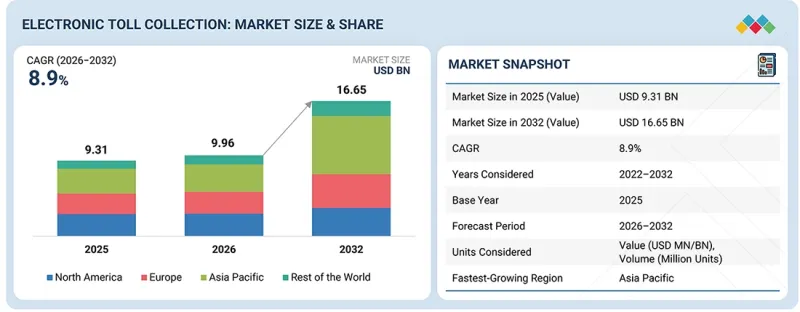
세계의 자동요금징수(ETC) 시장 규모는 예측 기간 중 CAGR 8.9%로 확대하며, 2025년 93억 1,000만 달러에서 2032년에는 166억 5,000만 달러에 달할 것으로 전망되고 있습니다.
시장의 성장은 지능형 교통시스템(ITS) 인프라에 대한 투자 확대, 원활한 차량 이동에 대한 수요 증가, 그리고 고속도로, 도심 도로, 교량, 터널에서 디지털 요금 결제 생태계의 보급 확대에 힘입어 이루어지고 있습니다.
| 조사 범위 | |
|---|---|
| 조사 대상 기간 | 2021-2032년 |
| 기준연도 | 2024년 |
| 예측 기간 | 2025-2032년 |
| 대상 단위 | 금액(10억 달러) |
| 부문 | 요금 징수 아키텍처별, 기술별, 오퍼링별, 용도별, 지역별 |
| 대상 지역 | 북미, 유럽, 아시아태평양, 기타 지역 |
자동화 및 접근성 높은 요금 징수 시스템으로의 전환에 따라 RFID, GNSS, 자동 번호판 인식(ANPR), 클라우드 기반 요금 관리 플랫폼 등의 기술 도입이 가속화되고 있습니다.
또한 교통 정체 완화, 통행료 수입의 효율화, 통근자들의 편의성 향상에 대한 관심이 높아지면서 대규모 ETC 도입이 가속화되고 있습니다. 커넥티드 모빌리티, 실시간 분석, AI를 활용한 교통 관리, 상호 운용 가능한 결제 시스템 분야의 지속적인 발전은 확장성과 운영 성능을 한층 더 강화하고 있습니다. 한편, 스마트 시티 인프라 및 통합 교통 네트워크에 대한 투자 확대는 도입 기회를 넓혀주고 있으며, 자동요금징수를 차세대 지능형 모빌리티 및 도로 인프라 현대화의 중요한 원동력으로 자리매김하고 있습니다.
"예측 기간 중 ANPR 카메라 부문은 가장 높은 연평균 성장률(CAGR)을 기록할 것으로 전망됩니다. " '
자동요금징수를 위한 ANPR 카메라 부문은 예측 기간 중 가장 높은 연평균 성장률(CAGR)을 달성할 것으로 전망됩니다. 이러한 성장은 정확하고 실시간으로 차량을 식별할 수 있는 기능이 필요한 프리플로우 및 배리어프리 요금 징수 시스템의 도입 확대에 힘입은 것입니다. ANPR 카메라 기술은 차량 번호판을 자동으로 촬영하고 인식할 수 있게 하여, 물리적 태그나 차량 정차 없이도 원활한 요금 징수 거래를 지원합니다. 이러한 시스템은 요금 징수의 효율성, 교통 처리 능력 및 단속의 정확성을 높이기 위해 고속도로, 도심 도로 요금망, 교량, 스마트 교통 회랑에 점점 더 많이 통합되고 있습니다. 또한 상호 운용이 가능한 요금 징수 인프라, 위반 관리 및 차량 분류에 대한 수요가 증가함에 따라 카메라 시스템, 엣지 처리 및 AI 기반 이미지 분석 분야의 혁신이 가속화되고 있습니다. 지능형 교통시스템, 클라우드 연동형 요금 징수 플랫폼, 그리고 디지털 모빌리티 인프라에 대한 투자 확대가 도입을 더욱 촉진하고 있습니다. 이미지 성능, 분석 소프트웨어 및 시스템 통합 능력의 지속적인 발전으로 인해 확장 가능한 도입과 운영 최적화가 가능해졌으며, ANPR 카메라 부문은 자동요금징수 시장에서 주요 성장 동력으로서의 입지를 확고히 하고 있습니다.
“2025년에는 트랜잭션 처리 소프트웨어가 ETC 시장의 상당 부분을 차지할 것으로 예상됩니다. ” '
트랜잭션 처리 소프트웨어는 2032년에 자동요금징수 시장에서 가장 큰 시장 점유율을 차지할 것으로 예상됩니다. 이러한 성장은 디지털 요금 징수 인프라의 도입 확대와 요금 네트워크 전반에 걸친 실시간이며 안전하고 대규모의 거래 관리에 대한 수요 증가에 힘입어 이루어지고 있습니다. 트랜잭션 처리 소프트웨어는 요금 계산, 결제 승인, 계정 관리, 상호 운용성, 대조 및 중앙 집중식 데이터 처리를 가능하게 함으로써 ETC 시스템 운영의 기반 역할을 합니다. 고속도로, 도심 통행료 징수 프로그램, 교량, 일반 도로 환경에서 통행료 징수 시스템의 도입이 급속히 진행되고 있으며, 교통 당국이 업무 효율과 사용자 경험 모두를 향상시키려는 가운데 그 확산이 가속화되고 있습니다. 이러한 플랫폼은 기존의 요금 징수 방식에 비해 더 신속한 거래 처리, RFID, GNSS, ANPR 기술과의 원활한 통합, 그리고 더 높은 요금 수입의 정확성을 실현합니다. 또한 클라우드 아키텍처, AI를 활용한 분석, 사이버 보안 기능, 통합 결제 생태계의 발전으로 인해 소프트웨어의 기능이 확장되어, 복잡하고 교통량이 많은 교통 환경에서도 확장성 있는 도입이 가능해졌습니다.
“2032년에는 미국이 ETC 시장에서 가장 큰 점유율을 차지할 것으로 예측됩니다. ” '
미국은 고속도로, 교량, 도시 교통망 전반에 걸친 전자·무현금 통행료 징수 인프라의 광범위한 구축에 힘입어, 2032년에는 전자 통행료 징수 시장에서 최대 점유율을 차지할 것으로 전망됩니다. 이 국가는 오픈 로드 통행료 징수 시스템의 조기 도입, 지능형 교통시스템(ITS)에 대한 적극적인 투자, 그리고 RFID, ANPR, 클라우드 기반 통행료 관리 플랫폼의 도입 확대라는 혜택을 누리고 있습니다. 교통 정체 완화, 요금 징수 효율 향상, 통근자의 편의성 제고에 대한 관심이 높아지면서 교통 네트워크 전반에 걸친 ETC 도입이 가속화되고 있습니다. 또한 확고한 입지를 갖춘 통행료 징수 사업자의 존재, 지속적인 인프라 현대화 노력, AI를 활용한 교통 분석 및 디지털 결제 생태계의 통합을 통해 미국은 세계 전자 통행료 징수 시장의 리더로서의 입지를 더욱 공고히 하고 있습니다.
2차 조사를 통해 수집된 각종 부문 및 하위 부문 시장 규모를 확정하고 검증하기 위해, 자동요금징수 시장의 주요 업계 전문가들을 대상으로 광범위한 1차 인터뷰를 시행했습니다. 이 보고서의 1차 인터뷰 대상자 구성은 다음과 같습니다.
조사 범위:
이 보고서에서는 자동요금징수 시장을 세분화하여 용도(고속도로, 도심), 유형(트랜스폰더/태그형 요금 징수 시스템, 기타), 제공 형태(하드웨어, 백오피스 및 기타 서비스), 기술(RFID, DSRC, 기타 기술)별로 시장 규모를 예측하고 있습니다. 또한 시장 촉진요인과 과제, 시장의 제약 요인에 대해서도 다루고 있습니다. 지역별(북미, 유럽, 아시아·태평양, 기타 지역) 시장 동향에 대해서도 상세히 분석하고 있습니다. 이 보고서에는 주요 기업의 공급망 분석 및 자동요금징수 생태계의 경쟁사 분석이 포함되어 있습니다.
이 보고서를 구매할 때의 주요 이점:
주요 촉진요인(교통 정체 완화와 교통사고 감축에 대한 시급한 필요성, 첨단 요금 징수 솔루션 도입에 대한 정부의 강력한 지원, 자동 요금 납부 옵션의 높은 편의성, 교통 인프라 분야의 기술 발전) , 제약 요인(기술에 대한 과도한 의존 및 기술적 고장에 대한 취약성, 개발도상국에서의 ETC 도입 제약, GPS 및 GNSS 기반 ETC 시스템에 대한 막대한 초기 투자 필요성), 기회(경제적·환경적 이익을 위한 연료 소비량 및 배출량 최소화에 대한 집중적인 노력, 요금 징수 시스템에 블록체인 기술 통합, 교통 분야에서의 민관협력(PPP) 계약 증가, 완전 전자식 요금 징수 시스템의 보급 확대) 및 과제(데이터 개인정보 보호에 대한 우려, 요금 징수 시스템과 관련된 상호 운용성 문제)
서비스 개발/혁신 - 자동요금징수 시장의 향후 기술, 연구개발 활동, 신제품 출시에 관한 상세 인사이트
시장 개발: 수익성이 높은 시장에 대한 포괄적인 정보 - 이 보고서에서는 다양한 지역의 자동요금징수 시장을 분석하고 있습니다.
시장의 다양화: 자동요금징수 시장의 신제품, 미개발 지역, 최근 동향 및 투자에 관한 포괄적인 정보.
경쟁사 분석: Kapsch TrafficCom AG(오스트리아), Conduent Incorporated(미국), ST Engineering(TransCore)(미국), Thales(프랑스), Cubic Corporation(미국), Siemens(독일), EFKON GmbH(오스트리아), Neology, Inc.(미국), FEIG ELECTRONIC(독일), Q-Free(노르웨이) 등, 자동요금징수 시장의 주요 참여 기업의 시장 점유율, 성장 전략, 서비스 제공에 대한 상세한 평가.
자주 묻는 질문
목차
제1장 서론
제2장 개요
제3장 주요 인사이트
제4장 시장 개요
제5장 업계 동향
제6장 기술 진보, AI에 의한 영향, 특허, 그리고 혁신
제7장 지역 규제와 준수
제8장 고객 상황과 구매 행동
제9장 통행요금 결제 방법
제10장 자동요금징수(ETC)에 채택되고 있는 요금 징수 아키텍처
제11장 자동요금징수(ETC) 시장(요금 징수 아키텍처별)
제12장 자동요금징수(ETC) 시장(기술별)
제13장 자동요금징수(ETC) 시장(오퍼링별)
제14장 자동요금징수(ETC) 시장(용도별)
제15장 자동요금징수(ETC) 시장(지역별)
제16장 경쟁 구도
제17장 기업 개요
제18장 조사 방법
제19장 부록
KSA 26.06.24The global electronic toll collection market is projected to grow from USD 9.31 billion in 2025 to USD 16.65 billion by 2032 at a CAGR of 8.9% during the forecast period. Market growth is being driven by increasing investments in intelligent transportation infrastructure, growing demand for frictionless vehicle movement, and rising adoption of digital toll payment ecosystems across highways, urban corridors, bridges, and tunnels.
| Scope of the Report | |
|---|---|
| Years Considered for the Study | 2021-2032 |
| Base Year | 2024 |
| Forecast Period | 2025-2032 |
| Units Considered | Value (USD Billion) |
| Segments | By Technology, Application and Region |
| Regions covered | North America, Europe, APAC, RoW |
The transition toward automated and barrier-free toll collection systems is accelerating the deployment of technologies such as RFID, GNSS, automatic number plate recognition (ANPR), and cloud-based toll management platforms.
Additionally, the increasing focus on reducing traffic congestion, improving toll revenue efficiency, and enhancing commuter convenience is supporting large-scale ETC implementation. Continuous advancements in connected mobility, real-time analytics, AI-enabled traffic management, and interoperable payment systems are further strengthening scalability and operational performance, while growing investments in smart city infrastructure and integrated transportation networks are expanding deployment opportunities, positioning electronic toll collection as a critical enabler of next-generation intelligent mobility and road infrastructure modernization.
"The ANPR cameras segment is projected to grow at the highest CAGR during the forecast period."
The ANPR cameras segment for electronic toll collection is projected to achieve the highest CAGR during the forecast period. This growth is supported by the increasing adoption of free-flow and barrier-free tolling systems that require accurate, real-time vehicle identification capabilities. ANPR camera technologies enable automatic capture and recognition of vehicle license plates, supporting seamless toll transactions without requiring physical tags or vehicle stoppage. These systems are increasingly being integrated into highways, urban road pricing networks, bridges, and smart transportation corridors to improve toll collection efficiency, traffic throughput, and enforcement accuracy. Additionally, rising demand for interoperable tolling infrastructure, violation management, and automated vehicle classification is accelerating innovation in camera systems, edge processing, and AI-based image analytics. Growing investments in intelligent transportation systems, cloud-connected toll platforms, and digital mobility infrastructure are further driving deployment. Continuous advancements in imaging performance, analytics software, and system integration capabilities are enabling scalable implementation and operational optimization, positioning the ANPR cameras segment as a key growth driver in the electronic toll collection market.
"Transaction Processing Software is projected to account for a significant share of the ETC market in 2025."
Transaction Processing Software is projected to account for the highest market share of the electronic toll collection market in 2032. This growth is driven by increasing deployment of digital tolling infrastructure and the rising need for real-time, secure, and high-volume transaction management across toll networks. Transaction processing software serves as the operational backbone of ETC systems by enabling toll calculation, payment authorization, account management, interoperability, reconciliation, and centralized data processing. There is strong adoption of tolling systems across highways, urban tolling programs, bridges, and open-road environments, accelerating their deployment as transportation authorities aim to improve both operational efficiency and the user experience. These platforms enable faster transaction execution, seamless integration with RFID, GNSS, and ANPR technologies, and greater toll revenue accuracy than conventional toll collection approaches. Additionally, advancements in cloud architecture, AI-enabled analytics, cybersecurity capabilities, and integrated payment ecosystems are expanding software functionality and enabling scalable deployment in complex, high-traffic transportation environments.
"The US is projected to capture the largest share in the ETC market in 2032."
The US is projected to capture the largest share in the electronic toll collection market in 2032, supported by the extensive deployment of electronic and cashless tolling infrastructure across highways, bridges, and urban mobility corridors. The country benefits from early adoption of open road tolling, strong investments in intelligent transportation systems, and growing implementation of RFID, ANPR, and cloud-based toll management platforms. Increasing focus on reducing traffic congestion, improving toll collection efficiency, and enhancing commuter convenience is accelerating ETC adoption across transportation networks. Additionally, the presence of established toll operators, continuous infrastructure modernization initiatives, and integration of AI-driven traffic analytics and digital payment ecosystems continue to strengthen the US position as a leading market for electronic toll collection globally.
Extensive primary interviews were conducted with key industry experts in the electronic toll collection market space to determine and verify the market size for various segments and subsegments gathered through secondary research. The breakdown of primary participants for the report is shown below.
The study contains insights from various industry experts, from component suppliers to Tier 1 companies and OEMs. The break-up of the primaries is as follows:
By Company Type - Tier 1-35%, Tier 2-45%, Tier 3 -20%
By Designation- C-level Executives - 40%, Directors - 30%, Others - 30%
By Region North America - 40%, Europe - 30%, Asia Pacific - 20%, RoW - 10%
The electronic toll collection market is dominated by a few globally established players, such as Kapsch TrafficCom AG (Austria), Conduent Incorporated (US), ST Engineering (TransCore) (Singapore), Thales (France), and Siemens (Germany).
Research Coverage:
The report segments the electronic toll collection market and forecasts its size by application (highways, urban areas), type (transponder/tag-based tolling systems, other types), offering (hardware, back-office & other services), and technology (RFID, DSRC, other technologies). It also discusses the market's drivers, restraints, opportunities, and challenges. It gives a detailed view of the market across regions (North America, Europe, Asia Pacific, RoW). The report includes a supply chain analysis of key players and a competitive analysis of the electronic toll collection ecosystem.
Key Benefits of Buying the Report:
Analysis of key drivers (Urgent need to mitigate traffic congestion and reduce road accidents, strong government support to deploy advanced tolling solutions, high convenience of automated toll payment options, technological advancements in transportation infrastructure), restraints (overreliance on technologies and susceptibility to technical failure, ETC implementation constraints in developing countries, requirement for high initial investments in GPS- and GNSS-based ETC systems), opportunities (significant focus on minimizing fuel consumption and emissions for economic and environmental gains, integration of blockchain technology into toll collection systems, rising number of public-private partnership agreements in transportation sector, increasing adoption of all-electronic tolling systems), and challenges (data privacy concerns, interoperability issues associated with tolling systems)
Service Development/Innovation: Detailed insights into upcoming technologies, research and development activities, and new product launches in the electronic toll collection market
Market Development: Comprehensive information about lucrative markets - the report analyses the electronic toll collection market across varied regions
Market Diversification: Exhaustive information about new products, untapped geographies, recent developments, and investments in the electronic toll collection market.
Competitive Assessment: In-depth assessment of market shares, growth strategies, and service offerings of leading players, such as Kapsch TrafficCom AG (Austria), Conduent Incorporated (US), ST Engineering (TransCore) (US), Thales (France), Cubic Corporation (US), Siemens (Germany), EFKON GmbH (Austria), Neology, Inc. (US), FEIG ELECTRONIC (Germany), and Q-Free (Norway), among others in the electronic toll collection market.
TABLE OF CONTENTS
1 INTRODUCTION
- 1.1 STUDY OBJECTIVES
- 1.2 MARKET DEFINITION
- 1.2.1 INCLUSIONS AND EXCLUSIONS
- 1.3 MARKET SCOPE
- 1.3.1 MARKET SEGMENTATION AND REGIONAL SCOPE
- 1.3.2 YEARS CONSIDERED
- 1.3.3 CURRENCY CONSIDERED
- 1.4 UNIT CONSIDERED
- 1.5 LIMITATIONS
- 1.6 STAKEHOLDERS
- 1.7 SUMMARY OF CHANGES
2 EXECUTIVE SUMMARY
- 2.1 MARKET HIGHLIGHTS AND KEY INSIGHTS
- 2.2 KEY MARKET PARTICIPANTS: MAPPING OF STRATEGIC DEVELOPMENTS
- 2.3 DISRUPTIVE TRENDS IN ELECTRONIC TOLL COLLECTION MARKET
- 2.4 HIGH-GROWTH SEGMENTS
- 2.5 REGIONAL SNAPSHOT: MARKET SIZE, GROWTH RATE, AND FORECAST
3 PREMIUM INSIGHTS
- 3.1 ATTRACTIVE OPPORTUNITIES FOR PLAYERS IN ELECTRONIC TOLL COLLECTION MARKET
- 3.2 ELECTRONIC TOLL COLLECTION MARKET, BY TECHNOLOGY
- 3.3 ELECTRONIC TOLL COLLECTION MARKET, BY OFFERING
- 3.4 ELECTRONIC TOLL COLLECTION MARKET, BY TOLLING ARCHITECTURE
- 3.5 ELECTRONIC TOLL COLLECTION MARKET, BY APPLICATION
- 3.6 ELECTRONIC TOLL COLLECTION MARKET, BY REGION
4 MARKET OVERVIEW
- 4.1 INTRODUCTION
- 4.2 MARKET DYNAMICS
- 4.2.1 DRIVERS
- 4.2.1.1 Urgent need to mitigate traffic congestion and reduce road accidents
- 4.2.1.2 Strong government support to deploy advanced tolling solutions across highways and urban areas
- 4.2.1.3 High convenience of automated toll payment options
- 4.2.1.4 Technological advancements in transportation infrastructure
- 4.2.2 RESTRAINTS
- 4.2.2.1 Susceptibility of ETC solutions to technical failures and vulnerability to cybertattacks
- 4.2.2.2 Implementation constraints in developing countries
- 4.2.2.3 Requirement for high initial investments in GPS- and GNSS-based ETC systems
- 4.2.3 OPPORTUNITIES
- 4.2.3.1 Significant focus on minimizing fuel consumption and emissions for economic and environmental gains
- 4.2.3.2 Integration of blockchain technology into toll collection systems
- 4.2.3.3 Rising number of public-private partnership agreements in transportation sector
- 4.2.3.4 Increasing adoption of all-electronic tolling systems
- 4.2.4 CHALLENGES
- 4.2.4.1 Data privacy concerns
- 4.2.4.2 Interoperability issues associated with tolling systems
- 4.2.1 DRIVERS
- 4.3 INTERCONNECTED MARKETS AND CROSS-SECTOR OPPORTUNITIES
- 4.4 STRATEGIC MOVES BY TIER 1/2/3 PLAYERS
5 INDUSTRY TRENDS
- 5.1 PORTER'S FIVE FORCES ANALYSIS
- 5.1.1 THREAT OF NEW ENTRANTS
- 5.1.2 THREAT OF SUBSTITUTES
- 5.1.3 BARGAINING POWER OF SUPPLIERS
- 5.1.4 BARGAINING POWER OF BUYERS
- 5.1.5 INTENSITY OF COMPETITIVE RIVALRY
- 5.2 MACROECONOMIC OUTLOOK
- 5.2.1 INTRODUCTION
- 5.2.2 GDP TRENDS AND FORECAST
- 5.2.3 TRENDS IN GLOBAL ELECTRONIC TOLL COLLECTION INDUSTRY
- 5.2.4 TRENDS IN ROADWAY TRANSPORTATION INDUSTRY
- 5.3 VALUE CHAIN ANALYSIS
- 5.4 ECOSYSTEM ANALYSIS
- 5.5 PRICING ANALYSIS
- 5.5.1 AVERAGE SELLING PRICE TREND OF RFID TAGS AND READERS, BY KEY PLAYER, 2022-2025
- 5.5.2 AVERAGE SELLING PRICE TREND OF ELECTRONIC TOLL COLLECTION SYSTEMS, BY REGION, 2022-2025
- 5.6 TRADE ANALYSIS
- 5.6.1 IMPORT SCENARIO (HS CODE 8530)
- 5.6.2 EXPORT SCENARIO (HS CODE 8530)
- 5.7 KEY CONFERENCES AND EVENTS, 2026
- 5.8 TRENDS/DISRUPTIONS IMPACTING CUSTOMER BUSINESS
- 5.9 INVESTMENT AND FUNDING SCENARIO
- 5.10 CASE STUDY ANALYSIS
- 5.10.1 WESTERN DIGITAL AND THEOBROMA SYSTEMS PROVIDES CUSTOMIZED TOLL COLLECTION SYSTEM FOR EUROPEAN PROJECT
- 5.10.2 SICE UPGRADES HUMBER BRIDGE TOLLING SYSTEM FOR OPTIMIZED TRAFFIC MANAGEMENT AND REVENUE GENERATION
- 5.10.3 MASSACHUSETTS DEPARTMENT OF TRANSPORTATION SELECTED TRANSCORE FOR E-ZPASS CUSTOMER SERVICE ENHANCEMENT
- 5.10.4 ERC SELECTS CLOUD-BASED TOLLING SOLUTION FROM COGNIZANT TO MAXIMIZE REVENUE
- 5.10.5 PLUS MALAYSIA USES TAPWAY'S AI AND NVIDIA'S GPUS IN RFID TOLL TRACKING SYSTEM BASED ON ANPR TECHNOLOGY
- 5.11 IMPACT OF US TARIFF - OVERVIEW
- 5.11.1 INTRODUCTION
- 5.11.2 KEY TARIFF RATES
- 5.11.3 PRICE IMPACT ANALYSIS
- 5.11.4 IMPACT ON COUNTRIES/REGIONS
- 5.11.4.1 US
- 5.11.4.2 Europe
- 5.11.4.3 Asia Pacific
- 5.11.5 IMPACT ON APPLICATION
6 TECHNOLOGICAL ADVANCEMENTS, AI-DRIVEN IMPACT, PATENTS, AND INNOVATIONS
- 6.1 KEY TECHNOLOGIES
- 6.1.1 GNSS/GPS-BASED TOLLING SYSTEMS
- 6.1.2 AI-POWERED TRAFFIC ANALYTICS AND AUTOMATED ENFORCEMENT
- 6.2 COMPLEMENTARY TECHNOLOGIES
- 6.2.1 IOT SENSORS AND ROADSIDE UNITS
- 6.2.2 CYBERSECURITY SOLUTIONS
- 6.2.3 BIG DATA ANALYTICS PLATFORMS
- 6.2.4 DIGITAL PAYMENT AND FINTECH INTEGRATION
- 6.3 TECHNOLOGY ROADMAP
- 6.4 PATENT ANALYSIS
- 6.5 IMPACT OF AI/GEN AI ON ELECTRONIC TOLL COLLECTION MARKET
- 6.5.1 TOP USE CASES AND MARKET POTENTIAL
- 6.5.2 BEST PRACTICES FOLLOWED BY OEMS IN ELECTRONIC TOLL COLLECTION MARKET
- 6.5.3 CASE STUDIES RELATED TO AI IMPLEMENTATION IN ELECTRONIC TOLL COLLECTION MARKET
- 6.5.4 INTERCONNECTED ECOSYSTEM AND IMPACT ON MARKET PLAYERS
- 6.5.5 CLIENTS' READINESS TO ADOPT GENERATIVE AI IN ELECTRONIC TOLL COLLECTION MARKET
7 REGIONAL REGULATIONS AND COMPLIANCE
- 7.1 REGIONAL REGULATIONS AND COMPLIANCE
- 7.2 REGULATORY BODIES, GOVERNMENT AGENCIES, AND OTHER ORGANIZATIONS
- 7.3 INDUSTRY STANDARDS
8 CUSTOMER LANDSCAPE AND BUYER BEHAVIOR
- 8.1 DECISION-MAKING PROCESS
- 8.2 BUYER STAKEHOLDERS AND BUYING EVALUATION CRITERIA
- 8.2.1 KEY STAKEHOLDERS IN BUYING PROCESS
- 8.2.2 BUYING CRITERIA
- 8.3 ADOPTION BARRIERS AND INTERNAL CHALLENGES
- 8.4 UNMET NEEDS OF VARIOUS APPLICATIONS
- 8.5 MARKET PROFITABILITY
9 PAYMENT METHODS ADOPTED TO PAY TOLLS
- 9.1 INTRODUCTION
- 9.2 PREPAID
- 9.3 POST-PAID
10 TOLLING ARCHITECTURES DEPLOYED IN ELECTRONIC TOLL COLLECTION
- 10.1 INTRODUCTION
- 10.2 HARDWARE PROVIDERS
- 10.3 SOFTWARE & PLATFORM PROVIDERS
- 10.4 SYSTEM INTEGRATORS
- 10.5 TOLL OPERATORS/CONCESSIONAIRES
- 10.6 MANAGED SERVICE PROVIDERS
11 ELECTRONIC TOLL COLLECTION MARKET, BY TOLLING ARCHITECTURE
- 11.1 INTRODUCTION
- 11.2 OPEN ROAD TOLLING (ORT)
- 11.2.1 INCLINATION TOWARD REDUCING CONGESTION AND IMPROVING FUEL EFFICIENCY TO BOOST ADOPTION
- 11.3 BARRIER-BASED ETC
- 11.3.1 LOW DEPLOYMENT COMPLEXITY AND HIGH TRANSACTION ACCURACY TO ACCELERATE IMPLEMENTATION
- 11.4 HYBRID SYSTEMS
- 11.4.1 GROWING EMPHASIS ON DIGITAL PAYMENTS AND SMART MOBILITY INITIATIVES TO DRIVE INSTALLATION
12 ELECTRONIC TOLL COLLECTION MARKET, BY TECHNOLOGY
- 12.1 INTRODUCTION
- 12.2 RFID
- 12.2.1 EASY INTEGRATION INTO ANY INFRASTRUCTURE AND LOW OPERATING COST TO FUEL SEGMENTAL GROWTH
- 12.3 DSRC
- 12.3.1 GROWING DEMAND FOR SECURE AND PRIVACY-CENTRIC ETC SOLUTIONS TO FOSTER SEGMENTAL GROWTH
- 12.4 GNSS/GPS
- 12.4.1 SUPPORT FOR DISTANCE-BASED CHARGING WITHOUT EXTENSIVE ROADSIDE INFRASTRUCTURE TO BOOST MARKET
- 12.5 OTHER TECHNOLOGIES
13 ELECTRONIC TOLL COLLECTION MARKET, BY OFFERING
- 13.1 INTRODUCTION
- 13.2 HARDWARE
- 13.2.1 ROADSIDE INFRASTRUCTURE
- 13.2.1.1 Growing preference for automated mobility environments to create roadside infrastructure requirements
- 13.2.2 ANPR CAMERAS
- 13.2.2.1 Increasing adoption of open road tolling and congestion management programs to facilitate segmental growth
- 13.2.3 RFID/DSRC READERS
- 13.2.3.1 Increasing demand for low-latency tolling and traffic management systems to augment segmental growth
- 13.2.4 TRANSPONDERS/OBUS
- 13.2.4.1 Expansion of national and regional interoperability initiatives to stimulate segmental growth
- 13.2.5 SENSORS & CONTROLLERS
- 13.2.5.1 Potential to improve detection accuracy and system visibility to promote segmental growth
- 13.2.1 ROADSIDE INFRASTRUCTURE
- 13.3 SOFTWARE
- 13.3.1 TRANSACTION PROCESSING
- 13.3.1.1 Rising investments in high-speed, low-latency processing infrastructure to contribute to segmental growth
- 13.3.2 VIOLATION ENFORCEMENT
- 13.3.2.1 Need to identify and manage unpaid toll transactions to promote segmental growth
- 13.3.3 TOLL MANAGEMENT
- 13.3.3.1 Surging deployment of multi-corridor toll networks and interoperable transportation infrastructure to accelerate segmental growth
- 13.3.4 REVENUE MANAGEMENT
- 13.3.4.1 Requirement to identify leakage points and optimize collection efficiency to encourage market expansion
- 13.3.5 INTEROPERABILITY PLATFORMS
- 13.3.5.1 Ability to facilitate transaction exchange, account synchronization, payment coordination, across toll operators to boost deployment
- 13.3.1 TRANSACTION PROCESSING
- 13.4 SERVICES
- 13.4.1 MANAGED SERVICES
- 13.4.1.1 Elevating use of performance-based delivery models to promote segmental growth
- 13.4.2 INTEGRATION & DEPLOYMENT
- 13.4.2.1 Increasing adoption of multi-technology toll environments to contribute to segmental growth
- 13.4.3 MAINTENANCE & SUPPORT
- 13.4.3.1 Necessity to maintain compliance with operational requirements and service-level agreements to encourage segmental growth
- 13.4.4 CONSULTING
- 13.4.4.1 Growing complexity of tolling environments to create need for consulting services
- 13.4.1 MANAGED SERVICES
14 ELECTRONIC TOLL COLLECTION MARKET, BY APPLICATION
- 14.1 INTRODUCTION
- 14.2 HIGHWAYS/EXPRESSWAYS
- 14.2.1 URGENT NEED TO IMPROVE TRAFFIC FLOW AND REDUCE CONGESTION AND HARMFUL EMISSIONS ACROSS HIGHWAYS TO UPTAKE GROWTH
- 14.3 URBAN CONGESTION CHARGING
- 14.3.1 SMART CITY DEVELOPMENT INITIATIVES TO SPUR DEMAND
- 14.4 BRIDGES & TUNNELS
- 14.4.1 GROWING ADOPTION OF AUTOMATED TOLLING ACROSS BRIDGES AND TUNNELS TO FACILITATE SEGMENTAL GROWTH
- 14.5 CROSS-BORDER TOLLING
- 14.5.1 INCREASING INTERNATIONAL TRANSPORTATION CONNECTIVITY AND REGIONAL MOBILITY PROGRAMS TO DRIVE SEGMENTAL GROWTH
15 ELECTRONIC TOLL COLLECTION MARKET, BY REGION
- 15.1 INTRODUCTION
- 15.2 NORTH AMERICA
- 15.2.1 US
- 15.2.1.1 Growing emphasis on modernizing road infrastructure to accelerate market growth
- 15.2.2 CANADA
- 15.2.2.1 Rising installation of ETC systems on major highways and bridges to drive market
- 15.2.3 MEXICO
- 15.2.3.1 Increasing number of projects for connecting with neighboring countries to contribute to market growth
- 15.2.1 US
- 15.3 EUROPE
- 15.3.1 UK
- 15.3.1.1 Adoption of advanced tolling technologies to enhance traffic efficiency to fuel market growth
- 15.3.2 GERMANY
- 15.3.2.1 Strong technological expertise and advanced tolling infrastructure to support market growth
- 15.3.3 FRANCE
- 15.3.3.1 Rising deployment of electronic tolling in environmental charging zones to reinforce market growth
- 15.3.4 ITALY
- 15.3.4.1 Expanding toll road network and digitally enabled heavy-vehicle tolling to contribute to market growth
- 15.3.5 SPAIN
- 15.3.5.1 Surging installation of automated and MLFF-ready ETC solutions across highways to foster market growth
- 15.3.6 NORDICS
- 15.3.6.1 Advancing digital road-charging through GNSS, ANPR, and eco-focused pricing models to drive market
- 15.3.7 NORWAY
- 15.3.7.1 HIGH adoption of free-flow tolling and digital mobility infrastructure to strengthen market expansion
- 15.3.8 REST OF EUROPE
- 15.3.1 UK
- 15.4 ASIA PACIFIC
- 15.4.1 CHINA
- 15.4.1.1 Rising government support for automating toll payments to augment market growth
- 15.4.2 JAPAN
- 15.4.2.1 Increasing need to reduce traffic at toll gates to fuel market growth
- 15.4.3 SOUTH KOREA
- 15.4.3.1 Expansion of smart mobility initiatives and digital transportation programs to spur demand
- 15.4.4 AUSTRALIA
- 15.4.4.1 Leveraging free-flow tolling to improve urban mobility and transport efficiency to support market growth
- 15.4.5 SINGAPORE
- 15.4.5.1 Pioneering urban-centric digital tolling through GNSS-based ERP framework to foster market growth
- 15.4.6 INDIA
- 15.4.6.1 Accelerating nationwide toll digitization through RFID expansion and expressway development projects to expedite market growth
- 15.4.7 REST OF ASIA PACIFIC
- 15.4.1 CHINA
- 15.5 ROW
- 15.5.1 SOUTH AMERICA
- 15.5.1.1 Brazil
- 15.5.1.1.1 Transition toward automated and free-flow toll collection environments to improve traffic throughput to drive market
- 15.5.1.2 Argentina
- 15.5.1.2.1 Greater adoption of digital toll collection models supported by infrastructure upgrades to propel market
- 15.5.1.3 Rest of South America
- 15.5.1.1 Brazil
- 15.5.2 MIDDLE EAST & AFRICA
- 15.5.2.1 GCC countries
- 15.5.2.1.1 Government initiatives to regulate traffic and curb over-speeding to support market growth
- 15.5.2.2 Rest of Middle East & Africa
- 15.5.2.1 GCC countries
- 15.5.1 SOUTH AMERICA
16 COMPETITIVE LANDSCAPE
- 16.1 OVERVIEW
- 16.2 KEY PLAYER COMPETITIVE STRATEGIES/RIGHT TO WIN, 2021-2026
- 16.2.1 PRODUCT PORTFOLIO
- 16.2.2 REGIONAL FOCUS
- 16.2.3 MANUFACTURING FOOTPRINT
- 16.2.4 ORGANIC/INORGANIC GROWTH STRATEGIES
- 16.3 MARKET SHARE ANALYSIS, 2025
- 16.4 REVENUE ANALYSIS, 2021-2025
- 16.5 COMPANY VALUATION AND FINANCIAL METRICS
- 16.6 BRAND COMPARISON
- 16.6.1 KAPSCH TRAFFICCOM AG (AUSTRIA)
- 16.6.2 CONDUENT, INC. (US)
- 16.6.3 ST ENGINEERING (TRANSCORE) (US)
- 16.6.4 THALES GROUP (FRANCE)
- 16.6.5 SIEMENS AG (GERMANY)
- 16.7 COMPANY EVALUATION MATRIX: KEY PLAYERS, 2025
- 16.7.1 STARS
- 16.7.2 EMERGING LEADERS
- 16.7.3 PERVASIVE PLAYERS
- 16.7.4 PARTICIPANTS
- 16.7.5 COMPANY FOOTPRINT: KEY PLAYERS, 2025
- 16.7.5.1 Company footprint
- 16.7.5.2 Region footprint
- 16.7.5.3 Offering footprint
- 16.7.5.4 Tolling architecture footprint
- 16.7.5.5 Technology footprint
- 16.7.5.6 Application footprint
- 16.8 COMPANY EVALUATION MATRIX: STARTUPS/SMES, 2025
- 16.8.1 PROGRESSIVE COMPANIES
- 16.8.2 RESPONSIVE COMPANIES
- 16.8.3 DYNAMIC COMPANIES
- 16.8.4 STARTING BLOCKS
- 16.8.5 COMPETITIVE BENCHMARKING: KEY STARTUPS/SMES, 2025
- 16.8.5.1 Detailed list of key startups/SMEs
- 16.8.5.2 Competitive benchmarking of key startups/SMEs
- 16.9 COMPETITIVE SCENARIO
- 16.9.1 PRODUCT LAUNCHES/DEVELOPMENTS
- 16.9.2 DEALS
- 16.9.3 OTHER DEVELOPMENTS
17 COMPANY PROFILES
- 17.1 KEY PLAYERS
- 17.1.1 KAPSCH TRAFFICCOM AG
- 17.1.1.1 Business overview
- 17.1.1.2 Products/Solutions/Services offered
- 17.1.1.3 Recent developments
- 17.1.1.3.1 Product launches
- 17.1.1.3.2 Deals
- 17.1.1.3.3 Expansions
- 17.1.1.3.4 Other developments
- 17.1.1.4 MnM view
- 17.1.1.4.1 Key strengths/Right to win
- 17.1.1.4.2 Strategic choices
- 17.1.1.4.3 Weaknesses/Competitive threats
- 17.1.2 CONDUENT INCORPORATED
- 17.1.2.1 Business overview
- 17.1.2.2 Products/Solutions/Services offered
- 17.1.2.3 Recent developments
- 17.1.2.3.1 Product launches
- 17.1.2.3.2 Other developments
- 17.1.2.4 MnM view
- 17.1.2.4.1 Key strengths/Right to win
- 17.1.2.4.2 Strategic choices
- 17.1.2.4.3 Weaknesses/Competitive threats
- 17.1.3 EFKON GMBH
- 17.1.3.1 Business overview
- 17.1.3.2 Products/Solutions/Services offered
- 17.1.3.3 Recent developments
- 17.1.3.3.1 Product launches
- 17.1.3.3.2 Other developments
- 17.1.3.4 MnM view
- 17.1.3.4.1 Key strengths/Right to win
- 17.1.3.4.2 Strategic choices
- 17.1.3.4.3 Weaknesses/Competitive threats
- 17.1.4 ST ENGINEERING (TRANSCORE)
- 17.1.4.1 Business overview
- 17.1.4.2 Products/Solutions/Services offered
- 17.1.4.3 Recent developments
- 17.1.4.3.1 Product launches
- 17.1.4.3.2 Deals
- 17.1.4.3.3 Expansions
- 17.1.4.3.4 Other developments
- 17.1.4.4 MnM view
- 17.1.4.4.1 Key strengths/Right to win
- 17.1.4.4.2 Strategic choices
- 17.1.4.4.3 Weaknesses/Competitive threats
- 17.1.5 THALES
- 17.1.5.1 Business overview
- 17.1.5.2 Products/Solutions/Services offered
- 17.1.5.3 Recent developments
- 17.1.5.3.1 Other developments
- 17.1.5.4 MnM view
- 17.1.5.4.1 Key strengths/Right to win
- 17.1.5.4.2 Strategic choices
- 17.1.5.4.3 Weaknesses/Competitive threats
- 17.1.6 SIEMENS
- 17.1.6.1 Business overview
- 17.1.6.2 Products/Solutions/Services offered
- 17.1.7 Q-FREE
- 17.1.7.1 Business overview
- 17.1.7.2 Products/Services/Solutions offered
- 17.1.7.3 Recent developments
- 17.1.7.3.1 Developments
- 17.1.8 CUBIC CORPORATION
- 17.1.8.1 Business overview
- 17.1.8.2 Products/Solutions/Services offered
- 17.1.8.3 Recent developments
- 17.1.8.3.1 Product launches
- 17.1.9 NEOLOGY
- 17.1.9.1 Business overview
- 17.1.9.2 Products/Solutions/Services offered
- 17.1.9.3 Recent developments
- 17.1.9.3.1 Product launches
- 17.1.9.3.2 Deals
- 17.1.9.3.3 Other developments
- 17.1.10 FEIG ELECTRONIC
- 17.1.10.1 Business overview
- 17.1.10.2 Products/Solutions/Services offered
- 17.1.10.3 Recent developments
- 17.1.10.3.1 Product launches
- 17.1.10.3.2 Deals
- 17.1.11 TOSHIBA CORPORATION,
- 17.1.11.1 Business overview
- 17.1.11.2 Products/Solutions/Services offered
- 17.1.12 MITSUBISHI HEAVY INDUSTRIES, LTD.
- 17.1.12.1 Business overview
- 17.1.12.2 Products/Solutions/Services offered
- 17.1.12.3 Recent developments
- 17.1.12.3.1 Developments
- 17.1.13 QUARTERHILL INC.
- 17.1.13.1 Business overview
- 17.1.13.2 Products/Solutions/Services offered
- 17.1.13.3 Recent developments
- 17.1.13.3.1 Product launches
- 17.1.13.3.2 Deals
- 17.1.13.3.3 Other developments
- 17.1.14 PERCEPTICS, LLC
- 17.1.14.1 Business overview
- 17.1.14.2 Products/Solutions/Services offered
- 17.1.14.3 Recent developments
- 17.1.14.3.1 Product launches
- 17.1.15 SKYTOLL
- 17.1.15.1 Business overview
- 17.1.15.2 Products/Solutions/Services offered
- 17.1.15.3 Recent developments
- 17.1.15.3.1 Expansions
- 17.1.15.3.2 Other developments
- 17.1.1 KAPSCH TRAFFICCOM AG
- 17.2 OTHER PLAYERS
- 17.2.1 EMOVIS
- 17.2.2 STAR SYSTEMS INTERNATIONAL
- 17.2.3 GEA
- 17.2.4 ADAPTIVE RECOGNITION INC.
- 17.2.5 SICE
- 17.2.6 JENOPTIK
- 17.2.7 FAR EASTERN GROUP
- 17.2.8 TOLL COLLECT GMBH
- 17.2.9 GEOTOLL
- 17.2.10 INDRA
- 17.2.11 KISTLER GROUP
- 17.2.12 VERRA MOBILITY
- 17.3 CONCESSIONAIRES
- 17.3.1 VINCI HIGHWAYS
- 17.3.2 TRANSURBAN GROUP
- 17.3.3 ABERTIS
- 17.3.4 EGIS
- 17.3.5 ROADIS
- 17.3.6 IRB INFRASTRUCTURE DEVELOPERS LTD.
18 RESEARCH METHODOLOGY
- 18.1 INTRODUCTION
- 18.2 RESEARCH DATA
- 18.2.1 SECONDARY DATA
- 18.2.1.1 Key data from secondary sources
- 18.2.2 PRIMARY DATA
- 18.2.2.1 Primary interview participants
- 18.2.2.2 Breakdown of primaries
- 18.2.2.3 Key data from primary sources
- 18.2.2.4 Key industry insights
- 18.2.1 SECONDARY DATA
- 18.3 FACTOR ANALYSIS
- 18.3.1 SUPPLY-SIDE ANALYSIS
- 18.3.2 DEMAND-SIDE ANALYSIS
- 18.4 MARKET SIZE ESTIMATION METHODOLOGY
- 18.4.1 BOTTOM-UP APPROACH
- 18.4.1.1 Approach to arrive at market size using bottom-up analysis (demand side)
- 18.4.2 TOP-DOWN APPROACH
- 18.4.2.1 Approach to arrive at market size using top-down approach (supply side)
- 18.4.3 GROWTH PROJECTION AND FORECAST-RELATED ASSUMPTIONS
- 18.4.1 BOTTOM-UP APPROACH
- 18.5 MARKET BREAKDOWN AND DATA TRIANGULATION
- 18.6 RESEARCH ASSUMPTIONS
- 18.7 RESEARCH LIMITATIONS
- 18.8 RISK ASSESSMENT
19 APPENDIX
- 19.1 INSIGHTS FROM INDUSTRY EXPERTS
- 19.2 DISCUSSION GUIDE
- 19.3 KNOWLEDGE STORE: MARKETSANDMARKETS' SUBSCRIPTION PORTAL
- 19.4 CUSTOMIZATION OPTIONS
- 19.5 RELATED REPORTS
- 19.6 AUTHOR DETAILS


