
|
시장보고서
상품코드
2064091
EV 배터리 시장 예측(-2035년) : 배터리 유형별, 재료 유형별, 배터리 형태별, 배터리 용량별, 추진 방식별, 차종별, 방법별, 리튬이온 배터리 컴포넌트별, 지역별EV Battery Market by Battery Type (Li-ion, SSB), Vehicle Type (PC, LCV, MHCV, Bus), Propulsion (BEV, PHEV), Battery Form (Prismatic, Pouch, Cylindrical), Material Type, Battery Capacity, Method and Region - Global Forecast to 2035 |
||||||

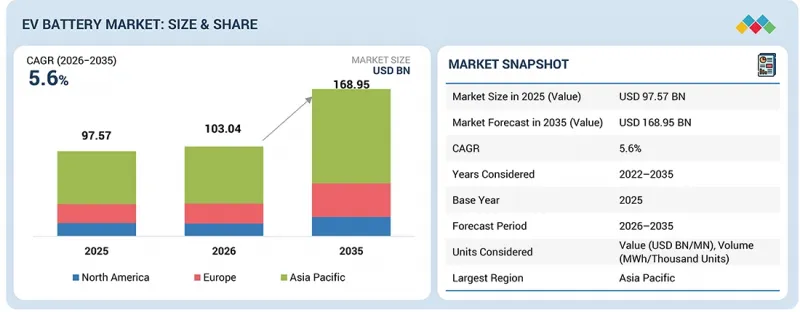
EV 배터리 시장 규모는 2026년 1,030억 4,000만 달러에서 2035년까지 1,689억 5,000만 달러에 달할 것으로 예측되고 있으며, CAGR은 5.6%에 달할 전망입니다.
| 조사 범위 | |
|---|---|
| 조사 대상 기간 | 2026-2035년 |
| 기준연도 | 2025년 |
| 예측 기간 | 2026-2035년 |
| 대상 단위 | 10억 달러 |
| 부문 | 배터리 유형별, 재료 유형별, 배터리 형태별, 배터리 용량별, 추진 방식별, 차종별, 방법별, 리튬이온 배터리 컴포넌트별, 지역별 |
| 대상 지역 | 아시아태평양, 유럽, 북미 |
EV 배터리 시장에서 배터리의 형태는 전략적 차별화 요인으로 부상하고 있습니다. 이는 각 제조사들이 셀 수준의 에너지 밀도 극대화만을 추구하는 것이 아니라, 비용, 차량 패키징, 생산 확장성 등을 고려하여 배터리 시스템을 최적화하는 경우가 늘어나고 있기 때문입니다. 프리즘형 셀은 공간 활용 효율이 높고 팩에 통합하기 쉽다는 장점 덕분에 대중형 전기자동차에 점점 더 많이 채택되고 있는 반면, 파우치형 셀은 여전히 프리미엄 차량이나 고성능을 지향하는 용도에 채택되고 있습니다. 동시에, 자동차 제조사들이 자동화 생산, 충전 성능, 그리고 구조적 배터리 통합을 우선시함에 따라 대형 원통형 셀의 채택도 확대되고 있으며, 배터리 아키텍처는 전기자동차 플랫폼의 경쟁력에서 점점 더 중요한 요소가 되고 있습니다.
예측 기간 중 50-110kWh의 배터리 용량이 전기자동차 배터리 시장을 주도할 것으로 예상됩니다.
50-110kWh 배터리 용량 부문은 주행 거리, 배터리 비용, 충전 성능, 차량 중량 간의 균형이 잘 잡혀 있으며, 전기자동차 배터리 시장을 주도할 것으로 예상됩니다. 이 배터리 용량 범위는 일반 대중용 및 프리미엄 BEV 모두에서 선호되는 선택지로, 일반적으로 실제 주행 거리는 350-650km를 달성합니다. OEM 각사는 전 세계에서 계속해서 견고한 수요가 예상되는 SUV, 크로스오버, 장거리 주행용 세단에 대응하기 위해, 이 용량 범위를 중심으로 차량 플랫폼 설계를 진행하는 경향이 강해지고 있습니다. 예를 들어 2025년에는 전 세계 승용 전기자동차 판매 대수의 70% 가까이가 50-110kWh의 배터리 용량을 탑재한 차량에 집중되었습니다. 셀 기술의 발전과 배터리 팩 통합 기술 덕분에, 각 OEM 업체들은 50-110kWh의 용량 범위 내에서 주행 거리를 극대화할 수 있게 되었습니다. LFP, NMC, 실리콘 강화 음극 등 고에너지 밀도 화학계는 에너지 저장 효율을 향상시키는 한편, 셀-투-팩(CTP) 및 구조형 배터리 설계는 배터리 팩의 대형화 없이도 팩의 유효 용량을 늘리고 시스템 중량을 경감시킵니다. 또한 배터리 팩의 비용 절감과 급속 충전 성능 향상으로 인해 50-110kWh 배터리 범주에 속하는 차량은 승용차 및 소형 상용차 각 부문에서 상업적으로 점점 더 매력적인 선택지가 되고 있습니다.
예측 기간 중 BEV 부문이 전기자동차 배터리 시장을 주도할 것으로 예상됩니다.
BEV는 대용량 배터리 팩에 전적으로 의존하고 있으므로 하이브리드차량에 비해 차량당 배터리 수요가 크게 증가할 것으로 예상되며, 이는 전기자동차 배터리 시장을 주도할 것으로 보입니다. 배터리 가격 하락, 에너지 밀도 향상, 그리고 급속 충전 인프라 확충이 승용차 및 상용차 양 부문에서 BEV의 보급 가속화를 지원하고 있습니다. 전기자동차 배터리 팩의 평균 가격은 2021년 약 132달러/kWh에서 2025년에는 100달러/kWh 미만으로 하락함에 따라 차량의 가격 경쟁력이 향상됨과 동시에 순수 전기자동차(BEV)의 대규모 보급이 가속화되고 있습니다. 또한 유럽이나 중국 등 주요 시장에서 배기가스 제로 차량에 대한 규제가 중점적으로 추진되고 있는 점이 플러그인 하이브리드차보다 BEV의 성장을 지속적으로 지원하고 있습니다. 각 자동차 제조사들도 차량 효율 향상, 주행 거리 연장, 그리고 생산 규모 확대를 위해 BEV 전용 플랫폼에 대한 투자를 확대하고 있습니다. 2025년에도 BEV는 전 세계 전기자동차 판매 대수의 대부분을 계속 차지하고 있습니다. 저가형 모델부터 프리미엄 모델에 이르기까지 신차 모델이 지속적으로 출시됨에 따라 배터리 수요는 견고한 추세를 보일 것으로 예상됩니다. 예를 들어 2026년 3월, BYD는 ‘Blade Battery 2.0’과 고출력 충전 플랫폼을 발표했습니다. 이를 통해 충전 시간을 약 5분 만에 10%에서 70%까지 단축할 수 있을 뿐만 아니라, 이전 세대에 비해 에너지 밀도도 향상되었습니다. 이러한 개발은 BEV의 보급을 촉진하고, 전 세계 전기자동차 배터리 시장의 지속적인 성장을 지원하고 있습니다.
예측 기간 중 유럽은 전기자동차 배터리 시장에서 큰 점유율을 차지할 것으로 전망됩니다.
유럽에서는 배터리 생산의 현지화가 진행되고 있으며, 차량의 전기화에 대한 강력한 규제 측면의 지원과 지역 전체의 전기자동차 수요 확대에 힘입어, 전기자동차 배터리 시장에서 큰 점유율을 차지할 것으로 예상됩니다. 해당 지역에서는 수입 배터리 의존도를 낮추고 공급 안정성을 강화하기 위해, 셀 제조, 배터리 소재, 팩 조립, 재활용 분야에 대한 투자를 통해 배터리 밸류체인을 확대하고 있습니다. 독일, 프랑스, 스웨덴 등의 국가들은 해당 지역의 기가팩토리 개발과 배터리 생태계 확장을 지속적으로 지원하고 있습니다. 이러한 전환은 대규모 투자 계획에 힘입어 더욱 가속화되고 있으며, 유럽에서는 장기적인 산업 경쟁력을 강화하기 위해 2026년 5월 기준으로 전기자동차 제조, 배터리 공급망, 충전 인프라 분야에 걸쳐 총 약 2,350억 달러 규모의 투자가 발표되었습니다. 또한 차량의 CO2 배출량 감축과 배터리의 지속가능성에 초점을 맞춘 유럽의 규제로 인해, OEM 및 배터리 제조사들은 현지화된 첨단 배터리 기술의 도입을 가속화하려 하고 있습니다.
EV 배터리 시장은 Contemporary Amperex Technology Co., Limited(중국), BYD Company Ltd.(중국), LG Energy Solution(한국), CALB(중국), Gotion Inc.(중국) 등 주요 기업이 주도하고 있습니다. 이 기업은 에너지 밀도, 충전 속도, 안전 성능 및 주행 거리 향상을 목표로 한 첨단 배터리 셀 및 통합형 배터리 팩 솔루션을 제공하고 있습니다.
조사 범위:
이 보고서에서는 EV 배터리 시장을 배터리 유형(리튬이온, SSB), 차종(승용차, 경상용차, 중·대형 상용차, 버스), 구동 방식(BEV, PHEV), 배터리 형태(각형, 파우치형, 원통형), 소재 유형, 배터리 용량, 방식, 리튬이온 배터리 유형 및 지역별로 분석하고 있습니다. 또한 EV 배터리 시장 생태계의 주요 참여 기업에 대한 경쟁 현황과 기업 개요에 대해서도 포괄적으로 다루고 있습니다. 또한 본 조사에서는 주요 시장 진출 기업에 대한 상세한 경쟁 분석 외에도, 각 기업의 프로필, 제품 및 사업 제공과 관련된 주요 관찰 사항, 최근 동향, 주요 시장 전략에 대해서도 다루고 있습니다.
이 보고서를 구매할 때의 주요 이점:
- 이 보고서는 전기자동차 배터리 시장 전체 및 그 하위 부문의 매출에 대한 가장 정확한 추정치를 제공함으로써, 시장을 선도하는 기업과 신규 진입 기업 여러분을 지원합니다.
- 이 보고서는 이해관계자들이 경쟁 구도를 이해하고, 자사의 비즈니스를 더 나은 위치로 이끌며, 적절한 시장 진입 전략을 수립하는 데 필요한 추가적인 인사이트를 얻는 데 도움이 됩니다.
- 또한 이 보고서는 이해관계자들이 시장 동향을 파악하는 데 도움이 되며, 주요 시장 촉진요인, 억제요인, 과제 및 기회에 대한 정보를 제공합니다.
- 또한 이 보고서는 이해관계자들이 전기자동차 배터리 시장의 현재 및 향후 가격 동향을 이해하는 데에도 도움이 됩니다.
이 보고서에서는 다음 사항에 대한 인사이트를 제공합니다. :
- 주요 촉진요인(Battery-as-a-Service 및 배터리 교체 대응 설계의 보급 확대, 초고속 충전용 배터리에 대한 OEM 수요) 분석, 제약 요인(중국 중심의 전기자동차 배터리 공급망 집중), 기회(저비용 전기자동차 플랫폼용 나트륨 이온 배터리, 배터리 재활용 및 블랙매스 회수 생태계, 중국 외 지역에서의 배터리 공급망 현지화), 그리고 과제(기가팩토리 규모 확대에 따른 막대한 설비 투자 부담, 열 관리, 안전성, 그리고 급속 충전시 성능 저하 문제)
- 제품 개발/혁신: 전기자동차 배터리 시장의 향후 기술 동향 및 연구개발 활동에 대한 상세한 분석.
- 시장 개발: 수익성이 높은 시장에 대한 포괄적인 정보 - 이 보고서에서는 다양한 지역의 전기자동차 배터리 시장을 분석하고 있습니다.
- 시장의 다각화: 전기자동차 배터리 시장의 미개발 지역, 최근 동향 및 투자에 관한 포괄적인 정보.
- 경쟁사 분석: 전기자동차 배터리 시장에서 Contemporary Amperex Technology Co., Limited(중국), BYD Company Ltd.(중국), LG Energy Solution(한국), CALB(중국), Gotion Inc.(중국) 등 주요 기업의 시장 점유율, 성장 전략, 제품 라인업에 대한 상세한 평가.
자주 묻는 질문
목차
제1장 서론
제2장 개요
제3장 주요 인사이트
제4장 시장 개요
제5장 업계 동향
제6장 기술의 진보
제7장 규제 상황
제8장 고객 상황과 구매 행동
제9장 OEM, 공급업체 및 재료 분석
제10장 전기자동차용 배터리에서 중국의 지배력 확대에 관한 인사이트
제11장 EV 배터리 시장(배터리 유형별)
제12장 EV 배터리 시장(재료 유형별)
제13장 EV 배터리 시장(배터리 형태별)
제14장 EV 배터리 시장(배터리 용량별)
제15장 EV 배터리 시장(추진 방식별)
제16장 EV 배터리 시장(차종별)
제17장 EV 배터리 시장(방법별)
제18장 EV 배터리 시장(리튬이온 배터리 컴포넌트별)
제19장 EV 배터리 시장(지역별)
제20장 경쟁 구도
제21장 기업 개요
제22장 조사 방법
제23장 부록
KSA 26.06.26The EV battery market is projected to reach USD 168.95 billion by 2035, from USD 103.04 billion in 2026, with a CAGR of 5.6%.
| Scope of the Report | |
|---|---|
| Years Considered for the Study | 2026-2035 |
| Base Year | 2025 |
| Forecast Period | 2026-2035 |
| Units Considered | USD Billion |
| Segments | by Battery Type, Vehicle Type Propulsion Battery Form, Material Type, Battery Capacity, Method, Li-ion Battery Type and Region |
| Regions covered | Asia Pacific, Europe, North America |
Battery form factor is emerging as a strategic differentiator in the EV battery market as manufacturers increasingly optimize battery systems for cost, vehicle packaging, and production scalability rather than maximizing cell-level energy density alone. Prismatic cells are gaining stronger adoption in mass-market EVs due to efficient space utilization and simplified pack integration, while pouch cells continue to serve premium and performance-oriented applications. At the same time, large-format cylindrical cells are expanding as automakers prioritize automated manufacturing, charging performance, and structural battery integration, making battery architecture an increasingly important factor in EV platform competitiveness.
The 50-110 kWh battery capacity is expected to lead the EV battery market during the forecast period.
The 50-110 kWh battery capacity segment is expected to lead the EV battery market as it provides a balanced combination of driving range, battery cost, charging performance, and vehicle weight. This battery range has become a preferred choice for both mass-market and premium BEVs, typically supporting real-world driving ranges of 350-650 km. OEMs are increasingly designing vehicle platforms around this capacity range to support SUVs, crossovers, and long-range sedans, which continue to see strong global demand. For instance, in 2025, nearly 70% of global passenger EV sales were concentrated in vehicles equipped with battery capacities between 50 and 110 kWh. Advancements in cell chemistry and battery pack integration are enabling OEMs to maximize driving range within the 50-110 kWh capacity range. Higher-energy chemistries such as LFP, NMC, and silicon-enhanced anodes improve energy storage efficiency, while cell-to-pack (CTP) and structural battery designs increase usable pack capacity and reduce system weight without requiring larger battery packs. In addition, lower battery pack costs and faster charging performance are making vehicles in the 50-110 kWh battery category more commercially attractive across passenger and light commercial vehicle segments.
The BEV segment is expected to dominate the EV battery market during the forecast period.
BEVs are expected to dominate the EV battery market as they depend entirely on high-capacity battery packs, resulting in significantly higher battery demand per vehicle compared to hybrid vehicles. Declining battery prices, improvements in energy density, and expansion of fast-charging infrastructure are supporting faster BEV adoption across both passenger and commercial vehicle segments. Average EV battery pack prices declined from approximately USD 132/kWh in 2021 to below USD 100/kWh in 2025, improving vehicle affordability and accelerating large-scale BEV deployment. In addition, regulatory focus on zero-tailpipe-emission vehicles in key markets such as Europe and China continues to support BEV growth over plug-in hybrids. OEMs are also increasing investment in dedicated BEV platforms to improve vehicle efficiency, extend driving range, and achieve better manufacturing scale. In 2025, BEVs continued to account for the majority of global electric car sales. Continuous launches across both affordable and premium vehicle categories are expected to maintain strong battery demand. For instance, in March 2026, BYD introduced Blade Battery 2.0 along with its high-power charging platform, enabling charging from 10% to 70% in around five minutes while improving energy density compared to the previous generation. These developments are increasing BEV adoption and supporting the sustained growth of the EV battery market globally.
Europe is expected to hold a significant share in the EV battery market during the forecast period.
Europe is expected to hold a significant share in the EV battery market due to increasing localization of battery production, strong regulatory support for vehicle electrification, and growing demand for EVs across the region. The region is expanding its battery value chain through investments in cell manufacturing, battery materials, pack assembly, and recycling to reduce dependence on imported batteries and strengthen supply security. Countries such as Germany, France, and Sweden continue to support regional gigafactory development and battery ecosystem expansion. This transition is further supported by large-scale investment commitments, with Europe announcing nearly USD 235 billion in investments across EV manufacturing, battery supply chains, and charging infrastructure as of May 2026 to strengthen long-term industrial competitiveness. In addition, European regulations focused on fleet CO2 reduction and battery sustainability are encouraging OEMs and battery manufacturers to accelerate the deployment of localized and advanced battery technologies.
In-depth interviews were conducted with CEOs, marketing directors, other innovation and technology directors, and executives from various key organizations operating in this market.
- By Company Type: Tier 1 - 37%, Tier 2 - 41%, and Tier 3 - 22%
- By Designation: Directors - 31%, Managers - 45%, and Others - 24%
- By Region: North America - 39%, Europe - 28%, and Asia Pacific - 33%
The EV battery market is dominated by major players, including Contemporary Amperex Technology Co., Limited (China), BYD Company Ltd. (China), LG Energy Solution (South Korea), CALB (China), and Gotion Inc. (China). These companies offer advanced battery cells and integrated battery pack solutions designed to improve energy density, charging speed, safety performance, and vehicle range.
Research Coverage:
The report covers the EV battery market by Battery Type (Li-ion, SSB), Vehicle Type (PC, LCV, MHCV, Bus), Propulsion (BEV, PHEV), Battery Form (Prismatic, Pouch, Cylindrical), Material Type, Battery Capacity, Method, Li-ion Battery Type, and Region. It covers the competitive landscape and company profiles of the major EV battery market ecosystem players. The study also includes an in-depth competitive analysis of the key market players, along with their company profiles, key observations related to product and business offerings, recent developments, and key market strategies.
Key Benefits of Buying this Report:
- The report will help market leaders/new entrants with information on the closest approximations of revenue numbers for the overall EV battery market and its subsegments.
- This report will help stakeholders understand the competitive landscape and gain more insights to position their businesses better and plan suitable go-to-market strategies.
- The report also helps stakeholders understand the market pulse and provides information on key market drivers, restraints, challenges, and opportunities.
- The report also helps stakeholders understand the current and future pricing trends of the EV battery market.
The report provides insight into the following pointers:
- Analysis of key drivers (Growing adoption of battery-as-a-service and swapping-compatible battery pack designs, OEM demand for ultra-fast charging batteries), restraints (China-centric EV battery supply chain concentration), opportunities (Sodium-ion batteries for low-cost EV platforms, Battery recycling and black-mass recovery ecosystem, Localization of battery supply chains outside China), and challenges (High capex burden for gigafactory scaling, Thermal management, safety, and fast-charging degradation challenges).
- Product Development/Innovation: Detailed insights on upcoming technologies and R&D activities in the EV battery market.
- Market Development: Comprehensive information about lucrative markets - the report analyzes the EV battery market across varied regions.
- Market Diversification: Exhaustive information about untapped geographies, recent developments, and investments in the EV battery market.
- Competitive Assessment: In-depth assessment of market share, growth strategies, and product offerings of leading players like Contemporary Amperex Technology Co., Limited (China), BYD Company Ltd. (China), LG Energy Solution (South Korea), CALB (China), and Gotion Inc. (China), among others, in the EV battery market.
TABLE OF CONTENTS
1 INTRODUCTION
- 1.1 STUDY OBJECTIVES
- 1.2 MARKET DEFINITION
- 1.3 STUDY SCOPE
- 1.3.1 MARKET SEGMENTATION & REGIONAL SNAPSHOT
- 1.3.2 INCLUSIONS & EXCLUSIONS
- 1.4 YEARS CONSIDERED
- 1.5 CURRENCY CONSIDERED
- 1.6 UNITS CONSIDERED
- 1.7 STAKEHOLDERS
- 1.8 SUMMARY OF CHANGES
2 EXECUTIVE SUMMARY
- 2.1 KEY INSIGHTS & MARKET HIGHLIGHTS
- 2.2 KEY MARKET PARTICIPANTS: MAPPING OF STRATEGIC DEVELOPMENTS
- 2.3 DISRUPTIVE TRENDS SHAPING EV BATTERY MARKET
- 2.4 HIGH-GROWTH SEGMENTS
- 2.5 SNAPSHOT: GLOBAL MARKET SIZE, GROWTH RATE, AND FORECAST
3 PREMIUM INSIGHTS
- 3.1 ATTRACTIVE OPPORTUNITIES FOR PLAYERS IN EV BATTERY MARKET
- 3.2 EV BATTERY MARKET, BY REGION
- 3.3 EV BATTERY MARKET, BY BATTERY CAPACITY
- 3.4 EV BATTERY MARKET, BY BATTERY FORM
- 3.5 EV BATTERY MARKET, BY BATTERY TYPE
- 3.6 EV BATTERY MARKET, BY MATERIAL TYPE
- 3.7 EV BATTERY MARKET, BY PROPULSION
- 3.8 EV BATTERY MARKET, BY VEHICLE TYPE
4 MARKET OVERVIEW
- 4.1 INTRODUCTION
- 4.2 MARKET DYNAMICS
- 4.2.1 DRIVERS
- 4.2.1.1 Growing adoption of battery-as-a-service (BaaS) and swapping-compatible battery pack designs
- 4.2.1.2 OEM demand for ultra-fast charging batteries
- 4.2.2 RESTRAINTS
- 4.2.2.1 China-centric EV battery supply chain concentration
- 4.2.3 OPPORTUNITIES
- 4.2.3.1 Sodium-ion batteries for low-cost EV platforms
- 4.2.3.2 Battery recycling and black-mass recovery ecosystem
- 4.2.3.3 Localization of battery supply chains outside China
- 4.2.4 CHALLENGES
- 4.2.4.1 High capex burden for gigafactory scaling
- 4.2.4.2 Thermal management, safety, and fast-charging degradation challenges
- 4.2.1 DRIVERS
- 4.3 UNMET NEEDS AND WHITE SPACES
- 4.3.1 UNMET NEEDS IN EV BATTERY MARKET
- 4.3.2 WHITE SPACE OPPORTUNITIES
- 4.4 INTERCONNECTED MARKETS AND CROSS-SECTOR OPPORTUNITIES
- 4.4.1 INTERCONNECTED MARKETS
- 4.4.2 CROSS-SECTOR OPPORTUNITIES
- 4.5 STRATEGIC MOVES BY TIER 1/2/3 PLAYERS
5 INDUSTRY TRENDS
- 5.1 MACROECONOMIC INDICATORS
- 5.1.1 GDP TRENDS AND FORECAST
- 5.1.2 TRENDS IN GLOBAL BATTERY MARKET
- 5.1.3 TRENDS IN GLOBAL ELECTRIC VEHICLE INDUSTRY
- 5.2 TRENDS & DISRUPTIONS IMPACTING CUSTOMER BUSINESS
- 5.3 PRICING ANALYSIS
- 5.3.1 AVERAGE SELLING PRICE OF KEY PLAYERS FOR PASSENGER CARS
- 5.3.2 AVERAGE SELLING PRICE, BY REGION
- 5.4 ECOSYSTEM ANALYSIS
- 5.4.1 RAW MATERIAL SUPPLIERS
- 5.4.2 ANODE MATERIAL SUPPLIERS
- 5.4.3 CATHODE MATERIAL SUPPLIERS
- 5.4.4 BATTERY CELL/PACK SUPPLIERS
- 5.4.5 OEMS
- 5.5 SUPPLY CHAIN ANALYSIS
- 5.6 CASE STUDY ANALYSIS
- 5.6.1 BYD DEVELOPED BLADE BATTERY TO PRIORITIZE SAFETY AND DURABILITY WITHOUT COMPROMISING PERFORMANCE
- 5.6.2 WIPRO PARI LEVERAGED COGNEX'S ADVANCED MACHINE VISION SYSTEM TO ADDRESS THE COMPLEXITIES OF EV BATTERY MANUFACTURING
- 5.6.3 MAXWELL ENERGY OFFERED CUTTING-EDGE ULTRACAPACITOR TECHNOLOGY TO ENHANCE ENERGY RECOVERY AND POWER DELIVERY
- 5.6.4 BYD FLASH-CHARGING EV BATTERY TECHNOLOGY
- 5.6.5 CHERY SOLID-STATE EV BATTERY DEVELOPMENT
- 5.7 INVESTMENT AND FUNDING SCENARIO
- 5.8 TRADE DATA
- 5.8.1 IMPORT DATA (HS CODE 850650)
- 5.8.2 EXPORT DATA (HS CODE 850650)
- 5.9 KEY CONFERENCES AND EVENTS, 2026-2027
- 5.10 IMPACT OF BATTERY RECYCLING ECOSYSTEM ON EV BATTERY SUPPLY CHAIN
- 5.10.1 END-OF-LIFE EV BATTERY VOLUME GROWTH
- 5.10.2 EV BATTERY RECYCLING CAPACITY EXPANSION
- 5.11 IMPACT OF 2026 IRAN-US CONFLICT ON EV BATTERY MARKET
- 5.11.1 COMMODITY PRICE TRENDS
- 5.11.2 EV/BATTERY DEMAND TRENDS
- 5.11.3 SUPPLY-CHAIN DISRUPTIONS
- 5.11.3.1 Raw material mining
- 5.11.3.2 Chemical feedstocks
- 5.11.3.3 Shipping and logistics
- 5.11.4 REGIONAL/COUNTRY-LEVEL EFFECTS
- 5.11.4.1 China
- 5.11.4.2 South Korea and Japan
- 5.11.4.3 Europe
- 5.11.4.4 US
6 TECHNOLOGICAL ADVANCEMENTS
- 6.1 PATENT ANALYSIS
- 6.2 TECHNOLOGY ANALYSIS
- 6.2.1 INTRODUCTION
- 6.2.2 KEY TECHNOLOGIES
- 6.2.2.1 Material architecture innovations in advanced battery materials
- 6.2.2.1.1 Solid-state batteries
- 6.2.2.1.2 Condensed battery
- 6.2.2.1.3 Sodium-ion battery technology
- 6.2.2.1 Material architecture innovations in advanced battery materials
- 6.2.3 COMPLEMENTARY TECHNOLOGIES
- 6.2.3.1 Advancements in battery structural design and performance enhancement
- 6.2.3.1.1 4680 large cylindrical batteries
- 6.2.3.1.2 Blade batteries
- 6.2.3.1 Advancements in battery structural design and performance enhancement
- 6.2.4 ADJACENT TECHNOLOGIES
- 6.2.4.1 Cell-to-pack (CTP) technology
- 6.2.4.2 Cell-to-chassis (CTC) battery technology
7 REGULATORY LANDSCAPE
- 7.1 REGIONAL REGULATIONS AND COMPLIANCE
- 7.1.1 REGULATORY BODIES, GOVERNMENT AGENCIES, AND OTHER ORGANIZATIONS
- 7.1.1.1 North America
- 7.1.1.2 Europe
- 7.1.1.3 Asia Pacific
- 7.1.2 REGULATORY CHANGES, BY COUNTRY/REGION
- 7.1.3 REGULATIONS/VOLUNTARY PROCEDURES FOR EV BATTERIES
- 7.1.3.1 Regulations/voluntary procedures for performance measurement of EV batteries, by key country/region
- 7.1.3.2 Regulations/voluntary procedures for durability measurement of EV batteries, by key country/region
- 7.1.3.3 Regulations/voluntary procedures to ensure safety of EV batteries, by country
- 7.1.3.4 Regulations/voluntary procedures for recycling EV batteries, by key country/region
- 7.1.1 REGULATORY BODIES, GOVERNMENT AGENCIES, AND OTHER ORGANIZATIONS
8 CUSTOMER LANDSCAPE & BUYER BEHAVIOR
- 8.1 DECISION-MAKING PROCESS
- 8.2 BUYER STAKEHOLDERS AND BUYING EVALUATION CRITERIA
- 8.2.1 KEY STAKEHOLDERS IN BUYING PROCESS
- 8.2.2 BUYING CRITERIA
9 OEM, SUPPLIER, AND MATERIAL ANALYSIS
- 9.1 SUPPLIER ANALYSIS
- 9.1.1 CONTEMPORARY AMPEREX TECHNOLOGY CO., LIMITED
- 9.1.2 CALB
- 9.1.3 GOTION, INC.
- 9.1.4 SK INNOVATION CO. LTD.
- 9.1.5 EVE ENERGY CO., LTD.
- 9.1.6 SAMSUNG SDI
- 9.2 OEM ANALYSIS
- 9.2.1 AVERAGE BATTERY CAPACITY, BY OEM, 2025
- 9.2.2 POPULAR BEV MODELS BY BATTERY CAPACITY VS. RANGE, 2025
- 9.2.3 AVERAGE BATTERY CAPACITY OF BEV PASSENGER CARS, BY COUNTRY, 2022-2025
- 9.2.4 AVERAGE BATTERY CAPACITY OF PHEV PASSENGER CARS, BY COUNTRY, 2022-2025
- 9.2.5 OEM BEV AND BATTERY PROCUREMENT STRATEGIES
- 9.2.5.1 Tesla
- 9.2.5.2 BYD Company Ltd.
- 9.2.5.3 BMW AG
- 9.2.5.4 General Motors
- 9.2.5.5 Mercedes-Benz
- 9.2.5.6 Stellantis
- 9.2.5.7 Toyota Motor Corporation
- 9.2.5.8 Rivian
- 9.2.5.9 Volkswagen AG
- 9.2.5.10 Renault Group
- 9.2.5.11 Ford Motor Company
- 9.2.5.12 Nissan Motor Co., Ltd.
- 9.2.5.13 Hyundai/Kia
- 9.2.5.14 Honda Motor Co., Ltd.
- 9.3 KEY BATTERY SUPPLIERS: PRODUCTION FOOTPRINT AND CAPACITY GROWTH
- 9.3.1 CONTEMPORARY AMPEREX TECHNOLOGY CO., LIMITED
- 9.3.2 LG ENERGY SOLUTIONS
- 9.3.3 EVE ENERGY CO., LTD.
- 9.3.4 GOTION INC.
- 9.3.5 SK ON CO., LTD.
- 9.3.6 SAMSUNG SDI
- 9.3.7 CALB
- 9.3.8 TOSHIBA CORPORATION
- 9.3.9 PANASONIC ENERGY
- 9.3.10 TOYOTA BATTERY CO., LTD.
- 9.3.11 SUNWODA ELECTRONICS CO., LTD.
- 9.3.12 TOYOTA INDUSTRIES CORPORATION
- 9.3.13 VERKOR SA
- 9.3.14 AUTOMOTIVE CELLS COMPANY
- 9.3.15 PRIME PLANET ENERGY & SOLUTIONS, INC.
- 9.3.16 AESC
- 9.3.17 VEHICLE ENERGY JAPAN INC.
- 9.3.18 BLUE ENERGY CO., LTD.
- 9.3.19 GS YUASA INTERNATIONAL LTD.
- 9.4 PRODUCTION CAPACITY TREND OF MAJOR EV BATTERY MANUFACTURER, 2022-2025
- 9.5 EMERGING TRENDS IN RAW MATERIALS AND RESOURCES USED FOR LITHIUM-ION BATTERIES
- 9.5.1 COBALT
- 9.5.2 LITHIUM
- 9.5.3 NICKEL
- 9.5.4 GRAPHITE
10 INSIGHTS ON CHINA'S GROWING DOMINANCE IN EV BATTERIES
- 10.1 MARKET SHARE OF TOP EV BATTERY MANUFACTURERS IN CHINA, 2025
- 10.1.1 MARKET SHARE OF TOP TERNARY BATTERY MANUFACTURERS IN CHINA, 2025
- 10.1.2 MARKET SHARE OF TOP LFP BATTERY MANUFACTURERS IN CHINA, 2025
- 10.2 CHINA: MONTHLY POWER BATTERY INSTALLATION TREND, 2023-2025
- 10.2.1 CHINA: TERNARY VS. LFP BATTERY INSTALLATION TREND, 2025
- 10.3 CHINA: MONTHLY BATTERY PRODUCTION TREND, 2023-2025
- 10.3.1 CHINA TERNARY VS LFP BATTERY PRODUCTION TREND, 2025
11 EV BATTERY MARKET, BY BATTERY TYPE
- 11.1 INTRODUCTION
- 11.2 LITHIUM-ION
- 11.2.1 CONTINUOUS IMPROVEMENTS IN BATTERY CHEMISTRY TO DRIVE MARKET
- 11.2.2 LITHIUM IRON PHOSPHATE
- 11.2.3 NICKEL MANGANESE COBALT
- 11.2.4 LITHIUM IRON MANGANESE PHOSPHATE
- 11.2.5 OTHERS
- 11.3 SOLID-STATE
- 11.3.1 DELIVER ENHANCED THERMAL STABILITY, REDUCED RISK OF FIRES, AND LONGER LIFESPANS
- 11.4 OTHER BATTERY TYPES
- 11.5 NICKEL-METAL HYDRIDE
- 11.6 KEY PRIMARY INSIGHTS
12 EV BATTERY MARKET, BY MATERIAL TYPE
- 12.1 INTRODUCTION
- 12.2 COBALT
- 12.2.1 SUPPORT FOR HIGH-PERFORMANCE BATTERY CHEMISTRIES TO DRIVE MARKET
- 12.3 LITHIUM
- 12.3.1 HIGH ENERGY DENSITY TO BOOST DEMAND
- 12.4 NATURAL GRAPHITE
- 12.4.1 IDEAL FOR EFFICIENT ENERGY STORAGE
- 12.5 MANGANESE
- 12.5.1 GROWING ADOPTION OF MANGANESE-BASED CATHODES TO DRIVE MARKET
- 12.6 IRON
- 12.6.1 WIDESPREAD AVAILABILITY TO BOOST USAGE IN LFP BATTERIES
- 12.7 PHOSPHATE
- 12.7.1 ENHANCES THERMAL STABILITY AND NON-TOXICITY OF LFP BATTERIES
- 12.8 NICKEL
- 12.8.1 GROWING DEMAND FOR HIGH-ENERGY-DENSITY BATTERIES TO DRIVE MARKET
- 12.9 OTHER MATERIAL TYPES
- 12.10 KEY PRIMARY INSIGHTS
13 EV BATTERY MARKET, BY BATTERY FORM
- 13.1 INTRODUCTION
- 13.2 PRISMATIC
- 13.2.1 HIGH ENERGY DENSITY AND DURABILITY TO DRIVE DEMAND
- 13.3 POUCH
- 13.3.1 THERMAL MANAGEMENT, STRUCTURAL INTEGRATION, AND SAFETY PERFORMANCE TO DRIVE ADOPTION
- 13.4 CYLINDRICAL
- 13.4.1 UNIFORMITY, DURABILITY, AND EASE OF MAINTENANCE TO DRIVE DEMAND
- 13.5 KEY PRIMARY INSIGHTS
14 EV BATTERY MARKET, BY BATTERY CAPACITY
- 14.1 INTRODUCTION
- 14.2 < 50 KWH
- 14.2.1 NEED FOR URBAN-FRIENDLY, AFFORDABLE BATTERY PACKS TO DRIVE MARKET
- 14.3 50-110 KWH
- 14.3.1 RISING DEMAND FOR ELECTRIC VANS/LIGHT TRUCKS TO DRIVE MARKET
- 14.4 111-200 KWH
- 14.4.1 INCREASING DEMAND FOR COMMERCIAL EVS TO DRIVE MARKET
- 14.5 201-300 KWH
- 14.5.1 GROWING DEMAND FOR ELECTRIC PICKUP TRUCKS TO DRIVE DEMAND
- 14.6 > 300 KWH
- 14.6.1 RISING ADOPTION OF HEAVY-DUTY ELECTRIC VEHICLES TO DRIVE DEMAND
- 14.7 KEY PRIMARY INSIGHTS
15 EV BATTERY MARKET, BY PROPULSION
- 15.1 INTRODUCTION
- 15.2 BEV
- 15.2.1 ADVANCEMENTS IN BATTERY TECHNOLOGY TO DRIVE MARKET
- 15.3 PHEV
- 15.3.1 REDUCED FUEL CONSUMPTION OF PHEVS TO DRIVE DEMAND FOR ADVANCED EV BATTERIES
- 15.4 FCEV
- 15.5 HEV
- 15.6 KEY PRIMARY INSIGHTS
16 EV BATTERY MARKET, BY VEHICLE TYPE
- 16.1 INTRODUCTION
- 16.2 PASSENGER CAR
- 16.2.1 STRINGENT GOVERNMENT POLICIES TO REDUCE EMISSIONS TO DRIVE MARKET
- 16.3 LIGHT COMMERCIAL VEHICLE
- 16.3.1 GROWING DEMAND FOR ZERO-EMISSION COMMERCIAL VEHICLES IN LOGISTICS INDUSTRY TO DRIVE MARKET
- 16.4 MEDIUM & HEAVY TRUCK
- 16.4.1 PUSH FOR SUSTAINABILITY IN COMMERCIAL FREIGHT OPERATIONS TO DRIVE MARKET
- 16.5 BUS
- 16.5.1 GROWING FOCUS ON SUSTAINABLE URBAN TRANSPORTATION TO DRIVE MARKET
- 16.6 KEY PRIMARY INSIGHTS
17 EV BATTERY MARKET, BY METHOD
- 17.1 INTRODUCTION
- 17.2 WIRE BONDING
- 17.3 LASER BONDING
- 17.4 ULTRASONIC METAL WELDING
18 EV BATTERY MARKET, BY LITHIUM-ION BATTERY COMPONENT
- 18.1 INTRODUCTION
- 18.2 POSITIVE ELECTRODE
- 18.3 NEGATIVE ELECTRODE
- 18.4 ELECTROLYTE
- 18.5 SEPARATOR
19 EV BATTERY MARKET, BY REGION
- 19.1 INTRODUCTION
- 19.2 ASIA PACIFIC
- 19.2.1 CHINA
- 19.2.1.1 Awareness of environmental issues and the benefits of sustainable transportation to drive market
- 19.2.2 INDIA
- 19.2.2.1 Focus on reducing carbon emissions and expansion of domestic battery production to drive market
- 19.2.3 JAPAN
- 19.2.3.1 Emphasis on greenhouse gas reduction to drive market
- 19.2.4 SOUTH KOREA
- 19.2.4.1 Promotion of electric mobility to drive market
- 19.2.1 CHINA
- 19.3 EUROPE
- 19.3.1 GERMANY
- 19.3.1.1 Presence of leading OEMs like BMW, Mercedes-Benz, and Volkswagen to drive market
- 19.3.2 FRANCE
- 19.3.2.1 Push for clean mobility through electrification goals to drive market
- 19.3.3 ITALY
- 19.3.3.1 Focus on electrifying public transport to drive market
- 19.3.4 UK
- 19.3.4.1 Stringent emission reduction targets and government-backed policies to drive market
- 19.3.5 SPAIN
- 19.3.5.1 Large-scale investments in battery plants and consumer demand for sustainable vehicles to drive market
- 19.3.6 NORWAY
- 19.3.6.1 Development of localized battery value chain to drive market
- 19.3.7 SWEDEN
- 19.3.7.1 Local supply chain development to drive market
- 19.3.8 DENMARK
- 19.3.8.1 Climate neutrality by 2050 to drive market
- 19.3.1 GERMANY
- 19.4 NORTH AMERICA
- 19.4.1 US
- 19.4.1.1 Government investments in battery technology and infrastructure to drive market
- 19.4.2 CANADA
- 19.4.2.1 Expansion of OEMs and development of new manufacturing facilities to drive market
- 19.4.3 MEXICO
- 19.4.1 US
20 COMPETITIVE LANDSCAPE
- 20.1 INTRODUCTION
- 20.2 KEY PLAYER STRATEGIES/RIGHT TO WIN
- 20.3 MARKET SHARE ANALYSIS, 2025
- 20.4 EV BATTERY MARKET SHARE TREND ANALYSIS, 2022-2025
- 20.5 REVENUE ANALYSIS
- 20.6 COMPANY VALUATION AND FINANCIAL METRICS
- 20.7 BRAND/PRODUCT COMPARISON
- 20.8 COMPANY EVALUATION MATRIX: KEY PLAYERS, 2025
- 20.8.1 STARS
- 20.8.2 EMERGING LEADERS
- 20.8.3 PERVASIVE PLAYERS
- 20.8.4 PARTICIPANTS
- 20.8.5 COMPANY FOOTPRINT
- 20.8.5.1 Company footprint
- 20.8.5.2 Region footprint
- 20.8.5.3 Battery form footprint
- 20.8.5.4 Battery type footprint
- 20.8.5.5 Propulsion footprint
- 20.9 COMPANY EVALUATION MATRIX: STARTUPS/SMES, 2025
- 20.9.1 PROGRESSIVE COMPANIES
- 20.9.2 RESPONSIVE COMPANIES
- 20.9.3 DYNAMIC COMPANIES
- 20.9.4 STARTING BLOCKS
- 20.9.5 COMPETITIVE BENCHMARKING
- 20.9.5.1 List of startups/SMEs
- 20.9.5.2 Competitive benchmarking of startups/SMEs
- 20.10 COMPETITIVE SCENARIO
- 20.10.1 PRODUCT LAUNCHES/DEVELOPMENTS
- 20.10.2 DEALS
- 20.10.3 EXPANSIONS
- 20.10.4 SUPPLY CONTRACTS
- 20.10.5 OTHER DEVELOPMENTS
21 COMPANY PROFILES
- 21.1 KEY PLAYERS
- 21.1.1 CONTEMPORARY AMPEREX TECHNOLOGY CO., LIMITED
- 21.1.1.1 Business overview
- 21.1.1.2 Products offered
- 21.1.1.3 Recent developments
- 21.1.1.3.1 Product launches/developments
- 21.1.1.3.2 Deals
- 21.1.1.3.3 Other developments
- 21.1.1.4 MnM view
- 21.1.1.4.1 Key strengths
- 21.1.1.4.2 Strategic choices
- 21.1.1.4.3 Weaknesses and competitive threats
- 21.1.2 BYD COMPANY LTD.
- 21.1.2.1 Business overview
- 21.1.2.2 Products offered
- 21.1.2.3 Recent developments
- 21.1.2.3.1 Product launches/developments
- 21.1.2.3.2 Deals
- 21.1.2.3.3 Expansions
- 21.1.2.3.4 Other developments
- 21.1.2.4 MnM view
- 21.1.2.4.1 Key strengths
- 21.1.2.4.2 Strategic choices
- 21.1.2.4.3 Weaknesses and competitive threats
- 21.1.3 LG ENERGY SOLUTION
- 21.1.3.1 Business overview
- 21.1.3.2 Products offered
- 21.1.3.3 Recent developments
- 21.1.3.3.1 Deals
- 21.1.3.3.2 Expansions
- 21.1.3.3.3 Supply contracts
- 21.1.3.4 MnM view
- 21.1.3.4.1 Key strengths
- 21.1.3.4.2 Strategic choices
- 21.1.3.4.3 Weaknesses and competitive threats
- 21.1.4 CALB
- 21.1.4.1 Business overview
- 21.1.4.2 Products offered
- 21.1.4.3 Recent developments
- 21.1.4.3.1 Product launches/developments
- 21.1.4.3.2 Deals
- 21.1.4.3.3 Expansions
- 21.1.4.3.4 Other developments
- 21.1.4.4 MnM view
- 21.1.4.4.1 Key strengths
- 21.1.4.4.2 Strategic choices
- 21.1.4.4.3 Weaknesses and competitive threats
- 21.1.5 GOTION, INC.
- 21.1.5.1 Business overview
- 21.1.5.2 Products offered
- 21.1.5.3 Recent developments
- 21.1.5.3.1 Product launches/developments
- 21.1.5.3.2 Deals
- 21.1.5.3.3 Expansions
- 21.1.5.3.4 Other developments
- 21.1.5.4 MnM view
- 21.1.5.4.1 Key strengths
- 21.1.5.4.2 Strategic choices
- 21.1.5.4.3 Weaknesses and competitive threats
- 21.1.6 SK INNOVATION CO. LTD.
- 21.1.6.1 Business overview
- 21.1.6.2 Products offered
- 21.1.6.3 Recent developments
- 21.1.6.3.1 Product launches/developments
- 21.1.6.3.2 Deals
- 21.1.6.3.3 Expansions
- 21.1.6.3.4 Other developments
- 21.1.6.3.5 Supply contracts
- 21.1.7 PANASONIC HOLDINGS CORPORATION
- 21.1.7.1 Business overview
- 21.1.7.2 Products offered
- 21.1.7.3 Recent developments
- 21.1.7.3.1 Deals
- 21.1.7.3.2 Expansions
- 21.1.7.3.3 Supply contracts
- 21.1.7.3.4 Other developments
- 21.1.8 EVE ENERGY CO., LTD.
- 21.1.8.1 Business overview
- 21.1.8.2 Products offered
- 21.1.8.3 Recent developments
- 21.1.8.3.1 Product launches/developments
- 21.1.8.3.2 Deals
- 21.1.8.3.3 Expansions
- 21.1.8.3.4 Other developments
- 21.1.8.3.5 Supply contracts
- 21.1.9 SAMSUNG SDI
- 21.1.9.1 Business overview
- 21.1.9.2 Products offered
- 21.1.9.3 Recent developments
- 21.1.9.3.1 Product launches/developments
- 21.1.9.3.2 Deals
- 21.1.9.3.3 Expansions
- 21.1.9.3.4 Supply contracts
- 21.1.9.3.5 Other developments
- 21.1.10 SUNWODA ELECTRONIC CO., LTD.
- 21.1.10.1 Business overview
- 21.1.10.2 Products offered
- 21.1.10.3 Recent developments
- 21.1.10.3.1 Product launches/developments
- 21.1.10.3.2 Deals
- 21.1.10.3.3 Expansions
- 21.1.10.3.4 Supply contracts
- 21.1.10.3.5 Other developments
- 21.1.11 TOSHIBA CORPORATION
- 21.1.11.1 Business overview
- 21.1.11.2 Products offered
- 21.1.11.3 Recent developments
- 21.1.11.3.1 Product launches/developments
- 21.1.11.3.2 Deals
- 21.1.12 MITSUBISHI CORPORATION
- 21.1.12.1 Business overview
- 21.1.12.2 Products offered
- 21.1.12.3 Recent developments
- 21.1.12.3.1 Deals
- 21.1.12.3.2 Other developments
- 21.1.1 CONTEMPORARY AMPEREX TECHNOLOGY CO., LIMITED
- 21.2 OTHER PLAYERS
- 21.2.1 EXIDE INDUSTRIES LIMITED
- 21.2.2 E-ONE MOLI ENERGY CORP.
- 21.2.3 ALTAIR NANOTECHNOLOGIES INC.
- 21.2.4 CLARIOS
- 21.2.5 LECLANCHE SA
- 21.2.6 ENVISION GROUP
- 21.2.7 A123 SYSTEMS (SUBSIDIARY OF WANXIANG GROUP)
- 21.2.8 GS YUASA INTERNATIONAL LTD.
- 21.2.9 AUTOMOTIVE ENERGY SUPPLY CORPORATION
- 21.2.10 REPT BATTERO ENERGY CO LTD.
- 21.2.11 AUTOMOTIVE CELLS COMPANY
- 21.2.12 BLUEOVAL SK
- 21.2.13 CELLFORCE GROUP GMBH
- 21.2.14 ULTIUM CELLS
- 21.2.15 ONE BATTERY
- 21.2.16 SILA NANOTECHNOLOGIES INC.
- 21.2.17 MORROW BATTERIES
- 21.2.18 ENERSYS
22 RESEARCH METHODOLOGY
- 22.1 RESEARCH DATA
- 22.1.1 SECONDARY DATA
- 22.1.1.1 Key secondary sources
- 22.1.1.2 Key data from secondary sources
- 22.1.2 PRIMARY DATA
- 22.1.2.1 Primary interviewees from the demand and supply sides
- 22.1.2.2 Key industry insights and breakdown of primary interviews
- 22.1.2.3 Breakdown of primary interviews
- 22.1.2.4 List of primary interview participants
- 22.1.1 SECONDARY DATA
- 22.2 MARKET SIZE ESTIMATION
- 22.2.1 BOTTOM-UP APPROACH
- 22.2.2 TOP-DOWN APPROACH
- 22.3 DATA TRIANGULATION
- 22.4 FACTOR ANALYSIS
- 22.5 RESEARCH ASSUMPTIONS
- 22.6 RESEARCH LIMITATIONS
- 22.7 RISK ASSESSMENT
23 APPENDIX
- 23.1 DISCUSSION GUIDE
- 23.2 KNOWLEDGESTORE: MARKETSANDMARKETS' SUBSCRIPTION PORTAL
- 23.3 CUSTOMIZATION OPTIONS
- 23.3.1 EV BATTERY MARKET, BY PROPULSION TYPE (COUNTRY LEVEL)
- 23.3.2 EV BATTERY MARKET, BY BATTERY CAPACITY (VEHICLE TYPE LEVEL)
- 23.3.3 COMPANY INFORMATION
- 23.3.3.1 Profiling of additional market players (up to five)
- 23.4 RELATED REPORTS
- 23.5 AUTHOR DETAILS


