|
시장보고서
상품코드
2066978
AI 센서 시장 : 센서 유형별, 기술별, 아키텍처 유형별, 용도별, 지역별 - 세계 예측(-2032년)AI Sensor Market by Sensor Type (Motion, Ultrasonic, Image, Radar, LiDAR), By Technology (Machine Learning, Natural Language Processing, Computer Vision), and By Architecture Type (Standalone AI Sensing, Sensing Fusion System) - Global Forecast to 2032 |
||||||

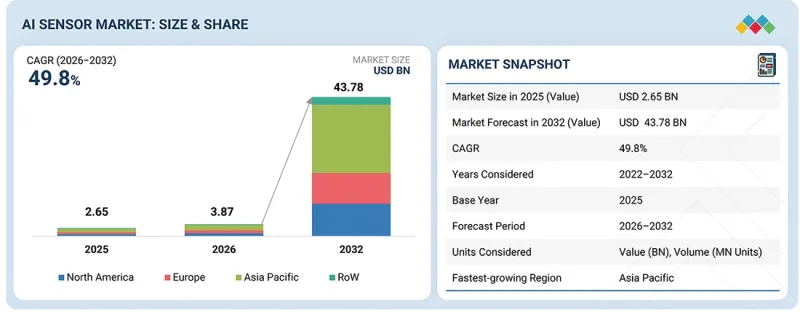
AI 센서 시장 규모는 2026년 38억 7,000만 달러에서 확대되어 2032년까지 437억 8,000만 달러에 달할 것으로 예측되며, 예측 기간 동안 CAGR은 49.8%를 기록할 전망입니다.
클라우드를 이용하지 않고도 기기에서 직접 실시간 추론을 실행할 수 있는 엣지 AI 지원 센싱 시스템의 도입이 증가함에 따라, 해당 시장은 눈부신 성장을 이루고 있습니다. AI 지원 이미지 센서, 모션 센서, LiDAR, 레이더 및 환경 감지 모듈은 자율 시스템, 산업용 자동화 플랫폼, 로봇 공학, 스마트 인프라 애플리케이션에 점점 더 많이 통합되고 있습니다.
| 조사 범위 | |
|---|---|
| 조사 대상 기간 | 2021-2032년 |
| 기준 연도 | 2025년 |
| 예측 기간 | 2026-2032년 |
| 산정 단위 | 금액(10억 달러) |
| 부문 | 센서 유형별, 기술별, 아키텍처 유형별, 용도별, 지역별 |
| 대상 지역 | 북미, 유럽, 아시아태평양, 기타 지역 |
또한, 인더스트리 4.0, 스마트 제조 및 예측 유지보수 시스템의 급속한 확산에 따라, 맥락 인식 및 적응형 분석이 가능한 AI 기반 센싱 아키텍처에 대한 수요가 증가하고 있습니다. 멀티모달 센싱, 센서 융합 시스템, 그리고 엣지 기반 지각 플랫폼에 대한 관심이 높아지면서, 전 세계 AI 센서 생태계 전반에 걸친 혁신과 상용화가 더욱 가속화되고 있습니다.
“예측 기간 동안 센싱 융합 시스템 부문이 가장 높은 성장률을 보일 것으로 예상됩니다.”
센싱 아키텍처별로 살펴보면, 센싱 융합 시스템 부문은 독립형 AI 센싱에 비해 더 복잡한 하드웨어 설계, 더 많은 통합 노력, 그리고 더 정밀한 보정이 필요하기 때문에 현재 시장 점유율이 낮은 상황입니다. 단일 모달리티 센서와 달리, 비전, 레이더, IMU, 오디오, 환경 감지 등 2개 이상의 소스에서 얻은 입력을 결합하기 때문에 현재로서는 비용과 도입의 복잡성이 증가하고 있습니다. 그러나 최종사용자 산업 분야에서 가혹한 환경 하에서도 더욱 풍부한 맥락 인식, 더 높은 정확도, 그리고 더 신뢰할 수 있는 의사결정에 대한 수요가 증가하고 있는 만큼, 2032년까지 해당 부문의 시장 점유율은 상승할 것으로 예상됩니다. 센싱 융합 시스템은 자율주행차, 로봇공학, 산업용 자동화, 스마트 인프라 등의 분야에서 주목받고 있으며, 이러한 분야에서는 융합된 지각 기능이 단일 센서 솔루션보다 뛰어난 성능을 발휘합니다.
“예측 기간 동안 자동차·모빌리티 분야가 AI 센서 시장의 성장을 주도할 것으로 예상됩니다.”
용도별로는 자동차·모빌리티 분야가 예측 기간 동안 AI 센서 시장의 성장을 주도할 것으로 전망됩니다. 이는 차량이 급속도로 지능화, 커넥티비티화되고, 소프트웨어 주도형으로 진화하고 있기 때문입니다. 이 분야에서는 운전자 모니터링, 탑승자 감지, 주차 보조, 차량 내 인텔리전스, 첨단 운전자 보조 시스템(ADAS) 등의 안전 및 인식 기능을 지원할 수 있는 AI 센서에 대한 수요가 증가하고 있습니다. 또한, 자동차 제조사들은 정확도와 실시간 응답성을 높이기 위해 여러 센서 입력을 결합하는 추세이며, 이에 따라 엣지 기반 AI 센싱 솔루션에 대한 수요가 증가하고 있습니다. 그 결과, 자동차 부문은 승용차와 상용차 모두에서 AI 센서의 가장 중요한 도입 분야로 부상하고 있습니다.
“예측 기간 동안 아시아태평양은 AI 센서 시장에서 가장 높은 성장률을 기록할 것으로 예상됩니다.”
아시아태평양은 스마트 모빌리티, 첨단 제조, 커넥티드 디지털 인프라로의 전환이 급속히 진행되고 있어, 예측 기간 동안 AI 센서 시장에서 가장 높은 성장률을 보일 것으로 전망됩니다. 중국, 일본, 한국, 인도 및 동남아시아 일부 국가에서는 운전자 모니터링, ADAS(첨단 운전자 보조 시스템), 머신비전, 스마트 팩토리, 도시 모빌리티 시스템 등의 분야에서 AI 센서의 활용이 확대되고 있습니다. 견조한 전자기기 생산, 자동화의 진전, 그리고 지능형 엣지 디바이스에 대한 수요 확대가 이 지역 전체에서 이러한 솔루션의 보급을 가속화하고 있습니다.
2차 조사를 통해 수집된 각종 부문 및 하위 부문의 시장 규모를 파악하고 검증하기 위해 AI 센서 솔루션을 제공하는 주요 업계 전문가들을 대상으로 광범위한 1차 인터뷰가 실시되었습니다. 본 조사에는 부품 공급업체부터 1차 협력사, OEM에 이르기까지 다양한 업계 전문가들의 인사이트이 포함되어 있습니다.
본 보고서에서는 AI 센서 시장의 주요 기업들을 각각의 시장 순위 분석과 함께 소개하고 있습니다. 본 보고서에서 다루고 있는 주요 기업은 Bosch Sensortec(독일), Sony Semiconductor Solutions Corporation(일본), Teledyne Technologies Incorporated(미국), 그리고 TDK Corporation(일본)입니다. 이 밖에도 OMNIVISION Technologies, Inc.(미국), onsemi(미국), Ambarella, Inc.(미국), Prophesee S.A.(프랑스), AIStorm, Inc.(미국) 등이 AI 센서 시장에서 소수의 기타 기업으로 꼽힙니다.
조사 범위:
본 조사 보고서에서는 AI 센서 시장을 센서 종류, 용도, 기술, 아키텍처 유형 및 지역별로 분류하고 있습니다. 본 보고서에서는 AI 센서 시장과 관련된 주요 촉진요인, 제약요인, 과제 및 기회에 대해 설명하고, 2032년까지의 시장 전망을 제시하고 있습니다. 이 외에도 본 보고서에는 AI 센서 시장 생태계에 속한 모든 기업에 대한 리더십 매핑 및 분석이 포함되어 있습니다.
본 보고서를 구매할 때의 주요 이점
본 보고서는 AI 센서 시장 전체 및 각 하위 부문의 수치에 대한 가장 정확한 추정치를 제공함으로써, 이 시장의 선도 기업과 신규 진입 기업을 지원합니다. 이해관계자들이 경쟁 구도를 이해하고, 자사의 비즈니스를 더 나은 위치로 이끌며, 적절한 시장 진입 전략을 수립하는 데 필요한 추가적인 인사이트를 얻는 데 도움이 됩니다. 또한, 본 보고서는 이해관계자들이 시장 동향을 파악할 수 있도록 지원하며, 주요 시장 촉진요인, 억제요인, 과제 및 기회에 대한 정보를 제공합니다.
본 보고서에서는 다음 사항에 대한 인사이트를 제공합니다:
- 주요 촉진요인 분석(자율 시스템, 산업 자동화, 스마트 기기에서 엣지 AI 및 실시간 온디바이스 추론의 채택 확대; 웨어러블, 히어러블, XR 기기, 스마트홈 제품을 포함한 AI 탑재 가전 제품에 대한 수요 증가), 제약요인(소형 배터리 구동 기기의 높은 전력 소비 및 열적 제약; 개인정보 보호, 사이버 보안, 규정 준수 관련 우려 증가), 기회(AI PC, 스마트 글라스, XR 시스템, 멀티모달 웨어러블의 도입 가속화; 로봇 공학, 자율 시스템, 스마트 산업 인프라의 성장), 과제(엣지 환경에서의 정확도, 지연 시간, 초저전력 소비 간의 균형 조정; 고도화된 모델에 대한 연산 능력, 메모리, 열적 여유 제한)
- 제품 개발/혁신 : AI 센서 시장의 향후 기술, 연구개발 활동 및 신제품·서비스 출시에 관한 상세한 인사이트
- 시장 개발 : 수익성이 높은 시장에 대한 종합적인 정보 - 본 보고서에서는 다양한 지역에 걸친 AI 센서 시장을 분석하고 있습니다.
- 시장의 다양화 : AI 센서 시장의 제품 및 서비스, 미개척 지역, 최근 동향, 그리고 투자에 관한 종합적인 정보
경쟁사 분석 : Bosch Sensortec(독일), Sony Semiconductor Solutions Corporation(일본), OMNIVISION Technologies, Inc.(미국), onsemi(미국), Teledyne Technologies Incorporated(미국), TDK Corporation(일본) 등 주요 기업의 시장 점유율, 성장 전략 및 서비스 제공 내용에 대한 상세한 평가.
자주 묻는 질문
목차
제1장 소개
제2장 주요 요약
제3장 주요 인사이트
제4장 시장 개요
제5장 업계 동향
제6장 기술 진보, AI에 의한 영향, 특허, 그리고 혁신
제7장 규제 상황
제8장 고객 상황과 구매 행동
제9장 AI 센서 시장(센서 유형별)
제10장 AI 센서 시장(기술별)
제11장 AI 센서 시장(아키텍처 유형별)
제12장 AI 센서 시장(용도별)
제13장 AI 센서 시장(지역별)
제14장 경쟁 구도
제15장 기업 개요
제16장 조사 방법
제17장 부록
KSM 26.06.30The AI sensor market is projected to reach USD 43.78 billion by 2032, growing from USD 3.87 billion in 2026, registering a CAGR of 49.8% during the forecast period. The market is witnessing significant growth due to the increasing deployment of edge AI-enabled sensing systems capable of performing real-time inference directly on devices without cloud dependency. AI-enabled image sensors, motion sensors, LiDAR, radar, and environmental sensing modules are increasingly being integrated into autonomous systems, industrial automation platforms, robotics, and smart infrastructure applications.
| Scope of the Report | |
|---|---|
| Years Considered for the Study | 2021-2032 |
| Base Year | 2025 |
| Forecast Period | 2026-2032 |
| Units Considered | Value (USD Billion) |
| Segments | By Sensor Type, Technology, Architecture and Region |
| Regions covered | North America, Europe, APAC, RoW |
Additionally, the rapid expansion of Industry 4.0, smart manufacturing, and predictive maintenance systems is driving the demand for AI-powered sensing architectures capable of contextual awareness and adaptive analytics. Increasing emphasis on multimodal sensing, sensor fusion systems, and edge-based perception platforms is further driving innovation and commercialization across the global AI Sensor ecosystem.
"The sensing fusion system segment is expected to register the highest growth during the forecast period."
By sensing architecture, the sensing fusion system segment currently holds a smaller share because they require more complex hardware design, higher integration effort, and tighter calibration than standalone AI sensing. Unlike single-modality sensors, they combine inputs from two or more sources, such as vision, radar, IMU, audio, or environmental sensing, which raises cost and deployment complexity today. However, the segment's share is expected to rise by 2032 because end-use industries increasingly need richer contextual awareness, higher accuracy, and more reliable decisions in difficult environments. Sensing fusion systems are gaining traction in autonomous vehicles, robotics, industrial automation, and smart infrastructure, where fused perception delivers better performance than single-sensor solutions.
"The automotive & mobility segment is expected to lead the growth of the AI sensor market during the forecast period."
By application, the automotive & mobility segment is expected to lead the growth of the AI sensor market during the forecast period because vehicles are rapidly becoming more intelligent, connected, and software-driven. Demand in this segment is rising for AI sensors that can support safety and perception functions such as driver monitoring, occupant sensing, parking support, in-cabin intelligence, and advanced driver assistance. Automakers are also combining multiple sensing inputs to improve accuracy and response in real time, which is increasing the need for edge-based AI sensing solutions. As a result, the automotive sector is emerging as the most important deployment area for AI sensors across both passenger and commercial vehicles.
"Asia Pacific is expected to register the highest growth in the AI sensor market during the forecast period."
Asia Pacific is likely to grow at the highest rate in the AI sensor market during the forecast period because the region is moving quickly toward smarter mobility, advanced manufacturing, and connected digital infrastructure. Countries such as China, Japan, South Korea, India, and parts of Southeast Asia are increasing use of AI sensors in applications like driver monitoring, ADAS, machine vision, smart factories, and urban mobility systems. Strong electronics production, rising automation, and expanding demand for intelligent edge devices are helping these solutions scale faster across the region.
Extensive primary interviews were conducted with key industry experts offering AI sensor solutions to determine and verify the market size for various segments and subsegments gathered through secondary research. The study contains insights from various industry experts, from component suppliers to Tier 1 companies and OEMs.
The break-up of the primaries is as follows:
- By Company Type: Tier 1 - 40%, Tier 2 - 35%, and Tier 3 - 25%
- By Designation: C-level Executives - 40%, Directors - 45%, and Others - 15%
- By Region: Asia Pacific - 41%, North America - 26%, Europe - 28%, and Rest of the World - 5%
The report profiles key players in the AI sensor market with their respective market ranking analysis. Prominent players profiled in this report are Bosch Sensortec (Germany), Sony Semiconductor Solutions Corporation (Japan), Teledyne Technologies Incorporated (US), and TDK Corporation (Japan). Apart from this, OMNIVISION Technologies, Inc. (US), onsemi (US), Ambarella, Inc. (US), Prophesee S.A. (France), AIStorm, Inc. (US), among others, are among the few other companies in the AI sensor market.
Research Coverage:
This research report categorizes the AI sensor market based on sensor type, application, technology, architecture type, and region. The report describes the major drivers, restraints, challenges, and opportunities pertaining to the AI sensor market and forecasts the same till 2032. Apart from this, the report also consists of leadership mapping and analysis of all the companies included in the AI sensor market ecosystem.
Key Benefits of Buying the Report
The report will help the market leaders/new entrants in this market with information on the closest approximations of the numbers for the overall AI sensor market and the subsegments. It will help stakeholders understand the competitive landscape and gain more insights to position their businesses better and plan suitable go-to-market strategies. The report also helps stakeholders understand the pulse of the market and provides them with information on key market drivers, restraints, challenges, and opportunities.
The report provides insights into the following pointers:
- Analysis of key drivers (Rising adoption of edge AI and real-time on-device inference across autonomous systems, industrial automation, and smart devices; growing demand for AI-enabled consumer electronics including wearables, hearables, XR devices, and smart home products), restraints (High power use and thermal limits in compact, battery-powered devices; growing concerns around privacy, cybersecurity, and compliance), opportunities (Faster adoption of AI PCs, smart glasses, XR systems, and multimodal wearables; growth in robotics, autonomous systems, and smart industrial infrastructure), challenges (Balancing accuracy, latency, and ultra-low power at the edge; limited compute, memory, and thermal headroom for advanced models)
- Product Development/Innovation: Detailed insights into upcoming technologies, research & development activities, and new product & service launches in the AI sensor market
- Market Development: Comprehensive information about lucrative markets-the report analyzes the AI sensor market across varied regions
- Market Diversification: Exhaustive information about products & services, untapped geographies, recent developments, and investments in the AI sensor market
Competitive Assessment: In-depth assessment of market shares, growth strategies, and service offerings of leading players, such as Bosch Sensortec (Germany), Sony Semiconductor Solutions Corporation (Japan), OMNIVISION Technologies, Inc. (US), onsemi (US), Teledyne Technologies Incorporated (US), and TDK Corporation (Japan).
TABLE OF CONTENTS
1 INTRODUCTION
- 1.1 STUDY OBJECTIVES
- 1.2 MARKET DEFINITION
- 1.3 MARKET SCOPE
- 1.3.1 MARKET SEGMENTATION AND REGIONAL SCOPE
- 1.3.2 INCLUSIONS AND EXCLUSIONS
- 1.3.3 YEARS CONSIDERED
- 1.4 CURRENCY CONSIDERED
- 1.5 UNIT CONSIDERED
- 1.6 LIMITATIONS
- 1.7 STAKEHOLDERS
- 1.8 SUMMARY OF CHANGES
2 EXECUTIVE SUMMARY
- 2.1 MARKET HIGHLIGHTS AND KEY INSIGHTS
- 2.2 KEY MARKET PARTICIPANTS: MAPPING OF STRATEGIC DEVELOPMENTS
- 2.3 DISRUPTIVE TRENDS IN AI SENSOR MARKET
- 2.4 HIGH-GROWTH SEGMENTS
- 2.5 REGIONAL SNAPSHOT: MARKET SIZE, GROWTH RATE, AND FORECAST
3 PREMIUM INSIGHTS
- 3.1 ATTRACTIVE OPPORTUNITIES FOR PLAYERS IN AI SENSOR MARKET
- 3.2 AI SENSOR MARKET, BY SENSOR TYPE
- 3.3 AI SENSOR MARKET, BY TECHNOLOGY
- 3.4 AI SENSOR MARKET, BY ARCHITECTURE TYPE
- 3.5 AI SENSOR MARKET, BY APPLICATION
- 3.6 AI SENSOR MARKET, BY COUNTRY
4 MARKET OVERVIEW
- 4.1 INTRODUCTION
- 4.2 MARKET DYNAMICS
- 4.2.1 DRIVERS
- 4.2.1.1 Rising adoption of edge AI and real-time on-device inference across autonomous systems, industrial automation, and smart devices
- 4.2.1.2 Growing demand for AI-enabled consumer electronics, including wearables, hearables, XR devices, and smart home products
- 4.2.1.3 Increasing deployment of AI sensing technologies in automotive applications such as ADAS, driver monitoring, and in-cabin sensing
- 4.2.1.4 Expansion of industrial automation, machine vision, and predictive maintenance systems within Industry 4.0 environments
- 4.2.2 RESTRAINTS
- 4.2.2.1 Power consumption and thermal management limitations in compact and battery-operated AI sensing devices
- 4.2.2.2 Rising concerns related to data privacy, cybersecurity, and regulatory compliance for AI-enabled sensing systems
- 4.2.3 OPPORTUNITIES
- 4.2.3.1 Growing adoption of AI-native edge devices such as AI PCs, smart glasses, XR systems, and multimodal wearable platforms
- 4.2.3.2 Expansion of robotics, autonomous systems, and smart industrial infrastructure requiring contextual AI perception
- 4.2.3.3 Increasing demand for AI-driven healthcare monitoring, smart diagnostics, and remote patient sensing solutions
- 4.2.3.4 Rising investments in spatial computing, immersive technologies, and next-generation human-machine interaction systems
- 4.2.4 CHALLENGES
- 4.2.4.1 Difficulty in balancing inference accuracy, latency, and ultra-low-power operation in edge AI sensing environments
- 4.2.4.2 Limited compute, memory, and thermal resources for running advanced AI models directly on embedded sensing devices
- 4.2.1 DRIVERS
- 4.3 INTERCONNECTED MARKETS AND CROSS-SECTOR OPPORTUNITIES
- 4.3.1 INTERCONNECTED MARKETS
- 4.3.2 CROSS-SECTOR OPPORTUNITIES
- 4.4 STRATEGIC MOVES BY TIER 1/2/3 PLAYERS
5 INDUSTRY TRENDS
- 5.1 INTRODUCTION
- 5.2 PORTER'S FIVE FORCES ANALYSIS
- 5.2.1 THREAT OF NEW ENTRANTS
- 5.2.2 THREAT OF SUBSTITUTES
- 5.2.3 BARGAINING POWER OF SUPPLIERS
- 5.2.4 BARGAINING POWER OF BUYERS
- 5.2.5 INTENSITY OF COMPETITIVE RIVALRY
- 5.3 MACROECONOMIC OUTLOOK
- 5.3.1 INTRODUCTION
- 5.3.2 GDP TRENDS AND FORECAST
- 5.4 SUPPLY CHAIN ANALYSIS
- 5.5 ECOSYSTEM ANALYSIS
- 5.6 PRICING ANALYSIS
- 5.6.1 INDICATIVE PRICE OF AI IMAGE SENSOR MODULES, BY KEY PLAYER, 2025
- 5.6.2 AVERAGE SELLING PRICE TREND OF AI SENSOR, BY SENSOR TYPE
- 5.6.3 AVERAGE SELLING PRICE TREND OF AI SENSOR, BY REGION
- 5.7 TRADE ANALYSIS
- 5.7.1 IMPORT SCENARIO (HS CODE 902690)
- 5.7.2 EXPORT SCENARIO (HS CODE 902690)
- 5.8 KEY CONFERENCES AND EVENTS, 2026-2027
- 5.9 TRENDS/DISRUPTIONS IMPACTING CUSTOMER BUSINESS
- 5.10 INVESTMENT AND FUNDING SCENARIO, 2022-2026
- 5.11 CASE STUDY ANALYSIS
- 5.11.1 BOSCH DEPLOYMENT OF AI SENSORS AND PREDICTIVE ANALYTICS FOR SMART MANUFACTURING EFFICIENCY AND EQUIPMENT MONITORING
- 5.11.2 INTEGRATION OF NEXEED SMART MANUFACTURING SOLUTIONS AND OPERATIONAL PERFORMANCE IMPROVEMENTS AT BOSCH
- 5.12 IMPACT OF 2025 US TARIFF ON AI SENSOR MARKET
- 5.12.1 INTRODUCTION
- 5.12.2 KEY TARIFF RATES
- 5.12.3 PRICE IMPACT ANALYSIS
- 5.12.4 IMPACT ON COUNTRIES/REGIONS
- 5.12.4.1 US
- 5.12.4.2 Europe
- 5.12.4.3 Asia Pacific
- 5.12.5 IMPACT ON END USERS
6 TECHNOLOGICAL ADVANCEMENTS, AI-DRIVEN IMPACT, PATENTS, AND INNOVATIONS
- 6.1 KEY EMERGING TECHNOLOGIES
- 6.1.1 EDGE AI AND AI-IN-SENSOR INTEGRATION
- 6.1.2 ADVANCED MEMS AND SMART SENSOR FUSION
- 6.1.3 AI VISION AND SPATIAL PERCEPTION
- 6.1.4 NEURAL NETWORKS
- 6.1.5 CASE-BASED REASONING
- 6.1.6 INDUCTIVE LEARNING
- 6.1.7 AMBIENT INTELLIGENCE
- 6.1.8 EDGE AI INFERENCE
- 6.2 COMPLEMENTARY TECHNOLOGIES
- 6.2.1 EDGE COMPUTING AND AI ANALYTICS PLATFORMS
- 6.2.2 WIRELESS CONNECTIVITY AND INTELLIGENT IOT INFRASTRUCTURE
- 6.2.3 AI CYBERSECURITY AND TRUSTED EDGE ARCHITECTURES
- 6.3 ADJACENT TECHNOLOGIES
- 6.3.1 MACHINE LEARNING AND PREDICTIVE ANALYTICS
- 6.3.2 DIGITAL TWINS AND INTELLIGENT SIMULATION
- 6.3.3 SPATIAL COMPUTING AND HUMAN-MACHINE INTERACTION
- 6.4 TECHNOLOGY ROADMAP
- 6.5 PATENT ANALYSIS
7 REGULATORY LANDSCAPE
- 7.1 INTRODUCTION
- 7.1.1 REGULATORY BODIES, GOVERNMENT AGENCIES, AND OTHER ORGANIZATIONS
- 7.1.2 STANDARDS
8 CUSTOMER LANDSCAPE AND BUYER BEHAVIOR
- 8.1 DECISION-MAKING PROCESS
- 8.2 KEY STAKEHOLDERS IN BUYING PROCESS AND EVALUATION CRITERIA
- 8.2.1 KEY STAKEHOLDERS IN BUYING PROCESS
- 8.2.2 BUYING CRITERIA
- 8.3 ADOPTION BARRIERS AND INTERNAL CHALLENGES
- 8.4 UNMET NEEDS FROM VARIOUS APPLICATIONS
9 AI SENSOR MARKET, BY SENSOR TYPE
- 9.1 INTRODUCTION
- 9.2 MOTION & POSITION SENSORS
- 9.2.1 INCREASING IMPORTANCE OF MOTION INTELLIGENCE IN EDGE AI APPLICATIONS TO DRIVE MARKET
- 9.3 ULTRASONIC SENSORS
- 9.3.1 AI-ENABLED NAVIGATION AND OBSTACLE DETECTION TO INCREASE DEMAND
- 9.4 IMAGE SENSORS
- 9.4.1 AI-BASED VISION APPLICATIONS ACCELERATING INTEGRATION OF IMAGE SENSORS IN AUTOMOTIVE AND INDUSTRIAL SYSTEMS
- 9.5 RADAR SENSORS
- 9.5.1 RISING NEED FOR FAST AND RELIABLE ENVIRONMENTAL PERCEPTION TO BOOST ADOPTION
- 9.6 LIDAR SENSORS
- 9.6.1 HIGH-RESOLUTION DEPTH SENSING TO DRIVE ADOPTION
- 9.7 ENVIRONMENTAL SENSORS
- 9.7.1 GROWING NEED FOR REAL-TIME ENVIRONMENTAL INTELLIGENCE TO DRIVE MARKET
- 9.8 PRESSURE SENSORS
- 9.8.1 USEFUL IN ENVIRONMENTS WHERE CONSISTENT PHYSICAL MEASUREMENT SUPPORTS AUTOMATION, SAFETY, AND PERFORMANCE OPTIMIZATION
- 9.9 TEMPERATURE SENSORS
- 9.9.1 NEED FOR REAL-TIME PERFORMANCE MONITORING TO DRIVE ADOPTION
- 9.10 OTHER AI SENSORS
10 AI SENSOR MARKET, BY TECHNOLOGY
- 10.1 INTRODUCTION
- 10.2 MACHINE LEARNING
- 10.2.1 DEEP LEARNING
- 10.2.1.1 Offers ability to build hierarchical representations
- 10.2.2 SUPERVISED LEARNING
- 10.2.2.1 Algorithm learns to make predictions or decisions based on labeled training data
- 10.2.3 UNSUPERVISED LEARNING
- 10.2.3.1 Includes clustering methods consisting of algorithms with unlabeled training data
- 10.2.4 REINFORCEMENT LEARNING
- 10.2.4.1 Allows systems and software to determine ideal behavior for maximizing performance of systems
- 10.2.5 OTHER MACHINE LEARNING TECHNOLOGIES
- 10.2.1 DEEP LEARNING
- 10.3 NATURAL LANGUAGE PROCESSING
- 10.3.1 REAL-TIME TRANSLATION AND ABILITY TO COMMUNICATE IN NATURAL LANGUAGE WITH SYSTEMS TO SUPPORT MARKET GROWTH
- 10.4 CONTEXT-AWARE COMPUTING
- 10.4.1 HIGH DEMAND FOR HARD AND SOFT SENSORS TO DRIVE MARKET
- 10.5 COMPUTER VISION
- 10.5.1 DEVELOPING ALGORITHMS AND TECHNIQUES TO ANALYZE, PROCESS, AND INTERPRET DIGITAL IMAGES AND VIDEOS TO PROPEL MARKET
11 AI SENSOR MARKET, BY ARCHITECTURE TYPE
- 11.1 INTRODUCTION
- 11.2 STANDALONE AI SENSING
- 11.2.1 SIMPLER DEPLOYMENT AND COST EFFICIENCY TO PROPEL MARKET
- 11.3 SENSING FUSION SYSTEMS
- 11.3.1 ABILITY TO BUILD HIERARCHICAL REPRESENTATIONS TO SUPPORT ADOPTION
12 AI SENSOR MARKET, BY APPLICATION
- 12.1 INTRODUCTION
- 12.2 AUTOMOTIVE & MOBILITY
- 12.2.1 AI SENSORS ENABLE ADAS, DRIVER MONITORING, AND AUTONOMOUS DRIVING
- 12.3 CONSUMER ELECTRONICS & WEARABLES
- 12.3.1 INCLINATION TOWARD SMART AND INTELLIGENT DEVICES TO DRIVE MARKET
- 12.4 INDUSTRIAL MANUFACTURING & ROBOTICS
- 12.4.1 MACHINE VISION AND ROBOTICS DRIVING PRECISION IN INDUSTRIAL OPERATIONS
- 12.5 AEROSPACE, DEFENSE, & PUBLIC SAFETY
- 12.5.1 NEED TO STRENGTHEN SURVEILLANCE, NAVIGATION, AND MISSION SAFETY TO PROPEL MARKET
- 12.6 SMART HOMES, BUILDINGS, & INFRASTRUCTURE
- 12.6.1 INCREASING NEED TO IMPROVE HOME SECURITY TO DRIVE MARKET
- 12.7 HEALTHCARE & LIFE SCIENCES
- 12.7.1 NEED FOR EARLY DETECTION OF DISEASES AND REDUCING DIAGNOSTIC DELAYS TO PROPEL MARKET
- 12.8 RETAIL, LOGISTICS, & SUPPLY CHAIN
- 12.8.1 AI SENSORS IMPROVE INVENTORY TRACKING AND WAREHOUSE EFFICIENCY
- 12.9 AGRICULTURE & ENVIRONMENTAL MONITORING
- 12.9.1 IMPROVED CROP HEALTH AND BETTER MANAGEMENT OF RESOURCES TO DRIVE MARKET
- 12.10 OTHER APPLICATIONS
13 AI SENSOR MARKET, BY REGION
- 13.1 INTRODUCTION
- 13.2 NORTH AMERICA
- 13.2.1 US
- 13.2.1.1 Presence of leading AI sensor manufacturers to drive market
- 13.2.2 CANADA
- 13.2.2.1 Growing automation in automotive and manufacturing sectors to drive market
- 13.2.3 MEXICO
- 13.2.3.1 Increasing demand for temperature sensors for medical equipment to drive market
- 13.2.1 US
- 13.3 EUROPE
- 13.3.1 GERMANY
- 13.3.1.1 Government initiatives for promoting the implementation of Industry 4.0 to drive market
- 13.3.2 UK
- 13.3.2.1 Consumer electronics sector to create growth opportunities
- 13.3.3 FRANCE
- 13.3.3.1 Growth of industrial manufacturing sector to propel market
- 13.3.4 SPAIN
- 13.3.4.1 Growing adoption of smart manufacturing and AI-enabled technologies to drive market
- 13.3.5 ITALY
- 13.3.5.1 Automotive innovation and adoption of industrial robotics to propel market
- 13.3.6 NORDICS
- 13.3.6.1 Strong focus on smart healthcare, sustainable technologies, and industrial digitalization to drive market
- 13.3.7 REST OF EUROPE
- 13.3.1 GERMANY
- 13.4 ASIA PACIFIC
- 13.4.1 CHINA
- 13.4.1.1 Presence of prominent automotive, aerospace & defense, and electronics companies to fuel market growth
- 13.4.2 JAPAN
- 13.4.2.1 Presence of leading sensor manufacturing companies to drive market
- 13.4.3 INDIA
- 13.4.3.1 Strong government support for adoption of industrial automation to propel market
- 13.4.4 SOUTH KOREA
- 13.4.4.1 Increasing demand for advanced sensors from electronics and automotive industries to support market growth
- 13.4.5 AUSTRALIA
- 13.4.5.1 Rising adoption of smart mining, healthcare technologies, and industrial automation to drive market
- 13.4.6 REST OF ASIA PACIFIC
- 13.4.1 CHINA
- 13.5 ROW
- 13.5.1 MIDDLE EAST
- 13.5.1.1 GCC Countries
- 13.5.1.1.1 Large-scale smart city and energy infrastructure projects to drive market
- 13.5.1.2 Rest of Middle East & Africa
- 13.5.1.1 GCC Countries
- 13.5.2 AFRICA
- 13.5.2.1 South Africa
- 13.5.2.1.1 Increasing adoption of smart mining and industrial monitoring technologies to drive market
- 13.5.2.2 Rest of Africa
- 13.5.2.1 South Africa
- 13.5.3 SOUTH AMERICA
- 13.5.3.1 Brazil
- 13.5.3.1.1 Growing adoption of precision agriculture and industrial automation to propel market
- 13.5.3.2 Argentina
- 13.5.3.2.1 Expansion of smart agriculture and food processing automation to drive market
- 13.5.3.3 Rest of South America
- 13.5.3.1 Brazil
- 13.5.1 MIDDLE EAST
14 COMPETITIVE LANDSCAPE
- 14.1 INTRODUCTION
- 14.2 KEY PLAYER COMPETITIVE STRATEGIES/RIGHT TO WIN, 2022-2026
- 14.3 REVENUE ANALYSIS, 2021-2025
- 14.4 MARKET SHARE ANALYSIS, 2025
- 14.5 COMPANY VALUATION AND FINANCIAL METRICS
- 14.6 BRAND COMPARISON
- 14.6.1 BOSCH SENSORTEC GMBH
- 14.6.2 SONY SEMICONDUCTOR SOLUTIONS CORPORATION
- 14.6.3 KEYENCE CORPORATION
- 14.6.4 TELEDYNE TECHNOLOGIES INCORPORATED
- 14.6.5 SEMICONDUCTOR COMPONENTS INDUSTRIES, LLC
- 14.7 COMPANY EVALUATION MATRIX: KEY PLAYERS, 2025
- 14.7.1 STARS
- 14.7.2 EMERGING LEADERS
- 14.7.3 PERVASIVE PLAYERS
- 14.7.4 PARTICIPANTS
- 14.7.5 COMPANY FOOTPRINT: KEY PLAYERS, 2025
- 14.7.5.1 Company footprint
- 14.7.5.2 Region footprint
- 14.7.5.3 Sensor type footprint
- 14.7.5.4 Technology footprint
- 14.7.5.5 Application footprint
- 14.7.5.6 Architecture type footprint
- 14.8 COMPANY EVALUATION MATRIX: STARTUPS/SMES, 2025
- 14.8.1 PROGRESSIVE COMPANIES
- 14.8.2 RESPONSIVE COMPANIES
- 14.8.3 DYNAMIC COMPANIES
- 14.8.4 STARTING BLOCKS
- 14.8.5 COMPETITIVE BENCHMARKING: STARTUPS/SMES, 2025
- 14.8.5.1 Detailed list of key startups/SMEs
- 14.8.5.2 Competitive benchmarking of key startups/SMEs
- 14.9 COMPETITIVE SCENARIO
- 14.9.1 PRODUCT LAUNCHES
- 14.9.2 DEALS
15 COMPANY PROFILES
- 15.1 KEY PLAYERS
- 15.1.1 BOSCH SENSORTEC GMBH
- 15.1.1.1 Business overview
- 15.1.1.2 Products/Solutions/Services offered
- 15.1.1.3 Recent developments
- 15.1.1.3.1 Product launches
- 15.1.1.4 MnM view
- 15.1.1.4.1 Key strengths
- 15.1.1.4.2 Strategic choices
- 15.1.1.4.3 Weaknesses and competitive threats
- 15.1.2 SONY SEMICONDUCTOR SOLUTIONS CORPORATION
- 15.1.2.1 Business overview
- 15.1.2.2 Products/Solutions/Services offered
- 15.1.2.3 Recent developments
- 15.1.2.3.1 Deals
- 15.1.2.4 MnM view
- 15.1.2.4.1 Key strengths
- 15.1.2.4.2 Strategic choices
- 15.1.2.4.3 Weaknesses and competitive threats
- 15.1.3 KEYENCE CORPORATION
- 15.1.3.1 Business overview
- 15.1.3.2 Products/Solutions/Services offered
- 15.1.3.3 Recent developments
- 15.1.3.3.1 Product launches
- 15.1.3.3.2 Deals
- 15.1.3.4 MnM view
- 15.1.3.4.1 Key strengths
- 15.1.3.4.2 Strategic choices
- 15.1.3.4.3 Weaknesses and competitive threats
- 15.1.4 TELEDYNE TECHNOLOGIES INCORPORATED
- 15.1.4.1 Business overview
- 15.1.4.2 Products/Solutions/Services offered
- 15.1.4.3 Recent developments
- 15.1.4.3.1 Product launches
- 15.1.4.3.2 Deals
- 15.1.4.4 MnM view
- 15.1.4.4.1 Key strengths
- 15.1.4.4.2 Strategic choices
- 15.1.4.4.3 Weaknesses and competitive threats
- 15.1.5 SEMICONDUCTOR COMPONENTS INDUSTRIES, LLC
- 15.1.5.1 Business overview
- 15.1.5.2 Products/Solutions/Services offered
- 15.1.5.3 Recent developments
- 15.1.5.3.1 Product launches
- 15.1.5.3.2 Deals
- 15.1.5.4 MnM view
- 15.1.5.4.1 Key strengths
- 15.1.5.4.2 Strategic choices
- 15.1.5.4.3 Weaknesses and competitive threats
- 15.1.6 RENESAS ELECTRONICS CORPORATION
- 15.1.6.1 Business overview
- 15.1.6.2 Products/Solutions/Services offered
- 15.1.6.3 Recent developments
- 15.1.6.3.1 Deals
- 15.1.7 STMICROELECTRONICS
- 15.1.7.1 Business overview
- 15.1.7.2 Products/Solutions/Services offered
- 15.1.7.3 Recent developments
- 15.1.7.3.1 Product launches
- 15.1.7.3.2 Deals
- 15.1.8 SENSATA TECHNOLOGIES
- 15.1.8.1 Business overview
- 15.1.8.2 Products/Solutions/Services offered
- 15.1.8.3 Recent developments
- 15.1.8.3.1 Product launches
- 15.1.9 SYNTIANT CORP.
- 15.1.9.1 Business overview
- 15.1.9.2 Products/Solutions/Services offered
- 15.1.9.3 Recent developments
- 15.1.9.3.1 Product launches
- 15.1.9.3.2 Deals
- 15.1.10 GOERTEK MICROELECTRONICS CO., LTD.
- 15.1.10.1 Business overview
- 15.1.10.2 Products/Solutions/Services offered
- 15.1.10.3 Recent developments
- 15.1.10.3.1 Product launches
- 15.1.10.3.2 Deals
- 15.1.11 AUGURY INC.
- 15.1.11.1 Business overview
- 15.1.11.2 Products/Solutions/Services offered
- 15.1.11.3 Recent developments
- 15.1.11.3.1 Product launches
- 15.1.11.3.2 Deals
- 15.1.1 BOSCH SENSORTEC GMBH
- 15.2 OTHER PLAYERS
- 15.2.1 AISTORM, INC.
- 15.2.2 AONDEVICES, INC.
- 15.2.3 HARBOR TECHNOLOGY SOLUTIONS CO., LTD.
- 15.2.4 TAIYO YUDEN CO.
- 15.2.5 AROMA BIT, INC.
- 15.2.6 ARTERY TECHNOLOGY (CHONGQING) CO., LTD.
- 15.2.7 YOKOGAWA ELECTRIC CORPORATION
- 15.2.8 TE CONNECTIVITY LTD.
- 15.2.9 SYNAPTICS INCORPORATED
- 15.2.10 INVENSENSE, INC.
- 15.2.11 ANALOG DEVICES, INC.
- 15.2.12 HIMAX TECHNOLOGIES, INC.
- 15.2.13 PROPHESEE
- 15.2.14 ALTERED CARBON LIMITED
- 15.2.15 SENSIRION AG
16 RESEARCH METHODOLOGY
- 16.1 RESEARCH DATA
- 16.2 SECONDARY AND PRIMARY RESEARCH
- 16.2.1 SECONDARY DATA
- 16.2.1.1 Key data from secondary sources
- 16.2.1.2 List of key secondary sources
- 16.2.2 PRIMARY DATA
- 16.2.2.1 Key data from primary sources
- 16.2.2.2 List of primary interview participants
- 16.2.2.3 Breakdown of primaries
- 16.2.2.4 Key industry insights
- 16.2.1 SECONDARY DATA
- 16.3 MARKET SIZE ESTIMATION
- 16.3.1 BOTTOM-UP APPROACH
- 16.3.2 TOP-DOWN APPROACH
- 16.3.3 MARKET SIZE CALCULATION FOR BASE YEAR
- 16.4 MARKET FORECAST APPROACH
- 16.4.1 BOTTOM-UP APPROACH (SUPPLY SIDE)
- 16.4.2 TOP-DOWN APPROACH (DEMAND SIDE)
- 16.5 DATA TRIANGULATION
- 16.6 FACTOR ANALYSIS
- 16.7 RESEARCH ASSUMPTIONS
- 16.8 RESEARCH LIMITATIONS
- 16.9 RISK ANALYSIS
17 APPENDIX
- 17.1 DISCUSSION GUIDE
- 17.2 KNOWLEDGESTORE: MARKETSANDMARKETS' SUBSCRIPTION PORTAL
- 17.3 CUSTOMIZATION OPTIONS
- 17.4 RELATED REPORTS
- 17.5 AUTHOR DETAILS