|
시장보고서
상품코드
2074460
지속가능한 항공연료 시장(-2031년) : 연료 유형(바이오, 수소,이퓨얼), 변환 경로(FT, HEFA, ATJ, CPT), 원료(폐식용유, 농업 잔류물, 고형 폐기물), 혼합 용량, 플랫폼, 지역별Sustainable Aviation Fuel Market by Fuel Type (Bio-based, Hydrogen, E-Fuel), Conversion Pathways (FT, HEFA, ATJ, CPT), Feedstock (Used Cooking Oil, Agricultural Residues, Solid Waste), Blending Capacity, Platform, and Region - Global Forecast to 2031 |
||||||

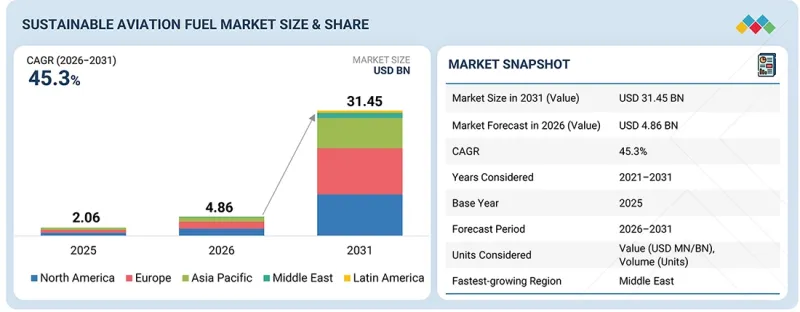
지속가능한 항공연료 시장 규모는 예측 기간 중에 CAGR45.3%로 확대되어 2026년 48억 6,000만 달러에서 2031년에는 314억 5,000만 달러에 이를 전망입니다.
항공 업계가 이산화탄소 배출량 감축 및 지속가능성 목표 달성을 위한 노력을 기울이고 있는 가운데, 해당 시장은 급속히 성장하고 있습니다. 시장의 주요 동향으로는 민간 항공사 및 공항 운영 사업자에 의한 재생 가능 항공 연료 도입 확대가 꼽힙니다.
| 조사 범위 | |
|---|---|
| 조사 대상 기간 | 2020-2031년 |
| 기준연도 | 2025년 |
| 예측 기간 | 2026-2031년 |
| 단위 | 금액(달러) |
| 부문 | 연료 유형, 혼합 용량, 플랫폼, 지역별 |
| 대상 지역 | 북미, 유럽, 아시아태평양, 기타 지역 |
의무화, 인센티브, 배출 감축 정책을 통해 정부와 규제 당국은 시장 활성화를 위해 노력하고 있습니다. 연료 생산업체들은 생산 효율을 높이고 연료 공급을 확보하기 위해 첨단 원료 기술과 정유시설 설비 현대화에 투자하고 있습니다. 항공사, 연료 생산업체, 공항 운영사가 협력하고 있으며, 이는 항공 운항에서 지속가능한 항공 연료(SAF)의 이용 확대를 가속화하는 데 기여하고 있습니다.
“바이오연료 혼합 비율별로 살펴보면, 30%를 초과하는 구간이 예측 기간 동안 가장 높은 연평균 성장률(CAGR)을 보일 것으로 전망됩니다.”
30% 이상의 혼합 능력 부문은 항공사들이 탄소 배출량 감축을 더 높은 수준에서 추진하는 움직임에 발맞추어 성장하고 있습니다. 항공사들도 지속가능성 목표에 더욱 주력하고 있습니다. 정부와 항공 당국은 연료 규정 개정을 통해 지속 가능한 항공 연료(SAF)의 혼합 비율 인상을 지원하고 있습니다. 연료 생산자들은 SAF의 활용 확대를 지원하기 위해 첨단 혼합 기술에 투자하고 있습니다. 인증된 지속 가능한 항공 연료공급이 증가하고 있는 점도 민간 항공 산업 전반에 걸친 혼합 비율 제고를 뒷받침하고 있습니다.
“플랫폼별로는 군용기 부문이 예측 기간 동안 가장 높은 연평균 성장률(CAGR)을 보일 것으로 전망됩니다.”
방위 항공 분야가 연료로 인한 배출량 감축에 힘쓰는 가운데, 군용기 부문은 성장을 거듭하고 있습니다. 많은 국가의 정부가 군용기 사용을 목적으로 한 지속 가능한 항공 연료의 시험을 진행하고 있습니다. 또한 군용기 현대화 프로그램 역시 방위 항공 업무 전반에 걸쳐 더 깨끗한 연료 사용을 촉진하고 있습니다. 또한, 현대화 프로그램은 군용기 운용 전반에 걸쳐 지속 가능한 항공 연료의 도입을 더욱 촉진하고 있습니다.
“2025년에는 북미가 가장 큰 시장 점유율을 차지했습니다.”
북미의 지속 가능한 항공 연료 시장은 재생 가능 항공 연료 도입에 대한 정부의 강력한 지원 덕분에 2025년에 가장 큰 시장 점유율을 차지했습니다. 항공사 및 항공 관련 기업들은 운항에 따른 이산화탄소 배출량을 줄이기 위해 지속 가능한 항공 연료의 조달을 확대되고 있습니다. 주요 연료 생산 기업의 존재와 장기 공급 계약 역시 민간 항공 운항 전반에 걸쳐 지속 가능한 항공 연료의 도입을 뒷받침하고 있습니다.
본 보고서에서는 전 세계 지속가능 항공유 시장을 조사했으며, 시장 개요, 시장 성장에 영향을 미치는 다양한 요인에 대한 분석, 기술 및 특허 동향, 법규제 환경, 사례 연구, 시장 규모 추이 및 전망, 각종 분류·지역/주요 국가별 상세 분석, 경쟁 구도, 주요 기업 프로파일 등을 정리했습니다.
자주 묻는 질문
목차
제1장 서론
제2장 주요 요약
제3장 프리미엄 인사이트
제4장 시장 개요
제5장 업계 동향
제6장 고객 현황과 구매 행동
제7장 규제 상황과 지속가능성 이니셔티브
제8장 기술 진보, AI의 영향, 특허, 혁신, 향후 응용
제9장 지정학적 분쟁이 지속가능한 항공연료 시장에 미치는 영향
제10장 지속가능한 항공연료 시장 : 바이오연료 변환 경로별
제11장 지속가능한 항공연료 시장 : 혼합 용량별
제12장 지속가능한 항공연료 시장 : 연료 유형별
제13장 지속가능한 항공연료 시장 : 플랫폼별
제14장 지속가능한 항공연료 시장 : 원료 유형별
제15장 지속가능한 항공연료 시장 : 지역별
제16장 경쟁 구도
제17장 기업 개요
제18장 조사 방법
제19장 부록
LSH 26.07.06The sustainable aviation fuel market is projected to grow from USD 4.86 billion in 2026 to USD 31.45 billion by 2031 at a CAGR of 45.3% during the forecast period. The market is growing rapidly, owing to initiatives by the aviation industry to reduce carbon emissions and achieve sustainability targets. A major trend in the market is the growing uptake of renewable aviation fuels by commercial airlines and airport operators.
| Scope of the Report | |
|---|---|
| Years Considered for the Study | 2020-2031 |
| Base Year | 2025 |
| Forecast Period | 2026-2031 |
| Units Considered | Value (USD Billion) |
| Segments | By Fuel Type, Capacity, Platform and Region |
| Regions covered | North America, Europe, APAC, RoW |
A combination of mandates, incentives, and emission reduction policies is helping governments and regulators push the market forward. Fuel producers are investing in advanced feedstock technologies and refinery upgrades to increase the efficiency of production and the availability of fuel. Airlines, fuel producers, and airport operators are working together, which is helping to speed up the use of sustainable aviation fuel in aviation operations.
"By biofuel blending capacity, the above 30% segment is projected to grow at the highest CAGR during the forecast period."
The above 30% blending capacity segment is growing in tandem with the airlines' increasing efforts to reduce carbon emissions at a higher level. Aviation companies are also focusing more on sustainability goals. Governments and aviation authorities are supporting higher sustainable aviation fuel blending levels through changing fuel regulations. Fuel producers are investing in advanced blending technologies to support higher SAF usage. The growing availability of certified sustainable aviation fuel is also supporting the adoption of higher blending ratios across commercial aviation operations.
"By platform, the military aircraft segment is projected to grow at the highest CAGR during the forecast period."
The military aircraft segment is witnessing growth as defense aviation strives to reduce fuel emissions. The governments of many countries are testing sustainable aviation fuel for military aircraft use. Military upgrade programs are also pushing cleaner fuel use across defense aviation operations. Modernization programs are further supporting sustainable aviation fuel adoption across military aircraft operations.
"North America captured the largest market share in 2025."
The North American sustainable aviation fuel market captured the largest market share in 2025 due to strong government support for renewable aviation fuel adoption. Airlines and aviation companies are increasing sustainable aviation fuel procurement to reduce carbon emissions from flight operations. The presence of major fuel producers, along with long-term supply agreements, is also supporting sustainable aviation fuel adoption across commercial aviation operations.
The breakdown of profiles for primary participants in the sustainable aviation fuel market is provided below:
- By Company Type: Tier 1 - 35%, Tier 2 - 45%, and Tier 3 - 20%
- By Designation: C Level - 35%, Director Level - 25%, and Others - 40%
- By Region: North America - 25%, Europe - 15%, Asia Pacific - 45%, Middle East - 10%, and Rest of the World (RoW) - 5%
Research Coverage:
This market study examines the sustainable aviation fuel market across various segments and subsegments. It aims to estimate the market's size and growth potential in different regions. The study also provides a detailed competitive analysis of key market players, including their company profiles, product offerings, recent developments, and strategic market initiatives.
Reasons to Buy This Report:
The report will assist market leaders and new entrants with estimates of the revenue figures for the overall sustainable aviation fuel market. It will also enable stakeholders to understand the competitive landscape better and gain insights to position their businesses more effectively and develop appropriate go-to-market strategies. Additionally, the report will help stakeholders understand the market dynamics and provide information on key market drivers, restraints, challenges, and opportunities.
The report provides insights into the following pointers:
- Market Drivers (Rising focus on aviation carbon emission reduction), Restraints (High cost of SAF production), Opportunities (Expansion of renewable fuel production facilities), Challenges (Limited feedstock availability for fuel production)
- Market Penetration: Comprehensive information on the sustainable aviation fuel market offered by the top players in the market
- Product Development/Innovation: Detailed insights into upcoming technologies, research & development activities, and product launches in the market
- Market Development: Comprehensive information about lucrative markets across varied regions
- Market Diversification: Exhaustive information about new products, untapped geographies, recent developments, and investments in the market
- Competitive Assessment: In-depth assessment of market share, growth strategies, products, and manufacturing capabilities of leading players in the sustainable aviation fuel market
TABLE OF CONTENTS
1 INTRODUCTION
- 1.1 STUDY OBJECTIVES
- 1.2 MARKET DEFINITION
- 1.3 STUDY SCOPE
- 1.3.1 MARKET SEGMENTATION AND REGIONAL SCOPE
- 1.3.2 INCLUSIONS AND EXCLUSIONS
- 1.3.3 YEARS CONSIDERED
- 1.4 CURRENCY CONSIDERED
- 1.5 STAKEHOLDERS
- 1.6 SUMMARY OF CHANGES
2 EXECUTIVE SUMMARY
- 2.1 KEY INSIGHTS AND MARKET HIGHLIGHTS
- 2.2 KEY MARKET PARTICIPANTS: MAPPING OF STRATEGIC DEVELOPMENTS
- 2.3 DISRUPTIVE TRENDS SHAPING MARKET
- 2.4 HIGH-GROWTH SEGMENTS
- 2.5 REGIONAL SNAPSHOT: MARKET SIZE, GROWTH RATE, AND FORECAST
3 PREMIUM INSIGHTS
- 3.1 ATTRACTIVE OPPORTUNITIES FOR PLAYERS IN SUSTAINABLE AVIATION FUEL MARKET
- 3.2 SUSTAINABLE AVIATION FUEL MARKET, BY HEFA BIOFUEL CONVERSION PATHWAY
- 3.3 SUSTAINABLE AVIATION FUEL MARKET, BY PLATFORM
- 3.4 SUSTAINABLE AVIATION FUEL MARKET, BY BLENDING CAPACITY
- 3.5 SUSTAINABLE AVIATION FUEL MARKET, BY FEEDSTOCK TYPE
4 MARKET OVERVIEW
- 4.1 INTRODUCTION
- 4.2 MARKET DYNAMICS
- 4.2.1 DRIVERS
- 4.2.1.1 Focus on reducing aviation carbon emissions and achieving long-term decarbonization targets
- 4.2.1.2 Government support through blending mandates and emission reduction policies
- 4.2.1.3 Investments in production capacity expansion and commercialization infrastructure
- 4.2.2 RESTRAINTS
- 4.2.2.1 High cost of fuel production compared with conventional jet fuel
- 4.2.2.2 Limited fuel production capacity in emerging economies
- 4.2.3 OPPORTUNITIES
- 4.2.3.1 Expansion of renewable fuel production facilities
- 4.2.3.2 Long-term fuel supply agreements
- 4.2.3.3 Commercialization of advanced production pathways
- 4.2.4 CHALLENGES
- 4.2.4.1 Limited feedstock availability
- 4.2.4.2 Supply chain constraints
- 4.2.1 DRIVERS
- 4.3 UNMET NEEDS AND WHITE SPACES
- 4.4 INTERCONNECTED MARKETS AND CROSS-SECTOR OPPORTUNITIES
- 4.4.1 RENEWABLE ENERGY, CARBON MANAGEMENT, AND AVIATION DECARBONIZATION ECOSYSTEMS
- 4.4.2 AIRPORT INFRASTRUCTURE, FUEL LOGISTICS, AND AVIATION OPERATIONS
- 4.4.3 AGRICULTURE, WASTE MANAGEMENT, AND CIRCULAR ECONOMY ECOSYSTEMS
- 4.5 STRATEGIC MOVES BY TIER-1/2/3 PLAYERS
5 INDUSTRY TRENDS
- 5.1 MACROECONOMIC OUTLOOK
- 5.1.1 GDP TRENDS AND FORECAST
- 5.1.2 TRENDS IN GLOBAL AVIATION FUEL INDUSTRY
- 5.1.3 TRENDS IN GLOBAL SUSTAINABLE AVIATION FUEL INDUSTRY
- 5.2 VALUE CHAIN ANALYSIS
- 5.3 ECOSYSTEM ANALYSIS
- 5.4 INVESTMENT AND FUNDING SCENARIO
- 5.5 PRICING ANALYSIS
- 5.5.1 AVERAGE SELLING PRICE TREND, BY BIOFUEL CONVERSION PATHWAY, 2021-2025
- 5.5.2 AVERAGE SELLING PRICE TREND, BY REGION, 2021-2025
- 5.6 COMPARISON BETWEEN JET FUEL AND SUSTAINABLE AVIATION FUEL
- 5.6.1 VOLUME AND PRICE
- 5.6.2 FUEL CONSUMPTION AND EMISSION
- 5.6.3 OPERATIONAL COST AND EFFICIENCY
- 5.6.4 INFRASTRUCTURE REQUIREMENT
- 5.7 TRADE ANALYSIS
- 5.7.1 IMPORT SCENARIO (HS CODE 3826)
- 5.7.2 EXPORT SCENARIO (HS CODE 3826)
- 5.8 KEY CONFERENCE AND EVENTS, 2026-2027
- 5.9 TRENDS AND DISRUPTIONS IMPACTING CUSTOMER BUSINESS
- 5.10 CASE STUDY ANALYSIS
- 5.10.1 DELTA AIR LINES PARTNERED WITH NESTE FOR LONG-TERM SUSTAINABLE AVIATION FUEL SUPPLY
- 5.10.2 LANZAJET DEVELOPED AND COMMERCIALIZED ATJ TECHNOLOGY FOR SUSTAINABLE AVIATION FUEL
- 5.10.3 AIR NEW ZEALAND SIGNED AGREEMENT WITH NESTE FOR SUSTAINABLE AVIATION FUEL PROCUREMENT
- 5.10.4 UNITED AIRLINES PARTNERED WITH FULCRUM BIOENERGY FOR WASTE-TO-SUSTAINABLE AVIATION FUEL DEVELOPMENT
- 5.11 IMPACT OF 2025 US TARIFF
- 5.11.1 KEY TARIFF RATES
- 5.11.2 PRICE IMPACT ANALYSIS
- 5.11.3 IMPACT ON COUNTRY/REGION
- 5.11.3.1 US
- 5.11.3.2 Europe
- 5.11.3.3 Asia Pacific
- 5.11.4 IMPACT ON END USER
- 5.11.4.1 Commercial aviation
- 5.11.4.2 Cargo aviation
6 CUSTOMER LANDSCAPE AND BUYER BEHAVIOR
- 6.1 DECISION-MAKING PROCESS
- 6.2 KEY STAKEHOLDERS IN BUYING PROCESS AND THEIR EVALUATION CRITERIA
- 6.2.1 KEY STAKEHOLDERS IN BUYING PROCESS
- 6.2.2 BUYING CRITERIA
- 6.3 ADOPTION BARRIERS AND INTERNAL CHALLENGES
- 6.4 UNMET NEEDS OF END USERS
- 6.4.1 SCALABLE AND COST-EFFICIENT SUSTAINABLE AVIATION FUEL PRODUCTION
- 6.4.2 ENHANCED FEEDSTOCK FLEXIBILITY AND SUPPLY CHAIN STABILITY
- 6.4.3 RAPID COMMERCIALIZATION AND INFRASTRUCTURE DEVELOPMENT
7 REGULATORY LANDSCAPE AND SUSTAINABILITY INITIATIVES
- 7.1 REGIONAL REGULATIONS AND COMPLIANCE
- 7.1.1 REGULATORY BODIES, GOVERNMENT AGENCIES, AND OTHER ORGANIZATIONS
- 7.1.2 INDUSTRY STANDARDS
- 7.2 SUSTAINABILITY INITIATIVES
- 7.2.1 ECO-APPLICATIONS
- 7.3 IMPACT OF SUSTAINABILITY ON REGULATORY POLICIES
- 7.3.1 IMPACT ON SUSTAINABLE AVIATION FUEL MARKET
- 7.3.2 REGULATORY POLICIES DRIVING SUSTAINABLE AVIATION FUEL MARKET
- 7.4 CERTIFICATIONS, LABELING, AND ECO-STANDARDS
8 TECHNOLOGICAL ADVANCEMENTS, AI-DRIVEN IMPACT, PATENTS, INNOVATIONS, AND FUTURE APPLICATIONS
- 8.1 KEY TECHNOLOGIES
- 8.1.1 POWER-TO-LIQUID (PTL) SYNTHETIC FUEL TECHNOLOGY
- 8.1.2 CARBON CAPTURE AND UTILIZATION (CCU)
- 8.1.3 GREEN HYDROGEN-BASED AVIATION FUEL PRODUCTION
- 8.2 COMPLEMENTARY TECHNOLOGIES
- 8.2.1 ADVANCED FEEDSTOCK PRETREATMENT TECHNOLOGY
- 8.2.2 DIGITAL PROCESS OPTIMIZATION AND AI-BASED REFINERY MANAGEMENT
- 8.3 ADJACENT TECHNOLOGIES
- 8.3.1 HYDROGEN AVIATION PROPULSION TECHNOLOGY
- 8.3.2 ELECTRIC AND HYBRID-ELECTRIC AIRCRAFT TECHNOLOGY
- 8.4 TECHNOLOGY/PRODUCT ROADMAP
- 8.5 TECHNOLOGY TRENDS
- 8.5.1 ETHANOL-TO-JET (ETJ) TECHNOLOGY
- 8.5.2 ADVANCED GASIFICATION
- 8.5.3 HYDROCRACKING TECHNOLOGY
- 8.5.4 UNICRACKING BY FISCHER-TROPSCH
- 8.5.5 FISCHER-TROPSCH CATALYST
- 8.5.6 SUSTAINABLE AVIATION FUEL-COMPATIBLE TURBINE GENERATOR
- 8.6 PATENT ANALYSIS
- 8.7 IMPACT OF AI/GEN AI
- 8.7.1 TOP USE CASES AND MARKET POTENTIAL
- 8.7.2 CASE STUDIES OF AI IMPLEMENTATION
- 8.7.3 INTERCONNECTED ECOSYSTEM AND IMPACT ON MARKET PLAYERS
- 8.7.4 CLIENTS' READINESS TO ADOPT AI/GEN AI
- 8.8 FUTURE APPLICATIONS
9 IMPACT OF GEOPOLITICAL CONFLICTS ON SUSTAINABLE AVIATION FUEL MARKET
- 9.1 GEOPOLITICAL ENERGY SECURITY AND SHIFT TOWARD ALTERNATIVE AVIATION FUELS
- 9.1.1 REDUCTION OF DEPENDENCY ON CONVENTIONAL FOSSIL JET FUEL IMPORTS
- 9.1.2 ROLE OF SUSTAINABLE AVIATION FUEL IN ENHANCING NATIONAL ENERGY RESILIENCE
- 9.1.3 TRANSITION FROM OIL-DEPENDENT AVIATION TO DIVERSIFIED FUEL ECOSYSTEM
- 9.2 REGIONAL CONFLICT HOTSPOTS AND THEIR IMPACT ON SUSTAINABLE AVIATION FUEL SUPPLY CHAINS
- 9.2.1 EUROPE (RUSSIA-UKRAINE WAR AND ENERGY DIVERSIFICATION STRATEGIES)
- 9.2.2 MIDDLE EAST (OIL SUPPLY RISKS AND AVIATION FUEL PRICE VOLATILITY)
- 9.2.3 ASIA PACIFIC (CHINA-TAIWAN TENSIONS AND FEEDSTOCK SECURITY CONCERNS)
- 9.2.4 NORTH AMERICA (ENERGY INDEPENDENCE AND DEFENSE-DRIVEN INVESTMENTS)
- 9.3 ACCELERATION OF GOVERNMENT POLICIES, DEFENSE COLLABORATIONS, AND LOCALIZED PRODUCTION
- 9.3.1 STRATEGIC SUSTAINABLE AVIATION FUEL RESERVES AND DOMESTIC PRODUCTION INITIATIVES
- 9.3.2 GOVERNMENT SUBSIDIES, MANDATES, AND DEFENSE PROCUREMENT SUPPORT
- 9.3.3 LOCALIZATION OF FEEDSTOCK SOURCING AND REFINING INFRASTRUCTURE
- 9.4 SUPPLY CHAIN RECONFIGURATION AND FEEDSTOCK COMPETITION UNDER GEOPOLITICAL PRESSURES
- 9.4.1 DISRUPTION IN GLOBAL AGRICULTURAL AND WASTE-BASED FEEDSTOCK TRADE
- 9.4.2 COMPETITION BETWEEN FOOD, ENERGY, AND AVIATION FUEL APPLICATIONS
- 9.4.3 SUPPLY CHAIN DECOUPLING AND INVESTMENTS IN REGIONAL BIOREFINERIES
- 9.5 RISE OF DEFENSE, COMMERCIAL AVIATION, AND NET-ZERO ALIGNMENT FOR SUSTAINABLE AVIATION FUEL ADOPTION
- 9.5.1 MILITARY AVIATION DECARBONIZATION AND ENERGY RESILIENCE PROGRAMS
- 9.5.2 SUSTAINABLE AVIATION FUEL AS STRATEGIC TOOL FOR LONG-TERM CLIMATE AND ENERGY SECURITY GOALS
10 SUSTAINABLE AVIATION FUEL MARKET, BY BIOFUEL CONVERSION PATHWAY (MARKET SIZE & FORECAST TO 2031-USD MILLION)
- 10.1 INTRODUCTION
- 10.2 FISCHER-TROPSCH (FT)
- 10.2.1 ADVANCEMENTS IN GASIFICATION TECHNOLOGIES TO DRIVE MARKET
- 10.2.1.1 Use case: Bayou Fuels Project by Velocys
- 10.2.2 FISCHER-TROPSCH SYNTHETIC PARAFFINIC KEROSENE (FT-SPK)
- 10.2.3 FISCHER-TROPSCH SYNTHETIC PARAFFINIC KEROSENE WITH AROMATICS (FT-SPK/A)
- 10.2.1 ADVANCEMENTS IN GASIFICATION TECHNOLOGIES TO DRIVE MARKET
- 10.3 HYDROPROCESSED ESTERS & FATTY ACIDS (HEFA)
- 10.3.1 WIDE-SCALE AVAILABILITY OF LIPID-BASED FEEDSTOCKS TO DRIVE MARKET
- 10.3.1.1 Use case: Renewable aviation fuel production by Neste
- 10.3.2 HYDROPROCESSED ESTERS & FATTY ACIDS SYNTHETIC PARAFFINIC KEROSENE (HEFA-SPK)
- 10.3.3 HYDROPROCESSED ESTERS & FATTY ACIDS CO-PROCESSED SYNTHETIC PARAFFINIC KEROSENE (HC-HEFA-SPK)
- 10.3.4 HYDROPROCESSED FERMENTED SUGARS TO SYNTHETIC ISO-PARAFFINS (HFS-SIP)
- 10.3.1 WIDE-SCALE AVAILABILITY OF LIPID-BASED FEEDSTOCKS TO DRIVE MARKET
- 10.4 ALCOHOL-TO-JET (ATJ)
- 10.4.1 GROWING INVESTMENTS IN BIOFUEL PRODUCTION FACILITIES TO DRIVE MARKET GROWTH
- 10.4.1.1 Use case: Freedom Pines Fuels facility by LanzaJet
- 10.4.2 ALCOHOL-TO-JET SYNTHETIC PARAFFINIC KEROSENE (ATJ-SPK)
- 10.4.3 ALCOHOL-TO-JET SYNTHETIC KEROSENE WITH AROMATICS (ATJ-SKA)
- 10.4.1 GROWING INVESTMENTS IN BIOFUEL PRODUCTION FACILITIES TO DRIVE MARKET GROWTH
- 10.5 CATALYTIC HYDROTHERMOLYSIS JET (CHJ)
- 10.5.1 SURGE IN DEMAND FOR HIGH-YIELD SUSTAINABLE FUEL PRODUCTION AND FEEDSTOCK FLEXIBILITY TO DRIVE MARKET
- 10.5.1.1 Use case: ReadiJet sustainable aviation fuel by Applied Research Associates
- 10.5.1 SURGE IN DEMAND FOR HIGH-YIELD SUSTAINABLE FUEL PRODUCTION AND FEEDSTOCK FLEXIBILITY TO DRIVE MARKET
- 10.6 CO-PROCESSING
- 10.6.1 INCREASED UTILIZATION OF EXISTING REFINERY INFRASTRUCTURE TO DRIVE MARKET
- 10.6.1.1 Use case: Renewable feedstock co-processing at Repsol Refineries
- 10.6.1 INCREASED UTILIZATION OF EXISTING REFINERY INFRASTRUCTURE TO DRIVE MARKET
11 SUSTAINABLE AVIATION FUEL MARKET, BY BLENDING CAPACITY (MARKET SIZE & FORECAST TO 2031-USD MILLION)
- 11.1 INTRODUCTION
- 11.2 <10%
- 11.2.1 REGULATORY COMPLIANCE REQUIREMENTS AND EARLY-STAGE ADOPTION TO DRIVE MARKET
- 11.2.1.1 Use case: SAF Blending Program at Los Angeles International Airport
- 11.2.1 REGULATORY COMPLIANCE REQUIREMENTS AND EARLY-STAGE ADOPTION TO DRIVE MARKET
- 11.3 10-30%
- 11.3.1 RISING AIRLINE DECARBONIZATION COMMITMENTS TO DRIVE MARKET
- 11.3.1.1 Use case: SAF supply agreement between Neste and Lufthansa Group
- 11.3.1 RISING AIRLINE DECARBONIZATION COMMITMENTS TO DRIVE MARKET
- 11.4 >30%
- 11.4.1 INDUSTRY FOCUS ON DEEP DECARBONIZATION AND HIGHER UTILIZATION RATES TO DRIVE MARKET
- 11.4.1.1 Use case: 100% SAF demonstration flight by Airbus and Rolls-Royce
- 11.4.1 INDUSTRY FOCUS ON DEEP DECARBONIZATION AND HIGHER UTILIZATION RATES TO DRIVE MARKET
12 SUSTAINABLE AVIATION FUEL MARKET, BY FUEL TYPE (MARKET SIZE & FORECAST TO 2031-USD MILLION)
- 12.1 INTRODUCTION
- 12.2 BIO-BASED
- 12.2.1 ONGOING AVIATION DECARBONIZATION EFFORTS AND EXPANDING RENEWABLE FEEDSTOCK UTILIZATION TO DRIVE MARKET
- 12.2.1.1 Use case: Renewable aviation fuel supply by Neste
- 12.2.1 ONGOING AVIATION DECARBONIZATION EFFORTS AND EXPANDING RENEWABLE FEEDSTOCK UTILIZATION TO DRIVE MARKET
- 12.3 HYDROGEN
- 12.3.1 EMPHASIS ON ZERO-EMISSION AVIATION AND CLEAN ENERGY INFRASTRUCTURE DEVELOPMENT TO DRIVE MARKET
- 12.3.1.1 Use case: ZEROe Hydrogen Aircraft Program by Airbus
- 12.3.1 EMPHASIS ON ZERO-EMISSION AVIATION AND CLEAN ENERGY INFRASTRUCTURE DEVELOPMENT TO DRIVE MARKET
- 12.4 SYNTHETIC
- 12.4.1 ADVANCEMENTS IN GREEN HYDROGEN AND CARBON CAPTURE TECHNOLOGIES TO DRIVE MARKET
- 12.4.1.1 Use case: Project Roadrunner by Infinium
- 12.4.1 ADVANCEMENTS IN GREEN HYDROGEN AND CARBON CAPTURE TECHNOLOGIES TO DRIVE MARKET
13 SUSTAINABLE AVIATION FUEL MARKET, BY PLATFORM (MARKET SIZE & FORECAST TO 2031-USD MILLION)
- 13.1 INTRODUCTION
- 13.2 COMMERCIAL AIRCRAFT
- 13.2.1 AIRLINE NET-ZERO COMMITMENTS AND SAF PROCUREMENT AGREEMENTS TO DRIVE MARKET
- 13.2.1.1 Use case: Sustainable aviation fuel adoption by United Airlines
- 13.2.1 AIRLINE NET-ZERO COMMITMENTS AND SAF PROCUREMENT AGREEMENTS TO DRIVE MARKET
- 13.3 MILITARY AIRCRAFT
- 13.3.1 DEFENSE DECARBONIZATION INITIATIVES AND ENERGY SECURITY OBJECTIVES TO DRIVE MARKET
- 13.3.1.1 Use case: United States Air Force SAF Integration Program
- 13.3.1 DEFENSE DECARBONIZATION INITIATIVES AND ENERGY SECURITY OBJECTIVES TO DRIVE MARKET
- 13.4 BUSINESS & GENERAL AVIATION
- 13.4.1 CORPORATE SUSTAINABILITY GOALS AND HEIGHTENED DEMAND FOR LOW-CARBON PRIVATE AIR TRAVEL TO DRIVE MARKET
- 13.4.1.1 Use case: Sustainable aviation fuel adoption by NetJets
- 13.4.1 CORPORATE SUSTAINABILITY GOALS AND HEIGHTENED DEMAND FOR LOW-CARBON PRIVATE AIR TRAVEL TO DRIVE MARKET
- 13.5 UNMANNED AERIAL VEHICLES (UAVS)
- 13.5.1 ESCALATING DEMAND FOR SUSTAINABLE MISSION OPERATIONS TO DRIVE MARKET
- 13.5.1.1 Use case: Maritime surveillance operations using ScanEagle UAV
- 13.5.1 ESCALATING DEMAND FOR SUSTAINABLE MISSION OPERATIONS TO DRIVE MARKET
14 SUSTAINABLE AVIATION FUEL MARKET, BY FEEDSTOCK TYPE (MARKET SIZE & FORECAST TO 2031-USD MILLION)
- 14.1 INTRODUCTION
- 14.2 USED COOKING OIL (UCO)
- 14.2.1 EXPANDING WASTE-BASED FEEDSTOCK COLLECTION NETWORKS TO DRIVE MARKET
- 14.2.1.1 Use case: Used cooking oil-to-SAF production by Neste
- 14.2.1 EXPANDING WASTE-BASED FEEDSTOCK COLLECTION NETWORKS TO DRIVE MARKET
- 14.3 AGRICULTURAL RESIDUES
- 14.3.1 EXTENSIVE USE OF NON-FOOD BIOMASS FEEDSTOCKS AND WASTE-TO-FUEL TECHNOLOGIES TO DRIVE MARKET
- 14.3.1.1 Use case: Agricultural residue-based SAF production by Gevo
- 14.3.1 EXTENSIVE USE OF NON-FOOD BIOMASS FEEDSTOCKS AND WASTE-TO-FUEL TECHNOLOGIES TO DRIVE MARKET
- 14.4 MUNICIPAL SOLID WASTE (MSW)
- 14.4.1 IMPROVED FOCUS ON WASTE-TO-FUEL SOLUTIONS AND CIRCULAR ECONOMY INITIATIVES TO DRIVE MARKET
- 14.4.1.1 Use case: Waste-to-SAF production by Fulcrum BioEnergy
- 14.4.1 IMPROVED FOCUS ON WASTE-TO-FUEL SOLUTIONS AND CIRCULAR ECONOMY INITIATIVES TO DRIVE MARKET
- 14.5 FORESTRY RESIDUES
- 14.5.1 ABUNDANT FOREST WASTE RESOURCES TO DRIVE MARKET
- 14.5.1.1 Use case: Forestry waste-to-SAF project by Red Rock Biofuels
- 14.5.1 ABUNDANT FOREST WASTE RESOURCES TO DRIVE MARKET
- 14.6 SUGARCANE & ETHANOL-BASED FEEDSTOCKS
- 14.6.1 EXPANSION OF ETHANOL PRODUCTION CAPACITY TO DRIVE MARKET
- 14.6.1.1 Use case: Ethanol-to-SAF production facility by LanzaJet
- 14.6.1 EXPANSION OF ETHANOL PRODUCTION CAPACITY TO DRIVE MARKET
- 14.7 ALGAE & ADVANCED FEEDSTOCKS
- 14.7.1 SUBSTANTIAL INVESTMENT IN NEXT-GENERATION FEEDSTOCKS TO DRIVE MARKET
- 14.7.1.1 Use case: Algae-based SAF development program by Viridos
- 14.7.1 SUBSTANTIAL INVESTMENT IN NEXT-GENERATION FEEDSTOCKS TO DRIVE MARKET
- 14.8 RENEWABLE ELECTRICITY & CO2
- 14.8.1 RISE OF GREEN HYDROGEN AND CARBON CAPTURE INFRASTRUCTURE TO DRIVE MARKET
- 14.8.1.1 Use case: Project Roadrunner by Infinium
- 14.8.1 RISE OF GREEN HYDROGEN AND CARBON CAPTURE INFRASTRUCTURE TO DRIVE MARKET
15 SUSTAINABLE AVIATION FUEL MARKET, BY REGION (MARKET SIZE & FORECAST TO 2031-USD MILLION)
- 15.1 INTRODUCTION
- 15.2 NORTH AMERICA
- 15.2.1 US
- 15.2.1.1 Overview
- 15.2.1.2 Key driver: Federal scale targets and credit-linked project economics
- 15.2.1.3 Use case: ATJ and HEFA commercialization for major airline networks
- 15.2.2 CANADA
- 15.2.2.1 Overview
- 15.2.2.2 Key driver: National aviation emissions reduction with fuel security for long-distance connectivity
- 15.2.2.3 Use case: SAF blending for transatlantic and domestic trunk routes
- 15.2.2.4 Analyst view
- 15.2.1 US
- 15.3 EUROPE
- 15.3.1 UK
- 15.3.1.1 Overview
- 15.3.1.2 Key driver: Mandate-backed demand with pressure to reduce dependence on imported HEFA
- 15.3.1.3 Use case: Heathrow and long-haul airline SAF procurement
- 15.3.1.4 Analyst view
- 15.3.2 FRANCE
- 15.3.2.1 Overview
- 15.3.2.2 Key driver: Protecting aerospace competitiveness while meeting EU fuel obligations
- 15.3.2.3 Use case: SAF integration into airline operations and aerospace demonstration programs
- 15.3.2.4 Analyst view
- 15.3.3 GERMANY
- 15.3.3.1 Overview
- 15.3.3.2 Key driver: Industrial decarbonization and eSAF technology leadership
- 15.3.3.3 Use case: PtL SAF for premium long-haul and corporate travel demand
- 15.3.3.4 Analyst view
- 15.3.4 DENMARK
- 15.3.4.1 Overview
- 15.3.4.2 Key driver: Renewable power advantage and e-fuel ecosystem development
- 15.3.4.3 Use case: Copenhagen airport SAF and e-fuel demonstration corridor
- 15.3.4.4 Analyst view
- 15.3.5 FINLAND
- 15.3.5.1 Overview
- 15.3.5.2 Key driver: Renewable fuel production leadership and waste/residue feedstock expertise
- 15.3.5.3 Use case: HEFA-based SAF supply for European and international airline customers
- 15.3.5.4 Analyst view
- 15.3.6 REST OF EUROPE
- 15.3.6.1 Overview
- 15.3.6.2 Key driver: EU-wide compliance spreading SAF demand beyond larger aviation markets
- 15.3.6.3 Use case: Cross-border SAF supply, tourism-route decarbonization, and Nordic e-fuel pilots
- 15.3.6.4 Analyst view
- 15.3.1 UK
- 15.4 ASIA PACIFIC
- 15.4.1 INDIA
- 15.4.1.1 Overview
- 15.4.1.2 Key driver: Aviation growth and domestic feedstock monetization
- 15.4.1.3 Use case: ATJ and MSW-to-Jet supply for international departures
- 15.4.1.4 Analyst view
- 15.4.2 AUSTRALIA
- 15.4.2.1 Overview
- 15.4.2.2 Key driver: Domestic fuel security and agricultural value creation
- 15.4.2.3 Use case: Queensland ATJ and agricultural-residue SAF for Qantas-linked demand
- 15.4.2.4 Analyst view
- 15.4.3 SOUTH KOREA
- 15.4.3.1 Overview
- 15.4.3.2 Key driver: Transforming refining strength into low-carbon export competitiveness
- 15.4.3.3 Use case: Refinery-based SAF blending for outbound international routes
- 15.4.3.4 Analyst view
- 15.4.4 JAPAN
- 15.4.4.1 Overview
- 15.4.4.2 Key driver: Airline decarbonization combined with national green transformation policy
- 15.4.4.3 Use case: Imported and domestic SAF for JAL and ANA long-haul operations
- 15.4.4.4 Analyst view
- 15.4.5 CHINA
- 15.4.5.1 Overview
- 15.4.5.2 Key driver: Production capacity buildout and export opportunity before domestic demand fully matures
- 15.4.5.3 Use case: HEFA SAF exports and future domestic airline adoption
- 15.4.5.4 Analyst view
- 15.4.6 SINGAPORE
- 15.4.6.1 Overview
- 15.4.6.2 Key driver: Hub competitiveness and centralized SAF procurement
- 15.4.6.3 Use case: Pooled SAF procurement for Changi departures
- 15.4.6.4 Analyst view
- 15.4.7 REST OF ASIA PACIFIC
- 15.4.7.1 Overview
- 15.4.7.2 Key driver: Feedstock availability and export-oriented production
- 15.4.7.3 Use case: Southeast Asian HEFA supply and regional airline trials
- 15.4.7.4 Analyst view
- 15.4.1 INDIA
- 15.5 MIDDLE EAST
- 15.5.1 UAE
- 15.5.1.1 Overview
- 15.5.1.2 Key driver: Aviation hub decarbonization combined with economic diversification
- 15.5.1.3 Use case: Local SAF production for Emirates, Etihad, and hub-based international uplift
- 15.5.1.4 Analyst view
- 15.5.2 BAHRAIN
- 15.5.2.1 Overview
- 15.5.2.2 Key driver: Cargo decarbonization and project-backed offtake
- 15.5.2.3 Use case: DHL Express supply chain decarbonization
- 15.5.2.4 Analyst view
- 15.5.3 QATAR
- 15.5.3.1 Overview
- 15.5.3.2 Key driver: Long-haul airline emissions management and premium carrier positioning
- 15.5.3.3 Use case: SAF offtake at international airports for Qatar Airways routes
- 15.5.3.4 Analyst view
- 15.5.1 UAE
- 15.6 LATIN AMERICA
- 15.6.1 BRAZIL
- 15.6.1.1 Overview
- 15.6.1.2 Key driver: Converting biofuel leadership into SAF production leadership
- 15.6.1.3 Use case: ATJ SAF from ethanol and book-and-claim transactions for airlines
- 15.6.1.4 Analyst view
- 15.6.2 MEXICO
- 15.6.2.1 Overview
- 15.6.2.2 Key driver: Airport fuel readiness and cross-border aviation decarbonization
- 15.6.2.3 Use case: SAF supply for Mexico City, Cancun, Guadalajara, and cross-border routes
- 15.6.2.4 Analyst view
- 15.6.1 BRAZIL
16 COMPETITIVE LANDSCAPE
- 16.1 INTRODUCTION
- 16.2 KEY PLAYER STRATEGIES/RIGHT TO WIN, 2022-2026
- 16.3 REVENUE ANALYSIS, 2021-2025
- 16.4 MARKET SHARE ANALYSIS, 2025
- 16.5 BRAND/PRODUCT COMPARISON
- 16.6 COMPANY VALUATION AND FINANCIAL METRICS
- 16.7 COMPANY EVALUATION MATRIX: KEY PLAYERS, 2025
- 16.7.1 STARS
- 16.7.2 EMERGING LEADERS
- 16.7.3 PERVASIVE PLAYERS
- 16.7.4 PARTICIPANTS
- 16.7.5 COMPANY FOOTPRINT
- 16.7.5.1 Company footprint
- 16.7.5.2 Region footprint
- 16.7.5.3 Blending capacity footprint
- 16.7.5.4 Fuel type footprint
- 16.8 COMPANY EVALUATION MATRIX: STARTUPS/SMES, 2025
- 16.8.1 PROGRESSIVE COMPANIES
- 16.8.2 RESPONSIVE COMPANIES
- 16.8.3 DYNAMIC COMPANIES
- 16.8.4 STARTING BLOCKS
- 16.8.5 COMPETITIVE BENCHMARKING
- 16.8.5.1 List of startups/SMEs
- 16.8.5.2 Competitive benchmarking of startups/SMEs
- 16.9 COMPETITIVE SCENARIO
- 16.9.1 PRODUCT LAUNCHES/DEVELOPMENTS
- 16.9.2 DEALS
- 16.9.3 OTHER DEVELOPMENTS
17 COMPANY PROFILES
- 17.1 KEY PLAYERS
- 17.1.1 NESTE
- 17.1.1.1 Business overview
- 17.1.1.2 Products offered
- 17.1.1.3 Recent developments
- 17.1.1.3.1 Deals
- 17.1.1.3.2 Other developments
- 17.1.1.4 MnM view
- 17.1.1.4.1 Key strengths
- 17.1.1.4.2 Strategic choices
- 17.1.1.4.3 Weaknesses and competitive threats
- 17.1.2 TOTALENERGIES
- 17.1.2.1 Business overview
- 17.1.2.2 Products offered
- 17.1.2.3 Recent developments
- 17.1.2.3.1 Other developments
- 17.1.2.4 MnM view
- 17.1.2.4.1 Key strengths
- 17.1.2.4.2 Strategic choices
- 17.1.2.4.3 Weaknesses and competitive threats
- 17.1.3 WORLD ENERGY, LLC
- 17.1.3.1 Business overview
- 17.1.3.2 Products offered
- 17.1.3.3 Recent developments
- 17.1.3.3.1 Deals
- 17.1.3.3.2 Other developments
- 17.1.3.4 MnM view
- 17.1.3.4.1 Key strengths
- 17.1.3.4.2 Strategic choices
- 17.1.3.4.3 Weaknesses and competitive threats
- 17.1.4 ENI S.P.A.
- 17.1.4.1 Business overview
- 17.1.4.2 Products offered
- 17.1.4.3 Recent developments
- 17.1.4.3.1 Product launches/developments
- 17.1.4.3.2 Deals
- 17.1.4.3.3 Other developments
- 17.1.4.4 MnM view
- 17.1.4.4.1 Key strengths
- 17.1.4.4.2 Strategic choices
- 17.1.4.4.3 Weaknesses and competitive threats
- 17.1.5 OMV AKTIENGESELLSCHAFT
- 17.1.5.1 Business overview
- 17.1.5.2 Products offered
- 17.1.5.3 Recent developments
- 17.1.5.3.1 Product launches/developments
- 17.1.5.3.2 Deals
- 17.1.5.3.3 Other developments
- 17.1.5.4 MnM view
- 17.1.5.4.1 Key strengths
- 17.1.5.4.2 Strategic choices
- 17.1.5.4.3 Weaknesses and competitive threats
- 17.1.6 SHELL INTERNATIONAL B.V.
- 17.1.6.1 Business overview
- 17.1.6.2 Products offered
- 17.1.6.3 Recent developments
- 17.1.6.3.1 Deals
- 17.1.7 LANZATECH
- 17.1.7.1 Business overview
- 17.1.7.2 Products offered
- 17.1.7.3 Recent developments
- 17.1.7.3.1 Product launches/developments
- 17.1.7.3.2 Deals
- 17.1.7.3.3 Other developments
- 17.1.8 GEVO, INC.
- 17.1.8.1 Business overview
- 17.1.8.2 Products offered
- 17.1.8.3 Recent developments
- 17.1.8.3.1 Product launches/developments
- 17.1.8.3.2 Deals
- 17.1.8.3.3 Other developments
- 17.1.9 VELOCYS LTD
- 17.1.9.1 Business overview
- 17.1.9.2 Products offered
- 17.1.9.3 Recent developments
- 17.1.9.3.1 Product launches/developments
- 17.1.9.3.2 Deals
- 17.1.9.3.3 Other developments
- 17.1.10 NORTHWEST ADVANCED BIO-FUELS, LLC
- 17.1.10.1 Business overview
- 17.1.10.2 Products offered
- 17.1.10.3 Recent developments
- 17.1.10.3.1 Product launches/developments
- 17.1.10.3.2 Deals
- 17.1.10.3.3 Other developments
- 17.1.11 SKYNRG B.V.
- 17.1.11.1 Business overview
- 17.1.11.2 Products offered
- 17.1.11.3 Recent developments
- 17.1.11.3.1 Deals
- 17.1.11.3.2 Other developments
- 17.1.12 TOPSOE A/S
- 17.1.12.1 Business overview
- 17.1.12.2 Products offered
- 17.1.12.3 Recent developments
- 17.1.12.3.1 Deals
- 17.1.13 MOEVE
- 17.1.13.1 Business overview
- 17.1.13.2 Products offered
- 17.1.13.3 Recent developments
- 17.1.13.3.1 Deals
- 17.1.13.3.2 Other developments
- 17.1.14 REPSOL
- 17.1.14.1 Business overview
- 17.1.14.2 Products offered
- 17.1.14.3 Recent developments
- 17.1.14.3.1 Product launches/developments
- 17.1.14.3.2 Deals
- 17.1.15 PHILLIPS 66
- 17.1.15.1 Business overview
- 17.1.15.2 Products offered
- 17.1.15.3 Recent developments
- 17.1.15.3.1 Product launches/developments
- 17.1.15.3.2 Deals
- 17.1.15.3.3 Other developments
- 17.1.1 NESTE
- 17.2 OTHER PLAYERS
- 17.2.1 ATMOSFAIR GMBH
- 17.2.2 SAF PLUS INTERNATIONAL GROUP
- 17.2.3 CEMVITA INC.
- 17.2.4 DGFUELS, LLC
- 17.2.5 WASTEFUEL
- 17.2.6 RED ROCK BIOFUELS
- 17.2.7 AIR COMPANY HOLDINGS, INC.
- 17.2.8 DIMENSIONAL ENERGY
- 17.2.9 VIRENT, INC.
- 17.2.10 SGP BIOENERGY HOLDINGS, LLC
18 RESEARCH METHODOLOGY
- 18.1 RESEARCH DATA
- 18.1.1 SECONDARY DATA
- 18.1.1.1 Key data from secondary sources
- 18.1.2 PRIMARY DATA
- 18.1.2.1 Primary interview participants
- 18.1.2.2 Key data from primary sources
- 18.1.2.3 Breakdown of primary interviews
- 18.1.1 SECONDARY DATA
- 18.2 MARKET SIZE ESTIMATION
- 18.2.1 BOTTOM-UP APPROACH
- 18.2.2 TOP-DOWN APPROACH
- 18.2.3 BASE NUMBER CALCULATION
- 18.3 DATA TRIANGULATION
- 18.4 FACTOR ANALYSIS
- 18.4.1 DEMAND-SIDE INDICATORS
- 18.4.2 SUPPLY-SIDE INDICATORS
- 18.5 RESEARCH ASSUMPTIONS
- 18.6 RESEARCH LIMITATIONS
- 18.7 RISK ASSESSMENT
19 APPENDIX
- 19.1 DISCUSSION GUIDE
- 19.2 ANNEXURE
- 19.3 KNOWLEDGESTORE: MARKETSANDMARKETS' SUBSCRIPTION PORTAL
- 19.4 CUSTOMIZATION OPTIONS
- 19.5 RELATED REPORTS
- 19.6 AUTHOR DETAILS