

|
시장보고서
상품코드
2074462
폴리 메타크릴산메틸(PMMA) 시장 : 등급(범용, 광학용), 형상(압출 성형 시트, 주조 아크릴 시트), 최종사용자 산업(간판&디스플레이, 건설, 자동차, 조명기구, 전자기기)Polymethyl Methacrylate (PMMA) Market by Grade (General Purpose, Optical), Form (Extruded Sheet, Cast Acrylic Sheet), End-Use Industry (Signs & Displays, Construction, Automotive, Lighting Fixtures, Electronics) - Global Forecast to 2031 |
||||||

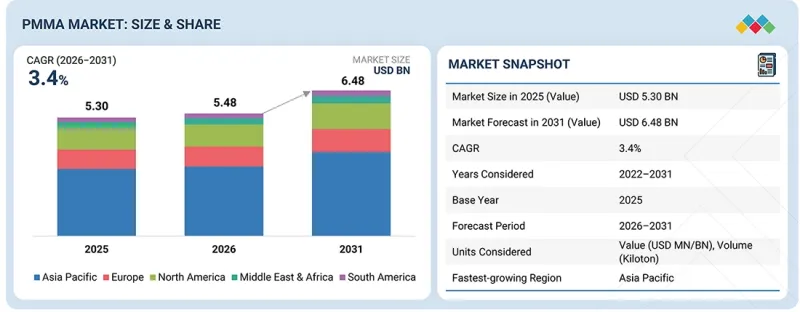
PMMA 시장 규모는 2026년 54억 8,000만 달러에서 2031년에는 64억 8,000만 달러에 이를 것으로 예측되며, 2026년부터 2031년까지 연평균 복합 성장률(CAGR)은 3.4%를 기록할 전망입니다.
| 조사 범위 | |
|---|---|
| 조사 대상 기간 | 2022-2031년 |
| 기준연도 | 2025년 |
| 예측 기간 | 2026-2031년 |
| 단위 | 금액(달러)·킬로톤 |
| 부문 | 등급, 형상, 최종사용자 산업, 지역 |
| 대상 지역 | 북미, 아시아태평양, 유럽, 중동 및 아프리카, 남미 |
PMMA 시장은 자동차 생산 증가, 전자기기 제조 확대, 건설 및 개보수 활동의 활성화에 힘입어 성장하고 있습니다. 자동차 부품, 전자 디스플레이, 조명 시스템, 건축 프로젝트 등에서 사용되는 가볍고 투명하며 강인한 소재에 대한 수요가 증가하고 있으며, 이것이 세계 시장의 성장을 뒷받침하고 있습니다.
“예측 기간 동안 광학 등급이 2위 부문이 될 것으로 전망됩니다.”
두 번째로 큰 등급 부문은 광학 등급 PMMA로, 높은 광투과율, 낮은 복굴절률, 고성능 용도에 적합한 뛰어난 광학적 투명성을 갖추고 있습니다. 광학 등급 소재는 고정밀도, 광 제어, 투명성이 요구되는 용도를 위해 설계되었으나, 범용 PMMA는 기타 용도로도 사용할 수 있습니다. 광학 렌즈, 디스플레이 패널, LCD 및 OLED 스크린, LED 조명 시스템, 광도판, 의료기기, 자동차용 조명 등에 널리 사용되고 있습니다. 광학 등급 PMMA에 대한 수요는 첨단 CE 제품, 에너지 절약형 조명, 스마트 디스플레이 기술의 보급에 힘입어 증가하고 있으며, 이에 따라 시장 내 입지가 더욱 공고해져 전 세계에서 두 번째로 큰 PMMA 등급 부문이 될 것으로 예측됩니다.
“아크릴 시트 주조 부문은 예측 기간 동안 시장 규모에서 2위를 차지할 것으로 전망됩니다.”
주조 아크릴 시트는 뛰어난 광학적 특성, 표면 마감, 내화학성, 두께 덕분에 PMMA 제품 중 두 번째로 큰 시장 점유율을 차지하고 있습니다. 이 제품들은 셀 캐스팅 공법으로 제조되어, 압출 성형 시트에 비해 기계적 특성과 투명도가 향상되었으며, 고품질로 특수한 용도에 사용할 수 있습니다. 아크릴 시트는 수족관, 건축용 유리, 소매점 진열대, 고급 인테리어 디자인, 의료기기, 안전 방호벽, 운송 장비 등에서 널리 사용되고 있습니다. 이 부문은 고품질 건축자재에 대한 수요 증가, 맞춤형 가공 능력, 우수한 전시 및 연출 옵션에 대한 수요 증가에 힘입어 계속해서 성장세를 이어가고 있습니다. 주조 아크릴 시트 제품은 뛰어난 내구성과 내후성, 두꺼운 제품 생산이 가능하다는 점으로 잘 알려져 있으며, 여전히 수요가 높고 PMMA 형태별 부문에서 2위를 차지하고 있습니다.
“자동차 분야는 예측 기간 동안 규모 면에서 2위를 차지할 것으로 전망됩니다.”
자동차 산업은 PMMA의 최종 용도 분야 중 두 번째로 큰 비중을 차지하고 있으며, 이 분야에서는 소재의 경량성, 높은 투명성, 내후성 및 설계 유연성이 중요하게 여겨지고 있습니다. PMMA의 용도에는 계기판, 실내 트림, 디스플레이 패널, 외장 장식 부품, 파노라마 루프 부품, 테일램프 및 헤드램프 등이 포함됩니다. 자동차 제조업체들이 배터리 성능과 주행 거리를 최적화하기 위해 경량 소재를 모색하고 있는 가운데, 업계의 전기차 전환이 추가적인 성장 가능성을 뒷받침하고 있습니다. 또한, 고급 조명 시스템, 디지털 디스플레이, 스마트 콕핏 시스템의 도입이 자동차 분야에서 PMMA 사용 확대를 주도하고 있습니다. 자동차 분야는 여전히 PMMA의 두 번째로 큰 용도 분야이며, 아시아태평양, 북미, 유럽에서의 견조한 수요가 계속해서 확대되고 있습니다.
“금액 기준으로 볼 때, 예측 기간 동안 북미가 2위 부문이 될 것으로 전망됩니다.”
PMMA 지역별 시장에서 2위를 차지하는 곳은 북미입니다. 이는 해당 지역 전체에서 건설, 자동차, 의료, 항공우주, 전자 산업이 발달해 있기 때문입니다. 이 지역에서는 건축용 유리, 간판, 조명 시스템, 의료기기, 운송 장비, 소비재 분야에서 고성능 소재에 대한 수요가 증가하고 있습니다. 인프라 현대화, 상업용 건물 건설, 첨단 제조업에 대한 막대한 투자에 힘입어 미국만으로도 북미의 PMMA 수요 대부분을 차지하고 있습니다. 북미는 헬스케어 및 의료 기술 분야에서 세계를 선도하고 있으며, 의료기기, 의료용 차단재, 치과 제품, 진단 기기, 보호구 및 기타 용도가 PMMA 수요를 견인하고 있습니다. 또한, 해당 지역의 거대한 자동차 산업과 전기차 생산 대수 증가가 맞물리면서, 조명 및 내장재 용도의 PMMA 소비량이 지속적으로 증가할 것으로 확실시되고 있으며, 북미는 두 번째로 큰 지역 시장이 되었습니다.
본 보고서에서는 전 세계 폴리메틸메타크릴레이트(PMMA) 시장을 조사했으며, 시장 개요, 시장 성장에 영향을 미치는 각종 요인에 대한 분석, 기술 및 특허 동향, 법규제 환경, 사례 연구, 시장 규모 추이 및 전망, 각 분류·지역/주요 국가별 상세 분석, 경쟁 구도, 주요 기업 프로파일 등을 정리했습니다.
자주 묻는 질문
목차
제1장 서론
제2장 주요 요약
제3장 프리미엄 인사이트
제4장 시장 개요
제5장 업계 동향
제6장 기술 진보, AI의 영향, 특허, 혁신, 향후 응용
제7장 지속가능성과 규제 상황
제8장 고객 현황과 구매 행동
제9장 PMMA 시장 : 등급별
제10장 PMMA 시장 : 형태별
제11장 PMMA 시장 : 용도별
제12장 PMMA 시장 : 지역별
제13장 경쟁 구도
제14장 기업 개요
제15장 조사 방법
제16장 부록
LSH 26.07.07The PMMA market is projected to reach USD 6.48 billion by 2031 from USD 5.48 billion in 2026, at a CAGR of 3.4% from 2026 to 2031.
| Scope of the Report | |
|---|---|
| Years Considered for the Study | 2022-2031 |
| Base Year | 2025 |
| Forecast Period | 2026-2031 |
| Units Considered | Value (USD Million/Billion) Volume (Kiloton) |
| Segments | Grade, Form, End-use industry, and Region |
| Regions covered | North America, Asia Pacific, Europe, the Middle East & Africa, and South America |
The PMMA market is growing due to increased car production, more electronics manufacturing, and rising construction and renovation activities. There is growing demand for lightweight, clear, and strong materials used in vehicle parts, electronic displays, lighting systems, and building projects, supporting worldwide market growth.
"Optical grade projected to be the second-largest segment during the forecast period."
The second-largest grade segment is optical-grade PMMA, which offers higher light transmittance, low birefringence, and outstanding optical clarity for high-performance applications. Optical-grade material is engineered for uses requiring high precision, light management, and transparency, while general-purpose PMMA can be used for other applications. It is commonly used as optical lenses, display panels, LCD and OLED screens, LED lighting systems, light guide plates, medical devices, and automotive lighting. The demand for optical-grade PMMA is being fueled by the adoption of advanced consumer electronics, energy-efficient lighting, and smart display technologies, and this is expected to further bolster its market position, making it the second-largest PMMA grade segment in the world.
"Cast acrylic sheet segment projected to be the second-largest segment during the forecast period."
The cast acrylic sheet has the second-largest market share among PMMA products because of its excellent optical properties, surface finish, chemical resistance, and thickness. They are manufactured by cell casting, have improved mechanical properties and transparency compared to extruded sheets, and can be used for high-quality and specialized applications. Acrylic sheets are commonly used in aquariums, architectural glazing, retail displays, upscale interior design, medical devices, hazard-protection barriers, and transportation. The segment continues to be driven by the rising demand for high-quality architectural materials, custom fabrication capabilities, and enhanced presentation options. Cast acrylic sheet products are known for their excellent durability, weather resistance, and thickened products, so they are still in great demand, becoming the second-largest PMMA form part.
"Automotive segment projected to be the second-largest segment during the forecast period."
Automotive is the second-largest PMMA end-use industry segment, where the material's light weight, high transparency, weather resistance, and design flexibility are important. Applications of PMMA include instrument clusters, interior trims, display panels, decorative exterior parts, panoramic roof components, taillamps, and vehicle headlamps. The industry's shift to EVs is driving further growth potential as automakers look to lightweight materials to optimize battery performance and range. Besides, the use of high-end lighting systems, digital displays, and smart cockpit systems is driving the rising use of PMMA in vehicles. Automotive remains the second-biggest application sector for PMMA, with strong demand continuing to grow from Asia Pacific, North America, and Europe.
"In terms of value, North America is projected to be the second-largest segment during the forecast period."
The second-biggest regional market of PMMA is North America, owing to the developed construction, automotive, healthcare, aerospace, and electronics industries across the region. This area has a good demand for high-performance materials in architectural glazing, signage, lighting systems, medical devices, transportation equipment, and consumer goods. The US alone is responsible for most of the regional demand for PMMA, aided by heavy investment in the modernization of infrastructure, commercial building, and high-end manufacturing. Medical devices, medical barriers, dental products, diagnostic equipment, protective devices, and other applications are driving PMMA demand in North America, where the region is a leader in healthcare and medical technology. Furthermore, the substantial automotive industry in the region, combined with the rising volume of EVs produced, ensures continued growth in PMMA's consumption in lighting and interior use, making North America the second-largest regional market.
By Company Type: Tier 1: 25%, Tier 2: 42%, and Tier 3: 33%
By Designation: C-level Executives: 20%, Directors: 30%, and Other Designations: 50%
By Region: North America: 20%, Europe: 10%, Asia Pacific: 40%, South America: 10%, and Middle East & Africa 20%
Notes: Other designations include sales, marketing, and product managers.
Tier 1: >USD 1 Billion; Tier 2: USD 500 million-1 Billion; and Tier 3: <USD 500 million
Companies Covered: Trinseo (US), SABIC (Saudi Arabia), Rohm GmbH (Germany), Asahi Kasei Corporation (Japan), Mitsubishi Chemical Group Corporation (Japan), LX MMA (South Korea), Kuraray Co., Ltd. (Japan), Sumitomo Chemical Co., Ltd. (Japan), CHIMEI Corporation (Taiwan), LOTTE Chemical Corporation (South Korea), Plaskolite LLC (US), and Schweiter Technologies AG (Switzerland) among others are covered in the report.
The study includes an in-depth competitive analysis of these key players in the PMMA market, with their company profiles, recent developments, and key market strategies.
Research Coverage
This research report categorizes the PMMA market based on grade (general-purpose grade and optical grade), form (extruded sheets, cast acrylic sheets, other forms), end-use industry (signs & displays, construction, automotive, lighting fixtures, electronics, marine, healthcare, agriculture, and consumer goods, and other end-use industries), and region (Asia Pacific, North America, Europe, South America, and Middle East & Africa). The report's scope covers detailed information regarding the drivers, restraints, challenges, and opportunities influencing the growth of the PMMA market. A detailed analysis of the key industry players has been done to provide insights into their business overview, products offered, and key strategies, such as partnerships, collaborations, product launches, expansions, and acquisitions, associated with the PMMA market. This report covers a competitive analysis of upcoming startups in the PMMA market ecosystem.
Reasons to Buy the Report
The report will provide market leaders/new entrants with the closest approximations of revenue numbers for the overall PMMA market and its subsegments. This report will help stakeholders understand the competitive landscape, gain deeper insights into how to better position their businesses, and plan suitable go-to-market strategies. The report will help stakeholders understand the pulse of the market and provide them with information on key market drivers, restraints, challenges, and opportunities.
The report provides insights into the following points:
Analysis of key drivers (increase in automotive sales and production, growing electrical and electronics industry, and thriving construction sector and renovation activities), restraints (availability of low-cost substitutes and fluctuating feedstock costs and supply imbalances), opportunities (rising adoption of circular PMMA and increasing applications in the healthcare sector), and challenges (environmental & regulatory pressure and supply chain disruptions).
- Product Development/Innovation: Detailed insights into upcoming technologies, research & development activities, and product & service launches in the PMMA market.
- Market Development: Comprehensive information about profitable markets - the report analyzes the PMMA market across varied regions.
Market Diversification: Exhaustive information about new products & services, untapped geographies, recent developments, and investments in the PMMA market.
- Competitive Assessment: In-depth assessment of market shares, growth strategies, and service offerings of leading players such as Trinseo (US), SABIC (Saudi Arabia), Rohm GmbH (Germany), Asahi Kasei Corporation (Japan), Mitsubishi Chemical Group Corporation (Japan), LX MMA (South Korea), Kuraray Co., Ltd. (Japan), Sumitomo Chemical Co., Ltd. (Japan), CHIMEI Corporation (Taiwan), LOTTE Chemical Corporation (South Korea), Plaskolite LLC (US), and Schweiter Technologies AG (Switzerland).
TABLE OF CONTENTS
1 INTRODUCTION
- 1.1 STUDY OBJECTIVES
- 1.2 MARKET DEFINITION
- 1.3 STUDY SCOPE
- 1.3.1 MARKETS COVERED AND REGIONAL SCOPE
- 1.3.2 PMMA MARKET, BY END-USE INDUSTRY
- 1.3.3 INCLUSIONS AND EXCLUSIONS
- 1.3.4 YEARS CONSIDERED
- 1.3.5 CURRENCY CONSIDERED
- 1.3.6 UNITS CONSIDERED
- 1.4 RESEARCH LIMITATIONS
- 1.5 STAKEHOLDERS
- 1.6 SUMMARY OF CHANGES
2 EXECUTIVE SUMMARY
- 2.1 KEY INSIGHTS AND MARKET HIGHLIGHTS
- 2.2 KEY MARKET PARTICIPANTS: SHARE INSIGHTS AND STRATEGIC DEVELOPMENTS
- 2.3 DISRUPTIVE TRENDS SHAPING THE MARKET
- 2.4 HIGH-GROWTH SEGMENTS & EMERGING FRONTIERS
- 2.5 SNAPSHOT: GLOBAL MARKET SIZE, GROWTH RATE, AND FORECAST
3 PREMIUM INSIGHTS
- 3.1 ATTRACTIVE OPPORTUNITIES FOR PLAYERS IN PMMA MARKET
- 3.2 ASIA PACIFIC: PMMA MARKET, BY GRADE AND COUNTRY
- 3.3 PMMA MARKET, BY GRADE
- 3.4 PMMA MARKET, BY FORM
- 3.5 PMMA MARKET, BY END-USE INDUSTRY
- 3.6 PMMA MARKET, BY COUNTRY
4 MARKET OVERVIEW
- 4.1 INTRODUCTION
- 4.2 MARKET DYNAMICS
- 4.2.1 DRIVERS
- 4.2.1.1 Increase in automotive sales and production
- 4.2.1.2 Growing electrical & electronics industry
- 4.2.1.3 Thriving construction sector and renovation activities
- 4.2.2 RESTRAINTS
- 4.2.2.1 Availability of low-cost substitutes
- 4.2.2.2 Fluctuating feedstock costs and supply imbalances
- 4.2.3 OPPORTUNITIES
- 4.2.3.1 Rising adoption of circular PMMA
- 4.2.3.2 Increasing applications in healthcare sector
- 4.2.4 CHALLENGES
- 4.2.4.1 Environmental & regulatory pressure
- 4.2.4.2 Supply chain disruptions
- 4.2.1 DRIVERS
- 4.3 UNMET NEEDS AND WHITE SPACES
- 4.3.1 UNMET NEEDS IN PMMA MARKET
- 4.3.2 WHITE SPACE OPPORTUNITIES
- 4.4 INTERCONNECTED MARKETS AND CROSS-SECTOR OPPORTUNITIES
- 4.4.1 INTERCONNECTED MARKETS
- 4.4.2 CROSS-SECTOR OPPORTUNITIES
- 4.4.2.1 Construction - Automotive
- 4.4.2.2 Automotive - Lighting Fixtures
- 4.4.2.3 Electronics - signs & displays
- 4.4.2.4 Agriculture - Construction
- 4.4.2.5 Marine - automotive
- 4.4.2.6 Consumer goods - electronics
- 4.4.2.7 Automotive - electronics
- 4.5 STRATEGIC MOVES BY TIER-1/2/3 PLAYERS
- 4.5.1 TIER 1 PLAYERS: GLOBAL LEADERS DRIVING CONSOLIDATION AND INNOVATION
- 4.5.1.1 TTRINSCEO AND TAPI GROUP ADVANCE CIRCULAR PMMA ADOPTION FOR PREMIUM CLOSURES
- 4.5.2 MITSUBISHI CHEMICAL GROUP CORPORATION EVALUATES NEW INVESTMENT OPPORTUNITIES IN INDIA
- 4.5.3 TIER 2 PLAYERS: REGIONAL INNOVATORS AND NICHE LEADERS
- 4.5.3.1 ROHM gmbh INVESTS IN CHEMICAL RECYCLING FOR CLOSED-LOOP PMMA PRODUCTION
- 4.5.3.2 LOTTE CHEMICAL COMMERCIALIZES RECYCLED PMMA FOR AUTOMOTIVE LAMP APPLICATIONS
- 4.5.4 TIER 3 PLAYERS: STRENGTHENS ECO-EFFICIENCY WITH ZERO WASTE MILESTONE
- 4.5.4.1 MAKEVALE GROUP STRENGTHENS ITS POSITION IN SPECIALTY PMMA AND ACRYLIC POLYMER MANUFACTURING
- 4.5.1 TIER 1 PLAYERS: GLOBAL LEADERS DRIVING CONSOLIDATION AND INNOVATION
5 INDUSTRY TRENDS
- 5.1 PORTER'S FIVE FORCES ANALYSIS
- 5.1.1 THREAT OF NEW ENTRANTS
- 5.1.2 THREAT OF SUBSTITUTES
- 5.1.3 BARGAINING POWER OF SUPPLIERS
- 5.1.4 BARGAINING POWER OF BUYERS
- 5.1.5 INTENSITY OF COMPETITION RIVALRY
- 5.2 MACROECONOMIC ANALYSIS
- 5.2.1 INTRODUCTION
- 5.2.2 GDP TRENDS AND FORECASTS
- 5.3 VALUE CHAIN ANALYSIS
- 5.4 ECOSYSTEM ANALYSIS
- 5.5 PRICING ANALYSIS
- 5.5.1 AVERAGE SELLING PRICE TREND, BY REGION
- 5.5.2 AVERAGE SELLING PRICE TREND OF KEY PLAYERS, BY GRADE
- 5.6 TRADE ANALYSIS
- 5.6.1 IMPORT SCENARIO (HS CODE 390610)
- 5.6.2 EXPORT SCENARIO (HS CODE 390610)
- 5.7 KEY CONFERENCES AND EVENTS, 2026-2027
- 5.8 TRENDS/DISRUPTIONS IMPACTING CUSTOMER BUSINESS
- 5.9 INVESTMENT AND FUNDING SCENARIO
- 5.10 CASE STUDY ANALYSIS
- 5.10.1 TRINSEO S.A.'S ALTUGLAS R-LIFE ACRYLIC RESIN PROVIDES DISPLAYS MADE FROM RECYCLED PMMA
- 5.10.2 ADVANCING CIRCULAR LIGHTING SOLUTIONS WITH ROHM GMBH'S RECYCLED PMMA-BASED OPTICAL COMPONENTS
- 5.10.3 ROHM GMBH'S ANTIMICROBIAL ACRYLIC SHEET MEETS DEMAND DURING COVID-19 PANDEMIC
- 5.11 IMPACT OF 2025 US TARIFF: PMMA MARKET
- 5.11.1 KEY TARIFF RATES
- 5.11.2 PRICE IMPACT ANALYSIS
- 5.11.3 IMPACT ON COUNTRY/REGION
- 5.11.3.1 US
- 5.11.3.2 Europe
- 5.11.3.3 Asia Pacific
- 5.11.4 END-USE INDUSTRY IMPACT
6 TECHNOLOGICAL ADVANCEMENTS, AI-DRIVEN IMPACT, PATENTS, INNOVATIONS, AND FUTURE APPLICATIONS
- 6.1 KEY TECHNOLOGIES
- 6.1.1 POLYMERIZATION
- 6.1.2 CELL CASTING
- 6.1.2.1 Extrusion
- 6.1.2.2 Depolymerization technology
- 6.2 COMPLEMENTARY TECHNOLOGIES
- 6.2.1 NANOTECHNOLOGY
- 6.2.2 LIGHTWEIGHTING AND HIGH-PERFORMANCE MATERIALS
- 6.3 ADJACENT TECHNOLOGIES
- 6.3.1 3D PRINTING
- 6.4 TECHNOLOGY ROADMAP
- 6.4.1 SHORT-TERM (2026-2028) | EARLY TRANSITION TO SMART & SUSTAINABLE PMMA PRODUCTION
- 6.4.2 MID-TERM (2028-2030) | ADVANCED MATERIAL INNOVATION & CIRCULAR ECONOMY INTEGRATION
- 6.4.3 LONG-TERM (2030-2035+) | AUTONOMOUS MANUFACTURING & NEXT-GENERATION PMMA MATERIALS
- 6.5 PATENT ANALYSIS
- 6.5.1 INTRODUCTION
- 6.5.2 METHODOLOGY
- 6.5.3 PMMA MARKET, PATENT ANALYSIS, 2016-2025
- 6.6 FUTURE APPLICATIONS
- 6.6.1 BIO-COMPATIBLE PMMA NANOCOMPOSITES FOR SMART BONE IMPLANTS
- 6.6.2 HIGH-EFFICIENCY PMMA-BASED LUMINESCENT SOLAR CONCENTRATORS (LSCS)
- 6.6.3 RECYCLABLE PMMA-BASED AUTOMOTIVE "SMART GLASS" SUNROOFS
- 6.6.4 IMPACT-MODIFIED CROSS-LINKED PMMA COATINGS FOR WIND TURBINE BLADES
- 6.7 IMPACT OF AI/GEN AI ON PMMA MARKET
- 6.7.1 TOP USE CASES AND MARKET POTENTIAL
- 6.7.2 BEST PRACTICES IN PMMA PROCESSING
- 6.7.3 CASE STUDIES OF AI IMPLEMENTATION IN PMMA MARKET
- 6.7.3.1 Interconnected ecosystem and impact on market players
- 6.7.4 CLIENTS' READINESS TO ADOPT GENERATIVE AI IN PMMA MARKET
7 SUSTAINABILITY AND REGULATORY LANDSCAPE
- 7.1 REGIONAL REGULATIONS AND COMPLIANCE
- 7.1.1 REGULATORY BODIES, GOVERNMENT AGENCIES, AND OTHER ORGANIZATIONS
- 7.1.2 INDUSTRY STANDARDS
- 7.2 SUSTAINABILITY INITIATIVES
- 7.2.1 EUROPE-WIDE PMMA RECYCLING ALLIANCE
- 7.2.2 UNIVERSITY OF BATH LOW-ENERGY PMMA RECYCLING METHOD
- 7.2.3 MMATWO PROJECT
- 7.2.4 ECO-FRIENDLY PMMA INNOVATION
- 7.3 IMPACT OF REGULATORY POLICY ON SUSTAINABILITY INITIATIVES
8 CUSTOMER LANDSCAPE & BUYER BEHAVIOUR
- 8.1 DECISION-MAKING PROCESS
- 8.2 BUYER STAKEHOLDERS AND BUYING EVALUATION CRITERIA
- 8.2.1 KEY STAKEHOLDERS IN BUYING PROCESS
- 8.2.2 BUYING CRITERIA
- 8.3 ADOPTION BARRIERS & INTERNAL CHALLENGES
- 8.4 UNMET NEEDS FROM VARIOUS APPLICATIONS
- 8.5 MARKET PROFITABILITY
- 8.5.1 REVENUE POTENTIAL
- 8.5.2 COST DYNAMICS
- 8.5.3 MARGIN OPPORTUNITIES, BY APPLICATION
9 PMMA MARKET, BY GRADE
- 9.1 INTRODUCTION
- 9.2 GENERAL-PURPOSE GRADE
- 9.2.1 SUITABILITY IN A WIDE RANGE OF APPLICATIONS TO SUPPORT MARKET GROWTH
- 9.3 OPTICAL GRADE
- 9.3.1 HIGH LIGHT TRANSMITTANCE TO DRIVE MARKET GROWTH
10 PMMA MARKET, BY FORM
- 10.1 INTRODUCTION
- 10.2 PRIMARY FORM
- 10.3 PELLETS
- 10.3.1 RISING USE IN LENSES, LAMPS, AND AUTOMOBILES TO DRIVE MARKET
- 10.4 BEADS
- 10.4.1 INCREASING USE IN PAINTS & COATINGS TO DRIVE MARKET
- 10.5 SECONDARY FORM
- 10.6 EXTRUDED SHEETS
- 10.6.1 COST EFFICIENCY OF PRODUCTION PROCESS TO DRIVE MARKET
- 10.7 CAST ACRYLIC SHEETS
- 10.7.1 GROWING DEMAND FOR RECYCLED PMMA TO SUPPORT MARKET GROWTH
- 10.7.2 SOLID SURFACE ACRYLIC SHEETS
- 10.7.3 CONTINUOUS CAST ACRYLIC SHEETS
- 10.7.4 COMPOSITE ACRYLIC SHEETS
- 10.7.5 OTHER FORMS
11 PMMA MARKET, BY END-USE INDUSTRY
- 11.1 INTRODUCTION
- 11.2 SIGNS & DISPLAYS
- 11.2.1 INCREASING MARKETING INITIATIVES TO DRIVE MARKET GROWTH
- 11.2.2 SIGNAGE
- 11.2.3 DISPLAY BOARDS
- 11.2.4 POINT-OF-SALE BOARDS
- 11.3 CONSTRUCTION
- 11.3.1 RISE IN CONSTRUCTION SPENDING TO INCREASE DEMAND
- 11.3.2 BY END USE
- 11.3.2.1 Residential
- 11.3.2.2 Multi-family
- 11.3.2.3 Commercial
- 11.3.2.4 Industrial
- 11.3.3 BY TYPE
- 11.3.3.1 Barriers
- 11.3.3.1.1 Shatterproof glass
- 11.3.3.1.2 Noise barriers
- 11.3.3.2 Flooring
- 11.3.3.2.1 PMMA resin flooring
- 11.3.3.2.2 High-end decorative flooring
- 11.3.3.1 Barriers
- 11.3.4 PAINTS & COATINGS
- 11.4 AUTOMOTIVE
- 11.4.1 HIGH USE AS AN ALTERNATIVE TO GLASS TO DRIVE MARKET
- 11.4.2 AUTOMOTIVE PARTS & ACCESSORIES
- 11.4.2.1 Body parts
- 11.4.2.2 Lamp covers
- 11.4.2.3 Interior & exterior trim
- 11.4.3 VEHICLE TYPE
- 11.4.3.1 Passenger cars
- 11.4.3.2 Light commercial vehicles
- 11.4.3.3 Heavy commercial vehicles
- 11.4.3.4 Quad/ATV & side by side
- 11.4.3.5 Snowmobiles
- 11.4.3.6 Recreational vehicles
- 11.4.4 FUEL TYPE
- 11.4.4.1 ICE vehicles (petrol, diesel, and others)
- 11.4.4.2 Electric vehicles
- 11.5 LIGHTING FIXTURES
- 11.5.1 RISING DEMAND FOR LED LIGHTING TO DRIVE MARKET GROWTH
- 11.5.2 LIGHT GUIDE PANELS
- 11.5.3 SOLAR EQUIPMENT
- 11.6 ELECTRONICS
- 11.6.1 RISING DEMAND FOR IOT PRODUCTS TO ACCELERATE MARKET GROWTH
- 11.6.2 MOBILE PHONES, TABLETS, AND LCD SCREENS
- 11.6.3 OTHER ELECTRONIC APPLICATIONS
- 11.7 MARINE
- 11.7.1 INCREASED UTILIZATION IN WINDOWS & GLAZING APPLICATIONS TO DRIVE MARKET
- 11.7.2 ACCESSORIES & PARTS
- 11.7.2.1 Interior surfacing
- 11.7.2.2 Consoles
- 11.7.2.3 Glazing & windows
- 11.7.2.4 Sinks
- 11.7.2.5 Shower pans
- 11.7.2.6 Countertops
- 11.7.2.7 Wall cladding
- 11.7.2.8 Outboard engine covers
- 11.7.2.9 Portable tables
- 11.7.2.10 Other accessories & parts
- 11.7.3 TYPE
- 11.7.3.1 Personal watercraft
- 11.7.3.2 Commercial
- 11.7.3.3 Sports watercraft/jet skis
- 11.8 HEALTHCARE
- 11.8.1 RISING HEALTHCARE EXPENDITURE TO SUPPORT MARKET GROWTH
- 11.8.2 HEALTHCARE DEVICES
- 11.8.3 FURNITURE
- 11.8.4 WALL CLADDING
- 11.8.5 SANITARYWARE
- 11.8.6 OTHER HEALTHCARE APPLICATIONS
- 11.9 AGRICULTURE
- 11.9.1 STEADY INCREASE IN ADOPTION OF GREENHOUSES TO DRIVE DEMAND
- 11.9.2 GLAZING & WINDOWS
- 11.9.3 AGRICULTURE MACHINERY & VEHICLES
- 11.10 CONSUMER GOODS
- 11.10.1 INCREASED USE IN HOMEWARE APPLICATION TO FUEL DEMAND
- 11.10.2 EXERCISE EQUIPMENT
- 11.10.3 HOMEWARE
- 11.10.4 OTHER CONSUMER GOODS APPLICATIONS
- 11.11 OTHER END-USE INDUSTRIES
12 PMMA MARKET, BY REGION
- 12.1 INTRODUCTION
- 12.2 ASIA PACIFIC
- 12.2.1 CHINA
- 12.2.1.1 Advanced manufacturing and EV exports to drive market
- 12.2.2 INDIA
- 12.2.2.1 Rising automobile manufacturing and agriculture exports to support market growth
- 12.2.3 JAPAN
- 12.2.3.1 Automobile production and electronics industry to drive market
- 12.2.4 SOUTH KOREA
- 12.2.4.1 Increasing automotive and cosmetics exports to drive market
- 12.2.5 AUSTRALIA & NEW ZEALAND
- 12.2.5.1 Government support for construction industry and growing automotive sales to drive market
- 12.2.6 MALAYSIA
- 12.2.6.1 Growing construction output to fuel demand
- 12.2.7 REST OF ASIA PACIFIC
- 12.2.1 CHINA
- 12.3 NORTH AMERICA
- 12.3.1 US
- 12.3.1.1 Electronics industry to drive market growth
- 12.3.2 CANADA
- 12.3.2.1 Rising investments in greenhouse sector to drive demand
- 12.3.3 MEXICO
- 12.3.3.1 Government-led investments in construction industry to support growth
- 12.3.1 US
- 12.4 EUROPE
- 12.4.1 GERMANY
- 12.4.1.1 Growing automotive industry and electronics exports to drive market
- 12.4.2 UK
- 12.4.2.1 Rising adoption of EVs to drive growth
- 12.4.3 FRANCE
- 12.4.3.1 Growth of automotive industry to drive demand
- 12.4.4 ITALY
- 12.4.4.1 Growth in automotive industry to drive growth
- 12.4.5 SPAIN
- 12.4.5.1 Government initiatives in construction and automotive industries to drive market
- 12.4.6 REST OF EUROPE
- 12.4.1 GERMANY
- 12.5 SOUTH AMERICA
- 12.5.1 BRAZIL
- 12.5.1.1 Growing automotive sector to drive demand
- 12.5.2 ARGENTINA
- 12.5.2.1 Growth of automotive industry to drive demand
- 12.5.3 REST OF SOUTH AMERICA
- 12.5.1 BRAZIL
- 12.6 MIDDLE EAST & AFRICA
- 12.6.1 GCC COUNTRIES
- 12.6.1.1 Saudi Arabia
- 12.6.1.1.1 Saudi Vision 2030 fueling market growth
- 12.6.1.2 UAE
- 12.6.1.2.1 Government initiatives to drive market growth
- 12.6.1.3 Rest of GCC countries
- 12.6.1.1 Saudi Arabia
- 12.6.2 SOUTH AFRICA
- 12.6.2.1 Rising automotive exports and greenhouse expansion to drive market
- 12.6.3 REST OF MIDDLE EAST & AFRICA
- 12.6.1 GCC COUNTRIES
13 COMPETITIVE LANDSCAPE
- 13.1 OVERVIEW
- 13.2 KEY PLAYERS' STRATEGIES/RIGHT TO WIN
- 13.3 MARKET SHARE ANALYSIS
- 13.4 REVENUE ANALYSIS
- 13.5 COMPANY VALUATION AND FINANCIAL METRICS
- 13.6 BRAND COMPARISON
- 13.7 COMPANY EVALUATION MATRIX: KEY PLAYERS, 2025
- 13.7.1 STARS
- 13.7.2 EMERGING LEADERS
- 13.7.3 PERVASIVE PLAYERS
- 13.7.4 PARTICIPANTS
- 13.7.5 COMPANY FOOTPRINT: KEY PLAYERS, 2025
- 13.7.5.1 Company footprint
- 13.7.5.2 Region footprint
- 13.7.5.3 Grade footprint
- 13.7.5.4 Form footprint
- 13.7.5.5 End-use industry footprint
- 13.8 COMPANY EVALUATION MATRIX: STARTUPS/SMES, 2025
- 13.8.1 PROGRESSIVE COMPANIES
- 13.8.2 RESPONSIVE COMPANIES
- 13.8.3 DYNAMIC COMPANIES
- 13.8.4 STARTING BLOCKS
- 13.8.5 COMPETITIVE BENCHMARKING: STARTUPS/SMES, 2025
- 13.8.5.1 Detailed list of key startups/SMEs
- 13.8.5.2 Competitive benchmarking of key startups/SMEs
- 13.9 COMPETITIVE SCENARIO
- 13.9.1 DEALS
- 13.9.2 PRODUCT LAUNCHES
- 13.9.3 EXPANSIONS
- 13.9.4 OTHER DEVELOPMENTS
14 COMPANY PROFILES
- 14.1 KEY PLAYERS
- 14.1.1 TRINSEO
- 14.1.1.1 Business overview
- 14.1.1.2 Products offered
- 14.1.1.3 Recent developments
- 14.1.1.3.1 Product launches
- 14.1.1.3.2 Deals
- 14.1.1.3.3 Expansions
- 14.1.1.3.4 Other developments
- 14.1.1.4 MnM view
- 14.1.1.4.1 Right to win
- 14.1.1.4.2 Strategic choices
- 14.1.1.4.3 Weaknesses and competitive threats
- 14.1.2 ASAHI KASEI CORPORATION
- 14.1.2.1 Business overview
- 14.1.2.2 Products offered
- 14.1.2.3 Recent developments
- 14.1.2.3.1 Other developments
- 14.1.2.4 MnM view
- 14.1.2.4.1 Right to win
- 14.1.2.4.2 Strategic choices
- 14.1.2.4.3 Weaknesses and competitive threats
- 14.1.3 SABIC
- 14.1.3.1 Business overview
- 14.1.3.2 Products offered
- 14.1.3.3 MnM view
- 14.1.3.3.1 Right to win
- 14.1.3.3.2 Strategic choices
- 14.1.3.3.3 Weaknesses and competitive threats
- 14.1.4 MITSUBISHI CHEMICAL GROUP CORPORATION
- 14.1.4.1 Business overview
- 14.1.4.2 Products offered
- 14.1.4.3 Recent developments
- 14.1.4.3.1 Deals
- 14.1.4.3.2 Expansions
- 14.1.4.3.3 Other developments
- 14.1.4.4 MnM view
- 14.1.4.4.1 Right to win
- 14.1.4.4.2 Strategic choices
- 14.1.4.4.3 Weaknesses and competitive threats
- 14.1.5 LX MMA
- 14.1.5.1 Business overview
- 14.1.5.2 Products offered
- 14.1.5.3 Recent developments
- 14.1.5.3.1 Expansions
- 14.1.5.4 MnM view
- 14.1.5.4.1 Right to win
- 14.1.5.4.2 Strategic choices
- 14.1.5.4.3 Weaknesses and competitive threats
- 14.1.6 ROHM GMBH
- 14.1.6.1 Business overview
- 14.1.6.2 Products offered
- 14.1.6.3 Recent developments
- 14.1.6.3.1 Product launches
- 14.1.6.3.2 Deals
- 14.1.6.3.3 Expansions
- 14.1.6.3.4 Other developments
- 14.1.6.4 MnM view
- 14.1.7 KURARAY CO., LTD.
- 14.1.7.1 Business overview
- 14.1.7.2 Products offered
- 14.1.7.3 Recent developments
- 14.1.7.3.1 Deals
- 14.1.7.3.2 Expansions
- 14.1.7.3.3 Other developments
- 14.1.7.4 MnM view
- 14.1.8 SUMITOMO CHEMICALS CO., LTD.
- 14.1.8.1 Business overview
- 14.1.8.2 Products offered
- 14.1.8.3 Recent developments
- 14.1.8.3.1 Deals
- 14.1.8.3.2 Expansions
- 14.1.8.3.3 Other developments
- 14.1.8.4 MnM view
- 14.1.9 CHIMEI CORPORATION
- 14.1.9.1 Business overview
- 14.1.9.2 Products offered
- 14.1.9.3 Recent developments
- 14.1.9.3.1 Deals
- 14.1.9.3.2 Expansions
- 14.1.9.4 MnM view
- 14.1.10 LOTTE CHEMICAL CORPORATION
- 14.1.10.1 Business overview
- 14.1.10.2 Products offered
- 14.1.10.3 Recent developments
- 14.1.10.3.1 Deals
- 14.1.10.3.2 Expansions
- 14.1.10.4 MnM view
- 14.1.11 PLASKOLITE LLC
- 14.1.11.1 Business overview
- 14.1.11.2 Products offered
- 14.1.11.3 Recent developments
- 14.1.11.3.1 Deals
- 14.1.11.3.2 Expansions
- 14.1.11.4 MnM view
- 14.1.12 SCHWEITER TECHNOLOGIES AG
- 14.1.12.1 Business overview
- 14.1.12.2 Products offered
- 14.1.12.3 Recent developments
- 14.1.12.3.1 Deals
- 14.1.12.4 MnM view
- 14.1.1 TRINSEO
- 14.2 OTHER PLAYERS
- 14.2.1 ASIA POLY HOLDINGS BERHAD
- 14.2.2 PALRAM INDUSTRIES LTD.
- 14.2.3 MASAF PLAST
- 14.2.4 VERZATEC
- 14.2.5 MAKEVALE GROUP LTD.
- 14.2.6 SPARTECH LLC
- 14.2.7 NITTO JUSHI KOGYO CO., LTD.
- 14.2.8 SAMYANG CORPORATION
- 14.2.9 S.S.B. POLYMERS
- 14.2.10 GEHR PLASTICS INC.
- 14.2.11 PETRO RABIGH
- 14.2.12 YOGYA INDUSTRIES PVT. LTD.
- 14.2.13 GEVACRIL SRL
15 RESEARCH METHODOLOGY
- 15.1 RESEARCH DATA
- 15.1.1 SECONDARY DATA
- 15.1.1.1 Critical secondary inputs
- 15.1.1.2 Key data from secondary sources
- 15.1.2 PRIMARY DATA
- 15.1.2.1 Key data from primary sources
- 15.1.2.2 Key industry insights
- 15.1.2.3 Breakdown of primary interviews
- 15.1.1 SECONDARY DATA
- 15.2 MARKET SIZE ESTIMATION APPROACH
- 15.2.1 BASE NUMBER CALCULATION
- 15.2.1.1 Supply-side: Overall consumption of extruded sheets
- 15.2.1 BASE NUMBER CALCULATION
- 15.3 DATA TRIANGULATION
- 15.4 FACTOR ANALYSIS
- 15.5 RESEARCH ASSUMPTIONS
- 15.6 RESEARCH LIMITATIONS
- 15.7 RISK ASSESSMENT
16 APPENDIX
- 16.1 DISCUSSION GUIDE
- 16.2 KNOWLEDGESTORE: MARKETSANDMARKETS' SUBSCRIPTION PORTAL
- 16.3 CUSTOMIZATION OPTIONS
- 16.4 RELATED REPORTS
- 16.5 AUTHOR DETAILS


