|
시장보고서
상품코드
2076876
UAV 재머 시장 : 제공별, 전개별, 유효 사정별, 방해 주파수대별, 기술별, 최종사용자별, 지역별 - 세계 예측(-2031년)UAV Jammers Market by Offering (RF, GPS & GNSS Integrated Jammer, Jamming Gun), Deployment (Handheld, Vehicle-Mounted, Fixed-Site), Range, Jamming Band (1-8 GHz, Multi-Band), Technology, End User, and Region - Global Forecast to 2031 |
||||||

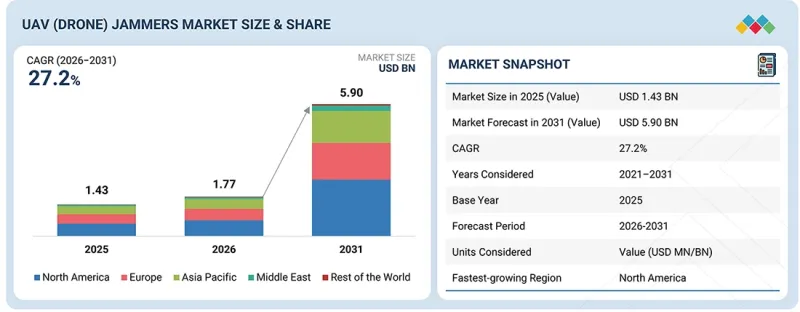
UAV(드론) 재머 시장 규모는 예측 기간 동안 CAGR 27.2%로 확대되어 2026년 17억 7,000만 달러에서 2031년에는 59억 달러에 달할 것으로 전망됩니다.
| 조사 범위 | |
|---|---|
| 조사 대상 기간 | 2020-2031년 |
| 기준 연도 | 2025년 |
| 예측 기간 | 2026-2031년 |
| 산정 단위 | 금액(10억 달러) |
| 부문 | 제공별, 전개별, 유효 사정별, 방해 주파수대별, 기술별, 최종사용자별, 지역별 |
| 대상 지역 | 북미, 유럽, 아시아태평양, 기타 지역 |
다중 대역 방해 시스템, FPV 대응 재머 기술, AI를 활용한 드론 식별, 휴대용 재머 설계, 그리고 드론 떼에 대한 대응 능력의 지속적인 발전이 시장의 주요 성장 동력이 되고 있습니다.
예측 기간 동안 사거리별로는 전술급(1-5km) 재머 부문이 UAV(드론) 재머 시장을 주도할 것으로 전망됩니다.
전술 범위의 드론 재머는 다중 대역 주파수 지원, FPV 대응 기능, GNSS 방해 기능, 휴대형 배치 옵션 등의 기능을 갖추고 있습니다. 이러한 시스템은 군사 시설, 국경 경비 작전, 중요 인프라 시설 및 기타 전술적 환경에 적합한 감시 범위를 제공합니다. 장거리 시스템에 비해 일반적으로 전력 소비가 적고, 다양한 장소에 구축하기 쉽다는 특징이 있습니다. 상업용 드론, FPV 드론, 군용 드론 등 다양한 종류의 드론을 지원할 수 있는 능력 덕분에, 고정형 및 이동형 모두에서 그 활용이 확대되고 있습니다.
예측 기간 동안 기술별로는 AI 탑재형이 시장에서 가장 빠르게 성장하는 부문이 될 것으로 전망됩니다.
AI 기반 드론 방해 시스템은 운영자가 다양한 종류의 드론을 분류하고, 통신 신호를 분석하며, 잠재적 위협을 평가하고, 적절한 방해 조치를 선택할 수 있도록 지원하기 위해 도입되었습니다. 이러한 기능을 통해 여러 대의 무인항공기(UAV)를 동시에 관리할 수 있게 되어, FPV 드론 및 자율 비행 드론을 포함한 드론의 활동에 대응하는 데 필요한 시간을 단축할 수 있습니다. 드론 기술이 시간이 지남에 따라 발전함에 따라, 위협을 보다 정확하게 식별하고 운용 성능을 향상시키기 위해 방해 시스템에 AI를 접목하는 움직임이 점점 더 활발해지고 있습니다.
예측 기간 동안 북미는 UAV(드론) 재머 시장에서 가장 높은 연평균 성장률(CAGR)을 기록할 것으로 전망됩니다.
북미는 국방비 증가, 진행 중인 군사 현대화 프로그램, 그리고 국방 능력에 대한 중요성 부각 등을 주요 요인으로 하여 가장 빠르게 성장하고 있는 무인항공기(드론) 재머 시장입니다. 이 지역은 지속적인 국방 및 국토안보 지출과 군 및 정부 기관의 드론 방해 시스템 도입 확대에 힘입어 시장에서 중요한 위치를 차지하고 있습니다. 미국에서는 다양한 종류의 상업용, FPV 및 군용 무인항공기(UAV)에 대응하기 위해 휴대형, 차량 탑재형 및 고정형 드론 방해 기술에 대한 투자가 진행되고 있습니다. 또한, 방위 및 치안 활동 전반에 걸친 지속적인 조달 활동, 실지 시험, 그리고 드론 대응 시스템의 활용도 해당 지역의 시장 확대를 뒷받침하고 있습니다.
조사 범위:
본 시장 조사는 다양한 부문 및 하위 부문에 걸친 UAV(드론) 재머 시장을 대상으로 합니다. 본 조사는 각 지역별 해당 시장의 규모와 성장 가능성을 추정하는 것을 목적으로 합니다. 또한, 시장 내 주요 기업에 대한 상세한 경쟁 분석, 기업 개요, 제품 및 사업 제공과 관련된 주요 관찰 사항, 최근 동향, 그리고 각 기업이 채택한 주요 시장 전략에 대해서도 포괄적으로 다루고 있습니다.
이 보고서를 구매해야 하는 이유:
본 보고서는 시장을 선도하는 기업 및 신규 진입 기업을 대상으로, UAV(드론) 재머 시장 전체의 매출액에 관한 가장 정확한 추정치를 제공합니다. 또한, 이해관계자들이 경쟁 구도를 이해하고, 자사의 비즈니스를 더 나은 위치로 이끌며, 적절한 시장 진입 전략을 수립하기 위한 추가적인 인사이트를 얻는 데 도움이 됩니다. 또한, 본 보고서는 이해관계자들이 시장 동향을 파악하는 데 도움이 되며, 주요 시장 촉진요인, 억제요인, 과제 및 기회에 관한 정보를 제공합니다.
본 보고서에서는 다음 사항에 대한 인사이트를 제공합니다:
- 시장 촉진요인(감시 및 공격 목적으로 저비용 드론 사용 증가, 비파괴적 드론 방해 기술에 대한 수요 증가), 제약요인(재머 사용에 대한 엄격한 규제, 첨단 멀티밴드 재머 하드웨어의 높은 비용), 기회(FPV 대응 재머 제품 개발, 차량 탑재형 및 고정형 재머 방식의 확대), 과제(드론 통신 기술의 급속한 변화, 통신 범위, 전력, 휴대성, 배터리 수명의 균형 조정)
- 시장 침투율 : 시장을 선도하는 주요 기업들이 제공하는 UAV(드론) 재머 시스템에 대한 종합적인 정보
- 제품 개발 및 혁신 : UAV(드론) 재머 시장의 향후 기술 동향, 연구개발 활동 및 신제품 출시에 관한 상세한 분석
- 시장 개발 : 다양한 지역의 수익성이 높은 시장에 대한 종합적인 정보
- 시장의 다양화 : UAV(드론) 재머 시장의 신제품, 미개척 지역, 최근 동향 및 투자에 관한 종합적인 정보
- 경쟁사 분석 : UAV(드론) 재머 시장의 주요 기업별 시장 점유율, 성장 전략, 제품 및 생산능력에 대한 상세한 분석
자주 묻는 질문
목차
제1장 소개
제2장 주요 요약
제3장 주요 인사이트
제4장 시장 개요
제5장 업계 동향
제6장 기술 진보, AI에 의한 영향, 특허, 혁신, 그리고 향후 응용
제7장 규제 상황
제8장 고객 상황과 구매 행동
제9장 UAV(드론) 재머 시장(제공별)
제10장 UAV(드론) 재머 시장(전개별)
제11장 UAV(드론) 재머 시장(유효 사정별)
제12장 UAV(드론) 재머 시장(방해 주파수대별)
제13장 UAV(드론) 재머 시장(기술별)
제14장 UAV(드론) 재머 시장(최종사용자별)
제15장 UAV(드론) 재머 시장(지역별)
제16장 경쟁 구도
제17장 기업 개요
제18장 조사 방법
제19장 부록
KSM 26.07.07The UAV (Drone) jammers market is projected to grow from USD 1.77 billion in 2026 to USD 5.90 billion in 2031 at a CAGR of 27.2% during the forecast period.
| Scope of the Report | |
|---|---|
| Years Considered for the Study | 2020-2031 |
| Base Year | 2025 |
| Forecast Period | 2026-2031 |
| Units Considered | Value (USD Billion) |
| Segments | By Offering, Range, Technology and Region |
| Regions covered | North America, Europe, APAC, RoW |
Ongoing advancements in multi-band jamming systems, anti-FPV jammer technologies, AI-enabled drone identification, portable jammer designs, and counter-swarm drone mitigation capabilities are among the key drivers of the market.
The tactical-range jammers (1-5 Km) segment is projected to lead the UAV (Drone) jammers market by range during the forecast period.
Tactical-range drone jammers are equipped with features like multi-band frequency coverage, anti-FPV capabilities, GNSS disruption functions, and portable deployment options. These systems provide coverage that is suitable for military facilities, border security operations, critical infrastructure sites & other tactical environments. Compared to long-range systems, they generally require less power and are easier to deploy in different locations. Their ability to address different types of commercial, FPV, and military drones has supported their use across both fixed and mobile operations.
AI-enabled is projected to be the faster-growing segment of the market by technology during the forecast period.
AI-enabled drone jamming systems are adopted to help operators classify different varieties of drones, analyze communication signals, assess potential threats, and select suitable jamming actions. These functions support the management of multiple UAVs at the same time and reduce the time needed to respond to drone activity, including FPV and autonomous drones. As drone technologies evolves by time, AI is increasingly being incorporated into jamming systems to support more accurate threat identification and improve operational performance.
North America is projected to register the highest CAGR in the UAV (Drone) jammers market during the forecast period.
North America is the fastest-growing UAV (Drone) jammers market, mostly driven by increased defense spending, ongoing military modernization programs, and a growing emphasis on defense capabilities. The region holds a substantial position in the market due to continued defense and homeland security spending and the increasing deployment of drone jamming systems by military and government organizations. In the US, investments are being made in portable, vehicle-mounted, and fixed-site drone-jamming technologies to address different types of commercial, FPV, and military UAVs. Ongoing procurement efforts, field testing, and the use of drone mitigation systems across defense and security operations are also supporting market expansion in the region.
The breakdown of profiles for primary participants in the UAV (Drone) jammers market is provided below:
- By Company Type: Tier 1 - 30%, Tier 2 - 45%, and Tier 3 - 25%
- By Designation: C-Level - 20%, Director-Level - 10%, and Others -70%
- By Region: North America - 40%, Europe - 20%, Asia Pacific - 20%, Middle East - 10%, and Rest of the World - 10%
Research Coverage:
This market study covers the UAV (Drone) jammers market across various segments and subsegments. It aims to estimate the size and growth potential of this market across different regions. This study also includes an in-depth competitive analysis of the key players in the market, their company profiles, key observations related to their products and business offerings, recent developments, and key market strategies they adopted.
Reasons to Buy This Report:
The report will help the market leaders/new entrants with information on the closest approximations of the revenue numbers for the overall UAV (Drone) jammers market. It will also help stakeholders understand the competitive landscape and gain more insights to position their businesses better and plan suitable go-to-market strategies. The report will also help stakeholders understand the market pulse and will provide information on key market drivers, restraints, challenges, and opportunities.
The report provides insights into the following pointers:
- Market drivers (rising use of low-cost drones for surveillance and attacks, increasing demand for non-kinetic drone disruption), restraints (strict regulation on jammer use, high cost of advanced multi-band jammer hardware), opportunities (development of anti-FPV jammer products, expansion of vehicle-mounted and fixed-site jammer formats), challenges (rapid change in drone communication technologies, balancing range, power, portability, and battery life)
- Market Penetration: Comprehensive information on UAV (Drone) jammers systems offered by the top players in the market
- Product Development/Innovation: Detailed insights into upcoming technologies, research & development activities, and product launches in the UAV (Drone) jammers market
- Market Development: Comprehensive information about lucrative markets across varied regions
- Market Diversification: Exhaustive information about new products, untapped geographies, recent developments, and investments in the UAV (Drone) jammers market
- Competitive Assessment: In-depth assessment of market share, growth strategies, products, and manufacturing capabilities of leading players in the UAV (Drone) jammers market
TABLE OF CONTENTS
1 INTRODUCTION
- 1.1 STUDY OBJECTIVES
- 1.2 MARKET DEFINITION
- 1.3 STUDY SCOPE
- 1.3.1 MARKET SEGMENTATION AND REGIONAL SCOPE
- 1.3.2 INCLUSIONS AND EXCLUSIONS
- 1.3.3 YEARS CONSIDERED
- 1.4 CURRENCY CONSIDERED
- 1.5 STAKEHOLDERS
2 EXECUTIVE SUMMARY
- 2.1 KEY INSIGHTS AND MARKET HIGHLIGHTS
- 2.2 KEY MARKET PARTICIPANTS: MAPPING OF STRATEGIC DEVELOPMENTS
- 2.3 HIGH GROWTH SEGMENTS
- 2.4 DISRUPTIVE TRENDS SHAPING MARKET
- 2.5 REGIONAL SNAPSHOT: MARKET SIZE, GROWTH RATE, AND FORECAST
3 PREMIUM INSIGHTS
- 3.1 ATTRACTIVE OPPORTUNITIES FOR PLAYERS IN UAV (DRONE) JAMMERS MARKET
- 3.2 UAV (DRONE) JAMMERS MARKET, BY OFFERING
- 3.3 UAV (DRONE) JAMMERS MARKET, BY TECHNOLOGY
- 3.4 UAV (DRONE) JAMMERS MARKET, BY HOMELAND SECURITY & LAW ENFORCEMENT END USER
- 3.5 UAV (DRONE) JAMMERS MARKET, BY MILITARY & DEFENSE END USER
4 MARKET OVERVIEW
- 4.1 INTRODUCTION
- 4.2 MARKET DYNAMICS
- 4.2.1 DRIVERS
- 4.2.1.1 Extensive use of low-cost drones for surveillance and attacks
- 4.2.1.2 Heightened demand for non-kinetic drone disruption
- 4.2.1.3 Expanding security requirements across borders, military bases, and critical sites
- 4.2.2 RESTRAINTS
- 4.2.2.1 Strict regulations on jammer usage
- 4.2.2.2 High cost of advanced UAV jammers
- 4.2.3 OPPORTUNITIES
- 4.2.3.1 Development of anti-FPV jammers
- 4.2.3.2 Rise of vehicle-mounted and fixed-site jammer formats
- 4.2.3.3 Aftermarket revenue from upgrades and spares
- 4.2.4 CHALLENGES
- 4.2.4.1 Rapid evolution of drone communication technologies
- 4.2.4.2 Complexity in balancing range, power, portability, and battery life
- 4.2.1 DRIVERS
- 4.3 UNMET NEEDS AND WHITE SPACES
- 4.3.1 MITIGATION OF AUTONOMOUS AND NON-RF-CONTROLLED DRONES
- 4.3.2 PRECISION ELECTRONIC ATTACK WITH REDUCED COLLATERAL INTERFERENCE
- 4.3.3 SCALABLE DEFENSE AGAINST COORDINATED DRONE SWARMS
- 4.3.4 OPEN ARCHITECTURE INTEGRATION AND INTEROPERABILITY
- 4.4 INTERCONNECTED MARKETS AND CROSS-SECTOR OPPORTUNITIES
- 4.4.1 C-UAS INTEGRATION
- 4.4.2 ELECTRONIC WARFARE AND SPECTRUM OPERATIONS
- 4.4.3 CRITICAL INFRASTRUCTURE PROTECTION AND PHYSICAL SECURITY
- 4.4.4 TACTICAL COMMUNICATIONS AND MOBILE SECURITY PLATFORMS
- 4.5 STRATEGIC MOVES BY TIER-1/2/3 PLAYERS
5 INDUSTRY TRENDS
- 5.1 ECOSYSTEM ANALYSIS
- 5.1.1 PROMINENT COMPANIES
- 5.1.2 SMALL AND MEDIUM-SIZED ENTERPRISES
- 5.1.3 END USERS
- 5.2 VALUE CHAIN ANALYSIS
- 5.3 TRADE DATA ANALYSIS
- 5.3.1 IMPORT SCENARIO (HS CODE 854370)
- 5.3.2 EXPORT SCENARIO (HS CODE 854370)
- 5.4 CASE STUDY ANALYSIS
- 5.4.1 FRONTLINE USE OF EDM4S/SKYWIPER PORTABLE UAV JAMMERS IN UKRAINE
- 5.4.2 FPV DRONE SUPPRESSION THROUGH KVERTUS AD COUNTER FPV JAMMERS
- 5.4.3 HANDHELD SKYWIPER JAMMER PROCUREMENT FOR INTERNATIONAL PARTNER FORCES
- 5.4.4 HIGH-SECURITY EVENT PROTECTION USING DRONESHIELD DRONEGUN
- 5.5 KEY CONFERENCES AND EVENTS, 2026
- 5.6 TRENDS/DISRUPTIONS IMPACTING CUSTOMER BUSINESS
- 5.7 INVESTMENT AND FUNDING SCENARIO
- 5.8 MACROECONOMIC OUTLOOK
- 5.9 GDP TRENDS AND FORECAST
- 5.9.1 TRENDS IN GLOBAL UAV (DRONE) JAMMER INDUSTRY
- 5.9.2 TRENDS IN GLOBAL C-UAS INDUSTRY
- 5.10 VOLUME DATA
- 5.11 PRICING ANALYSIS
- 5.11.1 INDICATIVE PRICING ANALYSIS, BY OFFERING, 2025
- 5.11.2 INDICATIVE PRICING ANALYSIS, BY DEPLOYMENT, 2025
- 5.12 TOTAL COST OF OWNERSHIP
- 5.13 BILL OF MATERIALS
- 5.14 BUSINESS MODELS
- 5.14.1 DIRECT SALES MODEL
- 5.14.2 TENDER-BASED PROCUREMENT MODEL
- 5.14.3 CUSTOMIZED/MISSION-SPECIFIC CONFIGURATION MODEL
- 5.14.4 LOCAL DISTRIBUTOR/CHANNEL PARTNER MODEL
- 5.14.5 LIFECYCLE SUPPORT AND UPGRADE MODEL
6 TECHNOLOGICAL ADVANCEMENTS, AI-DRIVEN IMPACT, PATENTS, INNOVATIONS, AND FUTURE APPLICATIONS
- 6.1 KEY TECHNOLOGIES
- 6.1.1 AI-ENABLED AND COGNITIVE JAMMING SYSTEMS
- 6.1.2 PROTOCOL-BASED AND CYBER-RF DRONE MITIGATION TECHNOLOGIES
- 6.1.3 INTEGRATED MULTI-SENSOR AND AUTONOMOUS COUNTER-DRONE ARCHITECTURES
- 6.2 COMPLEMENTARY TECHNOLOGIES
- 6.2.1 RADAR AND RF DRONE DETECTION SYSTEMS TECHNOLOGIES
- 6.2.2 EO/IR TRACKING SYSTEMS
- 6.2.3 COMMAND-AND-CONTROL AND C-UAS MANAGEMENT SOFTWARE
- 6.3 ADJACENT TECHNOLOGIES
- 6.3.1 DIRECTED ENERGY WEAPONS
- 6.3.2 AUTONOMOUS INTERCEPTOR DRONES
- 6.4 TECHNOLOGY ROADMAP
- 6.5 IMPACT OF AI/GEN AI
- 6.5.1 TOP USE CASES AND MARKET POTENTIAL
- 6.5.2 BEST PRACTICES
- 6.5.3 CASE STUDIES OF AI IMPLEMENTATION
- 6.5.4 INTERCONNECTED ECOSYSTEM AND IMPACT ON MARKET PLAYERS
- 6.5.5 CLIENTS' READINESS TO ADOPT AI/GEN AI
- 6.6 PATENT ANALYSIS
- 6.7 FUTURE APPLICATIONS
- 6.8 SUCCESS STORIES AND REAL-WORLD APPLICATIONS
- 6.8.1 LZ TECH: J3 SERIES PRECISION DRONE JAMMING PLATFORM
- 6.8.2 ELEVONX: SKYNER BASE J FIXED-SITE COUNTER-DRONE SYSTEM
- 6.8.3 INDRAJAAL: REPULSOR INTEGRATED C-UAS NETWORK
7 REGULATORY LANDSCAPE
- 7.1 REGIONAL REGULATIONS AND COMPLIANCE
- 7.1.1 REGULATORY BODIES, GOVERNMENT AGENCIES, AND OTHER ORGANIZATIONS
- 7.1.2 INDUSTRY STANDARDS
8 CUSTOMER LANDSCAPE AND BUYER BEHAVIOR
- 8.1 DECISION-MAKING PROCESS
- 8.2 BUYER STAKEHOLDERS AND BUYING EVALUATION CRITERIA
- 8.2.1 KEY STAKEHOLDERS IN BUYING PROCESS
- 8.2.2 BUYING CRITERIA
- 8.3 ADOPTION BARRIERS AND INTERNAL CHALLENGES
- 8.4 UNMET NEEDS OF END-USE INDUSTRIES
9 UAV (DRONE) JAMMERS MARKET, BY OFFERING
- 9.1 INTRODUCTION
- 9.2 CLASSIFICATION OF UAV JAMMERS BASED ON TARGETED SIGNAL/LINK TYPE
- 9.2.1 COMMAND & CONTROL LINK JAMMING
- 9.2.2 GNSS/NAVIGATION JAMMING
- 9.2.3 TELEMETRY LINK JAMMING
- 9.2.4 VIDEO DOWNLINK JAMMING
- 9.2.5 MULTI-SIGNAL JAMMING
- 9.3 RF JAMMERS
- 9.3.1 EXPANDING COUNTER-DRONE REQUIREMENTS ACROSS DEFENSE AND CRITICAL INFRASTRUCTURE TO DRIVE MARKET
- 9.4 GPS/GNSS JAMMERS
- 9.4.1 INCREASING RELIANCE OF UAV OPERATIONS ON SATELLITE NAVIGATION SYSTEMS TO DRIVE MARKET
- 9.5 INTEGRATED (RF+GPS/GNSS) JAMMERS
- 9.5.1 FOCUS ON ADDRESSING ADVANCED DRONE THREATS THROUGH MULTI-DOMAIN SIGNAL DENIAL TO DRIVE MARKET
- 9.6 DRONE JAMMING GUNS
- 9.6.1 RISING NEED FOR PORTABLE COUNTER-DRONE SOLUTIONS IN DYNAMIC ENVIRONMENTS TO DRIVE MARKET
10 UAV (DRONE) JAMMERS MARKET, BY DEPLOYMENT
- 10.1 INTRODUCTION
- 10.2 HANDHELD
- 10.2.1 IMPORTANCE OF IMMEDIATE DRONE MITIGATION IN TACTICAL ENVIRONMENTS TO DRIVE MARKET
- 10.3 MAN- PORTABLE 110 10.3.1 SURGE IN DEMAND FOR MOBILE PROTECTION OF FORWARD-DEPLOYED PERSONNEL TO DRIVE MARKET
- 10.4 VEHICLE-MOUNTED
- 10.4.1 NEED TO SECURE MILITARY CONVOYS, BORDER REGIONS, AND TEMPORARY DEPLOYMENTS TO DRIVE MARKET
- 10.5 FIXED- SITE
- 10.5.1 GROWING PROTECTION REQUIREMENTS FOR CRITICAL INFRASTRUCTURE AND STRATEGIC FACILITIES TO DRIVE MARKET
- 10.6 MARITIME
- 10.6.1 EMPHASIS ON PROTECTING NAVAL ASSETS AND MARITIME TRADE ROUTES TO DRIVE MARKET
- 10.7 AIRBORNE/DRONE-MOUNTED
- 10.7.1 ESCALATING ADOPTION OF MOBILE AIRBORNE MITIGATION PLATFORMS TO DRIVE MARKET
11 UAV (DRONE) JAMMERS MARKET, BY RANGE
- 11.1 INTRODUCTION
- 11.2 SHORT RANGE (>1 KM)
- 11.2.1 HEIGHTENED DEMAND FOR LOCALIZED DRONE PROTECTION ACROSS CRITICAL FACILITIES TO DRIVE MARKET
- 11.2.2 USE CASE: PRISON SECURITY - CONTRABAND DELIVERIES IN US CORRECTIONAL FACILITIES
- 11.3 TACTICAL RANGE (1-5 KM)
- 11.3.1 GROWING USE OF COMMERCIAL AND FPV DRONES IN SURVEILLANCE AND PAYLOAD DELIVERY APPLICATIONS TO DRIVE MARKET
- 11.3.2 USE CASE: OPERATION NIGHT DROP - DRONE CONTRABAND DELIVERIES IN GEORGIA PRISONS
- 11.4 MEDIUM RANGE (6-20 KM)
- 11.4.1 RISE IN UNAUTHORIZED DRONE ACTIVITIES NEAR CRITICAL FACILITIES TO DRIVE MARKET
- 11.4.2 USE CASE: DRONE INCURSIONS NEAR US AIR FORCE BASES IN UK
- 11.5 LONG RANGE (21-50 KM)
- 11.5.1 INCREASING DEMAND FOR EARLY DRONE INTERDICTION ACROSS STRATEGIC ZONES TO DRIVE MARKET
- 11.5.2 USE CASE: US, UK FORCES REPEL 'LARGEST ATTACK' BY HOUTHIS IN RED SEA
12 UAV (DRONE) JAMMERS MARKET, BY JAMMING BAND
- 12.1 INTRODUCTION
- 12.2 UHF/SUB-GHZ-BAND (300 MHZ-1 GHZ)
- 12.2.1 CONTINUED USE OF LONG-RANGE COMMAND FREQUENCIES IN TACTICAL UAVS TO DRIVE MARKET
- 12.3 L/GNSS-BAND (1-2 GHZ)
- 12.3.1 OVER-RELIANCE ON SATELLITE NAVIGATION FOR UAV OPERATIONS TO DRIVE MARKET
- 12.4 S-BAND (2-4 GHZ)
- 12.4.1 WIDESPREAD USE OF 2.4 GHZ DRONE COMMUNICATION LINKS TO DRIVE MARKET
- 12.5 C-BAND (4-8 GHZ)
- 12.5.1 EXPANDING UAV DEPLOYMENTS ACROSS MILITARY FACILITIES, AIRPORTS, AND CRITICAL INFRASTRUCTURE TO DRIVE MARKET
- 12.6 MULTI-BAND
- 12.6.1 INCREASING USE OF MULTI-FREQUENCY DRONE COMMUNICATION ARCHITECTURES TO DRIVE MARKET
13 UAV (DRONE) JAMMERS MARKET, BY TECHNOLOGY
- 13.1 INTRODUCTION
- 13.2 CONVENTIONAL
- 13.2.1 HIGH DEMAND FOR PROVEN RF DISRUPTION TECHNIQUES TO DRIVE MARKET
- 13.3 AI-ENABLED
- 13.3.1 NEED FOR ADAPTIVE MITIGATION AGAINST COMPLEX DRONE THREATS TO DRIVE MARKET
14 UAV (DRONE) JAMMERS MARKET, BY END USER
- 14.1 INTRODUCTION
- 14.2 COMMERCIAL & CIVIL
- 14.2.1 RISING CONCERNS OVER UNAUTHORIZED DRONE ACTIVITIES IN CIVILIAN AREAS TO DRIVE MARKET
- 14.2.2 PUBLIC VENUES
- 14.2.2.1 Use case: Paris 2024 olympic venues and event security
- 14.2.3 TRANSPORTATION HUBS
- 14.2.3.1 Use case: Drone sightings at Dublin airport
- 14.2.4 R&D CENTERS
- 14.2.4.1 Use case: Temporary flight restrictions around los alamos national laboratory
- 14.2.5 CORPORATE & INDUSTRIAL FACILITIES
- 14.2.5.1 Use case: Unauthorized drone activity near norwegian energy infrastructure
- 14.3 CRITICAL INFRASTRUCTURE & GOVERNMENT SECURITY
- 14.3.1 PROTECTION OF NATIONAL ASSETS AND ESSENTIAL SERVICES FROM UNAUTHORIZED DRONE ACTIVITIES TO DRIVE MARKET
- 14.3.2 STADIUMS & ARENAS
- 14.3.2.1 Use case: Drone security during fifa world cup Qatar 2022
- 14.3.3 AIRPORTS
- 14.3.3.1 Use case: Drone sightings near Singapore Changi airport
- 14.3.4 PRISONS
- 14.3.4.1 Use case: Drone smuggling activities at canadian correctional facilities
- 14.3.5 POWER PLANTS
- 14.3.5.1 Use case: Drone activity around Swedish nuclear power plants
- 14.3.6 OIL & GAS FIELDS
- 14.3.6.1 Use case: Drone sightings near norwegian oil and gas infrastructure
- 14.3.7 DATA CENTERS
- 14.3.7.1 Use case: Drone restrictions around data centre corridor in northern Virginia
- 14.3.8 DEFENSE INDUSTRIAL BASES
- 14.3.8.1 Use case: US defense data center modernization and infrastructure protection
- 14.4 MILITARY & DEFENSE
- 14.4.1 GROWING ACCESSIBILITY OF COMMERCIAL DRONES AND INCREASING USE OF UAVS IN MODERN CONFLICTS TO DRIVE MARKET
- 14.4.2 ARMED FORCES
- 14.4.2.1 Use case: Drone activity near us air force bases in UK
- 14.4.3 AIR FORCES
- 14.4.3.1 Use case: Drone swarm activity near langley air force base
- 14.4.4 NAVIES
- 14.4.4.1 Use case: Maritime security operations in red sea
- 14.4.5 OTHER SPECIALIZED FORCES
- 14.5 HOMELAND SECURITY & LAW ENFORCEMENT
- 14.5.1 FOCUS ON STRENGTHENING SECURITY FRAMEWORKS AND ENHANCING EMERGENCY RESPONSE CAPABILITIES TO DRIVE MARKET
- 14.5.2 NATIONAL/FEDERAL POLICE
- 14.5.2.1 Use case: Drone security operations during g7 summit in Hiroshima
- 14.5.3 CIVILIAN INTELLIGENCE & SECURITY AGENTS
- 14.5.3.1 Use case: Drone incursions near swedish government and critical infrastructure sites
- 14.5.4 PARAMILITARY POLICE
- 14.5.4.1 Use case: Drone activity along the India-Pakistan border
15 UAV (DRONE) JAMMERS MARKET, BY REGION
- 15.1 INTRODUCTION
- 15.2 NORTH AMERICA
- 15.2.1 US
- 15.2.1.1 Expanding homeland security programs and domestic critical infrastructure protection to drive market
- 15.2.2 CANADA
- 15.2.2.1 Strengthening Arctic sovereignty and border security programs to drive market
- 15.2.1 US
- 15.3 EUROPE
- 15.3.1 UK
- 15.3.1.1 Expanding protection of strategic infrastructure and NATO security commitments to drive market
- 15.3.2 GERMANY
- 15.3.2.1 Defense modernization and protection of industrial infrastructure to drive market
- 15.3.3 FRANCE
- 15.3.3.1 Protecting nuclear infrastructure and overseas territories to drive market
- 15.3.4 ITALY
- 15.3.4.1 Securing maritime infrastructure and critical national assets to drive market
- 15.3.5 SPAIN
- 15.3.5.1 Managing border security and protecting high-traffic airspaces to drive market
- 15.3.6 POLAND
- 15.3.6.1 Strengthening border protection and NATO defense preparedness to drive market
- 15.3.7 REST OF EUROPE
- 15.3.1 UK
- 15.4 ASIA PACIFIC
- 15.4.1 CHINA
- 15.4.1.1 Urban airspace management and protection of strategic infrastructure to drive market
- 15.4.2 JAPAN
- 15.4.2.1 Protecting high-density urban infrastructure and disaster response networks to drive market
- 15.4.3 INDIA
- 15.4.3.1 Focus on border security and protection of strategic infrastructure to drive market
- 15.4.4 SOUTH KOREA
- 15.4.4.1 Enhancing border surveillance and indigenous defense capabilities to drive market
- 15.4.5 AUSTRALIA
- 15.4.5.1 Protecting maritime borders and remote critical infrastructure to drive market
- 15.4.6 THAILAND
- 15.4.6.1 Strengthening border surveillance and protection of tourism infrastructure to drive market
- 15.4.7 REST OF ASIA PACIFIC
- 15.4.1 CHINA
- 15.5 MIDDLE EAST
- 15.5.1 GCC
- 15.5.1.1 UAE
- 15.5.1.1.1 Securing critical infrastructure and expanding smart city programs to drive market
- 15.5.1.2 Saudi Arabia
- 15.5.1.2.1 Protecting energy infrastructure and strengthening national security programs to drive market
- 15.5.1.1 UAE
- 15.5.2 ISRAEL
- 15.5.2.1 Counter-drone innovation and border security requirements to drive market
- 15.5.3 TURKEY
- 15.5.3.1 Expanding indigenous defense manufacturing and border security programs to drive market
- 15.5.4 REST OF MIDDLE EAST
- 15.5.1 GCC
- 15.6 REST OF THE WORLD
- 15.6.1 LATIN AMERICA
- 15.6.1.1 Rising border, trafficking, and critical infrastructure security risks to drive market
- 15.6.2 AFRICA
- 15.6.2.1 Vast borders, remote mining assets, and infrastructure security needs to drive market
- 15.6.1 LATIN AMERICA
16 COMPETITIVE LANDSCAPE
- 16.1 OVERVIEW
- 16.2 KEY PLAYER STRATEGIES/RIGHT TO WIN, 2022-2026
- 16.3 REVENUE ANALYSIS, 2021-2025
- 16.4 MARKET SHARE ANALYSIS, 2025
- 16.5 BRAND/PRODUCT COMPARISON
- 16.6 COMPANY VALUATION AND FINANCIAL METRICS
- 16.7 COMPANY EVALUATION MATRIX: KEY PLAYERS, 2025
- 16.7.1 STARS
- 16.7.2 EMERGING LEADERS
- 16.7.3 PERVASIVE PLAYERS
- 16.7.4 PARTICIPANTS
- 16.7.5 COMPANY FOOTPRINT
- 16.7.5.1 Company footprint
- 16.7.5.2 Region footprint
- 16.7.5.3 Offering footprint
- 16.7.5.4 Deployment footprint
- 16.7.5.5 End user footprint
- 16.8 COMPANY EVALUATION MATRIX: STARTUPS/SMES, 2025
- 16.8.1 PROGRESSIVE COMPANIES
- 16.8.2 RESPONSIVE COMPANIES
- 16.8.3 DYNAMIC COMPANIES
- 16.8.4 STARTING BLOCKS
- 16.8.5 COMPETITIVE BENCHMARKING
- 16.8.5.1 List of startups/SMEs
- 16.8.5.2 Competitive benchmarking of startups/SMEs
- 16.9 COMPETITIVE SCENARIO
- 16.9.1 PRODUCT LAUNCHES/DEVELOPMENTS
- 16.9.2 DEALS
- 16.9.3 OTHER DEVELOPMENTS
17 COMPANY PROFILES
- 17.1 KEY PLAYERS
- 17.1.1 TRD SYSTEMS PTE LTD
- 17.1.1.1 Business overview
- 17.1.1.2 Products offered
- 17.1.1.3 Recent developments
- 17.1.1.3.1 Deals
- 17.1.1.3.2 Other developments
- 17.1.1.4 MnM view
- 17.1.1.4.1 Right to win
- 17.1.1.4.2 Strategic choices
- 17.1.1.4.3 Weaknesses and competitive threats
- 17.1.2 DRONESHIELD LTD
- 17.1.2.1 Business overview
- 17.1.2.2 Products offered
- 17.1.2.3 Recent developments
- 17.1.2.3.1 Deals
- 17.1.2.3.2 Other developments
- 17.1.2.4 MnM view
- 17.1.2.4.1 Right to win
- 17.1.2.4.2 Strategic choices
- 17.1.2.4.3 Weaknesses and competitive threats
- 17.1.3 ASELSAN
- 17.1.3.1 Business overview
- 17.1.3.2 Products offered
- 17.1.3.3 Recent developments
- 17.1.3.3.1 Product launches/developments
- 17.1.3.4 MnM view
- 17.1.3.4.1 Right to win
- 17.1.3.4.2 Strategic choices
- 17.1.3.4.3 Weaknesses and competitive threats
- 17.1.4 DEDRONE HOLDINGS, INC.
- 17.1.4.1 Business overview
- 17.1.4.2 Products offered
- 17.1.4.3 Recent developments
- 17.1.4.3.1 Product launches/developments
- 17.1.4.3.2 Deals
- 17.1.4.4 MnM view
- 17.1.4.4.1 Right to win
- 17.1.4.4.2 Strategic choices
- 17.1.4.4.3 Weaknesses and competitive threats
- 17.1.5 ENTERPRISE CONTROL SYSTEMS LTD.
- 17.1.5.1 Business overview
- 17.1.5.2 Products offered
- 17.1.5.3 Recent developments
- 17.1.5.3.1 Product launches/developments
- 17.1.5.3.2 Deals
- 17.1.5.4 MnM view
- 17.1.5.4.1 Right to win
- 17.1.5.4.2 Strategic choices
- 17.1.5.4.3 Weaknesses and competitive threats
- 17.1.6 DRONEVERSE TECHNOLOGIES
- 17.1.6.1 Business overview
- 17.1.6.2 Products offered
- 17.1.6.3 Recent developments
- 17.1.6.3.1 Other developments
- 17.1.7 KVERTUS
- 17.1.7.1 Business overview
- 17.1.7.2 Products offered
- 17.1.7.3 Recent developments
- 17.1.7.3.1 Other developments
- 17.1.8 LZ TECH CO., LTD.
- 17.1.8.1 Business overview
- 17.1.8.2 Products offered
- 17.1.9 MC2 TECHNOLOGIES
- 17.1.9.1 Business overview
- 17.1.9.2 Products offered
- 17.1.9.3 Recent developments
- 17.1.9.3.1 Other developments
- 17.1.10 CPM ELETTRONICA
- 17.1.10.1 Business overview
- 17.1.10.2 Products offered
- 17.1.11 PARAS DEFENCE AND SPACE TECHNOLOGIES LIMITED
- 17.1.11.1 Business overview
- 17.1.11.2 Products offered
- 17.1.11.3 Recent developments
- 17.1.11.3.1 Deals
- 17.1.11.3.2 Other developments
- 17.1.12 ROHDE & SCHWARZ
- 17.1.12.1 Business overview
- 17.1.12.2 Products offered
- 17.1.12.3 Recent developments
- 17.1.12.3.1 Product launches/developments
- 17.1.12.3.2 Deals
- 17.1.13 ZEN TECHNOLOGIES LIMITED
- 17.1.13.1 Business overview
- 17.1.13.2 Products offered
- 17.1.13.3 Recent developments
- 17.1.13.3.1 Other developments
- 17.1.14 DZYNE TECHNOLOGIES INC.
- 17.1.14.1 Business overview
- 17.1.14.2 Products offered
- 17.1.14.3 Recent developments
- 17.1.14.3.1 Product launches/developments
- 17.1.14.3.2 Other developments
- 17.1.15 HERTZ NEW TECHNOLOGIES SP. Z O.O.
- 17.1.15.1 Business overview
- 17.1.15.2 Products offered
- 17.1.1 TRD SYSTEMS PTE LTD
- 17.2 OTHER PLAYERS
- 17.2.1 ELEVONX D.O.O
- 17.2.2 MYDEFENCE A/S
- 17.2.3 NQDEFENSE
- 17.2.4 AARONIA AG
- 17.2.5 ARQUIMEA GROUP, S.A.
- 17.2.6 NETLINE COMMUNICATIONS TECHNOLOGIES LTD.
- 17.2.7 CERBAIR SAS
- 17.2.8 MCTECH RF TECHNOLOGY
- 17.2.9 RANTELON OU
- 17.2.10 STEELROCK TECHNOLOGIES LTD
18 RESEARCH METHODOLOGY
- 18.1 RESEARCH DATA
- 18.1.1 SECONDARY DATA
- 18.1.1.1 Key data from secondary sources
- 18.1.2 PRIMARY DATA
- 18.1.2.1 Primary sources
- 18.1.2.2 Key data from primary sources
- 18.1.2.3 Breakdown of primary interviews
- 18.1.1 SECONDARY DATA
- 18.2 FACTOR ANALYSIS
- 18.2.1 DEMAND-SIDE INDICATORS
- 18.2.2 SUPPLY-SIDE INDICATORS
- 18.3 MARKET SIZE ESTIMATION
- 18.3.1 BOTTOM-UP APPROACH
- 18.3.1.1 Market size estimation methodology (demand side)
- 18.3.2 TOP-DOWN APPROACH
- 18.3.1 BOTTOM-UP APPROACH
- 18.4 DATA TRIANGULATION
- 18.5 RESEARCH ASSUMPTIONS
- 18.6 RESEARCH LIMITATIONS
- 18.7 RISK ASSESSMENT
19 APPENDIX
- 19.1 DISCUSSION GUIDE
- 19.2 KNOWLEDGESTORE: MARKETSANDMARKETS' SUBSCRIPTION PORTAL
- 19.3 CUSTOMIZATION OPTIONS
- 19.4 RELATED REPORTS
- 19.5 AUTHOR DETAILS