
|
시장보고서
상품코드
2079663
감정 감지 및 인식(EDR) 시장 : 솔루션별(소프트웨어 플랫폼, API & SDK), 서비스별(매니지드 감정 AI, 통합 및 도입), 데이터 모달리티별(멀티모달 데이터 융합, 시각, 음성 및 오디오), 용도별 - 세계 예측(-2031년)Emotion Detection and Recognition (EDR) Market by Solution (Software Platforms, APIs & SDKs), Service (Managed Emotion AI, Integration & Deployment), Data Modality (Multimodal Data Fusion, Visual, Speech & Audio), Application - Global Forecast to 2031 |
||||||

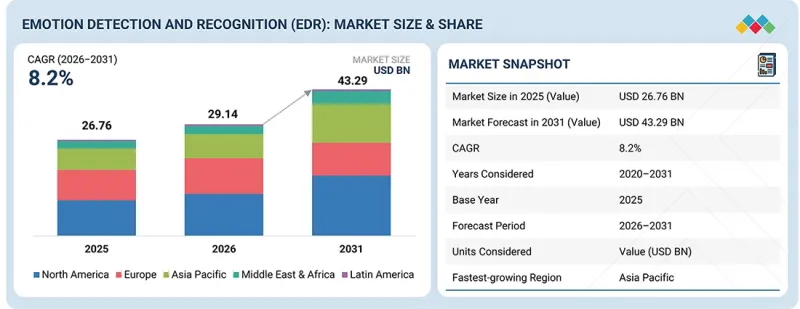
감정 감지 및 인식(EDR) 시장 규모는 예측 기간 동안 CAGR 8.2%로 확대되어 2026년 291억 4,000만 달러에서 2031년에는 432억 9,000만 달러에 달할 것으로 전망됩니다.
음성 어시스턴트, 음성 상거래 플랫폼, 대화형 AI 솔루션의 도입 확대가 EDR 기술에 대한 수요를 견인하고 있습니다.
| 조사 범위 | |
|---|---|
| 조사 대상 기간 | 2020-2031년 |
| 기준 연도 | 2025년 |
| 예측 기간 | 2026-2031년 |
| 단위 | 금액(달러) |
| 부문 | 제공, 전개 방식, 데이터 모달리티, 용도, 업계 |
| 대상 지역 | 북미, 유럽, 아시아태평양, 중동 및 아프리카, 라틴아메리카 |
기업들은 고객 서비스, 가상 비서, 음성 지원 애플리케이션 분야에서 감정적 맥락을 이해하고, 대화 품질을 향상시키며, 응답을 개인화하고, 사용자 참여도를 높이기 위해 음성 감정 인식 기능을 점점 더 많이 활용하고 있습니다.
"제공 부문별로는 감정 인식 소프트웨어 플랫폼 부문이 2026년에 가장 큰 시장 점유율을 차지할 것으로 예측됩니다."
감정 인식 소프트웨어 플랫폼은 음성, 텍스트, 시각, 생체 인증 등 다양한 모달리티를 통해 감정 데이터를 수집, 분석, 해석하는 핵심 기술 계층으로서의 역할을 수행하고 있기 때문에 EDR 시장에서 가장 큰 점유율을 차지하고 있습니다. 이러한 플랫폼은 감정 분석, 감정 탐지, 행동 인텔리전스, 멀티모달 분석을 위한 엔드투엔드 기능을 제공하여, 조직이 감정을 인식하는 애플리케이션을 대규모로 도입할 수 있도록 지원합니다. 이러한 플랫폼의 도입은 특히 고객 경험 관리, 컨택센터, 의료, 자동차, 보안, 인력 분석 분야에서 활발히 이루어지고 있습니다. 구체적인 예로는 마이크로소프트의 Azure AI 서비스, 구글의 AI 및 자연어 처리 솔루션, AWS의 AI 서비스, NICE CXone, Qualtrics XM Discover, Verint Speech Analytics, Smart Eye의 자동차용 감정 및 운전자 모니터링 플랫폼 등이 있으며, 이러한 솔루션들은 조직이 방대한 양의 고객 데이터와 행동 데이터로부터 실용적인 인사이트를 도출하는 데 기여하고 있습니다.
"데이터 모달리티별로 살펴보면, 예측 기간 동안 멀티모달 데이터 융합 부문이 가장 높은 연평균 성장률(CAGR)을 기록할 것으로 예상됩니다."
조직들이 점점 더 정확하고 맥락을 파악하는 감정 인식 기능을 요구함에 따라, 다중 모달 데이터 융합의 도입이 급속히 진행되고 있습니다. 음성, 텍스트, 표정, 안구 운동, 생리 신호 등 여러 데이터 소스를 결합함으로써, 멀티모달 시스템은 단일 모달 접근 방식보다 인간의 감정을 보다 포괄적으로 이해할 수 있게 해줍니다. 이 기능은 단일 출처만으로는 감정 상태를 확실하게 파악할 수 없는 고객 경험 분석, 건강 관리 모니터링, 자동차 안전, 인력 인텔리전스, 보안 애플리케이션 분야에서 특히 유용합니다. 기업들이 정확도 향상, 편향 감소, 의사결정 개선을 우선시함에 따라, 여러 감정 및 행동 신호의 통합이 중요한 요건으로 대두되고 있으며, 이는 멀티모달 감정 인식 플랫폼 및 솔루션에 대한 투자 확대를 촉진하고 있습니다.
"지역별로는 예측 기간 동안 북미가 시장을 주도할 것으로 추정됩니다."
북미에는 Microsoft, AWS, Google, IBM, NICE, Verint, Qualtrics, Genesys 등 주요 기술 제공업체들이 자리 잡고 있으며, AI 및 고급 분석에 대한 투자도 활발히 이루어지고 있어 감정 감지 및 인식(EDR) 시장을 주도하고 있습니다. 지역 매출의 대부분은 미국이 차지하고 있으며, 고객 경험 관리, 컨택센터, 의료, 직원 분석, 자동차 분야 등에서 감정 분석의 도입이 확대되고 있는 것이 성장을 주도하고 있습니다. 캐나다에서도 강력한 AI 연구 생태계, 확대되는 디지털 전환 노력, 헬스케어 기술에 대한 투자에 힘입어 도입이 확대되고 있습니다. 이 지역은 음성 분석, 감정 분석, 멀티모달 AI 솔루션의 조기 도입은 물론, 클라우드 제공업체, 엔터프라이즈 소프트웨어 공급업체, 고객 경험 플랫폼 간의 전략적 파트너십의 혜택을 누리고 있습니다. 이러한 요인들로 인해 북미는 감정 인식 기술의 개발, 상용화 및 도입에 있어 주요 거점으로서의 위상을 확립하고 있습니다.
본 보고서에서는 전 세계 감정 감지 및 인식(EDR) 시장을 조사하여, 시장 개요, 시장 성장에 영향을 미치는 다양한 요인에 대한 분석, 기술 및 특허 동향, 법규제 환경, 사례 연구, 시장 규모 추정 및 전망, 각종 분류·지역/주요 국가별 상세 분석, 경쟁 현황, 주요 기업 개요 등을 정리하고 있습니다.
목차
제1장 소개
제2장 주요 요약
제3장 주요 인사이트
제4장 시장 개요
제5장 업계 동향
제6장 기술의 진보, AI의 영향, 특허, 혁신, 향후 응용
제7장 규제 상황
제8장 소비자 상황과 구매 행동
제9장 감정 감지 및 인식(EDR) 시장 : 제공별
제10장 감정 감지 및 인식(EDR) 시장 : 전개 방식별
제11장 감정 감지 및 인식(EDR) 시장 : 데이터 모달리티별
제12장 감정 감지 및 인식(EDR) 시장 : 용도별
제13장 감정 감지 및 인식(EDR) 시장 : 업계별
제14장 감정 감지 및 인식(EDR) 시장 : 지역별
제15장 경쟁 구도
제16장 기업 개요
제17장 조사 방법
제18장 부록
KSMThe emotion detection and recognition market is projected to grow from USD 29.14 billion in 2026 to USD 43.29 billion by 2031 at a Compound Annual Growth Rate (CAGR) of 8.2% during the forecast period. The growing adoption of voice assistants, voice commerce platforms, and conversational AI solutions is driving demand for Emotion Detection and Recognition (EDR) technologies.
| Scope of the Report | |
|---|---|
| Years Considered for the Study | 2020-2031 |
| Base Year | 2025 |
| Forecast Period | 2026-2031 |
| Units Considered | Value (USD Million/Billion) |
| Segments | Offering, Deployment Mode, Data Modality, Application, Vertical |
| Regions covered | North America, Europe, Asia Pacific, Middle East & Africa, Latin America |
Organizations are increasingly leveraging speech emotion recognition capabilities to understand emotional context, improve interaction quality, personalize responses, and enhance user engagement across customer service, virtual assistant, and voice-enabled applications.
"By offering, the emotion recognition software platforms segment is projected to hold the largest market share in 2026."
Emotion recognition software platforms account for the largest share of the EDR market due to their role as the primary technology layer for collecting, analyzing, and interpreting emotional data across speech, text, visual, and biometric modalities. These platforms provide end-to-end capabilities for emotion analysis, sentiment detection, behavioral intelligence, and multimodal analytics, enabling organizations to deploy emotion-aware applications at scale. Their adoption is particularly strong across customer experience management, contact centers, healthcare, automotive, security, and workforce analytics. Examples include Microsoft's Azure AI services, Google's AI and Natural Language offerings, AWS AI services, NICE CXone, Qualtrics XM Discover, Verint Speech Analytics, and Smart Eye's automotive emotion and driver monitoring platforms, which help organizations derive actionable insights from large volumes of customer and behavioral data.
"By data modality, the multimodal data fusion segment is expected to witness the highest CAGR during the forecast period."
Multimodal data fusion is witnessing strong adoption as organizations increasingly seek more accurate and context-aware emotion recognition capabilities. By combining multiple data sources such as speech, text, facial expressions, eye movements, and physiological signals, multimodal systems provide a more comprehensive understanding of human emotions than single-modality approaches. This capability is particularly valuable in customer experience analytics, healthcare monitoring, automotive safety, workforce intelligence, and security applications, where emotional states cannot be reliably inferred from a single source. As enterprises prioritize higher accuracy, reduced bias, and improved decision-making, the integration of multiple emotional and behavioral signals is becoming a key requirement, driving increased investment in multimodal emotion recognition platforms and solutions.
"By region, North America is estimated to lead the market during the forecast period"
North America leads the Emotion Detection and Recognition (EDR) market due to the presence of major technology providers such as Microsoft, AWS, Google, IBM, NICE, Verint, Qualtrics, and Genesys, alongside strong investments in artificial intelligence and advanced analytics. The US contributes most of the regional revenue, driven by widespread adoption of emotion analytics across customer experience management, contact centers, healthcare, workforce analytics, and automotive applications. Canada is also witnessing increasing adoption, supported by its strong artificial intelligence research ecosystem, growing digital transformation initiatives, and investments in healthcare technologies. The region continues to benefit from early adoption of speech analytics, sentiment analysis, and multimodal AI solutions, as well as strategic partnerships between cloud providers, enterprise software vendors, and customer experience platforms. These factors have established North America as a key hub for the development, commercialization, and deployment of emotion-aware technologies.
Breakdown of Primaries
The study draws insights from a range of industry experts, including component suppliers, Tier 1 companies, and OEMs. The break-up of the primaries is as follows:
- By Company Type: Tier 1 - 20%, Tier 2 - 32%, and Tier 3 - 48%
- By Designation: C-level - 40%, Managerial & Other Levels - 60%
- By Region: North America - 20%, Europe - 30%, Asia Pacific - 40%, Middle East & Africa - 5%, Latin America - 5%
Major vendors in the emotion detection and recognition market include Microsoft (US), AWS (US), Oracle (US), NiCE (Israel), Salesforce (US), Google (US), Qualtrics (US), Bosch (Germany), NEC (Japan), Genesys (US), IBM (US), Nemesysco (Israel), Smart Eye (Sweden), Uniphore (US), CallMiner (US), audEERING (Germany), Tobii (Sweden), Seeing Machines (Australia), Medallia (US), Sprinklr (US), Verint (US), Realeyes (UK), Observe.AI (US), Entropik (India), Behavioral Signals (US), Kairos (US), Noldus (Netherlands), Cognovi Labs (US), Cerence (US), MorphCast (Italy), Hume AI (US), and Vern AI (US).
The study includes an in-depth competitive analysis of the key players in the emotion detection and recognition market, their company profiles, recent developments, and key market strategies.
Research Coverage
The report segments the Emotion Detection and Recognition (EDR) market and forecasts its size based on offering (solutions [emotion recognition software platforms, emotion recognition APIs & SDKs], services [consulting & strategy services, integration & deployment services, support & maintenance services, managed emotion AI services]), deployment (on-premises, cloud), data modality (speech & audio, visual data [facial expressions, images & video], text data, physiological & biometric data, multimodal data fusion), application (consumer experience analytics, security, surveillance & threat detection, marketing & advertising analytics, health & wellness monitoring, workforce engagement & productivity analysis, driver monitoring & automotive safety, education & learning analytics, entertainment & interactive experiences, lie detection & behavioral analysis), vertical (BFSI, retail & e-commerce, healthcare, IT & ITeS, automotive, media & entertainment, others [education, government & defense, travel & hospitality]). The study also includes an in-depth competitive analysis of the market's key players, their company profiles, key observations related to product and business offerings, recent developments, and key market strategies.
Key Benefits of Buying the Report
The report will help market leaders/new entrants with information on the closest approximations of revenue numbers for the overall emotion detection and recognition market and its subsegments. This report will help stakeholders understand the competitive landscape and gain valuable insights to better position their businesses and plan suitable go-to-market strategies. The report also helps stakeholders understand the market pulse and provides information on key market drivers, restraints, challenges, and opportunities.
The report provides insights into the following pointers:
- Analysis of drivers (Rising adoption of AI-powered customer experience and contact center analytics, Expansion of driver monitoring systems and in-cabin sensing technologies, Advancements in multimodal AI combining facial, speech, text, and physiological analysis), restraints (Lack of standardized regulations governing emotion AI technologies, Limited accuracy across diverse cultures, demographics, and languages), opportunities (Integration of generative AI and large language models with emotion analytics, Expansion of emotion AI in healthcare diagnostics and mental health monitoring), and challenges (Balancing innovation with privacy and regulatory compliance requirements, Addressing algorithmic bias in emotion detection models).
- Product Development/Innovation: Detailed insights on upcoming technologies, research development activities, and product & service launches in the emotion detection and recognition market.
- Market Development: Comprehensive information about lucrative markets - the report analyzes the emotion detection and recognition market across varied regions.
- Market Diversification: Exhaustive information about new products and services, untapped geographies, recent developments, and investments in the emotion detection and recognition market.
- Competitive Assessment: In-depth assessment of market shares, growth strategies, and service offerings of leading players like Microsoft (US), AWS (US), Oracle (US), NiCE (Israel), Salesforce (US), Google (US), Qualtrics (US), Bosch (Germany), NEC (Japan), Genesys (US), IBM (US), Nemesysco (Israel), Smart Eye (Sweden), Uniphore (US), CallMiner (US), audEERING (Germany), Tobii (Sweden), Seeing Machines (Australia), Medallia (US), Sprinklr (US), Verint (US), Realeyes (UK), Observe.AI (US), Entropik (India), Behavioral Signals (US), Kairos (US), Noldus (Netherlands), Cognovi Labs (US), Cerence (US), MorphCast (Italy), Hume AI (US), and Vern AI (US), in the emotion detection and recognition market strategies.
TABLE OF CONTENTS
1 INTRODUCTION
- 1.1 STUDY OBJECTIVES
- 1.2 MARKET DEFINITION
- 1.3 STUDY SCOPE AND SEGMENTATION
- 1.3.1 MARKET SEGMENTATION
- 1.3.2 INCLUSIONS AND EXCLUSIONS
- 1.3.3 YEARS CONSIDERED
- 1.4 CURRENCY CONSIDERED
- 1.5 STAKEHOLDERS
- 1.6 SUMMARY OF CHANGES
2 EXECUTIVE SUMMARY
- 2.1 MARKET HIGHLIGHTS AND KEY INSIGHTS
- 2.2 KEY MARKET PARTICIPANTS: MAPPING OF STRATEGIC DEVELOPMENTS
- 2.3 DISRUPTIVE TRENDS SHAPING MARKET
- 2.4 HIGH-GROWTH SEGMENTS & EMERGING FRONTIERS
- 2.5 SNAPSHOT: GLOBAL MARKET SIZE, GROWTH RATE, AND FORECAST
3 PREMIUM INSIGHTS
- 3.1 ATTRACTIVE OPPORTUNITIES FOR PLAYERS IN EMOTION DETECTION AND RECOGNITION MARKET
- 3.2 EMOTION DETECTION AND RECOGNITION MARKET, BY OFFERING
- 3.3 EMOTION DETECTION AND RECOGNITION MARKET, BY SOLUTION
- 3.4 EMOTION DETECTION AND RECOGNITION MARKET, BY SERVICE
- 3.5 EMOTION DETECTION AND RECOGNITION MARKET, BY DEPLOYMENT MODE
- 3.6 EMOTION DETECTION AND RECOGNITION MARKET, BY APPLICATION
- 3.7 EMOTION DETECTION AND RECOGNITION MARKET, BY VERTICAL
- 3.8 EMOTION DETECTION AND RECOGNITION MARKET, BY REGION
4 MARKET OVERVIEW
- 4.1 INTRODUCTION
- 4.2 MARKET DYNAMICS
- 4.2.1 DRIVERS
- 4.2.1.1 Rising adoption of AI-powered customer experience and contact center analytics
- 4.2.1.2 Expansion of driver monitoring systems and in-cabin sensing technologies
- 4.2.1.3 Advancements in multimodal AI combining facial, speech, text, and physiological analysis
- 4.2.2 RESTRAINTS
- 4.2.2.1 Lack of standardized regulations governing emotion AI technologies
- 4.2.2.2 Limited accuracy across diverse cultures, demographics, and languages
- 4.2.3 OPPORTUNITIES
- 4.2.3.1 Integration of generative AI and large language models with emotion analytics
- 4.2.3.2 Expansion of emotion AI in healthcare diagnostics and mental health monitoring
- 4.2.4 CHALLENGES
- 4.2.4.1 Balancing innovation with privacy and regulatory compliance requirements
- 4.2.4.2 Addressing algorithmic bias in emotion detection models
- 4.2.1 DRIVERS
- 4.3 UNMET NEEDS AND WHITE SPACES
- 4.4 INTERCONNECTED MARKETS AND CROSS-SECTOR OPPORTUNITIES
- 4.4.1 INTERCONNECTED MARKETS
- 4.4.2 CROSS-SECTOR OPPORTUNITIES
- 4.5 STRATEGIC MOVES BY TIER-1/2/3 PLAYERS
- 4.5.1 CROSS-TIER STRATEGIC PATTERNS
- 4.5.2 STRATEGIC TRENDS
- 4.5.2.1 Expansion of emotion intelligence beyond customer experience
- 4.5.2.2 Emergence of emotionally aware AI assistants and digital humans
- 4.5.2.3 Growing emphasis on responsible and trustworthy emotion AI
5 INDUSTRY TRENDS
- 5.1 PORTER'S FIVE FORCES ANALYSIS
- 5.1.1 THREAT OF NEW ENTRANTS
- 5.1.2 THREAT OF SUBSTITUTES
- 5.1.3 BARGAINING POWER OF SUPPLIERS
- 5.1.4 BARGAINING POWER OF BUYERS
- 5.1.5 INTENSITY OF COMPETITIVE RIVALRY
- 5.2 MACROECONOMIC INDICATORS
- 5.2.1 INTRODUCTION
- 5.2.2 GDP TRENDS AND FORECAST
- 5.2.3 TRENDS IN GLOBAL ICT INDUSTRY
- 5.3 VALUE CHAIN ANALYSIS
- 5.3.1 PLANNING & DESIGN
- 5.3.2 INFRASTRUCTURE DEVELOPMENT (EDR PLATFORMS)
- 5.3.3 SYSTEM INTEGRATION
- 5.3.4 ECOSYSTEM PARTNERS & PLATFORM PROVIDERS
- 5.3.5 CONSULTATION & ADVISORY (CROSS-STAGE LAYER)
- 5.3.6 END USER GROUPS
- 5.4 ECOSYSTEM ANALYSIS
- 5.5 PRICING ANALYSIS
- 5.5.1 AVERAGE SELLING PRICE TREND OF KEY PLAYERS, BY PLATFORM
- 5.5.2 INDICATIVE PRICING ANALYSIS FOR KEY PLAYERS
- 5.6 KEY CONFERENCES & EVENTS, 2026-2027
- 5.7 TRENDS AND DISRUPTIONS IMPACTING CUSTOMER BUSINESS
- 5.8 INVESTMENT AND FUNDING SCENARIO
- 5.9 CASE STUDY ANALYSIS
- 5.9.1 SMART EYE OPTIMIZED LONG-HAUL DRIVER ATTENTION THROUGH EYE-TRACKING AND DRIVER MONITORING TECHNOLOGY
- 5.9.2 KANTAR IMPROVED PANEL INTEGRITY USING REALEYES VERIFY
- 5.9.3 HEATHROW AIRPORT IMPROVED PASSENGER WAYFINDING USING TOBII EYE-TRACKING TECHNOLOGY
- 5.9.4 LEADING FAST-FOOD BRAND IMPROVED ADVERTISING EFFECTIVENESS THROUGH ENTROPIK'S EMOTION AI PLATFORM
- 5.10 IMPACT OF 2025 US TARIFF - EMOTION DETECTION AND RECOGNITION MARKET
- 5.10.1 INTRODUCTION
- 5.10.2 KEY TARIFF RATES
- 5.10.3 PRICE IMPACT ANALYSIS
- 5.10.4 IMPACT ON COUNTRY/REGION
- 5.10.4.1 North America
- 5.10.4.2 Europe
- 5.10.4.3 Asia Pacific
- 5.10.5 IMPACT ON END-USE INDUSTRIES
6 TECHNOLOGICAL ADVANCEMENTS, AI-DRIVEN IMPACT, PATENTS, INNOVATIONS, AND FUTURE APPLICATIONS
- 6.1 TECHNOLOGY ANALYSIS
- 6.1.1 KEY EMERGING TECHNOLOGIES
- 6.1.1.1 Multimodal AI
- 6.1.1.2 Affective Computing
- 6.1.1.3 Explainable AI (XAI)
- 6.1.2 COMPLEMENTARY TECHNOLOGIES
- 6.1.2.1 Computer Vision
- 6.1.2.2 Natural Language Processing (NLP)
- 6.1.2.3 Machine Learning
- 6.1.3 ADJACENT TECHNOLOGIES
- 6.1.3.1 Conversational AI
- 6.1.3.2 3.1.3.2 Human-Machine Interface (HMI)
- 6.1.1 KEY EMERGING TECHNOLOGIES
- 6.2 TECHNOLOGY/PRODUCT ROADMAP
- 6.2.1 SHORT-TERM (2026-2027) | FOUNDATION & EARLY ENTERPRISE ADOPTION
- 6.2.2 MID-TERM (2027-2030) SCALE-UP, INTEROPERABILITY & INTELLIGENT AUTOMATION
- 6.2.3 LONG-TERM (2030-2035+) | AUTONOMOUS, EMOTIONALLY INTELLIGENT & HUMAN-CENTRIC AI ECOSYSTEMS
- 6.3 PATENT ANALYSIS
- 6.4 FUTURE APPLICATIONS
- 6.4.1 EMOTION-AWARE CONVERSATIONAL AI PLATFORMS
- 6.4.2 EMOTION-DRIVEN HEALTHCARE & MENTAL WELLNESS SYSTEMS
- 6.4.3 EMOTION-AWARE AUTONOMOUS MOBILITY & DRIVER MONITORING
- 6.4.4 EMOTION-ENABLED DIGITAL HUMANS & VIRTUAL ASSISTANTS
- 6.4.5 EMOTION INTELLIGENCE FOR WORKFORCE & CUSTOMER EXPERIENCE PLATFORMS
- 6.5 IMPACT OF AI/GEN AI ON EMOTION DETECTION AND RECOGNITION MARKET
- 6.5.1 BEST PRACTICES IN EMOTION DETECTION AND RECOGNITION (EDR) MARKET
- 6.5.2 CASE STUDIES OF AI IMPLEMENTATION IN EMOTION DETECTION AND RECOGNITION (EDR) MARKET
- 6.5.3 INTERCONNECTED ADJACENT ECOSYSTEM AND IMPACT ON MARKET PLAYERS
- 6.5.4 CLIENTS' READINESS TO ADOPT GENERATIVE AI IN EMOTION DETECTION AND RECOGNITION MARKET
- 6.6 SUCCESS STORIES AND REAL-WORLD APPLICATIONS
- 6.6.1 SMART EYE: AI-POWERED DRIVER MONITORING SYSTEMS
- 6.6.2 ENTROPIK: EMOTION AI FOR CONSUMER INSIGHTS AND EXPERIENCE OPTIMIZATION
7 REGULATORY LANDSCAPE
- 7.1 REGIONAL REGULATIONS AND COMPLIANCE
- 7.1.1 REGULATORY BODIES, GOVERNMENT AGENCIES, AND OTHER ORGANIZATIONS
- 7.1.2 INDUSTRY STANDARDS
8 CONSUMER LANDSCAPE & BUYER BEHAVIOR
- 8.1 DECISION-MAKING PROCESS
- 8.2 KEY STAKEHOLDERS & BUYING CRITERIA
- 8.2.1 KEY STAKEHOLDERS IN BUYING PROCESS
- 8.2.2 BUYING CRITERIA
- 8.3 ADOPTION BARRIERS & INTERNAL CHALLENGES
9 EMOTION DETECTION AND RECOGNITION MARKET, BY OFFERING
- 9.1 INTRODUCTION
- 9.1.1 OFFERING: EMOTION DETECTION AND RECOGNITION MARKET DRIVERS
- 9.2 SOLUTION
- 9.2.1 SOLUTIONS ENABLE REAL-TIME EMOTION ANALYSIS AND ACTIONABLE HUMAN INSIGHTS ACROSS DIGITAL AND PHYSICAL INTERACTIONS DRIVING MARKET GROWTH
- 9.2.2 EMOTION RECOGNITION SOFTWARE PLATFORMS
- 9.2.2.1 Emotion recognition software platforms enable centralized emotion analytics driving market growth
- 9.2.3 EMOTION RECOGNITION APIS & SDKS
- 9.2.3.1 Emotion recognition APIs & SDKs enable embedded emotion AI capabilities driving market growth
- 9.3 SERVICES
- 9.3.1 SERVICES SUPPORT SUCCESSFUL EMOTION AI IMPLEMENTATION DRIVING MARKET GROWTH
- 9.3.2 CONSULTING & STRATEGY SERVICES
- 9.3.2.1 Consulting & Strategy Services guide effective emotion AI adoption driving market growth
- 9.3.3 INTEGRATION & DEPLOYMENT
- 9.3.3.1 Integration & deployment services facilitate seamless emotion AI implementation driving market growth
- 9.3.4 SUPPORT & MAINTENANCE SERVICES
- 9.3.4.1 Support & maintenance services ensure reliable emotion AI performance driving market growth
- 9.3.5 MANAGED EMOTION AI SERVICES
- 9.3.5.1 Managed emotion AI services simplify ongoing emotion AI operations driving market growth
10 EMOTION DETECTION AND RECOGNITION MARKET, BY DEPLOYMENT MODE
- 10.1 INTRODUCTION
- 10.1.1 DEPLOYMENT MODE: EMOTION DETECTION AND RECOGNITION MARKET DRIVERS
- 10.2 ON-PREMISES
- 10.2.1 ON-PREMISES DEPLOYMENTS PROVIDE ENHANCED CONTROL AND DATA GOVERNANCE DRIVING MARKET GROWTH
- 10.3 CLOUD
- 10.3.1 CLOUD DEPLOYMENTS ENABLE SCALABLE EMOTION ANALYTICS AND RAPID IMPLEMENTATION DRIVING MARKET GROWTH
11 EMOTION DETECTION AND RECOGNITION MARKET, BY DATA MODALITY
- 11.1 INTRODUCTION
- 11.1.1 DATA MODALITY: EMOTION DETECTION AND RECOGNITION MARKET DRIVERS
- 11.2 SPEECH & AUDIO
- 11.2.1 SPEECH & AUDIO ENABLES REAL-TIME EMOTION ANALYSIS FROM VOCAL INTERACTIONS DRIVING MARKET GROWTH
- 11.3 VISUAL DATA (FACIAL EXPRESSIONS, IMAGES & VIDEO)
- 11.3.1 VISUAL DATA ENABLES ACCURATE EMOTION RECOGNITION THROUGH FACIAL AND BEHAVIORAL ANALYSIS DRIVING MARKET GROWTH
- 11.4 TEXT DATA
- 11.4.1 TEXT DATA TRANSFORMS WRITTEN INTERACTIONS INTO ACTIONABLE EMOTIONAL INSIGHTS DRIVING MARKET GROWTH
- 11.5 PHYSIOLOGICAL & BIOMETRIC DATA
- 11.5.1 PHYSIOLOGICAL & BIOMETRIC DATA ENABLES DEEPER EMOTIONAL ASSESSMENT THROUGH BIOLOGICAL SIGNALS DRIVING MARKET GROWTH
- 11.6 MULTIMODAL DATA FUSION
- 11.6.1 MULTIMODAL DATA FUSION ENHANCES EMOTION RECOGNITION ACCURACY THROUGH INTEGRATED DATA ANALYSIS DRIVING MARKET GROWTH
12 EMOTION DETECTION AND RECOGNITION MARKET, BY APPLICATION
- 12.1 INTRODUCTION
- 12.1.1 APPLICATION: EMOTION DETECTION AND RECOGNITION MARKET DRIVERS
- 12.2 CONSUMER EXPERIENCE ANALYTICS
- 12.2.1 CONSUMER EXPERIENCE ANALYTICS TRANSFORMS EMOTIONAL INSIGHTS INTO ENHANCED CUSTOMER ENGAGEMENT DRIVING MARKET GROWTH
- 12.3 MARKETING & ADVERTISING ANALYTICS
- 12.3.1 MARKETING & ADVERTISING ANALYTICS IMPROVES CAMPAIGN EFFECTIVENESS THROUGH EMOTION-DRIVEN AUDIENCE INSIGHTS DRIVING MARKET GROWTH
- 12.4 HEALTH & WELLNESS MONITORING
- 12.4.1 EMOTIONAL AND BEHAVIORAL ANALYTICS IMPROVE HEALTH & WELLNESS MONITORING, DRIVING MARKET GROWTH
- 12.5 DRIVER MONITORING & AUTOMOTIVE SAFETY
- 12.5.1 DRIVER MONITORING & AUTOMOTIVE SAFETY ENHANCES OCCUPANT AWARENESS AND ROAD SAFETY DRIVING MARKET GROWTH
- 12.6 WORKFORCE ENGAGEMENT & PRODUCTIVITY ANALYSIS
- 12.6.1 WORKFORCE ENGAGEMENT & PRODUCTIVITY ANALYSIS SUPPORTS EMPLOYEE WELL-BEING AND ORGANIZATIONAL PERFORMANCE DRIVING MARKET GROWTH
- 12.7 SECURITY, SURVEILLANCE & THREAT DETECTION
- 12.7.1 SECURITY, SURVEILLANCE & THREAT DETECTION STRENGTHENS SITUATIONAL AWARENESS AND RISK IDENTIFICATION DRIVING MARKET GROWTH
- 12.8 EDUCATION & LEARNING ANALYTICS
- 12.8.1 EDUCATION & LEARNING ANALYTICS ENABLES PERSONALIZED AND ADAPTIVE LEARNING EXPERIENCES DRIVING MARKET GROWTH
- 12.9 LIE DETECTION & BEHAVIORAL ANALYSIS
- 12.9.1 EMOTION AI ADVANCES LIE DETECTION AND BEHAVIORAL ASSESSMENT, DRIVING MARKET GROWTH
- 12.10 ENTERTAINMENT & INTERACTIVE EXPERIENCES
- 12.10.1 ENTERTAINMENT & INTERACTIVE EXPERIENCES DELIVER PERSONALIZED AND IMMERSIVE USER ENGAGEMENT DRIVING MARKET GROWTH
13 EMOTION DETECTION AND RECOGNITION MARKET, BY VERTICAL
- 13.1 INTRODUCTION
- 13.1.1 VERTICAL: EMOTION DETECTION AND RECOGNITION MARKET DRIVERS
- 13.2 BFSI
- 13.2.1 BFSI ENHANCES CUSTOMER ENGAGEMENT AND SERVICE INTELLIGENCE THROUGH EMOTION ANALYTICS DRIVING MARKET GROWTH
- 13.3 RETAIL & E-COMMERCE
- 13.3.1 RETAIL & E-COMMERCE STRENGTHENS PERSONALIZED SHOPPING EXPERIENCES THROUGH EMOTION RECOGNITION DRIVING MARKET GROWTH
- 13.4 HEALTHCARE
- 13.4.1 EMOTION RECOGNITION STRENGTHENS CLINICAL DECISION-MAKING AND PATIENT CARE, DRIVING MARKET GROWTH
- 13.5 IT & ITES
- 13.5.1 IT & ITES IMPROVES DIGITAL ENGAGEMENT AND INTELLIGENT SERVICE DELIVERY DRIVING MARKET GROWTH
- 13.6 AUTOMOTIVE
- 13.6.1 AUTOMOTIVE ENHANCES DRIVER SAFETY AND OCCUPANT MONITORING THROUGH EMOTION RECOGNITION DRIVING MARKET GROWTH
- 13.7 MEDIA & ENTERTAINMENT
- 13.7.1 MEDIA & ENTERTAINMENT DELIVERS DEEPER AUDIENCE INSIGHTS AND PERSONALIZED EXPERIENCES DRIVING MARKET GROWTH
- 13.8 OTHER VERTICALS
14 EMOTION DETECTION AND RECOGNITION MARKET, BY REGION
- 14.1 INTRODUCTION
- 14.2 NORTH AMERICA
- 14.2.1 NORTH AMERICA: EMOTION DETECTION AND RECOGNITION MARKET DRIVERS
- 14.2.2 US
- 14.2.2.1 Strong investments in customer experience analytics and AI innovation driving EDR adoption in US
- 14.2.3 CANADA
- 14.2.3.1 Growing AI research capabilities and digital transformation initiatives supporting EDR adoption in Canada
- 14.3 EUROPE
- 14.3.1 EUROPE: EMOTION DETECTION AND RECOGNITION MARKET DRIVERS
- 14.3.2 UK
- 14.3.2.1 Growing AI innovation and customer experience investments supporting EDR adoption in the UK
- 14.3.3 GERMANY
- 14.3.3.1 Automotive innovation and industrial AI adoption driving EDR deployment in Germany
- 14.3.4 FRANCE
- 14.3.4.1 Expanding AI research initiatives and digital transformation efforts supporting EDR adoption in France
- 14.3.5 ITALY
- 14.3.5.1 Digital transformation and customer experience modernization supporting EDR adoption in Italy
- 14.3.6 REST OF EUROPE
- 14.4 ASIA PACIFIC
- 14.4.1 ASIA PACIFIC: MARKET DRIVERS
- 14.4.2 CHINA
- 14.4.2.1 Expanding AI leadership and digital ecosystem development driving EDR adoption in China
- 14.4.3 JAPAN
- 14.4.3.1 Human-centric technology innovation and intelligent mobility initiatives supporting EDR adoption in Japan
- 14.4.4 INDIA
- 14.4.4.1 Digital transformation and expanding AI adoption accelerating EDR deployment in India
- 14.4.5 REST OF ASIA PACIFIC
- 14.5 MIDDLE EAST & AFRICA
- 14.5.1 MIDDLE EAST & AFRICA: EMOTION DETECTION AND RECOGNITION MARKET DRIVERS
- 14.5.2 GCC
- 14.5.2.1 National AI strategies and smart city investments supporting EDR adoption across GCC
- 14.5.2.2 UAE
- 14.5.2.2.1 UAE has established itself as one of leading artificial intelligence markets
- 14.5.2.3 KSA
- 14.5.2.3.1 Saudi Arabia Accelerates AI Adoption to Advance Emotion Detection and Recognition
- 14.5.2.4 Rest of GCC
- 14.5.3 SOUTH AFRICA
- 14.5.3.1 Digital innovation and customer experience modernization supporting EDR adoption in South Africa
- 14.5.4 REST OF MIDDLE EAST & AFRICA
- 14.5.4.1 Digital transformation and expanding AI adoption accelerating EDR deployment in Rest of Middle East & Africa
- 14.6 LATIN AMERICA
- 14.6.1 LATIN AMERICA: EMOTION DETECTION AND RECOGNITION MARKET DRIVERS
- 14.6.2 BRAZIL
- 14.6.2.1 National AI strategies and smart city investments supporting EDR adoption across Brazil
- 14.6.3 MEXICO
- 14.6.3.1 Digital innovation and customer experience modernization supporting EDR adoption in Mexico
- 14.6.4 REST OF LATIN AMERICA
- 14.6.4.1 Digital transformation and expanding AI adoption accelerating EDR deployment in Rest of Latin America
15 COMPETITIVE LANDSCAPE
- 15.1 KEY PLAYER STRATEGIES/RIGHT TO WIN, 2024-2026
- 15.2 REVENUE ANALYSIS, 2020-2025
- 15.3 MARKET SHARE ANALYSIS, 2025
- 15.4 BRAND COMPARISON
- 15.5 COMPANY VALUATION AND FINANCIAL METRICS
- 15.5.1 COMPANY VALUATION, 2026
- 15.5.2 FINANCIAL METRICS USING EV/EBIDTA, 2026
- 15.6 COMPANY EVALUATION MATRIX: KEY PLAYERS, 2025
- 15.6.1 STARS
- 15.6.2 EMERGING LEADERS
- 15.6.3 PERVASIVE PLAYERS
- 15.6.4 PARTICIPANTS
- 15.6.5 COMPANY FOOTPRINT: KEY PLAYERS, 2026
- 15.6.5.1 Company footprint
- 15.6.5.2 Region footprint
- 15.6.5.3 Offering footprint
- 15.6.5.4 Vertical footprint
- 15.7 COMPANY EVALUATION MATRIX: STARTUPS/SMES, 2025
- 15.7.1 PROGRESSIVE COMPANIES
- 15.7.2 RESPONSIVE COMPANIES
- 15.7.3 DYNAMIC COMPANIES
- 15.7.4 STARTING BLOCKS
- 15.7.5 COMPETITIVE BENCHMARKING: STARTUPS/SMES, 2026
- 15.7.5.1 Detailed list of key startups/SMEs
- 15.7.6 COMPETITIVE BENCHMARKING OF KEY STARTUPS/SMES
- 15.7.6.1 Region footprint
- 15.7.6.2 Offering footprint
- 15.7.6.3 Vertical footprint
- 15.8 COMPETITIVE SCENARIO
- 15.8.1 PRODUCT LAUNCHES & ENHANCEMENTS
- 15.8.2 DEALS
16 COMPANY PROFILES
- 16.1 KEY PLAYERS
- 16.1.1 MICROSOFT
- 16.1.1.1 Business overview
- 16.1.1.2 Products/Solutions/Services offered
- 16.1.1.3 MnM view
- 16.1.1.3.1 Key strengths
- 16.1.1.3.2 Strategic choices
- 16.1.1.3.3 Weaknesses & competitive threats
- 16.1.2 AWS
- 16.1.2.1 Business overview
- 16.1.2.2 Products/Solutions/Services offered
- 16.1.2.3 Recent developments
- 16.1.2.4 MnM view
- 16.1.2.4.1 Key strengths
- 16.1.2.4.2 Strategic choices
- 16.1.2.4.3 Weaknesses & competitive threats
- 16.1.3 NICE
- 16.1.3.1 Business overview
- 16.1.3.2 Products/Solutions/Services offered
- 16.1.3.3 Recent developments
- 16.1.3.3.1 Product launches/Enhancements
- 16.1.3.4 MnM view
- 16.1.3.4.1 Key strengths
- 16.1.3.4.2 Strategic choices
- 16.1.3.4.3 Weaknesses & competitive threats
- 16.1.4 SALESFORCE
- 16.1.4.1 Business overview
- 16.1.4.2 Products/Solutions/Services offered
- 16.1.4.3 Recent developments
- 16.1.4.3.1 Product launches/Enhancements
- 16.1.4.4 MnM view
- 16.1.4.4.1 Key strengths
- 16.1.4.4.2 Strategic choices
- 16.1.4.4.3 Weaknesses & competitive threats
- 16.1.5 GOOGLE
- 16.1.5.1 Business overview
- 16.1.5.2 Products/Solutions/Services offered
- 16.1.5.3 Recent developments
- 16.1.5.3.1 Product enhancements
- 16.1.5.3.2 Deals
- 16.1.5.4 MnM view
- 16.1.5.4.1 Key strengths
- 16.1.5.4.2 Strategic choices
- 16.1.5.4.3 Weaknesses & competitive threats
- 16.1.6 ORACLE
- 16.1.6.1 Business overview
- 16.1.6.2 Products/Solutions/Services offered
- 16.1.7 NEMESYSCO
- 16.1.7.1 Business overview
- 16.1.7.2 Products/Solutions/Services offered
- 16.1.8 QUALTRICS
- 16.1.8.1 Business overview
- 16.1.8.2 Products/Solutions/Services offered
- 16.1.9 BOSCH
- 16.1.9.1 Business overview
- 16.1.9.2 Products/Solutions/Services offered
- 16.1.9.3 Recent developments
- 16.1.9.3.1 Product enhancements
- 16.1.9.3.2 Deals
- 16.1.10 NEC
- 16.1.10.1 Business overview
- 16.1.10.2 Products/Solutions/Services offered
- 16.1.11 GENESYS
- 16.1.11.1 Business overview
- 16.1.11.2 Products/Solutions/Services offered
- 16.1.12 IBM
- 16.1.12.1 Business overview
- 16.1.12.2 Products/Solutions/Services offered
- 16.1.12.3 Recent developments
- 16.1.12.3.1 Deals
- 16.1.1 MICROSOFT
- 16.2 OTHER KEY PLAYERS
- 16.2.1 SMARTEYE
- 16.2.2 TOBII
- 16.2.3 SEEING MACHINES
- 16.2.4 MEDALLIA
- 16.2.5 SPRINKLR
- 16.2.6 VERINT
- 16.2.7 CERENCE
- 16.2.8 UNIPHORE
- 16.2.9 CALLMINER
- 16.2.10 AUDEERING
- 16.2.11 REALEYES
- 16.2.12 OBSERVE.AI
- 16.2.13 ENTROPIK
- 16.2.14 BEHAVIORAL SIGNALS
- 16.2.15 KAIROS
- 16.2.16 NOLDUS
- 16.2.17 COGNOVI LABS
- 16.2.18 MORPHCAST
- 16.2.19 HUME AI
- 16.2.20 VERN AI
17 RESEARCH METHODOLOGY
- 17.1 RESEARCH DATA
- 17.1.1 SECONDARY DATA
- 17.1.2 PRIMARY DATA
- 17.1.2.1 Breakup of primary profiles
- 17.1.2.2 Key insights from industry experts
- 17.2 DATA TRIANGULATION
- 17.3 MARKET SIZE ESTIMATION
- 17.3.1 TOP-DOWN APPROACH
- 17.3.2 BOTTOM-UP APPROACH
- 17.4 MARKET FORECAST
- 17.5 RESEARCH ASSUMPTIONS
- 17.6 RESEARCH LIMITATIONS
18 APPENDIX
- 18.1 DISCUSSION GUIDE
- 18.2 KNOWLEDGESTORE: MARKETSANDMARKETS' SUBSCRIPTION PORTAL
- 18.3 CUSTOMIZATION OPTIONS
- 18.4 RELATED REPORTS
- 18.5 AUTHOR DETAILS