|
시장보고서
상품코드
2081118
냉각탑 시장 예측(-2031년) : 플로우 유형별, 기술별, 건축자재별, 디자인별, 유형별, 용도별, 지역별Cooling Tower Market by Type (Evaporative, Dry, Hybrid), Design (Natural, Mechanical), Construction Material (Concrete, Steel, FRP, Wood), Flow Type, Technology, Application (Power Generation, HVACR, Food & Beverage) & Region - Global Forecast to 2031 |
||||||

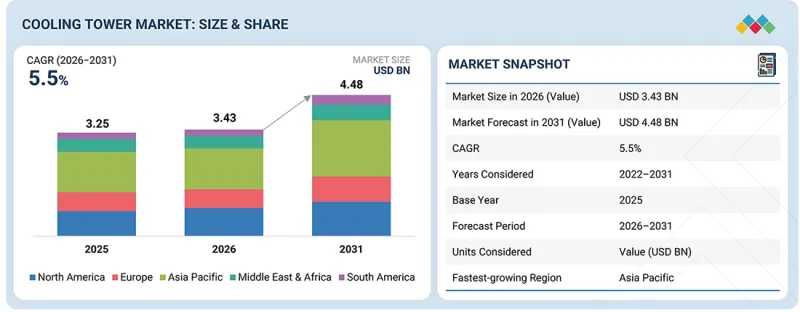
냉각탑 시장 규모는 2026년 34억 3,000만 달러에서 2031년에는 44억 8,000만 달러로, CAGR 5.5%로 확대할 것으로 추정되고 있습니다.
| 조사 범위 | |
|---|---|
| 조사 대상 기간 | 2022-2031년 |
| 기준연도 | 2025년 |
| 예측 기간 | 2026-2031년 |
| 산정대 | 금액(100만 달러), 수량(대) |
| 부문 | 플로우 유형별, 기술별, 건축자재별, 디자인별, 유형별, 용도별, 지역별 |
| 대상 지역 | 아시아태평양, 북미, 유럽, 중동 및 아프리카, 남미 |
이 시장은 산업화와 인프라 개발의 진전, 에너지 효율이 높은 냉각 솔루션에 대한 수요 증가, 데이터센터 및 디지털 인프라의 확대, 상업용 건물에서의 HVAC 시스템 도입 확대, 제조업 및 공정 산업의 성장, 물 절약 및 지속가능한 냉각 기술에 대한 집중, 신흥 경제국에서의 산업 생산 능력 확대, 기존 냉각 인프라의 현대화 및 개보수, 환경 및 에너지 효율 관련 규제 강화, 그리고 스마트 모니터링 및 자동 냉각 시스템의 발전으로 인해 성장하고 있습니다.
'건식 냉각탑 부문은 유형별로 볼 때, 금액 기준으로 성장률이 두 번째로 높은 부문이 될 것으로 예측됩니다.'
드라이 방식은 냉각탑 시장에서 가치 기준으로 두 번째로 빠르게 성장하는 부문이 될 것으로 전망됩니다. 각 산업이 지속가능한 조치의 도입을 요구하는 압박에 직면한 가운데, 건식 냉각탑은 냉각 과정에서 물의 증발을 필요로 하지 않음으로써 매력적인 해결책을 제시합니다. 열전달 능력 향상 및 시스템 효율 개선과 같은 건식 냉각 기술의 발전으로 인해 발전, 석유화학, 데이터센터 등 다양한 분야에서 이 기술의 도입이 확대되고 있습니다.
'디자인별로는 기계 환기식이 시장 규모에서 1위를 차지할 것으로 전망된다'
기계식 냉각탑은 견고한 구조와 다양한 용도에서 효율적인 냉각을 제공할 수 있는 능력 덕분에 세계 시장에서 급속한 성장이 예상됩니다. 이러한 유연한 설계 덕분에 특정 냉각 요구 사항에 맞춰 맞춤화가 가능하며, 맞춤형 솔루션을 필요로 하는 업계에 매력적인 선택지가 되고 있습니다. 또한 팬 기술과 제어 시스템의 혁신으로 인해 기계식 냉각탑의 성능과 신뢰성이 향상되어, 데이터센터, 석유화학, 식품 가공 등 중요한 분야에서 이 기술이 채택되는 데 기여하고 있습니다.
'HVACR은 금액 기준으로 냉각탑 시장에서 큰 점유율을 차지하고 있습니다.'
쾌적한 실내 환경 유지와 신선식품 보존에 필수적인 HVACR 분야에서, 냉각탑은 온도 조절과 시스템의 최적 성능 확보에 있으며, 매우 중요한 역할을 하고 있습니다. 상업용 빌딩, 산업 시설, 주택 단지를 막론하고, HVACR 시스템은 공조 기기나 냉동 시스템에서 발생하는 열을 관리하기 위해 효율적인 냉각 솔루션에 의존하고 있습니다. 전 세계에서 도시화와 인프라 개발이 가속화되는 가운데, HVACR 솔루션, 나아가 냉각탑에 대한 수요는 계속해서 증가하고 있으며, 냉각탑 시장 전체에 대한 그 중요한 기여도가 확고해지고 있습니다.
'유럽은 냉각탑 시장에서 3위의 규모를 자랑합니다.'
유럽은 산업 혁신과 환경 의식이 독자적으로 융합되어 있는 것을 배경으로, 세계 냉각탑 시장에서 3위를 차지하며 중요한 위치를 점하고 있습니다. 기술에서 농업에 이르기까지 다양한 분야를 아우르는 유럽의 냉각탑 수요는 운영 효율을 높이고 환경에 미치는 영향을 최소화하려는 노력을 반영하고 있습니다. 또한 이 지역에서 정밀 공학과 최첨단 기술을 중시하는 분위기는 지속적인 개선 문화를 조성하고, 첨단인 냉각 솔루션의 도입을 촉진하고 있습니다. 또한 유럽의 전략적인 지역적 위치와 상호 연계된 시장은 협력과 지식 교류를 촉진하여, 해당 지역의 냉각탑 시장 성장을 더욱 지원하고 있습니다.
냉각탑 시장에는 Baltimore Aircoil Company Inc.(미국), John Cockerill(벨기에), SPX Technologies(미국), Ebara Corporation(일본), Evapco, Inc.(미국), SPIG(이탈리아), Babcock &Wilcox Enterprises Inc.(미국), Seagull Cooling Tower(말레이시아), Enexio(독일), Paharpur Cooling Tower Limited(인도)와 같은 주요 기업으로 구성되어 있습니다. 본 조사에서는 냉각탑 시장의 주요 기업에 대해 기업 개요, 최근 동향 및 주요 시장 전략을 포함한 상세한 경쟁 분석을 수행하고 있습니다.
조사 범위
이 보고서에서는 냉각탑 시장을 유형, 설계, 구조 재료, 유동 방식, 기술, 용도 및 지역별로 세분화하고, 각 지역의 전체 시장 규모 추정치를 제시하고 있습니다. 주요 업계 업체에 대한 상세한 분석을 통해 사업 개요, 제품 및 서비스, 주요 전략, 신제품 출시, 사업 확장, 그리고 냉각탑 시장과 관련된 인수합병에 대한 인사이트를 제공합니다.
이 보고서를 구매할 때의 주요 이점
본 조사 보고서는 업계 분석(업계 동향), 주요 기업의 시장 순위 분석, 기업 개요 등 다양한 수준의 분석에 초점을 맞추고 있으며, 이를 종합함으로써 경쟁 구도의 전체적인 모습, 냉각탑 시장의 새로운 성장 분야 및 고성장 부문, 고성장 지역, 그리고 시장 촉진요인, 억제요인, 기회, 과제에 대해 파악할 수 있습니다.
이 보고서에서는 다음 사항에 대한 인사이트를 제공합니다. :
- 시장 침투율: 전 세계 냉각탑 시장의 주요 기업이 제공하는 냉각탑 시장에 관한 포괄적인 정보.
- 촉진요인 분석(아시아태평양 개발도상 시장의 관심 증가, 엄격한 환경 규제, HVACR 설비 설치 증가 및 산업 활동 확대, 그리고 냉각탑 산업을 재정의하는 기술 발전에 힘입은 냉각탑 수요 증가), 제약 요인(유럽 및 북미 지역의 완만한 성장), 기회(원자력 발전 업계의 수요 증가), 그리고 과제(높은 물 소비량 요구 사항, 빈번한 부식으로 인한 시스템 성능 저하)
- 제품 개발 및 혁신: 냉각탑 시장의 향후 기술, 연구개발 활동 및 신제품 출시에 대한 상세 인사이트.
- 시장 동향: 수익성이 높은 신흥 시장에 대한 포괄적인 정보 -- 이 보고서에서는 지역별 냉각탑 시장을 분석하고 있습니다.
- 시장 규모: 냉각탑을 제조하는 기업의 생산 능력에 대해 입수 가능한 범위 내에서 정보를 제공함과 동시에, 냉각탑 시장의 향후 생산 능력 전망에 대해서도 기술하고 있습니다.
- 경쟁사 분석: 냉각탑 시장 주요 기업의 시장 점유율, 전략, 제품 및 생산 능력에 대한 상세한 평가.
자주 묻는 질문
목차
제1장 서론
제2장 개요
제3장 주요 인사이트
제4장 시장 개요
제5장 기술 진보, AI에 의한 영향, 특허, 혁신, 향후 응용
제6장 규제 상황과 지속가능성 구상
제7장 고객 상황과 구매 행동
제8장 냉각탑 시장(플로우 유형별)
제9장 냉각탑 시장(기술별)
제10장 냉각탑 시장(건축자재별)
제11장 냉각탑 시장(디자인별)
제12장 냉각탑 시장(유형별)
제13장 냉각탑 시장(용도별)
제14장 냉각탑 시장(지역별)
제15장 경쟁 구도
제16장 기업 개요
제17장 조사 방법
제18장 부록
KSA 26.07.14The cooling towers market is estimated to grow from USD 3.43 billion in 2026 to USD 4.48 billion in 2031 at a CAGR of 5.5%.
| Scope of the Report | |
|---|---|
| Years Considered for the Study | 2022-2031 |
| Base Year | 2025 |
| Forecast Period | 2026-2031 |
| Units Considered | Value (USD Million), Volume (Units) |
| Segments | Type, Design, Construction Material, Flow Type, Technology, Application, and Region |
| Regions covered | Asia Pacific, North America, Europe, Middle East & Africa, and South America |
The market is growing due to rising industrialization and infrastructure development, growing demand for energy-efficient cooling solutions, expansion of data centers and digital infrastructure, increasing adoption of HVAC systems in commercial buildings, growth in manufacturing and process industries, focus on water conservation and sustainable cooling technologies, industrial capacity expansion across emerging economies, modernization and retrofit of existing cooling infrastructure, stricter environmental and energy efficiency regulations, and advancements in smart monitoring and automated cooling systems.
"The dry segment is projected to be the second-fastest growing segment by type in terms of value."
Dry is projected to be the second-fastest-growing segment of the cooling tower market. As industries face increasing pressure to adopt sustainable practices, dry cooling towers offer a compelling solution by eliminating the need for water evaporation in cooling. Advancements in dry cooling technology, such as enhanced heat transfer capabilities and improved system efficiency, are driving their adoption across a wide range of applications, including power generation, petrochemicals, and data centers.
"Mechanical draft to lead the market by design in terms of value"
Mechanical design cooling towers are poised for rapid growth in the global market due to their robust construction and ability to provide efficient cooling in diverse applications. Their flexible design allows for customization to meet specific cooling requirements, making them attractive to industries seeking tailored solutions. Furthermore, innovations in fan technology and control systems are enhancing the performance and reliability of mechanical cooling towers, driving their adoption in critical sectors such as data centers, petrochemicals, and food processing.
"HVACR accounted for a significant share of the cooling tower market in terms of value."
In the HVACR sector, which is indispensable for maintaining comfortable indoor environments and preserving perishable goods, cooling towers play a crucial role in regulating temperatures and ensuring optimal system performance. Whether in commercial buildings, industrial facilities, or residential complexes, HVACR systems rely on efficient cooling solutions to manage heat generated by air conditioning units and refrigeration systems. As urbanization and infrastructure development accelerate globally, the demand for HVACR solutions, and consequently cooling towers, continues to rise, solidifying its significant contribution to the overall cooling tower market.
"Europe is the third-largest market for cooling tower."
Europe holds a significant position as the third-largest region in the global cooling tower market, driven by its unique blend of industrial innovation and environmental consciousness. With a diverse range of sectors, from technology to agriculture, Europe's demand for cooling towers reflects a commitment to enhancing operational efficiency and minimizing environmental impact. Moreover, the region's emphasis on precision engineering and cutting-edge technology fosters a culture of continuous improvement, driving the adoption of advanced cooling solutions. Additionally, Europe's strategic geographical location and interconnected markets facilitate collaboration and knowledge exchange, further propelling the growth of the cooling tower market in the region.
In-depth interviews were conducted with Chief Executive Officers (CEOs), marketing directors, other innovation and technology directors, and executives from various key organizations operating in the cooling tower market, and information was gathered from secondary research to determine and verify the market size of several segments.
- By Company Type: Tier 1 - 40%, Tier 2 - 30%, and Tier 3 - 30%
- By Designation: C Level Executives- 20%, Directors - 10%, and Others - 70%
- By Region: North America - 20%, Europe - 20%, APAC - 40%, South America- 10% , and
the Middle East & Africa -10%
The cooling tower market comprises major players such as Baltimore Aircoil Company Inc. (US), John Cockerill (Belgium), SPX Technologies (US), Ebara Corporation (Japan), Evapco, Inc. (US), SPIG (Italy), Babcock & Wilcox Enterprises Inc. (US), Seagull Cooling Tower Co., Ltd (Malaysia), Enexio (Germany), and Paharpur Cooling Tower Limited (India). The study includes in-depth competitive analysis of these key players in the cooling tower market, with their company profiles, recent developments, and key market strategies.
Research Coverage
This report segments the market for cooling tower market on the basis of type, design, construction material, flow type, technology, application, and region, and provides estimations for the overall value of the market across various regions. A detailed analysis of key industry players has been conducted to provide insights into their business overviews, products & services, key strategies, new product launches, expansions, and mergers & acquisition associated with the market for cooling tower market.
Key benefits of buying this report
This research report is focused on various levels of analysis - industry analysis (industry trends), market ranking analysis of top players, and company profiles, which together provide an overall view on the competitive landscape; emerging and high-growth segments of the cooling tower market; high-growth regions; and market drivers, restraints, opportunities, and challenges.
The report provides insights on the following pointers:
- Market Penetration: Comprehensive information on the cooling tower market offered by top players in the global cooling tower market.
- Analysis of drivers (Growing Interest from Developing Markets in Asia Pacific, Heightened Demand for Cooling Towers Driven by Stringent Environmental Regulations, Increase in HVACR Installations and Expansion of Industrial Operations, and Advancements Redefining the Cooling Tower Industry), restraints (Moderate Expansion in Europe and North America), opportunities (Increasing Demand from the Nuclear Power Generation Industry), and challenges (High Water Consumption Requirements, Frequent Corrosion Reducing System Performance)
- Product Development/Innovation: Detailed insights on upcoming technologies, research & development activities, and new product launches in the cooling tower market.
- Market Development: Comprehensive information about lucrative emerging markets - the report analyzes the markets for cooling tower market across regions.
- Market Capacity: Production capacities of companies producing cooling tower are provided wherever available with upcoming capacities for the cooling tower market.
- Competitive Assessment: In-depth assessment of market shares, strategies, products, and manufacturing capabilities of leading players in the cooling tower market.
TABLE OF CONTENTS
1 INTRODUCTION
- 1.1 STUDY OBJECTIVES
- 1.2 MARKET DEFINITION
- 1.3 STUDY SCOPE
- 1.3.1 COOLING TOWER MARKET SEGMENTATION AND REGIONAL SCOPE
- 1.3.2 INCLUSIONS AND EXCLUSIONS
- 1.3.3 YEARS CONSIDERED
- 1.4 CURRENCY CONSIDERED
- 1.5 UNITS CONSIDERED
- 1.6 STAKEHOLDERS
- 1.7 SUMMARY OF CHANGES
2 EXECUTIVE SUMMARY
- 2.1 KEY INSIGHTS AND MARKET HIGHLIGHTS
- 2.2 KEY MARKET PARTICIPANTS: MAPPING OF STRATEGIC DEVELOPMENTS
- 2.3 DISRUPTIVE TRENDS IN COOLING TOWER MARKET
- 2.4 HIGH GROWTH SEGMENTS
- 2.5 REGIONAL SNAPSHOT: MARKET SIZE, GROWTH RATE, AND FORECAST
3 PREMIUM INSIGHTS
- 3.1 ATTRACTIVE OPPORTUNITIES FOR PLAYERS IN COOLING TOWER MARKET
- 3.2 COOLING TOWER MARKET, BY APPLICATION AND REGION
- 3.3 COOLING TOWER MARKET, BY COUNTRY
4 MARKET OVERVIEW
- 4.1 INTRODUCTION
- 4.2 MARKET DYNAMICS
- 4.2.1 DRIVERS
- 4.2.1.1 Industrial expansion and power sector growth
- 4.2.1.2 Rapid urbanization and HVAC adoption
- 4.2.1.3 Data center proliferation
- 4.2.2 RESTRAINTS
- 4.2.2.1 High water consumption concerns
- 4.2.2.2 Legionella contamination risk
- 4.2.2.3 Competition from alternative technologies
- 4.2.3 OPPORTUNITIES
- 4.2.3.1 Smart & IoT-enabled cooling towers
- 4.2.3.2 Retrofit & aftermarket services
- 4.2.3.3 Emerging markets infrastructure build-out
- 4.2.4 CHALLENGES
- 4.2.4.1 Volatile raw material prices
- 4.2.4.2 Evolving energy efficiency regulations
- 4.2.1 DRIVERS
- 4.3 UNMET NEEDS AND WHITE SPACES
- 4.3.1 UNMET NEEDS IN COOLING TOWER MARKET
- 4.3.2 WHITE SPACE OPPORTUNITIES
- 4.4 INTERCONNECTED MARKETS AND CROSS-SECTOR OPPORTUNITIES
- 4.4.1 INTERCONNECTED MARKETS
- 4.4.2 CROSS-SECTOR OPPORTUNITIES
- 4.5 STRATEGIC MOVES BY TIER-1/2/3 PLAYERS
- 4.5.1 KEY MOVES AND STRATEGIC FOCUS
- 4.6 PORTER'S FIVE FORCES ANALYSIS
- 4.6.1 BARGAINING POWER OF SUPPLIERS
- 4.6.2 BARGAINING POWER OF BUYERS
- 4.6.3 THREAT OF SUBSTITUTES
- 4.6.4 THREAT OF NEW ENTRANTS
- 4.6.5 INTENSITY OF COMPETITIVE RIVALRY
- 4.7 VALUE CHAIN ANALYSIS
- 4.7.1 RAW MATERIAL SUPPLIERS
- 4.7.2 COMPONENT MANUFACTURERS
- 4.7.3 COOLING TOWER MANUFACTURERS
- 4.7.4 END CONSUMERS
- 4.8 ECOSYSTEM
- 4.9 PRICING ANALYSIS
- 4.9.1 AVERAGE SELLING PRICE TREND, BY REGION
- 4.10 MACROECONOMIC INDICATORS
- 4.10.1 GLOBAL GDP TRENDS
- 4.11 IMPACT OF 2025 US TARIFFS ON COOLING TOWER MARKET
- 4.11.1 INTRODUCTION
- 4.11.2 KEY TARIFF RATES
- 4.11.3 PRICE IMPACT ANALYSIS
- 4.11.4 IMPACT ON COUNTRIES/REGIONS
- 4.11.4.1 US
- 4.11.4.2 Europe
- 4.11.4.3 Asia Pacific
- 4.11.5 IMPACT ON END-USE INDUSTRIES
- 4.12 TRADE ANALYSIS
- 4.12.1 IMPORT SCENARIO (HS CODE 841989)
- 4.12.2 EXPORT SCENARIO (HS CODE 841989)
- 4.13 TRENDS/DISRUPTIONS IMPACTING CUSTOMER BUSINESS
- 4.14 INVESTMENT AND FUNDING SCENARIO
- 4.15 CASE STUDY ANALYSIS
- 4.15.1 BALTIMORE AIRCOIL COMPANY, INC.'S "CS REPLACEMENT FILL 20211215" GUIDE HELPS CUSTOMERS REPLACE COOLING TOWER FILLS BY PROVIDING DETAILED INSTRUCTIONS AND RECOMMENDATIONS
- 4.15.2 PAHARPUR COOLING TOWERS LTD. INSTALLS GREENPRO-CERTIFIED LOW-APPROACH COOLING TOWERS AT TAJ PALACE AND TAJ EXOTICA TO LOWER ENERGY CONSUMPTION
- 4.15.3 REALITEQ PROVIDES COMMUNICATION, INTEGRATION, AND OPERATING SCREENS FOR REMOTE MONITORING AND CONTROL SYSTEMS
- 4.16 KEY CONFERENCES & EVENTS
5 TECHNOLOGICAL ADVANCEMENTS, AI-DRIVEN IMPACT, PATENTS, INNOVATIONS, AND FUTURE APPLICATIONS
- 5.1 TECHNOLOGY ANALYSIS
- 5.1.1 KEY TECHNOLOGY
- 5.1.1.1 Modular cooling tower
- 5.1.2 COMPLEMENTARY TECHNOLOGY
- 5.1.2.1 HDPE cooling technology
- 5.1.3 ADJACENT TECHNOLOGY
- 5.1.3.1 Renewable energy integration
- 5.1.1 KEY TECHNOLOGY
- 5.2 TECHNOLOGY/PRODUCT ROADMAP
- 5.2.1 SHORT TERM (2025-2027) | EFFICIENCY IMPROVEMENT & DIGITAL FOUNDATION
- 5.2.2 MID-TERM (2027-2030) | EXPANSION & SMART COOLING INTEGRATION
- 5.2.3 LONG TERM (2030-2030+) | AUTONOMOUS COOLING & SUSTAINABILITY TRANSFORMATION
- 5.3 PATENT ANALYSIS
- 5.3.1 LEGAL STATUS OF PATENTS
- 5.3.2 JURISDICTION ANALYSIS
- 5.4 FUTURE APPLICATIONS
- 5.4.1 AI DATA CENTERS & HIGH-PERFORMANCE COMPUTING
- 5.4.2 GREEN HYDROGEN & CLEAN ENERGY FACILITIES
- 5.4.3 SMART MANUFACTURING & INDUSTRY 4.0
- 5.4.4 DISTRICT COOLING & SMART CITIES
- 5.4.5 WATER RECYCLING & CIRCULAR ECONOMY SYSTEMS
- 5.5 IMPACT OF AI/GEN AI ON COOLING TOWER MARKET
- 5.5.1 TOP USE CASES AND MARKET POTENTIAL
- 5.5.2 BEST PRACTICES IN COOLING TOWER PROCESSING
- 5.5.3 CASE STUDIES OF AI IMPLEMENTATION IN COOLING TOWER MARKET
- 5.5.4 INTERCONNECTED ADJACENT ECOSYSTEM AND IMPACT ON MARKET PLAYERS
- 5.5.5 CLIENTS' READINESS TO ADOPT GENERATIVE AI IN COOLING TOWER MARKET
6 REGULATORY LANDSCAPE AND SUSTAINABILITY INITIATIVES
- 6.1 REGIONAL REGULATIONS AND COMPLIANCE
- 6.1.1 REGULATORY BODIES, GOVERNMENT AGENCIES, AND OTHER ORGANIZATIONS
- 6.2 ASIA PACIFIC: REGULATORY BODIES, GOVERNMENT AGENCIES, AND OTHER ORGANIZATIONS
- 6.3 EUROPE: REGULATORY BODIES, GOVERNMENT AGENCIES, AND OTHER ORGANIZATIONS
- 6.4 NORTH AMERICA: REGULATORY BODIES, GOVERNMENT AGENCIES, AND OTHER ORGANIZATIONS
- 6.4.1 INDUSTRY STANDARDS
- 6.5 IMPACT OF REGULATORY POLICIES AND SUSTAINABILITY INITIATIVES
- 6.6 CERTIFICATIONS, LABELING, AND ECO-STANDARDS
7 CUSTOMER LANDSCAPE & BUYER BEHAVIOR
- 7.1 INTRODUCTION
- 7.2 DECISION-MAKING PROCESS
- 7.3 KEY STAKEHOLDERS AND BUYING CRITERIA
- 7.3.1 KEY STAKEHOLDERS IN BUYING PROCESS
- 7.3.2 BUYING CRITERIA
- 7.4 ADOPTION BARRIERS & INTERNAL CHALLENGES
- 7.5 UNMET NEEDS IN VARIOUS END-USE INDUSTRIES
- 7.6 MARKET PROFITABILITY
- 7.6.1 REVENUE POTENTIAL
- 7.6.2 COST DYNAMICS
- 7.6.3 MARGIN OPPORTUNITIES IN KEY END-USE INDUSTRIES
8 COOLING TOWER MARKET, BY FLOW TYPE
- 8.1 INTRODUCTION
- 8.2 COUNTER FLOW
- 8.2.1 REQUIREMENT FOR LESS SPACE DUE TO VERTICAL TOWER CONSTRUCTION TO DRIVE DEMAND
- 8.3 CROSS FLOW
- 8.3.1 EASY CLEANING AND OPERATING FEATURES TO FUEL DEMAND
9 COOLING TOWER MARKET, BY TECHNOLOGY
- 9.1 INTRODUCTION
- 9.2 OPEN CIRCUIT
- 9.2.1 GROWING USE IN CIVIL AND INDUSTRIAL APPLICATIONS TO DRIVE MARKET
- 9.3 CLOSE CIRCUIT
- 9.3.1 HIGH USE IN FOOD & BEVERAGES INDUSTRY TO FUEL MARKET GROWTH
- 9.4 HYBRID CIRCUIT
- 9.4.1 LOW ENERGY CONSUMPTION AND MAINTENANCE COSTS TO DRIVE DEMAND
10 COOLING TOWER MARKET, BY CONSTRUCTION MATERIAL
- 10.1 INTRODUCTION
- 10.2 CONCRETE
- 10.2.1 RISING DEMAND IN POWER GENERATION, PETROCHEMICALS, AND CHEMICALS INDUSTRIES TO PROPEL MARKET
- 10.3 FIBER-REINFORCED PLASTIC (FRP)
- 10.3.1 LIGHTWEIGHT, HIGH STRENGTH, FLEXIBILITY, AND CHEMICAL RESISTANCE PROPERTIES TO DRIVE DEMAND
- 10.4 WOOD
- 10.4.1 SIGNIFICANT USE TO CONSTRUCT MECHANICAL AND NATURAL DRAFT COOLING TOWERS TO DRIVE MARKET
- 10.5 STEEL
- 10.5.1 HIGH USE OF STEEL IN MANUFACTURING OF COOLING TOWERS TO DRIVE MARKET
11 COOLING TOWER MARKET, BY DESIGN
- 11.1 INTRODUCTION
- 11.2 MECHANICAL DRAFT
- 11.2.1 HIGHER EFFICIENCY THAN NATURAL DRAFT COOLING TOWERS TO DRIVE DEMAND
- 11.3 NATURAL DRAFT
- 11.3.1 LOW MAINTENANCE COSTS AND POWER-SAVING FEATURES TO FUEL DEMAND
12 COOLING TOWER MARKET, BY TYPE
- 12.1 INTRODUCTION
- 12.2 EVAPORATIVE
- 12.2.1 RAPID INDUSTRIALIZATION AND RISING INSTALLATION OF DIRECT AND INDIRECT EVAPORATIVE COOLING SYSTEMS TO DRIVE MARKET
- 12.3 DRY
- 12.3.1 HIGH DEMAND FOR DRY COOLING TOWERS IN HVACR AND FOOD & BEVERAGE INDUSTRIES TO FUEL MARKET GROWTH
- 12.4 HYBRID
- 12.4.1 GROWING NEED FOR HYBRID COOLING TOWERS IN POWER GENERATION APPLICATIONS TO PROPEL MARKET
13 COOLING TOWER MARKET, BY APPLICATION
- 13.1 INTRODUCTION
- 13.2 POWER GENERATION
- 13.2.1 HIGH ADOPTION OF COOLING TOWERS IN POWER INDUSTRY TO DRIVE MARKET
- 13.2.1.1 Thermal power plants
- 13.2.1.2 Nuclear power plants
- 13.2.1.3 Other power generation applications
- 13.2.1 HIGH ADOPTION OF COOLING TOWERS IN POWER INDUSTRY TO DRIVE MARKET
- 13.3 HVACR
- 13.3.1 GROWING DEPLOYMENT OF HVACR SYSTEMS IN COMMERCIAL BUILDINGS TO FUEL DEMAND
- 13.3.1.1 District cooling
- 13.3.1.2 Data centers
- 13.3.1.3 Other HVACR applications
- 13.3.1 GROWING DEPLOYMENT OF HVACR SYSTEMS IN COMMERCIAL BUILDINGS TO FUEL DEMAND
- 13.4 FOOD & BEVERAGE
- 13.4.1 INCREASING INSTALLATION OF COOLING TOWER TO PREVENT OVERHEATING AND MAINTAIN HYGIENE TO DRIVE MARKET
- 13.4.1.1 Dairy
- 13.4.1.2 Distilleries/Breweries
- 13.4.1.3 Other food & beverage applications
- 13.4.1 INCREASING INSTALLATION OF COOLING TOWER TO PREVENT OVERHEATING AND MAINTAIN HYGIENE TO DRIVE MARKET
- 13.5 CHEMICAL
- 13.5.1 RISING DEPLOYMENT OF COOLING TOWERS TO CONTROL EXCESS HEAT AND MAINTAIN DESIRED TEMPERATURE INSIDE PLANTS TO FUEL MARKET GROWTH
- 13.5.1.1 Fertilizer manufacturing
- 13.5.1.2 Pharmaceutical manufacturing
- 13.5.1.3 Other chemical applications
- 13.5.1 RISING DEPLOYMENT OF COOLING TOWERS TO CONTROL EXCESS HEAT AND MAINTAIN DESIRED TEMPERATURE INSIDE PLANTS TO FUEL MARKET GROWTH
- 13.6 PETROCHEMICAL AND OIL & GAS
- 13.6.1 INCREASING REQUIREMENT FOR LARGE COOLING SYSTEMS TO DRIVE DEMAND
- 13.7 OTHERS
- 13.7.1 PAPER & PULP MILLS
- 13.7.2 MARINE INDUSTRY
- 13.7.3 IRON FOUNDRIES
14 COOLING TOWER MARKET, BY REGION
- 14.1 INTRODUCTION
- 14.2 ASIA PACIFIC
- 14.2.1 CHINA
- 14.2.1.1 Shift in power generation source from coal to natural gas and nuclear energy to drive market
- 14.2.2 INDIA
- 14.2.2.1 Rising foreign investments and industrial growth to drive market
- 14.2.3 JAPAN
- 14.2.3.1 Promotion of cooling towers by cooling tower institute to drive market
- 14.2.4 SOUTH KOREA
- 14.2.4.1 Rising investments in energy sources to propel market
- 14.2.5 AUSTRALIA
- 14.2.5.1 Increasing demand for cooling solutions from infrastructure development projects to fuel market growth
- 14.2.6 REST OF ASIA PACIFIC
- 14.2.1 CHINA
- 14.3 EUROPE
- 14.3.1 GERMANY
- 14.3.1.1 Expanding petrochemicals and chemicals industries to drive market
- 14.3.2 ITALY
- 14.3.2.1 Increasing demand in chemicals industry to propel market
- 14.3.3 FRANCE
- 14.3.3.1 Shift toward renewable energy production to boost market growth
- 14.3.4 SPAIN
- 14.3.4.1 Increasing use of cooling towers in oil refineries to fuel market growth
- 14.3.5 UK
- 14.3.5.1 Shift toward renewable power generation to drive demand
- 14.3.6 RUSSIA
- 14.3.6.1 Expansion of oil refineries to drive market
- 14.3.7 REST OF EUROPE
- 14.3.1 GERMANY
- 14.4 NORTH AMERICA
- 14.4.1 US
- 14.4.1.1 Presence of large number of power plants and oil refineries to propel market
- 14.4.2 CANADA
- 14.4.2.1 Increasing demand for cooling towers in various industries to contribute to market growth
- 14.4.3 MEXICO
- 14.4.3.1 Growing oil & gas industry to drive market
- 14.4.1 US
- 14.5 MIDDLE EAST & AFRICA
- 14.5.1 GCC COUNTRIES
- 14.5.1.1 Saudi Arabia
- 14.5.1.1.1 Expanding petrochemical industry and humid conditions to drive demand
- 14.5.1.2 UAE
- 14.5.1.2.1 Increasing natural gas production to drive market
- 14.5.1.3 Rest of GCC Countries
- 14.5.1.1 Saudi Arabia
- 14.5.2 SOUTH AFRICA
- 14.5.2.1 Notable increase in energy demand to create growth opportunities for market players
- 14.5.3 REST OF MIDDLE EAST & AFRICA
- 14.5.1 GCC COUNTRIES
- 14.6 SOUTH AMERICA
- 14.6.1 BRAZIL
- 14.6.1.1 Rapid growth in electricity generation and oil & gas production to drive market
- 14.6.2 ARGENTINA
- 14.6.2.1 Increasing electricity demand to propel market
- 14.6.3 REST OF SOUTH AMERICA
- 14.6.1 BRAZIL
15 COMPETITIVE LANDSCAPE
- 15.1 INTRODUCTION
- 15.2 KEY PLAYER STRATEGIES
- 15.3 REVENUE ANALYSIS
- 15.4 MARKET SHARE ANALYSIS
- 15.5 COMPANY VALUATION AND FINANCIAL METRICS
- 15.6 BRAND/PRODUCTION COMPARISON
- 15.6.1 BALTIMORE AIRCOIL COMPANY, INC
- 15.6.2 SPX TECHNOLOGIES
- 15.6.3 EVAPCO, INC
- 15.6.4 EBARA CORPORATION
- 15.7 COMPANY EVALUATION MATRIX: KEY PLAYERS, 2025
- 15.7.1 STARS
- 15.7.2 EMERGING LEADERS
- 15.7.3 PERVASIVE PLAYERS
- 15.7.4 PARTICIPANTS
- 15.7.5 COMPANY FOOTPRINT: KEY PLAYERS, 2025
- 15.7.5.1 Company footprint
- 15.7.5.2 Region footprint
- 15.7.5.3 Flow type footprint
- 15.7.5.4 Technology footprint
- 15.7.5.5 Construction material footprint
- 15.7.5.6 Design footprint
- 15.7.5.7 Type footprint
- 15.7.5.8 Application footprint
- 15.8 COMPANY EVALUATION MATRIX: START-UPS/SMES, 2025
- 15.8.1 PROGRESSIVE COMPANIES
- 15.8.2 RESPONSIVE COMPANIES
- 15.8.3 DYNAMIC COMPANIES
- 15.8.4 STARTING BLOCKS
- 15.8.5 COMPETITIVE BENCHMARKING
- 15.8.5.1 Detailed list of key start-ups/SMEs
- 15.8.5.2 Competitive benchmarking of key start-ups/SMEs
- 15.9 COMPETITIVE SCENARIO AND TRENDS
- 15.9.1 PRODUCT LAUNCHES
- 15.9.2 DEALS
- 15.9.3 EXPANSIONS
16 COMPANY PROFILES
- 16.1 KEY PLAYERS
- 16.1.1 BALTIMORE AIRCOIL COMPANY, INC
- 16.1.1.1 Business overview
- 16.1.1.2 Products/Solutions/Services offered
- 16.1.1.3 Recent developments
- 16.1.1.3.1 Product launches
- 16.1.1.3.2 Deals
- 16.1.1.4 MnM view
- 16.1.1.4.1 Key strengths
- 16.1.1.4.2 Strategic choices
- 16.1.1.4.3 Weaknesses and competitive threats
- 16.1.2 SPX TECHNOLOGIES
- 16.1.2.1 Business overview
- 16.1.2.2 Products/Solutions/Services offered
- 16.1.2.3 Recent developments
- 16.1.2.3.1 Deals
- 16.1.2.3.2 Expansions
- 16.1.2.4 MnM view
- 16.1.2.4.1 Key strengths
- 16.1.2.4.2 Strategic choices
- 16.1.2.4.3 Weaknesses and competitive threats
- 16.1.3 JOHN COCKERILL
- 16.1.3.1 Business overview
- 16.1.3.2 Products/Solutions/Services offered
- 16.1.3.3 Recent developments
- 16.1.3.3.1 Deals
- 16.1.3.4 MnM view
- 16.1.3.4.1 Key strengths
- 16.1.3.4.2 Strategic choices
- 16.1.3.4.3 Weaknesses and competitive threats
- 16.1.4 ENEXIO
- 16.1.4.1 Business overview
- 16.1.4.2 Products/Solutions/Services offered
- 16.1.4.3 Recent developments
- 16.1.4.3.1 Deals
- 16.1.4.4 MnM view
- 16.1.4.4.1 Key strengths
- 16.1.4.4.2 Strategic choices
- 16.1.4.4.3 Weaknesses and competitive threats
- 16.1.5 EVAPCO, INC
- 16.1.5.1 Business overview
- 16.1.5.2 Products/Solutions/Services offered
- 16.1.5.3 Recent developments
- 16.1.5.3.1 Product launches
- 16.1.5.4 MnM view
- 16.1.5.4.1 Key strengths
- 16.1.5.4.2 Strategic choices
- 16.1.5.4.3 Weaknesses and competitive threats
- 16.1.6 EBARA CORPORATION
- 16.1.6.1 Business overview
- 16.1.6.2 Products/Solutions/Services offered
- 16.1.6.3 Recent developments
- 16.1.6.3.1 Others
- 16.1.6.4 MnM view
- 16.1.6.4.1 Key strengths
- 16.1.6.4.2 Strategic choices
- 16.1.6.4.3 Weaknesses and competitive threats
- 16.1.7 SPIG
- 16.1.7.1 Business overview
- 16.1.7.2 Products/Solutions/Services offered
- 16.1.7.3 Recent developments
- 16.1.7.3.1 Deals
- 16.1.7.4 MnM view
- 16.1.8 JOHNSON CONTROLS
- 16.1.8.1 Business overview
- 16.1.8.2 Products offered
- 16.1.8.3 MnM view
- 16.1.9 SEAGULL COOLING TOWER CO., LTD.
- 16.1.9.1 Business overview
- 16.1.9.2 Products offered
- 16.1.10 PAHARPUR COOLING TOWER LTD
- 16.1.10.1 Business overview
- 16.1.10.2 Products offered
- 16.1.1 BALTIMORE AIRCOIL COMPANY, INC
- 16.2 OTHER PLAYERS
- 16.2.1 KRONES AG
- 16.2.2 AMCOT COOLING TOWER CORPORATION.
- 16.2.3 BELLCT
- 16.2.4 DONGAHE INDUSTRIAL COMPANY LTD.
- 16.2.5 BOLDROCCHI T.E. SRL.
- 16.2.6 HENG AN (HACST)
- 16.2.7 MARLEY FLOW
- 16.2.8 MITA COOLING TECHNOLOGIES S.R.L.
- 16.2.9 NIHON SPINDLE MANUFACTURING CO., LTD.
- 16.2.10 PERFECT COOLING TOWERS
- 16.2.11 STAR COOLING TOWERS PVT. LTD.
- 16.2.12 DELTA COOLING TOWERS, INC.
- 16.2.13 NATIONAL COOLING TOWERS
- 16.2.14 TOWER TECH COOLING SYSTEM PVT. LTD
- 16.2.15 WATCO GROUP
- 16.2.16 ROBSON INDUSTRIES INC.
17 RESEARCH METHODOLOGY
- 17.1 RESEARCH DATA
- 17.1.1 SECONDARY DATA
- 17.1.1.1 List of key secondary sources
- 17.1.1.2 Key data from secondary sources
- 17.1.2 PRIMARY DATA
- 17.1.2.1 Key data from primary sources
- 17.1.2.2 List of primary interview participants-demand and supply side
- 17.1.2.3 Key industry insights
- 17.1.2.4 Breakdown of interviews with experts
- 17.1.1 SECONDARY DATA
- 17.2 MARKET SIZE ESTIMATION
- 17.2.1 BOTTOM-UP APPROACH
- 17.2.2 TOP-DOWN APPROACH
- 17.3 FORECAST NUMBER CALCULATION
- 17.4 DATA TRIANGULATION
- 17.5 FACTOR ANALYSIS
- 17.6 ASSUMPTIONS
- 17.7 LIMITATIONS & RISKS
18 APPENDIX
- 18.1 DISCUSSION GUIDE
- 18.2 KNOWLEDGESTORE: MARKETSANDMARKETS' SUBSCRIPTION PORTAL
- 18.3 CUSTOMIZATION OPTIONS
- 18.4 RELATED REPORTS
- 18.5 AUTHOR DETAILS