|
시장보고서
상품코드
2087997
전동 건설기계 시장(-2033년) : 유형(굴삭기, 로더, 그레이더, 덤프트럭, LHD, 자체 추진식 살포기, 트랙터), 추진 방식(전기, 하이브리드, 수소), 배터리 용량 및 화학 성분, 출력, 지역Electric Construction Equipment Market by Type (Excavator, Loader, Grader, Dump Truck, LHD, Self-propelled Sprayer, Tractor), Propulsion (Electric, Hybrid, Hydrogen), Battery Capacity & Chemistry, Power Output, and Region - Global Forecast to 2033 |
||||||

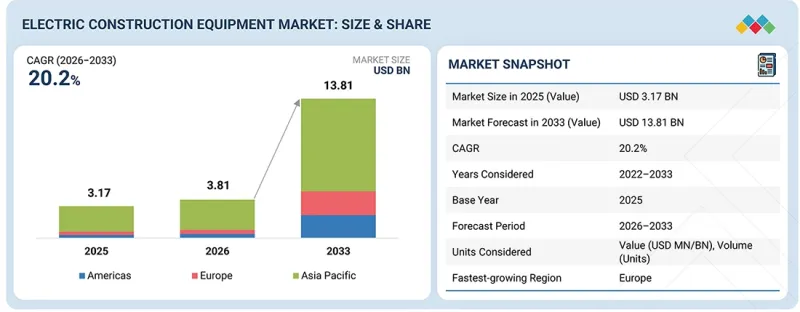
전동 건설기계 시장 규모는 2026년 38억 1,000만 달러에서 2033년까지 138억 1,000만 달러로 성장하여 CAGR은 20.2%를 나타낼 것으로 예측됩니다.
| 조사 범위 | |
|---|---|
| 조사 대상 기간 | 2026-2033년 |
| 기준연도 | 2025년 |
| 예측 기간 | 2026-2033년 |
| 단위 | 달러 |
| 부문 | 유형, 추진, 배터리 용량 및 화학 조성, 출력, 지역별 |
| 대상 지역 | 아메리카, 아시아태평양, 유럽 |
시장의 성장은 시범 프로젝트의 범위를 넘어선 전기 건설 기계의 상용화에 의해 점점 더 주도되고 있으며, 특히 소형 및 중형 유압 굴삭기, 휠 로더, 와이드 바디 트럭에서 이러한 추세가 두드러집니다. 이러한 분야에서는 현재의 배터리 기술을 통해 생산성을 크게 저해하지 않으면서도 일상적인 업무 요건을 충족할 수 있는 수준에 도달했습니다.
또한, 공공 인프라 및 도시 건설 프로젝트 분야에서 특히 유럽 전역에서 제로 배출을 요건으로 하는 조달 수요가 증가하고 있습니다. 정부 자금을 지원받는 프로젝트에 입찰하는 건설업체들은 이산화탄소 배출량 감축 및 소음 수준 저감을 입증해야 할 필요성이 점점 더 커지고 있습니다. 이러한 추세는 건설기계 구매 결정에 직접적인 영향을 미치며, 보유 차량의 전기화를 가속화하고 있습니다.
갱내 채굴에서는 전동 기계가 점차 보급되고 있습니다. 이는 배기가스가 전혀 발생하지 않기 때문에 디젤 구동 기계에 비해 환기나 냉각의 필요성이 줄어들기 때문입니다. 이러한 장점 덕분에 광업, 건설, 농업을 포함한 오프로드 차량(OHV) 분야 전반에서 배터리 전기, 하이브리드, 수소 연료전지 파워트레인으로의 전환이 진행되고 있습니다.
유럽에서는 배터리 용량이 100 kWh를 초과하는 트랙터의 성장세가 가장 빠릅니다.
배터리 용량이 100 kWh를 넘는 전기 트랙터가 유럽에서 급속히 보급되고 있습니다. 이러한 급증은 주로 심경, 대규모 고랑 작물 재배, 파종, 중량물 운반 등 부하가 큰 농작업에 필요한 출력, 토크, 작동 시간을 확보할 수 있기 때문인 것으로 보입니다. 대규모 농지에서 작업할 때 100-200kWh를 초과하는 용량의 배터리 팩에 대한 수요가 증가하고 있으며, 이를 통해 낮 시간에 충전할 필요 없이 충분한 가동 시간을 확보할 수 있게 되었습니다.
이러한 대형 중장비를 구매하는 주요 고객은 대규모 상업 농장 경영자들로, 이들은 보유 차량의 전기화와 관련하여 규제 및 비용 측면에서 큰 압박에 직면해 있습니다. 유럽에서는 광대한 농지를 활용할 수 있는 경우가 많으며, 대규모 농지에서는 기계화된 고성능 장비가 필요하기 때문에 100kWh를 초과하는 용량의 기계에 대한 수요가 증가하고 있습니다.
John Deere, AGCO Corporation, Fendt, Case IH, Tadus 등의 OEM 업체들은 100 kWh를 초과하는 배터리를 탑재한 프로토타입 개발을 적극적으로 추진하고 있습니다. 예를 들어, John Deere의 SESAM 콘셉트 모델은 최대 400 hp를 발휘하는 130 kWh 배터리 팩을 탑재하고 있습니다. 이러한 주요 제조업체들은 특히 복합 농업, 축산, 지자체용, 특수 작물 분야에서 유럽 농가들의 운영 요구를 충족시키기 위해 대용량 배터리 플랫폼 개발에 주력하고 있습니다.
이러한 요인들로 인해, 유럽은 대규모 농업에 필요한 장시간 가동 및 고출력에 대한 수요 증가를 배경으로, 배터리 용량 100kWh를 초과하는 전기 트랙터 시장에서 계속해서 주도적인 위치를 유지할 것으로 전망됩니다.
배터리 전동 부문이 시장에서 선두를 차지하고 있습니다.
현재 배터리 구동 기술은 전동 건설기계 시장을 주도하고 있으며, 주요 기종 분류에서 가장 높은 상용화율과 전동화율을 달성하고 있습니다. 배터리 기술이 일상적인 가동 요건을 효과적으로 뒷받침하고 있기 때문에 미니 굴삭기, 소형 굴삭기, 휠 로더, 스키드 스티어 로더, 소형 트럭 로더에 가장 널리 채택되고 있습니다. 아시아태평양이 이 시장을 주도하고 있으며, 중국은 탄탄한 국내 생산 능력과 확립된 배터리 공급망에 힘입어 전동 휠 로더와 굴삭기의 대규모 도입을 통해 그 선두에 서 있습니다.
현재 각 OEM 업체들은 전동화의 적용 대상을 소형 건설기계에서 더 대형 기계 등급으로 확대되고 있습니다. Bauma 2025에서 볼보 CE는 'A30 Electric' 및 'A40 Electric' 전동 아티큘레이트 덤프 트럭을 공개했고, 리브헤르는 배터리 구동식 광산용 트럭 플랫폼을 선보였으며, 코마츠도 전동 굴삭기 라인업을 확충했습니다. 이러한 발전은 전동화가 소형 건설기계에서 대형 건설 및 광산용 기계로 점차 확대되고 있음을 보여줍니다.
배터리 구동 기술은 더 이상 소형 건설 기계에만 국한된 것이 아닙니다. 현재는 미니 굴삭기, 소형 굴삭기, 휠 로더가 도입을 주도하고 있지만, 각 OEM 업체들이 최근 굴절식 덤프트럭, 대형 굴삭기, 광산기계에 투자를 진행하고 있는 것으로 보아, 전동화는 더욱 높은 부가가치를 지닌 기계 부문으로 전환되고 있음을 시사하고 있습니다. 이러한 전환에 따라 향후 10년 동안 배터리 수요와 전기 건설 기계의 잠재 시장 모두 확대될 것으로 예측됩니다.
남미와 북미는 건설용 전기 기계 시장에서 두 번째로 빠르게 성장하는 지역입니다.
이러한 현상의 주된 원인은 건설, 골재 생산, 광업 분야에서 전동 기술의 도입이 확대되고 있기 때문입니다. 굴삭기와 로더는 가동률이 높고 배터리 구동 방식과 호환성이 있어, 전기 건설 기계 수요에서 가장 큰 점유율을 차지하고 있습니다.
소형 및 중형 전동 굴삭기에는 일반적으로 60-300 kWh 용량의 배터리 팩이 사용됩니다. 반면, 전동 휠 로더나 굴절식 덤프트럭의 경우, 200kWh를 초과하는 배터리 용량이 필요한 경우가 많습니다. 리튬-니켈-망간-코발트(Li-NMC) 배터리는 에너지 밀도가 높고, 기계의 무게를 크게 늘리지 않으면서도 가동 시간을 연장할 수 있기 때문에 이 지역에서는 여전히 선호되는 배터리 화학 조성입니다. 더 큰 규모의 전동 기기 도입이 확대됨에 따라, 북미에서는 NMC 배터리에 대한 수요가 더욱 증가할 것으로 예측됩니다.
또한, 광산의 전기화를 위한 투자 증가도 시장 성장을 뒷받침하고 있습니다. 갱내 채굴 사업자들은 광산 운영비의 상당 부분을 차지하는 환기 및 냉각 비용을 절감하기 위해 배터리 구동 장비의 도입을 추진하고 있습니다. 이러한 전환에 따라 광업 분야에서 배터리 구동 로더, 운반 트럭, 다목적 차량의 활용이 가속화되고 있습니다.
OEM 활동도 지역 전체에서 확대되고 있습니다. Caterpillar와 같은 기업들은 배터리 구동식 광산용 트럭 플랫폼의 상용화를 추진하고 있습니다. 또한, Volvo CE, CASE, Bobcat, John Deere 등은 전동 유압 굴삭기 및 로더의 제품 라인업을 확대되고 있습니다.
또한 캘리포니아주 등에서는 무공해 오프로드 기계에 관한 정책이 강화되고 있어, 건설 및 인프라 프로젝트에서 도급업체와 차량 운영업체가 배터리 구동식 기계를 도입하도록 장려하고 있습니다. 이러한 규제는 특히 도시 지역의 프로젝트나 소음에 대한 배려가 필요한 지역에서 배출 기준 및 소음 기준 준수가 조달 결정의 중요한 요소로 자리 잡고 있기 때문에 전동 건설 기계의 도입을 촉진하고 있습니다. 이러한 요인들로 인해 건설업체들은 프로젝트 참여 자격을 강화하고 지속가능성 목표를 달성하기 위해 전기 기계에 대한 투자를 점점 더 늘리고 있습니다.
본 보고서에서는 전 세계 전동 건설기계 시장을 조사했으며, 시장 개요, 시장 성장에 영향을 미치는 다양한 요인에 대한 분석, 기술 및 특허 동향, 법규제 환경, 사례 연구, 시장 규모 추이 및 전망, 각종 분류·지역/주요 국가별 상세 분석, 경쟁 현황, 주요 기업 프로파일 등을 정리했습니다.
자주 묻는 질문
목차
제1장 서론
제2장 주요 요약
제3장 프리미엄 인사이트
제4장 시장 개요
제5장 업계 동향
제6장 기술 진보, 특허, 혁신, 향후 응용
제7장 규제 상황
제8장 고객 현황과 구매 행동
제9장 전동 건설기계 시장 : 유형별
제10장 전동 건설기계 시장 : 배터리 용량별
제11장 전동 건설기계 시장 : 배터리 화학 조성별
제12장 전동 건설기계 시장 : 출력별
제13장 전동 건설기계 시장 : 추진별
제14장 전동 건설기계 시장 : 용도별
제15장 전동 농업기계 시장 : 유형별
제16장 전동 트랙터 시장 : 배터리 용량별
제17장 전동 트랙터 시장 : 배터리 화학 조성별
제18장 전동 트랙터 시장 : 추진별
제19장 전동 건설기계 시장 : 지역별
제20장 경쟁 구도
제21장 기업 개요
제22장 조사 방법
제23장 부록
LSH 26.07.20The electric construction equipment market is projected to grow from USD 3.81 billion in 2026 to USD 13.81 billion by 2033, at a CAGR of 20.2%.
| Scope of the Report | |
|---|---|
| Years Considered for the Study | 2026-2033 |
| Base Year | 2025 |
| Forecast Period | 2026-2033 |
| Units Considered | USD Billion |
| Segments | Electric Construction Equipment Market by Type, Propulsion, Battery Capacity & Chemistry, Power Output, and Region - Global Forecast to 2033 |
| Regions covered | Americas, Asia Pacific, Europe |
Market growth is increasingly driven by the commercialization of electric equipment beyond pilot projects, particularly in compact and mid-sized excavators, wheel loaders, and wide-body trucks. These equipment categories have now reached a level where current battery technology can support daily operational needs without significantly compromising productivity.
In addition, there is a rising demand for zero-emission procurement requirements in public infrastructure and urban construction projects, particularly across Europe. Contractors bidding for government-funded projects are increasingly required to demonstrate lower carbon emissions and reduced noise levels. This trend is directly influencing equipment purchasing decisions and accelerating the electrification of fleets.
In underground mining, electric equipment is becoming more popular because its zero tailpipe emissions reduce the need for ventilation and cooling compared with diesel-powered machinery. This advantage is driving a shift toward battery-electric, hybrid, and hydrogen fuel-cell powertrains across off-highway vehicle (OHV) sectors, including mining, construction, and agriculture.
Tractors with >100 kWh battery capacity exhibit the fastest growth in Europe.
Electric tractors with battery capacities exceeding 100 kWh are rapidly gaining popularity in Europe. This surge is largely due to their ability to provide the necessary power, torque, and operating range for demanding agricultural tasks, such as deep tillage, large-scale row crop work, planting, and heavy hauling. As larger field operations increasingly require battery packs in the 100-200+ kWh range, this enables acceptable operating hours without midday charging.
The primary buyers for these heavy-duty machines are operators of large commercial farms, who face significant regulatory and cost pressures to electrify their fleets. The greater availability of expansive farmland in Europe drives up demand for equipment with over 100 kWh of capacity, as these larger fields require more mechanized, high-capacity machinery.
OEMs such as John Deere, AGCO Corporation, Fendt, Case IH, and Tadus are actively developing prototypes powered by batteries greater than 100 kWh. For example, John Deere's SESAM concept features a 130 kWh battery pack that delivers up to 400 hp. These leading manufacturers are focusing on higher-capacity battery platforms to meet the operational needs of European farmers, especially in mixed farming, livestock, municipal, and specialty-crop applications.
As a result, Europe is expected to remain the leading market for electric tractors with battery capacities above 100 kWh, driven by the increasing demand for longer operating hours and higher power output necessary for large-scale farming operations.
The battery electric segment secures the leading market position.
Battery electric technology currently dominates the electric construction equipment market, achieving the highest rates of commercialization and electrification across major equipment categories. The strongest adoption is seen in mini excavators, compact excavators, wheel loaders, skid-steer loaders, and compact track loaders, as battery technology effectively supports their daily operating requirements. The Asia Pacific region leads this market, with China at the forefront due to its large-scale deployment of electric wheel loaders and excavators, bolstered by robust domestic manufacturing capabilities and a well-established battery supply chain.
OEMs are now extending electrification beyond compact equipment to larger machine classes. At Bauma 2025, Volvo CE introduced the A30 Electric and A40 Electric articulated haulers, while Liebherr presented its battery-electric mining truck platform, and Komatsu expanded its range of electric excavators. These advancements indicate that electrification is gradually shifting from compact construction equipment to heavy-duty construction and mining applications.
Battery electric technology is no longer confined to compact construction equipment. Although mini excavators, compact excavators, and wheel loaders currently drive adoption, recent investments by OEMs in articulated haulers, large excavators, and mining equipment suggest that electrification is moving into higher-value machine categories. This transition is expected to increase both battery demand and the addressable market for electric construction equipment over the next decade.
The Americas are the second-fastest-growing market for electric construction equipment.
The Americas are projected to be the second-fastest-growing market for electric construction equipment, driven primarily by increasing adoption of this technology across construction, aggregates, and mining applications. Excavators and loaders represent the largest share of electric equipment demand due to their high utilization rates and compatibility with battery-electric operation.
Compact and mid-sized electric excavators typically use battery packs ranging from 60 to 300 kWh. In contrast, electric wheel loaders and articulated haulers often require battery capacities exceeding 200 kWh. Lithium-Nickel-Manganese-Cobalt (Li-NMC) remains the preferred battery chemistry in the region, as it offers higher energy density and allows for longer operating hours without significantly increasing machine weight. The trend toward deploying larger electric equipment is anticipated to further boost the demand for NMC batteries across North America.
Market growth is also supported by rising investments in mine electrification. Underground mining operators are adopting battery-electric equipment to lower ventilation and cooling costs, which can constitute a substantial portion of mine operating expenses. This shift is accelerating the use of battery-electric loaders, haul trucks, and utility vehicles in mining applications.
OEM activity is expanding across the region. Companies like Caterpillar are advancing the commercialization of their battery-electric mining truck platform, while firms such as Volvo CE, CASE, Bobcat, and John Deere are broadening their electric excavator and loader offerings.
Additionally, states like California are enhancing their zero-emission off-road equipment initiatives, encouraging contractors and fleet operators to consider battery-electric alternatives for construction and infrastructure projects. These regulations are promoting the adoption of electric construction equipment, especially for urban projects and those in noise-sensitive areas, where compliance with emission and noise standards is becoming a crucial factor in procurement decisions. Consequently, contractors are increasingly investing in electric machinery to enhance project eligibility and achieve sustainability targets.
In-depth interviews were conducted with CEOs, marketing directors, other innovation and strategy directors, and executives from various key organizations operating in this market.
- By Company Type: OEMs (100%)
- By Designation: C-level Executives (30%), Directors (20%), and Others (50%)
- By Region: Asia Pacific (50%), Americas (30%), and Europe (20%)
The key players in the electric construction equipment market are Hitachi Construction Machinery (Japan), Caterpillar Inc. (US), Komatsu Ltd. (Japan), Volvo Construction Equipment (Sweden), Hitachi Construction Machinery Co., Ltd. (Japan), and JCB (UK). Major companies' key strategies to maintain their position in the global electric construction equipment market are strong global networking, mergers & acquisitions, partnerships, and technological advancements.
Research Coverage
The study segments and forecasts the size of the electric construction equipment market based on type (electric excavators, electric motor graders, electric dozers, electric loaders, electric dump trucks, and electric load-haul dump loaders), battery capacity (<50 kWh, 50-200 kWh, 200-500 kWh, and >500 kWh), battery chemistry (lithium-iron phosphate, lithium-nickel manganese cobalt oxide, and others), power output (<50 hp, 50-150 hp, 150-300 hp, and >300 hp), application (construction, mining, agriculture), propulsion (battery electric, hybrid electric, and hydrogen), type of electric agriculture equipment (electric self-propelled sprayers and electric tractors), propulsion of electric tractors (battery electric, hybrid electric, and hydrogen), battery capacity of electric tractors (<50 KWh, 50-100 KWh, and >100 KWh), battery chemistry of electric tractors (lithium-iron phosphate, lithium-nickel manganese cobalt oxide, and others), and region (Asia Pacific, Europe, and Americas). It also includes an in-depth competitive analysis of major electric construction equipment manufacturers, including their company profiles, key observations on product and business offerings, recent developments, and key market strategies.
Key Benefits of Buying this Report:
The report will assist market leaders and new entrants by providing revenue estimates for the overall electric construction equipment market and its subsegments. This report will help stakeholders understand the competitive landscape and gain valuable insights to better position their businesses and develop effective go-to-market strategies. Additionally, it helps stakeholders stay informed about current market trends and provides insights into key market drivers, restraints, challenges, and opportunities.
This report provides insights into the following pointers:
- Analysis of key drivers (expansion of zero-emission construction projects and urban jobsite electrification, escalating ventilation expenses driving electrification in underground mining, growing preference for low-noise construction equipment in residential projects, and growing government incentives and financing support for electric tractor), restraints (higher upfront acquisition costs compared to conventional ICE equipment and productivity challenges arising from extended charging times and limited charging infrastructure availability), opportunities (ongoing innovation in high-capacity and fast-charging battery systems, increased manufacturing and testing of hybrid electric vehicles, expansion of hybrid electric vehicle development, testing, and production activities, and emergence of hydrogen-powered construction equipment), and challenges (limited component standardization and cross-platform compatibility in long-haul operations and increasing complexity in maintaining optimal battery temperature and efficiency) influencing the growth of the electric construction equipment market
- Product Development/Innovation: In-depth insights on upcoming technologies and new product and service launches in the electric construction equipment market
- Market Development: Comprehensive market information; the report analyzes the authentication and brand protection market across varied regions.
- Market Diversification: Exhaustive information about new products & services, untapped geographies, recent developments, and investments in the electric construction equipment market
- Competitive Assessment: In-depth assessment of market shares, growth strategies, and service offerings of leading players in the electric construction equipment market, such as Caterpillar Inc. (US), Komatsu Ltd. (Japan), Volvo Construction Equipment (Sweden), Hitachi Construction Machinery Co., Ltd. (Japan), and JCB (UK)
TABLE OF CONTENTS
1 INTRODUCTION
- 1.1 STUDY OBJECTIVES
- 1.2 MARKET DEFINITION
- 1.3 STUDY SCOPE
- 1.3.1 MARKET SEGMENTATION AND REGIONAL SNAPSHOT
- 1.3.2 INCLUSIONS AND EXCLUSIONS
- 1.3.3 YEARS CONSIDERED
- 1.4 CURRENCY CONSIDERED
- 1.5 UNIT CONSIDERED
- 1.6 STAKEHOLDERS
- 1.7 SUMMARY OF CHANGES
2 EXECUTIVE SUMMARY
- 2.1 KEY INSIGHTS AND MARKET HIGHLIGHTS
- 2.2 KEY MARKET PARTICIPANTS: MAPPING OF STRATEGIC DEVELOPMENTS
- 2.3 DISRUPTIVE TRENDS IN ELECTRIC CONSTRUCTION EQUIPMENT MARKET
- 2.4 HIGH GROWTH SEGMENTS
- 2.5 REGIONAL SNAPSHOT: MARKET SIZE, GROWTH RATE, AND FORECAST
3 PREMIUM INSIGHTS
- 3.1 ATTRACTIVE OPPORTUNITIES FOR PLAYERS IN THE ELECTRIC CONSTRUCTION EQUIPMENT MARKET
- 3.2 ELECTRIC CONSTRUCTION EQUIPMENT MARKET, BY TYPE
- 3.3 ELECTRIC CONSTRUCTION EQUIPMENT MARKET, BY BATTERY CAPACITY
- 3.4 ELECTRIC CONSTRUCTION EQUIPMENT MARKET, BY BATTERY CHEMISTRY
- 3.5 ELECTRIC CONSTRUCTION EQUIPMENT MARKET, BY POWER OUTPUT
- 3.6 ELECTRIC CONSTRUCTION EQUIPMENT MARKET, BY PROPULSION
- 3.7 ELECTRIC CONSTRUCTION EQUIPMENT MARKET, BY APPLICATION
- 3.8 ELECTRIC AGRICULTRUE EQUIPMENT MARKET, BY TYPE
- 3.9 ELECTRIC TRACTOR MARKET, BY BATTERY CAPACITY
- 3.10 ELECTRIC TRACTOR MARKET, BY BATTERY CHEMISTRY
- 3.11 ELECTRIC CONSTRUCTION EQUIPMENT MARKET, TRACTOR BY PROPULSION
- 3.12 ELECTRIC CONSTRUCTION EQUIPMENT MARKET, BY REGION
4 MARKET OVERVIEW
- 4.1 INTRODUCTION
- 4.2 MARKET DYNAMICS
- 4.2.1 DRIVERS
- 4.2.1.1 Expansion of zero-emission construction projects and urban jobsite electrification
- 4.2.1.2 Escalating ventilation expenses driving electrification in underground mining
- 4.2.1.3 Growing preference for low-noise construction equipment in residential projects
- 4.2.1.4 Growing government incentives and financing support for electric tractors
- 4.2.2 RESTRAINTS
- 4.2.2.1 Higher upfront acquisition cost compared to conventional ICE equipment
- 4.2.2.2 Productivity issues arising from extended charging times and limited charging infrastructure availability
- 4.2.3 OPPORTUNITIES
- 4.2.3.1 Ongoing innovation in high-capacity and fast-charging battery systems
- 4.2.3.2 Expansion of hybrid electric vehicle development, testing, and production activities
- 4.2.3.3 Emergence of hydrogen-powered construction equipment
- 4.2.4 CHALLENGES
- 4.2.4.1 Limited component standardization and cross-platform compatibility in long-haul operations
- 4.2.4.2 Increasing complexity in maintaining optimal battery temperature and efficiency
- 4.2.1 DRIVERS
- 4.3 UNMET NEEDS AND WHITE SPACES
- 4.4 INTERCONNECTED MARKETS AND CROSS-SECTOR OPPORTUNITIES
- 4.5 STRATEGIC MOVES BY TIER 1/2/3 SUPPLIERS
5 INDUSTRY TRENDS
- 5.1 MACROECONOMIC OUTLOOK
- 5.1.1 INTRODUCTION
- 5.1.2 GDP TRENDS AND FORECAST
- 5.1.3 TRENDS IN GLOBAL OFF HIGHWAY VEHICLES INDUSTRY
- 5.1.3.1 Regional GDP dynamics
- 5.1.3.2 Developed markets
- 5.1.3.3 Emerging markets
- 5.1.3.3.1 China
- 5.1.3.3.2 India
- 5.1.3.3.3 Brazil
- 5.1.3.3.4 Mexico
- 5.1.3.3.5 Indonesia
- 5.1.3.3.6 Thailand
- 5.1.3.3.7 Malaysia
- 5.1.3.4 Investment environment
- 5.2 SUPPLY CHAIN ANALYSIS
- 5.3 ECOSYSTEM ANALYSIS
- 5.3.1 RAW MATERIAL SUPPLIERS
- 5.3.2 COMPONENT PROVIDERS
- 5.3.3 BATTERY PROVIDERS
- 5.3.4 ELECTRIC CONSTRUCTION EQUIPMENT MANUFACTURERS
- 5.3.5 AFTERMARKET AND DISTRIBUTION PLAYERS
- 5.4 PRICING ANALYSIS
- 5.4.1 INDICATIVE PRICING ANALYSIS, BY TYPE, 2025
- 5.4.2 INDICATIVE PRICING ANALYSIS, BY REGION, 2025
- 5.4.2.1 Indicative pricing of Electric Excavators, by region, 2025 (USD/Unit)
- 5.4.2.2 Indicative pricing of Electric Loaders, by region, 2025 (USD/Unit)
- 5.4.2.3 Indicative pricing of Electric Dump Trucks, by Region, 2025 (USD/Unit)
- 5.4.2.4 Indicative pricing of Electric LHD, by Region, 2025 (USD/Unit)
- 5.4.2.5 Indicative pricing of Electric LHD, by Region, 2025 (USD/Unit)
- 5.5 TRADE ANALYSIS
- 5.5.1 IMPORT SCENARIO (HS CODE 842710)
- 5.5.2 EXPORT SCENARIO (HS CODE 842710)
- 5.6 KEY CONFERENCES AND EVENTS, 2026-2027
- 5.7 TRENDS/DISRUPTIONS IMPACTING CUSTOMER BUSINESS
- 5.8 CASE STUDY ANALYSIS
- 5.8.1 CATERPILLAR'S ELECTRIC MINI EXCAVATOR
- 5.8.2 HITACHI'S ZE85 ELECTRIC EXCAVATOR
- 5.8.3 KOMATSU'S ELECTRIC MINI EXCAVATORS
- 5.8.4 VOLVO CE'S MID-SIZE ELECTRIC WHEEL LOADERS
- 5.8.5 JCB'S ELECTRIC TELEHANDLERS
- 5.9 OEM ANALYSIS
- 5.9.1 BATTERY CAPACITY OF ELECTRIC COMPACT CONSTRUCTION EQUIPMENT BY OEMS
- 5.9.2 BATTERY CAPACITY VS. POWER OUTPUT
- 5.9.3 OEM PARTNERSHIPS WITH BATTERY MANUFACTURERS
- 5.9.4 OEM PARTNERSHIPS WITH CHARGING TECHNOLOGY PROVIDERS
- 5.9.5 OEM ELECTRIFICATION AND AUTONOMY ROADMAP
- 5.10 IMPACT OF EU-INDIA TRADE DEAL ON ELECTRIC CONSTRUCTION EQUIPMENT MARKET
- 5.11 IMPACT OF ISRAEL-IRAN WAR ON ELECTRIC CONSTRUCTION EQUIPMENT MARKET
- 5.12 ENERGY INFRASTRUCTURE & CHARGING ECOSYSTEM
- 5.12.1 DEPOT CHARGING
- 5.12.2 MOBILE CHARGING SOLUTIONS
- 5.12.3 RENEWABLE-POWERED JOBSITES
- 5.12.4 MINE-SITE ELECTRIFICATION
6 TECHNOLOGICAL ADVANCEMENTS, PATENTS, INNOVATIONS, AND FUTURE APPLICATIONS
- 6.1 KEY TECHNOLOGIES
- 6.1.1 AUTONOMOUS CONSTRUCTION EQUIPMENT
- 6.1.1.1 Remote monitoring and predictive maintenance
- 6.1.2 AI-BASED ENERGY AND BATTERY MANAGEMENT SYSTEMS
- 6.1.1 AUTONOMOUS CONSTRUCTION EQUIPMENT
- 6.2 COMPLEMENTARY TECHNOLOGIES
- 6.2.1 GRADE CONTROL SYSTEMS
- 6.2.2 REGENERATIVE BRAKING
- 6.2.3 HYDROGEN FUEL CELLS
- 6.2.4 AUGMENTED REALITY
- 6.3 ADJACENT TECHNOLOGIES
- 6.3.1 AGRICULTURAL EQUIPMENT AUTOMATION
- 6.3.2 ADVANCED TELEMATICS
- 6.3.3 BATTERY MANAGEMENT SYSTEMS (BMS)
- 6.4 PATENT ANALYSIS
- 6.5 FUTURE APPLICATIONS
- 6.6 IMPACT OF AI/GENERATIVE AI
- 6.7 TOTAL COST OF OWNERSHIP OF ELECTRIC CONSTRUCTION EQUIPMENT
- 6.7.1 ELECTRIC VS. ICE MINI EXCAVATORS
- 6.7.2 TOTAL COST OF OWNERSHIP OF ELECTRIC TRACTORS
- 6.7.3 TOTAL COST OF OWNERSHIP OF ELECTRIC LOADERS
- 6.8 FUTURE DEVELOPMENTS IN BATTERY TECHNOLOGY
- 6.8.1 SOLID-STATE BATTERIES
- 6.8.2 LITHIUM-ION BATTERIES
- 6.8.3 SODIUM-ION BATTERIES
- 6.8.4 SWAPPABLE BATTERY TECHNOLOGY
7 REGULATORY LANDSCAPE
- 7.1 REGIONAL REGULATIONS AND COMPLIANCE
- 7.1.1 REGULATORY BODIES, GOVERNMENT AGENCIES, AND OTHER ORGANIZATIONS
8 CUSTOMER LANDSCAPE AND BUYER BEHAVIOR
- 8.1 DECISION-MAKING PROCESS
- 8.2 KEY STAKEHOLDERS IN BUYING PROCESS AND THEIR EVALUATION CRITERIA
- 8.2.1 KEY STAKEHOLDERS IN BUYING PROCESS
- 8.2.2 BUYING CRITERIA
- 8.3 ADOPTION BARRIERS AND INTERNAL CHALLENGES
- 8.4 UNMET NEEDS OF VARIOUS END-USE INDUSTRIES
- 8.5 MARKET PROFITABILITY
- 8.5.1 REVENUE POTENTIAL
- 8.5.2 COST DYNAMICS
- 8.5.3 MARGIN OPPORTUNITIES
9 ELECTRIC CONSTRUCTION EQUIPMENT MARKET, BY TYPE
- 9.1 INTRODUCTION
- 9.2 ELECTRIC EXCAVATORS
- 9.2.1 EXTENSIVE USE IN CONSTRUCTION AND MINING DUE TO NOISELESS OPERATIONS
- 9.3 ELECTRIC LOADERS
- 9.3.1 INCREASED INVESTMENTS BY PROMINENT COMPANIES
- 9.4 ELECTRIC MOTOR GRADERS
- 9.4.1 RISING NEED IN US DUE TO STRINGENT EMISSION NORMS
- 9.5 ELECTRIC DOZERS
- 9.5.1 HIGH DEMAND FROM ASIA PACIFIC DUE TO STRONG PRESENCE OF CONSTRUCTION AND MINING COMPANIES
- 9.6 ELECTRIC DUMP TRUCKS
- 9.6.1 SURGE IN MINING ACTIVITIES
- 9.7 ELECTRIC LOAD HAUL DUMP LOADERS
- 9.7.1 FOCUS ON MINIMIZING UNDERGROUND VENTILATION COST
- 9.8 PRIMARY INSIGHTS
10 ELECTRIC CONSTRUCTION EQUIPMENT MARKET, BY BATTERY CAPACITY
- 10.1 INTRODUCTION
- 10.2 <50 KWH
- 10.2.1 SUITABLE FOR PACKED CONSTRUCTION SITES AND NARROW MINING APPLICATIONS
- 10.3 50-200 KWH
- 10.3.1 HIGH DEMAND FOR SMALL AND MID-RANGE CONSTRUCTION EQUIPMENT
- 10.4 200-500 KWH
- 10.4.1 ONGOING DEVELOPMENT OF NEWER MODELS
- 10.5 >500 KWH
- 10.5.1 UNTAPPED GROWTH POTENTIAL WITH ADVANCES IN BATTERY TECHNOLOGY
- 10.6 BATTERY CAPACITY OF OEM-LEVEL EQUIPMENT
- 10.7 PRIMARY INSIGHTS
11 ELECTRIC CONSTRUCTION EQUIPMENT MARKET, BY BATTERY CHEMISTRY
- 11.1 INTRODUCTION
- 11.2 LITHIUM IRON PHOSPHATE
- 11.2.1 NEED FOR EFFICIENT ENERGY STORAGE DUE TO RISE IN RENEWABLE ENERGY SOURCES
- 11.3 LITHIUM NICKEL MANGANESE COBALT OXIDE
- 11.3.1 HIGHER CONSUMER ACCEPTANCE IN EUROPE AND AMERICAS
- 11.4 OTHERS
- 11.4.1 SODIUM-ION BATTERIES
- 11.4.2 SOLID-STATE BATTERIES
- 11.5 COST ANALYSIS
- 11.6 DEVELOPMENTS IN BATTERY CHEMISTRY
- 11.7 PRIMARY INSIGHTS
12 ELECTRIC CONSTRUCTION EQUIPMENT MARKET, BY POWER OUTPUT
- 12.1 INTRODUCTION
- 12.2 <50 HP
- 12.2.1 LARGE-SCALE ADOPTION IN LIGHT CONSTRUCTION APPLICATIONS
- 12.3 50-150 HP
- 12.3.1 INCREASED PRODUCT DEVELOPMENT ACTIVITIES
- 12.4 150-300 HP
- 12.4.1 EXPANDING DEVELOPMENTS IN BATTERIES AND CONSTRUCTION EQUIPMENT PRODUCTS
- 12.5 >300 HP
- 12.5.1 LIMITED COMMERCIALIZATION DUE TO HIGH BATTERY COSTS
- 12.6 PRIMARY INSIGHTS
13 ELECTRIC CONSTRUCTION EQUIPMENT MARKET, BY PROPULSION
- 13.1 INTRODUCTION
- 13.2 BATTERY ELECTRIC
- 13.2.1 EMPHASIS ON ENVIRONMENTAL SUSTAINABILITY
- 13.3 HYBRID ELECTRIC
- 13.3.1 LIMITATIONS ASSOCIATED WITH 100% ELECTRIFICATION
- 13.4 HYDROGEN ELECTRIC
- 13.4.1 GROWING ADOPTION OF ENVIRONMENTALLY CONSCIOUS PRACTICES
- 13.5 PRIMARY INSIGHTS
14 ELECTRIC CONSTRUCTION EQUIPMENT MARKET, BY APPLICATION
- 14.1 INTRODUCTION
- 14.2 CONSTRUCTION
- 14.2.1 COMPLIANCE WITH STRINGENT EMISSION AND NOISE REGULATIONS
- 14.3 MINING
- 14.3.1 EMERGING TREND OF ELECTRIFICATION
- 14.4 AGRICULTURE
- 14.4.1 ELEVATED DEMAND FOR FOOD PRODUCTION
- 14.5 PRIMARY INSIGHTS
15 ELECTRIC AGRICULTURE EQUIPMENT MARKET, BY TYPE
- 15.1 INTRODUCTION
- 15.2 OPERATIONAL DATA
- 15.3 ELECTRIC SELF-PROPELLED SPRAYERS
- 15.3.1 PREVENTION OF CROP WITHERING
- 15.4 ELECTRIC TRACTORS
- 15.4.1 GOVERNMENT INITIATIVES FOR BOOSTING FOOD PRODUCTIVITY
- 15.5 PRIMARY INSIGHTS
16 ELECTRIC TRACTOR MARKET, BY BATTERY CAPACITY
- 16.1 INTRODUCTION
- 16.2 <50 KWH
- 16.2.1 INCREASED PREFERENCE DUE TO ACCESSIBILITY AND LOW COST
- 16.3 50-100 KWH
- 16.3.1 LONG-TERM SAVINGS THROUGH REDUCED FUEL AND MAINTENANCE COSTS
- 16.4 >100 KWH
- 16.4.1 RIGOROUS DEVELOPMENT OF HIGH-POWERED ELECTRIC TRACTORS BY OEMS
- 16.5 ELECTRIC TRACTOR MODELS AND BATTERY CAPACITIES
- 16.6 PRIMARY INSIGHTS
17 ELECTRIC TRACTOR MARKET, BY BATTERY CHEMISTRY
- 17.1 INTRODUCTION
- 17.2 LITHIUM IRON PHOSPHATE (LFP)
- 17.2.1 INCREASED INVESTMENTS BY AGRICULTURAL MACHINERY MANUFACTURERS
- 17.3 LITHIUM NICKEL MANGANESE COBALT OXIDE (NMC)
- 17.3.1 HIGHER DENSITY AND FASTER CHARGING CAPABILITIES THAN OTHER CHEMISTRIES
- 17.4 OTHERS
- 17.4.1 SODIUM-ION BATTERIES
- 17.4.2 SOLID-STATE BATTERIES
- 17.5 PRIMARY INSIGHTS
18 ELECTRIC TRACTOR MARKET, BY PROPULSION
- 18.1 INTRODUCTION
- 18.2 BATTERY ELECTRIC
- 18.2.1 DECLINING COST OF LITHIUM-ION BATTERIES
- 18.3 HYBRID ELECTRIC
- 18.3.1 HIGHER POWER OUTPUT THAN BATTERY ELECTRIC TRACTORS
- 18.4 HYDROGEN
- 18.4.1 ADVANCEMENTS IN FUEL CELL TECHNOLOGY AND INFRASTRUCTURE
- 18.5 PRIMARY INSIGHTS
19 ELECTRIC CONSTRUCTION EQUIPMENT MARKET, BY REGION
- 19.1 INTRODUCTION
- 19.2 ASIA PACIFIC
- 19.2.1 CHINA
- 19.2.1.1 National emission standards for mining automation to drive market
- 19.2.2 INDIA
- 19.2.2.1 Growing demand for eco-friendly, cost-effective electric construction equipment to drive market
- 19.2.3 JAPAN
- 19.2.3.1 Increasing investments in electric construction excavators and other equipment to drive market
- 19.2.4 SOUTH KOREA
- 19.2.4.1 Ongoing electrification of loaders for mining to drive market
- 19.2.5 REST OF ASIA PACIFIC
- 19.2.1 CHINA
- 19.3 EUROPE
- 19.3.1 GERMANY
- 19.3.1.1 Stringent government norms to drive market
- 19.3.2 UK
- 19.3.2.1 Rising demand for electric construction excavators to drive market
- 19.3.3 FRANCE
- 19.3.3.1 Implementation of National Low-Carbon Strategy to drive market
- 19.3.4 SPAIN
- 19.3.4.1 Emphasis on reducing carbon emissions from construction machinery to drive market
- 19.3.5 RUSSIA
- 19.3.5.1 Government support for domestic EV manufacturing to drive market
- 19.3.6 ITALY
- 19.3.6.1 Electrification of construction and mining sectors to drive market
- 19.3.7 REST OF EUROPE
- 19.3.1 GERMANY
- 19.4 AMERICAS
- 19.4.1 US
- 19.4.1.1 Presence of major electric construction equipment providers to drive market
- 19.4.2 CANADA
- 19.4.2.1 Global dominance in electric construction industry to drive market
- 19.4.3 MEXICO
- 19.4.3.1 Ongoing electrification promotion programs to drive market
- 19.4.4 BRAZIL
- 19.4.4.1 Incorporation of electric excavators in construction frameworks to regularize mining to drive market
- 19.4.5 ARGENTINA
- 19.4.5.1 Commitment to sustainability and emission reductions to drive market
- 19.4.1 US
- 19.5 PRIMARY INSIGHTS
20 COMPETITIVE LANDSCAPE
- 20.1 OVERVIEW
- 20.2 KEY PLAYER STRATEGIES/RIGHT TO WIN, JANUARY 2021-JUNE 2026
- 20.3 REVENUE ANALYSIS, 2021-2025
- 20.4 MARKET SHARE ANALYSIS, 2025
- 20.5 COMPANY VALUATION
- 20.6 FINANCIAL METRICS
- 20.7 BRAND/PRODUCT COMPARISON
- 20.8 COMPANY EVALUATION MATRIX: ELECTRIC CONSTRUCTION EQUIPMENT MANUFACTURERS, 2025
- 20.8.1 STARS
- 20.8.2 EMERGING LEADERS
- 20.8.3 PERVASIVE PLAYERS
- 20.8.4 PARTICIPANTS
- 20.8.5 COMPANY FOOTPRINT
- 20.8.5.1 Company footprint
- 20.8.5.2 Region footprint
- 20.8.5.3 Type footprint
- 20.8.5.4 Application footprint
- 20.9 COMPANY EVALUATION MATRIX: ELECTRIC EXCAVATOR MANUFACTURERS, 2025
- 20.9.1 STARS
- 20.9.2 EMERGING LEADERS
- 20.9.3 PERVASIVE PLAYERS
- 20.9.4 PARTICIPANTS
- 20.9.5 COMPANY FOOTPRINT
- 20.9.5.1 Company footprint
- 20.9.5.2 Region footprint
- 20.9.5.3 Propulsion footprint
- 20.9.5.4 Battery chemistry footprint
- 20.10 COMPETITIVE SCENARIO
- 20.10.1 PRODUCT LAUNCHES/DEVELOPMENTS
- 20.10.2 DEALS
- 20.10.3 EXPANSIONS
- 20.10.4 OTHER DEVELOPMENTS
21 COMPANY PROFILES
- 21.1 KEY PLAYERS
- 21.1.1 HITACHI CONSTRUCTION MACHINERY CO., LTD.
- 21.1.1.1 Business overview
- 21.1.1.2 Products offered
- 21.1.1.3 Recent developments
- 21.1.1.3.1 Product launches/developments
- 21.1.1.3.2 Deals
- 21.1.1.3.3 Expansions
- 21.1.1.3.4 Other developments
- 21.1.1.4 MnM view
- 21.1.1.4.1 Key strengths
- 21.1.1.4.2 Strategic choices
- 21.1.1.4.3 Weaknesses and competitive threats
- 21.1.2 CATERPILLAR INC.
- 21.1.2.1 Business overview
- 21.1.2.2 Products offered
- 21.1.2.3 Recent developments
- 21.1.2.3.1 Product launches/developments
- 21.1.2.3.2 Deals
- 21.1.2.3.3 Expansions
- 21.1.2.3.4 Other developments
- 21.1.2.4 MnM view
- 21.1.2.4.1 Key strengths
- 21.1.2.4.2 Strategic choices
- 21.1.2.4.3 Weaknesses and competitive threats
- 21.1.3 KOMATSU LTD.
- 21.1.3.1 Business overview
- 21.1.3.2 Products offered
- 21.1.3.3 Recent developments
- 21.1.3.3.1 Product launches/developments
- 21.1.3.3.2 Deals
- 21.1.3.3.3 Others
- 21.1.3.4 MnM view
- 21.1.3.4.1 Key strengths
- 21.1.3.4.2 Strategic choices
- 21.1.3.4.3 Weaknesses and competitive threats
- 21.1.4 VOLVO CONSTRUCTION EQUIPMENT
- 21.1.4.1 Business overview
- 21.1.4.2 Products offered
- 21.1.4.3 Recent developments
- 21.1.4.3.1 Product launches/developments
- 21.1.4.3.2 Deals
- 21.1.4.3.3 Expansions
- 21.1.4.3.4 Other developments
- 21.1.4.4 MnM view
- 21.1.4.4.1 Key strengths
- 21.1.4.4.2 Strategic choices
- 21.1.4.4.3 Weaknesses and competitive threats
- 21.1.5 SANY HEAVY INDUSTRIES CO., LTD.
- 21.1.5.1 Business overview
- 21.1.5.2 Products offered
- 21.1.5.3 Recent developments
- 21.1.5.3.1 Product launches/developments
- 21.1.5.3.2 Expansions
- 21.1.5.3.3 Other developments
- 21.1.5.4 MnM view
- 21.1.5.4.1 Key strengths
- 21.1.5.4.2 Strategic choices
- 21.1.5.4.3 Weaknesses and competitive threats
- 21.1.6 JCB
- 21.1.6.1 Business overview
- 21.1.6.2 Products offered
- 21.1.6.3 Recent developments
- 21.1.6.3.1 Product launches/developments
- 21.1.6.3.2 Deals
- 21.1.6.3.3 Expansions
- 21.1.6.3.4 Other developments
- 21.1.7 DEERE & COMPANY
- 21.1.7.1 Business overview
- 21.1.7.2 Products offered
- 21.1.7.3 Recent developments
- 21.1.7.3.1 Product launches/developments
- 21.1.7.3.2 Deals
- 21.1.7.3.3 Expansions
- 21.1.7.3.4 Other developments
- 21.1.8 SANDVIK AB
- 21.1.8.1 Business overview
- 21.1.8.2 Products offered
- 21.1.8.3 Recent developments
- 21.1.8.3.1 Product launches/developments
- 21.1.8.3.2 Deals
- 21.1.8.3.3 Expansions
- 21.1.8.3.4 Other developments
- 21.1.9 EPIROC AB
- 21.1.9.1 Business overview
- 21.1.9.2 Products offered
- 21.1.9.3 Recent developments
- 21.1.9.3.1 Product launches/developments
- 21.1.9.3.2 Deals
- 21.1.9.3.3 Other developments
- 21.1.10 LIEBHERR
- 21.1.10.1 Business overview
- 21.1.10.2 Products offered
- 21.1.10.3 Recent developments
- 21.1.10.3.1 Product launches/developments
- 21.1.10.3.2 Deals
- 21.1.10.3.3 Expansions
- 21.1.10.3.4 Other developments
- 21.1.11 DOOSAN BOBCAT
- 21.1.11.1 Business overview
- 21.1.11.2 Products offered
- 21.1.11.3 Recent developments
- 21.1.11.3.1 Product launches/developments
- 21.1.11.3.2 Deals
- 21.1.11.3.3 Other developments
- 21.1.1 HITACHI CONSTRUCTION MACHINERY CO., LTD.
- 21.2 OTHER PLAYERS
- 21.2.1 SOLETRAC INC.
- 21.2.2 FENDT
- 21.2.3 HUSQVARNA AB
- 21.2.4 XUZHOU CONSTRUCTION MACHINERY GROUP CO., LTD.
- 21.2.5 KUBOTA CORPORATION
- 21.2.6 KOBELCO CONSTRUCTION MACHINERY EUROPE BV
- 21.2.7 BHARAT EARTH MOVERS LIMITED
- 21.2.8 CNH INDUSTRIAL NV
- 21.2.9 WACKER NEUSON SE
- 21.2.10 TAKEUCHI GLOBAL
- 21.2.11 HD HYUNDAI HEAVY INDUSTRIES CO., LTD.
- 21.2.12 LIUGONG MACHINERY CO., LTD.
22 RESEARCH METHODOLOGY
- 22.1 RESEARCH DATA
- 22.1.1 SECONDARY DATA
- 22.1.1.1 Secondary sources
- 22.1.1.2 Key data from secondary sources
- 22.1.2 PRIMARY DATA
- 22.1.2.1 Sampling techniques and data collection methods
- 22.1.2.2 List of primary participants
- 22.1.2.3 Breakdown of primary interviews
- 22.1.1 SECONDARY DATA
- 22.2 MARKET SIZE ESTIMATION
- 22.2.1 BOTTOM-UP APPROACH
- 22.2.2 TOP-DOWN APPROACH
- 22.3 DATA TRIANGULATION
- 22.4 RESEARCH ASSUMPTIONS AND RISK ASSESSMENT
- 22.5 RESEARCH LIMITATIONS
23 APPENDIX
- 23.1 INSIGHTS FROM INDUSTRY EXPERTS
- 23.2 DISCUSSION GUIDE
- 23.3 KNOWLEDGESTORE: MARKETSANDMARKETS' SUBSCRIPTION PORTAL
- 23.4 CUSTOMIZATION OPTIONS
- 23.4.1 ELECTRIC CONSTRUCTION EQUIPMENT MARKET, BY APPLICATION
- 23.4.1.1 Construction
- 23.4.1.2 Mining
- 23.4.1.3 Agriculture
- 23.4.2 ELECTRIC CONSTRUCTION EQUIPMENT MARKET, BY PROPULSION
- 23.4.2.1 Electric
- 23.4.2.2 Hybrid
- 23.4.2.3 Hydrogen
- 23.4.3 ELECTRIC CONSTRUCTION EQUIPMENT MARKET, BY BATTERY CAPACITY AND BATTERY CHEMISTRY
- 23.4.3.1 <50 kWh
- 23.4.3.2 50-200 kWh
- 23.4.3.3 200-500 kWh
- 23.4.3.4 >500 kWh
- 23.4.3.5 Lithium Iron Phosphate
- 23.4.3.6 Lithium Nickel Manganese Cobalt Oxide
- 23.4.3.7 Other Battery Chemistries
- 23.4.4 ELECTRIC MINING MACHINERY MARKET, BY BATTERY CAPACITY AND CHEMISTRY
- 23.4.4.1 <50 kWh
- 23.4.4.2 50-200 kWh
- 23.4.4.3 200-500 kWh
- 23.4.4.4 >500 kWh
- 23.4.4.5 Lithium Iron Phosphate
- 23.4.4.6 Lithium Nickel Manganese Cobalt Oxide
- 23.4.4.7 Others
- 23.4.5 ELECTRIC AGRICULTURE EQUIPMENT MARKET, BY BATTERY CAPACITY AND CHEMISTRY
- 23.4.5.1 <50 kWh
- 23.4.5.2 50-200 kWh
- 23.4.5.3 200-500 kWh
- 23.4.5.4 >500 kWh
- 23.4.5.5 Lithium Iron Phosphate
- 23.4.5.6 Lithium Nickel Manganese Cobalt Oxide
- 23.4.5.7 Others
- 23.4.6 ELECTRIC CONSTRUCTION EQUIPMENT MARKET FOR ADDITIONAL COUNTRIES
- 23.4.6.1 Australia
- 23.4.6.2 Scandinavian Countries
- 23.4.7 DETAILED ANALYSIS AND PROFILING OF UP TO 5 ADDITIONAL MARKET PLAYERS
- 23.4.1 ELECTRIC CONSTRUCTION EQUIPMENT MARKET, BY APPLICATION
- 23.5 RELATED REPORTS
- 23.6 AUTHOR DETAILS