

|
시장보고서
상품코드
2092394
입도 분석 시장 : 제품별, 분산 방식별, 최종사용자별 - 세계 예측(-2031년)Particle Size Analysis Market by Product, Dispersion, Enduser Global Forecast to 2031 |
||||||

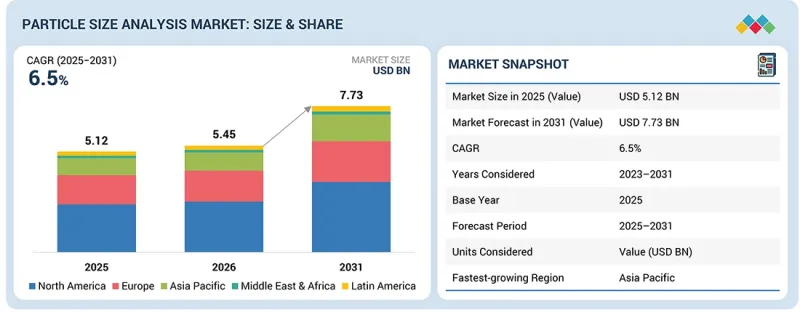
세계의 입도 분석 시장 규모는 2025년 51억 2,000만 달러에서 2031년에는 77억 3,000만 달러에 달할 것으로 예측되며, 2026년부터 2031년까지 CAGR은 6.5%를 기록할 전망입니다.
의약품, 바이오의약품, 나노기술에 대한 수요가 증가함에 따라, 제품의 품질과 성능을 유지하기 위한 정밀한 입자 크기 특성 평가의 필요성이 커지고 있습니다.
| 조사 범위 | |
|---|---|
| 조사 대상 기간 | 2026-2031년 |
| 기준 연도 | 2025년 |
| 예측 기간 | 2026-2031년 |
| 단위 | 금액(달러) |
| 부문 | 기술, 분산 방식, 유형, 최종사용자, 지역 |
| 대상 지역 | 북미, 유럽, 아시아태평양, 라틴아메리카, 중동 및 아프리카 |
동시에, 시장은 더 빠르고 처리량이 높으며 정밀도가 뛰어난 측정이 가능한, 고도로 자동화된 AI 기반 분석 시스템으로 전환되고 있습니다.
"기술별로는 레이저 회절 부문이 2025년 시장에서 가장 큰 점유율을 차지했습니다."
레이저 회절 방식은 광범위한 입자 크기 범위를 처리할 수 있는 높은 정밀도, 측정 속도 및 범용성을 갖추고 있으며, 습식 및 건식 시료 분석 모두에 적합하기 때문에 입도 분석 시장에서 강력한 성장세를 보이고 있습니다. 의약품, 화학, 식품, 광업 등 다양한 산업 분야에서 활용되고 있습니다. 이러한 도입을 촉진하는 주요 동향은 정밀한 품질 관리와 규제 준수에 대한 수요가 증가하고 있다는 점입니다. 특히 바이오의약품이나 첨단 소재 분야에서는 입자 크기의 균일성이 제품 성능을 좌우하는 중요한 요소로 작용하고 있습니다.
"분산 방식별로는 습식 분산 부문이 2025년 시장에서 가장 큰 점유율을 차지했습니다."
습식 분산 부문은 의약품, 나노기술, 첨단 소재 분야에서 활용이 확대되고 있는 미세 입자, 현탁액, 유화액에 대해 고정밀도, 높은 재현성, 신뢰성 높은 측정 결과를 제공할 수 있어 강력한 성장을 이루고 있습니다. 이러한 성장을 주도하는 주요 동향은 바이오의약품, 약제 현탁액, 화학 슬러리 등 액상 제제에 대한 수요 증가입니다. 이러한 제제에서 습식 분산은 입자의 분리성을 높이고 응집을 최소화함으로써 데이터의 정확도를 향상시킵니다.
"최종사용자별로는 헬스케어 부문이 2025년 시장에서 가장 큰 점유율을 차지했습니다."
헬스케어 부문에서는 첨단 의약품 개발, 바이오의약품, 나노입자를 활용한 치료법에 대한 수요가 증가함에 따라 강력한 성장세를 보이고 있습니다. 이러한 분야에서는 안전성과 유효성을 확보하기 위해 정밀한 입자 특성 평가가 필수적입니다. 입자 크기는 생체 이용률, 안정성, 성능에 직접적인 영향을 미치기 때문에 약물전달 시스템, 백신, 진단 분석법, 의료기기에 대한 관심이 높아지고 있는 점이 도입을 더욱 촉진하고 있습니다. 또한, 제약 분야의 연구개발 투자 확대, 의료 인프라 확충, 엄격한 규제 요건으로 인해 정확하고 신뢰할 수 있는 입자 분석 솔루션에 대한 수요가 증가하고 있으며, 의료 분야는 시장에서 가장 빠르게 성장하는 부문 중 하나가 되고 있습니다.
"아시아태평양은 예측 기간 동안 가장 높은 성장률을 보일 것으로 예상됩니다."
아시아태평양은 급속한 산업화, 제약 및 화학 제조업의 확대, 중국, 인도, 일본, 한국 등 국가들의 나노기술 및 연구개발 투자 증가에 힘입어, 입도 분석 시장에서 가장 빠르게 성장하고 있는 지역으로 부상하고 있습니다. 이 지역은 정부의 강력한 지원, 제품 품질에 대한 규제 당국의 관심 증가, 의료, 전자, 재료 과학 등 산업 분야에서 첨단 분석 기술의 도입 확대라는 혜택을 누리고 있습니다. 또한, 비용 효율적인 제조 기반, 풍부한 숙련된 인력, 그리고 신흥 시장으로의 세계 기업 진출 확대가 입도 분석 장치에 대한 수요를 가속화하고 있으며, 아시아태평양은 시장의 주요 성장 동력이 되고 있습니다.
본 보고서에서는 전 세계 입도 분석 시장을 조사하여, 시장 개요, 시장 성장에 영향을 미치는 다양한 요인에 대한 분석, 기술 및 특허 동향, 법규제 환경, 사례 연구, 시장 규모 추정 및 전망, 각종 분류·지역/주요 국가별 상세 분석, 경쟁 구도, 주요 기업 개요 등을 정리하고 있습니다.
자주 묻는 질문
목차
제1장 소개
제2장 주요 요약
제3장 주요 인사이트
제4장 시장 개요
제5장 기술의 진보, AI의 영향, 특허, 혁신, 향후 응용
제6장 고객 상황과 구매 행동
제7장 규제 분석
제8장 업계 동향
제9장 입도 분석 시장 : 기술별
제10장 입도 분석 시장 : 최종사용자별
제11장 입도 분석 시장 : 유형별
제12장 입도 분석 시장 : 지역별
제13장 경쟁 구도
제14장 기업 개요
제15장 조사 방법
제16장 부록
KSM 26.07.24The global particle size analysis market is projected to reach USD 7.73 billion by 2031 from USD 5.12 billion in 2025, at a CAGR of 6.5% from 2026 to 2031. Growing demand for pharmaceuticals, biologics, and nanotechnology is increasing the need for precise particle-size characterization to maintain product quality and performance.
| Scope of the Report | |
|---|---|
| Years Considered for the Study | 2026-2031 |
| Base Year | 2025 |
| Forecast Period | 2026-2031 |
| Units Considered | Value (USD billion) |
| Segments | Technology, Dispersion, Type, End User, and Region |
| Regions covered | North America, Europe, Asia Pacific, Latin America, and Middle East & Africa |
At the same time, the market is moving toward advanced, automated, and AI-driven analytical systems that enable faster, high-throughput, and more accurate measurements.
"The laser diffraction segment held the largest share of the market in 2025."
Based on the technology, the particle size analysis market is segmented into laser diffraction, dynamic light scattering, imaging, Coulter principle, nanoparticle tracking analysis, sieve analysis, and other technologies. In 2025, the laser diffraction segment holds the largest share in the particle size analysis market. The laser diffraction segment is experiencing strong growth in the particle size analysis market due to its high accuracy, speed, and versatility across a wide particle size range, making it suitable for both wet and dry sample analysis across industries such as pharmaceuticals, chemicals, food, and mining. A key trend driving its adoption is the increasing demand for precise quality control and regulatory compliance, especially in biopharma and advanced materials, where consistent particle size is critical for product performance.
"The wet dispersion segment held the largest share of the market in 2025."
Based on dispersion, the particle size analysis market is segmented into wet, dry, and spray dispersion. In 2025, the wet dispersion segment holds the largest share in the particle size analysis market. The wet dispersion segment is growing strongly in the particle size analysis market due to its ability to deliver highly accurate, reproducible, and reliable measurements for fine particles, suspensions, and emulsions, which are increasingly used in pharmaceuticals, nanotechnology, and advanced materials. A key trend driving this growth is the rising demand for liquid-based formulations such as biologics, drug suspensions, and chemical slurries, in which wet dispersion provides better particle separation and minimizes agglomeration, thereby improving data precision.
"The healthcare industry segment held the largest share of the market in 2025."
Based on end user, the particle size analysis market is segmented into the healthcare industry (pharmaceutical and biotechnology companies, public and private research institutions, academic institutions), cosmetic industry, chemical and petroleum industry, mining, minerals, and cement industry, food and beverages industry, and other industries. In 2025, the healthcare industry segment holds the largest share in the particle size analysis market. The healthcare end-user segment is witnessing strong growth in the particle size analysis market due to the increasing demand for advanced drug development, biologics, and nanoparticle-based therapies, where precise particle characterization is critical for safety and efficacy. The rising focus on drug delivery systems, vaccines, diagnostic assays, and medical devices is further driving adoption, as particle size directly impacts bioavailability, stability, and performance. Additionally, growing investments in pharmaceutical R&D, expanding healthcare infrastructure, and strict regulatory requirements are pushing the need for accurate and reliable particle analysis solutions, making healthcare one of the fastest-growing segments in the market.
"The market in the Asia Pacific region is expected to witness the highest growth during the forecast period."
Asia-Pacific is emerging as the fastest-growing region in the particle size analysis market, driven by rapid industrialization, expanding pharmaceutical and chemical manufacturing, and increasing investments in nanotechnology and R&D across countries like China, India, Japan, and South Korea. The region benefits from strong government support, growing regulatory focus on product quality, and rising adoption of advanced analytical technologies in industries such as healthcare, electronics, and materials science. Additionally, the presence of cost-effective manufacturing, a large skilled workforce, and increasing global company expansion into emerging markets is accelerating demand for particle size analysis instruments, making Asia Pacific the key growth engine for the market.
A breakdown of the primary participants referred to for this report is provided below:
- By Company Type: Tier 1-48%, Tier 2-36%, and Tier 3- 16%
- By Designation: C-level-10%, Director-level-14%, and Others-76%
- By Region: North America-40%, Europe-32%, Asia Pacific-20%, Latin America-5%, and the Middle East & Africa-3%
As of 2025, the leading participants in the global particle size analysis market include Spectris (UK), HORIBA (Japan), Danaher (US), Anton Paar GmbH (Austria), Bettersize Instruments Ltd. (China), Brookhaven Instruments (US), Fritsch GmbH (Germany), LS Instruments (Switzerland), Metller Toledo (US), Micromeritics Instrument Corporation (US), Microtrac Retsch GmbH (Germany), Shimadzu Corporation (Japan), Sympatec GmbH (Germany), and TSI (US), among others. These companies employ a range of strategic initiatives such as mergers and acquisitions, collaborations, partnerships, and product launches to strengthen their presence and expand their share in the global market.
Research Coverage
This report studies the particle size analysis market based on technology, dispersion, type, end user, and region. It also covers the factors affecting market growth, analyzes the various opportunities and challenges in the market, and provides details of the competitive landscape for market leaders. Furthermore, the report analyzes micromarkets by growth trends and forecasts revenue for the market segments across five main regions (and the respective countries within these regions).
Reasons to Buy the Report
The report will help market leaders/new entrants with information on the closest approximations of revenue for the overall particle size analysis market and its subsegments. This report will help stakeholders understand the competitive landscape and gain additional insights to better position their businesses and plan suitable go-to-market strategies. The report also helps stakeholders understand the market pulse and provides information on key market drivers, restraints, challenges, and opportunities.
This report provides insights into the following pointers:
- Analysis of key drivers (Growing demand for precision in pharmaceuticals & biologics), restraints (High cost of advanced instruments), opportunities (inline & real-time monitoring in manufacturing), and challenges (skill gap in advanced analytics) influencing the growth of the life science instrumentation market
- Product Development/Innovation: Detailed insights on upcoming technologies, research & development activities, and new product & service launches in the particle size analysis market
- Market Development: Comprehensive information about lucrative markets-the report analyzes the particle size analysis market across varied regions
- Market Diversification: Exhaustive information about new products & services, untapped geographies, recent developments, and investments in the particle size analysis market
- Competitive Assessment: In-depth assessment of market share, growth strategies, and service offerings of leading players like Spectris (UK), HORIBA (Japan), Danaher (US), Anton Paar GmbH (Austria), Bettersize Instruments Ltd. (China), Brookhaven Instruments (US), Fritsch GmbH (Germany), LS Instruments (Switzerland), and others.
TABLE OF CONTENTS
1 INTRODUCTION
- 1.1 STUDY OBJECTIVES
- 1.2 MARKET DEFINITION
- 1.3 STUDY SCOPE
- 1.3.1 MARKET SEGMENTATION
- 1.3.2 INCLUSIONS & EXCLUSIONS
- 1.4 YEARS CONSIDERED
- 1.5 CURRENCY CONSIDERED
- 1.6 RESEARCH LIMITATIONS
- 1.7 STAKEHOLDERS
2 EXECUTIVE SUMMARY
- 2.1 MARKET HIGHLIGHTS AND KEY INSIGHTS
- 2.2 KEY MARKET PARTICIPANTS: MAPPING OF STRATEGIC DEVELOPMENTS
- 2.3 DISRUPTIVE TRENDS IN PARTICLE SIZE ANALYSIS MARKET
- 2.4 HIGH GROWTH SEGMENTS
3 PREMIUM INSIGHTS
- 3.1 MARKET OVERVIEW
- 3.2 PARTICLE SIZE ANALYSIS MARKET, BY TECHNOLOGY
- 3.3 REGIONAL SNAPSHOT OF PARTICLE SIZE ANALYSIS MARKET
4 MARKET OVERVIEW
- 4.1 INTRODUCTION
- 4.2 MARKET DYNAMICS
- 4.2.1 DRIVERS
- 4.2.1.1 Rapid Growth of mRNA, Lipid Nanoparticle (LNP), and Biologic Therapeutics Driving Demand for Precise Nanoparticle Characterization
- 4.2.1.2 AI-Enabled Automation and Intelligent Software Enhancing Operational Efficiency and Expanding Instrument Adoption
- 4.2.1.3 Increasing investments in pharmaceutical R&D
- 4.2.1.4 Stringent regulatory guidelines for product quality across industries
- 4.2.2 RESTRAINTS
- 4.2.2.1 High cost of particle size analyzers
- 4.2.2.2 Limitations in particle characterization range
- 4.2.3 OPPORTUNITIES
- 4.2.3.1 Increasing number of conferences and events
- 4.2.3.2 Expanding applications of particle size analysis in quality control and contamination detection across emerging industries
- 4.2.4 CHALLENGES
- 4.2.4.1 Lack of well-established distribution network among SMEs
- 4.2.4.2 Limitations of laser diffraction technology
- 4.2.1 DRIVERS
- 4.3 UNMET NEEDS AND WHITE SPACES
- 4.4 STRATEGIC MOVES BY TIER 1/2/3 PLAYERS
5 TECHNOLOGICAL ADVANCEMENTS, AI-DRIVEN IMPACTS, PATENTS, INNOVATIONS, AND FUTURE APPLICATIONS
- 5.1 KEY TECHNOLOGIES
- 5.1.1 LASER DIFFRACTION
- 5.1.2 COULTER PRINCIPLE (ELECTRICAL SENSING ZONE)
- 5.2 COMPLEMENTARY TECHNOLOGIES
- 5.2.1 DYNAMIC LIGHT SCATTERING (DLS)
- 5.2.2 NANOPARTICLE TRACKING ANALYSIS (NTA)
- 5.3 PATENT ANALYSIS
- 5.4 FUTURE APPLICATIONS
- 5.5 IMPACT OF AI/GEN AI ON PARTICLE SIZE ANALYSIS MARKET
- 5.5.1 TOP USE CASES AND MARKET POTENTIAL
- 5.5.2 BEST PRACTICES FOLLOWED BY COMPANIES IN PARTICLE SIZE ANALYSIS MARKET
- 5.5.3 CASE STUDIES RELATED TO AI/GEN AI IMPLEMENTATION IN PARTICLE SIZE ANALYSIS MARKET
- 5.5.4 INTERCONNECTED ECOSYSTEM AND IMPACT ON MARKET PLAYERS
- 5.5.5 CLIENT'S READINESS TO ADOPT AI/GEN AI IN PARTICLE SIZE ANALYSIS MARKET
- 5.6 SUCCESS STORIES AND REAL-WORLD APPLICATIONS
- 5.6.1 KEY APPLICATIONS AND INDUSTRIAL OUTCOMES ENABLED BY PARTICLE SIZE ANALYZERS
6 CUSTOMER LANDSCAPE AND BUYER BEHAVIOR
- 6.1 DECISION-MAKING PROCESS
- 6.2 KEY STAKEHOLDERS IN BUYING PROCESS AND EVALUATION CRITERIA
- 6.2.1 KEY STAKEHOLDERS IN BUYING PROCESS
- 6.2.2 KEY BUYING CRITERIA
- 6.3 ADOPTION BARRIERS AND INTERNAL CHALLENGES
- 6.4 UNMET NEEDS OF VARIOUS APPLICATIONS
7 REGULATORY ANALYSIS
- 7.1 NORTH AMERICA
- 7.1.1 US
- 7.1.1.1 Key regulatory bodies and government agencies
- 7.1.1 US
- 7.2 INDUSTRY STANDARDS
8 INDUSTRY TRENDS
- 8.1 PORTER'S FIVE FORCES ANALYSIS
- 8.1.1 THREAT FROM NEW ENTRANTS
- 8.1.2 THREAT FROM SUBSTITUTES
- 8.1.3 BARGAINING POWER OF SUPPLIERS
- 8.1.4 BARGAINING POWER OF BUYERS
- 8.1.5 INTENSITY OF COMPETITIVE RIVALRY
- 8.2 MACROECONOMIC OUTLOOK
- 8.2.1 INTRODUCTION
- 8.2.2 MACROECONOMIC INDICATORS
- 8.2.2.1 GDP trends and forecast
- 8.2.2.2 Trends in global particle size analysis market
- 8.3 VALUE CHAIN ANALYSIS
- 8.3.1 RAW MATERIAL SUPPLIERS
- 8.3.2 MANUFACTURERS
- 8.3.3 SALES & DISTRIBUTION
- 8.3.4 END USERS
- 8.4 ECOSYSTEM ANALYSIS
- 8.5 PRICING ANALYSIS
- 8.5.1 AVERAGE SELLING PRICE TREND, BY REGION
- 8.5.2 AVERAGE SELLING PRICE OF PARTICLE SIZE ANALYZERS, BY KEY PLAYER
- 8.6 TRADE DATA ANALYSIS
- 8.6.1 IMPORT DATA (HS CODE 903180)
- 8.6.2 EXPORT DATA (HS CODE 903180)
- 8.7 KEY CONFERENCES & EVENTS, 2026-2027
- 8.8 TRENDS/DISRUPTIONS IMPACTING CUSTOMER BUSINESS
- 8.9 INVESTMENT & FUNDING SCENARIO
- 8.10 CASE STUDY ANALYSIS
- 8.10.1 CASE STUDY 1: ZETASIZER ULTRA VALIDATION FOR NANOPARTICLE CHARACTERIZATION
- 8.10.2 CASE STUDY 2: ZETPARTICLE CHARACTERIZATION FOR PHARMACEUTICAL APPLICATIONS
- 8.10.3 CASE STUDY 3: REAL-TIME VIABLE MONITORING IN PHARMACEUTICAL ASEPTIC MANUFACTURING
- 8.11 PARTICLE SIZE ANALYSIS MARKET - IMPACT OF US TARIFFS
- 8.11.1 INTRODUCTION
- 8.11.2 KEY TARIFF RATES
- 8.11.3 PRICE IMPACT ANALYSIS
- 8.11.4 IMPACT ON COUNTRY/REGION
- 8.11.4.1 US
- 8.11.4.2 Europe
- 8.11.4.3 Asia Pacific
- 8.11.5 IMPACT ON END USER
9 PARTICLE SIZE ANALYSIS MARKET, BY TECHNOLOGY
- 9.1 INTRODUCTION
- 9.2 LASER DIFFRACTION
- 9.2.1 ADVANCED PARTICLE CHARACTERIZATION THROUGH AI-DRIVEN LASER DIFFRACTION TECHNOLOGIES TO DRIVE MARKET
- 9.3 DYNAMIC LIGHT SCATTERING
- 9.3.1 NEED FOR TRANSFORMING PARTICLE SIZE ANALYSIS THROUGH NEXT-GENERATION AI-DRIVEN DYNAMIC LIGHT SCATTERING (DLS) TECHNOLOGIES TO DRIVE MARKET
- 9.4 IMAGING
- 9.4.1 GROWTH OF IMAGING-BASED PARTICLE SIZE ANALYSIS THROUGH AUTOMATION AND AI INTEGRATION TO BOOST GROWTH
- 9.4.1.1 Dynamic imaging
- 9.4.1.2 Static imaging
- 9.4.1 GROWTH OF IMAGING-BASED PARTICLE SIZE ANALYSIS THROUGH AUTOMATION AND AI INTEGRATION TO BOOST GROWTH
- 9.5 NANOPARTICLE TRACKING ANALYSIS (NTA)
- 9.5.1 GROWTH OF NANOPARTICLE TRACKING ANALYSIS (NTA) IN ADVANCED SINGLE-PARTICLE CHARACTERIZATION AND BIOPHARMACEUTICAL APPLICATIONS TO BOOST GROWTH
- 9.6 COULTER PRINCIPLE
- 9.6.1 FOCUS ON STRENGTHENING GROWTH OF COULTER PRINCIPLE-BASED PARTICLE SIZE ANALYSIS THROUGH HIGH-PRECISION ELECTRICAL SENSING TO BOOST DEMAND
- 9.7 SIEVE ANALYSIS
- 9.7.1 DEVELOPMENT OF OTHER ADVANCED AND ACCURATE TECHNIQUES DISRUPTS GROWTH TO DRIVE MARKET
- 9.8 OTHER TECHNOLOGIES
10 PARTICLE SIZE ANALYSIS MARKET, BY END USER
- 10.1 INTRODUCTION
- 10.2 HEALTHCARE INDUSTRY
- 10.2.1 ADVANCING PRECISION DIAGNOSTICS THROUGH HIGH-RESOLUTION PARTICLE CHARACTERIZATION
- 10.2.2 PHARMA COS
- 10.2.2.1 Increasing Regulatory Focus on Drug Quality and Growing Outsourcing of Particle Engineering Driving Adoption of Particle Size Analysis
- 10.2.2.2 Process analytical technology
- 10.2.2.2.1 Growing Adoption of Process Analytical Technology (PAT) and Continuous Manufacturing Accelerating Demand for Real-Time Particle Size Monitoring
- 10.2.2.3 Other applications
- 10.2.2.3.1 Expanding particle characterization across complex pharmaceutical manufacturing workflows
- 10.2.3 BIOPHARMA COS
- 10.2.3.1 Rapid Expansion of Biologics and Nanomedicines Driving Demand for Advanced Particle Characterization Technologies
- 10.2.3.2 Process analytical technology
- 10.2.3.2.1 Increasing adoption of process analytical technology in biopharmaceutical manufacturing driving real-time particle characterization
- 10.2.3.3 Other applications
- 10.2.3.3.1 Enhancing biologics development through advanced nanoparticle characterization
- 10.2.4 PUBLIC & PRIVATE RESEARCH INSTITUTIONS
- 10.2.4.1 Emphasis on strengthening drug development pipelines with AI-enabled particle size characterization technologies to drive market
- 10.2.5 ACADEMIC INSTITUTIONS
- 10.2.5.1 Need for strengthening university research capabilities with advanced particle size characterization technologies to drive market
- 10.3 COSMETIC INDUSTRY
- 10.3.1 RAPID USE OF PRECISION PARTICLE SIZE CONTROL AND NANO-FORMULATION TECHNOLOGIES TO BOOST MARKET
- 10.4 CHEMICAL & PETROLEUM INDUSTRY
- 10.4.1 NEED FOR MAINTAINING REFINERY AND PETROCHEMICAL EFFICIENCY VIA PRECISION PARTICLE SIZE ENGINEERING AND PROCESS OPTIMIZATION TO DRIVE MARKET
- 10.5 MINING, MINERALS, AND CEMENT INDUSTRY
- 10.5.1 NEED TO ACCELERATE SUSTAINABLE MINING AND CEMENT PRODUCTION THROUGH DIGITAL PARTICLE SIZE MONITORING AND SMART GRINDING SYSTEMS TO BOOST GROWTH
- 10.6 FOOD & BEVERAGE INDUSTRY
- 10.6.1 GROWING CONCERN OVER FOOD QUALITY & SAFETY COMPLIANCE, ESPECIALLY IN EMERGING COUNTRIES, TO DRIVE MARKET
- 10.7 OTHER INDUSTRIES
11 PARTICLE SIZE ANALYSIS MARKET, BY TYPE
- 11.1 INTRODUCTION
- 11.2 BENCHTOP ANALYZERS
- 11.2.1 WIDE-SCALE USE FOR ENHANCED PRECISION AND EFFICIENCY IN MODERN LABORATORIES TO DRIVE MARKET
- 11.3 PORTABLE ANALYZERS
- 11.3.1 REVOLUTIONIZING LANDSCAPE OF PARTICLE SIZE ANALYSIS TO BOOST GROWTH
12 PARTICLE SIZE ANALYSIS MARKET, BY REGION
- 12.1 INTRODUCTION
- 12.2 NORTH AMERICA
- 12.2.1 US
- 12.2.1.1 Presence of large pharmaceutical and biotechnological companies to support market growth
- 12.2.2 CANADA
- 12.2.2.1 Increasing number of conferences on nanotechnology to drive growth
- 12.2.1 US
- 12.3 EUROPE
- 12.3.1 GERMANY
- 12.3.1.1 Increasing number of conferences and workshops to push adoption of particle size analyzers
- 12.3.2 UK
- 12.3.2.1 Academia and research institutions to play major role in increased demand for particle size analyzers
- 12.3.3 FRANCE
- 12.3.3.1 Public-private investments in biotechnology and pharmaceutical R&D to support adoption of particle size analyzers
- 12.3.4 ITALY
- 12.3.4.1 Strong pharmaceutical manufacturing and R&D activities to support adoption of particle size analyzers
- 12.3.5 SPAIN
- 12.3.5.1 Favorable environment for pharma and biotech companies and SMEs to support demand
- 12.3.6 REST OF EUROPE
- 12.3.1 GERMANY
- 12.4 ASIA PACIFIC
- 12.4.1 CHINA
- 12.4.1.1 Expanding pharmaceutical, nanotechnology, and research activities to drive demand for particle size analysis
- 12.4.2 JAPAN
- 12.4.2.1 Rising R&D expenditure to drive market
- 12.4.3 INDIA
- 12.4.3.1 Expanding pharmaceutical manufacturing and export capabilities to drive demand for particle size analysis
- 12.4.4 AUSTRALIA
- 12.4.4.1 Strong focus on pharmaceutical particle characterization and industrial particle analysis to support market growth
- 12.4.5 SOUTH KOREA
- 12.4.5.1 Strong government R&D investments and biotechnology innovation to drive market growth
- 12.4.6 REST OF ASIA PACIFIC
- 12.4.1 CHINA
- 12.5 LATIN AMERICA
- 12.5.1 BRAZIL
- 12.5.1.1 Expanding healthcare infrastructure and pharmaceutical activities to support demand for particle size analysis
- 12.5.2 MEXICO
- 12.5.2.1 Expanding mining, petroleum, and pharmaceutical industries to support demand for particle size analysis
- 12.5.3 REST OF LATIN AMERICA
- 12.5.1 BRAZIL
- 12.6 MIDDLE EAST & AFRICA
- 12.6.1 MULTIPLE CONFERENCES AND EXHIBITIONS TO PROMOTE UTILIZATION OF PARTICLE SIZE ANALYZERS
- 12.6.2 GCC COUNTRIES
- 12.6.2.1 Accelerating pharmaceutical quality infrastructure through advanced particle characterization
- 12.6.3 REST OF MIDDLE EAST & AFRICA
13 COMPETITIVE LANDSCAPE
- 13.1 OVERVIEW
- 13.2 KEY PLAYER STRATEGIES
- 13.2.1 OVERVIEW OF STRATEGIES ADOPTED BY PLAYERS IN PARTICLE SIZE ANALYSIS MARKET
- 13.3 REVENUE SHARE ANALYSIS
- 13.4 MARKET SHARE ANALYSIS
- 13.4.1 PARTICLE SIZE ANALYSIS MARKET SHARE, BY KEY PLAYER, 2025
- 13.5 COMPANY VALUATION & FINANCIAL METRICS
- 13.5.1 FINANCIAL METRICS
- 13.5.2 COMPANY VALUATION
- 13.6 BRAND/PRODUCT COMPARISON
- 13.7 COMPANY EVALUATION MATRIX: KEY PLAYERS
- 13.7.1 STARS
- 13.7.2 EMERGING LEADERS
- 13.7.3 PERVASIVE PLAYERS
- 13.7.4 PARTICIPANTS
- 13.8 COMPANY EVALUATION MATRIX: STARTUPS/SMES
- 13.8.1 PROGRESSIVE COMPANIES
- 13.8.2 RESPONSIVE COMPANIES
- 13.8.3 DYNAMIC COMPANIES
- 13.8.4 STARTING BLOCKS
- 13.8.5 COMPETITIVE FOOTPRINT: KEY PLAYERS, 2025
- 13.8.5.1 Company footprint
- 13.8.5.2 Regional footprint
- 13.8.5.3 Technology footprint
- 13.8.5.4 Dispersion footprint
- 13.8.5.5 Type footprint
- 13.8.5.6 End user footprint
- 13.9 COMPANY EVALUATION MATRIX: STARTUPS/SMES
- 13.9.1 PROGRESSIVE COMPANIES
- 13.9.2 RESPONSIVE COMPANIES
- 13.9.3 DYNAMIC COMPANIES
- 13.9.4 STARTING BLOCKS
- 13.9.5 COMPETITIVE BENCHMARKING: STARTUPS/SMES, 2025
- 13.10 COMPETITIVE SCENARIO
- 13.10.1 PRODUCT LAUNCHES & APPROVALS
- 13.10.2 DEALS
- 13.10.3 EXPANSIONS
14 COMPANY PROFILES
- 14.1 KEY PLAYERS
- 14.1.1 SPECTRIS
- 14.1.1.1 Business overview
- 14.1.1.2 Products offered
- 14.1.1.3 Recent developments
- 14.1.1.3.1 Deals
- 14.1.1.4 MnM view
- 14.1.1.4.1 Key strengths
- 14.1.1.4.2 Strategic choices
- 14.1.1.4.3 Weaknesses and competitive threats
- 14.1.2 HORIBA
- 14.1.2.1 Business overview
- 14.1.2.2 Products offered
- 14.1.2.3 Recent developments
- 14.1.2.3.1 Product launches & approvals
- 14.1.2.4 Expansions
- 14.1.2.5 MnM view
- 14.1.2.5.1 Key strengths
- 14.1.2.5.2 Strategic choices
- 14.1.2.5.3 Weaknesses and competitive threats
- 14.1.3 DANAHER CORPORATION
- 14.1.3.1 Business overview
- 14.1.3.2 Products offered
- 14.1.3.3 MnM view
- 14.1.3.3.1 Key strengths
- 14.1.3.3.2 Strategic choices
- 14.1.3.3.3 Weaknesses and competitive threats
- 14.1.4 ANTON PAAR GMBH
- 14.1.4.1 Business overview
- 14.1.4.2 Products offered
- 14.1.4.3 Recent developments
- 14.1.4.3.1 Product launches & approvals
- 14.1.4.3.2 Deals
- 14.1.4.3.3 Expansions
- 14.1.4.4 MnM view
- 14.1.4.4.1 Key Strengths
- 14.1.4.4.2 Strategic Choices
- 14.1.4.4.3 Weaknesses and Competitive Threats
- 14.1.5 BETTERSIZE INSTRUMENTS LTD.
- 14.1.5.1 Business overview
- 14.1.5.2 Products offered
- 14.1.5.3 Recent developments
- 14.1.5.3.1 Product launches & approvals
- 14.1.5.3.2 Deals
- 14.1.5.3.3 Expansions
- 14.1.5.4 MnM view
- 14.1.5.4.1 Key strengths
- 14.1.5.4.2 Strategic choices
- 14.1.5.4.3 Weaknesses and competitive threats
- 14.1.6 NOVA VENTURES GROUP
- 14.1.6.1 Business overview
- 14.1.6.2 Products offered
- 14.1.7 FRITSCH GMBH
- 14.1.7.1 Business overview
- 14.1.7.2 Products offered
- 14.1.7.3 Recent developments
- 14.1.7.3.1 Product launches & approvals
- 14.1.8 LS INSTRUMENTS
- 14.1.8.1 Business overview
- 14.1.8.2 Products offered
- 14.1.8.3 Recent developments
- 14.1.8.3.1 Deals
- 14.1.8.3.2 Expansions
- 14.1.9 METTLER TOLEDO
- 14.1.9.1 Business overview
- 14.1.9.2 Products offered
- 14.1.10 VERDER SCIENTIFIC GMBH & CO. KG
- 14.1.10.1 Business overview
- 14.1.10.2 Products offered
- 14.1.10.3 Recent developments
- 14.1.10.3.1 Deals
- 14.1.10.3.2 Expansions
- 14.1.11 SYMPATEC GMBH
- 14.1.11.1 Business overview
- 14.1.11.2 Products offered
- 14.1.11.3 Recent developments
- 14.1.11.3.1 Expansions
- 14.1.12 SHIMADZU CORPORATION
- 14.1.12.1 Business overview
- 14.1.12.2 Products offered
- 14.1.12.3 Recent developments
- 14.1.12.3.1 Expansions
- 14.1.13 TSI
- 14.1.13.1 Business overview
- 14.1.13.2 Products offered
- 14.1.14 DANDONG HMKTEST INSTRUMENT CO., LTD.
- 14.1.14.1 Business overview
- 14.1.14.2 Products offered
- 14.1.15 MICROMERITICS INSTRUMENT CORPORATION
- 14.1.15.1 Business overview
- 14.1.15.2 Products offered
- 14.1.15.3 Recent developments
- 14.1.15.3.1 Deals
- 14.1.1 SPECTRIS
- 14.2 OTHER PLAYERS
- 14.2.1 PAMAS PARTIKELMESS - UND ANALYSESYTEME GMBH
- 14.2.2 JINAN WINNER PARTICLE INSTRUMENT STOCK CO., LTD.
- 14.2.3 3P INSTRUMENTS
- 14.2.4 IZON SCIENCE LIMITED
- 14.2.5 CSC SCIENTIFIC COMPANY, INC.
- 14.2.6 INPROCESS-LSP
- 14.2.7 YOKOGAWA FLUID IMAGING TECHNOLOGIES, INC
- 14.2.8 APIX ANALYTICS
- 14.2.9 GENIZER LLC
- 14.2.10 TECHNOVALUE
15 RESEARCH METHODOLOGY
- 15.1 RESEARCH DATA
- 15.1.1 SECONDARY DATA
- 15.1.1.1 Key data from secondary sources
- 15.1.1.2 Objectives of secondary research
- 15.1.2 PRIMARY DATA
- 15.1.2.1 Objectives of primary research
- 15.1.2.2 Key industry insights
- 15.1.1 SECONDARY DATA
- 15.2 MARKET SIZE ESTIMATION
- 15.2.1 BOTTOM-UP APPROACH
- 15.2.1.1 Approach 1: Company revenue estimation approach
- 15.2.1.2 Approach 4: Primary interviews
- 15.2.2 TOP-DOWN APPROACH
- 15.2.1 BOTTOM-UP APPROACH
- 15.3 MARKET BREAKDOWN AND DATA TRIANGULATION
- 15.4 MARKET SHARE ASSESSMENT
- 15.5 RESEARCH ASSUMPTIONS
- 15.6 RESEARCH LIMITATIONS
- 15.7 RISK ASSESSMENT
16 APPENDIX
- 16.1 DISCUSSION GUIDE
- 16.2 KNOWLEDGESTORE: MARKETSANDMARKETS' SUBSCRIPTION PORTAL
- 16.3 CUSTOMIZATION OPTIONS
- 16.4 RELATED REPORTS
- 16.5 AUTHOR DETAILS


