
|
시장보고서
상품코드
2092407
주거용 엘리베이터 시장 : 엘리베이터 기술별(트랙션식, 기계실 없는식, 유압식), 서비스별(신규 설치, 보수 및 수리), 지역별 - 세계 예측(-2031년)Residential Elevators Market by Elevator Technology (Traction, Machine-room-less, Hydraulic), Service (New Installation, Maintenance & Repair), and Region - Global Forecast to 2031 |
||||||

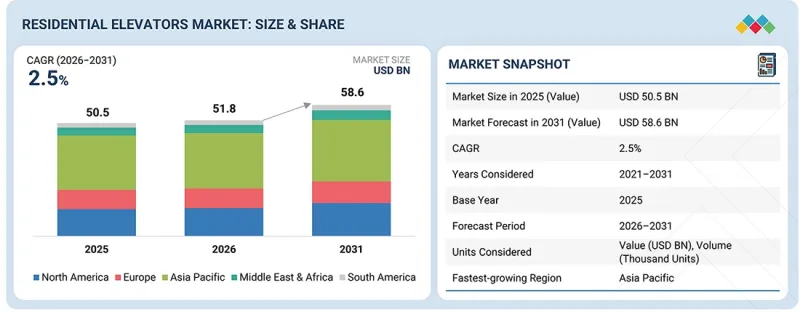
주거용 엘리베이터 시장 규모는 2026년 518억 달러에서 2031년에는 586억 달러에 달할 것으로 예측되며, CAGR은 2.5%를 기록할 전망입니다.
주거용 엘리베이터 시장은 고령화의 진행과 에너지 효율이 높은 건물에 대한 관심이 높아지는 것을 배경으로 성장하고 있습니다. 또한, 스마트 시티 및 인프라에 대한 투자 확대가 추가적인 성장을 가속화하고 있습니다.
| 조사 범위 | |
|---|---|
| 조사 대상 기간 | 2021-2031년 |
| 기준 연도 | 2025년 |
| 예측 기간 | 2026-2031년 |
| 대상 단위 | 금액(달러) 수량(유닛) |
| 부문 | 엘리베이터 기술, 서비스, 지역 |
| 대상 지역 | 북미, 아시아태평양, 유럽, 중동 및 아프리카, 남미 |
"기계실 없는 트랙션식 엘리베이터는 예측 기간 동안 시장 규모 2위를 차지할 것으로 전망됩니다."
기계실 없는(MRL) 엘리베이터는 뛰어난 성능을 갖추고 있으면서도 이용 가능한 공간을 효율적으로 활용할 수 있어, 주거용 엘리베이터 시장에서 두 번째로 큰 규모를 차지하는 기술 부문입니다. MRL 엘리베이터는 구동 장치가 엘리베이터 샤프트 내에 설치되기 때문에 기존의 엘리베이터 시스템과 달리 주택 설계 시 별도의 기계실을 마련할 필요가 없습니다. 따라서 공간의 효율적인 활용이 중요한 요소로 작용하는 현대적인 단독주택, 타운하우스, 고급 주택 프로젝트에서 이상적인 선택지가 되고 있습니다. MRL 시스템은 부드럽고 조용한 작동은 물론, 회생 구동 및 영구자석 모터를 통해 승차감 향상과 에너지 소비 절감을 실현합니다. 컴팩트한 크기 덕분에 신축이나 리모델링 공사에 설치하기 쉬워, 주택 건축 분야에서 활용도가 높아지고 있습니다. 또한, MRL 엘리베이터는 현대적인 건축 양식과 자연스럽게 조화를 이루는 것은 물론, 스마트 제어 기능, 원격 모니터링, 예측 유지보수 기능 등을 갖추고 있어 주택 소유자들 사이에서 인기가 높아지고 있습니다. 또한, 신뢰성, 효율성, 사용 편의성을 향상시키기 위한 지속적인 기술 개발의 혜택을 계속해서 누리고 있습니다. 주거용 엘리베이터는 세계 엘리베이터 산업에서 주요 기술 시장 중 하나입니다. 그중에서도 MRL 엘리베이터는 공간 절약성, 지속가능성, 첨단 기술을 갖춘 구조가 높이 평가받으며, 주택 소유주와 건설업체를 중심으로 도입이 확대되고 있습니다.
"유지보수·수리 서비스는 예측 기간 동안 시장 규모 2위를 차지할 것으로 전망됩니다."
이는 설치된 엘리베이터 시스템의 적절한 기능, 안전성 및 신뢰성을 장기간에 걸쳐 확보해야 하기 때문입니다. 주거용 엘리베이터는 수명이 긴 자산이므로, 정기적인 점검, 유지보수, 정비, 소프트웨어 업데이트, 윤활 및 원활하고 효율적인 가동을 위한 최적화가 필요합니다. 전 세계적으로 설치되는 가정용 엘리베이터의 수는 계속 증가하고 있으며, 이에 따라 정기적인 유지보수 수요도 높아지고 있습니다. 연간 유지보수 계약을 선택하는 주택 소유자가 늘어나는 가운데, 설비를 가능한 한 오랫동안 사용할 수 있도록 하고, 안정적인 성능을 유지하며, 제조사의 권장 사항을 따르는 것이 그 어느 때보다 중요해지고 있습니다.
또한, 모니터링 및 예측 유지보수를 위한 IoT 기술의 발전으로 인해 서비스 제공업체는 문제가 발생하기 전에 선제적으로 애플리케이션을 유지보수하고, 시스템의 상태를 원격으로 추적할 수 있게 되어 서비스 제공 방식에 혁명적인 변화를 가져왔습니다. 이러한 기능들은 효율성을 높일 뿐만 아니라 고객의 편의성도 향상시킵니다. 각 엘리베이터 제조사들도 종합적인 유지보수 패키지, 디지털 진단, 신속한 대응 서비스를 제공함으로써 애프터서비스 네트워크에 대한 투자를 확대하고 있으며, 이 모든 것이 새로운 수익원으로 자리 잡고 있습니다. 예방 유지보수에 대한 소비자의 인식이 높아지고, 기술적으로 고도로 발전한 주거용 엘리베이터의 이용이 확대됨에 따라, 유지보수 및 수리 서비스에 대한 수요는 여전히 증가하고 있습니다. 이로 인해 이 부문은 주거용 엘리베이터 서비스 시장 전체에서 가장 큰 기여 요인 중 하나가 되었습니다.
"북미가 금액 기준으로 예측 기간 동안 시장 규모 2위를 차지할 것으로 전망됩니다."
북미는 주택의 배리어프리 솔루션, 고급 주택 프로젝트, 새로운 주택 인프라에 대한 수요가 높기 때문에 주택용 엘리베이터 시장에서 2위의 규모를 차지하고 있습니다. 이 지역에는 고령자가 많아, 자립적인 생활을 영위하거나 널찍한 주택 내에서 층간을 이동하기 위해 주택용 엘리베이터에 대한 의존도가 높아지고 있습니다. 또한, 대규모 단독주택, 고급 주택, 맞춤형 주택의 존재가 엘리베이터 설치에 유리한 조건을 만들어내고 있습니다. 시장의 성장은 활발한 리모델링 및 주택 개보수 활동 덕분에 더욱 가속화되고 있습니다. 주택 소유자들은 접근성, 편의성 및 자산 가치를 높이기 위한 리모델링을 할 때, 자택에 엘리베이터를 설치하는 경향이 점점 더 강해지고 있습니다. 또한, 이 지역은 소비자의 구매력이 높고 첨단 주택 기술의 보급률도 높기 때문에 IoT 연결, 비접촉식 조작, 원격 진단, 에너지 절약 시스템을 갖춘 스마트 주택용 엘리베이터의 도입이 촉진되고 있습니다.
또한, 주요 엘리베이터 제조업체들의 시장 진입, 확립된 서비스 네트워크, 그리고 컴팩트한 크기와 기계실이 필요 없는 엘리베이터 기술 분야의 지속적인 혁신 역시 엘리베이터 시장을 견인하고 있습니다. 또한, 유니버설 디자인 원칙에 대한 집중과 고급 주택 설비에 대한 수요 증가가 미국 및 캐나다 시장의 성장을 주도하고 있습니다. 이러한 모든 요인이 복합적으로 작용하여 북미는 주거용 엘리베이터 시장에서 세계 2위의 규모를 차지하고 있으며, 접근성 향상, 스마트홈, 주거 건축의 기능 향상을 위한 투자가 지속적으로 이루어지고 있습니다.
본 보고서에서는 전 세계 주거용 엘리베이터 시장을 조사하여, 시장 개요, 시장 성장에 영향을 미치는 다양한 요인에 대한 분석, 기술 및 특허 동향, 법규제 환경, 사례 연구, 시장 규모 추정 및 전망, 각종 분류·지역/주요 국가별 상세 분석, 경쟁 현황, 주요 기업 개요 등을 정리하고 있습니다.
자주 묻는 질문
목차
제1장 소개
제2장 주요 요약
제3장 주요 인사이트
제4장 시장 개요
제5장 업계 동향
제6장 기술의 진보
제7장 지속가능성과 규제 상황
제8장 고객 상황과 구매 행동
제9장 주거용 엘리베이터 시장 : 엘리베이터 기술별
제10장 주거용 엘리베이터 시장 : 서비스별
제11장 주거용 엘리베이터 시장 : 지역별
제12장 경쟁 구도
제13장 기업 개요
제14장 조사 방법
제15장 부록
KSMThe residential elevators market is projected to reach USD 58.6 billion by 2031 from USD 51.8 billion in 2026, at a CAGR of 2.5%. The residential elevators market is growing due to an aging population and a rising focus on energy-efficient buildings. Additionally, growing investments in smart cities and infrastructure are accelerating further growth.
| Scope of the Report | |
|---|---|
| Years Considered for the Study | 2021-2031 |
| Base Year | 2025 |
| Forecast Period | 2026-2031 |
| Units Considered | Value (USD Billion) Volume (Thousand Units) |
| Segments | Elevator Technology, Service, and Region |
| Regions covered | North America, Asia Pacific, Europe, the Middle East & Africa, and South America |
"The machine-room-less traction elevator segment is projected to be the second-largest segment during the forecast period."
Machine-room-less (MRL) elevators are the second biggest technology segment in the residential elevators market, as they offer high performance yet make the best use of the space available. With MRL elevators, it is different than the traditional elevator system, because the drive machinery is placed inside the elevator shaft, freeing up the design of the home from the need to have a separate machine room. This makes them an ideal choice for contemporary single-family homes, townhouses, and upscale residential projects where a key factor is the efficient use of space. In addition to offering smooth and quiet performance, MRL systems provide improved ride comfort and reduce energy consumption with regenerative drives and permanent magnet motors. The small size makes them easy to install in new buildings and retrofits, increasing their versatility in residential buildings. Furthermore, the MRL elevators are becoming more popular among homeowners due to their seamless integration with modern architectural styles, along with their smart control features, remote monitoring, and predictive maintenance capabilities. They have also continued to benefit from ongoing technological developments to enhance their reliability, efficiency, and ease of use. The residential elevators sector is one of the biggest technology markets in the global elevator industry, as MRL elevators are becoming increasingly popular with homeowners and builders due to their sustainable, space-saving, and technologically advanced construction.
"Maintenance & repair segment projected to be the second-largest segment during the forecast period."
The maintenance and repair services segment is the second-largest segment, by service, in the residential elevators market, as it is necessary to ensure the proper functioning, safety, and reliability of the installed elevator systems for a long time. Residential elevators are long-life assets that need to be inspected, maintained, and serviced periodically, updated with software and lubricated, and optimized for smooth and efficient operation. The number of residential elevators installed around the world continues to grow, and there has been a corresponding demand for periodic maintenance. With an increasing number of homeowners choosing annual maintenance contracts, it has become more important than ever to make sure the equipment lasts as long as possible, performs consistently, and follows the manufacturer's recommendations. Moreover, the progress in the Internet of Things (IoT) technology for monitoring and predictive maintenance has revolutionized service provision by enabling service providers to proactively maintain their applications before problems arise and to remotely track system health. These features not only boost efficiency but also add to the convenience for customers. Elevator manufacturers are also investing in their after-market service networks by providing comprehensive maintenance packages, digital diagnostics, and quick response service, all of which are new revenue streams. The rising awareness of consumers about preventive maintenance and the rising use of technologically advanced residential elevators are still increasing the demand for maintenance and repair services. This makes this segment one of the largest contributors to the overall residential elevator services market.
"In terms of value, the North American region is projected to be the second-largest segment during the forecast period."
North America holds the second-largest market for residential elevators due to high demand for home accessibility solutions, upscale housing projects, and new residential infrastructure. The area has a large elderly population, who are growing more reliant on residential elevators to facilitate their ability to live independently and to move between floors in large homes. Also, the presence of big single-family residences, luxury residences, and custom-built homes generates favorable conditions for installing elevators. Market growth is also strengthened by robust renovation and home improvement activity, with homeowners more likely to install elevators in their homes when they're remodeling to improve accessibility, convenience, and property value. Moreover, the region has high consumer purchasing power and a high take-up of advanced home technologies, which helps the implementation of smart residential elevators that have IoT connectivity, touchless control, remote diagnostics, and energy-efficient systems. Additionally, the elevator market is bolstered by the involvement of major elevator manufacturers, established service networks, and ongoing innovation in compact-sized and machine-room-less elevator technology. In addition, the focus on universal design principles and the rising demand for high-end home features drive market expansion in the United States and Canada. All of these have contributed to North America becoming the second-largest market for residential elevators, which are receiving consistent investments in accessibility, smart homes, and the enhancement of residential buildings.
By Company Type: Tier 1: 25%, Tier 2: 42%, and Tier 3: 33%
By Designation: C-level Executives: 20%, Directors: 30%, and Other Designations: 50%
By Region: North America: 20%, Europe: 10%, Asia Pacific: 40%, South America: 10%, and Middle East & Africa 20%
Notes: Other designations include sales, marketing, and product managers.
Tier 1: >USD 1 Billion; Tier 2: USD 500 million-1 Billion; and Tier 3: <USD 500 million
Companies Covered: Otis Worldwide Corporation (US), Schindler (Switzerland), KONE Corporation (Finland), Hitachi Ltd. (Japan), Hyundai Elevator Co. Ltd. (South Korea), Fujitec Co., Ltd. (Japan), Toshiba Elevator and Building Systems Corporation (TELC) (Japan), Mitsubishi Electric Corporation (Japan), TK Elevator (Germany), SJEC Corporation (China), among others are covered in the report.
The study includes an in-depth competitive analysis of these key players in the residential elevators market, with their company profiles, recent developments, and key market strategies.
Research Coverage
This research report categorizes the residential elevators market based on elevator technology (traction elevators, machine-room-less traction elevators, and hydraulic elevators), service (new installation, maintenance & repair, and modernization), and region (Asia Pacific, North America, Europe, South America, and Middle East & Africa). The report's scope covers detailed information regarding the drivers, restraints, challenges, and opportunities influencing the growth of the residential elevators market. A detailed analysis of the key industry players has been done to provide insights into their business overview, products offered, and key strategies, such as partnerships, collaborations, product launches, expansions, and acquisitions, associated with the residential elevators market. This report covers a competitive analysis of upcoming startups in the residential elevators market ecosystem.
Reasons to Buy the Report
The report will offer the market leaders/new entrants with information on the closest approximations of the revenue numbers for the overall residential elevators market and the subsegments. This report will help stakeholders understand the competitive landscape, gain more insights into positioning their businesses better, and plan suitable go-to-market strategies. The report will help stakeholders understand the pulse of the market and provide them with information on key market drivers, restraints, challenges, and opportunities.
The report provides insights into the following points:
Analysis of key drivers (aging population is driving home mobility demand, increasing focus on energy efficiency in buildings, increasing investment in smart cities and infrastructure development), restraints (high maintenance cost, uncertainty & risk regarding global economy), opportunities (residential Elevator-as-a-Service (EaaS), standardized plug-and-play retrofit platforms), and challenges (compliance with multiple regional safety standards, diverse residential building structures).
- Product Development/Innovation: Detailed insights into upcoming technologies, research & development activities, and product & service launches in the residential elevators market.
- Market Development: Comprehensive information about profitable markets - the report analyzes the residential elevators market across varied regions.
Market Diversification: Exhaustive information about new products & services, untapped geographies, recent developments, and investments in the residential elevators market.
- Competitive Assessment: In-depth assessment of market shares, growth strategies, and service offerings of leading players such as Otis Worldwide Corporation (US), Schindler (Switzerland), KONE Corporation (Finland), Hitachi Ltd. (Japan), Hyundai Elevator Co. Ltd. (South Korea), Fujitec Co., Ltd. (Japan), Toshiba Elevator and Building Systems Corporation (TELC) (Japan), Mitsubishi Electric Corporation (Japan), TK Elevator (Germany), SJEC Corporation (China).
TABLE OF CONTENTS
1 INTRODUCTION
- 1.1 STUDY OBJECTIVES
- 1.2 MARKET DEFINITION
- 1.3 STUDY SCOPE
- 1.3.1 MARKETS COVERED & REGIONAL SCOPE
- 1.3.2 INCLUSIONS & EXCLUSIONS
- 1.3.3 YEARS CONSIDERED
- 1.4 CURRENCY CONSIDERED
- 1.5 UNIT CONSIDERED
- 1.6 STAKEHOLDERS
- 1.7 RESEARCH LIMITATIONS
2 EXECUTIVE SUMMARY
- 2.1 KEY INSIGHTS AND MARKET HIGHLIGHTS
- 2.2 KEY MARKET PARTICIPANTS: SHARE INSIGHTS AND STRATEGIC DEVELOPMENTS
- 2.3 DISRUPTIVE TRENDS SHAPING THE MARKET
- 2.4 HIGH-GROWTH SEGMENTS & EMERGING FRONTIERS
- 2.5 SNAPSHOT: GLOBAL MARKET SIZE, GROWTH RATE, AND FORECAST
3 PREMIUM INSIGHTS
- 3.1 ATTRACTIVE OPPORTUNITIES FOR PLAYERS IN RESIDENTIAL ELEVATORS MARKET
- 3.2 RESIDENTIAL ELEVATORS MARKET, BY ELEVATOR TECHNOLOGY AND SERVICE
- 3.3 RESIDENTIAL ELEVATORS MARKET, BY COUNTRY
4 MARKET OVERVIEW
- 4.1 INTRODUCTION
- 4.2 MARKET DYNAMICS
- 4.2.1 DRIVERS
- 4.2.1.1 Aging population is driving home mobility demand
- 4.2.1.2 Increasing focus on energy efficiency in buildings
- 4.2.1.3 Increasing investment in smart cities and infrastructure development
- 4.2.2 RESTRAINTS
- 4.2.2.1 High maintenance cost
- 4.2.2.2 Uncertainty & risk regarding global economy
- 4.2.3 OPPORTUNITIES
- 4.2.3.1 Residential Elevator-as-a-Service (EaaS)
- 4.2.3.2 Standardized plug-and-play retrofit platforms
- 4.2.4 CHALLENGES
- 4.2.4.1 Compliance with Multiple Regional Safety Standards
- 4.2.4.2 Diverse residential building structures
- 4.2.1 DRIVERS
- 4.3 UNMET NEEDS AND WHITE SPACES
- 4.3.1 UNMET NEEDS IN RESIDENTIAL ELEVATORS MARKET
- 4.3.1.1 Affordable mid-market residential elevators without performance trade-offs
- 4.3.1.2 Ultra-compact residential elevators for homes without floor penetration
- 4.3.2 WHITE SPACE OPPORTUNITIES
- 4.3.2.1 Self-powered residential elevators compatible with rooftop solar
- 4.3.2.2 Residential elevator digital twin throughout lifecycle
- 4.3.2.3 Residential elevator health monitoring platform
- 4.3.1 UNMET NEEDS IN RESIDENTIAL ELEVATORS MARKET
- 4.4 INTERCONNECTED MARKETS AND CROSS-SECTOR OPPORTUNITIES
- 4.4.1 INTERCONNECTED MARKETS
- 4.4.2 CROSS-SECTOR OPPORTUNITIES
- 4.4.3 STRATEGIC MOVES BY TIER 1/2/3 PLAYERS
- 4.4.4 KEY MOVES AND STRATEGIC FOCUS
5 INDUSTRY TRENDS
- 5.1 PORTER'S FIVE FORCES' ANALYSIS
- 5.1.1 THREAT OF NEW ENTRANTS
- 5.1.2 THREAT OF SUBSTITUTES
- 5.1.3 BARGAINING POWER OF SUPPLIERS
- 5.1.4 BARGAINING POWER OF BUYERS
- 5.1.5 INTENSITY OF COMPETITIVE RIVALRY
- 5.2 MACROECONOMIC ANALYSIS
- 5.2.1 INTRODUCTION
- 5.2.2 GDP TRENDS AND FORECASTS
- 5.3 VALUE CHAIN ANALYSIS
- 5.4 ECOSYSTEM ANALYSIS
- 5.5 PRICING ANALYSIS
- 5.5.1 AVERAGE SELLING PRICE RANGE OF ELEVATORS, BY TYPE
- 5.5.2 RESIDENTIAL ELEVATORS (AVERAGE PRICE RANGE)
- 5.6 TRADE ANALYSIS
- 5.6.1 IMPORT DATA RELATED TO HS CODE 842810, BY COUNTRY, 2021-2025 (USD THOUSAND)
- 5.6.2 EXPORT DATA RELATED TO HS CODE 842810, BY COUNTRY, 2021-2025 (USD THOUSAND)
- 5.7 KEY CONFERENCES AND EVENTS, 2026-2027
- 5.8 TRENDS/DISRUPTIONS IMPACTING CUSTOMER BUSINESS
- 5.9 INVESTMENT AND FUNDING SCENARIO
- 5.10 CASE STUDY ANALYSIS
- 5.10.1 VISTA SERENA - SAVARIA VUELIFT
- 5.10.2 THE GLEN ECLIPSE - SAVARIA ECLIPSE
- 5.10.3 MRS. OJEDA RESIDENCE, FLORIDA - STILTZ DUO HOME ELEVATOR
- 5.11 IMPACT OF 2025 US TARIFFS ON RESIDENTIAL ELEVATORS MARKET
- 5.11.1 INTRODUCTION
- 5.11.2 KEY TARIFF RATES
- 5.11.3 PRICE IMPACT ANALYSIS
- 5.11.4 KEY IMPACT ON VARIOUS REGIONS
- 5.11.4.1 US
- 5.11.4.2 Europe
- 5.11.4.3 Asia Pacific
- 5.11.5 INDUSTRY IMPACT
6 TECHNOLOGICAL ADVANCEMENTS
- 6.1 KEY TECHNOLOGIES
- 6.1.1 INTUITIVE ELEVATOR TECHNOLOGY
- 6.1.2 CABLE-FREE SMART ELEVATORS
- 6.2 COMPLEMENTARY TECHNOLOGIES
- 6.2.1 TOUCHLESS INTERFACE
- 6.2.2 INTERNET OF THINGS (IOT) AND 5G TECHNOLOGY
- 6.3 ADJACENT TECHNOLOGIES
- 6.3.1 ARTIFICIAL INTELLIGENCE (AI) FOR TRAFFIC MANAGEMENT
- 6.3.2 AUGMENTED REALITY (AR) FOR MAINTENANCE
- 6.4 TECHNOLOGY/PRODUCT ROADMAP
- 6.4.1 SHORT-TERM (2025-2027) | SMART CONNECTIVITY & COMPACT MOBILITY PHASE
- 6.4.2 MID-TERM (2027-2030) | INTELLIGENT AUTOMATION & DIGITAL ECOSYSTEM
- 6.4.3 LONG-TERM (2030-2035+): AUTONOMOUS & SUSTAINABLE HOME MOBILITY PHASE
- 6.5 PATENT ANALYSIS
- 6.6 FUTURE APPLICATIONS
- 6.6.1 SHAPE-ADAPTIVE ELEVATOR CABINS
- 6.6.2 ENERGY-SHARING ELEVATOR NETWORKS
- 6.6.3 ELECTROCHROMIC SMART GLASS ELEVATOR CABINS
- 6.7 IMPACT OF AI/GENERATIVE AI ON RESIDENTIAL ELEVATORS MARKET
- 6.7.1 TOP USE CASES AND MARKET POTENTIAL
- 6.7.2 BEST PRACTICES IN RESIDENTIAL ELEVATORS
- 6.7.3 CASE STUDIES OF AI IMPLEMENTATION IN RESIDENTIAL ELEVATORS MARKET
- 6.7.4 INTERCONNECTED ADJACENT ECOSYSTEM AND IMPACT ON MARKET PLAYERS
- 6.7.5 CLIENTS' READINESS TO ADOPT GENERATIVE AI IN RESIDENTIAL ELEVATORS MARKET
7 SUSTAINABILITY AND REGULATORY LANDSCAPE
- 7.1 REGIONAL REGULATIONS AND COMPLIANCE
- 7.1.1 REGULATORY BODIES, GOVERNMENT AGENCIES, AND OTHER ORGANIZATIONS
- 7.1.2 INDUSTRY STANDARDS
- 7.2 SUSTAINABILITY INITIATIVES
- 7.2.1 CARBON IMPACT AND ECO-APPLICATIONS OF RESIDENTIAL ELEVATORS
- 7.2.1.1 Carbon Impact Reduction
- 7.2.1.2 Eco-applications
- 7.2.1 CARBON IMPACT AND ECO-APPLICATIONS OF RESIDENTIAL ELEVATORS
- 7.3 SUSTAINABILITY IMPACT AND REGULATORY POLICY INITIATIVES
- 7.4 CERTIFICATIONS, LABELING, AND ECO-STANDARDS
8 CUSTOMER LANDSCAPE & BUYER BEHAVIOR
- 8.1 DECISION-MAKING PROCESS
- 8.2 BUYER STAKEHOLDERS AND BUYING EVALUATION CRITERIA
- 8.2.1 KEY STAKEHOLDERS IN BUYING PROCESS
- 8.2.2 BUYING CRITERIA
- 8.3 ADOPTION BARRIERS & INTERNAL CHALLENGES
- 8.4 UNMET NEEDS IN RESIDENTIAL ELEVATORS MARKET
- 8.5 MARKET PROFITABILITY
- 8.5.1 REVENUE POTENTIAL
- 8.5.2 COST DYNAMICS
- 8.5.3 MARGIN OPPORTUNITIES, BY SERVICE
9 RESIDENTIAL ELEVATORS MARKET BY ELEVATOR TECHNOLOGY
- 9.1 INTRODUCTION
- 9.2 TRACTION ELEVATORS
- 9.2.1 LIGHTWEIGHT PROPERTY TO DRIVE MARKET
- 9.3 MACHINE-ROOM-LESS TRACTION ELEVATORS
- 9.3.1 COST-EFFECTIVENESS AND SUPERIOR PERFORMANCE OF TECHNOLOGY TO DRIVE MARKET
- 9.4 HYDRAULIC ELEVATORS
- 9.4.1 USE IN LOW-RISE BUILDINGS TO DRIVE MARKET
10 RESIDENTIAL ELEVATORS MARKET, BY SERVICE
- 10.1 INTRODUCTION
- 10.2 NEW INSTALLATION
- 10.2.1 RISING CONSTRUCTION ACTIVITIES TO DRIVE MARKET
- 10.3 MAINTENANCE & REPAIR
- 10.3.1 GROWING CONCERNS REGARDING AGING ELEVATORS TO DRIVE MARKET
- 10.4 MODERNIZATION
- 10.4.1 NEED TO REPLACE AGING AND OBSOLETE SYSTEMS TO DRIVE MARKET
11 RESIDENTIAL ELEVATORS MARKET, BY REGION
- 11.1 INTRODUCTION
- 11.2 ASIA PACIFIC
- 11.2.1 CHINA
- 11.2.1.1 Large-scale urban renewal driving residential elevator demand
- 11.2.2 JAPAN
- 11.2.2.1 Aging population and residential modernization driving demand
- 11.2.3 INDIA
- 11.2.3.1 Rapid urbanization and smart housing development driving demand
- 11.2.4 SOUTH KOREA
- 11.2.4.1 Aging housing stock and energy-efficient renovation driving residential elevator demand
- 11.2.5 REST OF ASIA PACIFIC
- 11.2.1 CHINA
- 11.3 NORTH AMERICA
- 11.3.1 US
- 11.3.1.1 Increase in redevelopment projects to drive market growth
- 11.3.2 CANADA
- 11.3.2.1 Growth in residential investments to drive market
- 11.3.3 MEXICO
- 11.3.3.1 Rising housing investments to support market growth
- 11.3.1 US
- 11.4 SOUTH AMERICA
- 11.4.1 BRAZIL
- 11.4.1.1 Rapid urbanization and vertical housing development
- 11.4.2 ARGENTINA
- 11.4.2.1 Increase in energy-efficient building renovations to drive market
- 11.4.3 REST OF SOUTH AMERICA
- 11.4.1 BRAZIL
- 11.5 EUROPE
- 11.5.1 GERMANY
- 11.5.1.1 Government housing initiatives and residential building modernization to drive demand
- 11.5.2 FRANCE
- 11.5.2.1 Residential housing recovery and accessibility regulations driving demand
- 11.5.3 UK
- 11.5.3.1 Affordable housing investments and smart urban development driving demand
- 11.5.4 ITALY
- 11.5.4.1 Smart housing investments and residential upgrades driving market growth
- 11.5.5 SPAIN
- 11.5.5.1 Residential renovation initiatives and housing development supporting adoption
- 11.5.6 REST OF EUROPE
- 11.5.1 GERMANY
- 11.6 MIDDLE EAST & AFRICA
- 11.6.1 GCC COUNTRIES
- 11.6.1.1 Saudi Arabia
- 11.6.1.1.1 Growing housing development and aging population are driving residential elevator demand in Saudi Arabia
- 11.6.1.2 UAE
- 11.6.1.2.1 Expanding housing investments and aging demographics are increasing residential elevator demand in the UAE
- 11.6.1.3 Rest of GCC Countries
- 11.6.1.1 Saudi Arabia
- 11.6.2 REST OF MIDDLE EAST & AFRICA
- 11.6.1 GCC COUNTRIES
12 COMPETITIVE LANDSCAPE
- 12.1 OVERVIEW
- 12.2 KEY PLAYERS' STRATEGIES/RIGHT TO WIN, 2021-2026
- 12.3 REVENUE ANALYSIS, 2021-2025
- 12.4 MARKET SHARE ANALYSIS, 2025
- 12.5 COMPANY VALUATION AND FINANCIAL METRICS
- 12.6 BRAND/PRODUCT COMPARISON
- 12.7 COMPANY EVALUATION MATRIX: KEY PLAYERS, 2025
- 12.7.1 STARS
- 12.7.2 EMERGING LEADERS
- 12.7.3 PERVASIVE PLAYERS
- 12.7.4 PARTICIPANTS
- 12.7.5 COMPANY FOOTPRINT: KEY PLAYERS, 2025
- 12.7.5.1 Company footprint
- 12.7.5.2 Region footprint
- 12.7.5.3 Elevator technology footprint
- 12.7.5.4 Service footprint
- 12.8 COMPANY EVALUATION MATRIX: STARTUPS/SMES, 2025
- 12.8.1 PROGRESSIVE COMPANIES
- 12.8.2 RESPONSIVE COMPANIES
- 12.8.3 DYNAMIC COMPANIES
- 12.8.4 STARTING BLOCKS
- 12.8.5 COMPETITIVE BENCHMARKING: STARTUPS/SMES, 2025
- 12.8.5.1 Detailed list of key startups/SMEs
- 12.8.6 COMPETITIVE BENCHMARKING OF KEY STARTUPS/SMES
- 12.9 COMPETITIVE SCENARIO
- 12.9.1 PRODUCT LAUNCHES
- 12.9.2 DEALS
- 12.9.3 EXPANSIONS
- 12.9.4 OTHER DEVELOPMENTS
13 COMPANY PROFILES
- 13.1 KEY PLAYERS
- 13.1.1 OTIS WORLDWIDE CORPORATION
- 13.1.1.1 Business overview
- 13.1.1.2 Products/Solutions/Services offered
- 13.1.1.3 Recent developments
- 13.1.1.3.1 Product launches
- 13.1.1.3.2 Deals
- 13.1.1.3.3 Expansions
- 13.1.1.3.4 Others
- 13.1.1.4 MnM view
- 13.1.1.4.1 Key strengths
- 13.1.1.4.2 Strategic choices
- 13.1.1.4.3 Weaknesses and competitive threats
- 13.1.2 SCHINDLER
- 13.1.2.1 Business overview
- 13.1.2.2 Products/Solutions/Services offered
- 13.1.2.3 Recent developments
- 13.1.2.3.1 Product launches
- 13.1.2.4 MnM view
- 13.1.2.4.1 Key strengths
- 13.1.2.4.2 Strategic choices
- 13.1.2.4.3 Weaknesses and competitive threats
- 13.1.3 KONE CORPORATION
- 13.1.3.1 Business overview
- 13.1.3.2 Products/Solutions/Services offered
- 13.1.3.3 Recent developments
- 13.1.3.3.1 Deals
- 13.1.3.3.2 Expansions
- 13.1.3.3.3 Others
- 13.1.3.4 MnM view
- 13.1.3.4.1 Key strengths
- 13.1.3.4.2 Strategic choices
- 13.1.3.4.3 Weaknesses and competitive threats
- 13.1.4 HITACHI, LTD.
- 13.1.4.1 Business overview
- 13.1.4.2 Products/Solutions/Services offered
- 13.1.4.3 Recent developments
- 13.1.4.3.1 Product launches
- 13.1.4.3.2 Deals
- 13.1.4.3.3 Expansions
- 13.1.4.3.4 Others
- 13.1.4.4 MnM view
- 13.1.4.4.1 Key strengths
- 13.1.4.4.2 Strategic choices
- 13.1.4.4.3 Weaknesses and competitive threats
- 13.1.5 HYUNDAI ELEVATOR CO., LTD.
- 13.1.5.1 Business overview
- 13.1.5.2 Products/Solutions/Services offered
- 13.1.5.3 Recent developments
- 13.1.5.3.1 Product launches
- 13.1.5.3.2 Deals
- 13.1.5.3.3 Expansions
- 13.1.5.3.4 Others
- 13.1.5.4 MnM view
- 13.1.5.4.1 Key strengths
- 13.1.5.4.2 Strategic choices
- 13.1.5.4.3 Weaknesses and competitive threats
- 13.1.6 FUJITEC CO., LTD.
- 13.1.6.1 Business overview
- 13.1.6.2 Products/Solutions/Services offered
- 13.1.6.3 Recent developments
- 13.1.6.3.1 Product launches
- 13.1.6.3.2 Expansions
- 13.1.6.3.3 Others
- 13.1.6.4 MnM view
- 13.1.7 TOSHIBA ELEVATORS AND BUILDING SYSTEMS CORPORATION
- 13.1.7.1 Business overview
- 13.1.7.2 Products/Solutions/Services offered
- 13.1.7.3 Recent developments
- 13.1.7.3.1 Deals
- 13.1.7.3.2 Others
- 13.1.7.4 MnM view
- 13.1.8 MITSUBISHI ELECTRIC CORPORATION
- 13.1.8.1 Business overview
- 13.1.8.2 Products/Solutions/Services offered
- 13.1.8.3 Recent developments
- 13.1.8.3.1 Product launches
- 13.1.8.3.2 Deals
- 13.1.8.4 MnM view
- 13.1.9 TK ELEVATOR
- 13.1.9.1 Business overview
- 13.1.9.2 Products/Solutions/Services offered
- 13.1.9.3 Recent developments
- 13.1.9.3.1 Product launches
- 13.1.9.3.2 Deals
- 13.1.9.3.3 Expansions
- 13.1.9.4 MnM view
- 13.1.10 SJEC CORPORATION
- 13.1.10.1 Business overview
- 13.1.10.2 Products/Solutions/Services offered
- 13.1.10.3 MnM view
- 13.1.1 OTIS WORLDWIDE CORPORATION
- 13.2 OTHER PLAYERS
- 13.2.1 KLEEMANN
- 13.2.2 SIGMA ELEVATORS
- 13.2.3 WEMAINTAIN
- 13.2.4 ESCON ELEVATORS
- 13.2.5 SHENYANG YUANDA INTELLECTUAL INDUSTRY GROUP CO., LTD.
- 13.2.6 ORONA
- 13.2.7 EITA ELEVATOR
- 13.2.8 GLARIE ELEVATOR
- 13.2.9 AARON INDUSTRIES LTD.
- 13.2.10 LEO ELEVATORS
- 13.2.11 TRIO ELEVATORS CO (INDIA) PRIVATE LIMITED
- 13.2.12 STANNAH GROUP
- 13.2.13 CIBES LIFT
- 13.2.14 WALTON GROUP
- 13.2.15 EXPEDITE AUTOMATION LLP
- 13.2.16 LIFT AI VENTURES INC.
14 RESEARCH METHODOLOGY
- 14.1 RESEARCH DATA
- 14.2 SECONDARY DA T A
- 14.2.1 KEY DATA FROM SECONDARY SOURCES
- 14.3 PRIMARY DATA
- 14.3.1 KEY DATA FROM PRIMARY SOURCES
- 14.4 MARKET SIZE ESTIMATION
- 14.5 DATA TRIANGULATION
- 14.6 RESEARCH ASSUMPTIONS
- 14.7 RISK ASSESSMENT
- 14.8 GROWTH RATE ASSUMPTIONS
15 APPENDIX
- 15.1 DISCUSSION GUIDE
- 15.2 KNOWLEDGESTORE: MARKETSANDMARKETS' SUBSCRIPTION PORTAL
- 15.3 CUSTOMIZATION OPTIONS
- 15.4 RELATED REPORTS
- 15.5 AUTHOR DETAILS