|
시장보고서
상품코드
2094054
조직 식물성 단백질 시장 : 가공 방법별, 기능성별, 원료별, 제품 형태별, 성질별, 단백질 함유량별, 용도별, 지역별 - 세계 예측(-2031년)Textured Vegetable Protein Market by Source (Soy, Pea, Wheat, Other Sources), Product Form (Granules, Chunks/Cubes, Flakes, Crumbles, Others), Nature, Application, Protein Content, Processing Method, Functionality, and Region - Global Forecast to 2031 |
||||||

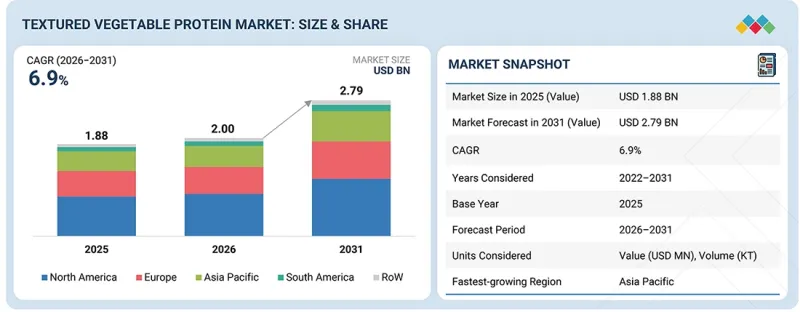
조직 식물성 단백질(TVP) 시장 규모는 2026년 20억 달러에서 2031년까지 27억 9,000만 달러로 성장할 것으로 예상되며, CAGR은 6.9%에 달할 것으로 예측됩니다.
| 조사 범위 | |
|---|---|
| 조사 대상 기간 | 2022-2031년 |
| 기준 연도 | 2025년 |
| 예측 기간 | 2026-2031년 |
| 산정 단위 | 금액(10억 달러), 수량(천 톤) |
| 부문 | 가공 방법별, 기능성별, 원료별, 제품 형태별, 성질별, 단백질 함유량별, 용도별, 지역별 |
| 대상 지역 | 북미, 아시아태평양, 유럽, 남미, 기타 지역 |
"원료별로는 완두콩 단백질 부문이 가장 큰 시장 점유율을 차지할 것으로 전망됩니다."
원료별로는, 대두 이외의 단백질 공급원을 찾는 소비자의 수요가 증가함에 따라 가공업체들이 식물성 단백질의 제품 라인업을 다양화하고 있어, 완두콩 단백질의 상업적 수용이 확대되고 있습니다. 압출 성형 가공에 적합하고, 부드러운 풍미를 지녔으며, 대두를 사용하지 않고 무글루텐, 비유전자 변형(비GMO) 기준을 충족하는 특성 덕분에, 완두콩 단백질은 다양한 조직 식물성 단백질(TVP) 용도로의 활용이 확대되고 있습니다. 또한, 완두콩 단백질의 추출 및 텍스처화 기술의 발전으로 제품의 기능성이 한층 더 향상되어, 제조업체들은 육류 대체품 및 기타 식품 배합에서 더 뛰어난 식감, 조리 성능, 그리고 수분 유지력을 실현할 수 있게 되었습니다. 특히 북미 및 유럽 지역의 완두콩 단백질 가공 능력에 대한 지속적인 투자를 통해, 텍스처드 단백질 배합용 원료의 공급이 강화되고 있습니다. 이러한 요인들로 인해, 예측 기간 동안 완두콩 단백질 부문의 성장이 촉진될 것으로 예상됩니다.
"예측 기간 동안 청크/큐브 부문은 조직 식물성 단백질 시장에서 큰 점유율을 차지할 것으로 예상됩니다."
제품 형태별로는, 청크/큐브 부문이 식물 유래 육류 제품 및 가공 식품에 널리 사용되고 있는 만큼, 조직 식물성 단백질 시장에서 큰 점유율을 차지할 것으로 예상됩니다. 청크는 다양한 크기로 제공되며, 제조업체는 이를 육류 대체품, 수프, 스튜, 카레, 즉석식, 냉동식품 등 다양한 식품 용도로 활용할 수 있습니다. 크기가 커서 고기 같은 덩어리가 보이도록 해야 하는 제품에 적합하며, 소매 및 외식 산업 분야에서 그 사용이 확대되고 있습니다. 또한, 이 부문은 닭고기, 소고기 및 기타 육류 대체 제품 분야에서 덩어리 형태의 조직 식물성 단백질을 사용한 식물성 제품의 출시가 증가하고 있는 점도 성장에 힘을 실어주고 있습니다. 또한, 청크는 특정 가공식품에서 육류 대체재로 사용되고 있으며, 제조업체가 단백질 함량을 유지하면서 배합 비용을 관리하는 데 도움이 되고 있습니다. 다양한 요리와 식품 형태에 걸쳐 적용되는 덩어리 형태의 조직 식물성 단백질의 폭넓은 용도는, 예측 기간 동안 이 부문의 큰 시장 점유율을 뒷받침할 것으로 예상됩니다.
"예측 기간 동안 유럽은 전 세계 조직 식물성 단백질 시장에서 큰 점유율을 차지할 것으로 예상됩니다."
예측 기간 동안 유럽은 조직 식물성 단백질 시장에서 큰 점유율을 차지할 것으로 예상됩니다. 이 지역에는 잘 정립된 식물성 식품 산업이 자리 잡고 있으며, 육류 대체품 및 기타 식물성 식품을 생산하는 제조업체들이 집중되어 있습니다. 독일, 영국, 프랑스, 네덜란드 등의 국가들은 주요 시장이며, 식물성 식단, 플렉시테리언(유연한 채식주의) 식습관, 그리고 지속가능한 식품 선택에 대한 소비자의 수요 증가에 힘입고 있습니다. 또한 유럽은 고도로 발달한 식품 가공 산업, 견고한 소매 유통망, 그리고 식물성 단백질 분야의 혁신에 대한 지속적인 투자라는 이점도 누리고 있습니다. 또한, 주요 조직 식물성 단백질(TVP) 제조업체들의 존재와 지속적인 신제품 출시가 해당 지역 세계 시장 점유율을 높이는 데 기여할 것으로 예상됩니다.
이 시장의 주요 기업은 ADM(미국), Cargill, Incorporated(미국), Roquette Freres(프랑스), International Flavors & Fragrances Inc.(미국), Ingredion Incorporated(미국), DSM-Firmenich(네덜란드/스위스), MGP(미국), PURIS(미국), BENEO GmbH(독일), Axiom Foods, Inc.(미국), The Scoular Company(미국), Shandong Yuxin Bio-Tech(중국), Gushen Biological Technology Group(중국), Foodchem International Corporation(중국), Dacsa Group(스페인), Shandong Wonderful Biotech(중국), Sun Nutrafoods(인도), Crown Soya Protein Group Company(중국), Hoya Foods(대만), Sotexpro(프랑스), Living Foods India Pvt. Ltd.(인도), Prana Organic(캐나다), Stentorian Industries(대만), Blattmann Schweiz AG(스위스), Sonic Biochem(인도)입니다.
조사 범위
본 조사 보고서에서는 조직 식물성 단백질(TVP) 시장을 원료별(대두 단백질, 완두콩 단백질, 밀 단백질, 풋콩, 병아리콩, 렌즈콩, 쌀, 귀리, 기타), 제품 형태별(과립, 덩어리/큐브, 플레이크, 크럼블, 스트립/슈레드, 압출 성형 단백질 크리스피/인클루전, 기타), 특성별(유기농, 일반형), 단백질 함량별(50% 미만, 50%-70%, 70% 이상), 용도별(식품용, 사료용), 가공 방법별(압출 성형, 기타 가공 방법), 기능별(보습성, 지방 결합성, 식감 향상, 단백질 강화, 유화성, 기타 기능성), 및 지역별(북미, 유럽, 아시아태평양, 남미, 기타 지역)로 분석하고 있습니다.
본 보고서의 조사 범위에는 조직 식물성 단백질(TVP) 산업의 성장에 영향을 미치는 주요 요인(촉진요인, 제약요인, 과제 및 기회 등)에 대한 상세한 정보가 포함되어 있습니다. 주요 업계 기업들에 대한 철저한 분석을 통해, 조직 식물성 단백질 시장과 관련된 각 기업의 사업, 서비스, 주요 전략, 계약, 제휴, 합의, 제품 출시, 합병 및 인수, 그리고 최근 동향에 대한 인사이트를 제공합니다. 본 보고서에서는 조직 식물성 단백질 시장의 생태계에서 두각을 나타내고 있는 신생 스타트업 기업들에 대한 경쟁 분석도 수록하고 있습니다. 또한, 본 조사에서는 기술 분석, 생태계 및 시장 매핑, 특허·규제 현황 등 업계 특유의 동향에 대해서도 포괄적으로 다루고 있습니다.
이 보고서를 구매해야 하는 이유
본 보고서는 시장 선도 기업 및 신규 진입 기업을 대상으로, 조직 식물성 단백질 시장 전체 및 그 하위 부문의 매출에 대한 가장 정확한 추정치를 제공합니다. 이를 통해 이해관계자들은 경쟁 구도를 파악하고, 자사의 비즈니스를 더 유리한 위치로 이끌며, 적절한 시장 진입 전략을 수립하기 위한 추가적인 인사이트를 얻을 수 있습니다. 또한, 본 보고서는 이해관계자들이 시장 동향을 파악하는 데 도움이 되며, 주요 시장 촉진요인, 억제요인, 과제 및 기회에 대한 정보를 제공합니다.
본 보고서에서는 다음 사항에 대한 인사이트를 제공합니다:
- 주요 촉진요인(육류 대체품에 대한 수요 확대, 식물성 식품 사업 분야의 투자 및 제휴 급증), 제약요인(식물성 단백질 원료와 관련된 알레르기, 조직 식물성 단백질 가공의 복잡성), 기회(기존의 조직 식물성 단백질 원료에서 다양한 단백질 원료로의 전환, 비용 효율적인 식물 유래 배합의 등장), 및 과제(높은 생산 비용, 엄격한 정부 규제)에 대한 분석.
- 제품 개발/혁신 : 조직 식물성 단백질 시장의 연구개발 활동 및 신제품 출시에 대한 상세한 분석
- 시장 개발 : 다양한 지역의 조직 식물성 단백질에 대한 분석을 통해 수익성이 높은 시장에 대한 종합적인 정보를 제공합니다.
- 시장의 다각화 : 조직 식물성 단백질 시장의 제품 원료, 미개척 지역, 최근 동향 및 투자에 관한 종합적인 정보
- 경쟁사 분석 : ADM(미국), Cargill, Incorporated(미국), Roquette Freres(프랑스), International Flavors & Fragrances Inc.(미국), Ingredion Incorporated(미국), DSM-Firmenich(네덜란드/스위스), MGP(미국), PURIS(미국), BENEO GmbH(독일), Axiom Foods, Inc.(미국), The Scoular Company(미국), Shandong Yuxin Bio-Tech(중국), Gushen Biological Technology Group(중국), Foodchem International Corporation(중국), Dacsa Group(스페인) 등이 조직 식물성 단백질 시장의 주요 기업들입니다.
자주 묻는 질문
목차
제1장 소개
제2장 주요 요약
제3장 주요 인사이트
제4장 시장 개요
제5장 업계 동향
제6장 규제 상황과 지속가능성에 대한 대처
제7장 고객 상황과 구매 행동
제8장 기술 진보, AI에 의한 영향, 특허, 혁신, 그리고 향후 응용
제9장 조직 식물성 단백질 시장(가공 방법별)
제10장 조직 식물성 단백질 시장(기능성별)
제11장 조직 식물성 단백질 시장(원료별)
제12장 조직 식물성 단백질 시장(제품 형태별)
제13장 조직 식물성 단백질 시장(성질별)
제14장 조직 식물성 단백질 시장(단백질 함유량별)
제15장 조직 식물성 단백질 시장(용도별)
제16장 조직 식물성 단백질 시장(지역별)
제17장 경쟁 구도
제18장 기업 개요
제19장 조사 방법
제20장 인접 시장 및 관련 시장
제21장 부록
KSM 26.07.28The textured vegetable protein market is projected to grow from USD 2.00 billion in 2026 to USD 2.79 billion by 2031, at a CAGR of 6.9%.
| Scope of the Report | |
|---|---|
| Years Considered for the Study | 2022-2031 |
| Base Year | 2025 |
| Forecast Period | 2026-2031 |
| Units Considered | Value (USD billion), Volume (KT) |
| Segments | by Source, Product Form, Nature, Application, Protein Content, Processing Method, Functionality, and Region |
| Regions covered | North America, Asia Pacific, Europe, South America, RoW |
"By source, the pea protein segment is likely to capture the largest market share"
By source, pea protein is witnessing an increased commercial acceptance as processors are diversifying their plant protein offerings to cater to the rising consumer demand for protein sources beyond soy. Its compatibility with extrusion processing, mild flavor profile, and ability to meet soy-free, gluten-free and non-GMO specifications has facilitated its utilization across a broad range of textured vegetable protein applications. Furthermore, advancements in pea protein extraction and texturization techniques have further contributed to improving the functional properties of the product, enabling manufacturers to achieve better texture, cooking performance and hydration in meat substitutes and other food formulations. Continued investments in the processing capacity of pea proteins, specifically in North America and Europe, are strengthening the raw material availability for textured protein formulations. These factors are expected to drive the growth of the pea protein segment during the forecast period.
"The chunks/cubes segment is expected to account for a significant share of the textured vegetable protein market during the forecast period."
By product form, the chunks/cubes segment is expected to account for a significant share of the textured vegetable protein market due to its widespread use in plant-based meat products and processed foods. Chunks are available in different sizes, allowing manufacturers to use them across a variety of food applications, including meat alternatives, soups, stews, curries, ready meals, and frozen foods. Their larger size makes them suitable for products that require visible meat-like pieces, expanding their use across retail and foodservice applications. The segment is also supported by the increasing number of plant-based product launches that use chunk-based textured proteins in chicken, beef, and other meat analog products. In addition, chunks are used as meat extenders in selected processed food products, helping manufacturers manage formulation costs while maintaining protein content. The broad application range of chunk-based textured proteins across different cuisines and food formats is expected to support the segment's significant market share during the forecast period.
"Europe is expected to account for a significant share of the global textured vegetable protein market during the forecast period."
Europe is expected to account for a significant share of the textured vegetable protein market during the forecast period. The region has an established plant-based food industry and a high concentration of manufacturers producing meat alternatives and other plant-based food products. Countries such as Germany, the UK, France, and the Netherlands are key markets, supported by growing consumer demand for plant-based diets, flexitarian eating patterns, and sustainable food choices. Europe also benefits from a well-developed food processing industry, strong retail distribution, and continued investment in plant protein innovation. In addition, the presence of major textured vegetable protein manufacturers and ongoing product launches is expected to support the region's significant share of the global market.
In-depth interviews were conducted with chief executive officers (CEOs), directors, and managers from various key organizations operating in the textured vegetable protein market.
- By Company Type: Tier 1 - 25%, Tier 2 - 45%, and Tier 3 - 30%
- By Designation: Directors- 35%, C-level Executives - 40%, Others - 25%
- By Region: North America - 20%, Europe - 25%, Asia Pacific - 35%, South America - 15%, and Rest of the World -5%
Prominent companies in the market include ADM (US), Cargill, Incorporated (US), Roquette Freres (France), International Flavors & Fragrances Inc. (US), Ingredion Incorporated (US), dsm-firmenich (Netherlands/Switzerland), MGP (US), PURIS (US), BENEO GmbH (Germany), Axiom Foods, Inc. (US), The Scoular Company (US), Shandong Yuxin Bio-Tech Co., Ltd. (China), Gushen Biological Technology Group Co., Ltd. (China), Foodchem International Corporation (China), and Dacsa Group (Spain),, Shandong Wonderful Biotech Co., Ltd. (China), Sun Nutrafoods (India), Crown Soya Protein Group Company (China), Hoya Foods (Taiwan), Sotexpro (France), Living Foods India Pvt. Ltd. (India), Prana Organic (Canada), Stentorian Industries Co., Ltd. (Taiwan), Blattmann Schweiz AG (Switzerland), and Sonic Biochem (India).
Research Coverage
This research report categorizes The Textured Vegetable Protein Market, By Source (Soy Protein, Pea Protein, Wheat Protein, Fava Bean, Chickpea, Lentil, Rice, Oat, Other Sources), Product Form (Granules, Chunks/Cubes, Flakes, Crumbles, Strips/Shreds, Extruded Protein Crispies/Inclusions, Others), Nature (Organic, Conventional), Protein Content (Below 50%, 50%-70%, Above 70%), Application (Food Applications [Meat Alternatives, Ready-to-Eat/Ready-to-Cook Foods, Snacks, Bakery & Savory Products, Soups, Sauces & Seasonings, Foodservice & Institutional, Other Food Applications], Feed Applications [Pet Food, Aquafeed, Livestock Feed Additives, Other Feed Applications]), Processing Method (Extrusion, Other Processing Methods), Functionality (Water Binding, Fat Binding, Texture Enhancement, Protein Enrichment, Emulsification, Other Functional Properties), and Region (North America, Europe, Asia Pacific, South America, RoW).
The report's scope encompasses detailed information on the major factors, including drivers, restraints, challenges, and opportunities, which influence the growth of the textured vegetable protein industry. A thorough analysis of the key industry players was done to provide insights into their business, services, key strategies, contracts, partnerships, agreements, product launches, mergers & acquisitions and recent developments associated with the textured vegetable protein market. This report provides a competitive analysis of emerging startups in the textured vegetable protein market ecosystem. Furthermore, the study covers industry-specific trends, including technology analysis, ecosystem & market mapping, and patent & regulatory landscape, among others.
Reasons to Buy This Report
The report provides market leaders/new entrants with information on the closest approximations of revenue numbers for the overall textured vegetable protein and its subsegments. It will help stakeholders understand the competitive landscape and gain more insights to position their businesses better and plan suitable go-to-market strategies. The report also helps stakeholders understand the pulse of the market and provides them with information on key market drivers, restraints, challenges, and opportunities.
The report provides insights into the following pointers:
- Analysis of key drivers (growing demand for meat alternatives, surge in investments and collaborations in plant-sourced food businesses), restraints (allergies associated with vegetable protein sources, complexities in processing textured vegetable proteins), opportunities (shift from traditional textured vegetable protein sources to diversified protein sources, emergence of cost-efficient plant-based formulations), and challenges (high production cost, stringent government regulations).
- Product Development/Innovation: Detailed insights into research & development activities and new product launches in the textured vegetable protein market
- Market Development: Comprehensive information about lucrative markets, by offering an analysis of textured vegetable protein across varied regions
- Market Diversification: Exhaustive information about product sources, untapped geographies, recent developments, and investments in the textured vegetable protein market
- Competitive Assessment: In-depth assessment of market shares, growth strategies, product offerings, brand/product comparison, and product footprints of leading players such as ADM (US), Cargill, Incorporated (US), Roquette Freres (France), International Flavors & Fragrances Inc. (US), Ingredion Incorporated (US), dsm-firmenich (Netherlands/Switzerland), MGP (US), PURIS (US), BENEO GmbH (Germany), Axiom Foods, Inc. (US), The Scoular Company (US), Shandong Yuxin Bio-Tech Co., Ltd. (China), Gushen Biological Technology Group Co., Ltd. (China), Foodchem International Corporation (China), Dacsa Group (Spain), and other players in the textured vegetable protein market.
TABLE OF CONTENTS
1 INTRODUCTION
- 1.1 STUDY OBJECTIVES
- 1.2 MARKET DEFINITION
- 1.3 STUDY SCOPE
- 1.3.1 INCLUSIONS AND EXCLUSIONS
- 1.4 YEARS CONSIDERED
- 1.5 CURRENCY CONSIDERED
- 1.6 VOLUME UNIT CONSIDERED
- 1.7 STAKEHOLDERS
- 1.8 SUMMARY OF CHANGES
2 EXECUTIVE SUMMARY
- 2.1 MARKET HIGHLIGHTS AND KEY INSIGHTS
- 2.2 KEY MARKET PARTICIPANTS: MAPPING OF STRATEGIC DEVELOPMENTS
- 2.3 DISRUPTIVE TRENDS IN TEXTURED VEGETABLE PROTEIN MARKET
- 2.4 HIGH-GROWTH SEGMENTS
- 2.5 REGIONAL SNAPSHOT: MARKET SIZE, GROWTH RATE, AND FORECAST
3 PREMIUM INSIGHTS
- 3.1 ATTRACTIVE OPPORTUNITIES FOR PLAYERS IN TEXTURED VEGETABLE PROTEIN MARKET
- 3.2 TEXTURED VEGETABLE PROTEIN MARKET, BY SOURCE AND REGION
- 3.3 TEXTURED VEGETABLE PROTEIN MARKET, BY PROTEIN CONTENT
- 3.4 TEXTURED VEGETABLE PROTEIN MARKET, BY SOURCE
- 3.5 TEXTURED VEGETABLE PROTEIN MARKET, BY PRODUCT FORM
- 3.6 TEXTURED VEGETABLE PROTEIN MARKET, BY APPLICATION
- 3.7 TEXTURED VEGETABLE PROTEIN MARKET, BY NATURE
- 3.8 TEXTURED VEGETABLE PROTEIN MARKET, BY COUNTRY
4 MARKET OVERVIEW
- 4.1 INTRODUCTION
- 4.2 MARKET DYNAMICS
- 4.2.1 DRIVERS
- 4.2.1.1 Growing demand for meat alternatives
- 4.2.1.2 Advancements in extrusion and protein processing technologies
- 4.2.1.3 Surge in investments and collaborations in plant-sourced food business
- 4.2.2 RESTRAINTS
- 4.2.2.1 Allergies associated with vegetable protein sources
- 4.2.2.2 Complexities in processing textured vegetable proteins
- 4.2.3 OPPORTUNITIES
- 4.2.3.1 Growing adoption of hybrid meat products
- 4.2.3.2 Shift from traditional extraction sources of textured vegetable protein to new sources
- 4.2.4 CHALLENGES
- 4.2.4.1 Stringent government regulations
- 4.2.4.2 High cost of production
- 4.2.1 DRIVERS
- 4.3 UNMET NEEDS AND WHITE SPACES
- 4.3.1 UNMET NEEDS IN TEXTURED VEGETABLE PROTEIN MARKET
- 4.3.2 WHITE SPACE OPPORTUNITIES
- 4.4 INTERCONNECTED MARKETS AND CROSS-SECTOR OPPORTUNITIES
- 4.4.1 INTERCONNECTED MARKETS
- 4.4.2 CROSS-SECTOR OPPORTUNITIES
- 4.5 STRATEGIC MOVES BY TIER-1/2/3 PLAYERS
- 4.5.1 KEY MOVES AND STRATEGIC FOCUS
5 INDUSTRY TRENDS
- 5.1 INTRODUCTION
- 5.2 PORTER'S FIVE FORCES ANALYSIS
- 5.2.1 IMPACT OF PORTER'S FIVE FORCES ON TEXTURED VEGETABLE PROTEIN MARKET
- 5.2.2 THREAT OF NEW ENTRANTS
- 5.2.3 THREAT OF SUBSTITUTES
- 5.2.4 BARGAINING POWER OF SUPPLIERS
- 5.2.5 BARGAINING POWER OF BUYERS
- 5.2.6 INTENSITY OF COMPETITIVE RIVALRY
- 5.3 MACROECONOMIC INDICATORS
- 5.3.1 GLOBAL PRODUCTION OF PLANT PROTEIN FEEDSTOCKS
- 5.3.2 GROWING HEALTH TRENDS
- 5.3.3 CONSUMER SHIFT TOWARD PLANT-BASED NUTRITION
- 5.4 VALUE CHAIN ANALYSIS
- 5.4.1 RESEARCH AND PRODUCT DEVELOPMENT
- 5.4.2 CROP CULTIVATION AND RAW MATERIAL SOURCING
- 5.4.3 PROTEIN EXTRACTION AND INGREDIENT PROCESSING
- 5.4.4 TEXTURIZATION AND PRODUCT MANUFACTURING
- 5.4.5 COMMERCIALIZATION AND DISTRIBUTION
- 5.4.6 END-USE APPLICATIONS
- 5.5 ECOSYSTEM ANALYSIS
- 5.5.1 DEMAND SIDE
- 5.5.2 SUPPLY SIDE
- 5.6 PRICING ANALYSIS
- 5.6.1 AVERAGE SELLING PRICE OF KEY PLAYERS, BY SOURCE, 2025
- 5.6.2 AVERAGE SELLING PRICE TREND, BY SOURCE
- 5.6.3 AVERAGE SELLING PRICE TREND, BY REGION
- 5.7 TRADE ANALYSIS
- 5.7.1 TRADE ANALYSIS OF HS CODE 210610: PROTEIN CONCENTRATES AND TEXTURED PROTEIN SUBSTANCES
- 5.7.1.1 Export trends under HS code 210610 (2021-2025)
- 5.7.1.2 Import trends under HS code 210610 (2021-2025)
- 5.7.1 TRADE ANALYSIS OF HS CODE 210610: PROTEIN CONCENTRATES AND TEXTURED PROTEIN SUBSTANCES
- 5.8 KEY CONFERENCES AND EVENTS, 2026-2027
- 5.9 TRENDS/DISRUPTIONS IMPACTING CUSTOMER BUSINESS
- 5.10 INVESTMENT AND FUNDING SCENARIO
- 5.11 CASE STUDY ANALYSIS
- 5.11.1 PLANT-BASED MEAT BRAND ENHANCED PLANT-BASED MEAT WITH RESPONSE 4380 IP SOY PROTEIN
- 5.11.2 GOODDOT EXPANDED PLANT-BASED MEAT ADOPTION THROUGH AFFORDABLE PLANT PROTEINS
- 5.12 IMPACT OF US TARIFF - TEXTURED VEGETABLE PROTEIN MARKET
- 5.12.1 INTRODUCTION
- 5.12.2 PRICE IMPACT ANALYSIS
- 5.12.3 IMPACT ON COUNTRIES/REGIONS
- 5.12.3.1 US
- 5.12.3.2 Europe
- 5.12.3.3 Asia Pacific
- 5.12.4 IMPACT ON END-USE INDUSTRIES
6 REGULATORY LANDSCAPE AND SUSTAINABILITY INITIATIVES
- 6.1 INTRODUCTION
- 6.2 REGIONAL REGULATIONS AND COMPLIANCE
- 6.2.1 REGULATORY BODIES, GOVERNMENT AGENCIES, AND OTHER ORGANIZATIONS
- 6.2.2 INDUSTRY STANDARDS
- 6.2.3 LABELING REQUIREMENTS AND CLAIMS
- 6.2.4 ANTICIPATED REGULATORY CHANGES IN NEXT 5-10 YEARS
- 6.2.4.1 Enhanced supply chain traceability and digital recordkeeping requirements
- 6.2.4.2 Stricter regulation of plant-based labeling and product claims
- 6.2.4.3 Increased focus on sustainability reporting and responsible sourcing
- 6.2.4.4 Expansion of regulatory frameworks for alternative proteins and novel ingredients
- 6.2.4.5 Greater harmonization of international food safety and plant protein standards
- 6.3 SUSTAINABILITY INITIATIVES
- 6.3.1 SUSTAINABLE SOURCING OF PLANT PROTEIN RAW MATERIALS
- 6.3.2 CARBON FOOTPRINT REDUCTION INITIATIVES
- 6.3.3 RESOURCE EFFICIENCY AND CIRCULAR ECONOMY APPROACHES
- 6.3.4 SUSTAINABLE MANUFACTURING AND CLEAN ENERGY ADOPTION
- 6.4 IMPACT OF REGULATORY POLICIES ON SUSTAINABILITY INITIATIVES
- 6.5 CERTIFICATIONS, LABELING, ECO-STANDARDS
7 CUSTOMER LANDSCAPE AND BUYER BEHAVIOR
- 7.1 INTRODUCTION
- 7.2 DECISION-MAKING PROCESS
- 7.3 KEY STAKEHOLDERS INVOLVED IN BUYING PROCESS AND THEIR EVALUATION CRITERIA
- 7.3.1 KEY STAKEHOLDERS IN BUYING PROCESS
- 7.3.2 BUYING CRITERIA
- 7.4 ADOPTION BARRIERS AND INTERNAL CHALLENGES
- 7.5 UNMET NEEDS OF VARIOUS END USERS
- 7.6 MARKET PROFITABILITY
- 7.7 REVENUE POTENTIAL
- 7.7.1 COST DYNAMICS
8 TECHNOLOGICAL ADVANCEMENTS, AI-DRIVEN IMPACT, PATENTS, INNOVATIONS, AND FUTURE APPLICATIONS
- 8.1 INTRODUCTION
- 8.2 KEY TECHNOLOGIES
- 8.2.1 EXTRUSION TECHNOLOGY
- 8.2.2 PROTEIN FRACTIONATION AND CONCENTRATION TECHNOLOGIES
- 8.2.3 TEXTURE ENGINEERING AND STRUCTURING TECHNOLOGIES
- 8.3 COMPLEMENTARY TECHNOLOGIES
- 8.3.1 ENZYMATIC MODIFICATION AND FUNCTIONALIZATION TECHNOLOGIES
- 8.3.2 HYDROCOLLOID AND INGREDIENT SYSTEM TECHNOLOGIES
- 8.3.3 FLAVOR GENERATION AND SENSORY ENHANCEMENT TECHNOLOGIES
- 8.3.4 DIGITAL MANUFACTURING AND PROCESS OPTIMIZATION TECHNOLOGIES
- 8.4 ADJACENT TECHNOLOGIES
- 8.4.1 3D PRINTING
- 8.4.2 CONTROLLED EXTRUSION PROCESSES AND PRECISION FERMENTATION
- 8.4.3 NUTRIENT FORTIFICATION AND BIOFORTIFICATION
- 8.5 TECHNOLOGY/PRODUCT ROADMAP
- 8.5.1 SHORT-TERM | EXTRUSION OPTIMIZATION & ALTERNATIVE PROTEIN EXPANSION
- 8.5.2 MID-TERM | TEXTURE INNOVATION, DIGITALIZATION, & FUNCTIONAL DIFFERENTIATION
- 8.5.3 LONG-TERM | HYBRID PROTEINS, FERMENTATION-ENABLED INGREDIENTS, & NEXT-GENERATION APPLICATIONS
- 8.6 PATENT ANALYSIS
- 8.6.1 LIST OF MAJOR PATENTS
- 8.7 FUTURE APPLICATIONS
- 8.7.1 TEXTURED VEGETABLE PROTEIN IN CULTIVATED MEAT SCAFFOLD SYSTEMS
- 8.7.2 TEXTURED VEGETABLE PROTEIN IN 3D-PRINTED PLANT-BASED MEAT PRODUCTS
- 8.7.3 TEXTURED VEGETABLE PROTEIN IN STRUCTURED WHOLE-CUT CULTIVATED MEAT PRODUCTS
- 8.8 IMPACT OF GENERATIVE AI ON TEXTURED VEGETABLE PROTEIN MARKET
- 8.8.1 INTRODUCTION
- 8.8.2 BEST PRACTICES IN TEXTURED VEGETABLE PROTEIN INDUSTRY
- 8.8.3 CASE STUDIES OF AI IMPLEMENTATION IN TEXTURED VEGETABLE PROTEIN MARKET
- 8.8.4 INTERCONNECTED ADJACENT ECOSYSTEM AND IMPACT ON MARKET PLAYERS
- 8.8.5 CLIENTS' READINESS TO ADOPT GENERATIVE AI IN TEXTURED VEGETABLE PROTEIN MARKET
- 8.9 SUCCESS STORIES AND REAL-WORLD APPLICATIONS
9 TEXTURED VEGETABLE PROTEIN MARKET, BY PROCESSING METHOD
- 9.1 INTRODUCTION
- 9.2 EXTRUSION
- 9.2.1 HIGH-MOISTURE EXTRUSION
- 9.2.1.1 Growing demand for whole-cut and premium meat alternatives to accelerate adoption of high-moisture extrusion technologies
- 9.2.2 LOW-MOISTURE EXTRUSION
- 9.2.2.1 Widespread use of low-moisture extrusion in meat analog and protein-enriched food applications to support market growth
- 9.2.1 HIGH-MOISTURE EXTRUSION
- 9.3 OTHER PROCESSING METHODS
10 TEXTURED VEGETABLE PROTEIN MARKET, BY FUNCTIONALITY
- 10.1 INTRODUCTION
- 10.2 WATER BINDING
- 10.3 FAT BINDING
- 10.4 TEXTURE ENHANCEMENT
- 10.5 PROTEIN ENRICHMENT
- 10.6 EMULSIFICATION
- 10.7 OTHER FUNCTIONAL PROPERTIES
11 TEXTURED VEGETABLE PROTEIN MARKET, BY SOURCE
- 11.1 INTRODUCTION
- 11.2 SOY
- 11.2.1 HIGH SHELF-LIFE AND LOW CALORIES IN SOYMEAL PRODUCTS TO BOOST DEMAND
- 11.2.2 SOY PROTEIN CONCENTRATE
- 11.2.3 SOY PROTEIN ISOLATE
- 11.2.4 DEFATTED SOY FLOUR
- 11.3 PEA
- 11.3.1 USE OF TEXTURED PEA PROTEIN IN DIFFERENT PRODUCTS TO DRIVE MARKET
- 11.4 WHEAT
- 11.4.1 EXCELLENT BINDING CHARACTERISTICS TO INCREASE WHEAT USAGE IN ALTERNATIVE MEAT PRODUCTS
- 11.5 FAVA BEAN
- 11.5.1 GROWING CONSUMPTION OF SOY-FREE AND ALLERGEN-FRIENDLY PROTEIN INGREDIENTS TO DRIVE DEMAND FOR FAVA BEAN-BASED TEXTURED VEGETABLE PROTEIN
- 11.6 CHICKPEA
- 11.6.1 STRONG EMULSIFICATION AND WATER-BINDING PROPERTIES TO SUPPORT ADOPTION OF CHICKPEA PROTEIN IN TEXTURED VEGETABLE PROTEIN
- 11.7 LENTIL
- 11.7.1 ABILITY OF LENTIL PROTEIN TO DEVELOP MEAT-LIKE FIBROUS STRUCTURES TO SUPPORT MARKET GROWTH
- 11.8 RICE
- 11.8.1 COMPLEMENTARY NUTRITIONAL PROFILE OF RICE PROTEIN TO DRIVE ADOPTION IN TEXTURED VEGETABLE PROTEIN FORMULATIONS
- 11.9 OAT
- 11.9.1 HIGH PROTEIN AND B-GLUCAN FIBER CONTENT TO SUPPORT ADOPTION OF OATS IN TEXTURED VEGETABLE PROTEIN APPLICATIONS
- 11.10 OTHER SOURCES
12 TEXTURED VEGETABLE PROTEIN MARKET, BY PRODUCT FORM
- 12.1 INTRODUCTION
- 12.2 GRANULES
- 12.2.1 ABILITY OF GRANULES TO REPLICATE MINCED MEAT TEXTURE TO BOOST ADOPTION IN PLANT-BASED FOODS
- 12.3 CHUNKS/CUBES
- 12.3.1 GROWING DEMAND FOR WHOLE-CUT MEAT ALTERNATIVES TO SUPPORT ADOPTION OF CHUNKS AND CUBES
- 12.4 FLAKES
- 12.4.1 RAPID HYDRATION AND FORMULATION VERSATILITY OF FLAKES TO SUPPORT TEXTURED VEGETABLE PROTEIN UTILIZATION IN CONVENIENCE FOOD APPLICATIONS
- 12.5 CRUMBLES
- 12.5.1 SUITABILITY OF CRUMBLE-FORMAT TEXTURED VEGETABLE PROTEIN FOR READY-TO-EAT AND READY-TO-COOK FOOD APPLICATIONS TO SUPPORT MARKET GROWTH
- 12.6 STRIPS/SHREDS
- 12.6.1 USE OF STRIPS AND SHREDS IN WHOLE-MUSCLE MEAT ALTERNATIVE APPLICATIONS TO SUPPORT MARKET GROWTH
- 12.7 EXTRUDED PROTEIN CRISPIES/INCLUSIONS
- 12.7.1 USE OF EXTRUDED PROTEIN CRISPIES AND INCLUSIONS IN HIGH-PROTEIN FOOD APPLICATIONS TO DRIVE MARKET
- 12.7.2 OTHER PRODUCT FORMS
13 TEXTURED VEGETABLE PROTEIN MARKET, BY NATURE
- 13.1 INTRODUCTION
- 13.2 CONVENTIONAL
- 13.2.1 WIDESPREAD AVAILABILITY AND COST COMPETITIVENESS TO DRIVE CONSUMPTION OF CONVENTIONAL TEXTURED VEGETABLE PROTEINS
- 13.3 ORGANIC
- 13.3.1 GROWING DEMAND FOR CERTIFIED ORGANIC PLANT-BASED FOODS TO SUPPORT ADOPTION OF ORGANIC TEXTURED VEGETABLE PROTEINS
14 TEXTURED VEGETABLE PROTEIN MARKET, BY PROTEIN CONTENT
- 14.1 INTRODUCTION
- 14.2 BELOW 50%
- 14.2.1 USE OF FLOUR-BASED TEXTURED VEGETABLE PROTEINS IN COST-SENSITIVE FOOD APPLICATIONS TO DRIVE MARKET
- 14.3 50-70%
- 14.3.1 GROWING DEMAND FOR HIGH-PROTEIN PLANT-BASED FOODS TO SUPPORT ADOPTION OF 50-70% TEXTURED VEGETABLE PROTEINS
- 14.4 ABOVE 70%
- 14.4.1 INCREASING FOCUS ON PROTEIN ENRICHMENT TO SUPPORT DEMAND FOR ABOVE-70% TEXTURED VEGETABLE PROTEINS
15 TEXTURED VEGETABLE PROTEIN MARKET, BY APPLICATION
- 15.1 INTRODUCTION
- 15.2 FOOD APPLICATIONS
- 15.2.1 MEAT ALTERNATIVES
- 15.2.1.1 Growing flexitarian adoption, health-conscious consumption, and sustainability considerations to support demand for textured vegetable protein in meat alternatives
- 15.2.1.2 Burgers
- 15.2.1.3 Sausages
- 15.2.1.4 Nuggets
- 15.2.1.5 Meatballs
- 15.2.1.6 Ground meat analogs
- 15.2.1.7 Whole-cut analogs
- 15.2.1.8 Seafood alternatives
- 15.2.2 READY-TO-EAT/READY-TO-COOK FOODS
- 15.2.2.1 Consumer preference for convenience, nutrition, and sustainability in food choices to drive market
- 15.2.2.2 Frozen meals
- 15.2.2.3 Instant meals
- 15.2.2.4 Canned food
- 15.2.3 SNACKS
- 15.2.3.1 Growing consumer preference for protein-rich snacking to drive demand for textured vegetable protein
- 15.2.3.2 Protein snacks
- 15.2.3.3 Extruded snacks
- 15.2.3.4 Crisps
- 15.2.4 BAKERY & SAVORY PRODUCTS
- 15.2.4.1 Growing demand for protein-enriched bakery and savory products to support textured vegetable protein adoption
- 15.2.5 SOUPS, SAUCES, & SEASONINGS
- 15.2.5.1 Increasing demand for convenient shelf-stable meal solutions to drive consumption of textured vegetable protein in soups, sauces, & seasonings
- 15.2.6 FOOD SERVICE & INSTITUTIONAL
- 15.2.6.1 Growing adoption of plant-based menu offerings across foodservice and institutional channels to support demand for textured vegetable proteins
- 15.2.7 OTHER FOOD APPLICATIONS
- 15.2.1 MEAT ALTERNATIVES
- 15.3 FEED APPLICATIONS
- 15.3.1 PET FOOD
- 15.3.1.1 Rising demand for high-protein nutrition and sustainable sourcing to drive textured vegetable protein adoption in pet food
- 15.3.2 LIVESTOCK FEED ADDITIVES
- 15.3.2.1 Increasing adoption of alternative plant proteins in livestock nutrition to support demand for textured vegetable proteins
- 15.3.3 AQUAFEED
- 15.3.3.1 Growing adoption of alternative plant proteins in aquafeed to support demand for textured vegetable proteins
- 15.3.4 OTHER FEED APPLICATIONS
- 15.3.1 PET FOOD
16 TEXTURED VEGETABLE PROTEIN MARKET, BY REGION
- 16.1 INTRODUCTION
- 16.2 NORTH AMERICA
- 16.2.1 US
- 16.2.1.1 Strong soybean production and advanced manufacturing ecosystem to support market growth
- 16.2.2 CANADA
- 16.2.2.1 Abundant pulse feedstocks and strategic protein investments to drive market
- 16.2.3 MEXICO
- 16.2.3.1 Growing flexitarian consumer base and expanding plant-based innovation to drive market
- 16.2.1 US
- 16.3 EUROPE
- 16.3.1 GERMANY
- 16.3.1.1 Strong flexitarian adoption and strategic plant protein investments to drive market
- 16.3.2 FRANCE
- 16.3.2.1 Rising consumer adoption of plant-based foods and strategic industry partnerships to drive market
- 16.3.3 UK
- 16.3.3.1 Advancements in alternative protein innovation and market development to drive market
- 16.3.4 SPAIN
- 16.3.4.1 Increasing consumer demand and product innovation in alternative proteins to drive market
- 16.3.5 ITALY
- 16.3.5.1 Expanding plant-based food business and strengthening industry collaboration to drive market
- 16.3.6 REST OF EUROPE
- 16.3.1 GERMANY
- 16.4 ASIA PACIFIC
- 16.4.1 CHINA
- 16.4.1.1 Advancing protein diversification and alternative protein development to drive market
- 16.4.2 INDIA
- 16.4.2.1 Established consumption of soy-based protein foods and growing alternative protein initiatives to drive market
- 16.4.3 JAPAN
- 16.4.3.1 Strategic focus on food security and protein innovation to drive market
- 16.4.4 AUSTRALIA & NEW ZEALAND
- 16.4.4.1 Expanding alternative protein adoption and domestic plant protein processing capacity to support market growth
- 16.4.5 REST OF ASIA PACIFIC
- 16.4.1 CHINA
- 16.5 SOUTH AMERICA
- 16.5.1 BRAZIL
- 16.5.1.1 Abundant soybean supply and strong protein processing capabilities to drive market
- 16.5.2 ARGENTINA
- 16.5.2.1 Expanding protein ingredient exports and growing interest in plant-based foods to drive market
- 16.5.3 REST OF SOUTH AMERICA
- 16.5.1 BRAZIL
- 16.6 REST OF THE WORLD
- 16.6.1 MIDDLE EAST
- 16.6.1.1 Growing investments in alternative protein manufacturing and food security initiatives to drive market
- 16.6.2 AFRICA
- 16.6.2.1 Rising adoption of soy-based protein foods and government support for soybean production to drive market
- 16.6.1 MIDDLE EAST
17 COMPETITIVE LANDSCAPE
- 17.1 OVERVIEW
- 17.2 KEY PLAYER COMPETITIVE STRATEGIES/RIGHT TO WIN, 2021-2026
- 17.3 REVENUE ANALYSIS, 2023-2025
- 17.4 MARKET SHARE ANALYSIS, 2025
- 17.5 BRAND/PRODUCT COMPARISON
- 17.5.1 ADM (US)
- 17.5.2 ROQUETTE FRERES (FRANCE)
- 17.5.3 DSM-FIRMENICH (SWITZERLAND)
- 17.5.4 INGREDION (US)
- 17.5.5 INTERNATIONAL FLAVORS & FRAGRANCES INC. (US)
- 17.6 COMPANY EVALUATION MATRIX: KEY PLAYERS, 2025
- 17.6.1 STARS
- 17.6.2 EMERGING LEADERS
- 17.6.3 PERVASIVE PLAYERS
- 17.6.4 PARTICIPANTS
- 17.6.5 COMPANY FOOTPRINT: KEY PLAYERS, 2025
- 17.6.5.1 Company footprint
- 17.6.5.2 Region footprint
- 17.6.5.3 Source footprint
- 17.6.5.4 Nature footprint
- 17.6.5.5 Product form footprint
- 17.7 COMPANY EVALUATION MATRIX: STARTUPS/SMES, 2025
- 17.7.1 PROGRESSIVE COMPANIES
- 17.7.2 RESPONSIVE COMPANIES
- 17.7.3 DYNAMIC COMPANIES
- 17.7.4 STARTING BLOCKS
- 17.7.5 COMPETITIVE BENCHMARKING: STARTUPS/SMES, 2025
- 17.7.5.1 Detailed list of key startups/SMEs
- 17.7.5.2 Competitive benchmarking of key startups/SMEs
- 17.8 COMPANY VALUATION AND FINANCIAL METRICS
- 17.8.1 COMPANY VALUATION
- 17.8.2 EV/EBITDA
- 17.9 COMPETITIVE SCENARIO
- 17.9.1 PRODUCT LAUNCHES
- 17.9.2 DEALS
- 17.9.3 EXPANSIONS
18 COMPANY PROFILES
- 18.1 KEY PLAYERS
- 18.1.1 ADM
- 18.1.1.1 Business overview
- 18.1.1.2 Products offered
- 18.1.1.3 Recent developments
- 18.1.1.3.1 Product launches
- 18.1.1.3.2 Deals
- 18.1.1.3.3 Expansions
- 18.1.1.4 MnM view
- 18.1.1.4.1 Right to win
- 18.1.1.4.2 Strategic choices
- 18.1.1.4.3 Weaknesses and competitive threats
- 18.1.2 CARGILL, INCORPORATED
- 18.1.2.1 Business overview
- 18.1.2.2 Products offered
- 18.1.2.3 Recent developments
- 18.1.2.3.1 Product launches
- 18.1.2.3.2 Expansions
- 18.1.2.4 MnM view
- 18.1.2.4.1 Right to win
- 18.1.2.4.2 Strategic choices
- 18.1.2.4.3 Weaknesses and competitive threats
- 18.1.3 ROQUETTE FRERES
- 18.1.3.1 Business overview
- 18.1.3.2 Products offered
- 18.1.3.3 Recent developments
- 18.1.3.3.1 Product launches
- 18.1.3.3.2 Deals
- 18.1.3.3.3 Expansions
- 18.1.3.4 MnM view
- 18.1.3.4.1 Right to win
- 18.1.3.4.2 Strategic choices
- 18.1.3.4.3 Weaknesses and competitive threats
- 18.1.4 INTERNATIONAL FLAVORS & FRAGRANCES INC.
- 18.1.4.1 Business overview
- 18.1.4.2 Products offered
- 18.1.4.3 Recent developments
- 18.1.4.3.1 Product launches
- 18.1.4.3.2 Deals
- 18.1.4.3.3 Other developments
- 18.1.4.4 MnM view
- 18.1.4.4.1 Right to win
- 18.1.4.4.2 Strategic choices
- 18.1.4.4.3 Weaknesses and competitive threats
- 18.1.5 INGREDION
- 18.1.5.1 Business overview
- 18.1.5.2 Products offered
- 18.1.5.3 Recent developments
- 18.1.5.3.1 Product launches
- 18.1.5.3.2 Deals
- 18.1.5.3.3 Expansions
- 18.1.5.4 MnM view
- 18.1.5.4.1 Right to win
- 18.1.5.4.2 Strategic choices
- 18.1.5.4.3 Weaknesses and competitive threats
- 18.1.6 DSM-FIRMENICH
- 18.1.6.1 Business overview
- 18.1.6.2 Products offered
- 18.1.6.3 Recent developments
- 18.1.6.3.1 Product launches
- 18.1.6.3.2 Deals
- 18.1.6.4 MnM view
- 18.1.7 MGP INGREDIENTS, INC.
- 18.1.7.1 Business overview
- 18.1.7.2 Products offered
- 18.1.7.3 Recent developments
- 18.1.7.3.1 Product launches
- 18.1.7.3.2 Expansions
- 18.1.7.4 MnM view
- 18.1.8 PURIS
- 18.1.8.1 Business overview
- 18.1.8.2 Products offered
- 18.1.8.3 Recent developments
- 18.1.8.3.1 Product launches
- 18.1.8.3.2 Expansions
- 18.1.8.4 MnM view
- 18.1.9 BENEO
- 18.1.9.1 Business overview
- 18.1.9.2 Products offered
- 18.1.9.2.1 Deals
- 18.1.9.2.2 Expansions
- 18.1.9.3 MnM view
- 18.1.10 AXIOM FOODS, INC.
- 18.1.10.1 Business overview
- 18.1.10.2 Products offered
- 18.1.10.3 MnM view
- 18.1.11 THE SCOULAR COMPANY
- 18.1.11.1 Business overview
- 18.1.11.2 Products offered
- 18.1.11.3 MnM view
- 18.1.12 SHANDONG YUXIN BIO-TECH CO., LTD.
- 18.1.12.1 Business overview
- 18.1.12.2 Products offered
- 18.1.12.3 MnM view
- 18.1.13 GUSHEN BIOLOGICAL TECHNOLOGY GROUP CO., LTD.
- 18.1.13.1 Business overview
- 18.1.13.2 Products offered
- 18.1.13.3 MnM view
- 18.1.14 FOODCHEM INTERNATIONAL CORPORATION
- 18.1.14.1 Business overview
- 18.1.14.2 Products offered
- 18.1.14.3 MnM view
- 18.1.15 DACSA GROUP
- 18.1.15.1 Business overview
- 18.1.15.2 Products offered
- 18.1.15.3 MnM view
- 18.1.1 ADM
- 18.2 OTHER PLAYERS
- 18.2.1 SHANDONG WONDERFUL BIOTECH CO., LTD.
- 18.2.1.1 Business overview
- 18.2.1.2 Products offered
- 18.2.1.3 MnM view
- 18.2.2 SUN NUTRAFOODS
- 18.2.2.1 Business overview
- 18.2.2.2 Products offered
- 18.2.2.3 MnM view
- 18.2.3 CROWN SOYA PROTEIN GROUP COMPANY
- 18.2.3.1 Business overview
- 18.2.3.2 Products offered
- 18.2.3.3 MnM view
- 18.2.4 HOYA FOODS
- 18.2.4.1 Business overview
- 18.2.4.2 Products offered
- 18.2.4.3 MnM view
- 18.2.5 SOTEXPRO
- 18.2.5.1 Business overview
- 18.2.5.2 Products offered
- 18.2.5.3 MnM view
- 18.2.6 LIVING FOODS INDIA PVT. LTD.
- 18.2.7 PRANA ORGANIC
- 18.2.8 STENTORIAN INDUSTRIES CO., LTD.
- 18.2.9 BLATTMANN SCHWEIZ AG
- 18.2.10 SONIC BIOCHEM
- 18.2.1 SHANDONG WONDERFUL BIOTECH CO., LTD.
19 RESEARCH METHODOLOGY
- 19.1 RESEARCH DATA
- 19.1.1 SECONDARY DATA
- 19.1.1.1 List of major secondary sources
- 19.1.1.2 Key data from secondary sources
- 19.1.2 PRIMARY DATA
- 19.1.2.1 Key data from primary sources
- 19.1.2.2 Key industry insights
- 19.1.2.3 Breakdown of primaries
- 19.1.1 SECONDARY DATA
- 19.2 MARKET SIZE ESTIMATION
- 19.2.1 BOTTOM-UP APPROACH
- 19.2.2 TOP-DOWN APPROACH
- 19.2.2.1 Approach to estimate market size using top-down analysis
- 19.3 DATA TRIANGULATION
- 19.4 RESEARCH ASSUMPTIONS
- 19.5 RESEARCH LIMITATIONS AND RISK ASSESSMENT
20 ADJACENT & RELATED MARKETS
- 20.1 INTRODUCTION
- 20.2 LIMITATIONS
- 20.3 PLANT-BASED PROTEIN MARKET
- 20.3.1 MARKET DEFINITION
- 20.3.2 MARKET OVERVIEW
- 20.4 PEA PROTEIN MARKET
- 20.4.1 MARKET DEFINITION
- 20.4.2 MARKET OVERVIEW
21 APPENDIX
- 21.1 DISCUSSION GUIDE
- 21.2 KNOWLEDGESTORE: MARKETSANDMARKETS' SUBSCRIPTION PORTAL
- 21.3 CUSTOMIZATION OPTIONS
- 21.4 RELATED REPORTS
- 21.5 AUTHOR DETAILS