|
시장보고서
상품코드
2101311
의료용 방사선 검출, 모니터링, 안전 시장 예측(-2031년) : 제품, 안전 제품(안면 보호구, 손 보호구), 검출기(가스 충전형, 신틸레이터, 고체형), 최종사용자별(병원)Medical Radiation Detection, Monitoring & Safety Market by Product, Safety Product (Face Protection, Hand Safety), Detector (Gas-Filled, Scintillators, Solid-State), End User (Hospitals)- Global Forecast to 2031 |
||||||

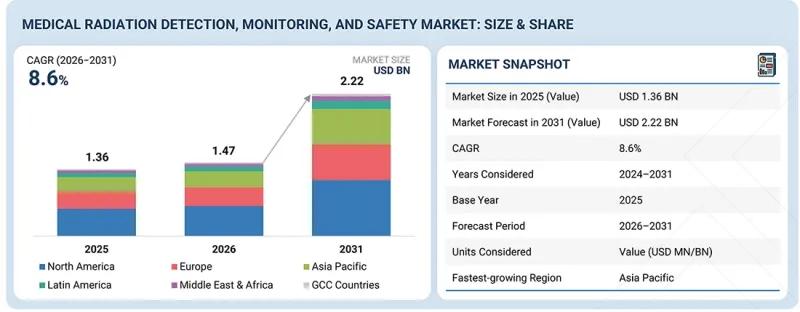
세계의 의료용 방사선 검출·모니터링·안전 시장 규모는 2026년에는 약 14억 7,000만 달러로 추정되고 있으며, 2031년에는 22억 2,000만 달러에 달하며, CAGR 8.6%로 성장할 것으로 예상되고 있습니다.
기능성 향상을 특징으로 하는 PET-CT 및 MRI 기술의 발전으로 인해 그 용도는 기존의 진단 목적에 그치지 않고 치료 계획 및 시술 중 실시간 모니터링까지 확대되고 있습니다.
| 조사 범위 | |
|---|---|
| 조사 대상 기간 | 2026-2031년 |
| 기준연도 | 2025년 |
| 예측 기간 | 2026-2031년 |
| 단위 | 금액(달러) |
| 부문 | 제품, 검출기, 안전 제품, 최종사용자, 지역별 |
| 대상 지역 | 북미, 유럽, 아시아태평양, 중동 및 아프리카, 라틴아메리카, GCC 국가 |
그 결과, 다양한 의료 분야에서 이러한 기술의 진화하는 용도를 정확하게 평가할 수 있는 방사선 검출·모니터링 장치에 대한 수요가 증가하고 있습니다. PET-CT와 같은 하이브리드 영상 진단법의 지속적인 개발로 인해 기능 영상과 해부학적 영상을 결합하는 것이 가능해졌습니다. 이러한 첨단 영상 진단 기술은 종양, 순환기, 신경 분야에서의 정밀진단 및 치료 계획 수립에 점점 더 많이 활용되고 있습니다. 따라서 효과적인 방사선 탐지 및 안전 대책의 필요성이 최우선 과제로 대두되고 있습니다.
'개인용 선량계 부문이 예측 기간 중 가장 높은 연평균 성장률(CAGR)을 기록할 것으로 예상됩니다."
많은 국가에서는 방사선 피폭 가능성이 있는 환경에서 근무하는 근로자에게 개인용 선량계 사용을 의무화하는 안전 규정이 마련되어 있습니다. 그 결과, 의료 기관에서의 개인용 선량계에 대한 수요가 증가하고 있습니다.
실시간 모니터링이 가능한 전자식 또는 지능형 선량계의 개발로 인해 이러한 기술의 기능성과 매력이 높아지고 있습니다. 이러한 첨단 선량계는 방사선 피폭에 관한 보다 정확하고 시의적절한 데이터를 제공하여 다양한 분야에서 도입을 더욱 촉진하고 있습니다.
"2025년, 전신 보호 부문이 가장 큰 점유율을 차지했습니다."
신흥 시장의 의료 인프라 확장이 방사선 보호 제품에 대한 수요를 견인하고 있습니다. 진단 센터와 병원이 증설됨에 따라 방사선을 다루는 직원의 안전을 확보하기 위한 보호 장비에 대한 수요도 증가하고 있습니다. 또한 일반적인 의료 시술보다 높은 방사선 피폭을 수반하는 경우가 많은 중재적 방사선학 시술의 확대도 효과적인 방호 장비에 대한 수요를 끌어올리고 있습니다. 전신용 방호 앞치마는 이러한 시술 중 의료 종사자를 보호하기 위해 필수적입니다.
"최종사용자별로는 병원 부문이 예측 기간 중 가장 높은 성장률을 보일 것으로 전망됩니다."
많은 국가에서 병원 인프라 확충 및 개선(신규 병원 설립 및 기존 병원 개보수 등)이 첨단 의료용 방사선 시스템에 대한 수요를 견인하고 있습니다. 또한 새로운 시설에는 최첨단 영상 진단 기술과 방사선 치료 시스템이 도입되고 있습니다. 의료 인프라 구축 및 첨단 의료 서비스 접근성 향상을 목표로 한 정부의 노력과 자금 지원은 이 과정에서 중요한 역할을 하고 있습니다. 이러한 노력에는 의료 시설 개선 및 의료용 방사선 장비 투자를 촉진하기 위한 보조금, 지원금, 기타 우대 조치가 포함되는 경우가 많습니다.
"예측 기간 중 아시아태평양이 가장 높은 성장률을 보일 것으로 예상됩니다."
아시아태평양은 일본, 인도, 중국 등의 신흥 경제국에 힘입어 예측 기간 중 의료용 방사선 감지·감시·안전 시장에서 가장 높은 성장률을 보일 것으로 예상됩니다. 이 지역은 시장 관계자들에게 큰 성장 기회를 제공하고 있으며, 예측 기간 중 가장 높은 연평균 성장률(CAGR)을 달성할 것으로 전망됩니다.
아시아태평양의 시장 성장에 기여하는 주요 요인으로는 질병의 조기 진단 및 정기 건강 검진의 중요성에 대한 의식의 향상를 목표로 한 정부의 노력이 꼽힙니다. 또한 의료비 증가, 병원 및 임상 진단 실험실 수의 증가, 방사선 피폭에 대한 일반 시민의 인식 제고 역시 모두 이 지역의 시장 확대를 이끄는 중요한 촉진요인으로 작용하고 있습니다.
이 보고서에서는 전 세계 의료용 방사선 감지·모니터링·안전 시장을 조사하여, 시장 개요, 시장 성장에 영향을 미치는 각종 요인에 대한 분석, 기술 및 특허 동향, 법규제 환경, 사례 연구, 시장 규모 추이 및 전망, 각 구분·지역/주요 국가별 상세 분석, 경쟁 구도, 주요 기업 개요 등을 종합적으로 다루고 있습니다.
자주 묻는 질문
목차
제1장 서론
제2장 개요
제3장 주요 인사이트
제4장 시장 개요
제5장 업계 동향
제6장 기술의 진보, AI의 영향, 특허, 혁신, 향후 응용
제7장 규제 상황과 지속가능성
제8장 고객 상황과 구매 행동
제9장 의료용 방사선 모니터링 시장 : 유형별
제10장 의료용 방사선 검출기 시장 : 유형별
제11장 의료용 방사선 안전 시장 : 유형별
제12장 의료용 방사선 검출·모니터링·안전 시장 : 최종사용자별
제13장 의료용 방사선 검출·모니터링·안전 시장 : 지역별
제14장 의료용 방사선 검출·모니터링·안전 시장 : 수량 분석
제15장 경쟁 구도
제16장 기업 개요
제17장 조사 방법
제18장 부록
KSA 26.07.31The value of the global medical radiation detection, monitoring, and safety market, estimated at around USD 1.47 billion in 2026, is expected to reach USD 2.22 billion in 2031, growing at a CAGR of 8.6%. Advances in PET-CT and MRI technologies, characterized by increased functionality, have expanded their use beyond traditional diagnostic purposes to include treatment planning and real-time monitoring during interventions.
| Scope of the Report | |
|---|---|
| Years Considered for the Study | 2026-2031 |
| Base Year | 2025 |
| Forecast Period | 2026-2031 |
| Units Considered | Value (USD billion) |
| Segments | By Product, Detector, Safety Product, End User, and Region |
| Regions covered | North America, Europe, Asia Pacific, the Middle East & Africa, Latin America, and the GCC Countries |
As a result, there is a growing demand for radiation detection and monitoring devices that can accurately assess the evolving applications of these technologies across various medical fields. The continued development of hybrid imaging modalities, such as PET-CT, facilitates the combination of functional and anatomical imaging. These advanced imaging techniques are increasingly used for sophisticated diagnosis and treatment planning in oncology, cardiology, and neurology. Consequently, the need for effective radiation detection and safety measures has become a priority.
"The personal dosimeters segment is expected to register the highest CAGR of the medical radiation detection, monitoring, and safety market during the forecast period."
By product, the medical radiation detection, monitoring, and safety market is divided into several segments: personal dosimeters, area process monitors, environmental radiation monitors, surface contamination monitors, radioactive material monitors, and other radiation detection & monitoring products. Many countries have safety regulations that require the use of personal dosimeters for workers in environments where they may be exposed to radiation. As a result, there is a high demand for personal dosimeters in healthcare institutions.
The development of electronic or intelligent dosimeters, which offer real-time monitoring, enhances the functionality and appeal of these technologies. These advanced dosimeters provide more accurate and timely data on radiation exposure, further promoting their adoption in various settings.
"The full-body protection segment accounted for the largest share of the medical radiation detection, monitoring, and safety market in 2025."
The medical radiation detection, monitoring, and safety market is categorized into four types of safety products: full-body protection, face protection, hand safety, and other medical radiation safety products. The growing healthcare infrastructure in emerging markets is driving the demand for radiation protection products. As more diagnostic centers and hospitals open, there is a corresponding need for protective gear to ensure the safety of employees who work with radiation. Additionally, the expansion of interventional radiology procedures, which typically involve higher-than-average radiation exposure, increases the demand for effective protective equipment. Full-body aprons are essential for protecting professionals during these procedures.
"The hospitals segment is projected to witness the highest growth rate in the medical radiation detection, monitoring, and safety market, by end user, during the forecast period."
The market for medical radiation detection, monitoring, and safety is divided by end user into two categories: hospitals and non-hospitals. The growth and improvement of hospital infrastructure in many countries, including the establishment of new hospitals and the renovation of existing ones, drive the demand for advanced medical radiation systems. Additionally, new facilities are equipped with state-of-the-art imaging technologies and radiation therapy systems. Government initiatives and funding aimed at upgrading healthcare infrastructure and enhancing access to advanced medical care play a significant role in this process. These initiatives often include subsidies, grants, and other incentives designed to help improve medical facilities and encourage investment in medical radiation equipment.
"The Asia Pacific region is projected to witness the highest growth rate in the medical radiation detection, monitoring, and safety market during the forecast period."
The global market for medical radiation detection, monitoring, and safety is divided into six regions: North America, Europe, Latin America, Asia Pacific, the Middle East and Africa, and the GCC Countries. The Asia Pacific region is expected to experience the highest growth rate in the medical radiation detection, monitoring, and safety market during the forecast period, driven by emerging economies such as Japan, India, and China. This region presents significant growth opportunities for market players and is projected to achieve the highest CAGR during the forecast period.
Key factors contributing to the growth of the medical radiation detection, monitoring, and safety market in the Asia Pacific include government initiatives aimed at raising awareness about early disease diagnosis and the importance of regular health check-ups. Additionally, rising healthcare expenditures, an increasing number of hospitals and clinical diagnostic laboratories, and growing public awareness of radiation exposure are all significant drivers of market expansion in this region.
The break-up of profiles of primary participants in the medical radiation detection, monitoring, and safety market:
- By Company Type: Tier 1 (26%), Tier 2 (44%), and Tier (30%)
- By Designation: C-level Executives (30%), Directors (34%), and Others (36%)
- By Region: North America (51%), Europe (21%), Asia Pacific (18%), Latin America (5%), the Middle East & Africa (4%), and GCC Countries (1%)
The key players in the medical radiation detection, monitoring, and safety market are Mirion Technologies, Inc. (US), Fortive (US), Thermo Fisher Scientific Inc. (US), IBA Worldwide (Belgium), AMETEK Inc. (US), Fuji Electric Co., Ltd. (Japan), Ludlum Measurements, Inc. (US), AliMed (US), UAB Polimaster Europe (Belarus), and Arktis Radiation Detectors Ltd. (Switzerland).
Research Coverage:
This research report categorizes the medical radiation detection, monitoring, and safety market by product (personal dosimeters, area process monitors, environment radiation monitors, surface contamination monitors, radioactive material monitors, and other radiation detection & monitoring products), detector (gas-filled detectors, scintillators, and solid-state detectors), safety product (full-body protection products, face protection products, hand safety products, and other medical radiation safety products), end user (hospitals and non-hospitals), and region (North America, Europe, Asia Pacific, Latin America, the Middle East & Africa, and GCC Countries).
The scope of the report covers detailed information regarding the major factors, such as drivers, restraints, opportunities, and challenges influencing the growth of the medical radiation detection, monitoring, and safety market. A detailed analysis of the key industry players has been conducted to provide insights into their business overviews, solutions, and key strategies such as partnerships, collaborations, expansions, agreements, new product launches, and recent developments in the medical radiation detection, monitoring & safety market. This report covers a competitive analysis of upcoming startups in the medical radiation detection, monitoring, and safety market ecosystem.
Reasons to buy this report:
The report will help market leaders and new entrants by providing the closest approximations of revenue numbers for the overall medical radiation detection, monitoring, and safety market and its subsegments. It will help stakeholders understand the competitive landscape and gain deeper insights to better position their businesses and plan suitable go-to-market strategies. The report also helps stakeholders understand the market pulse and provides information on key drivers, restraints, opportunities, and challenges.
The report provides insights into the following pointers:
- Analysis of key drivers (growing adoption of diagnostic imaging procedures, booming cancer cases worldwide, increasing safety awareness in radiation-prone environments, rise in number of surgeries, surge in positron emission tomography and computed tomography scans, and favorable government initiatives), challenges (high installation and maintenance costs and high cost of lead for manufacturing radiation safety products), opportunities (expanding healthcare infrastructure in emerging economies), and restraints (high cost of devices and lack of skilled professionals).
- Product Development/Innovation: Detailed insights on upcoming technologies, research & development activities, and product launches in the medical radiation detection, monitoring, and safety market.
- Market Development: Comprehensive information about lucrative markets; the report analyzes the medical radiation detection, monitoring, and safety market across varied regions.
- Market Diversification: Exhaustive information about new products, untapped geographies, recent developments, and investments in the medical radiation detection, monitoring, and safety market.
Competitive Assessment: In-depth assessment of market shares, growth strategies, and product offerings of leading players like Mirion Technologies, Inc. (US), Fortive (US), Thermo Fisher Scientific Inc. (US), IBA Worldwide (Belgium), among others, in the medical radiation detection, monitoring, and safety market.
TABLE OF CONTENTS
1 INTRODUCTION
- 1.1 STUDY OBJECTIVES
- 1.2 MARKET DEFINITION
- 1.3 STUDY SCOPE
- 1.3.1 MARKETS COVERED AND REGIONAL SCOPE
- 1.3.2 INCLUSIONS AND EXCLUSIONS
- 1.3.3 YEARS CONSIDERED
- 1.3.4 CURRENCY CONSIDERED
- 1.4 STAKEHOLDERS
- 1.5 SUMMARY OF CHANGES
2 EXECUTIVE SUMMARY
- 2.1 KEY INSIGHTS AND MARKET HIGHLIGHTS
- 2.2 KEY MARKET PARTICIPANTS: SHARE INSIGHTS AND STRATEGIC DEVELOPMENTS
- 2.3 DISRUPTIVE TRENDS SHAPING MARKET
- 2.4 HIGH-GROWTH SEGMENTS AND EMERGING FRONTIERS
- 2.5 SNAPSHOT: GLOBAL MARKET SIZE, GROWTH RATE, AND FORECAST
3 PREMIUM INSIGHTS
- 3.1 MEDICAL RADIATION DETECTION, MONITORING, AND SAFETY MARKET OVERVIEW
- 3.2 MEDICAL RADIATION DETECTION, MONITORING, AND SAFETY MARKET, BY PRODUCT, 2026 VS. 2031
- 3.3 MEDICAL RADIATION DETECTORS MARKET, BY TYPE,
- 3.4 2026 VS. 2031
- 3.5 MEDICAL RADIATION SAFETY PRODUCTS MARKET, BY TYPE, 2026 VS. 2031
- 3.6 MEDICAL RADIATION DETECTION, MONITORING, AND SAFETY MARKET, BY END USER, 2026 VS. 2031
- 3.7 MEDICAL RADIATION DETECTION, MONITORING, AND SAFETY MARKET: GEOGRAPHIC GROWTH OPPORTUNITIES
4 MARKET OVERVIEW
- 4.1 INTRODUCTION
- 4.2 MARKET DYNAMICS
- 4.2.1 DRIVERS
- 4.2.1.1 Growing adoption of diagnostic imaging procedures
- 4.2.1.2 Increasing incidence of cancer
- 4.2.1.3 Increasing safety awareness in radiation-prone environments
- 4.2.1.4 Rising number of surgeries
- 4.2.1.5 Surge in PET and CT scans
- 4.2.1.6 Favorable government initiatives
- 4.2.2 RESTRAINTS
- 4.2.2.1 High cost of devices
- 4.2.2.2 Lack of skilled professionals
- 4.2.3 OPPORTUNITIES
- 4.2.3.1 Expanding healthcare infrastructure in emerging economies
- 4.2.3.2 Expansion of radiotheranostics and nuclear medicine
- 4.2.4 CHALLENGES
- 4.2.4.1 High installation and maintenance costs
- 4.2.4.2 Volatility in raw material prices
- 4.2.1 DRIVERS
- 4.3 UNMET NEEDS AND WHITE SPACES
- 4.3.1 UNMET NEEDS IN MEDICAL RADIATION DETECTION, MONITORING, AND SAFETY MARKET
- 4.3.2 WHITE SPACE OPPORTUNITIES
- 4.4 INTERCONNECTED MARKETS AND CROSS-SECTOR OPPORTUNITIES
- 4.4.1 INTERCONNECTED MARKETS
- 4.4.2 CROSS-SECTOR OPPORTUNITIES
- 4.5 STRATEGIC MOVES BY TIER 1/2/3 PLAYERS
- 4.5.1 KEY MOVES AND STRATEGIC FOCUS
5 INDUSTRY TRENDS
- 5.1 PORTER'S FIVE FORCES ANALYSIS
- 5.1.1 THREAT OF NEW ENTRANTS
- 5.1.2 THREAT OF SUBSTITUTES
- 5.1.3 BARGAINING POWER OF SUPPLIERS
- 5.1.4 BARGAINING POWER OF BUYERS
- 5.1.5 INTENSITY OF COMPETITIVE RIVALRY
- 5.2 MACROECONOMIC INDICATORS
- 5.2.1 INTRODUCTION
- 5.2.2 GDP TRENDS AND FORECAST
- 5.3 SUPPLY CHAIN ANALYSIS
- 5.4 VALUE CHAIN ANALYSIS
- 5.5 ECOSYSTEM ANALYSIS
- 5.6 PRICING ANALYSIS
- 5.6.1 AVERAGE SELLING PRICE OF MEDICAL RADIATION DETECTION, MONITORING, AND SAFETY, BY REGION, 2023-2025
- 5.6.2 AVERAGE SELLING PRICE OF MEDICAL RADIATION DETECTION, MONITORING, AND SAFETY PRODUCTS, BY KEY PLAYER, 2023-2025
- 5.7 TRADE ANALYSIS
- 5.7.1 IMPORT SCENARIO (HS CODE 902221)
- 5.7.2 EXPORT SCENARIO (HS CODE 902221)
- 5.8 KEY CONFERENCES & EVENTS, 2026-2027
- 5.9 TRENDS/DISRUPTIONS IMPACTING CUSTOMERS' BUSINESSES
- 5.10 INVESTMENT & FUNDING SCENARIO
- 5.11 IMPACT OF US TARIFFS-MEDICAL RADIATION DETECTION, MONITORING, AND SAFETY MARKET
- 5.11.1 INTRODUCTION
- 5.11.2 KEY TARIFF RATES
- 5.11.3 PRICE IMPACT ANALYSIS
- 5.11.4 IMPACT ON COUNTRIES/REGIONS
- 5.11.4.1 North America
- 5.11.4.2 Europe
- 5.11.4.3 Asia Pacific
- 5.11.5 IMPACT ON END-USE INDUSTRIES
- 5.11.5.1 Hospitals and diagnostic imaging centers
- 5.11.5.2 Radiotherapy and cancer centers
- 5.11.5.3 Nuclear medicine and research institutions
6 TECHNOLOGICAL ADVANCEMENTS, AI-DRIVEN IMPACT, PATENTS, INNOVATIONS, AND FUTURE APPLICATIONS
- 6.1 KEY EMERGING TECHNOLOGIES
- 6.1.1 RADIATION SAFETY PRODUCTS
- 6.2 COMPLEMENTARY TECHNOLOGIES
- 6.2.1 RADIATION DETECTION AND MONITORING PRODUCTS
- 6.3 TECHNOLOGY/PRODUCT ROADMAP
- 6.4 PATENT ANALYSIS
- 6.4.1 LIST OF KEY PATENTS
- 6.5 FUTURE APPLICATIONS
- 6.6 IMPACT OF AI/GENERATIVE AI ON MEDICAL RADIATION DETECTION, MONITORING, AND SAFETY MARKET
- 6.6.1 INTRODUCTION
- 6.6.2 TOP USE CASES AND MARKET POTENTIAL
- 6.6.3 KEY COMPANIES IMPLEMENTING AI
- 6.6.4 FUTURE OF AI
7 REGULATORY LANDSCAPE AND SUSTAINABILITY
- 7.1 REGIONAL REGULATIONS AND COMPLIANCE
- 7.1.1 REGULATORY BODIES, GOVERNMENT AGENCIES, AND OTHER ORGANIZATIONS
- 7.2 SUSTAINABILITY INITIATIVES
- 7.2.1 ENVIRONMENTAL IMPACT AND ECO-FRIENDLY INITIATIVES
- 7.2.1.1 Eco-friendly Initiatives
- 7.2.1 ENVIRONMENTAL IMPACT AND ECO-FRIENDLY INITIATIVES
- 7.3 SUSTAINABILITY IMPACT AND REGULATORY POLICY INITIATIVES
8 CUSTOMER LANDSCAPE & BUYER BEHAVIOR
- 8.1 DECISION-MAKING PROCESS
- 8.2 BUYER STAKEHOLDERS AND BUYING EVALUATION CRITERIA
- 8.2.1 KEY STAKEHOLDERS IN BUYING PROCESS
- 8.2.2 BUYING CRITERIA
- 8.3 ADOPTION BARRIERS & INTERNAL CHALLENGES
- 8.4 UNMET NEEDS IN VARIOUS END-USE INDUSTRIES
- 8.5 MARKET PROFITABILITY
- 8.5.1 REVENUE POTENTIAL
- 8.5.2 COST DYNAMICS
- 8.5.3 MARGIN OPPORTUNITIES IN KEY APPLICATIONS
9 MEDICAL RADIATION MONITORING PRODUCTS MARKET, BY TYPE
- 9.1 INTRODUCTION
- 9.2 PERSONAL DOSIMETERS
- 9.2.1 PASSIVE DOSIMETERS
- 9.2.1.1 Optically stimulated luminescence dosimeters
- 9.2.1.1.1 Growing use of laboratories and hospitals to drive market
- 9.2.1.2 Thermoluminescent dosimeters
- 9.2.1.2.1 Increasing awareness about occupational hazards of radiation exposure to aid growth
- 9.2.1.3 Film badges
- 9.2.1.3.1 Portability and accuracy factors to support market growth
- 9.2.1.1 Optically stimulated luminescence dosimeters
- 9.2.2 ACTIVE DOSIMETERS
- 9.2.2.1 Self-reading pocket dosimeters
- 9.2.2.1.1 Need for field-readable devices to augment growth
- 9.2.2.2 Pocket electroscopes
- 9.2.2.2.1 Low cost and high sensitivity to facilitate market growth
- 9.2.2.1 Self-reading pocket dosimeters
- 9.2.1 PASSIVE DOSIMETERS
- 9.3 AREA PROCESS MONITORS
- 9.3.1 APPLICATIONS IN NUCLEAR REACTORS, ACCELERATORS, HOT CELLS, AND IRRADIATORS TO PROMOTE GROWTH
- 9.4 ENVIRONMENTAL RADIATION MONITORS
- 9.4.1 RISING USE BY GOVERNMENT AGENCIES WORLDWIDE TO FUEL MARKET
- 9.5 SURFACE CONTAMINATION MONITORS
- 9.5.1 GROWING DEVELOPMENT OF USER-FRIENDLY AND PORTABLE RADIATION CONTAMINATION MONITORS TO AID MARKET GROWTH
- 9.6 RADIOACTIVE MATERIAL MONITORS
- 9.6.1 GROWING USE IN MEDICAL IMAGING TO DRIVE MARKET
- 9.7 OTHER MEDICAL RADIATION MONITORING PRODUCTS
10 MEDICAL RADIATION DETECTORS MARKET, BY TYPE
- 10.1 INTRODUCTION
- 10.2 GAS-FILLED DETECTORS
- 10.2.1 GEIGER-MULLER COUNTERS
- 10.2.1.1 Ability to detect all types of medical radiation to expedite growth
- 10.2.2 IONIZATION CHAMBERS
- 10.2.2.1 Growing development of portable handheld ionization detectors to drive market
- 10.2.3 PROPORTIONAL COUNTERS
- 10.2.3.1 Improved sensitivity and uniform response to augment growth
- 10.2.1 GEIGER-MULLER COUNTERS
- 10.3 SCINTILLATORS
- 10.3.1 INORGANIC SCINTILLATORS
- 10.3.1.1 Rising applications in diagnostic centers and radiology departments to favor market growth
- 10.3.2 ORGANIC SCINTILLATORS
- 10.3.2.1 Growing focus on radiation safety to drive market
- 10.3.1 INORGANIC SCINTILLATORS
- 10.4 SOLID-STATE DETECTORS
- 10.4.1 SEMICONDUCTOR DETECTORS
- 10.4.1.1 Increasing research activities to contribute to market growth
- 10.4.2 DIAMOND DETECTORS
- 10.4.2.1 Growing advancements in high-quality chemical vapor deposition detectors to promote growth
- 10.4.1 SEMICONDUCTOR DETECTORS
11 MEDICAL RADIATION SAFETY PRODUCTS MARKET, BY TYPE
- 11.1 INTRODUCTION
- 11.2 FULL-BODY PROTECTION PRODUCTS
- 11.2.1 APRONS
- 11.2.1.1 Growing volume of medical imaging procedures to boost market
- 11.2.2 BARRIERS & SHIELDS
- 11.2.2.1 Increasing inclination toward decreasing health hazards to expedite growth
- 11.2.1 APRONS
- 11.3 FACE PROTECTION PRODUCTS
- 11.3.1 EYEWEAR
- 11.3.1.1 Strict guidelines for radiation protection to aid market growth
- 11.3.2 FACE MASKS
- 11.3.2.1 Ability to restrict unnecessary exposure to radiation to fuel market
- 11.3.1 EYEWEAR
- 11.4 HAND SAFETY PRODUCTS
- 11.4.1 GLOVES
- 11.4.1.1 Rising applications in fluoroscopy and radiography to support market growth
- 11.4.2 ATTENUATING SLEEVES
- 11.4.2.1 Growing use of personal protective equipment to drive market
- 11.4.1 GLOVES
- 11.5 OTHER MEDICAL RADIATION SAFETY PRODUCTS
12 MEDICAL RADIATION DETECTION, MONITORING, AND SAFETY MARKET, BY END USER
- 12.1 INTRODUCTION
- 12.2 HOSPITALS
- 12.2.1 RADIATION THERAPY
- 12.2.1.1 Rising cancer burden and increasing investment in next-gen technologies to drive market
- 12.2.2 RADIOLOGY
- 12.2.2.1 Increasing number of hospitals in emerging economies to support market growth
- 12.2.3 DENTISTRY
- 12.2.3.1 Growing adoption of digital dental imaging systems to fuel market
- 12.2.4 NUCLEAR MEDICINE
- 12.2.4.1 Surge in demand for radioisotopes to encourage growth
- 12.2.5 EMERGENCY CARE
- 12.2.5.1 Growing use of technologically advanced equipment in hospitals to propel market
- 12.2.5.2 Other hospital specialties
- 12.2.1 RADIATION THERAPY
- 12.3 NON-HOSPITAL END USERS
- 12.3.1 IMAGING CENTERS
- 12.3.1.1 Increasing establishment of advanced imaging centers to facilitate growth
- 12.3.2 RADIATION THERAPY & CANCER CENTERS
- 12.3.2.1 Growing trend of outpatient oncology centers and AI integration to boost market
- 12.3.3 DENTAL CLINICS
- 12.3.3.1 Rising demand for advanced imaging equipment to accelerate growth
- 12.3.4 ORTHOPEDIC FACILITIES
- 12.3.4.1 Growing demand for state-of-the-art medical imaging and radiation technologies to boost market
- 12.3.5 OTHER NON-HOSPITAL END USERS
- 12.3.1 IMAGING CENTERS
13 MEDICAL RADIATION DETECTION, MONITORING, AND SAFETY MARKET, BY REGION
- 13.1 INTRODUCTION
- 13.2 NORTH AMERICA
- 13.2.1 US
- 13.2.1.1 Rising healthcare expenditure and advanced medical imaging adoption to sustain market growth
- 13.2.2 CANADA
- 13.2.2.1 Increasing adoption of advanced diagnostic imaging and radiotherapy services to support market growth
- 13.2.1 US
- 13.3 EUROPE
- 13.3.1 GERMANY
- 13.3.1.1 Strong diagnostic imaging infrastructure and rising cancer burden to drive market growth
- 13.3.2 UK
- 13.3.2.1 Expansion of diagnostic imaging capacity and cancer services to drive market growth
- 13.3.3 FRANCE
- 13.3.3.1 Growing investments in diagnostic imaging, AI, and precision medicine to propel market growth
- 13.3.4 ITALY
- 13.3.4.1 Strong healthcare infrastructure and government investments supporting market growth
- 13.3.5 SPAIN
- 13.3.5.1 Strong public healthcare system and expanding diagnostic imaging capacity to drive market growth
- 13.3.6 REST OF EUROPE
- 13.3.1 GERMANY
- 13.4 ASIA PACIFIC
- 13.4.1 CHINA
- 13.4.1.1 Expanding healthcare infrastructure and increasing cancer burden to drive market growth
- 13.4.2 JAPAN
- 13.4.2.1 Extensive diagnostic imaging infrastructure and stringent radiation safety regulations to drive market growth
- 13.4.3 INDIA
- 13.4.3.1 Expanding healthcare infrastructure and rising cancer burden to drive market growth
- 13.4.4 AUSTRALIA
- 13.4.4.1 Rising diagnostic imaging volumes and strong radiation safety framework to support market growth
- 13.4.5 REST OF ASIA PACIFIC
- 13.4.1 CHINA
- 13.5 LATIN AMERICA
- 13.5.1 RISING CANCER BURDEN AND EXPANDING DIAGNOSTIC IMAGING INFRASTRUCTURE TO PROPEL MARKET GROWTH
- 13.6 MIDDLE EAST & AFRICA
- 13.6.1 RISING INVESTMENTS IN CANCER CARE AND DIAGNOSTIC IMAGING INFRASTRUCTURE TO ENCOURAGE MARKET GROWTH
14 MEDICAL RADIATION DETECTION, MONITORING, AND SAFETY: VOLUME ANALYSIS
- 14.1 INTRODUCTION
- 14.2 CANADA: TOTAL NUMBER OF CT EXAMS PERFORMED (IN MILLION)
15 COMPETITIVE LANDSCAPE
- 15.1 INTRODUCTION
- 15.2 KEY PLAYER STRATEGIES/RIGHT TO WIN
- 15.2.1 OVERVIEW OF STRATEGIES DEPLOYED BY PLAYERS IN MEDICAL RADIATION DETECTION, MONITORING, AND SAFETY MARKET
- 15.3 REVENUE ANALYSIS, 2023-2025
- 15.4 MARKET SHARE ANALYSIS, 2025
- 15.5 COMPANY EVALUATION MATRIX: KEY PLAYERS, 2025
- 15.5.1 STARS
- 15.5.2 EMERGING LEADERS
- 15.5.3 PERVASIVE PLAYERS
- 15.5.4 PARTICIPANTS
- 15.5.5 COMPANY FOOTPRINT: KEY PLAYERS, 2025
- 15.5.5.1 Company footprint
- 15.5.5.2 Region footprint
- 15.5.5.3 Product footprint
- 15.5.5.4 End-user footprint
- 15.6 COMPANY EVALUATION MATRIX: STARTUPS/SMES, 2025
- 15.6.1 PROGRESSIVE COMPANIES
- 15.6.2 RESPONSIVE COMPANIES
- 15.6.3 DYNAMIC COMPANIES
- 15.6.4 STARTING BLOCKS
- 15.6.5 COMPANY EVALUATION MATRIX: STARTUPS/SMES, 2025
- 15.6.5.1 Detailed list of key startups/SMEs
- 15.6.5.2 Competitive benchmarking of startups/SMEs (1/2)
- 15.7 COMPANY VALUATION & FINANCIAL METRICS
- 15.7.1 FINANCIAL METRICS
- 15.7.2 COMPANY VALUATION
- 15.8 BRAND/PRODUCT COMPARISON
- 15.9 COMPETITIVE SCENARIO
- 15.9.1 PRODUCT LAUNCHES & APPROVALS
- 15.9.2 DEALS
16 COMPANY PROFILES
- 16.1 KEY PLAYERS
- 16.1.1 MIRION TECHNOLOGIES, INC.
- 16.1.1.1 Business overview
- 16.1.1.2 Products & services offered
- 16.1.1.3 Recent developments
- 16.1.1.3.1 Product launches & approvals
- 16.1.1.3.2 Deals
- 16.1.1.4 MnM View
- 16.1.1.4.1 Key strengths
- 16.1.1.4.2 Strategic choices
- 16.1.1.4.3 Weaknesses and competitive threats
- 16.1.2 THERMO FISHER SCIENTIFIC
- 16.1.2.1 Business overview
- 16.1.2.2 Products offered
- 16.1.2.3 Recent developments
- 16.1.2.3.1 Product launches & approvals
- 16.1.2.3.2 Deals
- 16.1.2.4 MnM view
- 16.1.2.4.1 Key strengths
- 16.1.2.4.2 Strategic choices
- 16.1.2.4.3 Weaknesses & competitive threats
- 16.1.3 FORTIVE
- 16.1.3.1 Business overview
- 16.1.3.2 Products offered
- 16.1.3.3 MnM view
- 16.1.3.3.1 Key strengths
- 16.1.3.3.2 Strategic choices
- 16.1.3.3.3 Weaknesses and competitive threats
- 16.1.4 IBA WORLDWIDE
- 16.1.4.1 Business overview
- 16.1.4.2 Products & services offered
- 16.1.4.3 Recent developments
- 16.1.4.3.1 Product launches & approvals
- 16.1.4.3.2 Deals
- 16.1.4.4 MnM View
- 16.1.4.4.1 Key strengths
- 16.1.4.4.2 Strategic choices
- 16.1.4.4.3 Weaknesses and competitive threats
- 16.1.5 AMETEK INC.
- 16.1.5.1 Business overview
- 16.1.5.2 Products & services offered
- 16.1.5.3 MnM view
- 16.1.5.3.1 Key strengths
- 16.1.5.3.2 Strategic choices
- 16.1.5.3.3 Weaknesses & competitive threats
- 16.1.6 FUJI ELECTRIC CO., LTD.
- 16.1.6.1 Business overview
- 16.1.6.2 Products & services offered
- 16.1.7 LUDLUM MEASUREMENTS, INC.
- 16.1.7.1 Business overview
- 16.1.7.2 Products offered
- 16.1.8 ALIMED
- 16.1.8.1 Business overview
- 16.1.8.2 Products & services offered
- 16.1.8.3 Recent developments
- 16.1.8.3.1 Product launches & approvals
- 16.1.9 UAB POLIMASTER EUROPE
- 16.1.9.1 Business overview
- 16.1.9.2 Products offered
- 16.1.10 PTW FREIBURG GMBH
- 16.1.10.1 Business overview
- 16.1.10.2 Products offered
- 16.1.11 INFAB LLC
- 16.1.11.1 Business overview
- 16.1.11.2 Products offered
- 16.1.11.3 Recent developments
- 16.1.11.3.1 Product launches & approvals
- 16.1.12 AMRAY GROUP
- 16.1.12.1 Business overview
- 16.1.12.2 Products offered
- 16.1.1 MIRION TECHNOLOGIES, INC.
- 16.2 OTHER PLAYERS
- 16.2.1 RADIATION DETECTION COMPANY
- 16.2.2 ARROW-TECH, INC.
- 16.2.3 CENTRONIC
- 16.2.4 S.E. INTERNATIONAL, INC.
- 16.2.5 ATOMTEX
- 16.2.6 BERTIN TECHNOLOGIES
- 16.2.7 ALPHA SPECTRA, INC.
- 16.2.8 TRIVITRON HEALTHCARE
- 16.2.9 MICRON SEMICONDUCTOR LTD.
- 16.2.10 BURLINGTON MEDICAL
- 16.2.11 NUCLEONIX SYSTEMS
- 16.2.12 RADCOMM SYSTEMS
- 16.2.13 STANDARD IMAGING, INC.
17 RESEARCH METHODOLOGY
- 17.1 RESEARCH DATA
- 17.2 SECONDARY DATA
- 17.2.1 LIST OF SECONDARY SOURCES
- 17.2.2 KEY DATA FROM SECONDARY SOURCES
- 17.3 PRIMARY DATA
- 17.3.1 LIST OF PRIMARY SOURCES
- 17.3.2 KEY DATA FROM PRIMARY SOURCES
- 17.3.3 KEY INDUSTRY INSIGHTS
- 17.3.4 BREAKDOWN OF PRIMARY INTERVIEWS
- 17.4 MARKET SIZE ESTIMATION
- 17.4.1 TOTAL MARKET SIZE: MEDICAL RADIATION DETECTION, MONITORING, AND SAFETY MARKET
- 17.4.2 BOTTOM-UP APPROACH
- 17.4.2.1 Approach 1: Revenue estimation of key players
- 17.4.2.2 Approach 2: Study of annual reports and investor presentations
- 17.4.2.3 Approach 3: Primary interviews
- 17.4.2.4 Growth forecast
- 17.4.2.5 CAGR projections
- 17.4.3 TOP-DOWN APPROACH
- 17.5 DATA TRIANGULATION
- 17.6 RESEARCH ASSUMPTIONS
- 17.6.1 STUDY-RELATED ASSUMPTIONS
- 17.6.2 PARAMETRIC ASSUMPTIONS
- 17.6.3 GROWTH RATE ASSUMPTIONS
- 17.7 RESEARCH LIMITATIONS
- 17.8 RISK ASSESSMENT
18 APPENDIX
- 18.1 DISCUSSION GUIDE
- 18.2 KNOWLEDGESTORE: MARKETSANDMARKETS' SUBSCRIPTION PORTAL
- 18.3 CUSTOMIZATION OPTIONS
- 18.4 RELATED REPORTS
- 18.5 AUTHOR DETAILS