
|
시장보고서
상품코드
2102913
AC 회로차단기 시장 예측(-2031년) : 절연 방식별, 설치 장소별, 전압별, 최종 용도별, 지역별AC Circuit Breaker Market by Insulation Type (Vacuum, Gas, Oil), Installation (Indoor, Outdoor), By Voltage [Medium (1-52kV), High (53-230 kV), Very High (Above 230 kV)], End Use, and Region-Global Forecast to 2031 |
||||||

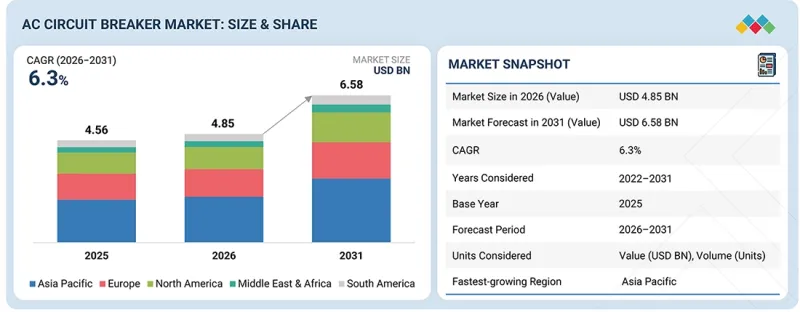
세계의 AC 회로차단기 시장 규모는 2026년 48억 5,000만 달러에서 2031년까지 65억 8,000만 달러로 성장하며, CAGR은 6.3%에 달할 것으로 예측됩니다.
차단기 시장의 성장은 전력 인프라 보호에서 그 역할이 점점 더 중요해지고 있음을 보여줍니다.
| 조사 범위 | |
|---|---|
| 조사 대상 기간 | 2022-2031년 |
| 기준연도 | 2025년 |
| 예측 기간 | 2026-2031년 |
| 산정 단위 | 금액(10억 달러), 수량(단위) |
| 부문 | 절연 방식별, 설치 장소별, 전압별, 최종 용도별, 지역별 |
| 대상 지역 | 유럽, 아시아태평양, 북미, 중동 및 아프리카, 남미 |
전 세계 전력망이 그 어느 때보다 대규모화되고 복잡해지며 상호 연결이 진전됨에 따라 신뢰성이 높은 개폐·보호 기기에 대한 수요가 급증하고 있습니다. 전력 회사 및 산업계에서는 노후화된 송배전 시스템의 현대화를 추진하고, 재생 가능 에너지원을 통합하는 동시에, 운송, 산업 분야, 디지털 인프라에서의 전기화 진전에 대응하고 있습니다.
첨단 절연 기술로의 전환 또한 이 시장의 확대를 지원하고 있습니다. 진공 절연 및 가스 절연 차단기가 기존의 유절연형을 서서히 대체하고 있으며, 전력 회사에 신뢰성 향상, 유지보수 수요 감소, 그리고 글로벌 지속가능성 목표에 대한 적합성 향상을 가져오고 있습니다.
"2025년, 절연 방식별로 보면 가스 절연식 차단기가 AC 회로차단기 시장에서 가장 큰 점유율을 차지했습니다."
절연 방식별로 보면 2025년에는 가스 절연식 차단기가 교류 차단기 시장에서 가장 큰 점유율을 차지했습니다. 가스 절연식 차단기, 특히 SF6를 사용하는 제품은 뛰어난 아크 소광 특성과 고전압 수준에서의 우수한 성능으로 알려져 있습니다. 이러한 제품들은 대규모 송전·배전 네트워크를 관리하는 전력 사업자들에게 오랫동안 선호되는 선택지가 되어 왔습니다. 유절연형에 비해 가스절연형 차단기는 유지보수 부담이 적고 설치 공간도 대폭 절약할 수 있으며, 전력 회사나 산업 사업자들에게 타협할 수 없는 높은 신뢰성을 제공합니다. 전 세계에서 전력망의 확장과 현대화가 진행되는 가운데, 효율성과 신뢰성을 겸비한 검증된 조합 덕분에 가스 절연형 부문은 확고한 선두 자리를 유지하고 있습니다.
"2025년에는 최종 용도별 시장에서 전력 사업자가 가장 큰 시장 점유율을 차지했습니다."
2025년에는 전력 사업자가 가장 큰 시장 점유율을 차지했습니다. 전 세계 전력 사업자들이 노후화된 전력망의 현대화를 가속화하고 재생 가능 에너지원의 통합을 확대함에 따라 첨단 개폐 및 보호 장비에 대한 수요는 계속해서 증가하고 있습니다. 동시에 송전망의 신뢰성, 운영상의 회복력, 정전 시간 단축 및 안전 기준 강화가 점점 더 중요시되면서 차세대 차단기 기술에 대한 막대한 투자가 촉진되고 있습니다. 이러한 지속적인 인프라 업그레이드 및 송전망 확장 구상에 힘입어, 전력 사업 부문은 시장에서 가장 큰 최종 용도 부문으로서의 입지를 공고히 할 뿐만 아니라, 예측 기간 중 가장 빠른 성장률을 기록할 것으로 전망됩니다.
AC 회로차단기 시장은 주로 정평이 나 있는 글로벌 선도 기업이 주도하고 있습니다. AC 회로차단기 시장의 주요 기업으로는 ABB(스위스), Hitachi Energy Ltd.(스위스), Mitsubishi Electric Corporation(일본), GE Vernova(미국), Siemens Energy(독일), Schneider Electric(프랑스), Eaton(아일랜드), LS ELECTRIC(한국), Fuji Electric(일본) 및 TOSHIBA CORPORATION(일본)이 포함됩니다.
조사 범위:
이 보고서에서는 절연 방식(진공, 가스, 오일), 설치 장소(실내, 실외), 전압(중전압, 고전압, 초고전압), 최종 용도(전력 회사, 산업용, 재생 가능 에너지, 상업용, 철도, 데이터센터, 전기자동차 인프라) 및 지역(아시아태평양, 북미, 유럽, 중동 및 아프리카, 남미)에 초점을 맞춰 AC 회로차단기 시장에 대한 상세한 정의, 설명 및 예측을 제공합니다. 이 보고서에서는 시장 촉진요인, 제약, 기회, 과제에 대해 정성적 및 정량적 분석을 수행하고 있습니다. 주요 분석 항목으로는 경쟁 구도 평가 시장 역학, 시장 규모 추산, 향후 동향 외에도 AC 회로차단기 시장의 주요 기업에 관한 투자 정보도 포함되어 있습니다.
이 보고서 구매의 주요 이점
이 보고서는 AC 회로차단기 시장의 기존 업계 리더와 신규 진입자 모두에게 이익이 되도록 세심하게 설계되었습니다. 시장 전체 및 개별 하위 부문에 대해 신뢰도 높은 매출 예측을 제공합니다. 이 데이터는 이해관계자에게 귀중한 정보원이 되어, 경쟁 구도를 포괄적으로 이해하고 자사의 비즈니스를 위한 효과적인 시장 전략을 수립할 수 있게 해줍니다. 또한 이 보고서는 이해관계자가 시장의 현황을 파악할 수 있는 수단이 되며, 시장 촉진요인, 제약, 과제 및 성장 기회에 대한 중요 인사이트를 제공합니다. 이러한 인사이트를 활용함으로써 이해관계자는 충분한 정보를 바탕으로 의사결정을 내리고, 끊임없이 변화하는 AC 회로차단기 업계 동향에 대한 최신 정보를 지속적으로 확보할 수 있습니다.
- 주요 요인 분석: 촉진요인(송전·배전 인프라 업그레이드를 위한 송전망 투자 확대, 인공지능, 클라우드 컴퓨팅, 하이퍼스케일 데이터센터의 급속한 확장, 재생 가능 에너지 발전에 대한 관심 증가), 제약 요인(구리 가격 변동 및 공급 부족, SF6 및 기타 불소계 가스 사용을 제한하는 엄격한 규제), 기회(전기자동차 판매 확대 및 충전 인프라 확충, 유틸리티급 배터리 에너지 저장 시스템의 인기 상승) 및 과제(최신 회로차단기와 관련된 사이버 보안 위험)에 대해 분석하여, AC 회로차단기 시장의 성장에 영향을 미치는 요인을 밝히고 있습니다.
- 제품 개발 및 혁신: 제품 개발과 혁신은 더 스마트하고, 친환경적이며, 효율적인 장비 개발에 초점을 맞추어 AC 회로차단기 시장을 변화시키고 있습니다. 기업은 지구 온난화 지수가 높다는 이유로 SF6 가스의 사용을 단계적으로 폐지하고, 친환경 대체재나 진공 기반 기술에 대한 투자를 확대하고 있습니다. 또한 디지털화도 진전되어 최신 회로차단기에는 센서와 예측 유지보수 기능이 탑재되어 신뢰성이 향상되고 있습니다. 전력망이 더욱 복잡해지고 분산화되는 가운데, 각 제조사는 재생 가능 에너지에서 전기자동차(EV) 충전에 이르기까지 다양한 용도에 대응할 수 있는 소형 모듈식 차단기를 설계하고 있습니다. 이러한 진보는 더 깨끗하고 상호 연결성이 높은 에너지의 미래를 향해 기존 제품을 혁신하려는 업계의 노력을 여실히 보여주고 있습니다.
- 시장 동향: AC 회로차단기 분야의 시장 동향은 전 세계적인 수요 증가에 대응하기 위한 전략적 투자, 제휴 및 생산 능력 확대가 특징입니다. 주요 기업은 공급망 효율화를 도모하기 위해 아시아태평양에서의 입지를 강화하고 있으며, 기술력을 강화하기 위해 합작 회사를 설립하고 있습니다. 또한 대기업이 친환경적이고 디지털 기술을 활용한 솔루션을 제공하는 틈새 기술 기업을 인수하는 등 인수합병도 진행되고 있습니다. 더불어 정부와 전력 회사는 송전망 현대화 및 농촌 전기화 프로그램을 통해 제조사와 제휴하고, 장기 공급 계약을 체결함으로써 수요를 안정화하고 있습니다. 전반적으로 이러한 동향은 견고한 전력 인프라 구축에 초점을 맞춘, 급속히 성숙해 가는 시장을 보여줍니다.
- 시장의 다각화: 수요가 기존 전력 회사를 넘어 확대됨에 따라 교류(AC) 회로차단기 업계에서 시장의 다각화가 매우 중요해지고 있습니다. 전력 회사는 여전히 최대 최종사용자이지만, 데이터센터, 전기자동차(EV) 충전, 철도, 재생 가능 에너지와 같은 분야에서도 수요가 확대되고 있으며, 각 분야마다 고유한 전력 수요가 있습니다. 이러한 변화에 따라 제조사들은 ‘만능형’ 솔루션이 아닌 용도에 특화된 회로차단기 개발을 추진하고 있습니다. 지역적 다각화도 진행되고 있으며, 각 기업은 북미나 유럽의 성숙한 시장에 머무르지 않고 아시아태평양, 중동 및 아프리카의 고성장 시장으로의 진출을 모색하고 있습니다. 이처럼 용도와 지역적 범위가 확대되고 있는 것은 보다 균형 잡히고 탄탄한 성장 기반을 구축하는 데 기여하고 있습니다.
자주 묻는 질문
목차
제1장 서론
제2장 개요
제3장 주요 인사이트
제4장 시장 개요
제5장 업계 동향
제6장 기술 진보, AI에 의한 영향, 특허, 혁신, 향후 응용
제7장 규제 상황과 지속가능성 구상
제8장 고객 상황과 구매 행동
제9장 AC 회로차단기 시장(절연 방식별)
제10장 AC 회로차단기 시장(설치 장소별)
제11장 AC 회로차단기 시장(전압별)
제12장 AC 회로차단기 시장(용도별)
제13장 AC 회로차단기 시장(지역별)
제14장 경쟁 구도
제15장 기업 개요
제16장 조사 방법
제17장 부록
KSA 26.08.05The global AC circuit breaker market is projected to grow from USD 4.85 billion in 2026 to USD 6.58 billion by 2031, registering a CAGR of 6.3%. The growth in the circuit breaker market highlights their increasingly vital role in protecting power infrastructure.
| Scope of the Report | |
|---|---|
| Years Considered for the Study | 2022-2031 |
| Base Year | 2025 |
| Forecast Period | 2026-2031 |
| Units Considered | Value (USD Billion), Volume (Units) |
| Segments | by Insulation Type, By Installation , By Voltage, By End Use, and Region |
| Regions covered | Europe, Asia Pacific, North America, Middle East & Africa, South America |
As electrical networks worldwide become larger, more complex, and interconnected than ever before, the demand for reliable switching and protection equipment has surged. Utilities and industries are modernizing aging transmission and distribution systems, integrating renewable energy sources, and accommodating the growing electrification of transportation, industrial sectors, and digital infrastructure.
The transition to advanced insulation technologies also drives this market expansion. Vacuum and gas-insulated circuit breakers are gradually replacing older oil-insulated designs, providing utilities with improved reliability, lower maintenance needs, and better alignment with global sustainability goals.
"Gas-insulated circuit breakers held the largest share of the AC circuit breaker market, by insulation type, in 2025."
Gas-insulated circuit breakers, by insulation type, captured the largest share of the AC circuit breaker market in 2025. Gas-insulated breakers, especially those utilizing SF6, are renowned for their excellent arc-quenching properties and strong performance at high voltage levels. They have long been the preferred choice for utilities managing large-scale transmission and distribution networks. Compared to oil-insulated alternatives, gas-insulated breakers require less maintenance, occupy significantly less space, and provide the reliable performance that power utilities and industrial operators cannot compromise on. As power grids continue to expand and modernize globally, the proven combination of efficiency and dependability keeps the gas-insulated segment firmly in the lead.
"Power utilities, by end use, accounted for the largest market share in 2025"
Power utilities held the largest market share in 2025. As utilities worldwide accelerate the modernization of aging power grids and expand the integration of renewable energy sources, the demand for advanced switching and protection equipment continues to rise. Simultaneously, increasing emphasis on grid reliability, operational resilience, reduced outage durations, and enhanced safety standards is driving substantial investments in next-generation circuit breaker technologies. These ongoing infrastructure upgrades and grid expansion initiatives reinforce the power utilities segment as the largest end use in the market while positioning it to register the fastest growth over the forecast period.
Breakdown of Primaries:
In-depth interviews with key industry participants, subject-matter experts, C-level executives of key market players, and industry consultants, among other experts, were conducted to obtain and verify critical qualitative and quantitative information, as well as to assess future market prospects. The primary interviews were distributed as follows:
By Company Type: Tier 1- 40%, Tier 2 - 35%, and Tier 3 - 25%
By Designation: C-Level Executives - 35%, Directors - 25%, and Managers - 40%
By Region: North America - 20%, Europe - 12%, Asia Pacific - 55%, South America - 5%, and
Middle East & Africa - 8%.
Note: Managers include sales managers, production managers, and regional managers.
Tier 1 company: revenue >USD 5 billion; tier 2 company: revenue between USD 1 and USD 5 billion; and tier 3 company: revenue <USD 1 billion in 2025
Well-established global leaders predominantly govern the AC circuit breaker market. Notable players in the AC circuit breaker market include ABB (Switzerland), Hitachi Energy Ltd. (Switzerland), Mitsubishi Electric Corporation (Japan), GE Vernova (US), Siemens Energy (Germany), Schneider Electric (France), Eaton (Ireland), LS ELECTRIC Co., Ltd (South Korea), Fuji Electric Co., Ltd (Japan), and TOSHIBA CORPORATION (Japan).
Research Coverage:
The report offers a detailed definition, description, and forecast of the AC circuit breaker market, focusing on insulation types (vacuum, gas, oil), installation (indoor, outdoor), voltage (medium, high, very high), end use (power utilities, industrial, renewables, commercial, railways, data centers, EV Infrastructure), and regions (Asia Pacific, North America, Europe, Middle East & Africa, South America). It provides a qualitative and quantitative analysis of market drivers, limitations, opportunities, and challenges. Key elements covered are competitive landscape assessment, market dynamics, value estimates, and future trends, along with investment information on major players in the AC circuit breaker market.
Key Benefits of Buying the Report
The report is thoughtfully designed to benefit both established industry leaders and newcomers in the AC circuit breaker market. It provides reliable revenue forecasts for the entire market as well as its individual sub-segments. This data is a valuable resource for stakeholders, enabling them to gain a comprehensive understanding of the competitive landscape and formulate effective market strategies for their businesses. Furthermore, the report serves as a channel for stakeholders to grasp the current state of the market, providing essential insights into market drivers, limitations, challenges, and growth opportunities. By incorporating these insights, stakeholders can make well-informed decisions and stay informed about the constantly evolving dynamics of the AC circuit breaker industry.
- Analysis of key: drivers (Increasing grid investments to upgrade transmission and distribution infrastructure, Rapid expansion of artificial intelligence, cloud computing, and hyperscale data centers, Growing emphasis on renewable energy generation), restraints (Copper price volatility and supply-side tightness, Stringent regulations restricting use of SF6 and other fluorinated gases), opportunities (Accelerating electric vehicle sales and charging infrastructure expansion, Rising popularity of utility-scale battery energy storage), and challenges (Cybersecurity risks associated with modern circuit breakers) influencing the growth of the AC circuit breaker market.
- Product Development/Innovation: Product development and innovation are transforming the AC circuit breaker market, with a focus on creating smarter, cleaner, and more efficient equipment. Companies are moving away from SF6 gas due to its high global warming potential, investing in eco-friendly alternatives and vacuum-based technologies. Digitalization is also on the rise, as modern circuit breakers come with sensors and predictive maintenance capabilities, enhancing reliability. As power networks become more complex and decentralized, manufacturers are designing compact, modular breakers for diverse applications, from renewable energy to EV charging. These advancements illustrate the industry's commitment to reinventing a traditional product for a cleaner and more connected energy future.
- Market Development: Market development in the AC circuit breaker sector is characterized by strategic investments, partnerships, and capacity expansions to meet rising global demand. Leading manufacturers are increasing their presence in Asia Pacific to enhance supply chain efficiency and are forming joint ventures to boost technological capabilities. Mergers and acquisitions are also occurring as larger companies acquire niche tech firms for eco-friendly, digitally enabled solutions. Additionally, governments and utilities are partnering with manufacturers through grid modernization and rural electrification programs, creating long-term supply agreements and stabilizing demand. Overall, these trends indicate a rapidly maturing market focused on building a resilient power infrastructure.
- Market Diversification: Market diversification is becoming crucial in the AC circuit breaker industry as demand expands beyond traditional power utilities. While utilities remain the largest end users, growing demand is emerging from data centers, EV charging, railways, and renewable energy, each with unique power needs. This shift is prompting manufacturers to create specialized circuit breakers instead of one-size-fits-all solutions. Geographic diversification is also increasing, with companies exploring high-growth markets in Asia Pacific, the Middle East, and Africa, moving beyond mature markets in North America and Europe. This broadening of applications and geographic reach is fostering a more balanced and resilient growth foundation.
TABLE OF CONTENTS
1 INTRODUCTION
- 1.1 STUDY OBJECTIVES
- 1.2 MARKET DEFINITION
- 1.3 STUDY SCOPE
- 1.3.1 MARKETS COVERED AND REGIONAL SCOPE
- 1.3.2 INCLUSIONS AND EXCLUSIONS
- 1.3.3 YEARS CONSIDERED
- 1.4 CURRENCY CONSIDERED
- 1.5 UNIT CONSIDERED
- 1.6 LIMITATIONS
- 1.7 STAKEHOLDERS
- 1.8 SUMMARY OF CHANGES
2 EXECUTIVE SUMMARY
- 2.1 MARKET HIGHLIGHTS AND KEY INSIGHTS
- 2.2 KEY MARKET PARTICIPANTS: MAPPING OF STRATEGIC DEVELOPMENTS
- 2.3 DISRUPTIVE TRENDS IN AC CIRCUIT BREAKER MARKET
- 2.4 HIGH GROWTH SEGMENTS
- 2.5 REGIONAL SNAPSHOT: MARKET SIZE, GROWTH RATE, AND FORECAST
3 PREMIUM INSIGHTS
- 3.1 ATTRACTIVE OPPORTUNITIES FOR PLAYERS IN AC CIRCUIT BREAKER MARKET
- 3.2 AC CIRCUIT BREAKER MARKET, BY REGION
- 3.3 AC CIRCUIT BREAKER MARKET IN ASIA PACIFIC, BY COUNTRY AND INSTALLATION
- 3.4 AC CIRCUIT BREAKER MARKET, BY INSULATION TYPE
- 3.5 AC CIRCUIT BREAKER MARKET, BY INSTALLATION
- 3.6 AC CIRCUIT BREAKER MARKET, BY VOLTAGE
- 3.7 AC CIRCUIT BREAKER MARKET, BY END USE
- 3.8 AC CIRCUIT BREAKER MARKET, BY REGION
4 MARKET OVERVIEW
- 4.1 INTRODUCTION
- 4.2 MARKET DYNAMICS
- 4.2.1 DRIVERS
- 4.2.1.1 Increasing grid investments to upgrade transmission and distribution infrastructure
- 4.2.1.2 Rapid expansion of artificial intelligence, cloud computing, and hyperscale data centers
- 4.2.1.3 Growing emphasis on renewable energy generation
- 4.2.2 RESTRAINTS
- 4.2.2.1 Copper price volatility and supply-side tightness
- 4.2.2.2 Stringent regulations restricting use of SF6 and other fluorinated gases
- 4.2.3 OPPORTUNITIES
- 4.2.3.1 Accelerating electric vehicle sales and charging infrastructure expansion
- 4.2.3.2 Rising popularity of utility-scale battery energy storage
- 4.2.4 CHALLENGES
- 4.2.4.1 Cybersecurity risks associated with modern circuit breakers
- 4.2.1 DRIVERS
- 4.3 UNMET NEEDS AND WHITE SPACES
- 4.4 INTERCONNECTED MARKETS AND CROSS-SECTOR OPPORTUNITIES
- 4.5 EMERGING BUSINESS MODELS AND ECOSYSTEM SHIFTS
- 4.6 STRATEGIC MOVES BY TIER-1/2/3 PLAYERS
5 INDUSTRY TRENDS
- 5.1 PORTER'S FIVE FORCES ANALYSIS
- 5.1.1 INTENSITY OF COMPETITIVE RIVALRY
- 5.1.2 THREAT OF NEW ENTRANTS
- 5.1.3 BARGAINING POWER OF SUPPLIERS
- 5.1.4 BARGAINING POWER OF BUYERS
- 5.1.5 THREATS OF SUBSTITUTES
- 5.2 MACROECONOMIC OUTLOOK
- 5.2.1 INTRODUCTION
- 5.2.2 GDP TRENDS AND FORECAST
- 5.2.3 TRENDS IN GLOBAL ENERGY TRANSITION INDUSTRY
- 5.2.4 TREND IN GLOBAL POWER GENERATION INDUSTRY
- 5.3 VALUE CHAIN ANALYSIS
- 5.4 ECOSYSTEM ANALYSIS
- 5.5 PRICING ANALYSIS
- 5.5.1 PRICING RANGE OF AC CIRCUIT BREAKERS, BY VOLTAGE, 2025
- 5.5.2 AVERAGE SELLING PRICE TREND OF AC CIRCUIT BREAKERS, BY REGION, 2022-2025
- 5.6 TRADE ANALYSIS
- 5.6.1 IMPORT SCENARIO (HS CODE 853521)
- 5.6.2 EXPORT SCENARIO (HS CODE 853521)
- 5.6.3 IMPORT SCENARIO (HS CODE 853529)
- 5.6.4 EXPORT SCENARIO (HS CODE 853529)
- 5.7 KEY CONFERENCES AND EVENTS, 2026-2027
- 5.8 TRENDS/DISRUPTIONS IMPACTING CUSTOMER BUSINESS
- 5.9 INVESTMENT AND FUNDING SCENARIO
- 5.10 CASE STUDY ANALYSIS
- 5.10.1 ECODATACENTER ADOPTS SCHNEIDER ELECTRIC'S CONNECTED CIRCUIT BREAKERS TO SUPPORT LOW-CARBON DATA CENTER
- 5.10.2 TIRRENO POWER DEPLOYS HITACHI ENERGY'S ECONIQ 420 KV DEAD TANK CIRCUIT BREAKER TO DECARBONIZE TRANSMISSION GRID
- 5.10.3 STATNETT LEVERAGES GE VERNOVA'S 420 KV G3 CIRCUIT BREAKER TO ENHANCE GRID RESILIENCE IN NORWAY
- 5.11 IMPACT OF US TARIFFS - AC CIRCUIT BREAKER MARKET
- 5.11.1 INTRODUCTION
- 5.11.2 KEY TARIFF RATES
- 5.11.3 PRICE IMPACT ANALYSIS
- 5.11.4 IMPACT ON COUNTRIES/REGIONS
- 5.11.4.1 US
- 5.11.4.2 Europe
- 5.11.4.3 Asia Pacific
- 5.11.5 IMPACT ON END USES
6 TECHNOLOGICAL ADVANCEMENTS, AI-DRIVEN IMPACT, PATENTS, INNOVATIONS, AND FUTURE APPLICATIONS
- 6.1 KEY EMERGING TECHNOLOGIES
- 6.1.1 SOLID-STATE AND HYBRID CIRCUIT BREAKERS
- 6.1.2 VACUUM INTERRUPTION
- 6.2 COMPLEMENTARY TECHNOLOGIES
- 6.2.1 DIGITAL CONDITION MONITORING AND PREDICTIVE MAINTENANCE
- 6.2.2 GAS-INSULATED SWITCHGEAR
- 6.3 ADJACENT TECHNOLOGIES
- 6.3.1 HVDC CIRCUIT BREAKERS AND DC SWITCHGEAR
- 6.3.2 FAULT CURRENT LIMITERS
- 6.4 TECHNOLOGY/PRODUCT ROADMAP
- 6.4.1 SHORT-TERM (2026-2028) | DIGITALIZATION AND SUSTAINABLE PRODUCT ENHANCEMENT
- 6.4.2 MID-TERM (2028-2031) | INTELLIGENT GRID INTEGRATION AND ECO-EFFICIENT TECHNOLOGIES
- 6.4.3 LONG-TERM (2031-2035+) | AUTONOMOUS GRID PROTECTION AND CARBON-NEUTRAL SWITCHING TECHNOLOGIES
- 6.5 PATENT ANALYSIS
- 6.6 FUTURE APPLICATIONS
- 6.7 IMPACT OF AI/GEN AI ON AC CIRCUIT BREAKER MARKET
- 6.7.1 TOP USE CASES AND MARKET POTENTIAL
- 6.7.2 BEST PRACTICES FOLLOWED BY OEMS IN AC CIRCUIT BREAKER MARKET
- 6.7.3 CASE STUDIES RELATED TO AI/GEN AI IMPLEMENTATION IN AC CIRCUIT BREAKER MARKET
- 6.7.4 INTERCONNECTED ECOSYSTEM AND IMPACT ON MARKET PLAYERS
- 6.7.5 CLIENTS' READINESS TO ADOPT AI/GEN AI-INTEGRATED AC CIRCUIT BREAKERS
- 6.8 SUCCESS STORIES AND REAL-WORLD APPLICATIONS
7 REGULATORY LANDSCAPE AND SUSTAINABILITY INITIATIVES
- 7.1 REGIONAL REGULATIONS AND COMPLIANCE
- 7.1.1 REGULATORY BODIES, GOVERNMENT AGENCIES, AND OTHER ORGANIZATIONS
- 7.1.2 INDUSTRY STANDARDS
- 7.2 SUSTAINABILITY INITIATIVES
- 7.3 IMPACT OF REGULATORY POLICIES ON SUSTAINABILITY INITIATIVES
- 7.4 CERTIFICATIONS, LABELING, AND ECO-STANDARDS
8 CUSTOMER LANDSCAPE AND BUYER BEHAVIOR
- 8.1 DECISION-MAKING PROCESS
- 8.2 KEY STAKEHOLDERS INVOLVED IN BUYING PROCESS AND EVALUATION CRITERIA
- 8.2.1 KEY STAKEHOLDERS IN BUYING PROCESS
- 8.2.2 BUYING CRITERIA
- 8.3 ADOPTION BARRIERS AND INTERNAL CHALLENGES
- 8.4 UNMET NEEDS OF VARIOUS END USES
- 8.5 MARKET PROFITABILITY
9 AC CIRCUIT BREAKER MARKET, BY INSULATION TYPE
- 9.1 INTRODUCTION
- 9.2 VACUUM
- 9.2.1 GROWING EMPHASIS ON LOW-MAINTENANCE PROTECTION OF SUBSTATIONS TO FOSTER SEGMENTAL GROWTH
- 9.3 GAS
- 9.3.1 HIGH INSULATING CAPABILITIES AND EFFECTIVENESS IN INTERRUPTING ELECTRICAL ARCS TO SPUR DEMAND
- 9.4 OIL
- 9.4.1 NOTABLE PREFERENCE FOR LEGACY REPLACEMENT OVER MAINSTREAM TECHNOLOGY TO EXPEDITE SEGMENTAL GROWTH
10 AC CIRCUIT BREAKER MARKET, BY INSTALLATION
- 10.1 INTRODUCTION
- 10.2 OUTDOOR
- 10.2.1 STRONG FOCUS ON SAFEGUARDING INTERCONNECTED AND COMPLEX ELECTRICAL NETWORKS TO FUEL SEGMENTAL GROWTH
- 10.3 INDOOR
- 10.3.1 SURGING AI-DRIVEN AND CLOUD COMPUTING WORKLOADS TO AUGMENT SEGMENTAL GROWTH
11 AC CIRCUIT BREAKER MARKET, BY VOLTAGE
- 11.1 INTRODUCTION
- 11.2 MEDIUM (1-52 KV)
- 11.2.1 RAPID EXPANSION OF DISTRIBUTION NETWORKS IN EMERGING ECONOMIES TO BOLSTER SEGMENTAL GROWTH
- 11.3 HIGH VOLTAGE (53-230 KV)
- 11.3.1 72.5 KV
- 11.3.1.1 Continuing grid reinforcement and sub-transmission network expansion to fuel segmental growth
- 11.3.2 145 KV
- 11.3.2.1 Rising application in regional transmission substations and large-scale renewable projects to drive market
- 11.3.3 OTHERS
- 11.3.1 72.5 KV
- 11.4 EXTRA HIGH (ABOVE 230 KV)
- 11.4.1 INCREASING CONSTRUCTION OF LONG-DISTANCE TRANSMISSION NETWORKS TO BOOST SEGMENTAL GROWTH
12 AC CIRCUIT BREAKER MARKET, BY END USE
- 12.1 INTRODUCTION
- 12.2 POWER UTILITIES
- 12.2.1 SHIFTING PREFERENCE TOWARD DIGITAL SUBSTATIONS AND GRID AUTOMATION TO FOSTER SEGMENTAL GROWTH
- 12.3 INDUSTRIAL
- 12.3.1 GROWING FOCUS ON CAPACITY EXPANSION AND BROWNFIELD MODERNIZATION IN ENERGY-INTENSIVE INDUSTRIES TO DRIVE MARKET
- 12.4 RENEWABLES
- 12.4.1 ONSHORE
- 12.4.1.1 Expanding distributed solar networks to expedite segmental growth
- 12.4.2 OFFSHORE
- 12.4.2.1 High capital intensity and advanced grid infrastructure to support market growth
- 12.4.1 ONSHORE
- 12.5 RAILWAYS
- 12.5.1 ONGOING ELECTRIFICATION OF RAIL CORRIDORS DUE TO DECARBONIZATION INITIATIVES TO DRIVE MARKET
- 12.6 DATA CENTERS
- 12.6.1 INCREASING GENERATIVE AI TRAINING AND INFERENCE WORKLOADS TO FACILITATE SEGMENTAL GROWTH
- 12.7 EV INFRASTRUCTURE
- 12.7.1 EXPANDING HIGH-CAPACITY VEHICLE CHARGING NETWORKS TO BOOST SEGMENTAL GROWTH
- 12.8 COMMERCIAL
- 12.8.1 RISING DEVELOPMENT OF REAL ESTATE AND BUILDING ELECTRIFICATION TRENDS TO FUEL SEGMENTAL GROWTH
- 12.9 OTHER END USES
13 AC CIRCUIT BREAKER MARKET, BY REGION
- 13.1 INTRODUCTION
- 13.2 ASIA PACIFIC
- 13.2.1 CHINA
- 13.2.1.1 Growing power consumption and renewable energy policies to augment market growth
- 13.2.2 INDIA
- 13.2.2.1 Burgeoning electricity demand amid economic expansion to bolster market growth
- 13.2.3 JAPAN
- 13.2.3.1 Rapid expansion of data centers and semiconductor plants to expedite market growth
- 13.2.4 REST OF ASIA PACIFIC
- 13.2.1 CHINA
- 13.3 EUROPE
- 13.3.1 GERMANY
- 13.3.1.1 Increasing electricity generation using renewable energy to foster market growth
- 13.3.2 FRANCE
- 13.3.2.1 Large-scale electrification and power network modernization strategy to bolster market growth
- 13.3.3 UK
- 13.3.3.1 Accelerating transition toward low-carbon electricity systems to support market growth
- 13.3.4 SPAIN
- 13.3.4.1 Rising implementation of renewable energy deployment programmes and large-scale grid expansion to drive market
- 13.3.5 ITALY
- 13.3.5.1 Increasing investment in data centers and renewable energy to accelerate market growth
- 13.3.6 REST OF EUROPE
- 13.3.1 GERMANY
- 13.4 NORTH AMERICA
- 13.4.1 US
- 13.4.1.1 Ongoing modernization of transmission and distribution infrastructure to augment market growth
- 13.4.2 CANADA
- 13.4.2.1 Rising initiative to modernize and expand transmission infrastructure to boost market growth
- 13.4.3 MEXICO
- 13.4.3.1 Increasing investment in electricity infrastructure and rapid industrial expansion to foster market growth
- 13.4.1 US
- 13.5 SOUTH AMERICA
- 13.5.1 BRAZIL
- 13.5.1.1 Growing need for high-voltage switching and protection infrastructure to augment market growth
- 13.5.2 ARGENTINA
- 13.5.2.1 Strong focus on power transmission network upgrades to contribute to market growth
- 13.5.3 REST OF SOUTH AMERICA
- 13.5.1 BRAZIL
- 13.6 MIDDLE EAST & AFRICA
- 13.6.1 GCC
- 13.6.1.1 Saudi Arabia
- 13.6.1.1.1 Increasing investment in power infrastructure and expansion of installed generation capacity to drive market
- 13.6.1.2 UAE
- 13.6.1.2.1 Rapid expansion of its transmission network and grid capacity to bolster market growth
- 13.6.1.3 Rest of GCC
- 13.6.1.1 Saudi Arabia
- 13.6.2 SOUTH AFRICA
- 13.6.2.1 Rising implementation of ambitious transmission expansion plans to augment market growth
- 13.6.3 REST OF MIDDLE EAST & AFRICA
- 13.6.1 GCC
14 COMPETITIVE LANDSCAPE
- 14.1 OVERVIEW
- 14.2 KEY PLAYER COMPETITIVE STRATEGIES/RIGHT TO WIN, 2022-2026
- 14.3 MARKET SHARE ANALYSIS, 2025
- 14.4 REVENUE ANALYSIS, 2021-2025
- 14.5 COMPANY EVALUATION MATRIX: KEY PLAYERS, 2025
- 14.5.1 STARS
- 14.5.2 EMERGING LEADERS
- 14.5.3 PERVASIVE PLAYERS
- 14.5.4 PARTICIPANTS
- 14.5.5 COMPANY FOOTPRINT: KEY PLAYERS, 2025
- 14.5.5.1 Region footprint
- 14.5.5.2 Insulation type footprint
- 14.5.5.3 Voltage footprint
- 14.5.5.4 Installation footprint
- 14.5.5.5 End use footprint
- 14.6 COMPANY EVALUATION MATRIX: STARTUPS/SMES, 2025
- 14.6.1 PROGRESSIVE COMPANIES
- 14.6.2 RESPONSIVE COMPANIES
- 14.6.3 DYNAMIC COMPANIES
- 14.6.4 STARTING BLOCKS
- 14.6.5 COMPETITIVE BENCHMARKING: STARTUPS/SMES, 2025
- 14.6.5.1 Detailed list of key startups/SMEs
- 14.6.5.2 Competitive benchmarking of key startups/SMEs
- 14.7 COMPANY VALUATION AND FINANCIAL METRICS
- 14.8 BRAND COMPARISON
- 14.8.1 ABB (SWITZERLAND)
- 14.8.2 HITACHI ENERGY LTD (SWITZERLAND)
- 14.8.3 SIEMENS ENERGY (GERMANY)
- 14.8.4 GE VERNOVA (US)
- 14.8.5 MITSUBISHI ELECTRIC CORPORATION (JAPAN)
- 14.9 COMPETITIVE SCENARIO
- 14.9.1 PRODUCT LAUNCHES
- 14.9.2 DEALS
- 14.9.3 EXPANSIONS
- 14.9.4 OTHER DEVELOPMENTS
15 COMPANY PROFILES
- 15.1 KEY PLAYERS
- 15.1.1 ABB
- 15.1.1.1 Business overview
- 15.1.1.2 Products/Solutions/Services offered
- 15.1.1.3 Recent developments
- 15.1.1.3.1 Product launches
- 15.1.1.3.2 Deals
- 15.1.1.3.3 Other developments
- 15.1.1.4 MnM view
- 15.1.1.4.1 Key strengths/Right to win
- 15.1.1.4.2 Strategic choices
- 15.1.1.4.3 Weaknesses/Competitive threats
- 15.1.2 SIEMENS ENERGY
- 15.1.2.1 Business overview
- 15.1.2.2 Products/Solutions/Services offered
- 15.1.2.3 Recent developments
- 15.1.2.3.1 Product launches
- 15.1.2.3.2 Deals
- 15.1.2.4 MnM view
- 15.1.2.4.1 Key strengths/Right to win
- 15.1.2.4.2 Strategic choices
- 15.1.2.4.3 Weaknesses/Competitive threats
- 15.1.3 HITACHI ENERGY LTD
- 15.1.3.1 Business overview
- 15.1.3.2 Products/Solutions/Services offered
- 15.1.3.3 Recent developments
- 15.1.3.3.1 Product launches
- 15.1.3.3.2 Deals
- 15.1.3.3.3 Other developments
- 15.1.3.4 MnM view
- 15.1.3.4.1 Key strengths/Right to win
- 15.1.3.4.2 Strategic choices
- 15.1.3.4.3 Weaknesses/Competitive threats
- 15.1.4 GE VERNOVA
- 15.1.4.1 Business overview
- 15.1.4.2 Products/Solutions/Services offered
- 15.1.4.3 Recent developments
- 15.1.4.3.1 Expansions
- 15.1.4.3.2 Other developments
- 15.1.4.4 MnM view
- 15.1.4.4.1 Key strengths/Right to win
- 15.1.4.4.2 Strategic choices
- 15.1.4.4.3 Weaknesses/Competitive threats
- 15.1.5 MITSUBISHI ELECTRIC CORPORATION
- 15.1.5.1 Business overview
- 15.1.5.2 Products/Solutions/Services offered
- 15.1.5.3 Recent developments
- 15.1.5.3.1 Product launches
- 15.1.5.3.2 Other developments
- 15.1.5.4 MnM view
- 15.1.5.4.1 Key strengths/Right to win
- 15.1.5.4.2 Strategic choices
- 15.1.5.4.3 Weaknesses/Competitive threats
- 15.1.6 SIEMENS
- 15.1.6.1 Business overview
- 15.1.6.2 Products/Solutions/Services offered
- 15.1.6.3 Recent developments
- 15.1.6.3.1 Developments
- 15.1.7 SCHNEIDER ELECTRIC
- 15.1.7.1 Business overview
- 15.1.7.2 Products/Solutions/Services offered
- 15.1.7.3 Recent developments
- 15.1.7.3.1 Product launches
- 15.1.7.3.2 Expansions
- 15.1.7.3.3 Other developments
- 15.1.8 EATON
- 15.1.8.1 Business overview
- 15.1.8.2 Products/Solutions/Services offered
- 15.1.8.3 Recent developments
- 15.1.8.3.1 Expansions
- 15.1.8.3.2 Other developments
- 15.1.9 MEIDENSHA CORPORATION
- 15.1.9.1 Business overview
- 15.1.9.2 Products/Solutions/Services offered
- 15.1.9.3 Recent developments
- 15.1.9.3.1 Product launches
- 15.1.9.3.2 Other developments
- 15.1.10 HD HYUNDAI ELECTRIC CO., LTD.
- 15.1.10.1 Business overview
- 15.1.10.2 Products/Solutions/Services offered
- 15.1.11 LS ELECTRIC CO., LTD.
- 15.1.11.1 Business overview
- 15.1.11.2 Products/Solutions/Services offered
- 15.1.11.3 Recent developments
- 15.1.11.3.1 Deals
- 15.1.11.3.2 Other developments
- 15.1.12 FUJI ELECTRIC CO., LTD.
- 15.1.12.1 Business overview
- 15.1.12.2 Products/Solutions/Services offered
- 15.1.13 TOSHIBA CORPORATION
- 15.1.13.1 Business overview
- 15.1.13.2 Products/Solutions/Services offered
- 15.1.13.3 Recent developments
- 15.1.13.3.1 Deals
- 15.1.14 POWELL INDUSTRIES, INC.
- 15.1.14.1 Business overview
- 15.1.14.2 Products/Solutions/Services offered
- 15.1.14.3 Recent developments
- 15.1.14.3.1 Deals
- 15.1.15 CHINT GROUP
- 15.1.15.1 Business overview
- 15.1.15.2 Products/Solutions/Services offered
- 15.1.15.3 Recent developments
- 15.1.15.3.1 Deals
- 15.1.16 BRUSH
- 15.1.16.1 Business overview
- 15.1.16.2 Products/Solutions/Services offered
- 15.1.17 SHANGHAI LIANGXIN ELECTRICAL CO., LTD.
- 15.1.17.1 Business overview
- 15.1.17.2 Products/Solutions/Services offered
- 15.1.17.3 Recent developments
- 15.1.17.3.1 Product launches
- 15.1.1 ABB
- 15.2 OTHER PLAYERS
- 15.2.1 TAVRIDA ELECTRIC
- 15.2.2 CG POWER & INDUSTRIAL SOLUTIONS LTD.
- 15.2.3 BHARAT HEAVY ELECTRICALS LIMITED
- 15.2.4 KONCAR
- 15.2.5 TBEA CO., LTD.
- 15.2.6 NOJA POWER SWITCHGEAR PTY LTD
- 15.2.7 CHINA XD GROUP
- 15.2.8 RPS SWITCHGEAR
- 15.2.9 XIAMEN HUADIAN SWITCHGEAR CO., LTD.
16 RESEARCH METHODOLOGY
- 16.1 RESEARCH DATA
- 16.1.1 SECONDARY DATA
- 16.1.1.1 List of key secondary sources
- 16.1.1.2 Key data from secondary sources
- 16.1.2 PRIMARY DATA
- 16.1.2.1 Key data from primary sources
- 16.1.2.2 List of primary interview participants
- 16.1.2.3 Key industry insights
- 16.1.2.4 Breakdown of primary interviews
- 16.1.1 SECONDARY DATA
- 16.2 MARKET SIZE ESTIMATION
- 16.2.1 BOTTOM-UP APPROACH
- 16.2.2 TOP-DOWN APPROACH
- 16.2.3 MARKET SIZE CALCULATION FOR BASE YEAR
- 16.2.3.1 Demand-side analysis
- 16.2.3.1.1 Demand-side assumptions
- 16.2.3.1.2 Demand-side calculations
- 16.2.3.2 Supply-side analysis
- 16.2.3.2.1 Supply-side assumptions
- 16.2.3.2.2 Supply-side calculations
- 16.2.3.1 Demand-side analysis
- 16.3 MARKET FORECAST APPROACH
- 16.3.1 DEMAND SIDE
- 16.3.2 SUPPLY SIDE
- 16.4 DATA TRIANGULATION
- 16.5 FACTOR ANALYSIS
- 16.6 RESEARCH ASSUMPTIONS AND LIMITATIONS
- 16.7 RISK ANALYSIS
17 APPENDIX
- 17.1 INSIGHTS FROM INDUSTRY EXPERTS
- 17.2 DISCUSSION GUIDE
- 17.3 KNOWLEDGESTORE: MARKETSANDMARKETS' SUBSCRIPTION PORTAL
- 17.4 CUSTOMIZATION OPTIONS
- 17.5 RELATED REPORTS
- 17.6 AUTHOR DETAILS


