

|
시장보고서
상품코드
2104454
3D 프린팅 시장 예측(-2032년) : 제공(프린터, 재료, 서비스, 소프트웨어), 기술(열용해 적층, 스테레오리소그래피), 프로세스별(PBF(Powder Bed Fusion)법, VAT 광중합)3D Printing Market by Offering (Printers, Materials, Services, Software), Technology (Fused Deposition Modeling, Stereolithography), and Process (Powder Bed Fusion, Vat Photopolymerization) - Global Forecast to 2032 |
||||||

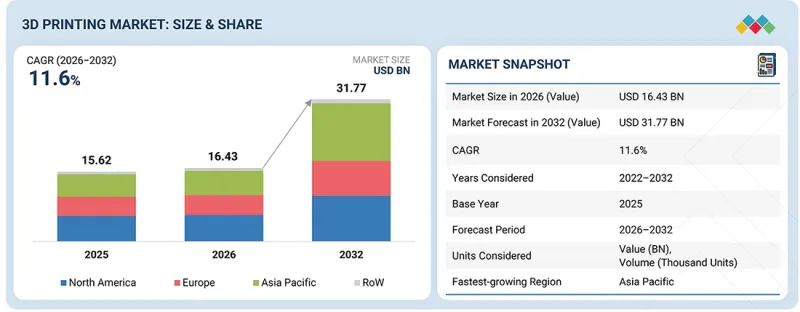
3D 프린팅 시장 규모는 2026년 164억 3,000만 달러에서 2032년에는 317억 7,000만 달러로, CAGR 11.6%로 확대할 것으로 예측됩니다. 의료 분야에서 환자별로 맞춤화된 임플란트, 의지, 치과용 기기, 수술 가이드, 해부학적 모델 제조를 위한 적층 제조 기술의 활용이 확대됨에 따라 3D 프린팅 시장은 강력한 성장을 이룰 것으로 전망됩니다.
의료 서비스 제공자와 의료기기 제조업체는 치료 성과 향상, 제조 리드타임 단축, 환자 개개인에 맞춘 의료 실현을 목적으로 3D 프린팅 기술 도입을 점점 더 확대하고 있습니다.
| 조사 범위 | |
|---|---|
| 조사 대상 기간 | 2021-2032년 |
| 기준연도 | 2025년 |
| 예측 기간 | 2026-2032년 |
| 단위 | 금액(달러) |
| 부문 | 제공, 기술, 프로세스, 지역별 |
| 대상 지역 | 북미, 유럽, 아시아태평양, 기타 지역 |
또한 생체적합성 소재, 금속 적층 제조, 의료용 프린팅 기술의 지속적인 발전으로 인해 임상 및 연구 현장에서 3D 프린팅 기술의 활용 범위가 확대되고 있습니다. 정밀 의료 및 맞춤형 의료 솔루션에 대한 수요 증가 또한 전 세계 3D 프린팅 시장의 성장을 더욱 촉진하고 있습니다.
'2026년에는 분말 침적 용융 공정이 가장 큰 시장 점유율을 차지할 것으로 추정됩니다. '
분말 침적 용융 공정은 우수한 기계적 특성을 갖춘, 매우 복잡하고 경량이며 고정밀도의 부품을 제조할 수 있으므로 3D 프린팅 시장에서 가장 큰 점유율을 차지할 전망입니다. 항공우주·방위, 자동차, 의료, 산업 제조 각 분야에서 금속 및 폴리머 부품에 대한 수요가 증가함에 따라 각 조직은 시제품 제작과 최종 제품 제조 모두에서 분말 침적 용융 공정의 도입을 촉진하고 있습니다. 또한 재료 낭비를 최소화하면서 복잡한 형상을 제조할 수 있을 뿐만 아니라 치수 정밀도와 표면 품질이 향상되어 고성능이 요구되는 산업 용도에 매우 적합합니다. 이러한 특징들이 해당 공정의 시장내 우위를 더욱 공고히 하고 있습니다.
'용도별로는 기능성 부품 제조 부문이 예측 기간 중 가장 높은 연평균 성장률(CAGR)을 기록할 것으로 예상됩니다. '
용도별로 살펴보면, 기능성 부품 제조 부문이 가장 높은 연평균 성장률(CAGR)을 기록할 것으로 예상됩니다. 이는 다양한 산업 분야에서 최종 제품 제조에 적층 제조 기술의 도입이 확대되고 있기 때문입니다. 기업에서는 특정 운영 요건이나 성능 요건을 충족하면서 제조 리드타임과 자재 낭비를 줄일 수 있는 내구성이 높고 고성능인 부품을 제조하기 위해 3D 프린팅의 활용이 점점 확대되고 있습니다. 또한 프린팅 기술과 산업용 소재의 지속적인 발전으로 인해 강도, 정밀도, 신뢰성이 뛰어난 기능성 부품의 제조가 가능해졌습니다. 이에 따라 항공우주·방위, 자동차, 의료, 산업용 제조, 소비재 등의 분야로 적용 범위가 확대되며 해당 부문의 성장을 지원하고 있습니다.
'북미는 예측 기간 중 시장 점유율 2위를 차지할 것으로 전망됩니다. '
북미는 첨단 제조업의 강력한 입지, 확립된 연구 기관, 적층 제조 기술의 조기 도입을 바탕으로 3D 프린팅 시장에서 2위의 점유율을 차지할 것으로 전망됩니다. 이 지역에서는 제조 효율, 제품 혁신, 공급망의 유연성을 향상시키기 위해 항공우주·방위, 의료, 자동차, 산업 제조 각 분야에서 3D 프린터 도입이 확대되고 있습니다. 또한 연구개발, 첨단 소재, 산업 규모의 적층 제조에 대한 지속적인 투자와 더불어, 기술 제공업체와 최종사용자 간의 협력 강화가 북미 전역에서 3D 프린팅 솔루션의 채택을 더욱 촉진하고 있습니다.
이 보고서에서는 전 세계 3D 프린팅 시장을 조사하여, 시장 개요, 시장 성장에 영향을 미치는 다양한 요인에 대한 분석, 기술 및 특허 동향, 법규제 환경, 사례 연구, 시장 규모 추이 및 전망, 각종 분류·지역/주요 국가별 상세 분석, 경쟁 구도, 주요 기업 개요 등을 종합적으로 다루고 있습니다.
자주 묻는 질문
목차
제1장 서론
제2장 개요
제3장 주요 인사이트
제4장 시장 개요
제5장 업계 동향
제6장 기술의 진보, AI의 영향, 특허, 혁신, 향후 응용
제7장 기술 상황
제8장 규제 상황
제9장 고객 상황과 구매 행동
제10장 3D 프린팅 시장 : 제공별
제11장 3D 프린팅 시장 : 용도별
제12장 3D 프린팅 시장 : 프로세스별
제13장 3D 프린팅 시장 : 기술별
제14장 3D 프린팅 시장 : 업계별
제15장 3D 프린팅 시장 : 지역별
제16장 경쟁 구도
제17장 기업 개요
제18장 조사 방법
제19장 부록
KSA 26.08.06The 3D printing market is anticipated to grow from USD 16.43 billion in 2026 to USD 31.77 billion by 2032, at a CAGR of 11.6%. The 3D printing market is expected to witness strong growth due to the expanding use of additive manufacturing in healthcare for producing patient-specific implants, prosthetics, dental devices, surgical guides, and anatomical models. Healthcare providers and medical device manufacturers are increasingly adopting 3D printing technologies to improve treatment outcomes, reduce production timelines, and enable personalized patient care.
| Scope of the Report | |
|---|---|
| Years Considered for the Study | 2021-2032 |
| Base Year | 2025 |
| Forecast Period | 2026-2032 |
| Units Considered | Value (USD Billion) |
| Segments | By Offering, Technology, Process and Region |
| Regions covered | North America, Europe, APAC, RoW |
In addition, continuous advancements in biocompatible materials, metal additive manufacturing, and medical-grade printing technologies are expanding the application of 3D printing technology across clinical and research settings. The growing demand for precision medicine and customized medical solutions is further supporting the expansion of the global 3D printing market.
"The powder bed fusion process is estimated to hold the largest market share in 2026."
The powder bed fusion process is likely to hold the largest share of the 3D printing market owing to its ability to manufacture highly complex, lightweight, and high-precision components with excellent mechanical properties. The increasing demand for metal and polymer parts across aerospace & defense, automotive, healthcare, and industrial manufacturing is encouraging organizations to adopt the powder bed fusion process for both prototyping and end-use production. Moreover, its capability to produce intricate geometries with minimal material waste, along with improved dimensional accuracy and surface quality, makes this process highly suitable for high-performance industrial applications, thereby strengthening its market dominance.
"The functional part manufacturing application is expected to record the highest CAGR during the forecast period."
Functional part manufacturing is expected to register the highest CAGR in the 3D printing market, by application, due to the increasing adoption of additive manufacturing for end-use production across multiple industries. Organizations are increasingly utilizing 3D printing to manufacture durable, high-performance components that meet specific operational and performance requirements while reducing production lead times and material waste. Moreover, continuous advancements in printing technologies and industrial-grade materials are enabling the production of functional parts with improved strength, precision, and reliability, making them suitable for aerospace & defense, automotive, healthcare, industrial manufacturing, and consumer goods applications, thereby driving segment growth.
"North America is likely to capture the second-largest market share of the 3D printing market throughout the forecast period."
North America is likely to hold the second-largest share of the 3D printing market owing to the strong presence of advanced manufacturing industries, well-established research institutions, and early adoption of additive manufacturing technologies. The region is witnessing increasing deployment of 3D printers across aerospace & defense, healthcare, automotive, and industrial manufacturing to improve production efficiency, product innovation, and supply chain flexibility. Moreover, continuous investments in research and development, advanced materials, and industrial-scale additive manufacturing, along with growing collaboration between technology providers and end users, are further strengthening the adoption of 3D printing solutions across North America.
Extensive primary interviews were conducted with key industry experts offering 3D printing solutions to determine and verify the market size for various segments and subsegments gathered through secondary research. The breakdown of primary participants for the report is provided below:
The study contains insights from various industry experts, from component suppliers to Tier 1 companies and OEMs. The break-up of the primaries is as follows:
- By Company Type: Tier 1 - 35%, Tier 2 - 40%, and Tier 3 - 25%
- By Designation: C-level Executives - 30%, Directors - 40%, and Others - 30%
- By Region: North America - 40%, Europe - 30%, Asia Pacific - 25%, and RoW - 5%
The report profiles key players in the 3D printing market with their respective market ranking analysis. Prominent players profiled in this report are Stratasys (US), EOS GmbH (Belgium), HP Development Company, L.P. (US), 3D Systems, Inc. (US), GE Aerospace (US). Apart from them, Materialise (Belgium), Nano Dimension (US), voxeljet AG (Germany), SLM Solutions (Germany), and Renishaw (UK) are also among a few key companies in the 3D printing market.
Research Coverage:
This research report categorizes the 3D printing market based on offering, process, technology, application, vertical, and region. The report describes the major drivers, restraints, challenges, and opportunities pertaining to the 3D printing market and forecasts the same till 2032. Apart from this, the report consists of leadership mapping and analysis of all the companies included in the 3D printing market ecosystem.
Key Benefits of Buying the Report
The report will help the market leaders/new entrants in this market with information on the closest approximations of the numbers for the overall 3D printing market and the subsegments. This report will help stakeholders understand the competitive landscape and gain more insights to position their businesses better and plan suitable go-to-market strategies. The report also helps stakeholders understand the pulse of the market and provides them with information on key market drivers, restraints, challenges, and opportunities.
The report provides insights into the following pointers:
- Analysis of key drivers (Ease in manufacturing customized products; Growing focus on sustainable manufacturing practices), restraints (Lack of standardized testing methods to verify the mechanical properties of 3D printing materials and high raw material costs; Inadequate design and process control data due to a lack of printing material specifications), opportunities (Rapid advancements in printing technologies and materials and development of knowledge and skill progression frameworks; Growing use of recycled and bio-based printing material), and challenges (Ensuring consistent quality of final 3D-printed product with repeatable and stable production processes; Shortage of skilled professionals in additive manufacturing)
- Product Development/Innovation: Detailed insights into upcoming technologies, research & development activities, and new product & service launches in the 3D printing market
- Market Development: Comprehensive information about lucrative markets-the report analyzes the 3D printing market across varied regions.
- Market Diversification: Exhaustive information about new products & services, untapped geographies, recent developments, and investments in the 3D printing market
- Competitive Assessment: In-depth assessment of market shares, growth strategies, and service offerings of leading players, such as Stratasys (US); EOS GmbH (Belgium); HP Development Company, L.P. (US); 3D Systems, Inc. (US); and GE Aerospace (US) in the 3D printing market.
TABLE OF CONTENTS
1 INTRODUCTION
- 1.1 STUDY OBJECTIVES
- 1.2 MARKET DEFINITION
- 1.3 MARKET SCOPE
- 1.3.1 MARKET SEGMENTATION AND REGIONAL SCOPE
- 1.3.2 INCLUSIONS AND EXCLUSIONS
- 1.4 CURRENCY CONSIDERED
- 1.5 LIMITATIONS
- 1.6 STAKEHOLDERS
- 1.7 SUMMARY OF CHANGES
2 EXECUTIVE SUMMARY
- 2.1 MARKET HIGHLIGHTS AND KEY INSIGHTS
- 2.2 KEY MARKET PARTICIPANTS: MAPPING OF STRATEGIC DEVELOPMENTS
- 2.3 DISRUPTIVE TRENDS IN 3D PRINTING MARKET
- 2.4 CAPABILITY BOUNDARY ASSESSMENT: READINESS SCORECARD
- 2.5 HIGH-GROWTH SEGMENTS
- 2.6 REGIONAL SNAPSHOT: MARKET SIZE, GROWTH RATE, AND FORECAST
3 PREMIUM INSIGHTS
- 3.1 ATTRACTIVE OPPORTUNITIES FOR PLAYERS IN 3D PRINTING MARKET
- 3.2 3D PRINTING MARKET, BY OFFERING
- 3.3 3D PRINTING MARKET, BY APPLICATION
- 3.4 3D PRINTING MARKET, BY PROCESS
- 3.5 3D PRINTING MARKET, BY TECHNOLOGY
- 3.6 3D PRINTING MARKET, BY VERTICAL
- 3.7 3D PRINTING MARKET, BY COUNTRY
4 MARKET OVERVIEW
- 4.1 INTRODUCTION
- 4.2 MARKET DYNAMICS
- 4.2.1 DRIVERS
- 4.2.1.1 Ease in manufacturing of customized products
- 4.2.1.2 Growing focus on sustainable manufacturing practices
- 4.2.1.3 Increasing government-led investments in 3D printing projects
- 4.2.1.4 Availability of various industrial-grade 3D printing materials
- 4.2.1.5 High demand for lightweight yet durable parts in aerospace & defense vertical
- 4.2.2 RESTRAINTS
- 4.2.2.1 Lack of standardized testing methods to verify mechanical properties of 3D printing materials and high raw material costs
- 4.2.2.2 Inadequate design and process control data due to lack of printing material specifications
- 4.2.3 OPPORTUNITIES
- 4.2.3.1 Rapid advancements in printing technologies and materials and development of knowledge and skill progression frameworks
- 4.2.3.2 Emerging applications of 3D printing technology in automotive, printed electronics, jewelry, and education verticals
- 4.2.3.3 Growing use of recycled and bio-based printing materials
- 4.2.4 CHALLENGES
- 4.2.4.1 Ensuring consistent quality of final 3D-printed products with repeatable and stable production processes
- 4.2.4.2 Shortage of skilled professionals in additive manufacturing
- 4.2.1 DRIVERS
- 4.3 INTERCONNECTED MARKETS AND CROSS-SECTOR OPPORTUNITIES
- 4.4 STRATEGIC MOVES BY TIER 1/2/3 PLAYERS
5 INDUSTRY TRENDS
- 5.1 INTRODUCTION
- 5.2 PORTER'S FIVE FORCES ANALYSIS
- 5.2.1 THREAT OF NEW ENTRANTS
- 5.2.2 THREAT OF SUBSTITUTES
- 5.2.3 BARGAINING POWER OF SUPPLIERS
- 5.2.4 BARGAINING POWER OF BUYERS
- 5.2.5 INTENSITY OF COMPETITIVE RIVALRY
- 5.3 MACROECONOMIC OUTLOOK
- 5.3.1 INTRODUCTION
- 5.3.2 GDP TRENDS AND FORECAST
- 5.3.3 TRENDS IN GLOBAL HEALTHCARE INDUSTRY
- 5.4 VALUE CHAIN ANALYSIS
- 5.4.1 RESEARCH AND DEVELOPMENT ENGINEERS
- 5.4.2 MATERIAL AND SOFTWARE PROVIDERS
- 5.4.3 MANUFACTURERS
- 5.4.4 SERVICE PROVIDERS
- 5.4.5 END-USER INDUSTRIES
- 5.4.6 AFTER-SALES SERVICE PROVIDERS
- 5.5 ECOSYSTEM ANALYSIS
- 5.6 PRICING ANALYSIS
- 5.6.1 PRICE RANGE OF 3D PRINTERS OFFERED BY KEY PLAYERS
- 5.6.2 AVERAGE SELLING PRICE TREND OF 3D PRINTERS, BY REGION
- 5.7 TRADE ANALYSIS
- 5.7.1 IMPORT SCENARIO (HS CODE 847790)
- 5.7.2 EXPORT SCENARIO (HS CODE 847790)
- 5.8 KEY CONFERENCES AND EVENTS, 2026-2027
- 5.9 TRENDS/DISRUPTIONS IMPACTING CUSTOMER BUSINESS
- 5.10 INVESTMENT AND FUNDING SCENARIO
- 5.11 CASE STUDY ANALYSIS
- 5.11.1 SWINBURNE UNIVERSITY COLLABORATED WITH RENISHAW TO ENHANCE ELECTRIC CARS' PERFORMANCE
- 5.11.2 LINAMAR CORPORATION ENHANCED INSPECTION PRECISION USING RENISHAW'S CUSTOM ADDITIVELY MANUFACTURED STYLUS
- 5.11.3 PROTOLABS' DMLS SERVICE HELPED ALEX DEGNES ADDRESS TWO-STROKE ENGINE SPEED RECORD CHALLENGE
- 5.11.4 PEPSICO ACHIEVED RAPID TOOLING DEVELOPMENT, DURABILITY, AND COST REDUCTION USING NXE 400 3D PRINTER
- 5.11.5 LALALAND PRODUCTION AND DESIGN REVOLUTIONIZED FOOTWEAR MANUFACTURING USING NEXA3D'S SLS PRINTER
- 5.12 IMPACT OF 2025 US TARIFF - 3D PRINTING MARKET
- 5.12.1 INTRODUCTION
- 5.12.2 PRICE IMPACT ANALYSIS
- 5.12.3 IMPACT ON COUNTRIES/REGIONS
- 5.12.3.1 US
- 5.12.3.2 Europe
- 5.12.3.3 Asia Pacific
- 5.12.4 IMPACT ON VERTICALS
- 5.12.4.1 Automotive
- 5.12.4.2 Aerospace & defense
- 5.12.4.3 Healthcare
- 5.12.4.4 Architecture & construction
- 5.12.4.5 Consumer products
- 5.12.4.6 Education
- 5.12.4.7 Industrial
- 5.12.4.8 Energy
- 5.12.4.9 Printed electronics
- 5.12.4.10 Jewelry
- 5.12.4.11 Food & culinary
6 TECHNOLOGICAL ADVANCEMENTS, AI-DRIVEN IMPACT, PATENTS, INNOVATIONS, AND FUTURE APPLICATIONS
- 6.1 KEY EMERGING TECHNOLOGIES
- 6.1.1 HYBRID MANUFACTURING
- 6.1.2 MELD PROCESS
- 6.2 COMPLEMENTARY TECHNOLOGIES
- 6.2.1 3D BIOPRINTING AND TISSUE ENGINEERING
- 6.2.2 IOT INTEGRATION AND CONNECTIVITY
- 6.3 ADJACENT TECHNOLOGIES
- 6.3.1 COMPUTER NUMERICAL CONTROL MACHINING
- 6.3.2 INJECTION MOLDING
- 6.4 TECHNOLOGY ROADMAP
- 6.5 PATENT ANALYSIS
- 6.6 FUTURE APPLICATIONS
- 6.7 IMPACT OF AI ON 3D PRINTING MARKET
- 6.7.1 TOP USE CASES AND MARKET POTENTIAL
- 6.7.2 BEST PRACTICES IN 3D PRINTING MARKET
- 6.7.3 CASE STUDIES OF AI IMPLEMENTATION IN 3D PRINTING MARKET
- 6.7.4 INTERCONNECTED ECOSYSTEM AND IMPACT ON MARKET PLAYERS
- 6.7.5 CLIENTS' READINESS TO ADOPT AI IN 3D PRINTING MARKET
- 6.7.6 SUCCESS STORIES AND REAL-WORLD APPLICATIONS
- 6.7.6.1 Materialise NV (Belgium) - AI-driven build preparation and manufacturing automation
- 6.7.6.2 Bambu Lab released PrintMon Maker, a new AI-powered 3D model generator
7 TECHNOLOGICAL LANDSCAPE
- 7.1 PROGRESS ANALYSIS BY CORE TECHNOLOGY
- 7.1.1 POWDER BED FUSION: CURRENT PERFORMANCE AND SCALING CHALLENGES
- 7.1.2 DIRECTED ENERGY DEPOSITION: MATERIAL VERSATILITY AND PART SIZE
- 7.1.3 BINDER JETTING: COST EFFICIENCY AND MATERIAL DENSITY
- 7.1.4 EMERGING TECHNOLOGIES: METAL EXTRUSION, COLD SPRAY, AND OTHER NEXT-GENERATION PROCESSES
- 7.2 SYSTEMATIC ASSESSMENT OF CAPABILITY BOUNDARIES
- 7.2.1 MATERIAL LIMITATIONS
- 7.2.2 FEATURE RESOLUTION AND PART SIZE LIMITATIONS
- 7.2.3 BUILD SPEED AND THROUGHPUT CONSTRAINTS
- 7.2.4 REPEATABILITY, QUALITY CONTROL, AND CERTIFICATION GAPS
- 7.3 IDENTIFICATION OF TECHNOLOGICAL SHORTCOMINGS AND ACTUAL INDUSTRY NEEDS
- 7.3.1 NEED FOR OPEN-SOURCE PARAMETER OPTIMIZATION
- 7.3.2 NEED FOR IN SITU MONITORING AND CLOSED-LOOP CONTROL
- 7.3.3 NEED FOR POST-PROCESSING AUTOMATION
8 REGULATORY LANDSCAPE
- 8.1 INTRODUCTION
- 8.1.1 REGULATORY BODIES, GOVERNMENT AGENCIES, AND OTHER ORGANIZATIONS
- 8.1.2 STANDARDS RELATED TO 3D PRINTING
9 CUSTOMER LANDSCAPE AND BUYER BEHAVIOR
- 9.1 KEY STAKEHOLDERS INVOLVED IN BUYING PROCESS AND THEIR EVALUATION CRITERIA
- 9.1.1 KEY STAKEHOLDERS IN BUYING PROCESS
- 9.1.2 BUYING CRITERIA
- 9.2 ADOPTION BARRIERS AND INTERNAL CHALLENGES
- 9.3 UNMET NEEDS FROM VARIOUS VERTICALS
- 9.4 COMPARATIVE TOTAL COST OF OWNERSHIP ANALYSIS
- 9.4.1 METAL ADDITIVE MANUFACTURING VS. TRADITIONAL MANUFACTURING
- 9.4.2 COST BREAKDOWN BY MATERIAL, EQUIPMENT, AND LABOR
10 3D PRINTING MARKET, BY OFFERING
- 10.1 INTRODUCTION
- 10.2 PRINTERS
- 10.2.1 DESKTOP PRINTERS
- 10.2.1.1 Increased adoption of desktop printers in schools and universities to drive market
- 10.2.2 INDUSTRIAL PRINTERS
- 10.2.2.1 Demand for generating concept models, precision and functional prototypes, and mastering patterns and molds to drive market
- 10.2.1 DESKTOP PRINTERS
- 10.3 MATERIALS
- 10.3.1 PLASTICS
- 10.3.1.1 Thermoplastics
- 10.3.1.1.1 Versatility of thermoplastics in 3D printing to fuel demand
- 10.3.1.1.2 Acrylonitrile butadiene styrene
- 10.3.1.1.3 Polylactic acid
- 10.3.1.1.4 Nylon
- 10.3.1.1.5 Other thermoplastics
- 10.3.1.1.5.1 Polypropylene
- 10.3.1.1.5.2 Polycarbonate
- 10.3.1.1.5.3 Polyvinyl alcohol
- 10.3.1.2 Photopolymers
- 10.3.1.2.1 Rising use of photopolymers in electronics, healthcare, packaging, and consumer products verticals to fuel market
- 10.3.1.1 Thermoplastics
- 10.3.2 METALS
- 10.3.2.1 Steel
- 10.3.2.1.1 Capability of stainless steel to strengthen 3D-printed models to drive demand
- 10.3.2.2 Aluminum
- 10.3.2.2.1 Rising adoption of alumide to build complex models, small series of models, and functional models to propel market
- 10.3.2.3 Titanium
- 10.3.2.3.1 Growing use of titanium powder to make models strong and precise to foster market growth
- 10.3.2.4 Nickel
- 10.3.2.4.1 Increasing demand for metal alloys in aerospace & defense industry to drive market
- 10.3.2.5 Other metals
- 10.3.2.1 Steel
- 10.3.3 CERAMICS
- 10.3.3.1 Growth in adoption of ceramics in printing home decor and tableware products to drive demand
- 10.3.4 OTHER MATERIALS
- 10.3.4.1 Wax
- 10.3.4.2 Laywood
- 10.3.4.3 Paper
- 10.3.4.4 Biocompatible materials
- 10.3.5 3D PRINTING MARKET FOR MATERIALS, BY FORM
- 10.3.5.1 Filament
- 10.3.5.1.1 Availability of general plastics in filament form for 3D printing applications to drive demand
- 10.3.5.2 Powder
- 10.3.5.2.1 Use of metal powders in aerospace & defense and jewelry and fashion design verticals to propel market
- 10.3.5.3 Liquid
- 10.3.5.3.1 Diversity of liquid materials in 3D printing technology used in various verticals to drive market
- 10.3.5.1 Filament
- 10.3.1 PLASTICS
- 10.4 SOFTWARE
- 10.4.1 DESIGN
- 10.4.1.1 Increasing installation of design software to create drawings of parts and assemblies to fuel market
- 10.4.2 INSPECTION
- 10.4.2.1 Development of inspection software to ensure compliance of prototypes with required specifications to fuel market growth
- 10.4.3 PRINTING
- 10.4.3.1 Use of printing software to analyze precision in printer functioning to drive market
- 10.4.4 SCANNING
- 10.4.4.1 Implementation of scanning software to create digital models and improve designs of physical objects to fuel market
- 10.4.1 DESIGN
- 10.5 SERVICES
- 10.5.1 CUSTOMIZATION AND ON-DEMAND MANUFACTURING IN 3D PRINTING TO DRIVE DEMAND
11 3D PRINTING MARKET, BY APPLICATION
- 11.1 INTRODUCTION
- 11.2 PROTOTYPING
- 11.2.1 REDUCTION IN MATERIAL WASTAGE AND OPERATIONAL COSTS USING 3D PRINTING IN MANUFACTURING PROTOTYPE MODELS TO DRIVE DEMAND
- 11.3 TOOLING
- 11.3.1 GROWING USE OF 3D PRINTING IN MANUFACTURING COMPLEX COMPONENTS AND TOOLS ON LARGE SCALE TO DRIVE MARKET
- 11.4 FUNCTIONAL PARTS MANUFACTURING
- 11.4.1 ADVANCEMENTS IN PRINTING TECHNOLOGY FOR HIGH-VOLUME PRODUCTION OF MECHANICALLY FUNCTIONAL PARTS TO DRIVE MARKET
12 3D PRINTING MARKET, BY PROCESS
- 12.1 INTRODUCTION
- 12.2 POWDER BED FUSION
- 12.2.1 INCREASING APPLICATIONS ACROSS VARIOUS VERTICALS TO DRIVE MARKET
- 12.3 VAT PHOTOPOLYMERIZATION
- 12.3.1 ADVANCEMENTS IN VAT PHOTOPOLYMERIZATION PROCESS FOR HIGH-PERFORMANCE 3D PRINTING APPLICATIONS TO DRIVE DEMAND
- 12.4 BINDER JETTING
- 12.4.1 COMPATIBILITY WITH VARIOUS MATERIALS AND HIGH PRODUCTION SPEED TO DRIVE DEMAND
- 12.5 MATERIAL EXTRUSION
- 12.5.1 SIMPLE PRINTING TECHNIQUE TO FUEL DEMAND
- 12.6 MATERIAL JETTING
- 12.6.1 RISING ADOPTION TO REDUCE MATERIAL WASTAGE TO DRIVE MARKET
- 12.7 OTHER PROCESSES
13 3D PRINTING MARKET, BY TECHNOLOGY
- 13.1 INTRODUCTION
- 13.2 FUSED DEPOSITION MODELING
- 13.2.1 HIGH USE IN AEROSPACE & DEFENSE VERTICAL TO DRIVE MARKET
- 13.3 STEREOLITHOGRAPHY
- 13.3.1 ABILITY TO DIRECTLY PRINT SOFT ANATOMICAL, CONCEPT, AND ARCHITECTURAL MODELS TO DRIVE DEMAND
- 13.4 SELECTIVE LASER SINTERING
- 13.4.1 RISING ADOPTION TO DEVELOP PARTS WITH JOINTS, SNAP FITS, AND LIVING HINGES TO FUEL MARKET
- 13.5 POLYJET PRINTING/MULTIJET PRINTING
- 13.5.1 INCREASED ADOPTION TO DEVELOP HIGHLY ACCURATE MODELS WITH INTRICATE DETAILS AND COMPLEX GEOMETRIES TO FUEL MARKET GROWTH
- 13.6 ELECTRON BEAM MELTING
- 13.6.1 HIGH DEMAND IN AEROSPACE & DEFENSE AND AUTOMOTIVE VERTICALS FOR PRODUCING HIGH-DENSITY PARTS TO DRIVE MARKET
- 13.7 DIGITAL LIGHT PROCESSING
- 13.7.1 POTENTIAL TO DEVELOP PRECISE PARTS WITH SMOOTH SURFACE FINISHING TO DRIVE DEMAND
- 13.8 DIRECT METAL LASER SINTERING
- 13.8.1 INCREASING USE TO DEVELOP DURABLE AND HEAT-RESISTANT COMPONENTS TO DRIVE MARKET
- 13.9 OTHER TECHNOLOGIES
14 3D PRINTING MARKET, BY VERTICAL
- 14.1 INTRODUCTION
- 14.2 AUTOMOTIVE
- 14.2.1 ADOPTION OF ADDITIVE MANUFACTURING FOR PROTOTYPING PROJECTS TO FUEL MARKET GROWTH
- 14.3 AEROSPACE & DEFENSE
- 14.3.1 INCREASED INVESTMENTS BY ESTABLISHED PLAYERS IN DEVELOPMENT OF 3D-PRINTED MODELS FOR NEW APPLICATIONS TO PROPEL MARKET
- 14.4 HEALTHCARE
- 14.4.1 RAPID ADVANCEMENTS IN 3D PRINTING TECHNOLOGY FOR MEDICAL DEVICES, DENTISTRY, AND PROSTHETICS APPLICATIONS TO DRIVE MARKET
- 14.5 ARCHITECTURE & CONSTRUCTION
- 14.5.1 RISING USE TO UNDERSTAND ABSTRACT CONCEPTS TO FUEL MARKET GROWTH
- 14.6 CONSUMER PRODUCTS
- 14.6.1 GROWING USE OF DESKTOP OR PERSONAL PRINTERS BY HOBBYISTS, ENTREPRENEURS, AND SMALL BUSINESSES TO FUEL MARKET GROWTH
- 14.7 EDUCATION
- 14.7.1 ENHANCEMENT OF LEARNING AND ENGAGEMENT ACROSS VARIOUS SUBJECTS USING 3D PRINTING TO DRIVE DEMAND
- 14.8 INDUSTRIAL
- 14.8.1 INCREASING APPLICATIONS OF ADDITIVE MANUFACTURING IN TOOLING, SPECIAL MACHINERY MANUFACTURING, AND ROBOTICS TO DRIVE MARKET
- 14.9 ENERGY
- 14.9.1 RISING USE OF 3D PRINTING TECHNOLOGY IN SMALL-SCALE MANUFACTURING AND REPAIR ACTIVITIES TO FUEL MARKET GROWTH
- 14.10 PRINTED ELECTRONICS
- 14.10.1 RISING ADOPTION OF 3D PRINTING TECHNOLOGY TO PRINT ELECTRONIC DEVICES TO DRIVE MARKET
- 14.11 JEWELRY
- 14.11.1 RISING ADOPTION OF 3D PRINTING TECHNOLOGY TO DESIGN CUSTOMIZED JEWELRY WITH PRECISION AND SPEED TO PROPEL MARKET
- 14.12 FOOD & CULINARY
- 14.12.1 EMERGING TREND OF 3D FOOD PRINTING TO DRIVE MARKET
- 14.13 OTHER VERTICALS
15 3D PRINTING MARKET, BY REGION
- 15.1 INTRODUCTION
- 15.2 NORTH AMERICA
- 15.2.1 US
- 15.2.1.1 Government-led initiatives to foster innovation and boost adoption of 3D printing technology to accelerate market growth
- 15.2.2 CANADA
- 15.2.2.1 Expanding automotive and healthcare verticals to fuel market growth
- 15.2.3 MEXICO
- 15.2.3.1 Focus of companies and universities to increase awareness about benefits of 3D printing technology to drive market
- 15.2.1 US
- 15.3 EUROPE
- 15.3.1 UK
- 15.3.1.1 Government-led funding for research initiatives aimed at improving efficiency, reliability, and scalability of 3D printing processes to drive market
- 15.3.2 GERMANY
- 15.3.2.1 Increasing demand for 3D printing technology from automobile companies to propel market
- 15.3.3 FRANCE
- 15.3.3.1 Growing use of 3D printing technology in implant and prosthetic manufacturing to drive market
- 15.3.4 ITALY
- 15.3.4.1 Continuous product launches by leading 3D printer manufacturing companies to drive market
- 15.3.5 SPAIN
- 15.3.5.1 Focus of private companies on investing in 3D printing-related innovations to expedite market growth
- 15.3.6 REST OF EUROPE
- 15.3.1 UK
- 15.4 ASIA PACIFIC
- 15.4.1 JAPAN
- 15.4.1.1 Increasing construction activities to accelerate demand
- 15.4.2 CHINA
- 15.4.2.1 Focus of global market players on strengthening footprints in China to drive market
- 15.4.3 INDIA
- 15.4.3.1 Large presence of 3D printing companies to boost market growth
- 15.4.4 SOUTH KOREA
- 15.4.4.1 Increasing applications of 3D printing in construction vertical to drive market
- 15.4.5 REST OF ASIA PACIFIC
- 15.4.1 JAPAN
- 15.5 ROW
- 15.5.1 SOUTH AMERICA
- 15.5.1.1 Growing adoption of 3D printing technology in construction activities and spare part manufacturing to drive market
- 15.5.2 AFRICA
- 15.5.2.1 Increasing innovations in construction and education verticals using 3D printing technology to fuel demand
- 15.5.3 MIDDLE EAST
- 15.5.3.1 GCC Countries
- 15.5.3.1.1 UAE and Saudi Arabia are important markets in region
- 15.5.3.2 Rest of Middle East
- 15.5.3.1 GCC Countries
- 15.5.1 SOUTH AMERICA
16 COMPETITIVE LANDSCAPE
- 16.1 OVERVIEW
- 16.2 KEY PLAYER STRATEGIES/RIGHT TO WIN, JANUARY 2022-JUNE 2026
- 16.3 REVENUE ANALYSIS, 2021-2025
- 16.4 MARKET SHARE ANALYSIS, 2025
- 16.5 COMPANY VALUATION AND FINANCIAL METRICS
- 16.6 BRAND COMPARISON
- 16.7 COMPANY EVALUATION MATRIX: KEY PLAYERS, 2025
- 16.7.1 STARS
- 16.7.2 EMERGING LEADERS
- 16.7.3 PERVASIVE PLAYERS
- 16.7.4 PARTICIPANTS
- 16.7.5 COMPANY FOOTPRINT: KEY PLAYERS, 2025
- 16.7.5.1 Overall footprint
- 16.7.5.2 Region footprint
- 16.7.5.3 Offering footprint
- 16.7.5.4 Technology footprint
- 16.7.5.5 Application footprint
- 16.7.5.6 Vertical footprint
- 16.8 COMPANY EVALUATION MATRIX: STARTUPS/SMES, 2025
- 16.8.1 PROGRESSIVE COMPANIES
- 16.8.2 RESPONSIVE COMPANIES
- 16.8.3 DYNAMIC COMPANIES
- 16.8.4 STARTING BLOCKS
- 16.8.5 COMPETITIVE BENCHMARKING OF KEY STARTUPS/SMES, 2025
- 16.8.5.1 Detailed list of key startups/SMEs
- 16.8.5.2 Competitive benchmarking of key startups/SMEs
- 16.9 COMPETITIVE SCENARIO
- 16.9.1 PRODUCT LAUNCHES
- 16.9.2 DEALS
- 16.9.3 EXPANSIONS
- 16.9.4 OTHER DEVELOPMENTS
17 COMPANY PROFILES
- 17.1 KEY PLAYERS
- 17.1.1 STRATASYS
- 17.1.1.1 Business overview
- 17.1.1.2 Products/Solutions/Services offered
- 17.1.1.3 Recent developments
- 17.1.1.3.1 Product launches
- 17.1.1.3.2 Deals
- 17.1.1.3.3 Other developments
- 17.1.1.4 MnM view
- 17.1.1.4.1 Key strengths/Right to win
- 17.1.1.4.2 Strategic choices
- 17.1.1.4.3 Weaknesses/Competitive threats
- 17.1.2 EOS GMBH
- 17.1.2.1 Business overview
- 17.1.2.2 Products/Solutions/Services offered
- 17.1.2.3 Recent developments
- 17.1.2.3.1 Product launches
- 17.1.2.3.2 Deals
- 17.1.2.3.3 Expansions
- 17.1.2.4 MnM view
- 17.1.2.4.1 Key strengths/Right to win
- 17.1.2.4.2 Strategic choices
- 17.1.2.4.3 Weaknesses/Competitive threats
- 17.1.3 HP DEVELOPMENT COMPANY, L.P.
- 17.1.3.1 Business overview
- 17.1.3.2 Products/Solutions/Services offered
- 17.1.3.3 Recent developments
- 17.1.3.3.1 Product launches
- 17.1.3.3.2 Deals
- 17.1.3.3.3 Other developments
- 17.1.3.4 MnM view
- 17.1.3.4.1 Key strengths/Right to win
- 17.1.3.4.2 Strategic choices
- 17.1.3.4.3 Weaknesses/Competitive threats
- 17.1.4 3D SYSTEMS, INC.
- 17.1.4.1 Business overview
- 17.1.4.2 Products/Solutions/Services offered
- 17.1.4.3 Recent developments
- 17.1.4.3.1 Product launches
- 17.1.4.3.2 Deals
- 17.1.4.3.3 Other developments
- 17.1.4.4 MnM view
- 17.1.4.4.1 Key strengths/Right to win
- 17.1.4.4.2 Strategic choices
- 17.1.4.4.3 Weaknesses/Competitive threats
- 17.1.5 GE AEROSPACE
- 17.1.5.1 Business overview
- 17.1.5.2 Products/Solutions/Services offered
- 17.1.5.3 Recent developments
- 17.1.5.3.1 Product launches
- 17.1.5.4 MnM view
- 17.1.5.4.1 Key strengths/Right to win
- 17.1.5.4.2 Strategic choices
- 17.1.5.4.3 Weaknesses/Competitive threats
- 17.1.6 MATERIALISE
- 17.1.6.1 Business overview
- 17.1.6.2 Products/Solutions/Services offered
- 17.1.6.3 Recent developments
- 17.1.6.3.1 Product launches
- 17.1.6.3.2 Deals
- 17.1.6.3.3 Expansions
- 17.1.7 NANO DIMENSION
- 17.1.7.1 Business overview
- 17.1.7.2 Products/Solutions/Services offered
- 17.1.7.3 Recent developments
- 17.1.7.3.1 Product launches
- 17.1.7.3.2 Deals
- 17.1.8 VOXELJET AG
- 17.1.8.1 Business overview
- 17.1.8.2 Products/Solutions/Services offered
- 17.1.8.3 Recent developments
- 17.1.8.3.1 Product launches
- 17.1.8.3.2 Deals
- 17.1.8.3.3 Other developments
- 17.1.9 SLM SOLUTIONS (ACQUIRED BY NIKON INDIA PVT. LTD.)
- 17.1.9.1 Business overview
- 17.1.9.2 Products/Solutions/Services offered
- 17.1.9.3 Recent developments
- 17.1.9.3.1 Deals
- 17.1.10 RENISHAW PLC
- 17.1.10.1 Business overview
- 17.1.10.2 Products/Solutions/Services offered
- 17.1.10.3 Recent developments
- 17.1.10.3.1 Deals
- 17.1.1 STRATASYS
- 17.2 OTHER PLAYERS
- 17.2.1 PROTO LABS, INC.
- 17.2.2 OPTOMEC, INC.
- 17.2.3 PRODWAYS GROUP
- 17.2.4 ULTIMAKER
- 17.2.5 TIERTIME
- 17.2.6 HOGANAS AB
- 17.2.7 UNIONTECH
- 17.2.8 TRUMPF
- 17.2.9 FORMLABS
- 17.2.10 CARBON, INC.
- 17.2.11 NANOVOXEL
- 17.2.12 RAPID SHAPE GMBH
- 17.2.13 MARK3D UK LIMITED
- 17.2.14 ZRAPID TECH
- 17.2.15 SPEE3D
18 RESEARCH METHODOLOGY
- 18.1 RESEARCH DATA
- 18.1.1 SECONDARY AND PRIMARY RESEARCH
- 18.1.2 SECONDARY DATA
- 18.1.2.1 Key secondary sources
- 18.1.2.2 Key data from secondary sources
- 18.1.3 PRIMARY DATA
- 18.1.3.1 Primary interviews with experts
- 18.1.3.2 Breakdown of primaries
- 18.1.3.3 Key data from primary sources
- 18.1.3.4 Key industry insights
- 18.2 MARKET SIZE ESTIMATION
- 18.2.1 TOP-DOWN APPROACH
- 18.2.1.1 Approach to derive market size using top-down analysis (supply side)
- 18.2.2 BOTTOM-UP APPROACH
- 18.2.2.1 Approach to derive market size using bottom-up analysis (demand side)
- 18.2.1 TOP-DOWN APPROACH
- 18.3 DATA TRIANGULATION
- 18.4 RESEARCH ASSUMPTIONS
- 18.5 RISK ASSESSMENT
- 18.6 RESEARCH LIMITATIONS
19 APPENDIX
- 19.1 DISCUSSION GUIDE
- 19.2 KNOWLEDGESTORE: MARKETSANDMARKETS' SUBSCRIPTION PORTAL
- 19.3 CUSTOMIZATION OPTIONS
- 19.4 RELATED REPORTS
- 19.5 AUTHOR DETAILS


