|
시장보고서
상품코드
2107170
디스플레이 모듈 시장 예측(-2032년) : 유형별, 표시 기술별, 제품 유형별, 디스플레이 사이즈별, 최종 용도별, 지역별Display Module Market by Type, Display Technology, Display Size - Global Forecast to 2032 |
||||||

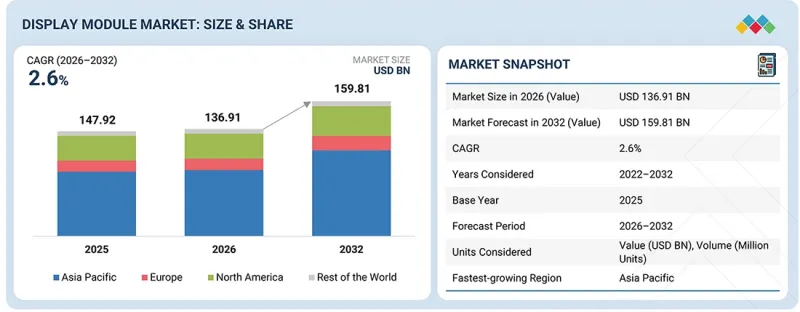
세계의 디스플레이 모듈 시장 규모는 2026년 1,369억 1,000만 달러에서 2032년까지 1,598억 1,000만 달러에 달할 것으로 추정되고 있으며, CAGR은 2.6%에 달할 전망입니다.
| 조사 범위 | |
|---|---|
| 조사 대상 기간 | 2021-2032년 |
| 기준연도 | 2025년 |
| 예측 기간 | 2026-2032년 |
| 산정 단위 | 금액(10억 달러) |
| 부문 | 유형별, 표시 기술별, 제품 유형별, 디스플레이 사이즈별, 최종 용도별, 지역별 |
| 대상 지역 | 북미, 유럽, 아시아태평양, 기타 지역 |
디스플레이 모듈 시장은 스마트폰, 태블릿, 노트북, TV, 웨어러블 기기, 자동차용 인포테인먼트 시스템, 산업용 기기, 의료기기 등 폭넓은 용도에서 첨단 디스플레이 모듈의 통합이 진행되고 있는 것이 원동력이 되고 있습니다. 고해상도 디스플레이, 색 재현성 향상, 대형화, 그리고 에너지 효율이 높은 비주얼 솔루션에 대한 소비자의 강력한 수요로 인해 OLED, AMOLED, Mini-LED, MicroLED 등 첨단 디스플레이 모듈 기술의 채택이 지속적으로 가속화되고 있습니다. 또한 커넥티드 기기, 전기자동차, 디스플레이 모듈 생태계 및 AR/VR 애플리케이션의 급속한 확장이 고성능 디스플레이 모듈에 대한 지속적인 수요를 견인하고 있습니다. 이러한 성장은 디스플레이 모듈 설계, 터치 기능 통합, 드라이버 IC 기술 및 제조 공정의 지속적인 발전에 힘입어 더욱 가속화되고 있으며, 차세대 전자 기기를 위한 더 얇고, 더 가볍고, 더 유연하며, 에너지 효율이 뛰어난 디스플레이 모듈을 실현하고 있습니다.
"2025년, 대형 디스플레이 모듈은 디스플레이 모듈 시장에서 두 번째로 큰 점유율을 차지했습니다."
2025년, 대형 디스플레이 모듈은 TV, 게이밍 모니터, 디지털 사이니지, 비디오 월, 인터랙티브 키오스크 및 상업용 디스플레이 시스템에서의 광범위한 채택에 힘입어 디스플레이 모듈 시장에서 두 번째로 큰 점유율을 차지했습니다. 대형 화면 크기, 초고해상도(4K 및 8K) 시청 경험, 몰입형 엔터테인먼트에 대한 소비자 수요 증가로 인해 대형 디스플레이 모듈의 도입이 크게 증가했습니다. 또한 스마트 리테일, 디지털 광고, 기업 간 협업, 교통, 공공 정보 시스템의 확대로 인해 대형 디스플레이 모듈에 대한 수요가 가속화되고 있습니다.
"스포츠·엔터테인먼트 분야는 예측 기간 중 디스플레이 모듈 시장에서 두 번째로 높은 연평균 성장률(CAGR)을 기록할 것으로 예상됩니다."
스포츠·엔터테인먼트 분야는 LED 비디오월, 경기장 스코어보드, 디지털 사이니지, 인터랙티브 키오스크, 몰입형 엔터테인먼트 시스템용 고해상도 디스플레이 모듈에 대한 투자 증가에 힘입어, 예측 기간 중 디스플레이 모듈 시장에서 두 번째로 높은 연평균 성장률(CAGR)을 기록할 것으로 전망됩니다. 경기장, 콘서트장, 영화관, 테마파크, e-sports 아레나, 이벤트 센터에서는 영상 품질 향상, 실시간 정보 제공, 그리고 관객을 매료시키는 경험을 실현하기 위해 LED, OLED, Mini-LED 기술을 기반으로 한 첨단 디스플레이 모듈의 도입이 점점 더 확대되고 있습니다. 스포츠 생중계, 콘서트, e-sports 대회, 대규모 공공 엔터테인먼트의 인기가 높아짐에 따라 뛰어난 밝기, 내구성, 화질을 갖춘 디스플레이 모듈에 대한 수요가 더욱 가속화되고 있습니다. 또한 증강현실(AR), 가상 제작 기술, 몰입형 디지털 체험의 도입이 진행됨에 따라 행사장 운영자 및 이벤트 주최자는 차세대 디스플레이 모듈 솔루션에 대한 투자를 적극적으로 추진하고 있으며, 이는 예측 기간 중 견고한 시장 성장을 지원하고 있습니다.
"아시아태평양은 예측 기간 중 가장 높은 연평균 성장률(CAGR)을 보일 것으로 전망됩니다."
아시아태평양은 소비자 가전 제조의 급속한 확대, OLED, AMOLED, Mini-LED, MicroLED 등 첨단 디스플레이 모듈 기술의 채택 확대, 그리고 스마트폰, 태블릿, 노트북, TV, 웨어러블 기기에 대한 수요 증가에 힘입어, 예측 기간 중 디스플레이 모듈 시장에서 가장 높은 연평균 성장률(CAGR)을 기록할 것으로 전망됩니다. 또한 이 지역에서는 첨단 디스플레이 모듈 제조 시설에 대한 막대한 투자가 지원되어, 전기자동차 생산, 디지털 콕핏 디스플레이, 자동차용 인포테인먼트 시스템 분야에서도 강력한 성장이 예상됩니다. 또한 반도체 및 전자기기 제조를 촉진하는 정부의 우호적인 정책에 더해, 삼성디스플레이, LG디스플레이, BOE 테크놀러지, AUO, 이놀룩스, 티엔마, TCL CSOT와 같은 주요 디스플레이 모듈 제조업체들의 존재가 지역 시장의 강화를 지속적으로 지원하고 있습니다. 차세대 디스플레이 모듈 연구개발에 대한 투자 확대, 국내 전자기기 소비 증가, 디지털 사이니지 및 스마트 리테일 솔루션 도입 확대, 그리고 확립된 전자기기 공급망이 시장 성장을 더욱 가속화하고 있습니다. 또한 경쟁력 있는 제조 비용, AR/VR 기기의 보급 확대, 그리고 의료, 산업, 자동차, 상업용 분야에서 디스플레이 모듈의 통합이 진행됨에 따라 아시아태평양은 디스플레이 모듈의 혁신, 생산 및 상용화를 위한 글로벌 거점으로서의 입지를 확고히 하고 있습니다.
2차 조사를 통해 수집된 각종 부문 및 하위 부문 시장 규모를 파악하고 검증하기 위해, 디스플레이 업계의 주요 전문가들을 대상으로 광범위한 1차 인터뷰가 실시되었습니다. 이 보고서의 1차 인터뷰 대상자 구성은 다음과 같습니다. :
이 보고서에서는 디스플레이 시장의 주요 기업에 대해 순위 분석과 함께 프로필을 소개하고 있습니다. 이 보고서에서 다루고 있는 주요 기업은 Samsung Display(한국), LG Display(한국), BOE Technology Group(중국), AUO Corporation(대만) 및 Innolux Corporation(대만)입니다.
이 외에도 이 보고서에는 Sharp Corporation(일본), Japan Display Inc.(일본), Tianma Microelectronics(중국), Visionox(중국) 등 기타 주요 기업에 대해서도 기술되어 있습니다.
조사 범위
이 보고서에서는 디스플레이 모듈 시장을 세분화하여 유형, 디스플레이 기술, 제품 유형, 최종 용도 산업, 디스플레이 크기, 디스플레이 해상도 및 지역별로 시장 규모를 예측하고 있습니다. 또한 시장 성장에 영향을 미치는 촉진요인, 억제요인, 기회, 과제에 대한 포괄적인 분석을 제공합니다. 이 보고서는 시장의 정성적 및 정량적 측면을 모두 다루고 있습니다.
이 보고서를 구매해야 하는 이유:
이 보고서는 디스플레이 모듈 시장 전체 및 관련 부문의 대략적인 매출 데이터를 제공함으로써, 이 시장의 선도 기업과 신규 진입 기업을 지원합니다. 또한 이해관계자가 경쟁 구도를 이해하고, 시장내 입지를 강화하며, 효과적인 시장 진입 전략을 수립하기 위한 심층적인 인사이트를 얻는 데 도움이 됩니다. 또한 시장 동향을 파악하고 주요 촉진요인, 제약 요인, 기회, 과제에 대한 정보를 제공합니다.
이 보고서는 다음 사항에 대한 인사이트를 제공합니다. :
- 주요 촉진요인(소비자 가전 제품에서의 고해상도·프리미엄 디스플레이 수요 증가, OLED, Mini-LED, Micro-LED 기술 채택 확대) 및 제약 요인(치열한 가격 경쟁과 평균 판매 가격(ASP) 하락, OLED 및 Micro-LED 디스플레이의 높은 제조 비용) 분석, 기회(플렉서블, 접이식, 투명, 롤업형 디스플레이 개발, AR/VR 및 혼합현실(MR) 기기의 성장), 과제(마이크로 LED 및 기타 차세대 디스플레이의 비용 효율적인 양산화 실현, 공급망 혼란, 핵심 소재에 대한 의존)
- 제품 개발 및 혁신: 디스플레이 모듈 시장의 향후 기술, 연구개발 활동 및 신제품 출시에 대한 상세한 분석
- 시장 개발: 다양한 지역의 디스플레이 모듈 시장 분석을 통해 수익성 높은 시장에 대한 포괄적인 정보를 제공합니다
- 시장 다각화: 디스플레이 모듈 시장의 신제품, 미개발 지역, 최근 동향 및 투자에 대한 포괄적인 정보
- 경쟁 분석: 삼성디스플레이(한국), LG디스플레이(한국), BOE Technology Group(중국), AUO Corporation(대만), Innolux Corporation(대만) 등 주요 기업의 시장 점유율, 성장 전략, 서비스 제공에 대한 상세한 평가.
자주 묻는 질문
목차
제1장 서론
제2장 개요
제3장 주요 인사이트
제4장 시장 개요
제5장 업계 동향
제6장 기술 진보, AI에 의한 영향, 특허, 그리고 혁신
제7장 규제 상황
제8장 고객 상황과 구매 행동
제9장 디스플레이 패널 유형
제10장 디스플레이 인터페이스 유형
제11장 디스플레이 해상도 유형
제12장 디스플레이 모듈 시장(유형별)
제13장 광학 디스플레이 모듈 시장(표시 기술별)
제14장 전자식(비광학식) 디스플레이 모듈 시장(디스플레이 기술별)
제15장 디스플레이 모듈 시장(제품 유형별)
제16장 디스플레이 모듈 시장(디스플레이 사이즈별)
제17장 디스플레이 모듈 시장(용도별)
제18장 디스플레이 모듈 시장(지역별)
제19장 경쟁 구도
제20장 기업 개요
제21장 조사 방법
제22장 부록
KSA 26.08.12The global display module market is estimated to reach USD 159.81 billion by 2032 from USD 136.91 billion in 2026, registering a CAGR of 2.6%.
| Scope of the Report | |
|---|---|
| Years Considered for the Study | 2021-2032 |
| Base Year | 2025 |
| Forecast Period | 2026-2032 |
| Units Considered | Value (USD Billion) |
| Segments | By Display Type, End User and Region |
| Regions covered | North America, Europe, APAC, RoW |
The display module market is driven by the increasing integration of advanced display modules across a wide range of applications, including smartphones, tablets, laptops, televisions, wearable devices, automotive infotainment systems, industrial equipment, and medical devices. Strong consumer demand for high-resolution displays, enhanced color accuracy, larger screen sizes, and energy-efficient visual solutions continues to accelerate the adoption of advanced display module technologies such as OLED, AMOLED, Mini-LED, and MicroLED. Furthermore, the rapid expansion of connected devices, electric vehicles, display-module ecosystems, and AR/VR applications is driving sustained demand for high-performance display modules. This growth is further supported by continuous advancements in display module design, touch integration, driver IC technologies, and manufacturing processes, enabling thinner, lighter, more flexible, and energy-efficient display modules for next-generation electronic devices.
"Large display modules held the second-largest share of the display module market in 2025."
Large display modules accounted for the second-largest share of the display module market in 2025, driven by their extensive adoption in televisions, gaming monitors, digital signage, video walls, interactive kiosks, and commercial display systems. Rising consumer demand for larger screen sizes, ultra-high-definition (4K and 8K) viewing experiences, and immersive entertainment has significantly increased the deployment of large display modules. In addition, the expansion of smart retail, digital advertising, corporate collaboration, transportation, and public information systems has accelerated the demand for large-format display modules.
"The sports & entertainment vertical is expected to register the second-highest CAGR in the display module market during the forecast period."
The sports & entertainment vertical is projected to witness the second-highest CAGR in the display module market during the forecast period, driven by increasing investments in high-resolution display modules for LED video walls, stadium scoreboards, digital signage, interactive kiosks, and immersive entertainment systems. Stadiums, concert venues, cinemas, theme parks, esports arenas, and event centers are increasingly deploying advanced display modules based on LED, OLED, and Mini-LED technologies to deliver enhanced visual quality, real-time information, and engaging audience experiences. The growing popularity of live sporting events, concerts, esports tournaments, and large-scale public entertainment is further accelerating demand for display modules with superior brightness, durability, and image performance. Additionally, the adoption of augmented reality (AR), virtual production technologies, and immersive digital experiences is encouraging venue operators and event organizers to invest in next-generation display module solutions, supporting strong market growth throughout the forecast period.
"Asia Pacific to exhibit the highest CAGR during the forecast period."
Asia Pacific is projected to register the highest CAGR in the display module market during the forecast period, driven by the rapid expansion of consumer electronics manufacturing, increasing adoption of advanced display module technologies such as OLED, AMOLED, Mini-LED, and MicroLED, and rising demand for smartphones, tablets, laptops, televisions, and wearable devices. The region is also witnessing strong growth in electric vehicle production, digital cockpit displays, and automotive infotainment systems, supported by significant investments in advanced display module manufacturing facilities. Furthermore, favorable government initiatives promoting semiconductor and electronics manufacturing, along with the presence of leading display module manufacturers such as Samsung Display, LG Display, BOE Technology, AUO, Innolux, Tianma, and TCL CSOT, continue to strengthen the regional market. Increasing investments in next-generation display module R&D, expanding domestic electronics consumption, growing deployment of digital signage and smart retail solutions, and a well-established electronics supply chain are further accelerating market growth. Additionally, competitive manufacturing costs, rising adoption of AR/VR devices, and increasing integration of display modules across healthcare, industrial, automotive, and commercial applications position the Asia Pacific as the global hub for display module innovation, production, and commercialization.
Extensive primary interviews were conducted with key experts in the display industry to determine and verify the market size for various segments and subsegments gathered through secondary research. The breakdown of primary participants for the report is provided below:
The study contains insights from various industry experts, from component suppliers to Tier 1 companies and OEMs. The break-up of the primaries is as follows:
- By Company Type: Tier 1 - 50%, Tier 2 - 30%, and Tier 3 - 20%
- By Designation: C-level Executives - 35%, Managers - 30%, and Others - 35%
- By Region: North America - 40%, Europe - 25%, Asia Pacific - 20%, and RoW - 15%
The report profiles key companies in the display market along with their ranking analysis. Prominent players profiled in this report are Samsung Display (South Korea), LG Display (South Korea), BOE Technology Group (China), AUO Corporation (Taiwan), and Innolux Corporation (Taiwan).
Apart from these, the report also includes other major players such as Sharp Corporation (Japan), Japan Display Inc. (Japan), Tianma Microelectronics (China), and Visionox (China).
Research Coverage
The report segments the display module market and forecasts its size by type, display technology, product type, end-use industry, display size, display resolution, and region. It also provides a comprehensive review of drivers, restraints, opportunities, and challenges influencing market growth. The report covers both qualitative and quantitative aspects of the market.
Reasons to Buy the Report:
The report will help leaders/new entrants in this market by providing approximate revenue figures for the overall display module market and related segments. This report will help stakeholders understand the competitive landscape and gain deeper insights to strengthen their market position and plan effective go-to-market strategies. The report will also help stakeholders understand the market pulse and provide information on key drivers, restraints, opportunities, and challenges.
The report provides insights into the following pointers:
- Analysis of key drivers (rising demand for high-resolution and premium displays across consumer electronics; increasing adoption of OLED, Mini-LED, and Micro-LED technologies), restraints (intense price competition and declining average selling prices (ASPs), high manufacturing costs of OLED and Micro-LED displays), opportunities (development of flexible, foldable, transparent, and rollable displays, growth of AR/VR and mixed-reality devices), and challenges (achieving cost-effective mass production of Micro-LED and other next-generation displays, supply chain disruptions and dependence on critical materials)
- Product Development/Innovation: Detailed insights into upcoming technologies, research & development activities, and product launches in the display module market
- Market Development: Comprehensive information about lucrative markets by analyzing the display module market across varied regions
- Market Diversification: Exhaustive information about new products, untapped geographies, recent developments, and investments in the display module market
- Competitive Assessment: In-depth assessment of market shares, growth strategies, and service offerings of leading players like Samsung Display (South Korea), LG Display (South Korea), BOE Technology Group (China), AUO Corporation (Taiwan), and Innolux Corporation (Taiwan).
TABLE OF CONTENTS
1 INTRODUCTION
- 1.1 STUDY OBJECTIVES
- 1.2 MARKET DEFINITION
- 1.3 STUDY SCOPE
- 1.3.1 MARKETS COVERED AND REGIONAL SCOPE
- 1.3.2 YEARS CONSIDERED
- 1.3.3 INCLUSIONS AND EXCLUSIONS
- 1.4 CURRENCY CONSIDERED
- 1.5 UNIT CONSIDERED
- 1.6 STAKEHOLDERS
2 EXECUTIVE SUMMARY
- 2.1 MARKET HIGHLIGHTS AND KEY INSIGHTS
- 2.2 KEY MARKET PARTICIPANTS: MAPPING OF STRATEGIC DEVELOPMENTS
- 2.3 DISRUPTIVE TRENDS IN DISPLAY MODULE MARKET
- 2.4 HIGH-GROWTH SEGMENTS
- 2.5 REGIONAL SNAPSHOT: MARKET SIZE, GROWTH RATE, AND FORECAST
3 PREMIUM INSIGHTS
- 3.1 ATTRACTIVE OPPORTUNITIES FOR PLAYERS IN DISPLAY MODULE MARKET
- 3.2 DISPLAY MODULE MARKET FOR OPTICAL, BY DISPLAY TECHNOLOGY
- 3.3 DISPLAY MODULE MARKET, BY END USE
- 3.4 DISPLAY MODULE MARKET, BY REGION
- 3.5 DISPLAY MODULE MARKET IN ASIA PACIFIC, BY PRODUCT TYPE AND COUNTRY
4 MARKET OVERVIEW
- 4.1 INTRODUCTION
- 4.2 MARKET DYNAMICS
- 4.2.1 DRIVERS
- 4.2.1.1 Growing preference for high-resolution displays in consumer electronics
- 4.2.1.2 Rapid digital transformation in automotive industry
- 4.2.1.3 Expanding digital healthcare infrastructure
- 4.2.1.4 Growing popularity of OLED, mini-LED, and microLED technologies
- 4.2.1.5 Mounting demand for interactive displays in retail, education, and smart office environments
- 4.2.1.6 Increasing penetration of IoT and smart home devices
- 4.2.2 RESTRAINTS
- 4.2.2.1 High costs of advanced display technologies
- 4.2.2.2 Volatility in raw material and semiconductor component prices
- 4.2.2.3 Supply chain disruptions
- 4.2.3 OPPORTUNITIES
- 4.2.3.1 Increasing commercialization of flexible, foldable, and rollable display technologies
- 4.2.3.2 Rising demand for AR/VR headsets and wearable devices
- 4.2.3.3 Growing consumption of autonomous vehicles
- 4.2.3.4 Increasing investment in digital healthcare and automation initiatives
- 4.2.3.5 Burgeoning demand for transparent and ultra-low-power displays
- 4.2.4 CHALLENGES
- 4.2.4.1 Issues in maintaining high production yields
- 4.2.4.2 Complexities in balancing premium display performance in price-sensitive markets
- 4.2.1 DRIVERS
- 4.3 INTERCONNECTED MARKETS AND CROSS-SECTOR OPPORTUNITIES
- 4.3.1 INTERCONNECTED MARKETS
- 4.3.2 CROSS-SECTOR OPPORTUNITIES
- 4.4 STRATEGIC MOVES BY TIER-1/2/3 PLAYERS
5 INDUSTRY TRENDS
- 5.1 INTRODUCTION
- 5.2 PORTER'S FIVE FORCES ANALYSIS
- 5.2.1 INTENSITY OF COMPETITIVE RIVALRY
- 5.2.2 BARGAINING POWER OF SUPPLIERS
- 5.2.3 BARGAINING POWER OF BUYERS
- 5.2.4 THREAT OF SUBSTITUTES
- 5.2.5 THREAT OF NEW ENTRANTS
- 5.3 MACROECONOMIC OUTLOOK
- 5.3.1 INTRODUCTION
- 5.3.2 GDP TRENDS AND FORECAST
- 5.3.3 TRENDS IN GLOBAL CONSUMER ELECTRONICS INDUSTRY
- 5.3.4 TRENDS IN GLOBAL RETAIL & HOSPITALITY INDUSTRY
- 5.4 VALUE CHAIN ANALYSIS
- 5.5 ECOSYSTEM ANALYSIS
- 5.6 PRICING ANALYSIS
- 5.6.1 AVERAGE SELLING PRICE TREND OF DISPLAY PANELS, BY KEY PLAYER, 2021-2025
- 5.6.2 AVERAGE SELLING PRICE TREND OF LCD SMARTPHONE DISPLAY MODULES, BY REGION, 2021-2025
- 5.7 TRADE ANALYSIS
- 5.7.1 IMPORT SCENARIO (HS CODE 8529)
- 5.7.2 EXPORT SCENARIO (HS CODE 8529)
- 5.8 KEY CONFERENCES AND EVENTS, 2026-2027
- 5.9 TRENDS/DISRUPTIONS IMPACTING CUSTOMER BUSINESS
- 5.10 INVESTMENT AND FUNDING SCENARIO
- 5.11 CASE STUDY ANALYSIS
- 5.11.1 SAMSUNG DISPLAY ADVANCES ROLLABLE AND SLIDABLE OLED DISPLAYS FOR NEXT-GENERATION DEVICES
- 5.11.2 BOE DRIVES INTELLIGENT COCKPIT INNOVATION THROUGH ADVANCED AUTOMOTIVE DISPLAYS
- 5.11.3 SAMSUNG DISPLAY DEVELOPS OLED-ON-SILICON (OLEDOS) DISPLAYS FOR XR APPLICATIONS
- 5.12 IMPACT OF US TARIFFS - DISPLAY MODULE MARKET
- 5.12.1 INTRODUCTION
- 5.12.2 KEY TARIFF RATES
- 5.12.3 PRICE IMPACT ANALYSIS
- 5.12.4 IMPACT ON COUNTRIES/REGIONS
- 5.12.4.1 US
- 5.12.4.2 Europe
- 5.12.4.3 Asia Pacific
- 5.12.5 IMPACT ON END USES
6 TECHNOLOGICAL ADVANCEMENTS, AI-DRIVEN IMPACT, PATENTS, AND INNOVATIONS
- 6.1 KEY TECHNOLOGIES
- 6.1.1 MICROLED DISPLAYS
- 6.1.2 OLED-ON-SILICON AND MICRODISPLAYS
- 6.2 COMPLEMENTARY TECHNOLOGIES
- 6.2.1 DISPLAY DRIVER IC AND TOUCH INTEGRATION
- 6.2.2 ARTIFICIAL INTELLIGENCE AND EDGE COMPUTING
- 6.3 TECHNOLOGY/PRODUCT ROADMAP
- 6.3.1 SHORT-TERM (2025-2027): OLED EXPANSION & HIGH-PERFORMANCE DISPLAY MODULES
- 6.3.2 MID-TERM (2027-2030): MICROLED COMMERCIALIZATION & XR DISPLAY EXPANSION
- 6.3.3 LONG-TERM (2030-2035+): IMMERSIVE, SUSTAINABLE & INTELLIGENT DISPLAY ECOSYSTEMS
- 6.4 PATENT ANALYSIS
- 6.5 IMPACT OF AI ON DISPLAY MODULE MARKET
- 6.5.1 TOP USE CASES AND MARKET POTENTIAL
- 6.5.2 BEST PRACTICES FOLLOWED BY OEMS IN DISPLAY MODULE MARKET
- 6.5.3 CASE STUDIES RELATED TO AI IMPLEMENTATION IN DISPLAY MODULE MARKET
- 6.5.4 INTERCONNECTED ECOSYSTEM AND IMPACT ON MARKET PLAYERS
- 6.5.5 CLIENTS' READINESS TO ADOPT AI-INTEGRATED DISPLAY MODULES
7 REGULATORY LANDSCAPE
- 7.1 REGIONAL REGULATIONS AND COMPLIANCE
- 7.1.1 REGULATORY BODIES, GOVERNMENT AGENCIES, AND OTHER ORGANIZATIONS
- 7.1.2 STANDARDS
8 CUSTOMER LANDSCAPE AND BUYER BEHAVIOR
- 8.1 INTRODUCTION
- 8.2 DECISION-MAKING PROCESS
- 8.3 KEY STAKEHOLDERS INVOLVED IN BUYING PROCESS AND THEIR EVALUATION CRITERIA
- 8.3.1 KEY STAKEHOLDERS IN BUYING PROCESS
- 8.3.2 BUYING CRITERIA
- 8.4 ADOPTION BARRIERS AND INTERNAL CHALLENGES
- 8.5 UNMET NEEDS OF VARIOUS END USES
9 DISPLAY PANEL TYPES
- 9.1 INTRODUCTION
- 9.2 FIXED PANELS
- 9.2.1 TRANSPARENT
- 9.2.2 NON-TRANSPARENT
- 9.3 FLEXIBLE PANELS
- 9.3.1 FOLDABLE
- 9.3.2 OTHER FLEXIBLE PANEL TYPES
10 DISPLAY INTERFACE TYPES
- 10.1 INTRODUCTION
- 10.2 LOW-VOLTAGE DIFFERENTIAL SIGNALING (LVDS)
- 10.3 MOBILE INDUSTRY PROCESSOR INTERFACE (MIPI)
- 10.4 HIGH-DEFINITION MULTIMEDIA INTERFACE (HDMI)
- 10.5 DISPLAYPORT
- 10.6 VIDEO GRAPHICS ARRAY (VGA)
- 10.7 OTHER DISPLAY INTERFACE TYPES
11 DISPLAY RESOLUTION TYPES
- 11.1 INTRODUCTION
- 11.2 LOWER THAN HD
- 11.3 HD
- 11.4 FULL HD
- 11.5 4K
- 11.6 8K
12 DISPLAY MODULE MARKET, BY TYPE
- 12.1 INTRODUCTION
- 12.2 OPTICAL
- 12.2.1 ABILITY TO PROVIDE IMMERSIVE VISUAL EXPERIENCES AND LOW LATENCY TO BOOST SEGMENTAL GROWTH
- 12.3 ELECTRONIC (NON-OPTICAL)
- 12.3.1 EXTENSIVE USAGE IN ELECTRONICS AND MANUFACTURING INDUSTRIES TO AUGMENT SEGMENTAL GROWTH
13 OPTICAL DISPLAY MODULE MARKET, BY DISPLAY TECHNOLOGY
- 13.1 INTRODUCTION
- 13.2 OLEDOS
- 13.2.1 HIGH EMPHASIS ON VISUAL FIDELITY AND LOW LATENCY TO CONTRIBUTE TO SEGMENTAL GROWTH
- 13.3 TFT LCD
- 13.3.1 STRONG FOCUS ON COST EFFICIENCY AND INCREMENTAL PERFORMANCE IMPROVEMENTS TO FUEL SEGMENTAL GROWTH
- 13.4 LCOS
- 13.4.1 TOLERANCE TO EXTREME TEMPERATURES AND COMPATIBILITY WITH WAVEGUIDE TO SPUR DEMAND
- 13.5 MICROLED
- 13.5.1 ONGOING EFFORTS TO RESOLVE MASS-TRANSFER PRECISION AND PRODUCTION YIELD CHALLENGES TO DRIVE MARKET
- 13.6 OTHER OPTICAL DISPLAY TECHNOLOGIES
- 13.6.1 OLED
- 13.6.1.1 Self-emissive display technology for high-performance optical applications
- 13.6.2 DLP
- 13.6.2.1 High-brightness projection technology for advanced visual systems
- 13.6.3 LASER BEAM SCANNING
- 13.6.3.1 Compact laser-based imaging technology for next-generation displays
- 13.6.1 OLED
14 ELECTRONIC (NON-OPTICAL) DISPLAY MODULE MARKET, BY DISPLAY TECHNOLOGY
- 14.1 INTRODUCTION
- 14.2 LCD
- 14.2.1 COST COMPETITIVENESS, RELIABILITY, LONG OPERATIONAL LIFE, AND SCALABILITY TO FOSTER SEGMENTAL GROWTH
- 14.3 OLED
- 14.3.1 SUPERIOR CONTRAST RATIOS, FASTER RESPONSE TIMES, WIDER VIEWING ANGLES, AND ULTRA-THIN FORM FACTORS TO SPUR DEMAND
- 14.4 LED
- 14.4.1 HIGH DURABILITY, IMPROVED ENERGY EFFICIENCY, AND LOW MAINTENANCE REQUIREMENTS TO FACILITATE SEGMENTAL GROWTH
- 14.5 MICROLED
- 14.5.1 STRONG FOCUS ON IMPROVING DISPLAY YIELDS AND SCALABILITY TO ACCELERATE SEGMENTAL GROWTH
- 14.6 E-PAPER
- 14.6.1 EXCELLENT VISIBILITY IN DIRECT SUNLIGHT, WIDE VIEWING ANGLES, AND EXTENDED BATTERY LIFE TO EXPEDITE SEGMENTAL GROWTH
15 DISPLAY MODULE MARKET, BY PRODUCT TYPE
- 15.1 INTRODUCTION
- 15.2 OPTICAL MODULE-BASED PRODUCTS
- 15.2.1 HMDS
- 15.2.1.1 AR
- 15.2.1.1.1 Shift toward lighter, more socially acceptable glasses-style form factors to accelerate segmental growth
- 15.2.1.2 VR & MR
- 15.2.1.2.1 High demand for gaming and entertainment and hardware refinement to bolster segmental growth
- 15.2.1.1 AR
- 15.2.2 HUDS
- 15.2.2.1 Growing emphasis on situational awareness and navigation accuracy to expedite segmental growth
- 15.2.1 HMDS
- 15.3 NON-OPTICAL MODULE-BASED PRODUCTS
- 15.3.1 SMARTPHONES
- 15.3.1.1 Rising 5G connectivity and mobile gaming popularity to boost segmental growth
- 15.3.2 TABLETS, MONITORS & LAPTOPS
- 15.3.2.1 Mounting demand for remote work, online education, and digital content creation to facilitate segmental growth
- 15.3.3 OTHER NON-OPTICAL MODULE-BASED PRODUCTS
- 15.3.3.1 Digital signage & commercial
- 15.3.3.2 Automotive (excluding HUDs)
- 15.3.3.3 Wearables (excluding HMDs)
- 15.3.3.4 Medical devices
- 15.3.3.5 Rugged
- 15.3.1 SMARTPHONES
16 DISPLAY MODULE MARKET, BY DISPLAY SIZE
- 16.1 INTRODUCTION
- 16.2 MICRODISPLAYS
- 16.2.1 LESS THAN 0.5 INCH
- 16.2.1.1 Mounting demand for lightweight, all-day-wearable AR glasses to boost segmental growth
- 16.2.2 0.5 TO 1.0 INCH
- 16.2.2.1 Continued refinement of optical efficiency to maximize image quality to foster segmental growth
- 16.2.3 MORE THAN 1.0 INCH
- 16.2.3.1 Increasing deployment of larger-format modules to augment segmental growth
- 16.2.1 LESS THAN 0.5 INCH
- 16.3 SMALL & MEDIUM-SIZED
- 16.3.1 GROWING DEMAND FOR HIGH RESOLUTIONS, LOW POWER CONSUMPTION, AND THIN FORM FACTORS TO DRIVE MARKET
- 16.4 LARGE-SIZED
- 16.4.1 RAPID DIGITAL TRANSFORMATION OF WORKPLACES, RETAIL ENVIRONMENTS, AND TRANSPORTATION SYSTEMS TO FUEL SEGMENTAL GROWTH
17 DISPLAY MODULE MARKET, BY END USE
- 17.1 INTRODUCTION
- 17.2 CONSUMER ELECTRONICS
- 17.2.1 INCREASING PRIORITIZATION OF DIGITALIZATION, AUTOMATION, AND INTERACTIVE VISUAL EXPERIENCES TO FUEL SEGMENTAL GROWTH
- 17.3 AUTOMOTIVE
- 17.3.1 RISING DEPLOYMENT OF ADVANCED DRIVER ASSISTANCE SYSTEMS TO CONTRIBUTE TO SEGMENTAL GROWTH
- 17.4 SPORTS & ENTERTAINMENT
- 17.4.1 STRONG FOCUS ON PROVIDING IMMERSIVE GAMING AND VIRTUAL CONCERT EXPERIENCES TO EXPEDITE SEGMENTAL GROWTH
- 17.5 RETAIL, HOSPITALITY & BFSI
- 17.5.1 INCREASING INVESTMENT IN DIGITAL CUSTOMER ENGAGEMENT AND SELF-SERVICE TECHNOLOGIES TO BOLSTER SEGMENTAL GROWTH
- 17.6 INDUSTRIAL
- 17.6.1 GROWING FOCUS ON AR-GUIDED MAINTENANCE AND INSPECTION WORKFLOWS TO ACCELERATE SEGMENTAL GROWTH
- 17.7 EDUCATION
- 17.7.1 RISING ADOPTION OF VR-BASED SIMULATION TRAINING IN TECHNICAL AND VOCATIONAL LEARNING TO DRIVE MARKET
- 17.8 HEALTHCARE
- 17.8.1 EXPANDING USE OF IMMERSIVE TECHNOLOGY FOR MEDICAL EDUCATION AND REHABILITATION THERAPY TO FUEL SEGMENTAL GROWTH
- 17.9 AEROSPACE & DEFENSE
- 17.9.1 GROWING EMPHASIS ON ENHANCED PILOT AND SOLDIER SITUATIONAL AWARENESS TO EXPEDITE SEGMENTAL GROWTH
- 17.10 TRANSPORTATION
- 17.10.1 INCREASING INVESTMENT IN SMART MOBILITY AND CONNECTED PUBLIC TRANSIT NETWORKS TO FOSTER SEGMENTAL GROWTH
- 17.11 OTHER END USES
18 DISPLAY MODULE MARKET, BY REGION
- 18.1 INTRODUCTION
- 18.2 NORTH AMERICA
- 18.2.1 US
- 18.2.1.1 Rising semiconductor manufacturing and premium electronics demand to boost market growth
- 18.2.2 CANADA
- 18.2.2.1 Increasing investment in industrial automation and digital infrastructure to augment market growth
- 18.2.3 MEXICO
- 18.2.3.1 Rapid expansion of electronics and automotive manufacturing operations to expedite market growth
- 18.2.1 US
- 18.3 EUROPE
- 18.3.1 GERMANY
- 18.3.1.1 Rising implementation of Industry 4.0 and smart factory initiatives to contribute to market growth
- 18.3.2 UK
- 18.3.2.1 Increasing investment in commercial digital signage and enterprise digital transformation to bolster market growth
- 18.3.3 FRANCE
- 18.3.3.1 Growing emphasis on strengthening electronics and semiconductor manufacturing capabilities to drive market
- 18.3.4 ITALY
- 18.3.4.1 Rising industrial automation, healthcare modernization, and consumer electronics demand to foster market growth
- 18.3.5 REST OF EUROPE
- 18.3.1 GERMANY
- 18.4 ASIA PACIFIC
- 18.4.1 CHINA
- 18.4.1.1 Mounting adoption of electric vehicles and AI-powered consumer electronics to augment market growth
- 18.4.2 JAPAN
- 18.4.2.1 Growing focus on premium display innovation to create lucrative market growth opportunities
- 18.4.3 SOUTH KOREA
- 18.4.3.1 Burgeoning demand for premium smartphones and wearable electronics to fuel market growth
- 18.4.4 TAIWAN
- 18.4.4.1 Rising adoption of electric vehicles and premium gaming equipment to expedite market growth
- 18.4.5 INDIA
- 18.4.5.1 Expanding smartphone manufacturing and digitalization to support market growth
- 18.4.6 REST OF ASIA PACIFIC
- 18.4.1 CHINA
- 18.5 ROW
- 18.5.1 MIDDLE EAST & AFRICA
- 18.5.1.1 Significant investment in smart cities and industrial modernization to foster market growth
- 18.5.1.2 GCC countries
- 18.5.1.3 Rest of Middle East & Africa
- 18.5.2 SOUTH AMERICA
- 18.5.2.1 Growing consumer electronics demand, automation, and digital infrastructure investments to expedite market growth
- 18.5.1 MIDDLE EAST & AFRICA
19 COMPETITIVE LANDSCAPE
- 19.1 OVERVIEW
- 19.2 KEY PLAYER COMPETITIVE STRATEGIES/RIGHT TO WIN, 2023-2026
- 19.3 REVENUE ANALYSIS, 2021-2025
- 19.4 MARKET SHARE ANALYSIS, 2025
- 19.5 BRAND COMPARISON
- 19.5.1 BOE TECHNOLOGY GROUP CO., LTD. (CHINA)
- 19.5.2 SAMSUNG DISPLAY (SOUTH KOREA)
- 19.5.3 LG DISPLAY CO., LTD. (SOUTH KOREA)
- 19.5.4 AUO CORPORATION (TAIWAN)
- 19.5.5 INNOLUX CORPORATION (TAIWAN)
- 19.6 COMPANY EVALUATION MATRIX: KEY PLAYERS, 2025
- 19.6.1 STARS
- 19.6.2 EMERGING LEADERS
- 19.6.3 PERVASIVE PLAYERS
- 19.6.4 PARTICIPANTS
- 19.6.5 COMPANY FOOTPRINT: KEY PLAYERS, 2025
- 19.6.5.1 Company footprint
- 19.6.5.2 Region footprint
- 19.6.5.3 Type footprint
- 19.6.5.4 Optical display technology footprint
- 19.6.5.5 Non-optical display technology footprint
- 19.6.5.6 End use footprint
- 19.6.5.7 Display size footprint
- 19.7 COMPANY EVALUATION MATRIX: STARTUPS/SMES, 2025
- 19.7.1 PROGRESSIVE COMPANIES
- 19.7.2 RESPONSIVE COMPANIES
- 19.7.3 DYNAMIC COMPANIES
- 19.7.4 STARTING BLOCKS
- 19.7.5 COMPETITIVE BENCHMARKING: STARTUPS/SMES, 2025
- 19.7.5.1 Detailed list of key startups/SMEs
- 19.7.5.2 Competitive benchmarking of key startups/SMEs
- 19.8 COMPANY VALUATION AND FINANCIAL METRICS
- 19.9 COMPETITIVE SCENARIO
- 19.9.1 PRODUCT LAUNCHES/ENHANCEMENTS
- 19.9.2 DEALS
20 COMPANY PROFILES
- 20.1 DISPLAY MODULE MANUFACTURERS
- 20.1.1 KOPIN CORPORATION
- 20.1.1.1 Business overview
- 20.1.1.2 Products/Solutions/Services offered
- 20.1.1.3 Recent developments
- 20.1.1.3.1 Product launches/enhancements
- 20.1.1.3.2 Deals
- 20.1.1.4 MnM view
- 20.1.1.4.1 Key strengths/Right to win
- 20.1.1.4.2 Strategic choices
- 20.1.1.4.3 Weaknesses/Competitive threats
- 20.1.2 WINSTAR DISPLAY CO., LTD.
- 20.1.2.1 Business overview
- 20.1.2.2 Products/Solutions/Services offered
- 20.1.2.3 Recent developments
- 20.1.2.3.1 Product launches/enhancements
- 20.1.2.3.2 Deals
- 20.1.2.4 MnM view
- 20.1.2.4.1 Key strengths/Right to win
- 20.1.2.4.2 Strategic choices
- 20.1.2.4.3 Weaknesses/Competitive threats
- 20.1.3 NEWHAVEN DISPLAY INTERNATIONAL, INC.
- 20.1.3.1 Business overview
- 20.1.3.2 Products/Solutions/Services offered
- 20.1.3.3 Recent developments
- 20.1.3.3.1 Product launches/enhancements
- 20.1.3.4 MnM view
- 20.1.3.4.1 Key strengths/Right to win
- 20.1.3.4.2 Strategic choices
- 20.1.3.4.3 Weaknesses/Competitive threats
- 20.1.4 ORIENT DISPLAY
- 20.1.4.1 Business overview
- 20.1.4.2 Products/Solutions/Services offered
- 20.1.4.3 Recent developments
- 20.1.4.3.1 Product launches/enhancements
- 20.1.4.4 MnM view
- 20.1.4.4.1 Key strengths/Right to win
- 20.1.4.4.2 Strategic choices
- 20.1.4.4.3 Weaknesses/Competitive threats
- 20.1.5 RAYSTAR OPTRONICS, INC.
- 20.1.5.1 Business overview
- 20.1.5.2 Products/Solutions/Services offered
- 20.1.5.3 Recent developments
- 20.1.5.3.1 Product launches/enhancements
- 20.1.5.4 MnM view
- 20.1.5.4.1 Key strengths/Right to win
- 20.1.5.4.2 Strategic choices
- 20.1.5.4.3 Weaknesses/Competitive threats
- 20.1.6 SHENZHEN GESIGHT TECHNOLOGY CO., LTD.
- 20.1.6.1 Business overview
- 20.1.6.2 Products/Solutions/Services offered
- 20.1.7 TRULY SEMICONDUCTORS LTD.
- 20.1.7.1 Business overview
- 20.1.7.2 Products/Solutions/Services offered
- 20.1.8 VISHAY INTERTECHNOLOGY, INC.
- 20.1.8.1 Business overview
- 20.1.8.2 Products/Solutions/Services offered
- 20.1.9 LUMUS
- 20.1.9.1 Business overview
- 20.1.9.2 Products/Solutions/Services offered
- 20.1.9.3 Recent developments
- 20.1.9.3.1 Product launches/enhancements
- 20.1.9.3.2 Deals
- 20.1.10 GOERTEK
- 20.1.10.1 Business overview
- 20.1.10.2 Products/Solutions/Services offered
- 20.1.10.3 Recent developments
- 20.1.10.3.1 Product launches/enhancements
- 20.1.1 KOPIN CORPORATION
- 20.2 DISPLAY PANEL MANUFACTURERS
- 20.2.1 BOE TECHNOLOGY GROUP CO., LTD.
- 20.2.1.1 Business overview
- 20.2.1.2 Products/Solutions/Services offered
- 20.2.2 SAMSUNG DISPLAY
- 20.2.2.1 Business overview
- 20.2.2.2 Products/Solutions/Services offered
- 20.2.2.3 Recent developments
- 20.2.2.3.1 Product launches/enhancements
- 20.2.2.3.2 Deals
- 20.2.3 LG DISPLAY CO., LTD.
- 20.2.3.1 Business overview
- 20.2.3.2 Products/Solutions/Services offered
- 20.2.3.3 Recent developments
- 20.2.3.3.1 Product launches/enhancements
- 20.2.3.3.2 Deals
- 20.2.4 AUO CORPORATION
- 20.2.4.1 Business overview
- 20.2.4.2 Products/Solutions/Services offered
- 20.2.4.3 Recent developments
- 20.2.4.3.1 Product launches/enhancements
- 20.2.5 INNOLUX CORPORATION
- 20.2.5.1 Business overview
- 20.2.5.2 Products/Solutions/Services offered
- 20.2.6 SONY GROUP CORPORATION
- 20.2.7 SEIKO EPSON CORPORATION
- 20.2.8 SHARP CORPORATION
- 20.2.9 VISIONOX COMPANY
- 20.2.10 E INK HOLDINGS INC.
- 20.2.1 BOE TECHNOLOGY GROUP CO., LTD.
- 20.3 OTHER PLAYERS
- 20.3.1 HIMAX TECHNOLOGIES, INC.
- 20.3.2 RAONTECH
- 20.3.3 OMNIVISION TECHNOLOGIES, INC.
- 20.3.4 GOOLTON TECHNOLOGY CO., LTD.
- 20.3.5 SUNNY OPTICAL TECHNOLOGY (GROUP) COMPANY LIMITED
21 RESEARCH METHODOLOGY
- 21.1 INTRODUCTION
- 21.2 RESEARCH DATA
- 21.2.1 SECONDARY DATA
- 21.2.1.1 List of key secondary sources
- 21.2.1.2 Key data from secondary sources
- 21.2.2 PRIMARY DATA
- 21.2.2.1 Breakdown of primary interviews
- 21.2.2.2 Key data from primary sources
- 21.2.2.3 Key industry insights
- 21.2.2.4 List of primary interview participants
- 21.2.1 SECONDARY DATA
- 21.3 MARKET SIZE ESTIMATION
- 21.3.1 BOTTOM-UP APPROACH
- 21.3.1.1 Approach to estimate market size using bottom-up analysis (demand side)
- 21.3.2 TOP-DOWN APPROACH
- 21.3.2.1 Approach to estimate market size using top-down analysis (supply side)
- 21.3.1 BOTTOM-UP APPROACH
- 21.4 MARKET FORECAST APPROACH
- 21.4.1 SUPPLY SIDE
- 21.4.2 DEMAND SIDE
- 21.5 DATA TRIANGULATION
- 21.6 RESEARCH ASSUMPTIONS
- 21.7 RESEARCH LIMITATIONS
- 21.8 RISK ANALYSIS
22 APPENDIX
- 22.1 DISCUSSION GUIDE
- 22.2 KNOWLEDGESTORE: MARKETSANDMARKETS' SUBSCRIPTION PORTAL
- 22.3 CUSTOMIZATION OPTIONS
- 22.4 RELATED REPORTS
- 22.5 AUTHOR DETAILS