
|
시장보고서
상품코드
2107267
항체 치료제 시장 : 제품별, 형태별, 표적별, 유래별, 투여 경로별, 치료 분야별, 최종사용자별, 지역별 - 세계 예측(-2035년)Antibody Therapeutics Market by Product, Format, Target, Therapy area, Source, RoA, Region, Competition - Global Forecast to 2035 |
||||||

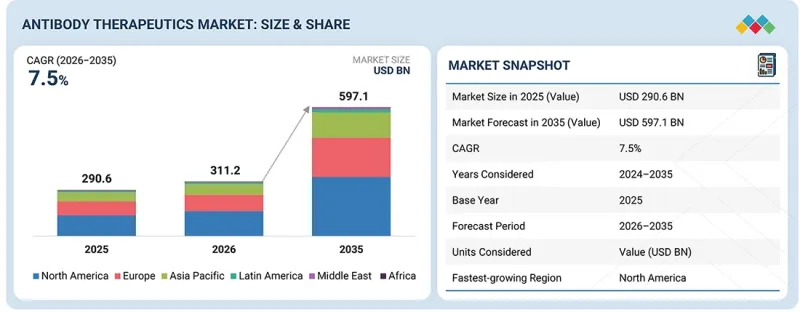
항체 치료제 시장 규모는 2026년 3,112억 달러에서 예측 기간 동안 CAGR 7.5%로 확대되어 2035년에는 5,971억 달러에 달할 것으로 예측됩니다.
| 조사 범위 | |
|---|---|
| 조사 대상 기간 | 2026-2035년 |
| 기준 연도 | 2025년 |
| 예측 기간 | 2026-2035년 |
| 산정 단위 | 금액(10억 달러) |
| 부문 | 제품별, 형태별, 표적별, 유래별, 투여 경로별, 치료 분야별, 최종사용자별, 지역별 |
| 대상 지역 | 북미, 유럽, 아시아태평양, 라틴아메리카, 중동 및 아프리카 |
시장 성장은 암, 자가면역 질환, 염증성 질환 및 기타 만성 질환 분야에서 표적 특이성이 높은 생물학적 제제에 대한 수요 증가에 의해 주도되고 있습니다. 단일클론 항체는 여전히 성장의 주요 요인으로 작용하고 있습니다. 또한, 항체 공학의 발전으로 인해 시장은 기존의 단일클론 항체에 그치지 않고, 이중특이성항체 및 다중 특이성 항체, 항체 단편, 항체약물접합체(ADC) 등으로 확대되고 있습니다.
제품별로는 2025년에 시판 중인 항체 치료제 시장 부문이 시장 점유율에서 가장 큰 비중을 차지했습니다.
시장 세분화에서는 시판 제품(키트루다, 듀피센트, 스카이리지, 달자렉스, 비브가트 및 기타 시판 제품)과 파이프라인 제품(이보네시맙, 사시츠주맙-틸모테칸(Sac-TMT), 이자론타맙-브렌기테칸 및 기타 파이프라인 제품)으로 분류됩니다. 2025년에는 승인된 단일클론 항체, 면역관문억제제, 항염증성 생물학적 제제, ADC 및 이중특이성항체의 임상 현장에서 높은 채택률과 매출 기여에 힘입어, 시판 중인 항체 치료제 부문이 시장에서 가장 큰 점유율을 차지했습니다. 이러한 우위는 이러한 치료법이 암, 자가면역 질환, 염증성 질환, 혈액 질환, 안과 질환 및 희귀 질환 적응증에서 입증된 효능, 표적 특이성, 확립된 안전성 프로파일 및 폭넓은 사용 실적을 반영한 결과입니다.
2025년에는 북미가 항체 치료제 시장 전체에서 가장 큰 점유율을 차지했습니다.
미국은 주요 기업, 대학 부속 병원, 연구 기관, 임상시험 네트워크 및 전문 바이오의약품 제조사로 구성된 긴밀한 생태계의 지원을 받아 북미 항체 치료제 시장에서 가장 큰 기여를 하고 있습니다. 이 지역은 높은 의료비 지출, 바이오의약품 연구 개발에 대한 아낌없는 자금 지원, 표적 치료법의 조기 도입, 그리고 단일클론 항체, 이중특이성항체, ADC 및 기타 차세대 항체 제제의 개발과 상용화를 지원하는 확립된 규제 절차 등의 혜택을 누리고 있습니다.
AbbVie Inc.(미국), Merck(미국), Novartis AG(스위스), Bristol-Myers Squibb(미국), Johnson & Johnson(미국), F. Hoffmann-La Roche Ltd.(스위스), Regeneron Pharmaceuticals Inc.(미국), Boehringer Ingelheim International GmbH(독일), MacroGenics, Inc.(미국), Sanofi(프랑스), Amgen Inc.(미국), GlaxoSmithKline plc(영국), Eli Lilly and Company(미국), Pfizer Inc.(미국), Daiichi Sankyo, Inc.(일본), AstraZeneca(영국), Celltrion(한국), UCB, Inc.(벨기에), Innovent Biologics(중국), Emergent BioSolutions Inc.(미국), Immunocore Ltd.(영국).
조사 범위:
본 조사 보고서에서는 항체 치료제 시장을 제품(시판 제품, 개발 중인 제품), 형태(단일클론 항체, 다클론 항체, 항체 단편, 이중특이성항체, 항체약물접합체), 표적(PD-1/PD-L1, TNF-α, 사이토카인/염증 경로 표적, HER2, 기타 표적), 유래(인간, 인간화, 키메라, 기타 유래) , 투여 경로(정맥 내, 피하, 기타 투여 경로), 치료 분야(자가면역·염증성 질환, 종양학, 혈액학, 감염증, 골학, 면역학, 신경학, 기타 치료 분야), 최종사용자(병원·전문 의료 센터, 장기 요양 시설, 기타 최종사용자), 및 지역(북미, 유럽, 아시아태평양, 라틴아메리카, 중동 및 아프리카)입니다.
본 보고서의 범위에는 항체 치료제 시장의 성장에 영향을 미치는 주요 요인(촉진요인, 억제요인, 과제, 기회 등)에 대한 상세 정보가 포함되어 있습니다. 주요 업계 플레이어에 대한 철저한 분석을 통해 각 기업의 사업 개요, 제품, 주요 전략, 신제품 출시, 인수합병 및 항체 치료제 시장과 관련된 최근 동향에 대한 인사이트를 제공합니다. 또한, 본 보고서에서는 항체 치료제 시장의 생태계에서 두각을 나타내고 있는 스타트업 기업의 경쟁 분석에 대해서도 다루고 있습니다.
본 보고서를 구매할 때의 주요 이점:
본 보고서는 항체 치료제 시장 및 그 하위 부문의 매출에 대해 가장 정확한 추정치를 제공함으로써, 시장을 선도하는 기업과 신규 진입 기업을 지원합니다. 또한 이해관계자가 경쟁 구도를 더 깊이 이해하고, 자사의 비즈니스를 포지셔닝하며, 적절한 시장 진입 전략을 수립하기 위한 인사이트를 얻는 데에도 도움이 됩니다. 본 보고서를 통해 이해관계자는 시장 동향을 파악하고, 주요 시장 촉진요인, 억제요인, 과제, 동향 및 기회에 대한 정보를 얻을 수 있습니다.
본 보고서는 다음 사항에 대한 인사이트를 제공합니다:
- 항체 치료제 시장의 성장에 영향을 미치는 주요 촉진요인(승인 활성화 및 파이프라인의 모멘텀), 제약요인(장기적이고 자본 집약적인 개발), 기회(종양학 분야 외로의 확장), 과제(안전성 및 승인 후 의무)에 대한 분석
- 제품 승인 : 항체 치료제 시장에서 새로 승인된 제품에 대한 상세한 분석
- 시장 동향 : 수익성이 높은 시장에 대한 종합적인 정보 - 본 보고서는 다양한 지역의 항체 치료제 시장을 분석합니다
- 시장 다각화 : 항체 치료제 시장의 신제품, 최근 동향 및 투자에 관한 종합적인 정보
- 파이프라인 분석 : 임상시험 중인 항체 치료제에 관한 종합적인 정보
- 경쟁 환경 평가 : AbbVie Inc.(미국), Merck(미국), Johnson & Johnson(미국), Regeneron Pharmaceuticals Inc.(미국), Sanofi(프랑스), Amgen Inc.(미국), GlaxoSmithKline plc(영국) 등 항체 치료제 시장의 주요 기업들의 시장 점유율, 성장 전략, 제품 라인업에 대한 상세한 평가
자주 묻는 질문
목차
제1장 소개
제2장 주요 요약
제3장 주요 인사이트
제4장 시장 개요
제5장 업계 동향
제6장 기술의 진보, AI에 의한 영향, 혁신, 향후 응용
제7장 지속가능성과 규제 상황
제8장 고객 상황과 구매 행동
제9장 항체 치료제 시장(제품별)
제10장 항체 치료제 시장(형태별)
제11장 항체 치료제 시장(표적별)
제12장 항체 치료제 시장(유래별)
제13장 항체 치료제 시장(투여 경로별)
제14장 항체 치료제 시장(치료 분야별)
제15장 항체 치료제 시장(최종사용자별)
제16장 항체 치료제 시장(지역별)
제17장 경쟁 구도
제18장 기업 개요
제19장 조사 방법
제20장 부록
KSM 26.08.14The antibody therapeutics market is projected to reach USD 597.1 billion by 2035, up from USD 311.2 billion in 2026, at a CAGR of 7.5% over the forecast period.
| Scope of the Report | |
|---|---|
| Years Considered for the Study | 2026-2035 |
| Base Year | 2025 |
| Forecast Period | 2026-2035 |
| Units Considered | Value (USD billion) |
| Segments | Product, Format, Target, Source, Route of Administration, Therapeutic Area, End User |
| Regions covered | North America, Europe, Asia Pacific, Latin America, the Middle East, and Africa |
Market growth is driven by increasing demand for highly targeted biologic therapies across oncology, autoimmune diseases, inflammatory disorders, and other chronic conditions. Monoclonal antibodies remain a major contributor to growth. Advances in antibody engineering are also expanding the market beyond conventional monoclonal antibodies to include bispecific and multispecific antibodies, antibody fragments, and antibody-drug conjugates (ADCs).
By product, the commercialized antibody therapeutics market segment accounted for the largest share of the market in 2025.
The market is segmented into commercialized products (Keytruda, Dupixent, Skyrizi, Darzalex, Vyvgart, and other commercialized products) and pipeline products (Ivonescimab, Sacituzumab tirumotecan (Sac-TMT), Izalontamab brengitecan, and other pipeline products). In 2025, the commercialized antibody therapeutics segment accounted for the largest share of the market, driven by strong clinical adoption and revenue contributions from approved monoclonal antibodies, immune checkpoint inhibitors, anti-inflammatory biologics, ADCs, and bispecific antibodies. This dominance reflects the proven efficacy, target specificity, established safety profiles, and broad use of these therapies across oncology, autoimmune, inflammatory, hematologic, ophthalmic, and rare disease indications.
In 2025, North America accounted for the largest share of the overall antibody therapeutics market.
The US is the largest contributor to North America's antibody therapeutics market, supported by a dense ecosystem of leading biopharmaceutical companies, academic medical centers, research institutes, clinical-trial networks, and specialized biologics manufacturers. The region benefits from high healthcare spending, strong funding for biologics R&D, early adoption of targeted therapies, and established regulatory pathways that support the development and commercialization of monoclonal antibodies, bispecific antibodies, ADCs, and other next-generation antibody formats.
The primary interviews conducted for this report can be categorized as follows:
- By Respondent: Tier 1-25%, Tier 2-35%, and Tier 3- 40%
- By Designation: C-level Executives - 30%, Directors- 45%, and Others- 25%
- By Region: North America - 35%, Europe - 25%, Asia Pacific - 15%, Latin America - 10%, Middle East- 10%, and Africa - 5%
AbbVie Inc. (US), Merck (US), Novartis AG (Switzerland), Bristol-Myers Squibb (US), Johnson & Johnson (US), F. Hoffmann-La Roche Ltd. (Switzerland), Regeneron Pharmaceuticals Inc. (US), Boehringer Ingelheim International GmbH (Germany), MacroGenics, Inc. (US), Sanofi (France), Amgen Inc. (US), GlaxoSmithKline plc (UK), Eli Lilly and Company (US), Pfizer Inc. (US), Daiichi Sankyo, Inc. (Japan), AstraZeneca (UK), Celltrion (South Korea), UCB, Inc. (Belgium), Innovent Biologics (China), Emergent BioSolutions Inc. (US), Immunocore Ltd. (UK).
Research Coverage:
This research report categorizes antibody therapeutics market by product (commercialized products, pipeline products), format (monoclonal antibodies, polyclonal antibodies, antibody fragments, bispecific antibodies, antibody drug conjugates), target (PD-1/PD-L1, TNF alpha, cytokine/inflammatory pathway targets, HER2, other targets), source (human, humanized, chimeric, other sources), route of administration (intravenous, subcutaneous, other routes of administration), therapeutic area (autoimmune & inflammatory diseases, oncology, hematology, infectious diseases, osteology, immunology, neurology, other therapeutic areas), end user (hospitals & specialty care centers, long-term care facilities, other end users), and region (North America, Europe, Asia Pacific, Latin America, Middle East, and Africa).
The report's scope covers detailed information on the primary factors, such as drivers, restraints, challenges, and opportunities, that influence the growth of the antibody therapeutics market. A thorough analysis of key industry players has been conducted to provide insights into their business overviews, products, key strategies, new product launches, acquisitions, and recent developments associated with the antibody therapeutics market. This report also covers the competitive analysis of upcoming startups in the antibody therapeutics market ecosystem.
Key Benefits of Buying the Report:
The report will help market leaders and new entrants by providing the closest approximations of revenue for the antibody therapeutics market and its subsegments. It will also help stakeholders better understand the competitive landscape and gain insights to position their business and develop suitable go-to-market strategies. This report will enable stakeholders to understand the market's pulse and provide information on key market drivers, restraints, challenges, trends, and opportunities.
The report provides insights into the following:
- Analysis of key drivers (strong approval and pipeline momentum), restraints (long, capital-intensive development), opportunities (expansion beyond oncology), and challenges (safety and post-approval obligations) influencing the growth of the antibody therapeutics market
- Product Approvals: Detailed insights on newly approved products of the antibody therapeutics market
- Market Development: Comprehensive information about lucrative markets - the report analyzes the antibody therapeutics market across varied regions
- Market Diversification: Exhaustive information about new products, recent developments, and investments in the antibody therapeutics market
- Pipeline Analysis: Comprehensive information about antibody therapeutics under clinical trials
- Competitive Assessment: In-depth assessment of market, growth strategies, and product offerings of leading players, including AbbVie Inc. (US), Merck (US), Johnson & Johnson (US), Regeneron Pharmaceuticals Inc. (US), Sanofi (France), Amgen Inc. (US), GlaxoSmithKline plc (UK), among several others, are key players in the antibody therapeutics market
TABLE OF CONTENTS
1 INTRODUCTION
- 1.1 STUDY OBJECTIVES
- 1.2 MARKET DEFINITION
- 1.3 STUDY SCOPE
- 1.3.1 MARKET SEGMENTATION & REGIONS COVERED
- 1.3.2 INCLUSIONS & EXCLUSIONS
- 1.3.3 YEARS CONSIDERED
- 1.3.4 CURRENCY CONSIDERED
- 1.4 STAKEHOLDERS
- 1.5 SUMMARY OF CHANGES
2 EXECUTIVE SUMMARY
- 2.1 KEY INSIGHTS & MARKET HIGHLIGHTS
- 2.2 KEY MARKET PARTICIPANTS: INSIGHTS & STRATEGIC DEVELOPMENTS
- 2.3 DISRUPTIVE TRENDS SHAPING MARKET GROWTH
- 2.4 HIGH-GROWTH SEGMENTS & EMERGING FRONTIERS
- 2.5 SNAPSHOT: GLOBAL MARKET SIZE, GROWTH RATE, AND FORECAST
3 PREMIUM INSIGHTS
- 3.1 ANTIBODY THERAPEUTICS MARKET OVERVIEW
- 3.2 ANTIBODY THERAPEUTICS MARKET, BY ROUTE OF ADMINISTRATION & REGION
- 3.3 ANTIBODY THERAPEUTICS MARKET: GEOGRAPHIC SNAPSHOT
- 3.4 ANTIBODY THERAPEUTICS MARKET SHARE, BY SOURCE, 2026 VS. 2035 (%)
4 MARKET OVERVIEW
- 4.1 INTRODUCTION
- 4.2 MARKET DYNAMICS
- 4.2.1 DRIVERS
- 4.2.1.1 Rising clinical success and regulatory approvals of antibody therapeutics
- 4.2.1.2 Technological advancements in antibody engineering and bispecific platforms
- 4.2.2 RESTRAINTS
- 4.2.2.1 Patent expirations and biosimilar competition intensifying pricing pressure
- 4.2.3 OPPORTUNITIES
- 4.2.3.1 Expansion of antibody therapeutics into non-oncology therapeutic areas
- 4.2.3.2 Rapid expansion of bispecific and multispecific antibody platforms
- 4.2.4 CHALLENGES
- 4.2.4.1 Concerns related to biocompatibility, safety, and adverse immune responses
- 4.2.1 DRIVERS
- 4.3 UNMET NEEDS & WHITE SPACES
- 4.4 INTERCONNECTED MARKETS & CROSS-SECTOR OPPORTUNITIES
- 4.5 STRATEGIC MOVES BY TIER-1/2/3 PLAYERS
5 INDUSTRY TRENDS
- 5.1 PORTER'S FIVE FORCES ANALYSIS
- 5.1.1 THREAT OF NEW ENTRANTS
- 5.1.2 THREAT OF SUBSTITUTES
- 5.1.3 BARGAINING POWER OF BUYERS
- 5.1.4 BARGAINING POWER OF SUPPLIERS
- 5.1.5 INTENSITY OF COMPETITIVE RIVALRY
- 5.2 MACROECONOMIC OUTLOOK
- 5.2.1 INTRODUCTION
- 5.2.2 GDP TRENDS & FORECAST
- 5.2.3 TRENDS IN GLOBAL ANTIBODY THERAPEUTICS MARKET
- 5.3 VALUE CHAIN ANALYSIS
- 5.4 ECOSYSTEM ANALYSIS
- 5.4.1 LIST OF KEY ANTIBODY CDMOS/CMOS & SERVICE PROVIDERS
- 5.4.2 MANUFACTURING SITES & CAPACITY EXPANSION OF KEY ANTIBODY MANUFACTURERS
- 5.5 PRICING ANALYSIS
- 5.5.1 AVERAGE SELLING PRICE OF KEY PRODUCTS, BY KEY PLAYER (2025)
- 5.5.2 INDICATIVE PRICING ANALYSIS, BY PRODUCT (2023-2025)
- 5.5.3 AVERAGE SELLING PRICE OF KEY PRODUCTS, BY REGION (2025)
- 5.6 KEY CONFERENCES & EVENTS, 2026-2027
- 5.7 TRENDS/DISRUPTIONS IMPACTING CUSTOMERS' BUSINESSES
- 5.8 INVESTMENT/FUNDING ACTIVITY
- 5.9 IMPACT OF 2025 US TARIFFS ON GLOBAL ANTIBODY THERAPEUTICS MARKET
- 5.9.1 INTRODUCTION
- 5.9.2 PRICE IMPACT ANALYSIS
- 5.9.3 IMPACT ON COUNTRY/REGION
- 5.9.3.1 North America
- 5.9.3.2 Europe
- 5.9.3.3 Asia Pacific
- 5.9.4 IMPACT ON END-USE INDUSTRIES
- 5.9.4.1 Hospitals
- 5.9.4.2 Specialty clinics & cancer centers
- 5.9.4.3 Other specialty care settings
6 TECHNOLOGICAL ADVANCEMENTS, AI-DRIVEN IMPACT, INNOVATIONS, AND FUTURE APPLICATIONS
- 6.1 INTRODUCTION
- 6.2 KEY EMERGING TECHNOLOGIES
- 6.2.1 BISPECIFIC & MULTISPECIFIC ANTIBODY ENGINEERING
- 6.2.2 NEXT-GENERATION ANTIBODY-DRUG CONJUGATES (ADCS)
- 6.2.3 FC ENGINEERING & HALF-LIFE EXTENSION
- 6.3 ADJACENT TECHNOLOGIES
- 6.3.1 ANTIBODY DISCOVERY & ENGINEERING PLATFORMS
- 6.3.2 GLYCOENGINEERING & EXPRESSION-SYSTEM ENGINEERING
- 6.4 COMPLEMENTARY TECHNOLOGIES
- 6.4.1 SUBCUTANEOUS DELIVERY & CO-FORMULATION
- 6.4.2 COMPANION DIAGNOSTICS & BIOMARKER-GUIDED PATIENT SELECTION
- 6.5 TECHNOLOGY/PRODUCT ROADMAP
- 6.6 FUTURE APPLICATIONS
- 6.7 PIPELINE ANALYSIS
- 6.7.1 KEY PIPELINE PRODUCTS & INDICATION EXPANSION
- 6.7.2 DISCONTINUED/DEPRIORITIZED PIPELINE ASSETS
- 6.8 IMPACT OF AI/GEN AI ON GLOBAL ANTIBODY THERAPEUTICS MARKET
- 6.8.1 TOP USE CASES & MARKET POTENTIAL
- 6.8.2 CASE STUDIES OF AI IMPLEMENTATION IN GLOBAL ANTIBODY THERAPEUTICS MARKET
- 6.8.3 INTERCONNECTED ADJACENT ECOSYSTEM & IMPACT ON MARKET PLAYERS
- 6.8.4 CLIENTS' READINESS TO ADOPT GENERATIVE AI IN GLOBAL ANTIBODY THERAPEUTICS MARKET
7 SUSTAINABILITY & REGULATORY LANDSCAPE
- 7.1 REGIONAL REGULATIONS & COMPLIANCE
- 7.1.1 REGULATORY BODIES, GOVERNMENT AGENCIES, AND OTHER ORGANIZATIONS
- 7.1.2 REGULATORY FRAMEWORK & REIMBURSEMENT
- 7.1.3 INDUSTRY STANDARDS
- 7.2 SUSTAINABILITY IMPACT & REGULATORY POLICY INITIATIVES
- 7.3 CERTIFICATIONS, LABELING, AND ECO-STANDARDS
8 CUSTOMER LANDSCAPE & BUYER BEHAVIOR
- 8.1 DECISION-MAKING PROCESS
- 8.2 BUYER STAKEHOLDERS & BUYING EVALUATION CRITERIA
- 8.2.1 KEY STAKEHOLDERS IN BUYING PROCESS
- 8.2.2 KEY BUYING CRITERIA, BY END USER
- 8.3 ADOPTION BARRIERS & INTERNAL CHALLENGES
- 8.4 UNMET NEEDS FROM END USERS
- 8.5 MARKET PROFITABILITY
9 ANTIBODY THERAPEUTICS MARKET, BY PRODUCT
- 9.1 INTRODUCTION
- 9.2 COMMERCIALIZED PRODUCTS
- 9.2.1 KEYTRUDA
- 9.2.1.1 Earlier-stage use, combination regimens, and subcutaneous conversion to sustain Keytruda leadership
- 9.2.2 DUPIXENT
- 9.2.2.1 Expansion across type 2 inflammatory diseases and age groups to support continued Dupixent growth
- 9.2.3 SKYRIZI
- 9.2.3.1 Durable IL-23 efficacy and gastroenterology expansion to reinforce Skyrizi adoption
- 9.2.4 DARZALEX
- 9.2.4.1 Frontline combinations and rapid subcutaneous dosing to extend Darzalex franchise
- 9.2.5 VYVGART
- 9.2.5.1 FcRn class expansion and self-administered delivery to accelerate Vyvgart uptake
- 9.2.6 OTHER COMMERCIALIZED PRODUCTS
- 9.2.1 KEYTRUDA
- 9.3 PIPELINE PRODUCTS
- 9.3.1 IVONESCIMAB
- 9.3.1.1 Dual PD-1/VEGF blockade and broad Phase III development to support Ivonescimab's global potential
- 9.3.2 SACITUZUMAB TIRUMOTECAN (SAC-TMT)
- 9.3.2.1 TROP2 validation and topoisomerase-I payload activity to drive sac-TMT across solid tumors
- 9.3.3 IZALONTAMAB BRENGITECAN
- 9.3.3.1 Dual EGFR/HER3 targeting and ADC delivery to support iza-bren in resistant epithelial cancers
- 9.3.4 OTHER PIPELINE PRODUCTS
- 9.3.1 IVONESCIMAB
10 ANTIBODY THERAPEUTICS MARKET, BY FORMAT
- 10.1 INTRODUCTION
- 10.2 MONOCLONAL ANTIBODIES
- 10.2.1 BROAD CLINICAL VALIDATION AND REPEATED INDICATION EXPANSION TO MAKE MONOCLONAL ANTIBODIES LARGEST FORMAT
- 10.3 POLYCLONAL ANTIBODIES
- 10.3.1 EMERGENCY PREPAREDNESS AND SPECIALIST USE TO SUSTAIN DEMAND FOR POLYCLONAL ANTIBODIES
- 10.4 ANTIBODY FRAGMENTS
- 10.4.1 IMPROVED TISSUE PENETRATION AND LOCAL DELIVERY TO SUPPORT GROWTH OF ANTIBODY FRAGMENTS
- 10.5 BISPECIFIC ANTIBODIES
- 10.5.1 RAPID APPROVALS AND DUAL-TARGET MECHANISMS TO MAKE BISPECIFIC ANTIBODIES HIGH-GROWTH FORMAT
- 10.6 ANTIBODY-DRUG CONJUGATES (ADCS)
- 10.6.1 DM1
- 10.6.1.1 Established HER2 use and regional follow-on products to sustain the DM1 payload segment
- 10.6.2 MMAE
- 10.6.2.1 Broad target applicability and large approved product base to support MMAE growth
- 10.6.3 SN-38
- 10.6.3.1 TROP-2 validation and bystander activity to support continued SN-38 demand
- 10.6.4 DM4
- 10.6.4.1 Folate receptor-alpha-based patient selection to anchor DM4 payload segment
- 10.6.5 OTHER PAYLOAD TYPES
- 10.6.1 DM1
- 10.7 OTHER ANTIBODY THERAPEUTICS
11 ANTIBODY THERAPEUTICS MARKET, BY TARGET
- 11.1 INTRODUCTION
- 11.2 PD-1/PD-L1
- 11.2.1 BROAD ONCOLOGY USE AND COMBINATION STRATEGIES TO SUSTAIN PD-1/PD-L1 DEMAND
- 11.3 TNF ALPHA
- 11.3.1 BIOSIMILAR ACCESS AND ENTRENCHED GUIDELINE USE TO SUSTAIN TNF ALPHA VOLUMES
- 11.4 CYTOKINE/INFLAMMATORY PATHWAY TARGETS
- 11.4.1 INTERLEUKIN AND INFLAMMATORY-PATHWAY EXPANSION TO DRIVE CHRONIC DISEASE ADOPTION
- 11.5 HER2
- 11.5.1 ADC INNOVATION AND BIOMARKER-LED EXPANSION TO STRENGTHEN HER2-TARGETED ANTIBODIES
- 11.6 OTHER TARGETS
12 ANTIBODY THERAPEUTICS MARKET, BY SOURCE
- 12.1 INTRODUCTION
- 12.2 HUMAN
- 12.2.1 LOWER IMMUNOGENICITY AND CHRONIC-USE EXPANSION TO SUPPORT FULLY HUMAN ANTIBODIES
- 12.3 HUMANIZED
- 12.3.1 LARGE BLOCKBUSTER BASE AND ENGINEERING FLEXIBILITY TO KEEP HUMANIZED ANTIBODIES DOMINANT
- 12.4 CHIMERIC
- 12.4.1 ESTABLISHED CLINICAL USE AND BIOSIMILAR ACCESS TO SUSTAIN CHIMERIC-ANTIBODY VOLUMES
- 12.5 OTHER SOURCES
13 ANTIBODY THERAPEUTICS MARKET, BY ROUTE OF ADMINISTRATION
- 13.1 INTRODUCTION
- 13.2 INTRAVENOUS
- 13.2.1 COMPLEX ONCOLOGY AND HOSPITAL-BASED DOSING TO MAKE INTRAVENOUS ADMINISTRATION LARGEST ROUTE
- 13.3 SUBCUTANEOUS
- 13.3.1 LOWER ADMINISTRATION BURDEN AND HOME-CARE POTENTIAL TO MAKE SUBCUTANEOUS DELIVERY FASTEST-GROWING ROUTE
- 13.4 OTHER ROUTES OF ADMINISTRATION
14 ANTIBODY THERAPEUTICS MARKET, BY THERAPEUTIC AREA
- 14.1 INTRODUCTION
- 14.2 AUTOIMMUNE & INFLAMMATORY DISEASES
- 14.2.1 CHRONIC DISEASE BURDEN AND TARGETED BIOLOGIC SEQUENCING TO SUSTAIN DEMAND
- 14.3 ONCOLOGY
- 14.3.1 EARLIER-LINE IMMUNOTHERAPY, ADCS, AND BISPECIFICS TO BOOST MARKET GROWTH
- 14.4 HEMATOLOGY
- 14.4.1 DEEPENING RESPONSE EXPECTATIONS AND OUTPATIENT FORMATS TO ACCELERATE HEMATOLOGY ANTIBODY USE
- 14.5 INFECTIOUS DISEASES
- 14.5.1 LONG-ACTING PROPHYLAXIS AND PREPAREDNESS PROGRAMS TO SUPPORT MARKET GROWTH
- 14.6 BONE DISORDER
- 14.6.1 POPULATION AGING, FRACTURE PREVENTION, AND BIOSIMILAR ACCESS TO SUSTAIN DEMAND
- 14.7 IMMUNOLOGY
- 14.7.1 TYPE 2 DISEASE EXPANSION AND BIOMARKER-LED TREATMENT TO DRIVE GROWTH
- 14.8 NEUROLOGY
- 14.8.1 DISEASE-MODIFYING ANTIBODIES AND EASIER ADMINISTRATION TO MAKE NEUROLOGY HIGH-GROWTH AREA
- 14.9 OTHER THERAPEUTIC AREAS
15 ANTIBODY THERAPEUTICS MARKET, BY END USER
- 15.1 INTRODUCTION
- 15.2 HOSPITALS & SPECIALTY CARE CENTERS
- 15.2.1 COMPLEX INFUSION PROTOCOLS AND MULTIDISCIPLINARY CARE TO KEEP HOSPITALS AND SPECIALTY CENTERS DOMINANT
- 15.3 LONG-TERM CARE FACILITIES
- 15.3.1 AGING POPULATIONS AND SCHEDULED CHRONIC BIOLOGIC CARE TO SUPPORT GRADUAL LONG-TERM CARE ADOPTION
- 15.4 OTHER END USERS
16 ANTIBODY THERAPEUTICS MARKET, BY REGION
- 16.1 INTRODUCTION
- 16.2 NORTH AMERICA
- 16.2.1 US
- 16.2.1.1 Regulatory speed and high-value specialty care to drive market growth
- 16.2.2 CANADA
- 16.2.2.1 Public reimbursement and coordinated cancer care to support steady antibody adoption
- 16.2.1 US
- 16.3 EUROPE
- 16.3.1 GERMANY
- 16.3.1.1 AMNOG assessment and dense specialty networks to support high-value antibody use
- 16.3.2 UK
- 16.3.2.1 MHRA agility and NHS specialist pathways to sustain targeted antibody uptake
- 16.3.3 FRANCE
- 16.3.3.1 National HTA, oncology infrastructure, and biologics investment to support market growth
- 16.3.4 ITALY
- 16.3.4.1 AIFA monitoring and hospital oncology networks to enable controlled antibody expansion
- 16.3.5 SPAIN
- 16.3.5.1 Hospital pharmacy expertise and national positioning reports to support measured adoption
- 16.3.6 REST OF EUROPE
- 16.3.1 GERMANY
- 16.4 ASIA PACIFIC
- 16.4.1 CHINA
- 16.4.1.1 Domestic bispecific and ADC innovation to accelerate antibody market expansion
- 16.4.2 JAPAN
- 16.4.2.1 Universal coverage and first-in-class launches to support stable high-value adoption
- 16.4.3 SOUTH KOREA
- 16.4.3.1 Biologics manufacturing scale and biosimilar leadership to support rapid market development
- 16.4.4 INDIA
- 16.4.4.1 Cost-efficient biosimilars and expanding specialty care to broaden antibody access
- 16.4.5 AUSTRALIA
- 16.4.5.1 Specialist centers and efficient regulation to support adoption of differentiated antibodies
- 16.4.6 REST OF ASIA PACIFIC
- 16.4.1 CHINA
- 16.5 LATIN AMERICA
- 16.5.1 BRAZIL
- 16.5.1.1 Large public and private care systems to anchor Latin American antibody demand
- 16.5.2 MEXICO
- 16.5.2.1 Large institutional purchasers and private oncology networks to support rising adoption
- 16.5.3 REST OF LATIN AMERICA
- 16.5.1 BRAZIL
- 16.6 MIDDLE EAST
- 16.6.1 GCC COUNTRIES
- 16.6.1.1 Saudi Arabia
- 16.6.1.1.1 Vision 2030 investment and SFDA modernization to accelerate specialty-biologic access
- 16.6.1.2 UAE
- 16.6.1.2.1 Private insurance, medical hubs, and regulatory reforms to support premium antibody uptake
- 16.6.1.3 Rest of GCC Countries
- 16.6.1.1 Saudi Arabia
- 16.6.2 REST OF MIDDLE EAST
- 16.6.1 GCC COUNTRIES
- 16.7 AFRICA
- 16.7.1 BIOSIMILARS AND REGIONAL MANUFACTURING INITIATIVES OFFER A PATHWAY TO WIDER ACCESS
17 COMPETITIVE LANDSCAPE
- 17.1 INTRODUCTION
- 17.2 KEY STRATEGIES/RIGHT TO WIN
- 17.2.1 OVERVIEW OF STRATEGIES ADOPTED BY PLAYERS IN ANTIBODY THERAPEUTICS MARKET
- 17.3 REVENUE ANALYSIS, 2023-2025
- 17.4 MARKET SHARE ANALYSIS, 2025
- 17.5 COMPANY EVALUATION MATRIX: KEY PLAYERS, 2025
- 17.5.1 STARS
- 17.5.2 EMERGING LEADERS
- 17.5.3 PERVASIVE PLAYERS
- 17.5.4 PARTICIPANTS
- 17.5.5 COMPANY FOOTPRINT: KEY PLAYERS, 2025
- 17.5.5.1 Company footprint
- 17.5.5.2 Region footprint
- 17.5.5.3 Format footprint
- 17.5.5.4 Source footprint
- 17.5.5.5 Route of administration footprint
- 17.6 COMPANY EVALUATION MATRIX: STARTUPS/SMES, 2025
- 17.6.1 PROGRESSIVE COMPANIES
- 17.6.2 RESPONSIVE COMPANIES
- 17.6.3 DYNAMIC COMPANIES
- 17.6.4 STARTING BLOCKS
- 17.6.5 COMPETITIVE BENCHMARKING: STARTUPS/SMES, 2025
- 17.6.5.1 Detailed list of key startups/SMEs
- 17.6.5.2 Competitive benchmarking of key startups/SMEs
- 17.7 COMPANY VALUATION & FINANCIAL METRICS
- 17.7.1 COMPANY VALUATION
- 17.7.2 FINANCIAL METRICS
- 17.8 BRAND/PRODUCT COMPARISON
- 17.9 COMPETITIVE SCENARIOS
- 17.9.1 PRODUCT APPROVALS
- 17.9.2 DEALS
- 17.9.3 OTHER DEVELOPMENTS
18 COMPANY PROFILES
- 18.1 KEY PLAYERS
- 18.1.1 F. HOFFMANN-LA ROCHE LTD.
- 18.1.1.1 Business overview
- 18.1.1.2 Products offered
- 18.1.1.3 Recent developments
- 18.1.1.3.1 Product approvals
- 18.1.1.3.2 Deals
- 18.1.1.3.3 Expansions
- 18.1.1.4 MnM view
- 18.1.1.4.1 Key strengths
- 18.1.1.4.2 Strategic choices
- 18.1.1.4.3 Weaknesses & competitive threats
- 18.1.2 ABBVIE INC.
- 18.1.2.1 Business overview
- 18.1.2.2 Products offered
- 18.1.2.3 Recent developments
- 18.1.2.3.1 Product approvals
- 18.1.2.3.2 Deals
- 18.1.2.3.3 Expansions
- 18.1.2.4 MnM view
- 18.1.2.4.1 Key strengths
- 18.1.2.4.2 Strategic choices
- 18.1.2.4.3 Weaknesses & competitive threats
- 18.1.3 AMGEN INC.
- 18.1.3.1 Business overview
- 18.1.3.2 Products offered
- 18.1.3.3 Recent developments
- 18.1.3.3.1 Product approvals
- 18.1.3.3.2 Deals
- 18.1.3.3.3 Expansions
- 18.1.3.4 MnM view
- 18.1.3.4.1 Key strengths
- 18.1.3.4.2 Strategic choices
- 18.1.3.4.3 Weaknesses & competitive threats
- 18.1.4 REGENERON PHARMACEUTICALS, INC.
- 18.1.4.1 Business overview
- 18.1.4.2 Products offered
- 18.1.4.3 Recent developments
- 18.1.4.3.1 Product approvals
- 18.1.4.3.2 Deals
- 18.1.4.3.3 Expansions
- 18.1.4.4 MnM view
- 18.1.4.4.1 Key strengths
- 18.1.4.4.2 Strategic choices
- 18.1.4.4.3 Weaknesses & competitive threats
- 18.1.5 ASTRAZENECA PLC
- 18.1.5.1 Business overview
- 18.1.5.2 Products offered
- 18.1.5.3 Recent developments
- 18.1.5.3.1 Product approvals
- 18.1.5.3.2 Deals
- 18.1.5.3.3 Expansions
- 18.1.5.4 MnM view
- 18.1.5.4.1 Key strengths
- 18.1.5.4.2 Strategic choices
- 18.1.5.4.3 Weaknesses & competitive threats
- 18.1.6 BIOGEN INC.
- 18.1.6.1 Business overview
- 18.1.6.2 Products offered
- 18.1.6.3 Recent developments
- 18.1.6.3.1 Product approvals
- 18.1.6.3.2 Deals
- 18.1.6.3.3 Expansions
- 18.1.6.4 MnM view
- 18.1.6.4.1 Key strengths
- 18.1.6.4.2 Strategic choices
- 18.1.6.4.3 Weaknesses & competitive threats
- 18.1.7 MERCK & CO., INC.
- 18.1.7.1 Business overview
- 18.1.7.2 Products offered
- 18.1.7.3 Recent developments
- 18.1.7.3.1 Product approvals
- 18.1.7.3.2 Deals
- 18.1.7.4 MnM view
- 18.1.7.4.1 Key strengths
- 18.1.7.4.2 Strategic choices
- 18.1.7.4.3 Weaknesses & competitive threats
- 18.1.8 NOVARTIS AG
- 18.1.8.1 Business overview
- 18.1.8.2 Products offered
- 18.1.8.3 Recent developments
- 18.1.8.3.1 Product approvals
- 18.1.8.3.2 Deals
- 18.1.8.4 MnM view
- 18.1.8.4.1 Key strengths
- 18.1.8.4.2 Strategic choices
- 18.1.8.4.3 Weaknesses & competitive threats
- 18.1.9 DAIICHI SANKYO COMPANY, LIMITED
- 18.1.9.1 Business overview
- 18.1.9.2 Products offered
- 18.1.9.3 Recent developments
- 18.1.9.3.1 Product approvals
- 18.1.9.3.2 Deals
- 18.1.10 GSK PLC
- 18.1.10.1 Business overview
- 18.1.10.2 Products offered
- 18.1.10.3 Recent developments
- 18.1.10.3.1 Product approvals
- 18.1.11 SANOFI
- 18.1.11.1 Business overview
- 18.1.11.2 Products offered
- 18.1.11.3 Recent developments
- 18.1.11.3.1 Product approvals
- 18.1.11.3.2 Deals
- 18.1.12 GILEAD SCIENCES, INC.
- 18.1.12.1 Business overview
- 18.1.12.2 Products offered
- 18.1.12.3 Recent developments
- 18.1.12.3.1 Product approvals
- 18.1.13 JAZZ PHARMACEUTICALS PLC
- 18.1.13.1 Business overview
- 18.1.13.2 Products offered
- 18.1.13.3 Recent developments
- 18.1.13.3.1 Product approvals
- 18.1.13.3.2 Deals
- 18.1.14 PFIZER INC.
- 18.1.14.1 Business overview
- 18.1.14.2 Products offered
- 18.1.14.3 Recent developments
- 18.1.14.3.1 Product approvals
- 18.1.14.3.2 Deals
- 18.1.15 JOHNSON & JOHNSON
- 18.1.15.1 Business overview
- 18.1.15.2 Products offered
- 18.1.15.3 Recent developments
- 18.1.15.3.1 Product approvals
- 18.1.15.3.2 Deals
- 18.1.16 ELI LILLY AND COMPANY
- 18.1.16.1 Business overview
- 18.1.16.2 Products offered
- 18.1.16.3 Recent developments
- 18.1.16.3.1 Product approvals
- 18.1.16.3.2 Expansions
- 18.1.17 H. LUNDBECK A/S
- 18.1.17.1 Business overview
- 18.1.17.2 Products offered
- 18.1.17.3 Recent developments
- 18.1.17.3.1 Product approvals
- 18.1.1 F. HOFFMANN-LA ROCHE LTD.
- 18.2 OTHER PLAYERS
- 18.2.1 CHUGAI PHARMACEUTICAL CO., LTD.
- 18.2.2 AKESO, INC.
- 18.2.3 SICHUAN KELUN-BIOTECH BIOPHARMACEUTICAL CO., LTD.
- 18.2.4 CELLTRION, INC.
- 18.2.5 CSL BEHRING
- 18.2.6 OTSUKA AMERICA PHARMACEUTICAL, INC.
- 18.2.7 LEPU BIOPHARMA CO., LTD.
- 18.2.8 SINOCELLTECH GROUP LTD.
- 18.2.9 SYNERMORE BIOLOGICS
- 18.2.10 SHANGHAI JUNSHI BIOSCIENCES CO., LTD.
- 18.2.11 JIANGSU HENGRUI PHARMACEUTICALS CO., LTD.
19 RESEARCH METHODOLOGY
- 19.1 RESEARCH DATA
- 19.1.1 SECONDARY DATA
- 19.1.2 PRIMARY DATA
- 19.2 MARKET ESTIMATION METHODOLOGY
- 19.2.1 MARKET SIZE ESTIMATION
- 19.2.2 INSIGHTS FROM PRIMARY EXPERTS
- 19.2.3 BOTTOM-UP APPROACH
- 19.3 MARKET GROWTH RATE PROJECTIONS
- 19.4 MARKET BREAKDOWN & DATA TRIANGULATION
- 19.5 RESEARCH ASSUMPTIONS
- 19.6 RESEARCH LIMITATIONS
- 19.7 RISK ANALYSIS
20 APPENDIX
- 20.1 DISCUSSION GUIDE
- 20.2 KNOWLEDGESTORE: MARKETSANDMARKETS' SUBSCRIPTION PORTAL
- 20.3 CUSTOMIZATION OPTIONS
- 20.4 RELATED REPORTS
- 20.5 AUTHOR DETAILS


