
|
시장보고서
상품코드
2107271
폴리머 폼 시장 : 폼 유형별, 수지 유형별, 최종 이용 산업별, 지역별 - 세계 예측(-2031년)Polymer Foam Market by Resin Type (PU, PS, PO, Phenolic), Foam Type (Rigid, Flexible), End Use Industry (Building & Construction, Packaging, Automotive, Furniture & Bedding, Footwear, Sports & Recreational) and Region-Global Forecast to 2031 |
||||||

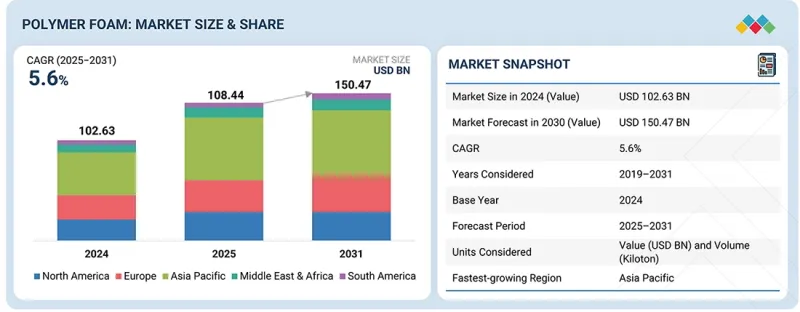
폴리머 폼 시장 규모는 2025년 1,084억 4,000만 달러에서 2031년까지 1,504억 7,000만 달러로 확대되어 예측 기간 동안 CAGR은 5.6%에 달할 것으로 전망됩니다.
폴리머 폼 시장이 성장하고 있는 것은 구조적 요인, 경제적 요인, 기술적 요인이 복합적으로 작용하여 산업 용도가 확대되고 있기 때문입니다.
| 조사 범위 | |
|---|---|
| 조사 대상 기간 | 2019-2031년 |
| 기준 연도 | 2024년 |
| 예측 기간 | 2025-2031년 |
| 산정 단위 | 금액(100만/10억 달러) 및 킬로톤 |
| 부문 | 폼 유형별, 수지 유형별, 최종 이용 산업별, 지역별 |
| 대상 지역 | 아시아태평양, 유럽, 북미, 중동 및 아프리카, 남미 |
시장의 주요 촉진요인은 특히 건설 업계와 자동차 업계에서 경량이며 에너지 효율이 뛰어난 소재가 요구되고 있다는 점에 있습니다. 건설 업계에서는 폴리머 발포체가 단열재 및 방음재로 널리 사용되고 있으며, 에너지 소비 절감과 점점 더 엄격해지는 건축물의 에너지 효율 규제에 대응하는 데 기여하고 있습니다. 자동차 업계에서는 연비 효율 향상과 전기자동차로의 전환이 가속화됨에 따라 시트, 내장재, 단열재에 경량 발포 소재가 채택되고 있습니다.
"수지 유형별로는 예측 기간 동안 폴리우레탄 부문이 금액 기준으로 가장 큰 시장 규모를 차지할 것으로 예상됩니다."
폴리우레탄 부문은 뛰어난 성능 특성 덕분에 예측 기간 동안 가장 큰 부문이 될 것으로 예상됩니다. 폴리우레탄 폼에는 연질과 경질 제품이 모두 있으며, 단열성과 완충성, 내구성, 경량 구조를 탁월하게 겸비하고 있어 건설, 가구, 침구, 자동차, 가전제품 등의 용도에 최적입니다. 이 부문이 시장 규모에서 우위를 차지하는 주요 요인은 고급 제품이나 성능을 중시하는 용도에서 널리 채택되고 있기 때문입니다. 건설 전문가들이 사용하는 단열 시스템용 경질 폴리우레탄 폼은 에너지 효율을 향상시키고 장기적으로 운영 비용을 절감해 주므로, 그들의 업무에 높은 부가가치를 제공합니다. 메모리 폼이나 고반발 타입을 포함한 유연성 폴리우레탄 폼은 주로 가구 및 침구용 고급 매트리스나 좌석 제품에 채택되고 있습니다. 자동차 업계에서는 폴리우레탄 폼의 응용을 통해 가치 창출을 확대하고 있으며, 이를 통해 차량 내부 부품의 쾌적성, 안전성 및 연비 효율이 향상되고 있습니다.
"최종 이용 산업별로 보면 예측 기간 동안 건축·건설 부문이 가장 빠르게 성장하는 시장이 될 것으로 예상됩니다."
건축·건설 부문은 지속가능성을 뒷받침하는 에너지 절약형 건축자재에 대한 수요가 증가하고 있어, 예측 기간 동안 가장 빠르게 성장하는 시장이 될 것으로 전망됩니다. 주택, 상업 시설, 산업용 건물의 단열에는 폴리머 폼이 널리 활용되고 있습니다. 여기에는 단열, 방음, 구조용 폴리우레탄 및 폴리스티렌 재질의 경질 폼이 포함됩니다. 이러한 자재는 열전도율이 극히 낮고, 경량이며, 방수성과 장기적인 강도 등 여러 가지 유익한 특성을 갖추고 있어 매우 높은 가치를 제공합니다. 신흥 시장에서는 도시화, 인구 증가, 인프라 프로젝트가 신규 건설 공사를 견인하고 있어 이 부문은 시장에서 지배적인 위치를 유지하고 있습니다. 엄격한 에너지 효율 기준 및 이산화탄소 배출 감축 요건을 포함한 에너지 효율이 높은 건축 규제의 도입으로, 선진 지역에서는 폴리머 폼을 포함한 첨단 단열재의 사용이 가속화되고 있습니다. 그린 빌딩 실천의 확산과 지속가능한 건설 기법의 결합으로 인해 재활용이 가능한 친환경 폼 소재에 대한 수요가 발생하고 있습니다.
"예측 기간 동안 아시아태평양은 금액 기준으로 최대 시장이 될 것으로 예상됩니다."
아시아태평양은 강력한 경제 발전, 급속한 도시화, 주요 부문에서의 대규모 산업 확장에 힘입어 예측 기간 동안 최대 시장이 될 것으로 전망됩니다. 중국, 인도, 일본, 한국 등 4대 경제 대국은 대규모 인프라 프로젝트와 주택 및 상업 건축 개발에 대한 재정 지원 확대를 통해 시장을 주도하고 있습니다. 건축 부문에서는 에너지 절약형 단열재가 요구되고 있으며, 이는 해당 지역 전체의 폴리머 폼 시장 규모를 확대시키고 있습니다.
아시아태평양은 자동차, 전자, 소비재 부문의 세계적 생산 거점이며, 이러한 부문에서는 경량 부재, 단열재, 보호용 포장재 제조에 폴리머 폼이 활용되고 있습니다. 이 지역에는 낮은 생산 비용으로 운영되며 원자재를 쉽게 조달할 수 있는 세계 기업 및 현지 제조업체가 존재하기 때문에 시장 규모가 확대되고 있습니다. 가처분 소득의 증가와 생활 수준의 향상으로 인해 고객들은 첨단 폼 소재를 사용한 고품질 가구, 침구, 가전제품을 구매하고 있습니다.
폴리머 폼 시장에서 사업을 전개하는 주요 기업으로는 ARMACELL(룩셈부르크), Sheela Foam Limited(인도), Kingspan Insulation, LLC(아일랜드), Owens Corning(미국), Saint-Gobain(프랑스), Dura Foam Industries Pvt, Ltd.(인도), FXI(미국), Aeroflex USA, Inc.(미국), Duroflex Foam(인도), Zotefoams plc(영국) 등이 있습니다. 이러한 주요 기업들은 폴리머 폼 시장에서 중요한 역할을 수행하고 있습니다. 각 기업은 시장 점유율과 매출을 확대하기 위해 제휴, 합작 투자, 사업 확장 등 다양한 전략을 채택하고 있습니다.
조사 범위:
본 보고서에서는 수지 유형, 발포체 종류, 최종 이용 산업 및 지역을 기준으로 부문을 정의하고, 폴리머 폼 시장의 규모를 예측하고 있습니다. 주요 기업의 전략적 프로필을 작성하고, 해당 기업의 시장 점유율과 핵심 경쟁력을 포괄적으로 분석하고 있습니다. 또한, 시장 내 각 기업의 사업 확장, 제휴, 인수합병(M&A) 등의 경쟁 동향을 추적·분석하고 있습니다.
본 보고서를 구매해야 하는 이유:
본 보고서는 폴리머 폼 시장 및 각 부문의 매출액에 대해 가장 정확한 추정치를 제공함으로써, 시장 선도 기업 및 신규 진입 기업에 도움이 될 것으로 기대됩니다. 또한, 이해관계자들이 시장의 경쟁 구도를 더 깊이 이해하고, 사업 입지를 강화하기 위한 귀중한 인사이트를 얻어 효과적인 시장 진입 전략을 수립하는 데에도 도움이 될 것으로 기대됩니다. 더불어, 이해관계자들이 시장 동향을 파악할 수 있도록 지원하는 동시에 주요 시장 촉진요인, 억제요인, 과제 및 기회에 대한 정보를 제공합니다.
본 보고서에서는 다음 사항에 대한 인사이트를 제공합니다:
- 성장 촉진요인(급속한 도시화와 건설업의 성장, 자동차 제조 거점의 확대, E-Commerce 및 포장 수요의 급증), 제약요인(일회용 플라스틱에 대한 환경 규제, 건축 기준 및 규격의 불일치), 기회(전기자동차(EV) 제조로의 전환, 콜드체인 물류의 성장, 대규모 인프라 투자), 및 과제(고급 발포체 가공 분야의 기술 격차, 발포체 폐기물에 대한 환경적 반발)에 대한 분석은 폴리머 발포체 시장의 성장에 영향을 미치고 있습니다.
- 제품 개발 및 혁신 : 폴리머 발포체 시장의 향후 기술 동향 및 연구 개발 활동에 대한 상세한 분석
- 시장 개발 : 다양한 지역의 수익성 높은 시장에 대한 종합적인 정보
- 시장 다각화 : 신제품, 각종 유형, 미개척 지역, 최근 동향 및 초고순도 흑연 시장에 대한 투자에 관한 종합적인 정보
- 경쟁 분석 : ARMACELL(룩셈부르크), Sheela Foam Limited(인도), Kingspan Insulation, LLC(아일랜드), Owens Corning(미국), Saint-Gobain(프랑스), Dura Foam Industries Pvt, Ltd.(인도), FXI(미국), Aeroflex USA, Inc.(미국), Duroflex Foam(인도), Zotefoams plc(영국) 등, 폴리머 폼 시장의 주요 기업에 대한 상세한 분석입니다.
자주 묻는 질문
목차
제1장 소개
제2장 주요 요약
제3장 주요 인사이트
제4장 시장 개요
제5장 업계 동향
제6장 기술 진보, AI에 의한 영향, 특허, 혁신, 향후 응용
제7장 규제 상황과 지속가능성에 대한 대처
제8장 고객 상황과 구매 행동
제9장 폴리머 폼 시장(폼 유형별)
제10장 폴리머 폼 시장(수지 유형별)
제11장 폴리머 폼 시장(최종 이용 산업별)
제12장 폴리머 폼 시장(지역별)
제13장 경쟁 구도
제14장 기업 개요
제15장 조사 방법
제16장 부록
KSM 26.08.14The polymer foam market is projected to grow from USD 108.44 billion in 2025 to USD 150.47 billion by 2031, at a CAGR of 5.6% during the forecast period. The polymer foam market experiences growth because structural factors, economic factors, and technological factors together increase its industrial applications.
| Scope of the Report | |
|---|---|
| Years Considered for the Study | 2019-2031 |
| Base Year | 2024 |
| Forecast Period | 2025-2031 |
| Units Considered | Value (USD Million/Billion) and Volume (Kiloton) |
| Segments | Resin Type, Foam Type, End-Use Industry, and Region |
| Regions covered | Asia Pacific, Europe, North America, the Middle East & Africa, and South America |
The primary market driver exists because industries need materials that are lightweight and energy-efficient, which applies especially to the construction and automotive industries. In construction, polymer foams are extensively used for thermal and acoustic insulation, helping reduce energy consumption and meet increasingly stringent building efficiency regulations. The automotive industry adopts lightweight foam materials for seating, interiors and insulation because of the accelerating trend towards fuel efficiency and electric vehicles.
"By resin type, the polyurethane segment is expected to be the largest market, in terms of value, during the forecast period."
The polyurethane segment is expected to be the largest segment during the forecast period due to its exceptional performance attributes. Polyurethane foams exist as flexible and rigid products, which provide an excellent combination of thermal insulation and cushioning, durability and lightweight structure that makes them ideal for use in construction and furniture, bedding and automotive and appliance applications. The segment's value dominance is largely attributed to its widespread adoption in premium and performance-driven applications. Rigid polyurethane foams for insulation systems, which construction professionals use, create energy efficiency improvements that lead to lower operational costs for extended periods of time, thus providing higher value for their work. Flexible polyurethane foams, which include memory foam and high-resilience variants, find their primary application in high-end mattresses and seating products for furniture and bedding purposes. The automotive industry expands its value creation through polyurethane foam applications, which improve vehicle interior components by providing better comfort and safety and fuel efficiency.
"By end-use industry, the building & construction segment is expected to be the fastest-growing market during the forecast period."
The building & construction segment is expected to be the fastest-growing market during the forecast period because of the rising demand for energy-efficient construction materials that support sustainability. The insulation of residential, commercial, and industrial buildings relies heavily on polymer foams, which include rigid foams made of polyurethane and polystyrene for thermal insulation, soundproofing and structural applications. These materials provide exceptional value because they possess multiple beneficial features, which include minimal heat transfer capacity, lightweight composition, water protection ability and long-lasting strength. The segment maintains its dominant market position because urbanization and population increases, and infrastructure projects drive new construction work in emerging markets. The implementation of energy-efficient building regulations, which include strict energy efficiency standards and carbon emission reduction requirements, accelerates the use of advanced insulation materials, which include polymer foams, in developed regions. The rise of green building practices, together with sustainable construction methods, creates a demand for environmentally friendly foam materials that can be recycled.
"Asia Pacific is expected to be the largest market, in terms of value, during the forecast period."
Asia Pacific is expected to be the largest market during the forecast period because of strong economic development, fast urban growth, and major industry expansions in key sectors. Four major economies, namely China, India, Japan, and South Korea, lead the market because of their extensive infrastructure projects and their growing financial support for residential and commercial building development. The building sector requires energy-efficient insulation materials, which increases the market value of polymer foams throughout the region.
Asia Pacific serves as a worldwide production center for the automotive, electronics, and consumer goods sectors, which utilize polymer foams to create lightweight components and thermal insulation and protective packaging materials. The market value of the region increases because it possesses global and local manufacturers who operate at low production costs and can easily obtain raw materials. The combination of rising disposable incomes and better living standards drives customers to purchase high-quality furniture, bedding and appliances which use advanced foam materials.
Profile break-up of primary participants for the report:
- By Company Type: Tier 1 - 45%, Tier 2 - 22%, and Tier 3 - 33%
- By Designation: C-Level Executives- 50%, Directors- 10%, and Others - 40%
- By Region: Asia Pacific - 17%, Europe - 33%, North America - 17%, Middle East & Africa - 25%, and South America - 8%
Leading players operating in the polymer foam market include ARMACELL (Luxembourg), Sheela Foam Limited (India), Kingspan Insulation, LLC (Ireland), Owens Corning (US), Saint-Gobain (France), Dura Foam Industries Pvt, Ltd. (India), FXI (US), Aeroflex USA, Inc. (US), Duroflex Foam (India) and Zotefoams plc (UK) and others. These key players are significant contributors to the polymer foam market. They have adopted various strategies, including agreements, joint ventures, and expansions, to increase their market share and business revenue.
Research Coverage:
The report defines segments and projects the size of the polymer foam market based on resin type, foam type, end-use industry, and region. It strategically profiles the key players and comprehensively analyzes their market share and core competencies. It also tracks and analyzes competitive developments, such as expansions, partnerships, and acquisitions undertaken by them in the market.
Reasons to Buy the Report:
The report is expected to help market leaders/new entrants by providing them with the closest approximations of revenue numbers for the polymer foam market and its segments. This report is also expected to help stakeholders gain a deeper understanding of the market's competitive landscape, acquire valuable insights to enhance their business positions, and develop effective go-to-market strategies. It also enables stakeholders to understand the market's pulse and provides information on key market drivers, restraints, challenges, and opportunities.
The report provides insights into the following pointers:
- Analysis of drivers (Rapid urbanization and construction growth, expanding automotive manufacturing base, booming e-commerce and packaging demand), restraints (Environmental restrictions on single-use plastics, inconsistent building codes and standards), opportunities (Shift toward EV manufacturing, growth of cold-chain logistics, high-volume infrastructure investments), and challenges (Technological gaps in advanced foam processing, environmental backlash against foam waste) are influencing the growth of the polymer foam market
- Product Development/Innovation: Detailed insights into upcoming technologies, research & development activities in the polymer foam market
- Market Development: Comprehensive information about lucrative markets across varied regions
- Market Diversification: Exhaustive information about new products, various types, untapped geographies, recent developments, and investments in the ultra-high-purity graphite market
- Competitive Assessment: In-depth assessment of market share, growth strategies, and product offerings of leading players, such as ARMACELL (Luxembourg), Sheela Foam Limited (India), Kingspan Insulation, LLC (Ireland), Owens Corning (US), Saint-Gobain (France), Dura Foam Industries Pvt, Ltd. (India), FXI (US), Aeroflex USA, Inc. (US), Duroflex Foam (India) and Zotefoams plc (UK) are the key players in polymer foam market.
TABLE OF CONTENTS
1 INTRODUCTION
- 1.1 STUDY OBJECTIVES
- 1.2 MARKET DEFINITION
- 1.3 STUDY SCOPE
- 1.3.1 MARKETS COVERED AND REGIONAL SCOPE
- 1.3.2 INCLUSIONS AND EXCLUSIONS
- 1.3.3 YEARS CONSIDERED
- 1.4 CURRENCY CONSIDERED
- 1.5 UNITS CONSIDERED
- 1.6 STAKEHOLDERS
- 1.7 SUMMARY OF CHANGES
2 EXECUTIVE SUMMARY
- 2.1 KEY INSIGHTS AND MARKET HIGHLIGHTS
- 2.2 KEY MARKET PARTICIPANTS: SHARE INSIGHTS AND STRATEGIC DEVELOPMENTS
- 2.3 DISRUPTIVE TRENDS IN POLYMER FOAM MARKET
- 2.4 HIGH-GROWTH SEGMENTS
- 2.5 REGIONAL SNAPSHOT: MARKET SIZE, GROWTH RATE, AND FORECAST
3 PREMIUM INSIGHTS
- 3.1 ATTRACTIVE OPPORTUNITIES FOR PLAYERS IN POLYMER FOAM MARKET
- 3.2 POLYMER FOAM MARKET, BY REGION
- 3.3 POLYMER FOAM MARKET, BY RESIN TYPE
- 3.4 POLYMER FOAM MARKET, BY COUNTRY
4 MARKET OVERVIEW
- 4.1 INTRODUCTION
- 4.2 MARKET DYNAMICS
- 4.2.1 DRIVERS
- 4.2.1.1 Growth of major end-use industries of polymer foams
- 4.2.1.2 High demand for polymer foams in Asia Pacific
- 4.2.1.3 Global focus on energy sustainability and energy conservation
- 4.2.2 RESTRAINTS
- 4.2.2.1 Volatility in raw material prices
- 4.2.3 OPPORTUNITIES
- 4.2.3.1 Growing demand for bio-based polyols
- 4.2.3.2 Rising demand for CO2-based polyols
- 4.2.4 CHALLENGES
- 4.2.4.1 High pricing pressure to cause fluctuations in crude oil prices
- 4.2.4.2 Stringent regulations
- 4.2.1 DRIVERS
- 4.3 UNMET NEEDS AND WHITE SPACES
- 4.3.1 UNMET NEEDS IN POLYMER FOAM MARKET
- 4.3.2 WHITE SPACE OPPORTUNITIES
- 4.4 INTERCONNECTED MARKETS AND CROSS-SECTOR OPPORTUNITIES
- 4.4.1 INTERCONNECTED MARKETS
- 4.4.2 CROSS-SECTOR OPPORTUNITIES
- 4.5 EMERGING BUSINESS MODELS AND ECOSYSTEM SHIFTS
- 4.5.1 EMERGING BUSINESS MODELS
- 4.5.2 ECOSYSTEM SHIFTS
- 4.6 STRATEGIC MOVES BY TIER-1/2/3 PLAYERS
5 INDUSTRY TRENDS
- 5.1 PORTER'S FIVE FORCES ANALYSIS
- 5.1.1 THREAT OF NEW ENTRANTS
- 5.1.2 THREAT OF SUBSTITUTES
- 5.1.3 BARGAINING POWER OF BUYERS
- 5.1.4 BARGAINING POWER OF SUPPLIERS
- 5.1.5 INTENSITY OF COMPETITIVE RIVALRY
- 5.2 MACROECONOMIC OUTLOOK
- 5.2.1 GDP TRENDS AND FORECAST
- 5.2.2 TRENDS IN GLOBAL POLYMER FOAM INDUSTRY
- 5.3 SUPPLY CHAIN ANALYSIS
- 5.3.1 RAW MATERIAL SUPPLIERS
- 5.3.2 MANUFACTURERS
- 5.3.3 DISTRIBUTION NETWORK
- 5.3.4 END-USE INDUSTRIES
- 5.4 ECOSYSTEM ANALYSIS
- 5.5 PRICING ANALYSIS
- 5.5.1 AVERAGE SELLING PRICE TREND, BY REGION
- 5.5.2 AVERAGE SELLING PRICE OF POLYMER FOAM, BY KEY PLAYERS
- 5.6 TRADE DATA
- 5.6.1 IMPORT SCENARIO (HS CODE 390210)
- 5.6.2 EXPORT SCENARIO (HS CODE 390210)
- 5.7 KEY CONFERENCES AND EVENTS, 2026-2027
- 5.8 TRENDS/DISRUPTIONS INFLUENCING CUSTOMER BUSINESS
- 5.9 INVESTMENT AND FUNDING SCENARIO
- 5.10 CASE STUDY ANALYSIS
- 5.10.1 CASE STUDY 1: KINGSPAN INTRODUCED HEMKOR RANGE, FEATURING ITS INAUGURAL BIO-BASED INSULATION PRODUCT
- 5.10.2 CASE STUDY 2: OWENS CORNING INTRODUCED FOAMULAR NEXT-GENERATION EXTRUDED (NGX) AS A BUILDING MATERIAL
- 5.10.3 CASE STUDY 3: KINGSPAN GROUP LAUNCHED ALPHACORE, AN ADVANCED INSULATION PRODUCT FOR BUILDINGS
- 5.11 IMPACT OF 2025 US TARIFF ON POLYMER FOAM MARKET
- 5.11.1 KEY TARIFF RATES
- 5.11.2 PRICE IMPACT ANALYSIS
- 5.11.3 IMPACT ON COUNTRIES/REGIONS
- 5.11.3.1 US
- 5.11.3.2 Europe
- 5.11.3.3 Asia Pacific
- 5.11.4 IMPACT ON END-USE INDUSTRIES
6 TECHNOLOGICAL ADVANCEMENTS, AI-DRIVEN IMPACT, PATENTS, INNOVATIONS, AND FUTURE APPLICATIONS
- 6.1 KEY TECHNOLOGIES
- 6.1.1 EXTRUSION FOAMING
- 6.1.2 INJECTION FOAMING
- 6.1.3 COMPRESSION FOAMING
- 6.2 COMPLEMENTARY TECHNOLOGIES
- 6.2.1 BIO-BASED FOAMS
- 6.2.2 NANOTECHNOLOGY
- 6.3 TECHNOLOGY ROADMAP
- 6.3.1 SHORT-TERM (2025-2027): SUSTAINABLE MATERIALS AND ADVANCED FOAM PROCESSING
- 6.3.2 MID-TERM (2027-2030): SMART MANUFACTURING AND CIRCULAR POLYMER FOAMS
- 6.3.3 LONG-TERM (2030-2035+): NEXT GENERATION CIRCULAR AND HIGH PERFORMANCE POLYMER FOAMS
- 6.4 PATENT ANALYSIS
- 6.5 FUTURE APPLICATIONS
- 6.5.1 SMART & MULTIFUNCTIONAL POLYMER FOAMS
- 6.5.2 SUSTAINABLE & CIRCULAR POLYMER FOAM SYSTEMS
- 6.5.3 ULTRA-LIGHTWEIGHT HIGH-PERFORMANCE STRUCTURAL FOAMS
- 6.5.4 DIGITALLY ENGINEERED & ADDITIVELY MANUFACTURED POLYMER FOAMS
- 6.6 IMPACT OF AI/GEN AI ON POLYMER FOAM MARKET
7 REGULATORY LANDSCAPE AND SUSTAINABILITY INITIATIVES
- 7.1 REGIONAL REGULATIONS AND COMPLIANCE
- 7.1.1 REGULATORY BODIES, GOVERNMENT AGENCIES, AND OTHER ORGANIZATIONS
- 7.1.2 INDUSTRY STANDARDS
- 7.2 SUSTAINABILITY INITIATIVES
- 7.2.1 CARBON IMPACT REDUCTION
- 7.2.2 ECO-APPLICATIONS
- 7.3 SUSTAINABILITY IMPACT AND REGULATORY POLICY INITIATIVES
- 7.4 CERTIFICATIONS, LABELING, AND ECO-STANDARDS
8 CUSTOMER LANDSCAPE AND BUYER BEHAVIOR
- 8.1 DECISION-MAKING PROCESS
- 8.2 KEY STAKEHOLDERS AND BUYING CRITERIA
- 8.2.1 KEY STAKEHOLDERS IN BUYING PROCESS
- 8.2.2 BUYING CRITERIA
- 8.3 ADOPTION BARRIERS AND INTERNAL CHALLENGES
- 8.4 UNMET NEEDS FROM END-USE INDUSTRIES
- 8.5 MARKET PROFITABILITY
- 8.5.1 REVENUE POTENTIAL
- 8.5.2 COST DYNAMICS
- 8.5.3 MARGIN OPPORTUNITIES IN KEY APPLICATIONS
9 POLYMER FOAM MARKET, BY FOAM TYPE
- 9.1 INTRODUCTION
- 9.2 FLEXIBLE FOAMS
- 9.2.1 TYPES OF FLEXIBLE FOAMS
- 9.2.1.1 Flexible polyurethane foam
- 9.2.1.2 Flexible polyethylene foam
- 9.2.1.3 Flexible polypropylene foam
- 9.2.2 GROWTH OF FLEXIBLE FOAM SEGMENT
- 9.2.3 MANUFACTURING PROCESS
- 9.2.4 PHYSICAL AND MECHANICAL PROPERTIES
- 9.2.5 KEY APPLICATIONS OF FLEXIBLE FOAMS
- 9.2.5.1 Cushioning
- 9.2.5.2 Apparel padding
- 9.2.5.3 Filtration
- 9.2.5.4 Other applications
- 9.2.1 TYPES OF FLEXIBLE FOAMS
- 9.3 RIGID FOAMS
- 9.3.1 TYPES OF RIGID FOAMS
- 9.3.1.1 Rigid polyurethane foam
- 9.3.1.2 Rigid polystyrene foam
- 9.3.1.3 Rigid polypropylene foam
- 9.3.1.4 Rigid polyethylene foam
- 9.3.2 SURGING DEMAND FOR INSULATION IN RESIDENTIAL AND COMMERCIAL BUILDINGS
- 9.3.3 MANUFACTURING PROCESS
- 9.3.4 PHYSICAL AND CHEMICAL PROPERTIES OF RIGID FOAM
- 9.3.5 KEY APPLICATIONS OF RIGID FOAMS
- 9.3.5.1 Building and transport insulation
- 9.3.5.2 Appliances insulation (refrigerators and freezers)
- 9.3.5.3 Buoyancy and in-fill
- 9.3.1 TYPES OF RIGID FOAMS
10 POLYMER FOAM MARKET, BY RESIN TYPE
- 10.1 INTRODUCTION
- 10.2 POLYURETHANE
- 10.2.1 WIDE USE IN BEDDING AND UPHOLSTERY TO DRIVE MARKET
- 10.2.2 RAW MATERIALS OF POLYURETHANE FOAM
- 10.2.2.1 Methylene diphenyl diisocyanate
- 10.2.2.2 Toluene diisocyanate
- 10.2.2.3 Polyol
- 10.2.3 POLYURETHANE FOAM CELL STRUCTURE
- 10.2.3.1 Introduction
- 10.2.3.2 Microcellular polyurethane foam
- 10.2.3.3 Nanocellular polyurethane foam
- 10.2.4 DENSITY COMPOSITION OF POLYURETHANE FOAM
- 10.2.4.1 Introduction
- 10.2.4.2 Low-density polyurethane foam
- 10.2.4.2.1 Reticulated polyurethane foam
- 10.2.4.2.2 Polyester foam
- 10.2.4.2.3 Polyether foam
- 10.2.4.3 Medium-density polyurethane foam
- 10.2.4.4 High-density polyurethane foam
- 10.3 POLYSTYRENE
- 10.3.1 INCREASING DEMAND FOR ECO-FRIENDLY BUILDING STRUCTURES TO DRIVE MARKET
- 10.3.2 TYPES OF POLYSTYRENE (PS) FOAM
- 10.3.2.1 Expanded polystyrene
- 10.3.2.2 EPS manufacturing process
- 10.3.2.2.1 Pre-expansion
- 10.3.2.2.2 Intermediate maturing and stabilization
- 10.3.2.2.3 Expansion and final molding
- 10.3.2.3 White expanded polystyrene
- 10.3.2.4 Grey expanded polystyrene
- 10.3.2.4.1 Silver expanded polystyrene
- 10.3.2.5 Black expanded polystyrene
- 10.3.2.6 Extruded polystyrene foam
- 10.4 POLYOLEFIN
- 10.4.1 HIGH DEMAND IN AUTOMOTIVE INDUSTRY TO FUEL MARKET GROWTH
- 10.4.2 POLYPROPYLENE FOAM
- 10.4.3 POLYETHYLENE FOAM
- 10.4.4 EVA FOAM
- 10.5 PHENOLIC
- 10.5.1 INCREASING DEMAND FROM HIGH-END APPLICATIONS TO DRIVE MARKET
- 10.6 OTHER RESIN TYPES
- 10.6.1 PVC FOAM
- 10.6.2 MELAMINE FOAM
- 10.6.3 SILICONE FOAM
- 10.6.4 PVDF FOAM
- 10.6.5 RUBBER
11 POLYMER FOAM MARKET, BY END-USE INDUSTRY
- 11.1 INTRODUCTION
- 11.2 BUILDING & CONSTRUCTION
- 11.2.1 STRINGENT REGULATIONS REGARDING ENERGY SAVINGS TO FUEL DEMAND
- 11.2.2 POLYMER FOAM FOR BUILDING & CONSTRUCTION
- 11.2.2.1 Thermal insulation
- 11.2.2.2 Air sealing
- 11.3 BEDDING & FURNITURE
- 11.3.1 GROWING DEMAND IN UPHOLSTERY APPLICATIONS TO DRIVE MARKET
- 11.3.2 POLYURETHANE FOAM FOR BEDDING & FURNITURE
- 11.3.2.1 Mattress & pillows
- 11.3.2.2 Medical
- 11.3.2.3 Carpet cushioning
- 11.3.2.4 Seating
- 11.3.2.5 Office furniture
- 11.4 PACKAGING
- 11.4.1 INCREASING DEMAND FOR POLYURETHANE FOAMS IN ELECTRONIC PRODUCTS TO DRIVE MARKET
- 11.4.2 POLYURETHANE FOAM FOR PACKAGING
- 11.4.2.1 Foam packaging
- 11.4.2.2 Composite packaging
- 11.5 AUTOMOTIVE
- 11.5.1 GROWING AUTOMOTIVE PRODUCTION AND LIGHTWEIGHT VEHICLE TRENDS TO BOOST MARKET
- 11.5.2 POLYURETHANE FOAM FOR AUTOMOTIVE INDUSTRY
- 11.5.2.1 Cushion overlays
- 11.5.2.2 Seat foams
- 11.5.2.3 Door panels
- 11.5.2.4 Energy absorbers
- 11.5.2.5 Sound absorption and vibration dampening
- 11.5.2.6 Others
- 11.6 FOOTWEAR, SPORTS & RECREATIONAL
- 11.6.1 RISING DEMAND FOR POLYMER FOAMS AS ADHESIVES IN FOOTWEAR TO DRIVE MARKET
- 11.6.2 POLYMER FOAM FOR FOOTWEAR
- 11.6.2.1 Shoe midsoles
- 11.6.2.2 Shoe bottoms
- 11.6.2.3 Shoe upper materials
- 11.7 OTHER END-USE INDUSTRIES
- 11.7.1 AVIATION & AEROSPACE
- 11.7.2 WIND ENERGY
- 11.7.3 MARINE
- 11.7.4 MEDICAL
- 11.7.5 REFRIGERATION
12 POLYMER FOAM MARKET, BY REGION
- 12.1 INTRODUCTION
- 12.2 ASIA PACIFIC
- 12.2.1 CHINA
- 12.2.1.1 Expanding automotive sector and need for improved public infrastructure to boost demand
- 12.2.2 JAPAN
- 12.2.2.1 Presence of well-established building & construction industry to boost demand
- 12.2.3 INDIA
- 12.2.3.1 Availability of resources and urbanization to drive market
- 12.2.4 SOUTH KOREA
- 12.2.4.1 Growth in automotive industry to fuel market growth
- 12.2.5 INDONESIA
- 12.2.5.1 High growth in building & construction and automotive industries to drive market
- 12.2.6 THAILAND
- 12.2.6.1 Strong local supply chain and automobile production to drive market
- 12.2.7 MALAYSIA
- 12.2.7.1 Increase in demand for polyurethane foam to drive market
- 12.2.8 REST OF ASIA PACIFIC
- 12.2.1 CHINA
- 12.3 EUROPE
- 12.3.1 ITALY
- 12.3.1.1 Increasing investments by foreign investors to drive market
- 12.3.2 SPAIN
- 12.3.2.1 Growth of construction industry to boost demand
- 12.3.3 GERMANY
- 12.3.3.1 Presence of major automobile companies and production facilities to boost demand
- 12.3.4 FRANCE
- 12.3.4.1 Growing demand for auto parts and packaging materials to drive market
- 12.3.5 UK
- 12.3.5.1 Rising consumption of polyolefin foams in automotive industry to drive market
- 12.3.6 TURKEY
- 12.3.6.1 Presence of key automotive players to drive market
- 12.3.7 RUSSIA
- 12.3.7.1 Government investments for modernizing and expanding infrastructure to boost demand
- 12.3.8 REST OF EUROPE
- 12.3.1 ITALY
- 12.4 NORTH AMERICA
- 12.4.1 US
- 12.4.1.1 Growth of housing projects to drive market expansion
- 12.4.2 MEXICO
- 12.4.2.1 Expanding construction sector to drive support market growth
- 12.4.3 CANADA
- 12.4.3.1 State-of-the-art manufacturing facilities and excellent infrastructure to provide growth opportunities
- 12.4.1 US
- 12.5 MIDDLE EAST & AFRICA
- 12.5.1 GCC
- 12.5.1.1 Saudi Arabia
- 12.5.1.1.1 Increased local car sales to drive demand for polymer foams
- 12.5.1.2 UAE
- 12.5.1.2.1 Building of new resorts, shopping malls, and other ongoing projects to boost market
- 12.5.1.3 Rest of GCC
- 12.5.1.1 Saudi Arabia
- 12.5.2 SOUTH AFRICA
- 12.5.2.1 Growth of various manufacturing industries to drive market
- 12.5.3 REST OF MIDDLE EAST & AFRICA
- 12.5.1 GCC
- 12.6 SOUTH AMERICA
- 12.6.1 BRAZIL
- 12.6.1.1 Expansion of production capacity and proximity to major South American countries to drive market
- 12.6.2 ARGENTINA
- 12.6.2.1 Growing automobile sector to boost demand
- 12.6.3 CHILE
- 12.6.3.1 Government investment in end-use industries to drive demand
- 12.6.4 REST OF SOUTH AMERICA
- 12.6.1 BRAZIL
13 COMPETITIVE LANDSCAPE
- 13.1 INTRODUCTION
- 13.2 KEY PLAYERS' STRATEGIES/RIGHT TO WIN
- 13.3 REVENUE ANALYSIS
- 13.4 MARKET SHARE ANALYSIS
- 13.5 COMPANY VALUATION AND FINANCIAL METRICS
- 13.6 BRAND/PRODUCT COMPARISON ANALYSIS
- 13.7 COMPANY EVALUATION MATRIX: KEY PLAYERS, 2025
- 13.7.1 STARS
- 13.7.2 EMERGING LEADERS
- 13.7.3 PERVASIVE PLAYERS
- 13.7.4 PARTICIPANTS
- 13.7.5 COMPANY FOOTPRINT: KEY PLAYERS
- 13.7.5.1 Company footprint
- 13.7.5.2 Region footprint
- 13.7.5.3 Resin type footprint
- 13.7.5.4 Foam type footprint
- 13.7.5.5 End-use industry footprint
- 13.8 COMPANY EVALUATION MATRIX: STARTUPS/SMES, 2025
- 13.8.1 PROGRESSIVE COMPANIES
- 13.8.2 RESPONSIVE COMPANIES
- 13.8.3 DYNAMIC COMPANIES
- 13.8.4 STARTING BLOCKS
- 13.8.5 COMPETITIVE BENCHMARKING: STARTUPS/SMES
- 13.8.5.1 Detailed list of key startups/SMEs
- 13.8.5.2 Competitive benchmarking of key startups/SMEs
- 13.9 COMPETITIVE SCENARIO AND TRENDS
- 13.9.1 PRODUCT LAUNCHES
- 13.9.2 DEALS
- 13.9.3 EXPANSIONS
14 COMPANY PROFILES
- 14.1 KEY PLAYERS
- 14.1.1 ARMACELL
- 14.1.1.1 Business overview
- 14.1.1.2 Products/Solutions/Services offered
- 14.1.1.3 Recent developments
- 14.1.1.3.1 Deals
- 14.1.1.3.2 Expansions
- 14.1.1.4 MnM view
- 14.1.1.4.1 Key strengths
- 14.1.1.4.2 Strategic choices
- 14.1.1.4.3 Weaknesses and competitive threats
- 14.1.2 SHEELA FOAM LIMITED
- 14.1.2.1 Business overview
- 14.1.2.2 Products/Solutions/Services offered
- 14.1.2.3 Recent developments
- 14.1.2.3.1 Deals
- 14.1.2.4 MnM view
- 14.1.2.4.1 Key strengths
- 14.1.2.4.2 Strategic choices
- 14.1.2.4.3 Weakness and competitive threats
- 14.1.3 KINGSPAN INSULATION, LLC
- 14.1.3.1 Business overview
- 14.1.3.2 Products/Solutions/Services offered
- 14.1.3.3 Recent developments
- 14.1.3.3.1 Product launches
- 14.1.3.3.2 Deals
- 14.1.3.4 MnM view
- 14.1.3.4.1 Key strengths
- 14.1.3.4.2 Strategic choices
- 14.1.3.4.3 Weaknesses and competitive threats
- 14.1.4 OWENS CORNING
- 14.1.4.1 Business overview
- 14.1.4.2 Products/Solutions/Services offered
- 14.1.4.3 Recent developments
- 14.1.4.3.1 Product launches
- 14.1.4.3.2 Deals
- 14.1.4.4 MnM view
- 14.1.4.4.1 Key strengths
- 14.1.4.4.2 Strategic choices
- 14.1.4.4.3 Weaknesses and competitive threats
- 14.1.5 SAINT-GOBAIN
- 14.1.5.1 Business overview
- 14.1.5.2 Products/Solutions/Services offered
- 14.1.5.3 Recent developments
- 14.1.5.3.1 Deals
- 14.1.5.4 MnM view
- 14.1.5.4.1 Key strengths
- 14.1.5.4.2 Strategic choices
- 14.1.5.4.3 Weaknesses and competitive threats
- 14.1.6 ZOTEFOAMS PLC
- 14.1.6.1 Business overview
- 14.1.6.2 Products/Solutions/Services offered
- 14.1.6.3 Recent developments
- 14.1.6.3.1 Deals
- 14.1.6.3.2 Expansions
- 14.1.7 FXI
- 14.1.7.1 Business overview
- 14.1.7.2 Products/Solutions/Services offered
- 14.1.8 AEROFLEX USA, INC.
- 14.1.8.1 Business overview
- 14.1.8.2 Products/Solutions/Services offered
- 14.1.8.3 Recent developments
- 14.1.8.3.1 Product launches
- 14.1.9 DUROFLEX FOAM
- 14.1.9.1 Business overview
- 14.1.9.2 Products/Solutions/Services offered
- 14.1.1 ARMACELL
- 14.2 OTHER PLAYERS
- 14.2.1 WOODBRIDGE
- 14.2.2 UFP TECHNOLOGIES, INC.
- 14.2.3 CARPENTER CO.
- 14.2.4 TORAY INDUSTRIES, INC.
- 14.2.5 BOYD
- 14.2.6 VITA (HOLDINGS) LIMITED
- 14.2.7 TROCELLEN
- 14.2.8 JOY FOAM
- 14.2.9 MEGAFLEX SCHAUMSTOFF GMBH
- 14.2.10 SAFAS
- 14.2.11 ORGANIKA S.A.
- 14.2.12 IKANO INDUSTRY
- 14.2.13 KING KOIL INDIA
- 14.2.14 NEVEON HOLDING GMBH
15 RESEARCH METHODOLOGY
- 15.1 RESEARCH DATA
- 15.1.1 SECONDARY DATA
- 15.1.1.1 List of key secondary sources
- 15.1.1.2 Key data from secondary sources
- 15.1.2 PRIMARY DATA
- 15.1.2.1 Key data from primary sources
- 15.1.2.2 List of primary interview participants
- 15.1.2.3 Key industry insights
- 15.1.2.4 Breakdown of primary interviews
- 15.1.1 SECONDARY DATA
- 15.2 DEMAND-SIDE ANALYSIS
- 15.3 MARKET SIZE ESTIMATION
- 15.3.1 BOTTOM-UP APPROACH
- 15.3.2 TOP-DOWN APPROACH
- 15.3.3 SUPPLY-SIDE ANALYSIS OF POLYMER FOAM MARKET
- 15.3.3.1 Calculations for supply-side analysis
- 15.4 GROWTH FORECAST
- 15.5 DATA TRIANGULATION
- 15.6 FACTOR ANALYSIS
- 15.7 RESEARCH ASSUMPTIONS
- 15.8 RESEARCH LIMITATIONS
- 15.9 RISK ASSESSMENT
16 APPENDIX
- 16.1 DISCUSSION GUIDE
- 16.2 KNOWLEDGESTORE: MARKETSANDMARKETS' SUBSCRIPTION PORTAL
- 16.3 CUSTOMIZATION OPTIONS
- 16.4 RELATED REPORTS
- 16.5 AUTHOR DETAILS


