
|
시장보고서
상품코드
2108981
특수 유전용 화학제품 시장 : 용도별, 유형별, 저장층 유형별, 지역별 - 예측(-2031년)Specialty Oilfield Chemicals Market by Type, Reservoir Type (Onshore, Offshore), Application (Production, Well Stimulation, Drilling Fluids, Enhanced Oil Recovery, Cementing, Workover & Completion), and Region - Global Forecast to 2031 |
||||||

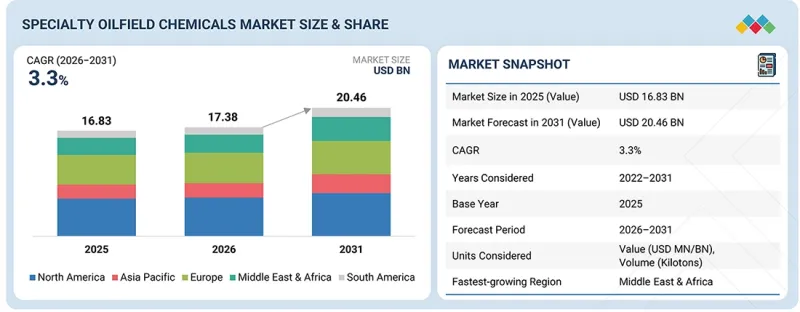
특수 유전용 화학제품 시장 규모는 2026년 173억 8,000만 달러로 평가되었고, 2031년까지 204억 6,000만 달러에 이를 것으로 예측되며, 예측 기간 중 CAGR 3.3%를 나타낼 전망입니다.
이 시장은 지속 가능하고 효율적인 화학 물질을 필요로 하는 석유 및 가스 탐사 및 채굴과 같은 다운스트림 공정 활동으로 인해 꾸준한 성장이 예상됩니다. 이러한 화학 약품은 유정에서 원유 회수율을 높이는 것은 물론, 심해 시추나 비전통적 저류층 등 어려운 조건 하에서 시추 중 유정의 무결성을 유지하는 데 효과적입니다.
| 조사 범위 | |
|---|---|
| 조사 대상 기간 | 2022-2031년 |
| 기준 연도 | 2025년 |
| 예측 기간 | 2026-2031년 |
| 산정 단위 | 금액(100만/10억 달러) 킬로톤 |
| 부문 | 유형, 용도 및 지역 |
| 대상 지역 | 북미, 아시아태평양, 유럽, 중동 및 아프리카, 남미 |
이 업계는 화학물질의 사용, 독성 및 환경에 미치는 영향에 관한 규제를 강화하고 있는 미국 환경보호청(EPA)이나 유럽화학물질청(ECHA) 등의 규제 기관에 의해 뒷받침되어 왔습니다. 이러한 과제에 대응하기 위해 각 제조업체는 지속가능성이 높고 생분해성이 뛰어나며 VOC(휘발성 유기 화합물) 배출이 적은 제품을 개발하고 있습니다. 이러한 규제 동향에 따라 화학 기술의 정밀도가 향상되고, 친환경 제품 혁신이 큰 진전을 이루고 있습니다. 실시간 모니터링과 지능형 화학물질 공급 시스템을 통해 대응 능력과 규정 준수 수준이 향상되면서, 이러한 제품 혁신의 도입이 점점 더 확대되고 있습니다. 탐사 활동이 더욱 복잡한 환경으로 진출함에 따라, 특수 유전용 화학제품은 업스트림 석유 및 가스 사업이 안전하고 효율적이며 환경을 배려하는 방식으로 운영되도록 보장하는 데 있어 앞으로도 매우 중요한 역할을 계속할 것으로 예측됩니다.
'2025년, 특수 유전용 화학제품 시장에서 유동점 저하제 부문이 가장 큰 점유율을 차지했습니다'
유형별로는 2025년에 유동점 저하제 부문이 가장 큰 시장 점유율을 차지했습니다. 이는 저온 환경에서 원유의 유동성을 확보하는 데 필수적이기 때문입니다. 이러한 화학 약품은 왁스 결정의 융점을 낮추어, 특히 한랭 지역이나 해양 시추 시 파이프라인의 흐름을 방해하지 않고 적절한 원유 수송을 보장하는 데 도움이 됩니다. 이러한 화학 물질은 러시아, 캐나다, 중동 등 원유의 왁스 함량이나 점도가 높은 지역에서 특히 중요합니다. 심해 및 북극권 유전에서의 생산이 지속적으로 확대되고 있으며, 신뢰성 높은 유동성 확보 솔루션에 대한 수요가 증가하고 있어, 이러한 유동점 저하제는 여전히 유전용 특수 화학제품 시장을 주도하는 존재로 자리 잡고 있습니다.
'2026-2031년 유전용 특수 화학제품 시장에서 생산 부문이 현저한 성장률을 기록할 전망'
용도별로 보면, 생산 부문은 유전 운영의 복잡성이 심화되고 있으며, 비전통적 및 전통적 저류층을 최대한 활용할 필요성이 높아지고 있는 것을 배경으로, 예측 기간 동안 가장 높은 연평균 성장률(CAGR)을 나타낼 전망입니다. 생산용 화학 약품은 유정의 건전성 유지, 설비의 열화 방지, 유동 확보 및 탄화수소 회수 최적화에 필수적입니다. 이러한 화학 약품에는 부식 방지제, 스케일 방지제, 파라핀 방지제, 살균제, 황화수소 스캐빈저 및 유화 방지제가 포함됩니다. 전 세계 에너지 수요는 계속 확대되고 있으며, 성숙한 유전이 생산에 투입되고 있을 뿐만 아니라 심해 시추 및 석유 증진 회수(EOR) 프로젝트가 생산용 화학약품 수요를 지속적으로 끌어올리고 있습니다. 또한, 자산 수명 연장, 운영 비용 절감, 그리고 엄격한 환경 법규 준수에 대한 업계의 중시가 이 부문 시장의 우위를 지속적으로 뒷받침하고 있습니다.
'중동 및 아프리카은 예측 기간 동안 가장 높은 연평균 성장률(CAGR)을 보일 것으로 전망됩니다'
지역별로 보면, 중동 및 아프리카은 2026-2031년, 특히 대규모 기존 탄화수소 매장량을 대상으로 한 업스트림 부문의 탐사 및 생산에 대한 지속적인 투자에 힘입어 특수 유전용 화학제품 시장에서 가장 높은 성장률을 나타낼 것으로 예측됩니다. 성숙 유전의 회수율 향상을 위한 노력이 강화됨에 따라, 첨단 EOR(증진 채유법), 자극 처리, 생산 및 유량 확보용 화학 약품에 대한 수요가 가속화되고 있습니다. 해상 및 비전통 자원 개발 활동의 확대와 더불어, 유정의 복잡성이 증가하고 있는 점도 이러한 화학 약품의 채택을 더욱 촉진하고 있습니다. 한편, 각국 정부와 국영 석유 회사들은 생산 최적화, 현지화 및 운영 효율 향상을 최우선 과제로 삼고 있습니다. 환경 규제의 강화 또한 독성이 낮고 지속 가능한 화학 솔루션의 개발을 촉진하여, 혁신 주도형 시장 확대의 기회를 창출하고 있습니다.
대상 기업 : 본 보고서에서는 BASF(독일), Clariant(스위스), Dow(미국), Syensqo(벨기에), SLB(미국), Halliburton(미국), Baker Hughes Company(미국), Arkema(프랑스), Cargill, Incorporated(미국), Chevron Phillips Chemical Company LLC(미국)를 다루고 있습니다.
본 조사에서는 특수 유전용 화학제품 시장의 이러한 주요 기업들에 대해 기업 프로파일, 최근 동향 및 주요 시장 전략을 포함한 상세한 경쟁 분석을 수록했습니다.
조사 범위
본 조사 보고서에서는 유전용 특수 화학제품 시장을 유형별(탈유화제, 억제제·스캐빈저, 유변학 조절제, 마찰 저감제, 특수 살균제, 특수 계면활성제, 유동점 저하제, 기타), 용도별(생산, 유정 자극, 시추 유체, 석유 증산 회수, 시멘트 주입, 개수·완공), 지역별(아시아태평양, 북미, 유럽, 남미, 중동 및 아프리카)로 분류하고 있습니다. 본 보고서의 범위에는 시장 성장에 영향을 미치는 촉진요인, 제약 요인, 과제 및 기회에 대한 상세한 정보가 포함되어 있습니다.
주요 업계 참여 기업에 대한 상세한 분석을 수행하여, 해당 기업의 사업 개요, 제공 제품, 그리고 유전용 특수 화학제품 시장과 관련된 파트너십, 제휴, 합병, 인수, 제품 출시, 사업 확장 등의 주요 전략에 대한 인사이트력을 제공합니다. 본 보고서에서는 유전용 특수 화학제품 시장 생태계에서 두각을 나타내고 있는 스타트업 기업에 대한 경쟁 분석도 다루고 있습니다.
본 보고서를 구매해야 하는 이유
본 보고서는 시장 선도 기업 및 신규 진출기업에게 유전용 특수 화학제품 시장 전체 및 각 하위 부문의 매출에 대한 가장 정확한 추정치를 제공합니다. 본 보고서는 이해관계자가 경쟁 구도를 이해하고, 자사의 비즈니스를 보다 적절하게 포지셔닝하기 위한 인사이트력을 심화하며, 적절한 시장 진출 전략을 수립하는 데 도움이 됩니다. 또한, 시장 동향을 파악하고 주요 시장 성장 촉진요인 및 과제에 대한 정보를 제공합니다.
본 보고서는 다음 사항에 대한 인사이트를 제공합니다.
- 유전용 특수 화학제품 시장의 성장에 영향을 미치는 주요 촉진요인(전 세계 원유 생산량 증가 및 업스트림 부문 개발 활동 지속, 심해·해상 탐사 증가), 제약 요인(원유 가격 변동, 업스트림 부문 운영을 혼란스럽게 하는 지정학적 불안정성), 기회(개보수 및 갱신 활동 증가), 그리고 과제(엄격한 환경 규제 및 지속가능성에 대한 압력, 가혹한 환경 하에서의 운영 복잡성)에 대한 분석
- 제품 개발 및 혁신 : 유전용 특수 화학제품 시장의 향후 기술, 연구 개발 활동, 그리고 제품 및 서비스 출시에 대한 상세한 인사이트
- 시장 개발 : 수익성이 높은 시장에 대한 종합적인 정보 - 본 보고서는 다양한 지역에 걸친 유전용 특수 화학제품 시장을 분석합니다
- 시장 다각화 : 유전용 특수 화학제품 시장의 신제품 및 서비스, 미개척 지역, 최근 동향 및 투자에 관한 종합적인 정보
- 경쟁 분석 : BASF(독일), Clariant(스위스), Dow(미국), Syensqo(벨기에), SLB(미국), Halliburton(미국), Baker Hughes Company(미국), Arkema(프랑스), Cargill, Incorporated(미국), Chevron Phillips Chemical Company LLC(미국) 등 주요 기업의 시장 점유율, 성장 전략, 서비스 제공 내용에 대한 상세한 평가
자주 묻는 질문
목차
제1장 서론
제2장 주요 요약
제3장 프리미엄 인사이트
제4장 시장 개요
제5장 업계 동향
제6장 기술, 특허, 디지털 기술, AI 도입에 의한 전략적 파괴
제7장 지속가능성 및 규제 상황
제8장 고객 현황 및 구매 행동
제9장 유전용 특수 화학제품 시장 : 용도별
제10장 유전용 특수 화학제품 시장 : 유형별
제11장 유전용 특수 화학제품 시장 : 저장층 유형별
제12장 유전용 특수 화학제품 시장 : 지역별
제13장 경쟁 구도
제14장 기업 개요
제15장 조사 방법
제16장 부록
AJY 26.08.18The specialty oilfield chemicals market is anticipated to reach USD 20.46 billion by 2031 from USD 17.38 billion in 2026, exhibiting a CAGR of 3.3% during the forecast period. The market is expected to witness steady growth, owing to downstream activities of oil and gas exploration and exploitation that require sustainable and efficient chemicals. They are effective in improving the recovery of oil from wells and in maintaining the integrity of the wellbore during drilling in challenging situations, including deep water drilling and unconventional reservoirs.
| Scope of the Report | |
|---|---|
| Years Considered for the Study | 2022-2031 |
| Base Year | 2025 |
| Forecast Period | 2026-2031 |
| Units Considered | Value (USD Million/Billion) Volume (Kilotons) |
| Segments | Type, Application, and Region |
| Regions covered | North America, Asia Pacific, Europe, Middle East & Africa, and South America |
The industry has been supported by regulatory bodies such as the US Environmental Protection Agency (EPA) and the European Chemicals Agency (ECHA), which are tightening regulations on the use, toxicity, and impact of chemicals on the environment. To meet this challenge, manufacturers are developing more sustainable, biodegradable, and low-VOC products. This drive toward regulation has led to great progress in chemistry that is more accurate and the innovation of environmentally friendly products. These product innovations are increasingly adopted, with real-time monitoring and intelligent chemical delivery systems improving the level of responsiveness and compliance. As exploration ventures further into complex environments, specialty oilfield chemicals are expected to continue to be critical to ensuring upstream oil and gas operations are safe, efficient, and environmentally responsible.
"Pour point depressants segment held the largest share of the specialty oilfield chemicals market in 2025"
In terms of type, the pour point depressants segment accounted for the largest market share in 2025, as it is essential for the movement of crude oil in low temperatures. These chemicals depress the melting point of the wax crystals and help to keep the pipeline flow open and ensure proper oil transportation, especially in cold environments and offshore drilling. They are especially crucial in areas where the crude oil has a high wax content and viscosity, such as in Russia, Canada, and the Middle East. These depressants remain the dominant specialty oilfield chemicals due to continued growth in production from deepwater and Arctic fields, and a desire for reliable flow assurance solutions.
"Production segment to register a significant growth rate in the specialty oilfield chemicals market from 2026 to 2031"
In terms of application, the production segment is likely to record the highest CAGR during the forecast period, fueled by the rising complexity of oilfield operations and the need to utilize unconventional and conventional reservoirs to the fullest. Production chemicals are vital in well integrity, protection from equipment degradation, flow assurance, and hydrocarbon recovery optimization. These chemicals include corrosion inhibitors, scale inhibitors, paraffin inhibitors, biocides, hydrogen sulfide scavengers, and demulsifiers. Global energy demand has continued to grow, mature fields are being put into production, and deepwater drilling and enhanced oil recovery (EOR) projects have continued to boost production chemicals demand. Moreover, the industry's emphasis on prolonged asset life, cost reduction in operating expenses, and adherence to stringent environmental laws continues to drive the market's dominance of this segment.
"Middle East & Africa region to exhibit the highest CAGR during the forecast period"
By region, the Middle East & Africa is anticipated to record the highest growth rate in the specialty oilfield chemicals market from 2026 to 2031, driven by sustained investments in upstream exploration and production, particularly across the large conventional hydrocarbon reserves. Rising efforts to enhance recovery from mature fields are accelerating demand for advanced EOR, stimulation, production, and flow-assurance chemicals. Expanding offshore and unconventional activities, coupled with increasing well complexity, are further supporting adoption. Meanwhile, governments and national oil companies are prioritizing production optimization, localization, and operational efficiency. Growing environmental scrutiny is also encouraging the development of lower-toxicity and more sustainable chemical solutions, creating opportunities for innovation-led market expansion.
By Company Type: Tier 1: 25%, Tier 2: 42%, and Tier 3: 33%
By Designation: C-level Executives: 20%, Directors: 30%, and Other Designations: 50%
By Region: North America: 20%, Europe: 10%, Asia Pacific: 40%, South America: 10%, and the Middle East & Africa: 20%
Notes: Other designations include sales, marketing, and product managers.
Tier 1: >USD 1 Billion; Tier 2: USD 500 million-1 Billion; and Tier 3: <USD 500 million
Companies Covered: BASF (Germany), Clariant (Switzerland), Dow (US), Syensqo (Belgium), SLB (US), Halliburton (US), Baker Hughes Company (US), Arkema (France), Cargill, Incorporated (US), and Chevron Phillips Chemical Company LLC (US) are covered in the report.
The study includes an in-depth competitive analysis of these key players in the specialty oilfield chemicals market, with their company profiles, recent developments, and key market strategies.
Research Coverage
This research report categorizes the specialty oilfield chemicals market based on type (demulsifiers, inhibitors & scavengers, rheology modifiers, friction reducers, specialty biocides, specialty surfactants, pour point depressants, and other types), application (production, well stimulation, drilling fluids, enhanced oil recovery, cementing, and workover & completion), and region (Asia Pacific, North America, Europe, South America, and the Middle East & Africa). The report's scope covers detailed information regarding the drivers, restraints, challenges, and opportunities influencing the market growth.
A detailed analysis of key industry players has been done to provide insights into their business overview, products offered, and key strategies, such as partnerships, collaborations, mergers, acquisitions, product launches, and expansions, associated with the specialty oilfield chemicals market. This report covers a competitive analysis of upcoming startups in the specialty oilfield chemicals market ecosystem.
Reasons to Buy the Report
The report will offer the market leaders/new entrants with information on the closest approximations of the revenue numbers for the overall specialty oilfield chemicals market and the subsegments. This report will help stakeholders understand the competitive landscape, gain more insights into positioning their businesses better, and plan suitable go-to-market strategies. The report will help stakeholders understand the pulse of the market and provide them with information on key market drivers, restraints, challenges, and opportunities.
The report provides insights into the following points:
- Analysis of key drivers (Rising global crude oil production and sustained upstream development activities, Increasing deepwater and offshore exploration), restraints (Fluctuating crude oil prices, Geopolitical instability disrupting upstream operations), opportunities (Increasing renovation and retrofit activities), and challenges (Stringent environmental regulations and sustainability pressures, Operational complexity in extreme environments) influencing the specialty oilfield chemicals market growth
- Product Development/Innovation: Detailed insights into upcoming technologies, research & development activities, and product & service launches in the specialty oilfield chemicals market
- Market Development: Comprehensive information about profitable markets - the report analyzes the specialty oilfield chemicals market across varied regions
- Market Diversification: Exhaustive information about new products & services, untapped geographies, recent developments, and investments in the specialty oilfield chemicals market
- Competitive Assessment: In-depth assessment of market shares, growth strategies, and service offerings of leading players, such as BASF (Germany), Clariant (Switzerland), Dow (US), Syensqo (Belgium), SLB (US), Halliburton (US), Baker Hughes Company (US), Arkema (France), Cargill, Incorporated (US), and Chevron Phillips Chemical Company LLC (US), among others
TABLE OF CONTENTS
1 INTRODUCTION
- 1.1 STUDY OBJECTIVES
- 1.2 MARKET DEFINITION
- 1.3 STUDY SCOPE
- 1.3.1 MARKETS COVERED AND REGIONAL SCOPE
- 1.3.2 INCLUSIONS AND EXCLUSIONS
- 1.3.3 YEARS CONSIDERED
- 1.3.4 CURRENCY CONSIDERED
- 1.3.5 UNIT CONSIDERED
- 1.4 STAKEHOLDERS
- 1.5 SUMMARY OF CHANGES
2 EXECUTIVE SUMMARY
- 2.1 KEY INSIGHTS AND MARKET HIGHLIGHTS
- 2.2 KEY MARKET PARTICIPANTS: SHARE INSIGHTS AND STRATEGIC DEVELOPMENTS
- 2.3 DISRUPTIVE TRENDS SHAPING MARKET
- 2.4 HIGH-GROWTH SEGMENTS
- 2.5 SNAPSHOT: MIDDLE EAST & AFRICA MARKET SIZE, GROWTH RATE, AND FORECAST
3 PREMIUM INSIGHTS
- 3.1 ATTRACTIVE OPPORTUNITIES FOR PLAYERS IN SPECIALTY OILFIELD CHEMICALS MARKET
- 3.2 SPECIALTY OILFIELD CHEMICALS MARKET, BY APPLICATION AND REGION
- 3.3 SPECIALTY OILFIELD CHEMICALS MARKET, BY COUNTRY
4 MARKET OVERVIEW
- 4.1 INTRODUCTION
- 4.2 MARKET DYNAMICS
- 4.2.1 DRIVERS
- 4.2.1.1 Rising global crude oil production and sustained upstream development activities
- 4.2.1.2 Rising demand from deepwater and offshore exploration expansions
- 4.2.1.3 Expansion of enhanced oil recovery (EOR) techniques
- 4.2.2 RESTRAINTS
- 4.2.2.1 Fluctuating crude oil prices
- 4.2.2.2 Geopolitical instability disrupts upstream operations
- 4.2.3 OPPORTUNITIES
- 4.2.3.1 Expanding renovation and retrofit activities
- 4.2.4 CHALLENGES
- 4.2.4.1 Stringent environmental regulations and sustainability pressures
- 4.2.4.2 Operational complexities in extreme environments limit chemical performance
- 4.2.1 DRIVERS
- 4.3 UNMET NEEDS AND WHITE SPACES
- 4.3.1 UNMET NEEDS IN SPECIALTY OILFIELD CHEMICALS MARKET
- 4.3.2 WHITE SPACE OPPORTUNITIES
- 4.4 INTERCONNECTED MARKETS AND CROSS-SECTOR OPPORTUNITIES
- 4.4.1 INTERCONNECTED MARKETS
- 4.5 CROSS-SECTOR OPPORTUNITIES
- 4.5.1 OILFIELD CHEMICALS↔DIGITAL OILFIELD TECHNOLOGIES
- 4.5.2 OILFIELD CHEMICALS ↔ CARBON CAPTURE, UTILIZATION & STORAGE (CCUS)
- 4.6 STRATEGIC MOVES BY TIER-1/2/3 PLAYERS
- 4.7 TIER 1 PLAYERS: GLOBAL LEADERS DRIVING INNOVATION AND PORTFOLIO EXPANSION
- 4.7.1 SLB - STRATEGIC ACQUISITIONS AND DIGITAL INNOVATION TO STRENGTHEN PRODUCTION CHEMISTRY SOLUTIONS
- 4.7.2 BAKER HUGHES - EXPANDING PRODUCTION CHEMICALS AND DIGITAL CHEMICAL MANAGEMENT CAPABILITIES
5 INDUSTRY TRENDS
- 5.1 PORTER'S FIVE FORCES ANALYSIS
- 5.1.1 THREAT OF NEW ENTRANTS
- 5.1.2 THREAT OF SUBSTITUTES
- 5.1.3 BARGAINING POWER OF SUPPLIERS
- 5.1.4 BARGAINING POWER OF BUYERS
- 5.1.5 INTENSITY OF COMPETITIVE RIVALRY
- 5.1.6 INTRODUCTION
- 5.1.7 GDP TRENDS AND FORECASTS
- 5.2 VALUE CHAIN ANALYSIS
- 5.3 ECOSYSTEM ANALYSIS
- 5.4 TRADE ANALYSIS
- 5.4.1 EXPORT SCENARIO (HS CODE 381190)
- 5.4.2 IMPORT SCENARIO (HS CODE 381190)
- 5.5 KEY CONFERENCES AND EVENTS, 2026-2027
- 5.6 TRENDS/DISRUPTIONS IMPACTING CUSTOMER BUSINESS
- 5.6.1 TRENDS/DISRUPTIONS IMPACTING CUSTOMER BUSINESS
- 5.7 INVESTMENT AND FUNDING SCENARIO
- 5.8 IMPACT OF 2025 US TARIFFS - SPECIALTY OILFIELD CHEMICALS MARKET
- 5.8.1 INTRODUCTION
- 5.8.2 KEY TARIFF RATES
- 5.8.3 PRICE IMPACT ANALYSIS
- 5.8.4 IMPACT ON COUNTRIES/REGIONS
- 5.8.4.1 US
- 5.8.4.2 China
- 5.8.4.3 Middle East
- 5.8.4.4 India
- 5.8.5 IMPACT ON END-USE INDUSTRIES
- 5.9 PRICING ANALYSIS
- 5.9.1 AVERAGE SELLING PRICE TREND OF KEY PLAYERS, BY TYPE
- 5.9.2 PRICING ANALYSIS BASED ON REGION
6 STRATEGIC DISRUPTION THROUGH TECHNOLOGY, PATENTS, DIGITAL, AND AI ADOPTIONS
- 6.1 KEY TECHNOLOGIES
- 6.1.1 NANOEMULSIONS
- 6.1.1.1 Biodegradable chemicals
- 6.1.1 NANOEMULSIONS
- 6.2 COMPLEMENTARY TECHNOLOGIES
- 6.2.1 CONTROLLED-RELEASE ADDITIVES (ENCAPSULATION)
- 6.3 ADJACENT TECHNOLOGIES
- 6.3.1 ENZYME-BASED FORMULATIONS
- 6.4 TECHNOLOGY/PRODUCT ROADMAP
- 6.4.1 SHORT-TERM (2025-2027) |DIGITAL PRODUCTION CHEMISTRY, SUSTAINABLE FORMULATIONS, AND HIGH-PERFORMANCE FLOW ASSURANCE
- 6.4.2 MID-TERM (2027-2030) | CHEMICAL EOR EXPANSION, SMART WATER MANAGEMENT, AND LOW-CARBON CHEMISTRY
- 6.4.3 LONG-TERM (2030-2035+) | AUTONOMOUS PRODUCTION CHEMISTRY, SMART CHEMICALS, AND CARBON-NEUTRAL SOLUTIONS
- 6.5 PATENT ANALYSIS
- 6.5.1 INTRODUCTION
- 6.5.2 METHODOLOGY
- 6.5.3 SPECIALTY OILFIELD CHEMICALS MARKET, PATENT ANALYSIS
- 6.6 FUTURE APPLICATIONS
- 6.6.1 DIGITAL PRODUCTION CHEMISTRY & AUTONOMOUS CHEMICAL MANAGEMENT
- 6.6.2 NEXT-GENERATION CHEMICAL ENHANCED OIL RECOVERY (EOR)
- 6.6.3 ADVANCED FLOW ASSURANCE FOR DEEPWATER & ULTRA-DEEPWATER OPERATIONS
- 6.6.4 SPECIALTY CHEMICALS FOR CARBON CAPTURE, UTILIZATION & STORAGE (CCUS) AND CO2-EOR
- 6.7 IMPACT OF AI/GEN AI ON SPECIALTY OILFIELD CHEMICALS MARKET
- 6.7.1 TOP USE CASES AND MARKET POTENTIAL
- 6.7.2 BEST PRACTICES IN SPECIALTY OILFIELD CHEMICALS
- 6.7.3 CASE STUDIES OF AI IMPLEMENTATION IN SPECIALTY OILFIELD CHEMICALS MARKET
- 6.7.4 INTERCONNECTED ADJACENT ECOSYSTEM AND IMPACT ON MARKET PLAYERS
- 6.7.5 CLIENTS' READINESS TO ADOPT GENERATIVE AI IN SPECIALTY OILFIELD CHEMICALS MARKET
- 6.8 SUCCESS STORIES AND REAL-WORLD APPLICATIONS
- 6.8.1 CHEMICAL ENHANCED OIL RECOVERY (EOR) EXTENDS PRODUCTIVE LIFE OF MATURE OILFIELDS
- 6.8.2 ADVANCED FLOW ASSURANCE CHEMICALS ENABLE LONG-DISTANCE DEEPWATER PRODUCTION
- 6.8.3 DIGITAL PRODUCTION CHEMISTRY IMPROVES ASSET RELIABILITY AND REDUCES OPERATING COSTS
7 SUSTAINABILITY AND REGULATORY LANDSCAPE
- 7.1 REGIONAL REGULATIONS AND COMPLIANCE
- 7.1.1 REGULATORY BODIES, GOVERNMENT AGENCIES, AND OTHER ORGANIZATIONS
- 7.1.2 INDUSTRY STANDARDS
- 7.2 SUSTAINABILITY INITIATIVES
- 7.2.1 LOW-TOXICITY AND ENVIRONMENTALLY FRIENDLY CHEMICAL FORMULATIONS
- 7.2.2 ENERGY EFFICIENCY AND CARBON EMISSION REDUCTION IN CHEMICAL MANUFACTURING
- 7.2.3 WASTE REDUCTION, WATER MANAGEMENT, AND CIRCULAR RESOURCE UTILIZATION
- 7.3 IMPACT OF REGULATORY POLICY ON SUSTAINABILITY INITIATIVES
8 CUSTOMER LANDSCAPE & BUYER BEHAVIOR
- 8.1 DECISION-MAKING PROCESS
- 8.2 BUYER STAKEHOLDERS AND BUYING EVALUATION CRITERIA
- 8.2.1 KEY STAKEHOLDERS IN BUYING PROCESS
- 8.2.2 BUYING CRITERIA
- 8.3 ADOPTION BARRIERS & INTERNAL CHALLENGES
- 8.4 UNMET NEEDS FROM VARIOUS APPLICATIONS
- 8.5 MARKET PROFITABILITY
- 8.5.1 REVENUE POTENTIAL
- 8.5.2 COST DYNAMICS
- 8.5.3 MARGIN OPPORTUNITIES, BY APPLICATION
9 SPECIALTY OILFIELD CHEMICALS MARKET, BY APPLICATION
- 9.1 INTRODUCTION
- 9.2 PRODUCTION
- 9.2.1 EXPANDING GLOBAL CRUDE OIL OUTPUT TO DRIVE DEMAND
- 9.3 WELL STIMULATION
- 9.3.1 RAPID GROWTH IN HYDRAULIC FRACTURING TO FUEL MARKET
- 9.4 DRILLING FLUIDS
- 9.4.1 ENSURING WELLBORE STABILITY AND EFFICIENT DRILLING TO BOOST MARKET
- 9.5 ENHANCED OIL RECOVERY
- 9.5.1 MATURING RESERVES TO DRIVE ADOPTION
- 9.6 CEMENTING
- 9.6.1 COMPLEX SUBSURFACE CONDITIONS TO ACCELERATE DEMAND
- 9.7 WORKOVER & COMPLETION
- 9.7.1 CRITICAL FORMATION PRESSURE MANAGEMENT TO PROPEL MARKET
10 SPECIALTY OILFIELD CHEMICALS MARKET, BY TYPE
- 10.1 INTRODUCTION
- 10.2 DEMULSIFIERS
- 10.2.1 DEMAND FOR ENHANCING CRUDE OIL PURITY TO DRIVE MARKET
- 10.3 INHIBITORS & SCAVENGERS
- 10.3.1 GREATER CORROSION CHALLENGES IN AGING WELLS TO FUEL MARKET
- 10.4 RHEOLOGY MODIFIERS
- 10.4.1 RISE IN DEMAND FOR ENSURING OPERATIONAL PRECISION AND SAFETY IN DRILLING OPERATIONS TO BOOST MARKET
- 10.5 FRICTION REDUCERS
- 10.5.1 EXPANSION OF WELL-STIMULATION PROGRAMS TO ACCELERATE DEMAND
- 10.6 SPECIALTY BIOCIDES
- 10.6.1 INCREASE IN NEED TO COMBAT MICROBIAL-INDUCED CORROSION TO DRIVE DEMAND
- 10.7 SPECIALTY SURFACTANTS
- 10.7.1 SURGE IN ENHANCED OIL RECOVERY EFFORTS TO PROPEL DEMAND
- 10.8 POUR POINT DEPRESSANTS
- 10.8.1 HIGH WAX CONTENT IN ASIAN CRUDE OILS TO SUPPORT DEMAND
- 10.9 OTHER TYPES
11 SPECIALTY OILFIELD CHEMICALS MARKET, BY RESERVOIR TYPE
- 11.1 INTRODUCTION
- 11.2 OFFSHORE RESERVOIRS
- 11.2.1 INCREASING DEEPWATER EXPLORATION AND HARSH OFFSHORE CONDITIONS TO FUEL MARKET
- 11.3 ONSHORE RESERVOIRS
- 11.3.1 EXPANDING UNCONVENTIONAL DRILLING AND AGING FIELDS TO DRIVE DEMAND
12 SPECIALTY OILFIELD CHEMICALS MARKET, BY REGION
- 12.1 INTRODUCTION
- 12.2 NORTH AMERICA
- 12.2.1 US
- 12.2.1.1 High upstream activities and stringent regulations to drive demand
- 12.2.2 CANADA
- 12.2.2.1 Rising oil sands output and heavy crude exports to boost demand
- 12.2.3 MEXICO
- 12.2.3.1 Rising offshore production, mature fields, and stricter regulations to propel demand
- 12.2.1 US
- 12.3 ASIA PACIFIC
- 12.3.1 CHINA
- 12.3.1.1 Production push and EOR investments to fuel demand
- 12.3.2 INDONESIA
- 12.3.2.1 Revitalization of oil and gas reserves to support demand
- 12.3.3 INDIA
- 12.3.3.1 Expanding domestic exploration and offshore enhancements to propel demand
- 12.3.4 MALAYSIA
- 12.3.4.1 New discoveries and offshore expansion to elevate demand
- 12.3.5 THAILAND
- 12.3.5.1 Offshore gas expansion and rising licensing to lead to market growth
- 12.3.6 REST OF ASIA PACIFIC
- 12.3.1 CHINA
- 12.4 EUROPE
- 12.4.1 NORWAY
- 12.4.1.1 Advancing offshore projects and operations in harsh environments to stimulate demand
- 12.4.2 UK
- 12.4.2.1 North Sea revival and sustainability goals to propel demand
- 12.4.3 RUSSIA
- 12.4.3.1 Diversified energy output and production shifts to boost market
- 12.4.4 KAZAKHSTAN
- 12.4.4.1 Upstream expansion and complex hydrocarbon operations to propel market
- 12.4.5 NETHERLANDS
- 12.4.5.1 Focus on offshore gas and regulatory shifts to accelerate demand
- 12.4.6 REST OF EUROPE
- 12.4.1 NORWAY
- 12.5 MIDDLE EAST & AFRICA
- 12.5.1 GCC COUNTRIES
- 12.5.1.1 Saudi Arabia
- 12.5.1.1.1 Rising production volumes and reservoir complexity to fuel demand
- 12.5.1.2 UAE
- 12.5.1.2.1 Upstream expansion and digitalization to drive market
- 12.5.1.3 Rest of GCC countries
- 12.5.1.1 Saudi Arabia
- 12.5.2 IRAN
- 12.5.2.1 Rising exploration and production activities to boost market
- 12.5.3 IRAQ
- 12.5.3.1 Surging licensing and well development to accelerate specialty chemical needs
- 12.5.4 NIGERIA
- 12.5.4.1 Evolving production dynamics and regulatory initiatives to boost demand
- 12.5.5 REST OF MIDDLE EAST & AFRICA
- 12.5.1 GCC COUNTRIES
- 12.6 SOUTH AMERICA
- 12.6.1 BRAZIL
- 12.6.1.1 High upstream activities and stringent regulations to drive demand
- 12.6.2 VENEZUELA
- 12.6.2.1 Resurgence of oil and gas sector to boost market
- 12.6.3 REST OF SOUTH AMERICA
- 12.6.1 BRAZIL
13 COMPETITIVE LANDSCAPE
- 13.1 OVERVIEW
- 13.2 KEY PLAYER STRATEGIES
- 13.3 MARKET SHARE ANALYSIS
- 13.4 REVENUE ANALYSIS
- 13.5 COMPANY VALUATION AND FINANCIAL METRICS
- 13.6 PRODUCT/BRAND COMPARISON
- 13.7 COMPANY EVALUATION MATRIX: KEY PLAYERS, 2025
- 13.7.1 STARS
- 13.7.2 EMERGING LEADERS
- 13.7.3 PERVASIVE PLAYERS
- 13.7.4 PARTICIPANTS
- 13.7.5 COMPANY FOOTPRINT: KEY PLAYERS, 2025
- 13.7.5.1 Company footprint
- 13.7.5.2 Regional footprint
- 13.7.5.3 Type footprint
- 13.7.5.4 Reservoir type footprint
- 13.7.5.5 Application footprint
- 13.8 COMPANY EVALUATION MATRIX: STARTUPS/SMES, 2025
- 13.8.1 PROGRESSIVE COMPANIES
- 13.8.2 RESPONSIVE COMPANIES
- 13.8.3 DYNAMIC COMPANIES
- 13.8.4 STARTING BLOCKS
- 13.8.5 COMPETITIVE BENCHMARKING: STARTUPS/SMES, 2025
- 13.8.5.1 Detailed list of key startups/SMEs
- 13.8.5.2 Competitive benchmarking of key startups/SMEs
- 13.9 COMPETITIVE SCENARIO
- 13.9.1 PRODUCT LAUNCHES
- 13.9.2 DEALS
- 13.9.3 EXPANSIONS
14 COMPANY PROFILES
- 14.1 KEY PLAYERS
- 14.1.1 BASF
- 14.1.1.1 Business overview
- 14.1.1.2 Products/Solutions/Services offered
- 14.1.1.3 Recent developments
- 14.1.1.3.1 Deals
- 14.1.1.3.2 Expansions
- 14.1.1.4 MnM view
- 14.1.1.4.1 Right to win
- 14.1.1.4.2 Strategic choices
- 14.1.1.4.3 Weaknesses and competitive threats
- 14.1.2 DOW
- 14.1.2.1 Business overview
- 14.1.2.2 Products/Solutions/Services offered
- 14.1.2.3 Recent developments
- 14.1.2.3.1 Deals
- 14.1.2.4 MnM view
- 14.1.2.4.1 Right to win
- 14.1.2.4.2 Strategic choices
- 14.1.2.4.3 Weaknesses and competitive threats
- 14.1.3 SLB
- 14.1.3.1 Business overview
- 14.1.3.2 Products/Solutions/Services offered
- 14.1.3.3 Recent developments
- 14.1.3.3.1 Deals
- 14.1.3.3.2 Expansions
- 14.1.3.4 MnM view
- 14.1.3.4.1 Right to win
- 14.1.3.4.2 Strategic choices
- 14.1.3.4.3 Weaknesses and competitive threats
- 14.1.4 HALLIBURTON
- 14.1.4.1 Business overview
- 14.1.4.2 Products/Solutions/Services offered
- 14.1.4.3 Recent developments
- 14.1.4.3.1 Product launches
- 14.1.4.3.2 Deals
- 14.1.4.3.3 Expansions
- 14.1.4.4 MnM view
- 14.1.4.4.1 Right to win
- 14.1.4.4.2 Strategic choices
- 14.1.4.4.3 Weaknesses and competitive threats
- 14.1.5 BAKER HUGHES COMPANY
- 14.1.5.1 Business overview
- 14.1.5.2 Products/Solutions/Services offered
- 14.1.5.3 Recent developments
- 14.1.5.3.1 Deals
- 14.1.5.3.2 Expansions
- 14.1.5.4 MnM view
- 14.1.5.4.1 Right to win
- 14.1.5.4.2 Strategic choices
- 14.1.5.4.3 Weaknesses and competitive threats
- 14.1.6 CLARIANT
- 14.1.6.1 Business overview
- 14.1.6.2 Products/Solutions/Services offered
- 14.1.6.3 Recent developments
- 14.1.6.3.1 Product launches
- 14.1.6.3.2 Deals
- 14.1.6.3.3 Expansions
- 14.1.6.4 MnM view
- 14.1.6.4.1 Right to win
- 14.1.7 SNF GROUP
- 14.1.7.1 Business overview
- 14.1.7.2 Products/Solutions/Services offered
- 14.1.7.2.1 Deals
- 14.1.7.2.2 Expansions
- 14.1.7.3 MnM view
- 14.1.8 ARKEMA
- 14.1.8.1 Business overview
- 14.1.8.2 Products/Solutions/Services offered
- 14.1.8.3 Recent developments
- 14.1.8.3.1 Product launches
- 14.1.8.4 MnM view
- 14.1.9 CARGILL, INCORPORATED
- 14.1.9.1 Business overview
- 14.1.9.2 Products/Solutions/Services offered
- 14.1.9.3 Recent developments
- 14.1.9.3.1 Deals
- 14.1.9.4 MnM view
- 14.1.10 CHEVRON PHILLIPS CHEMICAL COMPANY LLC
- 14.1.10.1 Business overview
- 14.1.10.2 Products/Solutions/Services offered
- 14.1.10.3 Recent developments
- 14.1.10.3.1 Expansions
- 14.1.10.4 MnM view
- 14.1.1 BASF
- 14.2 OTHER PLAYERS
- 14.2.1 ALBEMARLE CORPORATION
- 14.2.2 STEPAN COMPANY
- 14.2.3 INNOSPEC
- 14.2.4 LUBRIZOL
- 14.2.5 NOURYON
- 14.2.6 ASHLAND
- 14.2.7 THERMAX LIMITED
- 14.2.8 ELEMENTIS PLC
- 14.2.9 FLOTEK INDUSTRIES, INC.
- 14.2.10 GEO SPECIALTY CHEMICALS, INC.
- 14.2.11 SMC GLOBAL
- 14.2.12 OLEON NV
- 14.2.13 PURECHEM SERVICES
- 14.2.14 STERLING SPECIALTY CHEMICALS
- 14.2.15 ENROIL
15 RESEARCH METHODOLOGY
- 15.1 RESEARCH DATA
- 15.1.1 SECONDARY DATA
- 15.1.1.1 Key data from secondary sources
- 15.1.2 PRIMARY DATA
- 15.1.2.1 Key data from primary sources
- 15.1.2.2 Key industry insights
- 15.1.1 SECONDARY DATA
- 15.2 MARKET SIZE ESTIMATION
- 15.3 BASE NUMBER CALCULATION
- 15.3.1 DEMAND-SIDE APPROACH
- 15.3.2 SUPPLY-SIDE APPROACH
- 15.4 MARKET FORECAST APPROACH
- 15.4.1 SUPPLY SIDE
- 15.4.2 DEMAND SIDE
- 15.5 DATA TRIANGULATION
- 15.6 FACTOR ANALYSIS
- 15.7 RESEARCH ASSUMPTIONS
- 15.8 RESEARCH LIMITATIONS AND RISK ASSESSMENT
16 APPENDIX
- 16.1 DISCUSSION GUIDE
- 16.2 KNOWLEDGESTORE: MARKETSANDMARKETS' SUBSCRIPTION PORTAL
- 16.3 AVAILABLE CUSTOMIZATIONS
- 16.4 RELATED REPORTS
- 16.5 AUTHOR DETAILS


