

|
시장보고서
상품코드
2111241
SDR(Software Defined Radio) 시장 예측(-2033년) : 기술별, 용도별, 주파수 대역별, 지역별Software Defined Radio Market by Technology (General Purpose, Tactical & Mission-Critical, Broadband & High-Bandwidth, UAV/Autonomous, Cognitive & AI-Enabled), Frequency (HF/VHF/UHF, L&S, C, X, Ku & Ka), Application, and Region - Global Forecast to 2033 |
||||||

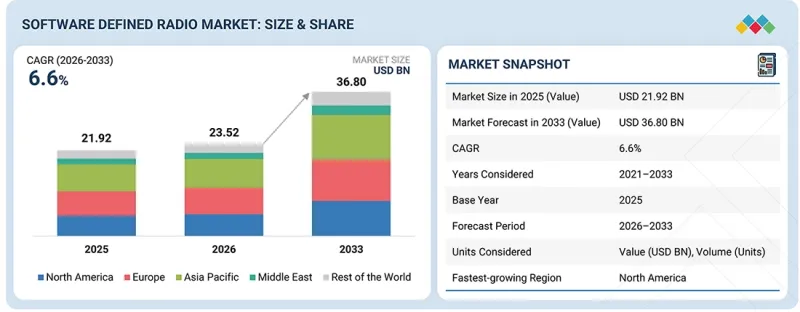
SDR(Software Defined Radio) 시장 규모는 2026년 235억 2,000만 달러에서 예측 기간 중 CAGR 6.6%로 확대하며, 2033년에는 368억 달러에 달할 것으로 전망되고 있습니다.
또한 출하 대수 기준으로는 2026년 342만 4,776대에서 2033년까지 447만 6,811대로 확대될 것으로 예측됩니다.
| 조사 범위 | |
|---|---|
| 조사 대상 기간 | 2021-2033년 |
| 기준연도 | 2025년 |
| 예측 기간 | 2026-2033년 |
| 산정 단위 | 금액(10억 달러) |
| 부문 | 기술별, 용도별, 주파수 대역, 지역별 |
| 대상 지역 | 북미, 유럽, 아시아태평양, 기타 지역 |
위성 및 우주 임무에서 발사 후 업데이트가 가능한 무선 장비가 필요해짐에 따라 SDR에 대한 수요가 증가하고 있습니다. SDR을 활용하면 운영 사업자는 우주선이 궤도에 머무는 동안에도 소프트웨어를 통해 파형, 주파수 대역, 통신 설정을 변경할 수 있습니다. 이를 통해 임무 고유의 무선 하드웨어에 대한 의존도가 낮아지고, 다양한 위성 네트워크 및 지상국과의 통신이 지원됩니다. 상용 위성 서비스, 소형 위성, 고속 우주 통신 링크의 이용 확대가 우주 통신 용도에서의 SDR에 대한 장기적인 수요를 지원하고 있습니다.
"주파수 대역별로는 예측 기간 중 HF/VHF/UHF 부문이 가장 큰 점유율을 차지할 것으로 예상됩니다."
HF/VHF/UHF 부문은 예측 기간 중도 계속해서 주요 주파수 대역 부문으로 자리매김할 것으로 예상됩니다. 이러한 주파수 대역은 군사, 공공안전, 항공, 해양 분야의 장거리 통신, 가시거리내 통신 및 전술 통신에 널리 활용되고 있습니다. HF, VHF, UHF 대역에서 작동하는 SDR을 통해 사용자는 단일 무선 기기로 다양한 통신 요구를 충족할 수 있습니다. 기존 통신 네트워크에서의 폭넓은 활용 실적과 안전한 음성·데이터 서비스를 지원하는 능력 덕분에, 해당 부문은 시장에서 주도적인 위치를 유지할 것으로 예상됩니다.
"기술별로는 UAV 및 자율 시스템 부문이 예측 기간 중 가장 높은 연평균 성장률(CAGR)을 기록할 전망입니다."
UAV 및 자율 시스템 부문이 가장 빠른 속도로 성장할 것으로 예상되는 이유는 무인 플랫폼이 지휘·제어, 영상, 텔레메트리, 센서 데이터를 위한 안전하고 신뢰할 수 있는 통신 링크를 필요로 하기 때문입니다. 소프트웨어 정의 무선(SDR)은 주파수 변경 및 간섭 대응이 가능하며, UAV, 지상국 및 기타 자율 플랫폼 간의 통신을 지원합니다. 국방, 공공안전, 감시, 산업 분야에서의 무인 시스템 도입 확대가 이러한 SDR 시스템의 채택을 촉진할 것으로 예상됩니다. [VV2.1]
"예측 기간 중 북미가 가장 높은 성장률을 보일 것으로 전망됩니다."
북미는 예측 기간 중 SDR 시장에서 가장 높은 성장률을 기록할 것으로 전망됩니다[VV3.1]. 이 지역에서는 동적 스펙트럼 공유, 첨단 무선 기술 및 안전한 통신 네트워크에 대한 투자가 진행되고 있습니다. SDR은 주파수 대역 상황이 변화했을 때 사용자가 주파수나 무선 설정을 조정하는 데 도움이 됩니다. 국방, 공공안전, 위성통신, 통신 네트워크 및 무선 연구 분야의 수요 증가가 SDR 공급업체에게 더 많은 기회를 창출하고 있습니다. 이러한 요인들이 북미 SDR 시장의 성장을 촉진할 것으로 예상됩니다.
조사 범위:
본 시장 조사는 다양한 부문 및 하위 부문에 걸친 SDR 시장을 대상으로 합니다. 본 조사는 각 분야 및 지역별 이 시장의 규모와 성장 잠재력을 추정하는 것을 목적으로 합니다. 또한 시장내 주요 기업에 대한 상세한 경쟁 분석, 기업 개요, 제품 및 사업 제공과 관련된 주요 관찰 사항, 최근 동향, 그리고 각 기업이 채택한 주요 시장 전략에 대해서도 포괄적으로 다루고 있습니다.
이 보고서를 구매해야 하는 이유:
이 보고서는 시장을 선도하는 기업 및 신규 진입 기업에게 SDR 시장 전체 매출에 대한 가장 정확한 추정치를 제공합니다. 또한 이해관계자가 경쟁 구도를 이해하고, 자사의 비즈니스를 더 나은 위치로 이끌며, 적절한 시장 진입 전략을 수립하는 데 필요한 추가적인 인사이트를 얻는 데 도움이 됩니다. 또한 이 보고서는 이해관계자가 시장 동향을 파악하는 데 도움을 주며, 주요 시장 촉진요인, 억제요인, 과제 및 기회에 대한 정보를 제공합니다.
이 보고서는 다음과 같은 사항에 대한 인사이트를 제공합니다. :
- 시장 촉진요인(군사 통신 시스템의 현대화, 서로 다른 부대, 플랫폼, 무선 시스템 간의 통신 필요성), 제약 요인(SDR 개발, 통합, 테스트, 유지보수에 드는 높은 비용, 구식 및 독자 사양의 무선 시스템 지속 사용), 기회(자동 주파수 선택 및 간섭 제어에 AI 활용, 드론 및 기타 무인 시스템에서의 SDR 활용 확대), 과제(사이버 공격으로부터 SDR 소프트웨어, 파형 및 업데이트 보호, 서로 다른 제조사의 SDR 하드웨어에서 동일한 파형 실행)
- 시장 침투율: 시장을 선도하는 주요 기업이 제공하는 SDR에 대한 포괄적인 정보
- 제품 개발 및 혁신: SDR 시장의 향후 기술 동향, 연구개발 활동 및 신제품 출시에 대한 상세한 분석
- 경쟁 분석: SDR 시장의 주요 참여 기업의 시장 점유율, 성장 전략, 제품 및 생산 능력에 대한 상세한 평가
자주 묻는 질문
목차
제1장 서론
제2장 개요
제3장 주요 인사이트
제4장 시장 개요
제5장 업계 동향
제6장 기술 진보, AI에 의한 영향, 특허, 혁신, 향후 응용
제7장 지속가능성과 규제 상황
제8장 고객 상황과 구매 행동
제9장 SDR(Software Defined Radio) 시장, 기술별(시장 규모 및 2033년까지의 예측 - 100만 달러)
제10장 SDR(Software Defined Radio) 시장, 용도별(시장 규모 및 2033년까지의 예측 - 100만 달러)
제11장 SDR(Software Defined Radio) 시장, 주파수 대역별(시장 규모 및 2033년까지의 예측 - 100만 달러)
제12장 SDR(Software Defined Radio) 시장, 지역별(시장 규모 및 2033년까지의 예측 - 100만 달러)
제13장 경쟁 구도
제14장 기업 개요
제15장 조사 방법
제16장 부록
KSA 26.08.19The software defined radio (SDR) market is projected to grow from USD 23.52 billion in 2026 and reach USD 36.80 billion by 2033 at a CAGR of 6.6% during the forecast period, and in terms of volume, the market is projected to grow from 3,424,776 units in 2026 to 4,476,811 units by 2033.
| Scope of the Report | |
|---|---|
| Years Considered for the Study | 2021-2033 |
| Base Year | 2025 |
| Forecast Period | 2026-2033 |
| Units Considered | Value (USD Billion) |
| Segments | By Technology, Frequency, Application and Region |
| Regions covered | North America, Europe, APAC, RoW |
SDR demand is increasing as satellite and space missions require radios that can be updated after launch. SDRs allow operators to change waveforms, frequency bands, and communication settings through software while the spacecraft remains in orbit. This reduces dependence on mission-specific radio hardware and supports communication with different satellite networks and ground stations. The growing use of commercial satellite services, small satellites, and high-speed space links is supporting long-term demand for SDRs in space communication applications.
"By frequency band, the HF/VHF/UHF segment is projected to be the most dominant during the forecast period."
The HF/VHF/UHF segment is expected to rema[VV1.1]in the leading frequency band segment during the forecast period. These bands are widely used for long-range, line-of-sight, and tactical communication across military, public safety, aviation, and maritime applications. SDRs operating across HF, VHF, and UHF allow users to support different communication needs through one radio. Their wide use in existing communication networks and ability to support secure voice and data services are expected to maintain the segment's leading market position.
"By technology, the UAV & autonomous systems segment is likely to grow at the highest CAGR during the forecast period."
The UAV & autonomous systems segment is expected to grow at the fastest rate because unmanned platforms require secure and reliable links for command, control, video, telemetry, and sensor data. Software-defined radios can change frequencies, adjust to interference, and support communication between UAVs, ground stations, and other autonomous platforms. Growing deployment of unmanned systems in defense, public safety, surveillance, and industrial operations is expected to support the adoption of these SDR systems. [VV2.1]
"North America is projected to grow at the fastest rate during the forecast period."
North America is expe[VV3.1]cted to record the fastest growth in the SDR market during the forecast period. The region is investing in dynamic spectrum sharing, advanced wireless technologies, and secure communication networks. SDRs help users adjust frequencies and radio settings as spectrum conditions change. Growing demand from defense, public safety, satellite communication, telecom networks, and wireless research is creating more opportunities for SDR providers. These factors are expected to support the growth of the SDR market in North America.
The breakdown of profiles for primary participants in the SDR market is provided below:
- By Company Type: Tier 1 - 40%, Tier 2 - 35%, and Tier 3 - 25%
- By Designation: C-level - 25%, Director-level - 35%, and Others - 40%
- By Region: North America - 35%, Europe - 30%, Asia Pacific - 25%, Middle East - 5%, and RoW - 5%
Research Coverage:
This market study covers the SDR market across various segments and subsegments. It aims to estimate the size and growth potential of this market across different parts and regions. This study also includes an in-depth competitive analysis of the key players in the market, their company profiles, key observations related to their products and business offerings, recent developments, and key market strategies they adopted.
Reasons to buy this report:
The report will help the market leaders/new entrants with information on the closest approximations of the revenue numbers for the overall SDR market. It will also help stakeholders understand the competitive landscape and gain more insights to position their businesses better and plan suitable go-to-market strategies. The report will also help stakeholders understand the market pulse and will provide information on key market drivers, restraints, challenges, and opportunities.
The report provides insights into the following pointers:
- Market drivers (modernization of military communication systems, need for communication between different forces, platforms, and radio systems), restraints (high cost of SDR development, integration, testing, and maintenance, continued use of old and proprietary radio systems), opportunities (use of AI for automatic frequency selection and interference control, growing use of SDRs in drones and other unmanned systems), challenges (protecting SDR software, waveforms, and updates from cyberattacks, running same waveform on SDR hardware from different companies)
- Market Penetration: Comprehensive information on SDR offered by the top players in the market
- Product Development/Innovation: Detailed insights into upcoming technologies, research & development activities, and product launches in the SDR market
- Competitive Assessment: In-depth assessment of market share, growth strategies, products, and manufacturing capabilities of leading players in the SDR market
TABLE OF CONTENTS
1 INTRODUCTION
- 1.1 STUDY OBJECTIVES
- 1.2 MARKET DEFINITION
- 1.3 STUDY SCOPE
- 1.3.1 MARKET SEGMENTATION & REGIONAL SNAPSHOT
- 1.3.2 INCLUSIONS AND EXCLUSIONS
- 1.4 YEARS CONSIDERED
- 1.5 CURRENCY CONSIDERED
- 1.6 STAKEHOLDERS
- 1.7 SUMMARY OF CHANGES
2 EXECUTIVE SUMMARY
- 2.1 KEY INSIGHTS & MARKET HIGHLIGHTS
- 2.2 KEY MARKET PARTICIPANTS: MAPPING OF STRATEGIC DEVELOPMENTS
- 2.3 HIGH-GROWTH SEGMENTS
- 2.4 DISRUPTIVE TRENDS SHAPING MARKET
- 2.5 REGIONAL SNAPSHOT: MARKET SIZE, GROWTH RATE, AND FORECAST
3 PREMIUM INSIGHTS
- 3.1 ATTRACTIVE OPPORTUNITIES FOR PLAYERS IN SOFTWARE DEFINED RADIO MARKET
- 3.2 SOFTWARE DEFINED RADIO MARKET, BY APPLICATION
- 3.3 SOFTWARE DEFINED RADIO MARKET, BY TECHNOLOGY
- 3.4 SOFTWARE DEFINED RADIO MARKET, BY FREQUENCY BAND
4 MARKET OVERVIEW
- 4.1 INTRODUCTION
- 4.2 MARKET DYNAMICS
- 4.2.1 DRIVERS
- 4.2.1.1 Modernization of military communication systems
- 4.2.1.2 Need for communication between different forces, platforms, and radio systems
- 4.2.1.3 Need for better use of available radio spectrum
- 4.2.1.4 Growing use of multiband and multi-mode radios in public safety and commercial applications
- 4.2.2 RESTRAINTS
- 4.2.2.1 High cost of SDR development, integration, testing, and maintenance
- 4.2.2.2 Continued use of old and proprietary radio systems
- 4.2.2.3 High power use, heat generation, and processing needs
- 4.2.3 OPPORTUNITIES
- 4.2.3.1 Use of AI for automatic frequency selection and interference control
- 4.2.3.2 Growing use of SDRs in drones and other unmanned systems
- 4.2.3.3 Development of open and modular SDR systems
- 4.2.4 CHALLENGES
- 4.2.4.1 Protecting SDR software, waveforms, and updates from cyberattacks
- 4.2.4.2 Running the same waveform on SDR hardware from different companies
- 4.2.4.3 Testing radio performance after software or waveform changes
- 4.2.1 DRIVERS
- 4.3 UNMET NEEDS AND WHITE SPACES
- 4.3.1 NEED FOR SMALLER AND LOWER-POWER SDR
- 4.3.2 SDR WITH WIDER FREQUENCY COVERAGE
- 4.3.3 EASIER SDR DEPLOYMENT AND MANAGEMENT
- 4.3.4 COMMUNICATION, SENSING, AND SPECTRUM SHARING IN ONE SDR PLATFORM
- 4.4 INTERCONNECTED MARKETS AND CROSS-SECTOR OPPORTUNITIES
- 4.4.1 MILITARY COMMUNICATION SYSTEMS MARKET
- 4.4.2 OPEN RAN AND PRIVATE 5G MARKET
- 4.4.3 SATELLITE COMMUNICATION MARKET
- 4.4.4 ELECTRONIC WARFARE, SPECTRUM MONITORING, AND SIGNAL INTELLIGENCE MARKET
- 4.5 STRATEGIC MOVES BY TIER 1/2/3 PLAYERS
5 INDUSTRY TRENDS
- 5.1 ECOSYSTEM ANALYSIS
- 5.1.1 MANUFACTURERS
- 5.1.2 COMPONENT SUPPLIERS
- 5.1.3 END USERS
- 5.2 VALUE CHAIN ANALYSIS
- 5.3 TRADE ANALYSIS
- 5.3.1 IMPORT SCENARIO (HS CODE 8525)
- 5.3.2 EXPORT SCENARIO (HS CODE 8525)
- 5.4 CASE STUDY ANALYSIS
- 5.4.1 DRDO'S INDIAN RADIO SOFTWARE ARCHITECTURE (IRSA) STANDARD FOR MILITARY SDR INTEROPERABILITY
- 5.4.2 NASA'S SPACE TELECOMMUNICATIONS RADIO SYSTEM (STRS) OPEN SDR ARCHITECTURE
- 5.4.3 OCCAR'S EUROPEAN SECURE SOFTWARE DEFINED RADIO (ESSOR) PROGRAM FOR MULTINATIONAL MILITARY COMMUNICATIONS
- 5.5 KEY CONFERENCES AND EVENTS (2026-2027)
- 5.6 INVESTMENT AND FUNDING SCENARIO
- 5.7 TRENDS/DISRUPTIONS IMPACTING CUSTOMER BUSINESS
- 5.8 MACROECONOMIC OUTLOOK
- 5.8.1 INTRODUCTION
- 5.8.2 GDP TRENDS AND FORECAST
- 5.8.3 TRENDS IN GLOBAL RADIO TECHNOLOGY INDUSTRY
- 5.8.4 TRENDS IN GLOBAL SOFTWARE DEFINED RADIO INDUSTRY
- 5.9 PRICING ANALYSIS
- 5.10 IMPACT OF 2025 US TARIFFS
- 5.10.1 INTRODUCTION
- 5.10.2 KEY TARIFF RATES
- 5.10.3 PRICE IMPACT ANALYSIS
- 5.10.4 IMPACT ON COUNTRY/REGION
- 5.10.4.1 US
- 5.10.4.2 Europe
- 5.10.4.3 Asia Pacific
- 5.10.5 IMPACT ON END-USE INDUSTRIES
- 5.11 IMPACT OF ONGOING GEOPOLITICAL TENSIONS ON SOFTWARE DEFINED RADIO MARKET
- 5.12 RUSSIA-UKRAINE: SDRS BECOME CONSUMABLE, UPDATEABLE BATTLEFIELD INFRASTRUCTURE
- 5.12.1 MIDDLE EAST ESCALATION: REDUNDANCY AND SENSOR-NETWORK SURVIVABILITY GAIN PRIORITY
- 5.12.2 INDO-PACIFIC TENSIONS: DISTANCE AND COALITION INTEROPERABILITY SUPPORT HIGHER-VALUE SDR CONFIGURATIONS
- 5.12.3 EUROPE AND NATO: READINESS CREATES RECURRING WAVEFORM AND INTEROPERABILITY MARKET
- 5.13 2026-2028 GEOPOLITICAL SCENARIOS AND SDR MARKET OUTCOMES
- 5.14 IMPLICATIONS FOR SDR VENDORS, DEFENSE BUYERS, AND INVESTORS
- 5.15 ASSESSMENT OF COMMERCIAL OFF THE SHELF SOLUTIONS FOR MILITARY APPLICATIONS
- 5.15.1 STRATEGIC ASSESSMENT
- 5.15.2 MARKET CONCLUSIONS AND RECOMMENDATIONS
6 TECHNOLOGICAL ADVANCEMENTS, AI-DRIVEN IMPACT, PATENTS, INNOVATIONS, AND FUTURE APPLICATIONS
- 6.1 KEY TECHNOLOGIES
- 6.1.1 AI-ENABLED COGNITIVE SOFTWARE DEFINED RADIO
- 6.1.2 DIRECT RF SAMPLING AND RF SYSTEM-ON-CHIP INTEGRATION
- 6.1.3 DYNAMIC SPECTRUM ACCESS AND SPECTRUM SHARING
- 6.2 COMPLEMENTARY TECHNOLOGIES
- 6.2.1 OPEN AND MODULAR RADIO ARCHITECTURE
- 6.2.2 ADVANCED RADIO SIGNAL PROCESSING
- 6.2.3 SECURE WAVEFORMS AND SOFTWARE UPDATES
- 6.3 ADJACENT TECHNOLOGIES
- 6.3.1 ELECTRONIC WARFARE, SIGNALS INTELLIGENCE, AND SPECTRUM MONITORING
- 6.3.2 5G, PRIVATE WIRELESS AND SATELLITE NETWORKS
- 6.3.3 UNMANNED AND AUTONOMOUS SYSTEMS COMMUNICATION
- 6.4 TECHNOLOGY ROADMAP
- 6.5 PATENT ANALYSIS
- 6.6 FUTURE APPLICATIONS
- 6.6.1 IMPACT OF AI/GENERATIVE AI
- 6.6.2 IMPLEMENTATION OF AI IN SOFTWARE DEFINED RADIO MARKET: TOP USE CASES AND MARKET POTENTIAL
- 6.6.3 IMPLEMENTATION OF AI IN SOFTWARE DEFINED RADIO MARKET: CASE STUDIES
- 6.6.4 INTERCONNECTED ECOSYSTEM AND IMPACT ON MARKET PLAYERS
- 6.6.5 CLIENTS' READINESS TO ADOPT AI/GENERATIVE AI
7 SUSTAINABILITY AND REGULATORY LANDSCAPE
- 7.1 REGIONAL REGULATIONS AND COMPLIANCE
- 7.1.1 REGULATORY BODIES, GOVERNMENT AGENCIES, AND OTHER ORGANIZATIONS
- 7.1.2 KEY REGULATIONS
- 7.1.3 INDUSTRY STANDARDS
- 7.2 SUSTAINABILITY INITIATIVES
- 7.2.1 SOFTWARE-BASED CAPABILITY AND PRODUCT LIFE EXTENSION
- 7.2.2 MODULAR HARDWARE REPAIR AND SYSTEM UPGRADES
- 7.2.3 ENERGY-EFFICIENT RADIO OPERATION
- 7.2.4 MORE EFFICIENT USE OF RADIO SPECTRUM
- 7.2.5 RESPONSIBLE MANUFACTURING AND END-OF-LIFE MANAGEMENT
- 7.3 CERTIFICATIONS, LABELING, AND ECO-STANDARDS
8 CUSTOMER LANDSCAPE & BUYER BEHAVIOR
- 8.1 DECISION-MAKING PROCESS
- 8.2 BUYER STAKEHOLDERS AND BUYING EVALUATION CRITERIA
- 8.2.1 BUYING EVALUATION CRITERIA
- 8.2.2 BUYING CRITERIA
- 8.3 ADOPTION BARRIERS & INTERNAL CHALLENGES
- 8.4 UNMET NEEDS OF VARIOUS END-USE INDUSTRIES
9 SOFTWARE DEFINED RADIO MARKET, BY TECHNOLOGY (MARKET SIZE & FORECAST TO 2033 - IN USD MILLION)
- 9.1 INTRODUCTION
- 9.2 GENERAL-PURPOSE SDR SYSTEMS
- 9.2.1 OPERATIONAL FLEXIBILITY TO DRIVE ADOPTION OF GENERAL-PURPOSE SDR SYSTEMS
- 9.2.2 FIXED SDR SYSTEMS
- 9.2.3 PORTABLE & MOBILE SDR SYSTEMS
- 9.2.4 EMBEDDED SDR SYSTEMS
- 9.3 TACTICAL & MISSION-CRITICAL SDR
- 9.3.1 MISSION-CRITICAL COMMUNICATION REQUIREMENTS TO DRIVE ADOPTION OF TACTICAL & MISSION-CRITICAL SDR SYSTEMS
- 9.3.2 TACTICAL COMMUNICATION SDR
- 9.3.3 MANET & MESH NETWORKING SDR
- 9.3.4 ANTI-JAM & SECURE SDR SYSTEMS
- 9.4 BROADBAND & HIGH-BANDWIDTH SDR
- 9.4.1 INCREASING DEMAND FOR HIGH-CAPACITY WIRELESS COMMUNICATIONS TO DRIVE ADOPTION
- 9.4.2 WIDEBAND SDR SYSTEMS
- 9.4.3 SATCOM SDR SYSTEMS
- 9.4.4 ISR & HIGH-SPEED DATA LINK SDR
- 9.5 UAV & AUTONOMOUS SYSTEM SDR
- 9.5.1 EXPANDING AUTONOMOUS PLATFORM DEPLOYMENT TO DRIVE DEMAND
- 9.5.2 UNMANNED AERIAL VEHICLES
- 9.5.3 UNMANNED GROUND VEHICLES
- 9.5.4 UNMANNED MARITIME VEHICLES
- 9.6 COGNITIVE & AI-ENABLED SDR
- 9.6.1 INTELLIGENT SPECTRUM DECISION-MAKING TO DRIVE ADOPTION
- 9.6.2 COGNITIVE RADIO SDR
- 9.6.3 AI/ML-ENABLED SDR
- 9.6.4 DYNAMIC SPECTRUM ACCESS SDR
10 SOFTWARE DEFINED RADIO MARKET, BY APPLICATION (MARKET SIZE & FORECAST TO 2033 - IN USD MILLION)
- 10.1 INTRODUCTION
- 10.2 TECHNOLOGY VS. APPLICATION: USE CASE ASSESSMENT
- 10.3 DEFENSE LAND SYSTEMS
- 10.3.1 EXPANSION OF DIGITALLY CONNECTED LAND FORCES TO DRIVE GROWTH
- 10.3.2 TACTICAL BATTLEFIELD COMMUNICATION
- 10.3.3 MILITARY VEHICLE COMMUNICATION
- 10.3.4 SOLDIER RADIOS & MANET SYSTEMS
- 10.4 PUBLIC SAFETY & GOVERNMENT SYSTEMS
- 10.4.1 RISING NEED FOR INTEROPERABLE EMERGENCY RESPONSE TO DRIVE GROWTH
- 10.4.2 POLICE COMMUNICATION
- 10.4.3 DISASTER RESPONSE
- 10.4.4 EMERGENCY SERVICES
- 10.5 TRANSPORTATION & SMART MOBILITY
- 10.5.1 EXPANSION OF CONNECTED TRANSPORT INFRASTRUCTURE TO DRIVE GROWTH
- 10.5.2 RAILWAY COMMUNICATION
- 10.5.3 INTELLIGENT TRANSPORTATION SYSTEMS
- 10.5.4 CONNECTED & AUTONOMOUS MOBILITY INFRASTRUCTURE
- 10.6 INDUSTRIAL & CRITICAL INFRASTRUCTURE
- 10.6.1 EXPANSION OF REMOTE AND AUTOMATED OPERATIONS TO DRIVE GROWTH
- 10.6.2 MINING COMMUNICATION
- 10.6.3 OIL & GAS OPERATIONS
- 10.6.4 UTILITY GRID COMMUNICATION
- 10.7 COMMERCIAL AIRCRAFT
- 10.7.1 INCREASING AIRCRAFT CONNECTIVITY REQUIREMENTS TO DRIVE ADOPTION
- 10.8 MILITARY AIRCRAFT
- 10.8.1 AIRBORNE MISSION MODERNIZATION TO INCREASE DEMAND FOR SDR-BASED MILITARY AIRCRAFT COMMUNICATIONS
- 10.9 BUSINESS & GENERAL AVIATION
- 10.9.1 FLIGHT COMMUNICATION MODERNIZATION TO SUPPORT SDR ADOPTION IN BUSINESS & GENERAL AVIATION
- 10.10 UNMANNED AERIAL SYSTEMS
- 10.10.1 EXPANSION OF COMMERCIAL AND MILITARY DRONE OPERATIONS TO DRIVE GROWTH
- 10.10.2 COMMERCIAL DRONES
- 10.10.2.1 Delivery drones
- 10.10.2.2 Agriculture drones
- 10.10.2.3 Media & photography drones
- 10.10.3 ENTERPRISE & INDUSTRIAL DRONES
- 10.10.3.1 Mining & construction
- 10.10.3.2 Oil & gas inspection
- 10.10.3.3 Telecom infrastructure monitoring
- 10.10.4 MILITARY DRONES
- 10.10.4.1 GROUP 1
- 10.10.4.2 GROUP 2
- 10.10.4.3 GROUP 3
- 10.10.4.4 GROUP 4
- 10.10.4.5 GROUP 5
- 10.10.4.6 LOITERING MUNITIONS
- 10.10.4.7 SWARM UAVs
- 10.10.5 GOVERNMENT & LAW ENFORCEMENT DRONES
- 10.10.5.1 BORDER SURVEILLANCE
- 10.10.5.2 LAW ENFORCEMENT
- 10.10.5.3 DISASTER MANAGEMENT
- 10.11 NAVAL PLATFORMS
- 10.11.1 EXPANSION OF DISTRIBUTED AND UNMANNED FLEET OPERATIONS TO DRIVE GROWTH
- 10.11.2 NAVAL TACTICAL COMMUNICATION
- 10.11.3 ISR COMMUNICATION SYSTEMS
- 10.12 COMMERCIAL MARITIME
- 10.12.1 EXPANSION OF DIGITALLY CONNECTED SHIPPING AND PORT OPERATIONS TO DRIVE GROWTH
- 10.12.2 COMMERCIAL SHIPPING
- 10.12.3 OFFSHORE PLATFORMS
- 10.12.4 PORT COMMUNICATION INFRASTRUCTURE
- 10.13 AUTONOMOUS MARITIME SYSTEMS
- 10.13.1 EXPANSION OF UNCREWED AND REMOTELY OPERATED MISSIONS TO DRIVE GROWTH
- 10.13.2 UNMANNED SURFACE VEHICLES
- 10.13.3 AUTONOMOUS UNDERWATER SYSTEMS
- 10.13.4 REMOTE MARITIME MONITORING
- 10.14 SATELLITES & GROUND STATIONS
- 10.14.1 EXPANSION OF SATELLITE CONSTELLATIONS AND DIGITAL GROUND NETWORKS TO DRIVE GROWTH
11 SOFTWARE DEFINED RADIO MARKET, BY FREQUENCY BAND (MARKET SIZE & FORECAST TO 2033 - IN USD MILLION)
- 11.1 INTRODUCTION
- 11.2 HF/VHF/UHF
- 11.2.1 NEED FOR RELIABLE LONG- AND MEDIUM-RANGE COMMUNICATIONS TO DRIVE ADOPTION
- 11.3 L&S BAND
- 11.3.1 RISING DEMAND FOR SATELLITE AND BEYOND-LINE-OF-SIGHT COMMUNICATIONS TO DRIVE GROWTH
- 11.4 C, X, KU & KA BAND
- 11.4.1 HIGHER DATA TRANSMISSION REQUIREMENTS TO DRIVE DEMAND
- 11.5 MULTI-BAND & WIDEBAND SDR SYSTEMS
- 11.5.1 NEED FOR FLEXIBLE COMMUNICATION ACROSS MULTIPLE FREQUENCY BANDS TO DRIVE DEMAND
12 SOFTWARE DEFINED RADIO MARKET, BY REGION (MARKET SIZE & FORECAST TO 2033 - IN USD MILLION)
- 12.1 INTRODUCTION
- 12.2 NORTH AMERICA
- 12.2.1 US
- 12.2.1.1 Large-scale tactical radio procurement to drive market
- 12.2.2 CANADA
- 12.2.2.1 Canadian military modernization to drive demand for digital tactical communications
- 12.2.1 US
- 12.3 EUROPE
- 12.3.1 UK
- 12.3.1.1 Replacement of legacy battlefield communications to drive market
- 12.3.2 GERMANY
- 12.3.2.1 Digitalization of land-based operations to drive SDR adoption across Bundeswehr
- 12.3.3 FRANCE
- 12.3.3.1 CONTACT program orders to drive SDR adoption across French armed forces
- 12.3.4 ITALY
- 12.3.4.1 Integration of SDRs into new combat vehicles to drive market
- 12.3.5 SPAIN
- 12.3.5.1 Tactical radio development to drive market
- 12.3.6 REST OF EUROPE
- 12.3.1 UK
- 12.4 ASIA PACIFIC
- 12.4.1 CHINA
- 12.4.1.1 Mission-critical network integration to drive market
- 12.4.2 INDIA
- 12.4.2.1 Indigenous coast guard procurement and long-term military requirements to drive market
- 12.4.3 JAPAN
- 12.4.3.1 Airborne wideband radio procurement to drive market
- 12.4.4 AUSTRALIA
- 12.4.4.1 Domestic defense communication projects to drive market
- 12.4.5 SOUTH KOREA
- 12.4.5.1 Next-generation tactical network development to drive market
- 12.4.6 REST OF ASIA PACIFIC
- 12.4.1 CHINA
- 12.5 MIDDLE EAST
- 12.5.1 GCC
- 12.5.1.1 Local radio development in UAE and Saudi Arabia to drive market
- 12.5.1.2 UAE
- 12.5.1.3 Saudi Arabia
- 12.5.2 REST OF MIDDLE EAST
- 12.5.1 GCC
- 12.6 REST OF THE WORLD
- 12.6.1 LATIN AMERICA
- 12.6.1.1 Disaster-response networks and remote-area communication needs to drive market
- 12.6.2 AFRICA
- 12.6.2.1 Local production of tactical radios for artillery systems to drive market
- 12.6.1 LATIN AMERICA
13 COMPETITIVE LANDSCAPE
- 13.1 INTRODUCTION
- 13.2 KEY PLAYER STRATEGIES/RIGHT TO WIN, JANUARY 2021-JULY 2026
- 13.3 REVENUE ANALYSIS, 2021-2025
- 13.4 MARKET SHARE ANALYSIS, 2026
- 13.5 BRAND/PRODUCT COMPARISON
- 13.6 COMPANY VALUATION AND FINANCIAL METRICS
- 13.7 COMPANY EVALUATION MATRIX: KEY PLAYERS, 2025
- 13.7.1 STARS
- 13.7.2 EMERGING LEADERS
- 13.7.3 PERVASIVE PLAYERS
- 13.7.4 PARTICIPANTS
- 13.7.5 COMPANY FOOTPRINT
- 13.7.5.1 Company footprint
- 13.7.5.2 Region footprint
- 13.7.5.3 Technology footprint
- 13.7.5.4 Application footprint
- 13.7.5.5 Frequency band footprint
- 13.8 COMPANY EVALUATION MATRIX: STARTUPS/SMES, 2025
- 13.8.1 PROGRESSIVE COMPANIES
- 13.8.2 RESPONSIVE COMPANIES
- 13.8.3 DYNAMIC COMPANIES
- 13.8.4 STARTING BLOCKS
- 13.8.5 COMPETITIVE BENCHMARKING
- 13.8.5.1 List of startups/SMEs
- 13.8.5.2 Competitive benchmarking of startups/SMEs
- 13.9 COMPETITIVE SCENARIO
- 13.9.1 PRODUCT LAUNCHES/ENHANCEMENTS/DEVELOPMENTS
- 13.9.2 DEALS
- 13.9.3 OTHER DEVELOPMENTS
14 COMPANY PROFILES
- 14.1 KEY PLAYERS (SDR OEM/PLATFORM INTEGRATORS)
- 14.1.1 L3HARRIS TECHNOLOGIES, INC.
- 14.1.1.1 Business overview
- 14.1.1.2 Products offered
- 14.1.1.3 Recent developments
- 14.1.1.3.1 Deals
- 14.1.1.3.2 Other developments
- 14.1.1.4 MnM View
- 14.1.1.4.1 Right to win
- 14.1.1.4.2 Strategic choices
- 14.1.1.4.3 Weaknesses and competitive threats
- 14.1.2 RTX
- 14.1.2.1 Business overview
- 14.1.2.2 Products offered
- 14.1.2.3 Recent developments
- 14.1.2.3.1 Deals
- 14.1.2.3.2 Other developments
- 14.1.2.4 MnM View
- 14.1.2.4.1 Right to win
- 14.1.2.4.2 Strategic choices
- 14.1.2.4.3 Weaknesses and competitive threats
- 14.1.3 NORTHROP GRUMMAN
- 14.1.3.1 Business overview
- 14.1.3.2 Products offered
- 14.1.4 GENERAL DYNAMICS CORPORATION
- 14.1.4.1 Business overview
- 14.1.4.2 Products offered
- 14.1.4.3 Recent developments
- 14.1.4.3.1 Deals
- 14.1.4.3.2 Other developments
- 14.1.4.4 MnM View
- 14.1.4.4.1 Right to win
- 14.1.4.4.2 Strategic choices
- 14.1.4.4.3 Weaknesses and competitive threats
- 14.1.5 THALES
- 14.1.5.1 Business overview
- 14.1.5.2 Products offered
- 14.1.5.3 Recent developments
- 14.1.5.3.1 Deals
- 14.1.5.3.2 Other developments
- 14.1.5.4 MnM View
- 14.1.5.4.1 Right to win
- 14.1.5.4.2 Strategic choices
- 14.1.5.4.3 Weaknesses and competitive threats
- 14.1.6 BAE SYSTEMS
- 14.1.6.1 Business overview
- 14.1.6.2 Products offered
- 14.1.6.3 Recent developments
- 14.1.6.3.1 Other developments
- 14.1.7 LEONARDO S.P.A.
- 14.1.7.1 Business overview
- 14.1.7.2 Products offered
- 14.1.7.3 Recent developments
- 14.1.7.3.1 Product developments
- 14.1.7.3.2 Deals
- 14.1.7.3.3 Other developments
- 14.1.8 ELBIT SYSTEMS LTD.
- 14.1.8.1 Business overview
- 14.1.8.2 Products offered
- 14.1.8.3 Recent developments
- 14.1.8.3.1 Product launches
- 14.1.8.3.2 Deals
- 14.1.8.3.3 Other developments
- 14.1.9 ASELSAN A.S.
- 14.1.9.1 Business overview
- 14.1.9.2 Products offered
- 14.1.9.3 Recent developments
- 14.1.9.3.1 Deals
- 14.1.10 ROHDE & SCHWARZ
- 14.1.10.1 Business overview
- 14.1.10.2 Products offered
- 14.1.10.3 Recent developments
- 14.1.10.3.1 Deals
- 14.1.10.3.2 Other developments
- 14.1.11 ANDURIL INDUSTRIES
- 14.1.11.1 Business overview
- 14.1.11.2 Products offered
- 14.1.11.3 Recent developments
- 14.1.11.3.1 Product launches
- 14.1.11.3.2 Deals
- 14.1.11.3.3 Other developments
- 14.1.12 AEROVIRONMENT, INC.
- 14.1.12.1 Business overview
- 14.1.12.2 Products offered
- 14.1.12.3 Recent developments
- 14.1.12.3.1 Product launches
- 14.1.12.3.2 Deals
- 14.1.1 L3HARRIS TECHNOLOGIES, INC.
- 14.2 KEY PLAYERS (COMMERCIAL & TELECOM SDR PROVIDERS)
- 14.2.1 HUAWEI TECHNOLOGIES CO., LTD.
- 14.2.1.1 Business overview
- 14.2.1.2 Products offered
- 14.2.1.3 Recent developments
- 14.2.1.3.1 Deals
- 14.2.2 ZTE CORPORATION
- 14.2.2.1 Business overview
- 14.2.2.2 Products offered
- 14.2.3 VIASAT, INC.
- 14.2.3.1 Business overview
- 14.2.3.2 Products offered
- 14.2.3.3 Recent developments
- 14.2.3.3.1 Product launches
- 14.2.3.3.2 Deals
- 14.2.3.3.3 Other developments
- 14.2.1 HUAWEI TECHNOLOGIES CO., LTD.
- 14.3 KEY PLAYERS (SDR HARDWARE & MODULE PROVIDERS)
- 14.3.1 MOBILICOM
- 14.3.1.1 Business overview
- 14.3.1.2 Products offered
- 14.3.1.3 Recent developments
- 14.3.1.3.1 Product launches
- 14.3.1.3.2 Deals
- 14.3.1.3.3 Other developments
- 14.3.2 DTC CODAN
- 14.3.2.1 Business overview
- 14.3.2.2 Products offered
- 14.3.2.3 Recent developments
- 14.3.2.3.1 Product launches
- 14.3.2.3.2 Deals
- 14.3.2.3.3 Other developments
- 14.3.3 MOTOROLA SOLUTIONS, INC.
- 14.3.3.1 Business overview
- 14.3.3.2 Products offered
- 14.3.3.3 Recent developments
- 14.3.3.3.1 Deals
- 14.3.3.3.2 Other developments
- 14.3.3.4 MnM view
- 14.3.3.4.1 Right to win
- 14.3.3.4.2 Strategic choices
- 14.3.3.4.3 Weaknesses and competitive threats
- 14.3.4 PERSISTENT SYSTEMS, LLC
- 14.3.4.1 Business overview
- 14.3.4.2 Products offered
- 14.3.4.3 Recent developments
- 14.3.4.3.1 Deals
- 14.3.4.3.2 Other developments
- 14.3.5 RAJANT CORPORATION
- 14.3.5.1 Business overview
- 14.3.5.2 Products offered
- 14.3.5.3 Recent developments
- 14.3.5.3.1 Product launches
- 14.3.5.3.2 Deals
- 14.3.6 ULTRA I&C
- 14.3.6.1 Business overview
- 14.3.6.2 Products offered
- 14.3.6.3 Recent developments
- 14.3.6.3.1 Product launches
- 14.3.6.3.2 Deals
- 14.3.6.3.3 Other developments
- 14.3.7 DOODLE LABS LLC
- 14.3.7.1 Business overview
- 14.3.7.2 Products offered
- 14.3.7.3 Recent developments
- 14.3.7.3.1 Product launches
- 14.3.7.3.2 Deals
- 14.3.8 BEECHAT NETWORK SYSTEMS LTD
- 14.3.8.1 Business overview
- 14.3.8.2 Products offered
- 14.3.8.3 Recent developments
- 14.3.8.3.1 Product launches
- 14.3.8.3.2 Deals
- 14.3.9 SIMPULSE
- 14.3.9.1 Business overview
- 14.3.9.2 Products offered
- 14.3.9.3 Recent developments
- 14.3.9.3.1 Deals
- 14.3.10 YTTEK TECHNOLOGY
- 14.3.10.1 Business overview
- 14.3.10.2 Products offered
- 14.3.10.3 Recent developments
- 14.3.10.3.1 Product launches/enhancements
- 14.3.11 ELSIGHT
- 14.3.11.1 Business overview
- 14.3.11.2 Products offered
- 14.3.11.3 Recent developments
- 14.3.11.3.1 Other developments
- 14.3.12 MICROHARD
- 14.3.12.1 Business overview
- 14.3.12.2 Products offered
- 14.3.1 MOBILICOM
- 14.4 KEY PLAYERS (SILICON & SEMICONDUCTOR PROVIDERS)
- 14.4.1 ANALOG DEVICES, INC.
- 14.4.1.1 Business overview
- 14.4.1.2 Products offered
- 14.4.1.3 Recent developments
- 14.4.1.3.1 Product launches
- 14.4.1.3.2 Deals
- 14.4.2 TEXAS INSTRUMENTS INCORPORATED
- 14.4.2.1 Business overview
- 14.4.2.2 Products offered
- 14.4.2.3 Recent developments
- 14.4.2.3.1 Deals
- 14.4.3 NXP SEMICONDUCTORS
- 14.4.3.1 Business overview
- 14.4.3.2 Products offered
- 14.4.3.3 Recent developments
- 14.4.3.3.1 Deals
- 14.4.4 STMICROELECTRONICS
- 14.4.4.1 Business overview
- 14.4.4.2 Products offered
- 14.4.5 ADVANCED MICRO DEVICES, INC.
- 14.4.5.1 Business overview
- 14.4.5.2 Products offered
- 14.4.5.3 Recent developments
- 14.4.5.3.1 Deals
- 14.4.6 ALTERA CORPORATION
- 14.4.6.1 Business overview
- 14.4.6.2 Products offered
- 14.4.6.3 Recent developments
- 14.4.6.3.1 Deals
- 14.4.7 QUALCOMM TECHNOLOGIES, INC.
- 14.4.7.1 Business overview
- 14.4.7.2 Products offered
- 14.4.7.3 Recent developments
- 14.4.7.3.1 Product launches
- 14.4.7.3.2 Deals
- 14.4.8 MEDIATEK
- 14.4.8.1 Business overview
- 14.4.8.2 Products offered
- 14.4.8.3 Recent developments
- 14.4.8.3.1 Product launches
- 14.4.1 ANALOG DEVICES, INC.
- 14.5 KEY PLAYERS (SDR OEM/PLATFORM INTEGRATORS)
- 14.5.1 EMERSON ELECTRIC CO.
- 14.5.1.1 Business overview
- 14.5.1.2 Products offered
- 14.5.1.3 Recent developments
- 14.5.1.3.1 Deals
- 14.5.1 EMERSON ELECTRIC CO.
- 14.6 OTHER PLAYERS
- 14.6.1 NUAND
- 14.6.2 GREATSCOTTGADGETS
- 14.6.3 FLEXRADIO
- 14.6.4 SDRPLAY LTD.
- 14.6.5 AIRSPY
- 14.6.6 RFSPACE INC.
- 14.6.7 PER VICES CORPORATION
- 14.6.8 DEEPWAVE DIGITAL, INC.
- 14.6.9 EPIQ SOLUTIONS
- 14.6.10 FAIRWAVES INC.
15 RESEARCH METHODOLOGY
- 15.1 RESEARCH DATA
- 15.1.1 SECONDARY DATA
- 15.1.2 PRIMARY DATA
- 15.1.2.1 Primary sources
- 15.2 FACTOR ANALYSIS
- 15.2.1 INTRODUCTION
- 15.2.2 DEMAND-SIDE INDICATORS
- 15.2.3 SUPPLY-SIDE INDICATORS
- 15.3 MARKET SIZE ESTIMATION
- 15.3.1 BOTTOM-UP APPROACH
- 15.3.1.1 Market size estimation methodology (demand side)
- 15.3.1.2 Market size estimation methodology (supply side)
- 15.3.2 TOP-DOWN APPROACH
- 15.3.1 BOTTOM-UP APPROACH
- 15.4 DATA TRIANGULATION
- 15.5 RESEARCH ASSUMPTIONS
- 15.6 RESEARCH LIMITATIONS
- 15.7 RISK ASSESSMENT
16 APPENDIX
- 16.1 DISCUSSION GUIDE
- 16.2 KNOWLEDGESTORE: MARKETSANDMARKETS' SUBSCRIPTION PORTAL
- 16.3 CUSTOMIZATION OPTIONS
- 16.4 RELATED REPORTS
- 16.5 AUTHOR DETAILS


