
|
시장보고서
상품코드
2111243
계면활성제 시장 예측(-2031년) : 유형별, 기재별, 용도별, 지역별Surfactants Market by Type (Anionic, Non-ionic, Cationic and Amphoteric), Application (Home Care, Personal Care, I&I Cleaners, Food & Beverage, Oilfield Chemicals, Agrochemicals, Textiles, Elastomers & Plastics), and Region - Global Forecast to 2031 |
||||||

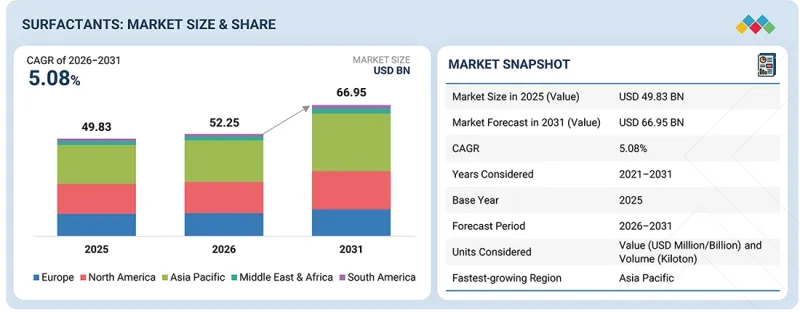
계면활성제 시장 규모는 2026년 522억 5,000만 달러에서 2031년까지 669억 5,000만 달러로, CAGR 5.08%로 확대할 것으로 추정되고 있습니다.
| 조사 범위 | |
|---|---|
| 조사 대상 기간 | 2021-2031년 |
| 기준연도 | 2025년 |
| 예측 기간 | 2026-2031년 |
| 산정 단위 | 금액(100만/10억 달러) 및 킬로톤 |
| 부문 | 유형별, 기재별, 용도별, 지역별 |
| 대상 지역 | 아시아태평양, 유럽, 북미, 중동 및 아프리카, 남미 |
지속적인 연구개발 활동을 통해 계면활성제의 성능과 용도 범위가 확대되고 있습니다. 각 제조사는 세정 효율 향상, 용해성 강화, 거품 발생 제어 개선, 그리고 다양한 사용 조건 하에서의 안정성 향상을 실현한 배합을 잇달아 도입하고 있습니다. 또한 혁신적인 기술을 통해 정밀한 표면 활성 및 배합 균형이 요구되는 특수한 배합에서의 성능도 향상되고 있습니다. 신기술 덕분에 계면활성제는 배합 효율과 제품 품질을 유지하면서 여러 기능을 발휘할 수 있게 되었습니다. 이러한 개발을 통해 제조사들은 다양한 용도에 걸친 고객의 변화하는 요구에 대응할 수 있게 되었습니다. 제품 개발에 대한 지속적인 투자는 계면활성제 제조사의 경쟁력을 강화하고 비즈니스 기회를 확대하고 있습니다. 따라서 지속적인 기술 발전은 장기적인 시장 성장을 지원하는 중요한 요인으로 자리 잡고 있습니다.
"2025년, 양이온성 계면활성제 부문은 계면활성제 시장에서 3위의 점유율을 차지했습니다."
2025년, 양이온성 계면활성제는 금액 기준으로 계면활성제 시장에서 3위의 점유율을 차지했습니다. 섬유 유연제 및 세탁 컨디셔너는 양이온성 계면활성제의 최대 용도입니다. 이는 이러한 물질이 섬유에 쉽게 흡착되어 부드러움을 향상시키고, 정전기 발생을 억제하며, 세탁 후의 촉감을 높여주기 때문입니다. 가정용 및 상업용 세탁 제품 제조업체들은 섬유의 품질을 유지하면서도 오래 지속되는 컨디셔닝 효과를 제공하는 프리미엄 섬유 관리 제형 개발을 계속하고 있습니다. 부가가치가 높은 세탁 제품에 대한 소비자의 선호도가 높아지고 세탁기 보급률이 증가함에 따라 전 세계에서 섬유 유연제 소비량이 증가하고 있습니다. 섬유 관리 제품이 주거, 호텔·관광 업계 및 산업용 세탁 분야에서 지속적으로 확대됨에 따라 전 세계 계면활성제 시장에서 양이온성 계면활성제에 대한 수요는 계속해서 견고한 모습을 보이고 있습니다.
"2025년, I&I용 세제 부문은 계면활성제 시장에서 3위의 점유율을 차지했습니다."
2025년, I&I용 세정제 용도는 금액 기준으로 계면활성제 시장에서 3위의 점유율을 차지했습니다. 제조 공장, 작업장, 창고, 운송 시설 및 유지보수 작업 현장에서는 설비나 생산 구역에서 윤활유, 절삭유, 탄소 침전물, 산업용 그리스를 제거할 수 있는 강력한 세정 제품이 요구되고 있습니다. 계면활성제는 이러한 제거가 어려운 오염 물질을 효율적으로 분해하는 데 필요한 유화 작용과 세정력을 제공할 뿐만 아니라, 기계 및 작업면의 철저한 세정을 지원합니다. 산업 사업자들은 설비의 신뢰성과 작업장의 청결도를 향상시키는 유지보수 프로그램에 대한 투자를 지속하고 있습니다. 제조 및 유지보수 활동 전반에 걸친 산업용 탈지제의 사용 확대는 산업용 및 시설용 세정 용도에 맞춰 특별히 배합된 고성능 계면활성제에 대한 수요를 지속적으로 견인하고 있습니다.
"2025년, 유럽은 금액 기준 세계 계면활성제 시장에서 3위의 점유율을 차지했습니다."
2025년, 유럽은 금액 기준으로 세계 3위의 계면활성제 시장을 형성했습니다. 유럽의 규제 체계, 특히 화학물질의 등록, 평가, 허가 및 제한에 관한 규정(REACH)은 해당 지역 전체의 계면활성제 개발에 계속해서 영향을 미치고 있습니다. 각 제조사는 높은 제품 성능을 유지하면서, 지속적으로 진화하는 안전성, 환경 및 화학물질 관리 요건을 준수하는 계면활성제에 대한 투자를 추진하고 있습니다. 이러한 전환으로 인해 세제, 퍼스널 케어 제품, 산업용 세정제, 특수 화학 제품 분야에서 생분해성이 높은 성분, 재생 가능한 원료 및 환경 부하가 낮은 배합의 채택이 촉진되고 있습니다. 규제 요건을 충족하기 위한 지속적인 제품 재조성 및 혁신으로 인해 첨단 계면활성제 기술에 대한 지속적인 수요가 발생하고 있으며, 유럽은 고부가가치이자 규제를 준수하는 계면활성제 제품의 주요 시장으로서의 입지를 공고히 하고 있습니다.
이 보고서에서 다룬 주요 기업 개요로는 BASF SE(독일), Stepan Company(미국), Dow Inc.(미국), Evonik Industries AG(독일), Nouryon(네덜란드), Solvay S.A.(벨기에), Clariant AG(스위스), Indorama Ventures Public Company Limited(태국), Ashland Inc.(미국), Kao Corporation(일본) 및 Croda International Plc(영국)가 포함됩니다.
조사 범위
이 보고서에서는 계면활성제 시장을 유형, 용도, 지역별로 분류하여 각 지역의 시장 규모 및 추정치(단위 - 100만 달러)와 수량(단위 - 킬로톤)을 제공합니다. 주요 기업에 대한 상세한 분석을 수행하여, 각 기업의 사업 개요, 서비스 및 계면활성제 시장과 관련된 주요 전략에 대한 인사이트를 제공합니다.
이 보고서를 구매해야 하는 이유
본 조사 보고서는 업계 분석(업계 동향), 주요 기업의 시장 점유율 분석, 기업 개요 등 다양한 수준의 분석에 초점을 맞추고 있으며, 이를 종합하여 계면활성제 시장의 경쟁 구도, 신흥 및 고성장 부문, 고성장 지역, 그리고 시장 촉진요인, 억제요인, 성장 기회에 대한 전체적인 그림을 제공합니다.
이 보고서는 다음 사항에 대한 인사이트를 제공합니다. :
- 시장 침투도: 세계 시장의 주요 기업이 제공하는 계면활성제에 관한 포괄적인 정보
- 주요 촉진요인 분석:(신흥 경제국의 도시화 및 가처분 소득 증가, 세계 화학 산업의 확대 및 산업·공공 시설(I&I)용 세정 수요 증가, 증산법(EOR)에서 계면활성제 사용 확대) , 제약 요인(석유화학 및 유지화학 원료 가격 변동, 엄격한 환경·화학물질 안전 규제), 기회(바이오 유래 및 재생 가능 계면활성제의 채택 확대, 다기능 계면활성제 배합에 대한 기술적 진보), 그리고 과제(세계 공급망의 복잡화에 대한 대응) 등, 계면활성제 시장의 성장에 영향을 미치는 요인
- 제품 개발 및 혁신: 계면활성제 시장의 향후 기술, 연구개발 활동, 그리고 신제품·서비스 출시에 관한 상세한 분석
- 시장 개발: 수익성이 높은 신흥 시장에 대한 포괄적인 정보 - 이 보고서에서는 지역별 계면활성제 시장을 분석하고 있습니다.
- 시장 다각화: 신제품, 미개발 지역 및 전 세계 계면활성제 시장의 최근 동향에 관한 포괄적인 정보
- 경쟁 분석: 계면활성제 시장의 주요 기업의 시장 점유율, 전략, 제품 및 생산 능력에 대한 상세한 평가
자주 묻는 질문
목차
제1장 서론
제2장 개요
제3장 주요 인사이트
제4장 시장 개요
제5장 업계 동향
제6장 고객 상황과 구매 행동
제7장 규제 상황과 지속가능성 구상
제8장 기술 진보, AI에 의한 영향, 특허, 혁신, 향후 응용
제9장 계면활성제 시장(유형별)
제10장 계면활성제 시장(기재별)
제11장 계면활성제 시장(용도별)
제12장 계면활성제 시장(지역별)
제13장 경쟁 구도
제14장 기업 개요
제15장 조사 방법
제16장 부록
KSA 26.08.19The surfactants market is estimated to grow from USD 52.25 billion in 2026 to USD 66.95 billion by 2031, at a CAGR of 5.08%.
| Scope of the Report | |
|---|---|
| Years Considered for the Study | 2021-2031 |
| Base Year | 2025 |
| Forecast Period | 2026-2031 |
| Units Considered | Value (USD Million/Billion) and Volume (Kiloton) |
| Segments | Type, Application, and Region |
| Regions covered | Asia Pacific, Europe, North America, Middle East & Africa, and South America |
Continuous research and development activities are expanding the performance and application range of surfactants. Manufacturers are introducing formulations with improved cleaning efficiency, enhanced compatibility, better foam control, and greater stability under different operating conditions. Innovation is also improving performance in specialized formulations that require precise surface activity and formulation balance. New technologies enable surfactants to deliver multiple functions while maintaining formulation efficiency and product quality. These developments allow manufacturers to address changing customer requirements across diverse applications. Ongoing investment in product development is strengthening the competitiveness of surfactant producers and expanding commercial opportunities. Continuous technological advancement therefore remains an important factor supporting long-term market growth.
"The cationic surfactants segment accounted for the third-largest share in the surfactants market in 2025."
Cationic surfactants accounted for the third-largest share of the surfactants market, in terms of value, in 2025. Fabric softeners and laundry conditioners represent the largest application for cationic surfactants because these materials readily adsorb onto fabric fibers, improving softness, reducing static buildup, and enhancing fabric feel after washing. Household and commercial laundry product manufacturers continue developing premium fabric care formulations that provide long-lasting conditioning while preserving textile quality. Rising consumer preference for value-added laundry products and increasing ownership of washing machines are supporting higher consumption of fabric conditioners worldwide. As fabric care products continue expanding across residential, hospitality, and commercial laundry sectors, demand for cationic surfactants remains strong within the global surfactants market.
"The I&I cleaners segment held the third-largest share in the surfactants market in 2025."
The I&I cleaners application held the third-largest share of the surfactants market, in terms of value, in 2025. Manufacturing plants, workshops, warehouses, transportation facilities, and maintenance operations require heavy-duty cleaning products capable of removing lubricants, machining oils, carbon deposits, and industrial grease from equipment and production areas. Surfactants provide the emulsification and detergency required to break down these difficult contaminants efficiently while supporting thorough cleaning of machinery and work surfaces. Industrial operators continue investing in maintenance programs that improve equipment reliability and workplace cleanliness. The expanding use of industrial degreasers across manufacturing and maintenance activities continues driving demand for high-performance surfactants formulated specifically for industrial and institutional cleaning applications.
"Europe accounted for the third-largest share of the global surfactants market, in terms of value, in 2025."
Europe was the third-largest surfactants market, in terms of value, in 2025. The European regulatory framework, particularly the Registration, Evaluation, Authorisation and Restriction of Chemicals (REACH), continues to influence surfactant development across the region. Manufacturers are investing in surfactants that comply with evolving safety, environmental, and chemical management requirements while maintaining high product performance. This transition encourages greater use of readily biodegradable ingredients, renewable feedstocks, and lower-impact formulations across detergents, personal care products, industrial cleaners, and specialty chemicals. Continuous product reformulation and innovation to satisfy regulatory expectations are creating sustained demand for advanced surfactant technologies, strengthening Europe's position as a leading market for high-value and regulation-compliant surfactant products.
- By Company Type: Tier 1 - 55%, Tier 2 - 25%, and Tier 3 - 20%
- By Designation: Directors - 50%, Managers - 30%, and Others - 20%
- By Region: North America - 40%, Europe - 35%, Asia Pacific - 20%, RoW - 5%
The key players profiled in the report include BASF SE (Germany), Stepan Company (US), Dow Inc. (US), Evonik Industries AG (Germany), Nouryon (Netherlands), Solvay S.A. (Belgium), Clariant AG (Switzerland), Indorama Ventures Public Company Limited (Thailand), Ashland Inc. (US), Kao Corporation (Japan), and Croda International Plc (UK).
Study Coverage
This report segments the market for surfactants based on type, application, and region, and provides estimations of value (in USD Million) and volume (in Kiloton) for the overall market size across various regions. A detailed analysis of key industry players has been conducted to provide insights into their business overviews, services, and key strategies associated with the surfactants market.
Reasons to Buy this Report
This research report is focused on various levels of analysis-industry analysis (industry trends), market share analysis of top players, and company profiles, which together provide an overall view of the competitive landscape, emerging and high-growth segments of the surfactants market, high-growth regions, and market drivers, restraints, and opportunities.
The report provides insights into the following points:
- Market Penetration: Comprehensive information on surfactants offered by top players in the global market
- Analysis of key drivers: (Urbanization and rising disposable incomes in emerging economies, Expanding global chemical industry and growing industrial and institutional (I&I) cleaning demand, Intensifying use of surfactants in enhanced oil recovery (EOR) operations), restraints (Petrochemical and oleochemical feedstock price volatility, Stringent environmental and chemical safety regulations), opportunities (Growing adoption of bio-based and renewable surfactants, technological advancements in multifunctional surfactant formulations), and challenges (Addressing growing complexity in global supply networks) influencing the growth of surfactants market
- Product Development/Innovation: Detailed insights on upcoming technologies, research & development activities, and new product & service launches in the surfactants market
- Market Development: Comprehensive information about lucrative emerging markets-the report analyzes the market for surfactants across regions.
- Market Diversification: Exhaustive information about new products, untapped regions, and recent developments in the global surfactants market
- Competitive Assessment: In-depth assessment of market shares, strategies, products, and manufacturing capabilities of leading players in the surfactants market
TABLE OF CONTENTS
1 INTRODUCTION
- 1.1 STUDY OBJECTIVES
- 1.2 MARKET DEFINITION
- 1.3 STUDY SCOPE
- 1.3.1 MARKETS COVERED AND REGIONAL SCOPE
- 1.3.2 INCLUSIONS AND EXCLUSIONS OF STUDY
- 1.3.3 MARKET DEFINITION AND INCLUSION, BY SUBSTRATE
- 1.3.4 MARKET DEFINITION AND INCLUSION, BY TYPE
- 1.3.5 MARKET DEFINITION AND INCLUSIONS, BY APPLICATION
- 1.3.6 YEARS CONSIDERED
- 1.3.7 CURRENCY CONSIDERED
- 1.3.8 UNIT CONSIDERED
- 1.4 STAKEHOLDERS
- 1.5 SUMMARY OF CHANGES
2 EXECUTIVE SUMMARY
- 2.1 MARKET HIGHLIGHTS AND KEY INSIGHTS
- 2.2 KEY MARKET PARTICIPANTS: MAPPING OF STRATEGIC DEVELOPMENTS
- 2.3 DISRUPTIVE TRENDS IN SURFACTANTS MARKET
- 2.4 HIGH-GROWTH SEGMENTS
- 2.5 REGIONAL SNAPSHOT: MARKET SIZE, GROWTH RATE, AND FORECAST
3 PREMIUM INSIGHTS
- 3.1 ATTRACTIVE OPPORTUNITIES FOR PLAYERS IN SURFACTANTS MARKET
- 3.2 SURFACTANTS MARKET, BY APPLICATION AND REGION
- 3.3 SURFACTANTS MARKET, BY TYPE
- 3.4 SURFACTANTS MARKET, BY COUNTRY
4 MARKET OVERVIEW
- 4.1 INTRODUCTION
- 4.2 MARKET DYNAMICS
- 4.2.1 DRIVERS
- 4.2.1.1 Urbanization and rising disposable incomes in emerging economies
- 4.2.1.2 Expanding global chemical industry and growing industrial and institutional cleaning demand
- 4.2.1.3 Intensifying use of surfactants in enhanced oil recovery (EOR) operations
- 4.2.2 RESTRAINTS
- 4.2.2.1 Petrochemical and oleochemical feedstock price volatility
- 4.2.2.2 Stringent environmental and chemical safety regulations
- 4.2.3 OPPORTUNITIES
- 4.2.3.1 Growing adoption of bio-based and renewable surfactants
- 4.2.3.2 Technological advancements in multifunctional surfactant formulations
- 4.2.4 CHALLENGES
- 4.2.4.1 Addressing growing complexity in global supply networks
- 4.2.1 DRIVERS
- 4.3 INTERCONNECTED MARKETS AND CROSS-SECTOR OPPORTUNITIES
- 4.3.1 INTERCONNECTED MARKETS
- 4.3.2 CROSS-SECTOR OPPORTUNITIES
- 4.4 STRATEGIC MOVES BY TIER-1/2/3 PLAYERS
- 4.4.1 KEY MOVES AND STRATEGIC FOCUS
5 INDUSTRY TRENDS
- 5.1 PORTER'S FIVE FORCES ANALYSIS
- 5.1.1 THREAT OF NEW ENTRANTS
- 5.1.2 THREAT OF SUBSTITUTES
- 5.1.3 BARGAINING POWER OF SUPPLIERS
- 5.1.4 BARGAINING POWER OF BUYERS
- 5.1.5 INTENSITY OF COMPETITIVE RIVALRY
- 5.2 MACROECONOMIC OUTLOOK
- 5.2.1 INTRODUCTION
- 5.2.2 GDP TRENDS AND FORECAST
- 5.2.3 TRENDS IN HOME CARE INDUSTRY
- 5.3 SUPPLY CHAIN ANALYSIS
- 5.3.1 RAW MATERIALS
- 5.3.2 MANUFACTURERS
- 5.3.3 DISTRIBUTION NETWORK
- 5.3.4 END USERS
- 5.4 ECOSYSTEM ANALYSIS
- 5.5 PRICING ANALYSIS
- 5.5.1 AVERAGE SELLING PRICE OF SURFACTANTS AMONG KEY PLAYERS, BY TYPE, 2025
- 5.5.2 AVERAGE SELLING PRICE TREND OF SURFACTANTS, BY REGION, 2021-2025
- 5.6 TRADE ANALYSIS
- 5.6.1 IMPORT SCENARIO (HS CODE 3402)
- 5.6.2 EXPORT SCENARIO (HS CODE 34O2)
- 5.7 KEY CONFERENCES & EVENTS, 2026-2027
- 5.8 TRENDS/DISRUPTIONS IMPACTING CUSTOMER BUSINESS
- 5.8.1 REVENUE SHIFTS & REVENUE POCKETS IN SURFACTANTS MARKET
- 5.9 INVESTMENT AND FUNDING SCENARIO
- 5.10 CASE STUDY ANALYSIS
- 5.10.1 IMPROVING LAUNDRY DETERGENT PERFORMANCE IN COLD-WATER WASHING
- 5.10.2 ENHANCING MILDNESS IN SULFATE-FREE SHAMPOOS
- 5.11 IMPACT OF 2025 US TARIFF - OVERVIEW
- 5.11.1 INTRODUCTION
- 5.11.2 KEY TARIFF RATES
- 5.11.3 PRICE IMPACT ANALYSIS
- 5.11.4 IMPACT ON COUNTRIES/REGIONS
- 5.11.4.1 US
- 5.11.4.2 Europe
- 5.11.4.3 Asia Pacific
- 5.11.5 IMPACT ON APPLICATIONS
6 CUSTOMER LANDSCAPE & BUYER BEHAVIOR
- 6.1 DECISION-MAKING PROCESS
- 6.2 BUYER STAKEHOLDERS AND BUYING EVALUATION CRITERIA
- 6.2.1 KEY STAKEHOLDERS IN BUYING PROCESS
- 6.2.2 BUYING CRITERIA
- 6.3 ADOPTION BARRIERS & INTERNAL CHALLENGES
- 6.4 UNMET NEEDS IN VARIOUS APPLICATIONS
7 REGULATORY LANDSCAPE AND SUSTAINABILITY INITIATIVES
- 7.1 REGIONAL REGULATIONS AND COMPLIANCE
- 7.1.1 REGULATORY BODIES, GOVERNMENT AGENCIES, AND OTHER ORGANIZATIONS
- 7.1.2 INDUSTRY STANDARDS
- 7.2 SUSTAINABILITY INITIATIVES
- 7.2.1 RESOURCE EFFICIENCY IMPROVEMENT
- 7.2.2 SUSTAINABLE APPLICATIONS
- 7.3 SUSTAINABILITY IMPACT AND REGULATORY POLICY INITIATIVES
- 7.4 CERTIFICATIONS, LABELING, AND ECO-STANDARDS
8 TECHNOLOGICAL ADVANCEMENTS, AI-DRIVEN IMPACT, PATENTS, INNOVATIONS, AND FUTURE APPLICATIONS
- 8.1 KEY EMERGING TECHNOLOGIES
- 8.1.1 SULFONATION AND SULFATION TECHNOLOGY
- 8.1.2 ETHOXYLATION AND ALKOXYLATION TECHNOLOGY
- 8.2 COMPLEMENTARY TECHNOLOGIES
- 8.2.1 FEEDSTOCK PURIFICATION AND PRETREATMENT TECHNOLOGY
- 8.2.2 ADVANCED SEPARATION AND PURIFICATION TECHNOLOGY
- 8.3 TECHNOLOGY/PRODUCT ROADMAP
- 8.3.1 SHORT-TERM (2026-2027) | FORMULATION ADVANCEMENT & EARLY MARKET EXPANSION
- 8.3.2 MID-TERM (2027-2030) | PERFORMANCE ENHANCEMENT & INDUSTRY STANDARDIZATION
- 8.3.3 LONG-TERM (2030-2035+) | ADVANCED SURFACTANT SYSTEMS & SUSTAINABLE INDUSTRY TRANSITION
- 8.4 PATENT ANALYSIS
- 8.4.1 APPROACH
- 8.4.2 DOCUMENT TYPES
- 8.4.3 TOP APPLICANTS
- 8.4.4 JURISDICTION ANALYSIS
- 8.5 IMPACT OF AI/GEN AI ON SURFACTANTS MARKET
- 8.5.1 TOP USE CASES AND MARKET POTENTIAL
- 8.5.2 BEST PRACTICES IN SURFACTANTS PROCESSING
- 8.5.3 CASE STUDIES OF AI IMPLEMENTATION IN SURFACTANTS MARKET
- 8.5.4 INTERCONNECTED ADJACENT ECOSYSTEM AND IMPACT ON MARKET PLAYERS
- 8.5.5 CLIENTS' READINESS TO ADOPT GENERATIVE AI IN SURFACTANTS MARKET
9 SURFACTANTS MARKET, BY TYPE
- 9.1 INTRODUCTION
- 9.2 ANIONIC SURFACTANTS
- 9.2.1 SUPERIOR DETERGENCY AND COST EFFICIENCY
- 9.2.2 LINEAR ALKYLBENZENE SULFONATE
- 9.2.3 ALCOHOL ETHOXY SULFATES
- 9.2.4 SECONDARY ALKANE SULFONATES
- 9.2.5 ALPHA OLEFIN SULFONATES
- 9.2.6 METHYL ESTER SULFONATES
- 9.2.7 SULFOSUCCINATES
- 9.2.8 OTHER ANIONIC SURFACTANTS
- 9.3 NON-IONIC SURFACTANTS
- 9.3.1 EXCELLENT FORMULATION COMPATIBILITY
- 9.3.2 ALCOHOL ETHOXYLATES
- 9.3.3 ALKYL PHENOL ETHOXYLATES
- 9.3.4 AMINE OXIDES
- 9.3.5 FATTY ACID ESTERS
- 9.3.6 OTHER NON-IONIC SURFACTANTS
- 9.4 CATIONIC SURFACTANTS
- 9.4.1 STRONG SURFACE ADSORPTION CHARACTERISTICS
- 9.4.2 QUATERNARY AMMONIUM COMPOUNDS
- 9.4.3 OTHER CATIONIC SURFACTANTS
- 9.5 AMPHOTERIC SURFACTANTS
- 9.5.1 BALANCED PERFORMANCE ACROSS MULTI-SURFACTANT FORMULATIONS
- 9.5.2 BETAINES
- 9.5.3 OTHER AMPHOTERIC SURFACTANTS
10 SURFACTANTS MARKET, BY SUBSTRATE
- 10.1 INTRODUCTION
- 10.2 SYNTHETIC SURFACTANTS
- 10.3 BIO-BASED SURFACTANTS
- 10.3.1 CHEMICALLY SYNTHESIZED BIO-BASED SURFACTANTS
- 10.3.1.1 Sucrose esters
- 10.3.1.2 Alkyl polyglycosides
- 10.3.1.3 Fatty acid glucamides
- 10.3.1.4 Sorbitan esters
- 10.3.2 BIOSURFACTANTS
- 10.3.2.1 Low molecular weight biosurfactants
- 10.3.2.2 High molecular weight biosurfactants
- 10.3.1 CHEMICALLY SYNTHESIZED BIO-BASED SURFACTANTS
11 SURFACTANTS MARKET, BY APPLICATION
- 11.1 INTRODUCTION
- 11.2 HOME CARE
- 11.2.1 GROWING PREFERENCE FOR HIGH-PERFORMANCE CLEANING PRODUCTS
- 11.3 PERSONAL CARE
- 11.3.1 RISING DEMAND FOR MILD AND SKIN-FRIENDLY FORMULATIONS
- 11.4 I&I CLEANERS
- 11.4.1 INCREASING HYGIENE STANDARDS ACROSS COMMERCIAL FACILITIES
- 11.5 FOOD & BEVERAGE
- 11.5.1 GROWING DEMAND FOR PROCESSED FOOD PRODUCTS
- 11.6 OILFIELD CHEMICALS
- 11.6.1 INCREASING ENHANCED OIL RECOVERY ACTIVITIES
- 11.7 AGROCHEMICALS
- 11.7.1 GROWING ADOPTION OF HIGH-PERFORMANCE PESTICIDE FORMULATIONS
- 11.8 TEXTILES
- 11.8.1 EXPANDING TECHNICAL TEXTILE PRODUCTION
- 11.9 ELASTOMERS & PLASTICS
- 11.9.1 GROWING DEMAND FOR HIGH-PERFORMANCE POLYMER ADDITIVES
- 11.10 OTHER APPLICATIONS
12 SURFACTANTS MARKET, BY REGION
- 12.1 INTRODUCTION
- 12.2 ASIA PACIFIC
- 12.2.1 CHINA
- 12.2.1.1 Growing industrial activities to drive market
- 12.2.2 INDIA
- 12.2.2.1 Rapid industrialization to drive demand
- 12.2.3 JAPAN
- 12.2.3.1 Growing demand for high-performance specialty surfactant formulations to fuel growth
- 12.2.1 CHINA
- 12.3 NORTH AMERICA
- 12.3.1 US
- 12.3.1.1 Strong industrial infrastructure to fuel growth
- 12.3.2 CANADA
- 12.3.2.1 Focus on advanced research and development to drive demand
- 12.3.3 MEXICO
- 12.3.3.1 Expansion of home and institutional cleaning product manufacturing to drive market
- 12.3.1 US
- 12.4 EUROPE
- 12.4.1 GERMANY
- 12.4.1.1 Growing preference for high-performance formulation standards to fuel market
- 12.4.2 FRANCE
- 12.4.2.1 Expansion of premium personal care product manufacturing to drive demand
- 12.4.3 UK
- 12.4.3.1 Rising development of science-led specialty ingredient innovations to drive growth
- 12.4.4 ITALY
- 12.4.4.1 Growing demand for high-performance plastic compounding to drive market
- 12.4.5 SPAIN
- 12.4.5.1 Growing investment in industrial water treatment solutions to drive market
- 12.4.6 POLAND
- 12.4.6.1 Expansion of processed food manufacturing to drive market
- 12.4.7 NETHERLANDS
- 12.4.7.1 Expansion of greenhouse horticulture activities to drive demand
- 12.4.1 GERMANY
- 12.5 MIDDLE EAST & AFRICA
- 12.5.1 SAUDI ARABIA
- 12.5.1.1 Growth in oilfield chemical production to drive market
- 12.5.2 UAE
- 12.5.2.1 Growth in regional specialty chemical distribution and blending to propel market
- 12.5.3 SOUTH AFRICA
- 12.5.3.1 Expansion of mineral processing chemical requirements to propel market
- 12.5.4 EGYPT
- 12.5.4.1 Expansion of textile processing activities to drive growth
- 12.5.1 SAUDI ARABIA
- 12.6 SOUTH AMERICA
- 12.6.1 BRAZIL
- 12.6.1.1 Economic momentum drives adoption across sectors
- 12.6.2 ARGENTINA
- 12.6.2.1 Increasing demand for surfactants in crop protection formulations to drive demand
- 12.6.1 BRAZIL
13 COMPETITIVE LANDSCAPE
- 13.1 INTRODUCTION
- 13.2 KEY PLAYER STRATEGIES/RIGHT TO WIN, JANUARY 2021-MAY 2026
- 13.3 MARKET SHARE ANALYSIS, 2025
- 13.4 REVENUE ANALYSIS, 2021-2025
- 13.5 COMPANY EVALUATION MATRIX: KEY PLAYERS, 2025
- 13.5.1 STARS
- 13.5.2 EMERGING LEADERS
- 13.5.3 PERVASIVE PLAYERS
- 13.5.4 PARTICIPANTS
- 13.5.5 COMPANY FOOTPRINT: KEY PLAYERS, 2025
- 13.5.5.1 Company footprint
- 13.5.5.2 Region footprint
- 13.5.5.3 Type footprint
- 13.5.5.4 Application footprint
- 13.6 COMPANY EVALUATION MATRIX: STARTUPS/SMES, 2025
- 13.6.1 PROGRESSIVE COMPANIES
- 13.6.2 RESPONSIVE COMPANIES
- 13.6.3 DYNAMIC COMPANIES
- 13.6.4 STARTING BLOCKS
- 13.6.5 COMPETITIVE BENCHMARKING: STARTUPS/SMES
- 13.6.5.1 Detailed list of key startups/SMES
- 13.6.5.2 Competitive benchmarking of key startups/SMEs
- 13.7 BRAND/PRODUCT COMPARISON ANALYSIS
- 13.8 COMPANY VALUATION AND FINANCIAL METRICS
- 13.9 COMPETITIVE SCENARIO
- 13.9.1 PRODUCT LAUNCHES
- 13.9.2 DEALS
- 13.9.3 EXPANSIONS
14 COMPANY PROFILES
- 14.1 KEY PLAYERS
- 14.1.1 BASF SE
- 14.1.1.1 Business overview
- 14.1.1.2 Products/Solutions/Services offered
- 14.1.1.3 Recent developments
- 14.1.1.3.1 Product launches
- 14.1.1.3.2 Deals
- 14.1.1.4 MnM view
- 14.1.1.4.1 Right to win
- 14.1.1.4.2 Strategic choices
- 14.1.1.4.3 Weaknesses and competitive threats
- 14.1.2 STEPAN COMPANY
- 14.1.2.1 Business overview
- 14.1.2.2 Products/Solutions/Services offered
- 14.1.2.3 Recent developments
- 14.1.2.3.1 Deals
- 14.1.2.3.2 Expansions
- 14.1.2.4 MnM view
- 14.1.2.4.1 Right to win
- 14.1.2.4.2 Strategic choices
- 14.1.2.4.3 Weaknesses and competitive threats
- 14.1.3 DOW INC.
- 14.1.3.1 Business overview
- 14.1.3.2 Products/Solutions/Services offered
- 14.1.3.3 Recent developments
- 14.1.3.3.1 Product launches
- 14.1.3.3.2 Deals
- 14.1.3.4 MnM view
- 14.1.3.4.1 Right to win
- 14.1.3.4.2 Strategic choices
- 14.1.3.4.3 Weaknesses and competitive threats
- 14.1.4 EVONIK INDUSTRIES AG
- 14.1.4.1 Business overview
- 14.1.4.2 Products/Solutions/Services offered
- 14.1.4.3 Recent developments
- 14.1.4.3.1 Product launches
- 14.1.4.3.2 Expansions
- 14.1.4.4 MnM View
- 14.1.4.4.1 Right to win
- 14.1.4.4.2 Strategic choices
- 14.1.4.4.3 Weaknesses and competitive threats
- 14.1.5 NOURYON
- 14.1.5.1 Business overview
- 14.1.5.2 Products/Solutions/Services offered
- 14.1.5.3 Recent developments
- 14.1.5.3.1 Product launches
- 14.1.5.3.2 Deals
- 14.1.5.3.3 Expansions
- 14.1.5.4 MnM view
- 14.1.5.4.1 Right to win
- 14.1.5.4.2 Strategic choices
- 14.1.5.4.3 Weaknesses and competitive threats
- 14.1.6 SYENSQO SA/NV
- 14.1.6.1 Business overview
- 14.1.6.2 Products/Solutions/Services offered
- 14.1.6.3 Recent developments
- 14.1.6.3.1 Product launches
- 14.1.6.3.2 Expansions
- 14.1.7 CLARIANT AG
- 14.1.7.1 Business overview
- 14.1.7.2 Products/Solutions/Services offered
- 14.1.7.3 Recent developments
- 14.1.7.3.1 Product launches
- 14.1.7.3.2 Deals
- 14.1.7.3.3 Expansions
- 14.1.8 INDORAMA VENTURES PUBLIC COMPANY LIMITED
- 14.1.8.1 Business overview
- 14.1.8.2 Products/Solutions/Services offered
- 14.1.8.3 Recent developments
- 14.1.8.3.1 Deals
- 14.1.8.3.2 Expansions
- 14.1.9 ASHLAND INC.
- 14.1.9.1 Business overview
- 14.1.9.2 Products/Solutions/Services offered
- 14.1.9.3 Recent developments
- 14.1.9.3.1 Deals
- 14.1.10 KAO CORPORATION
- 14.1.10.1 Business overview
- 14.1.10.2 Products/Solutions/Services offered
- 14.1.11 CRODA INTERNATIONAL PLC
- 14.1.11.1 Business overview
- 14.1.11.2 Products/Solutions/Services offered
- 14.1.11.3 Recent developments
- 14.1.11.3.1 Product launches
- 14.1.11.3.2 Deals
- 14.1.1 BASF SE
- 14.2 STARTUP/SMES
- 14.2.1 AARTI INDUSTRIES LIMITED
- 14.2.2 ADEKA CORPORATION
- 14.2.3 AK CHEM TECH CO., LTD.
- 14.2.4 ALZO INTERNATIONAL INC.
- 14.2.5 ARKEMA S.A.
- 14.2.6 BAYER AG
- 14.2.7 CEPSA
- 14.2.8 COLONIAL CHEMICAL, INC.
- 14.2.9 EOC GROUP
- 14.2.10 ENASPOL A.S.
- 14.2.11 GALAXY SURFACTANTS LTD.
- 14.2.12 INNOSPEC INC.
- 14.2.13 KLK OLEO
- 14.2.14 LANKEM LTD
15 RESEARCH METHODOLOGY
- 15.1 RESEARCH DATA
- 15.1.1 SECONDARY DATA
- 15.1.1.1 Key data from secondary sources
- 15.1.2 PRIMARY DATA
- 15.1.2.1 Key data from primary sources
- 15.1.2.2 Primary interview - demand side and supply side
- 15.1.2.3 Breakdown of primary interviews
- 15.1.2.4 Key industry insights
- 15.1.1 SECONDARY DATA
- 15.2 MARKET SIZE ESTIMATION
- 15.2.1 BOTTOM-UP APPROACH
- 15.2.2 TOP-DOWN APPROACH
- 15.3 GROWTH FORECAST
- 15.3.1 SUPPLY SIDE
- 15.3.2 DEMAND SIDE
- 15.4 DATA TRIANGULATION
- 15.5 FACTOR ANALYSIS
- 15.6 RESEARCH ASSUMPTIONS
- 15.7 RESEARCH LIMITATIONS
- 15.8 RISK ASSESSMENT
16 APPENDIX
- 16.1 DISCUSSION GUIDE
- 16.2 KNOWLEDGESTORE: MARKETSANDMARKETS' SUBSCRIPTION PORTAL
- 16.3 CUSTOMIZATION OPTIONS
- 16.4 RELATED REPORTS
- 16.5 AUTHOR DETAILS


