
|
시장보고서
상품코드
2111246
EV용 복합재료 시장 예측(-2031년) : 섬유 유형별, 수지 유형별, 유형별, 용도별, 제조 프로세스별, 지역별EV Composites Market by Fiber Type (Glass Fiber, Carbon Fiber, Other Fibers), Resin Type (Thermoplastics, Thermoset), Type (Ultra-Premium, Premium and Non-Premium), Manufacturing Process, Application, and Region - Global Forecast to 2031 |
||||||

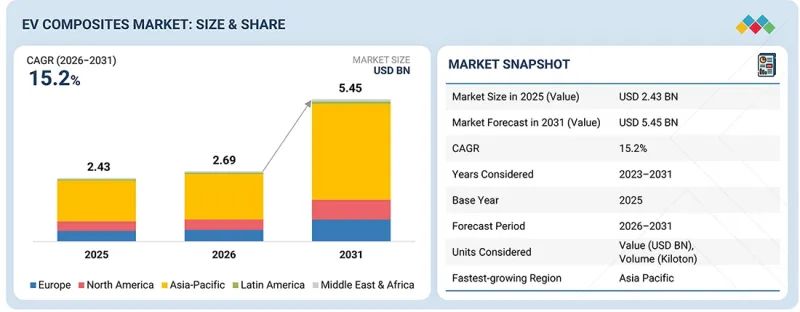
EV용 복합재료 시장 규모는 2026년에 26억 9,000만 달러로 추계되고 있으며, 2026-2031년에 CAGR 15.2%로 확대하며, 2031년에는 54억 5,000만 달러에 달할 것으로 예측됩니다.
이 시장의 주요 성장 요인으로는 전 세계 전기자동차(EV) 생산의 급속한 확대, 연비 및 배기가스 규제의 강화, 그리고 자동차 업계에서 경량·고성능·지속가능한 소재에 대한 중요성이 높아지고 있는 점을 들 수 있습니다.
| 조사 범위 | |
|---|---|
| 조사 대상 기간 | 2023-2031년 |
| 기준연도 | 2025년 |
| 예측 기간 | 2026-2031년 |
| 산정 단위 | 금액(100만 달러) 및 킬로톤 |
| 부문 | 섬유 유형별, 수지 유형별, 유형별, 용도별, 제조 프로세스별, 지역별 |
| 대상 지역 | 유럽, 북미, 아시아태평양, 중동 및 아프리카 및 라틴아메리카 |
복합재료는 차량 경량화, 배터리 효율 향상, 주행 거리 연장 및 구조적 무결성 강화에 있으며, 매우 중요한 역할을 수행하고 있으며, 차세대 전기자동차에 없어서는 안 될 구성 요소로 자리 잡고 있습니다. 섬유 유형 중에서도 유리섬유 복합재료는 성능과 비용의 균형이 뛰어나 계속해서 견고한 수요가 예상됩니다. 탄소섬유 복합재료와 비교했을 때, 유리섬유는 높은 인장 강도, 내식성, 내충격성 및 장기적인 내구성을 갖추고 있으면서도 훨씬 더 경제적인 솔루션을 제공합니다. 이러한 소재는 배터리 하우징, 차체 패널, 프론트엔드 모듈, 언더바디 실드, 구조 보강재 및 내장 부품에 널리 사용되고 있습니다. 뛰어난 단열성 및 전기 절연성은 배터리의 안전성과 열 관리 향상에 기여할 뿐만 아니라, 고전압 전기 시스템의 신뢰성 높은 성능을 보장합니다.
유리섬유 복합재료는 탁월한 설계 유연성을 제공하여, 제조업체가 압축 성형 및 수지 전사 성형과 같은 대량 생산 공정을 통해 복잡하고 공기역학적으로 최적화된 차량 부품을 제조할 수 있게 해줍니다. 재활용 가능한 열가소성 복합재료, 자동화 제조 기술 및 바이오 기반 수지 시스템의 발전으로 인해 유리섬유 복합재료의 지속가능성과 비용 경쟁력은 더욱 높아지고 있습니다. 또한 소음·진동·불쾌감(NVH) 저감, 탑승자 편의성 향상, 그리고 차량 경량화를 지원하는 능력 덕분에 유리섬유 복합재료는 양산형 전기자동차에서 선호되는 소재가 되고 있습니다. 전 세계 전기자동차 생산이 계속 가속화되고 제조사들이 비용 효율적인 경량화 솔루션을 모색함에 따라 예측 기간 중 유리섬유 복합재료의 채택은 꾸준히 증가할 것으로 예상됩니다.
"금액 기준으로 볼 때, 열경화성 수지 부문이 전기자동차용 복합재료 시장 전체에서 가장 큰 점유율을 차지했습니다."
열경화성 복합재료는 열경화성 수지를 매트릭스 재료로 사용하고, 탄소섬유, 유리섬유, 아라미드 섬유, 천연 섬유 등의 섬유로 보강함으로써 높은 강도, 강성 및 장기적인 내구성을 실현하고 있습니다. 에폭시, 불포화 폴리에스터, 비닐 에스테르, 폴리우레탄을 포함한 열경화성 수지 시스템은 뛰어난 섬유 함침 특성, 우수한 기계적 특성, 그리고 보강 섬유에 대한 강한 접착력 덕분에 전기자동차용 복합재료 제조에 여전히 널리 사용되고 있습니다. 일단 경화되면, 열경화성 복합재료는 재용융이 불가능한 영구적인 가교 분자 구조를 형성하여 탁월한 치수 안정성, 내피로성, 내식성 및 열, 화학 물질, 환경 열화에 대한 우수한 내성을 제공합니다.
이러한 특성 덕분에 열경화성 복합재료는 높은 구조적 무결성과 충돌 성능이 필수적인 배터리 하우징, 차체 패널, 루프 모듈, 섀시 부품, 언더바디 실드, 구조 보강재와 같은 까다로운 전기자동차 용도에 최적입니다. 또한 열경화성 복합재료는 뛰어난 전기 절연성과 열 안정성을 갖추고 있으며, 고전압 배터리 시스템 및 전력 전자 장치의 안전한 작동을 지원합니다.
열경화성 복합재료 부문은 전기자동차 생산의 급속한 확대, 차량 효율 및 주행 거리 향상을 위한 경량 소재 채택 확대, 그리고 엄격한 차량 안전 및 배기가스 규제를 배경으로 예측 기간 중 상당한 성장이 예상됩니다. 속경화 수지 시스템, 자동 수지 전사 성형(RTM), 압축 성형 기술, 그리고 재활용 가능한 열경화성 배합에 대한 지속적인 발전으로 제조 효율과 지속가능성이 향상되고 있습니다. 자동차 제조사들이 가볍고 내구성이 뛰어나며 고성능인 소재를 계속해서 우선시함에 따라 열경화성 복합재료는 전기자동차의 구조용 및 준구조용 부품에서 주요 소재 선택지로 남아 있을 것으로 예상됩니다.
"금액 기준으로 볼 때, RTM 제조 공정 분야는 전기자동차용 복합재료 시장 전체에서 3위의 점유율을 차지했습니다."
2025년, 수지 이송 성형(RTM) 부문은 전기자동차용 복합재료 시장에서 금액 기준으로 3위의 점유율을 차지했습니다. RTM은 경량이며 치수 정밀도가 높고, 구조적으로 견고하며, 우수한 표면 품질을 갖춘 부품을 제조할 수 있으므로 고성능 복합재료 부품 제조에 점점 더 많이 채택되고 있습니다. 이 공정은 배터리 케이스, 차체 패널, 구조 부품, 공력 부품 등에 널리 활용되고 있으며, 높은 설계 유연성과 효율적인 섬유 함침을 실현하고 있습니다. 고압 RTM, 자동화 생산 및 속경화 수지 시스템의 발전으로 사이클 타임이 단축되어 생산량 확대가 지원되고 있습니다. 전기자동차 제조사들이 경량화, 안전성 및 확장 가능한 제조를 지속적으로 우선시함에 따라 예측 기간 중 RTM으로 제조되는 복합재료 부품에 대한 수요가 꾸준히 증가할 것으로 예상됩니다.
"예측 기간 중 유럽은 전기자동차용 복합재료 시장에서 2위 규모를 차지할 것으로 전망됩니다."
유럽의 전기자동차용 복합재료 시장 성장은 규제 압력, 정부의 인센티브, 자동차 산업의 혁신, 인프라 구축 및 지속가능성 목표에 힘입어 가속화되고 있습니다. 탄소섬유 복합재료의 채택, 첨단 제조 기술, 배터리 하우징에 대한 집중과 같은 동향은 이 시장의 역동적인 특성을 여실히 보여주고 있습니다. 유럽이 전기 모빌리티로의 전환을 계속 주도함에 따라 고성능 복합재료에 대한 수요는 증가할 전망이며, 이는 전기자동차 업계의 추가적인 기술 발전과 보급을 견인할 것입니다. Rochling SE &Co. KG 및 ElringKlinger AG와 같은 주요 기업은 시장 동향에 발맞추어 전기자동차용 복합재료에 대한 증가하는 수요에 부응하기 위해 신제품 개발을 위한 연구개발(R&D) 노력을 강화하고 있습니다.
이 보고서에서는 기업 개요에 대한 포괄적인 분석을 제공합니다. :
주요 기업으로는 Toray Industries, Inc.(일본), Teijin Limited(일본), Syensqo(벨기에), Piran Advanced Composites(영국), HRC(Hengrui Corporation)(중국), Envalior(독일), Exel Composites(핀란드), Kautex Textron GmbH & Co. KG(독일), SGL Carbon(독일), POLYTEC HOLDING AG(오스트리아), Plastic Omnium(프랑스), Rochling SE & Co. KG(독일), Mar-Bal, Inc.(미국), ElringKlinger AG(독일) 및 Faurecia(프랑스) 등이 있습니다.
조사 범위
본 조사 보고서에서는 EV용 복합재료 시장을 섬유 유형(유리섬유, 탄소섬유, 기타 섬유), 수지 유형(열가소성 수지, 열경화성 수지), 유형(울트라 프리미엄, 프리미엄, 논프리미엄), 제조 공정(압축 성형, 사출성형, RTM), 용도(내장, 외장, 배터리 인클로저, 파워트레인 및 섀시), 지역(북미, 유럽, 아시아태평양, 중동 및 아프리카, 라틴아메리카)별로 분류하고 있습니다. 이 보고서의 조사 범위에는 EV용 복합재료 시장의 성장에 영향을 미치는 주요 요인(촉진요인, 제약 요인, 과제, 기회 등)에 대한 상세한 정보가 포함되어 있습니다. 주요 업계 플레이어에 대해 철저한 조사를 수행하여, 해당 기업의 사업 개요, 솔루션 및 서비스, 주요 전략, 계약, 파트너십, 합의 사항에 대한 인사이트를 제공합니다. 또한 신제품 및 서비스 출시, 합병·인수, 그리고 전기자동차용 복합재료 시장의 최근 동향에 대해서도 다루고 있습니다. 이 보고서에는 전기자동차용 복합재료 시장의 생태계에서 두각을 보이고 있는 스타트업 기업에 대한 경쟁 분석도 포함되어 있습니다.
이 보고서를 구매해야 하는 이유:
이 보고서는 전기자동차용 복합재료 시장 전체 및 그 하위 부문의 매출에 대한 가장 정확한 추정치를 제공함으로써, 이 시장의 시장 리더와 신규 진입 기업을 지원합니다. 이 보고서는 이해관계자가 경쟁 구도를 이해하고, 자사의 비즈니스를 더 나은 위치로 이끌며, 적절한 시장 진입 전략을 수립하기 위한 인사이트를 얻는 데 도움이 됩니다. 또한 이 보고서는 이해관계자가 시장 동향을 파악할 수 있도록 지원하며, 주요 시장 촉진요인, 억제요인, 과제 및 기회에 대한 정보를 제공합니다.
이 보고서는 다음 사항에 대한 인사이트를 제공합니다. :
- EV 복합재료 시장의 성장에 영향을 미치는 주요 촉진요인(EV 복합재료 채택 확대, 기술 발전) , 제약 요인(저비용의 성숙한 제품과의 경쟁, 낮은 시장 침투율), 기회(탄소섬유 비용 절감, 전기자동차 인프라 확충) 및 과제(공급망 단절 방지 및 최대 생산 능력 유지, 자금 사정 악화)에 대한 분석
- 제품 개발/혁신: EV용 복합재료 시장의 향후 기술, 연구개발 활동, 그리고 신제품 및 서비스 출시에 대한 상세 인사이트
- 시장 개발: 수익성이 높은 시장에 대한 포괄적인 정보 - 이 보고서에서는 다양한 지역의 EV용 복합재료 시장을 분석하고 있습니다.
- 시장 다각화: 전기자동차용 복합재료 시장의 신제품·서비스, 미개발 지역, 최근 동향 및 투자에 관한 포괄적인 정보
- 경쟁 분석: Toray Industries, Inc.(일본), Teijin Limited(일본), Syensqo(벨기에), Piran Advanced Composites(영국), HRC(Hengrui Corporation)(중국), Envalior(독일), Exel Composites(핀란드), Kautex Textron GmbH & Co. KG(독일), SGL Carbon(독일), POLYTEC HOLDING AG(오스트리아), Plastic Omnium(프랑스), Rochling SE & Co. KG(독일), Mar-Bal, Inc.(미국), ElringKlinger AG(독일), Faurecia(프랑스), The Gund Company(미국), IDI Composites International(미국), TRB Lightweight Structures(미국), CIE Automotive India(인도), ZhongAo Carbon(중국), Atlas Fibre(미국), Jiangsu Kangde Xin Composite Material(중국), Euro Advanced Carbon Fiber Composites GmbH(미국), Owens Corning(미국) 등이 전기자동차용 복합재료 시장에 진출해 있습니다.
자주 묻는 질문
목차
제1장 서론
제2장 개요
제3장 주요 인사이트
제4장 시장 개요
제5장 업계 동향
제6장 기술, 특허, 디지털 기술, AI의 도입에 의한 전략적 파괴
제7장 지속가능성과 규제 상황
제8장 고객 상황과 구매 행동
제9장 EV 복합재료 시장(섬유 유형별)
제10장 EV 복합재료 시장(수지 유형별)
제11장 EV 복합재료 시장(유형별)
제12장 EV 복합재료 시장(용도별)
제13장 EV 복합재료 시장(제조 프로세스별)
제14장 EV 복합재료 시장(지역별)
제15장 경쟁 구도
제16장 기업 개요
제17장 조사 방법
제18장 부록
KSA 26.08.19The EV composites market is estimated at USD 2.69 billion in 2026 and is projected to reach USD 5.45 billion by 2031, at a CAGR of 15.2% from 2026 to 2031. The market is primarily driven by the rapid expansion of global electric vehicle production, increasingly stringent fuel economy and emission regulations, and the automotive industry's growing emphasis on lightweight, high-performance, and sustainable materials.
| Scope of the Report | |
|---|---|
| Years Considered for the Study | 2023-2031 |
| Base Year | 2025 |
| Forecast Period | 2026-2031 |
| Units Considered | Value (USD million) and volume (kiloton) |
| Segments | Fiber type, resin type, manufacturing process, application, type, and region |
| Regions covered | Europe, North America, Asia Pacific, Middle East & Africa, and Latin America |
Composite materials play a critical role in reducing vehicle weight, improving battery efficiency, extending driving range, and enhancing structural integrity, making them an essential component in next-generation electric vehicles. Among fiber types, glass fiber composites continue to witness strong demand due to their excellent balance of performance and cost. Compared with carbon fiber composites, glass fiber offers a significantly more economical solution while delivering high tensile strength, corrosion resistance, impact resistance, and long-term durability. These materials are extensively used in battery enclosures, body panels, front-end modules, underbody shields, structural reinforcements, and interior components. Their excellent thermal and electrical insulation properties help improve battery safety and thermal management while ensuring reliable performance of high-voltage electrical systems.
Glass fiber composites provide outstanding design flexibility, enabling manufacturers to produce complex and aerodynamically optimized vehicle components through high-volume manufacturing processes such as compression molding and resin transfer molding. Advances in recyclable thermoplastic composites, automated manufacturing technologies, and bio-based resin systems are further enhancing the sustainability and cost competitiveness of glass fiber composites. In addition, their ability to reduce noise, vibration, and harshness (NVH), improve occupant comfort, and support vehicle lightweighting makes them a preferred material for mass-market electric vehicles. As global EV production continues to accelerate and manufacturers seek cost-effective lightweight solutions, the adoption of glass fiber composites is expected to increase steadily throughout the forecast period.
''In terms of value, the thermoset resin segment accounted for the largest share of the overall EV composites market.''
Thermoset composites utilize thermoset resins as the matrix material reinforced with fibers such as carbon fiber, glass fiber, aramid fiber, and natural fiber to deliver high strength, stiffness, and long-term durability. Thermoset resin systems including epoxy, unsaturated polyester, vinyl ester, and polyurethane remain widely used in electric vehicle composite manufacturing due to their excellent fiber impregnation characteristics, superior mechanical properties, and strong adhesion to reinforcing fibers. Once cured, thermoset composites form a permanently cross-linked molecular structure that cannot be remelted, providing exceptional dimensional stability, fatigue resistance, corrosion resistance, and excellent resistance to heat, chemicals, and environmental degradation.
These properties make thermoset composites well suited for demanding electric vehicle applications such as battery enclosures, body panels, roof modules, chassis components, underbody shields, and structural reinforcements, where high structural integrity and crash performance are critical. In addition, thermoset composites offer excellent electrical insulation and thermal stability, supporting the safe operation of high-voltage battery systems and power electronics.
The thermoset composites segment is expected to witness substantial growth during the forecast period, driven by the rapid expansion of electric vehicle production, increasing adoption of lightweight materials to improve vehicle efficiency and driving range, and stringent vehicle safety and emission regulations. Ongoing advancements in fast-curing resin systems, automated resin transfer molding (RTM), compression molding technologies, and recyclable thermoset formulations are improving manufacturing efficiency and sustainability. As automotive original equipment manufacturers continue to prioritize lightweight, durable, and high-performance materials, thermoset composites are expected to remain a key material choice for structural and semi-structural electric vehicle components.
''In terms of value, the RTM manufacturing process segment accounted for the third largest share of the overall EV composites market.''
In 2025, the resin transfer molding (RTM) segment accounted for the third-largest share of the electric vehicle composites market by value. RTM is increasingly adopted for manufacturing high-performance composite components due to its ability to produce lightweight, dimensionally accurate, and structurally strong parts with excellent surface quality. The process is widely used for battery enclosures, body panels, structural components, and aerodynamic parts, offering high design flexibility and efficient fiber impregnation. Advancements in high-pressure RTM, automated production, and fast-curing resin systems are reducing cycle times and supporting higher production volumes. As electric vehicle manufacturers continue to prioritize lightweighting, safety, and scalable manufacturing, demand for RTM-produced composite components is expected to grow steadily during the forecast period.
"During the forecast period, Europe is projected to be the second-largest EV composites market."
The growth of EV composites in Europe is fuelled by regulatory pressures, government incentives, automotive innovation, infrastructure development, and sustainability goals. Trends such as the adoption of carbon fiber composites, advanced manufacturing techniques, and the focus on battery enclosures highlight the dynamic nature of this market. As Europe continues to lead in the transition to electric mobility, the demand for high-performance composites is set to increase, driving further advancements and adoption in the EV industry. Leading companies like Rochling SE & Co. KG and ElringKlinger AG are ramping up their R&D efforts to develop new products, aligning with market trends and meeting the growing demand for EV composites.
This study has been validated through primary interviews with industry experts globally. These primary sources have been divided into the following three categories:
- By Company Type- Tier 1- 40%, Tier 2- 33%, and Tier 3- 27%
- By Designation- C Level- 50%, Director Level- 30%, and Others- 20%
- By Region- North America- 15%, Europe- 50%, Asia Pacific- 20%, Latin America- 10%, Middle East & Africa (MEA)-5%.
The report provides a comprehensive analysis of company profiles:
Prominent companies include Toray Industries, Inc. (Japan), Teijin Limited (Japan), Syensqo (Belgium), Piran Advanced Composites (UK), HRC (Hengrui Corporation) (China), Envalior (Germany), Exel Composites (Finland), Kautex Textron GmbH & Co. KG (Germany), SGL Carbon (Germany), POLYTEC HOLDING AG (Austria), Plastic Omnium (France), Rochling SE & Co. KG (Germany), Mar-Bal, Inc. (US), ElringKlinger AG (Germany), and Faurecia (France).
Research Coverage
This research report categorizes the EV composites market by fiber type (glass fiber, carbon fiber, other fibers), by resin type (thermoplastics, thermoset), by type (ultra-premium, premium and non-premium), by manufacturing process (compression molding, injection molding, rtm), application (interior, exterior, battery enclosure, powertrain & chassis), region (North America, Europe, Asia Pacific, the Middle East & Africa, and Latin America). The scope of the report includes detailed information about the major factors influencing the growth of the EV composites market, such as drivers, restraints, challenges, and opportunities. A thorough examination of key industry players has been conducted to provide insights into their business overview, solutions and services, key strategies, contracts, partnerships, and agreements. It also covers new product and service launches, mergers and acquisitions, and recent developments in the EV composites market. This report includes a competitive analysis of upcoming startups in the EV composites market ecosystem.
Reasons to buy this report:
The report will help market leaders/new entrants in this market with information on the closest approximations of revenue numbers for the overall EV Composites market and its subsegments. This report will help stakeholders understand the competitive landscape and gain insights to better position their businesses and plan suitable go-to-market strategies. The report also helps stakeholders understand the pulse of the market and provides them with information on key market drivers, restraints, challenges, and opportunities.
The report provides insights on the following pointers:
- Analysis of key drivers (Increasing adoption of EV composites, Technological advancements), restraints (Competition with low-cost mature products, Limited market penetration), opportunities (Reduction in cost of carbon fiber, Expansion of EV Infrastructure), and challenges (Maintaining uninterrupted supply chain and operating at full production capacity, liquidity crunch) influencing the growth of the EV composites market
- Product Development/Innovation: Detailed insights on upcoming technologies, research & development activities, and new product & service launches in the EV composites market
- Market Development: Comprehensive information about lucrative markets - the report analyses the EV composites market across varied regions.
- Market Diversification: Exhaustive information about new products & services, untapped geographies, recent developments, and investments in the EV composites market
- Competitive Assessment: In-depth assessment of market shares, growth strategies and service offerings of leading players such as Toray Industries, Inc. (Japan), Teijin Limited (Japan), Syensqo (Belgium), Piran Advanced Composites (UK), HRC (Hengrui Corporation) (China), Envalior (Germany), Exel Composites (Finland), Kautex Textron GmbH & Co. KG (Germany), SGL Carbon (Germany), POLYTEC HOLDING AG (Austria), Plastic Omnium (France), Rochling SE & Co. KG (Germany), Mar-Bal, Inc. (US), ElringKlinger AG (Germany), and Faurecia (France), The Gund Company (US), IDI Composites International (US), TRB Lightweight Structures (US), CIE Automotive India (India), ZhongAo Carbon (China), Atlas Fibre (US), Jiangsu Kangde Xin Composite Material (China), Euro Advanced Carbon Fiber Composites GmbH (US), Owens Corning (US) among others in the EV composites market
TABLE OF CONTENTS
1 INTRODUCTION
- 1.1 STUDY OBJECTIVES
- 1.2 MARKET DEFINITION
- 1.3 STUDY SCOPE
- 1.3.1 MARKETS COVERED AND REGIONAL SCOPE
- 1.3.2 CURRENCY CONSIDERED
- 1.3.3 UNITS CONSIDERED
- 1.4 LIMITATIONS
- 1.5 STAKEHOLDERS
- 1.6 SUMMARY OF CHANGES
2 EXECUTIVE SUMMARY
- 2.1 KEY INSIGHTS AND MARKET HIGHLIGHTS
- 2.2 KEY MARKET PARTICIPANTS: SHARE INSIGHTS AND STRATEGIC DEVELOPMENTS
- 2.3 DISRUPTIVE TRENDS SHAPING MARKET
- 2.4 HIGH-GROWTH SEGMENTS & EMERGING FRONTIERS
- 2.5 SNAPSHOT: GLOBAL MARKET SIZE, GROWTH RATE, AND FORECAST
3 PREMIUM INSIGHTS
- 3.1 ATTRACTIVE OPPORTUNITIES FOR PLAYERS IN EV COMPOSITES MARKET
- 3.2 EV COMPOSITES MARKET, BY APPLICATION AND REGION
- 3.3 EV COMPOSITES MARKET, BY TYPE
- 3.4 EV COMPOSITES MARKET, BY RESIN TYPE
- 3.5 EV COMPOSITES MARKET, BY FIBER TYPE
- 3.6 EV COMPOSITES MARKET, BY MANUFACTURING PROCESS
- 3.7 EV COMPOSITES MARKET, BY COUNTRY
4 MARKET OVERVIEW
- 4.1 INTRODUCTION
- 4.2 MARKET DYNAMICS
- 4.2.1 DRIVERS
- 4.2.1.1 Stringent standards on emission control
- 4.2.1.2 Increasing adoption of composite materials by premium EV manufacturers
- 4.2.1.3 Government policies and incentives driving EV adoption
- 4.2.2 RESTRAINTS
- 4.2.2.1 High processing and manufacturing cost of composites
- 4.2.2.2 Lack of EV infrastructure
- 4.2.3 OPPORTUNITIES
- 4.2.3.1 Reduction in cost of carbon fibers
- 4.2.3.2 Growing adoption of composite battery enclosures
- 4.2.3.3 Advancements in high-volume composite manufacturing technologies
- 4.2.4 CHALLENGES
- 4.2.4.1 Recycling of composite materials
- 4.2.4.2 Developing low-cost technologies
- 4.2.1 DRIVERS
- 4.3 UNMET NEEDS AND WHITE SPACES
- 4.3.1 UNMET NEEDS IN EV COMPOSITES MARKET
- 4.3.2 WHITE SPACE OPPORTUNITIES
- 4.4 INTERCONNECTED MARKETS AND CROSS-SECTOR OPPORTUNITIES
- 4.4.1 CROSS-SECTOR OPPORTUNITIES
- 4.5 EMERGING BUSINESS MODELS AND ECOSYSTEM SHIFTS
- 4.5.1 EMERGING BUSINESS MODELS
- 4.5.2 ECOSYSTEM SHIFTS
- 4.6 STRATEGIC MOVES BY TIER-1/2/3 PLAYERS
- 4.6.1 KEY MOVES AND STRATEGIC FOCUS
5 INDUSTRY TRENDS
- 5.1 PORTER'S FIVE FORCES ANALYSIS
- 5.1.1 THREAT OF NEW ENTRANTS
- 5.1.2 THREAT OF SUBSTITUTES
- 5.1.3 BARGAINING POWER OF SUPPLIERS
- 5.1.4 BARGAINING POWER OF BUYERS
- 5.1.5 INTENSITY OF COMPETITIVE RIVALRY
- 5.2 MACROECONOMICS INDICATORS
- 5.2.1 INTRODUCTION
- 5.2.2 GDP TRENDS AND FORECAST
- 5.2.3 TRENDS IN GLOBAL ELECTRIC VEHICLE INDUSTRY
- 5.3 VALUE CHAIN ANALYSIS
- 5.4 ECOSYSTEM ANALYSIS
- 5.5 PRICING ANALYSIS
- 5.5.1 AVERAGE SELLING PRICE, BY KEY PLAYERS
- 5.5.2 AVERAGE SELLING PRICE TREND OF EV COMPOSITES, BY REGION
- 5.6 TRADE ANALYSIS
- 5.6.1 IMPORT SCENARIO (HS CODE 7019)
- 5.6.2 EXPORT SCENARIO (HS CODE 7019)
- 5.6.3 IMPORT SCENARIO (HS CODE 681511)
- 5.6.4 EXPORT SCENARIO (HS CODE 681511)
- 5.7 KEY CONFERENCES AND EVENTS, 2026-2027
- 5.8 TRENDS/DISRUPTIONS IMPACTING CUSTOMER BUSINESS
- 5.9 INVESTMENT AND FUNDING SCENARIO
- 5.10 CASE STUDY ANALYSIS
- 5.11 IMPACT OF 2025 US TARIFF ON EV COMPOSITES MARKET
- 5.11.1 INTRODUCTION
- 5.11.2 KEY TARIFF RATES
- 5.11.3 PRICE IMPACT ANALYSIS
- 5.11.4 IMPACT ON COUNTRIES/REGIONS
- 5.11.4.1 US
- 5.11.4.2 Europe
- 5.11.4.3 Asia Pacific
- 5.11.5 IMPACT ON END-USE INDUSTRIES
6 STRATEGIC DISRUPTION THROUGH TECHNOLOGY, PATENTS, DIGITAL, AND AI ADOPTIONS
- 6.1 KEY EMERGING TECHNOLOGIES
- 6.1.1 HIGH-PRESSURE RESIN TRANSFER MOLDING (HP-RTM)
- 6.1.2 COMPRESSION MOLDING
- 6.1.3 INJECTION MOLDING
- 6.2 COMPLEMENTARY TECHNOLOGIES
- 6.2.1 AUTOMATED FIBER PLACEMENT (AFP) & AUTOMATED TAPE LAYING (ATL)
- 6.3 TECHNOLOGY/PRODUCT ROADMAP
- 6.3.1 SHORT-TERM (2025-2027) | FOUNDATION & EARLY COMMERCIALIZATION
- 6.3.2 MID-TERM (2027-2030) | EXPANSION & STANDARDIZATION
- 6.3.3 LONG-TERM (2030-2035+) | MASS COMMERCIALIZATION & DISRUPTION
- 6.4 PATENT ANALYSIS
- 6.4.1 INTRODUCTION
- 6.4.2 METHODOLOGY
- 6.4.3 DOCUMENT TYPE
- 6.4.4 INSIGHTS
- 6.4.5 LEGAL STATUS OF PATENTS
- 6.4.6 JURISDICTION ANALYSIS
- 6.4.7 TOP APPLICANTS
- 6.5 FUTURE APPLICATIONS
- 6.6 IMPACT OF AI/GEN AI ON EV COMPOSITES MARKET
- 6.6.1 TOP USE CASES AND MARKET POTENTIAL
- 6.6.2 BEST PRACTICES IN EV COMPOSITES PROCESSING
- 6.6.3 CASE STUDIES OF AI IMPLEMENTATION IN EV COMPOSITES MARKET
- 6.6.4 INTERCONNECTED ADJACENT ECOSYSTEM AND IMPACT ON MARKET PLAYERS
- 6.6.5 CLIENTS' READINESS TO ADOPT GENERATIVE AI IN EV COMPOSITES MARKET
- 6.6.6 BMW: AI-POWERED QUALITY INSPECTION FOR COMPOSITE COMPONENTS
- 6.6.7 TESLA: AI-DRIVEN ENGINEERING FOR LIGHTWEIGHT COMPOSITE STRUCTURES
- 6.6.8 RIVIAN: AI-BASED SUPPLY CHAIN OPTIMIZATION FOR COMPOSITE MANUFACTURING
7 SUSTAINABILITY AND REGULATORY LANDSCAPE
- 7.1 REGIONAL REGULATIONS AND COMPLIANCE
- 7.1.1 REGULATORY BODIES, GOVERNMENT AGENCIES, AND OTHER ORGANIZATIONS
- 7.1.2 INDUSTRY STANDARDS
- 7.2 SUSTAINABILITY INITIATIVES
- 7.2.1 CARBON IMPACT AND ECO-APPLICATIONS OF EV COMPOSITES
- 7.2.1.1 Carbon impact reduction
- 7.2.1.2 Eco-Applications
- 7.2.1 CARBON IMPACT AND ECO-APPLICATIONS OF EV COMPOSITES
- 7.3 SUSTAINABILITY IMPACT AND REGULATORY POLICY INITIATIVES
- 7.4 CERTIFICATIONS, LABELING, ECO-STANDARDS
8 CUSTOMER LANDSCAPE & BUYER BEHAVIOR
- 8.1 DECISION-MAKING PROCESS
- 8.2 BUYER STAKEHOLDERS AND BUYING EVALUATION CRITERIA
- 8.2.1 KEY STAKEHOLDERS IN BUYING PROCESS
- 8.2.2 BUYING CRITERIA
- 8.3 ADOPTION BARRIERS & INTERNAL CHALLENGES
- 8.4 UNMET NEEDS FROM VARIOUS APPLICATIONS
- 8.5 MARKET PROFITABILITY
- 8.5.1 REVENUE POTENTIAL
- 8.5.2 COST DYNAMICS
- 8.5.3 MARGIN OPPORTUNITIES, BY APPLICATION
9 EV COMPOSITES MARKET, BY FIBER TYPE
- 9.1 INTRODUCTION
- 9.2 GLASS FIBER
- 9.2.1 WIDELY USED IN ELECTRIC VEHICLES DUE TO ITS COST AND PERFORMANCE
- 9.3 CARBON FIBER
- 9.3.1 INCREASING ADOPTION IN BATTERY ENCLOSURES AND STRUCTURAL EV COMPONENTS
- 9.4 OTHER FIBER TYPES
10 EV COMPOSITES MARKET, BY RESIN TYPE
- 10.1 INTRODUCTION
- 10.2 THERMOSET
- 10.2.1 SUPERIOR STRENGTH AND THERMAL RESISTANCE TO DRIVE DEMAND
- 10.2.2 POLYESTER
- 10.2.3 VINYL ESTER
- 10.2.4 EPOXY
- 10.2.5 OTHER THERMOSET RESINS
- 10.3 THERMOPLASTIC
- 10.3.1 RECYCLABILITY AND RAPID PROCESSING TO DRIVE ADOPTION
- 10.3.2 POLYPROPYLENE
- 10.3.3 POLYAMIDE
- 10.3.4 POLYPHENYLENE SULFIDE
- 10.3.5 OTHER THERMOPLASTIC RESINS
- 10.3.5.1 Polyetheretherketone
- 10.3.5.2 Polyetherimide
11 EV COMPOSITES MARKET, BY TYPE
- 11.1 INTRODUCTION
- 11.1.1 EV COMPOSITES MARKET IN BATTERY ENCLOSURE APPLICATIONS
- 11.1.2 EV COMPOSITES MARKET IN INTERIOR APPLICATIONS
- 11.1.3 EV COMPOSITES MARKET IN EXTERIOR APPLICATIONS
- 11.1.4 EV COMPOSITES MARKET IN POWERTRAIN & CHASSIS APPLICATIONS
12 EV COMPOSITES MARKET, BY APPLICATION
- 12.1 INTRODUCTION
- 12.2 EXTERIOR
- 12.2.1 EXTERIOR PARTS MANUFACTURED WITH COMPOSITES IMPART RIGIDITY
- 12.3 INTERIOR
- 12.3.1 GLASS FIBER COMPOSITES WIDELY USED IN INTERIOR APPLICATIONS
- 12.4 POWERTRAIN & CHASSIS
- 12.4.1 STRINGENT GOVERNMENT REGULATIONS TO REDUCE OVERALL WEIGHT OF VEHICLES
- 12.5 BATTERY ENCLOSURES
- 12.5.1 DESIGNED TO ENSURE SAFETY OF BATTERY AND PASSENGERS IN EVENT OF COLLISION
13 EV COMPOSITES MARKET, BY MANUFACTURING PROCESS
- 13.1 INTRODUCTION
- 13.2 INJECTION MOLDING
- 13.2.1 ENABLES HIGH-VOLUME PRODUCTION OF COMPLEX THERMOPLASTIC EV COMPONENTS WITH EXCELLENT DIMENSIONAL ACCURACY
- 13.3 COMPRESSION MOLDING
- 13.3.1 PRODUCE HIGH-STRENGTH COMPLEX PARTS IN A VARIETY OF SIZES
- 13.4 RESIN TRANSFER MOLDING
- 13.4.1 SUITABLE FOR MEDIUM-VOLUME PRODUCTION OF LARGE COMPONENTS
- 13.5 OTHER MANUFACTURING PROCESSES
- 13.5.1 FILAMENT WINDING PROCESS
- 13.5.2 CONTINUOUS PROCESS
- 13.5.3 LAY-UP PROCESS
14 EV COMPOSITES MARKET, BY REGION
- 14.1 INTRODUCTION
- 14.2 NORTH AMERICA
- 14.2.1 NORTH AMERICA: EV COMPOSITES MARKET, BY FIBER TYPE
- 14.2.2 NORTH AMERICA: EV COMPOSITES MARKET, BY RESIN TYPE
- 14.2.3 NORTH AMERICA: EV COMPOSITES MARKET, BY MANUFACTURING PROCESS
- 14.2.4 NORTH AMERICA: EV COMPOSITES MARKET, BY COUNTRY
- 14.2.4.1 US
- 14.2.4.1.1 Growing investments in EV manufacturing and battery production to drive market
- 14.2.4.2 Canada
- 14.2.4.2.1 Government-led EV industrialization to fuel composite adoption
- 14.2.4.1 US
- 14.3 EUROPE
- 14.3.1 EUROPE: EV COMPOSITES MARKET, BY FIBER TYPE
- 14.3.2 EUROPE: EV COMPOSITES MARKET, BY RESIN TYPE
- 14.3.3 EUROPE: EV COMPOSITES MARKET, BY MANUFACTURING PROCESS
- 14.3.4 EUROPE: EV COMPOSITES MARKET, BY COUNTRY
- 14.3.4.1 Germany
- 14.3.4.1.1 Government initiatives and OEM investments to drive market
- 14.3.4.2 France
- 14.3.4.2.1 Growth in battery gigafactories and government-led electrification initiatives to drive market
- 14.3.4.3 UK
- 14.3.4.3.1 Rising investment in next-generation EV technologies and lightweight engineering
- 14.3.4.4 Italy
- 14.3.4.4.1 Increasing use of carbon fiber in luxury and performance EV manufacturing
- 14.3.4.5 Spain
- 14.3.4.5.1 Localization of EV supply chain to drive market
- 14.3.4.6 Russia
- 14.3.4.6.1 Government support for EV adoption to propel market
- 14.3.4.7 Belgium
- 14.3.4.7.1 Expanding EV manufacturing and battery materials ecosystem to support market growth
- 14.3.4.8 Rest of Europe
- 14.3.4.1 Germany
- 14.4 ASIA PACIFIC
- 14.4.1 ASIA PACIFIC: EV COMPOSITES MARKET, BY FIBER TYPE
- 14.4.2 ASIA PACIFIC: EV COMPOSITES MARKET, BY RESIN TYPE
- 14.4.3 ASIA PACIFIC: EV COMPOSITES MARKET, BY MANUFACTURING PROCESS
- 14.4.4 ASIA PACIFIC: EV COMPOSITES MARKET, BY COUNTRY
- 14.4.4.1 China
- 14.4.4.1.1 Rising efforts by domestic automakers to support market growth
- 14.4.4.2 Japan
- 14.4.4.2.1 High demand from OEMs to drive market
- 14.4.4.3 India
- 14.4.4.3.1 Government support to favor market growth
- 14.4.4.4 South Korea
- 14.4.4.4.1 Government incentives to promote EV demand to drive market
- 14.4.4.5 Australia
- 14.4.4.5.1 Carbon fiber capabilities and critical mineral resources driving demand
- 14.4.4.6 Rest of Asia Pacific
- 14.4.4.1 China
- 14.5 LATIN AMERICA
- 14.5.1 LATIN AMERICA: EV COMPOSITES MARKET, BY FIBER TYPE
- 14.5.2 LATIN AMERICA: EV COMPOSITES MARKET, BY RESIN TYPE
- 14.5.3 LATIN AMERICA: EV COMPOSITES MARKET, BY MANUFACTURING PROCESS
- 14.5.4 LATIN AMERICA: EV COMPOSITES MARKET, BY COUNTRY
- 14.5.4.1 Mexico
- 14.5.4.1.1 Strong automotive manufacturing base and EV investments to drive market growth
- 14.5.4.2 Brazil
- 14.5.4.2.1 Growing EV manufacturing investments to propel market
- 14.5.4.3 Rest of Latin America
- 14.5.4.1 Mexico
- 14.6 MIDDLE EAST & AFRICA
- 14.6.1 MIDDLE EAST & AFRICA: EV COMPOSITES MARKET, BY FIBER TYPE
- 14.6.2 MIDDLE EAST & AFRICA: EV COMPOSITES MARKET, BY RESIN TYPE
- 14.6.3 MIDDLE EAST & AFRICA: EV COMPOSITES MARKET, BY MANUFACTURING PROCESS
- 14.6.4 MIDDLE EAST & AFRICA: EV COMPOSITES MARKET, BY COUNTRY
- 14.6.5 GCC COUNTRIES
- 14.6.5.1 UAE
- 14.6.5.1.1 Supportive government policies to boost market growth
- 14.6.5.2 Rest of GCC countries
- 14.6.5.3 South Africa
- 14.6.5.3.1 Expanding automotive manufacturing base to support EV composites demand
- 14.6.5.4 Rest of Middle East & Africa
- 14.6.5.1 UAE
15 COMPETITIVE LANDSCAPE
- 15.1 OVERVIEW
- 15.2 KEY PLAYER STRATEGIES/RIGHT TO WIN
- 15.3 REVENUE ANALYSIS
- 15.4 MARKET SHARE ANALYSIS
- 15.5 BRAND/PRODUCT COMPARISON
- 15.6 COMPANY EVALUATION MATRIX: KEY PLAYERS, 2025
- 15.6.1 STARS
- 15.6.2 EMERGING LEADERS
- 15.6.3 PERVASIVE PLAYERS
- 15.6.4 PARTICIPANTS
- 15.6.5 COMPANY FOOTPRINT: KEY PLAYERS, 2025
- 15.6.5.1 Company footprint
- 15.6.5.2 Region footprint
- 15.6.5.3 Fiber type footprint
- 15.6.5.4 Type footprint
- 15.6.5.5 Resin type footprint
- 15.6.5.6 Application footprint
- 15.7 COMPANY EVALUATION MATRIX: STARTUPS/SMES, 2025
- 15.7.1 PROGRESSIVE COMPANIES
- 15.7.2 RESPONSIVE COMPANIES
- 15.7.3 DYNAMIC COMPANIES
- 15.7.4 STARTING BLOCKS
- 15.7.5 COMPETITIVE BENCHMARKING: STARTUPS/SMES, 2025
- 15.7.5.1 Detailed list of key startups/SMEs
- 15.7.5.2 Competitive benchmarking of key startups/SMEs
- 15.8 COMPANY VALUATION AND FINANCIAL METRICS
- 15.9 COMPETITIVE SCENARIO
- 15.9.1 PRODUCT LAUNCHES
- 15.9.2 DEALS
- 15.9.3 EXPANSIONS
16 COMPANY PROFILES
- 16.1 KEY COMPANIES
- 16.1.1 SYENSQO
- 16.1.1.1 Business overview
- 16.1.1.2 Products offered
- 16.1.1.3 Recent developments
- 16.1.1.3.1 Product launches
- 16.1.1.3.2 Deals
- 16.1.1.4 MnM view
- 16.1.1.4.1 Right to win
- 16.1.1.4.2 Strategic choices
- 16.1.1.4.3 Weaknesses and competitive threats
- 16.1.2 TORAY INDUSTRIES, INC.
- 16.1.2.1 Business overview
- 16.1.2.2 Products offered
- 16.1.2.3 Recent developments
- 16.1.2.3.1 Product launches
- 16.1.2.3.2 Deals
- 16.1.2.3.3 Expansions
- 16.1.2.4 MnM view
- 16.1.2.4.1 Right to win
- 16.1.2.4.2 Strategic choices
- 16.1.2.4.3 Weaknesses and competitive threats
- 16.1.3 POLYTEC HOLDING AG
- 16.1.3.1 Business overview
- 16.1.3.2 Products offered
- 16.1.3.3 Recent developments
- 16.1.3.3.1 Deals
- 16.1.3.4 MnM view
- 16.1.3.4.1 Right to win
- 16.1.3.4.2 Strategic choices
- 16.1.3.4.3 Weaknesses and competitive threats
- 16.1.4 OPMOBILITY
- 16.1.4.1 Business overview
- 16.1.4.2 Products offered
- 16.1.4.3 Recent developments
- 16.1.4.3.1 Deals
- 16.1.4.3.2 Expansions
- 16.1.4.4 MnM view
- 16.1.4.4.1 Right to win
- 16.1.4.4.2 Strategic choices
- 16.1.4.4.3 Weaknesses and competitive threats
- 16.1.5 FORVIA
- 16.1.5.1 Business overview
- 16.1.5.2 Products offered
- 16.1.5.3 Recent developments
- 16.1.5.3.1 Product launches
- 16.1.5.3.2 Deals
- 16.1.5.3.3 Expansions
- 16.1.5.4 MnM view
- 16.1.5.4.1 Right to win
- 16.1.5.4.2 Strategic choices
- 16.1.5.4.3 Weaknesses and competitive threats
- 16.1.6 ELRINGKLINGER AG
- 16.1.6.1 Business overview
- 16.1.6.2 Products offered
- 16.1.6.3 Recent developments
- 16.1.6.3.1 Deals
- 16.1.6.4 MnM view
- 16.1.6.4.1 Right to win
- 16.1.6.4.2 Strategic choices
- 16.1.6.4.3 Weaknesses and competitive threats
- 16.1.7 HENGRUI CORPORATION (HRC)
- 16.1.7.1 Business overview
- 16.1.7.2 Products offered
- 16.1.7.3 Recent developments
- 16.1.7.3.1 Deals
- 16.1.7.4 MnM view
- 16.1.7.4.1 Right to win
- 16.1.7.4.2 Strategic choices
- 16.1.7.4.3 Weaknesses and competitive threats
- 16.1.8 EXEL COMPOSITES
- 16.1.8.1 Business overview
- 16.1.8.2 Products offered
- 16.1.8.3 Recent developments
- 16.1.8.3.1 Deals
- 16.1.8.4 MnM view
- 16.1.8.4.1 Right to win
- 16.1.8.4.2 Strategic choices
- 16.1.8.4.3 Weaknesses and competitive threats
- 16.1.9 SGL CARBON
- 16.1.9.1 Business overview
- 16.1.9.2 Products offered
- 16.1.9.3 Recent developments
- 16.1.9.3.1 Deals
- 16.1.9.3.2 Expansions
- 16.1.9.4 MnM view
- 16.1.9.4.1 Right to win
- 16.1.9.4.2 Strategic choices
- 16.1.9.4.3 Weaknesses and competitive threats
- 16.1.10 TEIJIN LIMITED
- 16.1.10.1 Business overview
- 16.1.10.2 Products offered
- 16.1.10.3 Recent developments
- 16.1.10.3.1 Expansions
- 16.1.10.4 MnM view
- 16.1.10.4.1 Right to win
- 16.1.10.4.2 Strategic choices
- 16.1.10.4.3 Weaknesses and competitive threats
- 16.1.11 MITSUBISHI CHEMICAL GROUP CORPORATION
- 16.1.11.1 Business overview
- 16.1.11.2 Products offered
- 16.1.11.3 Recent developments
- 16.1.11.3.1 Product launches
- 16.1.11.4 MnM view
- 16.1.11.4.1 Right to win
- 16.1.11.4.2 Strategic choices
- 16.1.11.4.3 Weaknesses and competitive threats
- 16.1.12 OWENS CORNING
- 16.1.12.1 Business overview
- 16.1.12.2 Products offered
- 16.1.12.3 Recent developments
- 16.1.12.3.1 Deals
- 16.1.12.4 MnM view
- 16.1.12.4.1 Right to win
- 16.1.12.4.2 Strategic choices
- 16.1.12.4.3 Weaknesses and competitive threats
- 16.1.13 PIRAN ADVANCED COMPOSITES
- 16.1.13.1 Business overview
- 16.1.13.2 Products offered
- 16.1.13.3 MnM view
- 16.1.13.3.1 Right to win
- 16.1.13.3.2 Strategic choices
- 16.1.13.3.3 Weaknesses and competitive threats
- 16.1.14 MAR-BAL, INC.
- 16.1.14.1 Business overview
- 16.1.14.2 Products offered
- 16.1.14.3 MnM view
- 16.1.14.3.1 Right to win
- 16.1.14.3.2 Strategic choices
- 16.1.14.3.3 Weaknesses and competitive threats
- 16.1.15 ROCHLING SE & CO. KG
- 16.1.15.1 Business overview
- 16.1.15.2 Products offered
- 16.1.15.3 Recent developments
- 16.1.15.3.1 Deals
- 16.1.15.4 MnM view
- 16.1.15.4.1 Right to win
- 16.1.15.4.2 Strategic choices
- 16.1.15.4.3 Weaknesses and competitive threats
- 16.1.1 SYENSQO
- 16.2 OTHER PLAYERS
- 16.2.1 HANKUK CARBON CO., LTD.
- 16.2.2 CIE AUTOMOTIVE INDIA
- 16.2.3 UFP TECHNOLOGIES, INC.
- 16.2.4 ZHONGAO CARBON
- 16.2.5 ATLAS FIBRE
- 16.2.6 KAUTEX
- 16.2.7 ENVALIOR
- 16.2.8 TRB LIGHTWEIGHT STRUCTURES
- 16.2.9 THE GUND COMPANY
- 16.2.10 IDI COMPOSITES INTERNATIONAL
17 RESEARCH METHODOLOGY
- 17.1 RESEARCH DATA
- 17.1.1 SECONDARY DATA
- 17.1.1.1 Key data from secondary sources
- 17.1.2 PRIMARY DATA
- 17.1.2.1 Key data from primary sources
- 17.1.2.2 Key primary interview participants
- 17.1.2.3 Breakdown of interviews with experts
- 17.1.2.4 Key industry insights
- 17.1.1 SECONDARY DATA
- 17.2 MARKET SIZE ESTIMATION
- 17.2.1 BOTTOM-UP APPROACH
- 17.2.2 TOP-DOWN APPROACH
- 17.3 BASE NUMBER CALCULATION
- 17.3.1 APPROACH 1: SUPPLY-SIDE ANALYSIS
- 17.3.2 APPROACH 2: DEMAND-SIDE ANALYSIS
- 17.4 FORECAST NUMBER CALCULATION
- 17.5 DATA TRIANGULATION
- 17.6 FACTOR ANALYSIS
18 APPENDIX
- 18.1 DISCUSSION GUIDE
- 18.2 KNOWLEDGESTORE: MARKETSANDMARKETS' SUBSCRIPTION PORTAL
- 18.3 CUSTOMIZATION OPTIONS
- 18.4 RELATED REPORTS
- 18.5 AUTHOR DETAILS


