

|
시장보고서
상품코드
2112292
의료용 로봇 시장 예측(-2031년) : 제품 및 서비스별, 유형별, 최종사용자별, 지역별Medical Robots Market by Product & Services, Type (Surgical, Rehabilitation, Hospital, Pharmacy), End User, and Region - Global Forecasts to 2031 |
||||||

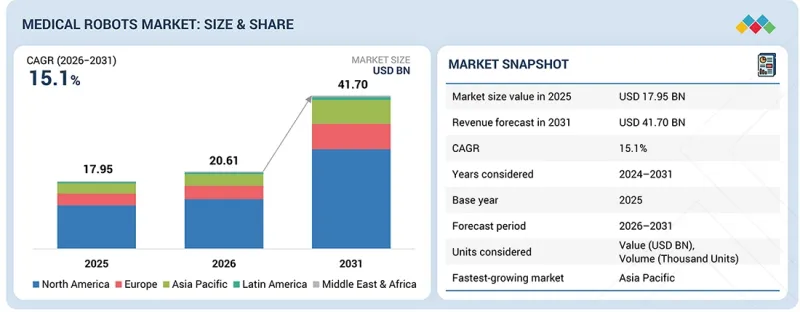
세계의 의료용 로봇 시장 규모는 2026년 206억 달러에서 2031년에는 417억 달러에 달할 것으로 예측되고 있으며, 예측 기간 중 CAGR은 15.1%에 달할 전망입니다.
| 조사 범위 | |
|---|---|
| 조사 대상 기간 | 2026-2031년 |
| 기준연도 | 2025년 |
| 예측 기간 | 2026-2031년 |
| 산정 단위 | 금액(10억 달러) |
| 부문 | 제품·서비스별, 유형별, 최종사용자별, 지역별 |
| 대상 지역 | 북미, 유럽, 아시아태평양, 라틴아메리카, 중동 및 아프리카 |
의료용 로봇 시장은 임상적, 기술적 요인과 의료 자동화 요인이 복합적으로 작용하여 강력한 성장이 예상됩니다. 만성질환 유병률의 상승, 고령 인구 증가, 그리고 저침습·고정밀 시술에 대한 수요 증가가 의료 현장 전반에 걸쳐 로봇 지원 솔루션의 도입을 지속적으로 촉진하고 있습니다. 수술용 로봇, 재활용 로봇, 병원 및 약국 자동화 시스템, 그리고 비침습적 방사선 수술 플랫폼 분야의 기술 발전으로 인해 시술 정밀도, 워크플로우 효율, 약물 관리 및 환자 예후가 개선되었으며, 그 결과 병원, 진료소, 약국, 재활 센터에서의 도입이 가속화되고 있습니다.
또한 투약 오류 최소화, 시술의 편차 감소, 의료 워크플로우 최적화, 그리고 인력 부족에 대한 대응에 대한 수요가 증가함에 따라 시장 확대에 기여하고 있습니다. 이러한 동향으로 인해 선진국과 신흥 국가 모두에서 강력한 성장세가 지속될 것으로 예상됩니다. 그러나 엄격한 규제 요건, 높은 시스템 비용, 유지 관리비, 그리고 전문적인 교육의 필요성이 예측 기간 중 도입을 어느 정도 억제할 가능성이 있습니다.
"예측 기간 중 로봇 시스템 부문이 가장 큰 시장 점유율을 차지할 것으로 예상됩니다."
제품 및 서비스별로 보면 의료용 로봇 시장은 로봇 시스템, 기구 및 부속품, 그리고 서비스로 분류됩니다. 예측 기간 중 로봇 시스템 부문이 가장 큰 시장 점유율을 차지할 것으로 예상됩니다. 이 부문의 높은 점유율은 최종사용자들 사이에서 기술적으로 고도화된 수술용 로봇 및 로봇 지원 플랫폼 도입에 대한 관심이 높아지고 있기 때문으로 보입니다. 고정밀·저침습 수술에 대한 수요 증가와 AI, 영상 진단, 내비게이션, 데이터베이스 기능의 통합이 첨단 로봇 시스템 도입을 더욱 촉진하고 있습니다. 또한 자동화 및 차세대 로봇 플랫폼에 대한 병원의 투자 확대에 따라 외과, 재활, 방사선 외과, 병원 자동화 등 각 응용 분야에서 로봇 시스템에 대한 수요가 강화될 것으로 예상됩니다.
"수술용 로봇 시스템 부문은 유형별로 볼 때 의료용 로봇 시장에서 가장 큰 점유율을 차지할 것으로 추정됩니다."
유형별로 보면 의료용 로봇 시장은 외과용 로봇 시스템, 재활용 로봇 시스템, 방사선 외과용 로봇 시스템, 병원용 로봇 시스템, 그리고 약국용 로봇 시스템으로 분류됩니다. 외과용 로봇 시스템은 용도별로 연부 조직 수술(일반 외과, 산부인과 수술, 비뇨기과 수술, 기타 용도)과 경부 조직 수술(무릎·고관절 수술, 척추 수술, 기타 용도)로 세분화됩니다.
2025년, 의료용 로봇 시장에서 외과용 로봇 시스템 부문이 가장 큰 점유율을 차지했습니다. 이 부문은 수술 수요 증가, 전 세계 수술 건수 증가, 그리고 외과용 로봇에 대한 임상 현장의 수용도 상승으로 인해 상당한 성장이 예상됩니다. 저침습 수술의 보급 확대, 외과의사의 조작성 향상, 시인성 향상 및 수술 정밀도 향상은 병원 및 전문 외과 센터에서의 외과용 로봇 시스템 도입을 더욱 촉진하고 있습니다.
"예측 기간 중 외래 수술 센터 부문이 가장 높은 성장률을 기록할 것으로 예상됩니다."
최종사용자별로 보면 의료용 로봇 시장은 병원·진료소, 당일 수술 센터, 약국, 재활 센터 및 기타 최종사용자로 구분됩니다. 일일 수술 센터 부문은 예측 기간 중 가장 높은 성장률을 보일 것으로 전망됩니다. 이 부문의 성장은 주로 치료비 절감, 환자의 입원 일수 단축, 회복 기간 단축과 같은 이점을 배경으로, 적합한 외과수술이 입원 치료에서 외래 치료로 전환되고 있는 것이 주요 요인입니다. 효율적이고 질이 높으며, 최소 침습적인 외과 의료에 대한 수요가 증가함에 따라 외래 수술 센터에서는 첨단 로봇 지원 기술의 도입이 진행되고 있습니다.
"예측 기간 중 아시아태평양은 의료용 로봇 시장에서 가장 높은 성장률을 기록할 것으로 전망됩니다."
전 세계 의료용 로봇 시장은 북미, 유럽, 아시아태평양, 라틴아메리카, 중동 및 아프리카의 5개 주요 지역으로 분류됩니다. 2025년에는 아시아태평양이 예측 기간 중 의료용 로봇 시장에서 가장 높은 성장률을 기록할 것으로 전망됩니다. 수술용 로봇 도입 확대, 방대한 환자 수, 가처분 소득 증가, 그리고 첨단 의료 솔루션에 대한 지출 의지 고조와 같은 요인들이 해당 지역의 시장 성장을 지원할 것으로 예상됩니다. 또한 기술의 급속한 도입, 의료 분야의 발전, 민간 의료 시설의 확대, 그리고 의료 인프라 개선을 위한 정부의 노력이 아시아태평양의 의료용 로봇 시장 성장을 더욱 촉진할 것으로 전망됩니다.
이 시장의 주요 기업으로는 Intuitive Surgical, Inc(미국), Stryker(미국), Becton, Dickinson and Company(미국), Medtronic(아일랜드), Omnicell, LLC(미국), Zimmer Biomet(미국),Smith & Nephew(영국), Ekso Bionics Holdings, Inc.(미국), ARxIUM(캐나다), Asensus Surgical(미국), Renishaw Plc(영국), ZAP Surgical Systems, Inc.(미국), KUKA SE & Co. KGaA(독일),CMR Surgical(영국), Accuray Incorporated(미국), DIH Medical(스위스), Johnson & Johnson(미국), Cyberdyne Inc.(일본), Lifeward, Inc.(이스라엘), Relay Robotics(미국),Aethon, Inc.(미국), Xenex Disinfection Services, Inc.(미국), Stereotaxis, Inc.(미국), PROCEPT BioRobotics Corporation(미국) 및 Globus Medical(미국). 각 기업은 자사 제품 라인 확충, 고객의 미충족 수요 대응, 수익성 향상, 그리고 세계 시장에서의 입지 확대를 도모하기 위해 인수, 신제품 출시, 사업 확장, 제휴·협업, 승인 획득과 같은 유기적 및 비유기적 성장 전략을 채택했습니다.
조사 범위
이 보고서에서는 제품·서비스, 유형, 최종사용자, 지역을 기준으로 의료용 로봇 시장을 조사하고 있습니다. 또한 시장 성장에 영향을 미치는 요인(촉진요인, 제약 요인, 기회, 과제 등)을 분석하고 있습니다. 더불어, 이해관계자에게 주어진 시장의 기회와 과제를 평가하고, 시장 선도 기업의 경쟁 구도에 대한 상세한 정보를 제공합니다. 이 보고서에서는 마이크로 시장의 성장 동향, 전망 및 의료용 로봇 시장 전체에 대한 기여도에 대해 조사하고 있습니다. 또한 5개 주요 지역의 시장 세분화에 따른 매출 예측도 제시하고 있습니다.
이 보고서를 구매해야 하는 이유
이 보고서는 의료용 로봇 업계의 시장 리더 및 신규 진입 기업에게 시장 전체 및 그 하위 부문의 대략적인 매출을 제공하여 귀중한 인사이트를 제공합니다. 이 보고서는 이해관계자가 경쟁 구도를 이해하는 데 도움을 주어, 자사의 비즈니스를 더 나은 위치에 두고 효과적인 시장 진입 전략을 수립할 수 있도록 합니다. 또한 이 보고서는 주요 시장 촉진요인과 과제를 밝혀내어 이해관계자가 시장의 현황을 파악하는 데 도움을 줍니다.
이 보고서는 다음 사항에 대한 인사이트를 제공합니다. :
- 주요 촉진요인(고령화 및 만성질환 증가, 기술 발전, 의료 분야내 자동화 수요 증가, 보험 급여 환경 개선, 의료 자금 조달 및 인프라 발전, 그리고 투약 오류를 최소화해야 할 필요성 증가), 제약 요인(로봇 시스템의 높은 비용 및 엄격한 규제 요건),기회(신흥 시장의 성장 기회 및 신규 용도), 과제(환자 및 의료 제공자의 수용도)에 대한 분석.
- 시장 침투: 이 보고서는 전 세계 의료용 로봇 시장의 주요 기업이 제공하는 제품 포트폴리오에 대한 상세한 정보를 제공합니다. 이 보고서는 제품·서비스, 유형, 지역, 최종사용자 등 다양한 부문를 포괄하고 있습니다.
- 제품 개발/혁신: 의료용 로봇 시장의 향후 기술 동향, 연구개발 활동 및 신제품 출시에 대한 상세 인사이트를 제공합니다.
- 시장 개발: 수익성이 높은 신흥 시장에 대한 포괄적인 정보를 제공합니다. 이 보고서는 지역별로 다양한 유형의 의료용 로봇 솔루션 시장을 분석합니다.
- 시장 다각화: 의료용 로봇 시장의 솔루션, 미개발 지역, 최근 동향 및 투자에 대한 포괄적인 정보를 제공합니다.
- 경쟁 분석: 의료용 로봇 시장의 주요 기업의 시장 점유율, 전략, 제품, 유통망 및 역량에 대한 상세한 평가입니다.
자주 묻는 질문
목차
제1장 서론
제2장 개요
제3장 주요 인사이트
제4장 시장 개요
제5장 업계 동향
제6장 기술 진보, AI에 의한 영향, 특허, 혁신
제7장 규제 상황
제8장 고객 상황과 구매 행동
제9장 의료용 로봇 시장(제품·서비스별)
제10장 의료용 로봇 시장(유형별)
제11장 의료용 로봇 시장(최종사용자별)
제12장 의료용 로봇 시장(지역별)
제13장 경쟁 구도
제14장 기업 개요
제15장 조사 방법
제16장 부록
KSA 26.08.21The global medical robots market is projected to reach USD 41.7 billion in 2031 from USD 20.6 billion in 2026, at a CAGR of 15.1% during the forecast period.
| Scope of the Report | |
|---|---|
| Years Considered for the Study | 2026-2031 |
| Base Year | 2025 |
| Forecast Period | 2026-2031 |
| Units Considered | Value (USD billion) |
| Segments | Products & Services, Type, End User, and Region |
| Regions covered | North America, Europe, APAC, LATAM, MEA |
The medical robots market is expected to witness strong growth, driven by a combination of clinical, technological, and healthcare automation factors. The rising prevalence of chronic diseases, growing geriatric population, and increasing demand for minimally invasive and precision-based procedures continue to support the adoption of robotic-assisted solutions across healthcare settings. Technological advancements in surgical robotics, rehabilitation robots, hospital and pharmacy automation systems, and non-invasive radiosurgery platforms have improved procedural accuracy, workflow efficiency, medication management, and patient outcomes, thereby accelerating adoption among hospitals, clinics, pharmacies, and rehabilitation centers.
Furthermore, the growing need to minimize medication errors, reduce procedural variability, optimize healthcare workflows, and address workforce constraints is contributing to market expansion. These trends are expected to sustain strong growth momentum across both developed and emerging economies; however, stringent regulatory requirements, high system costs, maintenance expenses, and the need for specialized training may restrain adoption to some extent over the forecast period.
"The robotic systems segment is expected to account for the highest market share during the forecast period."
Based on products & services, the medical robots market is segmented into robotic systems, instruments & accessories, and services. The robotic systems segment is projected to account for the highest market share during the forecast period. The high share in this segment can be attributed to the growing focus on adopting technologically advanced surgical robots and robotic-assisted platforms among end users. The increasing demand for precision-based, minimally invasive procedures and the integration of AI, imaging, navigation, and data-driven capabilities are further supporting the adoption of advanced robotic systems. In addition, expanding hospital investments in automation and next-generation robotic platforms are expected to strengthen demand for robotic systems across surgical, rehabilitation, radiosurgery, and hospital automation applications.
"The surgical robotic system segment is estimated to hold the largest share of the medical robots market by type."
Based on type, the medical robots market is segmented into surgical robotic systems, rehabilitation robotic systems, radiosurgery robotic systems, hospital robotic systems, and pharmacy robotic systems. The surgical robotic systems have been further segmented by application into soft tissue surgery (general surgery, gynecological surgery, urological surgery and other applications) and hard tissue surgery (knee & hip surgery, spine surgery, and other applications).
The surgical robotic systems segment accounted for the largest share of the medical robots market in 2025. This segment is expected to witness significant growth due to the increasing demand for surgeries, rising global surgical volumes, and growing clinical acceptance of surgical robots. The expanding adoption of minimally invasive procedures, improved surgeon control, enhanced visualization, and higher procedural precision are further supporting the uptake of surgical robotic systems across hospitals and specialty surgical centers.
"The ambulatory surgery centers segment is expected to register the highest growth during the forecast period."
Based on end user, the medical robots market is segmented into hospitals & clinics, ambulatory surgery centers, pharmacies, rehabilitation centers, and other end users. The ambulatory surgery centers segment is projected to witness the highest growth rate during the forecast period. Growth in this segment is primarily driven by the increasing shift of suitable surgical procedures from inpatient hospital settings to outpatient care environments, supported by the potential for lower treatment costs, shorter patient stays, and faster recovery timelines. The rising demand for efficient, high-quality, and minimally invasive surgical care is encouraging ambulatory surgery centers to adopt advanced robotic-assisted technologies.
"Asia Pacific is projected to register the highest growth in the medical robots market during the forecast period."
The global medical robots market is segmented into five major regions, namely, North America, Europe, Asia Pacific, Latin America, and the Middle East & Africa. In 2025, Asia Pacific is expected to register the highest growth in the medical robots market during the forecast period. Factors such as the increasing adoption of surgical robots, a large patient pool, rising disposable incomes, and growing willingness to spend on advanced healthcare solutions are expected to support market growth in the region. In addition, rapid technological adoption, advancements in the healthcare sector, expansion of private healthcare facilities, and government focus on improving healthcare infrastructure are further expected to drive the growth of the medical robots market in Asia Pacific.
Breakdown of primary interviews:
- By Supply Side: Tier 1 (35%), Tier 2 (40%), and Tier 3 (25%)
- By Designation: C-level Executives (45%), Directors (35%), and Others (20%)
- By Region: North America (27%), Europe (25%), Asia Pacific (30%), Latin America (8%), and Middle East and Africa (10%)
The prominent players in this market are Intuitive Surgical, Inc (US), Stryker (US), Becton, Dickinson and Company (US), Medtronic (Ireland), Omnicell, LLC (US), Zimmer Biomet (US), Smith & Nephew (UK), Ekso Bionics Holdings, Inc. (US), ARxIUM (Canada), Asensus Surgical (US), Renishaw Plc (UK), ZAP Surgical Systems, Inc. (US), KUKA SE & Co. KGaA (Germany), CMR Surgical (UK), Accuray Incorporated (US), DIH Medical (Switzerland), Johnson & Johnson (US), Cyberdyne Inc. (Japan), Lifeward, Inc. (Israel), Relay Robotics (US), Aethon, Inc. (US), Xenex Disinfection Services, Inc. (US), Stereotaxis, Inc. (US), PROCEPT BioRobotics Corporation (US), and Globus Medical (US). Players adopted organic as well as inorganic growth strategies such as acquisitions, product launches, expansions, agreements & collaborations, and approvals to increase their offerings, cater to the unmet needs of customers, increase their profitability, and expand their presence in the global market.
Research Coverage
The report studies the medical robots market based on product & service, type, end user, and region. The report analyzes factors (such as drivers, restraints, opportunities, and challenges) affecting the market growth. The report evaluates the opportunities and challenges in the market for stakeholders and provides details of the competitive landscape for market leaders. The report studies micro-markets with respect to their growth trends, prospects, and contributions to the total medical robots market. The report forecasts the revenue of market segments with respect to five major regions.
Reasons to Buy the Report
The report provides valuable insights for market leaders and new entrants in the medical robots industry, offering approximate revenue figures for the overall market and its subsegments. It assists stakeholders in understanding the competitive landscape, enabling them to better position their businesses and develop effective go-to-market strategies. Additionally, the report highlights key market drivers, restraints, challenges, and opportunities, helping stakeholders gauge the current state of the market
This report provides insights into the following pointers:
- Analysis of key drivers (aging population and rising chronic diseases, technological advancements, increasing need for automation in healthcare, improving reimbursement scenario, and advancements in healthcare funding & infrastructure, and growing need to minimize medication errors), restraints (high cost of robotic systems and stringent regulatory requirements), opportunities (growth opportunities in emerging markets, and novel application) and challenge (patient and provider acceptance).
- Market Penetration: It provides detailed information on the product portfolios offered by major players in the global medical robots market. The report covers various segments, including product & service, type, region, and end user.
- Product Development/Innovation: Detailed insights on upcoming technologies, research and development activities, and product launches in the medical robots market.
- Market Development: Comprehensive information about lucrative emerging markets. The report analyzes the markets for various types of medical robot solutions across regions.
- Market Diversification: Exhaustive information about solutions, untapped regions, recent developments, and investments in the medical robots market.
- Competitive Assessment: In-depth assessment of market shares, strategies, products, distribution networks, and capabilities of the leading players in the medical robots market.
TABLE OF CONTENTS
1 INTRODUCTION
- 1.1 STUDY OBJECTIVES
- 1.2 MARKET DEFINITION
- 1.3 MARKET SCOPE
- 1.3.1 MARKET SEGMENTATION AND REGIONAL SCOPE
- 1.3.2 INCLUSIONS AND EXCLUSIONS
- 1.3.3 YEARS CONSIDERED FOR STUDY
- 1.4 CURRENCY
- 1.5 STAKEHOLDERS
- 1.6 SUMMARY OF CHANGES
- 1.6.1 REFINEMENTS IN SCOPE
- 1.6.2 COVERAGE OF NEW PLAYERS
- 1.6.3 UPDATED MARKET DEVELOPMENTS OF PROFILED PLAYERS
- 1.6.4 UPDATED FINANCIAL INFORMATION/PRODUCT PORTFOLIOS OF PLAYERS
- 1.6.5 UPDATED GEOGRAPHIC ANALYSIS
2 EXECUTIVE SUMMARY
- 2.1 MARKET HIGHLIGHTS AND KEY INSIGHTS
- 2.2 KEY MARKET PARTICIPANTS: MAPPING OF STRATEGIC DEVELOPMENTS
- 2.3 DISRUPTIVE TRENDS IN MEDICAL ROBOTS MARKET
- 2.4 HIGH-GROWTH SEGMENTS
- 2.5 REGIONAL SNAPSHOT: MARKET SIZE, GROWTH RATE, AND FORECAST
3 PREMIUM INSIGHTS
- 3.1 MEDICAL ROBOTS MARKET OVERVIEW
- 3.2 MEDICAL ROBOTS MARKET, BY REGION
- 3.3 ASIA PACIFIC MEDICAL ROBOTS MARKET, BY PRODUCT & SERVICE AND COUNTRY
- 3.4 GEOGRAPHIC SNAPSHOT OF MEDICAL ROBOTS MARKET
- 3.5 MEDICAL ROBOTS MARKET: DEVELOPING VS. DEVELOPED MARKETS
4 MARKET OVERVIEW
- 4.1 INTRODUCTION
- 4.2 MARKET DYNAMICS
- 4.2.1 DRIVERS
- 4.2.1.1 Increasing geriatric population with chronic diseases
- 4.2.1.2 Technological advancements in medical robotics
- 4.2.1.3 Growing need for automation in healthcare
- 4.2.1.4 Favorable reimbursement scenario for surgical robots from third-party payers
- 4.2.1.5 Advancements in healthcare funding and infrastructure
- 4.2.1.6 Rising need to minimize medication and dispensing errors
- 4.2.2 RESTRAINTS
- 4.2.2.1 High cost of medical robotic systems
- 4.2.2.2 Stringent regulatory requirements and delays in product approvals
- 4.2.3 OPPORTUNITIES
- 4.2.3.1 High growth opportunities in emerging economies
- 4.2.3.2 Increased use of robotics in novel applications
- 4.2.4 CHALLENGES
- 4.2.4.1 Need to ensure patient and provider acceptance
- 4.2.1 DRIVERS
- 4.3 UNMET NEEDS AND WHITE SPACES
- 4.3.1 UNMET NEEDS IN MEDICAL ROBOTS MARKET
- 4.3.2 WHITE SPACE OPPORTUNITIES
- 4.4 INTERCONNECTED MARKETS AND CROSS-SECTOR OPPORTUNITIES
- 4.4.1 INTERCONNECTED MARKETS
- 4.4.2 CROSS-SECTOR OPPORTUNITIES
- 4.5 STRATEGIC MOVES BY TIER-1/2/3 PLAYERS
5 INDUSTRY TRENDS
- 5.1 PORTER'S FIVE FORCES ANALYSIS
- 5.1.1 BARGAINING POWER OF SUPPLIERS
- 5.1.2 BARGAINING POWER OF BUYERS
- 5.1.3 THREAT OF NEW ENTRANTS
- 5.1.4 THREAT OF SUBSTITUTES
- 5.1.5 INTENSITY OF COMPETITIVE RIVALRY
- 5.2 MACROECONOMIC OUTLOOK
- 5.2.1 INTRODUCTION
- 5.2.2 GDP TRENDS AND FORECAST
- 5.2.3 TRENDS IN GLOBAL MINIMALLY INVASIVE SURGICAL INSTRUMENTS INDUSTRY
- 5.3 REIMBURSEMENT SCENARIO ANALYSIS
- 5.4 VALUE CHAIN ANALYSIS
- 5.5 ECOSYSTEM ANALYSIS
- 5.6 PRICING ANALYSIS
- 5.6.1 AVERAGE SELLING PRICE TREND, BY REGION
- 5.6.2 AVERAGE SELLING PRICE TREND OF MEDICAL ROBOTS, BY TYPE
- 5.7 TRADE ANALYSIS
- 5.7.1 IMPORT DATA FOR HS CODE 901890
- 5.7.2 EXPORT DATA FOR HS CODE 901890
- 5.8 KEY CONFERENCES & EVENTS, 2026-2027
- 5.9 TRENDS/DISRUPTIONS IMPACTING CUSTOMER BUSINESS
- 5.10 CASE STUDY ANALYSIS
- 5.10.1 CASE STUDY 1: DR. MOHIT BHANDARI PERFORMS WORLD'S FIRST TRANSCONTINENTAL ROBOTIC BARIATRIC SURGERY USING SSI MANTRA
- 5.10.2 CASE STUDY 2: SUTTER HEALTH PERFORMS FIRST US ROBOTIC SINGLE-PORT NIPPLE-SPARING MASTECTOMY
- 5.10.3 CASE STUDY 3: ST JOHN OF GOD GEELONG EXPANDS ACCESS TO ADVANCED ROBOTIC SURGERY
- 5.11 INVESTMENT AND FUNDING SCENARIO
- 5.12 IMPACT OF 2025 US TARIFF ON MEDICAL ROBOTS MARKET
- 5.12.1 INTRODUCTION
- 5.12.2 KEY TARIFF RATES
- 5.12.3 PRICE IMPACT ANALYSIS
- 5.12.4 IMPACT ON COUNTRY/REGION
- 5.12.4.1 US
- 5.12.4.2 Europe
- 5.12.4.3 Asia Pacific
- 5.12.5 IMPACT ON END-USE INDUSTRIES
6 TECHNOLOGICAL ADVANCEMENTS, AI-DRIVEN IMPACT, PATENTS, AND INNOVATIONS
- 6.1 KEY EMERGING TECHNOLOGIES
- 6.1.1 ROBOTIC ARMS AND INSTRUMENTS
- 6.1.2 ARTIFICIAL INTELLIGENCE (AI) AND MACHINE LEARNING (ML)
- 6.1.3 TELEPRESENCE
- 6.1.4 REHABILITATION ROBOTICS & WEARABLE EXOSKELETON TECHNOLOGIES
- 6.1.5 PHARMACY AUTOMATION & INTELLIGENT MEDICATION MANAGEMENT
- 6.1.6 COMPLEMENTARY TECHNOLOGIES
- 6.1.6.1 Augmented reality (AR) and virtual reality (VR)
- 6.1.6.2 3D imaging
- 6.2 TECHNOLOGY/PRODUCT ROADMAP
- 6.2.1 SHORT-TERM (2025-2027) | FOUNDATION & EARLY COMMERCIALIZATION
- 6.2.2 MID-TERM (2027-2030) | EXPANSION & STANDARDIZATION
- 6.2.3 LONG-TERM (2030-2035+) | MASS COMMERCIALIZATION & DISRUPTION
- 6.3 PATENT ANALYSIS
- 6.4 IMPACT OF AI/GEN AI ON MEDICAL ROBOTS MARKET
- 6.4.1 TOP USE CASES AND MARKET POTENTIAL
- 6.4.2 BEST PRACTICES IN MEDICAL ROBOT DEPLOYMENT AND PROCESSING
- 6.4.3 CASE STUDIES OF AI IMPLEMENTATION IN MEDICAL ROBOTS MARKET
- 6.4.4 INTERCONNECTED ECOSYSTEM AND IMPACT ON MARKET PLAYERS
- 6.4.5 CLIENTS' READINESS TO ADOPT GENERATIVE AI IN MEDICAL ROBOTS MARKET
7 REGULATORY LANDSCAPE
- 7.1 REGIONAL REGULATIONS AND COMPLIANCE
- 7.1.1 REGULATORY BODIES, GOVERNMENT AGENCIES, AND OTHER ORGANIZATIONS
- 7.2 REGULATORY FRAMEWORK
- 7.2.1 NORTH AMERICA
- 7.2.1.1 US
- 7.2.2 EUROPE
- 7.2.3 ASIA PACIFIC
- 7.2.3.1 Japan
- 7.2.3.2 China
- 7.2.3.3 India
- 7.2.3.4 Latin America
- 7.2.3.4.1 Brazil
- 7.2.3.4.2 Mexico
- 7.2.3.5 Middle East
- 7.2.3.6 Africa
- 7.2.4 INDUSTRY STANDARDS
- 7.2.1 NORTH AMERICA
- 7.3 CERTIFICATIONS, LABELING, & ECO-STANDARDS
8 CUSTOMER LANDSCAPE & BUYER BEHAVIOR
- 8.1 DECISION-MAKING PROCESS
- 8.2 KEY STAKEHOLDERS INVOLVED IN BUYING PROCESS AND THEIR EVALUATION CRITERIA
- 8.2.1 KEY STAKEHOLDERS IN BUYING PROCESS
- 8.2.2 BUYING CRITERIA
- 8.3 ADOPTION BARRIERS & INTERNAL CHALLENGES
- 8.4 UNMET NEEDS FROM VARIOUS END-USE INDUSTRIES
- 8.5 MARKET PROFITABILITY
- 8.5.1 REVENUE POTENTIAL
- 8.5.2 COST DYNAMICS
- 8.5.3 MARGIN OPPORTUNITIES IN KEY APPLICATIONS
9 MEDICAL ROBOTS MARKET, BY PRODUCT & SERVICE
- 9.1 INTRODUCTION
- 9.2 INSTRUMENTS & ACCESSORIES
- 9.2.1 NEED FOR RECURRENT PURCHASE OF INSTRUMENTS & ACCESSORIES FOR SURGICAL PROCEDURES TO SUPPORT MARKET GROWTH
- 9.3 ROBOTIC SYSTEMS
- 9.3.1 INCREASING ADOPTION OF TECHNOLOGICALLY ADVANCED ROBOTIC SYSTEMS TO DRIVE MARKET
- 9.4 SERVICES
- 9.4.1 INCREASED DEMAND FOR ANNUAL MAINTENANCE CONTRACTS, TECHNICAL SUPPORT, AND USER TRAINING TO PROPEL MARKET
10 MEDICAL ROBOTS MARKET, BY TYPE
- 10.1 INTRODUCTION
- 10.2 SURGICAL ROBOTIC SYSTEMS
- 10.2.1 SOFT TISSUE SURGERY
- 10.2.1.1 General surgery
- 10.2.1.1.1 Increasing prevalence of diseases to drive market
- 10.2.1.2 Gynecological surgery
- 10.2.1.2.1 Increased availability of robotic platforms to increase adoption of robot-assisted gynecological surgeries
- 10.2.1.3 Urological surgery
- 10.2.1.3.1 Increasing prevalence of urological cancers to drive market
- 10.2.1.4 Other soft tissue surgeries
- 10.2.1.1 General surgery
- 10.2.2 HARD TISSUE SURGERY
- 10.2.2.1 Knee & hip surgery
- 10.2.2.1.1 Increasing number of knee & hip replacement surgeries to propel market
- 10.2.2.2 Spine surgery
- 10.2.2.2.1 Increasing adoption of robotic systems for spinal surgeries to drive market
- 10.2.2.3 Other hard tissue surgeries
- 10.2.2.1 Knee & hip surgery
- 10.2.1 SOFT TISSUE SURGERY
- 10.3 REHABILITATION ROBOTIC SYSTEMS
- 10.3.1 THERAPEUTIC ROBOTIC SYSTEMS
- 10.3.1.1 Increasing cases of stroke to drive adoption
- 10.3.2 ASSISTIVE ROBOTIC SYSTEMS
- 10.3.2.1 Rising geriatric population to support market growth
- 10.3.3 EXOSKELETON ROBOTIC SYSTEMS
- 10.3.3.1 Rising patient pool of neurological disorders to support market growth
- 10.3.4 OTHER REHABILITATION ROBOTIC SYSTEMS
- 10.3.1 THERAPEUTIC ROBOTIC SYSTEMS
- 10.4 RADIOSURGERY ROBOTIC SYSTEMS
- 10.4.1 GROWING ADOPTION OF ADVANCED STEREOTACTIC RADIATION DELIVERY SYSTEMS BY HOSPITALS TO DRIVE MARKET
- 10.5 HOSPITAL ROBOTIC SYSTEMS
- 10.5.1 DELIVERY ROBOTIC SYSTEMS
- 10.5.1.1 Increasing patient population along with shortage of nursing staff to drive adoption
- 10.5.1.2 Telepresence robotic systems
- 10.5.1.2.1 Increased adoption of telepresence robotic systems to drive market
- 10.5.1.3 Diagnostic robotic systems
- 10.5.1.3.1 Shortage of skilled healthcare professionals to drive adoption
- 10.5.1.4 Other hospital robotic systems
- 10.5.1 DELIVERY ROBOTIC SYSTEMS
- 10.6 PHARMACY ROBOTIC SYSTEMS
- 10.6.1 ROBOTIC DISPENSING SYSTEMS
- 10.6.1.1 High adoption of robots to reduce dispensing errors in hospitals to drive market
- 10.6.2 COMPOUNDING ROBOTIC SYSTEMS
- 10.6.2.1 Reduce cost per dose of medication and need for medication outsourcing
- 10.6.3 OTHER PHARMACY ROBOTIC SYSTEMS
- 10.6.1 ROBOTIC DISPENSING SYSTEMS
11 MEDICAL ROBOTS MARKET, BY END USER
- 11.1 INTRODUCTION
- 11.2 HOSPITALS & CLINICS
- 11.2.1 HIGH NUMBER OF ROBOTIC-ASSISTED SURGERIES PERFORMED TO SUPPORT MARKET GROWTH
- 11.3 AMBULATORY SURGERY CENTERS
- 11.3.1 COST-EFFECTIVE TREATMENTS TO SUPPORT MARKET GROWTH
- 11.4 PHARMACIES
- 11.4.1 REDUCED MEDICATION ERRORS AND INCREASED EFFICIENCY TO DRIVE ADOPTION
- 11.5 REHABILITATION CENTERS
- 11.5.1 INCREASING INCIDENCE OF DISABILITIES TO SUPPORT MARKET GROWTH
- 11.6 OTHER END USERS
12 MEDICAL ROBOTS MARKET, BY REGION
- 12.1 INTRODUCTION
- 12.2 NORTH AMERICA
- 12.2.1 MACROECONOMIC OUTLOOK FOR NORTH AMERICA
- 12.2.2 US
- 12.2.2.1 Presence of many established players to support strong adoption of medical robots
- 12.2.3 CANADA
- 12.2.3.1 Growing adoption of advanced healthcare solutions to propel market
- 12.3 EUROPE
- 12.3.1 MACROECONOMIC OUTLOOK FOR EUROPE
- 12.3.2 GERMANY
- 12.3.2.1 Strong medical infrastructure to propel market growth
- 12.3.3 UK
- 12.3.3.1 National NHS expansion to accelerate medical robot adoption
- 12.3.4 FRANCE
- 12.3.4.1 Government-backed innovation and hospital adoption to drive growth
- 12.3.5 ITALY
- 12.3.5.1 Government support for healthcare innovation to propel market growth
- 12.3.6 SPAIN
- 12.3.6.1 Increasing healthcare spending to drive market
- 12.3.7 REST OF EUROPE
- 12.4 ASIA PACIFIC
- 12.4.1 MACROECONOMIC OUTLOOK FOR ASIA PACIFIC
- 12.4.2 JAPAN
- 12.4.2.1 Domestic innovation and reimbursement support to support market growth
- 12.4.3 CHINA
- 12.4.3.1 Government support for healthcare modernization to propel market
- 12.4.4 INDIA
- 12.4.4.1 Increasing healthcare investments to boost demand for medical robotic systems
- 12.4.5 SOUTH KOREA
- 12.4.5.1 Government investment and high-volume surgical centers to support market growth
- 12.4.6 AUSTRALIA
- 12.4.6.1 Rising adoption of robotic-assisted surgery to propel market
- 12.4.7 REST OF ASIA PACIFIC
- 12.5 LATIN AMERICA
- 12.5.1 MACROECONOMIC OUTLOOK FOR LATIN AMERICA
- 12.5.2 BRAZIL
- 12.5.2.1 Expanding healthcare infrastructure to support adoption of medical robots
- 12.5.3 MEXICO
- 12.5.3.1 Need to reduce medication errors and rising geriatric population to drive market
- 12.5.4 REST OF LATIN AMERICA
- 12.6 MIDDLE EAST & AFRICA
- 12.6.1 MACROECONOMIC OUTLOOK FOR MIDDLE EAST & AFRICA
- 12.6.2 GCC COUNTRIES
- 12.6.2.1 Increasing initiatives to drive demand for surgical robots
- 12.6.3 REST OF MIDDLE EAST & AFRICA
13 COMPETITIVE LANDSCAPE
- 13.1 INTRODUCTION
- 13.2 KEY PLAYER STRATEGIES/RIGHT TO WIN
- 13.2.1 OVERVIEW OF STRATEGIES ADOPTED BY KEY PLAYERS IN MEDICAL ROBOTS MARKET
- 13.3 REVENUE ANALYSIS, 2021-2025
- 13.4 MARKET SHARE ANALYSIS, 2025
- 13.5 COMPANY EVALUATION MATRIX: KEY PLAYERS, 2025
- 13.5.1 STARS
- 13.5.2 EMERGING LEADERS
- 13.5.3 PERVASIVE PLAYERS
- 13.5.4 PARTICIPANTS
- 13.5.5 COMPANY FOOTPRINT: KEY PLAYERS, 2025
- 13.5.5.1 Company footprint
- 13.5.5.2 Region footprint
- 13.5.5.3 Product & service footprint
- 13.5.5.4 Type footprint
- 13.5.5.5 End-user footprint
- 13.6 COMPANY EVALUATION MATRIX: STARTUPS/SMES, 2025
- 13.6.1 PROGRESSIVE COMPANIES
- 13.6.2 RESPONSIVE COMPANIES
- 13.6.3 DYNAMIC COMPANIES
- 13.6.4 STARTING BLOCKS
- 13.6.5 COMPETITIVE BENCHMARKING: STARTUPS/SMES, 2025
- 13.6.5.1 Detailed list of key startups/SMEs
- 13.6.5.2 Competitive benchmarking of key startups/SMEs
- 13.7 BRAND COMPARISON
- 13.8 COMPANY VALUATION AND FINANCIAL METRICS
- 13.8.1 FINANCIAL METRICS
- 13.8.2 COMPANY VALUATION
- 13.9 COMPETITIVE SCENARIO
- 13.9.1 PRODUCT LAUNCHES & APPROVALS
- 13.9.2 DEALS
- 13.9.3 EXPANSIONS
- 13.9.4 OTHER DEVELOPMENTS
14 COMPANY PROFILES
- 14.1 KEY PLAYERS
- 14.1.1 INTUITIVE SURGICAL, INC.
- 14.1.1.1 Business overview
- 14.1.1.2 Products/Solutions/Services offered
- 14.1.1.3 Recent developments
- 14.1.1.3.1 Product approvals
- 14.1.1.3.2 Deals
- 14.1.1.3.3 Expansions
- 14.1.1.4 MnM view
- 14.1.1.4.1 Key strengths
- 14.1.1.4.2 Strategic choices
- 14.1.1.4.3 Weaknesses & competitive threats
- 14.1.2 STRYKER
- 14.1.2.1 Business overview
- 14.1.2.2 Products/Solutions/Services offered
- 14.1.2.3 Recent developments
- 14.1.2.3.1 Product launches
- 14.1.2.3.2 Deals
- 14.1.2.3.3 Expansions
- 14.1.2.4 MnM view
- 14.1.2.4.1 Key strengths
- 14.1.2.4.2 Strategic choices
- 14.1.2.4.3 Weaknesses and competitive threats
- 14.1.3 BD
- 14.1.3.1 Business overview
- 14.1.3.2 Products/Solutions/Services offered
- 14.1.3.3 Recent developments
- 14.1.3.3.1 Product launches
- 14.1.3.3.2 Deals
- 14.1.3.3.3 Other developments
- 14.1.3.4 MnM view
- 14.1.3.4.1 Key strengths
- 14.1.3.4.2 Strategic choices
- 14.1.3.4.3 Weaknesses and competitive threats
- 14.1.4 MEDTRONIC
- 14.1.4.1 Business overview
- 14.1.4.2 Products/Solutions/Services offered
- 14.1.4.3 Recent developments
- 14.1.4.3.1 Product approvals
- 14.1.4.3.2 Deals
- 14.1.4.3.3 Expansions
- 14.1.4.4 MnM view
- 14.1.4.4.1 Key strengths
- 14.1.4.4.2 Strategic choices
- 14.1.4.4.3 Weaknesses and competitive threats
- 14.1.5 OMNICELL, INC.
- 14.1.5.1 Business overview
- 14.1.5.2 Products/Solutions/Services offered
- 14.1.5.3 Recent developments
- 14.1.5.3.1 Product launches
- 14.1.5.3.2 Deals
- 14.1.5.3.3 Expansions
- 14.1.5.3.4 Other developments
- 14.1.5.4 MnM view
- 14.1.5.4.1 Key strengths
- 14.1.5.4.2 Strategic choices
- 14.1.5.4.3 Weaknesses and competitive threats
- 14.1.6 ZIMMER BIOMET
- 14.1.6.1 Business overview
- 14.1.6.2 Products/Solutions/Services offered
- 14.1.6.3 Recent developments
- 14.1.6.3.1 Product approvals
- 14.1.6.3.2 Deals
- 14.1.6.3.3 Other developments
- 14.1.7 SMITH+NEPHEW
- 14.1.7.1 Business overview
- 14.1.7.2 Products/Solutions/Services offered
- 14.1.7.3 Recent developments
- 14.1.7.3.1 Product/service launches and enhancements
- 14.1.8 EKSO BIONICS
- 14.1.8.1 Business overview
- 14.1.8.2 Products/Solutions/Services offered
- 14.1.8.3 Recent developments
- 14.1.8.3.1 Product approvals
- 14.1.8.3.2 Deals
- 14.1.8.3.3 Other developments
- 14.1.9 ARXIUM
- 14.1.9.1 Business overview
- 14.1.9.2 Products/Solutions/Services offered
- 14.1.9.3 Recent developments
- 14.1.9.3.1 Product approvals
- 14.1.10 ASENSUS SURGICAL US, INC. (SUBSIDIARY OF KARL STORZ)
- 14.1.10.1 Business overview
- 14.1.10.2 Products/Solutions/Services offered
- 14.1.10.3 Recent developments
- 14.1.10.3.1 Product approvals
- 14.1.10.3.2 Deals
- 14.1.11 RENISHAW PLC
- 14.1.11.1 Business overview
- 14.1.11.2 Products/Services/Solutions offered
- 14.1.11.3 Recent developments
- 14.1.11.3.1 Product approvals
- 14.1.12 SIEMENS HEALTHINEERS AG
- 14.1.12.1 Business overview
- 14.1.12.2 Products/Solutions/Services offered
- 14.1.12.3 Recent developments
- 14.1.12.3.1 Deals
- 14.1.13 KUKA AG
- 14.1.13.1 Business overview
- 14.1.13.2 Products/Solutions/Services offered
- 14.1.14 CMR SURGICAL
- 14.1.14.1 Business overview
- 14.1.14.2 Products/Services offered
- 14.1.14.3 Recent developments
- 14.1.14.3.1 Product approvals
- 14.1.14.3.2 Deals
- 14.1.14.3.3 Other developments
- 14.1.15 ACCURAY INCORPORATED
- 14.1.15.1 Business overview
- 14.1.15.2 Products/Solutions/Services offered
- 14.1.15.3 Recent developments
- 14.1.15.3.1 Product approvals
- 14.1.15.3.2 Deals
- 14.1.15.3.3 Expansions
- 14.1.15.3.4 Other developments
- 14.1.16 DIH MEDICAL
- 14.1.16.1 Business overview
- 14.1.16.2 Products/Solutions/Services offered
- 14.1.16.3 Recent developments
- 14.1.16.3.1 Product approvals
- 14.1.16.3.2 Deals
- 14.1.16.3.3 Other developments
- 14.1.17 JOHNSON & JOHNSON
- 14.1.17.1 Business overview
- 14.1.17.2 Products/Solutions/Services offered
- 14.1.17.3 Recent developments
- 14.1.17.3.1 Product launches & approvals
- 14.1.17.3.2 Other developments
- 14.1.18 CYBERDYNE INC.
- 14.1.18.1 Business overview
- 14.1.18.2 Products/Solutions/Services offered
- 14.1.18.3 Recent developments
- 14.1.18.3.1 Product approvals
- 14.1.18.3.2 Deals
- 14.1.18.3.3 Expansions
- 14.1.19 LIFEWARD, INC.
- 14.1.19.1 Business overview
- 14.1.19.2 Products/Solutions/Services offered
- 14.1.19.3 Recent developments
- 14.1.19.3.1 Product approvals
- 14.1.19.3.2 Deals
- 14.1.20 GLOBUS MEDICAL
- 14.1.20.1 Business overview
- 14.1.20.2 Products/Services/Solutions offered
- 14.1.20.3 Recent developments
- 14.1.20.3.1 Product launches & approvals
- 14.1.1 INTUITIVE SURGICAL, INC.
- 14.2 OTHER PLAYERS
- 14.2.1 RELAY ROBOTICS, INC.
- 14.3 PROCEPT BIOROBOTICS CORPORATION
- 14.3.1 AETHON, INC. (SUBSIDIARY OF ST ENGINEERING)
- 14.3.2 XENEX DISINFECTION SERVICES INC.
- 14.3.3 ZAP SURGICAL SYSTEMS, INC.
15 RESEARCH METHODOLOGY
- 15.1 RESEARCH DATA
- 15.1.1 SECONDARY DATA
- 15.1.1.1 Key data from secondary sources
- 15.1.2 PRIMARY DATA
- 15.1.2.1 Key data from primary sources
- 15.1.2.2 Key industry insights
- 15.1.1 SECONDARY DATA
- 15.2 MARKET SIZE ESTIMATION
- 15.2.1 BOTTOM-UP APPROACH
- 15.2.2 TOP-DOWN APPROACH
- 15.2.3 BASE NUMBER ESTIMATION
- 15.2.3.1 Supply-side analysis (revenue share analysis)
- 15.2.3.2 Company presentations and primary interviews
- 15.3 MARKET FORECAST APPROACH
- 15.4 MARKET BREAKDOWN AND DATA TRIANGULATION
- 15.5 MARKET SHARE ESTIMATION
- 15.6 STUDY ASSUMPTIONS
- 15.7 FACTOR ANALYSIS
- 15.8 RESEARCH LIMITATIONS
- 15.8.1 SCOPE-RELATED LIMITATIONS
- 15.8.2 METHODOLOGY-RELATED LIMITATIONS
- 15.9 RISK ASSESSMENT
16 APPENDIX
- 16.1 DISCUSSION GUIDE
- 16.2 KNOWLEDGESTORE: MARKETSANDMARKETS' SUBSCRIPTION PORTAL
- 16.3 CUSTOMIZATION OPTIONS
- 16.4 RELATED REPORTS
- 16.5 AUTHOR DETAILS


