

|
시장보고서
상품코드
2115778
디지털 치료제(DTx) 시장 : 제공별(소프트웨어, 몰입형), 용도별(치료(당뇨병, 중추신경계 질환, 심혈관질환, 재활), 예방), 수익 모델별(구독, 기업), 판매 채널별(B2B, B2C), 최종사용자별(병원, 보험자, 고용주) - 세계 예측(-2031년)Digital Therapeutics/DTx Market by Offering (Software, Immersive), Application (Treatment (Diabetes, CNS, CVD, Rehab), Preventive), Revenue (Subscription, Enterprise), Channel (B2B, B2C), End User (Hospitals, Payers, Employers) - Global Forecast to 2031 |
||||||

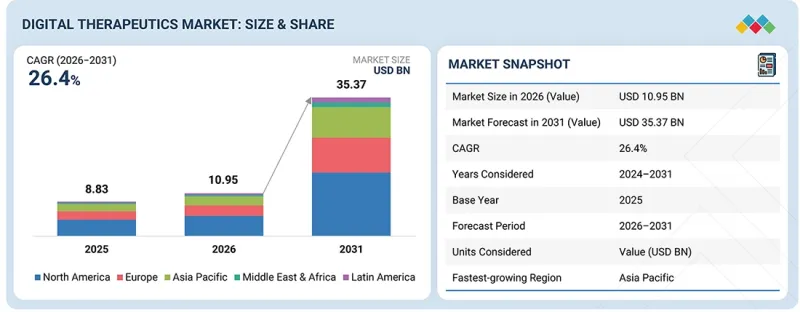
세계의 디지털 치료제 시장 규모는 2026년 109억 5,000만 달러에서 2031년에는 353억 7,000만 달러에 달할 것으로 예측되며, 2026년부터 2031년까지 CAGR은 26.4%가 될 전망입니다.
디지털 치료제 시장의 성장은 만성 질환 유병률 증가, 맞춤형 원격 환자 관리에 대한 수요 증가, 의료비를 절감하면서도 임상 결과를 개선하는 데 대한 관심이 높아지고 있는 것이 원동력이 되고 있습니다. 의료 제공자, 보험사, 고용주는 임상적 유효성이 입증된 소프트웨어 기반 중재를 통해 당뇨병, 비만, 심혈관질환, 근골격계 질환, 불면증, 정신 질환 등의 예방, 관리, 치료를 위해 근거 기반 디지털 치료제를 점점 더 많이 도입하고 있습니다.
| 조사 범위 | |
|---|---|
| 조사 대상 기간 | 2026-2031년 |
| 기준 연도 | 2025년 |
| 예측 기간 | 2026-2031년 |
| 단위 | 금액(달러) |
| 부문 | 제공, 제품 유형, 용도, 수익 모델, 판매 채널, 최종사용자 |
| 대상 지역 | 북미, 유럽, 아시아태평양, 라틴아메리카, 중동 및 아프리카 |
또한, 디지털 헬스 솔루션에 대한 규제 및 보험 급여 측면의 지원도 지속적으로 강화되고 있습니다. 2025년 3월에는 유럽 건강 데이터 공간(EHDS) 규정이 발효되어, EU 역내에서 전자 건강 데이터의 안전한 교환 및 2차 이용을 위한 조화로운 프레임워크가 마련되었습니다. 이를 통해 디지털 치료제의 통합 및 대규모 확산이 촉진될 것으로 기대됩니다. 또한, AI, 원격 환자 모니터링, 웨어러블 기술, 상호 운용 가능한 디지털 헬스 인프라의 지속적인 발전으로 디지털 치료제의 개인화, 접근성, 유효성이 향상됨과 동시에 가치 기반 의료 제공이 지원되고 있습니다. 한편, 시장 성장의 제약요인으로는 국가별로 상이한 보상 정책, 끊임없이 변화하는 규제 요건, 데이터 개인정보 보호 및 사이버 보안에 대한 우려, 의료 종사자의 인식 부족, 장기적인 치료 가치 및 경제적 가치를 입증하기 위한 충분한 임상 증거와 실세계 증거의 필요성 등이 꼽힙니다.
"2025년, 최종사용자별로는 병원이 가장 큰 점유율을 차지"
이러한 주도적인 지위는 만성 질환 관리, 정신건강, 재활, 급성기 후 관리 분야에서 디지털 치료제가 다직종 협업형 진료 과정에 통합되는 사례가 증가하고 있기 때문입니다. 병원은 기존 치료법을 보완하고, 환자의 참여도를 높이며, 지속적인 원격 모니터링을 지원하고, 입원 환경을 넘어선 치료 순응도를 높이기 위해 이러한 솔루션을 도입하고 있습니다. 가치 기반 치료의 중요성 강조, 재입원 감소, 개인화된 데이터 기반 중재 제공과 같은 움직임 또한 병원 네트워크 내 디지털 치료제 도입을 가속화하고 있습니다. 또한, 통합된 디지털 헬스 인프라, 확립된 임상 워크플로우, 기술 개발 기업 및 의료 제공자와의 협력 강화로 인해 병원은 증거 기반의 디지털 치료제 솔루션을 대규모로 도입하기가 더 쉬워지고 있습니다. 의료 시스템이 계속해서 커넥티드 케어와 만성 질환 관리를 중시하는 가운데, 병원은 디지털 치료제 시장에서 가장 큰 최종사용자층으로서의 지위를 유지하고 있습니다.
"판매 채널별로는 B2C 부문이 예측 기간 동안 가장 높은 성장률을 기록할 것으로 전망"
이러한 성장은 디지털 헬스 솔루션에 대한 소비자 인식의 제고, 편의성이 높은 자가 관리 도구에 대한 수요 증가, 예방 및 웰니스에 중점을 둔 케어에 대한 수용 확대에 의해 주도되고 있습니다. 소비자들은 기존의 의료 환경에만 의존하지 않고, 비만, 수면 장애, 스트레스, 불안, 당뇨병 및 기타 생활습관병 등을 관리하기 위해 모바일 앱과 커넥티드 기기를 통해 디지털 치료제를 점점 더 많이 활용하고 있습니다. 스마트폰 보급률의 급속한 확대, 웨어러블 헬스 기술, 구독형 디지털 헬스 플랫폼의 부상으로 인해 이러한 솔루션은 더 폭넓은 계층이 이용하기 쉽고 합리적인 가격으로 제공되고 있습니다. 또한 AI, 맞춤형 행동 코칭, 실시간 건강 인사이트의 발전으로 사용자 참여도와 장기적인 지속 이용률이 향상되고 있으며, D2C 마케팅 전략과 디지털 유통 채널의 확대 역시 B2C형 디지털 치료제의 보급을 더욱 가속화하고 있습니다.
"아시아태평양이 예측 기간 동안 가장 높은 성장률을 기록할 전망"
이러한 성장은 만성 질환 유병률의 증가, 의료의 급속한 디지털화, 스마트폰 보급 확대, 각국 정부의 디지털 헬스 인프라 구축 지원 정책 등에 의해 주도되고 있습니다. 중국, 일본, 인도, 한국, 싱가포르, 호주 등의 국가들은 의료 접근성을 개선하고 당뇨병, 심혈관질환, 비만, 정신 질환과 같은 증가하는 부담에 대처하기 위해 원격의료, 원격 환자 모니터링, AI를 활용한 의료, 디지털 질환 관리에 대한 투자를 확대하고 있습니다. 또한, 디지털 헬스 분야 스타트업의 부상, 의료 제공자와 기술 기업 간의 협력 확대, 디지털 헬스 솔루션에 대한 보험 급여 지원 확충이 해당 지역 전체의 디지털 치료제 도입을 가속화하고 있습니다.
최근 업계 동향도 이러한 추세를 더욱 뒷받침하고 있습니다. 2024년 2월, TruDoc Healthcare는 아시아를 대표하는 디지털 치료제 기업인 Wellthy Therapeutics를 인수했습니다. 이를 통해 GCC 지역 내 디지털 헬스 역량을 강화하고, 인도 시장으로의 진출을 확대하며, Wellthy의 임상적으로 검증된 디지털 치료제 플랫폼과 TruDoc의 가상 1차 진료 및 원격의료 서비스를 통합하고 있습니다. 이번 인수는 디지털 치료제에 대한 전략적 투자의 확대를 나타내며, 아시아태평양이 디지털 헬스 혁신 및 상용화의 핵심 거점으로서의 위상을 강화하고 있음을 보여줍니다.
본 보고서에서는 전 세계 디지털 치료제(DTx) 시장을 조사하여, 시장 개요, 시장 성장에 영향을 미치는 각종 요인 분석, 기술 및 특허 동향, 법규제 환경, 사례 연구, 시장 규모 추정 및 전망,각 부문·지역/주요 국가별 상세 분석, 경쟁 구도, 주요 기업 개요 등을 종합적으로 다루고 있습니다.
자주 묻는 질문
목차
제1장 소개
제2장 주요 요약
제3장 주요 인사이트
제4장 시장 개요
제5장 업계 동향
제6장 기술, 특허, 디지털, AI의 도입에 의한 전략적·파괴적 혁신
제7장 지속가능성과 규제 상황
제8장 고객 상황과 구매 행동
제9장 디지털 치료제 시장 : 제공별
제10장 디지털 치료제 시장 : 제품 유형별
제11장 디지털 치료제 시장 : 용도별
제12장 디지털 치료제 시장 : 수익 모델별
제13장 디지털 치료제 시장 : 판매 채널별
제14장 디지털 치료제 시장 : 최종사용자별
제15장 디지털 치료제 시장 : 지역별
제16장 경쟁 구도
제17장 기업 개요
제18장 조사 방법
제19장 부록
KSM 26.08.27The global digital therapeutics market is projected to reach USD 35.37 billion by 2031 from USD 10.95 billion in 2026, at a CAGR of 26.4% from 2026 to 2031. The growth of the digital therapeutics market is being driven by the increasing prevalence of chronic diseases, rising demand for personalized and remote patient care, and the growing focus on improving clinical outcomes while reducing healthcare costs. Healthcare providers, payers, and employers are increasingly adopting evidence-based digital therapeutics to prevent, manage, and treat conditions such as diabetes, obesity, cardiovascular diseases, musculoskeletal disorders, insomnia, and mental health disorders through clinically validated software interventions.
| Scope of the Report | |
|---|---|
| Years Considered for the Study | 2026-2031 |
| Base Year | 2025 |
| Forecast Period | 2026-2031 |
| Units Considered | Value (USD billion) |
| Segments | Offering, Product Type, Application, Revenue Model, Sales Channel, and End User |
| Regions covered | North America, Europe, Asia Pacific, Latin America, and Middle East and Africa |
Furthermore, regulatory and reimbursement support for digital health solutions continues to strengthen. In March 2025, the European Health Data Space (EHDS) Regulation entered into force, establishing a harmonized framework for the secure exchange and secondary use of electronic health data across the European Union, which is expected to facilitate the integration and scalability of digital therapeutics. In addition, continued advances in artificial intelligence (AI), remote patient monitoring, wearable technologies, and interoperable digital health infrastructure are enhancing the personalization, accessibility, and effectiveness of digital therapeutics while supporting value-based healthcare delivery. However, market growth may be constrained by fragmented reimbursement policies across countries, evolving regulatory requirements, concerns regarding data privacy and cybersecurity, limited awareness among healthcare professionals, and the need for robust clinical and real-world evidence to demonstrate long-term therapeutic and economic value.
"In 2025, the hospitals segment accounted for the largest share of the digital therapeutics market, by end user."
By end user, hospitals accounted for the largest share of the digital therapeutics market in 2025. Their leading position is driven by the increasing integration of digital therapeutics into multidisciplinary care pathways for chronic disease management, mental health, rehabilitation, and post-acute care. Hospitals are adopting these solutions to complement conventional therapies, improve patient engagement, support continuous remote monitoring, and enhance treatment adherence beyond inpatient settings. The growing emphasis on value-based care, reducing hospital readmissions, and delivering personalized, data-driven interventions has further accelerated the deployment of digital therapeutics across hospital networks. In addition, the availability of integrated digital health infrastructure, established clinical workflows, and stronger collaboration with technology developers and healthcare providers has enabled hospitals to effectively implement evidence-based digital therapeutic solutions at scale. As healthcare systems continue to prioritize connected care models and long-term disease management, hospitals have maintained their position as the largest end-user segment in the digital therapeutics market.
"The B2C segment, by sales channel, is expected to register the fastest growth during the forecast period."
By sales channel, the B2C (business-to-consumer) segment is expected to be the fastest-growing segment in the digital therapeutics market during the forecast period. This growth is driven by increasing consumer awareness of digital health solutions, rising demand for convenient self-management tools, and growing acceptance of preventive and wellness-focused care. Consumers are increasingly adopting digital therapeutics through mobile applications and connected devices to manage conditions such as obesity, sleep disorders, stress, anxiety, diabetes, and other lifestyle-related diseases without relying solely on traditional healthcare settings. The rapid expansion of smartphone penetration, wearable health technologies, and subscription-based digital health platforms has made these solutions more accessible and affordable for a broader population. Additionally, advancements in artificial intelligence, personalized behavioral coaching, and real-time health insights are improving user engagement and long-term adherence, while direct-to-consumer marketing strategies and expanding digital distribution channels are further accelerating the adoption of B2C digital therapeutics throughout the forecast period.
"Asia Pacific to witness the highest growth rate during the forecast period."
The Asia Pacific region is projected to register the highest growth rate in the digital therapeutics market during the forecast period. This growth is driven by the rising prevalence of chronic diseases, rapid healthcare digitalization, increasing smartphone adoption, and supportive government initiatives promoting digital health infrastructure across the region. Countries such as China, Japan, India, South Korea, Singapore, and Australia are expanding investments in telehealth, remote patient monitoring, artificial intelligence (AI)-enabled healthcare, and digital disease management to improve healthcare accessibility and address the growing burden of diabetes, cardiovascular diseases, obesity, and mental health disorders. Furthermore, the increasing presence of digital health startups, expanding collaborations between healthcare providers and technology companies, and growing reimbursement support for digital health solutions are accelerating the adoption of digital therapeutics across the region. Recent industry developments further reinforce this momentum; in February 2024, TruDoc Healthcare acquired Wellthy Therapeutics, one of Asia's leading digital therapeutics companies, to strengthen its digital healthcare capabilities across the GCC region while expanding into India, combining Wellthy's clinically validated digital therapeutics platform with TruDoc's virtual primary care and remote healthcare services. This acquisition highlights the increasing strategic investments in digital therapeutics and reinforces Asia Pacific's position as a key hub for innovation and commercialization in digital health.
The breakdown of primary participants is as mentioned below:
- By Company Type - Tier 1: 34%, Tier 2: 46%, and Tier 3: 20%
- By Designation - C-level: 35%, Director-level: 25%, and Others: 40%
- By Region - North America: 30%, Europe: 45%, Asia Pacific: 20%, Middle East & Africa: 3%, and Latin America: 2%
Key Players in the Digital Therapeutics Market
The key players functioning in the digital therapeutics market include Teladoc Health, Inc. (US), Noom, Inc. (US), Omada Health Inc. (US), Hinge Health, Inc. (US), DarioHealth Corp. (US), and Sword Health, Inc. (Portugal).
Research Coverage:
This research report categorizes the digital therapeutics market by offering (software/platforms, therapeutic programs, immersive & interface-based therapeutics), product type (prescription digital therapeutics, non-prescription digital therapeutics), application (treatment & care-related applications, preventive applications), revenue model (subscription-based model, licensing (enterprise/SAAS) model, outcome-/value-based model), sales channel (B2B sales channel, B2C sales channel), end user (healthcare provider, payers, employers, patients/individuals, other end users), and region (North America, Europe, Asia Pacific, Latin America, and Middle East and Africa). The scope of the report covers detailed information regarding the major factors, such as drivers, restraints, challenges, and opportunities, influencing the growth of the digital therapeutics market. A detailed analysis of the key industry players has been done to provide insights into their business overview, solutions and services, key strategies (contracts, partnerships, agreements, product & service launches, mergers, and acquisitions), and recent developments associated with the digital therapeutics market. Competitive analysis of upcoming startups in the digital therapeutics market ecosystem is covered in this report.
Reasons to Buy the Report
This report will enrich established firms and new entrants/smaller firms to gauge the market's pulse, which, in turn, would help them gain a greater share of the market. Firms purchasing the report could use one or a combination of the below-mentioned strategies to strengthen their positions in the market.
This report provides insights on:
- Analysis of key drivers (rising prevalence of chronic and behavioral health conditions, shift toward value-based and patient-centered care, expansion of smartphone adoption and digital health infrastructure, growing clinical evidence and regulatory recognition), restraints (limited reimbursement and inconsistent payment pathways, regulatory complexity and evolving approval frameworks), opportunities (expansion into new therapeutic areas, integration with AI and personalized medicine, increasing partnerships with pharmaceutical and healthcare organizations), and challenges (sustaining long-term patient engagement and adherence, demonstrating long-term clinical and economic value) influencing the growth of the digital therapeutics market.
- Product Development/Innovation: Detailed insights on upcoming technologies, research & development activities, and product launches in the digital therapeutics market.
- Market Development: Comprehensive information on the lucrative emerging markets, offering, product type, application, revenue model, sales channel, end user, and region.
- Market Diversification: Exhaustive information about the product portfolios, growing geographies, recent developments, and investments in the digital therapeutics market.
- Competitive Assessment: In-depth assessment of market shares, growth strategies, product offerings, and capabilities of the leading players in the digital therapeutics market like Teladoc Health, Inc. (US), Noom, Inc. (US), Omada Health Inc. (US), Hinge Health, Inc. (US), DarioHealth Corp. (US), Sword Health, Inc. (Portugal).
TABLE OF CONTENTS
1 INTRODUCTION
- 1.1 STUDY OBJECTIVES
- 1.2 MARKET DEFINITION
- 1.3 STUDY SCOPE
- 1.3.1 MARKET SEGMENTATION & REGIONAL SCOPE
- 1.3.2 INCLUSIONS & EXCLUSIONS
- 1.3.3 YEARS CONSIDERED
- 1.4 CURRENCY CONSIDERED
- 1.5 LIMITATIONS
- 1.6 STAKEHOLDERS
- 1.7 SUMMARY OF CHANGES
2 EXECUTIVE SUMMARY
- 2.1 KEY INSIGHTS & MARKET HIGHLIGHTS
- 2.2 KEY MARKET PARTICIPANTS: INSIGHTS & STRATEGIC DEVELOPMENTS
- 2.3 DISRUPTIVE TRENDS SHAPING MARKET GROWTH
- 2.4 HIGH-GROWTH SEGMENTS & EMERGING FRONTIERS
- 2.5 SNAPSHOT: GLOBAL MARKET SIZE, GROWTH RATE, AND FORECAST
3 PREMIUM INSIGHTS
- 3.1 DIGITAL THERAPEUTICS MARKET OVERVIEW
- 3.2 DIGITAL THERAPEUTICS MARKET, BY PRODUCT TYPE & COUNTRY
- 3.3 DIGITAL THERAPEUTICS MARKET: GEOGRAPHIC SNAPSHOT
4 MARKET OVERVIEW
- 4.1 INTRODUCTION
- 4.2 MARKET DYNAMICS
- 4.2.1 DRIVERS
- 4.2.1.1 Rising prevalence of chronic and behavioral health conditions
- 4.2.1.2 Shift toward value-based and patient-centered care
- 4.2.1.3 Expansion of smartphone adoption and digital health infrastructure
- 4.2.1.4 Growing clinical evidence and regulatory recognition
- 4.2.2 RESTRAINTS
- 4.2.2.1 Limited reimbursement and inconsistent payment pathways
- 4.2.2.2 Regulatory complexity and evolving approval frameworks
- 4.2.3 OPPORTUNITIES
- 4.2.3.1 Expansion into new therapeutic areas
- 4.2.3.2 Integration with AI and personalized medicine
- 4.2.3.3 Increasing partnerships with pharmaceutical and healthcare organizations
- 4.2.4 CHALLENGES
- 4.2.4.1 Sustaining long-term patient engagement and adherence
- 4.2.4.2 Demonstrating long-term clinical and economic value
- 4.2.1 DRIVERS
- 4.3 UNMET NEEDS & WHITE SPACES
- 4.4 INTERCONNECTED MARKETS & CROSS-SECTOR OPPORTUNITIES
- 4.5 STRATEGIC MOVES BY TIER-1/2/3 PLAYERS
5 INDUSTRY TRENDS
- 5.1 PORTER'S FIVE FORCES ANALYSIS
- 5.1.1 BARGAINING POWER OF SUPPLIERS
- 5.1.2 BARGAINING POWER OF BUYERS
- 5.1.3 THREAT OF SUBSTITUTES
- 5.1.4 THREAT OF NEW ENTRANTS
- 5.1.5 INTENSITY OF COMPETITIVE RIVALRY
- 5.2 MACROECONOMIC INDICATORS
- 5.2.1 INTRODUCTION
- 5.2.2 GDP TRENDS & FORECAST
- 5.2.3 TRENDS IN GLOBAL HEALTHCARE IT INDUSTRY
- 5.3 VALUE CHAIN ANALYSIS
- 5.3.1 RESEARCH & PRODUCT DEVELOPMENT
- 5.3.2 DATA INPUTS & TECHNOLOGY INFRASTRUCTURE
- 5.3.3 PLATFORM DEVELOPMENT & DEPLOYMENT
- 5.3.4 DISTRIBUTION
- 5.3.5 MARKETING & SALES
- 5.3.6 POST-SALES SERVICES
- 5.4 ECOSYSTEM ANALYSIS
- 5.5 PRICING ANALYSIS
- 5.5.1 INDICATIVE PRICING FOR DIGITAL THERAPEUTICS SOLUTIONS, BY OFFERING (2025)
- 5.5.2 INDICATIVE PRICING FOR DIGITAL THERAPEUTICS SOLUTIONS, BY REGION (2025)
- 5.6 KEY CONFERENCES & EVENTS, 2026-2027
- 5.7 TRENDS/DISRUPTIONS IMPACTING CUSTOMERS' BUSINESSES
- 5.8 INVESTMENT & FUNDING SCENARIO
- 5.9 CASE STUDY ANALYSIS
- 5.10 IMPACT OF 2025 US TARIFFS ON DIGITAL THERAPEUTICS MARKET
- 5.10.1 INTRODUCTION
- 5.10.2 KEY TARIFF RATES
- 5.10.3 PRICE IMPACT ANALYSIS
- 5.10.4 IMPACT ON COUNTRY/REGION
- 5.10.4.1 US
- 5.10.4.2 Europe
- 5.10.4.3 Asia Pacific
- 5.10.5 IMPACT ON END-USE INDUSTRY
- 5.10.5.1 Healthcare providers
- 5.10.5.2 Payers
- 5.10.5.3 Employers
- 5.10.5.4 Patients/Individuals
- 5.10.5.5 Other end users
6 STRATEGIC DISRUPTIONS THROUGH TECHNOLOGY, PATENTS, AND DIGITAL & AI ADOPTION
- 6.1 KEY EMERGING TECHNOLOGIES
- 6.1.1 SOFTWARE AS A MEDICAL DEVICE (SAMD)
- 6.1.2 MOBILE HEALTH (MHEALTH) APPLICATIONS
- 6.1.3 ARTIFICIAL INTELLIGENCE (AI) & MACHINE LEARNING (ML)
- 6.2 COMPLEMENTARY TECHNOLOGIES
- 6.2.1 REMOTE PATIENT MONITORING (RPM)
- 6.2.2 INTERNET OF MEDICAL THINGS (IOMT)
- 6.3 ADJACENT TECHNOLOGIES
- 6.3.1 ELECTRONIC HEALTH RECORDS (EHR/EMR)
- 6.3.2 DIGITAL DIAGNOSTICS
- 6.4 TECHNOLOGY/PRODUCT ROADMAP
- 6.5 PATENT ANALYSIS
- 6.5.1 PATENT PUBLICATION TRENDS FOR DIGITAL THERAPEUTICS MARKET
- 6.5.2 INSIGHTS: JURISDICTION & TOP APPLICANT ANALYSIS
- 6.6 FUTURE APPLICATIONS
- 6.6.1 AI-ENABLED PERSONALIZED THERAPEUTICS & CLINICAL DECISION SUPPORT
- 6.6.2 CONTINUOUS REMOTE CARE & DIGITAL HEALTH ECOSYSTEMS
- 6.6.3 DIGITAL BIOMARKER-DRIVEN PREVENTIVE & PRECISION CARE
- 6.7 IMPACT OF AI/GEN AI ON DIGITAL THERAPEUTICS MARKET
- 6.7.1 INTRODUCTION
- 6.7.2 MARKET POTENTIAL OF AI/GEN AI IN DIGITAL THERAPEUTICS MARKET
- 6.7.3 CASE STUDIES RELATED TO AI/GEN AI IMPLEMENTATION
- 6.7.3.1 AI technologies in digital therapeutics
- 6.7.4 IMPACT OF AI/GEN AI ON INTERCONNECTED & ADJACENT ECOSYSTEMS
- 6.7.4.1 Digital health & telehealth market
- 6.7.4.2 Remote patient monitoring (RPM) market
- 6.7.4.3 Electronic health records (EHR/EMR) market
- 6.7.5 USER READINESS & IMPACT ASSESSMENT
- 6.7.5.1 User readiness
- 6.7.5.1.1 User A: Healthcare providers
- 6.7.5.1.2 User B: Payers
- 6.7.5.2 Impact assessment
- 6.7.5.2.1 User A: Healthcare providers
- 6.7.5.2.1.1 Implementation
- 6.7.5.2.1.2 Impact
- 6.7.5.2.2 User B: Payers
- 6.7.5.2.2.1 Implementation
- 6.7.5.2.2.2 Impact
- 6.7.5.2.1 User A: Healthcare providers
- 6.7.5.1 User readiness
7 SUSTAINABILITY & REGULATORY LANDSCAPE
- 7.1 REGIONAL REGULATIONS & COMPLIANCE
- 7.1.1 REGULATORY BODIES, GOVERNMENT AGENCIES, AND OTHER ORGANIZATIONS
- 7.1.2 REGULATORY FRAMEWORK
- 7.1.2.1 North America
- 7.1.2.2 Europe
- 7.1.2.3 Asia Pacific
- 7.1.2.4 Latin America
- 7.1.2.5 Middle East & Africa
- 7.1.3 INDUSTRY STANDARDS
8 CUSTOMER LANDSCAPE & BUYER BEHAVIOR
- 8.1 INTRODUCTION
- 8.2 DECISION-MAKING PROCESS
- 8.3 BUYER STAKEHOLDERS & BUYING EVALUATION CRITERIA
- 8.3.1 KEY STAKEHOLDERS IN BUYING PROCESS
- 8.3.2 BUYING CRITERIA
- 8.4 ADOPTION BARRIERS & INTERNAL CHALLENGES
- 8.5 UNMET NEEDS FROM VARIOUS END-USE INDUSTRIES
- 8.5.1 UNMET NEEDS
- 8.5.2 END-USER EXPECTATIONS
- 8.6 MARKET PROFITABILITY
9 DIGITAL THERAPEUTICS MARKET, BY OFFERING
- 9.1 INTRODUCTION
- 9.2 SOFTWARE/PLATFORMS
- 9.2.1 AI-DRIVEN PLATFORM ARCHITECTURES AND EXPANDING REGULATORY PATHWAYS TO DRIVE MARKET EXPANSION
- 9.3 THERAPEUTIC PROGRAMS
- 9.3.1 EXPANDING FDA CLEARANCES ACROSS NEW INDICATIONS AND MATURING REIMBURSEMENT CODES TO DRIVE PROGRAM ADOPTION
- 9.4 IMMERSIVE & INTERFACE-BASED THERAPEUTICS
- 9.4.1 GROWING CLINICAL EVIDENCE AND NEW REIMBURSEMENT CODES FOR VR-DELIVERED CARE TO DRIVE SEGMENT GROWTH
10 DIGITAL THERAPEUTICS MARKET, BY PRODUCT TYPE
- 10.1 INTRODUCTION
- 10.2 PRESCRIPTION DIGITAL THERAPEUTICS
- 10.2.1 REGULATORY APPROVALS AND GROWING CLINICAL VALIDATION TO ACCELERATE ADOPTION OF PRESCRIPTION DIGITAL THERAPEUTICS
- 10.3 NON-PRESCRIPTION DIGITAL THERAPEUTICS
- 10.3.1 INCREASING CONSUMER ACCESSIBILITY AND DIGITAL HEALTH ADOPTION TO ACCELERATE GROWTH OF NON-PRESCRIPTION DIGITAL THERAPEUTICS
11 DIGITAL THERAPEUTICS MARKET, BY APPLICATION
- 11.1 INTRODUCTION
- 11.2 TREATMENT & CARE-RELATED APPLICATIONS
- 11.2.1 DIABETES
- 11.2.1.1 Rising global diabetes burden and connected digital care to accelerate adoption of digital therapeutics
- 11.2.2 CENTRAL NERVOUS SYSTEM (CNS) DISORDERS
- 11.2.2.1 Rising mental health burden and AI-enabled behavioral care to accelerate adoption of digital therapeutics for CNS disorders
- 11.2.3 SMOKING CESSATION
- 11.2.3.1 Increasing tobacco control initiatives and behavioral interventions to boost adoption
- 11.2.4 CHRONIC RESPIRATORY DISEASES
- 11.2.4.1 Rising burden of chronic respiratory conditions and remote disease management to fuel growth
- 11.2.5 MUSCULOSKELETAL DISORDERS
- 11.2.5.1 Rising burden of musculoskeletal conditions and AI-enabled rehabilitation to support market growth
- 11.2.6 CARDIOVASCULAR DISORDERS
- 11.2.6.1 Growing cardiovascular disease burden and remote cardiac care to contribute to market growth
- 11.2.7 MEDICATION ADHERENCE
- 11.2.7.1 Growing need to improve treatment compliance and long-term outcomes to drive growth
- 11.2.8 SLEEP DISORDERS
- 11.2.8.1 Rising prevalence of sleep disorders and connected sleep care to accelerate adoption of digital therapeutics
- 11.2.9 REHABILITATION & PATIENT CARE
- 11.2.9.1 Digital rehabilitation platforms to transform recovery beyond traditional clinical settings
- 11.2.10 SUBSTANCE USE DISORDERS & ADDICTION MANAGEMENT
- 11.2.10.1 Digital therapeutics to expand access to evidence-based addiction treatment and long-term recovery support
- 11.2.11 OTHER TREATMENT & CARE-RELATED APPLICATIONS
- 11.2.1 DIABETES
- 11.3 PREVENTIVE APPLICATIONS
- 11.3.1 PREDIABETES
- 11.3.1.1 Early risk identification and lifestyle intervention to drive adoption of digital therapeutics for prediabetes
- 11.3.2 OBESITY & WEIGHT MANAGEMENT
- 11.3.2.1 Digital therapeutics to complement GLP-1 therapies and enable sustainable weight management
- 11.3.3 NUTRITION & LIFESTYLE MANAGEMENT
- 11.3.3.1 Personalized nutrition and lifestyle coaching to expand role of digital therapeutics in preventive healthcare
- 11.3.4 OTHER PREVENTIVE APPLICATIONS
- 11.3.1 PREDIABETES
12 DIGITAL THERAPEUTICS MARKET, BY REVENUE MODEL
- 12.1 INTRODUCTION
- 12.2 SUBSCRIPTION-BASED MODELS
- 12.2.1 CONTINUOUS CARE DELIVERY AND RECURRING PATIENT ENGAGEMENT TO STRENGTHEN ADOPTION
- 12.3 LICENSING (ENTERPRISE/SAAS) MODELS
- 12.3.1 ENTERPRISE ADOPTION AND SCALABLE CLOUD DEPLOYMENTS TO DRIVE GROWTH OF LICENSING (ENTERPRISE/SAAS) MODELS
- 12.4 OUTCOME-/VALUE-BASED MODELS
- 12.4.1 GROWING SHIFT TOWARD PERFORMANCE-BASED REIMBURSEMENT TO DRIVE ADOPTION OF OUTCOME-/VALUE-BASED MODELS
13 DIGITAL THERAPEUTICS MARKET, BY SALES CHANNEL
- 13.1 INTRODUCTION
- 13.2 B2B SALES CHANNELS
- 13.2.1 HEALTHCARE ECOSYSTEM PARTNERSHIPS AND REIMBURSEMENT EXPANSION TO DRIVE B2B LEADERSHIP IN DIGITAL THERAPEUTICS
- 13.3 B2C SALES CHANNELS
- 13.3.1 CONSUMER-CENTRIC DIGITAL HEALTH ADOPTION AND PREVENTIVE CARE TRENDS TO ACCELERATE B2C GROWTH
14 DIGITAL THERAPEUTICS MARKET, BY END USER
- 14.1 INTRODUCTION
- 14.2 HEALTHCARE PROVIDERS
- 14.2.1 HOSPITALS
- 14.2.1.1 Expanding digital care delivery to drive hospital adoption of digital therapeutics
- 14.2.2 SPECIALTY CLINICS
- 14.2.2.1 Condition-specific care delivery to accelerate digital therapeutics adoption in specialty clinics
- 14.2.3 DIAGNOSTIC & REHABILITATION CENTERS
- 14.2.3.1 Digital rehabilitation and outcome-focused care to drive adoption in diagnostic & rehabilitation centers
- 14.2.4 OTHER HEALTHCARE PROVIDERS
- 14.2.1 HOSPITALS
- 14.3 HEALTHCARE PAYERS
- 14.3.1 PUBLIC PAYERS
- 14.3.1.1 Government-led digital health programs to expand role of digital therapeutics in public healthcare
- 14.3.2 PRIVATE PAYERS
- 14.3.2.1 Outcome-based insurance models and employer health strategies to boost digital therapeutics adoption among private payers
- 14.3.1 PUBLIC PAYERS
- 14.4 EMPLOYERS
- 14.4.1 GROWING EMPHASIS ON PREVENTIVE HEALTHCARE AND VALUE-BASED EMPLOYEE BENEFITS TO ACCELERATE ADOPTION ACROSS EMPLOYER SEGMENT
- 14.5 PATIENTS/INDIVIDUALS
- 14.5.1 INCREASING PREFERENCE FOR SELF-MANAGED AND PREVENTIVE HEALTHCARE TO DRIVE ADOPTION IN SEGMENT
- 14.6 OTHER END USERS
15 DIGITAL THERAPEUTICS MARKET, BY REGION
- 15.1 INTRODUCTION
- 15.2 NORTH AMERICA
- 15.2.1 MACROECONOMIC OUTLOOK FOR NORTH AMERICA
- 15.2.2 US
- 15.2.2.1 Expanding reimbursement, AI-powered care, and chronic disease management to drive digital therapeutics adoption
- 15.2.3 CANADA
- 15.2.3.1 Digital health expansion and public healthcare innovation to support digital therapeutics adoption
- 15.3 EUROPE
- 15.3.1 MACROECONOMIC OUTLOOK FOR EUROPE
- 15.3.2 GERMANY
- 15.3.2.1 Strong digital health ecosystem and favorable reimbursement to drive digital therapeutics adoption
- 15.3.3 FRANCE
- 15.3.3.1 Digital therapeutics access and reimbursement pathway development to boost market expansion
- 15.3.4 UK
- 15.3.4.1 NHS digital transformation and strong regulatory support to accelerate adoption
- 15.3.5 ITALY
- 15.3.5.1 Healthcare digitalization and chronic disease burden to create growth opportunities for digital therapeutics
- 15.3.6 SPAIN
- 15.3.6.1 Healthcare digitalization and telehealth expansion to drive digital therapeutics adoption
- 15.3.7 REST OF EUROPE
- 15.4 ASIA PACIFIC
- 15.4.1 MACROECONOMIC OUTLOOK FOR ASIA PACIFIC
- 15.4.2 CHINA
- 15.4.2.1 Software-driven therapeutics to gain regulatory momentum amid government digital health push
- 15.4.3 JAPAN
- 15.4.3.1 Demographic pressures and regulatory reform to drive cautious digital therapeutics adoption
- 15.4.4 INDIA
- 15.4.4.1 Regulatory formalization and selective capital deployment to shape early-stage growth
- 15.4.5 AUSTRALIA
- 15.4.5.1 Strong digital health ecosystem and telehealth adoption to drive digital therapeutics growth
- 15.4.6 SOUTH KOREA
- 15.4.6.1 Government digital health initiatives and AI innovation to accelerate digital therapeutics adoption
- 15.4.7 REST OF ASIA PACIFIC
- 15.5 LATIN AMERICA
- 15.5.1 MACROECONOMIC OUTLOOK FOR LATIN AMERICA
- 15.5.2 BRAZIL
- 15.5.2.1 Universal healthcare expansion and digital health innovation to drive digital therapeutics demand
- 15.5.3 MEXICO
- 15.5.3.1 Growing public health needs and expanding digital access to support market growth
- 15.5.4 REST OF LATIN AMERICA
- 15.6 MIDDLE EAST & AFRICA
- 15.6.1 MACROECONOMIC OUTLOOK FOR MIDDLE EAST & AFRICA
- 15.6.2 GCC COUNTRIES
- 15.6.2.1 National digital health guidance to accelerate software-based therapeutic adoption
- 15.6.2.2 Saudi Arabia
- 15.6.2.2.1 Vision 2030 digital health guidance to establish formal pathway for software-based therapeutics
- 15.6.2.3 UAE
- 15.6.2.3.1 Digital transformation and healthcare innovation to support digital therapeutics growth
- 15.6.2.4 Rest of Gcc Countries
- 15.6.3 SOUTH AFRICA
- 15.6.3.1 Digital health expansion and high disease burden to create opportunities for digital therapeutics
- 15.6.4 REST OF MIDDLE EAST & AFRICA
16 COMPETITIVE LANDSCAPE
- 16.1 OVERVIEW
- 16.2 KEY PLAYER STRATEGIES/RIGHT TO WIN
- 16.2.1 OVERVIEW OF STRATEGIES ADOPTED BY KEY PLAYERS IN DIGITAL THERAPEUTICS MARKET
- 16.3 REVENUE ANALYSIS, 2021-2025
- 16.4 MARKET SHARE ANALYSIS, 2025
- 16.5 BRAND/PRODUCT COMPARISON
- 16.6 COMPANY VALUATION & FINANCIAL METRICS
- 16.6.1 FINANCIAL METRICS
- 16.6.2 COMPANY VALUATION
- 16.7 COMPANY EVALUATION MATRIX: KEY PLAYERS, 2025
- 16.7.1 STARS
- 16.7.2 EMERGING LEADERS
- 16.7.3 PERVASIVE PLAYERS
- 16.7.4 PARTICIPANTS
- 16.7.5 COMPANY FOOTPRINT: KEY PLAYERS, 2025
- 16.7.5.1 Company footprint
- 16.7.5.2 Region footprint
- 16.7.5.3 Offering footprint
- 16.7.5.4 Application footprint
- 16.7.5.5 Revenue model footprint
- 16.7.5.6 End-user footprint
- 16.8 COMPANY EVALUATION MATRIX: STARTUPS/SMES, 2025
- 16.8.1 PROGRESSIVE COMPANIES
- 16.8.2 RESPONSIVE COMPANIES
- 16.8.3 DYNAMIC COMPANIES
- 16.8.4 STARTING BLOCKS
- 16.8.5 COMPETITIVE BENCHMARKING: STARTUPS/SMES, 2025
- 16.8.5.1 Detailed list of key startups/SMEs
- 16.8.5.2 Competitive benchmarking of startups/SMEs
- 16.9 COMPETITIVE SCENARIO
- 16.9.1 PRODUCT LAUNCHES & ENHANCEMENTS
- 16.9.2 DEALS
- 16.9.3 OTHER DEVELOPMENTS
17 COMPANY PROFILES
- 17.1 KEY PLAYERS
- 17.1.1 TELADOC HEALTH, INC.
- 17.1.1.1 Business overview
- 17.1.1.2 Products & services offered
- 17.1.1.3 Recent developments
- 17.1.1.3.1 Product launches & enhancements
- 17.1.1.3.2 Deals
- 17.1.1.4 MnM view
- 17.1.1.4.1 Right to win
- 17.1.1.4.2 Strategic choices
- 17.1.1.4.3 Weaknesses & competitive threats
- 17.1.2 NOOM, INC.
- 17.1.2.1 Business overview
- 17.1.2.2 Products & services offered
- 17.1.2.3 Recent developments
- 17.1.2.3.1 Product launches & enhancements
- 17.1.2.3.2 Deals
- 17.1.2.4 MnM view
- 17.1.2.4.1 Right to win
- 17.1.2.4.2 Strategic choices
- 17.1.2.4.3 Weaknesses & competitive threats
- 17.1.3 HINGE HEALTH, INC.
- 17.1.3.1 Business overview
- 17.1.3.2 Products & services offered
- 17.1.3.3 Recent developments
- 17.1.3.3.1 Product launches & enhancements
- 17.1.3.3.2 Deals
- 17.1.3.4 MnM view
- 17.1.3.4.1 Right to win
- 17.1.3.4.2 Strategic choices
- 17.1.3.4.3 Weaknesses & competitive threats
- 17.1.4 OMADA HEALTH INC.
- 17.1.4.1 Business overview
- 17.1.4.2 Products & services offered
- 17.1.4.3 Recent Developments
- 17.1.4.3.1 Product Launches & Enhancements
- 17.1.4.3.2 Deals
- 17.1.4.4 MnM view
- 17.1.4.4.1 Right to win
- 17.1.4.4.2 Strategic choices
- 17.1.4.4.3 Weaknesses & competitive threats
- 17.1.5 DARIOHEALTH CORP.
- 17.1.5.1 Business overview
- 17.1.5.2 Products & services offered
- 17.1.5.3 Recent developments
- 17.1.5.3.1 Product launches & enhancements
- 17.1.5.3.2 Deals
- 17.1.5.4 MnM view
- 17.1.5.4.1 Right to win
- 17.1.5.4.2 Strategic choices
- 17.1.5.4.3 Weaknesses & competitive threats
- 17.1.6 SWORD HEALTH, INC.
- 17.1.6.1 Business overview
- 17.1.6.2 Products & services offered
- 17.1.6.3 Recent developments
- 17.1.6.3.1 Product launches & enhancements
- 17.1.6.3.2 Deals
- 17.1.7 RESMED
- 17.1.7.1 Business overview
- 17.1.7.2 Products & services offered
- 17.1.7.3 Recent developments
- 17.1.7.3.1 Deals
- 17.1.8 VIRTA HEALTH CORP.
- 17.1.8.1 Business overview
- 17.1.8.2 Products & services offered
- 17.1.8.3 Recent developments
- 17.1.8.3.1 Product launches & enhancements
- 17.1.8.3.2 Deals
- 17.1.9 WELLDOC, INC.
- 17.1.9.1 Business overview
- 17.1.9.2 Products & services offered
- 17.1.9.3 Recent developments
- 17.1.9.3.1 Product launches & enhancements
- 17.1.9.3.2 Deals
- 17.1.10 CLICK THERAPEUTICS, INC.
- 17.1.10.1 Business overview
- 17.1.10.2 Products & services offered
- 17.1.10.3 Recent developments
- 17.1.10.3.1 Product launches & enhancements
- 17.1.10.3.2 Deals
- 17.1.10.3.3 Other developments
- 17.1.11 SIDEKICK HEALTH
- 17.1.11.1 Business overview
- 17.1.11.2 Products & services offered
- 17.1.11.3 Recent developments
- 17.1.11.3.1 Product launches & enhancements
- 17.1.11.3.2 Deals
- 17.1.12 AKILI, INC.
- 17.1.12.1 Business overview
- 17.1.12.2 Products & services offered
- 17.1.13 APPLIEDVR, INC.
- 17.1.13.1 Business overview
- 17.1.13.2 Products & services offered
- 17.1.13.3 Recent developments
- 17.1.13.3.1 Deals
- 17.1.14 WELLTHY THERAPEUTICS PVT. LTD.
- 17.1.14.1 Business overview
- 17.1.14.2 Products & services offered
- 17.1.15 HEADSPACE INC.
- 17.1.15.1 Business overview
- 17.1.15.2 Products & services offered
- 17.1.15.2.1 Product launches & enhancements
- 17.1.16 LARK TECHNOLOGIES, INC.
- 17.1.16.1 Business overview
- 17.1.16.2 Products & services offered
- 17.1.17 XRHEALTH
- 17.1.17.1 Business overview
- 17.1.17.2 Products & services offered
- 17.1.17.3 Recent developments
- 17.1.17.3.1 Product launches
- 17.1.17.3.2 Deals
- 17.1.18 AMALGAM RX, INC.
- 17.1.18.1 Business overview
- 17.1.18.2 Products & services offered
- 17.1.18.3 Recent developments
- 17.1.18.3.1 Deals
- 17.1.19 APTAR DIGITAL HEALTH
- 17.1.19.1 Business overview
- 17.1.19.2 Products & services offered
- 17.1.19.3 Recent developments
- 17.1.19.3.1 Deals
- 17.1.20 CANARY HEALTH
- 17.1.20.1 Business overview
- 17.1.20.2 Products & services offered
- 17.1.20.3 Recent developments
- 17.1.20.3.1 Deals
- 17.1.1 TELADOC HEALTH, INC.
- 17.2 START-UP/SME PLAYERS
- 17.2.1 FREESPIRA
- 17.2.2 MINDABLE HEALTH GMBH
- 17.2.3 GET.ON INSTITUT FUR ONLINE GESUNDHEITSTRAININGS GMBH
- 17.2.4 COGNIFIT INC.
- 17.2.5 2MORROW INC.
18 RESEARCH METHODOLOGY
- 18.1 RESEARCH APPROACH
- 18.1.1 SECONDARY RESEARCH
- 18.1.1.1 Key data from secondary sources
- 18.1.2 PRIMARY RESEARCH
- 18.1.2.1 Primary sources
- 18.1.2.2 Key data from primary sources
- 18.1.2.3 Breakdown of primaries
- 18.1.2.4 Insights from primary experts
- 18.1.1 SECONDARY RESEARCH
- 18.2 RESEARCH METHODOLOGY DESIGN
- 18.3 MARKET SIZE ESTIMATION
- 18.4 DATA TRIANGULATION
- 18.5 MARKET SHARE ESTIMATION
- 18.6 STUDY ASSUMPTIONS
- 18.7 RESEARCH LIMITATIONS
- 18.7.1 METHODOLOGY-RELATED LIMITATIONS
- 18.8 RISK ASSESSMENT
19 APPENDIX
- 19.1 DISCUSSION GUIDE
- 19.2 KNOWLEDGESTORE: MARKETSANDMARKETS' SUBSCRIPTION PORTAL
- 19.3 CUSTOMIZATION OPTIONS
- 19.4 RELATED REPORTS
- 19.5 AUTHOR DETAILS


