|
시장보고서
상품코드
2120867
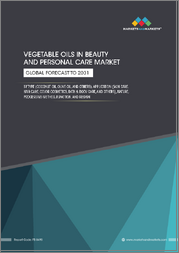
미용 및 퍼스널케어용 식물성 오일 시장 예측(-2031년) : 유형(코코넛 오일, 올리브 오일, 기타), 용도(스킨케어, 헤어케어, 색조 화장품, 바스 및 바디케어, 기타), 특성, 가공 방법, 기능, 지역별Vegetable Oils in Beauty and Personal Care Market by Type (Coconut Oil, Olive Oil, and Others), Application (Skin Care, Hair Care, Color Cosmetics, Bath & Body Care, and Others), Nature, Processing Method, Function, and Region - Global Forecast to 2031 |
||||||

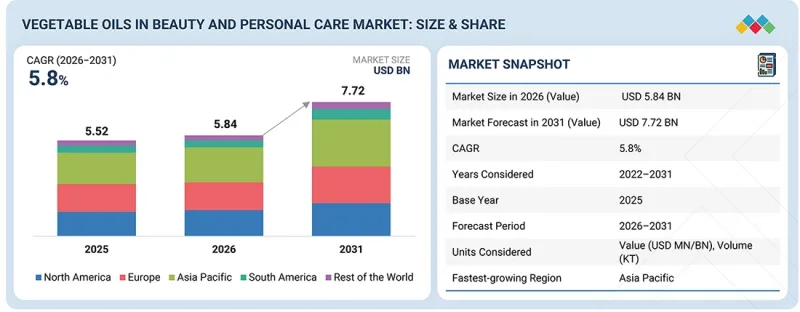
미용·퍼스널케어용 식물성 오일 시장 규모는 2026년에 58억 4,000만 달러로 추계되고 있으며, CAGR 5.8%로 추이하며, 2031년에는 77억 2,000만 달러에 달할 것으로 예측됩니다.
| 조사 범위 | |
|---|---|
| 조사 대상 기간 | 2022-2031년 |
| 기준연도 | 2025년 |
| 예측 기간 | 2026-2031년 |
| 단위 | 금액(달러) 수량(천 톤) |
| 부문 | 유형, 용도, 성질, 가공 방법, 기능, 지역 |
| 대상 지역 | 북미, 유럽, 아시아태평양, 남미, 기타 지역 |
"코코넛 오일은 스킨케어 및 헤어케어 제품에 널리 사용되고 있으며, 시장 성장을 주도하고 있습니다"
코코넛 오일은 미용 및 퍼스널 케어용 식물성 오일 시장에서 주요한 위치를 차지하고 있습니다. 코코야자를 원료로 하는 이 오일은 화장품 분야에서 폭넓은 용도, 다양한 상업용 등급, 확립된 농업 공급 기반을 바탕으로 미용 및 퍼스널 케어 업계 전반에서 중요한 식물성 오일로 활용되고 있습니다. Gustav Heess Oleochemische Erzeugnisse GmbH(독일)와 같은 상업 공급업체들은 Ph. Eur. 규격의 정제 코코넛 오일,수소화 코코넛 오일, 유기농 정제 코코넛 오일, 유기농 버진 코코넛 오일 등을 공급하며, 화장품 용도를 위해 다양한 물리적 특성과 가공 특성을 조제업체에 제공하고 있습니다. 예를 들어 수소화 코코넛 오일은 천연 액상 오일이 고형 지방으로 변환된 것이며, 반면 유기농 정제 및 유기농 버진 등급은 천연 및 유기농 제품 포지셔닝을 위한 선택지를 제공합니다. 코코넛 오일은 크림, 스크럽, 데오드란트, 메이크업 리무버, 마사지 오일, 립 케어, 네일 케어, 헤어 케어 제품 등 폭넓은 화장품 용도로 사용되고 있으며, 공급업체들은 이를 건성 피부나 건조한 모발을 위한 보습제로도 포지셔닝하고 있습니다. 전반적으로 코코넛 오일은 헤어 케어, 스킨 케어, 바디 케어 및 기타 퍼스널 케어 제품에 걸친 다기능적인 용도뿐만 아니라, 다양한 상업용 등급과 광범위한 재배 및 접근성을 통해 시장 성장을 크게 지원하고 있습니다.
"스킨케어 용도는 식물성 오일의 보습, 수분 유지, 피부 컨디셔닝 특성 덕분에 시장을 주도할 것으로 예상됩니다."
스킨케어 부문은 식물성 오일의 보습, 연화, 영양 공급, 피부 컨디셔닝 특성 덕분에 식물성 오일의 주요 용도로 자리 잡고 있습니다. 코코넛, 올리브, 해바라기, 아몬드,아르간, 아보카도 등 17유형의 식물성 오일을 대상으로 한 27건의 임상 연구 검토에서는 경피 수분 손실(TEWL)을 감소시켜 피부의 수분량을 개선하는 역할이 강조되었습니다. 이러한 특성으로 인해 보습제, 크림, 로션 및 기타 스킨케어 제품에서 식물성 오일이 널리 사용되고 있습니다. 모링가 오일이나 스위트 아몬드 오일 등 특수 식물성 오일 원료의 입수 가능성이 높아지면서, 건성 피부나 거칠어진 피부를 위한 제품에 배합되기 시작함에 따라 스킨케어 분야에서의 식물성 오일 이용은 더욱 확대되고 있으며, 스킨케어 분야는 미용·퍼스널 케어용 식물성 오일 시장의 성장을 촉진하는 중요한 요인이 되고 있습니다.
"특성별로는 기존형 부문이 광범위한 채택, 안정적인 공급, 대규모 화장품 생산에 대한 적합성으로 인해 시장을 독점할 것으로 추정됩니다."
스킨케어, 헤어케어, 컬러 화장품, 퍼스널 케어 제품에서 코코넛 오일, 해바라기 오일, 유채유, 대두유, 피마자유, 팜유 등의 식물 유래 오일이 널리 사용되고 있는 것이 성장의 배경이 되고 있습니다. 이러한 유지는 미용 및 퍼스널 케어 제조업체에게 널리 구할 수 있고 상업적으로도 활용하기 쉬운 원료 선택지를 제공하므로 기존형 부문은 계속해서 주도적인 지위를 유지하고 있습니다. 반면, USDA 유기농 표시를 하는 제품은 USDA National Organic Program에 기반한 유기농 생산, 취급, 가공, 표시 요건을 충족해야 하며, 해당 사업에는 인증 요건도 적용됩니다. 이러한 배경으로 인해 기존 방식의 식물성 오일은 미용·퍼스널 케어 제조사에게 계속해서 활용하기 쉬운 원료 선택지로 자리 잡고 있습니다.
"아시아태평양은 소비자의 강력한 수요와 미용·퍼스널 케어 산업의 확대로 인해 시장을 주도할 것으로 추정됩니다."
아시아태평양은 미용·퍼스널 케어 산업의 확대, 천연·식물 유래 제품에 대한 소비자의 선호도 증가, 식물성 오일 원료의 풍부한 공급에 힘입어 시장을 주도할 것으로 예상됩니다. 스킨케어 및 헤어케어 제품에 대한 수요 증가, 가처분 소득 증가, 급속한 도시화, 화장품 제조에 대한 투자 확대가 이 지역의 성장을 더욱 지원하고 있습니다. 또한 주요 식물성 오일 생산업체 및 화장품 원료 제조업체의 존재에 더해, 클린 라벨 및 지속가능한 제형 채택 확대가 아시아태평양의 주도적 지위를 강화하고 있습니다.
이 보고서에서는 전 세계 미용 및 퍼스널 케어용 식물성 오일 시장을 조사하여, 시장 개요, 시장 성장에 영향을 미치는 다양한 요인에 대한 분석, 기술 및 특허 동향, 법규제 환경, 사례 연구, 시장 규모 추이 및 전망, 각종 분류·지역/주요 국가별 상세 분석, 경쟁 구도, 주요 기업 개요 등을 정리하여 전해드립니다.
자주 묻는 질문
목차
제1장 서론
제2장 개요
제3장 주요 인사이트
제4장 시장 개요
제5장 업계 동향
제6장 기술의 진보, AI에 의한 영향, 특허, 혁신, 향후 응용
제7장 규제 상황과 지속가능성 구상
제8장 고객 상황과 구매 행동
제9장 미용·퍼스널케어용 식물성 오일 시장 : 유형별
제10장 미용·퍼스널케어용 식물성 오일 시장 : 용도별
제11장 미용·퍼스널케어용 식물성 오일 시장 : 특성별
제12장 미용·퍼스널케어용 식물성 오일 시장 : 가공 방법별
제13장 미용·퍼스널케어용 식물성 오일 시장 : 용도별
제14장 미용·퍼스널케어용 식물성 오일 시장 : 지역별
제15장 경쟁 구도
제16장 기업 개요
제17장 조사 방법
제18장 인접 시장 및 관련 시장
제19장 부록
KSA 26.09.07The vegetable oils in beauty and personal care market is estimated to be USD 5.84 billion in 2026 and is projected to reach USD 7.72 billion by 2031 at a CAGR of 5.8%.
| Scope of the Report | |
|---|---|
| Years Considered for the Study | 2022-2031 |
| Base Year | 2025 |
| Forecast Period | 2026-2031 |
| Units Considered | Value (USD Million) and Volume (KT) |
| Segments | Type, application, nature, processing method, function, and region |
| Regions covered | North America, Europe, Asia Pacific, South America, and Rest of the World (RoW) |
"Coconut oil is driving market growth through its widespread use in skincare and haircare formulations"
Coconut oil is a dominant oil within the vegetable oils segment of the beauty and personal care market. It is derived from Cocos nucifera and is an important vegetable oil used across the beauty and personal care industry due to its broad cosmetic applicability, multiple commercial grades, and established agricultural supply base. Commercial suppliers such as Gustav Heess Oleochemische Erzeugnisse GmbH (Germany) offer coconut oil in refined Ph. Eur., hydrogenated, organic refined, and organic virgin grades, providing formulators with different physical and processing characteristics for cosmetic applications. Hydrogenated coconut oil, for example, is converted from the natural liquid oil into a solid fat, while organic refined and organic virgin grades provide options for natural and organic product positioning. Coconut oil is used in a wide range of cosmetic applications, including creams, scrubs, deodorants, makeup removers, massage oils, lip-care, nail-care, and hair-care products, with the supplier also positioning it as a moisturizer for dry skin and hair. Overall, Coconut oil significantly supports market growth through its multifunctional use across hair care, skin care, body care, and other personal-care products, along with its diverse commercial grades and widespread cultivation and availability.
"The skin care application segment is estimated to dominate the vegetable oils in beauty and personal care market due to the moisturizing, hydrating, and skin-conditioning properties of the oils"
The skin care segment is a major application area for vegetable oils in the beauty and personal care market, owing to the moisturizing, emollient, nourishing, and skin-conditioning properties of the oils. A review of 27 clinical studies involving 17 vegetable oils, including coconut, olive, sunflower, almond, argan, and avocado oils, highlighted their role in improving skin hydration by reducing transepidermal water loss (TEWL). These properties support the widespread use of vegetable oils in moisturizers, creams, lotions, and other skincare formulations. The growing availability of specialized vegetable-oil ingredients, such as moringa and sweet almond oils, and their incorporation into products targeting dry and rough skin are further expanding the use of vegetable oils in skincare, making the Skin Care segment a key contributor to the growth of the vegetable oils in beauty and personal care market.
"By nature, the conventional segment is estimated to dominate the vegetable oils in beauty and personal care market due to the widespread adoption, reliable supply, and suitability of conventional oil for large-scale cosmetic production"
By nature, the conventional segment represents a major component of the vegetable oils in beauty and personal care market, supported by the extensive use of plant-derived oils such as coconut, sunflower, rapeseed, soybean, castor, and palm-derived oils in skincare, haircare, color cosmetics, and personal hygiene products. The conventional segment continues to maintain its leading position as these oils provide widely available and commercially accessible ingredient options for beauty & personal care manufacturers. In comparison, products making USDA organic claims must comply with organic production, handling, processing, and labeling requirements under the USDA National Organic Program, with certification requirements applying to relevant operations. This supports the continued use of conventional vegetable oils as accessible ingredient options for beauty and personal care manufacturers.
"Asia Pacific is estimated to dominate the global vegetable oils in beauty and personal care market due to the strong consumer demand and expanding beauty and personal care industry"
Asia Pacific is expected to dominate the vegetable oils in beauty and personal care market, supported by the region's expanding beauty and personal care industry, growing consumer preference for natural and plant-based products, and strong availability of vegetable oil sources. Rising demand for skincare and haircare products, increasing disposable incomes, rapid urbanization, and growing investments in cosmetic manufacturing further support regional growth. Additionally, the presence of major vegetable oil producers and cosmetic ingredient manufacturers, along with increasing adoption of clean-label and sustainable formulations, strengthens Asia Pacific's leading position in the global vegetable oils in beauty and personal care market.
In-depth interviews have been conducted with chief executive officers (CEOs), directors, and other executives from various key organizations operating in the vegetable oils in beauty and personal care market.
- By Company Type: Tier 1 - 30%, Tier 2 - 25%, and Tier 3 - 45%
- By Designation: CXOs - 25%, Managers - 40%, Executive - 35%
- By Region: North America - 20%, Europe - 30%, Asia Pacific - 30%, South America - 10%, and Rest of the World -10%
Prominent companies in the market include BASF SE (Germany), ADM (US), Cargill, Incorporated (US), Croda International plc (UK), Vantage (US), All Organic Treasures GmbH (Germany), Sophim (France), AOS Products Pvt. Ltd. (India), CREMER OLEO GmbH & Co. KG (Germany), Hallstar (US), Louis Dreyfus Company (Netherlands), AAK (Sweden), Henry Lamotte Oils (Germany), Gustav Heess Oleochemische Erzeugnisse GmbH (Germany), Rmayra Naturals Impex (India), and others.
Research Coverage
This research report categorizes the vegetable oils in beauty and personal care market by type (coconut oil, palm oil and palm kernel oil, olive oil, sunflower oil and other vegetable oils), application (skin care, hair care, bath & body care, color cosmetics, and other applications), nature (conventional, organic), processing method (cold pressed, expeller pressed, solvent extracted, refined, virgin/extra virgin), function (emollients, skin conditioning agent, hair conditioning agent, moisturizing agent, carrier oil, cleansing and surfactant base), and region (North America, Europe, Asia Pacific, South America, Rest of the World).
The report's scope encompasses detailed information on the major factors, including drivers, restraints, challenges, and opportunities, that influence the growth of the vegetable oils in beauty and personal care industry. A thorough analysis of the key industry players has been done to provide insights into their business, services, key strategies, contracts, partnerships, agreements, product launches, mergers & acquisitions, and recent developments associated with the vegetable oils in beauty and personal care market. This report provides a competitive analysis of emerging startups in the vegetable oils in beauty and personal care market ecosystem. Furthermore, the study covers industry-specific trends, including technology analysis, ecosystem & market mapping, and patent & regulatory landscape, among others.
Reasons to Buy This Report
The report provides market leaders/new entrants with information on the closest approximations of revenue numbers for the overall vegetable oils in beauty and personal care and its subsegments. It will help stakeholders understand the competitive landscape and gain more insights to better position their businesses and plan suitable go-to-market strategies. The report also helps stakeholders understand the pulse of the market and provides them with information on key market drivers, restraints, challenges, and opportunities.
The report provides insights into the following pointers:
- Analysis of key drivers (Growing consumer demand for natural and plant-based beauty products, advancements in green extraction and processing technologies enhancing the adoption of cosmetic-grade vegetable oils, increasing industry investment in sustainable and bio-based cosmetic ingredients), restraints (Price volatility due to climatic conditions and agricultural supply fluctuations, growing adoption of biotechnology-derived alternatives to conventional vegetable oils, sustainability concerns associated with palm oil driving the adoption of alternative ingredients), opportunities (Development of upcycled and circular economy-based vegetable oils, expansion of certified organic and sustainably sourced vegetable oil portfolios), and challenges (Balancing sustainability, scalability, and cost competitiveness, ensuring long-term oxidative stability without compromising natural positioning)
- Product Development/Innovation: Detailed insights into research & development activities and new product launches in the vegetable oils in beauty and personal care market
- Market Development: Comprehensive information about lucrative markets-analysis of vegetable oils in beauty and personal care across varied regions
- Market Diversification: Exhaustive information about new product sources, untapped geographies, recent developments, and investments in the vegetable oils in beauty and personal care market
- Competitive Assessment: In depth assessment of market shares, growth strategies, product offerings, brand/product comparison, and product footprints of leading players such as BASF SE (Germany), ADM (US), Cargill, Incorporated (US), Croda International plc (UK), Vantage (US), All Organic Treasures GmbH (Germany), Sophim (France), AOS Products Pvt. Ltd. (India), CREMER OLEO GmbH & Co. KG (Germany), Hallstar (US), Louis Dreyfus Company (Netherlands), AAK (Sweden), Henry Lamotte Oils (Germany), Gustav Heess Oleochemische Erzeugnisse GmbH (Germany), Rmayra Naturals Impex (India), and other players in the vegetable oils in beauty and personal care market.
TABLE OF CONTENTS
1 INTRODUCTION
- 1.1 STUDY OBJECTIVES
- 1.2 MARKET DEFINITION
- 1.3 STUDY SCOPE AND SEGMENTATION
- 1.3.1 MARKETS COVERED AND REGIONAL SCOPE
- 1.3.2 INCLUSIONS AND EXCLUSIONS
- 1.3.3 YEARS CONSIDERED
- 1.3.4 CURRENCY CONSIDERED
- 1.3.5 UNIT CONSIDERED
- 1.4 STAKEHOLDERS
- 1.5 SUMMARY OF CHANGES
2 EXECUTIVE SUMMARY
- 2.1 MARKET HIGHLIGHTS AND KEY INSIGHTS
- 2.2 KEY MARKET PARTICIPANTS: MAPPING OF STRATEGIC DEVELOPMENTS
- 2.3 DISRUPTIVE TRENDS IN VEGETABLE OILS IN BEAUTY AND PERSONAL CARE MARKET
- 2.4 HIGH-GROWTH SEGMENTS
- 2.5 REGIONAL SNAPSHOT: MARKET SIZE, GROWTH RATE, AND FORECAST
3 PREMIUM INSIGHTS
- 3.1 ATTRACTIVE OPPORTUNITIES FOR PLAYERS IN VEGETABLE OILS IN BEAUTY AND PERSONAL CARE MARKET
- 3.2 VEGETABLE OILS IN BEAUTY AND PERSONAL CARE MARKET, BY TYPE AND REGION
- 3.3 VEGETABLE OILS IN BEAUTY AND PERSONAL CARE MARKET, BY TOP 3 TYPES
- 3.4 VEGETABLE OILS IN BEAUTY AND PERSONAL CARE MARKET, BY NATURE
- 3.5 VEGETABLE OILS IN BEAUTY AND PERSONAL CARE MARKET, BY APPLICATION
- 3.6 VEGETABLE OILS IN BEAUTY AND PERSONAL CARE MARKET, BY PROCESSING METHOD
- 3.7 VEGETABLE OILS IN BEAUTY AND PERSONAL CARE MARKET, BY COUNTRY
4 MARKET OVERVIEW
- 4.1 INTRODUCTION
- 4.2 MARKET DYNAMICS
- 4.2.1 DRIVERS
- 4.2.1.1 Growing consumer demand for natural and plant-based beauty products
- 4.2.1.2 Advancements in green extraction and processing technologies
- 4.2.1.3 Increasing industry investment in sustainable and bio-based cosmetic ingredients
- 4.2.2 RESTRAINTS
- 4.2.2.1 Price volatility due to climatic conditions and agricultural supply fluctuations
- 4.2.2.2 Rising adoption of biotechnology-derived alternatives over conventional vegetable oils
- 4.2.2.3 Sustainability concerns associated with palm oil
- 4.2.3 OPPORTUNITIES
- 4.2.3.1 Development of upcycled and circular economy-based vegetable oils
- 4.2.3.2 Expansion of certified organic and sustainably sourced vegetable oil portfolios
- 4.2.4 CHALLENGES
- 4.2.4.1 Balancing sustainability, scalability, and cost competitiveness
- 4.2.4.2 Ensuring long-term oxidative stability without compromising natural positioning
- 4.2.1 DRIVERS
- 4.3 UNMET NEEDS AND WHITE SPACES
- 4.3.1 UNMET NEEDS IN VEGETABLE OILS IN BEAUTY AND PERSONAL CARE MARKET
- 4.3.2 WHITE SPACE OPPORTUNITIES
- 4.4 INTERCONNECTED MARKETS AND CROSS-SECTOR OPPORTUNITIES
- 4.4.1 INTERCONNECTED MARKETS
- 4.4.2 CROSS-SECTOR OPPORTUNITIES
- 4.5 STRATEGIC MOVES BY TIER-1/2/3 PLAYERS
- 4.5.1 KEY MOVES AND STRATEGIC FOCUS
5 INDUSTRY TRENDS
- 5.1 PORTER'S FIVE FORCES ANALYSIS
- 5.1.1 INTENSITY OF COMPETITIVE RIVALRY
- 5.1.2 BARGAINING POWER OF SUPPLIERS
- 5.1.3 BARGAINING POWER OF BUYERS
- 5.1.4 THREAT OF SUBSTITUTES
- 5.1.5 THREAT OF NEW ENTRANTS
- 5.2 MACROECONOMICS OUTLOOK
- 5.2.1 INTRODUCTION
- 5.2.2 MACROECONOMIC INDICATORS
- 5.2.2.1 Expansion of global bioeconomy & renewable carbon policies
- 5.2.2.2 Impact of disposable income on beauty and personal care purchases
- 5.3 VALUE CHAIN ANALYSIS
- 5.3.1 RESEARCH & PRODUCT DEVELOPMENT
- 5.3.2 RAW MATERIAL SOURCING & INGREDIENT DEVELOPMENT
- 5.3.3 MANUFACTURING, REFINING, & QUALITY ASSURANCE
- 5.3.4 INGREDIENT DISTRIBUTION & SUPPLY MANAGEMENT
- 5.3.5 CUSTOMER INTEGRATION & COMMERCIAL ADOPTION
- 5.4 ECOSYSTEM ANALYSIS
- 5.4.1 DEMAND SIDE
- 5.4.2 SUPPLY SIDE
- 5.5 PRICING ANALYSIS
- 5.5.1 INTRODUCTION
- 5.5.2 AVERAGE SELLING PRICE OF VEGETABLE OIL-BASED FINISHED BEAUTY AND PERSONAL CARE PRODUCTS, BY PRODUCT TYPE
- 5.5.3 INDICATIVE AVERAGE SELLING PRICE (ASP) TREND, BY REGION
- 5.5.4 INDICATIVE AVERAGE SELLING PRICE (ASP), BY VEGETABLE OIL TYPE
- 5.6 TRADE ANALYSIS
- 5.6.1 IMPORT ANALYSIS: VEGETABLE OILS IN BEAUTY AND PERSONAL CARE MARKET
- 5.6.2 EXPORT ANALYSIS: VEGETABLE OILS IN BEAUTY AND PERSONAL CARE MARKET
- 5.7 KEY CONFERENCES AND EVENTS, 2026-2027
- 5.8 TRENDS/DISRUPTIONS IMPACTING CUSTOMER BUSINESS
- 5.9 CASE STUDY ANALYSIS
- 5.9.1 CARGILL BEAUTY - VEGETABLE OIL-BASED REPLACEMENT FOR PETROLATUM
- 5.9.2 MOROCCAN ARGAN OIL - MECHANIZED EXTRACTION SUPPORTING COSMETIC INDUSTRY
- 5.9.3 SOPHIM - PRODUCED PHYTOSQUALAN FROM OLIVE OIL
- 5.10 IMPACT OF 2025 US TARIFF - VEGETABLE OILS IN BEAUTY AND PERSONAL CARE MARKET
- 5.10.1 INTRODUCTION
- 5.10.2 PRICE IMPACT ANALYSIS
- 5.10.3 IMPACT ON COUNTRIES/REGIONS
- 5.10.3.1 US
- 5.10.3.2 Europe
- 5.10.3.3 Asia Pacific
- 5.10.4 IMPACT ON END-USE INDUSTRIES
6 TECHNOLOGICAL ADVANCEMENTS, AI-DRIVEN IMPACT, PATENTS, INNOVATIONS, AND FUTURE APPLICATIONS
- 6.1 TECHNOLOGY ANALYSIS
- 6.1.1 KEY TECHNOLOGIES
- 6.1.1.1 Mechanical and cold-press extraction technology
- 6.1.1.2 Solvent extraction & advanced refining technology
- 6.1.2 COMPLEMENTARY TECHNOLOGIES
- 6.1.2.1 Supercritical carbon dioxide (SC-CO2) extraction
- 6.1.2.2 Oxidative stability enhancement & shelf-life preservation technology
- 6.1.3 ADJACENT TECHNOLOGIES
- 6.1.3.1 Smart manufacturing, digital traceability & supply chain technologies
- 6.1.3.2 Biotechnology & precision lipid production technologies
- 6.1.4 TECHNOLOGY/PRODUCT ROADMAP
- 6.1.4.1 Short-term | Advanced refining & sustainable ingredient development
- 6.1.4.2 Mid-term | AI-driven formulation & smart manufacturing
- 6.1.4.3 Long-term | Biotechnology & precision lipid innovation
- 6.1.1 KEY TECHNOLOGIES
- 6.2 PATENT ANALYSIS
- 6.3 FUTURE APPLICATIONS
- 6.3.1 RENEWABLE GLYCOLIPID STRUCTURING TECHNOLOGY FOR COSMETIC-GRADE VEGETABLE OILS
- 6.3.2 STRUCTURED LIPID & OLEOGEL TECHNOLOGY: SHAPING FUTURE OF COSMETIC-GRADE VEGETABLE OILS
- 6.3.3 VEGETABLE OIL-BASED LIPID NANOCARRIERS FOR NEXT-GENERATION COSMETIC ACTIVE DELIVERY
- 6.4 IMPACT OF GENERATIVE AI ON COSMETICS AND PERSONAL CARE GRADE INGREDIENTS INDUSTRY
- 6.4.1 INTRODUCTION
- 6.4.2 TOP USE CASES AND MARKET POTENTIAL
- 6.4.3 BEST PRACTICES IN COSMETICS & PERSONAL CARE GRADE INGREDIENTS INDUSTRY
- 6.4.4 CASE STUDIES OF AI IMPLEMENTATION IN COSMETICS & PERSONAL CARE GRADE INGREDIENTS INDUSTRY
- 6.4.5 INTERCONNECTED ADJACENT ECOSYSTEM AND IMPACT ON MARKET PLAYERS
- 6.4.6 CLIENTS' READINESS TO ADOPT GEN AI IN COSMETIC AND PERSONAL CARE GRADE INGREDIENTS INDUSTRY
- 6.5 SUCCESS STORIES AND REAL-WORLD APPLICATIONS
7 REGULATORY LANDSCAPE AND SUSTAINABILITY INITIATIVES
- 7.1 REGIONAL REGULATIONS AND COMPLIANCE
- 7.1.1 REGULATORY BODIES, GOVERNMENT AGENCIES, AND OTHER ORGANIZATIONS
- 7.1.2 INDUSTRY STANDARDS
- 7.1.3 LABELING REQUIREMENTS AND CLAIMS
- 7.1.4 ANTICIPATED REGULATORY CHANGES IN NEXT 5-10 YEARS
- 7.1.4.1 Enhanced ingredient traceability and supply chain transparency
- 7.1.4.2 Greater global harmonization of cosmetic ingredient regulations
- 7.1.4.3 Stricter sustainability and responsible sourcing requirements
- 7.1.4.4 Digital traceability, AI-enabled quality monitoring, and compliance automation
- 7.1.4.5 Higher safety and purity standards for natural cosmetic ingredients
- 7.2 SUSTAINABILITY INITIATIVES
- 7.2.1 SUSTAINABLE SOURCING
- 7.2.2 CARBON FOOTPRINT REDUCTION INITIATIVES
- 7.2.3 CIRCULAR ECONOMY APPROACHES
- 7.3 IMPACT OF REGULATORY POLICIES ON SUSTAINABILITY INITIATIVES
- 7.4 CERTIFICATIONS, LABELING, ECO-STANDARDS
8 CUSTOMER LANDSCAPE AND BUYER BEHAVIOR
- 8.1 DECISION-MAKING PROCESS
- 8.2 KEY STAKEHOLDERS INVOLVED IN BUYING PROCESS AND THEIR EVALUATION CRITERIA
- 8.2.1 KEY STAKEHOLDERS IN BUYING PROCESS
- 8.2.2 BUYING CRITERIA
- 8.3 ADOPTION BARRIERS AND INTERNAL CHALLENGES
- 8.4 UNMET NEEDS OF VARIOUS APPLICATION INDUSTRIES ACROSS SUPPLY CHAIN
- 8.5 MARKET PROFITABILITY
- 8.6 REVENUE POTENTIAL
- 8.6.1 COST DYNAMICS
- 8.6.2 MARGIN OPPORTUNITIES, BY TOP 8 TYPES
9 VEGETABLE OILS IN BEAUTY AND PERSONAL CARE MARKET, BY TYPE
- 9.1 INTRODUCTION
- 9.2 COCONUT OIL
- 9.2.1 DOMINANT VEGETABLE OIL DRIVING GROWTH IN BEAUTY AND PERSONAL CARE MARKET
- 9.3 PALM OIL & PALM KERNEL OIL
- 9.3.1 EXTENSIVE OLEOCHEMICAL APPLICATIONS IN BEAUTY AND PERSONAL CARE
- 9.4 OLIVE OIL
- 9.4.1 MULTIFUNCTIONALITY AND DIVERSE COSMETIC APPLICATIONS
- 9.5 SUNFLOWER OIL
- 9.5.1 BROAD APPLICATIONS, DIVERSE GRADES, AND GLOBAL AVAILABILITY
- 9.6 SOYBEAN OIL
- 9.6.1 SKIN-BARRIER BENEFITS AND COSMETIC VERSATILITY
- 9.7 CASTOR OIL
- 9.7.1 VERSATILE COSMETIC APPLICATIONS AND VALUE-ADDED DERIVATIVES
- 9.8 JOJOBA OIL
- 9.8.1 HIGH STABILITY, SKIN COMPATIBILITY, AND MULTIFUNCTIONAL COSMETIC APPLICATIONS
- 9.9 SWEET ALMOND OIL
- 9.9.1 MULTIFUNCTIONAL EMOLLIENT SUPPORTING GROWTH IN BEAUTY AND PERSONAL CARE
- 9.10 ARGAN OIL
- 9.10.1 FAST-GROWING SPECIALTY INGREDIENT IN BEAUTY AND PERSONAL CARE
- 9.11 AVOCADO OIL
- 9.11.1 MULTIFUNCTIONAL VEGETABLE OIL SUPPORTING GROWTH ACROSS BEAUTY AND PERSONAL CARE APPLICATIONS
- 9.12 GRAPESEED OIL
- 9.12.1 LIGHTWEIGHT AND SUSTAINABLE VEGETABLE OIL SUPPORTING BEAUTY AND PERSONAL CARE APPLICATIONS
- 9.13 SESAME OIL
- 9.13.1 VERSATILE VEGETABLE OIL SUPPORTING SKIN AND HAIR CARE APPLICATIONS
- 9.14 RICE BRAN OIL
- 9.14.1 BIOACTIVE-RICH VEGETABLE OIL SUPPORTING SKIN-CARE AND SUSTAINABLE BEAUTY APPLICATIONS
- 9.15 CANOLA RAPESEED OIL
- 9.15.1 MOISTURIZING AND CONDITIONING VEGETABLE OIL SUPPORTING SKIN AND HAIR CARE APPLICATIONS
- 9.16 MACADAMIA OIL
- 9.16.1 PREMIUM VEGETABLE OIL SUPPORTING SKIN, HAIR, AND COLOR COSMETICS APPLICATIONS
- 9.17 SHEA OIL
- 9.17.1 NUTRIENT-RICH VEGETABLE OIL SUPPORTING COSMETIC AND PERSONAL CARE APPLICATIONS
- 9.18 OTHER VEGETABLE OIL TYPES
10 VEGETABLE OILS IN BEAUTY AND PERSONAL CARE MARKET, BY APPLICATION
- 10.1 INTRODUCTION
- 10.2 SKIN CARE
- 10.2.1 GROWING ADOPTION OF VEGETABLE OILS IN SKINCARE FORMULATIONS TO SUPPORT MARKET GROWTH
- 10.3 HAIR CARE
- 10.3.1 ADOPTION OF VEGETABLE OILS IN ENHANCING HAIR CONDITIONING AND PROTECTION TO DRIVE MARKET
- 10.4 COLOR COSMETICS
- 10.4.1 USE OF VEGETABLE OILS IN ENHANCING PIGMENT DISPERSION AND FORMULATION PERFORMANCE TO SUPPORT COLOR COSMETICS DEMAND
- 10.5 BATH & BODY CARE
- 10.5.1 FOCUS ON SKIN MOISTURIZATION AND BARRIER CARE TO EXPAND USE OF VEGETABLE OILS IN BATH & BODY CARE PRODUCTS
- 10.6 OTHER APPLICATIONS
11 VEGETABLE OILS IN BEAUTY AND PERSONAL CARE MARKET, BY NATURE
- 11.1 INTRODUCTION
- 11.2 CONVENTIONAL
- 11.2.1 WIDE AVAILABILITY AND COMMERCIAL ACCESSIBILITY TO SUPPORT MARKET GROWTH
- 11.3 ORGANIC
- 11.3.1 RISING CONSUMER PREFERENCE FOR NATURAL AND SUSTAINABLY SOURCED INGREDIENTS TO SUPPORT MARKET GROWTH
12 VEGETABLE OILS IN BEAUTY AND PERSONAL CARE MARKET, BY PROCESSING METHOD
- 12.1 INTRODUCTION
- 12.2 COLD-PRESSED
- 12.2.1 ENABLING PRODUCTION OF MINIMALLY PROCESSED OILS IN BEAUTY AND PERSONAL CARE
- 12.3 EXPELLER-PRESSED
- 12.3.1 PROVIDING SOLVENT-FREE MECHANICAL EXTRACTION IN BEAUTY AND PERSONAL CARE
- 12.4 SOLVENT-EXTRACTED
- 12.4.1 ADVANCING SUSTAINABLE SOLVENT EXTRACTION FOR SPECIALTY COSMETIC OILS
- 12.5 REFINED
- 12.5.1 ENHANCING QUALITY, CONSISTENCY, AND FORMULATION PERFORMANCE
- 12.6 VIRGIN/EXTRA VIRGIN
- 12.6.1 SUPPORTING NATURAL AND PREMIUM COSMETIC FORMULATIONS
13 VEGETABLE OILS IN BEAUTY AND PERSONAL CARE MARKET, BY FUNCTION
- 13.1 INTRODUCTION
- 13.2 EMOLLIENT
- 13.2.1 EMOLLIENT FUNCTION DRIVES USE OF VEGETABLE OILS ACROSS SKIN AND HAIR CARE FORMULATIONS
- 13.3 MOISTURIZING AGENT
- 13.3.1 VEGETABLE OILS SUPPORT SKIN HYDRATION AND MOISTURE RETENTION ACROSS BEAUTY AND PERSONAL CARE APPLICATIONS
- 13.4 SKIN CONDITIONING AGENT
- 13.4.1 VEGETABLE OILS ENHANCE SKIN CONDITIONING THROUGH NATURAL LIPIDS AND BIOACTIVE COMPOUNDS
- 13.5 HAIR CONDITIONING AGENT
- 13.5.1 HAIR CONDITIONING FUNCTION EXPANDS USE OF VEGETABLE OILS ACROSS HAIR-CARE FORMULATIONS
- 13.6 CARRIER OIL
- 13.6.1 VEGETABLE OILS SERVE AS VERSATILE CARRIER OILS FOR COSMETIC FORMULATIONS AND ACTIVE-INGREDIENT DELIVERY
- 13.7 CLEANSING & SURFACTANT BASE
- 13.7.1 VEGETABLE OILS SERVE AS KEY FEEDSTOCKS FOR SURFACTANTS AND CLEANSING INGREDIENTS IN PERSONAL CARE
14 VEGETABLE OILS IN BEAUTY AND PERSONAL CARE MARKET, BY REGION
- 14.1 INTRODUCTION
- 14.2 NORTH AMERICA
- 14.2.1 US
- 14.2.1.1 Growing demand for clean-label and plant-based ingredients to drive market
- 14.2.2 CANADA
- 14.2.2.1 Growing consumer preference for natural and sustainable beauty products to drive market
- 14.2.3 MEXICO
- 14.2.3.1 Large-scale use of coconut oil in soaps and personal care products to drive market
- 14.2.1 US
- 14.3 EUROPE
- 14.3.1 GERMANY
- 14.3.1.1 Rising demand for natural cosmetics to fuel vegetable oil adoption
- 14.3.2 UK
- 14.3.2.1 Wide usage of coconut and shea oil in cosmetic products to drive market
- 14.3.3 FRANCE
- 14.3.3.1 Strong cosmetics manufacturing base and growing demand for sustainable beauty products to drive market
- 14.3.4 ITALY
- 14.3.4.1 Expanding premium skincare sector and clean beauty trends to propel market
- 14.3.5 SPAIN
- 14.3.5.1 Growing focus on natural skin care products to drive market
- 14.3.6 REST OF EUROPE
- 14.3.1 GERMANY
- 14.4 ASIA PACIFIC
- 14.4.1 CHINA
- 14.4.1.1 Rapid expansion of beauty and personal care industry to drive market
- 14.4.2 INDIA
- 14.4.2.1 Increasing consumer awareness of natural ingredient-based cosmetic products to drive market
- 14.4.3 JAPAN
- 14.4.3.1 Growing aging population and rising demand for anti-aging skincare to drive market
- 14.4.4 AUSTRALIA & NEW ZEALAND
- 14.4.4.1 Rising production of macadamia nuts owing to increasing utilization of macadamia oil to drive market
- 14.4.5 REST OF ASIA PACIFIC
- 14.4.1 CHINA
- 14.5 SOUTH AMERICA
- 14.5.1 BRAZIL
- 14.5.1.1 Simplified regulations for artisanal cosmetics to drive market
- 14.5.2 ARGENTINA
- 14.5.2.1 Expanding vegetable oil production and value-added processing to drive market
- 14.5.3 REST OF SOUTH AMERICA
- 14.5.1 BRAZIL
- 14.6 REST OF THE WORLD
- 14.6.1 MIDDLE EAST
- 14.6.1.1 Growing consumer demand for chemical-free cosmetics to drive market
- 14.6.2 AFRICA
- 14.6.2.1 Growing availability of indigenous vegetable oils to support beauty and personal care applications
- 14.6.1 MIDDLE EAST
15 COMPETITIVE LANDSCAPE
- 15.1 OVERVIEW
- 15.2 KEY PLAYER COMPETITIVE STRATEGIES/RIGHT TO WIN, 2022-2026
- 15.3 REVENUE ANALYSIS, 2023-2025
- 15.4 MARKET SHARE ANALYSIS, 2025
- 15.5 BRAND/PRODUCT COMPARISON
- 15.6 COMPANY EVALUATION MATRIX: KEY PLAYERS, 2025
- 15.6.1 STARS
- 15.6.2 EMERGING LEADERS
- 15.6.3 PERVASIVE PLAYERS
- 15.6.4 PARTICIPANTS
- 15.6.5 COMPANY FOOTPRINT: KEY PLAYERS, 2025
- 15.6.5.1 Regional footprint
- 15.6.5.2 Nature footprint
- 15.6.5.3 Application footprint
- 15.7 COMPANY EVALUATION MATRIX: STARTUPS/SMES, 2024
- 15.7.1 PROGRESSIVE COMPANIES
- 15.7.2 RESPONSIVE COMPANIES
- 15.7.3 DYNAMIC COMPANIES
- 15.7.4 STARTING BLOCKS
- 15.7.5 COMPETITIVE BENCHMARKING: STARTUPS/SMES, 2024
- 15.7.5.1 Detailed list of key startups/SMEs
- 15.7.5.2 Competitive benchmarking of key startups/SMEs
- 15.8 COMPANY VALUATION AND FINANCIAL METRICS
- 15.9 COMPETITIVE SCENARIO
- 15.9.1 PRODUCT LAUNCHES
- 15.9.2 DEALS
- 15.9.3 EXPANSIONS
16 COMPANY PROFILE
- 16.1 KEY PLAYER
- 16.1.1 BASF SE
- 16.1.1.1 Business overview
- 16.1.1.2 Products offered
- 16.1.1.3 Recent developments
- 16.1.1.3.1 Deals
- 16.1.1.4 MnM view
- 16.1.1.4.1 Key strengths
- 16.1.1.4.2 Strategic choices
- 16.1.1.4.3 Weaknesses and competitive threats
- 16.1.2 ADM
- 16.1.2.1 Business overview
- 16.1.2.2 Products offered
- 16.1.2.3 Recent developments
- 16.1.2.4 MnM view
- 16.1.2.4.1 Key strengths
- 16.1.2.4.2 Strategic choices
- 16.1.2.4.3 Weaknesses and competitive threats
- 16.1.3 CARGILL, INCORPORATED
- 16.1.3.1 Business overview
- 16.1.3.2 Products offered
- 16.1.3.3 Recent developments
- 16.1.3.4 MnM view
- 16.1.3.4.1 Key strengths
- 16.1.3.4.2 Strategic choices
- 16.1.3.4.3 Weaknesses and competitive threats
- 16.1.4 CRODA INTERNATIONAL PLC
- 16.1.4.1 Business overview
- 16.1.4.2 Products offered
- 16.1.4.3 Recent developments
- 16.1.4.3.1 Expansions
- 16.1.4.4 MnM view
- 16.1.4.4.1 Key strengths
- 16.1.4.4.2 Strategic choices
- 16.1.4.4.3 Weaknesses and competitive threats
- 16.1.5 VANTAGE
- 16.1.5.1 Business overview
- 16.1.5.2 Products offered
- 16.1.5.3 Recent developments
- 16.1.5.3.1 Deals
- 16.1.5.4 MnM view
- 16.1.5.4.1 Key strengths
- 16.1.5.4.2 Strategic choices
- 16.1.5.4.3 Weaknesses and competitive threats
- 16.1.6 ALL ORGANIC TREASURES GMBH
- 16.1.6.1 Business overview
- 16.1.6.2 Products offered
- 16.1.6.3 Recent developments
- 16.1.6.4 MnM view
- 16.1.7 SOPHIM
- 16.1.7.1 Business overview
- 16.1.7.2 Products offered
- 16.1.7.3 Recent developments
- 16.1.7.3.1 Expansions
- 16.1.7.4 MnM view
- 16.1.8 AOS PRODUCTS PVT. LTD
- 16.1.8.1 Business overview
- 16.1.8.2 Products offered
- 16.1.8.3 Recent developments
- 16.1.8.4 MnM view
- 16.1.9 CREMER OLEO GMBH & CO. KG
- 16.1.9.1 Business overview
- 16.1.9.2 Products offered
- 16.1.9.3 Recent developments
- 16.1.9.3.1 Deals
- 16.1.9.3.2 Expansions
- 16.1.9.4 MnM view
- 16.1.10 HALLSTAR
- 16.1.10.1 Business overview
- 16.1.10.2 Products offered
- 16.1.10.3 Recent developments
- 16.1.10.4 MnM view
- 16.1.11 LOUIS DREYFUS COMPANY
- 16.1.11.1 Business overview
- 16.1.11.2 Products offered
- 16.1.11.3 Recent developments
- 16.1.11.3.1 Deals
- 16.1.11.4 MnM view
- 16.1.12 AAK
- 16.1.12.1 Business overview
- 16.1.12.2 Products offered
- 16.1.12.3 Recent developments
- 16.1.12.4 MnM view
- 16.1.13 HENRY LAMOTTE OILS
- 16.1.13.1 Business overview
- 16.1.13.2 Products offered
- 16.1.13.3 Recent developments
- 16.1.13.4 MnM view
- 16.1.14 GUSTAV HEESS OLEOCHEMISCHE ERZEUGNISSE GMBH
- 16.1.14.1 Business overview
- 16.1.14.2 Products offered
- 16.1.14.3 Recent developments
- 16.1.14.3.1 Expansions
- 16.1.14.4 MnM view
- 16.1.15 RMAYRA NATURALS IMPEX
- 16.1.15.1 Business overview
- 16.1.15.2 Products offered
- 16.1.15.3 Recent developments
- 16.1.15.4 MnM view
- 16.1.1 BASF SE
- 16.2 OTHER PLAYERS
- 16.2.1 CLR
- 16.2.1.1 Business overview
- 16.2.1.2 Products offered
- 16.2.1.3 Recent developments
- 16.2.1.4 MnM view
- 16.2.2 SWAQDESH CHEMICAL PVT. LTD.
- 16.2.2.1 Business overview
- 16.2.2.2 Products offered
- 16.2.2.3 Recent developments
- 16.2.2.4 MnM view
- 16.2.3 ESPERIS S.P.A.
- 16.2.3.1 Business overview
- 16.2.3.2 Products offered
- 16.2.3.3 Recent developments
- 16.2.3.4 MnM view
- 16.2.4 ERNESTO VENTOS S.A.
- 16.2.4.1 Business overview
- 16.2.4.2 Products offered
- 16.2.4.3 Recent developments
- 16.2.4.4 MnM view
- 16.2.5 JOJOBA DESERT (A.C.S.) LTD.
- 16.2.5.1 Business overview
- 16.2.5.2 Products offered
- 16.2.5.3 Recent developments
- 16.2.5.3.1 Product launches
- 16.2.5.4 MnM view
- 16.2.6 ALDIVIA
- 16.2.7 SENSIENT COSMETIC TECHNOLOGIES
- 16.2.8 A.G. ORGANICA PRIVATE LIMITED
- 16.2.9 AVIRAL BIOSCIENCE
- 16.2.10 SIGMA OIL SEEDS
- 16.2.1 CLR
17 RESEARCH METHODOLOGY
- 17.1 RESEARCH DATA
- 17.1.1 SECONDARY DATA
- 17.1.1.1 Key data from secondary sources
- 17.1.2 PRIMARY DATA
- 17.1.2.1 Key data from primary sources
- 17.1.2.2 Breakdown of primary profiles
- 17.1.2.3 Key insights from industry experts
- 17.1.1 SECONDARY DATA
- 17.2 MARKET SIZE ESTIMATION
- 17.2.1 TOP-DOWN APPROACH
- 17.2.2 SUPPLY-SIDE ANALYSIS
- 17.2.3 BOTTOM-UP APPROACH (DEMAND SIDE)
- 17.3 DATA TRIANGULATION AND MARKET BREAKUP
- 17.4 RESEARCH ASSUMPTIONS
- 17.5 RESEARCH LIMITATIONS AND RISK ASSESSMENT
18 ADJACENT AND RELATED MARKETS
- 18.1 INTRODUCTION
- 18.2 RESEARCH LIMITATIONS
- 18.3 ESSENTIAL OILS MARKET
- 18.3.1 MARKET DEFINITION
- 18.3.2 MARKET OVERVIEW
- 18.3.3 ESSENTIAL OILS MARKET, BY APPLICATION
- 18.4 ESSENTIAL OILS MARKET, BY REGION
- 18.5 COCONUT OIL MARKET
- 18.5.1 MARKET DEFINITION
- 18.5.2 MARKET OVERVIEW
- 18.6 COCONUT OIL MARKET, BY NATURE
- 18.7 COCONUT OIL MARKET, BY REGION
19 APPENDIX
- 19.1 DISCUSSION GUIDE
- 19.2 KNOWLEDGESTORE: MARKETSANDMARKETS' SUBSCRIPTION PORTAL
- 19.3 CUSTOMIZATION OPTIONS
- 19.4 RELATED REPORTS
- 19.5 AUTHOR DETAILS