|
시장보고서
상품코드
2123823
혈액 배양 검사 시장 : 제공 제품별, 방법별, 기술별, 용도별, 최종 사용자별, 지역별 예측(-2031년)Blood Culture Tests Market by Product (Consumables, Instruments), Method (Manual, Automated), Technology (Culture-Based, Molecular, Proteomics), Application (Bacteremia, Fungemia), End User (Hospital, Academic Research), Region - Global Forecast to 2031 |
||||||

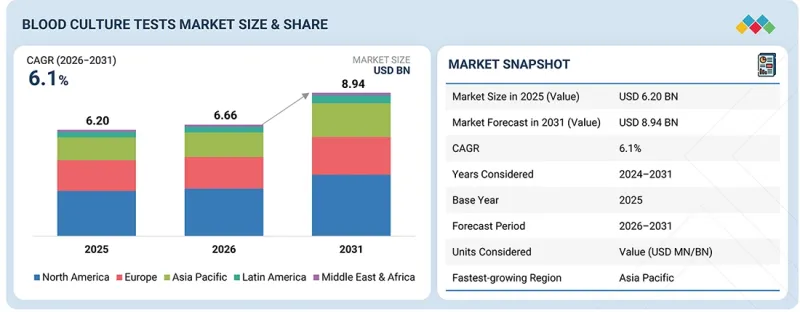
세계의 혈액 배양 검사 시장 규모는 2026년 66억 6,000만 달러로 추정되고, 2031년까지 89억 4,000만 달러로 성장할 것으로 예측되며, CAGR은 6.1%로 성장이 전망됩니다.
이러한 시장 성장은 혈류 감염(BSI), 패혈증, 의료 관련 감염(HAI)의 발생률 증가와 더불어 항생제 내성(AMR)에 대한 우려가 커짐에 따라 뒷받침되고 있습니다. 혈액 배양은 혈류 내 생존 가능한 미생물을 검출하고 적절한 항생제 치료 결정을 지원하는 중요한 진단 기법으로 계속해서 자리 잡고 있습니다.
| 조사 범위 | |
|---|---|
| 조사 대상 기간 | 2026-2031년 |
| 기준 연도 | 2025년 |
| 예측 기간 | 2026-2031년 |
| 산정 단위 | 금액(10억 달러) |
| 부문 | 제공 제품별, 방법별, 기술별, 용도별, 최종 사용자별, 지역별 |
| 대상 지역 | 북미, 유럽, 아시아태평양, 라틴아메리카, 중동 및 아프리카 |
입원 환자 수, 수술 건수, 중증 환자 및 면역 결핍 환자 증가가 혈액 배양 검사 건수의 추가 증가에 기여하고 있습니다. 또한, 자동 혈액 배양 시스템, 신속 미생물 동정 기술 및 통합 미생물학 워크플로우의 도입 확대와 더불어 진단 검사 시설의 인프라 확충이 맞물려 시장 성장을 가속화하고 있습니다.
“2026-2031년 혈액 배양 검사 시장에서 소모품 부문이 가장 높은 연평균 성장률(CAGR)을 나타낼 전망”
제품별로 보면, 예측 기간 동안 소모품 부문이 가장 높은 연평균 성장률(CAGR)을 나타낼 전망입니다. 이 부문은 주로 일상적인 혈액 배양 검사에 필요한 혈액 배양 병, 배지, 시약 및 기타 관련 소모품의 지속적인 사용에 의해 주도되고 있습니다. 일반적으로 설비 투자에 해당하며 교체 주기가 비교적 긴 장비와 달리, 혈액 배양병 및 관련 소모품은 검사마다 필요하기 때문에 검사 건수에 비례한 지속적인 수요가 발생하고 있습니다. 패혈증 및 혈류 감염증 진단 건수 증가, 입원 환자 수 및 중환자실 입원 환자 수 증가, 그리고 원인 병원체의 조기 규명에 대한 중요성이 커짐에 따라 병원 미생물학 검사실 및 진단실험실 전체의 소비량 증가에 기여하고 있습니다. 또한, 자동화 혈액 배양 플랫폼 도입 대수의 확대에 따라 호환 가능한 호기성·혐기성 및 소아용 혈액 배양 병과 배지에 대한 지속적인 수요가 발생하여, 세계 시장에서 이 부문의 입지를 더욱 공고히 하고 있습니다.
“2025년, 균혈증 부문이 혈액 배양 검사 시장에서 가장 큰 점유율을 차지했습니다.”
용도별로는 2025년에 균혈증 부문이 가장 큰 시장 점유율을 차지했습니다. 이는 세균성 혈류 감염의 검출 및 원인 병원체의 동정을 위해 혈액 배양이 널리 이용되고 있기 때문입니다. 세균혈증은 호흡기, 요로, 소화관, 피부 및 연부 조직에서 기인하는 감염증은 물론, 혈관 내 카테터나 기타 침습적 시술로 인해 이차적으로 발생할 수 있어, 그 결과 병원 전체에 걸쳐 상당한 검사 수요가 발생하고 있습니다. 혈액 배양은 혈류 내 생존 가능한 세균을 확인하고, 후속 병원체 동정 및 항균제 감수성 검사(AST)를 위한 분리주를 확보하기 위한 주요 진단법으로 자리 잡고 있습니다.
“2026-2031년 아시아태평양이 혈액 배양 검사 시장에서 가장 높은 성장률을 기록할 전망”
지역별로 보면, 아시아태평양은 예측 기간 동안 가장 높은 성장률을 보일 것으로 예측됩니다. 이 지역 시장 성장은 의료 인프라 확충, 의료비 증가, 그리고 신흥 경제국에서의 병원 및 임상 실험실 기능의 지속적인 발전에 힘입고 있습니다. 감염병, 혈류 감염, 패혈증, 의료 관련 감염으로 인한 막대한 부담에 더해, 환자 수 증가와 입원 환자 수 증가가 맞물려 해당 지역 전체에서 혈액 배양 검사 수요를 견인하고 있습니다. 정부 및 민간 의료 제공업체들은 진단실험실 인프라, 미생물학 역량, 병원 수용 능력, 의료 접근성 향상에 투자하고 있으며, 일부 시장에서는 기존 워크플로우에서 자동화된 혈액 배양 시스템으로의 점진적인 전환을 뒷받침하고 있습니다. 또한, 항생제 내성, 항생제 적정 사용 및 병원체 조기 식별 중요성에 대한 인식이 높아지는 데 더해, 자동화된 미생물학 플랫폼과 신속 진단 기술의 도입 확대가 시장 성장에 기여하고 있습니다. 이 지역의 성장을 뒷받침하는 주요 국가로는 중국, 인도, 일본, 한국 및 기타 급속히 발전하고 있는 아시아태평양의 의료 시장이 포함됩니다.
혈액 배양 검사 시장의 주요 기업으로는 Waters Corporation(미국), bioMerieux(프랑스), Thermo Fisher Scientific, Inc.(미국), DiaSorin S.p.A.(이탈리아), Danaher Corporation(미국),Bruker Corporation(미국), F. Hoffmann-La Roche Ltd(스위스), Shenzhen Mindray Bio-Medical Electronics(중국), Accelerate Diagnostics, Inc(미국), Autobio Diagnostics(중국) 등이 있습니다.
조사 범위 :
본 조사 보고서에서는 혈액 배양 검사 시장을 제품(소모품, 기기, 소프트웨어 및 서비스), 방법(기존/수동 혈액 배양 및 자동 혈액 배양), 기술(배양법, 분자진단, 단백질체학), 용도(균혈증, 진균혈증 및 마이코박테리아 검출), 최종 사용자(병원 검사실, 참조 검사실, 학술 연구 기관 및 기타 최종 사용자), 그리고 지역(북미, 유럽, 아시아태평양, 라틴아메리카, 중동 및 아프리카)별로 분류하고 있습니다.
본 보고서의 범위에는 혈액 배양 검사 시장의 성장에 영향을 미치는 주요 요인(촉진요인, 제약 요인, 기회, 과제 등)에 대한 상세한 정보가 포함되어 있습니다. 주요 업계 기업에 대한 심층 분석을 통해 각 기업의 사업 개요, 솔루션, 파트너십, 제휴, 사업 확장, 계약, 제품 출시, 시장의 최근 동향 등 주요 전략에 대한 인사이트를 제공합니다. 또한 본 보고서에서는 혈액 배양 검사 생태계 내 신생 스타트업 기업의 경쟁 분석도 다루고 있습니다.
본 보고서를 구매해야 하는 이유 :
본 보고서는 혈액 배양 검사 시장 전체 및 그 하위 부문의 매출에 관한 가장 정확한 추정치를 제공함으로써, 이 시장의 리더와 신규 진출기업 여러분을 지원합니다. 본 보고서는 이해관계자 여러분이 경쟁 구도를 이해하고, 더 깊은 인사이트를 얻어 자사의 비즈니스를 적절히 포지셔닝하며, 적절한 시장 진출 전략을 수립하는 데 도움이 됩니다. 또한, 본 보고서는 이해관계자 여러분이 시장 동향을 파악하는 데 도움을 주며, 주요 촉진요인, 억제요인, 기회, 과제에 대한 정보를 제공합니다.
본 보고서는 다음 사항에 대한 인사이트를 제공합니다.
- 주요 촉진요인 분석(패혈증 환자 수 증가 및 치료비 급등, 만성 질환을 앓는 고령 인구 급증, 병원 내 혈류 감염의 높은 발생률, 검사 결과 신속화가 요구되는 신속 진단 기술에 대한 수요 증가, 전 세계 감염증의 높은 유병률), 제약 요인(자동 혈액 배양 장치의 높은 비용, 훈련된 검사 기사의 부족), 기회(신흥 경제국에서의 성장 기회, 항생제 내성 미생물에 대한 특정 수요 증가), 그리고 과제(기존 혈액 배양 워크플로우에 따른 긴 소요 시간, 혈액 배양 오염 및 분석 전 단계에서의 오류) 등, 혈액 배양 검사 시장의 성장에 영향을 미치는 요인에 대해
- 제품 개발 및 혁신 : 혈액 배양 검사 시장의 향후 기술, 연구개발 활동 및 신제품 출시에 대한 상세한 인사이트
- 시장 개발 : 수익성이 높은 시장에 대한 종합적인 정보. 본 보고서에서는 다양한 지역의 혈액 배양 검사 시장을 분석하고 있습니다
- 시장 다각화 : 혈액 배양 검사 시장의 신제품, 미개척 지역, 최근 동향 및 투자에 관한 종합적인 정보
- 경쟁 분석 : Waters Corporation(미국), bioMerieux(프랑스), Thermo Fisher Scientific, Inc.(미국), DiaSorin S.p.A.(이탈리아) 등 주요 기업의 시장 점유율, 성장 전략 및 제품 라인업에 대한 상세한 평가
자주 묻는 질문
목차
제1장 서론
제2장 주요 요약
제3장 프리미엄 인사이트
제4장 시장 개요
제5장 업계 동향
제6장 기술 진보, AI의 영향, 특허, 혁신, 향후 용도
제7장 지속가능성 및 규제 상황
제8장 고객 현황 및 구매 행동
제9장 혈액 배양 검사 시장 : 제공 제품별
제10장 혈액 배양 검사 시장 : 방법별
제11장 혈액 배양 검사 시장 : 기술별
제12장 혈액 배양 검사 시장 : 용도별
제13장 혈액 배양 검사 시장 : 최종 사용자별
제14장 혈액 배양 검사 시장 : 지역별
제15장 경쟁 구도
제16장 기업 개요
제17장 조사 방법
제18장 부록
AJY 26.09.09The global blood culture tests market is anticipated to grow from USD 6.66 billion in 2026 to USD 8.94 billion by 2031, reflecting a CAGR of 6.1%. Market growth is supported by the rising incidence of bloodstream infections (BSIs), sepsis, and healthcare-associated infections (HAIs), along with increasing concerns regarding antimicrobial resistance (AMR). Blood culture remains an important diagnostic approach for detecting viable microorganisms in the bloodstream and supporting appropriate antimicrobial treatment decisions.
| Scope of the Report | |
|---|---|
| Years Considered for the Study | 2026-2031 |
| Base Year | 2025 |
| Forecast Period | 2026-2031 |
| Units Considered | Value (USD billion) |
| Segments | Product, Method, Technology, Application, End User, and Region |
| Regions covered | North America, Europe, Asia Pacific, Latin America, and Middle East & Africa |
The increasing number of hospital admissions, surgical procedures, and critically ill and immunocompromised patients is further contributing to blood culture testing volumes. Additionally, the growing adoption of automated blood culture systems, rapid microbial identification technologies, and integrated microbiology workflows, coupled with expanding diagnostic laboratory infrastructure, is accelerating market growth.
"Consumables to register the highest CAGR in the blood culture tests market from 2026 to 2031"
Based on product, the consumables segment is likely to record the highest CAGR during the forecast period. This segment is primarily driven by the recurring utilization of blood culture bottles, culture media, reagents, and other associated consumables required for routine blood culture testing. Unlike instruments, which are generally capital purchases with relatively long replacement cycles, blood culture bottles and related consumables are required for each test, creating sustained demand in proportion to testing volumes. Increasing diagnosis of sepsis and bloodstream infections, rising hospital and critical care admissions, and greater emphasis on early identification of causative pathogens are contributing to higher consumption across hospital microbiology and diagnostic laboratories. Furthermore, the expanding installed base of automated blood culture platforms is generating recurring demand for compatible aerobic, anaerobic, and pediatric blood culture bottles and media, further strengthening the segment's position in the global market.
"Bacteremia segment captured the largest share of the blood culture tests market in 2025"
Based on application, the bacteremia segment accounted for the largest market share in 2025, owing to the widespread use of blood cultures for the detection of bacterial bloodstream infections and identification of causative pathogens. Bacteremia can occur secondary to infections originating from the respiratory tract, urinary tract, gastrointestinal tract, skin and soft tissues, as well as from intravascular catheters and other invasive procedures, resulting in substantial testing demand across hospital settings. Blood culture remains a key diagnostic method for confirming viable bacteria in the bloodstream and obtaining isolates for subsequent pathogen identification and antimicrobial susceptibility testing (AST).
"Asia Pacific to register fastest growth rate in blood culture tests market between 2026 and 2031"
Based on region, Asia Pacific is expected to witness the fastest growth rate during the forecast period. The regional market growth is supported by expanding healthcare infrastructure, increasing healthcare expenditure, and continued development of hospital and clinical laboratory capabilities across emerging economies. The substantial burden of infectious diseases, bloodstream infections, sepsis, and healthcare-associated infections, coupled with large patient populations and increasing hospital admissions, is driving demand for blood culture testing across the region. Governments and private healthcare providers are investing in diagnostic laboratory infrastructure, microbiology capabilities, hospital capacity, and healthcare accessibility, supporting a gradual transition from conventional workflows toward automated blood culture systems in several markets. Furthermore, growing awareness of antimicrobial resistance, antimicrobial stewardship, and the importance of early pathogen identification, along with increasing adoption of automated microbiology platforms and rapid diagnostic technologies, is contributing to market expansion. Major countries supporting regional growth include China, India, Japan, South Korea, and other rapidly developing Asia Pacific healthcare markets.
Breakdown of primary participants in the blood culture tests market is as follows:
- By Company Type: Tier 1 (31%), Tier 2 (40%), and Tier 3 (29%)
- By Designation: C-level Executives (30%), Directors (24%), and Others (46%)
- By Region: North America (52%), Europe (20%), Asia Pacific (18%), Latin America (6%), and the Middle East & Africa (4%)
Key players in the blood culture tests market are Waters Corporation (US), bioMerieux (France), Thermo Fisher Scientific, Inc. (US), DiaSorin S.p.A. (Italy), Danaher Corporation (US), Bruker Corporation (US), F. Hoffmann-La Roche Ltd (Switzerland), Shenzhen Mindray Bio-Medical Electronics Co., Ltd. (China), Accelerate Diagnostics, Inc (US), and Autobio Diagnostics Co., Ltd (China).
Research Coverage:
This research report categorizes the blood culture tests market by product (consumables, instruments, and software & services), method (conventional/manual blood culture and automated blood culture), technology (culture-based, molecular, and proteomics), application (bacteremia, fungemia, and mycobacterial detection), end user (hospital laboratories, reference laboratories, academic research laboratories, and other end users), and region (North America, Europe, Asia Pacific, Latin America, and the Middle East & Africa).
The scope of the report covers detailed information regarding the major factors, such as drivers, restraints, opportunities, and challenges influencing the growth of the blood culture tests market. A detailed analysis of key industry players has been conducted to provide insights into their business overview, solutions, and key strategies, such as partnerships, collaborations, expansions, agreements, product launches, and recent developments in the market. This report covers the competitive analysis of upcoming startups in the blood culture tests ecosystem.
Reasons to Buy This Report:
The report will help leaders/new entrants in this market by providing information on the closest approximations of revenue for the overall blood culture tests market and its subsegments. This report will help stakeholders understand the competitive landscape and gain deeper insights to better position their businesses and plan suitable go-to-market strategies. The report also helps stakeholders understand the market pulse and provides information on key drivers, restraints, opportunities, and challenges.
The report provides insights into the following pointers:
- Analysis of key drivers (Increasing number of sepsis patients and cost of treatment, Rapid growth in geriatric population with chronic diseases, High incidence of nosocomial bloodstream infections, Growing demand for rapid diagnostic techniques with faster turnaround times, High prevalence of infectious diseases globally), restraints (High cost of automated blood culture instruments, Lack of trained laboratory technicians) opportunities (Growth opportunities in emerging economies, Increased need to identify antibiotic-resistant microorganisms) and Challenges (Long turnaround time associated with conventional blood culture workflows, Blood culture contamination and pre-analytical errors) influencing the blood culture tests market growth
- Product Development/Innovation: Detailed insights on upcoming technologies, research & development activities, and product launches in the blood culture tests market
- Market Development: Comprehensive information about lucrative markets; the report analyzes the blood culture tests market across varied regions
- Market Diversification: Exhaustive information about new products, untapped geographies, recent developments, and investments in the blood culture tests market
- Competitive Assessment: In-depth assessment of market shares, growth strategies, and product offerings of leading players like Waters Corporation (US), bioMerieux (France), Thermo Fisher Scientific, Inc. (US), and DiaSorin S.p.A. (Italy)
TABLE OF CONTENTS
1 INTRODUCTION
- 1.1 STUDY OBJECTIVES
- 1.2 MARKET DEFINITION
- 1.3 STUDY SCOPE
- 1.3.1 MARKETS COVERED & REGIONAL SCOPE
- 1.3.2 INCLUSIONS & EXCLUSIONS
- 1.3.3 YEARS CONSIDERED
- 1.4 CURRENCY CONSIDERED
- 1.5 STAKEHOLDERS
- 1.6 SUMMARY OF CHANGES
2 EXECUTIVE SUMMARY
- 2.1 KEY INSIGHTS & MARKET HIGHLIGHTS
- 2.2 KEY MARKET PARTICIPANTS: INSIGHTS & STRATEGIC DEVELOPMENTS
- 2.3 DISRUPTIVE TRENDS SHAPING MARKET GROWTH
- 2.4 HIGH-GROWTH SEGMENTS & EMERGING FRONTIERS
- 2.5 SNAPSHOT: GLOBAL MARKET SIZE, GROWTH RATE, AND FORECAST
3 PREMIUM INSIGHTS
- 3.1 BLOOD CULTURE TESTS MARKET OVERVIEW
- 3.2 BLOOD CULTURE TESTS MARKET, BY OFFERING, 2026 VS. 2031
- 3.3 BLOOD CULTURE TESTS MARKET, BY METHOD, 2026 VS. 2031
- 3.4 BLOOD CULTURE TESTS MARKET, BY TECHNOLOGY, 2026 VS. 2031
- 3.5 BLOOD CULTURE TESTS MARKET, BY APPLICATION, 2026 VS. 2031
- 3.6 BLOOD CULTURE TESTS MARKET, BY END USER, 2026 VS. 2031
- 3.7 BLOOD CULTURE TESTS MARKET: GEOGRAPHIC GROWTH OPPORTUNITIES
4 MARKET OVERVIEW
- 4.1 INTRODUCTION
- 4.2 MARKET DYNAMICS
- 4.2.1 DRIVERS
- 4.2.1.1 Increasing number of sepsis patients and rising cost of treatment
- 4.2.1.2 Rapid growth in geriatric population with chronic diseases
- 4.2.1.3 High incidence of bloodstream infections
- 4.2.1.4 Growing demand for rapid diagnostic techniques
- 4.2.1.5 High prevalence of infectious diseases
- 4.2.2 RESTRAINTS
- 4.2.2.1 High cost of automated blood culture instruments
- 4.2.2.2 Lack of trained laboratory technicians
- 4.2.3 OPPORTUNITIES
- 4.2.3.1 Growth opportunities in emerging economies
- 4.2.3.2 Increased need to identify antibiotic-resistant microorganisms
- 4.2.4 CHALLENGES
- 4.2.4.1 Long turnaround time associated with conventional blood culture workflows
- 4.2.4.2 Blood culture contamination and pre-analytical errors
- 4.2.1 DRIVERS
- 4.3 UNMET NEEDS & WHITE SPACES
- 4.3.1 UNMET NEEDS IN BLOOD CULTURE TESTS MARKET
- 4.3.2 WHITE SPACE OPPORTUNITIES
- 4.4 INTERCONNECTED MARKETS & CROSS-SECTOR OPPORTUNITIES
- 4.4.1 INTERCONNECTED MARKETS
- 4.4.2 CROSS-SECTOR OPPORTUNITIES
- 4.5 STRATEGIC MOVES BY TIER 1/2/3 PLAYERS
- 4.5.1 KEY MOVES & STRATEGIC FOCUS
5 INDUSTRY TRENDS
- 5.1 PORTER'S FIVE FORCES ANALYSIS
- 5.1.1 BARGAINING POWER OF SUPPLIERS
- 5.1.2 BARGAINING POWER OF BUYERS
- 5.1.3 THREAT OF NEW ENTRANTS
- 5.1.4 THREAT OF SUBSTITUTES
- 5.1.5 INTENSITY OF COMPETITIVE RIVALRY
- 5.2 MACROECONOMIC INDICATORS
- 5.2.1 INTRODUCTION
- 5.2.2 GDP TRENDS & FORECAST
- 5.3 SUPPLY CHAIN ANALYSIS
- 5.4 VALUE CHAIN ANALYSIS
- 5.5 ECOSYSTEM ANALYSIS
- 5.5.1 BLOOD CULTURE TESTS MARKET: ROLE OF COMPANIES IN ECOSYSTEM
- 5.6 PRICING ANALYSIS
- 5.6.1 AVERAGE SELLING PRICE OF BLOOD CULTURE TEST PRODUCTS, BY KEY PLAYER, 2024-2026
- 5.6.2 AVERAGE SELLING PRICE OF BLOOD CULTURE TEST PRODUCTS, BY REGION, 2024-2026
- 5.7 TRADE ANALYSIS
- 5.7.1 IMPORT SCENARIO (HS CODE 382100)
- 5.7.2 EXPORT SCENARIO (HS CODE 382100)
- 5.8 KEY CONFERENCES & EVENTS, 2026-2027
- 5.9 TRENDS/DISRUPTIONS IMPACTING CUSTOMERS' BUSINESSES
- 5.10 INVESTMENT & FUNDING SCENARIO
- 5.11 CASE STUDY ANALYSIS
- 5.11.1 ENHANCED STAINING AND WORKFLOW PROTOCOLS IMPROVE DETECTION OF FASTIDIOUS ORGANISMS IN POSITIVE BLOOD CULTURES
- 5.11.2 RAPID BLOOD CULTURE IDENTIFICATION AND ANTIMICROBIAL STEWARDSHIP REDUCE TIME TO OPTIMAL THERAPY
- 5.12 IMPACT OF 2025 US TARIFFS ON BLOOD CULTURE TESTS MARKET
- 5.12.1 INTRODUCTION
- 5.12.2 KEY TARIFF RATES
- 5.12.3 PRICE IMPACT ANALYSIS
- 5.12.4 IMPACT ON REGION
- 5.12.4.1 North America
- 5.12.4.2 Europe
- 5.12.4.3 Asia Pacific
- 5.12.5 IMPACT ON END-USE INDUSTRIES
- 5.12.5.1 Hospital laboratories
- 5.12.5.2 Reference laboratories
- 5.12.5.3 Academic research laboratories
- 5.12.5.4 Other end users
6 TECHNOLOGICAL ADVANCEMENTS, AI-DRIVEN IMPACT, PATENTS, INNOVATIONS, AND FUTURE APPLICATIONS
- 6.1 KEY TECHNOLOGIES
- 6.1.1 CULTURE-BASED TECHNOLOGIES
- 6.1.2 MOLECULAR TECHNOLOGIES
- 6.2 COMPLEMENTARY TECHNOLOGIES
- 6.2.1 RAPID ANTIMICROBIAL SUSCEPTIBILITY TESTING
- 6.3 TECHNOLOGY/PRODUCT ROADMAP
- 6.4 PATENT ANALYSIS
- 6.4.1 LIST OF MAJOR PATENTS
- 6.5 FUTURE APPLICATIONS
- 6.6 IMPACT OF AI/GENERATIVE AI ON BLOOD CULTURE TESTS MARKET
- 6.6.1 INTRODUCTION
- 6.6.2 TOP USE CASES & MARKET POTENTIAL
- 6.6.3 KEY COMPANIES IMPLEMENTING AI
- 6.6.4 FUTURE OF AI
7 SUSTAINABILITY & REGULATORY LANDSCAPE
- 7.1 REGIONAL REGULATIONS & COMPLIANCE
- 7.1.1 REGULATORY BODIES, GOVERNMENT AGENCIES, AND OTHER ORGANIZATIONS
- 7.1.2 INDUSTRY STANDARDS
- 7.2 SUSTAINABILITY INITIATIVES
- 7.2.1 ENVIRONMENTAL IMPACT & ECO-FRIENDLY INITIATIVES IN BLOOD CULTURE TESTS
- 7.2.1.1 Eco-friendly initiatives
- 7.2.1 ENVIRONMENTAL IMPACT & ECO-FRIENDLY INITIATIVES IN BLOOD CULTURE TESTS
- 7.3 SUSTAINABILITY IMPACT & REGULATORY POLICY INITIATIVES
8 CUSTOMER LANDSCAPE & BUYER BEHAVIOR
- 8.1 DECISION-MAKING PROCESS
- 8.2 BUYER STAKEHOLDERS & BUYING EVALUATION CRITERIA
- 8.2.1 KEY STAKEHOLDERS IN BUYING PROCESS
- 8.2.2 BUYING CRITERIA
- 8.3 ADOPTION BARRIERS & INTERNAL CHALLENGES
- 8.4 UNMET NEEDS ACROSS VARIOUS END USERS
- 8.5 MARKET PROFITABILITY
- 8.5.1 REVENUE POTENTIAL
- 8.5.2 COST DYNAMICS
- 8.5.3 MARGIN OPPORTUNITIES IN KEY APPLICATIONS
9 BLOOD CULTURE TESTS MARKET, BY OFFERING
- 9.1 INTRODUCTION
- 9.2 CONSUMABLES
- 9.2.1 BLOOD CULTURE MEDIA
- 9.2.1.1 Aerobic blood culture media
- 9.2.1.1.1 Growing blood culture volumes to support aerobic media market growth
- 9.2.1.2 Pediatric aerobic blood culture media
- 9.2.1.2.1 Rising pediatric sepsis burden to drive demand for specialized low-volume blood culture bottles
- 9.2.1.3 Anaerobic blood culture media
- 9.2.1.3.1 Increased need for routine diagnosis of bacteria in blood culture to drive segment
- 9.2.1.4 Mycobacterial blood culture media
- 9.2.1.4.1 Persistent global TB burden to drive demand for mycobacterial blood culture media
- 9.2.1.5 Fungi/yeast blood culture media
- 9.2.1.5.1 Easy identification and characterization of special fungal species to drive segment
- 9.2.1.1 Aerobic blood culture media
- 9.2.2 ASSAY KITS & REAGENTS
- 9.2.2.1 Increased need for rapid identification of bacteria and yeast from positive blood cultures to drive market
- 9.2.3 BLOOD CULTURE ACCESSORIES
- 9.2.3.1 Growing number of blood culture tests to drive market
- 9.2.1 BLOOD CULTURE MEDIA
- 9.3 INSTRUMENTS
- 9.3.1 AUTOMATED BLOOD CULTURE SYSTEMS
- 9.3.1.1 Need for automated imaging systems and advanced algorithms to drive market
- 9.3.2 SUPPORTING LABORATORY EQUIPMENT
- 9.3.2.1 Incubators
- 9.3.2.1.1 Incubators to provide optimal environment with adequate temperature and oxygen levels for microbial growth
- 9.3.2.2 Colony counters
- 9.3.2.2.1 Colony counters to increase direct image scanning and analysis capability
- 9.3.2.3 Microscopes
- 9.3.2.3.1 Growing emphasis on rapid preliminary identification to fuel demand for microscopes
- 9.3.2.4 Gram stainers
- 9.3.2.4.1 Gram strainers to guide initial antibiotic section and appropriate empirical therapy
- 9.3.2.5 Other supporting equipment
- 9.3.2.1 Incubators
- 9.3.1 AUTOMATED BLOOD CULTURE SYSTEMS
- 9.4 SOFTWARE & SERVICES
- 9.4.1 INCREASED NEED FOR AUTOMATED SYSTEMS IN HOSPITAL-BASED LABORATORIES TO DRIVE MARKET
10 BLOOD CULTURE TESTS MARKET, BY METHOD
- 10.1 INTRODUCTION
- 10.2 CONVENTIONAL/MANUAL BLOOD CULTURES
- 10.2.1 LOWER CAPITAL REQUIREMENTS TO DRIVE ADOPTION OF CONVENTIONAL BLOOD CULTURE METHODS IN RESOURCE-CONSTRAINED SETTINGS
- 10.3 AUTOMATED BLOOD CULTURES
- 10.3.1 NEED FOR FASTER TURNAROUND TIMES TO FUEL TRANSITION TOWARD AUTOMATED BLOOD CULTURE METHODS
11 BLOOD CULTURE TESTS MARKET, BY TECHNOLOGY
- 11.1 INTRODUCTION
- 11.2 CULTURE-BASED TECHNOLOGIES
- 11.2.1 ADVANCEMENTS IN AUTOMATED DETECTION TO STRENGTHEN CULTURE-BASED TECHNOLOGIES SEGMENT
- 11.3 MOLECULAR TECHNOLOGIES
- 11.3.1 PCR
- 11.3.1.1 Reduced risk of contamination and easy detection of bloodstream infections to drive segment
- 11.3.2 MICROARRAYS
- 11.3.2.1 Determination of better genotyping characterization and identification of bacterial infections to drive segment
- 11.3.3 PNA-FISH
- 11.3.3.1 Rapid species-level identification to strengthen role of PNA-FISH in bloodstream infection diagnosis
- 11.3.1 PCR
- 11.4 OTHER TECHNOLOGIES
12 BLOOD CULTURE TESTS MARKET, BY APPLICATION
- 12.1 INTRODUCTION
- 12.2 BACTEREMIA
- 12.2.1 GROWING INCIDENCE OF SEPSIS CASES GLOBALLY TO DRIVE MARKET
- 12.3 FUNGEMIA
- 12.3.1 INCREASING INCIDENCE OF BLOODSTREAM INFECTIONS TO DRIVE MARKET
- 12.4 MYCOBACTERIAL DETECTION
- 12.4.1 HIGH GLOBAL TB BURDEN AND CONCENTRATION OF CASES IN HIGH-RISK POPULATIONS TO DRIVE DEMAND
13 BLOOD CULTURE TESTS MARKET, BY END USER
- 13.1 INTRODUCTION
- 13.2 HOSPITAL LABORATORIES
- 13.2.1 INCREASED ABILITY TO CONDUCT LARGE VOLUME OF BLOOD CULTURE TESTS TO DRIVE MARKET
- 13.3 REFERENCE LABORATORIES
- 13.3.1 GROWING REFERRAL AND SPECIALIZED TESTING NEEDS TO FUEL REFERENCE LABORATORY DEMAND
- 13.4 ACADEMIC RESEARCH LABORATORIES
- 13.4.1 GROWING FOCUS ON NOVEL DIAGNOSTIC DEVELOPMENT TO FUEL BLOOD CULTURE TESTING IN RESEARCH LABORATORIES
- 13.5 OTHER END USERS
14 BLOOD CULTURE TESTS MARKET, BY REGION
- 14.1 INTRODUCTION
- 14.2 NORTH AMERICA
- 14.2.1 NORTH AMERICA: MACROECONOMIC OUTLOOK
- 14.2.2 US
- 14.2.2.1 Rising sepsis burden and antimicrobial resistance to drive demand for blood culture testing in US
- 14.2.3 CANADA
- 14.2.3.1 Increasing MRSA bloodstream infection burden to strengthen demand
- 14.3 BLOOD CULTURE TESTS MARKET: VOLUME ANALYSIS
- 14.3.1 INTRODUCTION
- 14.3.2 NORTH AMERICA: BLOOD CULTURE SETS VOLUME
- 14.4 EUROPE
- 14.4.1 EUROPE: MACROECONOMIC OUTLOOK
- 14.4.2 GERMANY
- 14.4.2.1 Expanding healthcare investment and inpatient care spending to drive adoption
- 14.4.3 UK
- 14.4.3.1 Rising AMR-related bacteremia and E. coli prevalence to expand blood culture testing
- 14.4.4 FRANCE
- 14.4.4.1 Rising healthcare expenditure and high physician density to strengthen adoption
- 14.4.5 ITALY
- 14.4.5.1 Expanding microbiology surveillance and continued healthcare investment to support Italy's market
- 14.4.6 SPAIN
- 14.4.6.1 Growing elderly population and healthcare utilization to sustain demand
- 14.4.7 REST OF EUROPE
- 14.5 ASIA PACIFIC
- 14.5.1 ASIA PACIFIC: MACROECONOMIC OUTLOOK
- 14.5.2 CHINA
- 14.5.2.1 Expanding healthcare investment and hospital capacity to drive blood culture testing demand in China
- 14.5.3 JAPAN
- 14.5.3.1 Extensive hospital infrastructure to sustain demand
- 14.5.4 INDIA
- 14.5.4.1 Rising government healthcare expenditure to support expansion of diagnostic and laboratory infrastructure
- 14.5.5 REST OF ASIA PACIFIC
- 14.6 LATIN AMERICA
- 14.6.1 LATIN AMERICA: MACROECONOMIC OUTLOOK
- 14.6.2 BRAZIL
- 14.6.2.1 Growth in hospital-service expenditure to support modernization of Brazil's clinical diagnostic infrastructure
- 14.6.3 MEXICO
- 14.6.3.1 Strengthening AMR laboratory requirements to support adoption
- 14.6.4 REST OF LATIN AMERICA
- 14.7 MIDDLE EAST & AFRICA
- 14.7.1 MIDDLE EAST & AFRICA: MACROECONOMIC OUTLOOK
15 COMPETITIVE LANDSCAPE
- 15.1 INTRODUCTION
- 15.2 KEY PLAYER STRATEGIES/RIGHT TO WIN
- 15.2.1 OVERVIEW OF STRATEGIES DEPLOYED BY PLAYERS IN BLOOD CULTURE TESTS MARKET
- 15.3 REVENUE ANALYSIS, 2023-2025
- 15.4 MARKET SHARE ANALYSIS, 2025
- 15.5 COMPANY EVALUATION MATRIX: KEY PLAYERS, 2025
- 15.5.1 STARS
- 15.5.2 EMERGING LEADERS
- 15.5.3 PERVASIVE PLAYERS
- 15.5.4 PARTICIPANTS
- 15.5.5 COMPANY FOOTPRINT: KEY PLAYERS, 2025
- 15.5.5.1 Company footprint
- 15.5.5.2 Region footprint
- 15.5.5.3 Offering footprint
- 15.5.5.4 Method footprint
- 15.5.5.5 Technology footprint
- 15.6 COMPANY EVALUATION MATRIX: STARTUPS/SMES, 2025
- 15.6.1 PROGRESSIVE COMPANIES
- 15.6.2 RESPONSIVE COMPANIES
- 15.6.3 DYNAMIC COMPANIES
- 15.6.4 STARTING BLOCKS
- 15.6.5 COMPANY EVALUATION MATRIX: STARTUPS/SMES, 2025
- 15.6.5.1 Detailed list of key startups/SMEs
- 15.6.5.2 Competitive benchmarking of startups/SMEs (1/2)
- 15.6.5.3 Competitive benchmarking of startups/SMEs (2/2)
- 15.7 COMPANY VALUATION & FINANCIAL METRICS
- 15.7.1 FINANCIAL METRICS
- 15.7.2 COMPANY VALUATION
- 15.8 BRAND/PRODUCT COMPARISON
- 15.9 COMPETITIVE SCENARIO
- 15.9.1 PRODUCT LAUNCHES & APPROVALS
- 15.9.2 DEALS
16 COMPANY PROFILES
- 16.1 KEY PLAYERS
- 16.1.1 WATERS CORPORATION
- 16.1.1.1 Business overview
- 16.1.1.2 Products offered
- 16.1.1.3 Recent developments
- 16.1.1.3.1 Product approvals
- 16.1.1.3.2 Deals
- 16.1.1.4 MnM view
- 16.1.1.4.1 Right to win
- 16.1.1.4.2 Strategic choices
- 16.1.1.4.3 Weaknesses & competitive threats
- 16.1.2 BIOMERIEUX
- 16.1.2.1 Business overview
- 16.1.2.2 Products offered
- 16.1.2.3 Recent developments
- 16.1.2.3.1 Product launches
- 16.1.2.4 MnM view
- 16.1.2.4.1 Right to win
- 16.1.2.4.2 Strategic choices
- 16.1.2.4.3 Weaknesses & competitive threats
- 16.1.3 THERMO FISHER SCIENTIFIC, INC.
- 16.1.3.1 Business overview
- 16.1.3.2 Products offered
- 16.1.3.3 Recent developments
- 16.1.3.3.1 Deals
- 16.1.3.4 MnM view
- 16.1.3.4.1 Right to win
- 16.1.3.4.2 Strategic choices
- 16.1.3.4.3 Weaknesses & competitive threats
- 16.1.4 DANAHER CORPORATION
- 16.1.4.1 Business overview
- 16.1.4.2 Products offered
- 16.1.4.3 MnM view
- 16.1.4.3.1 Right to win
- 16.1.4.3.2 Strategic choices
- 16.1.4.3.3 Weaknesses & competitive threats
- 16.1.5 F. HOFFMANN-LA ROCHE LTD.
- 16.1.5.1 Business overview
- 16.1.5.2 Products offered
- 16.1.5.3 Recent developments
- 16.1.5.3.1 Product launches
- 16.1.5.4 MnM view
- 16.1.5.4.1 Right to win
- 16.1.5.4.2 Strategic choices
- 16.1.5.4.3 Weaknesses & competitive threats
- 16.1.6 DIASORIN S.P.A.
- 16.1.6.1 Business overview
- 16.1.6.2 Products offered
- 16.1.6.3 Recent developments
- 16.1.6.3.1 Product approvals
- 16.1.7 BRUKER CORPORATION
- 16.1.7.1 Business overview
- 16.1.7.2 Products offered
- 16.1.7.3 Recent developments
- 16.1.7.3.1 Product launches & approvals
- 16.1.7.3.2 Deals
- 16.1.8 SHENZHEN MINDRAY BIO-MEDICAL ELECTRONICS CO., LTD.
- 16.1.8.1 Business overview
- 16.1.8.2 Products offered
- 16.1.8.3 Recent developments
- 16.1.8.3.1 Product launches
- 16.1.9 AUTOBIO DIAGNOSTICS CO., LTD.
- 16.1.9.1 Business overview
- 16.1.9.2 Products offered
- 16.1.9.3 Recent developments
- 16.1.9.3.1 Deals
- 16.1.10 SCENKER BIOLOGICAL TECHNOLOGY CO., LTD.
- 16.1.10.1 Business overview
- 16.1.10.2 Products offered
- 16.1.1 WATERS CORPORATION
- 16.2 OTHER PLAYERS
- 16.2.1 HIMEDIA LABORATORIES PVT. LTD.
- 16.2.2 BIOBASE GROUP
- 16.2.3 LABOTRONICS SCIENTIFIC
- 16.2.4 HARDY DIAGNOSTICS
- 16.2.5 BIOLOG, INC.
- 16.2.6 ZHUHAI DEER BIOENGINEERING CO., LTD.
- 16.2.7 ZHUHAI MEIHUA MEDICAL TECHNOLOGY CO. LTD.
- 16.2.8 FISON INSTRUMENTS LTD.
- 16.2.9 BINDER GMBH
- 16.2.10 LABTRON EQUIPMENT LTD.
- 16.2.11 LABNICS LTD.
- 16.2.12 COPAN ITALIA S.P.A.
- 16.2.13 GREINER BIO-ONE INTERNATIONAL GMBH
- 16.2.14 LIOFILCHEM S.R.L.
- 16.2.15 TITAN BIOTECH LTD.
17 RESEARCH METHODOLOGY
- 17.1 RESEARCH DATA
- 17.2 RESEARCH APPROACH
- 17.2.1 SECONDARY RESEARCH
- 17.2.1.1 Key data from secondary sources
- 17.2.2 PRIMARY DATA
- 17.2.2.1 Key data from primary sources
- 17.2.2.2 Key industry insights
- 17.2.1 SECONDARY RESEARCH
- 17.3 MARKET SIZE ESTIMATION
- 17.3.1 BOTTOM-UP APPROACH
- 17.3.1.1 Approach 1: Company revenue estimation approach
- 17.3.1.2 Approach 2: Presentations of companies and primary interviews
- 17.3.1.3 Growth forecast
- 17.3.2 TOP-DOWN APPROACH
- 17.3.1 BOTTOM-UP APPROACH
- 17.4 MARKET BREAKDOWN & DATA TRIANGULATION
- 17.5 MARKET SHARE ANALYSIS
- 17.6 RESEARCH ASSUMPTIONS
- 17.6.1 GROWTH RATE ASSUMPTIONS
- 17.7 RESEARCH LIMITATIONS
- 17.8 RISK ASSESSMENT
18 APPENDIX
- 18.1 DISCUSSION GUIDE
- 18.2 KNOWLEDGESTORE: MARKETSANDMARKETS' SUBSCRIPTION PORTAL
- 18.3 CUSTOMIZATION OPTIONS
- 18.4 RELATED REPORTS
- 18.5 AUTHOR DETAILS