
|
시장보고서
상품코드
2123825
사회 정서 학습(SEL) 시장 : 제공 제품별, 핵심 역량별, 유형별, 최종 사용자별, 지역별 예측(-2032년)Social and Emotional Learning Market by Offering (Solution, Services), Type, Core Competency (Self Awareness, Self-management, Social Awareness), End User (Pre-K, K-12, Healthcare and Mental Health Professionals), Region - Global Forecast to 2032 |
||||||

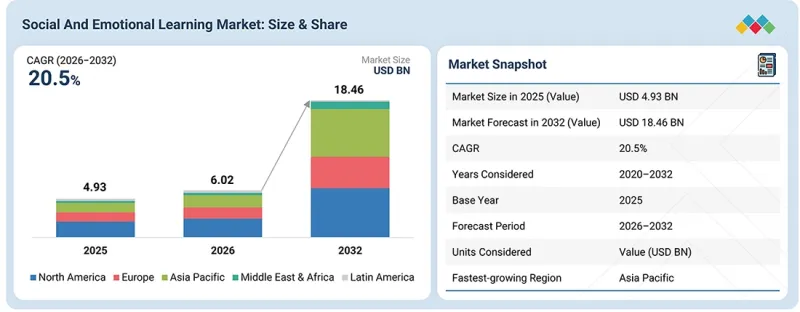
SEL 시장 규모는 2026년 60억 2,000만 달러로 추정되고, 2032년까지 184억 6,000만 달러로 확대될 것으로 예상되며, 예측 기간 중 연평균 복합 성장률(CAGR)은 20.5%를 기록할 전망입니다.
SEL에 대한 수요 증가는 인공지능(AI), 혼합 현실(MR), 웨어러블 기기 등 첨단 기술의 도입이 진행되고, 이러한 기술들이 현대 학습 환경에 통합되고 있는 데 기인합니다.
| 조사 범위 | |
|---|---|
| 조사 대상 기간 | 2020-2032년 |
| 기준 연도 | 2025년 |
| 예측 기간 | 2026-2032년 |
| 대상 단위 | 금액(10억 달러) |
| 부문 | 제공 제품별, 핵심 역량별, 유형별, 최종사용자별, 지역별 |
| 대상 지역 | 북미, 유럽, 아시아태평양, 중동 및 아프리카, 라틴아메리카 |
사회 정서 학습(SEL)은 개인이 충분한 정보를 바탕으로 의사 결정을 내리고, 의미 있는 인간관계를 구축하며, 개인적 및 직업적 성공을 거둘 수 있는 능력을 강화하는 데 중점을 둡니다. SEL 솔루션에는 교육자, 학부모, 지역 사회가 학생의 전인적 성장을 이끌 수 있도록 지원하기 위해 설계된 다양한 도구, 프로그램 및 평가 기법이 포함됩니다.
“유형별로는 용도 부문이 예측 기간 동안 가장 높은 연평균 성장률(CAGR)을 보일 것으로 예측됩니다.”
용도 분야란 학교 시스템, 데스크톱 또는 모바일 기기에 도입되어 교사와 학생 모두가 쉽게 접근할 수 있는 SEL 플랫폼을 의미합니다. 이러한 플랫폼은 인터넷 연결이 제한적이거나 불안정한 환경에서 특히 유용합니다. 일부 솔루션은 필요에 따라 오프라인에서도 작동하기 때문입니다. 사용 편의성, 유연성, 그리고 지속적인 학습을 지원하는 능력 덕분에 특히 개발도상 지역의 학교에 매우 적합합니다. 또한, 용도 기반 SEL 솔루션은 정기적인 업데이트와 기능 강화가 가능하여, 교육 기관은 변화하는 교육 요구와 기술 발전에 지속적으로 대응할 수 있습니다.
“최종 사용자별로는 예측 기간 동안 K-12 부문이 가장 큰 시장 규모를 차지할 것으로 예측됩니다.”
학업 성취도뿐만 아니라 학생들의 사회적·정서적 발달에 대한 중요성이 높아짐에 따라, K-12 학생들은 SEL 솔루션의 최대 최종 사용자 부문을 차지하고 있습니다. 학교에서는 행동 문제, 스트레스, 또래 관계, 정서적 안녕, 수업 참여 의욕과 같은 문제를 해결하기 위해 SEL 프로그램 도입이 점점 더 확대되고 있습니다. K-12 교육 현장의 SEL 솔루션에는 디지털 플랫폼, 평가 도구, 상호작용형 활동, 교육 과정 기반 프로그램, 교사 주도형 개입 등이 포함되며, 이러한 솔루션들은 학생들이 자기 인식, 자기 관리, 사회적 인식, 대인 관계 기술, 그리고 책임감 있는 의사결정 능력을 기르는 데 도움을 주고 있습니다.
“아시아태평양은 예측 기간 동안 가장 높은 연평균 성장률(CAGR)을 보일 것으로 전망됩니다.”
아시아태평양은 교육 시스템의 급속한 발전과 학생 웰빙에 대한 인식 제고에 힘입어 SEL 시장에서 가장 빠르게 성장하는 지역 중 하나로 부상하고 있습니다. 중국, 일본, 인도, 한국 등에서는 광범위한 교육 개혁의 일환으로 SEL 프레임워크가 적극적으로 도입되고 있습니다. 이 지역은 방대한 학생 수와 디지털 인프라에 대한 투자 확대라는 혜택을 누리고 있으며, 이러한 요인들이 SEL을 기존 학습 모델과 디지털 학습 모델 모두에 통합하는 데 힘을 실어주고 있습니다. 또한, 전인교육과 현대적인 교육 실천을 추진하는 정부의 이니셔티브에 힘입어 다양한 교육 시스템 전반에 걸친 도입이 가속화되고 있습니다. 교육 기관이 지속적으로 발전하고 학생들의 성장을 우선시함에 따라, 아시아태평양은 SEL 제공업체에게 큰 성장 기회를 제공할 것으로 예측됩니다.
주요 조사 대상 내역
SEL 시장의 주요 기업으로는 Committee for Children(미국), Navigate360(미국), Panorama Education(미국), Renaissance Learning(미국), 7 Mindsets(미국), EVERFI(미국),Wings for Kids(미국), RethinkEd(미국), Newsela(미국), SchoolMint(미국), Imagine Learning(미국), Positive Action(미국), Growing Leaders(미국), PlayCo(미국), Houghton Mifflin Harcourt(미국) 등이 있습니다. 이 기업들은 SEL 시장에서의 사업 기반을 확대하기 위해 파트너십, 계약 및 제휴, 신제품 출시, 기능 강화, 인수 등 다양한 성장 전략을 채택하고 있습니다.
조사 범위
본 보고서에서는 전 세계 SEL 시장을 ‘솔루션’과 ‘서비스’의 두 가지 범주로 분류하고 있습니다. 솔루션은 ‘사회 정서 학습 플랫폼’과 ‘사회 정서 학습 평가 도구’의 두 가지 범주로 나뉩니다. 서비스는 ‘컨설팅’, ‘통합 및 도입’, ‘교육 및 지원’의 세 가지 범주로 분류됩니다. 최종 사용자는 취학 전 교육(Pre-K), K-12, 의료 및 정신 건강 전문가, 기타 최종 사용자의 4가지 범주로 분류됩니다. 핵심 역량은 자기 인식, 자기 관리, 사회적 인식, 대인 관계 기술, 책임감 있는 의사 결정의 5가지 범주로 분류됩니다. 유형별로는 웹 기반과 용도의 두 가지 범주로 분류됩니다. 시장은 지역별로 북미, 유럽, 아시아태평양, 중동 및 아프리카, 라틴아메리카의 5개 지역으로 분류됩니다.
본 보고서의 주요 장점
본 보고서는 SEL 시장 전체 및 각 하위 부문의 매출에 관한 가장 정확한 추정치를 제공함으로써 시장을 선도하는 기업과 신규 진출기업을 지원합니다. 또한, 이해관계자 여러분이 경쟁 구도를 이해하고, 자사의 비즈니스를 더 나은 위치로 이끌며, 적절한 시장 진출 전략을 수립하는 데 필요한 인사이트를 얻는 데 도움이 될 것입니다. 더불어, 본 보고서는 시장 동향을 파악하는 데 도움을 주며, 주요 시장 성장 촉진요인, 억제요인, 과제 및 기회에 대한 정보를 제공합니다.
본 보고서는 다음 사항에 대한 인사이트를 제공합니다.
주요 촉진요인(학생의 정신 건강 및 웰니스에 대한 인식 제고, K-12 커리큘럼 및 교육 기준에 SEL 통합) 분석, 제약 요인(공교육 시스템의 예산 제약, 표준화된 SEL 평가 및 성과 측정 부재), 기회(유아 교육 및 취학 전 프로그램으로의 확대, 교원 연수 및 전문 역량 개발 서비스에 대한 수요 증가), 그리고 과제(장기적인 투자 수익률 입증, 데이터 개인정보 보호 및 학생 정보 보안에 대한 우려, 훈련된 교육자 및 상담사 부족) 등 SEL 시장의 성장에 영향을 미치는 요인들에 대해 분석했습니다.
- 제품 개발 및 혁신 : SEL 시장의 향후 기술, 연구개발 활동, 그리고 신제품 및 서비스 출시에 대한 상세한 인사이트.
- 시장 개발: 수익성이 높은 시장에 대한 종합적인 정보-본 보고서는 다양한 지역에 걸친 SEL 시장을 분석합니다.
- 시장 다각화 : SEL 시장의 신제품 및 서비스, 미개척 지역, 최근 동향 및 투자에 대한 종합적인 정보.
경쟁 분석 : Committee for Children(미국), Navigate360(미국), Panorama Education(미국), Renaissance Learning(미국), 7 Mindsets(미국), EVERFI(미국), Wings for Kids(미국), RethinkEd(미국), Newsela(미국),SchoolMint(미국), Imagine Learning(미국), Positive Action(미국), Growing Leaders(미국), PlayCo(미국), Houghton Mifflin Harcourt(미국) 등 주요 시장 진출기업에 대한 상세한 분석을 제공합니다.
자주 묻는 질문
목차
제1장 서론
제2장 주요 요약
제3장 프리미엄 인사이트
제4장 시장 개요
제5장 업계 동향
제6장 기술 진보, AI의 영향, 특허, 혁신, 향후 용도
제7장 규제 상황
제8장 고객 현황 및 구매 행동
제9장 사회 정서 학습 시장 : 제공 제품별
제10장 사회 정서 학습 시장 : 핵심 역량 별
제11장 사회 정서 학습 시장 : 유형별
제12장 사회 정서 학습 시장 : 최종 사용자별
제13장 사회 정서 학습 시장 : 지역별
제14장 경쟁 구도
제15장 기업 개요
제16장 조사 방법
제17장 부록
AJY 26.09.09The SEL market size is projected to grow from USD 6.02 billion in 2026 to USD 18.46 billion by 2032, at a CAGR of 20.5% during the forecast period, according to MarketsandMarkets. The growing demand for SEL is increasing due rising adoption of advanced technologies such as artificial intelligence (AI), mixed reality, and wearable devices, which are being integrated into modern learning environments.
| Scope of the Report | |
|---|---|
| Years Considered for the Study | 2020-2032 |
| Base Year | 2025 |
| Forecast Period | 2026-2032 |
| Units Considered | Value (USD Billion) |
| Segments | By Offering, End User, Core Competency, Type |
| Regions covered | North America, Europe, Asia Pacific, Middle East & Africa, Latin America |
Emotional Learning (EL) focuses on strengthening an individual's ability to make informed decisions, build meaningful relationships, and achieve personal and professional success. SEL solutions include a wide range of tools, programs, and assessments designed to support educators, parents, and communities in guiding students toward holistic development.
"By Type, the application segment is expected to grow with the highest CAGR during the forecast period."
The application segment refers to SEL platforms that are deployed on school systems, desktops, or mobile devices, making them easily accessible to both teachers and students. These platforms are particularly useful in environments with limited or inconsistent internet connectivity, as some solutions can operate offline when required. Their ease of use, flexibility, and ability to support continuous learning make them highly suitable for schools, especially in developing regions. Additionally, application-based SEL solutions allow for regular updates and enhancements, enabling institutions to keep pace with evolving educational needs and technological advancements.
"By End Use, the K-12 segment is expected to hold the largest market size during the forecast period."
K-12 students represent the largest end-user segment for SEL solutions due to the growing emphasis on students' social-emotional development alongside academic achievement. Schools are increasingly adopting SEL programs to address behavioral challenges, stress, peer relationships, emotional well-being, and classroom engagement. SEL solutions across K-12 settings include digital platforms, assessments, interactive activities, curriculum-based programs, and teacher-led interventions, helping students develop self-awareness, self-management, social awareness, relationship skills, and responsible decision-making.
"Asia Pacific is expected to grow with the highest CAGR during the forecast period."
Asia Pacific is emerging as one of the fastest-growing regions in the SEL market, driven by rapid advancements in education systems and increasing awareness of student well-being. Countries such as China, Japan, India, and South Korea are actively adopting SEL frameworks as part of broader education reforms. The region benefits from a large student population and growing investments in digital infrastructure, which are supporting the integration of SEL into both traditional and digital learning models. Additionally, government initiatives promoting holistic education and modern teaching practices are accelerating adoption across diverse education systems. As institutions continue to evolve and prioritize student development, Asia Pacific is expected to offer significant growth opportunities for SEL providers.
Breakdown of primaries
The study contains insights from various industry experts, from solution vendors to Tier 1 companies. The break-up of the primaries is as follows:
- By Company: Tier 1-35%, Tier 2-40%, and Tier 3-25%
- By Designation: C-Level Executives-42%, Directors-33%, and Managers-25%
- By Region: North America-36%, Europe-31%, Asia Pacific-23%, Middle East and Africa-5%, Latin America-5%,
The major players in the SEL market are Committee for Children (US), Navigate360 (US), Panorama Education (US), Renaissance Learning (US), 7 Mindsets (US), EVERFI (US), Wings for Kids (US), RethinkEd (US), Newsela (US), SchoolMint (US), Imagine Learning (US), Positive Action (US), Growing Leaders (US), PlayCo (US), and Houghton Mifflin Harcourt (US), etc. These players have adopted various growth strategies, such as partnerships, agreements and collaborations, new product launches, enhancements, and acquisitions to expand their footprint in the SEL market.
Research Coverage
The report segments the global SEL market by offering into two categories: solutions and services. The solution is divided into two categories: Social and Emotional Learning Platforms and Social and Emotional Learning Assessment Tools. By service into three categories: Consulting, Integration and Deployment, and Training and Support. End users into four categories: Pre-K, K-12, Healthcare & Mental Health Professionals, and Other End Users. Core competency into five categories: Self-Awareness, Self-Management, Social Awareness, Relationship Skills, and Responsible Decision-making. By type, into two categories: Web-based and Application. The market has been segmented by region into North America, Europe, Asia Pacific, Middle East and Africa, and Latin America.
Key benefits of the report
The report would help the market leaders/new entrants with information on the closest approximations of the revenue numbers for the overall SEL market and the subsegments. This report would help stakeholders understand the competitive landscape and gain insights to position their businesses better and plan suitable go-to-market strategies. The report would help stakeholders understand the market's pulse and provide them with information on the key market drivers, restraints, challenges, and opportunities.
The report provides insights on the following pointers:
Analysis of key drivers (Rising awareness of student mental health and well-being, Integration of SEL into K-12 curriculum and education standards), restraints (Budget constraints in public education systems, Lack of standardized SEL assessment and outcome measurement), opportunities (Expansion into early childhood education and preschool programs, Growing demand for teacher training and professional development services), and challenges (Demonstrating long-term return on investment, Data privacy and student information security concerns & Shortage of trained educators and counselors) influencing the growth of the SEL market.
- Product Development/Innovation: Detailed insights on upcoming technologies, research and development activities, and new product and service launches in the SEL market.
- Market Development: Comprehensive information about lucrative markets - the report analyses the SEL market across varied regions.
- Market Diversification: Exhaustive information about new products and services, untapped geographies, recent developments, and investments in the SEL market.
Competitive Assessment: In-depth assessment of market shares, growth strategies, and service offerings of leading players such as Committee for Children (US), Navigate360 (US), Panorama Education (US), Renaissance Learning (US), 7 Mindsets (US), EVERFI (US), Wings for Kids (US), RethinkEd (US), Newsela (US), SchoolMint (US), Imagine Learning (US), Positive Action (US), Growing Leaders (US), PlayCo (US), and Houghton Mifflin Harcourt (US), etc.
TABLE OF CONTENTS
1 INTRODUCTION
- 1.1 STUDY OBJECTIVES
- 1.2 MARKET DEFINITION
- 1.3 STUDY SCOPE
- 1.3.1 MARKET SEGMENTATION AND REGIONS COVERED
- 1.3.2 INCLUSIONS AND EXCLUSIONS
- 1.4 YEARS CONSIDERED
- 1.5 CURRENCY CONSIDERED
- 1.6 STAKEHOLDERS
- 1.7 SUMMARY OF CHANGES
2 EXECUTIVE SUMMARY
- 2.1 MARKET HIGHLIGHTS AND KEY INSIGHTS
- 2.2 KEY MARKET PARTICIPANTS: MAPPING OF STRATEGIC DEVELOPMENTS
- 2.3 DISRUPTIVE TRENDS IN SOCIAL AND EMOTIONAL LEARNING MARKET
- 2.4 HIGH-GROWTH SEGMENTS AND EMERGING FRONTIERS
- 2.5 REGIONAL SNAPSHOT: MARKET SIZE, GROWTH RATE, AND FORECAST
3 PREMIUM INSIGHTS
- 3.1 ATTRACTIVE OPPORTUNITIES FOR PLAYERS IN SOCIAL AND EMOTIONAL LEARNING MARKET
- 3.2 SOCIAL AND EMOTIONAL LEARNING MARKET, BY OFFERING
- 3.3 SOCIAL AND EMOTIONAL LEARNING MARKET, BY SOLUTION
- 3.4 SOCIAL AND EMOTIONAL LEARNING MARKET, BY SERVICE
- 3.5 SOCIAL AND EMOTIONAL LEARNING MARKET, BY END USER
- 3.6 NORTH AMERICA: SOCIAL AND EMOTIONAL LEARNING MARKET, BY OFFERING AND COUNTRY
4 MARKET OVERVIEW
- 4.1 INTRODUCTION
- 4.2 MARKET DYNAMICS
- 4.2.1 DRIVERS
- 4.2.1.1 Rising awareness of student mental health and well-being
- 4.2.1.2 Integration of SEL into K-12 curriculum and education standards
- 4.2.1.3 Rapid adoption of digital and AI-enabled learning platforms
- 4.2.2 RESTRAINTS
- 4.2.2.1 Budget constraints in public education systems
- 4.2.2.2 Lack of standardized SEL assessment and outcome measurement
- 4.2.3 OPPORTUNITIES
- 4.2.3.1 Expansion into early childhood education and preschool programs
- 4.2.3.2 Increasing adoption in international and private education markets
- 4.2.4 CHALLENGES
- 4.2.4.1 Demonstrating long-term return on investment
- 4.2.4.2 Data privacy and student information security concerns
- 4.2.4.3 Shortage of trained educators and counselors
- 4.2.1 DRIVERS
- 4.3 INTERCONNECTED MARKETS AND CROSS-SECTOR OPPORTUNITIES
- 4.3.1 INTERCONNECTED MARKETS
- 4.3.2 CROSS-SECTOR OPPORTUNITIES
- 4.4 STRATEGIC MOVES BY TIER-1/2/3 PLAYERS
5 INDUSTRY TRENDS
- 5.1 PORTER'S FIVE FORCES ANALYSIS
- 5.1.1 THREAT OF NEW ENTRANTS
- 5.1.2 THREAT OF SUBSTITUTES
- 5.1.3 BARGAINING POWER OF SUPPLIERS
- 5.1.4 BARGAINING POWER OF BUYERS
- 5.1.5 INTENSITY OF COMPETITIVE RIVALRY
- 5.2 MACROECONOMIC OUTLOOK
- 5.2.1 INTRODUCTION
- 5.2.2 GDP TRENDS AND FORECAST
- 5.2.3 TRENDS IN SOCIAL AND EMOTIONAL LEARNING MARKET
- 5.3 SUPPLY CHAIN ANALYSIS
- 5.4 ECOSYSTEM ANALYSIS
- 5.5 PRICING ANALYSIS
- 5.5.1 AVERAGE SELLING PRICE OF KEY PLAYERS, BY OFFERING
- 5.5.2 INDICATIVE PRICING ANALYSIS OF KEY PLAYERS
- 5.6 KEY CONFERENCES AND EVENTS, 2026-2027
- 5.7 TRENDS/DISRUPTIONS IMPACTING CUSTOMER BUSINESS
- 5.8 INVESTMENT AND FUNDING SCENARIO
- 5.9 CASE STUDY ANALYSIS
- 5.10 IMPACT OF 2025 US TARIFF - SOCIAL AND EMOTIONAL LEARNING MARKET
- 5.10.1 INTRODUCTION
- 5.10.2 KEY TARIFF RATES
- 5.10.3 PRICE IMPACT ANALYSIS
- 5.10.4 IMPACT ON REGIONS
- 5.10.4.1 North America
- 5.10.4.2 Europe
- 5.10.4.3 Asia Pacific
- 5.10.4.4 Middle East & Africa
- 5.10.4.5 Latin America
- 5.10.5 IMPACT ON END-USER INDUSTRIES
- 5.10.5.1 Pre-K
- 5.10.5.2 K-12
- 5.10.5.3 Healthcare & mental health professionals
- 5.10.5.4 Community/nonprofit organizations
6 TECHNOLOGICAL ADVANCEMENTS, AI-DRIVEN IMPACT, PATENTS, INNOVATIONS, AND FUTURE APPLICATIONS
- 6.1 KEY EMERGING TECHNOLOGIES
- 6.1.1 GENERATIVE AI
- 6.1.2 MACHINE LEARNING (ML)
- 6.1.3 PREDICTIVE ANALYTICS
- 6.1.4 BIG DATA ANALYTICS
- 6.1.5 DIGITAL TWINS
- 6.2 COMPLEMENTARY TECHNOLOGIES
- 6.2.1 LEARNING MANAGEMENT SYSTEMS (LMS)
- 6.2.2 STUDENT INFORMATION SYSTEMS (SIS)
- 6.2.3 CUSTOMER RELATIONSHIP MANAGEMENT (CRM)
- 6.2.4 DATA & ANALYTICS PLATFORMS
- 6.2.5 DIGITAL COMMUNICATION & COLLABORATION TOOLS
- 6.3 TECHNOLOGY ROADMAP
- 6.3.1 SHORT-TERM (2026-2028)
- 6.3.2 MID-TERM (2028-2030)
- 6.3.3 LONG-TERM (2030-2032+)
- 6.4 PATENT ANALYSIS
- 6.5 IMPACT OF AI/GEN AI ON SOCIAL AND EMOTIONAL LEARNING MARKET
- 6.5.1 TOP USE CASES AND MARKET POTENTIAL
- 6.5.2 CASE STUDIES OF AI IMPLEMENTATION IN SOCIAL AND EMOTIONAL LEARNING MARKET
- 6.5.3 INTERCONNECTED ADJACENT ECOSYSTEM AND IMPACT ON MARKET PLAYERS
- 6.5.4 CLIENTS' READINESS TO ADOPT GENERATIVE AI IN SOCIAL AND EMOTIONAL LEARNING MARKET
7 REGULATORY LANDSCAPE
- 7.1 REGIONAL REGULATIONS
- 7.1.1 REGULATORY BODIES, GOVERNMENT AGENCIES, AND OTHER ORGANIZATIONS
- 7.1.1.1 North America
- 7.1.1.1.1 US
- 7.1.1.1.2 Canada
- 7.1.1.2 Europe
- 7.1.1.2.1 Germany
- 7.1.1.2.2 UK
- 7.1.1.3 Asia Pacific
- 7.1.1.3.1 China
- 7.1.1.3.2 Japan
- 7.1.1.3.3 India
- 7.1.1.1 North America
- 7.1.2 INDUSTRY STANDARDS
- 7.1.1 REGULATORY BODIES, GOVERNMENT AGENCIES, AND OTHER ORGANIZATIONS
8 CUSTOMER LANDSCAPE AND BUYER BEHAVIOR
- 8.1 DECISION-MAKING PROCESS
- 8.2 KEY STAKEHOLDERS INVOLVED IN BUYING PROCESS AND THEIR EVALUATION CRITERIA
- 8.2.1 KEY STAKEHOLDERS IN BUYING PROCESS
- 8.3 BUYING CRITERIA
- 8.4 ADOPTION BARRIERS AND INTERNAL CHALLENGES
- 8.5 UNMET NEEDS OF VARIOUS END-USE INDUSTRIES
9 SOCIAL AND EMOTIONAL LEARNING MARKET, BY OFFERING
- 9.1 INTRODUCTION
- 9.1.1 OFFERING: SOCIAL AND EMOTIONAL LEARNING MARKET DRIVERS
- 9.2 SOLUTIONS
- 9.2.1 SEL PLATFORMS
- 9.2.1.1 Strengthening student well-being and development through personalized SEL, engagement tracking, and intervention management
- 9.2.2 SEL ASSESSMENT & PROGRESS MONITORING TOOLS
- 9.2.2.1 Assessing student competencies and monitoring SEL progress to enable targeted support
- 9.2.1 SEL PLATFORMS
- 9.3 SERVICES
- 9.3.1 CONSULTING
- 9.3.1.1 Accelerating SEL transformation through consulting, integration, and compliance expertise
- 9.3.2 DEPLOYMENT AND INTEGRATION
- 9.3.2.1 Ensuring effective SEL implementation through platform deployment, integration, and ongoing support
- 9.3.3 TRAINING AND SUPPORT
- 9.3.3.1 Enabling effective SEL adoption through educator training, professional development, and ongoing support
- 9.3.1 CONSULTING
10 SOCIAL AND EMOTIONAL LEARNING MARKET, BY CORE COMPETENCY
- 10.1 INTRODUCTION
- 10.1.1 CORE COMPETENCY: SOCIAL AND EMOTIONAL LEARNING MARKET DRIVERS
- 10.1.2 SELF-AWARENESS
- 10.1.2.1 Strengthening students' self-awareness through emotional recognition, reflection, and personalized development
- 10.1.3 SELF-MANAGEMENT
- 10.1.3.1 Strengthening students' self-management through emotional regulation, goal setting, and responsible behavior
- 10.1.4 SOCIAL AWARENESS
- 10.1.4.1 Strengthening students' social awareness through empathy, perspective-taking, and understanding others
- 10.1.5 RELATIONSHIP SKILLS
- 10.1.5.1 Strengthening students' relationship skills through communication, collaboration, and conflict resolution
- 10.1.6 RESPONSIBLE DECISION-MAKING
- 10.1.6.1 Enabling informed choices through critical thinking, ethical judgment, and consequence awareness
11 SOCIAL AND EMOTIONAL LEARNING MARKET, BY TYPE
- 11.1 INTRODUCTION
- 11.1.1 TYPE: SOCIAL AND EMOTIONAL LEARNING MARKET DRIVERS
- 11.1.2 WEB-BASED
- 11.1.2.1 Delivering accessible and scalable SEL experiences through web-based platforms
- 11.1.3 APPLICATION
- 11.1.3.1 Enabling personalized and interactive SEL experiences through application-based learning
12 SOCIAL AND EMOTIONAL LEARNING MARKET, BY END USER
- 12.1 INTRODUCTION
- 12.1.1 END USER: SOCIAL AND EMOTIONAL LEARNING MARKET DRIVERS
- 12.1.2 PRE-K
- 12.1.2.1 Building foundational social-emotional skills through early childhood learning
- 12.1.3 K-12
- 12.1.3.1 Supporting comprehensive social-emotional development through age-appropriate learning and intervention
- 12.1.4 HEALTHCARE & MENTAL HEALTH PROFESSIONALS
- 12.1.4.1 Supporting student well-being through assessment, intervention, and coordinated care
- 12.1.5 OTHER END USERS
- 12.1.5.1 Extending social-emotional support across community, enrichment, and workforce environments
13 SOCIAL AND EMOTIONAL LEARNING MARKET, BY REGION
- 13.1 INTRODUCTION
- 13.2 NORTH AMERICA
- 13.2.1 US
- 13.2.1.1 Driving SEL adoption through digital platforms, student well-being, and data-driven interventions
- 13.2.2 CANADA
- 13.2.2.1 Advancing SEL adoption through student well-being, digital learning, and inclusive education
- 13.2.1 US
- 13.3 EUROPE
- 13.3.1 UK
- 13.3.1.1 Advancing SEL adoption supported by strong education ecosystem and established student well-being initiatives
- 13.3.2 GERMANY
- 13.3.2.1 Advancing SEL adoption through greater emphasis on student mental health, emotional well-being, and inclusive education
- 13.3.3 FRANCE
- 13.3.3.1 Advancing SEL adoption through student well-being, inclusive education, and digital learning
- 13.3.4 ITALY
- 13.3.4.1 Promoting student well-being and inclusive learning through social-emotional development
- 13.3.5 SPAIN
- 13.3.5.1 Enhancing student well-being through inclusive education and social-emotional development
- 13.3.6 REST OF EUROPE
- 13.3.1 UK
- 13.4 ASIA PACIFIC
- 13.4.1 CHINA
- 13.4.1.1 Advancing SEL adoption through digital education and student well-being initiatives
- 13.4.2 JAPAN
- 13.4.2.1 Promoting SEL adoption through student well-being, digital education, and holistic development
- 13.4.3 INDIA
- 13.4.3.1 Expanding SEL adoption through digital education and student well-being initiatives
- 13.4.4 AUSTRALIA & NEW ZEALAND
- 13.4.4.1 Advancing SEL adoption through student well-being, inclusive education, and digital learning
- 13.4.5 SOUTH KOREA
- 13.4.5.1 Accelerating SEL adoption through digital education and student-centered development
- 13.4.6 REST OF ASIA PACIFIC
- 13.4.1 CHINA
- 13.5 MIDDLE EAST & AFRICA
- 13.5.1 UAE
- 13.5.1.1 Advancing SEL adoption through digital education, student well-being, and holistic development
- 13.5.2 KSA
- 13.5.2.1 Accelerating SEL adoption through Vision 2030, digital education, and student well-being
- 13.5.3 SOUTH AFRICA
- 13.5.3.1 Expanding SEL adoption through student well-being, digital education, and inclusive learning
- 13.5.4 REST OF MIDDLE EAST & AFRICA
- 13.5.1 UAE
- 13.6 LATIN AMERICA
- 13.6.1 BRAZIL
- 13.6.1.1 Advancing SEL adoption through student well-being, digital education, and inclusive learning
- 13.6.2 MEXICO
- 13.6.2.1 Expanding SEL adoption through student well-being, digital education, and inclusive learning
- 13.6.3 REST OF LATIN AMERICA
- 13.6.1 BRAZIL
14 COMPETITIVE LANDSCAPE
- 14.1 INTRODUCTION
- 14.2 KEY PLAYER COMPETITIVE STRATEGIES/ RIGHT TO WIN, 2023-2026
- 14.3 MARKET SHARE ANALYSIS, 2025
- 14.4 BRAND/PRODUCT COMPARISON
- 14.4.1 COMMITTEE FOR CHILDREN - SECOND STEP
- 14.4.2 NAVIGATE360 - STUDENT BEHAVIOR & WELL-BEING
- 14.4.3 RENAISSANCE LEARNING - MYSAEBRS & EDUCLIMBER
- 14.4.4 7 MINDSETS - WELLNESS & INSIGHTS
- 14.4.5 PANORAMA EDUCATION - PANORAMA STUDENT SUCCESS
- 14.5 COMPANY EVALUATION MATRIX: KEY PLAYERS, 2025
- 14.5.1 STARS
- 14.5.2 EMERGING LEADERS
- 14.5.3 PERVASIVE PLAYERS
- 14.5.4 PARTICIPANTS
- 14.5.5 COMPANY FOOTPRINT: KEY PLAYERS, 2025
- 14.5.5.1 Company footprint
- 14.5.5.2 Region footprint
- 14.5.5.3 Offering footprint
- 14.5.5.4 End user footprint
- 14.6 COMPANY EVALUATION MATRIX: STARTUPS/SMES, 2025
- 14.6.1 PROGRESSIVE COMPANIES
- 14.6.2 RESPONSIVE COMPANIES
- 14.6.3 DYNAMIC COMPANIES
- 14.6.4 STARTING BLOCKS
- 14.6.5 COMPETITIVE BENCHMARKING: STARTUPS/SMES, 2025
- 14.6.5.1 Detailed list of key startups/SMEs
- 14.6.5.2 Competitive benchmarking of key startups/SMEs
- 14.7 COMPANY VALUATION
- 14.8 COMPETITIVE SCENARIO
- 14.8.1 PRODUCT LAUNCHES & ENHANCEMENTS
- 14.8.2 DEALS
15 COMPANY PROFILES
- 15.1 MAJOR PLAYERS
- 15.1.1 COMMITTEE FOR CHILDREN
- 15.1.1.1 Business overview
- 15.1.1.2 Products/Solutions/Services offered
- 15.1.1.3 Recent developments
- 15.1.1.3.1 Product launches & enhancements
- 15.1.1.4 MnM view
- 15.1.1.4.1 Right to win
- 15.1.1.4.2 Strategic choices
- 15.1.1.4.3 Weaknesses and competitive threats
- 15.1.2 NAVIGATE360
- 15.1.2.1 Business overview
- 15.1.2.2 Products/Solutions/Services offered
- 15.1.2.3 Recent developments
- 15.1.2.3.1 Product launches & enhancements
- 15.1.2.4 MnM view
- 15.1.2.4.1 Right to win
- 15.1.2.4.2 Strategic choices
- 15.1.2.4.3 Weaknesses and competitive threats
- 15.1.3 PANORAMA EDUCATION
- 15.1.3.1 Business overview
- 15.1.3.2 Products/Solutions/Services offered
- 15.1.3.3 Recent developments
- 15.1.3.3.1 Deals
- 15.1.3.4 MnM view
- 15.1.3.4.1 Right to win
- 15.1.3.4.2 Strategic choices
- 15.1.3.4.3 Weaknesses and competitive threats
- 15.1.4 RENAISSANCE LEARNING
- 15.1.4.1 Business overview
- 15.1.4.2 Products/Solutions/Services offered
- 15.1.4.3 Recent developments
- 15.1.4.3.1 Product launches & enhancements
- 15.1.4.4 MnM view
- 15.1.4.4.1 Right to win
- 15.1.4.4.2 Strategic choices
- 15.1.4.4.3 Weaknesses and competitive threats
- 15.1.5 7 MINDSETS
- 15.1.5.1 Business overview
- 15.1.5.2 Products/Solutions/Services offered
- 15.1.5.3 Recent developments
- 15.1.5.3.1 Product launches & enhancements
- 15.1.5.4 MnM view
- 15.1.5.4.1 Right to win
- 15.1.5.4.2 Strategic choices
- 15.1.5.4.3 Weaknesses and competitive threats
- 15.1.6 RIVERSIDE INSIGHTS
- 15.1.6.1 Business overview
- 15.1.6.2 Products/Solutions/Services offered
- 15.1.6.3 Recent developments
- 15.1.6.3.1 Product launches & enhancements
- 15.1.6.3.2 Deals
- 15.1.7 WINGS FOR KIDS
- 15.1.7.1 Business overview
- 15.1.7.2 Products/Solutions/Services offered
- 15.1.8 RETHINKED
- 15.1.8.1 Business overview
- 15.1.8.2 Products/Solutions/Services offered
- 15.1.8.3 Recent developments
- 15.1.8.3.1 Product launches & enhancements
- 15.1.9 NEWSELA
- 15.1.9.1 Business overview
- 15.1.9.2 Products/Solutions/Services offered
- 15.1.9.3 Recent developments
- 15.1.9.3.1 Deals
- 15.1.10 EVERFI
- 15.1.10.1 Business overview
- 15.1.10.2 Products/Solutions/Services offered
- 15.1.10.3 Recent developments
- 15.1.10.3.1 Product launches & enhancements
- 15.1.11 SCHOOLMINT
- 15.1.11.1 Business overview
- 15.1.11.2 Products/Solutions/Services offered
- 15.1.12 IMAGINE LEARNING
- 15.1.12.1 Business overview
- 15.1.12.2 Products/Solutions/Services offered
- 15.1.13 POSITIVE ACTION
- 15.1.13.1 Business overview
- 15.1.13.2 Products/Solutions/Services offered
- 15.1.14 GROWING LEADERS
- 15.1.14.1 Business overview
- 15.1.14.2 Products/Solutions/Services offered
- 15.1.15 THE PLAY COLLECTIVE (PLAYCO)
- 15.1.16 THE CONOVER COMPANY
- 15.1.17 ORI LEARNING
- 15.1.18 PATHS EDUCATION LLC
- 15.1.19 HOUGHTON MIFFLIN HARCOURT
- 15.1.1 COMMITTEE FOR CHILDREN
- 15.2 STARTUPS/SMES
- 15.2.1 TAPROOT LEARNING
- 15.2.2 PEEKAPAK
- 15.2.3 MEANDMINE
- 15.2.4 EVERYDAY SPEECH
- 15.2.5 WAYFINDER
- 15.2.6 HEYKIDDO
- 15.2.7 CREATIVE GALILEO
- 15.2.8 NINJA FOCUS
16 RESEARCH METHODOLOGY
- 16.1 RESEARCH DATA
- 16.1.1 SECONDARY DATA
- 16.1.2 PRIMARY DATA
- 16.1.2.1 Primary interviews with experts
- 16.1.2.2 Breakdown of primary profiles
- 16.2 MARKET SIZE ESTIMATION
- 16.2.1 TOP-DOWN APPROACH
- 16.2.2 BOTTOM-UP APPROACH
- 16.2.3 SOCIAL AND EMOTIONAL LEARNING MARKET ESTIMATION: DEMAND-SIDE ANALYSIS
- 16.3 DATA TRIANGULATION
- 16.4 RISK ASSESSMENT
- 16.5 RESEARCH ASSUMPTIONS
- 16.6 RESEARCH LIMITATIONS
17 APPENDIX
- 17.1 DISCUSSION GUIDE
- 17.2 KNOWLEDGESTORE: MARKETSANDMARKETS' SUBSCRIPTION PORTAL
- 17.3 CUSTOMIZATION OPTIONS
- 17.4 RELATED REPORTS
- 17.5 AUTHOR DETAILS


