|
시장보고서
상품코드
2126317
실험실용 냉동고 시장 예측(-2031년) : 제품별, 용도별, 최종사용자별, 지역별Laboratory Freezers Market by Modality, Application, End User and Region - Global Forecast to 2031 |
||||||

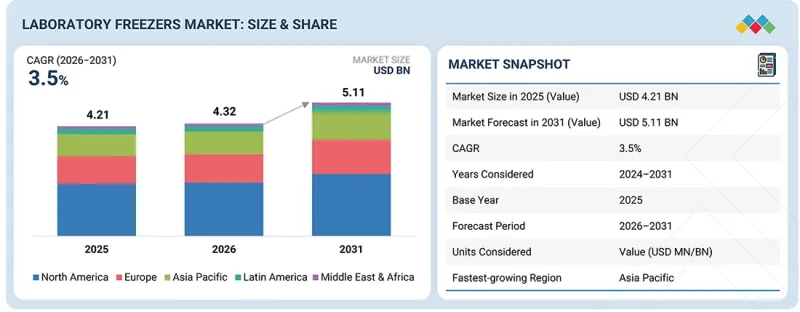
세계의 연구용 냉동고 시장 규모는 2026년 43억 2,000만 달러에서 2031년까지 51억 1,000만 달러에 달할 것으로 예측되고 있으며, 2026-2031년까지 연평균 성장률(CAGR)은 3.5%에 달할 전망입니다.
| 조사 범위 | |
|---|---|
| 조사 대상 기간 | 2026-2031년 |
| 기준연도 | 2025년 |
| 예측 기간 | 2026-2031년 |
| 산정 단위 | 금액(10억 달러) |
| 부문 | 제품별, 용도별, 최종사용자별, 지역별 |
| 대상 지역 | 북미, 유럽, 아시아태평양, 라틴아메리카, 중동 및 아프리카 |
실험실용 냉동고 시장은 주로 백신, 생물학적 시료, 시약, 혈액 성분, 세포주, 조직 및 기타 온도에 민감한 물질을 신뢰할 수 있는 온도 관리 하에 보관해야 할 필요성이 증가함에 따라 성장하고 있습니다. 제약 및 생명공학 연구, 백신 개발, 임상 진단, 바이오 뱅킹, 유전체학, 그리고 세포 및 유전자 치료의 급속한 확대로 인해 연구소, 병원, 진단 검사실, 제약 회사 및 바이오 뱅크에서 첨단 실험실용 냉동고의 도입이 가속화되고 있습니다. 또한 검체의 무결성 유지 및 콜드 체인 준수에 관한 엄격한 규제 및 품질 요건으로 인해 최종사용자들은 정밀한 온도 제어, 지속적인 모니터링, 자동 데이터 로깅, 원격 경보 및 백업 시스템을 갖춘 냉동고 도입을 추진하고 있습니다.
또한 의료 및 생명과학 인프라에 대한 투자 확대, 바이오리포지토리의 확충, 초저온 보존에 대한 수요 증가가 시장 성장을 지원하고 있습니다. 또한 각 제조사는 운영 비용 절감, 검체 손실 위험 최소화 및 실험실 워크플로우 효율 향상을 도모하기 위해 에너지 효율이 높은 압축기, 친환경 냉매, 단열 성능 향상, 자동화된 재고 관리, IoT 지원 모니터링 시스템을 도입하고 있으며, 이것이 실험실용 냉동고 시장의 지속적인 성장을 촉진하고 있습니다.
"제품별로는 2025년 실험실용 냉동고 시장에서 냉장고가 가장 큰 점유율을 차지했습니다."
제품별로 보면 실험실용 냉동고 시장은 냉동고, 냉장고 및 동결 보존 시스템으로 구분됩니다. 냉장고는 백신, 시약, 배양 배지, 의약품, 혈액 샘플 및 기타 온도에 민감한 물질을 일반적으로 2°C에서 8°C 범위의 제어된 온도에서 일상적으로 보관하는 데 널리 사용되므로 가장 큰 시장 점유율을 차지하고 있습니다. 병원, 진단 검사실, 혈액 은행, 약국, 연구소, 제약 및 생명공학 기업 등에 광범위하게 도입됨에 따라 견고하고 지속적인 수요가 발생하고 있습니다. 초저온 냉동고나 동결 보존 시스템과 비교하여, 실험실용 냉장고는 도입 비용과 운영 비용이 낮고 유지보수도 간편하여 일상적인 실험실 업무 흐름에서 폭넓게 적용할 수 있습니다. 또한 진단 검사, 백신 프로그램, 임상 연구, 의약품 제조의 확대와 더불어, 온도 안정성, 지속적인 모니터링, 자동 데이터 로깅 및 규제 준수에 대한 엄격한 요구 사항이 이 부문의 선도적인 위치를 지원하고 있습니다. 원격 경보 및 백업 제어 기능을 갖추고, 에너지 효율이 뛰어나며, 환경 친화적이고, IoT를 지원하는 냉장고의 채택 확대가 이 부문의 추가 성장을 지원할 것으로 예상됩니다.
"용도별로는 의약품·백신 보관 부문이 실험실용 냉동고 시장에서 가장 큰 점유율을 차지했습니다."
용도별로 보면 실험실용 냉동고 시장은 환경 시험, 유전 물질 보관, 의약품·백신 보관, 생물 시료·재고 관리 및 기타 용도로 분류됩니다. 의약품·백신 보관 부문은 온도 관리가 필요한 백신, 바이오의약품, 의약품, 의약품 유효 성분, 시약, 임상시험용 자재의 공급량이 방대하므로 가장 큰 시장 점유율을 차지했습니다. 백신 제조 및 예방접종 프로그램의 확대, 바이오의약품 및 특수 의약품 생산 증가, 그리고 의약품 연구 및 임상시험의 확대로 인해 실험용 냉장고 및 냉동고에 대한 강력한 수요가 발생하고 있습니다. 또한 온도 안정성, 지속적인 모니터링, 데이터 로깅, 경보 시스템, 비상 전원 및 콜드 체인 준수에 관한 엄격한 규제 요건으로 인해 제약 회사, 병원, 약국, 연구소 및 유통 센터는 신뢰할 수 있는 보관 장비에 대한 투자를 촉진하고 있습니다. 조사, 생산, 품질관리 및 유통의 각 워크플로우에서 의약품을 보관해야 할 필요성이 반복적으로 발생하고 있는 점도 이 부문 시장의 선도적 지위를 더욱 공고히 하고 있습니다.
최종사용자별로는 예측 기간 중 제약 및 생명공학 기업이 가장 큰 점유율을 차지했습니다.
최종사용자별로는 실험실용 냉동고 시장이 병원, 임상·병리 검사실, 제약·생명공학 기업, 학술·연구 기관, 약국·진료소, 세포·조직 은행으로 분류됩니다. 제약 및 생명공학 기업은 신약 개발, 백신 개발, 바이오의약품 제조, 임상 시험, 품질관리 및 상업 생산의 전 과정에서 온도 조절이 되는 보관 환경에 대한 광범위한 수요가 있으며, 가장 큰 시장 점유율을 차지했습니다. 이 기업은 백신, 바이오의약품, 세포주, 유전 물질, 시약, 의약품 유효 성분, 기준 물질, 임상 시험용 샘플 등 온도에 민감한 물질을 대량으로 보관하고 있습니다. 바이오의약품 연구개발에 대한 투자 확대, 바이오의약품 및 바이오시밀러 파이프라인 확충, 그리고 세포·유전자 치료제 개발로 인해 냉장고, 초저온 냉동고 및 동결 보존 시스템에 대한 수요는 더욱 증가하고 있습니다. 또한 검체의 무결성, 온도 모니터링, 데이터 로깅, 경보 관리, 백업 시스템 및 보관 검증에 관한 엄격한 규제 요건이 이 부문 시장의 선도적 지위를 지원하고 있습니다.
"아시아태평양 시장은 실험용 냉동고 시장에서 가장 높은 성장률을 보일 것으로 예측됩니다."
실험용 냉동고 시장은 북미, 유럽, 아시아태평양, 라틴아메리카, 중동 및 아프리카의 5개 주요 지역에 걸쳐 있습니다. 아시아태평양은 제약 및 생명공학 제조, 백신 생산, 임상 연구, 진단 검사 및 바이오 뱅킹 활동의 급속한 확장에 힘입어 가장 높은 성장률을 기록할 것으로 예측됩니다. 의료비 증가, 생명과학 인프라에 대한 정부 투자, 그리고 새로운 연구소, 병원, 콜드체인 시설의 설립이 실험용 냉장고, 초저온 냉동고 및 동결 보존 시스템에 대한 수요를 지원하고 있습니다. 또한 이 지역에서는 특히 중국, 인도,일본, 한국을 중심으로 바이오의약품, 바이오시밀러, 세포·유전자 치료제의 생산이 확대되고 있는 점도 성장에 긍정적인 요인으로 작용하고 있습니다. 또한 검체의 무결성에 대한 의식의 향상, 온도 관리 요건의 엄격화, 그리고 에너지 효율이 뛰어나고 디지털로 연결된 보관 시스템의 도입 확대가 지역 시장의 성장을 가속화할 것으로 예상됩니다.
실험용 냉동고 시장의 주요 기업으로는 Thermo Fisher Scientific(미국), Haier Biomedical(중국), PHC Holdings(일본), Eppendorf AG(독일), Avantor(미국) 등이 있습니다.
조사 범위
본 조사 보고서에서는 실험용 냉동고 시장을 제품, 용도, 최종사용자, 지역별로 분석하고 있습니다. 본 조사에서는 시장 확대를 견인하는 요인을 검증하고, 업계가 현재 직면하고 있는 전망과 제반 조건을 분석하는 한편, 시장 선도 기업 및 중소기업을 고려한 경쟁 구도에 관한 상세한 정보를 제공하고 있습니다. 또한 5개 지역 및 마이크로마켓 분석을 바탕으로 각 시장 부문의 매출을 추정하고 있습니다.
이 보고서를 구매해야 하는 이유
이 보고서는 시장 선도 기업 및 신규 진입 기업에게 실험실용 냉동고 시장 전체 및 그 하위 부문의 시장 수익 추정에 관한 귀중한 정보를 제공합니다. 이해관계자가 경쟁 구도를 이해하는 데 도움을 주며, 자사의 비즈니스를 보다 효과적으로 포지셔닝하고 적절한 시장 진입 전략을 수립할 수 있도록 지원합니다. 또한 이 보고서는 주요 시장 촉진요인 및 과제를 포함한 시장 역학에 대한 인사이트도 제공합니다.
이 리포트는 다음 사항에 대해 인사이트 있는 데이터를 제공합니다. :
- 시장 침투도: 실험실용 냉동고 시장의 주요 기업이 제공하는 제품 포트폴리오에 대한 상세한 분석
- 제품 개발/혁신: 실험실용 냉동고 시장의 향후 기술 동향, 연구개발 활동, 제품 및 서비스 출시에 대한 상세 인사이트
- 시장 개발: 수익성이 높은 성장 분야에 대한 인사이트 있는 데이터
- 시장 다각화: 실험실용 냉동고 시장의 최근 동향 및 발전에 대한 상세 정보
- 경쟁 분석: 주요 경쟁사의 제품, 성장 전략, 매출 예측 및 시장 카테고리에 대한 광범위한 평가
자주 묻는 질문
목차
제1장 서론
제2장 개요
제3장 주요 인사이트
제4장 시장 개요
제5장 업계 동향
제6장 기술, 특허, 디지털 기술, AI의 도입에 의한 전략적 파괴
제7장 규제 상황
제8장 고객 상황과 구매 행동
제9장 실험실용 냉동고 시장(제품별)
제10장 실험실용 냉동고 시장(용도별)
제11장 실험실용 냉동고 시장(최종사용자별)
제12장 실험실용 냉동고 시장(지역별)
제13장 경쟁 구도
제14장 기업 개요
제15장 조사 방법
제16장 부록
KSA 26.09.11The global laboratory freezers market is projected to reach USD 5.11 billion by 2031 from USD 4.32 billion in 2026, at a CAGR of 3.5% from 2026 to 2031.
| Scope of the Report | |
|---|---|
| Years Considered for the Study | 2026-2031 |
| Base Year | 2025 |
| Forecast Period | 2026-2031 |
| Units Considered | Value (USD billion) |
| Segments | Product, Application, End User, and Region |
| Regions covered | North America, Europe, the Asia Pacific, Latin America, and the Middle East & Africa |
The laboratory freezers market is primarily driven by the increasing need for reliable, temperature-controlled storage of vaccines, biological samples, reagents, blood components, cell lines, tissues, and other temperature-sensitive materials. The rapid expansion of pharmaceutical and biotechnology research, vaccine development, clinical diagnostics, biobanking, genomics, and cell and gene therapy is accelerating the adoption of advanced laboratory freezers across research institutes, hospitals, diagnostic laboratories, pharmaceutical companies, and biobanks. In addition, stringent regulatory and quality requirements for maintaining sample integrity and cold-chain compliance are encouraging end users to adopt freezers equipped with precise temperature control, continuous monitoring, automated data logging, remote alarms, and backup systems.
Furthermore, increasing investments in healthcare and life-science infrastructure, the expansion of biorepositories, and growing demand for ultra-low-temperature storage are supporting market growth. Manufacturers are also introducing energy-efficient compressors, environmentally sustainable refrigerants, improved insulation, automated inventory management, and IoT-enabled monitoring systems to reduce operating costs, minimize sample-loss risks, and enhance laboratory workflow efficiency, thereby driving sustained growth of the laboratory freezers market.
"By product, refrigerators accounted for the largest share of the laboratory freezers market in 2025."
By product, the laboratory freezers market is segmented into freezers, refrigerators, and cryopreservation systems. Refrigerators account for the largest market share due to their widespread use for the routine storage of vaccines, reagents, culture media, pharmaceutical products, blood samples, and other temperature-sensitive materials at controlled temperatures, typically between 2°C and 8°C. Their extensive installation across hospitals, diagnostic laboratories, blood banks, pharmacies, research institutes, and pharmaceutical and biotechnology companies generates strong and recurring demand. Compared with ultra-low-temperature freezers and cryopreservation systems, laboratory refrigerators offer lower acquisition and operating costs, simpler maintenance, and broader applicability in everyday laboratory workflows. Furthermore, expanding diagnostic testing, vaccine programs, clinical research, and pharmaceutical production-along with stringent requirements for temperature stability, continuous monitoring, automated data logging, and regulatory compliance are supporting the segment's leading position. Growing adoption of energy-efficient, environmentally sustainable, and IoT-enabled refrigerators with remote alarms and backup controls is expected to further drive segment growth.
"By application, the pharmaceutical & vaccine storage segment accounted for the largest share of the laboratory freezers market."
By application, the laboratory freezers market is segmented into environmental testing, genetic material storage, pharmaceutical & vaccine storage, biological samples & inventory management, and other applications. The pharmaceutical & vaccine storage segment accounted for the largest market share owing to the substantial volume of temperature-sensitive vaccines, biologics, drugs, active pharmaceutical ingredients, reagents, and clinical-trial materials requiring controlled storage. The expansion of vaccine manufacturing and immunization programs, increasing production of biologics and specialty medicines, and growth in pharmaceutical research and clinical trials are creating strong demand for laboratory refrigerators and freezers. Furthermore, stringent regulatory requirements for temperature stability, continuous monitoring, data logging, alarm systems, backup power, and cold-chain compliance encourage pharmaceutical manufacturers, hospitals, pharmacies, research laboratories, and distribution centers to invest in reliable storage equipment. The recurring need to store pharmaceutical products across research, production, quality-control, and distribution workflows further reinforces the segment's leading market position.
By end user, pharmaceutical & biotechnology companies accounted for the largest share in the forecast period.
By end user, the laboratory freezers market is segmented into hospitals, clinical & pathology laboratories, pharmaceutical & biotechnology companies, academic & research institutes, pharmacies & physicians' offices, and cell & tissue banks. Pharmaceutical & biotechnology companies accounted for the largest market share due to their extensive requirement for controlled-temperature storage across drug discovery, vaccine development, biologics manufacturing, clinical trials, quality control, and commercial production. These companies store substantial volumes of temperature-sensitive materials, including vaccines, biologics, cell lines, genetic material, reagents, active pharmaceutical ingredients, reference standards, and clinical-trial samples. Rising investment in biopharmaceutical R&D, expanding biologics and biosimilar pipelines, and the development of cell and gene therapies are further increasing demand for refrigerators, ultra-low-temperature freezers, and cryopreservation systems. Moreover, stringent regulatory requirements for sample integrity, temperature monitoring, data logging, alarm management, backup systems, and storage validation support the segment's leading market position.
"The Asia Pacific market is projected to show the highest growth rate in the laboratory freezers market."
The laboratory freezers market spans five major regions: North America, Europe, Asia Pacific, Latin America, and the Middle East & Africa. Asia Pacific is projected to register the highest growth rate, driven by the rapid expansion of pharmaceutical and biotechnology manufacturing, vaccine production, clinical research, diagnostic testing, and biobanking activities. Increasing healthcare expenditure, government investments in life-science infrastructure, and the establishment of new research laboratories, hospitals, and cold-chain facilities are strengthening demand for laboratory refrigerators, ultra-low-temperature freezers, and cryopreservation systems. The region is also benefiting from the growing production of biologics, biosimilars, and cell and gene therapies, particularly in China, India, Japan, and South Korea. Furthermore, increasing awareness of sample integrity, stricter temperature-control requirements, and rising adoption of energy-efficient and digitally connected storage systems are expected to accelerate regional market growth.
A breakdown of the primary participants referred to for this report is provided below:
- By Company Type: Tier 1 (45%), Tier 2 (35%), and Tier 3 (20%)
- By Designation: Directors (50%), Managers (30%), and Others (20%)
- By Region: North America (37%), Europe (25%), Asia Pacific (30%), Latin America (5%), and the Middle East & Africa (3%)
The major players in the laboratory freezers market include Thermo Fisher Scientific (US), Haier Biomedical (China), PHC Holdings (Japan), Eppendorf AG (Germany), and Avantor (US), among others
Research Coverage
The research report examines the laboratory freezers market by product, application, end user, and region. This research covers factors driving market expansion, analyzes prospects and parameters faced by industries today, and provides specifics on the competitive landscape, considering market leaders and small and medium enterprises. This research also estimates the revenue of different market segments by considering five regions and micromarket analysis
Reasons to Buy the Report
The report will provide market leaders and new entrants with valuable information regarding the revenue estimates for the overall laboratory freezers market and its subsegments. It will help stakeholders understand the competitive landscape, allowing them to position their businesses more effectively and develop appropriate go-to-market strategies. Additionally, the report offers insights into the market dynamics, including key drivers, restraints, challenges, and opportunities.
This report provides insightful data on the following pointers:
- Market Penetration: In-depth coverage of product portfolios offered by the top players in the laboratory freezers market
- Product Development/Innovation: Detailed insights into upcoming technologies, research & development activities, and product & service launches in the laboratory freezers market
- Market Development: Insightful data on profitable developing areas
- Market Diversification: Details about recent developments and advancements in the laboratory freezers market
- Competitive Assessment: Extensive assessment of the products, growth tactics, revenue projections, and market categories of the top competitors
TABLE OF CONTENTS
1 INTRODUCTION
- 1.1 STUDY OBJECTIVES
- 1.2 MARKET DEFINITION
- 1.3 MARKET SCOPE
- 1.3.1 MARKET SEGMENTATION AND REGIONAL SCOPE
- 1.3.2 INCLUSIONS AND EXCLUSIONS
- 1.3.3 YEARS CONSIDERED
- 1.4 CURRENCY CONSIDERED
- 1.5 STAKEHOLDERS
- 1.6 SUMMARY OF CHANGES
2 EXECUTIVE SUMMARY
- 2.1 MARKET HIGHLIGHTS AND KEY INSIGHTS
- 2.2 DISRUPTIVE TRENDS IN LABORATORY FREEZERS MARKET
- 2.3 HIGH GROWTH SEGMENTS
- 2.4 REGIONAL SNAPSHOT: MARKET SIZE, GROWTH RATE, AND FORECAST
3 PREMIUM INSIGHTS
- 3.1 LABORATORY FREEZERS MARKET OVERVIEW
- 3.2 NORTH AMERICA: LABORATORY FREEZERS MARKET, BY COUNTRY AND PRODUCT, 2025
- 3.3 GEOGRAPHIC SNAPSHOT OF LABORATORY FREEZERS MARKET
4 MARKET OVERVIEW
- 4.1 INTRODUCTION
- 4.2 MARKET DYNAMICS
- 4.2.1 DRIVERS
- 4.2.1.1 Expanding life science research and temperature-sensitive biologics storage
- 4.2.1.2 Expanding vaccine and biopharmaceutical production drives demand for validated frozen-storage infrastructure
- 4.2.2 RESTRAINTS
- 4.2.2.1 High capital and lifecycle costs of advanced freezers
- 4.2.2.2 Tightening refrigerant regulations that increase compliance costs
- 4.2.3 OPPORTUNITIES
- 4.2.3.1 Transition to natural-refrigerant and HFC-free cooling technologies
- 4.2.3.2 Growing clinical-trial activity to expand decentralized sample-storage requirements
- 4.2.4 CHALLENGES
- 4.2.4.1 Maintaining temperature uniformity and sample integrity
- 4.2.4.2 Stringent validation and documentation requirements
- 4.2.1 DRIVERS
5 INDUSTRY TRENDS
- 5.1 PORTER'S FIVE FORCES ANALYSIS
- 5.1.1 BARGAINING POWER OF BUYERS
- 5.1.2 BARGAINING POWER OF SUPPLIERS
- 5.1.3 THREAT OF NEW ENTRANTS
- 5.1.4 THREAT OF SUBSTITUTES
- 5.1.5 INTENSITY OF COMPETITIVE RIVALRY
- 5.2 MACROECONOMIC INDICATORS
- 5.2.1 GDP TRENDS AND FORECAST
- 5.2.2 TRENDS IN GLOBAL LABORATORY FREEZERS INDUSTRY
- 5.3 SUPPLY CHAIN ANALYSIS
- 5.3.1 PROMINENT COMPANIES
- 5.3.2 SMALL AND MEDIUM-SIZED ENTERPRISES
- 5.3.3 END USERS
- 5.4 VALUE CHAIN ANALYSIS
- 5.4.1 RESEARCH & DEVELOPMENT
- 5.4.2 RAW MATERIAL PROCUREMENT & PRODUCT DEVELOPMENT
- 5.4.3 MARKETING, SALES, AND DISTRIBUTION
- 5.5 ECOSYSTEM ANALYSIS
- 5.6 PRICING ANALYSIS
- 5.6.1 AVERAGE SELLING PRICE OF LABORATORY FREEZERS, BY KEY PLAYER, 2025
- 5.6.2 AVERAGE SELLING PRICE OF PRODUCT, BY KEY PLAYER, 2023-2025 (USD)
- 5.6.3 AVERAGE SELLING PRICE TREND, BY REGION, 2025
- 5.7 TRADE ANALYSIS
- 5.7.1 IMPORT DATA FOR HS CODE 841840
- 5.7.2 IMPORT DATA FOR FREEZERS OF THE UPRIGHT TYPE, OF A CAPACITY <= 900 L (HS CODE 841840)
- 5.7.3 EXPORT DATA FOR FREEZERS OF THE UPRIGHT TYPE, OF A CAPACITY <= 900 L (HS CODE 841840)
- 5.8 KEY CONFERENCES & EVENTS, 2026-2027
- 5.9 TRENDS/DISRUPTIONS IMPACTING CUSTOMER BUSINESS
- 5.9.1 DIGITAL MONITORING, SUSTAINABILITY, AND EXPANDING APPLICATIONS TRANSFORM MARKET
- 5.10 INVESTMENT & FUNDING SCENARIO
- 5.11 CASE STUDY ANALYSIS
- 5.11.1 CASE STUDY
- 5.12 IMPACT OF 2025 US TARIFF ON LABORATORY FREEZERS MARKET
- 5.12.1 INTRODUCTION
- 5.12.2 KEY TARIFF RATES
- 5.12.3 KEY TARIFF RATES
- 5.12.4 PRICE IMPACT ANALYSIS
- 5.12.5 IMPACT ON COUNTRY/REGION
- 5.12.5.1 US
- 5.12.5.2 Europe
- 5.12.5.3 Asia Pacific
- 5.12.6 IMPACT ON END USERS
6 STRATEGIC DISRUPTION THROUGH TECHNOLOGY, PATENTS, DIGITAL, AND AI ADOPTION
- 6.1 KEY EMERGING TECHNOLOGIES
- 6.1.1 NATURAL/ECO-FRIENDLY REFRIGERANTS
- 6.1.2 SMART/IOT-ENABLED FREEZERS
- 6.2 COMPLEMENTARY TECHNOLOGIES
- 6.2.1 TEMPERATURE-CONTROLLED TRANSPORT SYSTEMS
- 6.2.2 BUILDING-MANAGEMENT-SYSTEM INTEGRATION
- 6.2.3 ROBOTIC AND AUTOMATED SAMPLE-STORAGE SYSTEMS
- 6.3 PATENT ANALYSIS
- 6.4 IMPACT OF AI/GEN AI ON LABORATORY FREEZERS MARKET
- 6.4.1 TOP USE CASES AND MARKET POTENTIAL
- 6.4.2 BEST PRACTICES IN LABORATORY FREEZERS
- 6.4.3 CASE STUDIES OF AI IMPLEMENTATION IN LABORATORY FREEZERS MARKET
- 6.4.4 INTERCONNECTED ADJACENT ECOSYSTEMS AND IMPACT ON MARKET PLAYERS
- 6.4.5 CLIENTS' READINESS TO ADOPT GENERATIVE AI IN LABORATORY FREEZERS MARKET
- 6.5 SUCCESS STORIES AND REAL-WORLD APPLICATIONS
7 REGULATORY LANDSCAPE
- 7.1 REGULATORY TRENDS
- 7.1.1 NORTH AMERICA
- 7.1.1.1 US
- 7.1.1.2 Canada
- 7.1.2 EUROPE
- 7.1.3 ASIA PACIFIC
- 7.1.3.1 Japan
- 7.1.3.2 China
- 7.1.3.3 India
- 7.1.1 NORTH AMERICA
- 7.2 KEY REGULATORY BODIES, GOVERNMENT AGENCIES, AND OTHER ORGANIZATIONS
- 7.2.1 NORTH AMERICA
- 7.2.2 EUROPE
- 7.2.3 ASIA PACIFIC
- 7.2.4 LATIN AMERICA
- 7.2.5 MIDDLE EAST & AFRICA
- 7.3 INDUSTRY STANDARDS
8 CUSTOMER LANDSCAPE AND BUYER BEHAVIOR
- 8.1 DECISION-MAKING PROCESS
- 8.2 KEY STAKEHOLDERS & BUYING CRITERIA
- 8.2.1 KEY STAKEHOLDERS IN BUYING PROCESS
- 8.2.2 KEY BUYING CRITERIA
- 8.3 ADOPTION BARRIERS AND INTERNAL CHALLENGES
- 8.4 UNMET NEEDS OF VARIOUS END USERS
9 LABORATORY FREEZERS MARKET, BY PRODUCT
- 9.1 INTRODUCTION
- 9.2 FREEZERS
- 9.2.1 ULTRA-LOW-TEMPERATURE FREEZERS
- 9.2.1.1 Expanding biobanking and cell & gene therapy pipelines drive demand
- 9.2.2 GENERAL-PURPOSE FREEZERS
- 9.2.2.1 Increased clinical and diagnostic test volume to drive market growth
- 9.2.3 PLASMA FREEZERS
- 9.2.3.1 Rising blood component demand and trauma care needs sustain segment growth
- 9.2.4 ENZYME FREEZERS
- 9.2.4.1 Expansion of biotechnology research and enzyme-based diagnostics to drive demand
- 9.2.5 EXPLOSION-PROOF FREEZERS
- 9.2.5.1 Tightening laboratory safety codes accelerate adoption of hazardous-location freezer design
- 9.2.6 FLAMMABLE MATERIAL FREEZERS
- 9.2.6.1 Expanding chemical inventories in research and pharma labs boost demand for dedicated flammable storage
- 9.2.1 ULTRA-LOW-TEMPERATURE FREEZERS
- 9.3 REFRIGERATORS
- 9.3.1 BLOOD BANK REFRIGERATORS
- 9.3.1.1 Growing blood donation networks and trauma caseloads fuel demand
- 9.3.2 CHROMATOGRAPHY REFRIGERATORS
- 9.3.2.1 Precision temperature control for analytical workflows expand segment
- 9.3.3 EXPLOSION-PROOF REFRIGERATORS
- 9.3.3.1 Hazardous-location certification needs enhance demand in R&D labs
- 9.3.4 FLAMMABLE MATERIAL REFRIGERATORS
- 9.3.4.1 Stricter chemical safety compliance drives lab upgrades
- 9.3.5 LABORATORY REFRIGERATORS
- 9.3.5.1 Energy-efficient lab refrigerator to grow market
- 9.3.6 PHARMACY REFRIGERATORS
- 9.3.6.1 Expansion of pharmacy-based vaccination services drives purpose-built cold storage demand
- 9.3.1 BLOOD BANK REFRIGERATORS
- 9.4 CRYOPRESERVATION SYSTEMS
- 9.4.1 NEED FOR APPROPRIATE CRYOPRESERVATION STORAGE SYSTEMS TO ENSURE SAMPLE INTEGRITY BOOSTS SEGMENT GROWTH
10 LABORATORY FREEZERS MARKET, BY APPLICATION
- 10.1 INTRODUCTION
- 10.2 ENVIRONMENTAL TESTING
- 10.2.1 REFORMS IN ENVIRONMENTAL TESTING NORMS TO DRIVE DEMAND
- 10.3 GENETIC MATERIAL STORAGE
- 10.3.1 INCREASED RESEARCH INVESTMENTS IN OMICS RESEARCH TO DRIVE MARKET GROWTH
- 10.4 PHARMACEUTICAL & VACCINE STORAGE
- 10.4.1 TEMPERATURE-SENSITIVE REQUIREMENTS IN DRUG AND VACCINE MANUFACTURING TO DRIVE SEGMENT
- 10.5 BIOLOGICAL SAMPLES & INVENTORY MANAGEMENT
- 10.5.1 GROWTH IN SAMPLE VOLUME TO DRIVE DEMAND FOR REFRIGERATORS
- 10.6 OTHER APPLICATIONS
- 10.6.1 RAPID-RESPONSE COLD STORAGE DRIVING REPLACEMENT DEMAND ACROSS BLOOD BANKS AND TRANSFUSION SERVICES
11 LABORATORY FREEZERS MARKET, BY END USER
- 11.1 INTRODUCTION
- 11.2 HOSPITALS
- 11.2.1 RAPID-RESPONSE COLD STORAGE DRIVES REPLACEMENT DEMAND ACROSS EMERGENCY, ONCOLOGY, AND SURGICAL CARE
- 11.3 CLINICAL & PATHOLOGY LABORATORIES
- 11.3.1 DIGITAL PATHOLOGY AND AUTOMATION TO DRIVE MARKET GROWTH IN CLINICAL LABORATORIES
- 11.4 PHARMACEUTICAL & BIOTECHNOLOGY COMPANIES
- 11.4.1 GMP-COMPLIANT ULTRA-LOW TEMPERATURE STORAGE SCALING TO DRIVE GROWTH
- 11.5 ACADEMIC & RESEARCH INSTITUTES
- 11.5.1 GREEN-LAB AND ENERGY-REDUCTION INITIATIVES RESHAPING FREEZER PROCUREMENT AND OPERATING PRACTICES
- 11.6 PHARMACIES & PHYSICIANS' OFFICES
- 11.6.1 COMPLIANCE REQUIREMENTS FOR CHILDREN'S VACCINES TO BOOST SEGMENT
- 11.7 CELL & TISSUE BANKS
- 11.7.1 INCREASED ADOPTION OF FREEZERS IN MOLECULAR DIAGNOSTICS TO DRIVE MARKET EXPANSION
- 11.8 ENVIRONMENTAL LABS
- 11.8.1 INCREASED ADOPTION DUE TO STRICTER ENVIRONMENTAL MONITORING PROGRAMS
- 11.9 FORENSIC LABS
- 11.9.1 COLD-CASE RETESTING AND DNA EVIDENCE INTEGRITY REINFORCE LONG-TERM FROZEN STORAGE PROTOCOLS
- 11.10 FOOD & BEVERAGE COMPANIES
- 11.10.1 STRICT QUALITY CONTROL REQUIREMENTS TO DRIVE DEMAND
- 11.11 OTHER END USERS
- 11.11.1 LONG-TERM SAMPLE PRESERVATION TO DRIVE MARKET GROWTH IN OTHER END USERS
12 LABORATORY FREEZERS MARKET, BY REGION
- 12.1 INTRODUCTION
- 12.2 NORTH AMERICA
- 12.2.1 US
- 12.2.1.1 Established biopharma & R&D landscape to drive replacement cycle
- 12.2.2 CANADA
- 12.2.2.1 Growth in pharmaceutical R&D sector to grow demand for cold storage technologies
- 12.2.1 US
- 12.3 EUROPE
- 12.3.1 GERMANY
- 12.3.1.1 Strong local manufacturing footprints and established research infrastructure to drive market growth
- 12.3.2 UK
- 12.3.2.1 UKRI investments and national research infrastructure to fuel lab freezers adoption
- 12.3.3 FRANCE
- 12.3.3.1 Large research & development base to grow demand for cold storage samples
- 12.3.4 ITALY
- 12.3.4.1 Industry-academia partnership to drive market growth
- 12.3.5 SPAIN
- 12.3.5.1 Large clinical research base to drive freezer demand
- 12.3.6 REST OF EUROPE
- 12.3.1 GERMANY
- 12.4 ASIA PACIFIC
- 12.4.1 JAPAN
- 12.4.1.1 Increased investments in pharma manufacturing to drive market
- 12.4.2 CHINA
- 12.4.2.1 National GeneBank expansion and localized manufacturing scale to drive market growth
- 12.4.3 INDIA
- 12.4.3.1 National phenome and genome project to scale up demand for cold storage equipment
- 12.4.4 AUSTRALIA
- 12.4.4.1 Strong biobank network to drive demand cold storage options in Australia
- 12.4.5 SOUTH KOREA
- 12.4.5.1 Academic and medical institutes to drive demand for laboratory refrigeration solutions
- 12.4.6 REST OF ASIA PACIFIC
- 12.4.1 JAPAN
- 12.5 LATIN AMERICA
- 12.5.1 BRAZIL
- 12.5.1.1 Fiocruz biobank network and regional manufacturing base - key drivers
- 12.5.2 MEXICO
- 12.5.2.1 Expansion in biopharmaceutical sector to boost market
- 12.5.3 REST OF LATIN AMERICA
- 12.5.1 BRAZIL
- 12.6 MIDDLE EAST & AFRICA
- 12.6.1 GCC COUNTRIES
- 12.6.1.1 Government-led investments to grow market in GCC countries
- 12.6.2 REST OF MIDDLE EAST & AFRICA
- 12.6.1 GCC COUNTRIES
13 COMPETITIVE LANDSCAPE
- 13.1 INTRODUCTION
- 13.2 KEY PLAYER COMPETITIVE STRATEGIES/RIGHT TO WIN, 2023-2026
- 13.2.1 OVERVIEW OF STRATEGIES ADOPTED BY KEY PLAYERS IN LABORATORY FREEZERS MARKET
- 13.3 REVENUE ANALYSIS, 2021-2025
- 13.4 MARKET SHARE ANALYSIS, 2025
- 13.4.1 MARKET RANKING OF KEY PLAYERS, 2025
- 13.5 COMPANY VALUATION AND FINANCIAL METRICS
- 13.5.1 FINANCIAL METRICS
- 13.5.2 COMPANY VALUATION
- 13.6 BRAND/PRODUCT COMPARISON
- 13.7 COMPANY EVALUATION MATRIX: KEY PLAYERS, 2025
- 13.7.1 STARS
- 13.7.2 EMERGING LEADERS
- 13.7.3 PERVASIVE PLAYERS
- 13.7.4 PARTICIPANTS
- 13.7.5 COMPANY FOOTPRINT: KEY PLAYERS, 2025
- 13.7.5.1 Company footprint
- 13.7.5.2 Region footprint
- 13.7.5.3 Product footprint
- 13.7.5.4 Application footprint
- 13.7.5.5 End user footprint
- 13.8 COMPANY EVALUATION MATRIX: STARTUPS/SMES, 2025
- 13.8.1 PROGRESSIVE COMPANIES
- 13.8.2 RESPONSIVE COMPANIES
- 13.8.3 DYNAMIC COMPANIES
- 13.8.4 STARTING BLOCKS
- 13.8.5 COMPETITIVE BENCHMARKING: STARTUPS/SMES, 2025
- 13.8.5.1 Detailed list of key startups/SMEs
- 13.8.5.2 Competitive benchmarking of key startups/SMEs
- 13.9 COMPETITIVE SCENARIO
- 13.9.1 PRODUCT LAUNCHES
- 13.9.2 DEALS
- 13.9.3 EXPANSIONS
14 COMPANY PROFILES
- 14.1 KEY PLAYERS
- 14.1.1 THERMO FISHER SCIENTIFIC INC.
- 14.1.1.1 Business overview
- 14.1.1.2 Products offered
- 14.1.1.3 Recent developments
- 14.1.1.3.1 Product launches
- 14.1.1.3.2 Expansions
- 14.1.1.4 MnM view
- 14.1.1.4.1 Right to win
- 14.1.1.4.2 Strategic choices
- 14.1.1.4.3 Weaknesses & competitive threats
- 14.1.2 HAIER BIOMEDICAL
- 14.1.2.1 Business overview
- 14.1.2.2 Products offered
- 14.1.2.3 Recent developments
- 14.1.2.3.1 Product launches
- 14.1.2.3.2 Deals
- 14.1.2.4 MnM view
- 14.1.2.4.1 Right to win
- 14.1.2.4.2 Strategic choices
- 14.1.2.4.3 Weaknesses & competitive threats
- 14.1.3 PHC HOLDINGS CORPORATION
- 14.1.3.1 Business overview
- 14.1.3.2 Products offered
- 14.1.3.3 Recent developments
- 14.1.3.3.1 Product launches
- 14.1.3.4 MnM view
- 14.1.3.4.1 Right to win
- 14.1.3.4.2 Strategic choices
- 14.1.3.4.3 Weaknesses & competitive threats
- 14.1.4 EPPENDORF SE
- 14.1.4.1 Business overview
- 14.1.4.2 Products offered
- 14.1.4.3 Recent developments
- 14.1.4.3.1 Product launches & approvals
- 14.1.4.3.2 Deals
- 14.1.4.3.3 Expansions
- 14.1.4.4 MnM view
- 14.1.4.4.1 Right to win
- 14.1.4.4.2 Strategic choices
- 14.1.4.4.3 Weaknesses & competitive threats
- 14.1.5 AVANTOR, INC.
- 14.1.5.1 Business overview
- 14.1.5.2 Products offered
- 14.1.5.3 Recent developments
- 14.1.5.3.1 Deals
- 14.1.6 HELMER SCIENTIFIC
- 14.1.6.1 Business overview
- 14.1.6.2 Products offered
- 14.1.6.3 Recent developments
- 14.1.6.3.1 Product launches & approvals
- 14.1.7 FOLLETT PRODUCTS, LLC
- 14.1.7.1 Business overview
- 14.1.7.2 Products offered
- 14.1.8 LIEBHERR
- 14.1.8.1 Business overview
- 14.1.8.2 Products offered
- 14.1.8.3 Recent developments
- 14.1.8.3.1 Product launches & approvals
- 14.1.9 FELIX STORCH, INC.
- 14.1.9.1 Business overview
- 14.1.9.2 Products offered
- 14.1.10 CUSTOM BIOGENIC SYSTEMS
- 14.1.10.1 Business overview
- 14.1.10.2 Products offered
- 14.1.11 BLUE STAR LIMITED
- 14.1.11.1 Business overview
- 14.1.11.2 Products offered
- 14.1.12 PHILIPP KIRSCH GMBH
- 14.1.12.1 Business overview
- 14.1.12.2 Products offered
- 14.1.1 THERMO FISHER SCIENTIFIC INC.
- 14.2 OTHER PLAYERS
- 14.2.1 SO-LOW ENVIRONMENTAL EQUIPMENT CO. LTD
- 14.2.2 JEIO TECH
- 14.2.3 STERICOX INDIA PRIVATE LIMITED
- 14.2.4 THALHEIMER KUHLUNG FEZO
- 14.2.5 B MEDICAL SYSTEMS
- 14.2.6 STANDEX INTERNATIONAL CORPORATION
- 14.2.7 EVERMED S.R.L
- 14.2.8 ARCTIKO
- 14.2.9 VESTFROST SOLUTIONS
- 14.2.10 KW TECNILABO
- 14.2.11 COLE PARMER
- 14.2.12 ZHONGKE MEILING CRYOGENICS COMPANY LIMITED
- 14.2.13 ESAW INDIA
15 RESEARCH METHODOLOGY
- 15.1 RESEARCH DATA
- 15.1.1 SECONDARY RESEARCH
- 15.1.1.1 Key secondary sources
- 15.1.1.2 Key data from secondary sources
- 15.1.2 PRIMARY RESEARCH
- 15.1.2.1 Key primary sources
- 15.1.2.2 Key supply- and demand-side participants
- 15.1.2.3 Breakdown of primary interviews
- 15.1.2.4 Key primary insights
- 15.1.1 SECONDARY RESEARCH
- 15.2 MARKET SIZE ESTIMATION METHODOLOGY
- 15.2.1 REVENUE MAPPING-BASED MARKET ESTIMATION
- 15.2.2 END-USER-BASED MAPPING MARKET ESTIMATION
- 15.3 GROWTH FORECASTING MODEL
- 15.4 DATA TRIANGULATION AND MARKET BREAKDOWN
- 15.5 RESEARCH ASSUMPTIONS
- 15.6 RESEARCH LIMITATIONS
- 15.7 RISK ANALYSIS
16 APPENDIX
- 16.1 DISCUSSION GUIDE
- 16.2 KNOWLEDGESTORE: MARKETSANDMARKETS' SUBSCRIPTION PORTAL
- 16.3 CUSTOMIZATION OPTIONS
- 16.4 RELATED REPORTS
- 16.5 AUTHOR DETAILS