
|
시장보고서
상품코드
2126320
내연기관차 및 전기자동차용 자동차용 조명 시장 예측(-2033년) : 기술별, 용도별, 차종별, 유형별, 위치별, 지역별Automotive Lighting Market for ICE & Electric Vehicle, by Technology (Halogen, LED, Xenon/HID), Position and Application (Front, Rear, Side, Interior), Adaptive Lighting, Electric Vehicle, Two-wheeler Position Type, and Region - Global Forecast to 2033 |
||||||

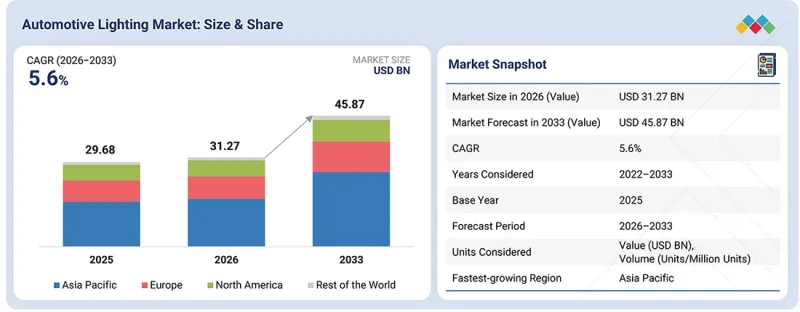
자동차용 조명 시장 규모는 2026년 312억 7,000만 달러에서 2033년까지 458억 7,000만 달러로, CAGR 5.6%로 확대할 것으로 예측됩니다.
이 시장은 자동차 생산 대수 증가, LED 조명 채택 확대, 자동차의 전동화, 그리고 교통안전 및 가시성에 대한 관심 고조에 힘입어 꾸준한 성장을 달성하고 있습니다. OLED 및 매트릭스 LED를 포함한 LED 기술의 발전으로 인해 승용차 및 상용차에 첨단 조명 시스템의 도입이 촉진되고 있습니다.
| 조사 범위 | |
|---|---|
| 조사 대상 기간 | 2026-2033년 |
| 기준연도 | 2025년 |
| 예측 기간 | 2026-2033년 |
| 대상 단위 | 10억 달러 |
| 부문 | 기술별, 용도별, 차종별, 유형별, 위치별, 지역별 |
| 대상 지역 | 아시아태평양, 유럽, 북미 및 세계의 기타 지역 |
자동차의 전동화가 진행되고 첨단 운전자 보조 시스템(ADAS)의 채택이 확대됨에 따라 시인성과 운전 안전성을 향상시키기 위한 어댑티브 조명 및 지능형 조명에 대한 수요가 증가하고 있습니다. 또한 LED 조명은 에너지 효율이 높은 조명, 독특한 차량 스타일링은 물론, 어댑티브 드라이빙 빔 및 다이내믹 라이팅과 같은 기능을 실현합니다. 주요 과제로는 매트릭스 LED, ADB, 마이크로 LED, 센서, 전자기기, 소프트웨어의 통합 및 개발 요구 사항이 증가함에 따라 첨단 조명 시스템의 복잡성과 비용이 높아지고 있다는 점을 들 수 있습니다. 이로 인해 고급차 이외의 차종으로의 보급이 어려워지고 있습니다.
"예측 기간 중 외장 조명은 계속해서 주요 용도로 자리매김할 것입니다."
승용차, 소형 상용차(LCV), 트럭에 헤드램프, 테일램프, 주간 주행등, 방향 지시등, 브레이크등 및 기타 신호 기능이 널리 탑재되어 있는 점이 외장 조명의 우위를 지원하고 있습니다. 차량 플랫폼의 전동화와 커넥티비티가 진전됨에 따라 외장 조명은 기본적인 조명에서 적응형 가시성, 차량 간 통신, 디자인을 통한 차별화로 전환되고 있습니다. LED의 채택 확대가 이러한 전환을 지원하고 있습니다. 컴팩트한 크기와 정밀한 광 제어 덕분에 더 소형화된 조명 모듈 내에서 매트릭스 LED, 어댑티브 하이빔, 고해상도 헤드램프, 다이내믹 시그널링을 구현할 수 있기 때문입니다. 특히 전기자동차나 프리미엄 차량의 경우, 자동차 제조사들이 첨단 외부 조명을 활용하여 안전 기능과 특징적인 전면 및 후면 디자인을 융합하고 있으므로 차량당 조명 장비가 특히 증가하고 있습니다. 2026년, FORVIA HELLA사는 Zeekr 8X를 위해 고해상도 매트릭스 LED 헤드램프를 개발했습니다. 이 헤드램프는 램프당 약 25,000개의 개별적으로 제어 가능한 LED 픽셀을 갖추고 있으며, 차선 유도 및 다이내믹 시그널을 도로 위에 투사하는 기능을 가지고 있습니다. 소프트웨어 제어에 의한 지능형 외장 조명로의 이러한 전환으로 인해 예측 기간 중 외장 조명은 주요 용도로 남아 있을 것이지만, 첨단 조명 시스템에 대한 수요는 더욱 높아질 것으로 예상됩니다.
"2033년까지 LED가 자동차 조명 기술 중 가장 빠르게 성장할 것으로 전망됩니다."
예측 기간 중 전 세계 자동차 조명 시장에서 LED 부문이 가장 높은 연평균 성장률(CAGR)을 달성할 것으로 전망됩니다. LED의 채택은 기존의 할로겐 용도, 특히 헤드램프, DRL(주간 주행등), 안개등, 신호등에서 매트릭스 LED, 어댑티브 드라이빙 빔,일루미네이티드 그릴, 로고, 전폭 라이트바, 다이내믹 리라이팅과 같은 고부가가치 용도로 확대되고 있습니다. 향후에는 발광 바디 패널, 프로그래밍 가능한 익스테리어 시그니처, 차량과 보행자 간 통신용 조명, 다이내믹 프로젝션 시스템 등이 적용될 전망입니다. 고해상도 LED, 마이크로LED, OLED 등의 신규 기술을 통해 픽셀 단위 제어, 어댑티브 빔 기능, 프로젝션, 개인화, 그리고 차량 간 통신이 가능해졌습니다. 각 OEM 업체들은 프리미엄 차량, 전기자동차(EV), SUV, 그리고 소프트웨어 정의 차량(SDV) 플랫폼에 이러한 기술을 점점 더 많이 통합하고 있습니다. 각 제조사들도 이러한 기술에 대한 투자를 확대하고 있으며, 코이트(Koito)는 자동차용 조명 생산 능력을 확충하고, ams OSRAM은 고성능 LED 및 자동차용 마이크로LED 기술에 대한 투자를 강화하고, 마렐리(Marelli)와 모저슨(Moserman)은 인도내 첨단 조명 제조 능력을 확대하고 있습니다. 이러한 투자는 고해상도 및 소프트웨어 지원 조명 시스템의 개발과 상용화를 지원하고 있습니다. 첨단 LED 기술로의 전환에 따라 차량당 조명 탑재량이 증가하며, 기존 조명을 뛰어넘는 새로운 수익 기회가 창출되고 있습니다.
아시아태평양은 높은 자동차 생산 대수, 전기자동차(EV)의 보급 확대, 그리고 첨단 조명 시스템의 보급률 상승에 힘입어 자동차용 LED 조명의 주요 성장 시장으로 계속 남아 있을 것으로 예상됩니다. 자동차 제조사들은 모든 차종 부문에서 기존 조명 기술을 LED 시스템으로 대체하는 움직임을 가속화하고 있으며, 매트릭스 LED, 어댑티브 드라이빙 빔, 고해상도 조명 등이 프리미엄 차량 및 전기자동차에서 LED 기술의 활용 범위를 확대하고 있습니다. 차량의 안전성, 에너지 효율, 스타일링 및 첨단 운전자 보조 시스템에 대한 관심이 높아지고 있는 점도 LED 조명에 대한 수요를 더욱 부추기고 있습니다. LED 기술의 가성비가 향상되고, 그 용도가 기본 조명에서 어댑티브 조명 및 지능형 조명 기능으로 확대됨에 따라 이 부문은 예측 기간 중 강력한 성장을 이룰 것으로 전망됩니다.
"예측 기간 중 유럽은 자동차 조명 시장 규모에서 2위 자리를 유지할 전망입니다."
유럽은 주요 자동차 제조사 및 조명 공급업체의 존재, 엄격한 차량 안전 기준, 그리고 첨단 조명 기술의 높은 보급률에 힘입어 예측 기간 중도 자동차 조명 시장 규모에서 2위 자리를 유지할 것으로 전망됩니다. 독일, 프랑스, 영국, 이탈리아는 여전히 중요한 자동차 시장이며, 수요는 LED, 매트릭스 LED, 어댑티브 조명 및 지능형 외부 조명 시스템으로 점점 더 이동하고 있습니다. 또한 이 지역의 차량 안전 및 전동화에 대한 집중은 제조사들이 가시성을 향상시키면서 동시에 차량의 스타일링과 커뮤니케이션 기능을 지원하는 조명 시스템 개발을 촉진하고 있습니다. 유럽의 각 자동차 제조사들도, 특히 프리미엄 전기자동차(EV)와 SUV에서 조명이 적용된 그릴, 독특한 DRL(주간 주행등), 다이내믹 리어 램프, 개인화된 앰비언트 조명 등을 통해 조명을 중요한 디자인 요소이자 브랜드 차별화 요소로 활용하고 있습니다. 또한 해당 지역의 전기자동차(EV) 및 소프트웨어 정의 차량(SDV)으로의 급속한 전환에 따라 조명과 ADAS(첨단 운전자 보조 시스템), 차량 센서, 인포테인먼트, 차량 소프트웨어 간의 통합이 가속화되고 있으며, 차량당 조명 탑재량 및 평균 판매 가격(ASP)이 증가하고 있습니다.
2025년, FORVIA HELLA는 마이크로 옵틱스를 활용한 LED 광도파로 시스템 ‘FlatLightµMX’ 기술로 CLEPA 혁신상을 수상했습니다. 이 기술을 통해 모듈 두께를 약 5mm로 줄이고, 단일 광학 소자 내에서 여러 조명 기능을 구현하고 있습니다. 또한 이 회사는 유럽의 각 OEM 업체를 대상으로 어댑티브 조명 및 LED 프론트 조명 시스템 수주를 확보하고 있으며, 이는 해당 지역에서 첨단 조명 기술에 대한 수요가 지속되고 있음을 반영합니다. LED 및 어댑티브 라이팅의 채택 확대에 더해, 자동차의 전동화 진전과 고급차 생산 확대가 예측 기간 중 유럽 자동차 조명 시장을 촉진할 것으로 전망됩니다.
자동차 조명 시장은 글로벌 기업이 주도하고 있으며, 일부 지역 기업도 시장에 진입해 있습니다. 자동차 조명 시장의 주요 기업으로는 Koito Manufacturing(일본), Marelli Holdings(이탈리아), Valeo(프랑스), HELLA GmbH & Co. KGaA(독일), Stanley Electric(일본) 등이 있습니다.
조사 범위
이 보고서의 조사 범위는 자동차 조명 시장의 성장에 영향을 미치는 주요 요인(촉진요인, 제약 요인, 과제, 기회 등)에 대한 상세한 정보를 포괄하고 있습니다. 주요 업계 플레이어에 대한 철저한 분석을 통해 각 기업의 사업 개요, 솔루션, 서비스,주요 전략, 계약, 제휴, 합의, 제품·서비스 출시, 합병·인수, 그리고 자동차 조명 시장과 관련된 최근 동향에 대한 인사이트를 제공합니다. 또한 이 보고서에서는 자동차 조명 시장의 생태계내 중소기업 및 스타트업에 대한 경쟁 분석, 공급업체 분석, 주요 공급업체의 개발 동향에 대해서도 다루고 있습니다.
이 보고서를 구매할 때의 주요 이점:
이 보고서는 자동차 조명 시장 전체 및 각 하위 부문의 매출에 관한 가장 정확한 추정치를 제공함으로써, 시장 선도 기업 및 신규 진입 기업을 지원합니다. 또한 이해관계자 여러분이 경쟁 구도를 이해하고, 자사의 비즈니스를 더 유리한 위치에 놓으며, 적절한 시장 진입 전략을 수립하기 위한 인사이트를 얻는 데 도움이 됩니다. 아울러, 이 보고서는 이해관계자 여러분이 시장 동향을 파악하는 데 일조하며, 주요 시장 촉진요인, 제약, 과제 및 기회에 대한 정보를 제공합니다.
이 보고서는 다음 사항에 대한 인사이트를 제공합니다. :
- 주요 촉진요인 분석(소프트웨어 정의 차량(SDV)으로의 전환, 자동차 조명 규제의 강화), 제약 요인(차량 개발 주기의 장기화로 인한 차세대 조명 기술의 상용화 지연, 저비용 애프터마켓용 LED 개조 부품의 보급으로 인해 프리미엄 조명 솔루션의 채택이 제한적임),기회(소프트웨어 정의형 및 온디맨드 기능형 조명 솔루션을 통한 지속적인 수익 창출, 자율주행 및 V2X 통신을 위한 지능형 외장 조명의 확대 추세),및 과제(고성능 조명 시스템의 열 성능 및 내구성 관리, 적응형 조명 시스템에 AI 및 소프트웨어 구동 기능 통합) 등, 자동차 조명 시장의 성장에 영향을 미치는 요인에 대한 인사이트를 제공합니다.
- 제품 개발/혁신: 자동차 조명 시장의 향후 기술 동향 및 신제품·서비스 출시에 대한 상세 인사이트.
- 시장 동향: 포괄적인 시장 정보 - 이 보고서에서는 다양한 지역의 인증 및 브랜드 보호 시장을 분석합니다.
- 시장 다각화: 자동차 조명 시장의 신제품 및 서비스, 미개발 지역, 최근 동향 및 투자에 관한 포괄적인 정보.
- 경쟁 분석: 자동차 조명 시장에서 Koito Manufacturing(일본), Marelli Holdings(이탈리아), Valeo(프랑스), HELLA GmbH & Co. KGaA(독일), Stanley Electric(일본) 등 주요 기업의 시장 점유율, 성장 전략 및 서비스 제공에 대한 상세한 평가.
자주 묻는 질문
목차
제1장 서론
제2장 개요
제3장 주요 인사이트
제4장 시장 개요
제5장 업계 동향
제6장 기술 진보, AI에 의한 영향, 특허, 혁신, 향후 전략적 응용
제7장 규제 상황
제8장 고객 상황과 구매 행동
제9장 자동차용 조명 시장(기술별)
제10장 자동차용 조명 시장(용도별)
제11장 자동차용 조명 시장(차종별)
제12장 자동차용 어댑티브 라이팅 시장(유형별)
제13장 전기자동차용 조명 시장(차종별)
제14장 전기자동차용 조명 시장(기술별)
제15장 전기자동차용 조명 시장(용도별)
제16장 이륜차용 조명 시장(위치별)
제17장 자동차용 조명 시장(지역별)
제18장 경쟁 구도
제19장 기업 개요
제20장 조사 방법
제21장 부록
KSA 26.09.11The automotive lighting market is projected to grow from USD 31.27 billion in 2026 to USD 45.87 billion by 2033, at a CAGR of 5.6%. The market is witnessing steady growth, supported by increasing vehicle production, growing adoption of LED lighting, vehicle electrification, and rising focus on road safety and visibility. Advancements in LED technologies, including OLED and Matrix LED, are strengthening the adoption of advanced lighting systems across passenger cars and commercial vehicles.
| Scope of the Report | |
|---|---|
| Years Considered for the Study | 2026-2033 |
| Base Year | 2025 |
| Forecast Period | 2026-2033 |
| Units Considered | USD billion |
| Segments | by Technology, Position and Application, Adaptive Lighting, Electric Vehicle, Two-wheeler Position Type, and Region |
| Regions covered | Asia Pacific, Europe, North America, and Rest of the World |
Growing vehicle electrification and adoption of advanced driver-assistance systems are increasing demand for adaptive and intelligent lighting to improve visibility and driving safety. LED lighting also enables energy-efficient illumination, distinctive vehicle styling, and functions such as adaptive driving beam and dynamic lighting. A key challenge is the rising complexity and cost of advanced lighting systems, as Matrix LED, ADB, MicroLED, sensors, electronics, and software increase integration and development requirements, making wider adoption beyond premium vehicles more difficult.
"Exterior lighting will remain dominant application during forecast period."
The widespread fitment of headlamps, tail lamps, daytime running lights, turn indicators, brake lights, and other signaling functions across passenger cars, LCVs, and trucks drives the dominance of exterior lighting. As vehicle platforms become more electrified and connected, exterior lighting shifts from basic illumination toward adaptive visibility, vehicle communication, and design differentiation. The increasing adoption of LED is supporting this transition because its compact size and precise light control enable Matrix LED, adaptive driving beam, high-resolution headlamps, and dynamic signaling within smaller lighting modules. Electric and premium vehicles are particularly increasing the lighting content per vehicle, as automakers use advanced exterior lighting to combine safety functions with distinctive front and rear designs. In 2026, FORVIA HELLA developed high-resolution Matrix LED headlamps for the Zeekr 8X, with around 25,000 individually controllable LED pixels per headlamp and functions that can project lane guidance and dynamic signals onto the road. This shift toward software-controlled and intelligent exterior lighting is expected to strengthen demand for advanced lighting systems while maintaining exterior lighting as the leading application during the forecast period.
"LED to be fastest-growing automotive lighting technology by 2033."
LED segment is projected to achieve the highest CAGR in the global automotive lighting market during the forecast period. LED adoption is expanding from conventional halogen applications, particularly headlamps, DRLs, fog lamps, and signal lighting, toward higher value applications such as Matrix LED, Adaptive Driving Beam, illuminated grilles, logos, full width light bars, and dynamic rear lighting. Future applications are expected to include illuminated body panels, programmable exterior signatures, vehicle-to-pedestrian communication lighting, and dynamic projection systems. Emerging technologies including high-resolution LED, MicroLED, and OLED are enabling pixel-level control, adaptive beam functions, projection, personalization, and vehicle communication. OEMs are increasingly integrating these technologies across premium vehicles, EVs, SUVs, and software-defined vehicle platforms. Manufacturers are also increasing investment in these technologies, with Koito expanding automotive lighting production capacity, ams OSRAM strengthening investments in high-performance LEDs and automotive MicroLED technology, and Marelli and Motherson expanding advanced lighting manufacturing capacity in India. These investments are supporting the development and commercialization of higher resolution and software-enabled lighting systems. The shift toward advanced LED technologies is increasing lighting content per vehicle and creating new revenue opportunities beyond conventional illumination.
Asia Pacific is projected to remain a major growth market for LED automotive lighting, supported by high vehicle production, increasing electric vehicle adoption, and rising penetration of advanced lighting systems. Automakers are increasingly replacing conventional lighting technologies with LED systems across vehicle segments, while matrix LED, adaptive driving beam, and high-resolution lighting are expanding the use of LED technology in premium and electric vehicles. The increasing focus on vehicle safety, energy efficiency, styling, and advanced driver assistance systems is further supporting demand for LED lighting. As LED technology becomes more cost-effective and its application expands from basic illumination to adaptive and intelligent lighting functions, the segment is expected to witness strong growth during the forecast period.
"Europe to remain second-largest market for automotive lighting during forecast period."
Europe is projected to remain the second-largest market for automotive lighting during the forecast period, supported by the presence of major automotive OEMs and lighting suppliers, stringent vehicle safety requirements, and high adoption of advanced lighting technologies. Germany, France, the UK, and Italy remain important automotive markets, with demand increasingly shifting toward LED, Matrix LED, adaptive lighting, and intelligent exterior lighting systems. The region's focus on vehicle safety and electrification is also encouraging manufacturers to develop lighting systems that improve visibility while supporting vehicle styling and communication. European OEMs are also using lighting as a key design and brand-differentiation element, particularly across premium EVs and SUVs, with illuminated grilles, signature DRLs, dynamic rear lamps, and personalized ambient lighting. In addition, the region's rapid transition toward EVs and software-defined vehicles is accelerating integration of lighting with ADAS, vehicle sensors, infotainment, and vehicle software, increasing lighting content and ASP per vehicle.
In 2025, FORVIA HELLA received the CLEPA Innovation Award for its FlatLight µMX technology, an LED light guide system using micro optics that reduces module depth to around 5 mm and enables multiple lighting functions within a single optical element. The company has also secured orders for adaptive lighting and LED front lighting systems for European OEMs, reflecting continued demand for advanced lighting technologies in the region. Growing adoption of LED and adaptive lighting, together with continued vehicle electrification and premium vehicle production, is expected to support the European automotive lighting market during the forecast period.
In-depth interviews were conducted with CEOs, marketing directors, other innovation and technology directors, and executives from various key organizations operating in the automotive lighting market.
The break-up of primaries is as follows:
By Companies: Lighting Solution Manufacturers - 35%, Tier 2 Suppliers - 40%, OEMs - 25%
By Designation: Directors- 15%, C-level Executives - 60%, Others - 25%
By Region: North America - 30%, Asia Pacific - 50%, Europe - 20%
Global players dominate the automotive lighting market and comprise several regional players. The key players in the automotive lighting market are Koito Manufacturing Co., Ltd. (Japan), Marelli Holdings Co., Ltd. (Italy), Valeo (France), HELLA GmbH & Co. KGaA (Germany), and Stanley Electric Co., Ltd. (Japan).
Research Coverage
The report's scope covers detailed information regarding the major factors, such as drivers, restraints, challenges, and opportunities, influencing the growth of the automotive lighting market. A thorough analysis of the key industry players provides insights into their business overview, solutions, and services; key strategies; contracts, partnerships, agreements, product & service launches, mergers, and acquisitions; and recent developments associated with the automotive lighting market. This report also covers competitive analysis of SMEs/startups in the automotive lighting market ecosystem, supplier analysis, and development by key suppliers.
Key Benefits of Buying the Report:
The report will help the market leaders/new entrants with information on the closest approximations of the revenue numbers for the overall automotive lighting market and the subsegments. This report will help stakeholders understand the competitive landscape and gain insights to position their businesses better and plan suitable go-to-market strategies. The report also helps stakeholders understand the market pulse and provides information on key market drivers, restraints, challenges, and opportunities.
The report provides insights on the following pointers:
- Analysis of Key Drivers (Transition Toward Software-defined Vehicles (SDVs), Stricter automotive lighting regulations), Restraints (Delayed commercialization of next-generation lighting technologies due to long vehicle development cycles, Limited adoption of premium lighting solutions due to proliferation of low-cost aftermarket LED retrofits), Opportunities (Recurring revenue creation with software-defined and feature-on-demand lighting solutions, Growing trend of intelligent exterior lighting for autonomous mobility and V2X communication), and Challenges (Managing thermal performance and durability of high-performance lighting systems, Integration of AI and software driven capabilities in adaptive lighting systems) influencing the growth of the automotive lighting market.
- Product Development/Innovation: Detailed insights on upcoming technologies and new product & service launches in the automotive lighting market.
- Market Development: Comprehensive market information - the report analyzes the authentication and brand protection market across varied regions.
- Market Diversification: Exhaustive information about new products & services, untapped geographies, recent developments, and investments in the automotive lighting market.
- Competitive Assessment: In-depth assessment of market shares, growth strategies, and service offerings of leading players like Koito Manufacturing Co., Ltd. (Japan), Marelli Holdings Co., Ltd. (Italy), Valeo (France), HELLA GmbH & Co. KGaA (Germany) and Stanley Electric Co., Ltd. (Japan), among others, in the automotive lighting market.
TABLE OF CONTENTS
1 INTRODUCTION
- 1.1 STUDY OBJECTIVES
- 1.2 MARKET DEFINITION
- 1.3 STUDY SCOPE
- 1.3.1 YEARS CONSIDERED
- 1.3.2 INCLUSIONS AND EXCLUSIONS
- 1.4 CURRENCY CONSIDERED
- 1.5 VOLUME UNITS CONSIDERED
- 1.6 STAKEHOLDERS
- 1.7 SUMMARY OF CHANGES
2 EXECUTIVE SUMMARY
- 2.1 MARKET HIGHLIGHTS AND KEY INSIGHTS
- 2.2 KEY MARKET PARTICIPANTS: MAPPING OF STRATEGIC DEVELOPMENTS
- 2.3 DISRUPTIVE TRENDS IN AUTOMOTIVE LIGHTING MARKET
- 2.4 HIGH GROWTH SEGMENTS
- 2.5 REGIONAL SNAPSHOT: MARKET SIZE, GROWTH RATE, AND FORECAST
3 PREMIUM INSIGHTS
- 3.1 ATTRACTIVE GROWTH OPPORTUNITIES IN ADAPTIVE AND EV LIGHTING SEGMENTS
- 3.2 AUTOMOTIVE LIGHTING MARKET, BY TECHNOLOGY
- 3.3 AUTOMOTIVE LIGHTING MARKET, BY VEHICLE TYPE
- 3.4 AUTOMOTIVE LIGHTING MARKET, BY APPLICATION
- 3.5 ELECTRIC VEHICLE LIGHTING MARKET, BY TECHNOLOGY
- 3.6 TWO-WHEELER LIGHTING MARKET, BY POSITION
- 3.7 AUTOMOTIVE ADAPTIVE LIGHTING MARKET, BY TYPE
- 3.8 AUTOMOTIVE LIGHTING MARKET, BY REGION
4 MARKET OVERVIEW
- 4.1 INTRODUCTION
- 4.2 MARKET DYNAMICS
- 4.2.1 DRIVERS
- 4.2.1.1 Transition toward Software-Defined Vehicles (SDVS) is transforming lighting into an intelligent communication platform
- 4.2.1.2 Stricter automotive lighting regulations driving adoption of advanced lighting systems
- 4.2.1.3 Electrification and energy optimization are accelerating adoption of high-efficiency lighting technologies
- 4.2.2 RESTRAINTS
- 4.2.2.1 Long vehicle development cycles delay commercialization of next-generation lighting technologies
- 4.2.2.2 Proliferation of low-cost aftermarket LED retrofits dilutes oem premium lighting adoption
- 4.2.3 OPPORTUNITIES
- 4.2.3.1 Software-defined and feature-on-demand lighting creating recurring revenue streams
- 4.2.3.2 Intelligent exterior lighting for autonomous mobility and V2X communication
- 4.2.4 CHALLENGES
- 4.2.4.1 Managing thermal performance and durability of high-performance lighting systems
- 4.2.4.2 Integration of AI and software-driven capabilities in adaptive lighting systems
- 4.2.1 DRIVERS
- 4.3 UNMET NEEDS AND WHITE SPACES
- 4.4 INTERCONNECTED MARKETS AND CROSS-SECTOR OPPORTUNITIES
- 4.5 STRATEGIC MOVES BY TIER-1/2/3 SUPPLIERS
5 INDUSTRY TRENDS
- 5.1 MACROECONOMIC OUTLOOK
- 5.1.1 INTRODUCTION
- 5.1.2 GDP TRENDS AND FORECAST
- 5.1.3 TRENDS IN AUTOMOTIVE LIGHTING INDUSTRY
- 5.1.3.1 Regional GDP dynamics
- 5.1.3.2 Developed markets
- 5.1.3.3 Emerging markets
- 5.1.3.3.1 China
- 5.1.3.3.2 India
- 5.2 SUPPLY CHAIN ANALYSIS
- 5.2.1 SEMICONDUCTOR ROADMAP
- 5.3 ECOSYSTEM ANALYSIS
- 5.3.1 LED CHIP SUPPLIERS
- 5.3.2 OPTICAL COMPONENT SUPPLIERS
- 5.3.3 LIGHTING MODULE SUPPLIERS
- 5.3.4 TIER I SUPPLIERS
- 5.3.5 OEMS
- 5.3.6 SOFTWARE PROVIDERS
- 5.3.7 ADAS PROVIDERS
- 5.3.8 END VEHICLE
- 5.3.9 SOFTWARE DEFINED VEHICLE LIGHTING ECOSYSTEM
- 5.3.10 OTA ENABLED LIGHTING
- 5.3.11 FEATURE ON DEMAND (FOD)
- 5.3.12 LIGHTING PERSONALIZATION
- 5.3.13 SOFTWARE MONETIZATION
- 5.3.14 DOMAIN CONTROLLER INTEGRATION
- 5.3.15 VEHICLE OS INTEGRATION
- 5.4 PRICING ANALYSIS
- 5.4.1 AUTOMOTIVE LIGHTING MARKET: AVERAGE SELLING PRICE, BY TECHNOLOGY
- 5.4.1.1 Halogen
- 5.4.1.2 LED
- 5.4.1.3 Xenon/HID
- 5.4.2 AVERAGE SELLING PRICE OF AUTOMOTIVE LIGHTING SYSTEMS, BY REGION
- 5.4.1 AUTOMOTIVE LIGHTING MARKET: AVERAGE SELLING PRICE, BY TECHNOLOGY
- 5.5 TRADE ANALYSIS
- 5.5.1 IMPORT SCENARIO (HS CODE 851220)
- 5.5.2 EXPORT SCENARIO (HS CODE 851220)
- 5.6 KEY CONFERENCES AND EVENTS, 2026-2027
- 5.7 TRENDS/DISRUPTIONS IMPACTING CUSTOMER BUSINESS
- 5.8 CASE STUDY ANALYSIS
- 5.8.1 MERCEDES BENZ DIGITAL LIGHT DEPLOYMENT FOR HIGH RESOLUTION ROAD PROJECTION
- 5.8.2 BMW NEUE KLASSE SOFTWARE DEFINED LIGHTING ARCHITECTURE
- 5.8.3 FORVIA HELLA SSL HD HEADLAMP COMMERCIALIZATION
- 5.9 IMPACT OF THE EU-INDIA FTA ON THE AUTOMOTIVE INDUSTRY
- 5.10 IMPACT OF US-ISRAEL-IRAN WAR ON AUTOMOTIVE INDUSTRY
- 5.11 OEM LIGHTING STRATEGY
- 5.11.1 OEM LIGHTING STRATEGY BY VEHICLE POSITIONING
- 5.11.2 STRATEGIC PRIORITIES OF MAJOR OEMS
- 5.11.3 OEM: LIGHTING STRATEGY
- 5.11.4 VEHICLE DIFFERENTIATION
- 5.11.5 BRAND IDENTITY THROUGH SIGNATURE LIGHTING
- 5.11.6 COST OPTIMIZATION
- 5.11.7 PLATFORM STANDARDIZATION
- 5.11.8 SOFTWARE ENABLED FEATURES
- 5.11.9 OTA UPGRADABLE LIGHTING
- 5.12 EVOLUTION OF AUTOMOTIVE LIGHTING ARCHITECTURE
- 5.12.1 CONVENTIONAL LIGHTING TECHNOLOGIES
- 5.12.2 SOFTWARE-DEFINED LIGHTING
- 5.12.3 ADAPTIVE LIGHTING EVOLUTION
- 5.13 TECHNOLOGY READINESS ASSESSMENT
- 5.13.1 AUTOMOTIVE LIGHTING TECHNOLOGY READINESS ASSESSMENT
- 5.13.2 TECHNOLOGY MATURITY VERSUS MARKET OPPORTUNITY
- 5.13.3 MATRIX LED
- 5.13.4 DIGITAL LIGHT
- 5.13.5 MICRO LED
- 5.13.6 OLED
- 5.13.7 LASER LIGHTING
- 5.13.8 PROJECTION LIGHTING
- 5.13.9 AI CONTROLLED LIGHTING
- 5.14 OEM ADOPTION ROADMAP
- 5.14.1 OEM AUTOMOTIVE LIGHTING ADOPTION ROADMAP, 2025 TO 2035
- 5.14.2 OEM ADOPTION MATURITY
- 5.14.3 OEM-SPECIFIC ADOPTION DIRECTION
- 5.14.4 MATRIX LED
- 5.14.5 OLED
- 5.14.6 MICRO LED
- 5.14.7 PROJECTION LIGHTING
- 5.14.8 ILLUMINATED GRILLES
- 5.14.9 ILLUMINATED LOGOS
- 5.14.10 DIGITAL LIGHT
- 5.15 FUTURE PROFIT POOLS
- 5.15.1 SOFTWARE CONTROLLED LIGHTING
- 5.15.2 ADAPTIVE BEAM SYSTEMS
- 5.15.3 PROJECTION LIGHTING
- 5.15.4 MICRO LED
- 5.15.5 INTELLIGENT AMBIENT LIGHTING
- 5.15.6 VEHICLE TO PEDESTRIAN COMMUNICATION LIGHTING
- 5.15.7 FUTURE REVENUE POOLS IN AUTOMOTIVE LIGHTING, 2035
6 TECHNOLOGICAL ADVANCEMENTS, AI-DRIVEN IMPACT, PATENTS, INNOVATIONS, AND FUTURE STRATEGIC APPLICATIONS
- 6.1 TECHNOLOGY ANALYSIS
- 6.1.1 KEY TECHNOLOGIES
- 6.1.1.1 LED Lighting Technology
- 6.1.1.2 Adaptive Driving Beam (ADB)
- 6.1.1.3 Matrix LED Lighting
- 6.1.1.4 OLED Lighting Technology
- 6.1.1 KEY TECHNOLOGIES
- 6.2 COMPLEMENTARY TECHNOLOGIES
- 6.2.1 LASER LIGHTING TECHNOLOGY
- 6.2.2 PROJECTION LIGHTING SYSTEMS
- 6.2.3 INTERIOR AMBIENT LIGHTING SYSTEMS
- 6.2.4 DYNAMIC SIGNAL LIGHTING SYSTEMS
- 6.3 ADJACENT TECHNOLOGIES
- 6.3.1 SOFTWARE DEFINED VEHICLE (SDV)
- 6.3.2 VEHICLE TO EVERYTHING (V2X) COMMUNICATION
- 6.3.3 ADAS SENSOR INTEGRATION
- 6.3.4 ARTIFICIAL INTELLIGENCE FOR ADAPTIVE LIGHTING
- 6.4 TECHNOLOGY/PRODUCT ROADMAP
- 6.5 PATENT ANALYSIS
- 6.6 FUTURE APPLICATIONS
- 6.7 IMPACT OF AI/GENERATIVE AI
- 6.8 SUPPLIER ANALYSIS
- 6.8.1 HEADLAMPS
- 6.8.2 FOG LAMPS
- 6.8.3 REAR LAMPS
- 6.8.4 INTERIOR LIGHTING
- 6.8.5 EXTERIOR LIGHTING
- 6.8.6 HEADLAMPS
- 6.8.7 FOG LAMPS
- 6.8.8 REAR LAMPS
- 6.8.9 INTERIOR LIGHTING
- 6.8.10 EXTERIOR LIGHTING
7 REGULATORY LANDSCAPE
- 7.1 REGIONAL REGULATIONS AND COMPLIANCE
- 7.1.1 REGULATORY BODIES, GOVERNMENT AGENCIES, AND OTHER ORGANIZATIONS
- 7.2 KEY REGULATIONS
- 7.2.1 ISO 26262
- 7.2.2 ISO/SAE 21434
- 7.2.3 OTA SECURITY
- 7.2.4 LIGHTING ECU PROTECTION
- 7.2.5 SECURE SOFTWARE
- 7.2.6 INDUSTRY STANDARDS
8 CUSTOMER LANDSCAPE AND BUYER BEHAVIOR
- 8.1 DECISION-MAKING PROCESS
- 8.2 KEY STAKEHOLDERS IN BUYING PROCESS AND THEIR EVALUATION CRITERIA
- 8.2.1 KEY STAKEHOLDERS IN BUYING PROCESS
- 8.2.2 BUYING CRITERIA
- 8.3 ADOPTION BARRIERS AND INTERNAL CHALLENGES
- 8.4 UNMET NEEDS OF VARIOUS END-USE INDUSTRIES
- 8.5 MARKET PROFITABILITY
- 8.5.1 REVENUE POTENTIAL
9 AUTOMOTIVE LIGHTING MARKET, BY TECHNOLOGY
- 9.1 INTRODUCTION
- 9.2 HALOGEN
- 9.2.1 GROWING POPULARITY OF LED TO DRIVE MARKET
- 9.3 LED
- 9.3.1 OLED
- 9.3.1.1 Advancements in OLED technology to drive market
- 9.3.2 MATRIX LED
- 9.3.2.1 Growing interest from major automakers to drive demand
- 9.3.1 OLED
- 9.4 XENON
- 9.4.1 HIGH COST AND DISTRACTING GLARE LIKELY TO HINDER MARKET GROWTH
- 9.5 LASER
- 9.5.1 LASER TECHNOLOGY AS ABSOLUTE INNOVATION IN LIGHTING
10 AUTOMOTIVE LIGHTING MARKET, BY APPLICATION
- 10.1 INTRODUCTION
- 10.2 MARKET DEFINITIONS
- 10.2.1 FRONT LIGHTING
- 10.2.1.1 Headlights
- 10.2.1.2 Fog lights
- 10.2.1.3 Daytime running lights (DRL)
- 10.2.2 REAR LIGHTING
- 10.2.2.1 Taillights
- 10.2.2.2 Center High-Mounted Stop Lights (CHMSL)
- 10.2.2.3 License plate lamps
- 10.2.3 SIDE LIGHTING
- 10.2.3.1 Sidelights
- 10.2.3.2 Side rear-view mirror indicators
- 10.2.4 INTERIOR LIGHTING
- 10.2.4.1 Dashboards
- 10.2.4.2 Glove boxes
- 10.2.4.3 Reading lights
- 10.2.4.4 Dome lights
- 10.2.4.5 Rear-view mirror interior lights
- 10.2.5 GLOBAL LIGHTING MARKET, BY APPLICATION
- 10.2.6 FRONT LIGHTING, BY VEHICLE TYPE
- 10.2.7 REAR LIGHTING, BY VEHICLE TYPE
- 10.2.8 SIDE LIGHTING, BY VEHICLE TYPE
- 10.2.9 INTERIOR LIGHTING, BY VEHICLE TYPE
- 10.2.1 FRONT LIGHTING
- 10.3 PASSENGER CAR LIGHTING MARKET, BY APPLICATION
- 10.4 PASSENGER CAR INTERIOR LIGHTING MARKET, BY APPLICATION
- 10.4.1 DASHBOARD LIGHTS
- 10.4.2 GLOVE BOX
- 10.4.3 READING LIGHTS
- 10.4.4 DOME LIGHTS
- 10.4.5 REAR-VIEW MIRROR INTERIOR LIGHTS
- 10.5 PASSENGER CAR FRONT LIGHTING MARKET, BY APPLICATION
- 10.5.1 HEADLIGHTS
- 10.5.2 FOG LIGHTS
- 10.5.3 DAYTIME RUNNING LIGHTS
- 10.6 PASSENGER CAR REAR LIGHTING MARKET, BY APPLICATION
- 10.6.1 TAIL LIGHTS
- 10.6.2 CENTER HIGH-MOUNTED STOP LIGHTS
- 10.6.3 LICENSE PLATE LIGHTS
- 10.7 PASSENGER CAR SIDE LIGHTING MARKET, BY APPLICATION
- 10.7.1 SIDELIGHTS
- 10.7.2 SIDE REAR-VIEW MIRROR INDICATOR LIGHTS
- 10.8 LIGHT COMMERCIAL VEHICLE LIGHTING MARKET, BY POSITION
- 10.9 LIGHT COMMERCIAL VEHICLE (LCV) INTERIOR LIGHTING MARKET, BY APPLICATION
- 10.9.1 DASHBOARD LIGHTS
- 10.9.2 GLOVE BOX
- 10.9.3 READING LIGHTS
- 10.9.4 DOME LIGHTS
- 10.9.5 REAR-VIEW MIRROR INTERIOR LIGHTS
- 10.10 LIGHT COMMERCIAL VEHICLE (LCV) FRONT LIGHTING MARKET, BY APPLICATION
- 10.10.1 HEADLIGHTS
- 10.10.2 FOG LIGHTS
- 10.10.3 DAYTIME RUNNING LIGHTS (DRL)
- 10.11 LIGHT COMMERCIAL VEHICLE (LCV) REAR LIGHTING MARKET, BY APPLICATION
- 10.11.1 TAILLIGHTS
- 10.11.2 CENTER HIGH-MOUNTED STOP LIGHTS (CHMSL)
- 10.11.3 LICENSE PLATE LIGHTS
- 10.12 LIGHT COMMERCIAL VEHICLE (LCV) SIDE LIGHTING MARKET, BY APPLICATION
- 10.12.1 SIDELIGHTS
- 10.13 TRUCK LIGHTING MARKET, BY POSITION
- 10.14 TRUCK INTERIOR LIGHTING MARKET, BY APPLICATION
- 10.14.1 DASHBOARD LIGHTS
- 10.14.2 CABIN AND READING LIGHTS
- 10.14.3 ENGINE COMPARTMENT LIGHTS
- 10.15 TRUCK FRONT LIGHTING MARKET, BY APPLICATION
- 10.15.1 HEADLIGHTS
- 10.15.2 FOG LIGHTS
- 10.15.3 CLEARANCE LAMPS
- 10.15.4 TURN SIGNAL LAMPS
- 10.15.5 DAYTIME RUNNING LIGHTS
- 10.16 TRUCK REAR LIGHTING MARKET, BY APPLICATION
- 10.16.1 STOP LAMPS
- 10.16.2 TAIL LAMPS
- 10.16.3 LICENSE PLATE LAMPS
- 10.16.4 TURN SIGNAL LAMPS
- 10.17 TRUCK SIDE LIGHTING MARKET, BY APPLICATION
- 10.17.1 MARKER LAMPS
- 10.18 BUS LIGHTING MARKET, BY POSITION
- 10.19 BUS INTERIOR LIGHTING MARKET, BY APPLICATION
- 10.19.1 DASHBOARD LAMPS
- 10.19.2 BUS AREA LIGHTS
- 10.19.3 DRIVER AREA LIGHTS
- 10.19.4 FOOTWELL LIGHTS
- 10.20 BUS FRONT LIGHTING MARKET, BY APPLICATION
- 10.20.1 HEADLAMP UNITS
- 10.20.2 CLEARANCE LAMPS
- 10.20.3 INDICATOR LAMPS
- 10.20.4 IDENTIFICATION LAMPS
- 10.20.5 DAYTIME RUNNING LIGHTS
- 10.21 BUS REAR LIGHTING MARKET, BY APPLICATION
- 10.21.1 LICENSE PLATE LAMPS
- 10.21.2 TAIL LAMPS
- 10.21.3 REAR CLEARANCE LAMPS
- 10.21.4 REAR IDENTIFICATION LAMPS
- 10.21.5 STOP LAMPS
- 10.22 BUS SIDE LIGHTING MARKET, BY APPLICATION
- 10.22.1 MARKER LAMPS
11 AUTOMOTIVE LIGHTING MARKET, BY VEHICLE TYPE
- 11.1 INTRODUCTION
- 11.2 PASSENGER CARS
- 11.2.1 INCREASING ADOPTION OF ADVANCED LIGHTING SYSTEMS AND GROWING DEMAND FOR PREMIUM AND LUXURY CARS TO DRIVE MARKET
- 11.3 LIGHT COMMERCIAL VEHICLES
- 11.3.1 GROWING LIGHT COMMERCIAL VEHICLE PRODUCTION TO DRIVE MARKET
- 11.4 TRUCKS
- 11.4.1 INCREASING PENETRATION OF ADVANCED HEADLIGHTS TO DRIVE MARKET
- 11.5 BUSES
- 11.5.1 GROWING PUBLIC TRANSPORTATION SYSTEM TO DRIVE MARKET
12 AUTOMOTIVE ADAPTIVE LIGHTING MARKET, BY TYPE
- 12.1 INTRODUCTION
- 12.2 FRONT ADAPTIVE LIGHTING
- 12.2.1 AUTO ON/OFF
- 12.2.1.1 Increasing incorporation of on/off features by automakers to drive market
- 12.2.2 BENDING/CORNERING LIGHTING
- 12.2.2.1 Increasing integration of predictive cornering lighting with ADAS to drive market
- 12.2.3 HIGH BEAM ASSIST
- 12.2.3.1 Increasing deployment of camera-based high beam assist systems to drive market
- 12.2.4 HEADLIGHT LEVELING
- 12.2.4.1 Growing developments in headlight leveling technology to drive market
- 12.2.1 AUTO ON/OFF
- 12.3 REAR ADAPTIVE LIGHTING
- 12.3.1 FAVORABLE GOVERNMENT REGULATIONS TO DRIVE MARKET
- 12.4 AMBIENT LIGHTING
- 12.4.1 DEVELOPMENTS IN INTELLIGENT AMBIENT LIGHTING SYSTEMS TO DRIVE MARKET
13 ELECTRIC VEHICLE LIGHTING MARKET, BY VEHICLE TYPE
- 13.1 INTRODUCTION
- 13.2 BEVS
- 13.2.1 INCREASING INTEGRATION OF INTELLIGENT LIGHTING TECHNOLOGIES IN BEVS TO DRIVE MARKET
- 13.3 PHEVS
- 13.3.1 GROWING ADOPTION OF PREMIUM PHEVS AND INTELLIGENT LIGHTING TECHNOLOGIES TO DRIVE MARKET
14 ELECTRIC VEHICLE LIGHTING MARKET, BY TECHNOLOGY
- 14.1 INTRODUCTION
- 14.2 HALOGEN
- 14.2.1 GROWING ADOPTION OF LED TO IMPACT HALOGEN MARKET
- 14.3 LED
- 14.3.1 GROWING INTEGRATION OF INTELLIGENT LED LIGHTING TECHNOLOGIES TO DRIVE MARKET
- 14.4 XENON/HID
- 14.4.1 DEMAND FOR XENON TO DECLINE DUE TO RISING POPULARITY OF LED
15 ELECTRIC VEHICLE LIGHTING MARKET, BY APPLICATION
- 15.1 INTRODUCTION
- 15.2 EXTERIOR LIGHTING
- 15.2.1 HEADLIGHTS
- 15.2.2 FOG LIGHTS
- 15.2.3 DAYTIME RUNNING LIGHTS
- 15.2.4 TAILLIGHTS
- 15.2.5 SIDELIGHTS
- 15.2.6 CENTER HIGH-MOUNT STOP LIGHTS
- 15.3 INTERIOR LIGHTING
- 15.3.1 DASHBOARD LIGHTS
- 15.3.2 GLOVE BOX LIGHTS
- 15.3.3 READING LIGHTS
- 15.3.4 DOME LIGHTS
16 TWO-WHEELER LIGHTING MARKET, BY POSITION
- 16.1 INTRODUCTION
- 16.2 FRONT
- 16.2.1 GROWING POPULARITY OF LED HEADLIGHTS TO DRIVE MARKET
- 16.3 SIDE
- 16.3.1 INCREASING ADOPTION OF INTELLIGENT LED SIDE INDICATORS TO DRIVE MARKET
- 16.4 REAR
- 16.4.1 INCREASING ADOPTION OF INTELLIGENT LED REAR LIGHTING SYSTEMS TO DRIVE MARKET
17 AUTOMOTIVE LIGHTING MARKET, BY REGION
- 17.1 INTRODUCTION
- 17.2 ASIA PACIFIC
- 17.2.1 CHINA
- 17.2.1.1 Expansion of intelligent vehicle manufacturing to drive market
- 17.2.2 JAPAN
- 17.2.2.1 Growing adoption of intelligent lighting technologies to drive market
- 17.2.3 SOUTH KOREA
- 17.2.3.1 Growing investments in intelligent mobility and automotive lighting innovation to drive market
- 17.2.4 INDIA
- 17.2.4.1 Government initiatives and vehicle safety regulations to drive market
- 17.2.5 REST OF ASIA PACIFIC
- 17.2.1 CHINA
- 17.3 EUROPE
- 17.3.1 GERMANY
- 17.3.1.1 Expansion of premium vehicle lighting technologies by German OEMs to drive market
- 17.3.2 FRANCE
- 17.3.2.1 Expansion of adaptive LED and matrix LED technologies to drive market
- 17.3.3 SPAIN
- 17.3.3.1 Growing investments in electrified vehicle production to drive market
- 17.3.4 UK
- 17.3.4.1 Advancements in premium automotive lighting technologies to drive market
- 17.3.5 REST OF EUROPE
- 17.3.1 GERMANY
- 17.4 NORTH AMERICA
- 17.4.1 US
- 17.4.1.1 Growing deployment of adaptive lighting technologies to drive market
- 17.4.2 CANADA
- 17.4.2.1 Increasing investments in electric vehicle manufacturing to drive market
- 17.4.3 MEXICO
- 17.4.3.1 Expanding vehicle production and supplier investments to drive market
- 17.4.1 US
- 17.5 REST OF THE WORLD (ROW)
- 17.5.1 BRAZIL
- 17.5.1.1 Increasing localization of automotive manufacturing to drive market
- 17.5.2 ARGENTINA
- 17.5.2.1 Expansion of domestic vehicle production to drive market
- 17.5.3 OTHERS IN ROW
- 17.5.1 BRAZIL
18 COMPETITIVE LANDSCAPE
- 18.1 OVERVIEW
- 18.2 KEY PLAYER COMPETITIVE STRATEGIES/RIGHT TO WIN
- 18.3 REVENUE ANALYSIS, 2021-2025
- 18.4 MARKET SHARE ANALYSIS, 2025
- 18.5 BRAND/PRODUCT COMPARISON
- 18.6 COMPANY EVALUATION MATRIX: KEY PLAYERS, 2025
- 18.6.1 STARS
- 18.6.2 EMERGING LEADERS
- 18.6.3 PERVASIVE PLAYERS
- 18.6.4 PARTICIPANTS
- 18.6.5 COMPANY FOOTPRINT: KEY PLAYERS, 2025
- 18.6.5.1 Company footprint
- 18.6.5.2 Technology footprint
- 18.6.5.3 Position Footprint
- 18.6.5.4 Region footprint
- 18.7 STARTUP/SME EVALUATION MATRIX: AUTOMOTIVE ADAPTIVE LIGHTING MANUFACTURERS
- 18.7.1 PROGRESSIVE COMPANIES
- 18.7.2 RESPONSIVE COMPANIES
- 18.7.3 DYNAMIC COMPANIES
- 18.7.4 STARTING BLOCKS
- 18.7.5 COMPETITIVE BENCHMARKING: STARTUPS/SMES, 2025
- 18.7.5.1 Detailed list of key startups/SMEs
- 18.7.5.2 Competitive benchmarking of key startups/SMEs
- 18.8 COMPANY VALUATION AND FINANCIAL METRICS
- 18.9 COMPETITIVE SCENARIO
- 18.9.1 PRODUCT LAUNCHES/DEVELOPMENTS
- 18.9.2 DEALS
- 18.9.3 EXPANSIONS
19 COMPANY PROFILES
- 19.1 KEY PLAYERS
- 19.1.1 KOITO MANUFACTURING CO., LTD.
- 19.1.1.1 Business overview
- 19.1.1.2 Products offered
- 19.1.1.3 Recent developments
- 19.1.1.3.1 Product launches
- 19.1.1.3.2 Deals
- 19.1.1.3.3 Expansions
- 19.1.1.3.4 Others
- 19.1.1.4 MnM view
- 19.1.1.4.1 Right to win
- 19.1.1.4.2 Strategic choices
- 19.1.1.4.3 Weaknesses and Competitive Threats
- 19.1.2 HELLA GMBH & CO. KGAA
- 19.1.2.1 Business overview
- 19.1.2.2 Products offered
- 19.1.2.3 Recent developments
- 19.1.2.3.1 Product launches
- 19.1.2.3.2 Deals
- 19.1.2.3.3 Expansions
- 19.1.2.3.4 Others
- 19.1.2.4 MnM view
- 19.1.2.4.1 Right to win
- 19.1.2.4.2 Strategic choices
- 19.1.2.4.3 Weaknesses and competitive threats
- 19.1.3 VALEO SE
- 19.1.3.1 Business overview
- 19.1.3.2 Products offered
- 19.1.3.3 Recent developments
- 19.1.3.3.1 Product launches
- 19.1.3.3.2 Deals
- 19.1.3.3.3 Expansion
- 19.1.3.4 MnM view
- 19.1.3.4.1 Right to win
- 19.1.3.4.2 Strategic choices
- 19.1.3.4.3 Weaknesses and competitive threats
- 19.1.4 MARELLI HOLDINGS CO., LTD.
- 19.1.4.1 Business overview
- 19.1.4.2 Products offered
- 19.1.4.3 Recent developments
- 19.1.4.3.1 Product launches
- 19.1.4.3.2 Deals
- 19.1.4.3.3 Expansion
- 19.1.4.4 MnM view
- 19.1.4.4.1 Right to win
- 19.1.4.4.2 Strategic choices
- 19.1.4.4.3 Weaknesses and competitive threats
- 19.1.5 STANLEY ELECTRIC CO., LTD.
- 19.1.5.1 Business overview
- 19.1.5.2 Products offered
- 19.1.5.3 Recent developments
- 19.1.5.3.1 Product launches
- 19.1.5.3.2 Deals
- 19.1.5.4 MnM view
- 19.1.5.4.1 Right to win
- 19.1.5.4.2 Strategic choices
- 19.1.5.4.3 Weaknesses and competitive threats
- 19.1.6 AMS OSRAM
- 19.1.6.1 Business overview
- 19.1.6.2 Products offered
- 19.1.6.3 Recent developments
- 19.1.6.3.1 Product launches
- 19.1.6.3.2 Deals
- 19.1.6.3.3 Expansions
- 19.1.7 AUMOVIO SE
- 19.1.7.1 Business overview
- 19.1.7.2 Products offered
- 19.1.7.3 Recent developments
- 19.1.7.3.1 Product launches
- 19.1.8 HYUNDAI MOBIS
- 19.1.8.1 Business overview
- 19.1.8.2 Products offered
- 19.1.8.3 Recent developments
- 19.1.8.3.1 Product launches
- 19.1.8.3.2 Deals
- 19.1.8.3.3 Expansion
- 19.1.9 ICHIKOH INDUSTRIES, LTD.
- 19.1.9.1 Business overview
- 19.1.9.2 Products offered
- 19.1.9.3 Recent developments
- 19.1.9.3.1 Product launches
- 19.1.9.3.2 Deals
- 19.1.9.3.3 Others
- 19.1.10 KONINKLIJKE PHILIPS N.V.
- 19.1.10.1 Business overview
- 19.1.10.2 Products offered
- 19.1.10.3 Recent developments
- 19.1.10.3.1 Product Launches
- 19.1.11 TUNGSRAM GROUP
- 19.1.11.1 Business overview
- 19.1.11.2 Products offered
- 19.1.1 KOITO MANUFACTURING CO., LTD.
- 19.2 OTHER PLAYERS
- 19.2.1 OP MOBILITY
- 19.2.2 ZIZALA LICHTSYSTEME GMBH
- 19.2.3 GRUPO ANTOLIN
- 19.2.4 TENNECO INC.
- 19.2.5 GENTEX CORPORATION
- 19.2.6 FLEX-N-GATE
- 19.2.7 KEBODA TECHNOLOGY CORP
- 19.2.8 VARROC
- 19.2.9 LUMAX INDUSTRIES
- 19.2.10 SEOUL SEMICONDUCTOR CO., LTD.
- 19.2.11 SAMVARDHANA MOTHERSON
- 19.2.12 SHC CORPORATIONS CO., LTD
- 19.2.13 HASCO VISION TECHNOLOGY CO., LTD.
- 19.2.14 UNO MINDA LIMITED
- 19.2.15 FICOSA INTERNATIONAL
20 RESEARCH METHODOLOGY
- 20.1 RESEARCH DATA
- 20.1.1 SECONDARY DATA
- 20.1.1.1 List of secondary sources for vehicle production
- 20.1.1.2 Secondary sources to estimate numbers related to automotive lighting market
- 20.1.1.3 Key data from secondary sources
- 20.1.2 PRIMARY DATA
- 20.1.2.1 List of primary participants
- 20.1.2.2 Breakdown of primary interviews
- 20.1.3 SAMPLING TECHNIQUES AND DATA COLLECTION METHODS
- 20.1.1 SECONDARY DATA
- 20.2 MARKET SIZE ESTIMATION
- 20.2.1 BOTTOM-UP APPROACH
- 20.2.2 TOP-DOWN APPROACH
- 20.3 DATA TRIANGULATION
- 20.4 RESEARCH LIMITATIONS
- 20.5 RESEARCH ASSUMPTIONS AND RISK ASSESSMENT
- 20.5.1 NUMBER OF LIGHTING UNITS
21 APPENDIX
- 21.1 INSIGHTS FROM INDUSTRY EXPERTS
- 21.2 DISCUSSION GUIDE
- 21.3 KNOWLEDGESTORE: MARKETSANDMARKETS' SUBSCRIPTION PORTAL
- 21.4 CUSTOMIZATION OPTIONS
- 21.5 RELATED REPORTS
- 21.6 AUTHOR DETAILS


