

|
시장보고서
상품코드
2126323
철도 신호 시장 : 열차 유형별(여객, 화물), 기술별(ABS, ETCS, CBTC, PTC, ATC), 용도별(간선, 화물), 제공별(하드웨어, 소프트웨어), 구성요소별, 인프라별, 도입 구분별, 연결 방식별, 지역별 - 세계 예측(-2033년)Railway Signaling Market by Train (Passenger, Freight), Technology (ABS, ETCS, CBTC, PTC & ATC), End-Use (Mainline, Freight), Offering (Hardware, Software), Component, Infrastructure, Deployment, Connectivity, and Region - Global Forecast to 2033 |
||||||

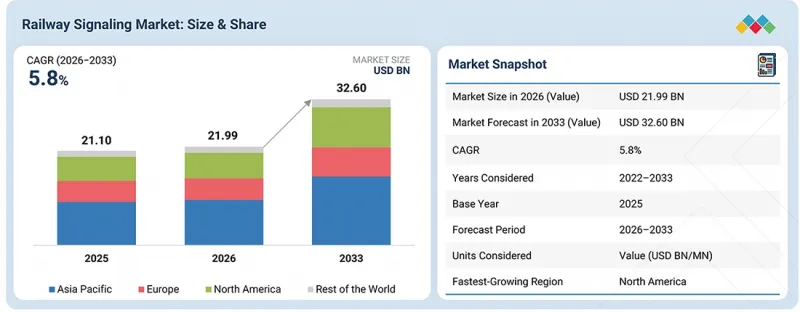
철도 신호 시장 규모는 2026년 219억 9,000만 달러에서 2033년까지 CAGR 5.8%를 기록하며 326억 달러에 달할 것으로 예측됩니다.
철도 신호 시장은 열차 운행 밀도가 높고 이용률이 높은 철도 노선에서 노후화된 릴레이식 연동 장치의 교체가 진행됨에 따라 성장이 가속화될 것으로 예상됩니다. 인프라 관리 사업자들은 더욱 고밀도화된 열차 운행에 대응하고, 첨단 열차 제어 시스템과의 통합을 가능하게 하는 전자식 아키텍처로의 전환을 추진하고 있습니다. 인도 국철에서는 Northern Railway, South Central Railway, Eastern Railway의 115개 역 및 신호 설비 지점을 대상으로 전자 연동 장치로의 교체 범위를 확대하고 있으며, 특히 열차 운행 밀도가 높고 이용률이 높은 노선에 프로젝트가 집중되고 있습니다.
| 조사 범위 | |
|---|---|
| 조사 대상 기간 | 2026-2033년 |
| 기준 연도 | 2025년 |
| 예측 기간 | 2026-2033년 |
| 단위 | 달러 |
| 부문 | 열차 유형, 기술, 용도, 제공, 구성요소, 인프라, 도입 구분, 연결 방식, 지역 |
| 대상 지역 | 아시아태평양, 유럽, 북미, 기타 지역 |
이러한 승인은 개별 신호 시스템의 업그레이드에서 노후화된 패널 및 릴레이 시스템의 반복적인 갱신 프로그램으로의 전환을 나타내며, 전자 연동 장치, 관련 신호 장비, 시스템 통합, Kavach 및 자동 블록 신호 시스템과의 호환성에 대한 지속적인 조달 수요를 창출하고 있습니다. 여러 철도 구역에 걸쳐 프로젝트가 집중되고 있는 것은 기존 연동 장치의 갱신이 반복적으로 수행되는 네트워크 현대화의 필수 요건이 되고 있음을 나타내며, 조달 범위는 연동 시스템에 그치지 않고 열차 감지, 통신, 시스템 통합, 시험, 시운전, 최신 열차 보호 및 교통 관리 시스템과의 호환성으로 확대되고 있습니다.
“도시 철도는 예측 기간 동안 최대 시장 점유율을 차지할 전망”
최종사용자별로 보면 지하철 사업자가 제약이 있는 기존 노선을 업그레이드하면서 열차 운행 빈도와 네트워크 용량을 늘리기 위해 CBTC를 점점 더 많이 활용함에 따라, 도시 철도 부문은 중요한 위치를 유지할 것으로 예상됩니다. 도시 철도의 조달 동향은 CBTC와 통신, 자동화, 제어 센터 시스템, 장기 유지보수를 결합한 통합형 신호 패키지로 점점 더 전환되고 있으며, 이는 개별 지하철 프로젝트의 기술적 내용과 수명주기 가치를 높이고 있습니다.
“열차 유형별로는 고속철도가 예측 기간 동안 중요한 시장 점유율을 차지할 전망”
이는 운행 속도의 향상에 따라 기존의 선로변 신호 시스템을 넘어선 지속적인 열차 감시, 높은 신뢰성의 열차 보호, 치밀하게 조정된 운행 관리가 필요하기 때문입니다. 고속철도 프로젝트에서는 높은 운행 속도에서도 안전한 열차 간격을 유지하도록 설계된 신호 아키텍처가 요구되며, 수송 능력과 정시성을 유지하기 위해 지속적인 열차 감시, 정밀한 운행 허가, ETCS, 자동 열차 운행에 대한 의존도가 높아지고 있습니다.
“중국은 예측 기간 동안 아시아태평양 철도 신호 시장에서 최대 점유율을 차지할 전망”
고속철도 및 기존 철도 전 노선에서 지속적인 철도망 확장에 더해, 수송 능력 증강과 열차 제어 시스템 업그레이드가 진행되고 있는 만큼, 중국은 아시아태평양에서 최대 시장 점유율을 유지할 것으로 예상됩니다. 이러한 사업 기회는 신규 노선 건설에 그치지 않고, 네트워크 업그레이드에는 동일한 프로젝트 범위 내에서 열차 제어, 신호, 통신, 시스템 통합, 시험 및 시운전이 필요하기 때문에 그 범위는 더욱 확대됩니다.
본 보고서에서는 전 세계 철도 신호 시장을 조사하여, 시장 개요, 시장 성장에 영향을 미치는 각종 요인 분석, 기술 및 특허 동향, 법규제 환경, 사례 연구, 시장 규모 추정 및 전망, 각종 분류·지역/주요 국가별 상세 분석, 경쟁 현황, 주요 기업 개요 등을 정리하고 있습니다.
자주 묻는 질문
목차
제1장 소개
제2장 주요 요약
제3장 주요 인사이트
제4장 시장 개요
제5장 업계 동향
제6장 기술의 진보, AI에 의한 영향, 특허, 혁신, 향후 응용
제7장 규제 상황과 지속가능성에 대한 대처
제8장 고객 상황과 구매 행동
제9장 철도 신호 업계의 미래 수익 모델
제10장 철도 신호 시장 : TCMS 열차 유형별
제11장 철도 신호 시장 : TCMS 제공별
제12장 철도 신호 시장 : 구성요소별
제13장 철도 신호 시장 : 기술별
제14장 철도 신호 시장 : 기반 인프라별
제15장 철도 신호 시장 : 용도별
제16장 철도 신호 시장 : 도입 방식별
제17장 철도 신호 시장 : 연결 방식별
제18장 철도 신호 시장 : 지역별
제19장 경쟁 구도
제20장 기업 개요
제21장 조사 방법
제22장 부록
KSM 26.09.10The railway signaling market is estimated to be USD 21.99 billion in 2026 and is projected to reach USD 32.60 billion by 2033, at a CAGR of 5.8%. The railway signaling market is expected to gain momentum from the replacement of aging relay-based interlocking across high-density and highly utilized railway corridors, as infrastructure managers increasingly migrate toward electronic architectures that support higher traffic intensity and integration with advanced train-control systems. Indian Railways is scaling electronic interlocking replacement across 115 stations and signaling locations in Northern, South Central, and Eastern Railways, with projects concentrated on high-density and highly utilized routes.
| Scope of the Report | |
|---|---|
| Years Considered for the Study | 2026-2033 |
| Base Year | 2025 |
| Forecast Period | 2026-2033 |
| Units Considered | USD billion |
| Segments | Train, Technology, End-Use, Offering, Component, Infrastructure, Deployment, Connectivity, and Region |
| Regions covered | Asia Pacific, Europe, North America, Rest of the World |
The approvals indicate a shift from individual signaling upgrades toward repeatable replacement programs for aging panel and relay systems, creating sustained procurement demand for electronic interlocking, associated signaling equipment, system integration, and compatibility with Kavach and automatic block signaling. The concentration of projects across multiple railway zones indicates that legacy interlocking replacement is becoming a repeatable network modernization requirement, expanding procurement beyond interlocking systems to train detection, communications, system integration, testing, commissioning, and compatibility with modern train protection and traffic management systems.
"The urban rail industry is projected to hold the largest market share during the forecast period."
Based on end-use, the urban segment is expected to maintain a significant position in the railway signaling market as metro operators increasingly use CBTC to increase train frequency and network capacity while upgrading constrained existing corridors. Urban rail procurement is increasingly shifting toward integrated signaling packages that combine CBTC with telecommunications, automation, control-center systems, and long-term maintenance, increasing the technology content and lifecycle value of individual metro projects. For instance, in August 2025, Alstom secured an order for Mumbai Metro Line 4 covering 39 driverless trainsets, Urbalis Forward CBTC signaling, and five years of maintenance, demonstrating the increasing bundling of signaling, rolling stock, and lifecycle support within urban rail contracts. In July 2025, Siemens Mobility secured a contract from RATP to automate Paris Metro Line 13 using its latest generation CBTC GoA4 system, including a new operations control center and equipment for 66 trains, with an option for up to 30 years of maintenance. These projects show that metro signaling procurement is moving toward higher value system packages where suppliers can capture revenue across train control, automation, control center systems, and long-term services, rather than through standalone signaling hardware.
"High-speed trains are expected to hold a significant market share during the forecast period."
Based on TCMS train type, the high-speed trains segment is expected to maintain a significant position because increasing operating speeds require continuous train supervision, high-integrity train protection, and tightly coordinated traffic management beyond conventional lineside signaling. High-speed rail projects require signaling architectures designed to maintain safe train separation at higher operating speeds, with greater reliance on continuous train supervision, precise movement authority, ETCS, and automated train operation to maintain capacity and punctuality. For instance, in January 2025, Siemens Mobility secured four contracts worth approximately USD 688 million for the UK HS2 project, covering ETCS Level 2 signaling, GoA2 Automatic Train Operation, traffic management, operational telecommunications, and long-term maintenance. The deployment is the first application of wayside ATO over ETCS Level 2 on a national high-speed rail system, linking train automation directly with digital signaling and traffic management. Integrating these systems within a single high-speed rail program increases the value of signaling contracts beyond core train protection, while creating longer-term revenue streams across system integration, software, maintenance, and operational support.
"China is predicted to hold the largest share of the railway signaling market in Asia Pacific during the forecast period."
China is expected to maintain the largest market share in Asia Pacific as continued railway expansion is being combined with capacity enhancement and train control system upgrades across high-speed and conventional routes. The opportunity extends beyond new line construction because network upgrades require train control, signaling, communications, system integration, testing, and commissioning within the same project scope. For instance, in January 2026, CRSC secured projects covering the Guangzhou East Station and Guangzhou East to Xintang lines, along with capacity expansion of the 254.3 km Baicheng to Arxan Railway, with CRSC handling signaling and communications integration, equipment procurement, installation, testing, and commissioning. The mix of new line development and existing route upgrades supports demand for integrated signaling packages and allows suppliers to capture greater value across system integration, project execution, and lifecycle services.
In-depth interviews were conducted with CEOs, marketing directors, other innovation and technology directors, and executives from various key organizations operating in this market.
- By Company Type: Signaling OEMs - 35%, Component Suppliers - 41%, and Railway Operators - 24%
- By Designation: C-level Executives - 60%, Directors - 10%, and Others - 30%
- By Region: Asia Pacific - 40%, Europe - 30%, North America - 20%, Rest of the World - 10%
The railway signaling market is dominated by major players, including Alstom (France), Siemens Mobility (Germany), Hitachi Rail Co., Ltd. (UK), China Railway Signal & Communication (CRSC) (China), and Wabtec Corporation (US). These companies have broad signaling portfolios and established capabilities in system design, integration, installation, testing, commissioning, and long-term maintenance across mainline, high-speed, freight, and urban rail networks.
Research Coverage:
This research report categorizes the railway signaling market by technology (ABS, CBTC, ETCS, PTC, ATC), component [hardware (interlocking systems, track circuits, axle counters, point machines, signals, balises, train detection systems, controllers, communication equipment, onboard equipment), software (traffic management software, control center software, diagnostics software)], infrastructure foundations (electronic interlocking, digital interlocking), end-use (mainline, urban, freight), by TCMS train type (light-rail & metros (DMU & EMU), high-speed trains, conventional passenger trains, freight trains), TCMS offering [solutions (hardware, software), services (consulting, installation, integration, maintenance, upgrades, managed services)], deployment (greenfield, brownfield), connectivity (GSM-R, Wi-Fi, Tetra, others), and region (North America, Europe, Asia Pacific, and the Rest of the World). The scope of the report covers detailed information regarding the major factors, such as drivers, restraints, challenges, and opportunities, influencing the growth of the railway signaling market. A detailed analysis of the key industry players has been done to provide insights into their business overview, solutions, and services; key strategies such as contracts, partnerships, agreements, product & service launches, mergers & acquisitions, and other developments. This report covers the competitive analysis of upcoming startups in the railway signaling market ecosystem.
Key Benefits of buying the report:
- The report will help market leaders/new entrants in this market with information on the closest approximations of the revenue numbers for the overall railway signaling market and the subsegments.
- This report will help stakeholders understand the competitive landscape and gain more insights to position their businesses better and plan suitable go-to-market strategies.
- The report will also help stakeholders understand the market pulse and provide information on key market drivers, restraints, challenges, and opportunities.
The report provides insights on the following pointers:
Analysis of key drivers (network capacity optimization through moving block signaling and traffic digitalization, increasing automation across metro and mainline rail network, transition toward intelligent, software-defined rail operations), restraints (legacy signaling migration creating opportunity cost for operators), opportunities (transition from GSM R to FRMCS and 5G railway communications, AI-driven traffic orchestration enabling autonomous freight rail operations), and challenges (interoperability requirements reducing product differentiation) influencing the growth of the railway signaling market
- Product Development/Innovation: Detailed insights into upcoming technologies, research & development activities, and new product & service launches in the railway signaling market.
- Market Development: Comprehensive information about lucrative markets (the report analyses the railway signaling market across varied regions)
- Market Diversification: Exhaustive information about new products & services, untapped geographies, recent developments, and investments in the railway signaling market
- Competitive Assessment: In-depth assessment of the market ranking, growth strategies, and service offerings of leading players like Alstom SA (France), Siemens Mobility (Germany), Hitachi Rail, Ltd. (UK), China Railway & Signal Communication (CRSC) Co., Ltd., and Wabtec Corporation (US) in the railway signaling market
TABLE OF CONTENTS
1 INTRODUCTION
- 1.1 STUDY OBJECTIVES
- 1.2 MARKET DEFINITION AND SCOPE
- 1.3 MARKET SCOPE
- 1.3.1 MARKET SEGMENTATION AND REGIONAL SCOPE
- 1.3.2 INCLUSIONS AND EXCLUSIONS
- 1.3.3 YEARS CONSIDERED
- 1.4 CURRENCY
- 1.5 UNIT CONSIDERED
- 1.6 STAKEHOLDERS
- 1.7 SUMMARY OF CHANGES
2 EXECUTIVE SUMMARY
- 2.1 MARKET HIGHLIGHTS & KEY INSIGHTS
- 2.2 KEY MARKET PARTICIPANTS: MAPPING OF STRATEGIC DEVELOPMENTS
- 2.3 DISRUPTIVE TRENDS IN RAILWAY SIGNALING MARKET
- 2.4 HIGH-GROWTH SEGMENTS
- 2.5 REGIONAL SNAPSHOT: MARKET SIZE, GROWTH RATE, AND FORECAST
3 PREMIUM INSIGHTS
- 3.1 ATTRACTIVE OPPORTUNITIES FOR PLAYERS IN RAILWAY SIGNALING MARKET
- 3.2 RAILWAY SIGNALING MARKET, BY TCMS TRAIN TYPE
- 3.3 RAILWAY SIGNALING MARKET, BY TCMS OFFERING
- 3.4 RAILWAY SIGNALING MARKET, BY COMPONENT
- 3.5 RAILWAY SIGNALING MARKET, BY TECHNOLOGY
- 3.6 RAILWAY SIGNALING MARKET, BY END USE
- 3.7 RAILWAY SIGNALING MARKET, BY REGION
4 MARKET OVERVIEW
- 4.1 INTRODUCTION
- 4.2 MARKET DYNAMICS
- 4.2.1 DRIVERS
- 4.2.1.1 Network capacity optimization through moving block signaling and traffic digitalization
- 4.2.1.2 Increasing automation across metro and mainline rail networks
- 4.2.1.3 Transition toward intelligent, software-defined rail operations
- 4.2.2 RESTRAINTS
- 4.2.2.1 Legacy signaling migration creates opportunity costs for operators
- 4.2.3 OPPORTUNITIES
- 4.2.3.1 Transition from GSM-R to FRMCS and 5G-based railway communications
- 4.2.3.2 AI-driven traffic orchestration enables autonomous freight rail operations
- 4.2.4 CHALLENGES
- 4.2.4.1 Interoperability requirements reduce product differentiation
- 4.2.1 DRIVERS
- 4.3 UNMET NEEDS AND WHITE SPACES
- 4.3.1 UNMET NEEDS IN RAILWAY SIGNALING MARKET
- 4.3.2 WHITE SPACE OPPORTUNITIES
- 4.4 INTERCONNECTED MARKETS AND CROSS-SECTOR OPPORTUNITIES
- 4.4.1 INTERCONNECTED MARKETS
- 4.4.2 CROSS-SECTOR OPPORTUNITIES
- 4.5 STRATEGIC MOVES BY TIER-1/2/3 PLAYERS
5 INDUSTRY TRENDS
- 5.1 MACROECONOMIC OUTLOOK
- 5.1.1 GDP TRENDS AND FORECAST
- 5.1.2 TRENDS IN GLOBAL RAILWAY SIGNALING MARKET
- 5.1.3 TRENDS IN GLOBAL ROLLING STOCK INDUSTRY
- 5.2 ECOSYSTEM ANALYSIS
- 5.2.1 RAIL INFRASTRUCTURE MANAGERS
- 5.2.2 RAILWAY SIGNALING PROVIDERS
- 5.2.3 COMMUNICATION, CLOUD, & AI TECHNOLOGY PROVIDERS
- 5.2.4 CYBERSECURITY & DIGITAL ASSET MANAGEMENT PROVIDERS
- 5.2.5 RAIL OPERATORS
- 5.3 SUPPLY CHAIN ANALYSIS
- 5.4 TRENDS/DISRUPTIONS IMPACTING CUSTOMER BUSINESS
- 5.5 INVESTMENT AND FUNDING SCENARIO
- 5.6 TRADE ANALYSIS
- 5.6.1 IMPORT SCENARIO (HS CODE 8530)
- 5.6.2 EXPORT SCENARIO (HS CODE 8530)
- 5.7 KEY CONFERENCES AND EVENTS, 2026-2027
- 5.8 CASE STUDY ANALYSIS
- 5.8.1 DIGITAL SIGNALING FOR MUMBAI-AHMEDABAD HIGH-SPEED RAIL
- 5.8.2 DIGITAL RAIL TRANSFORMATION FOR WAVE PROGRAM
- 5.8.3 POSITIVE TRAIN CONTROL MODERNIZATION FOR VALE FREIGHT NETWORK
- 5.9 SUPPLIER ANALYSIS
- 5.9.1 SIEMENS MOBILITY
- 5.9.2 ALSTOM
- 5.9.3 HITACHI RAIL
- 5.9.4 WABTEC CORPORATION
- 5.10 EUROPE-INDIA TRADE DEALS: IMPACT ANALYSIS
- 5.10.1 INTRODUCTION
- 5.10.2 EU TARIFFS
- 5.10.3 IMPORTS TO INDIA
- 5.10.4 EXPORTS FROM INDIA
- 5.11 US-IRAN IMPACT ON RAILWAY SIGNALING MARKET
- 5.11.1 INTRODUCTION
- 5.11.2 DIRECT IMPACT
- 5.11.3 INDIRECT IMPACT
- 5.11.4 RISE IN FUEL PRICES
6 TECHNOLOGICAL ADVANCEMENTS, AI-DRIVEN IMPACT, PATENTS, INNOVATIONS, AND FUTURE APPLICATIONS
- 6.1 KEY EMERGING TECHNOLOGIES
- 6.1.1 AI-BASED TRAFFIC MANAGEMENT & AUTONOMOUS DISPATCHING
- 6.1.2 CLOUD-NATIVE SIGNALING MANAGEMENT PLATFORMS
- 6.1.3 DIGITAL TWIN OF RAILWAY SIGNALING SYSTEMS
- 6.2 COMPLEMENTARY TECHNOLOGIES
- 6.2.1 FIBER OPTIC RAILWAY COMMUNICATION NETWORKS
- 6.2.2 ETCS LEVEL 3
- 6.3 ADJACENT TECHNOLOGIES
- 6.3.1 SMART RAIL INFRASTRUCTURE PLATFORMS
- 6.3.2 INTERNET OF THINGS (IOT) FOR RAIL ASSETS
- 6.4 PATENT ANALYSIS
- 6.5 RAILWAY DIGITALIZATION ROADMAP
- 6.5.1 DIGITAL RAILWAY
- 6.5.2 TRAFFIC MANAGEMENT SYSTEMS
- 6.5.3 AI-DISPATCHING
- 6.5.4 CLOUD-BASED SIGNALING
- 6.5.5 DIGITAL TWINS
- 6.5.6 EDGE COMPUTING
- 6.5.7 PREDICTIVE OPERATIONS
- 6.6 OEM TECHNOLOGY BENCHMARKING
- 6.6.1 ETCS ADOPTION
- 6.6.2 CBTC MIGRATION
- 6.6.3 POSITIVE TRAIN CONTROL
- 6.6.4 FRMCS READINESS
- 6.6.5 MULTI-VENDOR INTEROPERABILITY
- 6.7 FUTURE COMMUNICATION TECHNOLOGIES
- 6.7.1 GSM-R
- 6.7.2 FRMCS (5G)
- 6.7.3 PRIVATE LTE
- 6.7.4 SATELLITE COMMUNICATION
- 6.7.5 EDGE COMPUTING
- 6.8 IMPACT OF AI ON RAILWAY SIGNALING MARKET
- 6.8.1 TOP USE CASES AND MARKET POTENTIAL
- 6.8.1.1 AI-driven network optimization and autonomous traffic management
- 6.8.1.2 Intelligent asset management and predictive infrastructure maintenance
- 6.8.1.3 Digital validation, AI simulation, and software-defined signaling deployment
- 6.8.2 BEST PRACTICES FOLLOWED BY MANUFACTURERS IN RAILWAY SIGNALING MARKET
- 6.8.2.1 Safety assurance through controlled AI deployment
- 6.8.2.2 Data quality and model governance as procurement criterion
- 6.8.2.3 Cybersecurity built around AI and data lifecycle
- 6.8.2.4 Hybrid computing based on function criticality
- 6.8.2.5 AI model validation using operational evidence
- 6.8.3 INTERCONNECTED ECOSYSTEM AND IMPACT OF MARKET PLAYERS
- 6.8.4 CLIENTS' READINESS TO ADOPT AI IN RAILWAY SIGNALING MARKET
- 6.8.1 TOP USE CASES AND MARKET POTENTIAL
7 REGULATORY LANDSCAPE AND SUSTAINABILITY INITIATIVES
- 7.1 REGIONAL REGULATIONS AND COMPLIANCE
- 7.1.1 REGULATORY BODIES, GOVERNMENT AGENCIES, AND OTHER ORGANIZATIONS
- 7.1.1.1 Asia Pacific
- 7.1.1.2 Europe
- 7.1.1.3 North America
- 7.1.1.4 Rest of the World
- 7.1.1 REGULATORY BODIES, GOVERNMENT AGENCIES, AND OTHER ORGANIZATIONS
- 7.2 INDUSTRY STANDARDS
- 7.2.1 ASIA PACIFIC
- 7.2.2 EUROPE
- 7.2.3 NORTH AMERICA
- 7.2.4 REST OF THE WORLD
- 7.3 SUSTAINABILITY INITIATIVES
- 7.3.1 CARBON IMPACT AND ECO-APPLICATIONS
- 7.3.2 LIFECYCLE VS. OPERATION
- 7.3.3 ECO-APPLICATIONS
- 7.4 IMPACT OF REGULATORY POLICIES ON SUSTAINABILITY INITIATIVES
- 7.4.1 EUROPEAN UNION
- 7.4.2 US
- 7.4.3 CHINA
- 7.4.4 INDIA
8 CUSTOMER LANDSCAPE & BUYER BEHAVIOR
- 8.1 DECISION-MAKING PROCESS
- 8.2 KEY STAKEHOLDERS AND BUYING CRITERIA
- 8.2.1 KEY STAKEHOLDERS IN BUYING PROCESS
- 8.2.2 BUYING CRITERIA
- 8.3 ADOPTION BARRIERS AND INTERNAL CHALLENGES
- 8.4 UNMET NEEDS OF VARIOUS END-USE INDUSTRIES
9 FUTURE REVENUE MODELS FOR RAILWAY SIGNALING INDUSTRY
- 9.1 SIGNALING AS A SERVICE
- 9.2 SOFTWARE LICENSING
- 9.3 ANNUAL MAINTENANCE CONTRACTS
- 9.4 PREDICTIVE MAINTENANCE CONTRACTS
10 RAILWAY SIGNALING MARKET, BY TCMS TRAIN TYPE
- 10.1 INTRODUCTION
- 10.2 LIGHT RAIL & METROS (EMU & DMU)
- 10.2.1 EXPANDING URBAN METRO NETWORKS AND CAPACITY ENHANCEMENT TO DRIVE DEMAND
- 10.3 HIGH-SPEED TRAINS
- 10.3.1 EXPANDING HIGH-SPEED RAIL CORRIDORS AND ETCS DEPLOYMENT TO DRIVE SIGNALING DEMAND
- 10.4 CONVENTIONAL PASSENGER TRAINS
- 10.4.1 MODERNIZATION OF CONVENTIONAL RAIL NETWORKS AND DIGITAL INTERLOCKING DEPLOYMENT TO DRIVE SIGNALING DEMAND
- 10.5 FREIGHT TRAINS
- 10.5.1 INCREASING FREIGHT CORRIDOR DIGITALIZATION AND HEAVY-HAUL NETWORK MODERNIZATION TO DRIVE MARKET
- 10.6 KEY PRIMARY INSIGHTS
11 RAILWAY SIGNALING MARKET, BY TCMS OFFERING
- 11.1 INTRODUCTION
- 11.2 SOLUTIONS
- 11.2.1 HARDWARE
- 11.2.1.1 Railway digitalization and higher automation to drive market
- 11.2.2 SOFTWARE
- 11.2.2.1 AI-driven traffic management and predictive operations to drive market
- 11.2.1 HARDWARE
- 11.3 SERVICES
- 11.3.1 CONSULTING
- 11.3.1.1 Strategic consulting and digital modernization planning to drive market
- 11.3.2 INSTALLATION
- 11.3.2.1 Phased deployment and standardized installation to drive market
- 11.3.3 INTEGRATION
- 11.3.3.1 AI, cloud-based operations, and digital twins to propel market
- 11.3.4 MAINTENANCE
- 11.3.4.1 Condition-based and predictive maintenance to support market growth
- 11.3.5 UPGRADES
- 11.3.5.1 Phased signaling modernization and digital technology readiness to drive market
- 11.3.6 MANAGED
- 11.3.6.1 Remote monitoring and AI-enabled asset management to drive market
- 11.3.1 CONSULTING
- 11.4 KEY PRIMARY INSIGHTS
12 RAILWAY SIGNALING MARKET, BY COMPONENT
- 12.1 INTRODUCTION
- 12.2 HARDWARE
- 12.2.1 INTERLOCKING SYSTEMS
- 12.2.1.1 Digital interlocking migration and network capacity expansion to propel market
- 12.2.2 TRACK CIRCUITS
- 12.2.2.1 Digital track circuit modernization and advanced monitoring to drive market
- 12.2.3 AXLE COUNTERS
- 12.2.3.1 Digital signaling migration and complex track deployment to support market growth
- 12.2.4 POINT MACHINES
- 12.2.4.1 Intelligent point machine deployment and condition monitoring to drive market
- 12.2.5 SIGNALS
- 12.2.5.1 LED signal modernization and intelligent signaling integration to propel market
- 12.2.6 BALISES
- 12.2.6.1 ETCS deployment and automated train protection to drive market
- 12.2.7 TRAIN DETECTION SYSTEMS
- 12.2.7.1 Multi-technology train detection and centralized monitoring to support market growth
- 12.2.8 CONTROLLERS
- 12.2.8.1 High-performance controllers and distributed signaling architecture to drive market
- 12.2.9 COMMUNICATION EQUIPMENT
- 12.2.9.1 FRMCS and 5G railway communications to drive market
- 12.2.10 ONBOARD EQUIPMENT
- 12.2.10.1 Train automation and interoperable fleet modernization to drive market
- 12.2.1 INTERLOCKING SYSTEMS
- 12.3 SOFTWARE
- 12.3.1 TRAFFIC MANAGEMENT SOFTWARE
- 12.3.1.1 AI-driven traffic optimization and predictive scheduling to drive market
- 12.3.2 CONTROL CENTER SOFTWARE
- 12.3.2.1 Real-time operational control and integrated automation to drive market
- 12.3.3 DIAGNOSTICS SOFTWARE
- 12.3.3.1 AI-based fault prediction and condition monitoring to drive market
- 12.3.1 TRAFFIC MANAGEMENT SOFTWARE
- 12.4 KEY PRIMARY INSIGHTS
13 RAILWAY SIGNALING MARKET, BY TECHNOLOGY
- 13.1 INTRODUCTION
- 13.2 AUTOMATIC BLOCK SIGNALING
- 13.2.1 RISING CONVENTIONAL RAIL MODERNIZATION SUSTAINS DEMAND FOR AUTOMATIC BLOCK SIGNALING
- 13.3 COMMUNICATIONS-BASED TRAIN CONTROL
- 13.3.1 GROWING URBAN MOBILITY INVESTMENTS ACCELERATE SHIFT TOWARD ADVANCED CBTC SYSTEMS
- 13.4 EUROPEAN TRAIN CONTROL SYSTEM
- 13.4.1 ETCS STANDARDIZATION ACROSS INTERNATIONAL RAIL CORRIDORS TO ACCELERATE INTEROPERABLE SIGNALING DEPLOYMENT
- 13.5 POSITIVE TRAIN CONTROL
- 13.5.1 NEXT-GENERATION PTC SOLUTIONS ENABLE SAFER AND HIGH-CAPACITY RAIL OPERATIONS
- 13.6 AUTOMATIC TRAIN CONTROL
- 13.6.1 INTELLIGENT TRAIN AUTOMATION ADVANCES STRENGTHEN EVOLUTION OF ATC SYSTEMS
- 13.7 KEY PRIMARY INSIGHTS
14 RAILWAY SIGNALING MARKET, BY INFRASTRUCTURE FOUNDATION
- 14.1 INTRODUCTION
- 14.2 ELECTRONIC INTERLOCKING
- 14.3 DIGITAL INTERLOCKING
15 RAILWAY SIGNALING MARKET, BY END USE
- 15.1 INTRODUCTION
- 15.2 MAINLINE
- 15.2.1 ACCELERATING MAINLINE DIGITALIZATION TO EXPAND HIGH-CAPACITY SIGNALING DEPLOYMENT
- 15.3 URBAN
- 15.3.1 ACCELERATING URBAN RAIL AUTOMATION TO DRIVE NEXT-GENERATION SIGNALING DEMAND
- 15.4 FREIGHT
- 15.4.1 INTEGRATED FREIGHT CONTROL PLATFORMS TO DRIVE AUTONOMOUS HEAVY HAUL SIGNALING SOLUTIONS
- 15.5 PRIMARY INSIGHTS
16 RAILWAY SIGNALING MARKET, BY DEPLOYMENT
- 16.1 INTRODUCTION
- 16.2 GREENFIELD
- 16.3 BROWNFIELD
17 RAILWAY SIGNALING MARKET, BY CONNECTIVITY
- 17.1 INTRODUCTION
- 17.2 GSM-R
- 17.3 WI-FI
- 17.4 TETRA
- 17.5 OTHERS
18 RAILWAY SIGNALING MARKET, BY REGION
- 18.1 INTRODUCTION
- 18.2 ASIA PACIFIC
- 18.2.1 CHINA
- 18.2.1.1 End-to-end domestic rail technology integration to accelerate intelligent signaling deployment
- 18.2.2 JAPAN
- 18.2.2.1 Modular signaling architecture to accelerate low-disruption railway modernization
- 18.2.3 SOUTH KOREA
- 18.2.3.1 Urban railway optimization initiatives to drive demand for advanced signaling systems
- 18.2.4 INDIA
- 18.2.4.1 Evolving railway procurement strategies to strengthen signaling solution adoption
- 18.2.1 CHINA
- 18.3 EUROPE
- 18.3.1 GERMANY
- 18.3.1.1 Existing network capacity optimization to accelerate advanced signaling deployment
- 18.3.2 FRANCE
- 18.3.2.1 Integrated railway system development to strengthen signaling competitiveness
- 18.3.3 UK
- 18.3.3.1 Phased deployment of advanced train control technologies to support railway signaling demand
- 18.3.4 ITALY
- 18.3.4.1 Government support for railway modernization to drive market
- 18.3.5 SPAIN
- 18.3.5.1 Expanding advanced signaling programs to strengthen railway capacity and interoperability
- 18.3.1 GERMANY
- 18.4 NORTH AMERICA
- 18.4.1 US
- 18.4.1.1 Lifecycle modernization of train control systems to drive market
- 18.4.2 CANADA
- 18.4.2.1 Development of high-speed rail corridors to create new opportunities for integrated signaling systems
- 18.4.3 MEXICO
- 18.4.3.1 Expansion of national passenger rail corridors to drive demand for advanced signaling systems
- 18.4.1 US
- 18.5 REST OF THE WORLD
- 18.5.1 SOUTH AFRICA
- 18.5.1.1 Railway infrastructure reforms to enable private operator participation and drive signaling modernization
- 18.5.2 BRAZIL
- 18.5.2.1 Private railway investments to strengthen demand for modern signaling infrastructure
- 18.5.1 SOUTH AFRICA
19 COMPETITIVE LANDSCAPE
- 19.1 OVERVIEW
- 19.2 KEY PLAYER STRATEGIES/RIGHT TO WIN, JANUARY 2022-AUGUST 2026
- 19.3 MARKET SHARE ANALYSIS, 2025
- 19.4 REVENUE ANALYSIS, 2021-2025
- 19.5 AUTONOMOUS TRAIN READINESS INDEX
- 19.5.1 GOA0
- 19.5.2 GOA1
- 19.5.3 GOA2
- 19.5.4 GOA3
- 19.5.5 GOA4
- 19.6 BRAND COMPARISON
- 19.7 STRATEGIC OEM BENCHMARKING
- 19.8 COMPANY VALUATION AND FINANCIAL METRICS
- 19.9 COMPANY EVALUATION MATRIX: KEY PLAYERS, 2025
- 19.9.1 STARS
- 19.9.2 EMERGING LEADERS
- 19.9.3 PERVASIVE PLAYERS
- 19.9.4 PARTICIPANTS
- 19.9.5 COMPANY FOOTPRINT: KEY PLAYERS, 2025
- 19.9.5.1 Company footprint
- 19.9.5.2 Region footprint
- 19.9.5.3 Technology footprint
- 19.9.5.4 Component footprint
- 19.10 COMPANY EVALUATION MATRIX: STARTUPS/SMES, 2025
- 19.10.1 PROGRESSIVE COMPANIES
- 19.10.2 RESPONSIVE COMPANIES
- 19.10.3 DYNAMIC COMPANIES
- 19.10.4 STARTING BLOCKS
- 19.10.5 COMPETITIVE BENCHMARKING: STARTUPS/SMES, 2025
- 19.10.5.1 Detailed list of startups/SMEs
- 19.10.5.2 Competitive benchmarking of startups/SMEs
- 19.11 COMPETITIVE SCENARIO
- 19.11.1 PRODUCT LAUNCHES
- 19.11.2 DEALS
- 19.11.3 EXPANSIONS
- 19.11.4 OTHER DEVELOPMENTS
20 COMPANY PROFILES
- 20.1 KEY PLAYERS
- 20.1.1 ALSTOM SA
- 20.1.1.1 Business overview
- 20.1.1.2 Products/Solutions/Services offered
- 20.1.1.3 Recent developments
- 20.1.1.3.1 Deals
- 20.1.1.4 MnM view
- 20.1.1.4.1 Key strengths
- 20.1.1.4.2 Strategic choices
- 20.1.1.4.3 Weaknesses and competitive threats
- 20.1.2 SIEMENS MOBILITY
- 20.1.2.1 Business overview
- 20.1.2.2 Products/Solutions/Services offered
- 20.1.2.3 Recent developments
- 20.1.2.3.1 Product launches/developments
- 20.1.2.3.2 Deals
- 20.1.2.3.3 Other developments
- 20.1.2.4 MnM view
- 20.1.2.4.1 Key strengths
- 20.1.2.4.2 Strategic choices
- 20.1.2.4.3 Weaknesses and competitive threats
- 20.1.3 HITACHI RAIL
- 20.1.3.1 Business overview
- 20.1.3.2 Products/Solutions/Services offered
- 20.1.3.3 Recent developments
- 20.1.3.3.1 Product launches/developments
- 20.1.3.3.2 Deals
- 20.1.3.4 MnM view
- 20.1.3.4.1 Key strengths
- 20.1.3.4.2 Strategic choices
- 20.1.3.4.3 Weaknesses and competitive threats
- 20.1.4 CHINA RAILWAY SIGNAL & COMMUNICATION CO., LTD. (CRSC)
- 20.1.4.1 Business overview
- 20.1.4.2 Products/Solutions/Services offered
- 20.1.4.3 Recent developments
- 20.1.4.3.1 Product launches/developments
- 20.1.4.3.2 Deals
- 20.1.4.3.3 Expansions
- 20.1.4.4 MnM view
- 20.1.4.4.1 Key strengths
- 20.1.4.4.2 Strategic choices
- 20.1.4.4.3 Weaknesses and competitive threats
- 20.1.5 WABTEC CORPORATION
- 20.1.5.1 Business overview
- 20.1.5.2 Products/Solutions/Services offered
- 20.1.5.3 Recent developments
- 20.1.5.3.1 Product launches/developments
- 20.1.5.3.2 Deals
- 20.1.5.3.3 Other developments
- 20.1.5.4 MnM view
- 20.1.5.4.1 Key strengths
- 20.1.5.4.2 Strategic choices
- 20.1.5.4.3 Weaknesses and competitive threats
- 20.1.6 PROGRESS RAIL
- 20.1.6.1 Business overview
- 20.1.6.2 Products/Solutions/Services offered
- 20.1.6.3 Recent developments
- 20.1.6.3.1 Deals
- 20.1.6.3.2 Other developments
- 20.1.7 KNORR-BREMSE GLOBAL RAIL HOLDING GMBH
- 20.1.7.1 Business overview
- 20.1.7.2 Products/Solutions/Services offered
- 20.1.7.3 Recent developments
- 20.1.7.3.1 Deals
- 20.1.7.3.2 Expansions
- 20.1.7.3.3 Other developments
- 20.1.8 CAF S.A.
- 20.1.8.1 Business overview
- 20.1.8.2 Products/Solutions/Services offered
- 20.1.8.3 Recent developments
- 20.1.8.3.1 Other developments
- 20.1.9 NIPPON SIGNAL CO., LTD.
- 20.1.9.1 Business overview
- 20.1.9.2 Products/Solutions/Services offered
- 20.1.10 KYOSAN ELECTRIC MFG. CO., LTD.
- 20.1.10.1 Business overview
- 20.1.10.2 Products/Solutions/Services offered
- 20.1.11 MER MEC S.P.A
- 20.1.11.1 Business overview
- 20.1.11.2 Products/Solutions/Services offered
- 20.1.11.3 Recent developments
- 20.1.11.3.1 Deals
- 20.1.11.3.2 Other developments
- 20.1.12 MITSUBISHI ELECTRIC
- 20.1.12.1 Business overview
- 20.1.12.2 Products/Solutions/Services offered
- 20.1.1 ALSTOM SA
- 20.2 OTHER PLAYERS
- 20.2.1 PINTSCH GMBH
- 20.2.2 SCHEIDT & BACHMANN GMBH
- 20.2.3 TRAFFIC CONTROL TECHNOLOGY CO., LTD.
- 20.2.4 AZD PRAHA S.R.O
- 20.2.5 STADLER INC.
- 20.2.6 HIMA
- 20.2.7 TOSHIBA
- 20.2.8 UNITTEC
- 20.2.9 RAILTEL
- 20.2.10 CLEARSY
- 20.2.11 PILZ
21 RESEARCH METHODOLOGY
- 21.1 RESEARCH DATA
- 21.1.1 SECONDARY DATA
- 21.1.1.1 List of secondary sources
- 21.1.1.2 Key data from secondary sources
- 21.1.2 PRIMARY DATA
- 21.1.2.1 Primary interviews: demand and supply sides
- 21.1.2.2 Breakdown of primary interviews
- 21.1.2.3 Primary participants
- 21.1.2.4 Objectives of primary research
- 21.1.1 SECONDARY DATA
- 21.2 MARKET SIZE ESTIMATION
- 21.2.1 TOP-DOWN APPROACH
- 21.3 DATA TRIANGULATION
- 21.4 FACTOR ANALYSIS
- 21.5 RESEARCH ASSUMPTIONS
- 21.6 RESEARCH LIMITATIONS
- 21.7 RISK ASSESSMENT
22 APPENDIX
- 22.1 DISCUSSION GUIDE
- 22.2 KNOWLEDGESTORE: MARKETSANDMARKETS' SUBSCRIPTION PORTAL
- 22.3 CUSTOMIZATION OPTIONS
- 22.3.1 COMPANY PROFILE
- 22.3.2 RAILWAY SIGNALING MARKET, BY TCMS TRAIN TYPE, AT COUNTRY LEVEL
- 22.3.3 RAILWAY SIGNALING MARKET, BY END-USE, AT COUNTRY LEVEL
- 22.4 RELATED REPORTS
- 22.5 AUTHOR DETAILS


