
|
시장보고서
상품코드
2126790
중요 인프라 보호 시장 예측(-2031년) : 물리적 보안, IT 사이버 보안, OT 사이버 보안별Critical Infrastructure Protection Market By Physical Security, IT Cybersecurity, OT Cybersecurity - Global Forecast to 2031 |
||||||

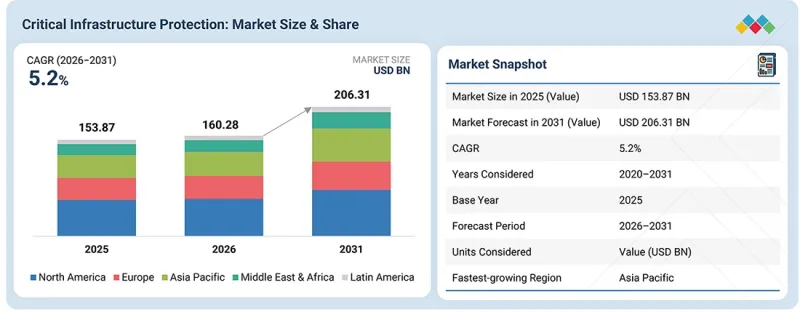
중요 인프라 보호(CIP) 시장 규모는 예측 기간 중 CAGR 5.2%로 확대하며, 2026년 1,602억 8,000만 달러에서 2031년에는 2,063억 1,000만 달러에 달할 것으로 예측됩니다.
| 조사 범위 | |
|---|---|
| 조사 대상 기간 | 2020-2031년 |
| 기준연도 | 2025년 |
| 예측 기간 | 2026-2031년 |
| 단위 | 금액(달러) |
| 부문 | 제품·서비스, 산업, 지역 |
| 대상 지역 | 북미, 유럽, 아시아태평양, 중동 및 아프리카, 라틴아메리카 |
중요 시설에서는 송전망 장애, 자연재해 및 기타 혼란 상황에서도 운영을 유지하기 위해 비상 전원 및 백업 발전 인프라 강화가 진행되고 있습니다. 이에 따라 발전기, 변전소, 연료 시스템, 백업 전원 설비 주변의 경계 보호, 접근 제어, 감시, 모니터링 및 OT 보안에 대한 수요가 증가하고 있습니다. 무정전 전원 공급 장치에 대한 의존도가 높아짐에 따라 이러한 시설을 위한 통합형 CIP 솔루션에 대한 투자는 더욱 증가하고 있습니다.
"IT 사이버 보안 솔루션별로는 OT 보안 및 인프라 관리를 위한 디지털 트윈 플랫폼 부문이 예측 기간 중 가장 높은 연평균 성장률(CAGR)을 기록할 것으로 예상됩니다."
중요 인프라 운영 사업자가 물리적 자산, 산업 공정, 네트워크 환경을 가상 환경에서 재현·분석하려는 가운데, 이러한 플랫폼은 가장 빠른 성장을 이룰 것으로 예상됩니다. 이러한 플랫폼을 활용함으로써 조직은 가동중인 인프라에 지장을 주지 않고 운영 상황을 시뮬레이션하며, 취약점을 파악하고, 잠재적인 보안 영향을 평가하며, 대응 전략을 테스트할 수 있게 됩니다. 에너지, 제조, 운송, 공공사업 분야의 복잡한 OT 시스템 도입 확대 또한 예측형 보안 및 인프라 관리 기능에 대한 수요를 더욱 높이고 있습니다. 또한 디지털 트윈을 자산 가시화, 예측 분석, 취약점 평가, 시나리오 시뮬레이션과 통합함으로써 예방적 리스크 관리 및 운영 보안 분야에서 그 가치가 더욱 높아지고 있습니다.
"물리적 보안 시스템별로는 감시·모니터링 시스템 부문이 2026년에 가장 큰 시장 점유율을 차지할 것으로 예측됩니다."
감시·모니터링 시스템은 에너지 시설, 교통 인프라, 산업 단지, 정부 시설, 상업 시설 등에 광범위하게 도입됨에 힘입어 물리적 보안 시스템 중 최대 점유율을 차지할 것으로 예측됩니다. 지속적인 자산 모니터링, 경계 보호, 침입 탐지, 상황 인식에 대한 요구 사항이 높아짐에 따라 CCTV, 열화상, 영상 분석, 드론 탐지 기술의 도입이 가속화되고 있습니다. 또한 통합된 지능형 모니터링으로의 전환을 통해 운영 담당자는 보안 사건을 보다 신속하게 식별하고, 대응 협력을 강화하며, 지역적으로 분산된 중요 자산을 보호할 수 있게 되었습니다. 더욱이, 감시 시스템과 접근 제어, 침입 탐지, 보안 운영 플랫폼 간의 통합이 진행되고 있는 점도 중요 인프라 환경 전반에 걸쳐 첨단 감시·모니터링 시스템에 대한 수요를 강화하고 있습니다.
"지역별로는 북미가 2026년에 가장 큰 시장 점유율을 차지할 것으로 예측됩니다."
북미의 CIP 시장은 전력, 교통, 상수도, 디지털, 통신 인프라의 대규모 현대화는 물론, 상호 연결된 자산 보호에 대한 요구 증가에 힘입어 성장하고 있습니다. 미국에서는 뱅크 오브 아메리카(Bank of America)가 디지털 인프라, 에너지, 교통, 상수도 및 관련 시스템을 대상으로 하는 2,500억 달러 규모의 ‘Critical Infrastructure Finance Initiative’를 발표하여, 통합형 보안을 필요로 하는 광범위한 인프라 투자 프로젝트가 창출되고 있습니다. 캐나다에서도 ‘Build Communities Strong Fund’를 통해 510억 달러를 교통, 상수도, 의료, 광대역 및 기타 인프라에 투입할 방침입니다. 또한 국경을 넘는 전력망의 현대화도 지역 시장의 성장 기회를 확대하고 있습니다. 새로운 미국-캐나다 간 송전 프로젝트를 통해 최대 650MW의 송전 용량이 추가되는 한편, 캐나다에서는 2050년까지 국내 전력 수요가 2배로 증가할 것으로 전망됩니다. 이러한 동향은 중요 인프라 전반에 걸친 물리적 보안, IT 사이버 보안, OT 보호, 통합 모니터링에 대한 수요를 지원하고 있습니다.
이 보고서에서는 전 세계 중요 인프라 보호 시장을 조사하여, 시장 개요, 시장 성장에 영향을 미치는 다양한 요인에 대한 분석, 기술 및 특허 동향, 법규제 환경, 사례 연구, 시장 규모 추이 및 전망, 각종 분류·지역/주요 국가별 상세 분석, 경쟁 구도, 주요 기업 개요 등을 종합적으로 다루고 있습니다.
자주 묻는 질문
목차
제1장 서론
제2장 개요
제3장 주요 인사이트
제4장 시장 개요
제5장 업계 동향
제6장 기술의 진보, AI에 의한 영향, 특허, 혁신, 향후 응용
제7장 규제 상황
제8장 소비자의 상황과 구매 행동
제9장 중요 인프라 보호 시장 : 제공별
제10장 중요 인프라 보호 시장 : 업계별
제11장 중요 인프라 보호 시장 : 지역별
제12장 경쟁 구도
제13장 기업 개요
제14장 조사 방법
제15장 부록
KSA 26.09.14The critical infrastructure protection (CIP) market is projected to grow from USD 160.28 billion in 2026 to USD 206.31 billion by 2031 at a CAGR of 5.2% during the forecast period.
| Scope of the Report | |
|---|---|
| Years Considered for the Study | 2020-2031 |
| Base Year | 2025 |
| Forecast Period | 2026-2031 |
| Units Considered | Value (USD Million/USD Billion) |
| Segments | Offering, Vertical, and Region |
| Regions covered | North America, Europe, Asia Pacific, Middle East & Africa, Latin America |
Critical facilities are increasingly strengthening emergency power and backup-generation infrastructure to maintain operations during grid failures, natural disasters, and other disruptions. This is driving demand for perimeter protection, access control, surveillance, monitoring, and OT security around generators, substations, fuel systems, and backup power equipment. Growing dependence on uninterrupted power is further increasing investment in integrated CIP solutions for these facilities.
"By IT cybersecurity solution, the digital twin platform for OT security & infrastructure management segment is expected to witness the highest CAGR during the forecast period."
Digital twin platforms for OT security & infrastructure management are expected to witness the fastest growth as critical infrastructure operators seek to replicate and analyze physical assets, industrial processes, and network environments in virtual settings. These platforms enable organizations to simulate operational conditions, identify vulnerabilities, assess potential security impacts, and test response strategies without disrupting live infrastructure. The increasing deployment of complex OT systems across energy, manufacturing, transportation, and utilities is driving greater demand for predictive security and infrastructure management capabilities. Integrating digital twins with asset visibility, predictive analytics, vulnerability assessment, and scenario simulation further enhances their value for proactive risk management and operational security.
"By physical security offering system, the surveillance & monitoring systems segment is projected to hold the largest market share in 2026."
Surveillance & monitoring systems are projected to account for the largest share within physical security systems, supported by widespread deployment across energy facilities, transportation infrastructure, industrial sites, government facilities, and commercial premises. Increasing requirements for continuous asset monitoring, perimeter protection, intrusion detection, and situational awareness are driving adoption of CCTV, thermal imaging, video analytics, and drone detection technologies. The shift toward centralized and intelligent monitoring is further enabling operators to identify security events faster, improve response coordination, and protect geographically distributed critical assets. Growing integration of surveillance with access control, intrusion detection, and security operations platforms is also strengthening demand for advanced surveillance and monitoring systems across critical infrastructure environments.
"By region, North America is projected to hold the largest market share in 2026."
North America's CIP market is supported by large-scale modernization of power, transportation, water, digital, and communications infrastructure, alongside increasing requirements to secure interconnected assets. In the US, Bank of America announced a USD 250 billion Critical Infrastructure Finance Initiative covering digital infrastructure, energy, transportation, water, and related systems, creating a broad pipeline of infrastructure requiring integrated security. Canada is also committing USD 51 billion through its Build Communities Strong Fund toward transportation, water, healthcare, broadband, and other infrastructure. Cross-border grid modernization is further strengthening the regional opportunity, with a new US-Canada transmission project adding up to 650 MW of transfer capacity, while Canada expects national electricity demand to double by 2050. These developments are supporting demand for physical security, IT cybersecurity, OT protection, and integrated monitoring across critical infrastructure.
Breakdown of Primaries
The study draws insights from a range of industry experts, including component suppliers, Tier 1 companies, and OEMs. The breakdown of the primaries is as follows:
- By Company Type: Tier 1 - 40%, Tier 2 - 35%, and Tier 3 - 25%
- By Designation: C-level Executives - 64%, Managers and Other Levels - 36%
- By Region: North America - 35%, Europe - 30%, Asia Pacific - 25%, Middle East & Africa - 10%, Latin America - 10%
Major vendors in the CIP market include Axis Communications (Sweden), TPG (Forcepoint G2CI) (US), Fortinet (US), Cisco (US), BAE Systems (UK), Lockheed Martin (US), General Dynamics (US), Northrop Grumman (US), Honeywell (US), Airbus (Netherlands), Thales (France), Tenable (US), ServiceNow (US), Teltronic (Spain), Waterfall Security Solutions (Israel), Westminster Group (UK), Owl Cyber Defense (US), Suprema (South Korea), Industrial Defender (US), Terma (Denmark), Rhebo (Germany), Leidos (US), Mecom Medien-Communications (Germany), Siemens (Germany), Huawei (China), GE Vernova (US), NEC Corporation (Japan), Fujitsu (Japan), Luna Innovations (US), Dragos (US), Claroty (US), Nozomi Networks (US), Xage Security (US), TXOne Networks (Taiwan), OTORIO (Israel), XM Cyber (Israel), Radiflow (Israel), DeNexus (US), Cyolo (Israel), Shieldworkz (UAE), Cydome (UK), SecurityGate.io (US), and Applied Risk (Netherlands).
The study includes an in-depth competitive analysis of the key players in the CIP market, their company profiles, recent developments, and key market strategies.
Research Coverage
The report segments the CIP market and forecasts its size based on offerings (physical security offerings (systems, services), IT cybersecurity solutions (solutions, services), and OT cybersecurity solutions (solutions, services)), physical security systems (perimeter protection, surveillance and monitoring systems, access control systems, screening and scanning systems, emergency communication systems), physical security services (professional services, managed services), IT cybersecurity solutions (network and endpoint protection, identity and access management, cloud and application security, encryption and data protection, threat detection and response platforms, compliance and policy management, patch management, data backup and recovery), IT cybersecurity services (professional services, managed services), OT cybersecurity solutions (OT and ICS security platforms, IoT and IIoT security solutions, OT threat detection and monitoring, digital twin platforms for OT security and infrastructure management, asset identification and visibility), OT cybersecurity services (professional services, managed services), verticals (financial institutions, government, defense, commercial sector, IT and telecom, chemicals and manufacturing, transport and logistics, energy and power, oil and gas, other verticals), and region (North America, Europe, Asia Pacific, Middle East & Africa, and Latin America).
The study also includes an in-depth competitive analysis of the market's key players, including company profiles, key observations on product and business offerings, recent developments, and key market strategies.
Key Benefits of Buying the Report
The report will help market leaders/new entrants with information on the closest approximations of revenue numbers for the overall CIP market and its subsegments. This report will help stakeholders understand the competitive landscape and gain valuable insights to better position their businesses and plan suitable go-to-market strategies. The report also helps stakeholders understand the market pulse and provides information on key market drivers, restraints, challenges, and opportunities.
The report provides insights on the following pointers:
- Analysis of critical drivers (Escalating cyber and physical threats targeting critical infrastructure, Stricter cybersecurity and resilience requirements across critical sectors), restraints (Complexity of integrating security with legacy OT environments, Limited availability of skilled OT cybersecurity professionals), opportunities (AI-enabled threat detection and automated response, Growing investment in infrastructure modernization and resilience), and challenges (Managing cybersecurity risks across third-party supply chains, Balancing security upgrades with operational continuity requirements)
- Product Development/Innovation: Detailed insights on upcoming technologies, research and development activities, and product & service launches in the CIP market
- Market Development: Comprehensive information about lucrative markets - the report analyzes the CIP market across varied regions
- Market Diversification: Exhaustive information about new products and services, untapped geographies, recent developments, and investments in the CIP market
- Competitive Assessment: In-depth assessment of market shares, growth strategies, and service offerings of leading players, such as Axis Communications (Sweden), TPG (Forcepoint G2CI) (US), Fortinet (US), Cisco (US), BAE Systems (UK), Lockheed Martin (US), General Dynamics (US), Northrop Grumman (US), Honeywell (US), Airbus (Netherlands), and Thales (France) among others
TABLE OF CONTENTS
1 INTRODUCTION
- 1.1 STUDY OBJECTIVES
- 1.2 MARKET DEFINITION
- 1.2.1 INCLUSIONS AND EXCLUSIONS
- 1.3 STUDY SCOPE
- 1.3.1 MARKET SEGMENTATION
- 1.3.2 YEARS CONSIDERED
- 1.4 CURRENCY CONSIDERED
- 1.5 STAKEHOLDERS
- 1.6 SUMMARY OF CHANGES
2 EXECUTIVE SUMMARY
- 2.1 MARKET HIGHLIGHTS AND KEY INSIGHTS
- 2.2 KEY MARKET PARTICIPANTS: MAPPING OF STRATEGIC DEVELOPMENTS
- 2.3 DISRUPTIVE TRENDS SHAPING MARKET
- 2.4 HIGH-GROWTH SEGMENTS & EMERGING FRONTIERS
- 2.5 SNAPSHOT: GLOBAL MARKET SIZE, GROWTH RATE, AND FORECAST
3 PREMIUM INSIGHTS
- 3.1 ATTRACTIVE OPPORTUNITIES FOR PLAYERS IN CRITICAL INFRASTRUCTURE PROTECTION MARKET
- 3.2 CRITICAL INFRASTRUCTURE PROTECTION MARKET, BY OFFERING
- 3.3 CRITICAL INFRASTRUCTURE PROTECTION MARKET, BY PHYSICAL SECURITY OFFERING
- 3.4 CRITICAL INFRASTRUCTURE PROTECTION MARKET, BY ORGANIZATION SIZE
- 3.5 CRITICAL INFRASTRUCTURE PROTECTION MARKET, BY REGION
4 MARKET OVERVIEW
- 4.1 INTRODUCTION
- 4.2 MARKET DYNAMICS
- 4.2.1 DRIVERS
- 4.2.1.1 Escalating cyber and physical threats targeting critical infrastructure
- 4.2.1.2 Stricter cybersecurity and resilience requirements across critical sectors
- 4.2.1.3 Growing IT/OT convergence and remote connectivity expanding the cyberattack surface
- 4.2.2 RESTRAINTS
- 4.2.2.1 Complexity of integrating cybersecurity with legacy OT environments
- 4.2.2.2 Limited availability of skilled cybersecurity and OT professionals
- 4.2.3 OPPORTUNITIES
- 4.2.3.1 Growing investment in infrastructure modernization and cyber-resilience
- 4.2.3.2 AI-enabled threat detection and automated cyber defense
- 4.2.4 CHALLENGES
- 4.2.4.1 Managing cybersecurity risks across third-party and critical infrastructure supply chains
- 4.2.4.2 Balancing cybersecurity upgrades with operational continuity requirements
- 4.2.1 DRIVERS
- 4.3 UNMET NEEDS AND WHITE SPACES
- 4.4 INTERCONNECTED MARKETS AND CROSS-SECTOR OPPORTUNITIES
- 4.4.1 INTERCONNECTED MARKETS
- 4.4.2 CROSS-SECTOR OPPORTUNITIES
- 4.5 STRATEGIC MOVES BY TIER-1/2/3 PLAYERS
- 4.5.1 CROSS-TIER STRATEGIC PATTERNS
- 4.5.2 STRATEGIC TRENDS
- 4.5.2.1 AI-driven threat detection and predictive analytics
- 4.5.2.2 Growth of managed CIP cybersecurity services
- 4.5.2.3 Expansion of cloud-native and hybrid CIP environments
- 4.5.2.4 Regulatory automation and cyber-resilience governance
5 INDUSTRY TRENDS
- 5.1 PORTER'S FIVE FORCES ANALYSIS
- 5.1.1 THREAT OF NEW ENTRANTS
- 5.1.2 THREAT OF SUBSTITUTES
- 5.1.3 BARGAINING POWER OF SUPPLIERS
- 5.1.4 BARGAINING POWER OF BUYERS
- 5.1.5 INTENSITY OF COMPETITIVE RIVALRY
- 5.2 MACROECONOMIC INDICATORS
- 5.2.1 INTRODUCTION
- 5.2.2 GDP TRENDS AND FORECAST
- 5.2.3 TRENDS IN GLOBAL ICT INDUSTRY
- 5.2.4 TRENDS IN GLOBAL CYBERSECURITY INDUSTRY
- 5.3 VALUE CHAIN ANALYSIS
- 5.3.1 COMPONENT PROVIDERS
- 5.3.2 PLANNING AND DESIGNING ORGANIZATIONS
- 5.3.3 SOLUTION AND SERVICE PROVIDERS
- 5.3.4 SYSTEM INTEGRATORS
- 5.3.5 RETAIL/DISTRIBUTION CHANNELS
- 5.3.6 END USERS
- 5.4 ECOSYSTEM ANALYSIS
- 5.5 PRICING ANALYSIS
- 5.5.1 AVERAGE SELLING PRICE TREND OF KEY PLAYERS, BY SYSTEM
- 5.5.2 INDICATIVE PRICING ANALYSIS, BY VENDOR
- 5.6 KEY CONFERENCES AND EVENTS IN 2026-2027
- 5.7 TRENDS/DISRUPTIONS IMPACTING CUSTOMER BUSINESS
- 5.8 INVESTMENT AND FUNDING SCENARIO
- 5.9 CASE STUDY ANALYSIS
- 5.9.1 CASE STUDY 1: ALTA PREVENTED MALICIOUS FILE UPLOADS WITH ZERO TRUST CDR
- 5.9.2 CASE STUDY 2: NEXPERTIS GUARDED AGAINST INSIDER THREATS WITH FORCEPOINT
- 5.9.3 CASE STUDY 3: CONSOLIDATED EDISON-PATROLLED AIRSPACE WITH AXIS 360-DEGREE CAMERAS AND DEDRONE COUNTER-DRONE SOLUTION
- 5.9.4 CASE STUDY 4: TOSIBOX REVOLUTIONIZED REMOTE CONNECTIVITY FOR NWCPUD UTILITIES
- 5.9.5 CASE STUDY 5: MANIPAL UNIVERSITY STRENGTHENED PHYSICAL SECURITY AND CAMPUS OPERATIONS WITH HONEYWELL'S SMART CARD SOLUTION
- 5.9.6 CASE STUDY 6: ADT'S INTEGRATED SURVEILLANCE ENHANCED PHYSICAL SECURITY AND OPERATIONAL EFFICIENCY AT DUBLIN AIRPORT TERMINAL 2
- 5.9.7 CASE STUDY 7: WESCO'S INTEGRATED NETWORK UPGRADE STRENGTHENED PHYSICAL AND CYBERSECURITY IN MUNICIPAL WASTEWATER INFRASTRUCTURE
- 5.9.8 CASE STUDY 8: PELCO'S PHYSICAL SECURITY TRANSFORMATION AT CHESAPEAKE BAY BRIDGE-TUNNEL SECURED VITAL TRANSPORTATION LINK
- 5.9.9 CASE STUDY 9: HAURAKI DISTRICT COUNCIL SECURED CRITICAL INFRASTRUCTURE AND MANAGED THIRD-PARTY RISK WITH DARKTRACE AI
- 5.9.10 CASE STUDY 10: ALGOSEC HELPED NCR CORPORATION ACHIEVE ZERO TRUST SECURITY
- 5.10 TRADE ANALYSIS
- 5.10.1 IMPORT DATA
- 5.10.2 EXPORT DATA
- 5.11 IMPACT OF US TRUMP TARIFF ON CRITICAL INFRASTRUCTURE PROTECTION MARKET
- 5.11.1 INTRODUCTION
- 5.11.2 KEY TARIFF RATES
- 5.11.3 PRICE IMPACT ANALYSIS
- 5.11.4 IMPACT ON COUNTRY/REGION
- 5.11.4.1 North America
- 5.11.4.1.1 US
- 5.11.4.1.2 Canada
- 5.11.4.1.3 Mexico
- 5.11.4.2 Europe
- 5.11.4.2.1 Germany
- 5.11.4.2.2 France
- 5.11.4.2.3 United Kingdom
- 5.11.4.3 Asia Pacific
- 5.11.4.3.1 China
- 5.11.4.3.2 India
- 5.11.4.3.3 Japan
- 5.11.4.1 North America
- 5.12 IMPACT OF US-IRAN CONFLICT ON CRITICAL INFRASTRUCTURE PROTECTION MARKET
6 TECHNOLOGICAL ADVANCEMENTS, AI-DRIVEN IMPACT, PATENTS, INNOVATIONS, AND FUTURE APPLICATIONS
- 6.1 TECHNOLOGY ANALYSIS
- 6.1.1 KEY TECHNOLOGIES
- 6.1.1.1 AI & ML for Predictive Security
- 6.1.1.2 Operational Technology (OT) Security Platforms
- 6.1.1.3 IoT
- 6.1.1.4 Quantum-resistant Cybersecurity
- 6.1.1.5 5G & Edge Computer for CIP
- 6.1.2 COMPLEMENTARY TECHNOLOGIES
- 6.1.2.1 Big Data Analytics
- 6.1.2.2 Blockchain Technology
- 6.1.3 ADJACENT TECHNOLOGIES
- 6.1.3.1 Zero Trust Architecture
- 6.1.3.2 Extended Detection and Response
- 6.1.3.3 Drones
- 6.1.3.4 Biometrics
- 6.1.1 KEY TECHNOLOGIES
- 6.2 TECHNOLOGY ROADMAP
- 6.2.1 SHORT-TERM (2026-2027) OT VISIBILITY, ASSET PROTECTION & SECURITY INTEGRATION
- 6.2.2 MID-TERM (2027-2030) | SCALING, INTELLIGENCE & ECOSYSTEM EXPANSION
- 6.2.3 LONG-TERM (2030-2035+) | AUTONOMOUS, PREDICTIVE & SELF-HEALING ICS SECURITY
- 6.3 PATENT ANALYSIS
- 6.4 FUTURE APPLICATIONS
- 6.4.1 AI-ENABLED THREAT DETECTION
- 6.4.2 REAL-TIME SECURE DATA EXCHANGE FOR AI, EDGE & CONNECTED ENVIRONMENTS
- 6.4.3 AUTONOMOUS THREAT DETECTION & RESPONSE
- 6.4.4 INTEGRATED PHYSICAL & CYBER INFRASTRUCTURE SECURITY
- 6.4.5 THIRD-PARTY & SUPPLY CHAIN RESILIENCE
- 6.5 IMPACT OF AI/GEN AI ON CIP MARKET
- 6.5.1 TOP USE CASES AND MARKET POTENTIAL
- 6.5.2 BEST PRACTICES IN CRITICAL INFRASTRUCTURE PROTECTION
- 6.5.3 CASE STUDIES RELATED TO AI IMPLEMENTATION IN CRITICAL INFRASTRUCTURE PROTECTION
- 6.5.4 INTERCONNECTED ADJACENT ECOSYSTEM AND IMPACT ON MARKET PLAYERS
- 6.5.5 CLIENTS' READINESS TO ADOPT GENERATIVE AI IN CRITICAL INFRASTRUCTURE PROTECTION MARKET
7 REGULATORY LANDSCAPE
- 7.1 TARIFF RELATED TO CRITICAL INFRASTRUCTURE PROTECTION PRODUCTS
- 7.2 REGULATORY BODIES, GOVERNMENT AGENCIES, AND OTHER ORGANIZATIONS
- 7.3 KEY REGULATIONS
- 7.3.1 US CRITICAL INFRASTRUCTURE INFORMATION ACT
- 7.3.2 NORTH AMERICAN ELECTRIC RELIABILITY CORPORATION CRITICAL INFRASTRUCTURE PROTECTION
- 7.3.3 EUROPEAN PROGRAM FOR CRITICAL INFRASTRUCTURE PROTECTION
- 7.3.4 IT SECURITY ACT OF GERMANY
- 7.3.5 INFORMATION TECHNOLOGY ACT OF 2002 OF INDIA
- 7.3.6 CYBERSECURITY LAW OF PEOPLE'S REPUBLIC OF CHINA
- 7.3.7 CYBERSECURITY ACT OF SINGAPORE
- 7.4 INDUSTRY STANDARDS
8 CONSUMER LANDSCAPE AND BUYER BEHAVIOR
- 8.1 DECISION-MAKING PROCESS
- 8.2 KEY STAKEHOLDERS AND BUYING CRITERIA
- 8.2.1 KEY STAKEHOLDERS IN BUYING PROCESS
- 8.2.2 BUYING CRITERIA
- 8.3 ADOPTION BARRIERS AND INTERNAL CHALLENGES
- 8.4 UNMET NEEDS IN VARIOUS END-USE INDUSTRIES
- 8.5 CRITICAL INFRASTRUCTURE PROTECTION MATURITY SPECTRUM
- 8.5.1 REACTIVE PROTECTION
- 8.5.2 PREVENTIVE PROTECTION
- 8.5.3 PREDICTIVE PROTECTION
- 8.5.4 ADAPTIVE PROTECTION
- 8.5.5 AUTONOMOUS PROTECTION
9 CRITICAL INFRASTRUCTURE PROTECTION MARKET, BY OFFERING
- 9.1 INTRODUCTION
- 9.1.1 OFFERING: CRITICAL INFRASTRUCTURE PROTECTION MARKET DRIVERS
- 9.2 PHYSICAL SECURITY OFFERINGS
- 9.2.1 SYSTEMS
- 9.2.1.1 Perimeter protection
- 9.2.1.1.1 Enhancing perimeter protection to safeguard first line of defense
- 9.2.1.1.2 Intrusion detection systems
- 9.2.1.1.3 Physical barriers (gates, bollards, fencing)
- 9.2.1.2 Surveillance & monitoring systems
- 9.2.1.2.1 Enhancing situational awareness with surveillance and monitoring systems
- 9.2.1.2.2 CCTV systems (fixed and PTZ cameras)
- 9.2.1.2.3 Thermal & multi-sensor units
- 9.2.1.2.4 AI-enabled smart video analytics
- 9.2.1.2.5 Drone surveillance platforms
- 9.2.1.2.6 Counter-drone detection & neutralization
- 9.2.1.2.7 Video management software (VMS)
- 9.2.1.3 Access control systems
- 9.2.1.3.1 Strengthening identity verification to counter insider threats
- 9.2.1.3.2 Smart card access solutions
- 9.2.1.3.3 Biometric identity verification systems
- 9.2.1.3.4 Mobile device-based access control
- 9.2.1.3.5 Visitor management systems
- 9.2.1.4 Screening & scanning systems
- 9.2.1.4.1 Enhancing threat detection with multi-layered screening
- 9.2.1.4.2 X-Ray scanning solutions (baggage and cargo)
- 9.2.1.4.3 Metal detection equipment
- 9.2.1.4.4 Explosive & hazardous material detection systems
- 9.2.1.5 Emergency communication systems
- 9.2.1.5.1 Building resilient and responsive communication networks
- 9.2.1.5.2 Audible & visual alert systems
- 9.2.1.5.3 Public address & mass notification platforms
- 9.2.1.1 Perimeter protection
- 9.2.2 SERVICES (PHYSICAL SECURITY OFFERING)
- 9.2.2.1 Professional services
- 9.2.2.1.1 Securing infrastructure through professional services
- 9.2.2.1.2 Design, Consulting & Implementation Services
- 9.2.2.1.3 Risk assessment & compliance consulting
- 9.2.2.1.4 Training & Education
- 9.2.2.1.5 Support & Maintenance
- 9.2.2.2 Managed services
- 9.2.2.2.1 Streamlining protection through managed security services
- 9.2.2.1 Professional services
- 9.2.1 SYSTEMS
- 9.3 IT CYBERSECURITY SOLUTIONS
- 9.3.1 SOLUTIONS
- 9.3.1.1 Network & endpoint protection
- 9.3.1.1.1 Defending first line with network & endpoint protection
- 9.3.1.1.2 Firewalls & NAC
- 9.3.1.1.3 EPP & XDR platforms
- 9.3.1.1.4 VPN & Zero Trust Network Access
- 9.3.1.1.5 Antivirus/Antimalware Solutions
- 9.3.1.2 Identity & access management solutions
- 9.3.1.2.1 Enforcing digital trust with IAM solutions for robust authentication mechanisms
- 9.3.1.3 Cloud & application security
- 9.3.1.3.1 Protecting digital transformation by rapid adoption of cloud computing, SaaS applications, and DevOps-driven innovation
- 9.3.1.4 Encryption & data protection
- 9.3.1.4.1 Safeguarding information assets to ensure confidentiality
- 9.3.1.5 Threat detection & response platforms
- 9.3.1.5.1 Intelligent defense with rapid detection and response to address modern, sophisticated attacks that bypass traditional defenses
- 9.3.1.5.2 Log Management & SIEM
- 9.3.1.5.3 Security Orchestration, Automation, and Response (SOAR)
- 9.3.1.6 Compliance & policy management
- 9.3.1.6.1 Aligning regulations with compliance & policy management solutions
- 9.3.1.7 Patch management
- 9.3.1.7.1 Intelligent defense with rapid detection and response to address vulnerabilities in operating systems
- 9.3.1.7.2 Automated Patch Deployment Tools
- 9.3.1.7.3 Vulnerability Assessment & Remediation
- 9.3.1.8 Data backup & recovery
- 9.3.1.8.1 Ensuring business continuity with data backup & recovery solutions
- 9.3.1.8.2 Disaster Recovery-as-a-Service (DRaaS)
- 9.3.1.8.3 Backup Automation & Orchestration Tools
- 9.3.1.1 Network & endpoint protection
- 9.3.2 SERVICES
- 9.3.2.1 Professional services
- 9.3.2.1.1 Guiding cybersecurity transformation through professional services
- 9.3.2.1.2 Design, Consulting & Implementation Services
- 9.3.2.1.3 Risk & Threat Management
- 9.3.2.1.4 Training & Education
- 9.3.2.1.5 Support & Maintenance
- 9.3.2.2 Managed services
- 9.3.2.2.1 Outsourcing security operations for cybersecurity management
- 9.3.2.1 Professional services
- 9.3.1 SOLUTIONS
- 9.4 OT CYBERSECURITY SOLUTIONS
- 9.4.1 SOLUTIONS
- 9.4.1.1 OT & ICS security platform
- 9.4.1.1.1 Safeguarding industrial control systems against external cyberattacks and insider threats
- 9.4.1.1.2 SCADA Network Security Systems
- 9.4.1.1.3 Industrial Control System (ICS) security solutions
- 9.4.1.1.4 Firewall solutions
- 9.4.1.2 IoT & IIoT Security Solutions
- 9.4.1.2.1 Safeguarding connected operational environments by detecting malicious patterns
- 9.4.1.2.2 Secure device authentication & management
- 9.4.1.2.3 Network segmentation
- 9.4.1.2.4 Anomaly detection
- 9.4.1.1 OT & ICS security platform
- 9.4.2 OT THREAT DETECTION & MONITORING
- 9.4.2.1 Staying alert against external cyberattacks and insider threats
- 9.4.2.1.1 SIEM solutions
- 9.4.2.1.2 Behavioral anomaly detection
- 9.4.2.1 Staying alert against external cyberattacks and insider threats
- 9.4.3 DIGITAL TWIN PLATFORMS
- 9.4.3.1 Building cyber-resilient models to simulate and predict cyber risks
- 9.4.3.1.1 Predictive analysis
- 9.4.3.1.2 Security scenario simulation and response planning
- 9.4.3.1 Building cyber-resilient models to simulate and predict cyber risks
- 9.4.4 ASSET IDENTIFICATION & VISIBILITY
- 9.4.4.1 Uncovering hidden risks in OT networks
- 9.4.4.1.1 Asset discovery tools
- 9.4.4.1.2 Configuration management databases services
- 9.4.4.1 Uncovering hidden risks in OT networks
- 9.4.5 SERVICES
- 9.4.5.1 Professional services
- 9.4.5.1.1 Expert guidance for industrial security to address OT cybersecurity challenges
- 9.4.5.1.2 OT cybersecurity compliance & risk advisory
- 9.4.5.1.3 Design & integration services
- 9.4.5.1.4 Industrial incident preparedness training
- 9.4.5.1.5 OT/ICS penetration testing and vulnerability assessment
- 9.4.5.2 Managed services
- 9.4.5.2.1 Continuous protection for critical operations
- 9.4.5.1 Professional services
- 9.4.1 SOLUTIONS
10 CRITICAL INFRASTRUCTURE PROTECTION MARKET, BY VERTICAL
- 10.1 INTRODUCTION
- 10.1.1 VERTICAL: CRITICAL INFRASTRUCTURE PROTECTION MARKET DRIVERS
- 10.2 FINANCIAL INSTITUTIONS
- 10.2.1 FINANCIAL INSTITUTIONS TO ENSURE ADHERENCE TO STRICT REGULATIONS BY ADOPTING CIP
- 10.3 GOVERNMENT
- 10.3.1 GROWTH IN CYBER THREATS FACED BY GOVERNMENT AGENCIES TO DRIVE ADOPTION OF CIP
- 10.4 DEFENSE
- 10.4.1 CYBERSECURITY COLLABORATION TO STRENGTHEN DEFENSE INFRASTRUCTURE
- 10.5 TRANSPORT & LOGISTICS
- 10.5.1 ENHANCED SECURITY MEASURES TO SAFEGUARD TRANSPORTATION NETWORKS
- 10.5.2 HIGHWAYS & BRIDGES
- 10.5.3 RAILWAY INFRASTRUCTURE
- 10.5.4 SEAPORTS
- 10.5.5 AIRPORTS
- 10.6 ENERGY & POWER
- 10.6.1 EFFICIENCY OF PRODUCTION PROCESSES IN HIGH-RISK ENVIRONMENTS TO DRIVE MARKET
- 10.6.2 THERMAL POWER PLANTS
- 10.6.3 NUCLEAR POWER PLANTS
- 10.6.4 RENEWABLE ENERGY POWER PLANTS
- 10.7 COMMERCIAL SECTOR
- 10.7.1 NEED FOR ADVANCED AI DEFENSES TO COMBAT INCREASING INCIDENCES OF CYBERTHREATS
- 10.8 TELECOM
- 10.8.1 NECESSITY FOR SAFEGUARDING IT AND TELECOMMUNICATION NETWORKS FROM HACKERS
- 10.9 CHEMICALS & MANUFACTURING
- 10.9.1 IMPORTANCE OF KEEN SURVEILLANCE FOR SAFETY IN HAZARDOUS ENVIRONMENTS
- 10.10 OIL & GAS
- 10.10.1 POLITICAL TURMOIL IN OIL-RICH COUNTRIES TO INCREASE RISK OF CYBER-ATTACKS
- 10.10.2 UPSTREAM
- 10.10.3 DOWNSTREAM
- 10.10.4 MIDSTREAM
- 10.11 OTHER VERTICALS
- 10.11.1 WATER & WASTEWATER SECTOR
11 CRITICAL INFRASTRUCTURE PROTECTION MARKET, BY REGION
- 11.1 INTRODUCTION
- 11.2 NORTH AMERICA
- 11.2.1 NORTH AMERICA: MARKET DRIVERS
- 11.2.2 US
- 11.2.2.1 Government initiatives to strengthen critical infrastructure cybersecurity amid escalating threats
- 11.2.3 CANADA
- 11.2.3.1 Concerning security lag in energy companies to drive need for CIP solutions and services
- 11.3 ASIA PACIFIC
- 11.3.1 ASIA PACIFIC: MARKET DRIVERS
- 11.3.2 CHINA
- 11.3.2.1 Surge in economic growth and technological innovation to drive market
- 11.3.3 JAPAN
- 11.3.3.1 Robust base of technologically advanced industries to drive market
- 11.3.4 INDIA
- 11.3.4.1 Digitalization transformation to spur demand for critical infrastructure
- 11.3.5 REST OF ASIA PACIFIC
- 11.4 EUROPE
- 11.4.1 EUROPE: MARKET DRIVERS
- 11.4.2 UK
- 11.4.2.1 Increase in cyberattacks to drive need for critical infrastructure protection
- 11.4.3 GERMANY
- 11.4.3.1 Government initiatives to contribute to technological advancements by protecting critical infrastructures
- 11.4.4 FRANCE
- 11.4.4.1 ANSSI's initiatives for securing critical infrastructure to drive market
- 11.4.5 ITALY
- 11.4.5.1 Surge in cyberattacks exacerbated by rise in remote work to drive market
- 11.4.6 REST OF EUROPE
- 11.5 MIDDLE EAST & AFRICA
- 11.5.1 MIDDLE EAST & AFRICA: MARKET DRIVERS
- 11.5.2 GULF COOPERATION COUNCIL (GCC)
- 11.5.2.1 KSA
- 11.5.2.1.1 Flourishing economy driven by manufacturing and industrial sectors to drive market
- 11.5.2.2 UAE
- 11.5.2.2.1 Initiatives by CICPA and TRA to maintain security of critical infrastructure
- 11.5.2.3 Rest of GCC countries
- 11.5.2.1 KSA
- 11.5.3 SOUTH AFRICA
- 11.5.3.1 Comprehensive approach to infrastructure protection to drive market
- 11.5.4 REST OF MIDDLE EAST & AFRICA
- 11.6 LATIN AMERICA
- 11.6.1 LATIN AMERICA: MARKET DRIVERS
- 11.6.2 BRAZIL
- 11.6.2.1 Rise in adoption of advanced CIP technologies to drive market
- 11.6.3 MEXICO
- 11.6.3.1 Digital evolution to help enhance critical infrastructure protection
- 11.6.4 REST OF LATIN AMERICA
12 COMPETITIVE LANDSCAPE
- 12.1 KEY PLAYER STRATEGIES/RIGHT TO WIN, 2024-2026
- 12.2 REVENUE ANALYSIS, 2020-2025
- 12.3 MARKET SHARE ANALYSIS, 2025
- 12.4 BRAND COMPARISON
- 12.5 COMPANY VALUATION AND FINANCIAL METRICS
- 12.5.1 COMPANY VALUATION, 2026
- 12.5.2 FINANCIAL METRICS USING EV/EBIDTA, 2026
- 12.6 COMPANY EVALUATION MATRIX: KEY PLAYERS, 2025
- 12.6.1 STARS
- 12.6.2 EMERGING LEADERS
- 12.6.3 PERVASIVE PLAYERS
- 12.6.4 PARTICIPANTS
- 12.6.5 COMPANY FOOTPRINT: KEY PLAYERS, 2025
- 12.6.5.1 Company footprint
- 12.6.5.2 Region footprint
- 12.6.5.3 Offering footprint
- 12.6.5.4 Vertical footprint
- 12.7 COMPANY EVALUATION MATRIX: STARTUPS/SMES, 2025
- 12.7.1 PROGRESSIVE COMPANIES
- 12.7.2 RESPONSIVE COMPANIES
- 12.7.3 DYNAMIC COMPANIES
- 12.7.4 STARTING BLOCKS
- 12.7.5 COMPETITIVE BENCHMARKING: STARTUPS/SMES, 2026
- 12.7.5.1 Detailed list of key startups/SMEs
- 12.7.6 COMPETITIVE BENCHMARKING OF KEY STARTUPS /SMES
- 12.7.6.1 Startups /SMEs Region Footprint
- 12.7.6.2 Startups /SMEs Offering Footprint
- 12.7.6.3 Startups /SMEs Vertical footprint
- 12.8 COMPETITIVE SCENARIO
- 12.8.1 PRODUCT LAUNCHES & ENHANCEMENTS
- 12.8.2 DEALS
13 COMPANY PROFILES
- 13.1 KEY PLAYERS
- 13.1.1 LOCKHEED MARTIN
- 13.1.1.1 Business overview
- 13.1.1.2 Products/Solutions/Services offered
- 13.1.1.3 Recent developments
- 13.1.1.3.1 Deals
- 13.1.1.4 MnM view
- 13.1.1.4.1 Key strengths
- 13.1.1.4.2 Strategic choices
- 13.1.1.4.3 Weaknesses and competitive threats
- 13.1.2 HUAWEI
- 13.1.2.1 Business overview
- 13.1.2.2 Products/Solutions/Services offered
- 13.1.2.3 Recent developments
- 13.1.2.3.1 Product launches/developments
- 13.1.2.3.2 Deals
- 13.1.2.4 MnM view
- 13.1.2.4.1 Key strengths
- 13.1.2.4.2 Strategic choices
- 13.1.2.4.3 Weaknesses and competitive threats
- 13.1.3 SIEMENS
- 13.1.3.1 Business overview
- 13.1.3.2 Products/Solutions/Services offered
- 13.1.3.3 Recent developments
- 13.1.3.3.1 Product launches/developments
- 13.1.3.4 MnM view
- 13.1.3.4.1 Key strengths
- 13.1.3.4.2 Strategic choices
- 13.1.3.4.3 Weaknesses and competitive threats
- 13.1.4 BAE SYSTEMS
- 13.1.4.1 Business overview
- 13.1.4.2 Products/Solutions/Services offered
- 13.1.4.3 Recent developments
- 13.1.4.3.1 Deals
- 13.1.4.4 MnM view
- 13.1.4.4.1 Key strengths
- 13.1.4.4.2 Strategic choices
- 13.1.4.4.3 Weaknesses and competitive threats
- 13.1.5 THALES
- 13.1.5.1 Business overview
- 13.1.5.2 Products/Solutions/Services offered
- 13.1.5.3 Recent developments
- 13.1.5.3.1 Product launches/developments
- 13.1.5.3.2 Deals
- 13.1.5.4 MnM view
- 13.1.5.4.1 Key strengths
- 13.1.5.4.2 Strategic choices
- 13.1.5.4.3 Weaknesses and competitive threats
- 13.1.6 GENERAL DYNAMICS
- 13.1.6.1 Business overview
- 13.1.6.2 Products/Solutions/Services offered
- 13.1.6.3 Recent developments
- 13.1.6.3.1 Expansions
- 13.1.7 NORTHROP GRUMMAN
- 13.1.7.1 Business overview
- 13.1.7.2 Products/Solutions/Services offered
- 13.1.7.3 Recent developments
- 13.1.7.3.1 Deals
- 13.1.7.4 MnM view
- 13.1.7.4.1 Key strengths
- 13.1.7.4.2 Strategic choices
- 13.1.7.4.3 Weaknesses and competitive threats
- 13.1.8 GE VERNOVA
- 13.1.8.1 Business overview
- 13.1.8.2 Products/Solutions/Services offered
- 13.1.8.3 Recent developments
- 13.1.8.3.1 Product launches/developments
- 13.1.9 AIRBUS
- 13.1.9.1 Business overview
- 13.1.9.2 Products/Solutions/Services offered
- 13.1.9.3 Recent developments
- 13.1.9.3.1 Deals
- 13.1.10 AXIS COMMUNICATIONS
- 13.1.10.1 Business overview
- 13.1.10.2 Products/Solutions/Services offered
- 13.1.10.3 Recent developments
- 13.1.10.3.1 Product launches/developments
- 13.1.10.3.2 Deals
- 13.1.11 CISCO
- 13.1.11.1 Business overview
- 13.1.11.2 Products/Solutions/Services offered
- 13.1.11.3 Recent developments
- 13.1.11.3.1 Product launches/developments
- 13.1.11.3.2 Deals
- 13.1.12 HONEYWELL
- 13.1.12.1 Business overview
- 13.1.12.2 Products/Solutions/Services offered
- 13.1.12.3 Recent developments
- 13.1.12.3.1 Product launches/developments
- 13.1.12.3.2 Deals
- 13.1.13 TENABLE
- 13.1.14 SERVICENOW
- 13.1.15 LUNA-OPTASENSE
- 13.1.16 TELTRONIC
- 13.1.17 WATERFALL SECURITY
- 13.1.18 WESTMINSTER GROUP PLC
- 13.1.19 OWL CYBER DEFENSE
- 13.1.20 SUPREMA INC
- 13.1.21 INDUSTRIAL DEFENDER
- 13.1.22 TERMA
- 13.1.23 RHEBO AG
- 13.1.24 LEIDOS
- 13.1.25 MECOM MEDIEN-COMMUNICATIONS
- 13.1.26 NEC CORPORATION
- 13.1.27 FUJITSU
- 13.1.28 DRAGOS
- 13.1.29 CLAROTY
- 13.1.30 FORTINET
- 13.1.31 XAGE SECURITY
- 13.1.32 TXONE NETWORKS
- 13.1.33 OTORIO
- 13.1.34 XM CYBER
- 13.1.35 RADIFLOW
- 13.1.36 DENEXUS
- 13.1.37 CYOLO
- 13.1.38 SHIELDWORKZ
- 13.1.39 CYDOME
- 13.1.40 SECURITYGATE.IO
- 13.1.41 APPLIED RISK
- 13.1.42 STERYON
- 13.1.43 FORCEPOINT
- 13.1.1 LOCKHEED MARTIN
14 RESEARCH METHODOLOGY
- 14.1 RESEARCH DATA
- 14.1.1 SECONDARY DATA
- 14.1.2 PRIMARY DATA
- 14.1.2.1 Breakdown of primaries
- 14.2 MARKET BREAKUP AND DATA TRIANGULATION
- 14.3 MARKET SIZE ESTIMATION
- 14.3.1 TOP-DOWN APPROACH
- 14.3.2 BOTTOM-UP APPROACH
- 14.4 MARKET FORECAST
- 14.5 ASSUMPTIONS
15 APPENDIX
- 15.1 DISCUSSION GUIDE
- 15.2 KNOWLEDGESTORE: MARKETSANDMARKETS' SUBSCRIPTION PORTAL
- 15.3 CUSTOMIZATION OPTIONS
- 15.4 RELATED REPORTS
- 15.5 AUTHOR DETAILS


