
|
시장보고서
상품코드
2129345
우주 데이터센터 시장 : 페이로드별, 전력 용량별, 용도별, 최종사용자별, 지역별 - 세계 예측(-2040년)Space-based Data Center Market by Payload, Power Capacity, Application, End User, and Region - Global Forecast to 2040 |
||||||

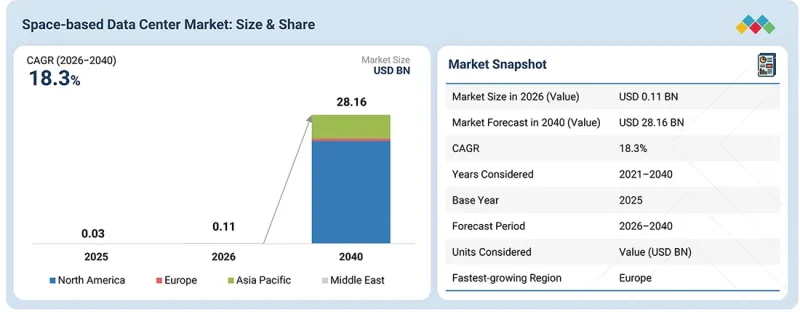
우주 데이터센터 시장 규모는 2026년 1억 1,000만 달러에서 2040년에는 281억 6,000만 달러로 확대되어, 예측 기간 동안 CAGR은 18.3%에 달할 것으로 추정됩니다.
궤도상 데이터 처리, AI 및 기계 학습을 통한 컴퓨팅, 클라우드 컴퓨팅, 데이터 스토리지에 대한 수요가 지속적으로 증가함에 따라 이 시장은 성장할 것으로 전망됩니다.
| 조사 범위 | |
|---|---|
| 조사 대상 기간 | 2021-2040년 |
| 기준 연도 | 2025년 |
| 예측 기간 | 2026-2040년 |
| 단위 | 금액(달러) |
| 부문 | 페이로드, 전력 용량, 용도, 지역별 |
| 대상 지역 | 북미, 유럽, 아시아태평양, 기타 지역 |
위성이 생성하는 데이터 양의 증가로 인해, 고성능 컴퓨팅, 광통신, 위성 간 연결 기능을 갖춘 궤도상 데이터센터의 도입이 진행되고 있습니다. 또한, 발사 비용의 감소, 재사용 가능한 발사체, 고출력 우주선, 우주 기반 엣지 컴퓨팅의 발전으로 인해 궤도상에서 확장 가능한 컴퓨팅 및 스토리지 인프라의 실현 가능성이 높아지고 있습니다.
2026년부터 2040년까지 AI·기계 학습 컴퓨팅 부문이 주도적인 위치를 차지할 것으로 전망됩니다.
용도별로는 예측 기간 동안 AI·기계 학습 컴퓨팅 분야가 가장 큰 점유율을 차지할 것으로 예상됩니다. 위성이 생성하는 이미지, 센서 데이터, 통신 데이터의 양이 증가하고 있어, 모든 원시 데이터를 지상국으로 전송하는 대신 궤도상에서 직접 처리할 필요성이 커지고 있습니다. 궤도상에서의 AI 처리 및 기계 학습을 통해 이미지 분석, 물체 탐지, 이상 징후 식별, 자율적인 의사결정을 보다 신속하게 수행할 수 있게 됩니다. 따라서 우주 기반 엣지 컴퓨팅, 고성능 컴퓨팅, AI 지원 위성 플랫폼의 도입 확대에 힘입어 상업, 정부, 국방, 지구 관측 등 각 응용 분야에서 이 부문에 대한 수요가 견인될 것으로 예상됩니다.
예측 기간 동안 1MW 이상의 부문이 가장 빠르게 성장할 것으로 전망됩니다.
전력 용량별로는 예측 기간 동안 1MW 이상 부문이 가장 높은 연평균 성장률(CAGR)을 기록할 것으로 예상됩니다. 이러한 고출력 플랫폼은 AI 및 기계 학습 컴퓨팅, 고성능 컴퓨팅, 대규모 데이터 처리, 클라우드 애플리케이션과 같은 까다로운 워크로드에 적합합니다. 우주에서의 발전, 열 관리, 모듈식 컴퓨팅 시스템 및 대용량 통신 인프라의 발전으로 궤도상에서 더 대규모의 컴퓨팅 플랫폼을 운영하는 것이 현실화됨에 따라, 이러한 플랫폼의 채택은 증가할 것으로 예상됩니다.
예측 기간 동안 아시아태평양이 가장 지배적인 지역이 될 것으로 보입니다.
아시아태평양은 예측 기간 동안 가장 큰 점유율을 차지할 것으로 예상되며, 이는 중국, 인도, 한국의 활동 확대에 힘입은 것입니다. 중국은 궤도상 AI 처리 및 위성 간 컴퓨팅 능력을 입증하는 ‘Three-Body Computing Constellation’을 통해 주요 시장 주도국으로 부상하고 있습니다. 인도에서는 TakeMe2Space의 MOI 프로그램이 지구 관측 데이터를 우주 공간에서 직접 처리함으로써 궤도상 컴퓨팅의 발전을 촉진하고 있습니다. 한국 또한 AI 탑재 위성, 차세대 우주 통신, 궤도상 컴퓨팅 기술에 대한 투자를 확대하고 있습니다. 이러한 동향에 더해, 위성 군집의 확대와 우주 기반 AI, 엣지 컴퓨팅, 데이터 처리, 스토리지에 대한 수요 증가로 인해 아시아태평양 시장에서의 입지가 더욱 공고해질 것으로 예상됩니다.
본 보고서에서는 전 세계 우주 데이터센터 시장을 조사하여, 시장 개요, 시장 성장에 영향을 미치는 다양한 요인에 대한 분석, 기술 및 특허 동향, 법규제 환경, 사례 연구, 시장 규모 추정 및 전망, 각종 분류·지역/주요 국가별 상세 분석, 경쟁 구도, 주요 기업 개요 등을 정리하고 있습니다.
자주 묻는 질문
목차
제1장 소개
제2장 주요 요약
제3장 주요 인사이트
제4장 시장 개요
제5장 업계 동향
제6장 기술의 진보, AI의 영향, 특허, 혁신, 향후 용도
제7장 지속가능성과 규제 상황
제8장 고객 상황과 구매 행동
제9장 우주 데이터센터 시장 : 용도별
제10장 우주 데이터센터 시장 : 통신 인프라별
제11장 우주 데이터센터 시장 : 최종사용자별
제12장 우주 데이터센터 시장 : 페이로드별
제13장 우주 데이터센터 시장 : 전력 용량별
제14장 우주 데이터센터 시장 : 지역별
제15장 경쟁 구도
제16장 기업 개요
제17장 조사 방법
제18장 부록
KSM 26.09.17The space-based data center market size is estimated to grow from USD 0.11 billion in 2026 to USD 28.16 billion by 2040, at a CAGR of 18.3% during the forecast period. The market is expected to grow as demand for in-orbit data processing, artificial intelligence (AI) and machine learning computing, cloud computing, and data storage continues to rise.
| Scope of the Report | |
|---|---|
| Years Considered for the Study | 2021-2040 |
| Base Year | 2025 |
| Forecast Period | 2026-2040 |
| Units Considered | Value (USD Billion) |
| Segments | By Payload, Power Capacity, Application and Region |
| Regions covered | North America, Europe, APAC, RoW |
Rising volumes of satellite-generated data are driving adoption of orbital data centers equipped with high-performance computing, optical communication, and inter-satellite connectivity. Additionally, declining launch costs, reusable launch vehicles, higher-power spacecraft, and advances in space-based edge computing are enhancing the feasibility of scalable computing and storage infrastructure in orbit.
AI & machine learning computing segment to dominate the space-based data center market from 2026 to 2040.
By application, the AI & machine learning computing segment is expected to account for the largest share of the space-based data center market during the forecast period. Satellites are generating increasing volumes of imagery, sensor and communications data, which is creating a need to process information directly in orbit rather than transmitting all raw data to ground stations. In-orbit AI processing and machine learning can enable faster image analysis, object detection, anomaly identification and autonomous decision-making. Growing adoption of space-based edge computing, high-performance computing, and AI-enabled satellite platforms is therefore expected to drive demand for this segment across commercial, government, defense, and Earth observation applications.
>=1 MW is expected to be the fastest-growing segment during the forecast period.
By power capacity, the >=1 MW segment is expected to grow at the highest CAGR in the space-based data center market during the forecast period. These high-power platforms are better suited for demanding workloads such as AI and machine learning computing, high-performance computing, large-scale data processing, and cloud applications. Their adoption is expected to increase as advances in space-based power generation, thermal management, modular computing systems, and high-capacity communication infrastructure make it more feasible to operate larger computing platforms in orbit.
Asia Pacific to be the most dominant region during the forecast period.
Asia Pacific is expected to account for the largest share of the space-based data center market during the forecast period, which is supported by growing activity in China, India, and South Korea. China is emerging as a key contributor because its Three-Body Computing Constellation demonstrates in-orbit AI processing and inter-satellite computing capabilities. In India, TakeMe2Space's MOI program is advancing orbital computing by processing Earth observation data directly in space. South Korea is also increasing investment in AI-enabled satellites, next-generation space communications and in-orbit computing technologies. These developments, along with expanding satellite constellations and growing demand for space-based AI, edge computing, data processing, and storage, are expected to strengthen Asia Pacific's market position.
The breakdown of profiles for primary participants in the space-based data center market is provided below:
- By Company Type: Tier 1 - 40%, Tier 2 - 30%, and Tier 3 - 30%
- By Designation: C-Level Executives - 20%, Directors - 10%, and Others - 70%
- By Region: North America - 25%, Europe - 40%, Asia Pacific - 17%, and Middle East - 18%
Research Coverage:
This market study covers the space-based data center market across various segments and subsegments. It aims to estimate the market size and growth potential across regions. This study also includes an in-depth competitive analysis of key market players, including company profiles, key observations on their products and business offerings, recent developments, and key market strategies.
Reasons to Buy This Report:
The report will help market leaders/new entrants with the closest available revenue estimates for the overall space-based data center market. It will also help stakeholders understand the competitive landscape and gain insights to better position their businesses and plan suitable go-to-market strategies. The report will also help stakeholders understand the market pulse and will provide information on key market drivers, restraints, challenges, and opportunities.
The report provides insights into the following pointers:
- Market drivers (rising demand for AI and high-performance computing infrastructure, increasing constraints on terrestrial data center expansion), restraints (high initial deployment and lifecycle ownership costs, limited commercial heritage and customer confidence), opportunities (on-orbit edge processing for satellite-generated data, orbital cloud computing and data storage services), challenges (thermal management and heat rejection in space)
- Market Penetration: Comprehensive information on space-based data center payloads and solutions offered by the top players in the market.
- Product Development/Innovation: Detailed insights into upcoming technologies, research & development activities, and product launches in the space-based data center market.
- Market Development: Comprehensive information about lucrative markets across varied regions.
- Market Diversification: Exhaustive information about new products, untapped geographies, recent developments, and investments in the space-based data center market.
- Competitive Assessment: In-depth assessment of market share, growth strategies, products, and manufacturing capabilities of leading players in the space-based data center market.
TABLE OF CONTENTS
1 INTRODUCTION
- 1.1 STUDY OBJECTIVES
- 1.2 MARKET DEFINITION
- 1.3 STUDY SCOPE
- 1.3.1 MARKETS COVERED
- 1.3.2 INCLUSIONS AND EXCLUSIONS
- 1.3.3 YEARS CONSIDERED
- 1.4 CURRENCY CONSIDERED
- 1.5 STAKEHOLDERS
2 EXECUTIVE SUMMARY
- 2.1 KEY INSIGHTS AND MARKET HIGHLIGHTS
- 2.2 KEY MARKET PARTICIPANTS: MAPPING OF STRATEGIC DEVELOPMENTS
- 2.3 DISRUPTIVE TRENDS IN SPACE-BASED DATA CENTER MARKET
- 2.4 HIGH-GROWTH SEGMENTS
- 2.5 REGIONAL SNAPSHOT: MARKET SIZE, GROWTH RATE, AND FORECAST
3 PREMIUM INSIGHTS
- 3.1 ATTRACTIVE OPPORTUNITIES FOR PLAYERS IN SPACE-BASED DATA CENTER MARKET
- 3.2 SPACE-BASED DATA CENTER MARKET, BY PAYLOAD
- 3.3 SPACE-BASED DATA CENTER MARKET, BY APPLICATION
- 3.4 SPACE-BASED DATA CENTER MARKET, BY POWER CAPACITY
- 3.5 SPACE-BASED DATA CENTER MARKET, BY COMMUNICATION INFRASTRUCTURE
4 MARKET OVERVIEW
- 4.1 INTRODUCTION
- 4.2 MARKET DYNAMICS
- 4.2.1 DRIVERS
- 4.2.1.1 Rising demand for artificial intelligence (AI) and high-performance computing infrastructure
- 4.2.1.2 Increasing constraints on terrestrial data center expansion
- 4.2.1.3 Growing volume of space-generated data requiring real-time processing
- 4.2.1.4 Advancement in launch, power, communication, and space computing technologies
- 4.2.2 RESTRAINTS
- 4.2.2.1 High initial deployment and lifecycle ownership costs
- 4.2.2.2 Limited economic viability for Earth-centric computing workloads
- 4.2.2.3 Limited commercial heritage and customer confidence
- 4.2.2.4 Long development and space qualification cycles
- 4.2.3 OPPORTUNITIES
- 4.2.3.1 On-orbit edge processing for satellite-generated data
- 4.2.3.2 Orbital cloud computing and data storage services
- 4.2.3.3 Sovereign and resilient computing infrastructure for government and defense
- 4.2.3.4 Growing demand for space data center subsystems and support services
- 4.2.4 CHALLENGES
- 4.2.4.1 Thermal management and heat rejection in space
- 4.2.4.2 Radiation resilience and computing reliability
- 4.2.4.3 Maintenance, repair, and technology refresh limitations
- 4.2.1 DRIVERS
- 4.3 UNMET NEEDS AND WHITE SPACES
- 4.3.1 SCALABLE POWER AND THERMAL MANAGEMENT FOR HIGH-DENSITY COMPUTING
- 4.3.2 SPACE-QUALIFIED HIGH-PERFORMANCE COMPUTING AND UPGRADEABLE HARDWARE
- 4.3.3 HIGH CAPACITY SPACE-TO-SPACE AND SPACE-TO-GROUND DATA CONNECTIVITY
- 4.3.4 PROVEN COMMERCIAL SERVICE MODELS AND CUSTOMER CONFIDENCE
- 4.4 INTERCONNECTED MARKETS AND CROSS-SECTOR OPPORTUNITIES
- 4.4.1 SATELLITE, EARTH OBSERVATION, AND IN-SPACE DATA PROCESSING
- 4.4.2 CLOUD COMPUTING, AI, AND HIGH-PERFORMANCE COMPUTING
- 4.4.3 OPTICAL COMMUNICATIONS AND SPACE NETWORKING
- 4.4.4 POWER, THERMAL MANAGEMENT, LAUNCH, AND IN-ORBIT SERVICING
- 4.5 STRATEGIC MOVES BY TIER 1/2/3 PLAYERS
5 INDUSTRY TRENDS
- 5.1 ECOSYSTEM ANALYSIS
- 5.1.1 KEY ENABLERS
- 5.1.2 SOLUTION PROVIDERS
- 5.1.3 END USERS
- 5.2 VALUE CHAIN ANALYSIS
- 5.2.1 RESEARCH AND SYSTEM DESIGN
- 5.2.2 CORE PRODUCT DEVELOPMENT
- 5.2.3 PAYLOAD AND PLATFORM MANUFACTURING
- 5.2.4 LAUNCH, INTEGRATION, AND COMMISSIONING
- 5.2.5 SERVICE DELIVERY AND LIFECYCLE SUPPORT
- 5.3 COST COMPARISON OF TERRESTRIAL AND SPACE DATA CENTERS
- 5.4 PRICING ANALYSIS
- 5.4.1 INDICATIVE PRICING, BY POWER CAPACITY
- 5.4.2 AVERAGE SELLING PRICE TREND, BY REGION, 2021-2025 (USD MILLION)
- 5.5 TRADE DATA ANALYSIS
- 5.5.1 IMPORT SCENARIO (HS CODE 880260)
- 5.5.2 EXPORT SCENARIO (HS CODE 880260)
- 5.6 COMPARISON OF CONVENTIONAL DATA CENTER AND SPACE-BASED DATA CENTER
- 5.7 CASE STUDY ANALYSIS
- 5.7.1 LONESTAR INDEPENDENCE LUNAR DATA-CENTER TEST
- 5.7.2 AWS SNOWCONE EDGE-COMPUTING TEST ON ISS
- 5.7.3 AXIOM SPACE ORBITAL DATA CENTER NODES
- 5.7.4 KEPLER DISTRIBUTED ON-ORBIT COMPUTING NETWORK
- 5.8 KEY UPCOMING PROGRAMS
- 5.9 PARAMETRIC ANALYSIS OF TERRESTRIAL AND SPACE DATA CENTER
- 5.10 KEY CONFERENCES & EVENTS, 2026-2027
- 5.11 INVESTMENT AND FUNDING SCENARIO
- 5.12 TRENDS AND DISRUPTIONS IMPACTING CUSTOMER BUSINESS
- 5.13 MACROECONOMIC OUTLOOK
- 5.13.1 INTRODUCTION
- 5.13.2 GDP TRENDS AND FORECAST
- 5.13.3 TRENDS IN GLOBAL DATA CENTER INDUSTRY
- 5.13.4 TRENDS IN GLOBAL SPACE INDUSTRY
- 5.14 BUSINESS MODELS
- 5.14.1 ORBITAL COMPUTE AND STORAGE AS A SERVICE
- 5.14.2 HOSTED COMPUTE PAYLOAD MODEL
- 5.14.3 DEDICATED ORBITAL DATA CENTER INFRASTRUCTURE
- 5.14.4 INTEGRATED COMPUTE AND DATA-TRANSFER SERVICE
- 5.15 BILL OF MATERIALS
- 5.16 TOTAL COST OF OWNERSHIP
- 5.17 VOLUME DATA
6 TECHNOLOGICAL ADVANCEMENTS, AI-DRIVEN IMPACT, PATENTS, INNOVATIONS, AND FUTURE APPLICATIONS
- 6.1 KEY EMERGING TECHNOLOGIES
- 6.1.1 HIGH-PERFORMANCE COMPUTING & EDGE COMPUTING
- 6.1.2 HIGH-DATA-BANDWIDTH OPTICAL LINKS
- 6.1.3 RADIATION HARDENED & RADIATION TOLERANT PROCESSORS / SOCS
- 6.1.4 ADVANCED THERMAL MANAGEMENT / MICROGRAVITY LIQUID COOLING
- 6.1.5 HIGH-POWER DEPLOYABLE SOLAR ARRAYS
- 6.2 COMPLEMENTARY TECHNOLOGIES
- 6.2.1 ROBOTIC SERVICING & REPAIR
- 6.2.2 ON-ORBIT ROBOTIC ASSEMBLY
- 6.2.3 REUSABLE HEAVY LIFT LAUNCH VEHICLES
- 6.2.4 ORBITAL TRANSFER VEHICLE (OTV)
- 6.3 ADJACENT TECHNOLOGIES
- 6.3.1 IN-SPACE MANUFACTURING
- 6.3.2 SPACE DEPOTS
- 6.4 TECHNOLOGY ROADMAP
- 6.5 PATENT ANALYSIS
- 6.6 FUTURE APPLICATIONS
- 6.7 IMPACT OF AI/ GENERATIVE AI ON SPACE-BASED DATA CENTER MARKET
- 6.7.1 TOP USE CASES AND MARKET POTENTIAL
- 6.8 SUCCESS STORIES AND REAL-WORLD APPLICATIONS
- 6.8.1 LONESTAR DATA HOLDINGS-INDEPENDENCE & FREEDOM LUNAR DATA CENTERS
- 6.8.2 STARCLOUD-1: IN-ORBIT AI COMPUTING
- 6.8.3 HPE-SPACEBORNE COMPUTER-2
7 SUSTAINABILITY & REGULATORY LANDSCAPE
- 7.1 REGIONAL REGULATIONS AND COMPLIANCE
- 7.1.1 REGULATORY BODIES, GOVERNMENT AGENCIES, AND OTHER ORGANIZATIONS
- 7.1.2 KEY REGULATIONS
- 7.1.3 INDUSTRY STANDARDS
- 7.2 SUSTAINABILITY INITIATIVES
- 7.2.1 CARBON IMPACT AND ECO-APPLICATIONS OF SPACE-BASED DATA CENTERS
8 CUSTOMER LANDSCAPE & BUYER BEHAVIOR
- 8.1 DECISION MAKING PROCESS
- 8.2 BUYER STAKEHOLDERS AND BUYING EVALUATION CRITERIA
- 8.2.1 KEY STAKEHOLDERS IN BUYING PROCESS
- 8.2.2 BUYING EVALUATION CRITERIA
- 8.3 ADOPTION BARRIERS & INTERNAL CHALLENGES
- 8.4 UNMET NEEDS OF VARIOUS END-USE INDUSTRIES
9 SPACE-BASED DATA CENTER MARKET, BY APPLICATION
- 9.1 INTRODUCTION
- 9.2 AI & MACHINE LEARNING COMPUTING
- 9.2.1 GROWING NEED TO PROCESS SATELLITE DATA WITH ONBOARD GPUS AND AI ACCELERATORS TO DRIVE MARKET
- 9.3 CLOUD & GENERAL-PURPOSE COMPUTING
- 9.3.1 EXPANSION OF CLOUD-NATIVE WORKLOADS AND SHARED COMPUTING INFRASTRUCTURE IN ORBIT TO DRIVE MARKET
- 9.4 DATA PROCESSING & ANALYTICS
- 9.4.1 RISING SATELLITE DATA VOLUMES AND LIMITED DOWNLINK CAPACITY INCREASE IN-ORBIT PROCESSING AND ANALYTICS DEMAND
- 9.5 DATA STORAGE, BACKUP & ARCHIVAL
- 9.5.1 GROWING NEED FOR RESILIENT DATA COPIES, ORBITAL BUFFERING, AND STORAGE SEPARATED FROM TERRESTRIAL INFRASTRUCTURE TO DRIVE MARKET
10 SPACE-BASED DATA CENTER MARKET, BY COMMUNICATION INFRASTRUCTURE
- 10.1 INTRODUCTION
- 10.2 SOLUTION
- 10.2.1 NEED FOR INTEGRATED SPACE-TO-SPACE AND SPACE-TO-GROUND CONNECTIVITY TO DRIVE MARKET
- 10.2.2 SPACE-TO-SPACE
- 10.2.3 SPACE-TO-GROUND
- 10.3 TECHNOLOGY (PAYLOAD)/HARDWARE
- 10.3.1 INCREASING NEED FOR HIGH-CAPACITY AND RELIABLE OPTICAL COMMUNICATION HARDWARE TO DRIVE MARKET
- 10.3.2 OPTICAL HEAD
- 10.3.3 OPTICAL TRANSMITTER & RECEIVER
- 10.3.4 MODEM & SIGNAL PROCESSING UNIT
- 10.3.5 POINTING, ACQUISITION & TRACKING (PAT) SYSTEM
11 SPACE-BASED DATA CENTER MARKET, BY END USER
- 11.1 INTRODUCTION
- 11.2 COMMERCIAL
- 11.2.1 GROWING DEMAND FOR IN-ORBIT PROCESSING, STORAGE, AND DATA SERVICES FROM COMMERCIAL OPERATORS TO DRIVE MARKET
- 11.3 GOVERNMENT & DEFENSE
- 11.3.1 GROWING NEED FOR SECURE IN-ORBIT PROCESSING AND RESILIENT MISSION DATA INFRASTRUCTURE TO DRIVE MARKET
- 11.4 RESEARCH & ACADEMIC
- 11.4.1 INCREASING USE OF IN-ORBIT COMPUTING FOR SCIENTIFIC DATA PROCESSING AND EXPERIMENTATION TO DRIVE MARKET
12 SPACE-BASED DATA CENTER MARKET, BY PAYLOAD
- 12.1 INTRODUCTION
- 12.2 DATA PROCESSING UNIT
- 12.2.1 INCREASING USE OF AI AND HIGH-PERFORMANCE EDGE COMPUTING IN ORBIT TO DRIVE MARKET
- 12.3 DATA STORAGE UNIT
- 12.3.1 GROWING NEED FOR PERSISTENT ORBITAL STORAGE AND OFF-EARTH DATA BACKUP TO DRIVE MARKET
- 12.4 COMMUNICATION & DATA TRANSFER UNIT
- 12.4.1 GROWING NEED FOR HIGH-CAPACITY SPACE-TO-SPACE AND SPACE-TO-GROUND CONNECTIVITY TO DRIVE MARKET
13 SPACE-BASED DATA CENTER MARKET, BY POWER CAPACITY
- 13.1 INTRODUCTION
- 13.2 < 100 KW
- 13.2.1 LOWER-POWER ORBITAL COMPUTING NODES AND EARLY COMMERCIAL PAYLOADS TO DRIVE MARKET
- 13.3 >100 KW TO <1 MW
- 13.3.1 INCREASING DEPLOYMENT OF DEDICATED AI AND HIGHER-DENSITY ORBITAL COMPUTING PLATFORMS TO DRIVE SEGMENTAL GROWTH
- 13.4 >=1 MW
- 13.4.1 GROWING REQUIREMENT FOR LARGE-SCALE AI AND HIGH-PERFORMANCE COMPUTING IN ORBIT TO DRIVE MARKET
14 SPACE-BASED DATA CENTER MARKET, BY REGION
- 14.1 INTRODUCTION
- 14.2 NORTH AMERICA
- 14.2.1 US
- 14.2.1.1 Deep launch capacity, defense demand, and a domestic AI-space supply chain to drive market
- 14.2.2 CANADA
- 14.2.2.1 Concentration of optical-relay expertise, public investment, and Arctic sovereign requirements to drive market
- 14.2.1 US
- 14.3 EUROPE
- 14.3.1 FRANCE
- 14.3.1.1 Integrated space manufacturing, launch capability, and sovereign digital infrastructure programs to drive market
- 14.3.2 REST OF EUROPE
- 14.3.1 FRANCE
- 14.4 ASIA PACIFIC
- 14.4.1 CHINA
- 14.4.1.1 State-led space computing programs, domestic satellite production, and large-scale AI infrastructure plans to drive market
- 14.4.2 SOUTH KOREA
- 14.4.2.1 Government-backed development of space-qualified AI processors, storage systems, and high-capacity LEO communications to drive market
- 14.4.3 INDIA
- 14.4.3.1 Private space reform, sovereign AI development, and growing Earth observation data volumes to drive market
- 14.4.1 CHINA
- 14.5 MIDDLE EAST
- 14.5.1 UAE
- 14.5.1.1 Sovereign-data requirements, Abu Dhabi's orbital-compute development, and local space and AI infrastructure to drive market
- 14.5.2 ISRAEL
- 14.5.2.1 Strength in radiation-tolerant computing, space processors, and digital payloads to drive market
- 14.5.1 UAE
15 COMPETITIVE LANDSCAPE
- 15.1 INTRODUCTION
- 15.2 KEY PLAYER STRATEGIES/RIGHT TO WIN, 2021-2026
- 15.3 MARKET SHARE ANALYSIS, 2025
- 15.4 BRAND/PRODUCT COMPARISON
- 15.5 COMPANY VALUATION AND FINANCIAL METRICS
- 15.6 COMPANY EVALUATION MATRIX: SOLUTION PROVIDERS, 2025
- 15.6.1 STARS
- 15.6.2 EMERGING LEADERS
- 15.6.3 PERVASIVE PLAYERS
- 15.6.4 PARTICIPANTS
- 15.6.5 COMPANY FOOTPRINT
- 15.6.5.1 Region footprint
- 15.6.5.2 Payload footprint
- 15.6.5.3 End user footprint
- 15.6.5.4 Application footprint
- 15.7 COMPANY EVALUATION MATRIX: KEY ENABLERS, 2025
- 15.7.1 STARS
- 15.7.2 EMERGING LEADERS
- 15.7.3 PERVASIVE PLAYERS
- 15.7.4 PARTICIPANTS
- 15.7.5 COMPANY FOOTPRINT
- 15.7.5.1 Region footprint
- 15.7.5.2 Payload footprint
- 15.7.5.3 End user footprint
- 15.7.5.4 Application footprint
- 15.8 COMPETITIVE SCENARIO
- 15.8.1 PRODUCT LAUNCHES
- 15.8.2 DEALS
- 15.8.3 OTHER DEVELOPMENTS
16 COMPANY PROFILES
- 16.1 KEY PLAYERS (SOLUTION PROVIDERS)
- 16.1.1 STARCLOUD, INC.
- 16.1.1.1 Business overview
- 16.1.1.2 Products offered
- 16.1.1.3 Recent developments
- 16.1.1.3.1 Product launches/developments
- 16.1.1.3.2 Deals
- 16.1.1.3.3 Other developments
- 16.1.1.4 MnM view
- 16.1.1.4.1 Right to win
- 16.1.1.4.2 Strategic choices
- 16.1.1.4.3 Weaknesses and competitive threats
- 16.1.2 AXIOM SPACE, INC.
- 16.1.2.1 Business overview
- 16.1.2.2 Products offered
- 16.1.2.3 Recent developments
- 16.1.2.3.1 Product launches/developments
- 16.1.2.3.2 Deals
- 16.1.2.4 MnM view
- 16.1.2.4.1 Right to win
- 16.1.2.4.2 Strategic choices
- 16.1.2.4.3 Weaknesses and competitive threats
- 16.1.3 KEPLER COMMUNICATIONS INC.
- 16.1.3.1 Business overview
- 16.1.3.2 Products offered
- 16.1.3.3 Recent developments
- 16.1.3.3.1 Deals
- 16.1.3.3.2 Other developments
- 16.1.3.4 MnM view
- 16.1.3.4.1 Right to win
- 16.1.3.4.2 Strategic choices
- 16.1.3.4.3 Weaknesses and competitive threats
- 16.1.4 SPACEX
- 16.1.4.1 Business overview
- 16.1.4.2 Products offered
- 16.1.4.3 Recent developments
- 16.1.4.3.1 Deals
- 16.1.4.4 MnM view
- 16.1.4.4.1 Right to win
- 16.1.4.4.2 Strategic choices
- 16.1.4.4.3 Weaknesses and competitive threats
- 16.1.5 COWBOY SPACE CORPORATION
- 16.1.5.1 Business overview
- 16.1.5.2 Products offered
- 16.1.5.3 Recent developments
- 16.1.5.3.1 Product launches/developments
- 16.1.5.3.2 Deals
- 16.1.5.3.3 Other developments
- 16.1.5.4 MnM view
- 16.1.5.4.1 Right to win
- 16.1.5.4.2 Strategic choices
- 16.1.5.4.3 Weaknesses and competitive threats
- 16.1.6 LONESTAR DATA HOLDINGS INC.
- 16.1.6.1 Business overview
- 16.1.6.2 Products offered
- 16.1.6.3 Recent developments
- 16.1.6.3.1 Product launches/developments
- 16.1.6.3.2 Deals
- 16.1.6.3.3 Other developments
- 16.1.7 RED HAT, INC.
- 16.1.7.1 Business overview
- 16.1.7.2 Products offered
- 16.1.7.3 Recent developments
- 16.1.7.3.1 Product enhancements
- 16.1.7.3.2 Deals
- 16.1.7.3.3 Other developments
- 16.1.8 ROTONIUM S.R.L.
- 16.1.8.1 Business overview
- 16.1.8.2 Products offered
- 16.1.8.3 Recent developments
- 16.1.8.3.1 Product launches/developments
- 16.1.8.3.2 Other developments
- 16.1.9 ORBITSEDGE, INC.
- 16.1.9.1 Business overview
- 16.1.9.2 Products offered
- 16.1.9.3 Recent developments
- 16.1.9.3.1 Product launches/developments
- 16.1.9.3.2 Deals
- 16.1.9.3.3 Other developments
- 16.1.10 SPACE COMPASS CORPORATION
- 16.1.10.1 Business overview
- 16.1.10.2 Products offered
- 16.1.10.3 Recent developments
- 16.1.10.3.1 Product launches/developments
- 16.1.10.3.2 Deals
- 16.1.10.3.3 Other developments
- 16.1.11 CLOUD CONSTELLATION CORPORATION
- 16.1.11.1 Business overview
- 16.1.11.2 Products offered
- 16.1.11.3 Recent developments
- 16.1.11.3.1 Deals
- 16.1.11.3.2 Other developments
- 16.1.12 THALES ALENIA SPACE
- 16.1.12.1 Business overview
- 16.1.12.2 Products offered
- 16.1.12.3 Recent developments
- 16.1.12.3.1 Product launches/developments
- 16.1.12.3.2 Deals
- 16.1.12.3.3 Other developments
- 16.1.13 VOYAGER TECHNOLOGIES, INC.
- 16.1.13.1 Business overview
- 16.1.13.2 Products offered
- 16.1.13.3 Recent developments
- 16.1.13.3.1 Product launches/developments
- 16.1.13.3.2 Deals
- 16.1.13.3.3 Other developments
- 16.1.14 MADARI SPACE
- 16.1.14.1 Business overview
- 16.1.14.2 Products offered
- 16.1.14.3 Recent developments
- 16.1.14.3.1 Deals
- 16.1.14.3.2 Other developments
- 16.1.1 STARCLOUD, INC.
- 16.2 KEY PLAYERS (KEY ENABLERS)
- 16.2.1 HEWLETT PACKARD ENTERPRISE DEVELOPMENT LP
- 16.2.1.1 Business overview
- 16.2.1.2 Products offered
- 16.2.1.3 Recent developments
- 16.2.1.3.1 Product launches/developments
- 16.2.1.3.2 Deals
- 16.2.1.3.3 Other developments
- 16.2.2 NVIDIA CORPORATION
- 16.2.2.1 Business overview
- 16.2.2.2 Products offered
- 16.2.2.3 Recent developments
- 16.2.2.3.1 Product launches/developments
- 16.2.2.3.2 Other developments
- 16.2.3 INTERNATIONAL BUSINESS MACHINES CORPORATION
- 16.2.3.1 Business overview
- 16.2.3.2 Products offered
- 16.2.3.3 Recent developments
- 16.2.3.3.1 Product launches/developments
- 16.2.3.3.2 Deals
- 16.2.3.3.3 Other developments
- 16.2.4 MICROSOFT
- 16.2.4.1 Business overview
- 16.2.4.2 Products offered
- 16.2.4.3 Recent developments
- 16.2.4.3.1 Product launches/developments
- 16.2.4.3.2 Deals
- 16.2.4.3.3 Other developments
- 16.2.5 AMAZON WEB SERVICES, INC.
- 16.2.5.1 Business overview
- 16.2.5.2 Products offered
- 16.2.5.3 Recent developments
- 16.2.5.3.1 Deals
- 16.2.5.3.2 Other developments
- 16.2.6 INTEL CORPORATION
- 16.2.6.1 Business overview
- 16.2.6.2 Products offered
- 16.2.6.3 Recent developments
- 16.2.6.3.1 Product launches/developments
- 16.2.6.3.2 Deals
- 16.2.6.3.3 Other developments
- 16.2.7 KIOXIA EUROPE GMBH
- 16.2.7.1 Business overview
- 16.2.7.2 Products offered
- 16.2.7.3 Recent developments
- 16.2.7.3.1 Deals
- 16.2.7.3.2 Other developments
- 16.2.8 CEREBRAS
- 16.2.8.1 Business overview
- 16.2.8.2 Products offered
- 16.2.8.3 Recent developments
- 16.2.8.3.1 Product launches/developments
- 16.2.9 SPACE FORGE
- 16.2.9.1 Business overview
- 16.2.9.2 Products offered
- 16.2.9.3 Recent developments
- 16.2.9.3.1 Deals
- 16.2.9.3.2 Other developments
- 16.2.10 BLUE ORIGIN
- 16.2.10.1 Business overview
- 16.2.10.2 Products offered
- 16.2.10.3 Recent developments
- 16.2.10.3.1 Product launches/developments
- 16.2.10.3.2 Deals
- 16.2.10.3.3 Other developments
- 16.2.11 SOPHIA SPACE INC.
- 16.2.11.1 Business overview
- 16.2.11.2 Products offered
- 16.2.11.3 Recent developments
- 16.2.11.3.1 Product launches/developments
- 16.2.11.3.2 Deals
- 16.2.11.3.3 Other developments
- 16.2.1 HEWLETT PACKARD ENTERPRISE DEVELOPMENT LP
17 RESEARCH METHODOLOGY
- 17.1 RESEARCH DATA
- 17.1.1 SECONDARY DATA
- 17.1.1.1 Key data from secondary sources
- 17.1.2 PRIMARY DATA
- 17.1.2.1 Primary sources
- 17.1.2.2 Key data from primary sources
- 17.1.3 BREAKDOWN OF PRIMARY INTERVIEWS
- 17.1.1 SECONDARY DATA
- 17.2 FACTOR ANALYSIS
- 17.2.1 INTRODUCTION
- 17.2.2 DEMAND-SIDE INDICATORS
- 17.2.3 SUPPLY-SIDE INDICATORS
- 17.3 MARKET SIZE ESTIMATION
- 17.3.1 BOTTOM-UP APPROACH
- 17.3.1.1 Market size estimation methodology (demand side)
- 17.3.2 TOP-DOWN APPROACH
- 17.3.1 BOTTOM-UP APPROACH
- 17.4 DATA TRIANGULATION
- 17.5 RESEARCH ASSUMPTIONS
- 17.6 RESEARCH LIMITATIONS
- 17.7 RISK ASSESSMENT
18 APPENDIX
- 18.1 DISCUSSION GUIDE
- 18.2 KNOWLEDGESTORE: MARKETSANDMARKETS' SUBSCRIPTION PORTAL
- 18.3 CUSTOMIZATION OPTIONS
- 18.4 RELATED REPORTS
- 18.5 AUTHOR DETAILS

(주말 및 공휴일 제외)


