

|
시장보고서
상품코드
2129347
수동형 RF 분석기, RF 센싱, SIGINT 시장 : 시스템 유형별(수동형 RF 분석기, SIGINT 시스템, 스펙트럼 모니터링 시스템), 플랫폼별(지상형, 차량 탑재형, 맨팩형, 항공기 탑재형), 도입 형태별, 용도별 - 세계 예측(-2032년)Passive RF Analyzers, RF Sensing, and SIGINT Market by System Type (Passive RF Analyzers, SIGINT Systems, Spectrum Monitoring Systems), Platform (Ground-based, Vehicle Mounted, Manpack, Airborne), Deployment, Application - Global Forecast to 2032 |
||||||

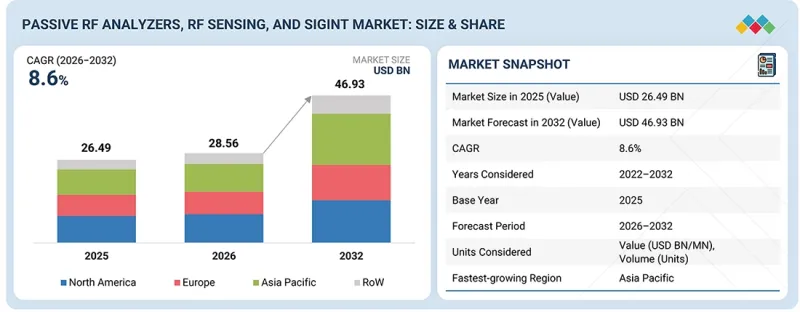
세계의 수동형 RF 분석기, RF 센싱, SIGINT 시장 규모는 2026년에 285억 6,000만 달러로 평가되며, 2032년에는 469억 3,000만 달러에 달할 것으로 예측되며, 예측 기간 동안 CAGR 8.6%로 성장할 것으로 전망됩니다.
| 조사 범위 | |
|---|---|
| 조사 대상 기간 | 2021-2032년 |
| 기준 연도 | 2025년 |
| 예측 기간 | 2026-2032년 |
| 단위 | 금액(달러) |
| 부문 | 시스템 유형, 플랫폼, 용도, 지역별 |
| 대상 지역 | 북미, 유럽, 아시아태평양, 기타 지역 |
"도입 형태별로는 모바일 부문이 2026년에 가장 큰 점유율을 차지할 전망"
모바일 시스템은 급변하는 임무 환경에서 운영상의 유연성을 제공하며, 잠재적 신호원에 더 가까운 위치에서 RF 감지를 가능하게 합니다. 군사 작전, 대 UAS(무인항공기), 국경 경비, 전술적 스펙트럼 모니터링에 대한 도입 확대가 이 부문의 수요를 뒷받침하고 있습니다. 모바일 RF 센싱 솔루션은 차량, 전술 플랫폼, 휴대용 시스템에 통합될 수 있어 이동 중 탐지 및 방향 탐지가 가능합니다. 저 SWaP 아키텍처 및 분산형 센싱에 대한 요구가 증가함에 따라 방위 분야 전반에서 모바일 시스템의 도입이 더욱 가속화되고 있습니다.
“예측 기간 동안 주파수별로는 UHF 부문이 가장 높은 연평균 성장률(CAGR)을 기록할 전망”
이는 국방·보안 분야에서 RF 센싱, 스펙트럼 모니터링, 방향 탐지에 대한 수요가 확대되고 있는 데 기인합니다. UHF 주파수는 수많은 전술 통신, 데이터 링크, 무인 시스템을 지원하며, 신호 발신원의 탐지 및 식별에 중요한 역할을 하고 있습니다. 대 UAS, SIGINT, 전자전, 국경 감시 시스템의 도입 확대에 따라 UHF 대응 솔루션에 대한 수요가 증가하고 있습니다. 또한, 소프트웨어 정의 무선, 광대역 수신기, 실시간 신호 처리의 발전으로 인해 복잡한 전자기 환경 하에서의 탐지 및 위치 파악 능력이 더욱 향상되고 있습니다.
“아시아태평양은 예측 기간 동안 가장 높은 연평균 성장률(CAGR)을 기록할 것으로 전망”
국방비 증가, 지정학적 긴장, 군사 현대화로 인해 첨단 정보 수집 능력 및 전자전 능력에 대한 투자가 가속화되고 있습니다. 중국, 인도, 일본, 한국, 호주 등의 국가들은 항공, 해군, 지상, 우주 기반 플랫폼 전반에 걸쳐 RF 감시를 확대하고 있습니다. 또한, UAS(무인항공기 시스템) 대응, 해상 감시, 국경 감시, 스펙트럼 인텔리전스의 도입 확대도 추가적인 수요를 창출하고 있습니다. 더불어, 방위 장비의 국산화와 첨단 RF 기술에 대한 집중도 지역 시장의 확장을 더욱 뒷받침하고 있습니다.
본 보고서에서는 전 세계 수동형 RF 분석기, RF 센싱, SIGINT 시장을 조사하여, 시장 개요, 시장 성장에 영향을 미치는 각종 요인 분석, 기술·특허 동향, 법규제 환경, 사례 연구, 시장 규모 추정 및 전망,각종 분류·지역/주요 국가별 상세 분석, 경쟁 구도, 주요 기업 개요 등을 정리하고 있습니다.
자주 묻는 질문
목차
제1장 소개
제2장 주요 요약
제3장 주요 인사이트
제4장 시장 개요
제5장 업계 동향
제6장 기술의 진보, AI의 영향, 특허, 혁신
제7장 규제 상황
제8장 고객 상황과 구매 행동
제9장 수동형 RF 분석기, RF 센싱, SIGINT 시장 : 시스템 유형별
제10장 수동형 RF 분석기, RF 센싱, SIGINT 시장 : 제공별
제11장 수동형 RF 분석기, RF 센싱, SIGINT 시장 : 플랫폼별
제12장 수동형 RF 분석기, RF 센싱, SIGINT 시장 : 전개별
제13장 수동형 RF 분석기, RF 센싱, SIGINT 시장 : 주파수별
제14장 수동형 RF 분석기, RF 센싱, SIGINT 시장 : 용도별
제15장 수동형 RF 분석기, RF 센싱, SIGINT 시장 : 지역별
제16장 경쟁 구도
제17장 기업 개요
제18장 조사 방법
제19장 부록
KSM 26.09.17The global passive RF analyzers, RF sensing, and SIGINT market was valued at USD 28.56 billion in 2026 and is projected to reach USD 46.93 billion by 2032, growing at a CAGR of 8.6% during the forecast period.
| Scope of the Report | |
|---|---|
| Years Considered for the Study | 2021-2032 |
| Base Year | 2025 |
| Forecast Period | 2026-2032 |
| Units Considered | Value (USD Billion) |
| Segments | By System Type, Platform, Application and Region |
| Regions covered | North America, Europe, APAC, RoW |
"Mobile segment to hold the largest share of the passive RF analyzers, RF sensing, and SIGINT market, by deployment, in 2026"
The mobile segment is projected to account for the largest share of the passive RF analyzers, RF sensing, and SIGINT market in 2026. Mobile systems provide operational flexibility for rapidly changing mission environments and enable RF detection closer to potential signal sources. Growing deployment across military operations, counter-UAS, border security, and tactical spectrum monitoring is supporting segment demand. Mobile RF sensing solutions can be integrated into vehicles, tactical platforms, and portable systems, enabling on-the-move detection and direction finding. Increasing requirements for low-SWaP architectures and distributed sensing are further strengthening adoption of mobile systems across defense applications.
"UHF segment to register the highest CAGR, by frequency, during the forecast period"
The UHF segment is projected to register the highest CAGR during the forecast period, driven by growing demand for RF sensing, spectrum monitoring, and direction finding across defense and security applications. UHF frequencies support numerous tactical communications, data links, and unmanned systems, making them important for emitter detection and identification. Increasing deployment of counter-UAS, SIGINT, electronic warfare, and border surveillance systems is strengthening demand for UHF-capable solutions. Advances in software-defined radios, wideband receivers, and real-time signal processing are further improving detection and geolocation capabilities in complex electromagnetic environments.
"Asia Pacific to register the highest CAGR during the forecast period"
The Asia Pacific passive RF analyzers, RF sensing, and SIGINT market is expected to register the highest CAGR during the forecast period. Rising defense expenditure, geopolitical tensions, and military modernization are accelerating investments in advanced intelligence and electronic warfare capabilities. Countries including China, India, Japan, South Korea, and Australia are expanding RF surveillance across airborne, naval, ground, and space-based platforms. Growing adoption of counter-UAS, maritime surveillance, border monitoring, and spectrum intelligence is creating additional demand. Increasing focus on indigenous defense manufacturing and advanced RF technologies is further supporting regional market expansion.
Breakdown of Primaries
Various executives from key organizations operating in the passive RF analyzers, RF sensing, and SIGINT market were interviewed in depth, including CEOs, marketing directors, business development executives, and innovation and technology directors.
- By Company Type: Tier 1-40%, Tier 2-30%, and Tier 3-30%
- By Designation: C-level Executives-20%, Directors-10%, and Others-70%
- By Region: North America-40%, Europe-25%, Asia Pacific-25%, and RoW-10%
The primary research covered leading companies including Northrop Grumman Corporation, RTX Corporation, BAE Systems plc, Lockheed Martin Corporation, Leonardo S.p.A., Thales Group, Elbit Systems Ltd., L3Harris Technologies, Inc., Rohde & Schwarz, Saab AB, Israel Aerospace Industries (IAI), HENSOLDT AG, ASELSAN, SPX Communication Technologies (TCI), and Keysight Technologies.
Study Coverage
The report segments the passive RF analyzers, RF sensing, and SIGINT market by system type, component, deployment, frequency, platform, application, and region. The report also discusses the drivers, restraints, opportunities, and challenges influencing market growth. It provides a detailed view of the market across four major regions-North America, Europe, Asia Pacific, and Rest of the World (RoW). In addition, the report includes a value chain analysis, competitive landscape, and company profiles of key market participants operating across the global passive RF analyzers, RF sensing, and SIGINT ecosystem.
Key Benefits of Buying the Report
- Analysis of drivers (rising defense investments in electronic warfare (EW), SIGINT, and multi-domain ISR capabilities, increasing military emphasis on electromagnetic spectrum superiority and spectrum awareness), restraints (high procurement and lifecycle costs of advanced passive RF and SIGINT systems, export controls and regulatory restrictions on advanced SIGINT technologies), opportunities (expansion of distributed RF sensor networks for wide-area spectrum surveillance, increasing adoption of passive RF technologies in commercial spectrum management and telecom monitoring), and challenges (detecting and classifying LPI and LPD signals, processing high-volume RF data with low latency for real-time intelligence generation) influencing market growth
- Products/Solution/Service Development/Innovation: Detailed insights into product launches, technology developments, R&D activities, and innovations in passive RF sensing, SIGINT, direction finding, spectrum monitoring, signal processing, and AI-enabled RF analytics
- Market Development: Comprehensive information about lucrative markets-the report analyzes the passive RF analyzers, RF sensing, and SIGINT market across varied regions
- Market Diversification: Analysis of opportunities across different platforms, deployments, frequency, applications, and geographies, including the adoption of distributed passive RF sensor networks and multi-domain sensing architectures
- Competitive Assessment: In-depth assessment of market shares, competitive strategies, product portfolios, technology capabilities, and recent developments of leading players, including Northrop Grumman Corporation, RTX Corporation, BAE Systems plc, Lockheed Martin Corporation, Leonardo S.p.A., Thales Group, Elbit Systems Ltd., L3Harris Technologies, Inc., Rohde & Schwarz, and Saab AB
TABLE OF CONTENTS
1 INTRODUCTION
- 1.1 STUDY OBJECTIVES
- 1.2 MARKET DEFINITION
- 1.3 MARKET SCOPE
- 1.3.1 MARKET SEGMENTATION AND REGIONAL SCOPE
- 1.3.2 INCLUSIONS AND EXCLUSIONS
- 1.3.3 YEARS CONSIDERED
- 1.4 CURRENCY CONSIDERED
- 1.5 UNIT CONSIDERED
- 1.6 LIMITATIONS
- 1.7 STAKEHOLDERS
2 EXECUTIVE SUMMARY
- 2.1 MARKET HIGHLIGHTS AND KEY INSIGHTS
- 2.2 KEY MARKET PARTICIPANTS: MAPPING OF STRATEGIC DEVELOPMENTS
- 2.3 DISRUPTIVE TRENDS SHAPING PASSIVE RF ANALYZERS, RF SENSING, AND SIGINT MARKET
- 2.4 HIGH-GROWTH SEGMENTS
- 2.5 REGIONAL SNAPSHOT: MARKET SIZE, GROWTH RATE, AND FORECAST
3 PREMIUM INSIGHTS
- 3.1 ATTRACTIVE OPPORTUNITIES FOR PLAYERS IN PASSIVE RF ANALYZERS, RF SENSING, AND SIGINT MARKET
- 3.2 PASSIVE RF ANALYZERS, RF SENSING, AND SIGINT MARKET, BY SYSTEM TYPE
- 3.3 PASSIVE RF ANALYZERS, RF SENSING, AND SIGINT MARKET, BY OFFERING
- 3.4 PASSIVE RF ANALYZERS, RF SENSING, AND SIGINT MARKET, BY PLATFORM
- 3.5 PASSIVE RF ANALYZERS, RF SENSING, AND SIGINT MARKET, BY FREQUENCY
- 3.6 PASSIVE RF ANALYZERS, RF SENSING, AND SIGINT MARKET, BY DEPLOYMENT
- 3.7 PASSIVE RF ANALYZERS, RF SENSING, AND SIGINT MARKET, BY APPLICATION
- 3.8 PASSIVE RF ANALYZERS, RF SENSING, AND SIGINT MARKET, BY REGION
- 3.9 PASSIVE RF ANALYZERS, RF SENSING, AND SIGINT MARKET, BY GEOGRAPHY
4 MARKET OVERVIEW
- 4.1 INTRODUCTION
- 4.2 MARKET DYNAMICS
- 4.2.1 DRIVERS
- 4.2.1.1 Rising defense investments in EW, SIGINT, and multi-domain ISR modernization programs
- 4.2.1.2 Increasing military prioritization of electromagnetic spectrum superiority
- 4.2.1.3 Expanding use of passive RF sensing in counter-UAS, border security, and critical infrastructure protection
- 4.2.2 RESTRAINTS
- 4.2.2.1 High upfront capital and lifecycle costs of advanced passive RF and SIGINT platforms
- 4.2.2.2 Export controls and regulatory restrictions on advanced SIGINT technologies
- 4.2.2.3 Dependence on classified defense programs and prolonged multi-year procurement cycles
- 4.2.3 OPPORTUNITIES
- 4.2.3.1 Expansion of distributed RF sensor networks for persistent wide-area spectrum monitoring
- 4.2.3.2 Increasing adoption of passive RF sensing across commercial spectrum management and telecom networks
- 4.2.3.3 Development of AI-enabled automated signal classification and cognitive SIGINT platforms
- 4.2.4 CHALLENGES
- 4.2.4.1 Detecting and classifying low-observable LPI/LPD waveforms
- 4.2.4.2 Operating in increasingly congested and contested electromagnetic environments
- 4.2.4.3 Processing high-volume RF data at low latency for real-time intelligence
- 4.2.1 DRIVERS
- 4.3 INTERCONNECTED MARKETS AND CROSS-SECTOR OPPORTUNITIES
- 4.4 STRATEGIC MOVES BY TIER 1/2/3 PLAYERS
5 INDUSTRY TRENDS
- 5.1 INTRODUCTION
- 5.2 PORTER'S FIVE FORCES ANALYSIS
- 5.2.1 THREAT OF NEW ENTRANTS
- 5.2.2 THREAT OF SUBSTITUTES
- 5.2.3 BARGAINING POWER OF SUPPLIERS
- 5.2.4 BARGAINING POWER OF BUYERS
- 5.2.5 INTENSITY OF COMPETITIVE RIVALRY
- 5.3 MACROECONOMIC OUTLOOK
- 5.3.1 INTRODUCTION
- 5.3.2 GDP TRENDS AND FORECAST
- 5.3.3 TRENDS IN SPECTRUM DOMINANCE, ELECTRONIC WARFARE MODERNIZATION, AND RF INTELLIGENCE CAPABILITIES
- 5.3.4 TRENDS IN AI-ENABLED RF SIGNAL PROCESSING, MULTI-DOMAIN ISR, AND COUNTER-UAS RF SENSING
- 5.4 VALUE CHAIN ANALYSIS
- 5.5 ECOSYSTEM ANALYSIS
- 5.6 PRICING ANALYSIS
- 5.6.1 AVERAGE SELLING PRICE TREND OF PASSIVE RF ANALYZERS, 2022-2025
- 5.6.2 AVERAGE SELLING PRICE TREND OF PASSIVE RF ANALYZERS, BY REGION, 2022-2025
- 5.7 TRADE ANALYSIS
- 5.7.1 IMPORT SCENARIO (HS CODE 9030)
- 5.7.2 EXPORT SCENARIO (HS CODE 9030)
- 5.8 KEY CONFERENCES AND EVENTS, 2026-2027
- 5.9 TRENDS/DISRUPTIONS IMPACTING CUSTOMER BUSINESS
- 5.10 INVESTMENT AND FUNDING SCENARIO, 2022-2026
- 5.11 CASE STUDY ANALYSIS
- 5.11.1 CRFS DEPLOYS CUSTOM RF SENSING SOLUTION FOR BORDER INTELLIGENCE
- 5.11.2 CRFS ENABLES SIGINT CAPABILITIES ON UNMANNED SYSTEMS FOR FASTER SIGNAL DETECTION
- 5.11.3 HENSOLDT DELIVERS DIGITAL EW CAPABILITY FOR EUROFIGHTER FOR MILLISECOND-LEVEL THREAT DETECTION
- 5.12 IMPACT OF US TARIFFS - PASSIVE RF ANALYZERS, RF SENSING, AND SIGINT MARKET
- 5.12.1 KEY TARIFF RATES
- 5.12.2 PRICE IMPACT ANALYSIS
- 5.12.3 IMPACT ON COUNTRIES/REGIONS
- 5.12.3.1 US
- 5.12.3.2 Europe
- 5.12.3.3 Asia Pacific
- 5.12.4 IMPACT ON END USERS
6 TECHNOLOGICAL ADVANCEMENTS, AI-DRIVEN IMPACT, PATENTS, AND INNOVATIONS
- 6.1 KEY TECHNOLOGIES
- 6.1.1 PASSIVE RF SENSING TECHNOLOGY
- 6.1.2 SOFTWARE-DEFINED RADIO
- 6.1.3 DIRECTION FINDING AND RF GEOLOCATION TECHNOLOGIES
- 6.2 COMPLEMENTARY TECHNOLOGIES
- 6.2.1 ARTIFICIAL INTELLIGENCE AND MACHINE LEARNING
- 6.2.2 DISTRIBUTED RF SENSOR NETWORKS
- 6.2.3 CLOUD AND EDGE COMPUTING FOR RF ANALYTICS
- 6.3 ADJACENT TECHNOLOGIES
- 6.3.1 ELECTRONIC WARFARE
- 6.3.2 COUNTER-UNMANNED AIRCRAFT SYSTEMS
- 6.3.3 MULTI-DOMAIN INTELLIGENCE, SURVEILLANCE, AND RECONNAISSANCE
- 6.4 TECHNOLOGY ROADMAP
- 6.4.1 SHORT-TERM (2025-2027): AI-ENABLED SPECTRUM AWARENESS AND SOFTWARE-DEFINED RF SENSING
- 6.4.2 MID-TERM (2027-2030): COGNITIVE SIGINT AND MULTI-DOMAIN SPECTRUM OPERATIONS
- 6.4.3 LONG-TERM (2030-2035+): AUTONOMOUS SPECTRUM INTELLIGENCE AND COGNITIVE ELECTRONIC WARFARE
- 6.5 PATENT ANALYSIS
- 6.6 IMPACT OF AI/GEN AI ON PASSIVE RF ANALYZERS, RF SENSING, AND SIGINT MARKET
- 6.6.1 TOP USE CASES AND MARKET POTENTIAL
- 6.6.2 BEST PRACTICES FOLLOWED BY OEMS IN PASSIVE RF ANALYZERS, RF SENSING, AND SIGINT MARKET
- 6.6.3 CASE STUDIES RELATED TO AI IMPLEMENTATION IN PASSIVE RF ANALYZERS, RF SENSING, AND SIGINT MARKET
- 6.6.4 INTERCONNECTED ECOSYSTEM AND IMPACT ON MARKET PLAYERS
- 6.6.5 CLIENTS' READINESS TO ADOPT AI-INTEGRATED PASSIVE RF ANALYZERS, RF SENSING, AND SIGINT TECHNOLOGIES
7 REGULATORY LANDSCAPE
- 7.1 REGIONAL REGULATIONS AND COMPLIANCE
- 7.1.1 REGULATORY BODIES, GOVERNMENT AGENCIES, AND OTHER ORGANIZATIONS
- 7.1.2 STANDARDS
8 CUSTOMER LANDSCAPE AND BUYER BEHAVIOR
- 8.1 DECISION-MAKING PROCESS
- 8.2 KEY STAKEHOLDERS INVOLVED IN BUYING PROCESS AND THEIR EVALUATION CRITERIA
- 8.2.1 KEY STAKEHOLDERS IN BUYING PROCESS
- 8.2.2 BUYING CRITERIA
- 8.3 ADOPTION BARRIERS AND INTERNAL CHALLENGES
- 8.4 UNMET NEEDS OF VARIOUS APPLICATIONS
9 PASSIVE RF ANALYZERS, RF SENSING, AND SIGINT MARKET, BY SYSTEM TYPE
- 9.1 INTRODUCTION
- 9.2 PASSIVE RF ANALYZERS
- 9.2.1 RISING INVESTMENTS IN ELECTRONIC WARFARE CAPABILITIES TO DRIVE SEGMENTAL GROWTH
- 9.3 SIGINT SYSTEMS
- 9.3.1 INCREASING BORDER SURVEILLANCE REQUIREMENTS TO SUPPORT SEGMENTAL GROWTH
- 9.4 SPECTRUM MONITORING SYSTEMS
- 9.4.1 PRESSING NEED TO MODERNIZE SPECTRUM MANAGEMENT FRAMEWORKS TO BOOST SEGMENTAL GROWTH
- 9.5 DIRECTION FINDING SYSTEMS
- 9.5.1 EXPANDING COUNTER-UAS AND MARITIME SURVEILLANCE INITIATIVES TO STIMULATE SEGMENTAL GROWTH
10 PASSIVE RF ANALYZERS, RF SENSING, AND SIGINT MARKET, BY OFFERING
- 10.1 INTRODUCTION
- 10.2 HARDWARE
- 10.2.1 RF ANTENNAS
- 10.2.1.1 Rising defense investments in electronic warfare, counter-UAS, and spectrum awareness to foster segmental growth
- 10.2.2 RF FRONT ENDS
- 10.2.2.1 Increasing geopolitical tensions and military modernization initiatives to boost demand for RF front-end solutions
- 10.2.3 LOW-NOISE AMPLIFIERS
- 10.2.3.1 Growing demand for high-sensitivity RF detection to contribute to segmental growth
- 10.2.4 FILTERS
- 10.2.4.1 Elevating need for reliable signal discrimination, interference mitigation, and spectrum resilience to accelerate filter demand
- 10.2.5 RECEIVERS
- 10.2.5.1 Growing importance of spectrum sensing and surveillance to facilitate adoption of receivers
- 10.2.6 SOFTWARE-DEFINED RADIOS (SDRS)
- 10.2.6.1 Rising focus on strengthening spectrum surveillance and threat detection capabilities to stimulate demand for SDRs
- 10.2.7 SPECTRUM RECEIVERS
- 10.2.7.1 Increasing spectrum surveillance requirements across commercial applications to support segmental growth
- 10.2.8 DIGITAL SIGNAL PROCESSORS (DSPS)
- 10.2.8.1 Escalating need for faster signal analysis and adaptive spectrum processing to sustain demand for DSPs
- 10.2.9 PROCESSORS
- 10.2.9.1 Advancing RF platforms to drive demand for multicore processors
- 10.2.10 OTHER HARDWARE TYPES
- 10.2.1 RF ANTENNAS
- 10.3 SOFTWARE
- 10.3.1 SIGNAL PROCESSING
- 10.3.1.1 Growing demand for real-time spectrum intelligence to accelerate adoption of signal processing software
- 10.3.2 SIGNAL CLASSIFICATION
- 10.3.2.1 Rising need for faster conversion of RF data into actionable intelligence to drive demand for signal classification software
- 10.3.3 AI & ANALYTICS
- 10.3.3.1 Shift toward automated, data-driven RF intelligence to accelerate uptake of AI & analytics software
- 10.3.4 SPECTRUM VISUALIZATION
- 10.3.4.1 Growing emphasis on real-time operator awareness and spectrum governance to support segmental growth
- 10.3.5 OTHER SOFTWARE TYPES
- 10.3.1 SIGNAL PROCESSING
- 10.4 SERVICES
- 10.4.1 INTEGRATION
- 10.4.1.1 Rising deployment of multi-vendor RF systems to drive demand for integration services
- 10.4.2 DEPLOYMENT
- 10.4.2.1 Expanding national spectrum monitoring infrastructure to support segmental growth
- 10.4.3 TRAINING
- 10.4.3.1 Rising investments in workforce readiness to accelerate uptake of training services
- 10.4.4 MAINTENANCE
- 10.4.4.1 Growing installed base of high-value RF systems to foster demand for maintenance services
- 10.4.1 INTEGRATION
11 PASSIVE RF ANALYZERS, RF SENSING, AND SIGINT MARKET, BY PLATFORM
- 11.1 INTRODUCTION
- 11.2 GROUND-BASED
- 11.2.1 PERSISTENT SPECTRUM AWARENESS REQUIREMENTS TO DRIVE GROUND-BASED RF SENSING ADOPTION
- 11.3 VEHICLE-MOUNTED
- 11.3.1 TEMPORARY SURVEILLANCE AND COUNTER-SMUGGLING MISSIONS TO BOOST VEHICLE-MOUNTED RF SENSING DEPLOYMENT
- 11.4 MANPACK
- 11.4.1 COUNTERTERRORISM AND URBAN WARFARE MISSIONS TO BOOST MANPACK SIGINT PROCUREMENT
- 11.5 AIRBORNE
- 11.5.1 AIRBORNE ISR MODERNIZATION AND UAS PROLIFERATION TO FUEL AIRBORNE RF SENSING DEMAND
- 11.6 NAVAL
- 11.6.1 MARITIME DOMAIN AWARENESS AND COASTAL SECURITY INVESTMENTS TO BOOST NAVAL PLATFORM DEPLOYMENT
- 11.7 SPACE-BASED
- 11.7.1 COMMERCIALIZATION OF SMALL SATELLITE CONSTELLATIONS AND ADVANCES IN SPACE TECHNOLOGY TO CREATE OPPORTUNITIES
12 PASSIVE RF ANALYZERS, RF SENSING, AND SIGINT MARKET, BY DEPLOYMENT
- 12.1 INTRODUCTION
- 12.2 FIXED
- 12.2.1 NEED FOR UNINTERRUPTED MONITORING AT PERMANENT SITES TO SUPPORT SEGMENTAL GROWTH
- 12.3 MOBILE
- 12.3.1 REQUIREMENT TO REPOSITION RF ASSETS AGAINST EMERGING THREATS TO DRIVE ADOPTION OF MOBILE SYSTEMS
13 PASSIVE RF ANALYZERS, RF SENSING, AND SIGINT MARKET, BY FREQUENCY
- 13.1 INTRODUCTION
- 13.2 HF
- 13.2.1 REQUIREMENT FOR LONG-RANGE COMMUNICATION MONITORING TO FOSTER SEGMENTAL GROWTH
- 13.3 UHF
- 13.3.1 RAPID EXPANSION OF MILITARY AND WIRELESS NETWORKS TO REINFORCE SEGMENTAL GROWTH
- 13.4 VHF
- 13.4.1 NEED TO PROTECT MISSION-CRITICAL COMMUNICATION CHANNELS TO SPUR DEMAND FOR VHF MONITORING SOLUTIONS
14 PASSIVE RF ANALYZERS, RF SENSING, AND SIGINT MARKET, BY APPLICATION
- 14.1 INTRODUCTION
- 14.2 MILITARY
- 14.2.1 BATTLEFIELD AWARENESS
- 14.2.1.1 Rising need for real-time situational awareness to accelerate adoption of RF intelligence
- 14.2.2 ELECTRONIC SUPPORT
- 14.2.2.1 Increasing electromagnetic threats to boost adoption of RF systems for electronic support operations
- 14.2.3 THREAT DETECTION
- 14.2.3.1 Rising demand for early threat identification to drive demand for RF intelligence
- 14.2.4 TARGET IDENTIFICATION
- 14.2.4.1 Modern defense operations to encourage use of RF intelligence for accurate target identification
- 14.2.1 BATTLEFIELD AWARENESS
- 14.3 COUNTER-UAS
- 14.3.1 DRONE DETECTION
- 14.3.1.1 Escalating unmanned aerial threats to prompt deployment of passive RF technologies for drone detection
- 14.3.2 DRONE IDENTIFICATION
- 14.3.2.1 Increasing need for accurate drone identification to strengthen demand for passive RF intelligence solutions
- 14.3.3 DRONE TRACKING
- 14.3.3.1 Growing requirement for persistent airspace surveillance to fuel implementation of passive RF technologies for drone tracking
- 14.3.4 SWARM DETECTION
- 14.3.4.1 Growing threat of coordinated drone attacks to boost adoption of passive RF technologies for swarm detection
- 14.3.1 DRONE DETECTION
- 14.4 BORDER SECURITY
- 14.4.1 SIGNAL INTERCEPTION
- 14.4.1.1 Increasing dependence on electromagnetic intelligence to drive adoption of passive RF solutions for signal interception
- 14.4.2 PERSISTENT MONITORING
- 14.4.2.1 Rising need for continuous electromagnetic surveillance to encourage use of passive RF systems for persistent monitoring
- 14.4.1 SIGNAL INTERCEPTION
- 14.5 PUBLIC SAFETY
- 14.5.1 EMERGENCY RESPONSE
- 14.5.1.1 Strong focus on strengthening disaster preparedness to promote use of passive RF solutions for emergency response
- 14.5.2 LARGE EVENTS
- 14.5.2.1 Enhanced security requirements at mass gatherings to accelerate passive RF monitoring deployments
- 14.5.3 VIP PROTECTION
- 14.5.3.1 Expanding high-profile security operations to increase demand for passive RF intelligence in VIP protection
- 14.5.4 ILLEGAL RF DETECTION
- 14.5.4.1 Growing spectrum misuse to drive demand for passive RF solutions for illegal radio transmission detection
- 14.5.1 EMERGENCY RESPONSE
- 14.6 CRITICAL INFRASTRUCTURE
- 14.6.1 AIRPORTS
- 14.6.1.1 Increasing aviation security requirements to support high adoption of passive RF intelligence at airports
- 14.6.2 PORTS
- 14.6.2.1 Strengthening maritime security to stimulate deployment of passive RF monitoring across ports
- 14.6.3 POWER PLANTS
- 14.6.3.1 Significant focus on safeguarding national energy assets to spike demand for passive RF monitoring technologies
- 14.6.4 OIL & GAS
- 14.6.4.1 Greater emphasis on protecting oil & gas facilities from unauthorized drones to spur demand for passive RF intelligence
- 14.6.5 DATA CENTERS
- 14.6.5.1 Growing investments in advanced cloud infrastructure to promote use of passive RF technologies in data centers
- 14.6.6 GOVERNMENT BUILDINGS
- 14.6.6.1 Heightened national security priorities to strengthen passive RF deployments across government buildings
- 14.6.7 TELECOM INFRASTRUCTURE
- 14.6.7.1 Expanding wireless networks to spur demand for passive RF intelligence across telecom infrastructure
- 14.6.1 AIRPORTS
- 14.7 MARITIME SURVEILLANCE
- 14.7.1 ILLEGAL FISHING
- 14.7.1.1 Escalating illegal fishing activities to increase adoption of passive RF intelligence for maritime enforcement
- 14.7.2 COASTAL MONITORING
- 14.7.2.1 Expanding coastal security programs to drive demand for passive RF monitoring solutions
- 14.7.3 NAVAL INTELLIGENCE
- 14.7.3.1 Naval modernization initiatives to accelerate adoption of passive RF intelligence for naval operations
- 14.7.4 SHIP RF MONITORING
- 14.7.4.1 Increasing maritime traffic to drive demand for passive RF-based ship monitoring solutions
- 14.7.1 ILLEGAL FISHING
- 14.8 HOMELAND SECURITY
- 14.8.1 COUNTER TERRORISM
- 14.8.1.1 Increasing terrorism threats to encourage use of passive RF intelligence for counterterrorism operations
- 14.8.2 NATIONAL SECURITY
- 14.8.2.1 Evolving geopolitical risks to create need for passive RF intelligence to ensure national security
- 14.8.3 CRITICAL EVENT MONITORING
- 14.8.3.1 Growing need for proactive threat management to drive use of passive RF intelligence for critical event monitoring
- 14.8.1 COUNTER TERRORISM
- 14.9 COMMERCIAL APPLICATIONS
- 14.9.1 GROWING NEED FOR INTERFERENCE MANAGEMENT IN PRIVATE WIRELESS NETWORKS TO DRIVE ADOPTION OF PASSIVE RF SENSING ACROSS COMMERCIAL APPLICATIONS
- 14.10 TELECOM SPECTRUM MONITORING
- 14.10.1 INCREASING NEED FOR CONTINUOUS SPECTRUM VISIBILITY TO SAFEGUARD NETWORK PERFORMANCE TO FUEL MARKET GROWTH
- 14.11 INDUSTRIAL RF MONITORING
- 14.11.1 EXPANDING USE OF PRIVATE LTE/5G AND IIOT NETWORKS ACROSS INDUSTRIAL FACILITIES TO DRIVE DEMAND FOR RF MONITORING
- 14.12 SMART CITY
- 14.12.1 GROWING NEED TO SAFEGUARD URBAN WIRELESS NETWORKS AGAINST UNAUTHORIZED TRANSMISSIONS TO DRIVE MARKET
- 14.13 RESEARCH
- 14.13.1 RISING NEED TO IDENTIFY ELECTRONIC THREATS TO ACCELERATE ADOPTION OF PASSIVE RF SENSING PLATFORMS
15 PASSIVE RF ANALYZERS, RF SENSING, AND SIGINT MARKET, BY REGION
- 15.1 INTRODUCTION
- 15.2 NORTH AMERICA
- 15.2.1 US
- 15.2.1.1 Increasing investments in enhancing electromagnetic warfare capabilities and advancing multi-domain operations to drive market
- 15.2.2 CANADA
- 15.2.2.1 Pressing need for domestic spectrum monitoring to boost demand
- 15.2.3 MEXICO
- 15.2.3.1 Growing density of wireless systems across industrial, telecommunications, and government environments to propel market
- 15.2.1 US
- 15.3 EUROPE
- 15.3.1 UK
- 15.3.1.1 Strong focus on electromagnetic spectrum dominance and secure communications to spike RF sensing technology demand
- 15.3.2 GERMANY
- 15.3.2.1 SIGINT modernization and electronic warfare investments to create opportunities for RF sensing
- 15.3.3 FRANCE
- 15.3.3.1 Greater emphasis on threat detection, identification, and operational planning to strengthen demand for advanced RF sensing
- 15.3.4 ITALY
- 15.3.4.1 Need for real-time electromagnetic situational awareness to elevate demand for passive RF sensing
- 15.3.5 REST OF EUROPE
- 15.3.1 UK
- 15.4 ASIA PACIFIC
- 15.4.1 CHINA
- 15.4.1.1 Electromagnetic reconnaissance expansion efforts to accelerate RF intelligence demand
- 15.4.2 JAPAN
- 15.4.2.1 Ongoing investment in secure communications and space-based defense infrastructure to elevate demand for RF sensing technology
- 15.4.3 INDIA
- 15.4.3.1 Urgent need for surveillance, reconnaissance, and network-centric warfare capabilities to accelerate RF sensing demand
- 15.4.4 SOUTH KOREA
- 15.4.4.1 Significant focus on development of electromagnetic warfare, counter-drone systems to facilitate market growth
- 15.4.5 AUSTRALIA
- 15.4.5.1 Surging deployment of airborne EW platforms to reinforce market growth
- 15.4.6 REST OF ASIA PACIFIC
- 15.4.1 CHINA
- 15.5 ROW
- 15.5.1 SOUTH AMERICA
- 15.5.1.1 Brazil
- 15.5.1.1.1 Significant focus on improving spectrum visibility to create growth opportunities
- 15.5.1.2 Argentina
- 15.5.1.2.1 Electromagnetic spectrum reinforcement and F-16 modernization to increase RF intelligence requirements
- 15.5.1.3 Rest of South America
- 15.5.1.1 Brazil
- 15.5.2 MIDDLE EAST & AFRICA
- 15.5.2.1 GCC countries
- 15.5.2.1.1 Growing emphasis on critical infrastructure security to spur RF demand
- 15.5.2.2 South Africa
- 15.5.2.2.1 Continued development of border surveillance and electromagnetic spectrum technologies to drive market
- 15.5.2.3 Rest of Middle East & Africa
- 15.5.2.1 GCC countries
- 15.5.1 SOUTH AMERICA
16 COMPETITIVE LANDSCAPE
- 16.1 OVERVIEW
- 16.2 KEY PLAYER COMPETITIVE STRATEGIES/RIGHT TO WIN, 2022-2026
- 16.3 REVENUE ANALYSIS, 2021-2025
- 16.4 MARKET SHARE ANALYSIS, 2025
- 16.5 COMPANY VALUATION AND FINANCIAL METRICS, 2025
- 16.6 COMPANY EVALUATION MATRIX, 2025
- 16.6.1 STARS
- 16.6.2 EMERGING LEADERS
- 16.6.3 PERVASIVE PLAYERS
- 16.6.4 PARTICIPANTS
- 16.6.5 COMPANY FOOTPRINT: KEY PLAYERS, 2025
- 16.6.5.1 Company footprint
- 16.6.5.2 Region footprint
- 16.6.5.3 System type footprint
- 16.6.5.4 Application footprint
- 16.7 COMPANY EVALUATION MATRIX: STARTUPS/SMES, 2025
- 16.7.1 PROGRESSIVE COMPANIES
- 16.7.2 RESPONSIVE COMPANIES
- 16.7.3 DYNAMIC COMPANIES
- 16.7.4 STARTING BLOCKS
- 16.7.5 COMPETITIVE BENCHMARKING: STARTUPS/SMES, 2023
- 16.7.5.1 Detailed list of startups/SMEs
- 16.7.5.2 Competitive benchmarking of key startups/SMEs
- 16.8 BRAND COMPARISON
- 16.8.1 NORTHROP GRUMMAN CORPORATION (US)
- 16.8.2 RTX CORPORATION (US)
- 16.8.3 BAE SYSTEMS PLC (UK)
- 16.8.4 LOCKHEED MARTIN CORPORATION (US)
- 16.8.5 LEONARDO S.P.A. (ITALY)
- 16.9 COMPETITIVE SCENARIO
- 16.9.1 PRODUCT LAUNCHES
- 16.9.2 DEALS
17 COMPANY PROFILES
- 17.1 INTRODUCTION
- 17.2 KEY PLAYERS - RF SENSING
- 17.2.1 ROHDE & SCHWARZ
- 17.2.1.1 Business overview
- 17.2.1.2 Products offered
- 17.2.1.3 Recent developments
- 17.2.1.3.1 Product launches
- 17.2.1.3.2 Other developments
- 17.2.1.4 MnM view
- 17.2.1.4.1 Key strengths/Right to win
- 17.2.1.4.2 Strategic choices
- 17.2.1.4.3 Weaknesses/Competitive threats
- 17.2.2 CODAN
- 17.2.2.1 Business overview
- 17.2.2.2 Products offered
- 17.2.2.3 Recent developments
- 17.2.2.3.1 Product launches
- 17.2.2.3.2 Deals
- 17.2.2.4 MnM view
- 17.2.2.4.1 Key strengths/Right to win
- 17.2.2.4.2 Strategic choices
- 17.2.2.4.3 Weaknesses/Competitive threats
- 17.2.3 CRFS
- 17.2.3.1 Business overview
- 17.2.3.2 Products offered
- 17.2.3.3 Recent developments
- 17.2.3.3.1 Product launches
- 17.2.3.3.2 Deals
- 17.2.3.3.3 Other developments
- 17.2.3.4 MnM view
- 17.2.3.4.1 Key strengths/Right to win
- 17.2.3.4.2 Strategic choices
- 17.2.3.4.3 Weaknesses/Competitive threats
- 17.2.4 SPX COMMUNICATION TECHNOLOGIES
- 17.2.4.1 Business overview
- 17.2.4.2 Products offered
- 17.2.4.3 Recent developments
- 17.2.4.3.1 Product launches
- 17.2.4.3.2 Deals
- 17.2.4.3.3 Other developments
- 17.2.4.4 MnM view
- 17.2.4.4.1 Key strengths/Right to win
- 17.2.4.4.2 Strategic choices
- 17.2.4.4.3 Weaknesses/Competitive threats
- 17.2.5 AARONIA AG
- 17.2.5.1 Business overview
- 17.2.5.2 Products offered
- 17.2.5.3 Recent developments
- 17.2.5.3.1 Product launches
- 17.2.5.3.2 Other developments
- 17.2.5.4 MnM view
- 17.2.5.4.1 Key strengths/Right to win
- 17.2.5.4.2 Strategic choices
- 17.2.5.4.3 Weaknesses/Competitive threats
- 17.2.6 KEYSIGHT TECHNOLOGIES
- 17.2.6.1 Business overview
- 17.2.6.2 Products offered
- 17.2.6.3 Recent developments
- 17.2.6.3.1 Product launches
- 17.2.6.4 MnM view
- 17.2.6.4.1 Key strengths/Right to win
- 17.2.6.4.2 Strategic choices
- 17.2.6.4.3 Weaknesses/Competitive threats
- 17.2.1 ROHDE & SCHWARZ
- 17.3 OTHER PLAYERS - RF SENSING
- 17.3.1 VIAVI SOLUTIONS
- 17.3.2 LS TELCOM
- 17.3.3 THINKRF
- 17.4 KEY PLAYERS - SIGINT
- 17.4.1 NORTHROP GRUMMAN CORPORATION
- 17.4.1.1 Business overview
- 17.4.1.2 Products offered
- 17.4.1.3 Recent developments
- 17.4.1.3.1 Product launches
- 17.4.1.3.2 Other developments
- 17.4.1.4 MnM view
- 17.4.1.4.1 Key strengths/Right to win
- 17.4.1.4.2 Strategic choices
- 17.4.1.4.3 Weaknesses/Competitive threats
- 17.4.2 RTX CORPORATION
- 17.4.2.1 Business overview
- 17.4.2.2 Products offered
- 17.4.2.3 Recent developments
- 17.4.2.3.1 Product launches
- 17.4.2.3.2 Other developments
- 17.4.2.4 MnM view
- 17.4.2.4.1 Key strengths/Right to win
- 17.4.2.4.2 Strategic choices
- 17.4.2.4.3 Weaknesses/Competitive threats
- 17.4.3 BAE SYSTEMS PLC
- 17.4.3.1 Business overview
- 17.4.3.2 Products offered
- 17.4.3.3 Recent developments
- 17.4.3.3.1 Product launches
- 17.4.3.3.2 Other developments
- 17.4.3.4 MnM view
- 17.4.3.4.1 Key strengths/Right to win
- 17.4.3.4.2 Strategic choices
- 17.4.3.4.3 Weaknesses/Competitive threats
- 17.4.4 LOCKHEED MARTIN CORPORATION
- 17.4.4.1 Business overview
- 17.4.4.2 Products offered
- 17.4.4.3 Recent developments
- 17.4.4.3.1 Product launches
- 17.4.4.3.2 Other developments
- 17.4.4.4 MnM view
- 17.4.4.4.1 Key strengths/Right to win
- 17.4.4.4.2 Strategic choices
- 17.4.4.4.3 Weaknesses/Competitive threats
- 17.4.5 LEONARDO S.P.A.
- 17.4.5.1 Business overview
- 17.4.5.2 Products offered
- 17.4.5.3 Recent developments
- 17.4.5.3.1 Product launches
- 17.4.5.3.2 Deals
- 17.4.5.3.3 Other developments
- 17.4.5.4 MnM view
- 17.4.5.4.1 Key strengths/Right to win
- 17.4.5.4.2 Strategic choices
- 17.4.5.4.3 Weaknesses/Competitive threats
- 17.4.1 NORTHROP GRUMMAN CORPORATION
- 17.5 OTHER PLAYERS - SIGINT
- 17.5.1 L3HARRIS TECHNOLOGIES
- 17.5.2 THALES
- 17.5.3 HENSOLDT
- 17.5.4 ELBIT SYSTEMS
- 17.5.5 SAAB AB
- 17.6 OTHER PLAYERS
- 17.6.1 ISRAEL AEROSPACE INDUSTRIES (IAI)
- 17.6.2 ASELSAN
- 17.6.3 BHARAT ELECTRONICS LIMITED (BEL)
- 17.6.4 INDRA SISTEMAS
- 17.6.5 ELETTRONICA S.P.A.
- 17.6.6 TELEDYNE FLIR
- 17.6.7 TEKTRONIX, INC.
18 RESEARCH METHODOLOGY
- 18.1 RESEARCH DATA
- 18.1.1 SECONDARY AND PRIMARY RESEARCH
- 18.1.2 SECONDARY DATA
- 18.1.2.1 List of key secondary sources
- 18.1.2.2 Key data from secondary sources
- 18.1.3 PRIMARY DATA
- 18.1.3.1 Key data from primary sources
- 18.1.3.2 Key primary participants
- 18.1.3.3 Breakdown of primaries
- 18.1.3.4 Key industry insights
- 18.2 MARKET SIZE ESTIMATION METHODOLOGY
- 18.2.1 BOTTOM-UP APPROACH
- 18.2.1.1 Approach to arrive at market size using bottom-up analysis (demand side)
- 18.2.2 TOP-DOWN APPROACH
- 18.2.2.1 Approach to arrive at market size using top-down analysis (supply side)
- 18.2.1 BOTTOM-UP APPROACH
- 18.3 DATA TRIANGULATION
- 18.4 RESEARCH ASSUMPTIONS
- 18.5 RESEARCH LIMITATIONS
- 18.6 RISK ANALYSIS
19 APPENDIX
- 19.1 DISCUSSION GUIDE
- 19.2 KNOWLEDGESTORE: MARKETSANDMARKETS' SUBSCRIPTION PORTAL
- 19.3 CUSTOMIZATION OPTIONS
- 19.4 RELATED REPORTS
- 19.5 AUTHOR DETAILS


